
Recruitee software vs AI hiring platforms: which fits your 2026 hiring?

Choosing the right recruitment tech stack often comes down to deciding whether recruitee software or an autonomous AI hiring platform better matches your team's operational reality. If your primary objective is building an attractive public career site, publishing job listings across multiple commercial boards, and collaborating through visual pipeline stages, Recruitee remains a solid traditional choice. Conversely, if your team is overwhelmed by hundreds of unvetted resumes and needs deep semantic criteria auditing, automated interview question design, and objective scoring, an AI hiring platform is the superior path. This comprehensive guide evaluates both approaches across total ownership costs, resume screening depth, interview workflows, data migration security, and long-term stack adaptability.
Recruitee Software vs AI Hiring Platforms: Core Differences and Comparison Table
At its core, recruitee software operates as a workflow management and sourcing system, whereas autonomous AI hiring platforms function as cognitive evaluation engines that analyze qualifications against precise benchmarks. Recruitee centralizes applicant communication, visual pipelines, and multi-channel job distribution. In contrast, modern AI platforms audit candidate evidence, eliminate keyword gaming, and generate standardized evaluation dossiers.
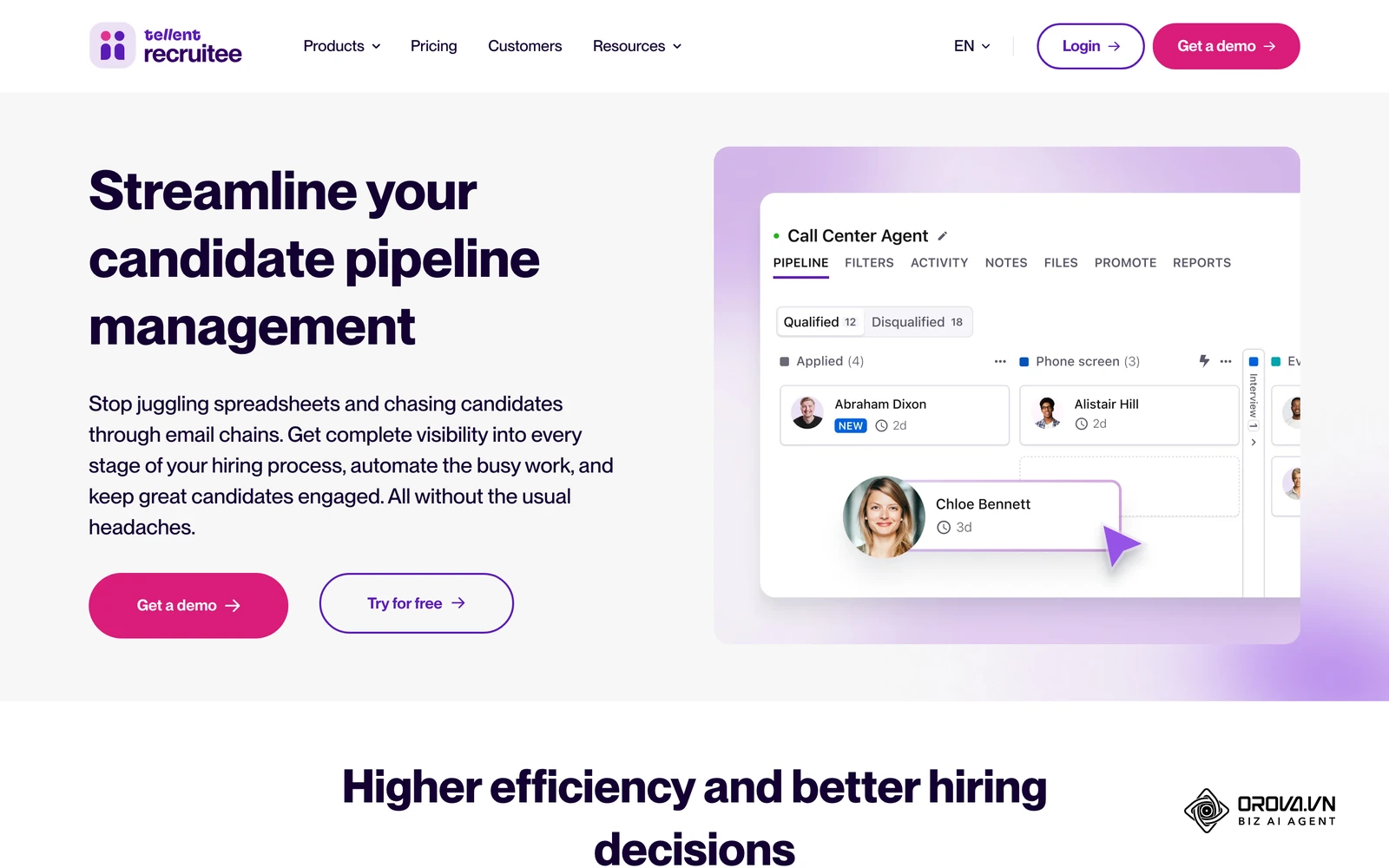
The following comparison matrix breaks down the technical and operational differences between both recruitment solutions:
| Evaluation Criterion | Recruitee Software (Traditional ATS) | Autonomous AI Hiring Platforms | Operational Advantage |
|---|---|---|---|
| Core Architecture | Relational database with visual Kanban pipeline stages | Semantic reasoning engine with weighted evaluation models | Recruitee for visual process; AI for candidate evaluation |
| Resume Screening | CV parsing, knockout questions and keyword search; AI Screening Assistant on the Advance and Optimize plans | Multi-criteria extraction with direct quote verification | AI platforms (evidence quoted for every criterion) |
| Interview Preparation | Generic text scorecards and static question templates | Dynamic question sets targeting resume inconsistencies | AI platforms (customized probing questions) |
| Interview Assessment | Manual text notes and subjective star ratings | Browser audio transcription and evidence-backed rubrics | AI platforms (transcription and objective scoring) |
| Sourcing & Career Site | Visual career site builder with multi-board job syndication | Focused on screening; relies on external job distribution | Recruitee (built-in branding and public job boards) |
| Pricing Architecture | Three plans: Start (5 active job posts), Advance and Optimize (unlimited job posts); prices quoted after a demo | Usually capacity-based or per-position tiers | Depends on whether you outgrow the Start plan |
| Candidate Experience | Self-service application forms and automated status emails | Rapid feedback loops and standardized evaluation rubrics | Recruitee for branded portals; AI for feedback speed |
| Implementation Effort | Career site setup, pipeline stages and integrations to configure | Criteria calibration and rubric testing per position | AI platforms (fewer moving parts to set up) |
What Are Recruitee Software and AI Hiring Platforms?
Understanding the architectural foundations of these tools helps hiring teams identify where each system delivers genuine leverage. Neither technology completely replaces human recruiters, but they solve fundamentally different problems in the hiring lifecycle.
What Is Recruitee Software?
Recruitee is a cloud-based applicant tracking software platform, part of the Tellent group, engineered to help internal recruitment teams manage job postings, candidate pipelines, and collaborative team evaluations. It was built primarily to replace scattered email threads and chaotic spreadsheets with structured Kanban boards, branded careers pages, and multi-channel job board distribution.
What Are AI Hiring Platforms?
Autonomous AI hiring platforms are specialized evaluation systems powered by natural language processing and semantic inference engines. They are designed to eliminate the manual bottleneck of screening hundreds of resumes by parsing complex job descriptions into verifiable criteria, auditing candidate documents for authentic evidence, and assisting hiring managers with tailored interview questions and structured evaluations.
Total Cost of Ownership: Recruitee Software vs AI Hiring Platforms
Evaluating the financial footprint of recruitment software requires examining more than the initial contract quote. Growing companies often struggle with unpredictable hiring costs when their plan limits how many roles they can publish at once.
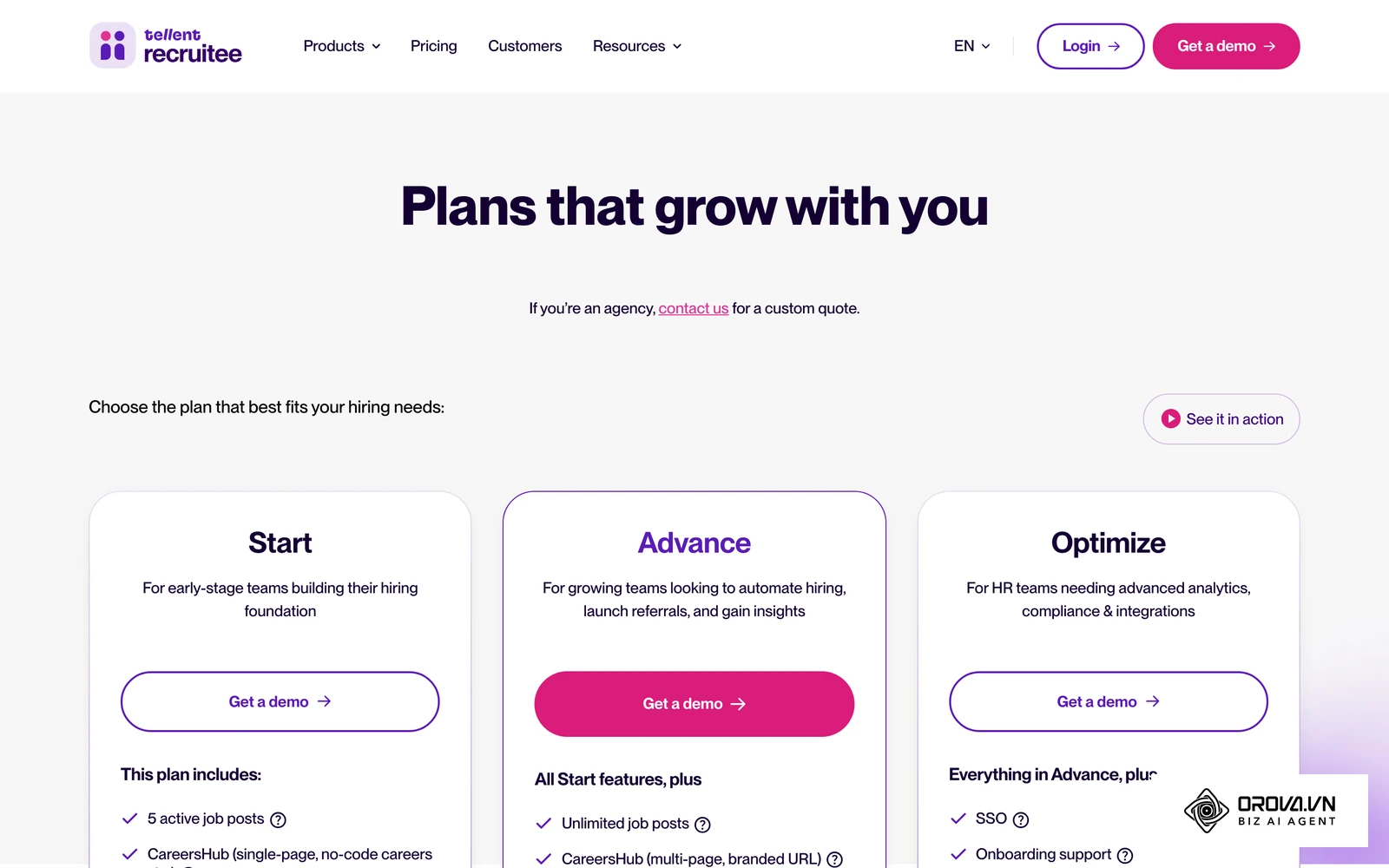
Recruitee's public pricing page (checked October 2026) lists three plans: Start, Advance, and Optimize. Start includes 5 active job posts, a single-page careers site, multi-job board posting and AI writing for candidate emails and feedback summaries. Advance removes the cap with unlimited job posts and adds a multi-page careers site, advanced reporting and an AI-powered Screening Assistant limited to 100 credits per month. Optimize adds SSO, onboarding support and the full Screening Assistant. No plan shows a public price; every tier routes to a demo and a custom quote. The budget risk is therefore not a per-slot fee but the jump: when a team on Start suddenly needs 15 open roles in one quarter, it has to move to Advance, and features such as SSO sit only in Optimize or as add-ons.
In contrast, AI hiring platforms usually price by processing capacity or by evaluation positions rather than by plan tier, so a hiring spike changes usage rather than the contract.
The table below is a planning worksheet for three hiring volume scenarios over a 12-month period. It maps each scenario to the Recruitee plan that fits it, based on the limits listed on the pricing page, and to the questions worth putting in your quote request:
| Annual Hiring Scenario | Recruitee Plan That Fits | What Changes the Annual Cost | Questions for Your Quote |
|---|---|---|---|
| Stable baseline (up to 5 open roles at a time) | Start (5 active job posts) | Premium job board postings, add-ons, extra seats if applicable | What happens when a 6th role must go live for a few weeks? |
| Moderate growth (around 15 open roles) | Advance (unlimited job posts) | Plan upgrade from Start, AI Screening Assistant credits beyond 100 per month | Can we upgrade mid-contract and pro-rate the difference? |
| Rapid scaling or seasonal surge (30 roles) | Advance or Optimize | SSO and onboarding support (Optimize), integrations, screening volume | Is full Screening Assistant use included, and what counts as a credit? |
Illustrative scenario: Consider a mid-sized logistics technology firm with 120 employees and two internal talent acquisition specialists. The team signed up for an entry plan capped at 5 active job posts to manage steady corporate hiring. In late spring, leadership secured a regional contract requiring the rapid onboarding of 18 warehouse operations supervisors within six weeks. Publishing all 18 openings meant upgrading to a higher plan before the budget review. While waiting for approval, the team cycled job postings sequentially—opening five roles, collecting applicants, and archiving them to free room for the next batch. This workaround introduced administrative confusion, delayed candidate communications, and pushed back their time-to-hire by several weeks.
For organizations that rarely have more than five roles open at once, Recruitee's Start plan offers straightforward budgeting. For companies facing unpredictable hiring surges, the real cost question is when you will have to move up a plan.
Resume Screening and Parsing: Recruitee Software vs AI Hiring Platforms
Resume screening represents the single largest operational time sink for talent acquisition teams. Recruitment teams that rely only on keyword-matching filters still end up reading most resumes by hand to confirm what the keywords actually mean.
Traditional ATS platforms process incoming resumes through CV parsing and keyword search. Recruitee extracts structured candidate fields, supports knockout questions on its application forms, and lets recruiters search their candidate database with keyword queries (such as "Python AND Kubernetes NOT Junior") across their candidate database. While helpful for basic filtering, keyword-based systems suffer from severe structural vulnerabilities. Unqualified applicants frequently manipulate keyword stuffing to bypass filters, while highly capable candidates who use alternative phrasing are erroneously overlooked. Recruitee has started closing this gap: its pricing page lists an AI-powered Screening Assistant (100 credits per month on Advance, full use on Optimize) that promises explainable results with human control. Ask in your demo whether it quotes the CV text behind each decision and how it weighs mandatory versus nice-to-have criteria.
Autonomous AI hiring platforms utilize advanced AI resume screening tools that evaluate candidate documents semantically. Rather than searching for isolated keywords, the system dissects the job description into distinct criteria groups (such as technical competencies, leadership history, and mandatory certifications). The AI reads candidate resumes holistically, extracting verifiable evidence and providing human recruiters with direct quotation citations for every requirement. If a candidate claims project management experience, the AI highlights the exact project scope, timeline, and measurable outcome described in the text.
The following benchmark demonstrates the operational throughput differences between traditional ATS filtering and autonomous AI evaluation:
| Hiring Workflow Stage | Manual Review in a Keyword-Filter ATS | Autonomous AI Agent Platform | Practical Difference |
|---|---|---|---|
| Ingesting 250 Inbound Resumes | Batched document upload; basic OCR field extraction | Instant batch ingestion across PDF, Word, and image formats | Parity on upload; AI standardizes complex formatting |
| Criteria Verification per Resume | Several minutes of manual recruiter reading per profile | Automated criteria check in a batch run | Recruiter time moves from reading to reviewing evidence |
| Evidence Verification | Recruiter manually scans pages for specific skill context | System extracts exact textual quotes confirming competencies | AI eliminates manual skimming and keyword hunting |
| Initial Candidate Categorization | Recruiter manually tags or moves profile cards on Kanban | Automated labels such as qualified, consider or not a fit | Most top-funnel triage no longer needs manual sorting |
| Shortlist Dossier Preparation | Manual compilation of notes for the hiring manager | Structured summary PDF detailing criteria pass/fail evidence | Hiring managers receive verified dossiers within hours, not days |
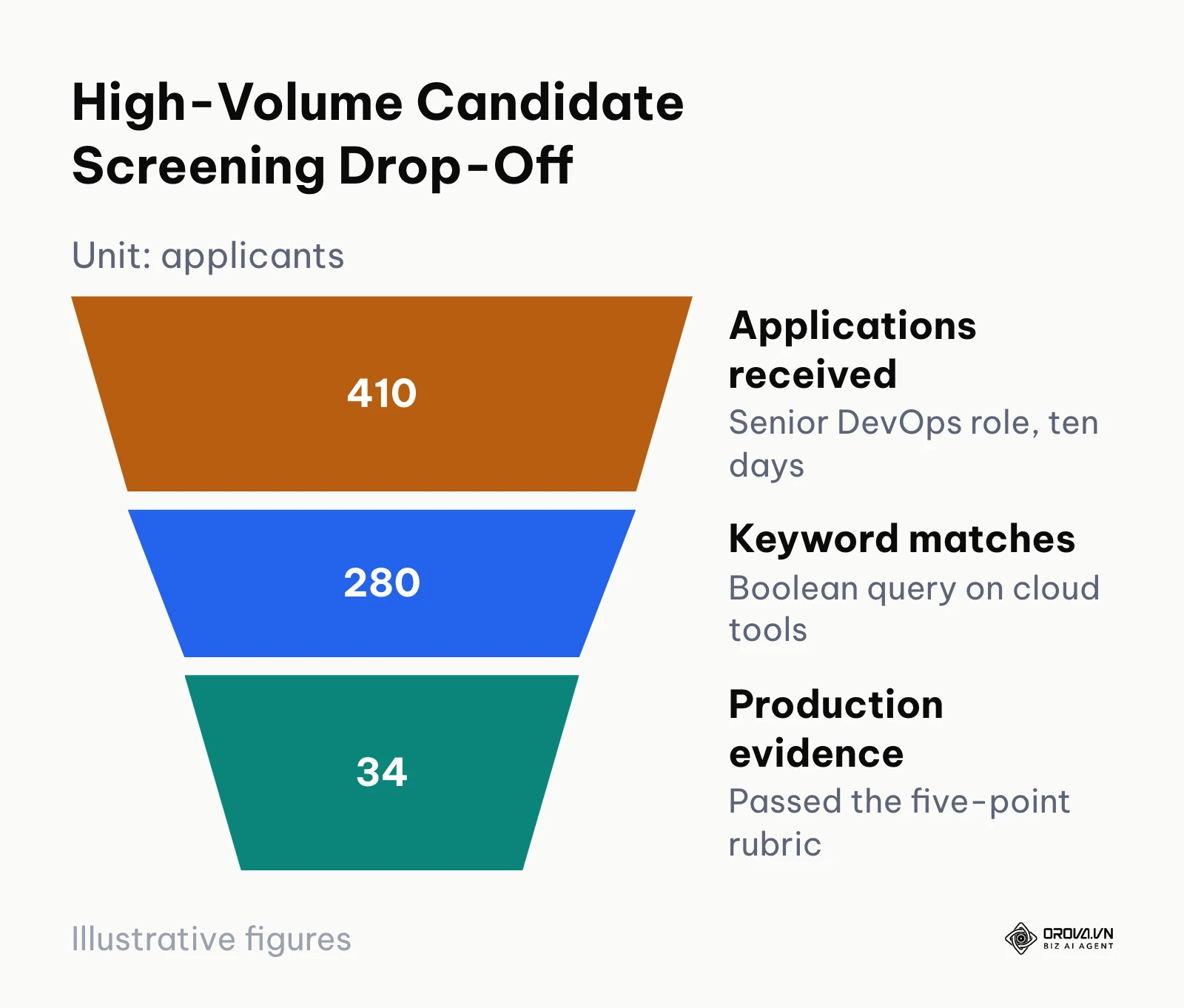
Illustrative scenario: A high-growth enterprise software provider published an open position for a Senior DevOps Engineer and received 410 applications within ten days. The sole internal recruiter attempted to filter the talent pool using standard ATS boolean queries for cloud infrastructure tools. Over 280 applicants matched the keywords because applicants routinely list every technology they have ever encountered in their skills footer. The recruiter spent four full working days manually reading each resume to verify whether applicants had managed production cloud migrations or merely completed basic coursework. After falling behind schedule, the hiring manager intervened, instituted an objective five-point criteria rubric, and re-screened the remaining pool. By shifting from keyword presence to verifiable project evidence, the team identified that only 34 applicants possessed the necessary production architecture experience, allowing them to schedule technical screens within 48 hours.
When evaluating candidate resumes, traditional ATS software merely organizes the influx; autonomous AI platforms actively complete the preliminary screening audit.
If manual resume reviews and disconnected interview notes slow down your hiring pipeline, consider streamlining your internal screening with Orova Recruit. The tool parses job requirements into objective criteria, scores candidate resumes with direct quotation evidence, and generates targeted interview questions based on candidate weak spots. You can test your first job opening in minutes without entering credit card details.
Interview Workflow and Assessment: Recruitee Software vs AI Hiring Platforms
The interview phase is where recruitment processes frequently break down due to subjective evaluations, inconsistent questioning, and delayed interviewer feedback. Every manual handoff between screening, interviewing and feedback adds days to time-to-fill.
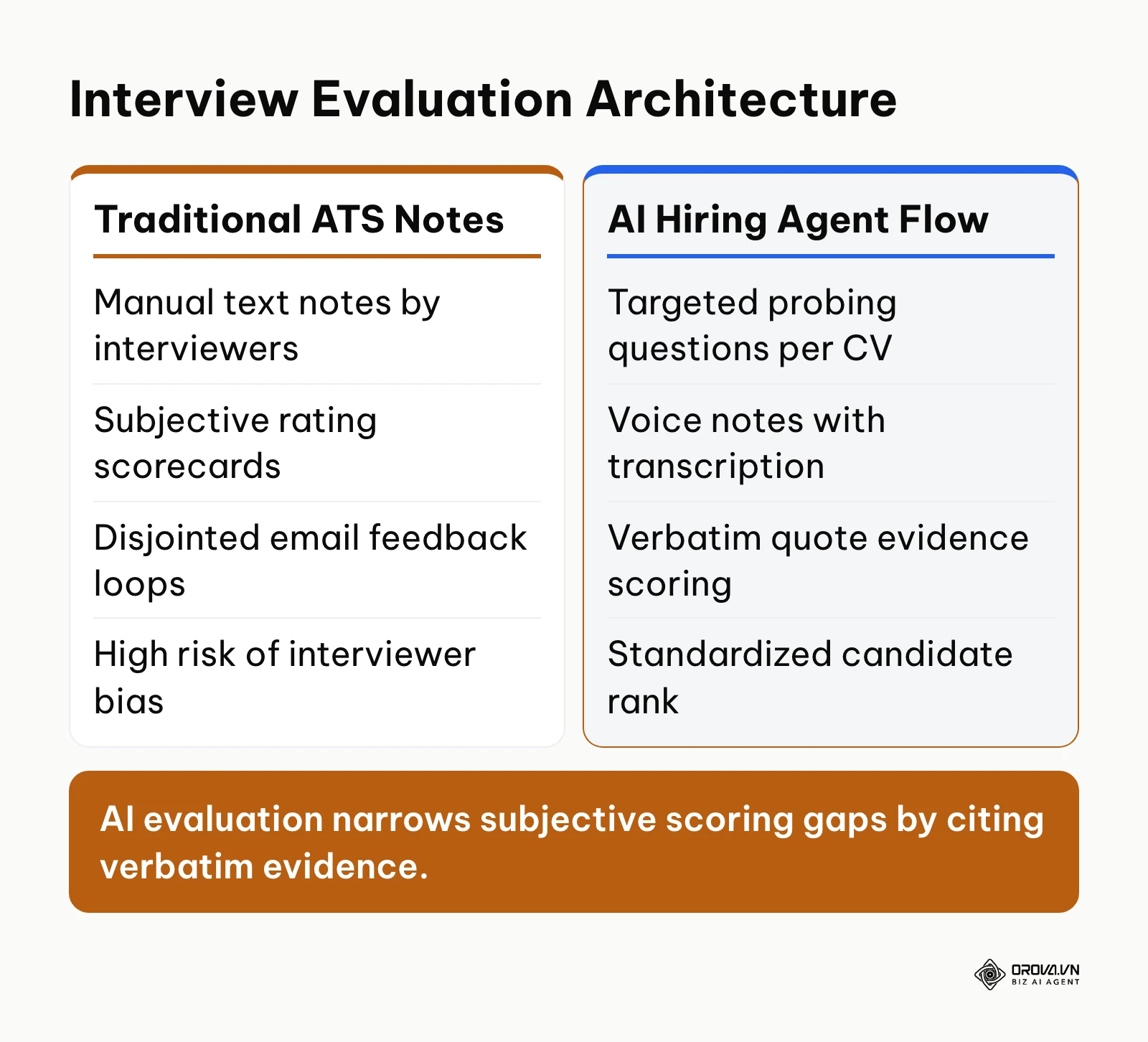
Recruitee approaches interview management through collaborative team scheduling and static scorecards. Hiring managers can view interview appointments, submit text notes, and assign numerical ratings to pre-configured evaluation criteria. Team members can leave internal comments and mention colleagues to discuss a candidate's performance. While this collaborative structure keeps feedback organized within a single record, it relies entirely on human discipline. Interviewers often forget what questions to ask, fail to probe candidate exaggerations, and submit vague, subjective feedback hours or days after the interview concludes.
Autonomous AI hiring platforms transform the interview stage from a passive note-taking exercise into a structured evaluation workflow. When an applicant advances to the interview phase, the AI platform analyzes discrepancies and weak spots identified during resume screening. The system constructs a set of targeted probing questions tailored specifically to that candidate, complete with evaluation guidelines detailing what competent versus superficial answers sound like.
Furthermore, many AI platforms let interviewers capture voice notes during the session and transcribe them automatically. Rather than frantically typing notes while trying to maintain eye contact, the interviewer focuses entirely on the conversation. Following the session, the AI audits the transcript against the position's evaluation criteria, citing verbatim quotes to justify whether the candidate met expectations. Crucially, human hiring managers retain full decision-making authority; the AI provides objective evidence, but humans make the final hiring choice.
Illustrative scenario: A fintech company interviewing candidates for an Enterprise Account Executive role struggled with inconsistent hiring outcomes. Three different sales directors conducted first-round interviews using unstructured personal notes. One director recommended an applicant based on charismatic rapport, while another flagged the same candidate for lacking enterprise deal experience. Because neither interviewer documented specific deal sizes or sales methodologies in the ATS, the hiring committee spent an hour debating subjective impressions during their weekly sync. The department head paused the hiring loop and established a mandatory evaluation standard: interviewers were required to ask five standardized scenario questions and record direct quotes regarding average contract values and sales cycles. Armed with verifiable transcript quotes demonstrating that the candidate had only managed mid-market transactions under 25,000 US dollars, the committee quickly aligned on passing on the candidate, avoiding an expensive mis-hire.
Recruitee provides a clean interface for storing human notes; AI platforms actively elevate the substantive quality and objectivity of the interview itself.
Candidate Sourcing and Career Site Branding: Recruitee Software vs AI Hiring Platforms
Inbound candidate acquisition is the domain where Recruitee demonstrates its clearest competitive strengths over specialized AI screening engines. Attracting qualified talent requires branded touchpoints, seamless application portals, and broad job board visibility.
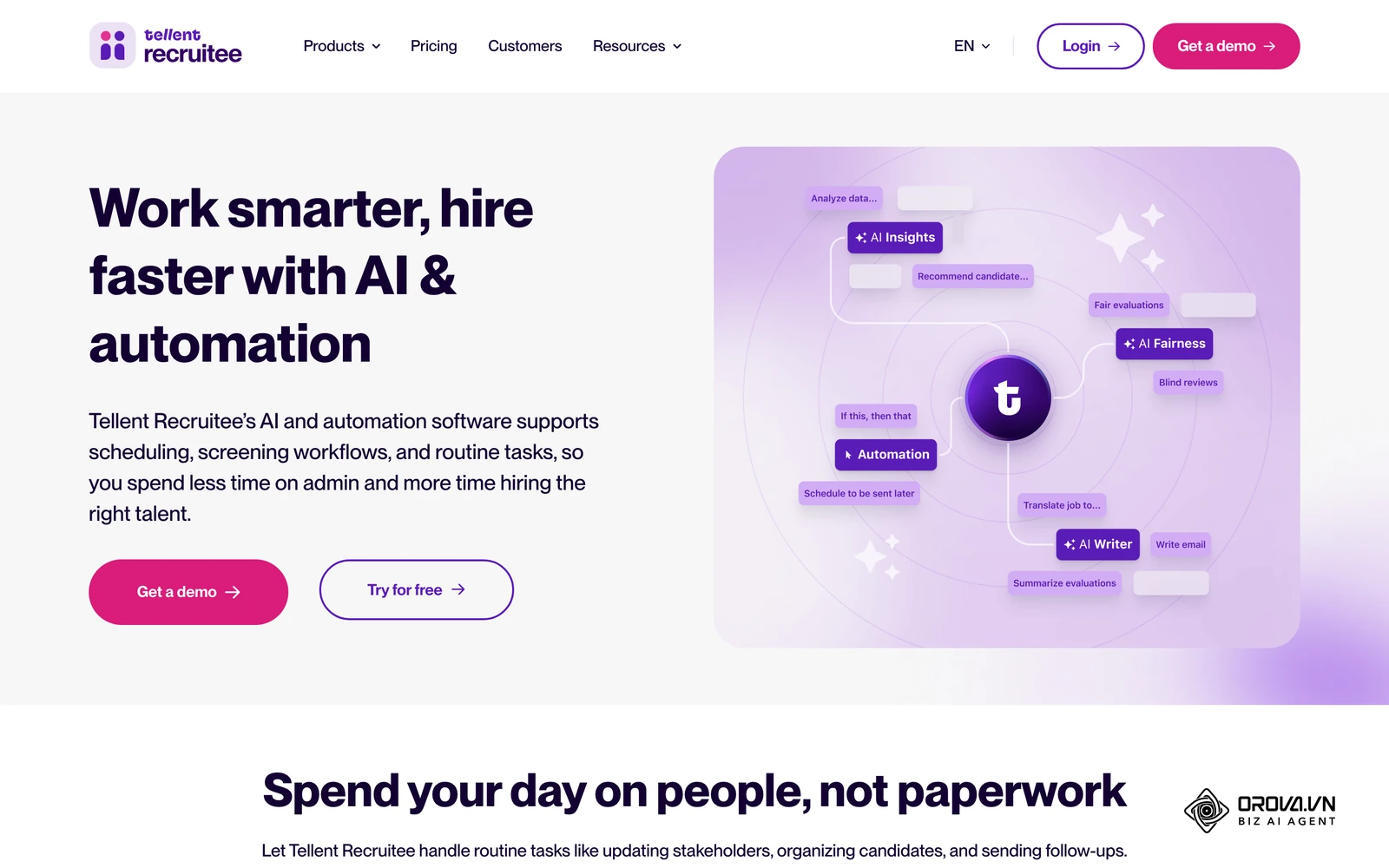
Recruitee excels at career site creation. The platform includes a visual, no-code career site editor that enables marketing and HR teams to design responsive, branded employment portals without writing custom code or relying on engineering resources. Organizations can customize employer branding banners, embed corporate culture videos, highlight employee testimonials, and publish department-specific job boards that update automatically when new positions are created.
Furthermore, Recruitee integrates directly with dozens of free and commercial job boards, including LinkedIn, Indeed, Glassdoor, and regional employment portals. With a single click, recruiters can syndicate job openings across multiple distribution channels and track candidate source attribution within their analytics dashboard.
Autonomous AI hiring platforms, by design, focus primarily on internal evaluation, criteria extraction, and assessment workflows rather than public web publishing. Most AI platforms do not include public career site builders, hosted application landing pages, or direct multi-channel job board syndication networks. Instead, they operate as internal recruitment engines where recruiters upload candidate resumes collected from various external channels.
If your organization lacks a centralized corporate careers website and requires an integrated solution to publish job listings, capture direct applicant form submissions, and showcase employer branding, Recruitee holds a distinct advantage.
Candidate Data Migration: Recruitee Software vs AI Hiring Platforms
Migrating recruitment data between systems is fraught with operational risk. Talent acquisition teams frequently fear losing years of historical candidate interactions, interviewer notes, and regulatory compliance records when transitioning from spreadsheets or legacy HR and recruitment software.
Most vendor documentation glosses over the friction of data migration, promising simple one-click CSV imports that frequently fail in practice due to mismatched database schemas, garbled character encoding, and unmapped custom fields. When migrating candidate records into recruitee software or an AI hiring platform, adhering to a strict migration protocol prevents catastrophic data corruption.
Use this 5-step candidate data migration checklist to safeguard recruitment data integrity. Tick each step only when its pass check is met:
| Step | What to Do | Pass Check Before Moving On | Done |
|---|---|---|---|
| 1. Data schema normalization and field mapping | Standardize core fields (Full Name, Primary Email, Phone Number, Current Company, Job Title), map legacy status tags such as "Screened", "Technical Test" and "Offered" to the target system's stages, and move non-standard attributes into dedicated text fields | Every source column has a named target field or a documented reason to drop it | ☐ |
| 2. Sanitized CSV export and duplicate resolution | Export the source database as UTF-8 CSV files, deduplicate on primary email and normalized phone number, and merge fragmented records with historical notes into one master profile per applicant | No two rows share the same primary email | ☐ |
| 3. GDPR and privacy compliance audit | Purge candidate profiles whose retention consent has expired under the European General Data Protection Regulation (GDPR) or local privacy rules | Every retained record shows a legal basis for processing and an original application date | ☐ |
| 4. Sandbox pilot import | Import a controlled batch of exactly 50 profiles with complex PDF attachments, formatted resumes and multi-line interviewer notes | Attachments open, accented characters render correctly, historical timestamps are intact | ☐ |
| 5. Post-migration reconcile and verification | Compare total record counts between source and target, then spot-check 20 randomly selected historical profiles | Counts match and previous interview notes, rejection reasons and communication history appear without truncation | ☐ |
By executing this structured five-stage protocol, recruitment operations teams can modernize their software stack without sacrificing valuable talent pool history or exposing the business to compliance liabilities.
When to Choose Recruitee Software
Recruitee represents a mature, well-crafted applicant tracking system tailored for organizations with specific structural requirements. You should choose recruitee software when your organization meets the following criteria:
- You need a centralized, branded career portal without web development support: If your company does not have a dedicated engineering team to build custom careers pages, Recruitee's visual, no-code site builder allows HR teams to launch professional, mobile-responsive employer branding portals in an afternoon.
- Your hiring volume is stable and predictable throughout the year: If you rarely have more than five roles open at once, the Start plan's 5 active job posts keep budgeting simple; if you regularly run more, Advance lists unlimited job posts.
- Multi-channel job board syndication is your primary sourcing bottleneck: If your team spends excessive hours manually posting the same job opening across LinkedIn, Indeed, and specialized job boards, Recruitee's automated distribution tools deliver immediate administrative efficiency.
- Your recruitment committee relies on collaborative, human-driven scorecards: If your hiring philosophy emphasizes recruiter-led manual reviews and peer commentary over automated evaluation algorithms, Recruitee's intuitive Kanban interface provides an enjoyable user experience.
When to Choose AI Hiring Platforms
Autonomous AI hiring platforms represent the logical technological evolution for organizations facing modern recruitment bottlenecks. You should select an AI hiring platform in the following scenarios:
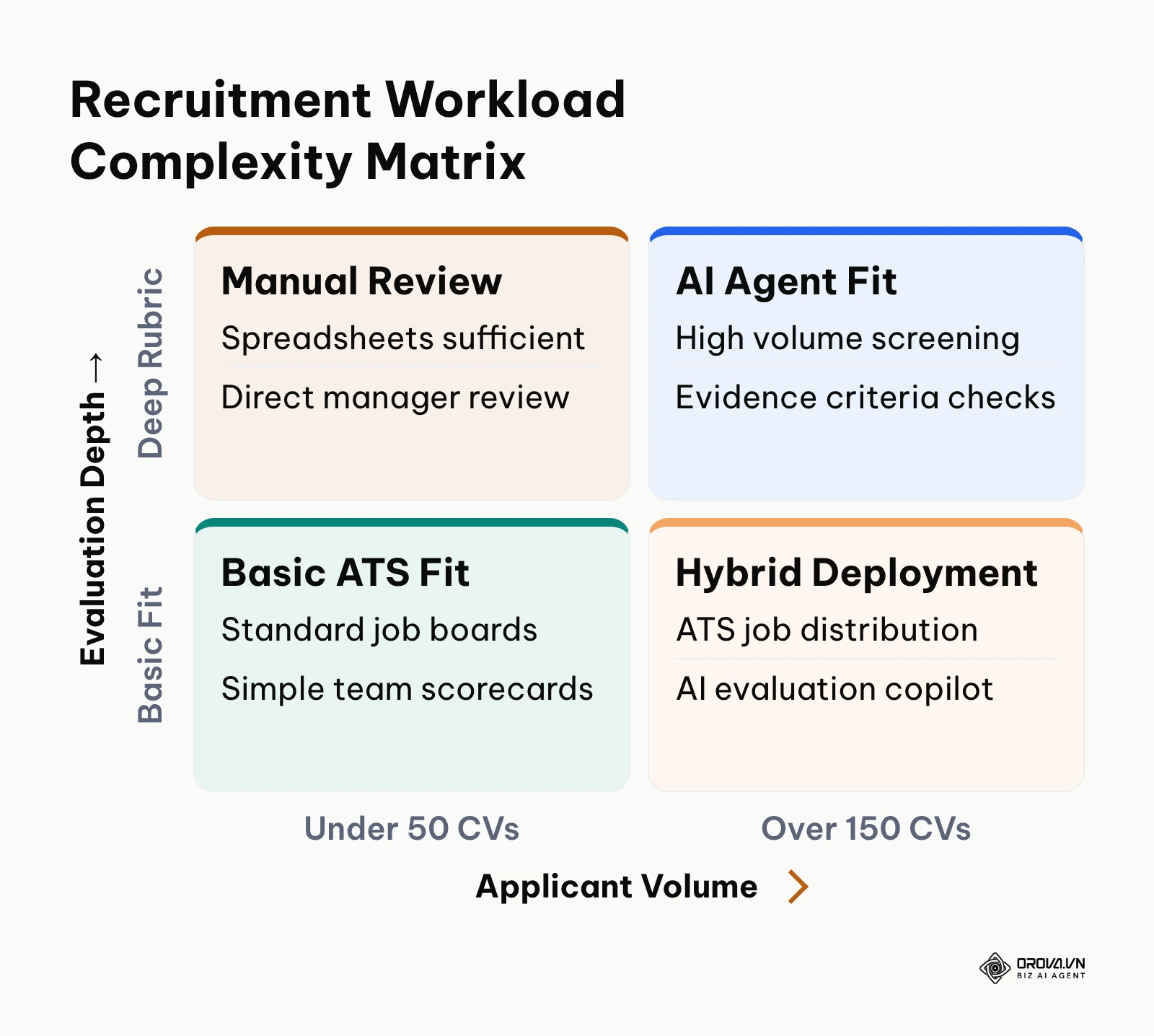
- Your recruiters are overwhelmed by high-volume inbound applications: If your job postings routinely attract 150 to 500+ applicants per role, manual resume skimming becomes an operational failure point. An AI platform audits every submission against weighted requirements in seconds, delivering verified shortlists instantly.
- You need to eliminate keyword gaming and subjective reviewer bias: If your hiring managers complain that candidate resumes look impressive on paper but fail basic competency checks during phone screens, an AI platform's evidence-based quotation auditing ensures only verified talent advances.
- Your team conducts technical, operational, or structured interviews: If your hiring managers need assistance formulating sharp probing questions and evaluating recorded interviews against objective rubrics, AI-assisted transcription and evidence scoring dramatically improve hiring precision.
- Your hiring needs fluctuate seasonally or scale unpredictably: If opening 20 roles in a single month would force a plan upgrade on your current ATS, an AI platform priced by capacity lets usage rise and fall with the hiring sprint.
Building an efficient hiring workflow should not require complex multi-month rollouts or unpredictable plan upgrades. With Orova Recruit, your hiring team can upload candidate resumes, evaluate evidence-backed scoring rubrics, and transcribe interview notes and score interviews within a single unified workspace. Get full access to all recruitment features for your active job positions, free through July 7, 2027, with no credit card required.
Can You Use Recruitee Software and AI Hiring Platforms Together?
Modern recruitment technology does not require an all-or-nothing choice. Forward-thinking organizations frequently deploy a hybrid recruitment stack, leveraging Recruitee for top-of-funnel candidate attraction and an autonomous AI platform for deep evaluation.
In a hybrid configuration, the division of operational labor is straightforward:
| Hiring Stage | Handled in Recruitee | Handled in the AI Platform |
|---|---|---|
| Candidate attraction | Career site, job postings syndicated to external boards, application forms on the branded portal | Not involved |
| Resume evaluation | Stores the incoming application | Parses requirements and verifies qualifications with quotation evidence |
| Interviews | Interview scheduling and team feedback on the candidate card | Customized probing questions, transcribed notes and evidence-based scoring |
| Final status sync | Recruiter moves the top candidates to the offer stage, preserving one audit trail | Shares the shortlist and evaluation summary with the recruiter |
However, operating a hybrid stack introduces operational handoff risks. Recruiters must ensure candidate data flows smoothly between platforms without manual double-entry, and communication rules must be configured carefully to avoid sending conflicting automated emails to applicants.
Hiring Technology Trends Over the Next Few Years: Author's Outlook
Multimodal Resume Auditing Replaces Keyword Filtering
Visible industry shifts as of 2026 demonstrate that traditional keyword filtering has reached the end of its useful lifecycle. Candidates now routinely utilize generative AI to rewrite their resumes to match job specifications perfectly, rendering simple keyword presence meaningless. In my view, within the next two to three years, applicant tracking systems that rely solely on keyword matching will lose much of their users' trust. Talent acquisition technology is likely to shift toward semantic and multimodal reasoning models that verify the factual consistency, depth, and contextual realism of an applicant's career trajectory. Talent leaders should prepare now by abandoning generic keyword checklists and training hiring managers to define verifiable, evidence-based performance criteria for every open requisition. This projection could prove incorrect if global privacy regulations restrict automated document analysis, forcing organizations back to strictly manual screening protocols.
Job-Slot Pricing Yields to Outcome-Based Capacity
Some ATS vendors still cap active jobs on entry plans, while others, Recruitee on its Advance plan among them, already list unlimited job posts. I believe that over the next few years, competitive pressure from AI platforms will push more vendors away from job caps. I expect the market to lean toward consumption-based or capacity-based models that charge for computational evaluation volume rather than active job openings. Human resource executives negotiating multi-year enterprise contracts today should push for flexible job limits and clear mid-contract upgrade terms. However, this trend could decelerate if enterprise procurement teams continue prioritizing predictable, fixed annual software line items over dynamic consumption billing.
The Interviewer Copilot Becomes the Core Decision Record
Interviews have historically been the most poorly documented phase of corporate decision-making, relying on scribbled notes and fallible human memory. Current technological developments indicate that real-time AI transcription, objective evidence extraction, and bias detection are becoming standard expectations in professional hiring. I anticipate that within three years, conducting an interview without an automated, consent-governed transcription and evidence-scoring copilot may be viewed as a governance gap. Organizations should begin auditing their interview data privacy consent policies and educating hiring committees on conducting structured, rubric-driven interviews. This expectation could fail to materialize if candidate pushback against recorded sessions creates widespread friction, prompting employers to preserve traditional unrecorded conversations.
Frequently Asked Questions About Recruitee Software
How does Recruitee's plan structure affect budgets during sudden hiring surges?
Only the Start plan is capped, at 5 active job posts according to Recruitee's pricing page (checked October 2026); Advance and Optimize list unlimited job posts. A hiring spike on Start therefore means moving up a plan rather than paying per extra job. Prices are quoted after a demo, so ask how a mid-contract upgrade is billed before you sign.
Can Recruitee software parse multilingual resumes without manual intervention?
Recruitee can ingest resumes in multiple languages and extract basic contact information like names, phone numbers, and email addresses. Its pricing page also lists AI job translations and, on Advance and Optimize, an AI Screening Assistant. How deeply it evaluates resumes written in different languages is worth testing in a trial with your own sample CVs, and dedicated AI evaluation platforms are worth comparing on the same sample.
What happens to candidate interaction history when migrating into Recruitee software?
When migrating candidate records from spreadsheets or older ATS databases, historical email correspondence, stage notes, and interview ratings can be preserved only if they are properly mapped to Recruitee's custom fields and notes architecture during CSV import. Unmapped fields will be truncated or omitted entirely. Following a rigorous 5-step data migration protocol ensures that valuable candidate interaction histories remain accessible.
How does artificial intelligence change traditional ATS workflows as of 2026?
As of 2026, artificial intelligence has expanded beyond basic generative drafting of job descriptions into autonomous candidate evaluation and interview auditing. Rather than simply organizing candidate cards on visual boards, AI platforms extract verifiable evidence from resumes, formulate probing interview questions targeting specific candidate gaps, and transcribe audio to score responses against objective rubrics. This shift elevates recruitment software from an administrative database to an active decision-support engine.
Does Recruitee software provide automated interview transcription and audio scoring?
Recruitee's pricing page lists interview templates for feedback and scoring and AI summaries of candidate feedback; interview recording and transcription are not listed there. Teams that want them should check Recruitee's integration marketplace or ask in the demo. Autonomous AI hiring platforms build audio recording, speaker diarization, and evidence-backed evaluation directly into the native workflow.
Is Recruitee software compliant with international privacy frameworks like GDPR?
Recruitee is headquartered in Europe and complies with European General Data Protection Regulation (GDPR) mandates, including candidate consent tracking, data retention automation, and candidate data deletion workflows. Organizations deploying Recruitee can configure data expiration rules to ensure applicant records are automatically anonymized or purged once regulatory retention windows expire.
Where Should You Start?
Modernizing your hiring infrastructure does not require overhauling your entire talent acquisition operation overnight. Depending on your current operational maturity, focus on taking one high-impact step today:
- If you currently manage hiring through spreadsheets and shared inboxes: Spend your afternoon conducting an audit of your active job descriptions. Convert one informal job listing into an objective evaluation rubric containing 8 to 12 clear, verifiable criteria across technical skills, practical experience, and mandatory credentials before evaluating your next candidate.
- If you currently use a traditional ATS but recruiters are drowning in unqualified resumes: Take your highest-volume job opening and replace generic boolean keyword filters with a standardized evidence-checking checklist. Require reviewers to extract two verbatim quotes from each candidate's resume confirming core competencies before advancing them to a hiring manager call.
- If you are preparing for a rapid multi-department hiring expansion: Audit your existing recruitment software contracts to check job limits and upgrade terms. Map your projected 12-month requisition schedule against your plan limits to determine whether your budget is better served by expanding your current vendor tier or adopting an autonomous evaluation platform.
Regardless of whether you choose an autonomous AI platform or commit to recruitee software, starting with clean data and calibrated criteria ensures your hiring stack delivers measurable talent outcomes.
About the author

Builder of Orova
Nguyễn Đỗ Trọng Ân has 8 years of experience in marketing, including 6 years managing market development across Asia. He builds Orova, a Biz AI Agent that never sleeps: it plans, runs and optimizes work for businesses.
Run your business with AI Agents
Orova is the always-on Biz AI Agent — it plans, runs, and optimizes the work for you.
Save time, unlock productivity.