
SEO attribution model: what it is and how to prove organic ROI

Selecting the right seo attribution model is the single most critical step for marketing leaders who must defend organic search budgets before the executive board. Most marketing teams still evaluate content performance by looking at isolated session traffic, keyword rankings, or last-click conversion reports in web analytics. This outdated approach creates a massive visibility blind spot: it credits paid search ads, direct visits, or retargeting emails with pipeline revenue, while treating informative top-of-funnel blog posts as zero-dollar expenses. When buyers take weeks to research solutions across multiple devices, ignoring organic search contribution leads directly to defunded editorial teams and misallocated marketing budgets. This comprehensive guide breaks down how organic attribution works across modern multi-touch customer journeys, how to configure conversion paths in current analytics platforms, how to capture first-touch blog sources inside your CRM, and how to measure real pipeline revenue in the zero-click search era.
What Is an SEO Attribution Model?
An SEO attribution model is a measurement framework that assigns financial value and conversion credit to organic search touchpoints across a buyer journey. It helps marketing teams prove organic search revenue rather than tracking vanity traffic, distinguishing multi-touch organic influence from single-session analytics that credit only the final click.
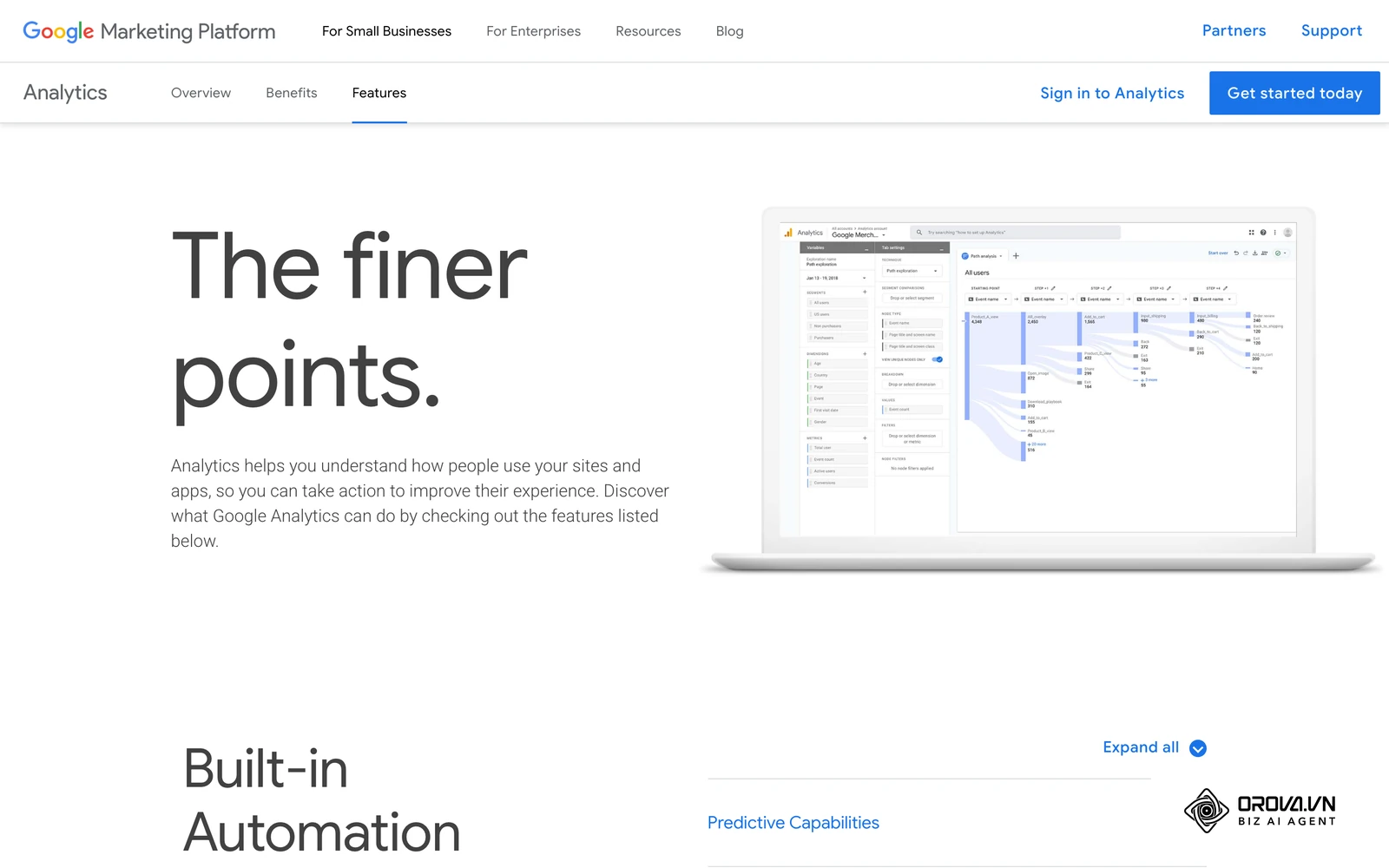
The term attribution originates from statistical econometric modeling, where researchers attempted to isolate which external variables drove macroeconomic changes. In digital marketing, attribution evolved into a rules-based or algorithmic system that credits touchpoints along a digital conversion path. While marketing teams often confuse an seo attribution model with broader web analytics or macro-budget modeling, each serves a distinct operational purpose.
| Concept | Primary Difference | Concrete Example |
|---|---|---|
| SEO Attribution Model | Measures the fractional revenue contribution of organic search interactions across a multi-session path | Tracking how an organic guide on cloud migration influenced a 20,000-dollar software deal closed two months later |
| Web Analytics Tracking | Records technical session metrics, immediate bounce rates, and single-session event completions | Recording that an organic visitor viewed three pages and spent four minutes on an article before leaving |
| Marketing Mix Modeling (MMM) | Uses top-down statistical regression to estimate macro channel impact across aggregate spend data | Estimating quarterly sales fluctuations against total organic headcount, brand advertising, and seasonal demand |
To understand how an seo attribution model functions in daily practice, consider a professional soccer match. When a forward taps the ball into the net, the official score sheet records that single player as the goal scorer. However, the victory was created by the central midfielder who intercepted the ball in defensive territory and delivered a precision forty-yard through pass. If the team manager evaluated player value exclusively by goal scoring, they would fire the midfield playmaker and fill the roster with forwards, causing the team to lose every subsequent match. Single-click analytics operate like that flawed manager by crediting only the final direct checkout or paid retargeting ad. An seo attribution model functions as the complete match analysis, ensuring the midfield pass receives proper credit for creating the scoring opportunity.
Why an SEO Attribution Model Matters for Modern Marketing
An seo attribution model exists to resolve the systematic undervaluation of early-stage educational content within multi-touch buying journeys. In modern business-to-business and considered-purchase consumer markets, prospective buyers rarely discover a brand on Google and complete a purchase during the same browsing session. A technical buyer searches for an industry problem, reads an architectural guide, returns two weeks later via a shared link on social media, subscribes to an email newsletter, and eventually completes a transaction six weeks later by navigating directly to the pricing page.
Within the broader marketing lifecycle, attribution sits directly between audience acquisition and strategic budget allocation. Upstream activities like technical optimization, keyword mapping, and editorial production generate qualified organic visibility. Downstream activities involve CRM pipeline management, sales rep outreach, and customer retention. When marketing organizations operate without an attribution model connecting these layers, the consequences are severe:
- Profitable top-of-funnel content assets are cancelled because they show zero direct last-click sales.
- Paid search budgets are inflated because paid brand campaigns claim false credit for conversions initiated by organic research.
- Content teams are pressured to produce low-value transactional listicles rather than comprehensive technical resources that build buyer trust.
- Executive leadership miscalculates the true SEO ROI of their content investments, leading to premature budget cuts during economic contractions.
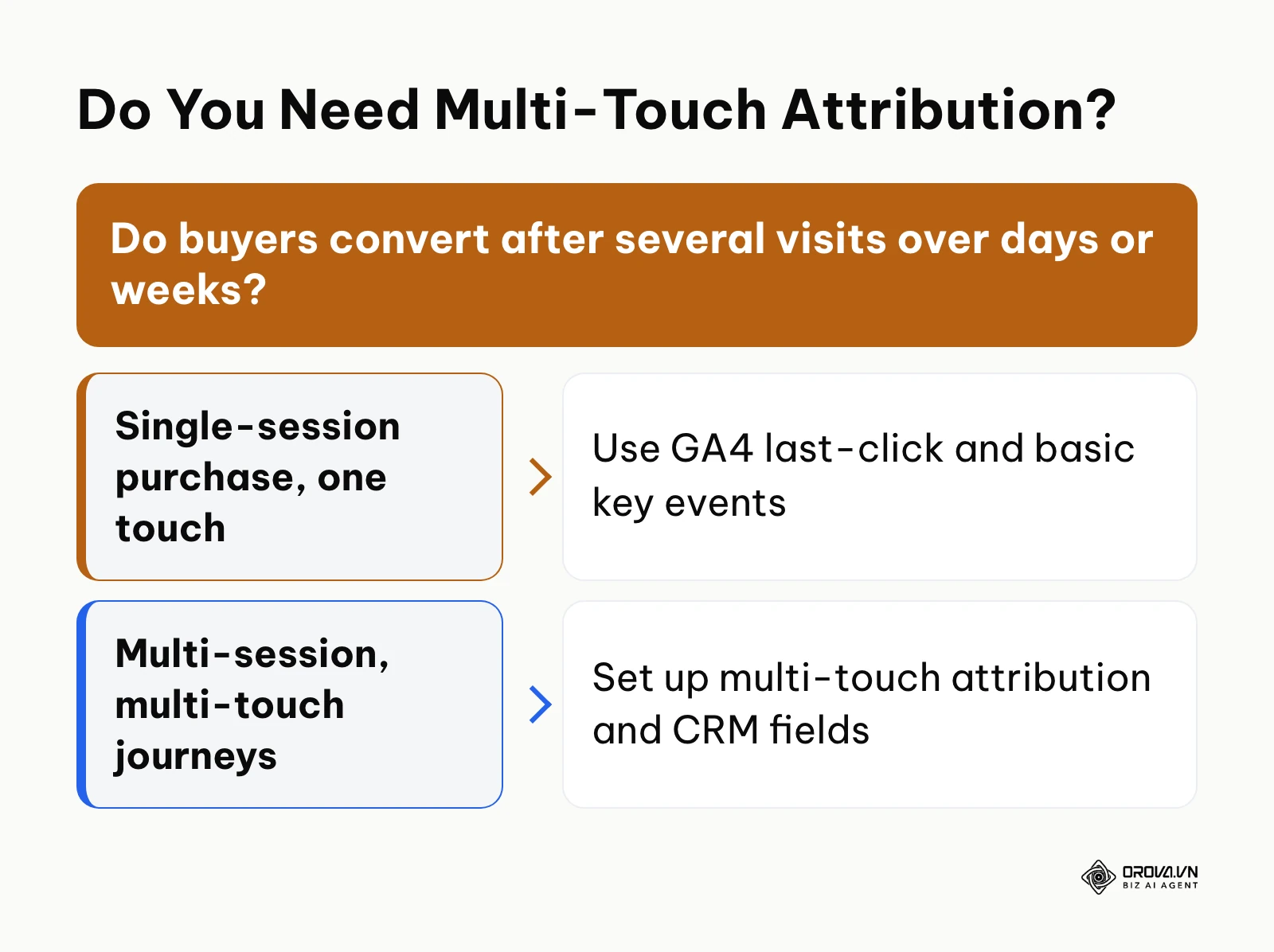
The flowchart below summarizes the decision logic for determining when your organization requires a dedicated multi-touch attribution setup.
When You Do Not Need an SEO Attribution Model Yet
Implementing a complex seo attribution model is premature and wasteful in three specific scenarios. First, early-stage websites generating under one thousand monthly organic visits should focus on publishing quality content rather than parsing fractional touchpoints. Second, transactional stores selling low-cost impulse goods with single-session checkouts gain minimal insight from multi-touch analysis. Third, local businesses relying purely on unrecorded phone calls lack the digital trail necessary for attribution. For these operations, tracking Google Search Console query impressions and standard Google Analytics conversion goals provides sufficient clarity without unnecessary technical overhead.
Business Value and Practical Benefits of an SEO Attribution Model
An seo attribution model delivers concrete business value by aligning financial investments with the true entry points of your customer acquisition pipeline. It transforms organic search from an unverified cost center into a predictable, mathematically defensible revenue driver.
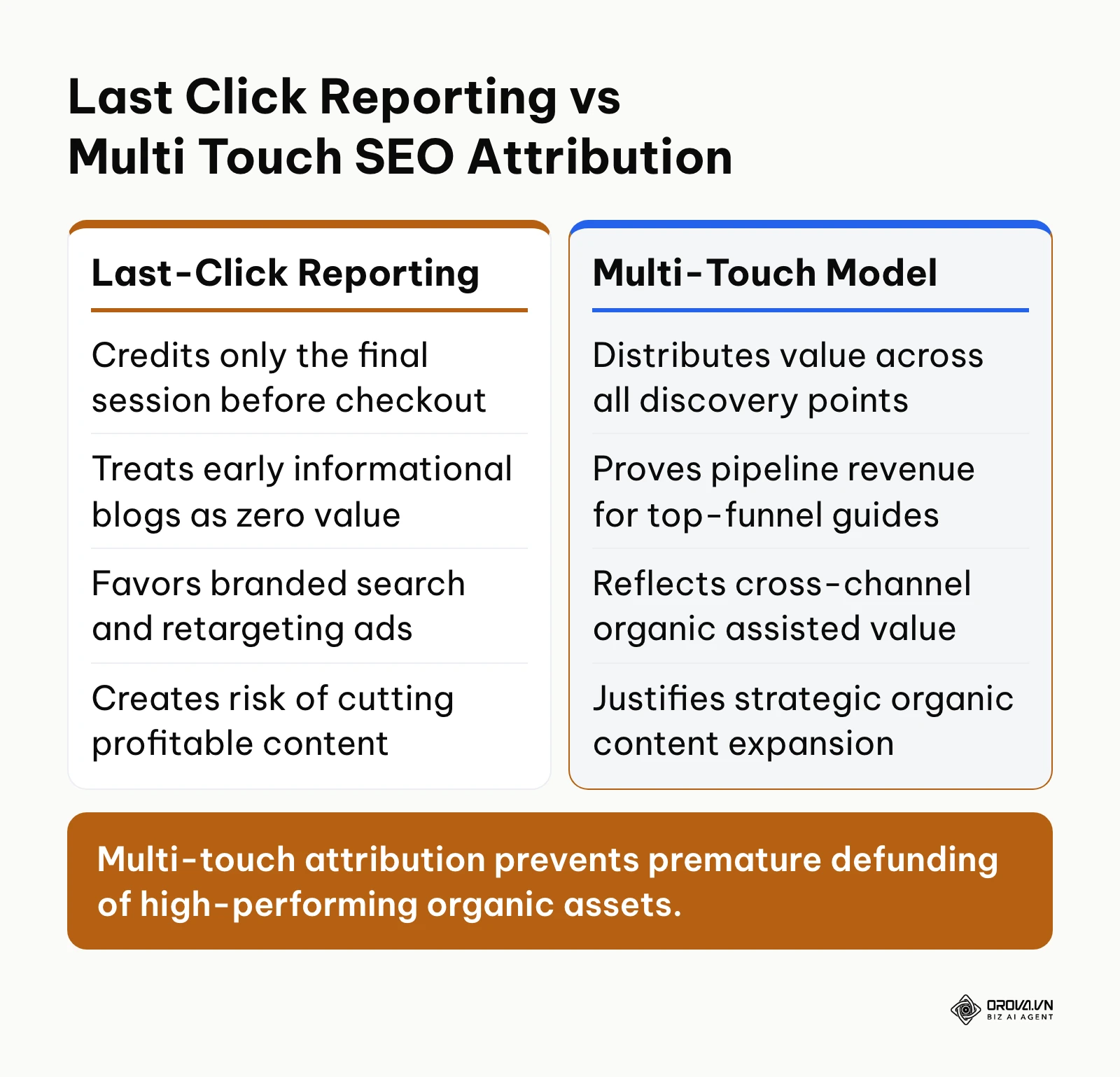
The diagram below compares how single-touch reporting and multi-touch attribution evaluate identical customer journeys.
Defending Editorial Headcount and Content Budgets
When organizations rely on last-click reporting, the content marketing team is constantly on the defensive. Content writers and technical editors produce in-depth documentation and strategic guides that educate buyers, yet executive dashboards show those URLs generating zero pipeline. Implementing an attribution model reveals the assisted value of every piece of content.
Before implementing attribution, an editorial team often faces budget freezes whenever paid media claims all quarterly pipeline. After establishing attribution tracking, the head of marketing can present concrete figures demonstrating that organic blog posts initiated a meaningful share of enterprise sales pipeline, securing editorial headcount for the following fiscal year.
Uncovering High-Assisting Content Assets
Not all organic traffic holds equal commercial intent. Standard pageview metrics might suggest that a generic industry definition post is your most valuable asset simply because it attracts twenty thousand visitors per month. An seo attribution model separates high-volume vanity content from high-velocity conversion drivers.
Before attribution analysis, teams often double down on high-traffic top-of-funnel queries that yield zero downstream pipeline. After reviewing assisted conversion paths, the team discovers that a niche troubleshooting guide with only four hundred monthly visits actually assists fifteen qualified sales demo requests per quarter, allowing editors to prioritize topics with proven commercial impact.
Aligning Marketing Spend with True Acquisition Velocity
Understanding the duration and touchpoint density of organic customer journeys prevents expensive marketing missteps. When marketers recognize that a prospect often needs several interactions over several weeks after an initial organic discovery, they stop expecting immediate same-day conversions from content initiatives.
Before attribution clarity, leadership frequently pulls funding from content marketing programs after sixty days due to a perceived lack of immediate sales. After mapping multi-touch lag times, leadership establishes realistic ninety-day evaluation cycles and aligns retargeting ad sequences to nurture organic visitors across their natural evaluation timeframe.
| Business Benefit | Primary Measurement Metric | Expected Realization Timeframe |
|---|---|---|
| Budget Defense | Pipeline Revenue Assisted by First-Touch Organic (dollars) | 30 to 60 days following setup |
| Topic Prioritization | Assisted Conversion Ratio (Assisted Conversions / Last-Click Conversions) | 60 to 90 days after baseline data |
| Paid Spend Efficiency | Blended Customer Acquisition Cost (CAC) reduction across brand terms | 90 to 180 days after channel rebalancing |
| Sales Cycle Acceleration | Average Days to Close for Organic-Initiated Prospects | 120 to 180 days across CRM deal tracking |
Illustrative example: A mid-market B2B cloud infrastructure company with twenty marketing employees and an average deal size of 15,000 dollars sought to understand why executive leadership questioned their 80,000 dollars annual technical blogging budget. The marketing operations specialist exported multi-channel conversion path data from Google Analytics, mapped first-touch landing URLs against enterprise opportunities created in Salesforce over six months, and recalculated campaign influence across all closed opportunities. The team encountered a tracking breakdown where cross-domain documentation subdomains stripped original organic referral data, which they resolved by implementing unified Google Tag Manager cross-domain linker parameters across both domains. The executive team approved the expanded content budget after the updated reporting clearly showed that sixty-four percent of closed enterprise accounts began with an organic search visit to their technical architecture guides.
Discover Orova.vn – a Biz AI Agent platform with OROVA SEO, a complete solution for every website. The system supports search engine optimization from A to Z with features including keyword research, writing new SEO-ready articles, optimizing existing content, rank tracking, plus competitor analysis and in-depth technical analysis. Sign up today to experience OROVA SEO completely free (offer valid through July 7, 2027).
How an SEO Attribution Model Works: Mechanics, Models, and Technical Setup
An seo attribution model works by collecting digital interaction identifiers across multiple browsing sessions, stitching those sessions into a continuous user timeline, and applying a mathematical algorithm to distribute financial conversion credit. Building an operational measurement system requires understanding each anatomical layer of the tracking pipeline.
The diagram below outlines the four primary stages required to capture organic touchpoints and map them directly to closed revenue.
Touchpoint Collection and Session Stitching
Touchpoint collection captures the entry mechanism of every visitor who lands on your website. When a user clicks an organic search result, the browser transmits HTTP referrer headers indicating the search engine domain, while the web server records the entry landing page URL.
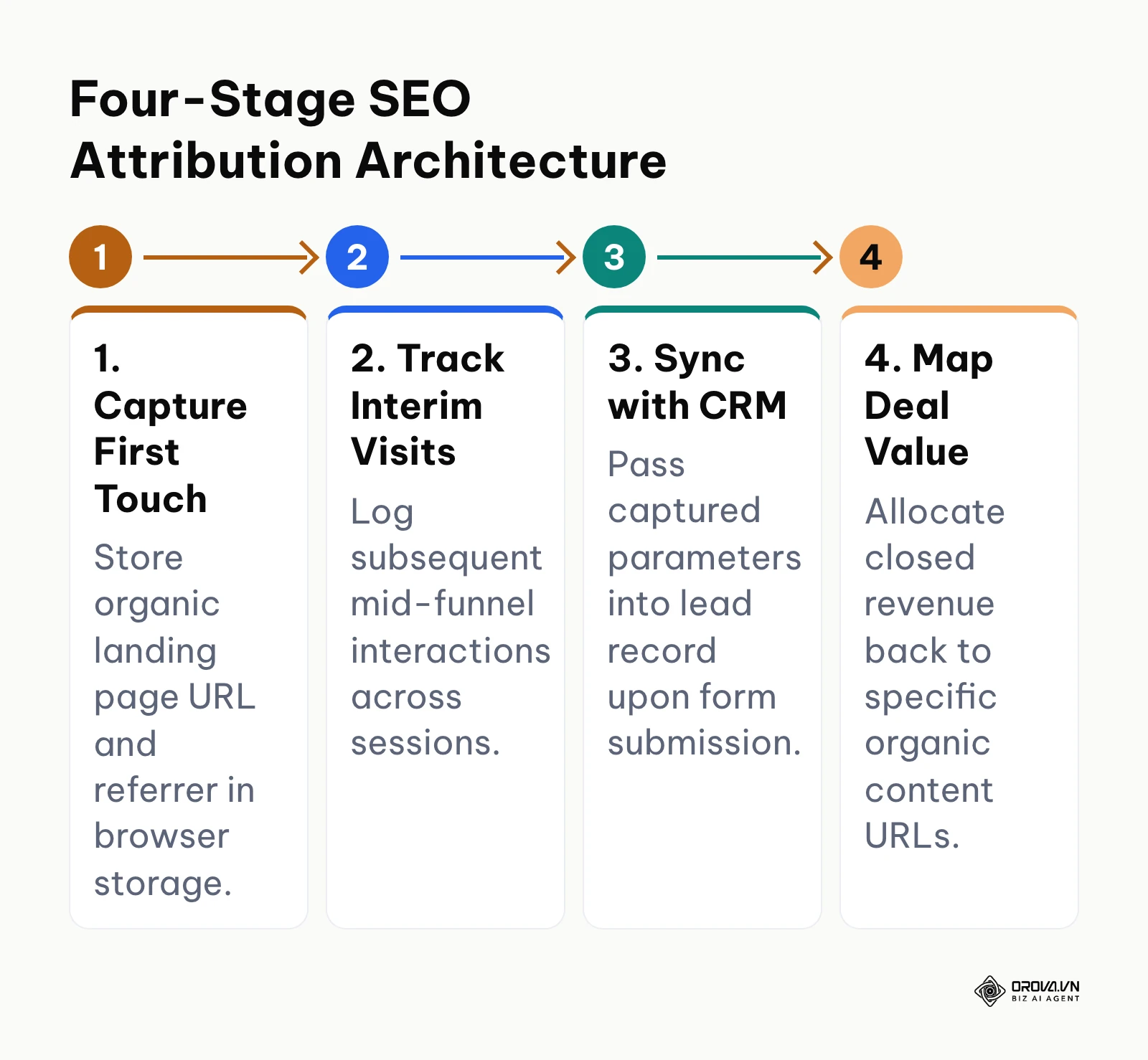
To maintain measurement accuracy across days or weeks, analytics systems must execute session stitching. This process relies on first-party cookies, pseudo-anonymous client identifiers, or authenticated user profiles to link a visit today with a visit that occurred thirty days ago.
- What it does: Records entry URL, HTTP referrer, timestamp, and device identifiers for every incoming session.
- Inputs: Browser HTTP request headers, landing page URL query strings, first-party cookie IDs.
- Outputs: An ordered chronological array of touchpoints associated with a single distinct user identity.
- Common failure points: Cross-domain link transitions lacking linker parameters, mobile browsers clearing cookies after seven days under aggressive tracking prevention policies, and users switching between personal mobile phones and work laptops.
Credit Distribution Algorithms and GA4 Realities
Once an analytics platform records a complete conversion path, it applies a credit distribution algorithm to divide the resulting revenue or conversion value among the participating touchpoints. Marketing theory historically recognized several classic rules-based attribution models (our guide to multi-touch attribution across channels covers them beyond search):
- First-Click (First-Touch): Assigns one hundred percent of the credit to the initial touchpoint that introduced the user to the website.
- Last-Click (Last-Touch): Assigns one hundred percent of the credit to the final touchpoint immediately preceding the conversion.
- Linear: Divides credit equally across every touchpoint recorded in the user journey.
- Position-Based (U-Shaped): Assigns forty percent of credit to the first touchpoint, forty percent to the final touchpoint, and divides the remaining twenty percent equally across the middle interactions.
- Time-Decay: Gives exponentially higher credit to touchpoints that occurred closest in time to the conversion event.
- Data-Driven Attribution (DDA): Uses machine learning algorithms to evaluate converting versus non-converting user paths, calculating the true fractional incrementality of each marketing touchpoint.
According to Google's official Analytics Help documentation on attribution, the rule-based models First Click, Linear, Time Decay and Position-Based were removed from Google Analytics 4 starting in September 2023.
Many outdated marketing guides still instruct practitioners to switch their primary GA4 reporting property to Linear or Position-Based models. In current analytics properties, your reporting attribution model options are limited to Data-driven and last-click options such as Paid and organic last click.
However, multi-touch analysis is not dead in GA4. Marketers can still evaluate complex multi-touch customer journeys by navigating to the Advertising workspace, selecting Attribution, and analyzing the Model comparison and Conversion paths reports. These specialized workspaces allow teams to compare how organic search performance shifts between Data-driven and Last-click models, revealing the hidden assisted volume of your top-performing blog articles.
| Attribution Model | Core Mechanics | Ideal Business Use Case | Current GA4 Availability |
|---|---|---|---|
| Data-Driven (DDA) | Machine learning calculates incremental touchpoint lift based on historical converting and non-converting paths | Websites with steady conversion volume seeking algorithmic credit allocation | Default reporting model for new GA4 properties |
| Last-Click | Awards 100% of conversion credit to the immediate final touchpoint before transaction | High-velocity impulse purchases where multi-session consideration is non-existent | Available as a primary reporting option in GA4 |
| First-Click | Awards 100% of conversion credit to the initial discovery landing page | Top-of-funnel content audits aiming to identify purely introductory acquisition assets | Removed from reporting; can be rebuilt from BigQuery event exports |
| Linear | Distributes fractional credit identically across every recorded interaction | Teams wanting a simple, democratic view of all channel contributions without complex math | Removed from reporting; can be rebuilt in a custom Looker Studio model |
| Position-Based (40/40/20) | Heavily weights discovery (40%) and closing (40%), distributing 20% to mid-funnel nurture | B2B lead generation where first-touch discovery and final form completion are equally critical | Removed from reporting; can be rebuilt with custom SQL |
Worked Example: Revenue Allocation for a 10,000-Dollar B2B Deal
To observe how model selection directly alters business perception, consider a realistic multi-touch customer journey for an enterprise software contract valued at 10,000 dollars (all figures in this example are illustrative). Over a forty-five-day buying cycle, a corporate operations director completes four distinct digital interactions:
- Touchpoint 1 (Organic Search): Discovers an educational architectural guide (/blog/cloud-security-framework) via Google search for a technical problem query.
- Touchpoint 2 (Organic Social): Clicks a LinkedIn post shared by their peer twelve days later, reading an industry benchmark summary.
- Touchpoint 3 (Email Marketing): Opens an automated newsletter two weeks later and clicks a case study webinar link.
- Touchpoint 4 (Direct Navigation): Types the company URL directly into their browser, navigates to the demonstration booking page, and submits the demo request form.
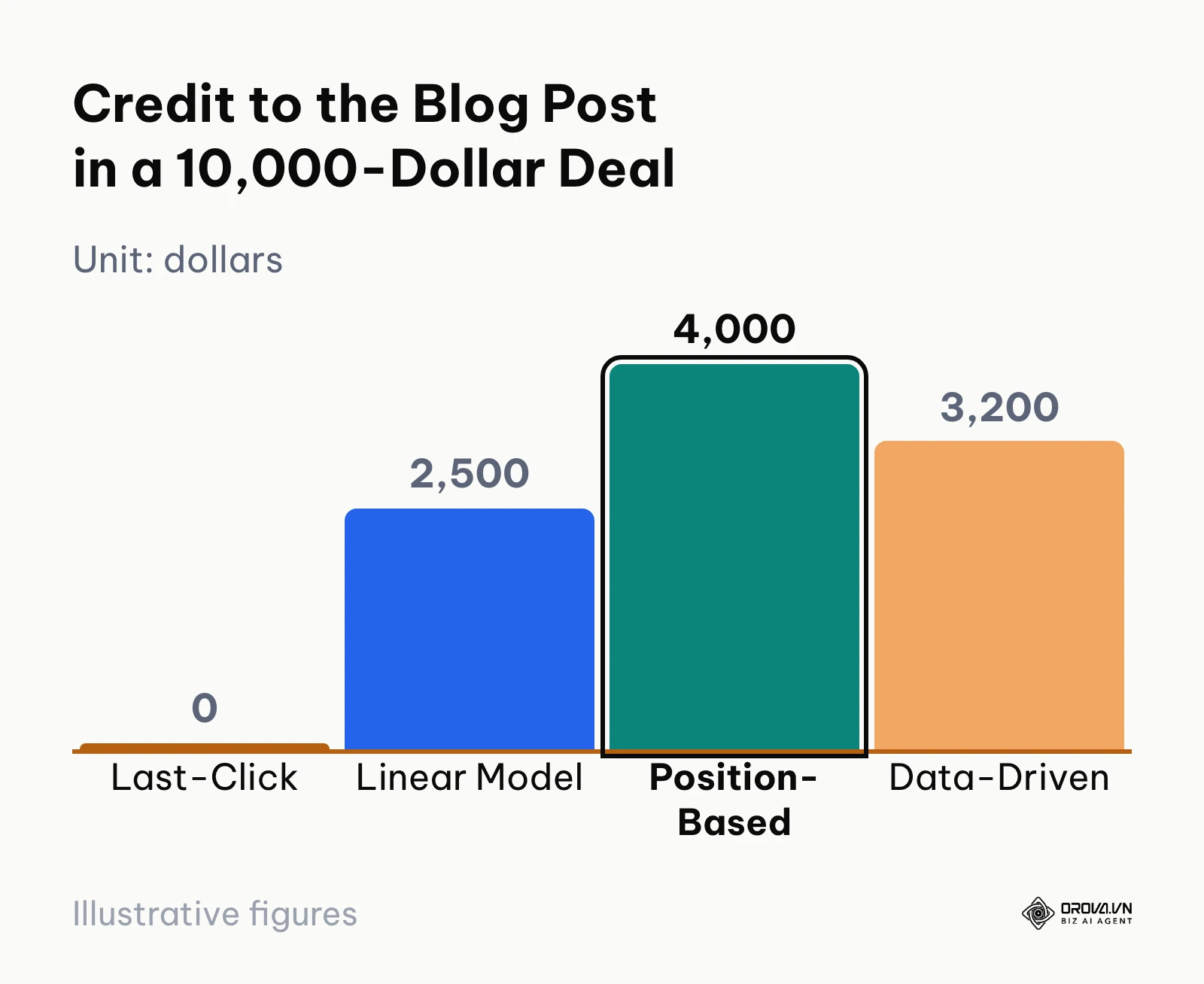
The bar chart below shows how much credit the blog post receives under each model.
Under standard Last-Click reporting, the organic blog post receives exactly 0 dollars (0%) of credit, while Direct navigation receives the full 10,000 dollars (100%). An executive examining this report would conclude that organic blogging produced zero revenue.
Under a First-Click model, the organic blog post receives the entire 10,000 dollars (100%), while social, email, and sales collateral receive zero financial acknowledgment.
Under a Linear model, each of the four touchpoints receives an equal twenty-five percent allocation, awarding the organic blog post 2,500 dollars (25%).
Under a Position-Based (U-Shaped) model, the discovery post receives forty percent (4,000 dollars), the final demo submission receives forty percent (4,000 dollars), and the intermediate social and email interactions receive ten percent each (1,000 dollars each).
Under an algorithmic Data-Driven Attribution model evaluating historical cohort behavior, the platform might find that prospects who engage with technical architecture guides close more often, awarding the blog post thirty-two percent (3,200 dollars), social eighteen percent (1,800 dollars), email fifteen percent (1,500 dollars), and direct navigation thirty-five percent (3,500 dollars).
| Customer Journey Touchpoint | Last-Click Model | First-Click Model | Linear Model | Position-Based Model | Data-Driven Model |
|---|---|---|---|---|---|
| 1. Organic Blog Post | 0 dollars (0%) | 10,000 dollars (100%) | 2,500 dollars (25%) | 4,000 dollars (40%) | 3,200 dollars (32%) |
| 2. Organic Social Share | 0 dollars (0%) | 0 dollars (0%) | 2,500 dollars (25%) | 1,000 dollars (10%) | 1,800 dollars (18%) |
| 3. Email Newsletter Click | 0 dollars (0%) | 0 dollars (0%) | 2,500 dollars (25%) | 1,000 dollars (10%) | 1,500 dollars (15%) |
| 4. Direct Demo Submission | 10,000 dollars (100%) | 0 dollars (0%) | 2,500 dollars (25%) | 4,000 dollars (40%) | 3,500 dollars (35%) |
| Total Contract Value | 10,000 dollars | 10,000 dollars | 10,000 dollars | 10,000 dollars | 10,000 dollars |
This numeric breakdown proves that relying on default last-click reports completely conceals the 3,200 dollars to 4,000 dollars in pipeline value generated by your organic technical guides.
CRM Integration via First-Touch Hidden Form Fields
Web analytics platforms provide aggregate directional insight, but they cannot tell your sales team which specific customer account read which article. To prove true pipeline contribution, you must push first-touch organic landing page data into your Customer Relationship Management (CRM) platform, such as HubSpot or Salesforce.
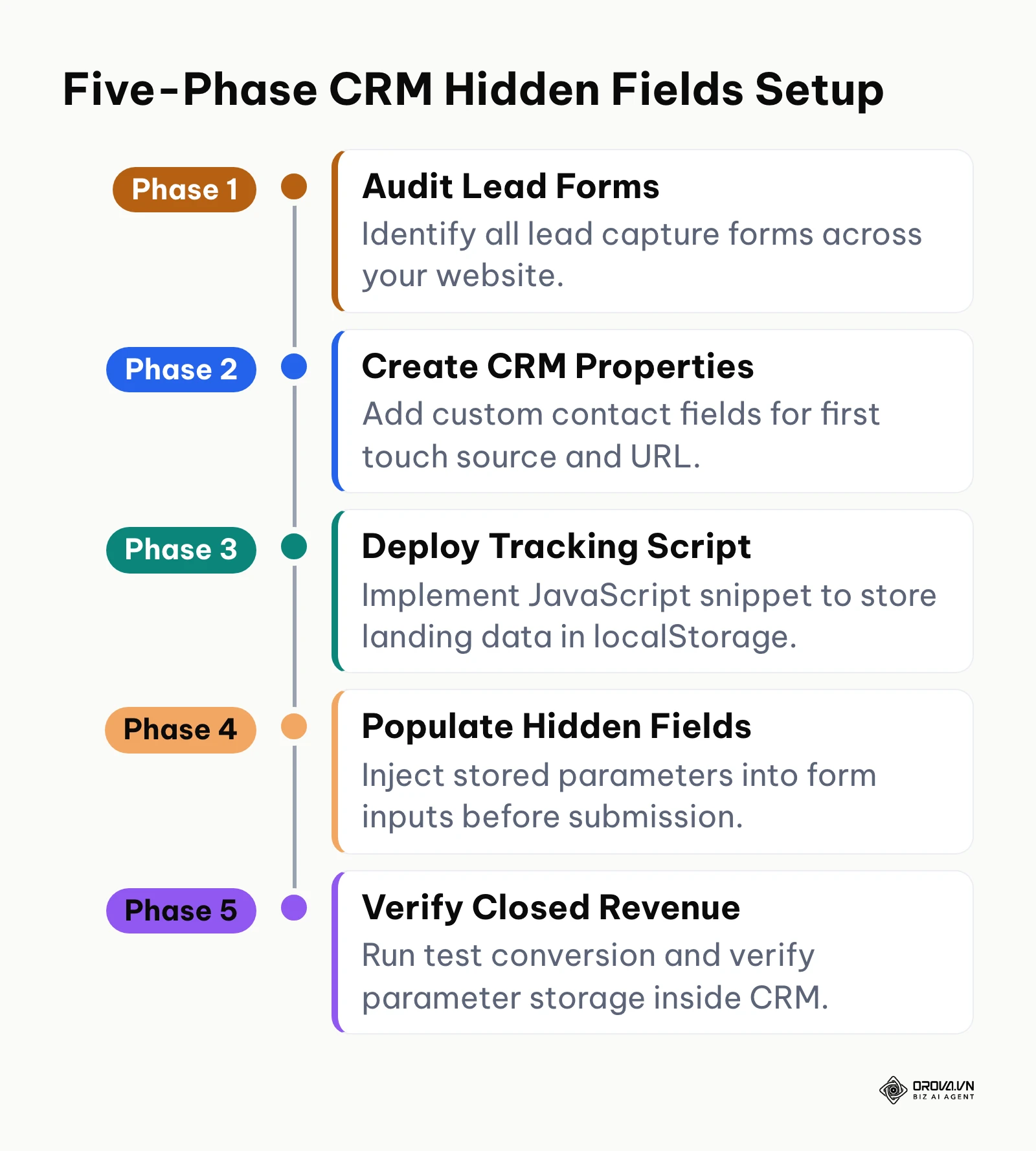
The sequence below illustrates the five phases for implementing persistent tracking fields inside your lead capture forms.
To execute this tracking, follow this implementation checklist:
- Create five custom text properties inside your CRM contact object: first_touch_source, first_touch_medium, first_touch_landing_page, last_touch_source, and original_referrer.
- Add these five properties as hidden fields on every website lead capture form.
- Deploy a lightweight JavaScript tracking snippet via Google Tag Manager that captures entry referrer data and landing page paths upon the visitor's initial arrival.
- Store these values inside the visitor's browser localStorage or sessionStorage so the parameters persist across multi-page navigation.
- Configure the script to detect form elements on the page and automatically populate the hidden input fields with the stored parameters prior to form submission.
- Verify through test form submissions that the captured landing URL successfully flows from the web form into the CRM contact record.
- Build a CRM pipeline report grouping closed-won deal revenue by the first_touch_landing_page property.
Below is an accessible JavaScript snippet that accomplishes this persistent storage and hidden field injection:
// Lightweight first-touch and last-touch storage script
(function() {
  var params = new URLSearchParams(window.location.search);
  var referrer = document.referrer || '';
  var isExternal = referrer && referrer.indexOf(window.location.hostname) === -1;
  var source = params.get('utm_source') || (isExternal ? new URL(referrer).hostname : 'direct');
  var medium = params.get('utm_medium') ||
    (/google\.|bing\.|duckduckgo\.|yahoo\./.test(referrer) ? 'organic' : (isExternal ? 'referral' : 'none'));

  // Capture first-touch data only once
  if (!localStorage.getItem('first_touch_landing_page')) {
    localStorage.setItem('first_touch_landing_page', window.location.pathname);
    localStorage.setItem('first_touch_source', source);
    localStorage.setItem('first_touch_medium', medium);
    localStorage.setItem('original_referrer', referrer || 'direct');
  }

  // Update last-touch source on every new external or tagged entry
  if (isExternal || params.get('utm_source') || !sessionStorage.getItem('last_touch_source')) {
    sessionStorage.setItem('last_touch_source', source);
  }

  // Fill the five hidden fields on every form that has them
  window.addEventListener('DOMContentLoaded', function() {
    var values = {
      first_touch_source: localStorage.getItem('first_touch_source'),
      first_touch_medium: localStorage.getItem('first_touch_medium'),
      first_touch_landing_page: localStorage.getItem('first_touch_landing_page'),
      original_referrer: localStorage.getItem('original_referrer'),
      last_touch_source: sessionStorage.getItem('last_touch_source')
    };
    document.querySelectorAll('form').forEach(function(form) {
      Object.keys(values).forEach(function(name) {
        var input = form.querySelector('input[name="' + name + '"]');
        if (input && values[name]) { input.value = values[name]; }
      });
    });
  });
})();
Measuring Zero-Click Visibility and AI Overviews
The rise of generative search features introduces a new attribution challenge: zero-click search visibility. When Google displays an AI Overview at the top of the search results page, users frequently consume a summarized answer directly on the search engine results page.
Google Search Central's documentation on AI features and your website explains that AI Overviews show links to web pages so people can explore a topic further. When users read your brand recommendation inside an AI Overview, they often do not click the citation link immediately. Instead, they remember your brand name, open a new tab three days later, and navigate to your website via a branded organic search query or direct URL entry.
Standard analytics models categorize these visitors as branded direct traffic, erasing the organic discovery origin. You can measure this zero-click assisted impact using free tools:
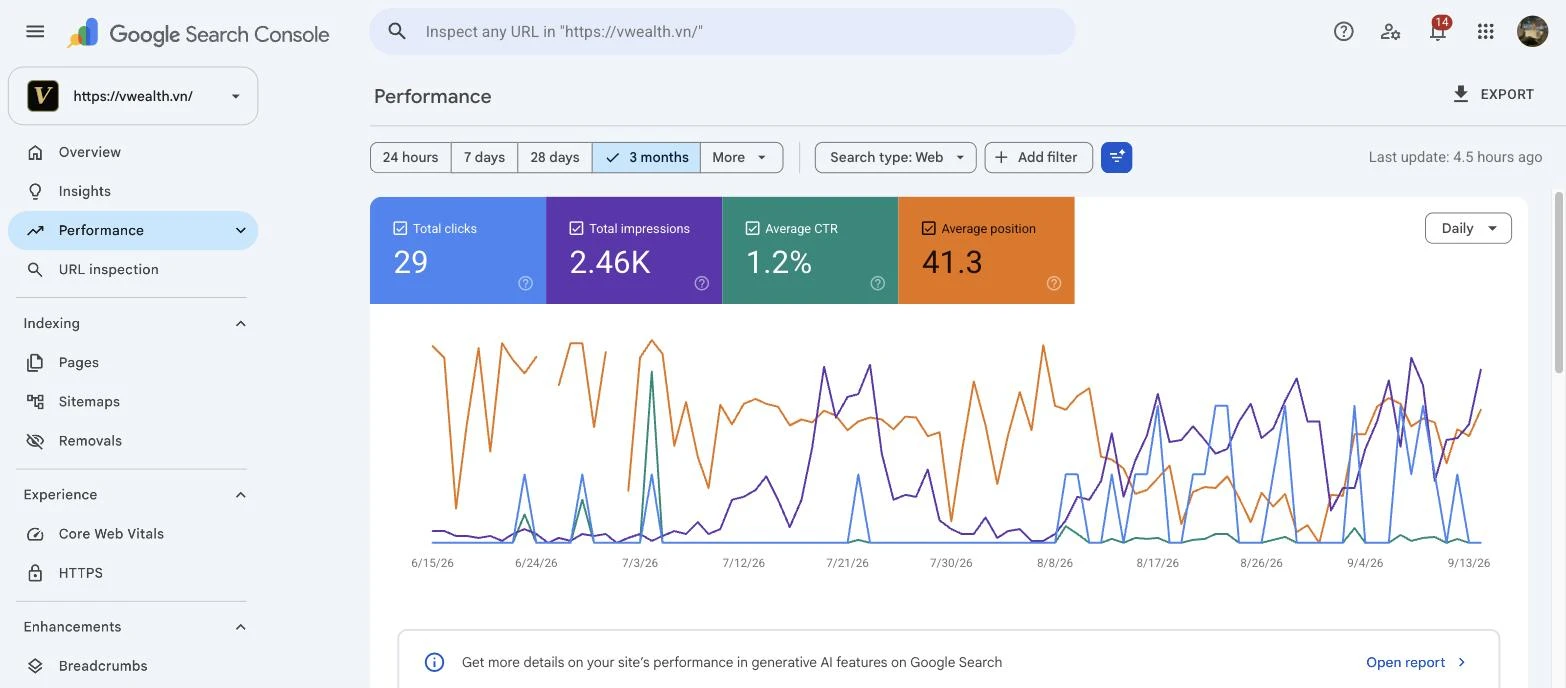
- In Google Search Console, isolate the date when your informational URL began ranking within target search queries where AI Overviews appear.
- In Google Analytics 4, monitor the daily volume of new users arriving via the Organic Search and Direct channels, and in Search Console filter queries that contain your brand name.
- Calculate the statistical correlation between impression spikes on informational URLs in Search Console and the corresponding lift in branded homepage entries over a fourteen-day window.
- To isolate branded search spikes driven by paid advertising from organic AI Overview lift, audit your Google Ads pacing. If branded search impressions rise noticeably during a period where paid search spend remained completely flat, that incremental branded lift correlates directly with unclicked organic search impressions and AI Overview citations.
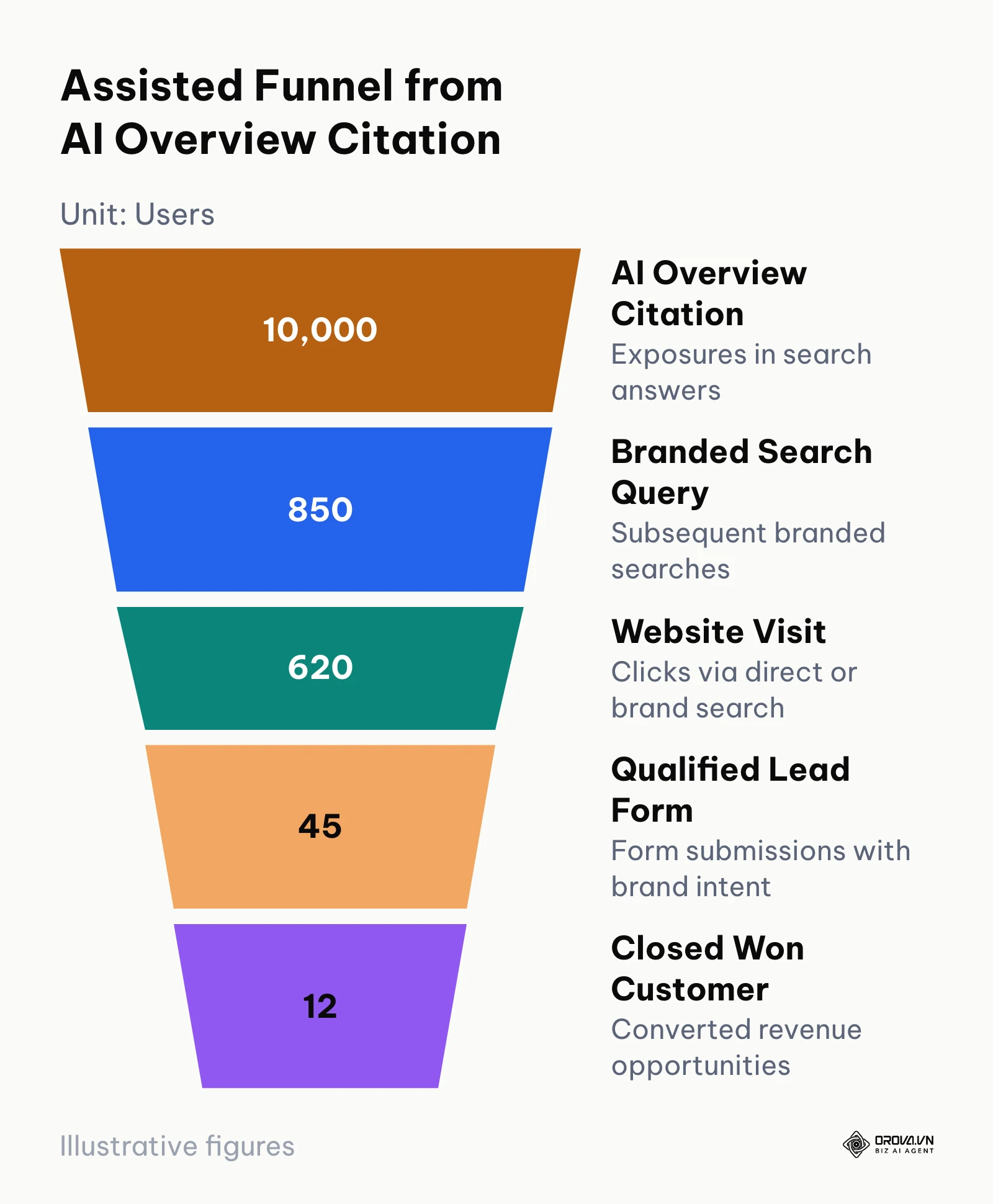
The funnel diagram below illustrates how top-of-funnel exposures within AI search answers nurture prospects through branded discovery and downstream revenue.
Decision Matrix: Matching Attribution Frameworks to Business Models
Selecting an appropriate attribution methodology requires matching your reporting capabilities to your business sales cycle, transactional velocity, and technical resources.
| Business Model | Typical Sales Cycle | Primary Customer Path | Recommended Attribution Setup | Key Supporting Tools |
|---|---|---|---|---|
| High-ACV B2B SaaS | 45 to 180 days | Multi-device, committee research across 5+ touchpoints | First-Touch CRM Hidden Fields combined with GA4 Data-Driven Attribution | HubSpot/Salesforce, Google Tag Manager, Looker Studio |
| Considered E-Commerce | 7 to 30 days | Research guide discovery followed by retargeted purchase | GA4 Data-Driven Attribution with 90-day conversion lookback window | GA4 Advertising Workspace, First-Party Cookie Tagging |
| Fast-Moving Consumer Goods | Under 48 hours | Immediate single-session or two-touch checkout | GA4 Last-Click with basic assisted channel comparison | GA4 Standard Reports, Google Merchant Center |
| Professional Services / Legal | 14 to 60 days | Educational blog discovery leading to phone call or contact form | Dynamic Call Tracking and First-Touch Landing Page CRM capture | CallRail, CRM Hidden Fields, Google Search Console |
Illustrative example: A direct-to-consumer ergonomic furniture retailer generating five million dollars in annual online sales noticed that their high-performing educational guide on home office posture showed zero direct sales in standard last-click e-commerce reports. The lead digital marketer configured a custom Exploration report in Google Analytics 4 comparing first-touch organic landings with 30-day conversion paths, then established a UTM tracking taxonomy across their internal email newsletters and remarketing campaigns. The initial hurdle occurred when iOS privacy features truncated Safari tracking cookies after seven days, which the team resolved by establishing a first-party server-side tagging container on a custom subdomain to preserve customer journey persistence. The analysis revealed that while the posture guide rarely generated same-day checkouts, it initiated customer acquisition for thirty-one percent of their highest-margin standing desk purchasers who later converted through direct visits or promo emails.
With OROVA.VN and the OROVA SEO module, you put an end to the exhausting days of manual work for good. Instead of struggling for hours to write articles and compile reports, the entire process is now optimized and completed in just 5 minutes.
How to Implement an SEO Attribution Model by Team Role
Implementing an seo attribution model requires clear role-based execution. Different team members hold distinct responsibilities depending on whether they operate as founders, in-house marketers, or external consultants.
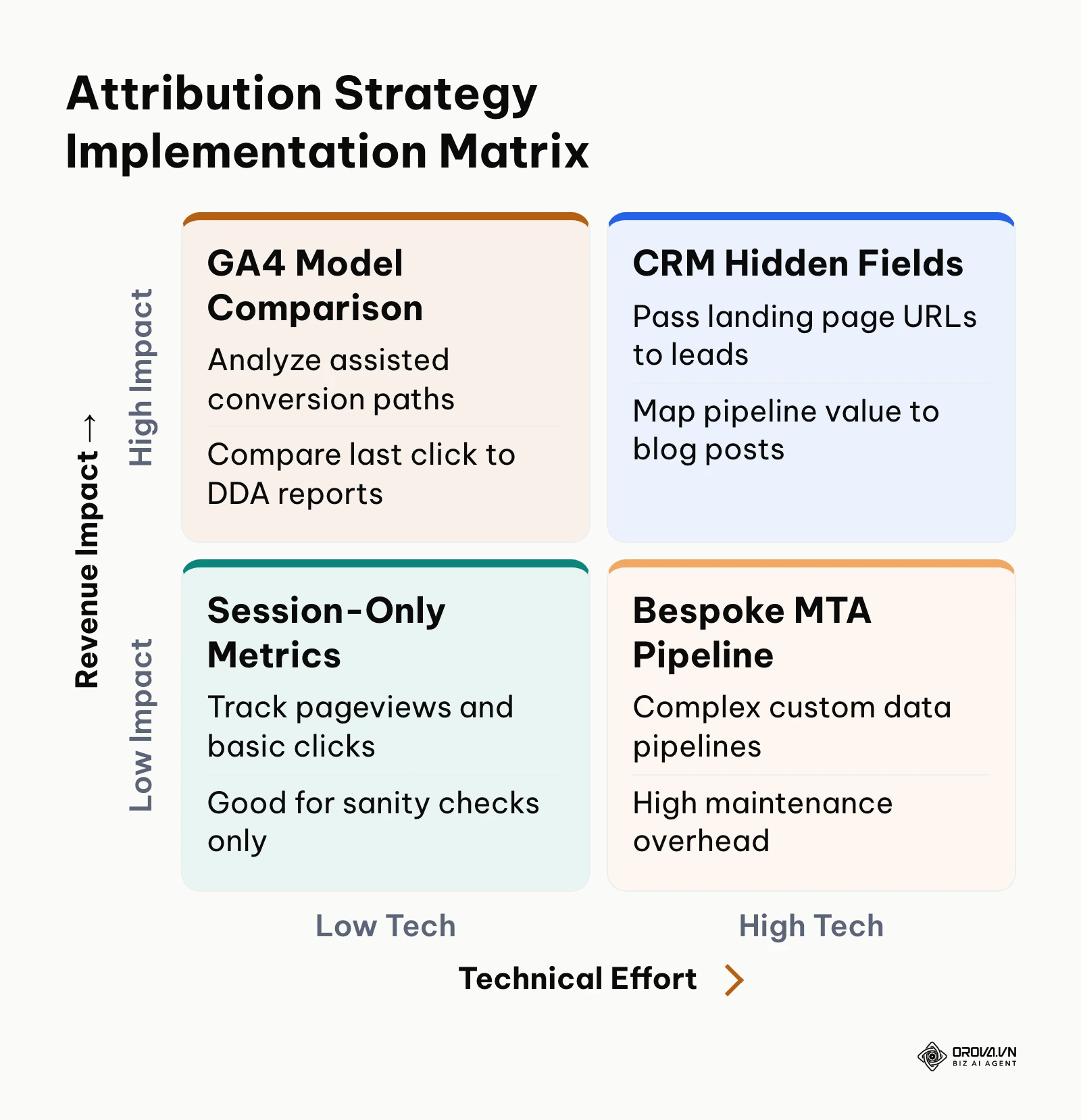
The implementation matrix below charts the relationship between technical deployment effort and business impact across various attribution workflows.
Small Business Owners and Solo Founders
Founders need commercial clarity without sinking dozens of hours into complex data engineering:
- This week: Access your Google Analytics 4 property, open Admin, select Data Display, click Attribution Settings, and verify that your Reporting attribution model is set to Data-driven rather than Last-click.
- Check that the lookback window for all other key events is set to 90 days, the longest option, so long-tail organic discovery is preserved (acquisition key events are capped at 30 days).
- Review the Advertising > Conversion paths report once per month to observe how frequently organic search appears in early and middle touchpoints relative to paid channels.
- Align your SaaS SEO funnel content investments based on which topic clusters generate real assisted conversions rather than gross traffic volume.
In-House SEO Managers and Marketing Leads
In-house marketing leaders must bridge the technical gap between website analytics and sales revenue:
- This week: Audit every lead generation form across your website and collaborate with your web developer to insert the five hidden CRM tracking fields outlined earlier.
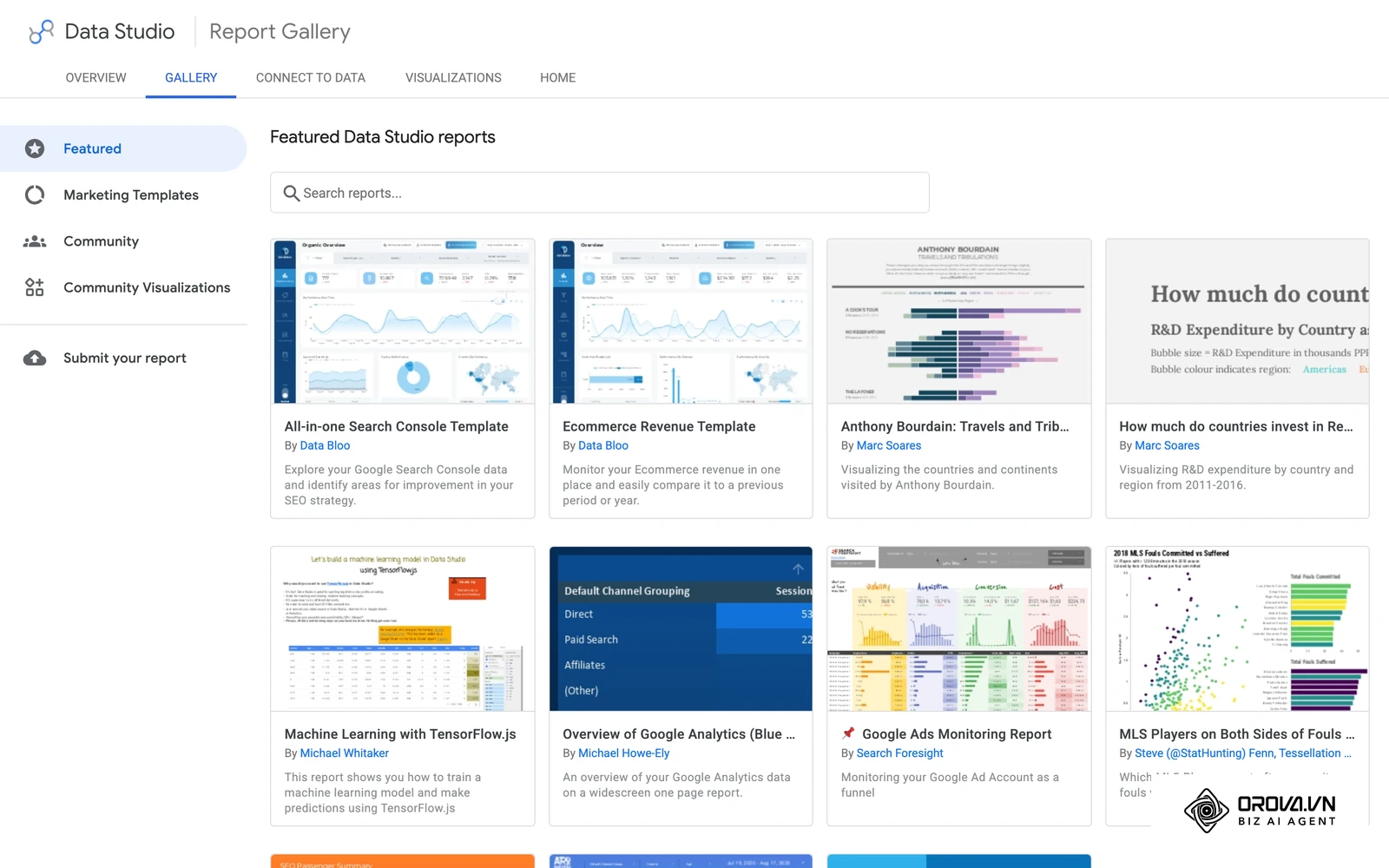
- Establish a monthly dashboard in Looker Studio that extracts GA4 multi-channel data, showcasing First-Touch Revenue from your CRM fields and Last-Click Revenue from GA4 side by side.
- Review your core business-focused SEO KPIs with executive stakeholders, shifting reporting discussions from keyword positions to pipeline influence.
- Conduct quarterly content pruning reviews that protect low-traffic URLs if those pages demonstrate high assisted-conversion ratios in CRM closed-deal data.
Agency Consultants and Freelance SEO Specialists
External advisors must demonstrate verifiable financial return to prevent client churn:
- This week: Incorporate an assisted conversion audit into your standard client reporting deliverables using the GA4 Model comparison tool.
- Educate client stakeholders on the limitations of last-click reporting during quarterly business reviews, demonstrating how previous organic campaigns initiated deals attributed to direct traffic.
- Configure custom Exploration reports demonstrating how organic informational articles support other paid media channels by lowering overall customer acquisition costs.
- Integrate strategic Google SEO optimization tools into client reporting workflows to correlate Search Console query demand with CRM pipeline volume.
Common Mistakes in SEO Attribution Implementation
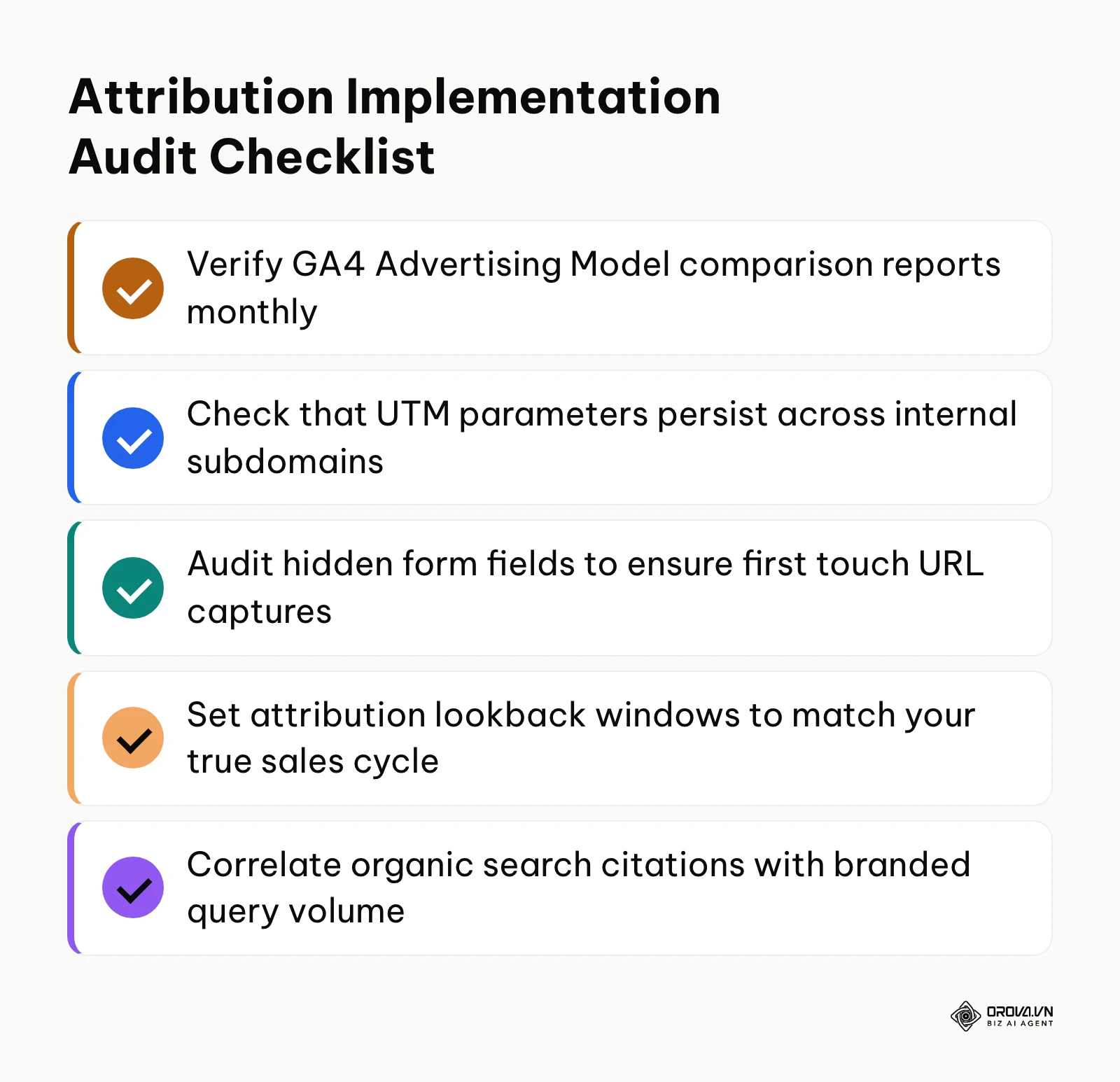
The audit checklist below highlights critical verification items to maintain data hygiene across your tracking pipeline.
| Implementation Mistake | Business Consequence | How to Prevent |
|---|---|---|
| Evaluating Top-Funnel Content on Last-Click | High-assisting educational content gets defunded or deleted | Always inspect assisted conversion metrics before pruning or modifying blog URLs |
| Shortening Lookback Windows to 30 Days in B2B | Multi-month enterprise sales cycles lose attribution connection | Keep the GA4 lookback window for other key events at 90 days in Attribution Settings |
| Failing to Persist First-Touch Data Across Sessions | Mid-funnel email or social visits overwrite organic origin | Store first-touch parameters in browser localStorage rather than temporary single-page variables |
| Ignoring Cross-Domain Subdomain Tracking | Moving from blog to app or store resets user identity to direct | Configure Google Tag Manager cross-domain linkers across all primary and secondary subdomains |
| Crediting 100% of Branded Search to SEO Skill | Paid brand campaigns or PR events distort organic performance | Separate branded queries from non-branded discovery queries in all performance reports |
Illustrative example: An enterprise SaaS analytics agency managing search strategy for twelve corporate software clients struggled to prevent clients from reallocating organic retainers toward Google Ads. The agency technical lead created five hidden form fields inside client HubSpot demo forms, deployed a custom JavaScript snippet to capture the original organic landing URL into browser session storage, and built an automated Looker Studio pipeline matching closed CRM revenue against organic entry URLs. The primary obstacle was that single-page application framework page transitions failed to trigger hidden field population, which the technical team resolved by binding the field injection script to form rendering mutation observers rather than standard page load events. Every client retained their organic content agreement during annual reviews because the attribution reports proved that organic informational guides directly influenced 420,000 dollars in qualified pipeline that paid search had historically claimed.
SEO Attribution Model Trends in the Coming Years: Author Perspective
The landscape of search measurement is undergoing its most profound transformation in two decades. Based on architectural patterns emerging across analytics platforms, I see three distinct developments shaping organic measurement over the coming years.
Shift Toward Server-Side Identity and Privacy-Durable Attribution
Today, as of 2026, client-side tracking cookies face severe browser restrictions, degrading multi-touch visibility across extended sales cycles. Over the coming years, I anticipate that standard browser-based attribution will become obsolete for complex purchases, replaced by first-party server-side tagging and customer data platform event streams. Teams that rely exclusively on standard browser scripts will see their reported organic assisted conversions drop artificially. In my view, marketing leaders must transition their core tracking infrastructure to server-side containers now to preserve touchpoint durability as third-party identifiers keep losing reliability. This expectation could prove incorrect if regulatory bodies enforce strict restrictions on first-party hashing mechanisms.
Predictive Pipeline Simulation Replacing Reactive Log Modeling
Current attribution relies on backwards-looking historical logs, assigning credit only after a conversion event has concluded. I expect that enterprise analytics will pivot toward predictive pipeline modeling, where machine learning algorithms project the downstream revenue contribution of an organic visit at the exact moment a user consumes top-funnel content. Instead of waiting sixty days to evaluate whether an informational guide contributed to a sale, systems will score session engagement against historical conversion likelihood. I recommend teams begin instrumenting granular scroll depth, intent-based click events, and time-on-page metrics today to train these future predictive scoring models.
Citation-Level Attribution for Generative Answer Engines
The expansion of zero-click answer engines and AI summaries has fragmented traditional click-through traffic. I believe that forward-thinking organizations will treat answer engine citations as distinct attribution touchpoints alongside traditional URLs. Attribution models will synthesize share of voice, citation frequency, and branded query lift into a unified organic influence metric. To prepare, practitioners should establish baselines correlating AI overview citations with branded search volume. This projection could fail if search providers restrict citation transparency or monetize answer summaries through closed ad networks.
Frequently Asked Questions About SEO Attribution Models
Is an SEO attribution model still necessary in the age of AI?
Yes, an seo attribution model is more necessary today than ever before because generative search and AI Overviews lengthen the customer research phase and reduce direct first-click conversions. Without attribution modeling, organizations will mistakenly assume that organic search has stopped producing revenue simply because user paths involve more zero-click research and delayed branded returns. Implementing attribution ensures that organic discovery receives proper financial credit regardless of how many intermediate AI or direct touchpoints occur.
How can you prove an informational blog post generated revenue when a user converts 45 days later via direct navigation?
You prove this by capturing the initial landing page URL into a persistent browser cookie or localStorage string during the user's first visit and passing that value into a hidden CRM field when the user eventually completes a form. Alternatively, you can use the GA4 Conversion Paths report with a 90-day lookback window to demonstrate that the direct checkout path originated with an organic search session on that specific blog URL.
Why did Google remove rule-based attribution models like Linear and First-Click from GA4?
Google removed these models starting in September 2023, explaining that few advertisers still used them and recommending data-driven attribution instead. Rule-based models split credit by fixed percentages regardless of whether an interaction genuinely changed user intent, whereas Data-Driven Attribution compares converting and non-converting paths to estimate each touchpoint's contribution.
How do you separate branded search lift driven by paid advertising from organic AI Overview citations?
To isolate these channels, audit your daily paid search spend and ad impression volume against your organic branded query trends in Google Search Console. If your non-paid branded impressions rise significantly during a window where paid advertising budgets and external media campaigns remained completely flat, that incremental branded lift correlates directly with unclicked impressions and citations generated within search engine AI answers.
What is the practical difference between assisted conversions and first-touch attribution?
First-touch attribution assigns one hundred percent of the conversion value strictly to the initial entry channel, ignoring all subsequent nurturing interactions. Assisted conversions measure every instance where a channel participated anywhere along the conversion path prior to the final click, allowing marketers to evaluate multi-touch influence without erasing the contribution of closing channels.
What is the recommended attribution lookback window for B2B organic search?
For B2B organizations, the lookback window for other key events should stay at 90 days, the longest setting available in Google Analytics 4. Enterprise software and considered professional services regularly exhibit buying cycles lasting between thirty and ninety days, meaning shorter thirty-day windows will artificially sever the connection between early organic discovery and final deal closing.
Where Should You Start with Your SEO Attribution Model?
Implementing an attribution system does not require rebuilding your entire technology stack overnight. Your immediate action depends on the current tracking maturity of your organization.
If you are starting with zero tracking infrastructure, your single initial action this afternoon is to log into Google Analytics 4, open Admin, navigate to Data Display, click Attribution Settings, and confirm that your reporting attribution model is configured to Data-driven with a 90-day lookback window for other key events. This adjustment makes your standard reports credit earlier touchpoints instead of only the final click.
If you have tracking active across isolated silos, your primary step today is to audit your primary contact or demo form and add the five hidden fields described earlier: first-touch source, first-touch medium, first landing page, original referrer and last-touch source. Connecting these five fields to your CRM contact records bridges anonymous web analytics with real pipeline revenue without requiring new software subscriptions or complex data warehouses.
If you are actively publishing content via a structured SEO blog but have never measured its assisted financial return, open the Advertising workspace in Google Analytics 4, navigate to Attribution, and generate a Model Comparison report comparing Last click against Data-driven attribution for organic search traffic. Inspecting the conversion volume difference across your top five landing pages will immediately demonstrate which informational articles are generating assisted pipeline value.
Taking any of these targeted initial steps provides the foundational visibility required to justify content investments and prove the true business value of your seo attribution model.
About the author

Builder of Orova
Nguyễn Đỗ Trọng Ân has 8 years of experience in marketing, including 6 years managing market development across Asia. He builds Orova, a Biz AI Agent that never sleeps: it plans, runs and optimizes work for businesses.
Run your business with AI Agents
Orova is the always-on Biz AI Agent — it plans, runs, and optimizes the work for you.
Save time, unlock productivity.