
What are SEO KPIs? How to choose them by goal and role

SEO KPIs are the few search metrics you tie directly to a business goal, such as revenue, qualified leads, or reach in a new market, so you can tell whether SEO is paying off. The right set depends on that goal, not on how many numbers your tools can show. Imagine you have spent six months optimizing your website, publishing high-quality content, and building authoritative links. Your organic traffic has doubled, and your keyword rankings are soaring. You walk into a meeting with your CEO, proudly presenting these charts, but their only question is: "How much revenue did this actually generate?" If you cannot answer that, you are tracking the wrong data. For years, digital marketers have relied on vanity metrics—numbers that look good on paper but do not translate to business growth. Today, tracking every single metric is a waste of time. You need a structured approach to measure what truly matters, separate brand growth from generic search growth, and automate the entire reporting process. In this guide, we will explore how to choose SEO KPIs by goal, track them, and use them to prove ROI and make data-driven decisions that align with your company's financial goals. By the end, you will know how to build a robust reporting system that speaks the language of business leaders.
What are SEO KPIs?
SEO KPIs are quantifiable metrics used by marketing teams and business owners to evaluate the success, efficiency, and financial return of their search engine optimization strategies. They act as navigational markers, helping you understand whether your technical tweaks and content creation are actually contributing to the broader business objectives or simply burning through your budget without a clear payoff.
The origin of these metrics traces back to the early days of web analytics, when webmasters simply counted "hits" or page views. As search engines evolved to become more sophisticated, so did the need for nuanced measurement, shifting the focus from mere visibility to actual user engagement and commercial value.
To fully grasp the concept, it is crucial to differentiate it from similar terms often used interchangeably in marketing meetings:
| Concept | How it differs | Example |
|---|---|---|
| SEO KPIs | Measures progress toward high-level business goals over time. | Organic Revenue, Customer Acquisition Cost from search. |
| SEO Metrics | Raw data points that inform daily tasks but do not directly show ROI. | Bounce rate, crawl rate, page load speed in seconds. |
| Business Objectives | The ultimate financial or growth targets of the company. | Increasing total company revenue by 20% this year. |
A common everyday example is driving a car. Your business objective is reaching a destination on time. The SEO metrics are the numbers on your dashboard—engine temperature, tire pressure, and current speed. The SEO KPIs are the estimated time of arrival (ETA) and your remaining fuel range; they directly tell you if your current performance will allow you to achieve your ultimate goal successfully.
The Meaning of SEO KPIs: Moving Beyond Vanity Metrics
The core purpose of tracking these indicators is to solve a fundamental problem for marketing professionals: accountability. Without a clear measurement framework, search engine optimization is often viewed as a "black box" by upper management—a mysterious expense that occasionally yields results. These indicators exist to translate technical and creative work into the universal language of business: revenue, growth, and efficiency.
In the broader picture of digital marketing, performance tracking sits squarely between execution and strategic planning. First, you conduct research and implement changes on your website. Next, you must measure the impact of those changes using an seo report to gather insights. Finally, those insights feed back into your strategy, dictating where to allocate resources next. It is a continuous feedback loop that prevents teams from operating blindly in a highly competitive digital environment.
If you ignore these tracking mechanisms, you lose the ability to justify your budget. You might be spending thousands of dollars creating content that generates massive traffic but zero sales, essentially subsidizing the internet with free information at your company's expense. You also lose the ability to identify failing strategies before they drain your resources completely, turning minor missteps into costly long-term failures.
When you do not need SEO KPIs yet: There are specific situations where setting up complex tracking is premature or wasteful. First, if your website is brand new and has less than a few hundred visitors a month, obsessing over conversion rates is pointless; you lack statistical significance. Second, if you are a local mom-and-pop shop that relies entirely on foot traffic and word-of-mouth, complex digital ROI tracking might overcomplicate your simple business model. In these early stages, focus on basic indexation and creating helpful content before worrying about advanced performance indicators.
The True Value and Benefits of Tracking SEO KPIs
Understanding the impact of your search strategy delivers profound advantages on two distinct levels: the macro business value for the company as a whole, and the micro operational benefits for the people doing the daily work.
Financial and Strategic Value for the Business
For the organization, the primary benefit is risk mitigation and resource optimization. When you know exactly which campaigns drive revenue, you stop wasting money on initiatives that do not work. Marketing leaders who can tie organic traffic to commercial outcomes are in a much stronger position when budgets are decided. This level of clarity allows companies to forecast growth accurately and outmaneuver competitors who are still guessing. It transforms marketing from a cost center into a predictable profit engine. For many B2B buyers, search is still a key way to discover vendors, which makes proper measurement a strategic priority.
Operational Benefits for the Executor
For the hands-on practitioner, robust tracking provides intense focus and professional validation. Instead of feeling overwhelmed by hundreds of minor technical errors, a specialist can prioritize the few critical issues that actually impact conversions. It also provides empirical proof of their hard work, transforming subjective debates about content quality into objective discussions about performance data, thereby elevating their status and influence within the company.
| Benefit | Measured by which metric? | Relative time to see results |
|---|---|---|
| Budget Justification | SEO ROI | Slowest: needs several months of revenue data |
| Content Prioritization | Conversion rate per page | Medium: needs enough conversions per page |
| Technical Focus | Core Web Vitals pass rate | Fastest: visible soon after fixes are crawled |
Illustrative example:
- Context: A mid-sized B2B SaaS company generating 5 million dollars in annual recurring revenue needed to prove the financial value of their newly established engineering blog to a skeptical board of directors.
- Steps taken: First, they mapped informational keywords to early-stage awareness in the buyer journey. Second, they set up goal tracking in Google Analytics 4 for newsletter signups and whitepaper downloads. Third, they attributed a micro-conversion value of 50 dollars to each signup based on historical lead-to-close rates.
- Hurdle and fix: They initially struggled with cross-device tracking, causing missing data when users switched from mobile reading to desktop purchasing. They fixed this by enabling Google Signals and user-ID tracking in GA4, unifying the user journey.
- Result: The marketing team could clearly show that their blog content directly drove 200 qualified signups per month, equating to 10,000 dollars in pipeline value, successfully securing a budget increase for the next quarter.
Discover Orova.vn – a Biz AI Agent platform with OROVA SEO, a complete solution for every website. The system supports search engine optimization from A to Z with features including keyword research, writing new SEO-ready articles, optimizing existing content, rank tracking, plus competitor analysis and in-depth technical analysis. Sign up today to experience OROVA SEO completely free (offer valid through July 7, 2027).
How SEO KPIs Work: The Modern Measurement Framework
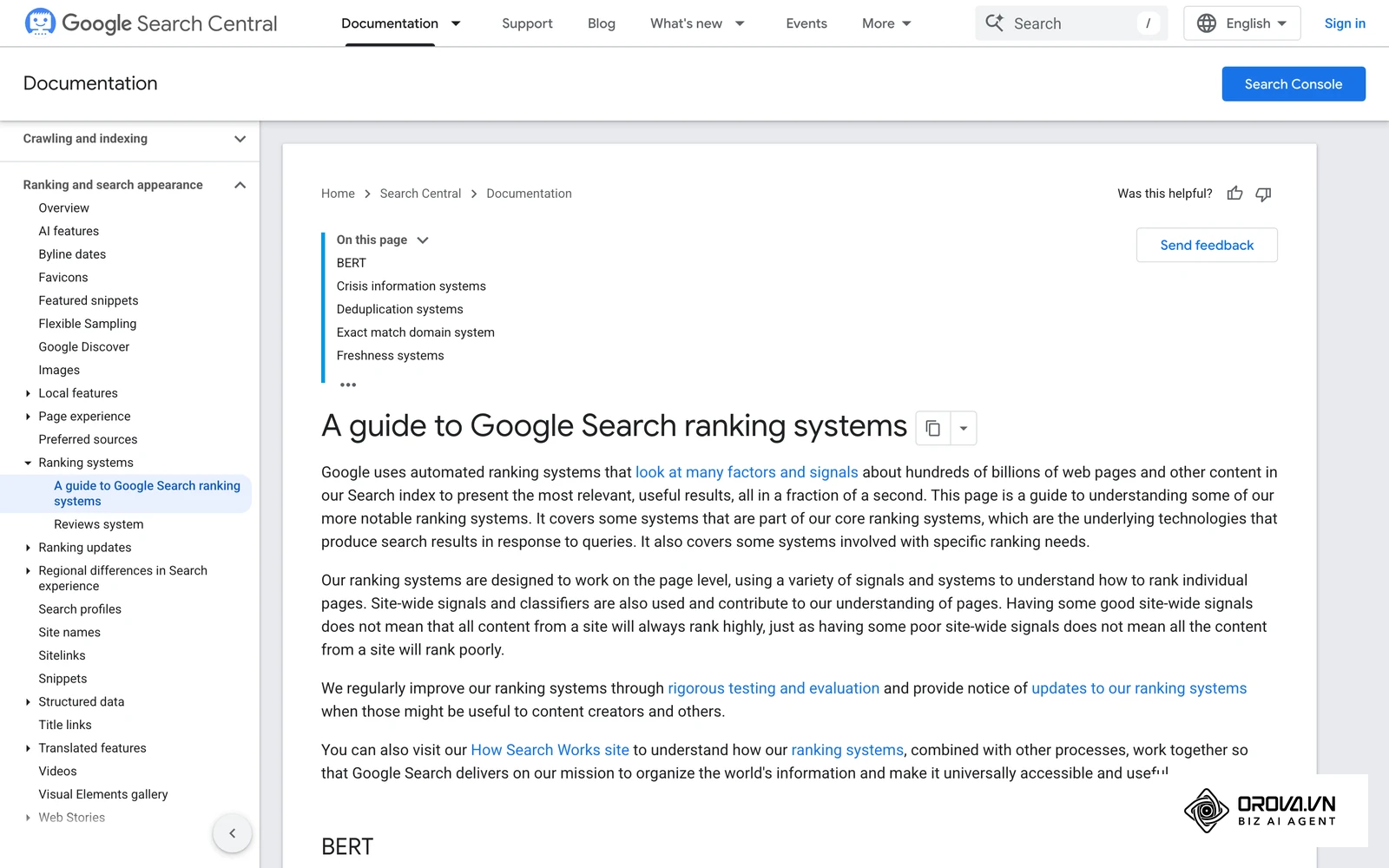
To effectively measure search performance, you must dissect the entire discipline into its core components. The modern framework moves away from looking at single data points in isolation and instead focuses on how different stages of the user journey interact. This section will break down the essential components, detail how to build your marketing dashboard kpis, and provide a structured approach to tracking.
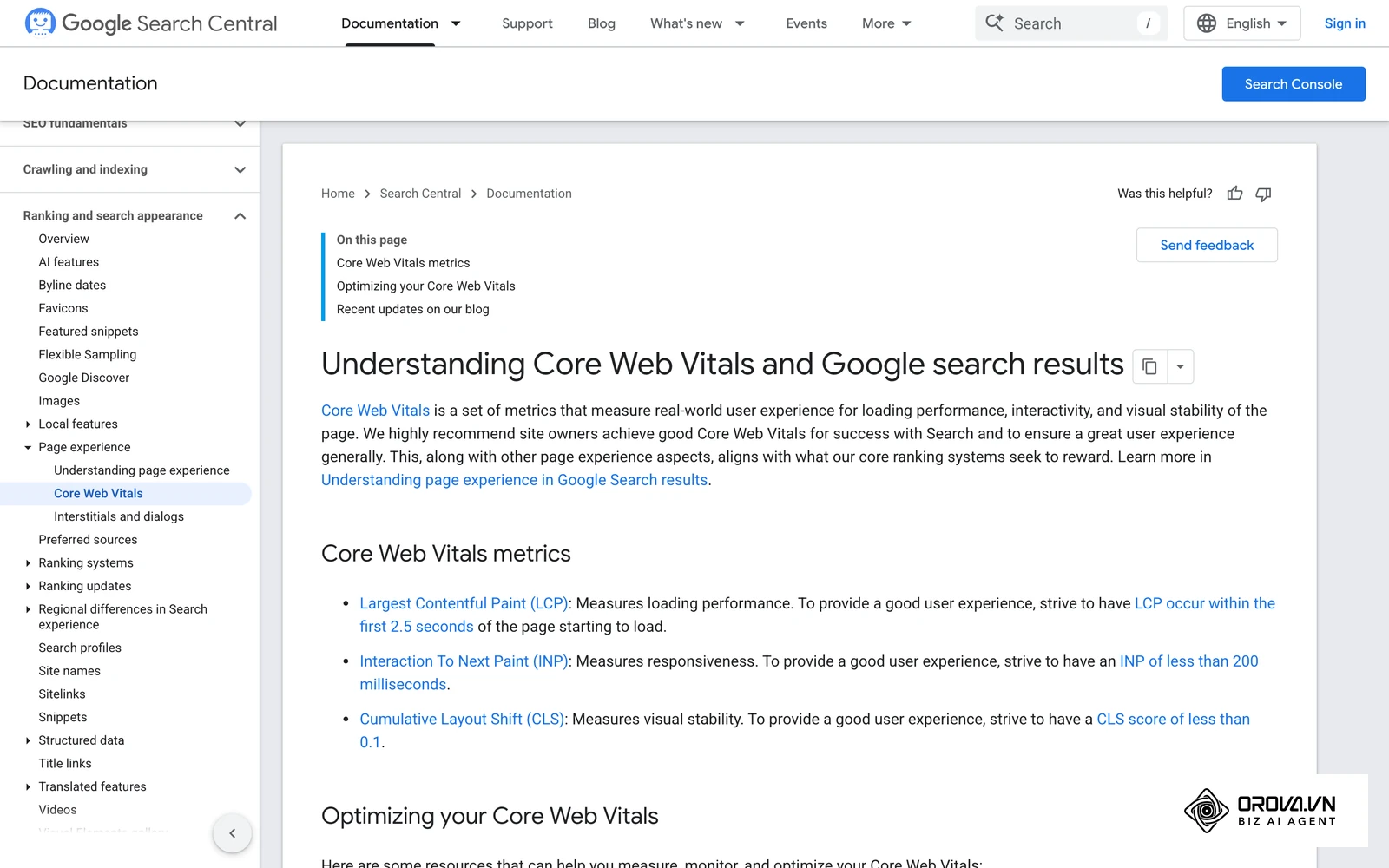
Visibility and Ranking Component
- What it does: This component tracks your website's presence in search engine results pages before a user even clicks. It represents the absolute top of your funnel, showing potential reach.
- Input data: Data is typically pulled from Google Search Console (Impressions, Average Position) or third-party rank tracking software; this search engine rank monitoring guide explains how to set that up.
- Output data: It provides a clear picture of your "share of voice" in the market and whether search engines consider your content relevant for specific targeted queries.
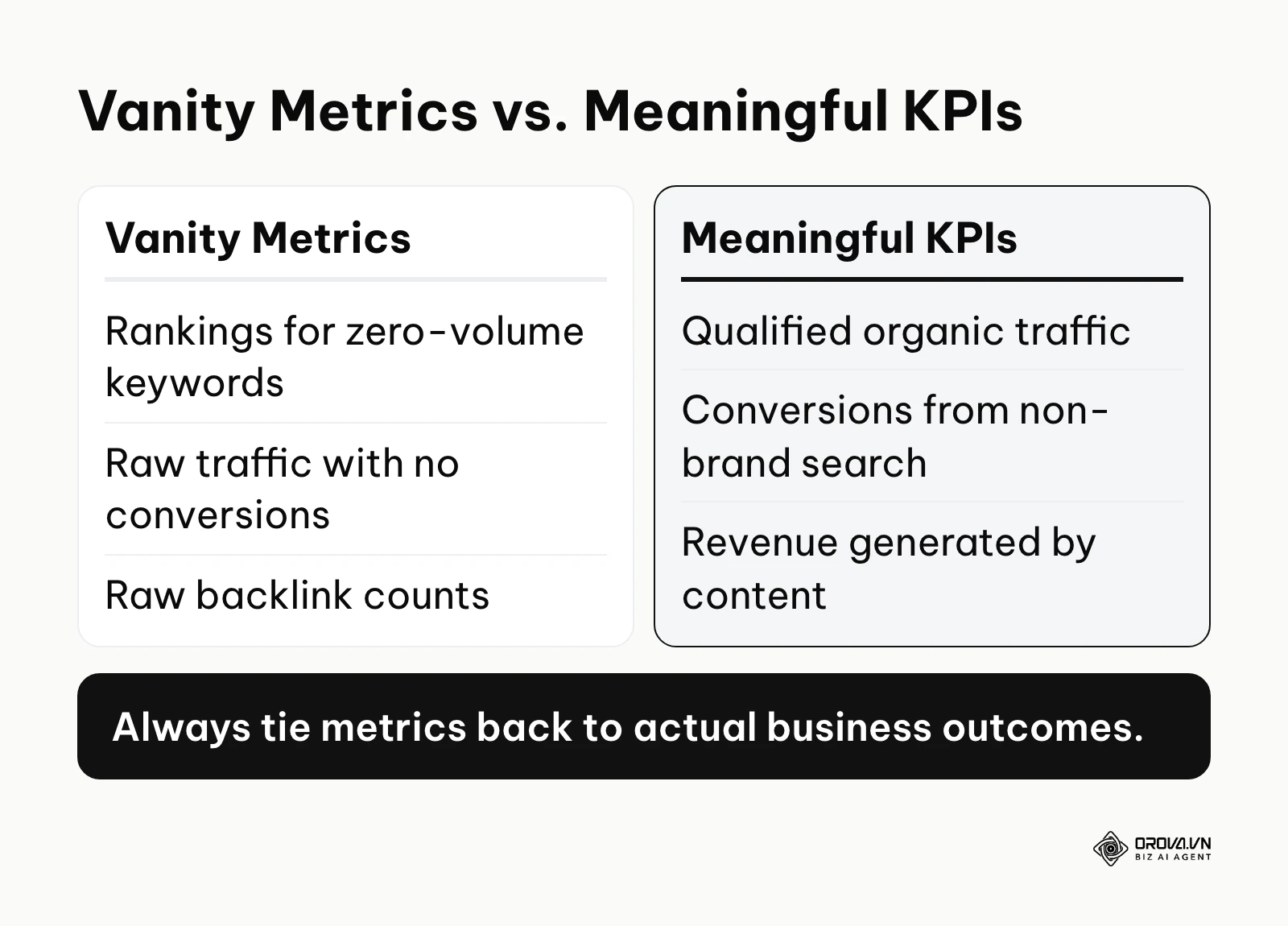
- Where it breaks: This metric often breaks when personalized search results skew the data. An average position of "3" might look great, but if it only appears there for users who have previously visited your site, the metric is highly misleading. Furthermore, tracking zero-volume keywords can inflate your perceived visibility without delivering any actual business value.
Traffic and Acquisition Component
- What it does: This tracks the volume and quality of users who actually click through to your website from search engines, moving from potential reach to actual visitors.
- Input data: Click data from Search Console and Sessions/Users data from Google Analytics 4. If you are unsure how these numbers are collected, see how to measure website traffic accurately.
- Output data: It reveals the actual audience size your efforts are capturing. More importantly, analyzing the Click-Through Rate (CTR) tells you how compelling your title tags and meta descriptions are to real human beings.
- Where it breaks: Traffic metrics are easily corrupted by bot traffic, spam referrals, or internal company traffic. If you do not apply rigorous IP filters to exclude your own employees' visits, your acquisition data will falsely suggest a growing, engaged audience when it is actually just your staff working.
Engagement and Behavioral Component
- What it does: Once users are on your site, this component measures how they interact with your content. It fundamentally answers the question: "Did they find what they were looking for?"
- Input data: GA4 metrics such as Engagement Rate, Average Engagement Time, and specific event triggers like scroll depth.
- Output data: High engagement signals to both you and search algorithms that your content is valuable, satisfying user intent and likely deserving of higher future rankings.
- Where it breaks: Traditional "Bounce Rate" was notoriously flawed because a user could read a 5,000-word article for ten minutes, find exactly what they needed, leave without clicking another page, and still be counted as a "bounce." The shift to Engagement Rate in GA4 fixes this, but it can still break if your events are not configured to trigger correctly upon scrolling or specific time thresholds.
Conversion and Commercial Component
- What it does: The ultimate test of performance, measuring the tangible business outcomes generated by organic traffic, such as e-commerce sales, qualified leads, or premium signups.
- Input data: E-commerce revenue data, form submissions, and Customer Relationship Management (CRM) data linked back to the organic search source.
- Output data: Hard financial figures, lead volume, and calculated ROI, which are generally the only numbers the executive suite truly cares about.
- Where it breaks: Attribution modeling is the biggest breaking point here. If a user discovers your brand via an organic blog post on Monday, but returns via a direct branded search on Friday to buy, a simplistic "last-click" attribution model will give zero credit to the original blog post, entirely misrepresenting the value of your informational content.
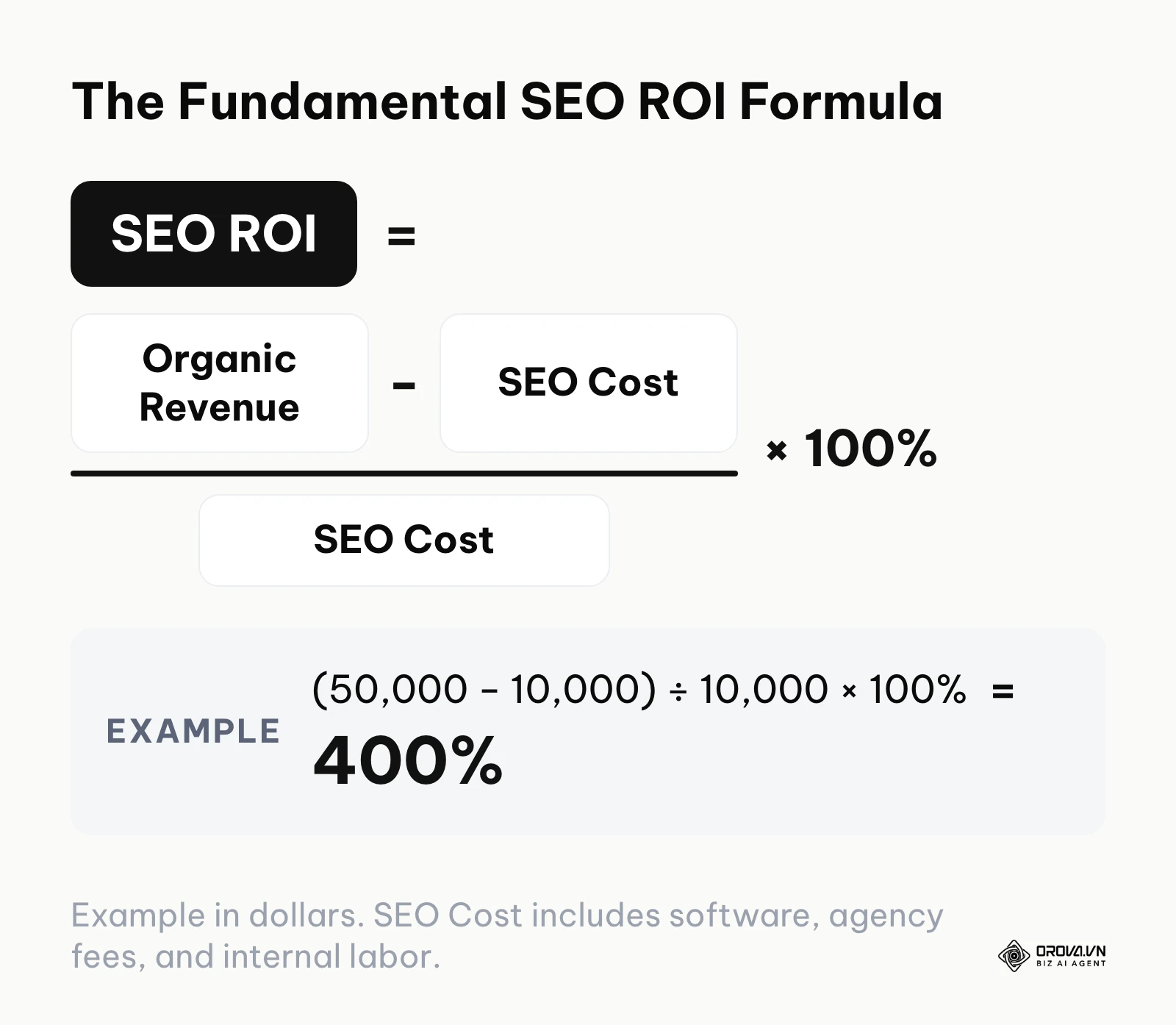
Once revenue is attributed, the basic calculation (explained in depth in this SEO ROI formula guide) is SEO ROI = (Organic Revenue − SEO Cost) ÷ SEO Cost × 100%. For example, if organic search brought in 50,000 dollars and SEO cost 10,000 dollars (software, agency fees, and internal labor), the ROI is (50,000 − 10,000) ÷ 10,000 × 100% = 400%.
AI Search and Generative Component
- What it does: In the modern era of AI Overviews and ChatGPT, traditional ranking positions are insufficient. This component tracks how often your brand is cited as an authoritative source by AI engines.
- Input data: Emerging tools that track brand mentions in Large Language Model (LLM) outputs, referral traffic from AI chat interfaces, and specific long-tail conversational query growth.
- Output data: An estimate of how often your brand appears in generative responses, which often bypass traditional search pages entirely.
- Where it breaks: Because AI platforms currently provide limited analytics APIs compared to traditional search engines, tracking here relies heavily on estimations and analyzing obscure referral strings, making it less precise and highly volatile as the underlying technology rapidly evolves.
| Type of KPI | Characteristics | Best Suited For |
|---|---|---|
| Macro-KPIs | Focus on revenue, leads, and total market share. | C-level executives and business owners. |
| Micro-KPIs | Focus on page-level performance, CTR, and keyword rankings. | SEO specialists and content creators. |
| Technical KPIs | Focus on site speed, crawlability, and indexation rates. | Web developers and technical SEO teams. |
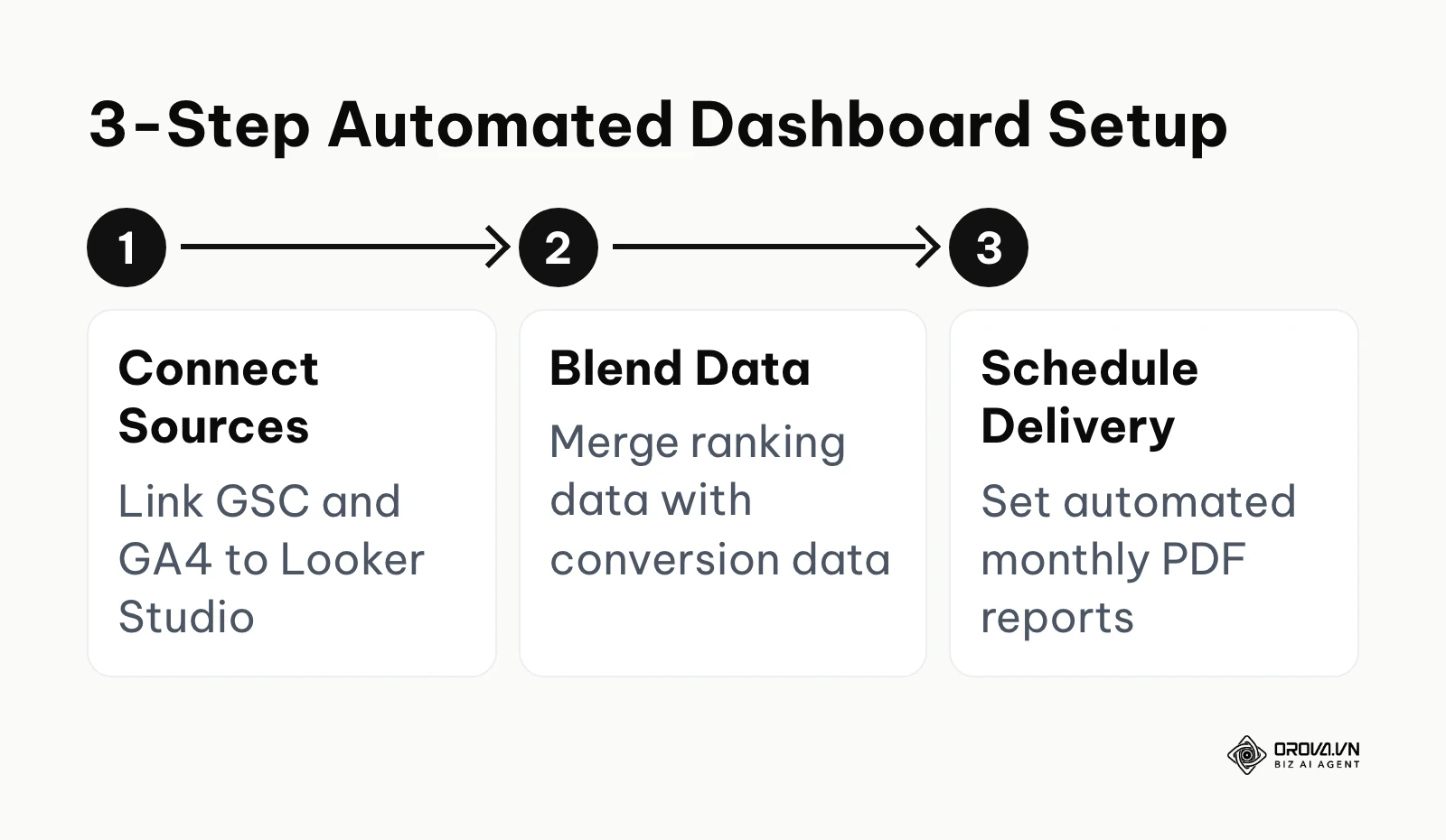
To manage this complex array of data without losing your mind, you need an automated system. Building a Looker Studio dashboard is a common approach for professional teams. First, you connect your primary data sources, specifically Google Search Console and GA4, using the native free connectors provided by Google. Second, you design the layout to separate high-level metrics at the top (Revenue, Total Traffic) from granular diagnostics at the bottom (Page-level CTR, specific keyword drops). Finally, you blend the data so you can view impressions and conversions on the exact same table, and set up a scheduled email delivery to automatically send the PDF report to stakeholders on the first Monday of every month.
Illustrative example:
- Context: An established e-commerce retailer selling specialized outdoor gear noticed a highly alarming trend: their organic traffic was up by 30% year-over-year, but revenue from organic search had plummeted by 15%.
- Steps taken: They exported their GA4 landing page data and mapped it against their product inventory. They discovered that the traffic surge was entirely driven by one top-of-funnel informational article about "how to clean hiking boots," while high-margin product category pages were quietly losing rankings to aggressive competitors.
- Hurdle and fix: The informational article had a massive audience but zero calls-to-action. They fixed this by embedding contextual product carousels for boot cleaning kits directly into the high-traffic article and internally linking heavily to the struggling category pages to pass authority.
- Result: Within two months, the conversion rate on the high-traffic article jumped from 0.1% to 1.5%, generating an additional 5,000 dollars in monthly sales, while the category pages regained their top 3 positions, stabilizing the overall revenue stream.
How to Start Measuring SEO KPIs Based on Your Role
Implementing a tracking strategy is not a one-size-fits-all endeavor. Your approach must be rigorously tailored to your specific responsibilities and the resources at your disposal. Trying to track everything at once will invariably lead to analysis paralysis. Start from the goal, then adjust the depth of tracking to your role.
Choose SEO KPIs by business goal
Before picking any metric, write down the one outcome SEO is expected to deliver this year. Each goal points to a different primary KPI, and the supporting metrics only exist to explain movements in that primary number.
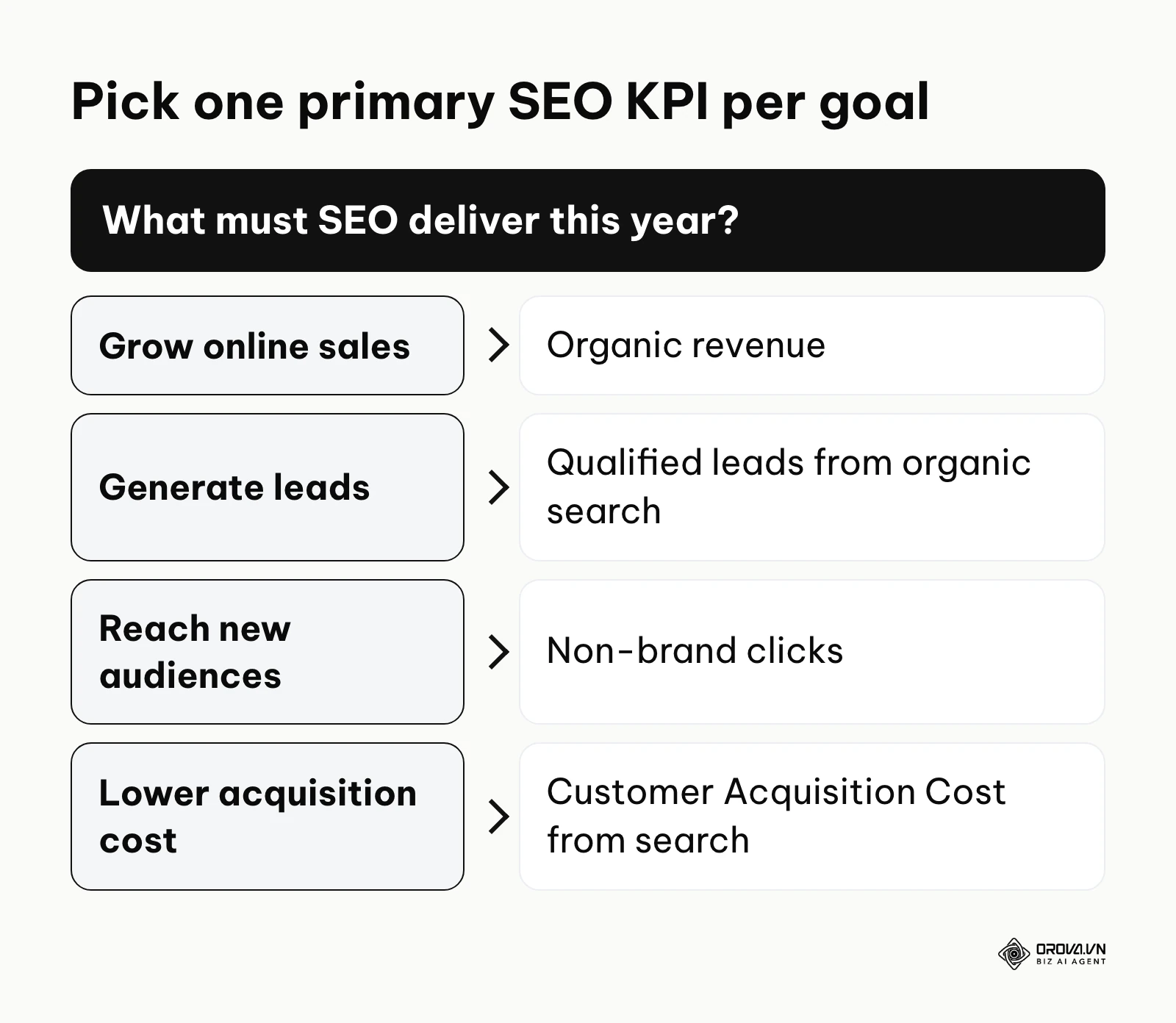
| Business goal | Primary SEO KPI | Supporting metrics |
|---|---|---|
| Grow online sales | Organic revenue | Conversion rate of product and category pages, non-brand clicks |
| Generate leads | Qualified leads from organic search | Form submissions per landing page, lead-to-customer rate |
| Reach new audiences | Non-brand clicks | Impressions and average position for non-brand queries, CTR |
| Lower acquisition cost | Customer Acquisition Cost from search | SEO cost, organic conversions |
| Protect existing visibility | Clicks to top pages | Indexed pages, crawl errors, Core Web Vitals pass rate |
If you have two goals, pick the one leadership will judge you on first. Everything else can stay in a diagnostic tab instead of the headline report.
Here is how different professionals should then adapt their measurement practices.
For Small Business Owners
If you are running the business yourself, you do not have time to analyze technical crawl logs or debate attribution models. Your focus must be strictly on the bottom line.
- Define one single primary conversion event (e.g., a phone call or a contact form submission) and ensure it is tracked accurately in GA4.
- Separate your brand search traffic (people searching for your exact company name) from non-brand traffic (people searching for your general services). This tells you if your marketing is actually reaching new people or just preaching to the choir.
- Review your performance only once a month; checking rankings daily will only cause unnecessary stress due to normal, unpredictable algorithmic fluctuations.
- Set up an automated custom alert in Analytics for traffic drops exceeding 20% so you are notified of critical issues without having to monitor the dashboards manually every day.
For In-House Marketing Managers
You sit between the executives who demand revenue and the specialists who handle the technical details. Your primary job is to bridge that communication gap effectively.
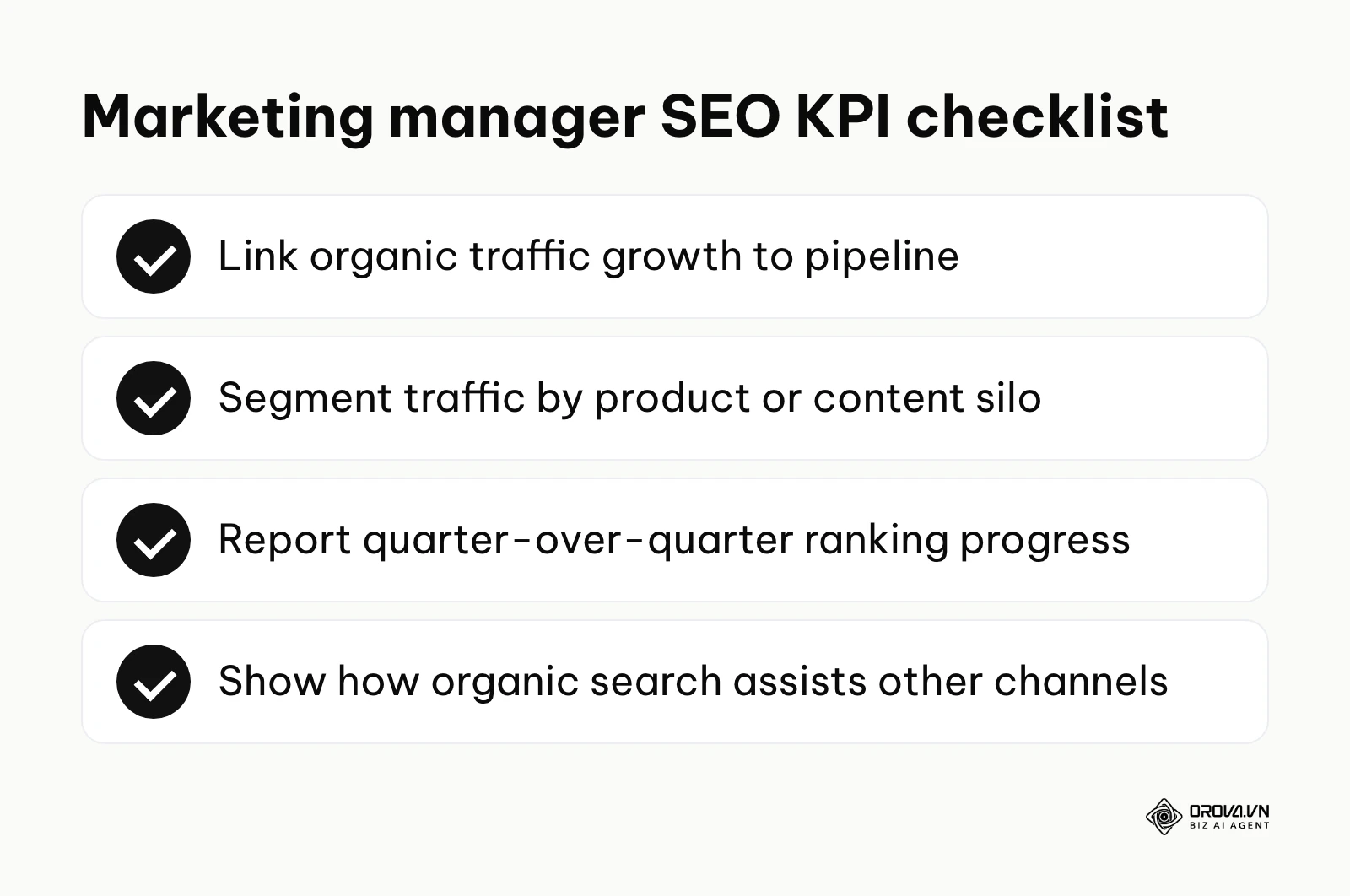
- Build a unified dashboard that tracks the direct correlation between organic traffic growth and overall pipeline generation.
- Segment your traffic by product categories or content silos to understand exactly which business units are performing best and which need intervention.
- Establish a baseline website ranking report that clearly shows quarter-over-quarter progress to secure ongoing budget approvals from leadership.
- Implement multi-channel attribution to prove how organic search assists other channels like paid ads or email marketing, highlighting the holistic value of your work.
- Create a standard operating procedure for communicating these metrics to the C-suite, strictly stripping out technical jargon in favor of business impact terminology.
For Agencies or Freelancers
Your primary objective is to unequivocally prove the financial value of your services to retain demanding clients and justify your monthly retainer fees.
- Align on the specific business goals with the client before the campaign starts, and document them explicitly in the contract to avoid scope creep.
- Create transparent, automated Looker Studio dashboards that the client can access 24/7, building trust through total data visibility.
- Track and proactively highlight "quick wins" in the first 90 days—such as improving CTR on existing high-ranking pages—to show immediate momentum before the larger, slower content strategies take effect.
- Always report on "Share of Voice" against their specific named competitors, as executives are highly motivated by seeing their own brand beat their direct rivals in the search results.
| Common Mistake | The Consequence | How to Avoid It |
|---|---|---|
| Tracking too many metrics. | Analysis paralysis; unable to make any clear strategic decisions. | Limit the headline report to a short list of core KPIs tied to one goal. |
| Ignoring brand vs non-brand. | Falsely attributing brand success (like a TV ad) to SEO efforts. | Filter queries containing brand terms in GSC. |
| Reporting on rankings alone. | Client churns rapidly when high rankings yield absolutely no sales. | Always tie ranking reports to conversion data. |
Illustrative example:
- Context: A local plumbing business was paying an agency a monthly retainer. The agency reported a 50% increase in traffic, but the owner saw no corresponding increase in phone calls or bookings.
- Steps taken: The owner fired the agency, hired an independent consultant, and demanded a complete audit of the traffic sources. The consultant segmented the data by geographic location and page intent.
- Hurdle and fix: The data revealed that 90% of the new traffic was coming from a generic blog post about "how toilets work" and the visitors were from entirely different countries, completely useless for a local service business. The fix was to pivot the strategy exclusively to local landing pages (e.g., "emergency plumber in [City]").
- Result: Overall traffic dropped by a terrifying 80%, but qualified local leads increased by 300%, turning a wasted expense into a highly profitable local marketing channel.
With OROVA.VN and the OROVA SEO module, you put an end to the exhausting days of manual work for good. Instead of struggling for hours to write articles and compile reports, the entire process is now optimized and completed in just 5 minutes.
The future of SEO KPIs: author's predictions
As the digital landscape shifts rapidly under the weight of new technologies, the metrics we rely on today will inevitably evolve. Based on the current trajectory of search engine algorithms and user behavior as of 2026, here is where I see performance measurement heading in the near future. Keep in mind that unforeseen regulatory changes or shifts in user adoption could alter these timelines.
The death of the "Ten Blue Links" metric
As of 2026, we are already seeing traditional blue links pushed further down the page by generative AI answers, massive video carousels, and interactive widgets. I believe that over the next few years, tracking a standard "Position 1" ranking will become largely meaningless for many informational queries. Instead, I expect parts of the industry to shift toward "Pixel Share"—measuring the actual percentage of screen real estate your brand occupies on a search results page, regardless of the specific format. You should start preparing for this now by diversifying your content formats, optimizing heavily for video and rich snippets, rather than relying solely on long-form text.
AI Citation Rate will replace traditional backlink counting
Currently, we obsess over domain authority and the raw number of backlinks pointing to a site. However, as AI search engines like ChatGPT and Google's embedded AI Overviews become the primary way users find complex information, being cited by a Large Language Model will carry significantly more weight than a standard web link. I anticipate that "AI Citation Rate"—the frequency with which an AI model explicitly references your brand as a source—could become a valued KPI. To prepare for this shift, you need to focus on digital PR, ensuring your brand is mentioned contextually in high-trust environments that feed these LLM training datasets, rather than buying cheap, low-quality links on obscure blogs.
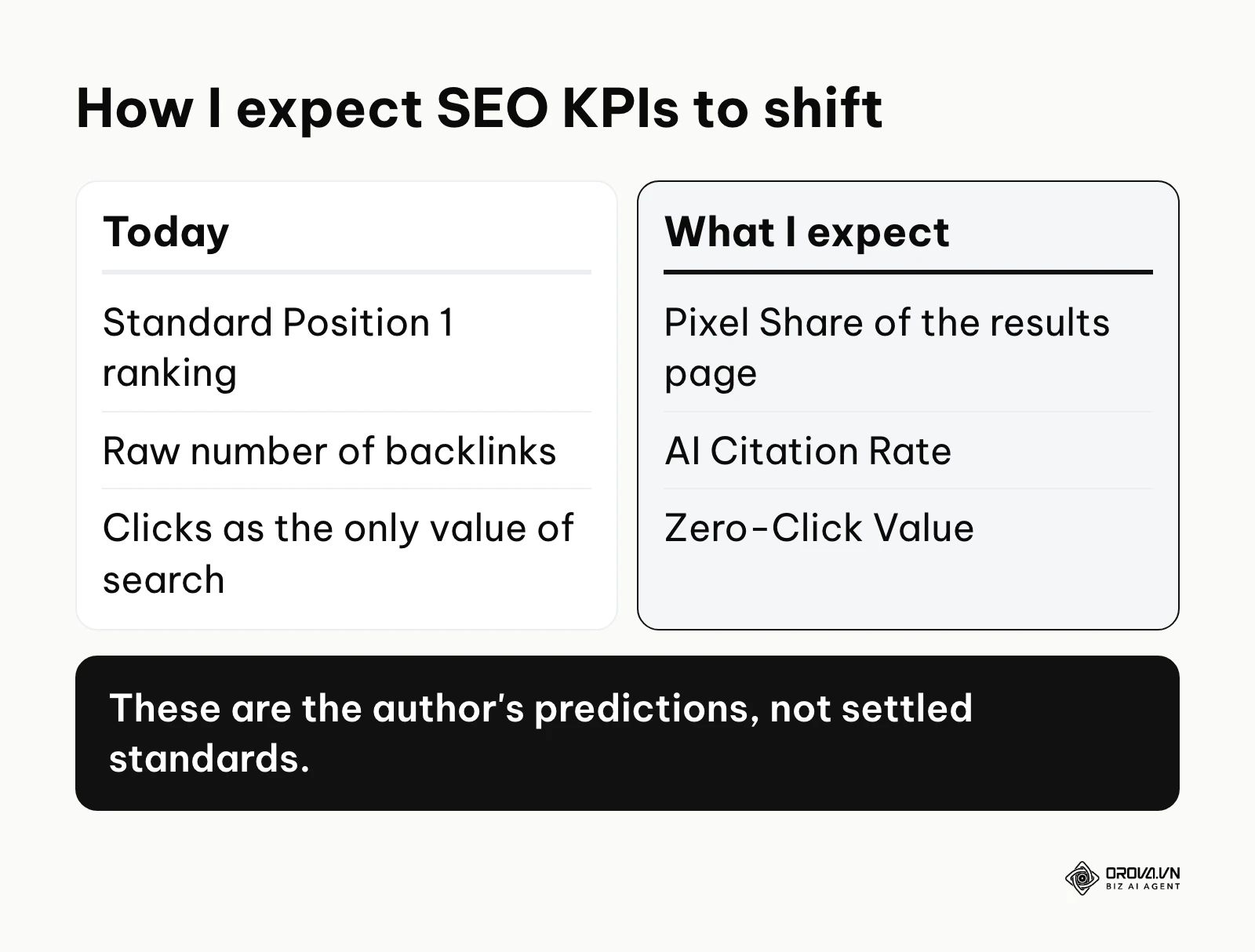
Zero-Click Value will become a standardized metric
The trend of users finding their answers directly on the search page without ever clicking through to a website is accelerating rapidly. Historically, SEOs viewed this as a total loss of traffic. I strongly suspect that we will soon develop sophisticated ways to measure the brand lift and offline commercial impact of these "zero-click" interactions. If a user sees your authoritative answer on Google and then walks into your physical retail store later that week, that has immense value. Marketers must prepare by ensuring their Google Business Profiles and localized content are flawless, treating the search engine results page itself as an extension of their own website. This prediction relies heavily on platforms providing better offline attribution data and may take longer than marketers hope.
Frequently asked questions about SEO KPIs
Are SEO KPIs still needed with AI?
Absolutely. While the nature of the metrics is fundamentally changing, the underlying business need to measure ROI is not. In fact, as AI introduces significantly more variability into search results, having a robust tracking system becomes even more critical. You need granular data to understand which AI-driven features are actually sending qualified traffic to your site and which are simply cannibalizing your clicks without providing value.
How to measure ROI of informational blog posts?
Informational content rarely converts immediately, making traditional ROI calculation tricky. The most effective method is assigning a dollar value to micro-conversions, such as newsletter signups or resource downloads, based on historical lead-nurturing data. Additionally, you can use multi-channel attribution models in GA4 to see how often a user who first arrived via an informational post returned later via a different channel to make a final purchase.
What to do when Organic Traffic increases but Conversions decrease?
This is a classic symptom of intent mismatch. It usually means your site is ranking well for broad, top-of-funnel keywords, but losing ground on high-intent, transactional queries. You must immediately segment your traffic data by landing page to identify the specific source of the empty traffic, and audit your seo checklist to ensure your high-value commercial pages are not suffering from technical issues or aggressive competitor displacement.
How do I separate brand search from non-brand search?
Brand search reflects your overall marketing and PR efforts, while non-brand search reflects your true SEO capability to capture new audiences. You can effectively separate them by creating a custom filter in Google Search Console that includes or excludes queries containing your company name, product names, and common misspellings. Tracking these separately ensures you are not artificially inflating your SEO success with traffic generated by a recent TV commercial or a viral social media campaign.
How often should I check my performance dashboard?
While data is collected continuously, checking dashboards daily often leads to reactive, poor decision-making due to normal algorithm fluctuations. For strategic adjustments, a comprehensive monthly deep-dive review is optimal. However, you should definitely have automated alerts set up to notify you immediately of catastrophic technical failures, such as a sudden 50% drop in indexed pages or a massive spike in 404 errors.
Where should you start?
The path to effective measurement depends entirely on your current state of organizational maturity. Trying to implement advanced attribution models when you do not even have basic tracking installed is a recipe for immense frustration and wasted effort. Here is a practical approach tailored to three common situations you might find yourself in.
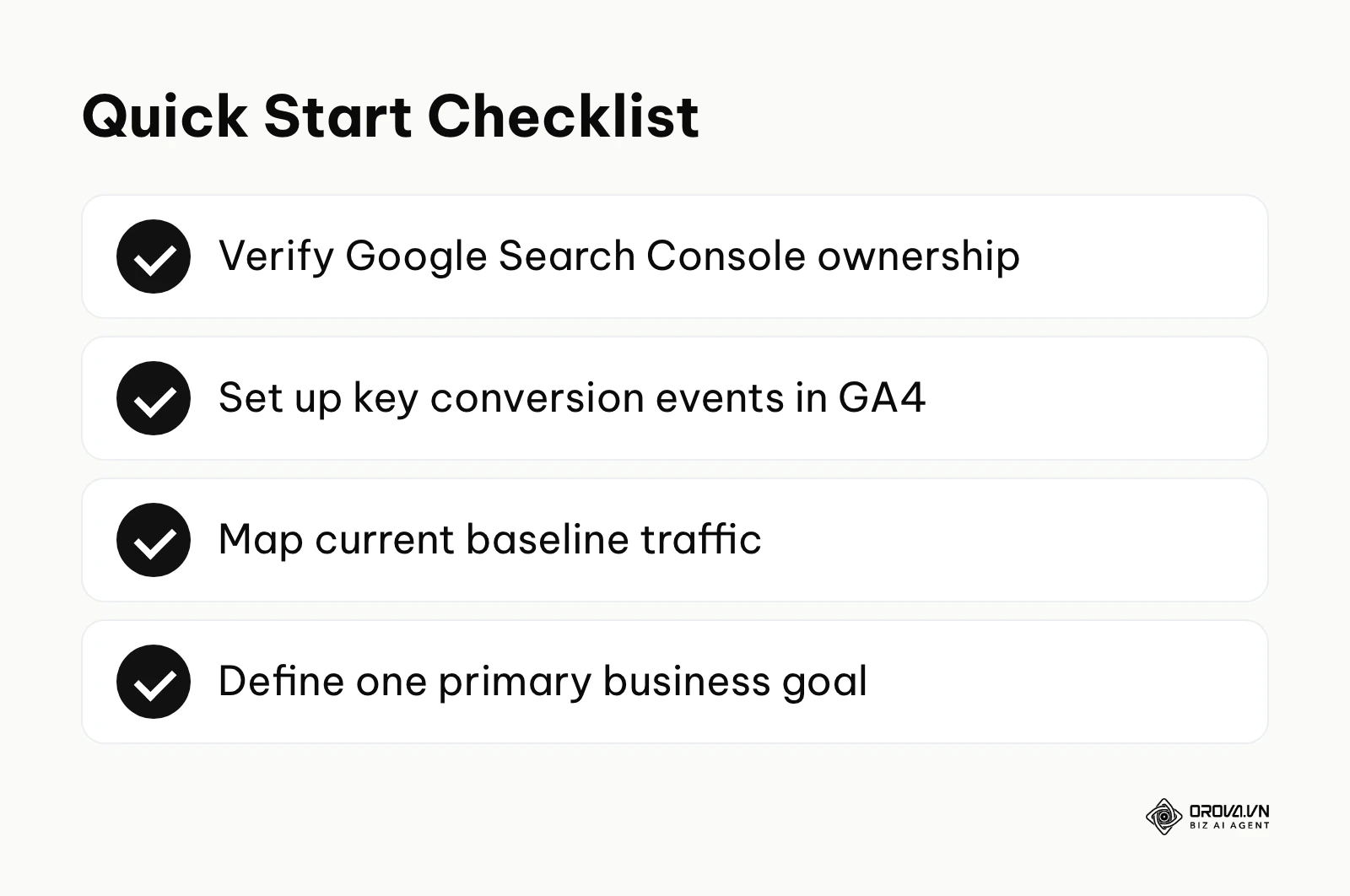
If you have absolutely nothing in place, do not worry about Looker Studio or advanced ROI calculations yet. Your very first step, which can be completed in an afternoon, is to create a Google Search Console account, verify ownership of your domain, and ensure your basic GA4 property is active and collecting data. These tools need significant time to collect historical data before they become useful, so simply turning them on is the most critical action you can take right now.
If you already have data but it is scattered chaotically across different tools and spreadsheets, your focus should be on consolidation. The immediate next step is to identify the single most important business goal for your website—such as lead form submissions or checkout completions. Once identified, ensure that this specific action is tracked flawlessly as a conversion event in your analytics platform, giving you a definitive "North Star" metric to guide your future efforts and align your team.
If you have been doing SEO work for months but are not measuring the financial impact, you need to establish a baseline immediately. Take your total marketing spend on search over the last quarter (including all salaries, software subscriptions, and agency fees) and map it directly against the total revenue generated from the organic search channel in that same period. This simple, initial calculation will force a serious conversation about efficiency and provide the foundational numbers needed to build a much more sophisticated tracking program moving forward.
About the author

Builder of Orova
Nguyễn Đỗ Trọng Ân has 8 years of experience in marketing, including 6 years managing market development across Asia. He builds Orova, a Biz AI Agent that never sleeps: it plans, runs and optimizes work for businesses.
Run your business with AI Agents
Orova is the always-on Biz AI Agent — it plans, runs, and optimizes the work for you.
Save time, unlock productivity.