
Google Ads agent in 2026: AI software vs human agency compared

You are staring at your advertising dashboard, watching your cost per click creep upward while your conversion rate stubbornly flatlines. You know you need external help, but when you search for a Google ads agent, you hit a wall of confusing terminology. Half of the search results point you toward boutique marketing firms promising strategic growth, while the other half push software dashboards promising machine learning miracles. This confusion stems from a fundamental overlap in the industry right now. The market has blurred the lines, leaving you wondering if you should be hiring a team of human experts or purchasing a subscription to an automated tool. If you make the wrong choice, you risk either bleeding your budget on hefty retainer fees before seeing any return, or letting an unsupervised algorithm burn through your daily limits on irrelevant clicks. This article breaks down exactly what a Google ads agent is in today's landscape, dissecting both the human and the software sides. By the end, you will have a clear framework to choose the exact setup that fits your budget, industry, and readiness level.
Google ads agent: Core differences and target users
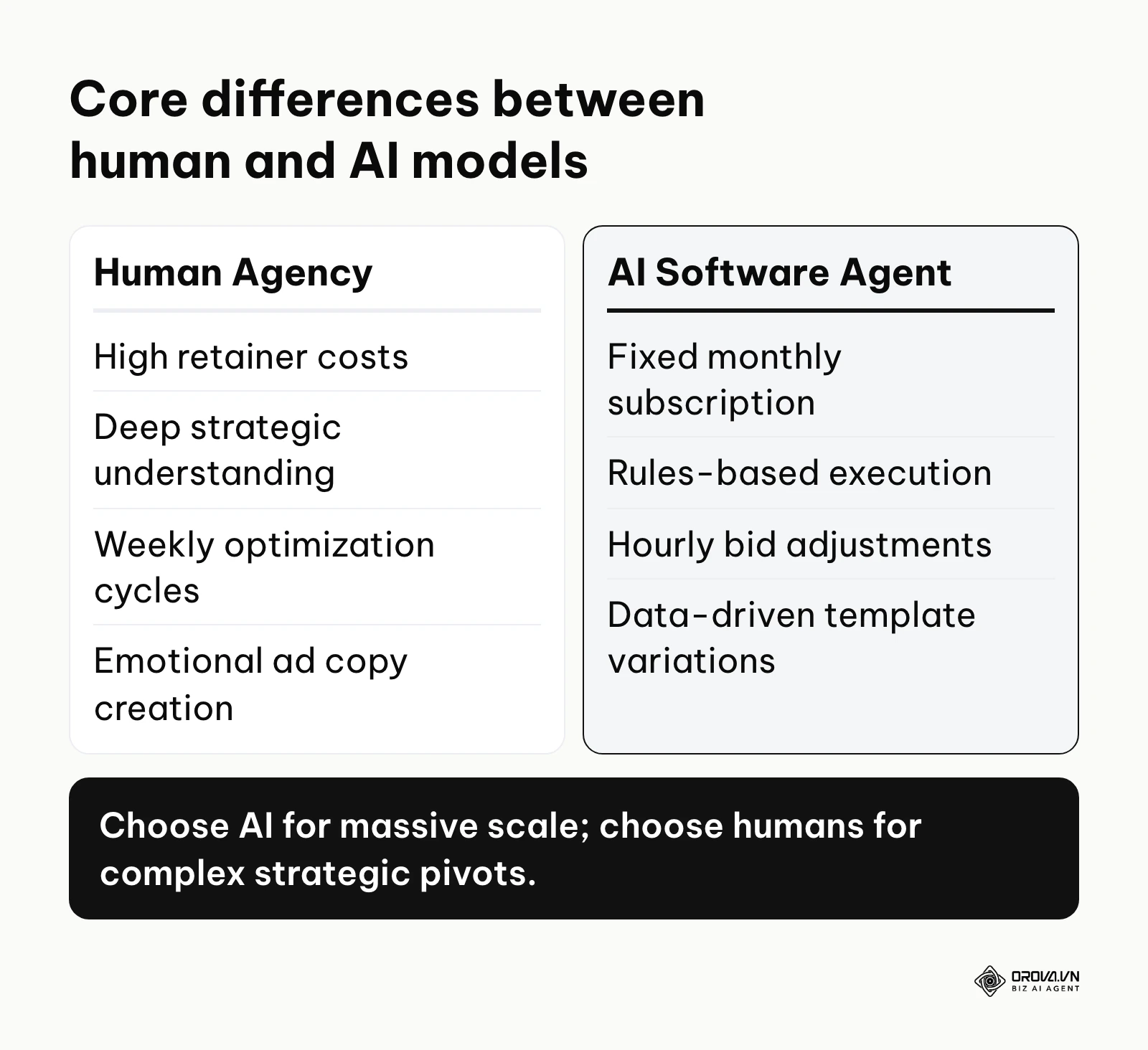
A Google ads agent can refer to either a human agency providing managed services or an AI software agent automating campaign execution. The core difference lies in strategic adaptation versus computational volume. A human agency is ideal for businesses needing deep market understanding and brand positioning. Conversely, an AI agent suits those requiring relentless, large-scale bid optimization and structured routine execution.
Defining the two types of Google ads agents
When you set out to improve your digital marketing performance, you will immediately encounter this split in definition. To make an informed decision, you must first completely understand what each entity actually does, how they operate behind the scenes, and what their true strengths are. The terminology can be highly deceptive because both sides use the exact same words—like optimization, scaling, and performance—but they achieve these outcomes through fundamentally opposed mechanisms. If you misunderstand what you are buying, you will inevitably misalign your expectations with the delivered results.
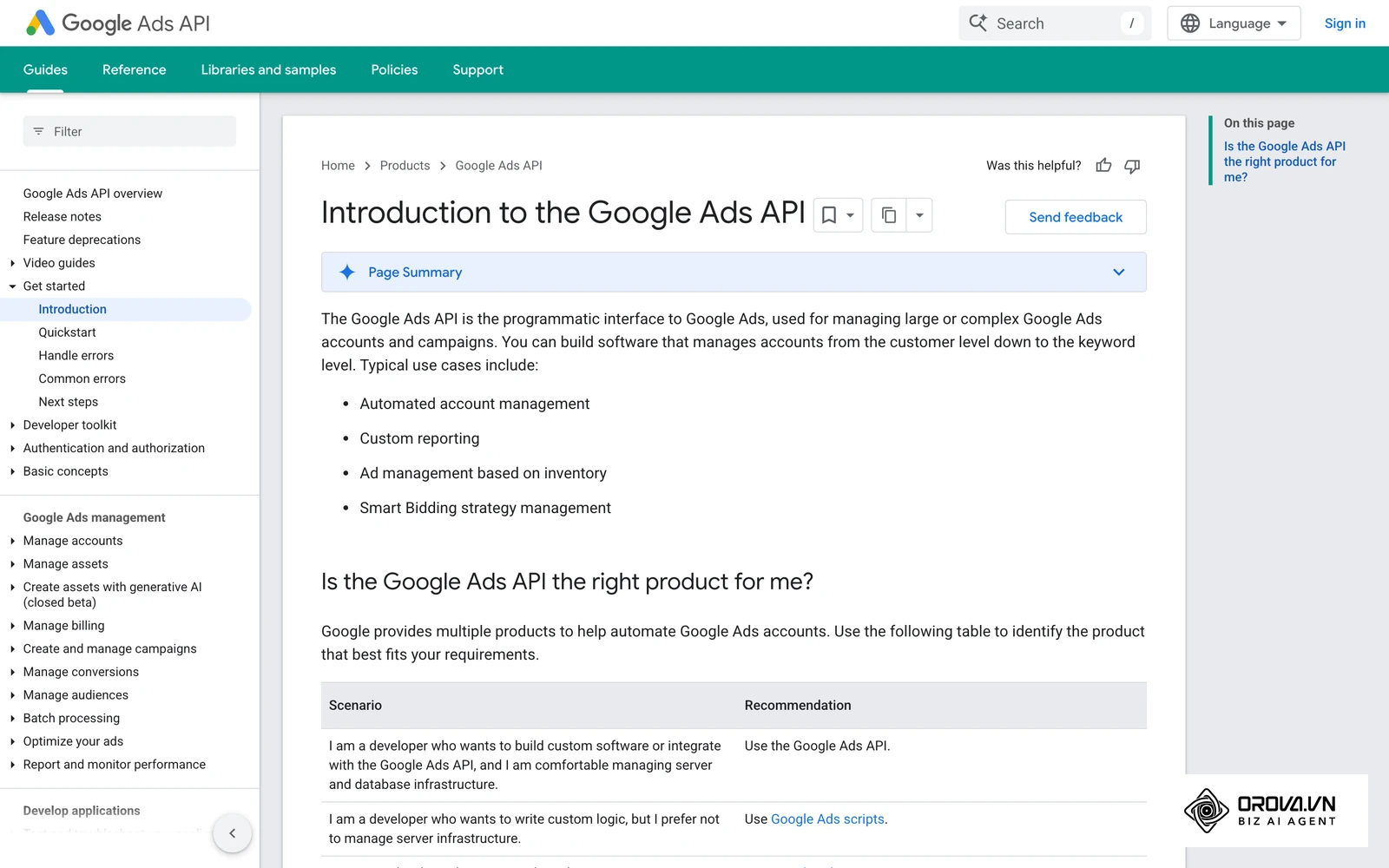
The digital advertising ecosystem has grown incredibly complex. Ten years ago, managing an ad account meant logging in once a week to adjust a few keyword bids based on gut feeling. Today, the Google Ads auction operates in milliseconds, evaluating thousands of signals—including the user's location, device, browsing history, and time of day—before deciding which ad to show. No human can process this volume of data in real-time. Yet, machines still struggle to understand why a user might prefer a luxury brand over a discount brand based purely on emotional resonance. This divide defines the two distinct paths available to you.
The Human Agency: Strategic partners with a price tag
A human agency consists of account managers, copywriters, data analysts, and strategic directors who take over your advertising efforts. They are built to handle ambiguity, nuance, and sudden shifts in business logic. Their primary purpose is to translate your complex business goals into a structured, cohesive marketing funnel.
The real strength of a human team lies in their ability to understand context and apply empathy. If your product is a highly technical enterprise software solution, a human can interview your sales team, understand the exact pain points of a Chief Information Officer, and craft ad copy that speaks directly to that emotional and logical state. They can also navigate sudden market shifts, such as a new competitor entering the space with a disruptive pricing model, and adjust your entire messaging strategy overnight. They understand that a user searching for "enterprise cybersecurity solutions" needs a very different landing page experience than a user searching for "free antivirus download."
However, human agencies have distinct physical and structural limitations. They operate on standard business hours, take weekends off, and experience fatigue. Their ability to manually adjust bids across thousands of keywords is strictly bound by the number of hours in a workday. Furthermore, the communication layers within an agency—where an analyst reports to an account manager, who then reports to you—can introduce significant lag in execution.
The AI Software Agent: Relentless execution and scale
An AI software agent is a sophisticated machine learning program designed to interface directly with Google's Application Programming Interface (API) to manage your campaigns within the rules you set. It is born to process structured data. Its primary purpose is to execute high-frequency adjustments based on statistical probabilities and historical trends.
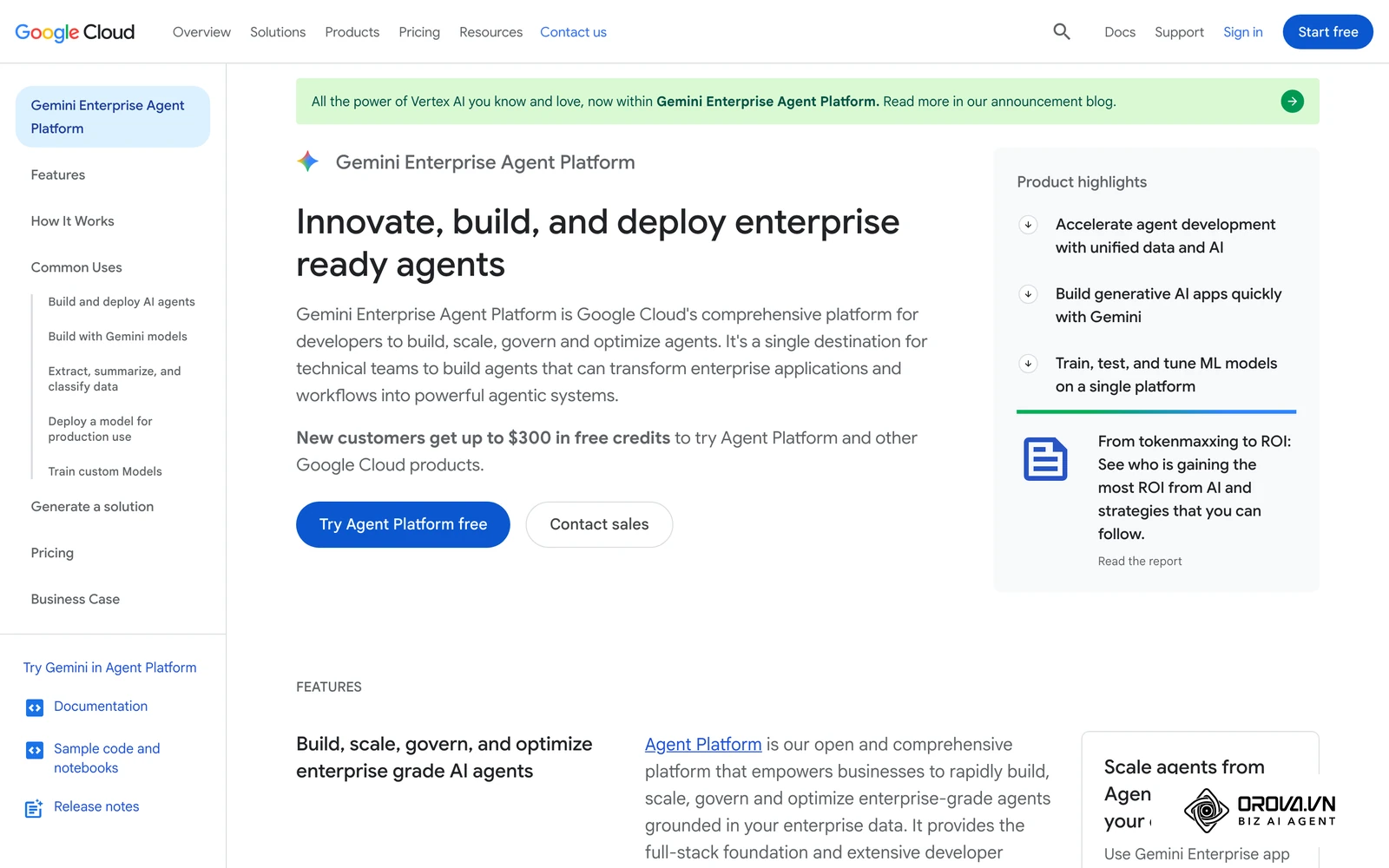
The true strength of an AI agent is its mathematical stamina and reaction speed. It does not sleep, it does not get bored, and it can analyze the historical performance of ten thousand keywords against time-of-day, device type, and geographical location simultaneously. It makes micro-adjustments to your bids every single hour to squeeze the maximum mathematical efficiency out of your budget. If a specific geographical region suddenly shows a spike in conversion rates at 2:00 AM, the software agent will instantly allocate more budget to capture that demand, while a human would likely not notice the anomaly until the weekly report is generated days later.
These tools excel in environments with high data volume where the strategic direction is already entirely clear, but the execution is simply too vast for a human to manage optimally. They are the ultimate executors of automated ads, provided they are given strict, logical parameters to operate within. Their greatest weakness, however, is a complete lack of common sense. An AI will blindly increase spending on a keyword if the math looks good, even if that keyword is totally irrelevant to your actual business model due to a shift in cultural slang.
Detailed comparison: AI software vs Human agency
Choosing between a human team and a software platform is not a matter of which is objectively better in a vacuum; it is a matter of architectural fit for your current operational state. You must evaluate your own resources, your industry complexity, and your tolerance for risk. The following breakdown analyzes both options across the most critical dimensions of advertising success to help you pinpoint exactly what you need.
Cost structures and return on ad spend
The financial commitment is usually the first filter for any business looking to outsource their advertising management. The cost structures of these two agents are fundamentally different, which directly impacts your actual return on ad spend.
Human agencies commonly charge a monthly retainer, a percentage of your total ad spend, or a combination of both. If your budget grows, their fee grows proportionally, which they argue incentivizes them to scale your profitable campaigns. However, this means your fixed costs can be significant before a single ad is ever clicked. You are paying for their office space, their software subscriptions, and their employee benefits.
Conversely, an AI agent operates on a Software as a Service (SaaS) model. These platforms typically charge a flat monthly fee regardless of how much you spend, or they utilize a tiered system based on the number of connected accounts or a much lower percentage threshold.
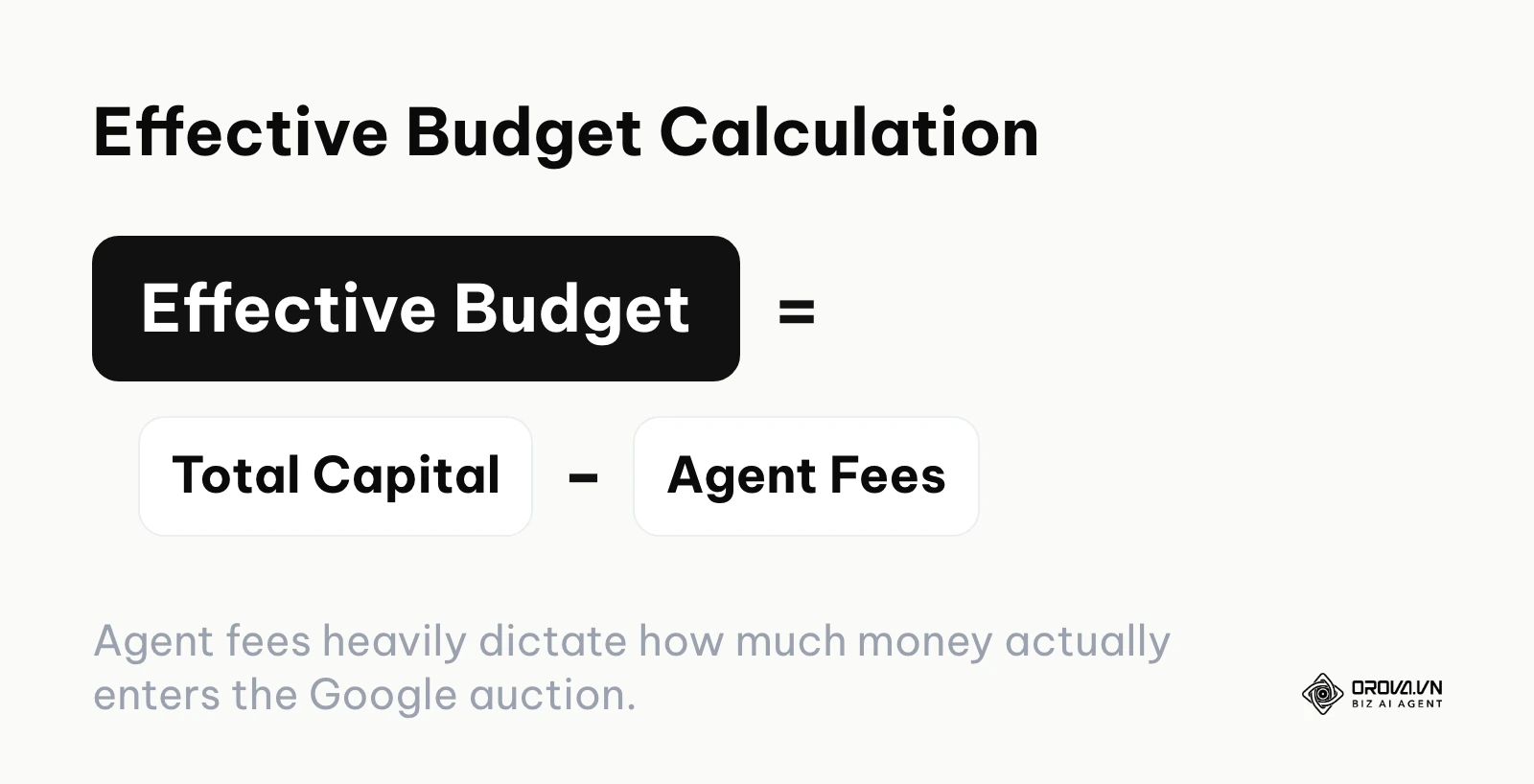
To illustrate the difference, consider the mathematical reality of your effective budget. Illustrative example, with round numbers in any currency: if you have a total monthly capital of 10,000 and an agency's retainer plus percentage fee come to 3,000, your effective ad spend—the money actually buying clicks from Google—is reduced to 7,000. If a software subscription costs 300 instead, 9,700 is left for actual advertising. If both achieve the exact same conversion rate, the larger effective budget will generally buy more conversions simply because more money went into the auction. However, if the human agency crafts a superior strategy that doubles the conversion rate, their higher fee can be more than justified. You must weigh the raw cost of execution against the potential value of human strategy, and judge both options on the marketing ROI they produce rather than on fees alone.
Speed of execution and optimization frequency
In the highly competitive digital auction house of Google, speed is a tangible, measurable advantage. The market fluctuates wildly based on time of day, competitor budgets running out, or sudden news events triggering massive search volume spikes.
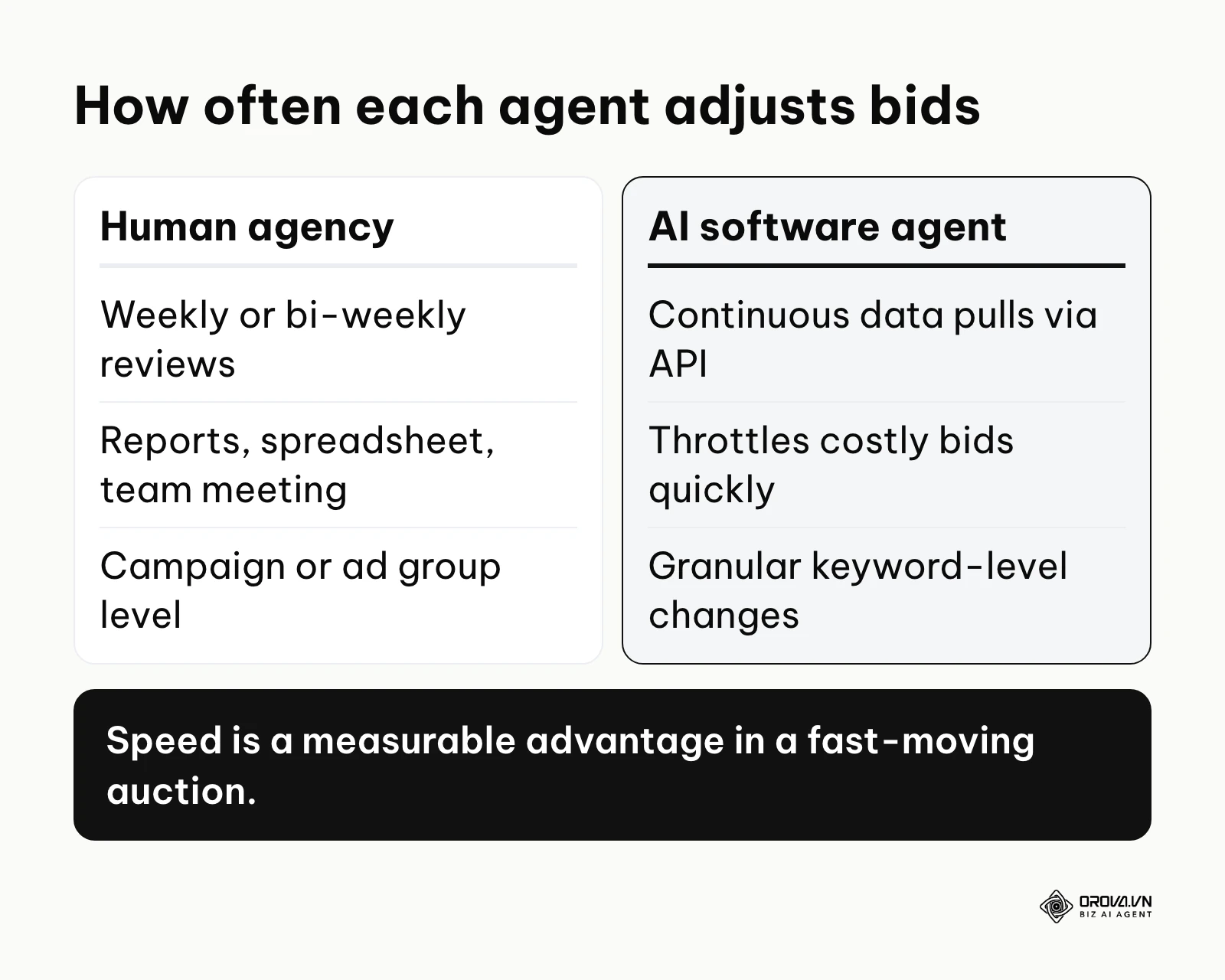
A human agency typically reviews accounts on a weekly or bi-weekly schedule. They pull reports, analyze the trends in a spreadsheet, discuss them in an internal team meeting, and then log in to implement changes. This latency means you might bleed budget on a poorly performing keyword for four consecutive days before a human analyst catches the trend. Furthermore, humans tend to optimize at the campaign or ad group level because digging down into individual keyword bids across large accounts is excessively tedious.
An AI agent operates in a state of continuous, relentless optimization. It pulls fresh data through the API constantly and reacts to anomalies within minutes. If a specific keyword suddenly spikes in cost-per-click without a corresponding increase in conversions, the software can automatically throttle the bid down to protect your budget instantly. This high-frequency trading approach ensures that your money is always deployed where the statistical probability of a conversion is highest, minute by minute. It removes much of the human bottleneck, allowing for granular adjustments at scale that a human team could never practically replicate.
Deep industry understanding and strategy formulation
While machines definitively win on speed and scale, humans absolutely dominate on context and intuition. Advertising is not just about math and auction theory; it is fundamentally about human psychology and persuasion.
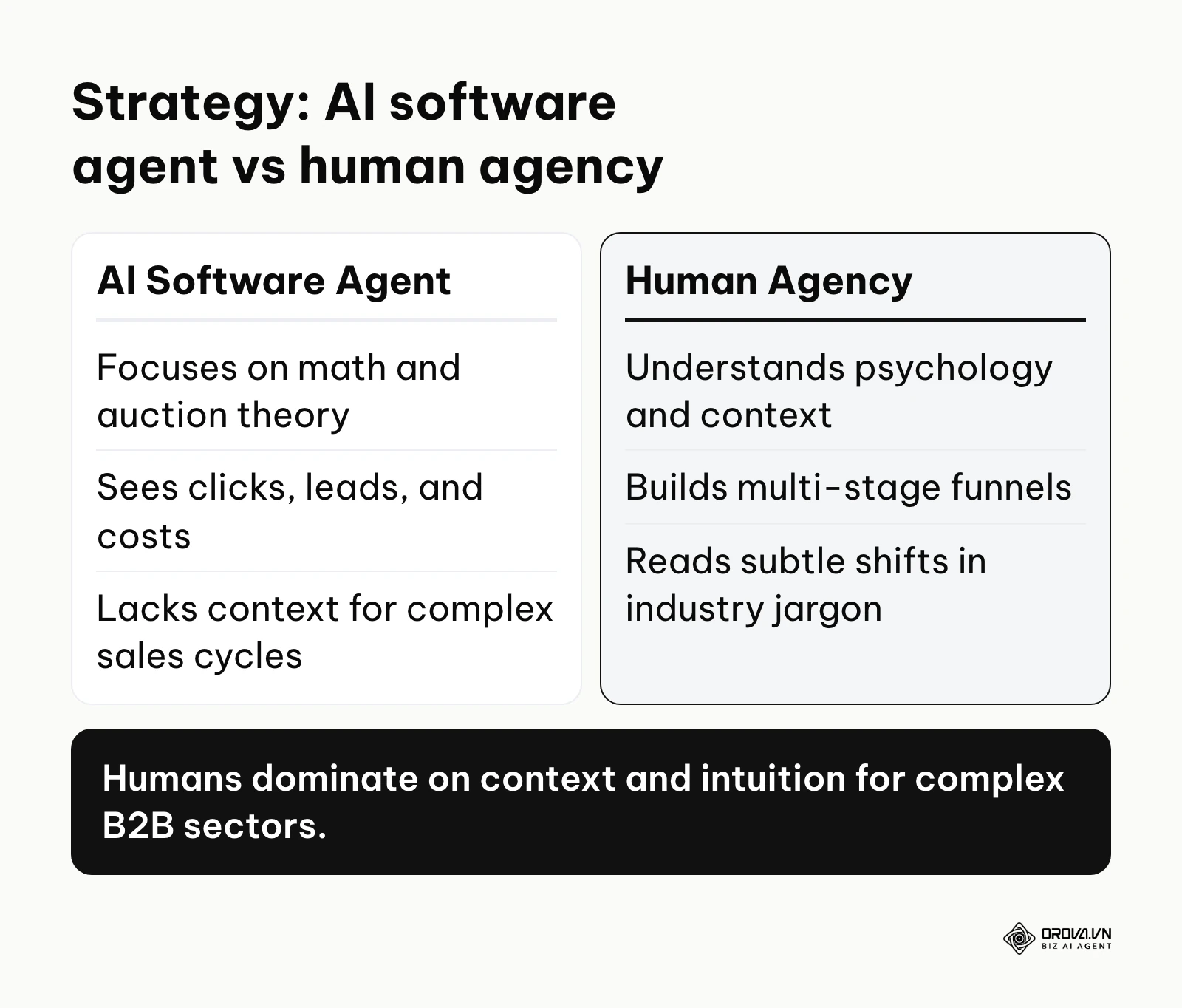
If you operate in a highly nuanced Business-to-Business (B2B) sector, such as selling industrial robotics to manufacturing plant managers, an AI agent cannot comprehend the sales cycle. The machine sees a click, a lead form submission, and a cost. It does not understand that a Chief Technology Officer needs a totally different value proposition than a floor manager. It cannot deduce that your product integrates with legacy systems, which is a major selling point that needs to be highlighted in the ad copy.
A human agency can conduct qualitative research, interview your best customers, and build a multi-stage funnel that nurtures leads over a six-month period. They understand that a whitepaper download requires a different follow-up ad than a visit to the pricing page. They can read the subtle shifts in industry jargon and adjust your copy accordingly. If your business requires educating the market, navigating complex compliance regulations, or selling a high-ticket service, the lack of contextual awareness in a pure software agent will lead to highly efficient spending on the completely wrong strategic goals.
Transparency and explainable ai advertising
One of the largest, most persistent frustrations business owners face with traditional agencies is the "black box" of reporting. You receive a monthly PDF with beautiful charts showing impressions, clicks, and vague performance metrics, but it is often incredibly difficult to understand exactly what the agency did day-to-day to justify their substantial fee. The narrative is tightly controlled by the account manager, who is naturally incentivized to highlight the wins and obscure or explain away the losses. You rarely get to see the actual raw data of their failures.
Ironically, while AI is often accused of being an unreadable black box in other fields, modern marketing AI software agents are moving heavily towards explainable ai advertising. Because the software logs every single API call it makes, you can view an exact, timestamped ledger of every bid change, every keyword paused, and every budget shifted.
The best platforms provide a clear, logical rationale for every single action they take. For example, the system will explicitly state: "Decreased bid on the keyword 'buy shoes' by 15% because the conversion rate dropped below the 30-day moving average threshold." This level of objective, unvarnished transparency allows you to audit the machine's logic precisely and adjust its governing rules if you disagree with its conclusions. This is something that is much harder to do with human ego involved, as challenging a human strategist often leads to defensive posturing rather than objective analysis.
Safety and financial guardrails
The most common fear preventing businesses from adopting software agents is the nightmare scenario of an algorithm going rogue. Business owners often worry that a machine learning model will misinterpret a data signal and spend an entire month's budget in a single afternoon. This fear is entirely valid if the tool is not configured correctly. When you hire an agency, the human element acts as a natural brake; a person is highly unlikely to accidentally add three zeros to a daily budget without noticing the error.
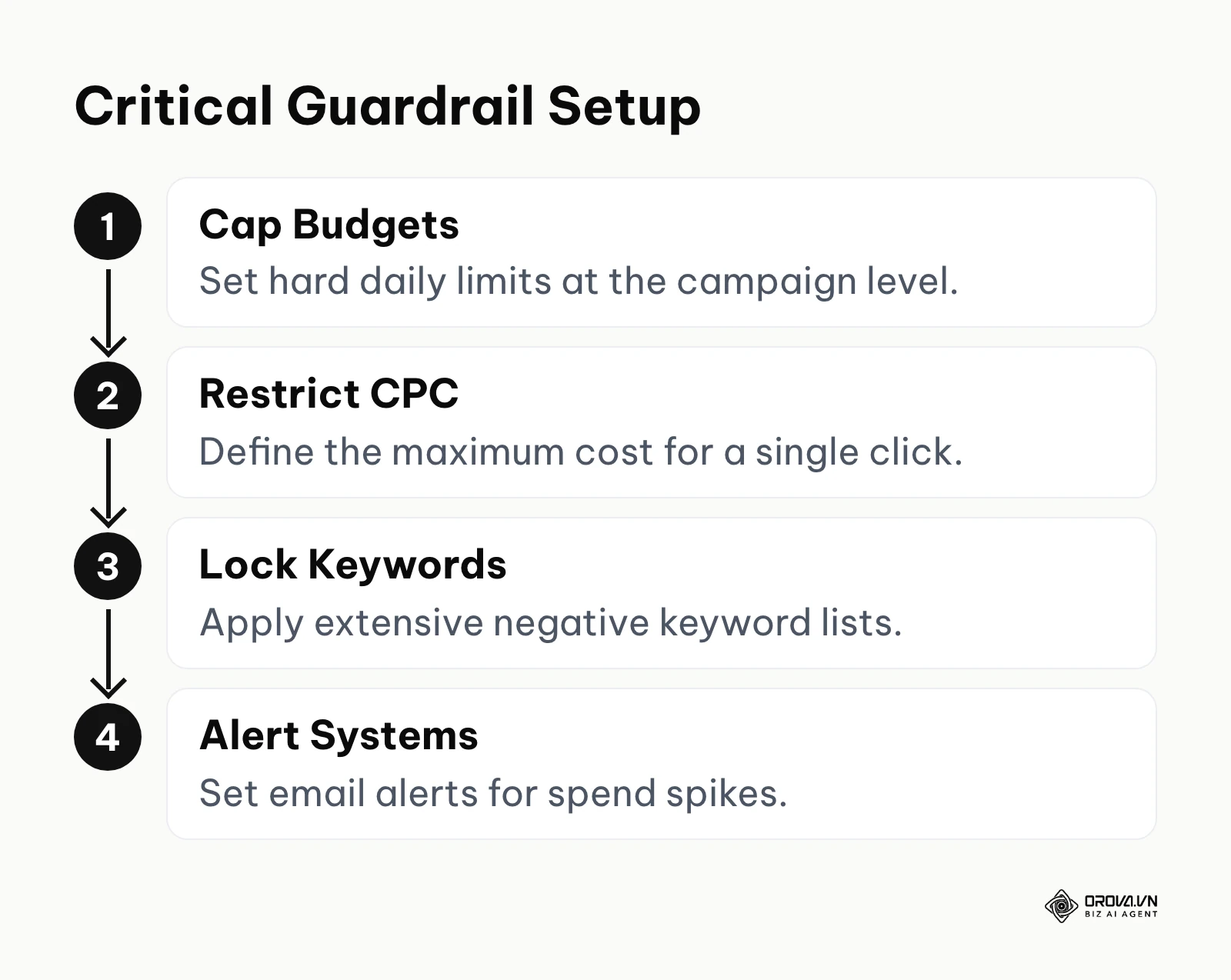
To safely deploy an AI agent, you must implement strict financial and operational guardrails. This is not an optional setup step; it is mandatory for financial survival. Before you connect any API access, you must define the absolute boundaries within which the machine is allowed to operate.
Here is the essential 10-step safety checklist you must complete before activating any automated system:
- Hard Cap Daily Budgets: Set absolute maximum daily limits at the campaign level within the Google Ads platform itself. This acts as a master override, ensuring that even if the software agent demands more money, Google will refuse to spend it.
- Maximum Cost Per Click (Max CPC): Define the absolute highest amount you are willing to pay for a single click. AI agents can sometimes enter bidding wars; a strict Max CPC prevents the software from winning auctions at ruinous, unprofitable prices.
- Target CPA Ceilings: Establish the maximum Cost Per Acquisition you can mathematically tolerate before the campaign becomes entirely unprofitable. The agent must be programmed to pause spending if this ceiling is breached for consecutive days.
- Negative Keyword Lists: Build exhaustive lists of irrelevant terms (such as "free," "cheap," "jobs," or "DIY") and lock them deeply into the account so the AI cannot ever bid on them, regardless of what its predictive models suggest.
- Allowed Geographic Zones: Strictly fence the locations where your ads can show. If you only serve local customers, restrict the radius tightly to prevent the AI from finding cheap but completely useless traffic overseas to inflate its click metrics.
- Time-of-Day Restrictions: Restrict bidding during hours when your sales team cannot follow up or when historical data shows zero purchasing intent. An AI might find cheap clicks at 3:00 AM, but if you run a B2B service, those clicks will never convert.
- Change Threshold Limits: Limit the AI to changing bids by no more than 10% to 15% in any 24-hour period. This prevents erratic, violent swings in strategy based on short-term data anomalies.
- Daily Spend Alerts: Configure automated email or in-app notifications to trigger immediately if the ad spend exceeds 30% of the daily average by noon. This provides a human early-warning system.
- Anomaly Pause Triggers: Configure strict rules that automatically pause the entire campaign if the conversion rate drops to zero for more than 48 hours, assuming the tracking pixel might have broken.
- Read-Only Probation: Always run the AI in "advisor mode" for the first two to three weeks. In this state, it only suggests changes for a human to approve manually, allowing you to audit its logic before granting it autonomous write access.
OROVA ADS applies AI Agent to automate and optimize ad performance on Google, Meta and TikTok. Scale your budget safely, monitor 24/7 and expand your business quickly.
Experience the solution at orova.vn/ads
Scenario-based decision framework: Which Google ads agent fits your scenario?
To move beyond academic theory, we must apply these concepts to real-world business constraints. The decision between human and machine is rarely straightforward and depends heavily on your available capital, the complexity of your sales cycle, and your internal team's bandwidth. You cannot simply copy what a massive corporation is doing if you run a local shop.
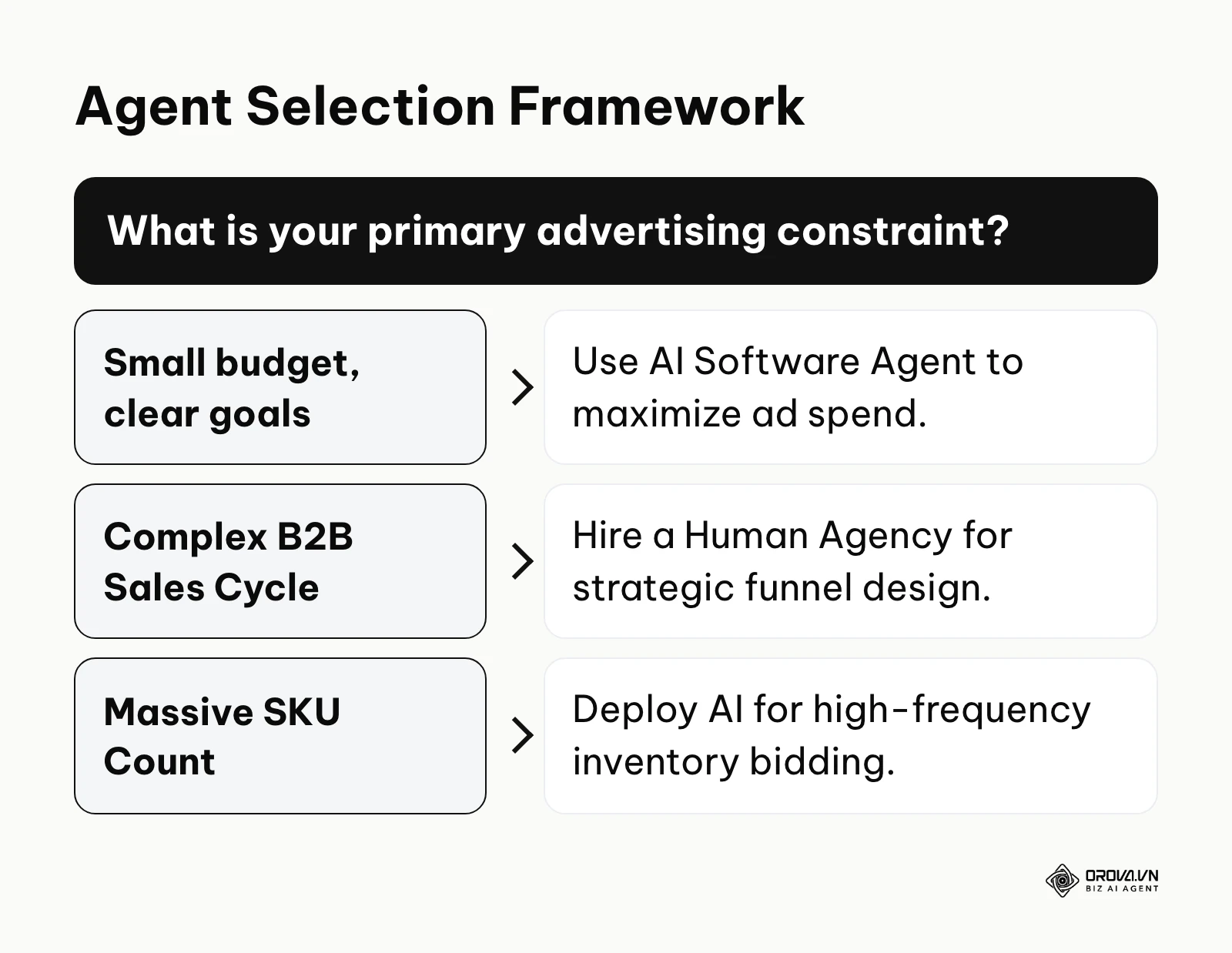
Scenario 1: The tight budget local business
Illustrative example: A local plumbing company in Chicago has a small monthly marketing budget. They need leads immediately to keep their service vans dispatched and their technicians busy.
- Context: The owner acts as the primary dispatcher and has very little time to study an ad campaign manual. They need maximum efficiency on a shoestring budget.
- Steps taken: The owner initially reached out to local agencies, but the minimum retainers quoted would have consumed most of that budget, leaving only a small fraction for actual advertising. Realizing this was unsustainable, they opted for an entry-level AI software agent. They spent one quiet weekend setting up the 10-step safety guardrails and inputting exactly 50 highly specific exact-match keywords, such as "emergency plumber near me" and "water heater repair chicago."
- Hurdles and fixes: During the first week, the AI started bidding aggressively during the middle of the night when the owner was asleep and unable to answer calls. The owner noticed the wasted spend on the software's morning dashboard report and immediately implemented a strict time-of-day restriction, limiting ads to run only between 6:00 AM and 8:00 PM.
- Results: Because the vast majority of the budget went directly to Google's auction rather than management fees, the company generated enough visible, trackable phone calls to keep two vans fully booked within the first thirty days. The software handled the tedious micro-bidding, allowing the owner to focus entirely on answering the phone and closing deals.
Scenario 2: The complex B2B enterprise
Illustrative example: A cybersecurity firm selling high-value annual compliance contracts to regional hospitals. The sales cycle typically takes nine months and involves navigating multiple stakeholders, from IT directors to hospital administrators.
- Context: The marketing department has a generous budget but is struggling to generate leads that the sales team actually accepts. The product is highly technical and requires deep market education.
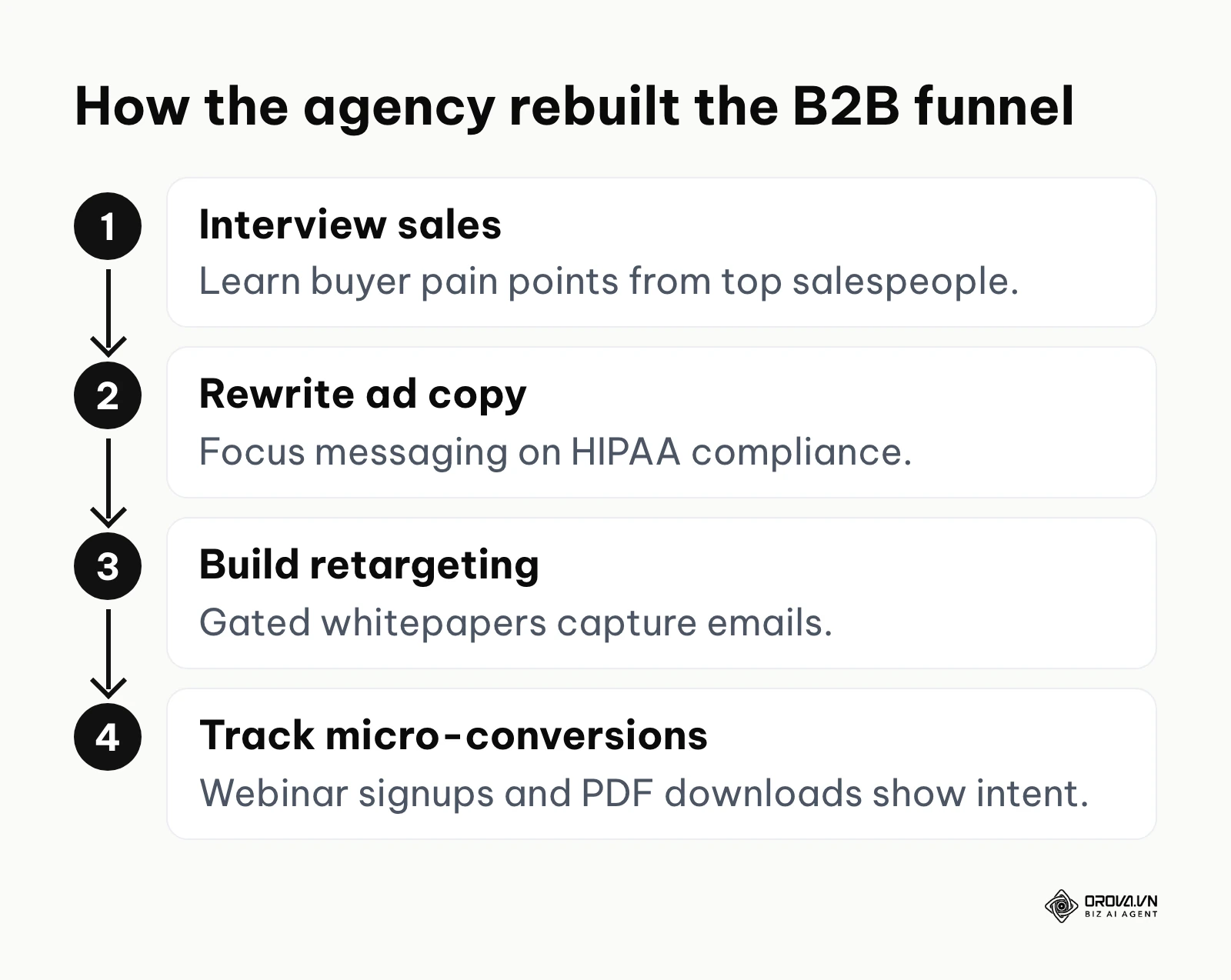
- Steps taken: The Marketing Director realized that standard keyword bidding on broad terms like "cybersecurity software" was yielding mostly unqualified students doing research. They hired a specialized B2B human agency. The agency conducted deep interviews with the firm's top salespeople, completely rewrote the ad copy to focus on HIPAA compliance regulations, and set up a complex multi-stage retargeting funnel using gated whitepapers to capture emails.
- Hurdles and fixes: The agency initially struggled to prove ROI to the board because the sales cycle was so extraordinarily long. The fix involved setting up specific micro-conversions within the ad platform, such as webinar signups and technical PDF downloads, to measure intent and optimize the campaigns while waiting for the actual closed-won deals to materialize in the CRM.
- Results: The strategy shift resulted in a significantly lower volume of total clicks, but a highly visible and immediate increase in qualified meetings booked by the sales team with actual Chief Information Security Officers. An AI acting alone would have chased the cheaper, unqualified clicks to satisfy immediate conversion metrics, entirely missing the strategic nuance.
Scenario 3: The rapidly scaling ecommerce store
Illustrative example: An online apparel brand with a massive inventory of 5,000 different products (SKUs) across 50 categories. They have strong historical data, a high-converting website, and clear profit margins.
- Context: The brand is in a high-growth phase and is struggling to manually adjust bids for thousands of individual products as inventory levels fluctuate daily.
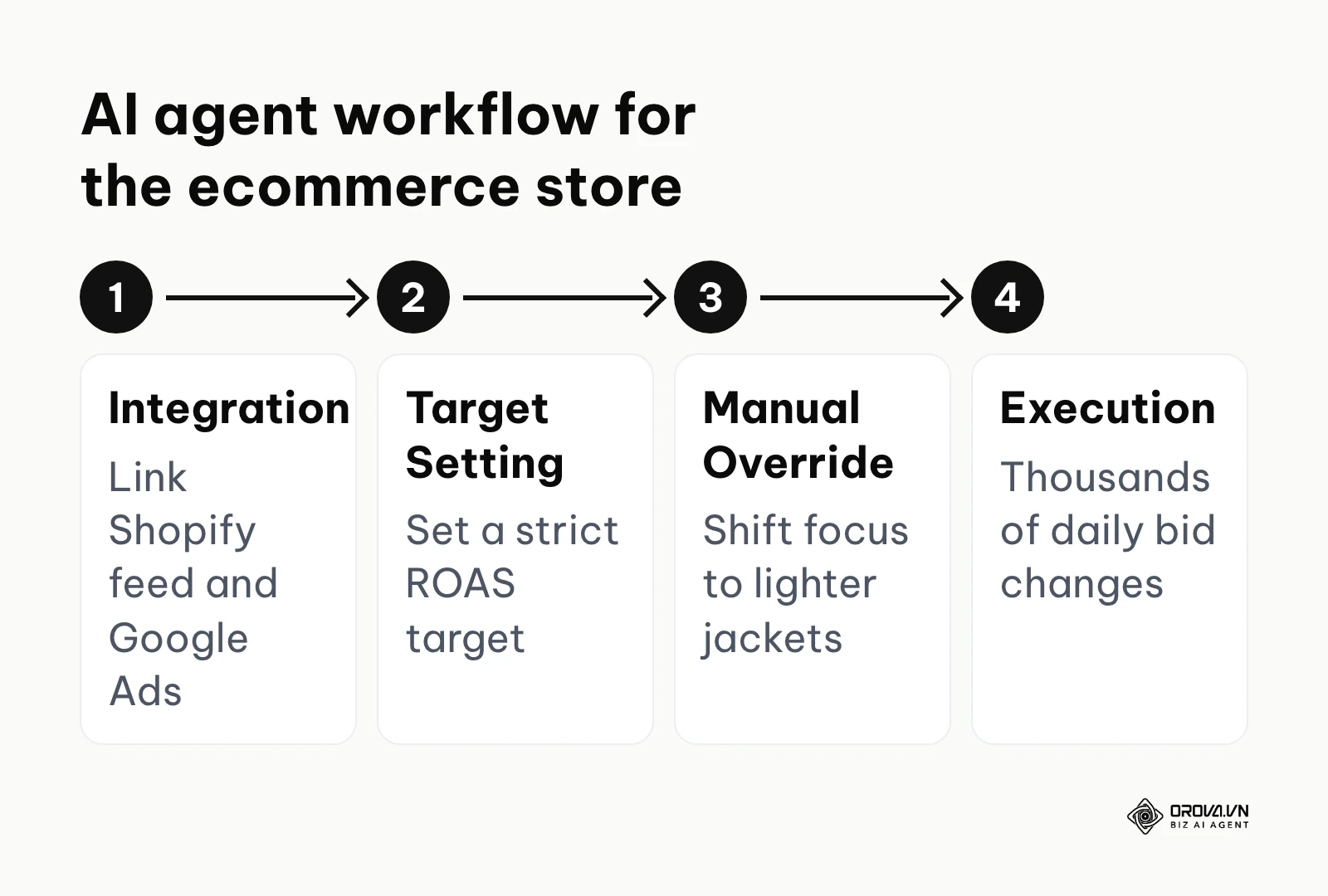
- Steps taken: They integrated a heavy-duty AI software agent directly with their Shopify inventory product feed and their Google Ads account. They set a strict target based on the roas formula, demanding a 300% return across all active campaigns to maintain profitability after shipping costs.
- Hurdles and fixes: In November, the AI aggressively pushed heavy winter coats based on historical seasonal data, ignoring the fact that it was an unseasonably warm month. The marketing team had to intervene quickly, using the software's manual override function to force prioritization of lighter jackets based on the current weather anomaly.
- Results: Once the environmental anomaly was corrected, the AI agent smoothly managed over 10,000 individual bid adjustments per day. It automatically pushed out-of-stock items down to zero spend and aggressively bid up high-margin products that were showing strong conversion rates. The main dashboard showed a highly stabilized ROAS across all product categories, an operational feat impossible without an army of human analysts.
Scenario 4: The data-rich SaaS company
Illustrative example: A project management software company with a large monthly search ads budget. They have vast amounts of data on user behavior, retention rates, and long-term lifetime value (LTV).
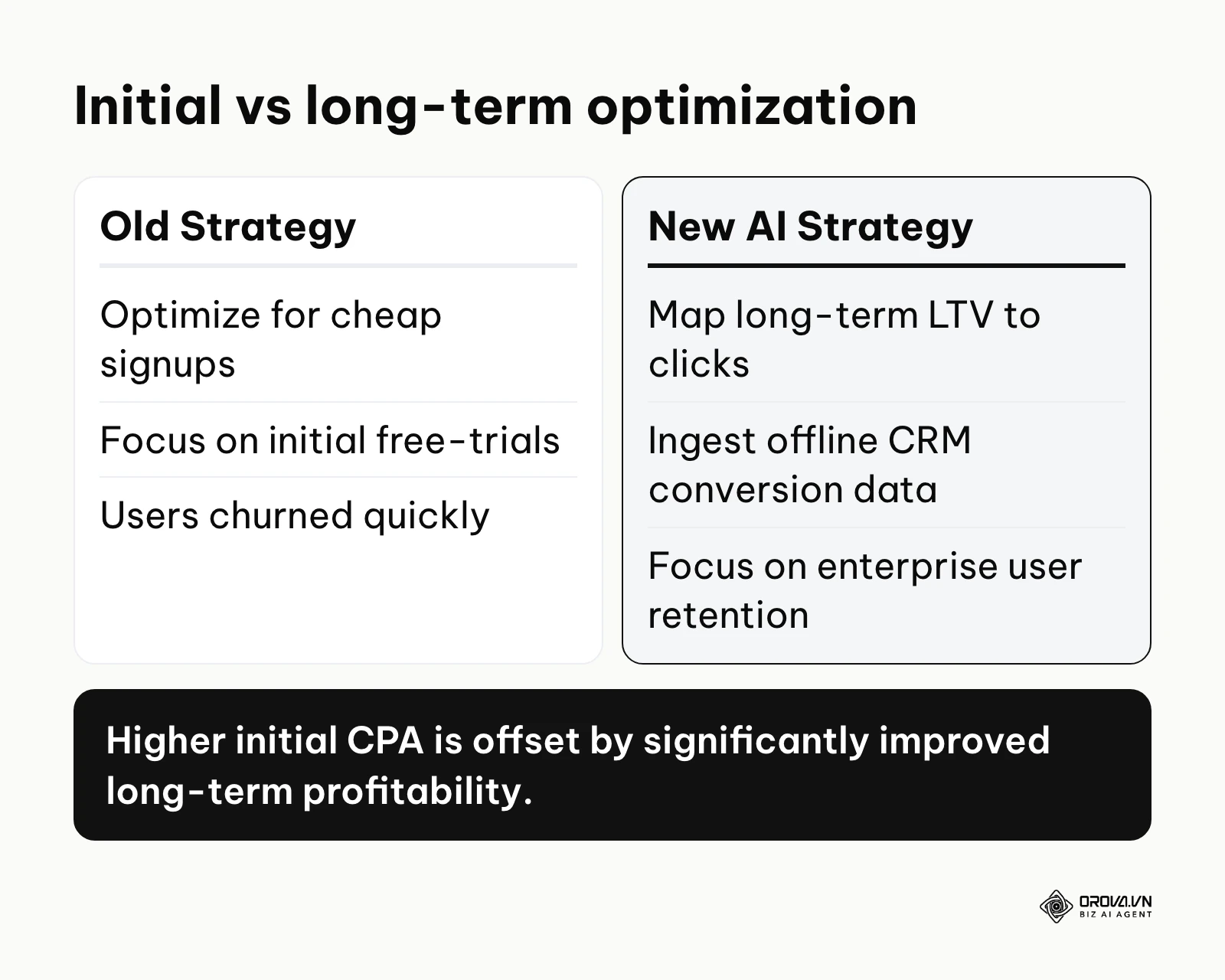
- Context: The company wanted to stop optimizing for cheap, initial free-trial signups that churned quickly, and instead start optimizing the ad platform to find users who stayed for years and upgraded to premium tiers.
- Steps taken: They utilized an advanced AI agent that could ingest offline conversion data directly from their CRM system. They successfully mapped the long-term LTV data back to the original Google Ads clicks, feeding the machine a much deeper signal of true success.
- Hurdles and fixes: The data pipeline broke twice during the first complex setup month, causing the AI to bid blindly based on incomplete data. The engineering team had to build a far more robust API connection and set up critical anomaly alerts to immediately pause campaigns if the CRM data feed failed to sync for more than 12 hours.
- Results: The AI eventually learned to identify the subtle search patterns of high-value enterprise users versus free-tier hobbyists. Over six months, the visible result was a higher initial cost-per-acquisition on the front end, but a significantly improved retention rate in the cohort analytics, driving massive long-term profitability.
Scenario 5: The seasonal service provider
Illustrative example: A national tax preparation service that conducts 80% of its total annual business in a frantic window between January and April.
- Context: The company needs to aggressively scale up ad spend in a very short window and scale it down to near zero in the summer. The environment is highly competitive and chaotic.
- Steps taken: They utilized a human agency to craft the emotional, high-impact messaging for the tax season, focusing on themes like "Don't fear the IRS." However, they deployed an AI software agent to handle the grueling, hour-by-hour bid pacing during the chaotic final weeks of April to ensure they didn't run out of budget too early in the day.
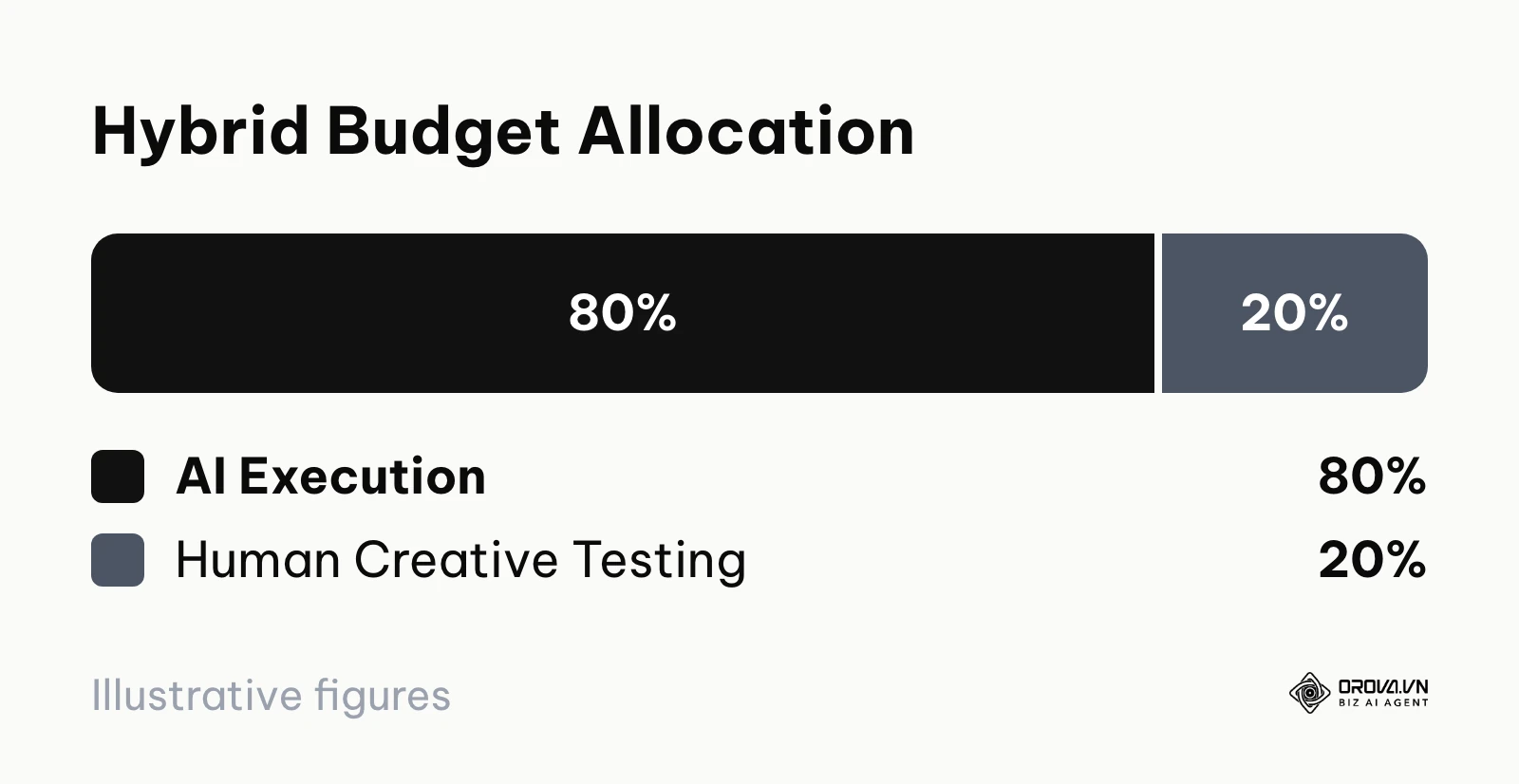
- Hurdles and fixes: The human agency and the software initially conflicted; the agency wanted to test wild new ad copy, while the AI aggressively throttled the new ads because they lacked historical conversion data. The fix required strictly segmenting the budget: allocating 80% for the AI to optimize proven, historical ads, and isolating 20% in a separate campaign for the humans to run experimental creative tests without algorithm interference.
- Results: The combined approach allowed the company to handle the massive surge in search volume efficiently. The AI aggressively captured the high-intent traffic in the final days of the season, while the agency's creative tests yielded a highly successful new headline that became the control for the following year.
Want to scale your budget but afraid of breaking performance? 📉
Integrate OROVA ADS now - an AI Agent that automatically monitors and optimizes Google, Meta, TikTok ads 24/7. Now, expanding and replicating your Performance Ads team is just one click away.
🚀 Try it now at: orova.vn/ads
The hybrid approach: Combining AI agents with human oversight
The reality of the modern advertising landscape is that you rarely have to choose an absolute extreme. The most sophisticated, high-performing marketing departments currently operate on a carefully balanced hybrid model. They recognize a fundamental truth: machines are exceptional at mathematics and volume, while humans are exceptional at empathy and creative strategy.
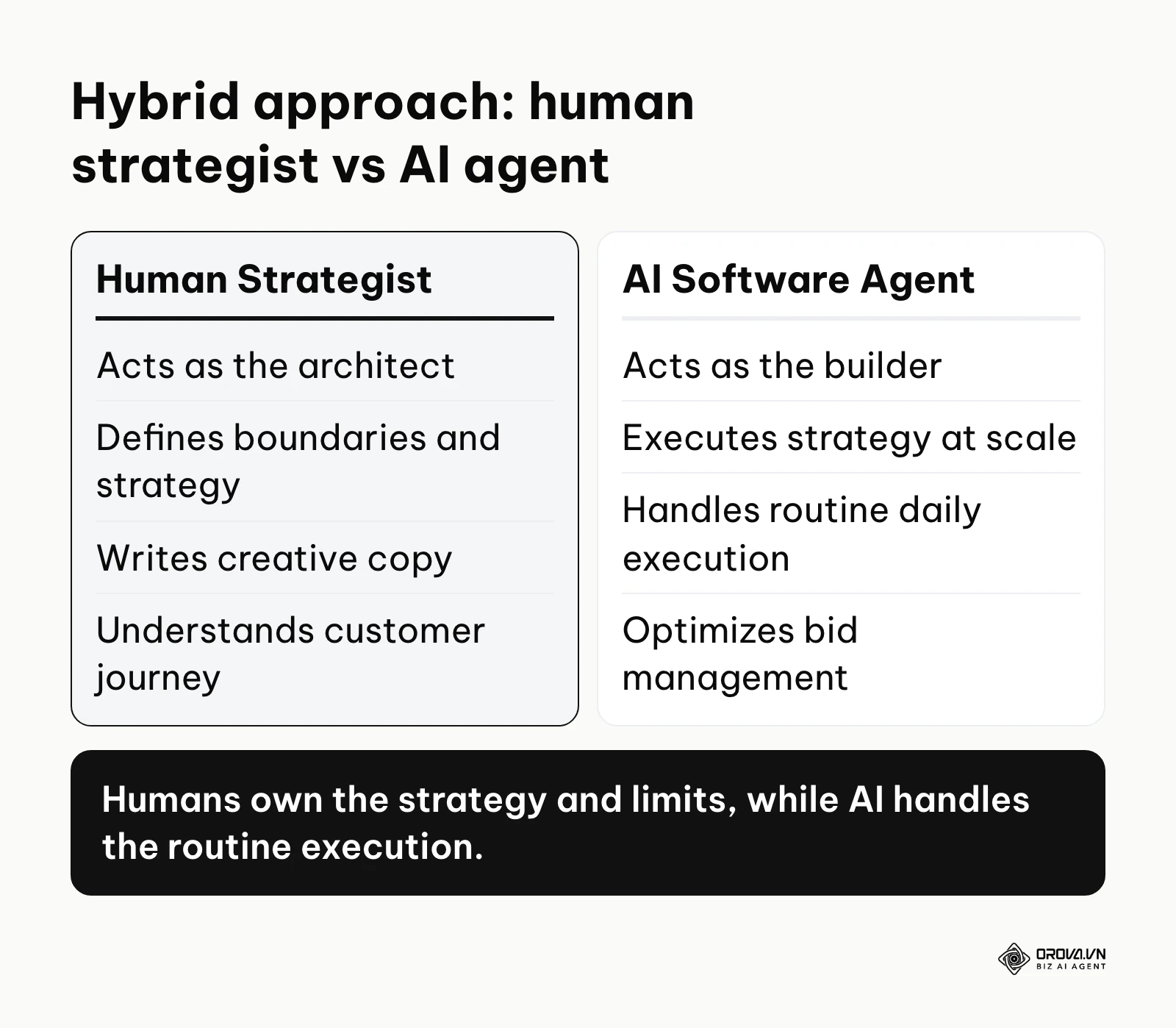
In a hybrid setup, you employ a human strategist—either an in-house marketing director or a specialized boutique consultant—to define the boundaries, write the creative copy, and deeply understand the customer journey. You then deploy an AI software agent to execute that strategy at scale within the parameters set by the human. The human acts as the architect, drawing the blueprints and ensuring the building meets the client's emotional needs; the AI acts as the builder, laying thousands of bricks perfectly straight, hour after hour without rest.
Transitioning to this model requires a profound shift in how you view agency relationships. You should no longer pay an agency a percentage of your spend just for making manual bid adjustments in a spreadsheet. Instead, you pay them for deep audience research, rigorous creative testing, and technical account setup, while the software handles the daily grind of the auction block.
This is where platforms like the Orova Ads module can help. It lets you manage Google Ads alongside Meta and TikTok in one dashboard, so you do not have to jump between separate platform silos. It syncs data on the schedule you set and receives real conversions from your CRM, a webhook, or an API. Its AI agent comes with over 200 built-in optimization actions. By default it only proposes changes for your human team to review; you can choose to let it execute 24/7 within your own rules. The human still owns the strategy and the limits, while the software handles the routine execution.
Future trends in Google ads management: Author's perspective
The landscape of digital advertising is evolving rapidly, and the role of the Google ads agent is shifting dramatically beneath our feet. Based on the technological trajectory I observe as of 2026, here are my three core predictions for where this industry is heading and how you should prepare.
The complete commoditization of bid management
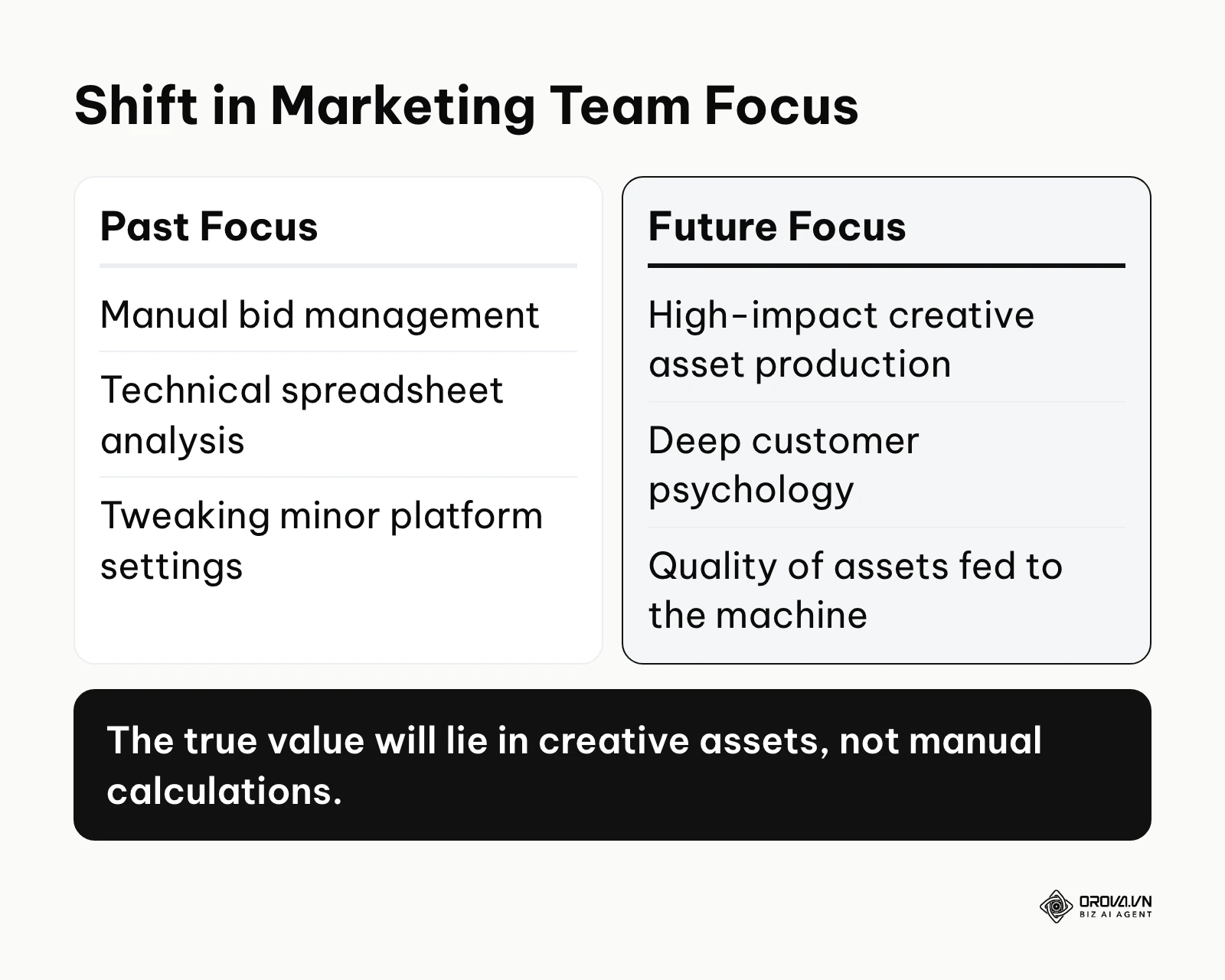
I believe manual bid management is on its way to being viewed as an archaic practice, much like manually connecting phone calls on a physical switchboard. The algorithms provided by the advertising platforms themselves are becoming so deeply entrenched and sophisticated that trying to out-calculate them manually is a massive waste of human capital. I anticipate that standalone AI tools focused solely on bid optimization will struggle to justify their subscription fees as Google bakes these exact features directly into their core product suite. Therefore, you should prepare by shifting your internal team's focus entirely away from technical spreadsheet analysis and toward high-impact creative asset production and deep customer psychology. The true value will lie in the quality of the assets you feed the machine, not how you tweak its minor settings. This prediction could be wrong if future antitrust regulations force ad networks to open up their bidding algorithms, creating a new market for independent third-party optimization tools, but the current momentum seems to point toward platform consolidation.
The rise of cross-platform AI agents
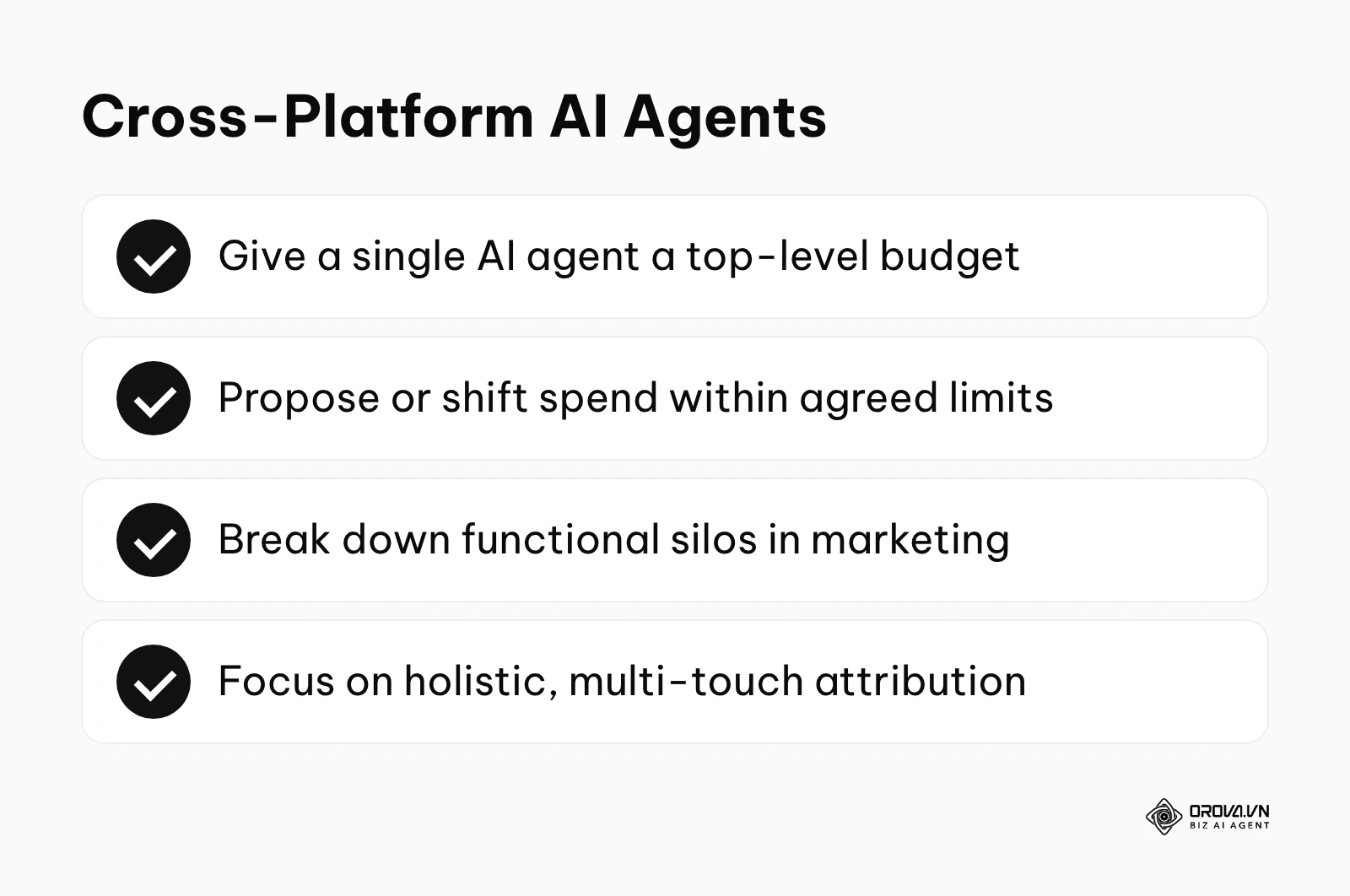
I see signals that the future may belong to AI agents that work across traditional platform silos. Currently, advertisers manage Google, Meta, and TikTok as distinct, separate ecosystems, often fighting for attribution credit. I expect more advertisers to give a single AI agent a top-level budget and let it propose, or shift within agreed limits, spend across all paid ad platforms based on recent performance. If search intent drops on Google but short-form video engagement spikes on TikTok, the agent could rebalance budgets quickly, while a human still sets the limits and reviews the logic. You need to start breaking down the functional silos in your marketing department right now; train your staff to understand holistic, multi-touch attribution rather than narrow, platform-specific metrics.
The shift towards strictly strategic human roles
As more of the daily execution layer becomes automated, I lean toward the belief that human agencies will not disappear entirely, but they will morph into purely strategic consultancies. The days of charging a percentage of ad spend for pushing buttons in a dashboard are, in my view, numbered. Future advertising agencies will look and operate much more like high-end management consulting firms. They will focus heavily on brand positioning, qualitative market research, and designing complex data architecture. If you currently run an agency, you must aggressively pivot your value proposition away from operational tasks. If you are hiring an agency, you should only be willing to pay for profound insights that an algorithm cannot deduce from historical click data.
Frequently asked questions about Google ads agents
Should I hire an agency if I only spend a few hundred dollars a month?
In most cases, no. At that budget level, a typical agency minimum retainer can rival or exceed your actual ad spend. At this budget level, you should focus on learning the absolute basics yourself or deploying a low-cost AI software agent to handle the technical bidding while you focus on writing compelling ad copy.
Can an AI agent understand my complex B2B niche?
Currently, AI agents are excellent at identifying statistical patterns but remarkably poor at understanding semantic nuance and complex organizational sales cycles. If your B2B product requires educating a buyer over several months, an AI agent can manage the bidding mechanics, but a human must design the strategic funnel and write the highly specialized content.
How do I stop a software agent from overspending?
You must implement strict, non-negotiable financial guardrails before ever granting API access. This includes setting hard daily budget caps at the campaign level within Google Ads, establishing maximum Cost Per Click limits, and running the software in "advisor mode" for the first few weeks to audit its recommendations safely.
What is the true role of AI in advertising today?
The true role of AI today is high-speed data processing and pattern recognition. It excels at analyzing millions of historical data points to adjust bids and allocate budgets across demographics faster than any human team could physically manage. It is a powerful amplifier of your strategy, not a replacement for fundamental marketing logic.
Are there hidden fees when using automated tools?
While SaaS pricing is generally transparent, hidden costs often arise from poor initial configuration. If an AI agent bids aggressively on broad, irrelevant keywords because your negative keyword lists are weak, the "hidden fee" is the massively wasted ad spend. Always review the exact pricing tiers carefully.
Where should you start?
Choosing the right path forward depends entirely on your current operational reality. Instead of trying to overhaul your entire marketing department overnight, identify which of these three states best describes your situation and take the single associated step.
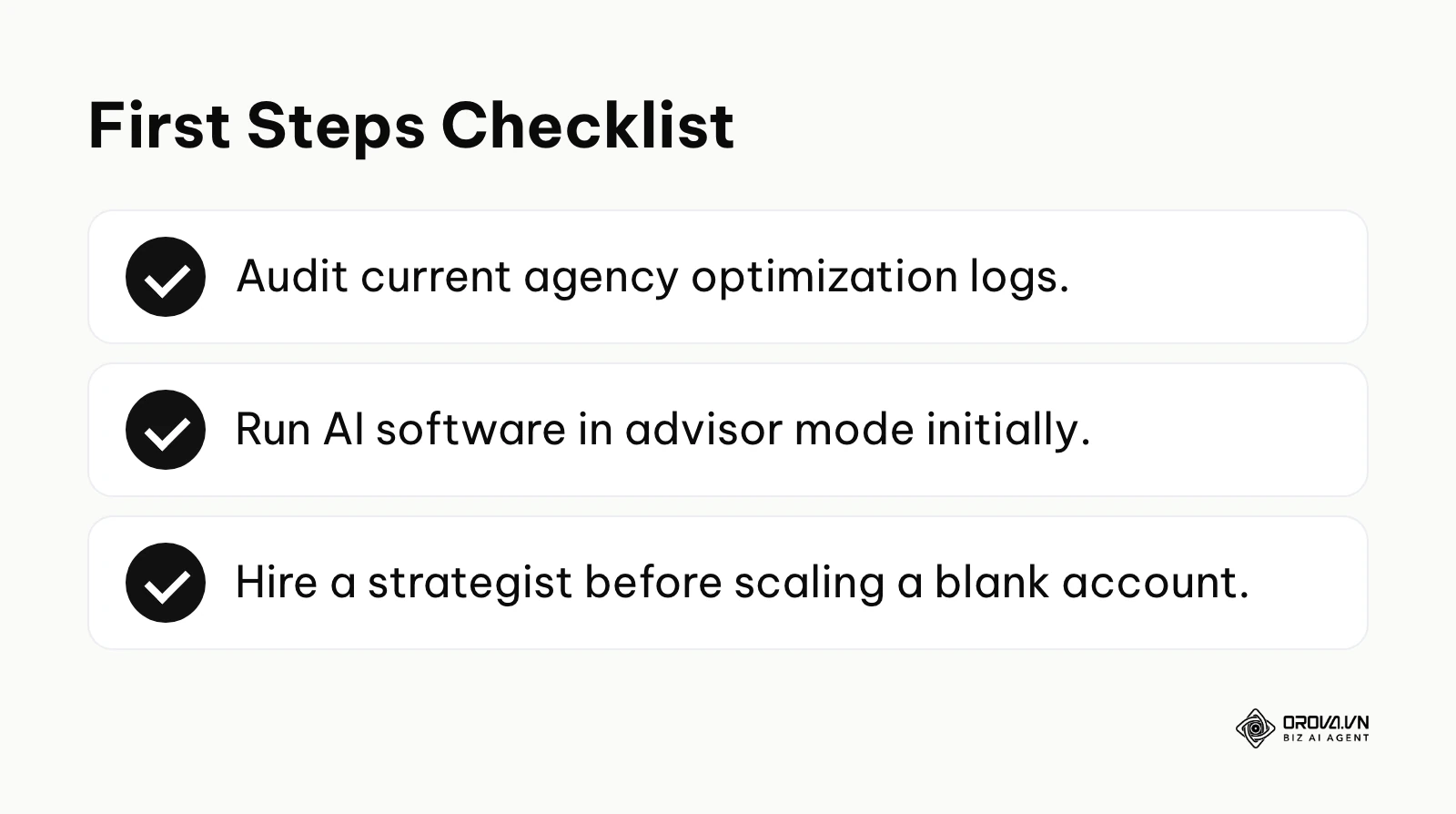
If you have a strict budget constraint but possess a wealth of historical data: Your first step is to implement a basic AI software agent on a strict trial basis. Connect your account securely, but do not turn on automatic execution. Spend one afternoon thoroughly reviewing the suggestions the AI generates based on your past data. This will give you a clear, risk-free sense of whether the machine's logic aligns with your business goals without risking a single dollar of actual spend.
If you are entering a completely new market with zero historical data: You need human strategy far before you need machine scale. Your immediate step is to hire a freelance strategist or a highly specialized agency for a one-time project to conduct deep audience research and build your initial campaign structure. Do not turn an AI loose on an empty account; it needs a baseline of accurate data to learn from effectively.
If you are currently paying a traditional agency but feeling uncertain about their true value: Your first action is to conduct a rigorous audit of their optimization logs. Request a detailed, itemized breakdown of the manual changes made to the account over the last 30 days. If the changes are sparse or solely focused on basic, routine bid tweaks, you are likely overpaying for simple execution. You should strongly explore moving those routine tasks to an automated system while retaining human consultants only for high-level creative work.
About the author

Builder of Orova
Nguyễn Đỗ Trọng Ân has 8 years of experience in marketing, including 6 years managing market development across Asia. He builds Orova, a Biz AI Agent that never sleeps: it plans, runs and optimizes work for businesses.
Run your business with AI Agents
Orova is the always-on Biz AI Agent — it plans, runs, and optimizes the work for you.
Save time, unlock productivity.