
AI lead generation: 8 best tools in 2026 compared, and how to choose

Investing in modern AI lead generation requires looking past promotional demonstrations to examine the mechanics of contact deliverability, verification expenses, and workflow integration. Choosing the wrong software burns thousands of dollars on unverified contact records, damages corporate sending domains, and buries sales development representatives under manual data cleaning tasks.
To construct a prospecting engine that yields predictable pipeline rather than spam complaints, revenue leaders must evaluate candidate software against five pragmatic standards: data freshness, verification transparency, multi-channel enrichment coverage, workflow automation depth, and total cost of ownership. Many legacy vendors merely rebrand static contact lists compiled quarters ago as artificial intelligence.
This guide evaluates the 8 best AI lead generation tools available in 2026. Each platform is analyzed on its operational strengths, structural limitations, and ideal customer scenarios so your team can deploy the right prospecting system.
8 Best AI Lead Generation Tools in 2026: Overall Comparison Table
Selecting an AI lead generation solution depends on whether your outbound sales motion prioritizes pre-indexed contact volume, customizable data waterfall workflows, phone-verified direct dials, or live web evidence extraction. The table below compares the eight solutions across their primary use cases, core strengths, data approach, and candid verdicts. Vendor pricing changes often, so check each vendor's own pricing page before you buy.
| Tool | Best For | Core Strength | Data Approach | Quick Verdict |
|---|---|---|---|---|
| Apollo.io | Mid-market sales teams needing an expansive native contact database | Vast native contact index with built-in email sequencing | Pre-built contact database | Best all-in-one starter directory |
| Clay | Growth teams building advanced waterfall enrichment pipelines | Multi-provider data orchestration with AI web research prompts | Orchestrates multiple third-party data providers | Best for complex RevOps workflows |
| ZoomInfo | Enterprise outbound teams needing deep account org charts | Extensive corporate firmographics and phone intelligence | Pre-built enterprise contact database | Industry standard for enterprise phone data |
| Instantly | Cold email specialists scaling multi-inbox deliverability | Automated inbox warmup and AI-assisted copywriting variations | Sending platform with an add-on lead database | Premier volume cold email infrastructure |
| Salesforge | B2B teams focused on hyper-personalized multi-language email | Programmatic email personalization based on account signals | Bring your own list; AI writes the emails | Built for dynamic personalized outbound |
| Cognism | Global outbound teams requiring compliant European phone data | Phone-verified direct dials with strict GDPR alignment | Pre-built database with phone-verified numbers | Best for compliant direct dial calling |
| Orova Bot | B2B teams seeking live public web leads with verifiable proof | Plain-language search, AI scoring with quoted evidence, contacts across 44 social networks | Finds new leads on public sources, no stored contact database | Suited to evidence-backed prospecting from public sources |
| Seamless.AI | Sales reps needing on-the-fly contact scraping via browser extensions | Real-time contact lookups on corporate domains and professional networks | On-demand contact lookup | Fast on-page contact identification |
Apollo.io: Database-First AI Lead Generation
Apollo.io serves as an accessible entry point for sales teams that want a vast, pre-indexed B2B database paired directly with cold outreach execution tools.
- Best for: Early-stage startups, mid-market sales teams, and agencies looking for an integrated database and cold email sequencer within a single subscription.
- Core strengths:
- Apollo hosts a large database of business contacts, allowing teams to filter prospects by company headcount, funding round, technological footprint, and job title without configuring third-party integrations.
- The built-in sequencing engine allows sales development representatives to move directly from list construction to multi-step email cadences, reducing context switching across separate software applications.
- The platform includes native intent signals, tracking when prospective target accounts research relevant software categories across third-party business portals.
- Weaknesses:
- Because Apollo relies on a centralized shared repository, email addresses experience data decay; unverified emails can bounce if they are not passed through a dedicated secondary verification filter.
- Mobile direct dial coverage remains inconsistent outside North America, requiring supplemental data sources for international phone outreach.
- When to choose: Choose Apollo when your primary goal is quickly building outbound prospecting lists from an established directory without engineering external API pipelines.
Clay: Waterfall AI Lead Generation
Clay functions as a programmable data enrichment spreadsheet, orchestrating dozens of external data vendors to resolve missing corporate details through automated waterfalls. Connecting Clay's automated web scraping workflows with modern AI marketing automation tools creates a continuous loop from lead identification to outbound pipeline generation.
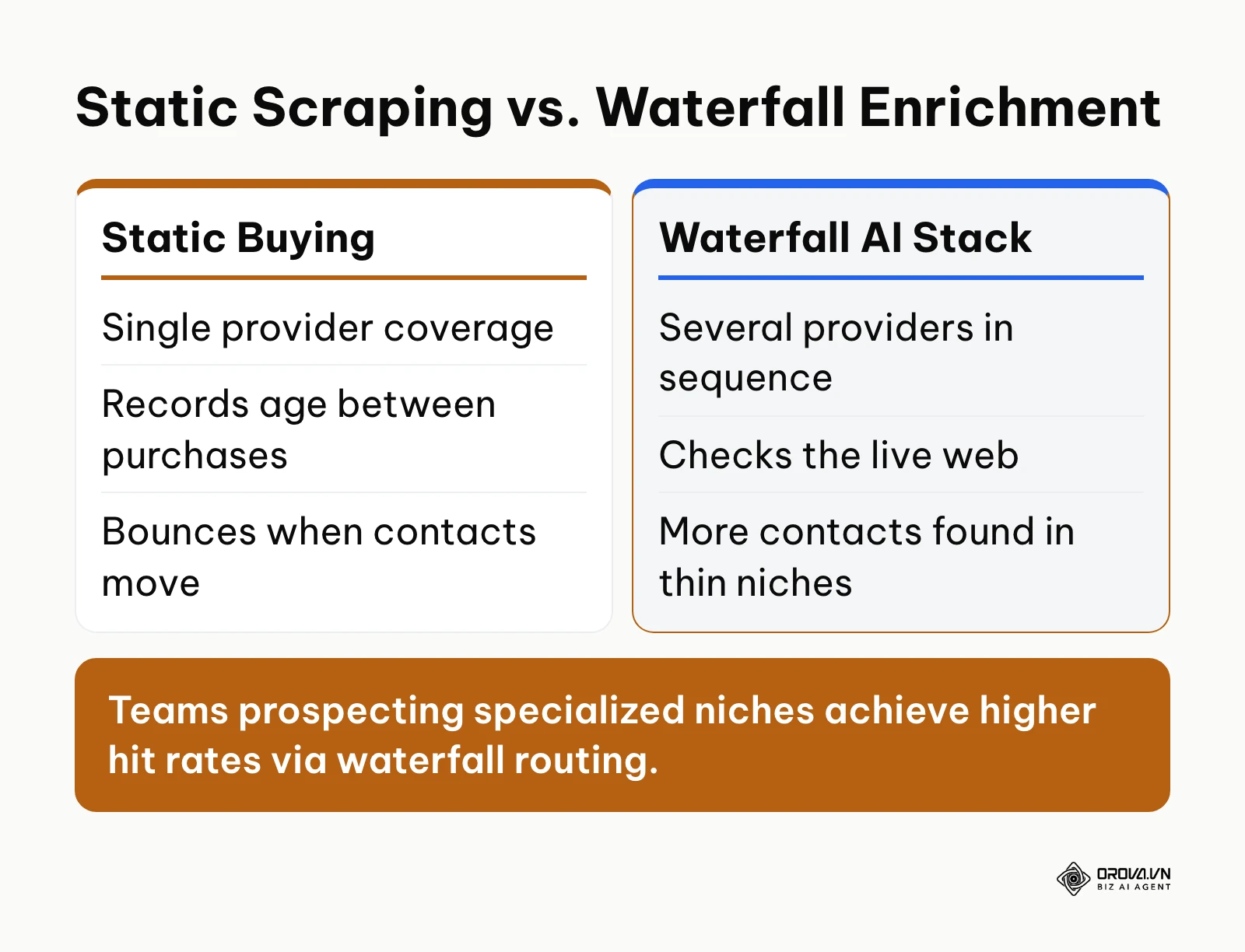
The comparison below highlights the structural differences between purchasing static lists and building automated enrichment pipelines.
- Best for: Technical growth marketers, revenue operations specialists, and outbound agencies that require bespoke data validation logic across specialized industries.
- Core strengths:
- Clay features waterfall enrichment, an architectural capability that automatically queries provider A, falls back to provider B if no contact is found, and checks provider C, which raises match rates in niches where a single provider has thin coverage.
- The platform integrates native large language model agents capable of navigating company websites, extracting specific details like recent executive appointments or pricing tiers, and generating structured outputs.
- Deep integrations with modern data warehouses, CRMs, and outbound platforms allow growth engineers to construct complex programmatic prospecting sequences.
- Weaknesses:
- Clay presents a steep learning curve that resembles spreadsheet programming, requiring dedicated RevOps resources to configure formulas, HTTP webhooks, and prompt logic properly.
- Credit consumption can escalate rapidly when cascading across multiple enterprise data providers, leading to unpredictable monthly software expenditures if usage caps are not monitored closely.
- When to choose: Choose Clay when standard databases fail to provide adequate contact coverage for your niche and you have the technical capacity to architect multi-vendor enrichment workflows.
Illustrative example:
- Context: A two-person growth team at a logistics software consultancy targeting regional freight shipping brokers across North America.
- Concrete steps taken: The team created a Clay workflow importing 1,200 company domains, chained an AI web scraper to extract active carrier certification numbers from state registry portals, and executed a waterfall cascade querying three data providers for transport manager direct phone numbers.
- Stumbling block encountered and resolution: Initial runs burned through 4,000 credits in three hours because the AI prompt hallucinated carrier certifications on non-freight landing pages; the team resolved this by injecting strict regex filters that checked for exact state registry formatting before triggering downstream contact lookups.
- Observable result: The refined pipeline generated a final list of 412 fully verified freight operations directors, with every record containing a confirmed carrier license number and verified mobile contact.
ZoomInfo: Enterprise AI Lead Generation
ZoomInfo remains the enterprise benchmark for corporate intelligence, providing deep hierarchical organizational charts, intent data, and verified direct dials for large outbound revenue teams.
- Best for: Enterprise sales organizations with dedicated SDR teams that execute high-volume cold telephone outbound campaigns and require strict compliance safeguards.
- Core strengths:
- The platform provides deep organizational mapping, allowing account executives to identify buying committees, reporting structures, and internal influencers within Fortune 500 accounts.
- ZoomInfo maintains high direct-dial mobile phone coverage across North America, verified through contributory data networks and manual validation teams.
- Enterprise-grade administrative controls, custom CRM integrations, and automated data cleansing ensure enterprise sales pipelines stay synchronized with corporate compliance policies.
- Weaknesses:
- ZoomInfo is sold through annual agreements negotiated with sales, making it cost-prohibitive for early-stage companies and smaller sales organizations.
- The user interface is dense and complex, frequently requiring specialized administrative onboarding to configure custom fields and deduplication parameters.
- When to choose: Choose ZoomInfo when your revenue model hinges on cold outbound calling into enterprise accounts where direct-dial phone accuracy directly dictates pipeline velocity.
Instantly: Cold Email AI Lead Generation
Instantly is designed specifically for revenue teams that execute cold email prospecting at scale, combining automated inbox rotation with automated deliverability safeguards. For high-growth teams, combining cold outreach with lead generation content marketing ensures prospects who research your brand after receiving an outbound email encounter educational thought leadership assets.
- Best for: Outbound agencies, solo founders, and sales teams that prioritize cold email as their primary pipeline channel and need to manage dozens of sending domains simultaneously.
- Core strengths:
- Instantly lets you connect many sending accounts and runs automated inbox warmup, protecting secondary sending domains from landing in corporate spam folders.
- The built-in B2B contact database allows users to locate verified prospect emails and import them directly into automated sending campaigns without leaving the software environment.
- The platform includes AI-assisted dynamic personalization tools that adjust email copy angles and icebreaker sentences based on prospect website content.
- Weaknesses:
- The software focuses almost exclusively on cold email execution, lacking native telephone dialing, LinkedIn multi-touch orchestration, or WhatsApp messaging features.
- Advanced data enrichment parameters remain basic compared to dedicated waterfall engines like Clay or enterprise data systems like ZoomInfo.
- When to choose: Choose Instantly when your outbound sales strategy relies primarily on multi-domain cold email sequences and you want to avoid per-seat email inbox fees.
Illustrative example:
- Context: An early-stage cybersecurity SaaS startup with one full-time SDR targeting IT infrastructure managers at mid-sized financial firms.
- Concrete steps taken: The SDR registered four secondary sending domains, set up 12 dedicated Google Workspace inboxes, enrolled them in Instantly's automated warmup pool for three weeks, and launched a two-step plain-text cold email sequence referencing recent regulatory compliance audits.
- Stumbling block encountered and resolution: In week two of sending, reply rates dropped suddenly because two domains experienced elevated spam complaints due to overly generic copy; the SDR resolved this by lowering per-inbox sending limits to 30 emails per day and inserting dynamic account-level compliance triggers.
- Observable result: The revised campaign maintained sender domain reputation scores above 98% across all 12 inboxes, generating 19 qualified sales discovery calls over the subsequent four weeks.
Salesforge: Dynamic AI Lead Generation
Salesforge approaches outbound sales from an AI-native perspective, focusing on real-time programmatic email personalization and dynamic language generation to maximize reply rates.
| Question | Instantly | Salesforge |
|---|---|---|
| Main job | Sending cold email at volume across many inboxes | Writing personalized cold email at scale |
| Where leads come from | Its add-on lead database or your own imported list | Mainly your own imported list or third-party enrichment |
| Deliverability tools | Inbox warmup and inbox rotation | Inbox rotation and mailbox deliverability monitoring |
| Pick it when | Volume and domain health are your bottleneck | Generic copy is what keeps reply rates low |
- Best for: B2B companies targeting diverse international markets that require authentic multi-language outbound messaging and contextual email personalization.
- Core strengths:
- The platform utilizes proprietary language models to write bespoke cold emails tailored to an account's recent business updates, technological stack, and market positioning rather than relying on basic merge tags.
- Native multi-language generation produces fluent cold outbound emails in dozens of languages, adapting tone and phrasing to match regional business norms.
- Salesforge integrates multi-inbox rotation and mailbox deliverability monitoring directly into its sequencing dashboard, maintaining sending domain reputation automatically.
- Weaknesses:
- The system focuses predominantly on copywriting and email sequencing; teams must import their own prospect lists or rely on third-party enrichment integrations for specialized data fields.
- Setting up effective programmatic personalization prompts requires careful testing to prevent the generative AI engine from producing generic or overly repetitive sales hooks.
- When to choose: Choose Salesforge when your prospects ignore standard template outreach and your conversion rates depend on generating customized email copy tailored to specific account triggers.
Cognism: Compliant Direct-Dial AI Lead Generation
Cognism specializes in providing premium B2B contact intelligence across EMEA and North America, distinguished by its phone-verified mobile numbers and strict compliance with global privacy regulations. When prospecting international accounts, reviewing directives from authorities such as the European Data Protection Board ensures direct outreach adheres to strict regulatory standards. Direct outbound telephone cadences can also be reinforced by running targeted B2B advertising campaigns on LinkedIn against the same account list.
- Best for: Mid-market and enterprise sales teams selling into Europe, the UK, and international territories that need compliant direct dials for outbound telephone prospecting.
- Core strengths:
- The platform offers Diamond Data, a premium contact tier where phone numbers are manually phoned and verified by human validation teams, resulting in high direct-dial connect rates.
- Cognism maintains strict compliance with GDPR and local privacy mandates, actively checking telephone lists against national Do-Not-Call (DNC) registries across European jurisdictions.
- The browser extension allows sales development representatives to enrich corporate profiles and capture verified mobile phone numbers directly from professional business directories.
- Weaknesses:
- Contracts are geared toward established sales teams and are typically annual, presenting a financial hurdle for early-stage startups.
- Native cold email sending and multi-channel sequencing features are limited compared to all-in-one engagement platforms like Apollo, necessitating an external sequencer.
- When to choose: Choose Cognism when your sales organization relies on cold calling decision-makers in European markets where regulatory compliance and phone accuracy are paramount.
Spent hours searching the web and still can't find B2B prospects that fit your ideal customer profile? Orova Bot uses AI to find businesses based on your description. With a list of relevant prospects to contact, you spend less time searching and more time selling.
Try it now at orova.vn/bot
Orova Bot: Live Public Web AI Lead Generation
Orova Bot finds new B2B prospects on public sources from a one-sentence description of the customer you want, then scores each one against your own criteria with quoted evidence, instead of selling access to a pre-compiled contact database. Rather than querying fixed keyword indexes, modern teams evaluate how the best AI search engine options parse semantic context across the open web to identify non-standard business categories.
- Best for: B2B companies and agencies that need to identify target accounts matching specialized operational criteria, verify every prospect against live public website evidence, and capture multi-channel contact points across email, phone, and social platforms.
- Core strengths:
- You define your target account profile in plain natural language, such as asking for commercial solar installers operating in Southeast Asia that offer maintenance contracts. The AI analyzes the prompt, extracts search criteria, suggests relevant public sources, and runs discovery across public business directories, industry association member lists, YouTube channels, and OpenStreetMap business locations, with AI web search used last when open sources run dry. You can edit, add, or switch off any criterion before the run.
- The system applies two distinct qualification tiers: automated data filters that check for required fields like email addresses or specific countries without consuming AI compute, and AI criteria, each marked Required or Bonus with a weight from 1 to 10. The overall score is a weighted average calculated by code, not invented by the AI. If a Required criterion scores below 50 because of concrete contrary evidence, the lead is excluded. You set the pass threshold and a review band, so every lead lands as Qualified, Review, or Not qualified.
- Every qualification verdict is backed by verifiable evidence; each check returns pass, fail, or insufficient evidence with a verbatim quote and the source link, and code confirms the quote really appears on that page; if it does not, the check is marked insufficient evidence.
- The bot collects contact details the company has published itself: representative name (when the page lists one), company email, phone numbers normalized with their country code (+84, +65, and so on), website, and profiles across 44 social networks (including Facebook, TikTok, LinkedIn, YouTube, Zalo, WhatsApp, LINE, and Discord) into one record, each with a link to its source. Fields a page does not show stay empty rather than guessed.
- Leads with an email address can be sent to your Orova Connect contact list, by hand or through an automatic action, or exported to Excel (.xlsx) or CSV with scores, reasons, and source links. "Delete and block" keeps an email, phone number, or domain from coming back in later runs.
Here is how the solar installer example above could look as a criteria set before you start the run:
| Criterion | Type | Group | Weight |
|---|---|---|---|
| Has a company email address | Automatic filter (no AI) | Required | Not weighted |
| Located in Singapore, Malaysia, or Thailand | Automatic filter (no AI) | Required | Not weighted |
| Installs solar systems for commercial or industrial buildings | AI scored, with quote | Required | 10 |
| Offers maintenance or service contracts | AI scored, with quote | Required | 8 |
| Shows projects completed for business clients | AI scored, with quote | Bonus | 5 |
- Weaknesses:
- Unlike Apollo or ZoomInfo, Orova Bot does not provide an instant, pre-indexed database of hundreds of millions of static profiles; it scans and evaluates the live public web, which takes execution time to discover and score accounts.
- Only leads with an email address can be added to the Orova Connect contact list.
- AI evaluation and unstructured web research consume compute quota, though automatic filters use no AI, and re-scoring a lead that was already scored does not deduct quota again. It works only with data businesses publish themselves; it does not log in to sites or go behind paywalls.
- Cost model: Free through July 7, 2027. Every plan includes every feature; plans differ only by quota, which is deducted by actual AI cost rather than by the number of leads found.
- When to choose: Choose Orova Bot when your ideal customer profile cannot be filtered accurately using standard industry taxonomy codes and you require verifiable web citations proving a prospect qualifies before adding them to your sales pipeline.
Seamless.AI: Real-Time Search AI Lead Generation
Seamless.AI operates as a real-time search engine for B2B contact information, using machine learning models to predict and verify corporate email addresses and phone numbers on demand.
- Best for: Individual sales reps and small outbound teams that conduct targeted prospecting directly within professional networking sites and company websites using a browser extension.
- Core strengths:
- Rather than relying strictly on an internal static database, Seamless.AI queries live web signals at the moment of search to locate business email addresses and corporate phone numbers.
- The Chrome browser extension allows SDRs to pull up contact information while researching company personnel on social profiles and corporate homepages, saving records directly to CRM platforms.
- Built-in buyer intent data tracks corporate content consumption, notifying sales reps when accounts exhibit search interest around relevant product categories.
- Weaknesses:
- Verification accuracy can fluctuate significantly across non-standard corporate email domains, resulting in occasional false positives that require external email hygiene verification.
- Several core workflow features, such as advanced CRM integrations and expanded data fields, are restricted to higher-tier customized contracts.
- When to choose: Choose Seamless.AI when your sales team conducts ad-hoc prospecting on the web and needs a rapid browser extension to extract contact details without managing complex spreadsheets.
The Real Cost of AI Lead Generation: Piecemeal Stacks vs. Integrated Agents
Many sales organizations dramatically underestimate their operational software expenditures because they evaluate only the base subscription price of prospecting tools. In practice, building an effective outbound pipeline using a piecemeal software stack requires paying for multiple disconnected applications: a directory scraper, a waterfall enrichment tool, a dedicated email verification API, and a multi-inbox cold email sequencer.
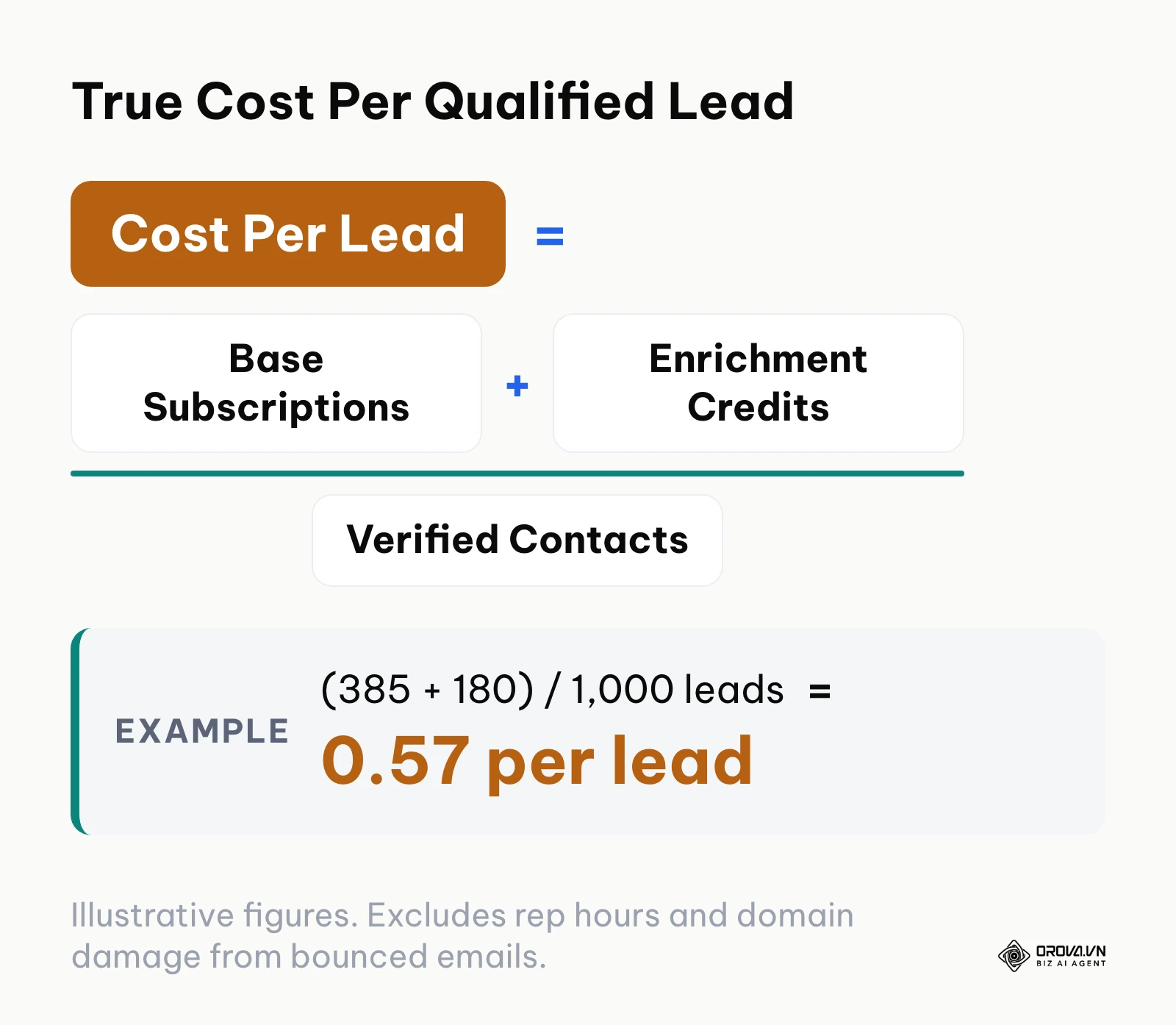
The formula below defines the true economic cost required to produce fully qualified and deliverable outbound sales prospects.
When sales teams operate across fragmented tool stacks, credit charges compound quickly: a waterfall that queries several providers can pay for the same contact more than once. At higher volumes, variable enrichment credits can rival the subscriptions themselves. Zapier or webhook maintenance also adds hidden engineering time whenever an API endpoint changes.
The hours your reps spend cleaning lists, fixing bounced records, and copying data between tools belong in this calculation too, even though no invoice shows them.
Use the worksheet below to calculate your own Total Cost of Ownership. The figures are an illustrative example for a stack of four tools (directory scraper, waterfall enrichment service, email verification API, and cold email sequencer) producing 1,000 verified leads a month; replace them with the numbers from your own invoices.
| Cost Line | What to Count | Illustrative Month (1,000 Verified Leads, Your Currency) |
|---|---|---|
| Software subscriptions | Every seat and plan across all tools in the stack | 385 |
| Enrichment and verification credits | Credits used, including lookups that returned nothing | 180 |
| Total direct cost | Subscriptions plus credits | 565 |
| Cost per verified lead | Total direct cost divided by verified leads | 0.57 |
| Hidden costs (track separately) | Rep hours on list cleaning, broken integrations, domains damaged by bounces | Not in the invoice |
If one tool can replace two or three of these lines, recalculate the cost per verified lead with its pricing and compare the two results side by side, rather than comparing subscription prices alone.
Evidence-Based AI Lead Generation: 3-Layer ICP Prompts and Multi-Channel Verification
Relying on standardized industry classification codes and unverified self-reported job titles produces pipeline bloat. A company tagged as "Software" might be an early-stage consumer mobile app or an enterprise B2B infrastructure vendor. Effective outbound teams replace guessing with evidence-based qualification, requiring artificial intelligence models to extract concrete proof from public corporate web assets before approving a lead. Autonomous crawlers inspect standard Schema.org microdata tags embedded in company websites to identify official physical locations, corporate structures, and service offerings.
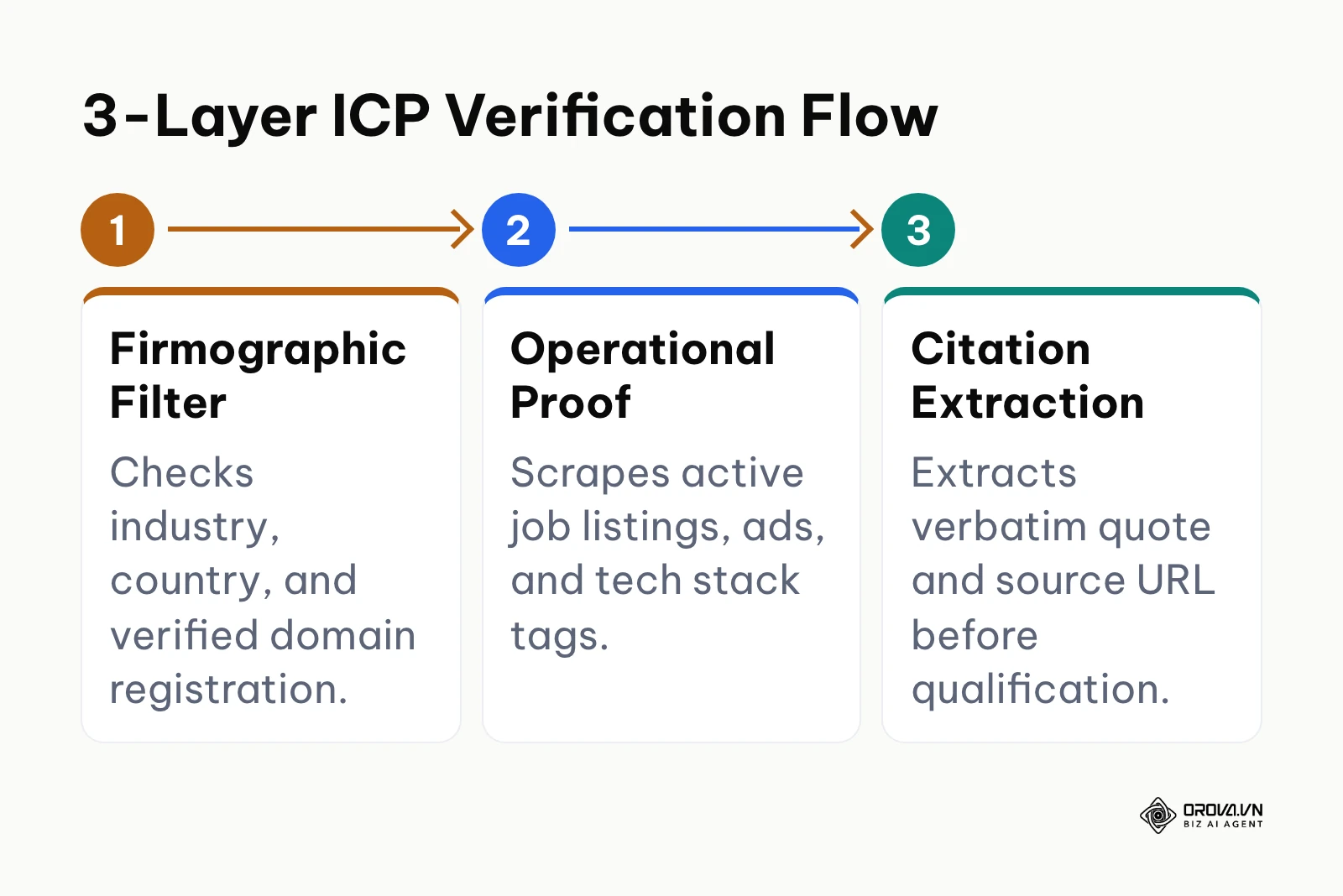
The diagram below outlines the three sequential stages of an evidence-based lead qualification pipeline.
To implement evidence-based qualification, outbound teams can deploy a structured 3-layer Ideal Customer Profile (ICP) prompt framework that enforces strict verification rules.
PROMPT: 3-LAYER EVIDENCE-BASED B2B QUALIFICATION

ROLE: Rigorous B2B Revenue Operations Auditor
TASK: Evaluate target company website and open public footprints against the criteria below.
RULES: For each criterion, you must return: Status [PASS / FAIL / INSUFFICIENT_EVIDENCE],
an exact verbatim quote from the target domain, and the specific source URL.
Do not assume or infer facts not explicitly stated on the page.

LAYER 1: FIRMOGRAPHIC FOUNDATION (Mandatory Filter)
- Target Geography: Must have physical operations or verified commercial headquarters in [Target Country/Region].
- Business Model: Must sell B2B commercial products or services (disqualify pure B2C storefronts).
- Evidence Source: Inspect Footer, About Us, Imprint, or Terms of Service page.

LAYER 2: OPERATIONAL INTENT & MATURITY (Weight: 8/10)
- Hiring Activity: Must show active job openings in [Department, e.g., Logistics/Engineering].
- Technology Adoption: Must display active usage or integration with [Target Tool/Ecosystem].
- Evidence Source: Inspect Careers page, Documentation, or public meta script tags.

LAYER 3: COMMERCIAL CAPABILITY & FIT (Weight: 9/10)
- Service Scope: Must explicitly state offering of [Specific Capability, e.g., Enterprise SLA / API Access].
- Disqualification Triggers: Reject if company states they only service [Excluded Sector].
- Evidence Source: Inspect Pricing, Solutions, or Case Study pages.

OUTPUT FORMAT:
{
  "company_name": "String",
  "qualification_status": "PASS | REVIEW | DISQUALIFIED",
  "layer_scores": [
    {"layer": 1, "status": "PASS", "quote": "Verbatim text", "url": "Exact link"},
    {"layer": 2, "status": "PASS", "quote": "Verbatim text", "url": "Exact link"},
    {"layer": 3, "status": "FAIL", "quote": "Verbatim text", "url": "Exact link"}
  ],
  "disqualification_reason": "String or null"
}
Once a target account passes the evidence qualification prompt, contact data must undergo rigorous multi-channel validation. Relying solely on corporate email addresses leaves sales teams vulnerable to spam filter updates and low inbox placement.
The following 8-step multi-channel verification checklist ensures contact records are technically sound across corporate email, mobile telephony, and social identities before synchronizing with your CRM.
Multi-Channel Contact Verification Checklist
- [ ] Step 1: MX Record & Mail Exchanger Validation. Query the prospect domain DNS records to verify that active mail exchanger (MX) servers are configured and capable of accepting incoming mail.
- [ ] Step 2: SMTP Handshake & Mailbox Ping. Execute an SMTP protocol handshake with the target mail server to confirm the specific mailbox username exists, ensuring no test messages are transmitted.
- [ ] Step 3: Catch-All Domain Detection. Determine whether the receiving mail server is configured as a catch-all domain (accepting all inbound mail regardless of prefix); flag catch-all addresses for secondary verification.
- [ ] Step 4: Disposable & Free Provider Suppression. Check email domains against public lists of temporary disposable email services and personal free webmail providers (Gmail, Yahoo, Outlook) to isolate authentic corporate inboxes.
- [ ] Step 5: E.164 Telecom Phone Formatting. Convert all scraped corporate and direct phone numbers into standardized international E.164 formatting (including country code prefix, such as +1 for North America, +84 for Vietnam, or +65 for Singapore).
- [ ] Step 6: HLR Telecom Network Ping. Perform a Home Location Register (HLR) network lookup to confirm the telephone number is currently assigned to an active carrier line and is not a disconnected landline.
- [ ] Step 7: Social Handle URL Resolution. Verify that extracted social media URLs (such as LinkedIn, WhatsApp, Facebook, or YouTube) redirect to an active business profile rather than a generic platform homepage or 404 error page.
- [ ] Step 8: Identity & Company Name Matching. Cross-reference the verified social profile bio text and company name against the target website domain to confirm the profile belongs to the decision-maker rather than a namesake at an unrelated entity.
Illustrative example:
- Context: A sales operations lead at an enterprise medical equipment manufacturer seeking private surgical clinic directors across three metropolitan regions.
- Concrete steps taken: The lead configured an autonomous web agent to scan state healthcare licensing portals, extracted 850 clinic homepages, and ran the 3-layer qualification prompt checking for on-site surgical suites and accredited anesthesiologists.
- Stumbling block encountered and resolution: Over 200 cosmetic wellness clinics passed the initial filter because their landing pages mentioned minor skin procedures; the lead resolved this by adding an explicit disqualification parameter in Layer 3 targeting non-surgical medspas and requiring verbatim citations mentioning licensed operating rooms.
- Observable result: The audit removed 184 unqualified aesthetic centers, leaving 312 fully verified surgical clinic accounts with active phone lines and direct clinic director contact details.
Is your sales team making plenty of calls but reaching prospects whose needs don't match your offer? Orova Bot uses AI to select suitable B2B prospects and explain why they're worth calling. Your team gets a list they can start calling right away, with clear reasons to prioritize each prospect.
Try it at orova.vn/bot, free through July 7, 2027.
How to Choose an AI Lead Generation Solution by Scenario
Sales organizations differ significantly by deal velocity, average contract value (ACV), outbound channel reliance, and technical engineering resources. A tool that excels for a high-volume cold email marketing agency can prove entirely inadequate for an enterprise sales team closing six-figure software contracts over the telephone.
The table below outlines five common operational scenarios, recommending the most effective platform and detailing the practical rationale for each choice.
| Operational Scenario | Recommended Solution | Practical Rationale |
|---|---|---|
| Solo founder or early-stage B2B startup launching outbound on a lean budget | Apollo.io | Combines an accessible contact database with native email sequencing , with a free tier to start, minimizing initial software stack expenses. |
| Specialized B2B agency requiring verifiable proof and multi-channel public web contacts | Orova Bot | Extracts live prospects from open web sources, checks qualification criteria with verbatim citation quotes, and collects contacts across 44 social networks without charging per lead found. |
| High-volume cold email outreach agency managing multiple client domains | Instantly | Supports many connected mailboxes and automated inbox warmup, avoiding per-seat inbox penalties when scaling volume. |
| Technical RevOps team prospecting complex enterprise verticals with missing data | Clay | Enables programmatic waterfall enrichment across dozens of data vendors, maximizing contact match rates across non-standard target accounts. |
| Enterprise sales team executing high-volume outbound cold calling campaigns | ZoomInfo or Cognism | Delivers phone-verified direct-dial mobile phone intelligence and compliant contact filtering, maximizing live telephone connect rates. |
Future Trends in AI Lead Generation: Author's Outlook
Looking at the evolution of outbound sales engineering as of 2026, the industry is moving rapidly away from massive static directories toward dynamic, agent-driven discovery engines. Below are three specific operational shifts I anticipate over the coming two to three years.
The Total Obsolescence of Static B2B Contact Databases
Today, commercial list brokers sell access to repositories containing hundreds of millions of static records, yet sales teams still see bounced emails and disconnected numbers on standard exports. In my view, static B2B databases will steadily lose ground to autonomous AI discovery agents that crawl, verify, and enrich prospect profiles in real time against live web sources. When an agent checks a company's own website on the day you contact it, the information is as fresh as that page. What could prove my view wrong is aggressive regulatory sandboxing or widespread adoption of aggressive bot-blocking firewalls on corporate domains that prevent autonomous AI discovery agents from indexing open business footprints. Sales leaders should prepare today by training their teams on natural language search prompts and live web extraction rather than relying solely on legacy list downloads.
Mandatory Evidence Verification Before CRM Ingestion
Sales organizations currently flood their CRM databases with low-intent contacts filtered only by generic industry tags and employee headcount brackets, creating bloated pipelines and misleading forecasting models. I believe revenue operations teams will increasingly expect every inbound and outbound prospect record to carry an attached proof manifest containing verbatim citations, active hiring listings, and verifiable technological footprints before a record can be created in a CRM. Machine learning models will automatically reject unverified records, preventing sales representatives from burning time on unqualified target accounts. This shift could be delayed if CRM platform providers fail to build native support for structured citation metadata, forcing teams to rely on custom database fields. Revenue operations leaders should start today by establishing clear proof criteria and requiring sales reps to document concrete buying triggers for every target account.
Convergence of Email, Voice, and Social Prospecting Into Unified Autonomous Agents
The historical division between specialized email warmers, direct-dial phone scrapers, and social messaging automations is breaking down as unified multi-modal AI systems mature. I expect that over the next few years, leading outbound platforms will operate as unified autonomous revenue agents capable of coordinating touches across corporate email, direct mobile messaging, and professional networks within a single strategic workflow. The AI agent will monitor an account's digital signals, determine whether a direct message or an executive email is more appropriate, and draft personalized contextual outreach automatically. What could impede this trajectory is rapid platform fragmentation, where social networks and messaging protocols erect strict closed-garden API boundaries that restrict multi-channel automation. To prepare, outbound teams should diversify their pipeline motions immediately, mastering multi-channel verification and outreach rather than depending exclusively on cold email deliverability.
Frequently Asked Questions About AI Lead Generation
What is AI lead generation?
AI lead generation is the process of using artificial intelligence models, machine learning algorithms, and autonomous web agents to identify target business accounts, verify their qualification against specific operational criteria, extract accurate contact details, and automate outbound sales outreach. Unlike legacy static databases, modern AI systems analyze real-time market signals, such as active hiring listings, technology stack changes, and public web updates, to find high-intent prospects.
How does artificial intelligence improve B2B lead generation compared to traditional methods?
Traditional B2B lead generation relies on manual web searching or purchasing pre-compiled spreadsheets that go out of date as people change roles and companies change their contact details. Artificial intelligence improves this process by evaluating live public web sources on demand, validating contact details through automated multi-vendor waterfalls, scoring prospects against custom criteria with verbatim citation proof, and generating personalized outreach messages tailored to each company's recent operational developments.
What is waterfall enrichment and why is it essential in modern sales prospecting?
Waterfall enrichment is an automated data retrieval architecture that queries multiple contact data providers in sequential order until a verified email address or phone number is located. If the primary data vendor fails to match a prospect, the system automatically routes the request to a secondary provider, and then to a tertiary vendor. This cascading process usually finds more contacts than any single vendor, at the cost of more credits.
How can outbound sales teams protect sending domain deliverability when running automated campaigns?
To safeguard email deliverability, sales development teams must establish secondary sending domains separate from their primary corporate website, configure complete SPF, DKIM, and DMARC authentication records, and maintain dedicated mailbox warmup cadences for at least two to three weeks before sending outbound messages. Furthermore, keep daily volume per inbox conservative, and run every prospect email address through automated verification so hard bounces stay as low as possible.
Is it legal to extract public business data for AI lead generation?
Extracting publicly available commercial business information, such as corporate email addresses, office locations, and official telephone numbers published on corporate websites, is generally lawful across major jurisdictions provided the data is collected without circumventing technical authentication paywalls. However, outbound sales teams must strictly comply with applicable regional privacy and electronic communications regulations, including the GDPR in the European Union, the CAN-SPAM Act in the United States, and national Do-Not-Call (DNC) telephone registries.
Where Should You Start with AI Lead Generation?
Building an outbound prospecting engine does not require adopting a half-dozen complex software applications simultaneously. Successful sales teams begin by establishing strict operational definitions of their target market, selecting a prospecting architecture that matches their team's technical capacity, and executing consistent daily outreach.
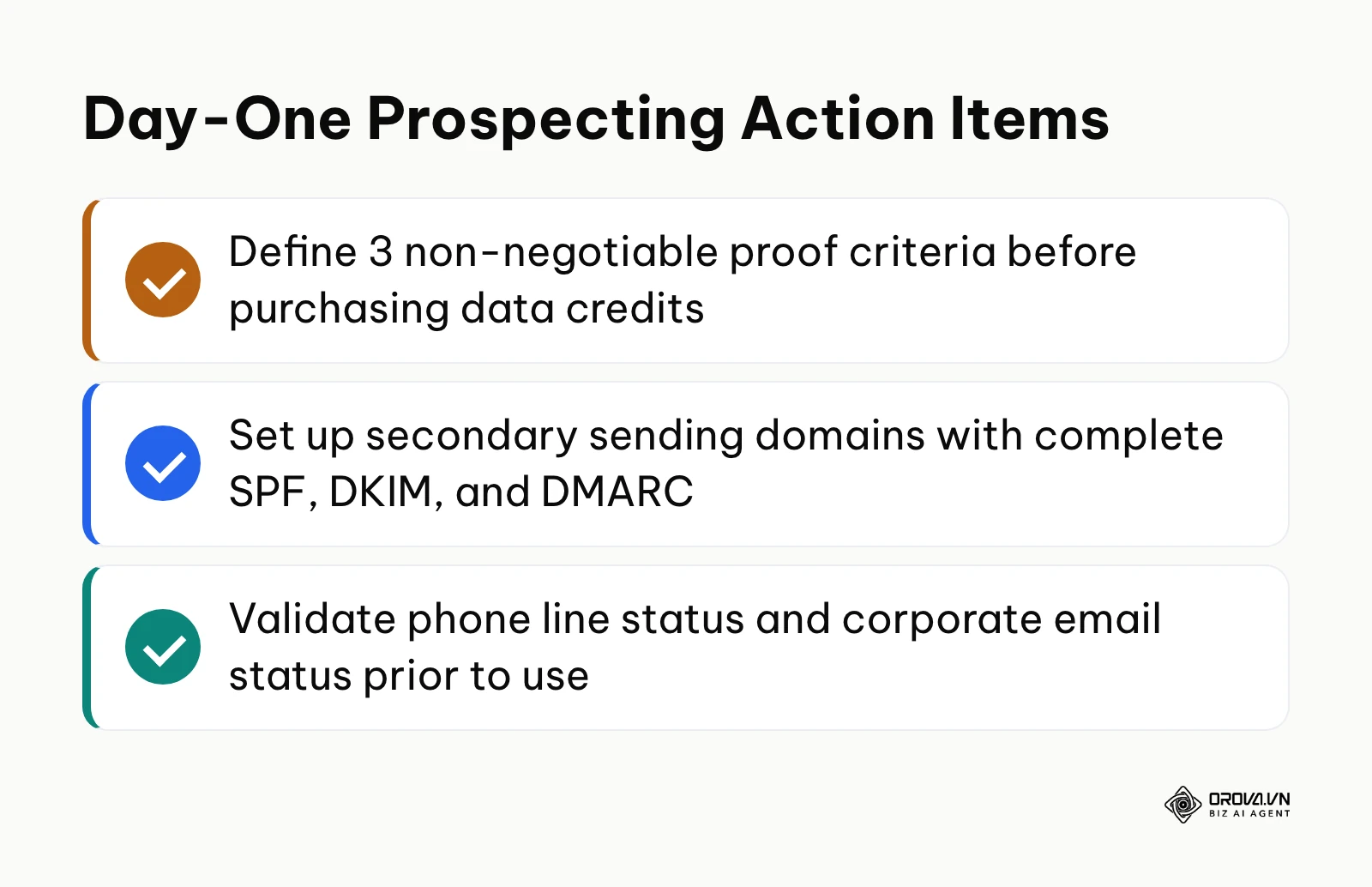
If you are a solo founder or early-stage team with limited resources, your immediate first step this afternoon is to draft a one-page Ideal Customer Profile defining three non-negotiable operational proof criteria (such as specific technology usage or active hiring) and manually verify ten candidate companies on the live web before spending any capital on data credits.
If you lead an established mid-market sales development team struggling with data decay, your immediate first step this afternoon is to conduct an audit of your last 500 outbound prospect records, calculate your true email bounce rate and phone disconnect rate, and test an automated verification filter to establish a clean baseline for future campaigns.
If you manage an enterprise revenue organization with dedicated RevOps resources, your immediate first step this afternoon is to map your existing sales stack to identify where manual data entry and spreadsheet manipulation occur, and outline an automated workflow connecting your lead discovery platform directly to your CRM directory. Starting with rigorous qualification standards ensures your sales pipeline reaps the full commercial rewards of modern AI lead generation.
About the author

Builder of Orova
Nguyễn Đỗ Trọng Ân has 8 years of experience in marketing, including 6 years managing market development across Asia. He builds Orova, a Biz AI Agent that never sleeps: it plans, runs and optimizes work for businesses.
Run your business with AI Agents
Orova is the always-on Biz AI Agent — it plans, runs, and optimizes the work for you.
Save time, unlock productivity.