
AI marketing agency vs DIY AI tools: how to decide and hire well

An ai marketing agency is an outside firm that runs your marketing with artificial intelligence built into its daily work: content, ad buying, testing and reporting. The real decision is rarely "which agency" first. It is whether to hire one at all, or to run the same work yourself with AI tools. Hire an agency when you lack in-house people who can own strategy and quality control, or when you need to scale output faster than you can hire. Do it yourself when you already have a marketer who understands your customers and mainly needs tools that remove the manual work, especially in paid ads, where AI software now handles much of the routine optimization.
This guide helps you make that call and then act on it. First you will compare hiring an agency with doing it yourself on cost, control, speed and risk. If hiring wins, you get a six-step process to vet partners, a set of request-for-proposal questions that expose shallow vendors, a brand safety workflow and a simple ROI formula. If doing it yourself wins, the same checklists tell you what your own team has to cover.
AI marketing agency: What is it and who should hire one?
An AI marketing agency is a specialized firm that integrates artificial intelligence at the core of its daily operations, from predictive analytics to programmatic content creation. You should hire one if you need to scale your output exponentially without linearly increasing your headcount costs. You should not hire one if your brand relies strictly on highly bespoke, offline experiential events where deep human nuance and physical interaction are absolutely mandatory.
According to The economic potential of generative AI by McKinsey (2023), adopting advanced machine learning workflows can significantly lower operational costs in content production. This operational shift represents a fundamental change in how corporate budgets are allocated. Instead of paying for billable hours spent on manual tasks, you are investing in computational power, algorithm training, and strategic oversight.
A true algorithmic partner does not just use public chatbots to write generic social media captions. They build custom data pipelines. They connect directly to your customer relationship management software to analyze real purchasing behavior. They deploy proprietary machine learning models that predict which creative variations will yield the lowest cost per acquisition before a single dollar is spent on media buying. This level of sophistication requires a fundamentally different evaluation approach than hiring a standard creative firm.
AI marketing agency vs doing it yourself with AI tools
Both paths use the same kind of technology. What changes is who does the thinking, who owns the accounts and data, and how the money is spent. An agency sells you finished work plus the judgment of people who have run many similar accounts. Doing it yourself means buying or subscribing to AI tools and giving one or more of your own people the time to run them.
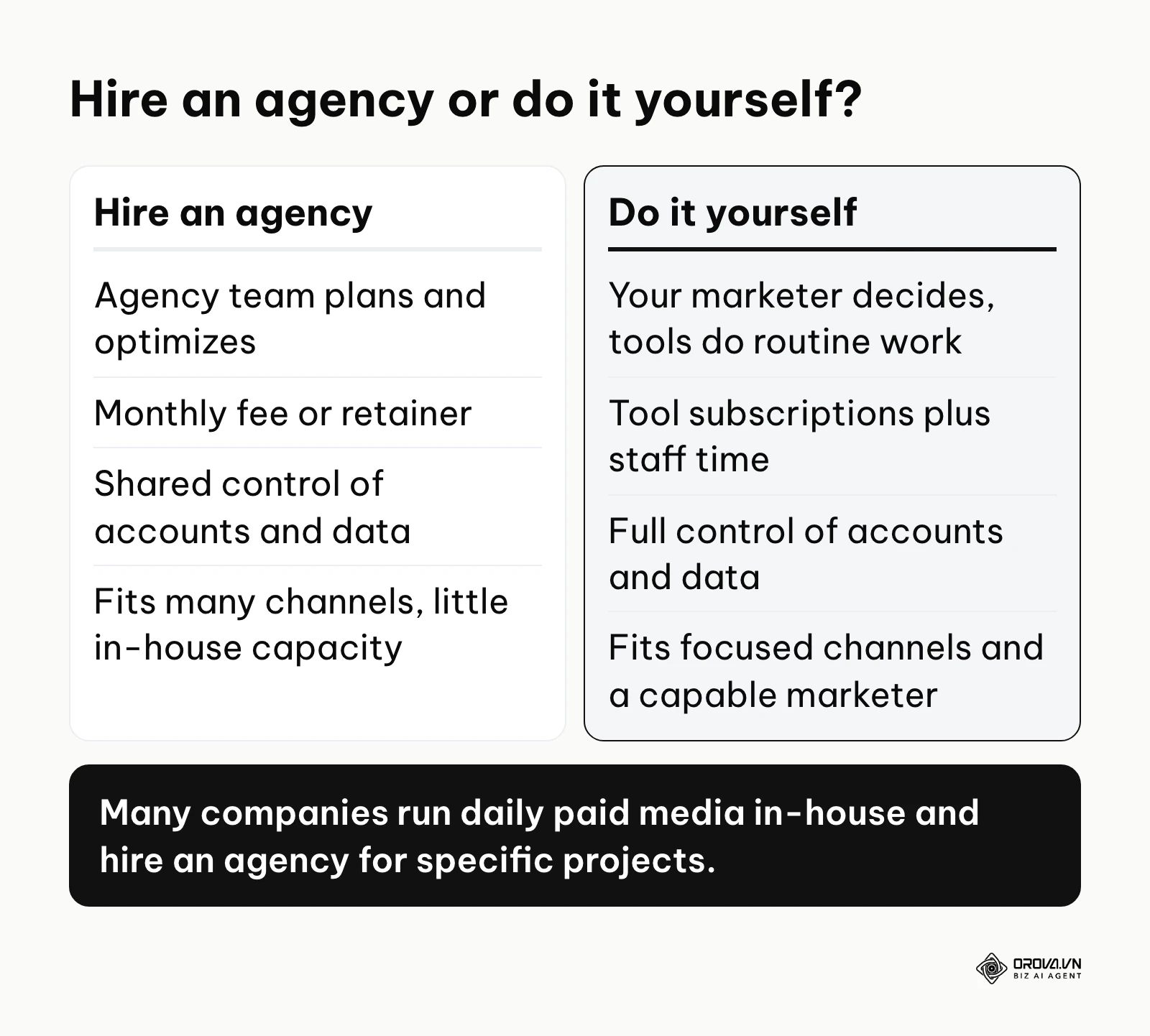
| Decision factor | Hire an AI marketing agency | Do it yourself with AI tools |
|---|---|---|
| Who does the work | The agency team plans, produces and optimizes; you approve. | Your marketer plans and approves; the tools draft, test and suggest. |
| Cost structure | Monthly fee or retainer, often plus technology and media management fees. | Tool subscriptions plus the salary time of the person running them. |
| Speed to start | Fast if the agency already has playbooks for your industry. | Fast for simple channels; slower while your team learns the tools. |
| Control over accounts and data | Shared; depends on contract terms and access rights. | Full; ad accounts, data and learnings stay inside your company. |
| Skills you need in-house | Someone who can brief, review and challenge the agency. | Someone who understands customers, offers and basic ad mechanics. |
| Best fit | Many channels at once, little internal capacity, a need for outside expertise. | A focused set of channels, a capable marketer, a wish to keep know-how in-house. |
The comparison diagram below condenses the two options.
How to decide which path fits your business
Answer four questions honestly. First, do you have at least one person who can own marketing results, even part-time? If not, an agency or freelancer is safer, because AI tools still need a human who decides what to promote and checks what goes live. Second, how many channels do you really need? A business that sells mainly through search and social ads can often cover them with one marketer and good software, while a brand running content, video, influencer work and paid media across several markets will struggle without outside help. Third, how sensitive is your data and brand? If your accounts hold years of conversion history, keeping them under your own control has real value. Fourth, what is the cost of a slow start? An experienced agency can launch in weeks; an in-house learner may need a few months to reach the same quality.
Many companies land on a hybrid. They keep daily paid media and reporting in-house with AI tools, and hire an agency for specific projects such as a brand campaign, a new market launch or a technical tracking setup. If you are still choosing channels, a comparison of paid ad platforms helps you see which ones a single marketer can realistically manage. For the paid media part, tools such as Orova Ads bring Google Ads, Meta and TikTok Ads into one dashboard, where AI suggests optimizations by default and only acts on your accounts after you switch automation on.
Illustrative example: Context: A regional furniture retailer was paying an outside firm to run search and social ads, while its single in-house marketer mostly forwarded reports. Steps taken: (1) The marketer listed every recurring task the firm performed each week. (2) The company moved routine work such as budget pacing, bid changes and weekly reporting to AI ad software it controlled. (3) It kept the outside firm on a smaller project basis for seasonal creative concepts. Snag and fix: In the first weeks the marketer approved too many automated suggestions at once and could not tell which change moved results; she switched to approving changes in small batches with notes. Outcome: The company kept full ownership of its ad accounts and history, and the outside partner's time went to the creative work the team could not do itself.
Before hiring: What you need to prepare
Before you even begin searching for a vendor, you must establish a solid internal baseline. You cannot accurately measure the impact of an advanced partner if your current historical data is fragmented or your brand guidelines are undocumented. The success of algorithmic optimization depends entirely on the quality of the raw material you provide.
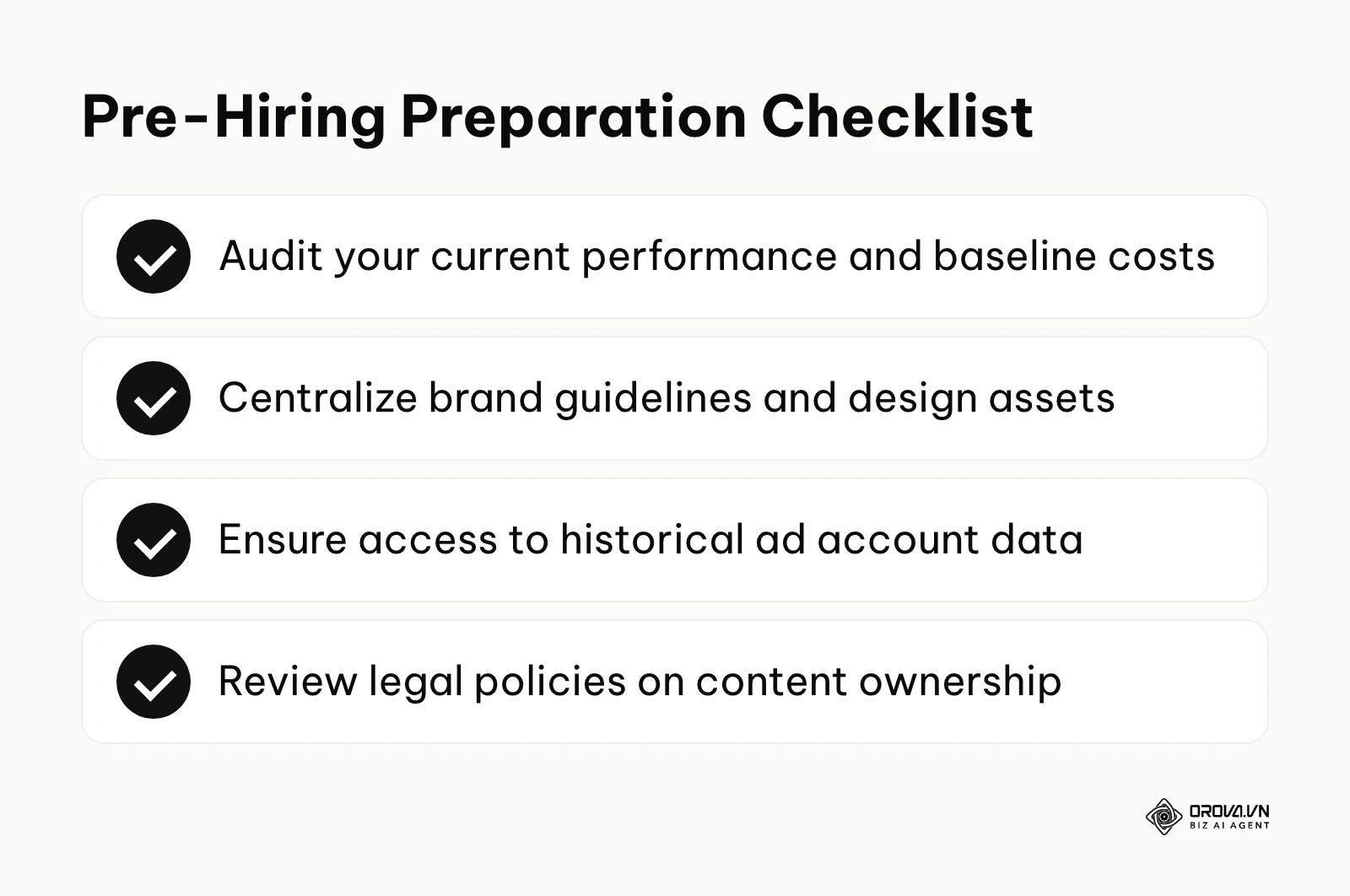
A common pitfall is expecting the vendor to figure out your brand voice from scratch. Machine learning models require explicit, structured parameters. If you feed them vague instructions, you will receive generic, unusable outputs. You need a centralized repository of approved assets, a clear definition of your tone, and strict boundaries regarding what the technology is not allowed to say.
| What to prepare | Where to gather this information | Estimated time required |
|---|---|---|
| Historical performance data | Export spreadsheets from your existing ad accounts and analytics tools. | 2 to 3 days |
| Comprehensive brand guidelines | Collect visual assets, tone of voice documents, and negative keywords. | 1 to 2 weeks |
| Clear technical KPIs | Define your exact target cost per acquisition and acceptable return on investment thresholds. | 2 to 4 days |
| Legal data compliance rules | Consult your legal team regarding intellectual property ownership and customer privacy. | 2 to 3 weeks |
The diagram below summarizes the essential steps to take before starting your search.
You must also prepare your internal team for a cultural shift. Introducing high-speed automation often creates friction with in-house creatives who fear job displacement. It is crucial to communicate that the goal is augmentation, not replacement. Your internal team will transition from manual execution to strategic curation. They will spend less time resizing images and more time setting up a robust marketing campaign framework that the vendor can execute against.
Furthermore, ensure your website infrastructure is ready to handle an influx of dynamic traffic. If the vendor scales your media spend effectively but your landing pages load slowly or fail to track conversions accurately, the algorithms will receive poor feedback signals. Clean your tracking tags and verify your server response times before signing any contracts.
How to choose an AI marketing agency: The 6-step hiring process
Selecting the right partner requires a rigorous, structured approach. You must evaluate not only their creative portfolio but also their data security protocols and underlying technical stack. The following six steps will help you filter out the pretenders and identify true operational experts.
Step 1: Define your AI-specific marketing goals
You must pinpoint exactly where you want algorithmic intervention. Broad goals like "increase sales" or "get more traffic" are insufficient. You need to identify specific bottlenecks in your current funnel that are currently limited by human constraints.
For example, your goal might be to dynamically generate personalized landing pages for fifty different customer segments, or to automate your media bidding across three different platforms simultaneously. By defining the exact technical problem, you can evaluate whether the vendor actually has the infrastructure to solve it. This often involves looking deeply into how they handle server-side tracking, which brings up the question of what is conversion api and how they intend to implement it for your specific needs.
If your goals are vague, the vendor will default to standard, low-impact services. Clear objectives force the vendor to propose specific technical architectures rather than generic retainer packages.
Step 2: Evaluate their AI tech stack and infrastructure
A vendor's technological infrastructure is the primary differentiator between true experts and trend-chasers. You must ask to see their proprietary tools and internal workflows. Do not accept a polished slide deck as proof of capability. Demand a live demonstration of their internal software environment.
Look for custom API integrations, specialized vector databases, and evidence of RAG (Retrieval-Augmented Generation, a framework that connects language models to a specific, closed database of your corporate knowledge). If their entire workflow consists of copying and pasting text into a public web interface, they are not a specialized partner. They are simply charging you a premium for tasks your intern could perform.
Pay attention to how they handle data ingestion. A sophisticated partner will have automated scripts that pull your product catalogs directly from your inventory management system, ensuring that their creative outputs never promote out-of-stock items.
Step 3: Run a structured AI RFP (Request for Proposal)
To expose superficial vendors, you must use a highly structured questionnaire. This Request for Proposal should cover three critical areas: technology, data security, and operational workflows. If a vendor struggles to answer these technical questions clearly, they do not have the depth required to handle your brand safely.
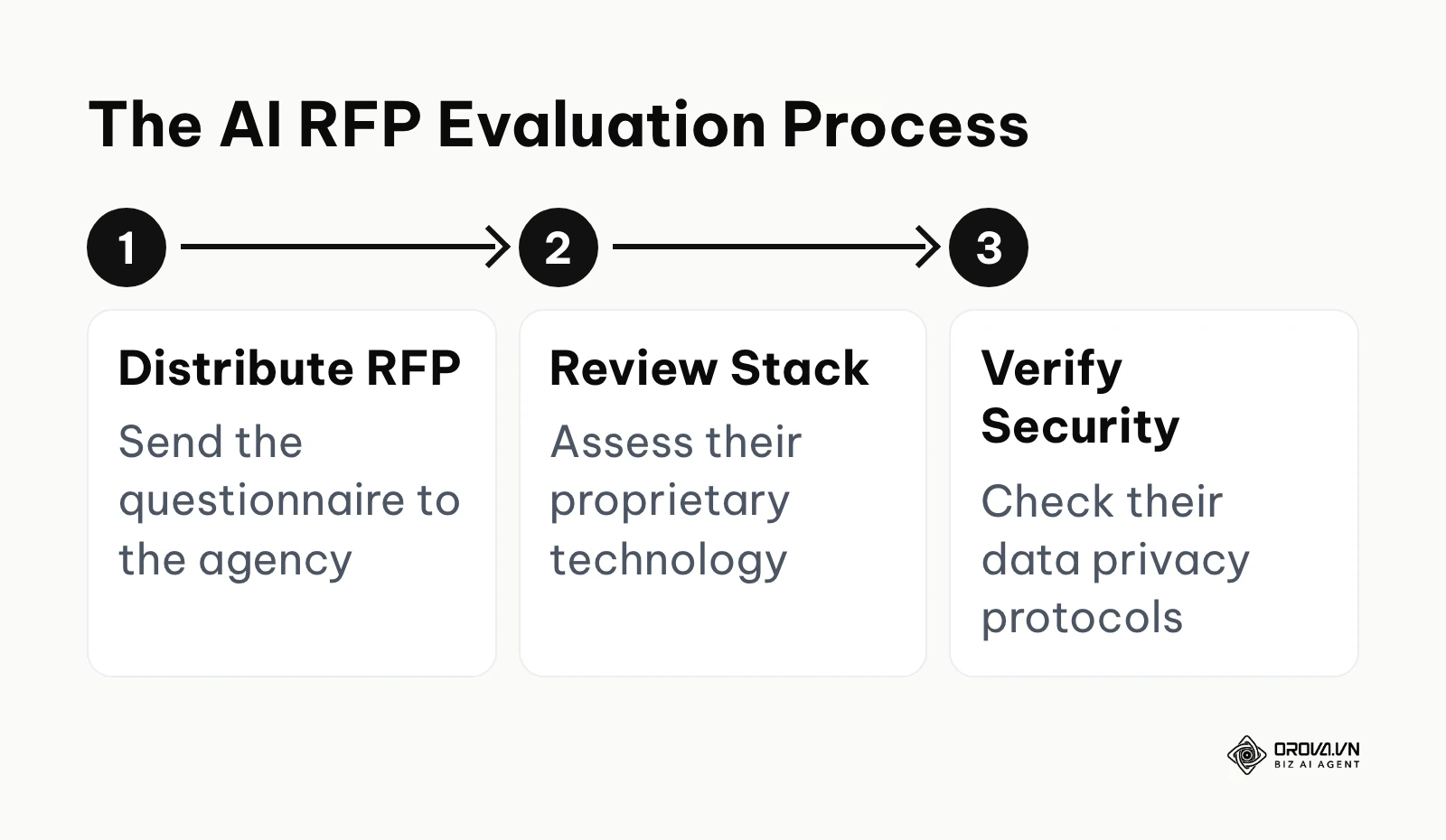
Below is a core subset of the critical questions you should include in your evaluation matrix:
| Category | Question to Ask | Red Flag Answer | Green Light Answer |
|---|---|---|---|
| Technology | Do you rely solely on off-the-shelf public models, or do you fine-tune open-source models? | "We exclusively use the standard public chat interfaces." | "We deploy custom RAG pipelines and fine-tune models on your historical data." |
| Technology | How do you prevent your models from learning outdated brand information? | "We manually remind the software to stay updated." | "We use automated vector database syncing that overwrites old parameters weekly." |
| Security | How is our proprietary customer data isolated from your other clients? | "We promise not to mix up your files." | "We utilize strict tenant isolation and dedicated cloud instances with zero-retention API policies." |
| Security | Who retains the intellectual property rights to the generated assets? | "It belongs to the software company, but you can use it." | "Our enterprise contracts ensure all generated IP is legally transferred to your corporation." |
| Operations | What is your exact human-in-the-loop review process? | "The software is so good we rarely need to check it." | "Every factual claim goes through a two-step mandatory human approval queue." |
| Operations | How do you handle algorithmic degradation or performance drops over time? | "We just run the prompts again until it improves." | "We actively monitor statistical drift and retrain the parameters when engagement drops below baseline." |
The diagram below outlines the sequential flow of evaluating these RFP responses.
Step 4: Verify brand safety and hallucination control
Brand safety is the single largest risk when deploying automated content generation. Hallucinations—instances where the software confidently invents false information—can lead to severe public relations crises and legal liabilities. You must thoroughly understand how the vendor prevents false claims from being published under your company name.
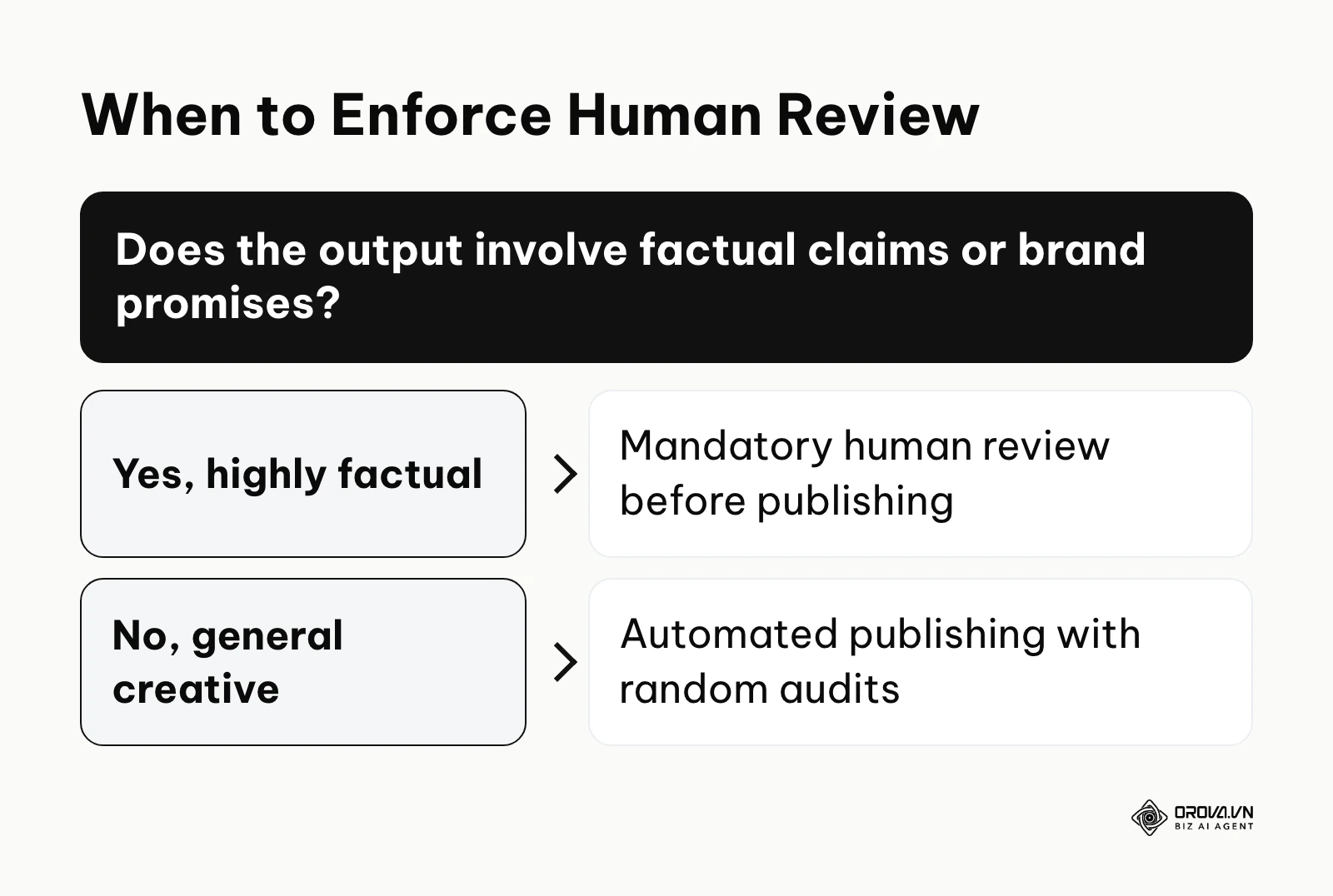
A reliable vendor will mandate a Human-in-the-loop (HITL) workflow. This means that while the heavy lifting of drafting and ideation is automated, a trained human editor must explicitly approve the final output before it reaches the public. They should also employ automated safeguard scripts that scan outputs for restricted keywords or unauthorized competitor mentions before a human even sees it. If you want to understand the mechanics of safe text generation, exploring ai generated content protocols is highly recommended.
The decision tree below illustrates when strict human oversight is absolutely necessary.
Step 5: Analyze real ROI case studies and performance data
Do not be distracted by vanity metrics like "thousands of words generated per hour" or "hundreds of image variations." Output volume is irrelevant if it does not drive measurable business value. You need to see hard data proving that their methodology lowers the cost per acquisition or significantly increases the final conversion rate.
Demand case studies that show the full trajectory of a campaign. Look for evidence of algorithmic learning phases, where initial performance might be average but improves drastically as the system ingests more conversion data.
Illustrative example: Context: A mid-sized financial software company needed to reduce their high customer acquisition cost across multiple competitive search networks. Steps taken: (1) The vendor connected their predictive modeling software to the company's internal sales database. (2) They automated the creation of thousands of dynamic landing page variations tailored to specific search intents. (3) They implemented automated bid pacing scripts that adjusted spend every hour based on market volatility. Snag and fix: Initially, the automated copy generated highly complex financial jargon that alienated entry-level buyers, causing bounce rates to spike. The vendor resolved this by refining the system prompt to enforce a strict eighth-grade reading level and requiring a senior human copywriter to review the first batch of new variations. Outcome: The company observed a massive influx of qualified pipeline meetings booked directly onto their sales calendars, and a steadily falling cost per acquisition over the following three months.
If your focus is primarily on scaling performance marketing, understanding the mechanics of AI ads will help you ask the vendor much sharper questions regarding their bidding strategies.
Step 6: Negotiate the human-to-AI ratio and contract terms
The final step is establishing clear commercial boundaries. Traditional retainer models based on human billable hours do not make sense when software is doing the majority of the heavy lifting. You need a pricing structure that reflects the cost of computing power and the strategic value delivered.
Clearly define the human-to-AI ratio in your Service Level Agreement. For example, you might agree that 80% of top-of-funnel social media posts will be fully automated with spot-checking, while 100% of technical whitepapers will require deep human research and final editing. Ensure your contract explicitly dictates that your company retains full intellectual property rights over all generated materials and that your proprietary training data must be permanently deleted from their servers upon contract termination.
OROVA ADS applies AI Agent to automate and optimize ad performance on Google, Meta and TikTok. Scale your budget safely, monitor 24/7 and expand your business quickly.
Experience the solution at orova.vn/ads
AI marketing agency vs traditional agency: A deep cost and performance analysis
Understanding the fundamental differences between modern algorithmic partners and traditional creative firms is crucial for allocating your corporate budget effectively. Traditional firms excel at creating highly emotional, bespoke, and culturally nuanced campaigns. They rely on large teams of copywriters, art directors, and media buyers who manually execute every phase of a project. This manual approach ensures high quality control but results in slow turnaround times and high overhead costs.
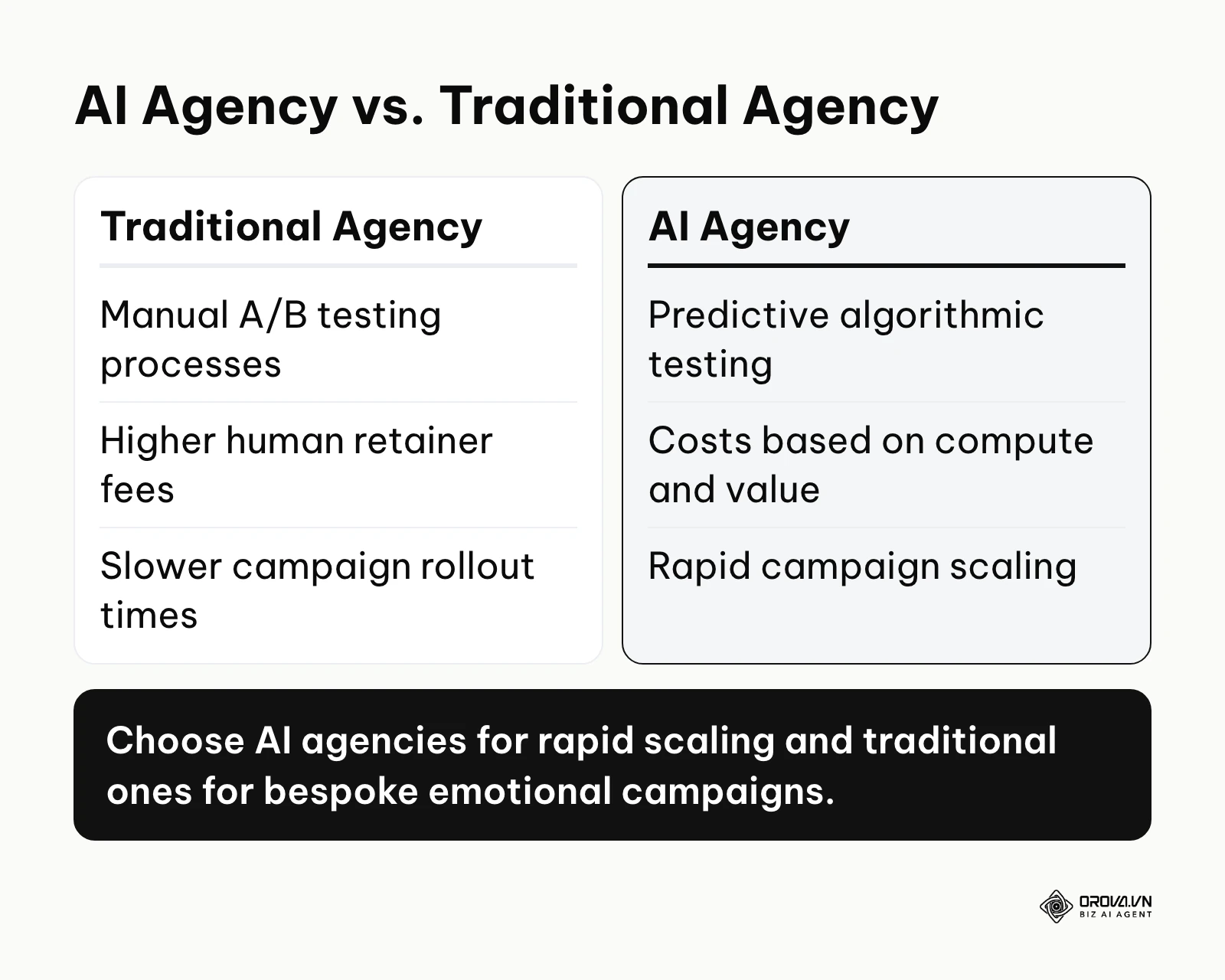
Algorithmic vendors operate on a fundamentally different paradigm. They treat marketing as a computational problem. They excel at rapid iteration, multivariate testing at massive scale, and real-time optimization. While they may not win a creative award for a deeply emotional television commercial, they will ruthlessly optimize your digital funnel to extract the maximum possible revenue from your existing traffic. The shift from manual execution to strategic automation is driving many companies to rethink their partnerships, similar to the transition seen in the debate of seo consultants vs ai automation strategies.
| Evaluation Criteria | Traditional Agency Model | AI Marketing Agency Model |
|---|---|---|
| Speed of Execution | Weeks to develop a single campaign concept. | Hours to generate hundreds of dynamic variations. |
| Testing Methodology | Manual A/B testing with limited sample sizes. | Continuous algorithmic testing across thousands of data points. |
| Cost Structure | High monthly retainers based on human billable hours. | Tiered pricing based on computing resources and API usage. |
| Creative Focus | Bespoke, emotional, and highly narrative-driven. | Data-driven, iterative, and focused purely on conversion rates. |
| Ideal Use Case | Major brand launches and offline experiential events. | High-volume media buying and programmatic content scaling. |
The comparison table below provides a quick visual summary of these core differences.
Illustrative example: Context: A national retail chain with fifty locations wanted to run hyper-localized holiday promotional campaigns simultaneously. Steps taken: (1) They split their quarterly budget, giving half to their legacy creative firm and half to a specialized algorithmic vendor. (2) The legacy firm spent three weeks conceptualizing and delivering four high-quality static banner designs to be used nationwide. (3) The new vendor utilized dynamic creative generation to automatically produce and deploy over five hundred localized variations, injecting specific city names and localized weather conditions into the ad copy within 48 hours. Snag and fix: The automated system initially applied incorrect regional discount codes to several localized assets. The vendor quickly resolved this by integrating a strict data-validation script that cross-referenced every generated image against the retailer's internal promotion database before pushing the ads live. Outcome: Store managers reported long physical lines of customers presenting the hyper-localized digital coupons, while the traditional campaign only generated general brand awareness without driving immediate foot traffic to specific stores.
AI marketing agency pricing models
When evaluating the cost of an algorithmic vendor, you must look beyond the flat retainer fee. The pricing models are often complex, blending software licensing, cloud computing costs, and strategic management fees. You should expect pricing to be tied to the volume of data processed or the number of active algorithmic models running on your behalf.
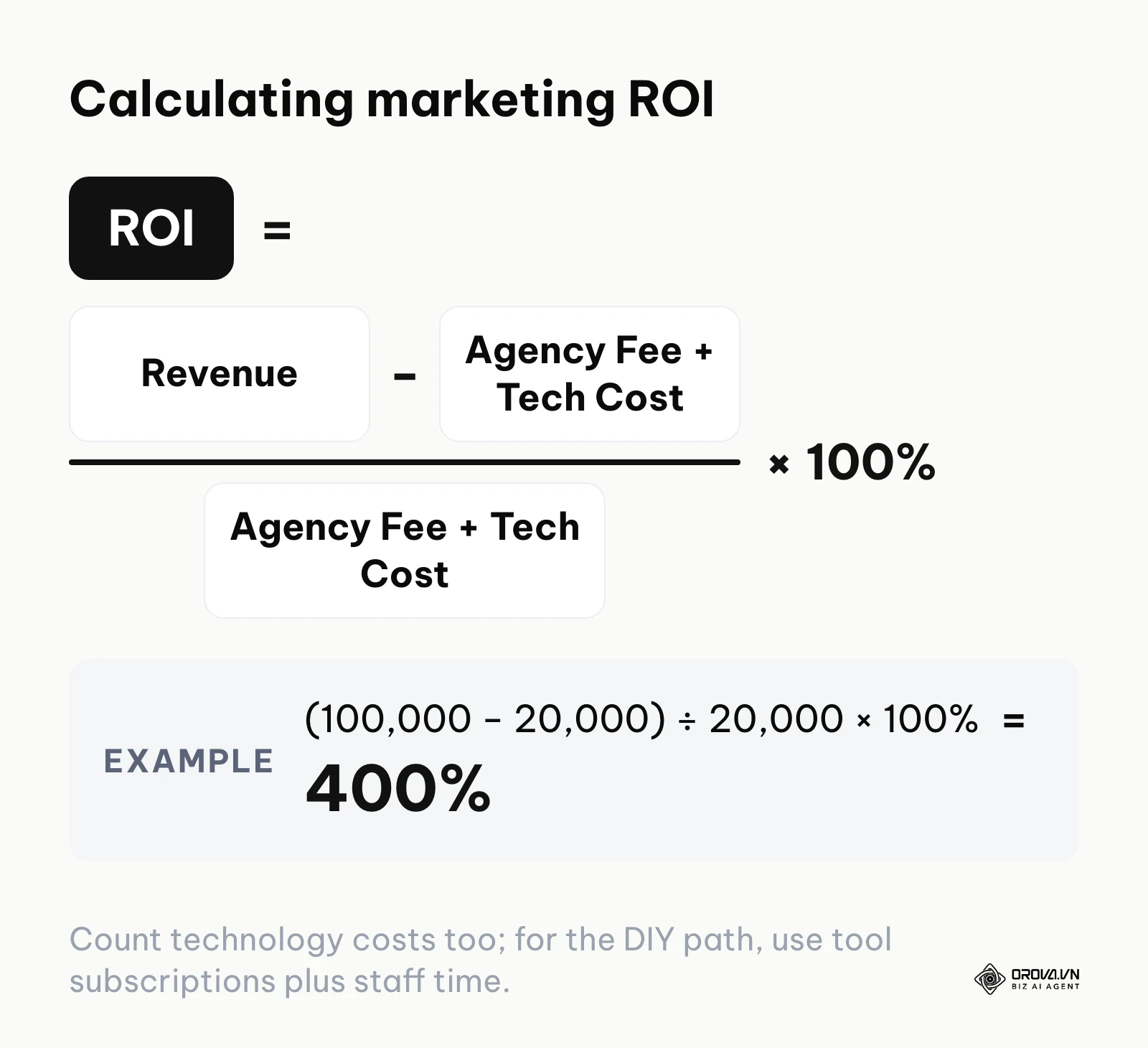
Do not fall into the trap of comparing a traditional firm's human hourly rate with an algorithmic vendor's software fee. Instead, calculate the total cost of ownership per finalized asset or the projected cost per acquisition. The formula below shows how to calculate return on investment when variable technology costs are included. For example, if a pilot produces 100,000 in attributable revenue and the agency fee plus technology cost comes to 20,000, ROI is (100,000 − 20,000) ÷ 20,000 × 100% = 400%. Run the same calculation for the do-it-yourself path, counting tool subscriptions plus the salary time of the person running them as the cost.
Measuring the performance of your AI marketing agency
Once your new partner is onboarded, you must establish strict tracking mechanisms. Traditional metrics like "hours worked" or "number of revisions" are obsolete. You need to focus on velocity, algorithmic efficiency, and bottom-line revenue impact.
A high-performing vendor should be able to drastically reduce your time-to-market. What previously took three weeks of manual coordination should now take three days of automated generation and human approval. However, speed without accuracy is dangerous. You must also measure the error rate of the generated outputs. If your internal team has to manually rewrite fifty percent of the vendor's deliverables, the technology is failing.
| Primary Metric | Meaning | Warning Threshold |
|---|---|---|
| Time-to-Market Velocity | The average days required to launch a new campaign from brief to deployment. | Consistently exceeds 7 days for standard digital campaigns. |
| Human Intervention Rate | The percentage of generated assets that require significant manual rewriting by your staff. | Higher than 30% after the initial three-month training phase. |
| Algorithmic CPA | The cost per acquisition driven specifically by dynamically generated variations. | Rising steadily over a two-week period without intervention. |
| Data Processing Lag | The delay between a user action and the system updating its predictive model. | More than 24 hours for high-volume consumer goods. |
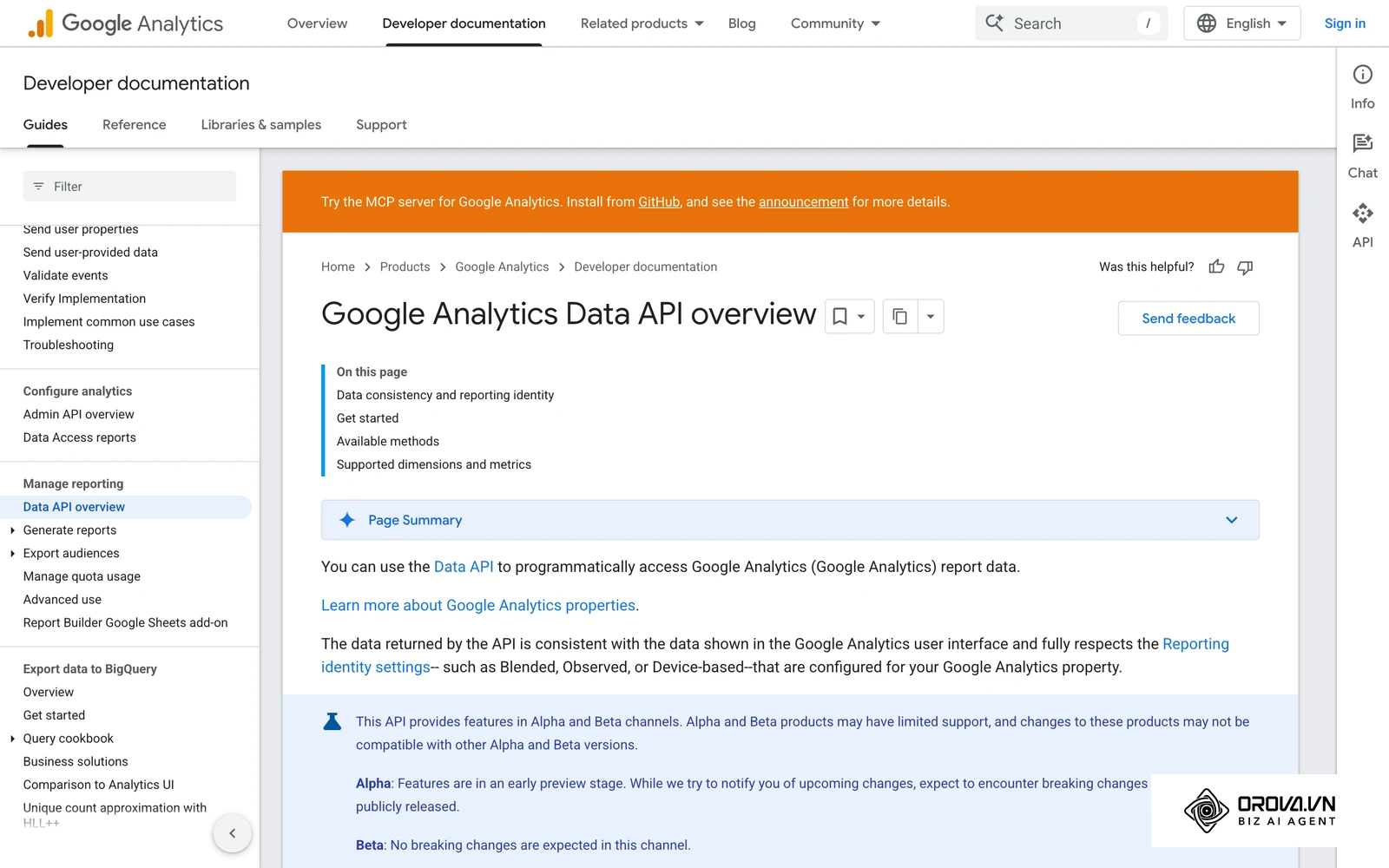
Strong teams increasingly expect external partners to show the technology behind these velocity metrics, not just a slide that promises them.
Want to scale your budget but afraid of breaking performance? 📉
Integrate OROVA ADS now - an AI Agent that automatically monitors and optimizes Google, Meta, TikTok ads 24/7. Now, expanding and replicating your Performance Ads team is just one click away.
🚀 Try it now at: orova.vn/ads
Common mistakes when working with an AI marketing agency
Transitioning to an automated workflow is highly disruptive. Many corporations make critical errors during the onboarding phase that cripple the project before it even begins. Avoiding these common mistakes will save you significant budget and protect your corporate reputation.
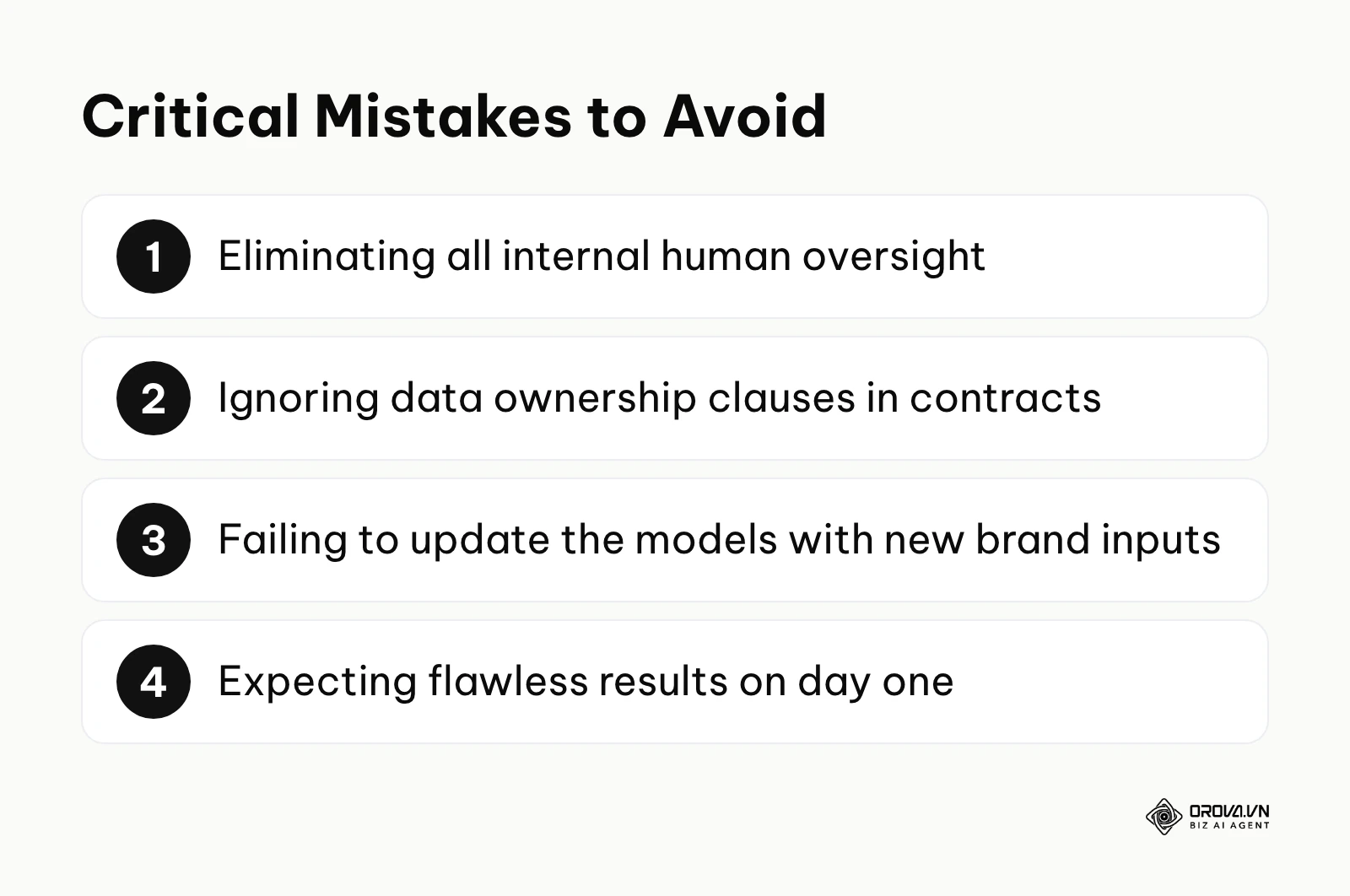
First, treating the technology as a magical black box is a recipe for disaster. You cannot simply hand over your credit card and expect flawless results without providing continuous feedback. The models require constant tuning. If you do not actively review the outputs and correct the system's assumptions during the first month, the algorithms will optimize toward the wrong objectives.
Second, failing to establish strict data ownership clauses can hold your company hostage. If the vendor uses your proprietary customer data to train a model, and the contract does not explicitly state that you own that specific model, you risk losing your competitive advantage if you terminate the relationship.
Illustrative example: Context: A fast-growing direct-to-consumer fitness brand rushed to replace their expensive internal copywriting team with a highly affordable automated vendor. Steps taken: (1) The vendor was granted unrestricted administrative access to the brand's content management system. (2) They deployed fully autonomous publishing scripts designed to post three SEO articles daily. (3) To maximize profit margins, the vendor completely eliminated all human editorial review. Snag and fix: The software hallucinated a non-existent medical benefit for a nutritional supplement and promised free overnight shipping on heavy fitness equipment. The brand suffered a massive customer service crisis. They immediately paused all active campaigns, manually audited hundreds of published pages, and forced the vendor to implement a strict mandatory human-in-the-loop approval dashboard. Outcome: The support inbox was overwhelmed with angry complaints demanding the fake free shipping, forcing the company to honor the mistake and absorb a severe financial loss before the automated content was finally corrected.
Third, isolating the algorithmic team from your broader corporate strategy leads to disjointed campaigns. The vendor must be integrated into your high-level planning meetings. If they only receive tactical requests without understanding the broader brand narrative, their automated outputs will feel robotic and disconnected from your core mission.
Finally, relying on outdated attribution models will obscure the true value of the technology. Human oversight of automated ad placements is still a basic requirement for responsible advertising, and your tracking has to show which results came from automation and which came from human decisions.
The list below summarizes the most critical mistakes to avoid.
Where AI marketing agencies are heading in the next few years: the author's take
As we look toward the future, the landscape of digital partnerships is shifting dramatically. Based on current technological trajectories up to 2026, I see several changes coming in how corporations engage with external vendors.
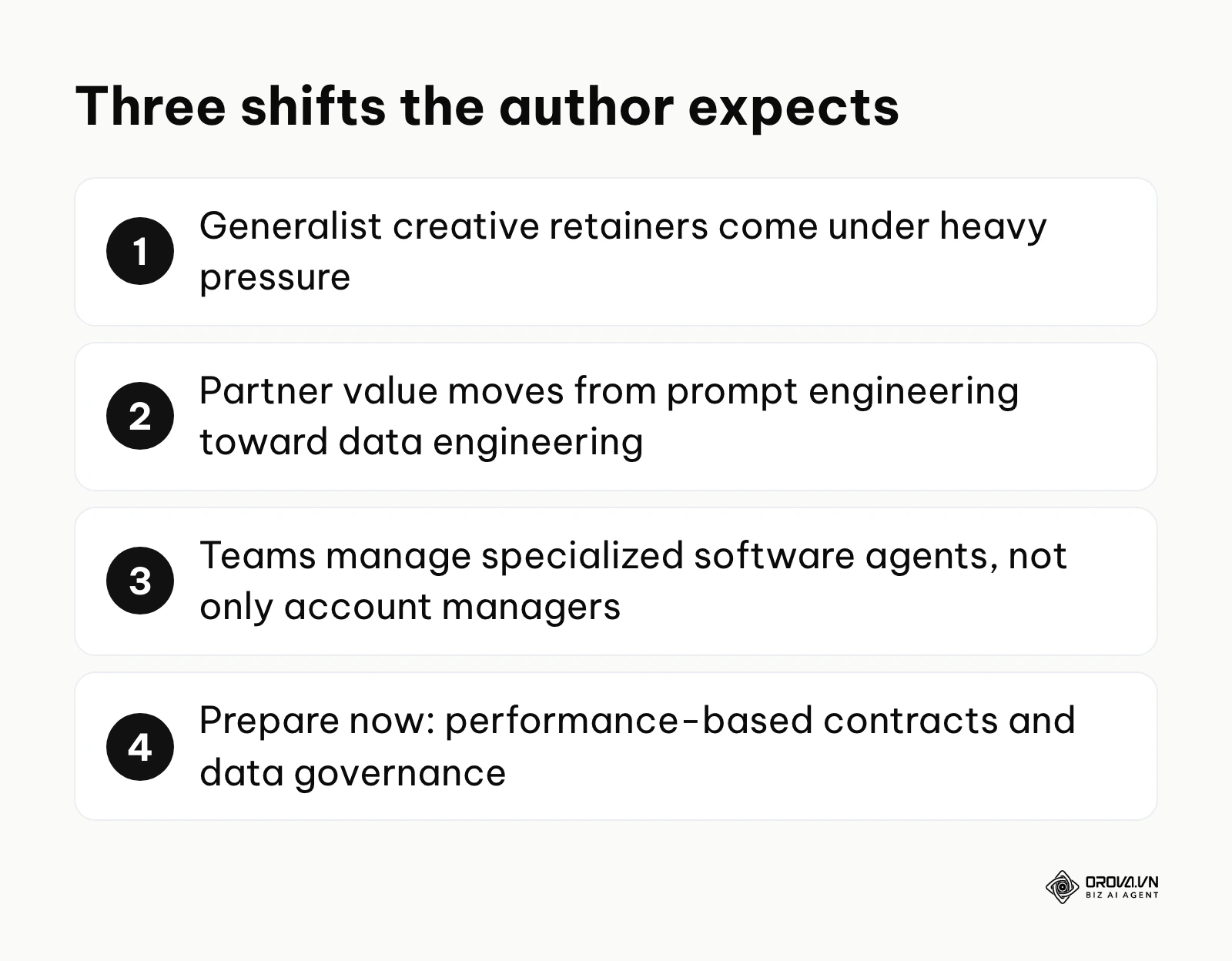
The death of the generalized creative retainer
Today, many traditional firms still charge large monthly retainers simply to keep a team of generalist copywriters and designers available. I think that over the next two to three years this model will come under heavy pressure. The commoditization of basic text and image generation means that clients will refuse to pay premium hourly rates for generic output. I anticipate a shift toward highly specialized micro-agencies that charge solely based on algorithmic performance and custom data integration. You should prepare by auditing your current retainer contracts and demanding performance-based compensation models.
Transitioning from prompt engineering to data engineering
Currently, many vendors boast about their complex "prompt engineering" skills. However, as language models become more intuitive and context-aware, the need for clever prompting is rapidly diminishing. I expect that much of the value of a partner will shift toward data engineering—their ability to clean, structure, and feed massive amounts of secure corporate data into private vector databases. The agencies that win in the future will look more like data science consultancies than creative studios. You should begin prioritizing vendors who demonstrate deep database architecture skills rather than just creative flair.
The rise of autonomous brand agents
While current workflows still heavily rely on human-in-the-loop approvals for safety, the technology is advancing quickly. I foresee the emergence of fully autonomous brand agents—specialized AI entities that act as your primary vendor. These agents will negotiate media buys, execute creative variations, and report back to your executive team with minimal human intervention. I lean toward the belief that corporate marketing departments will eventually manage a suite of specialized software agents rather than human account managers. You must start building robust internal data governance policies today to ensure these future autonomous systems operate safely within your brand parameters.
Frequently asked questions about AI marketing agencies
What is the typical cost of hiring an AI marketing agency?
The cost varies significantly based on the complexity of your data infrastructure. Unlike traditional firms that charge hourly retainers, modern automated vendors usually charge a hybrid fee: a base strategic management fee plus variable costs based on cloud computing usage and API calls. You should expect pricing to scale directly with the volume of dynamic assets generated and the complexity of the predictive models deployed.
Is it cheaper to use AI tools yourself than to hire an AI marketing agency?
On paper, tool subscriptions usually cost less than an agency fee, but the honest comparison includes the salary time of the person running the tools and the cost of mistakes while they learn. If you already have a capable marketer, doing it yourself is often the cheaper path for a few focused channels. If you would need to hire and train someone first, an agency can be cheaper for the first year.
Will an AI marketing agency replace my internal team entirely?
No, a reputable partner will augment your internal capabilities, not replace them entirely. Your internal staff will transition from manual production tasks to strategic oversight and high-level creative direction. AI is incredibly efficient at scaling output and optimizing bids, but it still requires deep human nuance to define the initial brand strategy and ensure empathetic messaging.
How do we protect our confidential data when working with these vendors?
Data protection must be addressed explicitly in your service level agreement. You should demand that the vendor uses dedicated, isolated cloud instances and enterprise-grade APIs with zero-data-retention policies. Never allow an external partner to feed your proprietary customer data into public, consumer-facing chat interfaces where it could be used to train broader public models.
Can AI effectively manage highly creative, emotional brand campaigns?
Currently, algorithms excel at data-driven performance marketing, programmatic SEO, and high-volume media buying. They are less effective at conceptualizing highly emotional, culturally nuanced brand narratives from scratch. For major television commercials or offline experiential events, traditional human creative direction remains superior.
How quickly can we expect to see ROI from an automated partner?
While automated generation can launch campaigns in a matter of days, true algorithmic optimization requires a learning phase. The software needs time to ingest performance data and adjust its predictive models. Agree on a review checkpoint after the first one to two months of continuous data and testing, and judge cost per acquisition only after that learning phase.
Where should you start?
If you are overwhelmed by the prospect of auditing and hiring a highly technical partner, the best approach is to start small and scale based on proven success. Do not attempt to overhaul your entire corporate infrastructure in a single quarter.
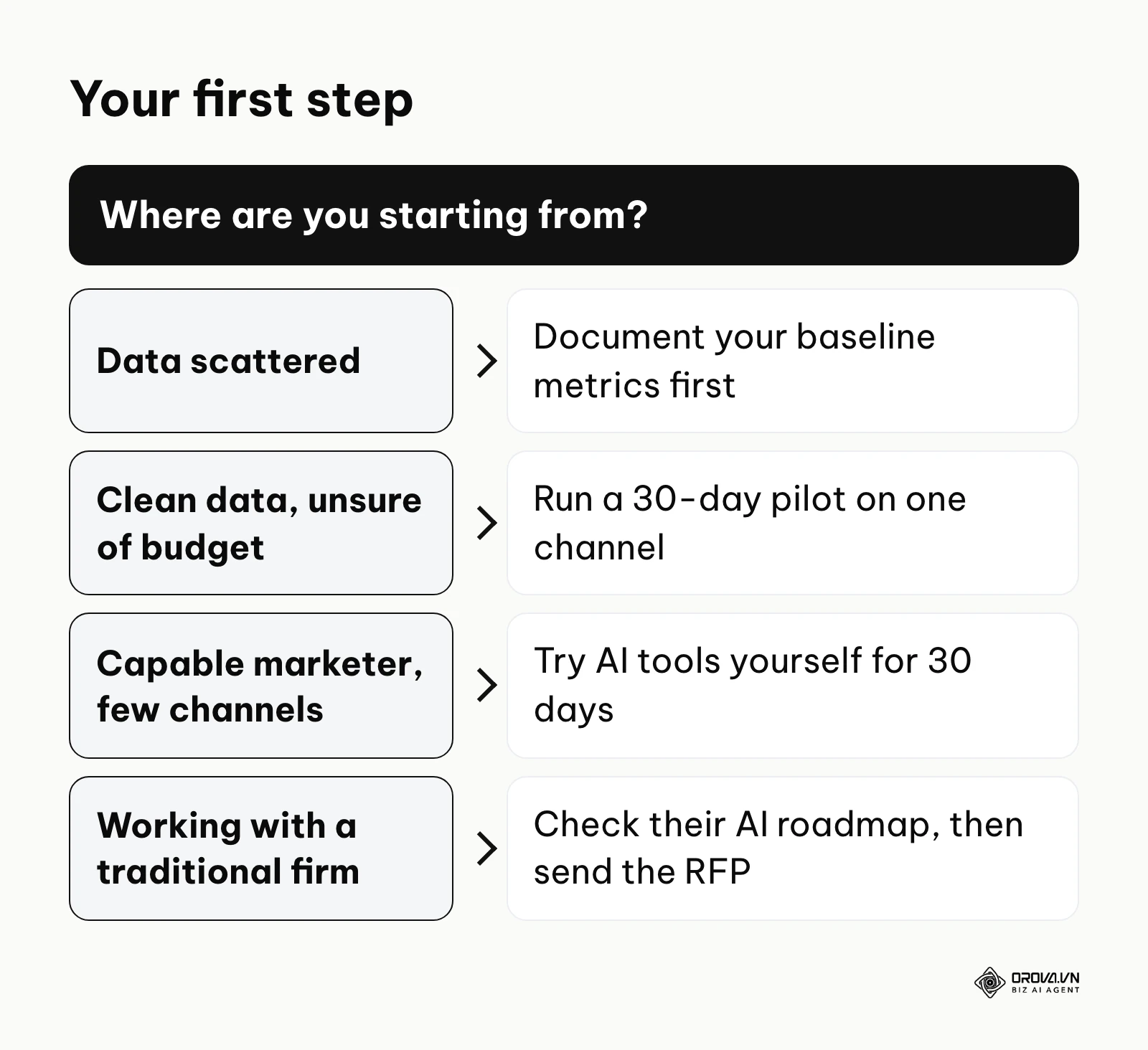
If your current data is scattered across multiple spreadsheets and legacy systems: Your immediate first step is to spend one afternoon documenting your exact baseline metrics. Export your cost per acquisition, lifetime value, and total media spend from the last six months into a single, clean document. A sophisticated partner cannot build predictive models without this historical foundation.
If you have clean data but are unsure if your budget justifies a specialized vendor: Your next step is to run a small, tightly controlled pilot project. Select one specific, underperforming advertising channel and allocate a distinct testing budget for a 30-day algorithmic sprint. This allows you to evaluate the vendor's technical competence and reporting transparency without risking your primary revenue streams.
If you have a capable marketer and only a few paid channels: Try the do-it-yourself path first. Give that person AI ad tools for one channel for 30 days, keep approvals manual, and compare the results and hours spent with what an agency would charge.
If you are already working with a traditional creative firm but want to increase output velocity: Schedule a meeting to strictly evaluate their current technical roadmap. Ask them to clearly define their integration of machine learning tools within their workflow. If their answer is vague or relies entirely on public chatbots, it is time to send out the RFP questions outlined in this guide to find a more capable partner.
About the author

Builder of Orova
Nguyễn Đỗ Trọng Ân has 8 years of experience in marketing, including 6 years managing market development across Asia. He builds Orova, a Biz AI Agent that never sleeps: it plans, runs and optimizes work for businesses.
Run your business with AI Agents
Orova is the always-on Biz AI Agent — it plans, runs, and optimizes the work for you.
Save time, unlock productivity.