
What is AI generated content? A practical workflow and 21-prompt library

Many marketing teams are drowning in the demand to publish daily blogs and social updates, often sacrificing quality for speed. The traditional approach of writing every piece of text from scratch is no longer scalable. This is why AI generated content has become an essential asset for modern businesses looking to maintain a high publishing cadence. However, if you have tried basic AI tools, you likely found the output sounds robotic and disconnected from your brand identity. This guide goes beyond basic theory to explain exactly how to integrate these technologies into your daily operations. You will learn the exact workflows, access a comprehensive prompt library, and discover how to set up a human-in-the-loop review process. By mastering these frameworks, your team can scale production efficiently without losing the authentic voice that connects with your audience.
What is AI generated content?
AI-generated content is any text, image, audio, or video material created by artificial intelligence models based on user instructions. It serves to accelerate the production of marketing assets, reports, and creative concepts. Unlike traditional human content, it relies on recognizing patterns in vast training data to synthesize new outputs instantly.
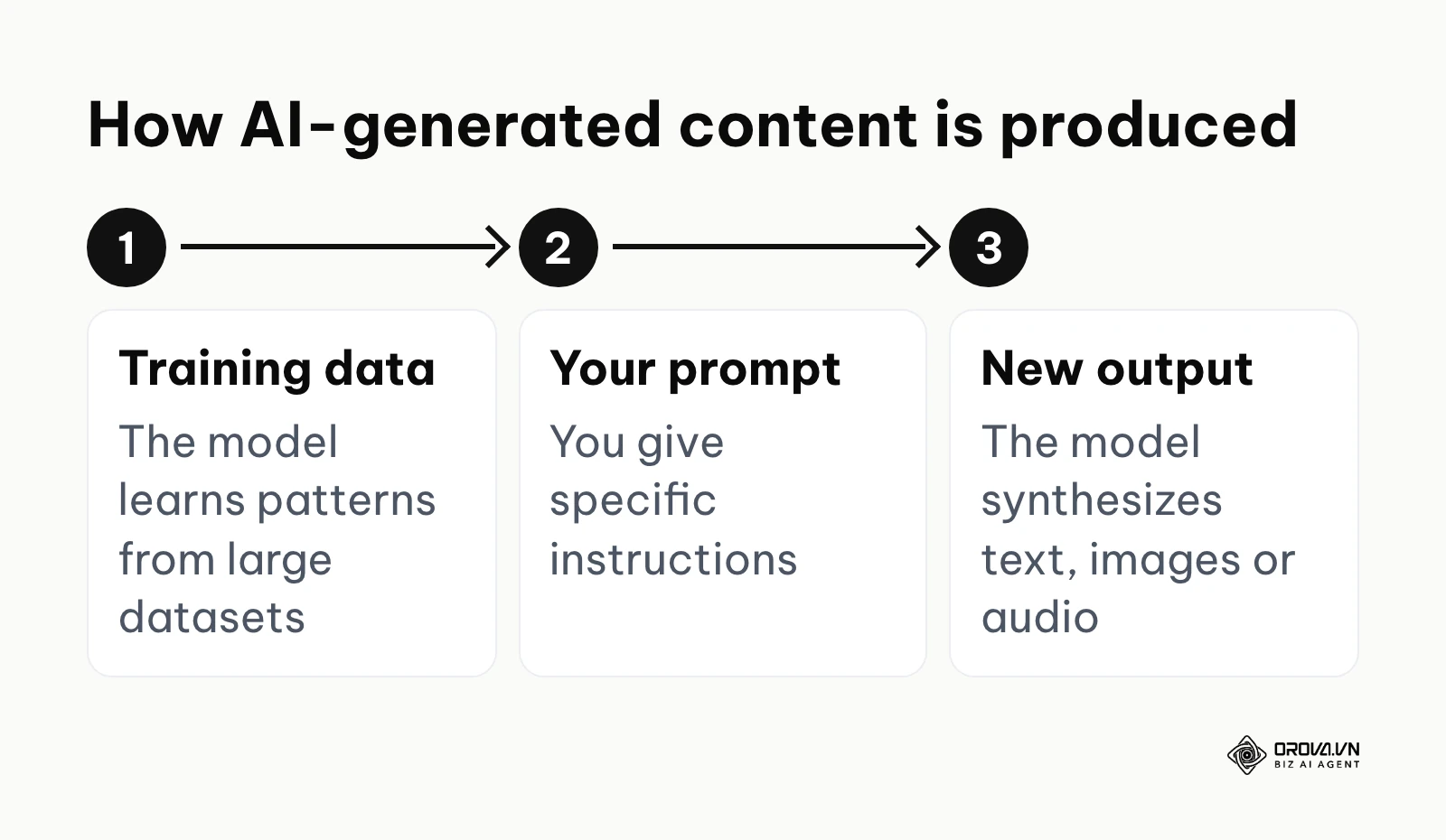
The term gained mainstream traction with the evolution of generative pre-trained transformers, shifting the focus from simple automated data entry to creative synthesis. Understanding how to classify it helps clarify its role in your marketing stack.
| Concept | Where it differs | Example |
|---|---|---|
| AI-generated content | Created entirely or heavily assisted by neural networks based on a prompt. | A blog post drafted by ChatGPT. |
| Human content | Conceived, researched, and written entirely by a person without AI generation. | An investigative journalism piece. |
| Automated content | Rule-based data insertion into pre-defined templates without creative AI. | A weather report pulling API data into a template. |
Illustrative example: A local bakery needs Instagram captions for a new pastry line. Instead of staring at a blank screen for an hour, the owner provides a short description of the ingredients to an AI tool, which instantly returns three caption options with varying tones.
The significance of AI-generated content in modern marketing
AI-generated content exists to solve the critical bottleneck of content scaling, allowing marketing teams to meet high publishing demands without exhausting their human resources. In the broader ecosystem, it sits securely between raw data input and final campaign execution. Marketers provide the strategic direction, the AI handles the heavy lifting of drafting, and the human editors refine the final product.
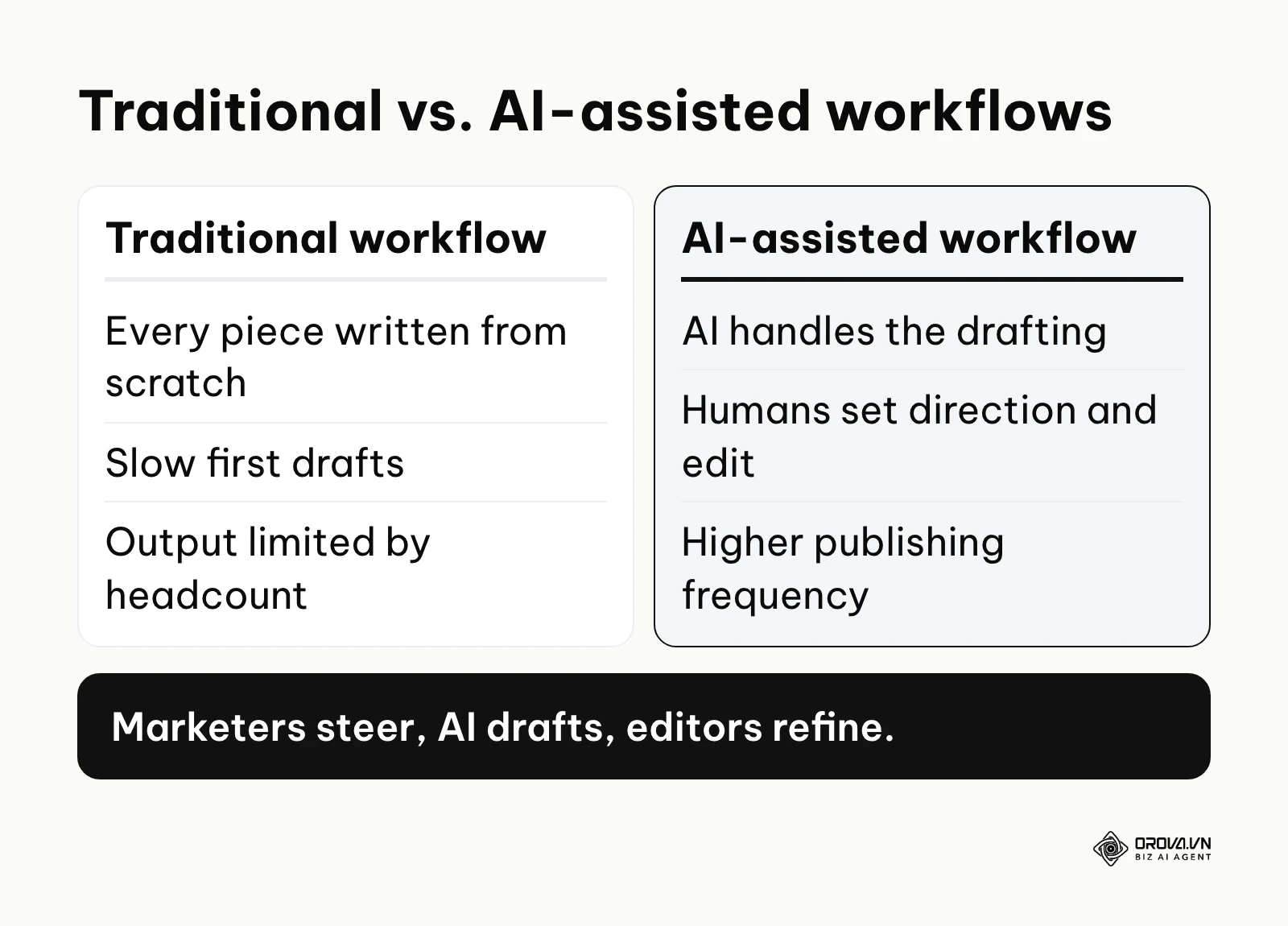
If you choose to ignore this technology, you risk losing visibility in an increasingly saturated digital space. Competitors who adopt AI can test multiple marketing angles and publish at a frequency that manual writing simply cannot match. Business adoption of generative AI has grown quickly as companies look for ways to speed up routine drafting tasks. It is no longer just a novelty; it is a fundamental operational shift.
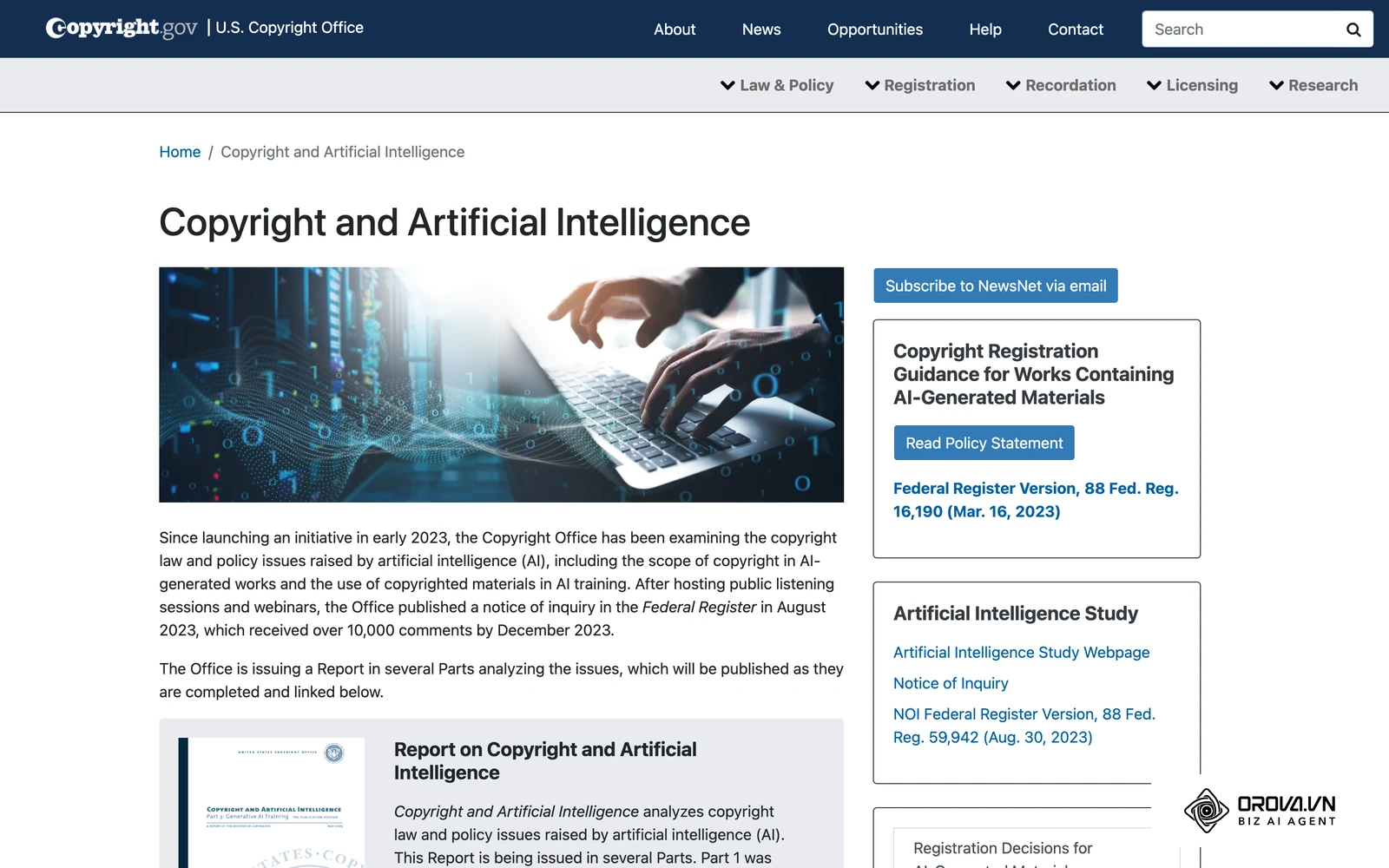
When NOT to use AI-generated content: You should not rely on AI for deep, original journalism that requires primary research, interviews, and on-the-ground investigation. Additionally, highly regulated industries like legal and medical advisory should avoid unreviewed AI outputs, as hallucinations can lead to severe compliance risks and legal penalties. Finally, deeply personal founder stories or apology letters must be written by humans, as the lack of genuine empathy in AI text can severely damage brand trust and authenticity. Copyright rules for AI output are also still evolving and differ by country, so check the official guidance in your market before relying on AI images or text for important commercial assets.
Value and benefits of AI-generated content
The primary value of AI-generated content lies in dramatically reducing production costs for businesses while eliminating the blank page syndrome for individual creators. When implemented correctly, it transforms how a team operates on a daily basis.
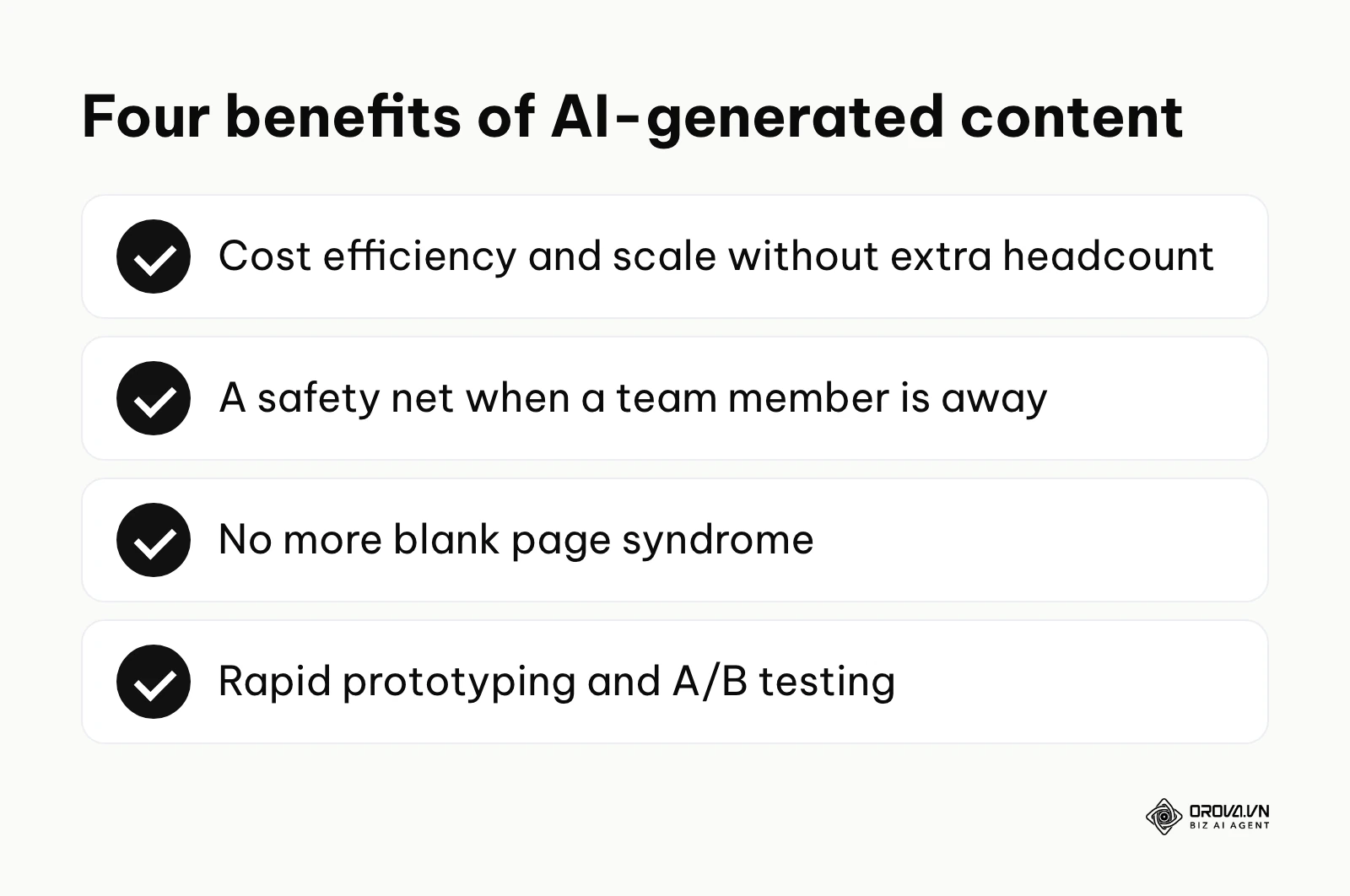
Business Value: Cost Efficiency and Scale
Producing content manually requires significant financial investment in copywriters, designers, and researchers. By integrating AI, businesses can scale their output without a proportional increase in headcount. This allows smaller companies to compete with larger enterprises in terms of publishing frequency.
Business Value: Risk Mitigation in Content Gaps
When a key team member goes on leave or leaves the company, content production often stalls. A standardized AI workflow acts as an operational safety net. Because the prompts and brand voice guidelines are documented, other team members can step in and continue generating baseline content, ensuring that marketing campaigns do not grind to a halt.
Direct User Benefit: Overcoming the Blank Page Syndrome
For the individual marketer, the hardest part of writing is often just getting started. AI tools act as a collaborative brainstorming partner, instantly generating outlines, structure ideas, and rough drafts. This eliminates the anxiety of the blank page and allows the marketer to step immediately into the role of an editor.
Illustrative example:
- Context: A solo marketing manager at a B2B SaaS startup.
- Steps: They used AI to outline 10 blog posts, generated draft structures, and handed them to freelance writers for expansion.
- Stumbling block and fix: The AI hallucinated software features that did not exist; they fixed this by uploading their product documentation directly into the prompt context before generating outlines.
- Result: The team published 10 articles in one week, and every draft was grounded in real product documentation instead of guesses.
Direct User Benefit: Rapid Prototyping and Testing
Instead of spending days debating which email subject line or ad copy will work best, a marketer can ask an AI to generate twenty variations in seconds. This enables rapid A/B testing, allowing creators to find winning marketing angles much faster than relying solely on manual brainstorming.
| Benefit | Measured By | Time to See Results |
|---|---|---|
| Increased publishing volume | Number of posts per week | 1 week |
| Reduced draft time | Hours spent per article | Immediately |
| Improved engagement | Click-through rates on A/B tests | 2-4 weeks |
| Consistent brand tone | Editorial revision rounds required | 1-2 months |
Once AI speeds up your content output, the harder question is which pieces actually perform. Orova Insight connects GA4, Search Console, Google Ads, Meta Ads, LinkedIn and more into one drag-and-drop dashboard, and you can ask questions in plain language to get the charts built for you.
How AI-generated content works (the complete workflow)
AI-generated content operates by taking user instructions (prompts), processing them through a large language or diffusion model trained on vast datasets, and synthesizing entirely new text or images. However, to get professional results, you need a structured workflow. The steps below detail how to build a robust Standard Operating Procedure for your team.
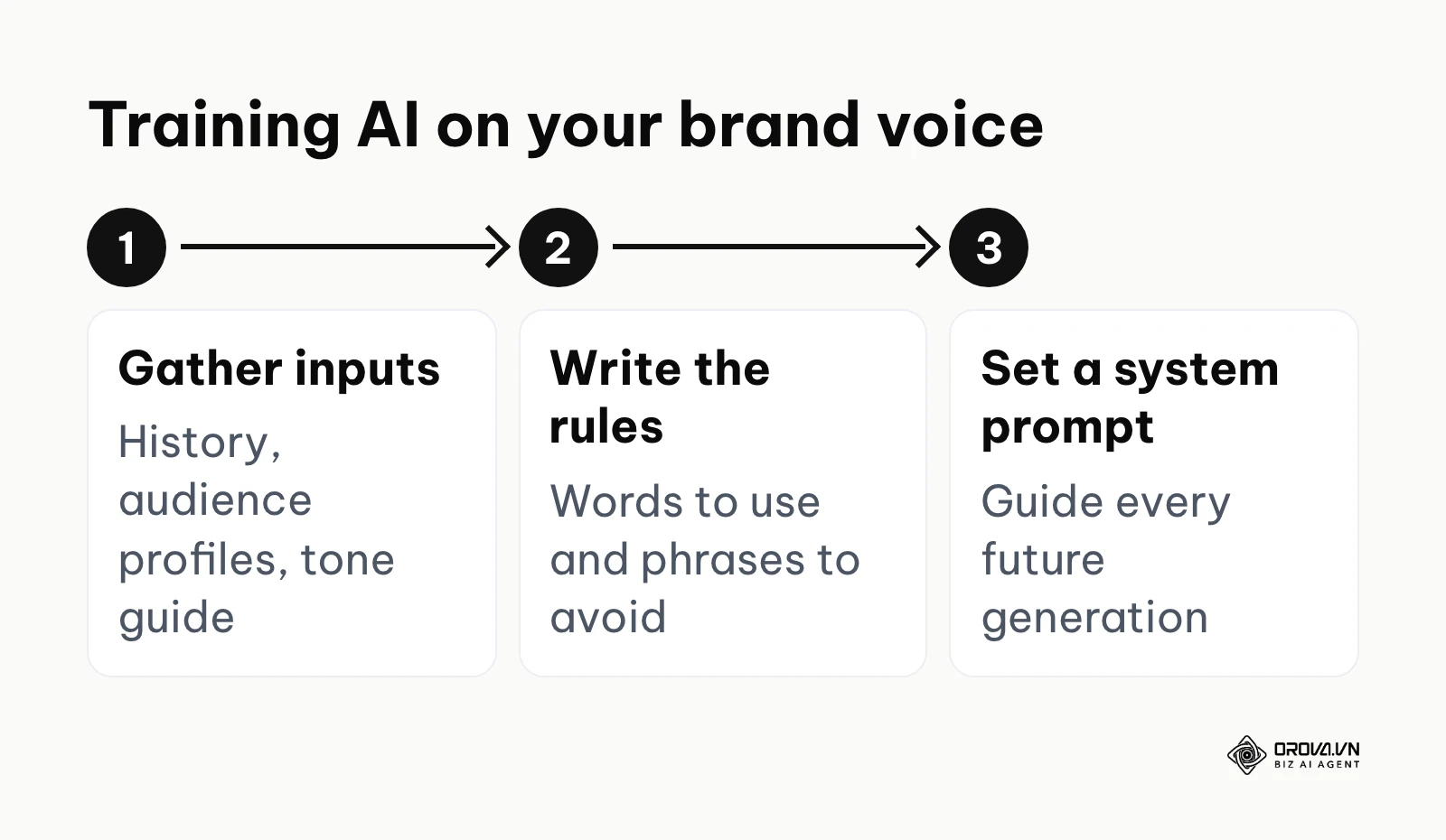
Step 1: Strategy, Ideation, and Brand Voice Training
The first action is defining what you want to write about and teaching the AI how to sound like your brand. The input is your historical data, target audience profiles, and a documented tone of voice guideline. The output is a clear, structured outline and a system prompt that guides all future generation. This step breaks down when marketers skip the training phase, resulting in generic outputs that sound like a robot. You must explicitly tell the AI what vocabulary to use and what phrases to avoid.
Step 2: Contextual Generation and Drafting
Once the strategy is set, the action shifts to drafting. The input is the approved outline and specific, iterative prompts. The output is a rough first draft of your article, email, or social post. This is where evaluating different AI writing tools becomes important, as some are better suited for long-form content while others excel at short copy. The process breaks down if you ask the AI to write a 2,000-word article in a single prompt; the text will inevitably lose focus. Instead, generate the content section by section. Used this way, AI speeds up the early drafting phase and frees human creators to focus on strategy.
Step 3: Human-in-the-Loop Moderation and Fact-Checking
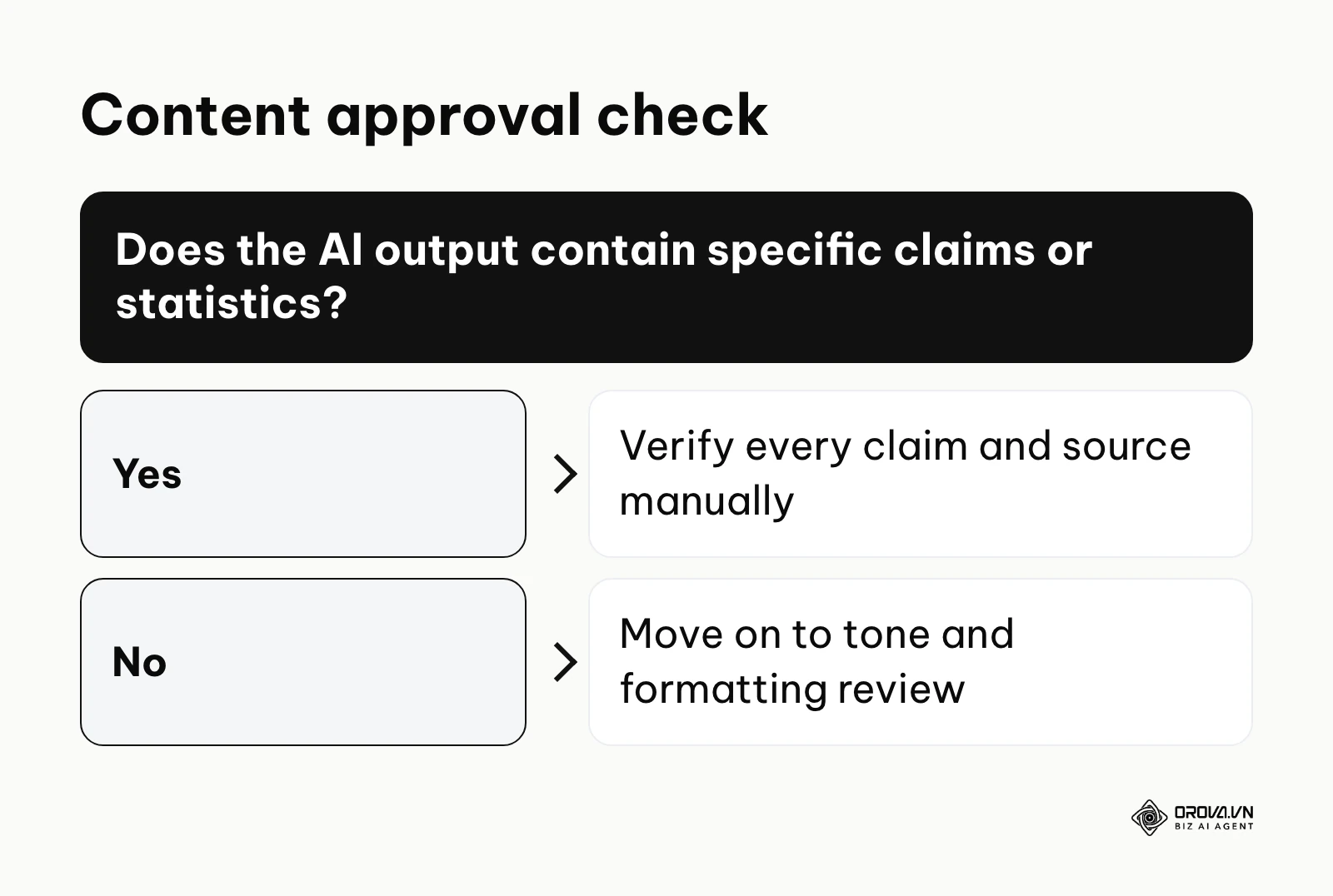
This is the most critical phase. The action involves a human editor reviewing the AI output. The input is the raw AI draft, and the output is a polished, accurate, and safe piece of content ready for publication. This step fails if teams blindly trust the AI, leading to published hallucinations.
The 10-Point AI Content Moderation Checklist:
- Factual Accuracy: Are all statistics, names, and historical dates correct?
- Source Verification: Do the cited sources and URLs actually exist, or are they hallucinations?
- Brand Voice Alignment: Does the vocabulary and tone match your established guidelines?
- Plagiarism Check: Is the text sufficiently original and free from direct copying?
- Bias Evaluation: Is the language inclusive, objective, and neutral?
- Formatting Structure: Are there appropriate headers, bold text, and bullet points for skimming?
- Internal Linking: Does it naturally connect to your other relevant blog posts or product pages?
- Emotional Resonance: Does the writing evoke the intended feeling from the reader?
- SEO Optimization: Are the primary and secondary keywords integrated naturally?
- Call to Action: Is there a clear, logical next step for the reader to take?
Step 4: Answer Engine Optimization (AEO) Formatting
The action here is structuring your reviewed content so that AI search engines can easily read and feature it. The input is your polished draft, and the output is a highly structured document featuring FAQ schema, clear definitions, and bulleted summaries. If you are discussing broad strategies, integrating SEO, AEO and GEO principles can help unify your overall approach to visibility. This step fails if your text is too dense or lacks clear, direct answers to common questions.
Illustrative example:
- Context: An SEO specialist for an e-commerce electronics retailer.
- Steps: They prompted the AI to format product category descriptions with FAQ schema, added a clear table of contents, and instructed it to answer "what is" questions directly in the first sentence.
- Stumbling block and fix: Initially, the AI's answers were too verbose for search engines to feature; they adjusted the prompt to strictly limit answers to 50 words.
- Result: The category pages became shorter, clearer and easier for search engines and AI answers to quote.
Step 5: Practical AI Prompt Library for 2026
To truly leverage these workflows, you need specific instructions. Below are 21 actionable prompts categorized for daily marketing tasks.
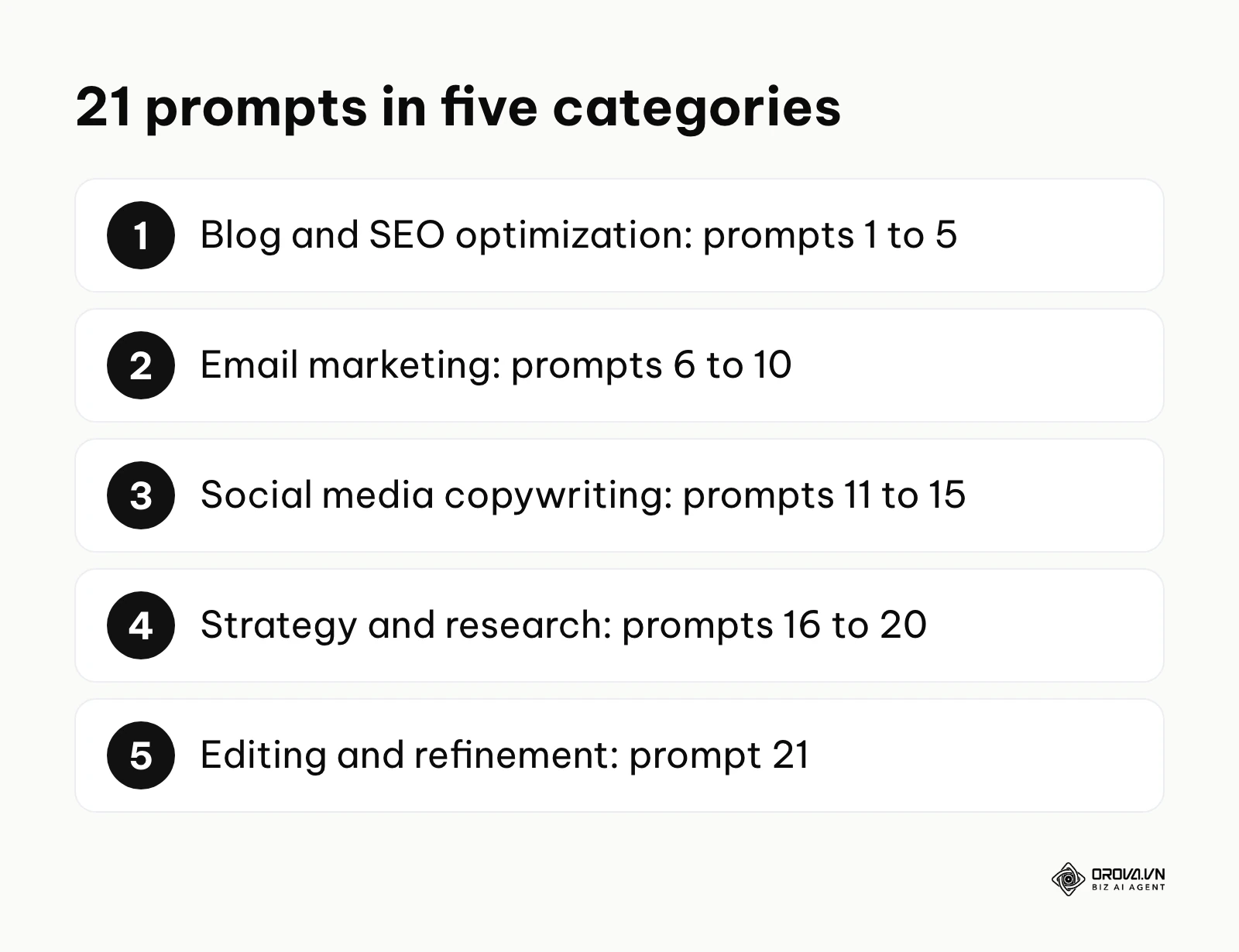
Category 1: Blog and SEO Optimization
- Topic Ideation: Act as a senior content strategist for a [Industry] company. Propose 5 unique blog topics about [Topic] targeting [Audience Persona]. Focus on unconventional angles that challenge industry norms.
- Detailed Outlining: Create a comprehensive, SEO-optimized outline for a blog post titled [Title]. Include H2 and H3 subheadings. Ensure the structure logically guides the reader from the core problem to the solution.
- Engaging Introduction: Write a compelling 150-word introduction for an article about [Topic]. Start with a strong hook that highlights a common frustration for [Audience]. State clearly what the reader will learn.
- Section Expansion: Expand the following H2 section: [H2 Title]. Write 300 words explaining the concept thoroughly. Use short paragraphs and incorporate a bulleted list for readability.
- Meta Description Creation: Generate 3 options for an SEO meta description for a page about [Topic]. Each option must be strictly between 140 and 150 characters and end with a clear call to action.
Category 2: Email Marketing
- Cold Outreach: Write a concise, 100-word cold email to a [Job Title] offering our [Product/Service]. Focus entirely on their pain point regarding [Specific Problem]. Include a low-friction question at the end to spark a reply.
- Newsletter Welcome: Draft a warm email for new subscribers to our [Newsletter Name]. Introduce our brand values, set expectations for what they will receive each week, and provide a link to our best resource.
- Abandoned Cart: Write a friendly cart abandonment email for [Product]. Remind them what they left behind, highlight one key benefit, and create a sense of urgency by mentioning that stock is limited.
- Event Invitation: Create an email invitation for an upcoming webinar titled [Webinar Name]. Outline three specific things the attendee will learn, introduce the speaker [Speaker Name], and include a clear registration button.
- Re-engagement Campaign: Draft a short re-engagement email for inactive subscribers. Acknowledge that it has been a while, offer a special [Discount/Incentive] to return, and provide a simple way to opt-out.
Prompts for social media, research and editing
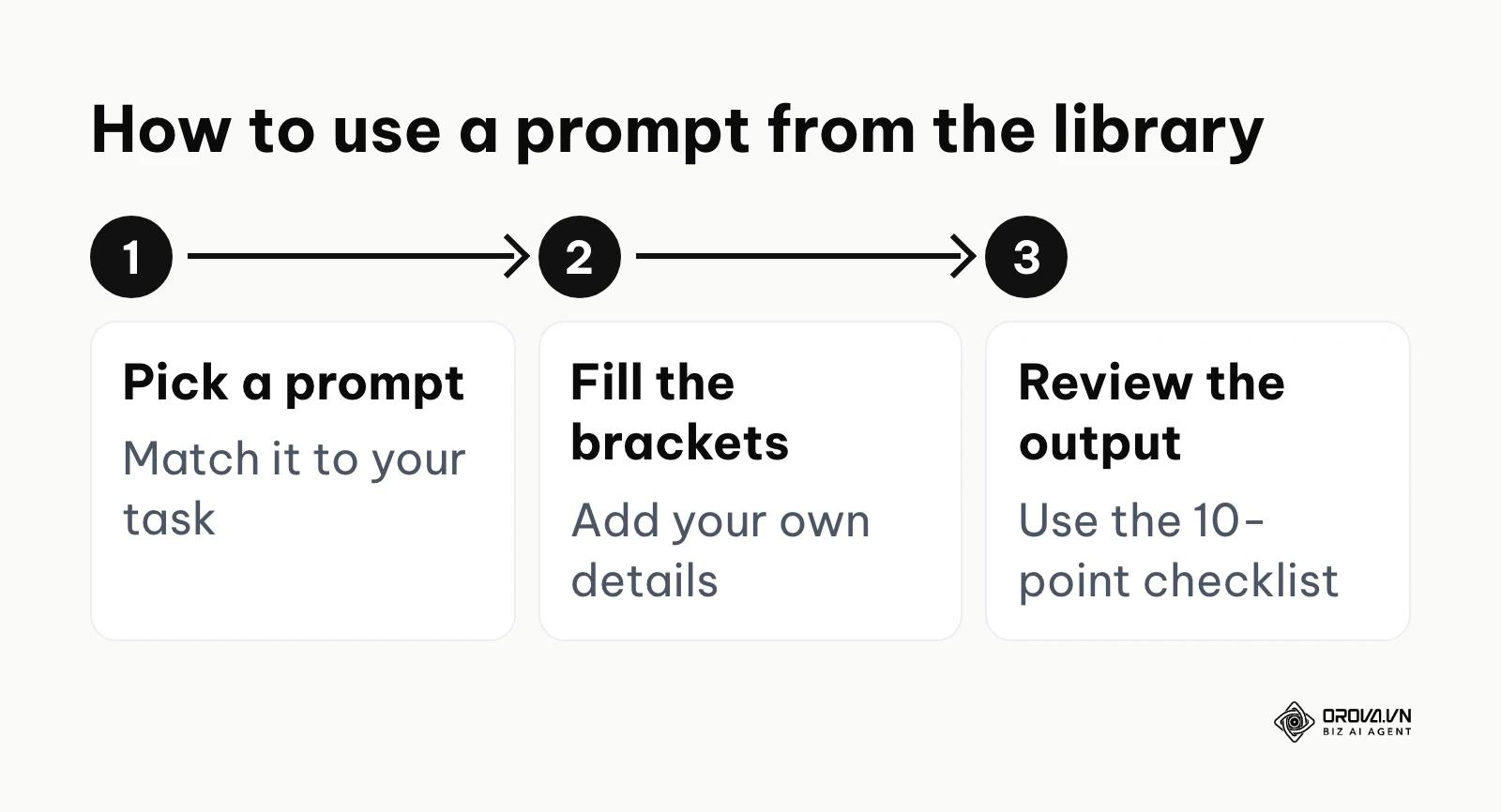
Replace every bracketed placeholder with your own details before you run a prompt, then review the output with the 10-point checklist above.
Category 3: Social Media Copywriting
- LinkedIn Thought Leadership: Turn this key insight: [Insight] into a compelling LinkedIn post. Start with a counter-intuitive statement, break the text into easily readable single sentences, and end by asking a question.
- Twitter/X Thread: Convert this blog post summary [Summary] into a 5-part Twitter thread. Ensure each tweet is under 280 characters, uses strong hooks, and flows logically.
- Instagram Caption: Write an engaging Instagram caption for a photo showing [Image Description]. Use a descriptive, sensory tone. Include a relevant question for the audience and suggest 5 targeted hashtags.
- Facebook Ad Copy: Write direct-response ad copy for Facebook promoting [Product/Offer]. Use the Problem, Agitation, Solution framework. Keep it punchy and focus on the immediate value.
- TikTok Video Hook: Generate 5 short, attention-grabbing spoken hooks for a TikTok video about [Topic]. The hooks must be under 3 seconds to read and immediately address the viewer's curiosity.
Category 4: Strategy and Research
- Buyer Persona Generation: Based on the following product description [Description], generate a detailed buyer persona. Include their demographic details, primary daily frustrations, and objections to purchasing.
- Competitor Analysis: Analyze the following text from a competitor's website: [Competitor Text]. Identify their main value proposition, target audience, and three potential weaknesses in their messaging.
- Content Gap Identification: I have written articles about [Topic 1] and [Topic 2]. Suggest 3 related sub-topics that I have not covered yet, which would be valuable for an audience interested in [Broad Industry].
- Interview Question Prep: I am interviewing a [Job Title] about [Subject]. Provide 10 insightful, open-ended questions that go beyond surface-level information and encourage them to share specific stories.
- Feature to Benefit Translation: Translate this technical product feature [Feature] into a compelling benefit statement for a non-technical end user. Explain exactly how it improves their daily workflow.
Category 5: Editing and Refinement
- Tone Adjustment: Rewrite the following paragraph [Text] to sound more [Desired Tone]. Ensure the core message remains intact but the vocabulary reflects the new tone perfectly.
To better understand the various outputs you can generate from these workflows, review the common formats below.
| Content Type | Key Characteristic | Who It Fits Best |
|---|---|---|
| Short-form Copy | Highly structured, rapid generation | Social media managers needing daily posts. |
| Long-form Text | Requires iterative prompting and heavy editing | Content marketers writing extensive guides. |
| Visual Assets | Driven by descriptive aesthetic prompts | Designers looking to prototype campaign imagery. |
| Data Summaries | Objective extraction of key points | Analysts needing to digest large reports quickly. |
How to start and adapt to AI-generated content
To start leveraging AI-generated content effectively, you must establish clear guidelines for your team and integrate AI tools into your daily production workflows. The approach varies significantly based on the size and structure of your organization.
Small Business Owners
For small business owners with limited resources, AI is a massive force multiplier.
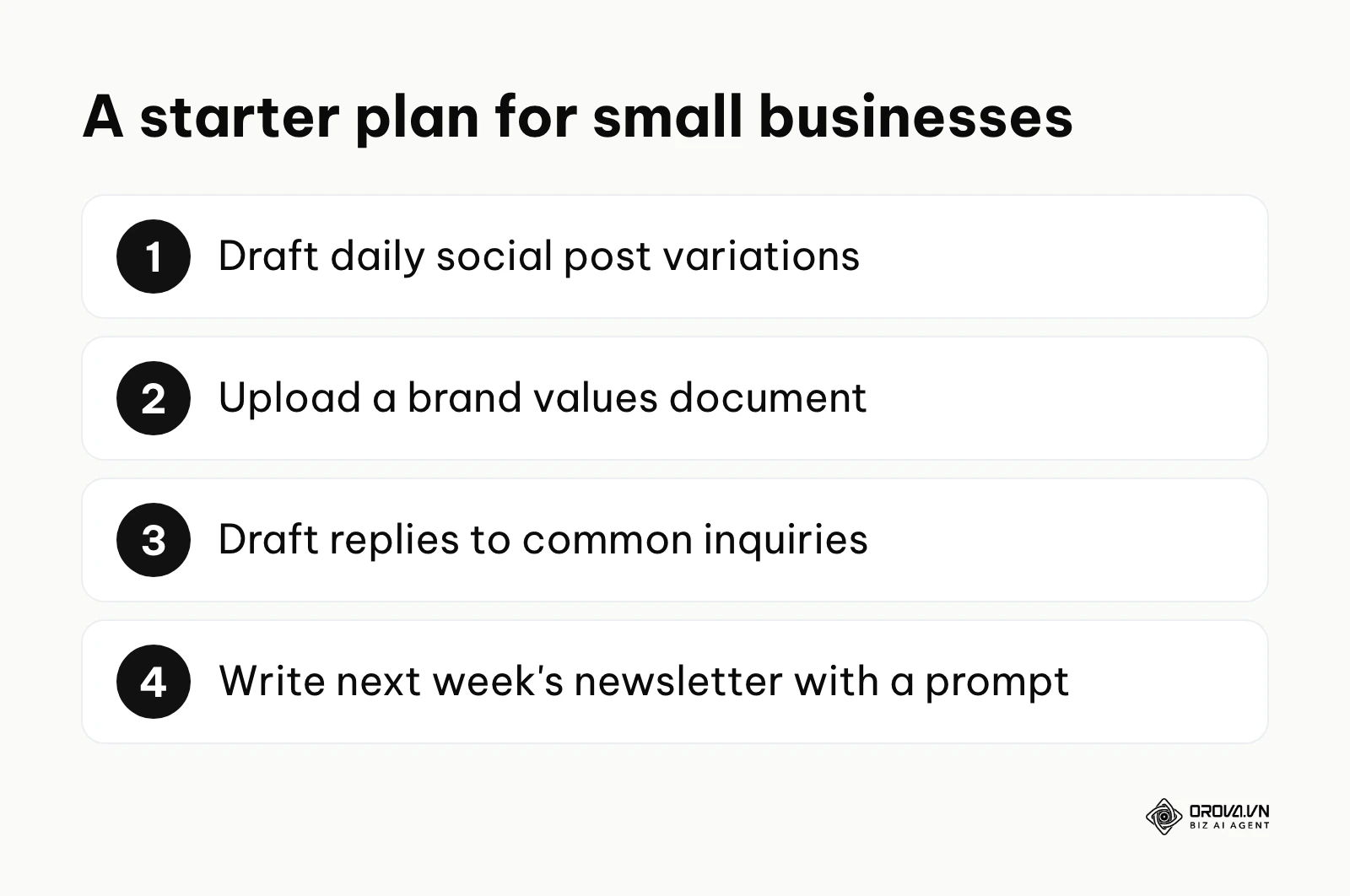
- Start by using AI to generate variations of your daily social media posts to save time.
- Create a basic text document outlining your brand's core values and upload it to your AI tool as a reference.
- Use AI to draft responses to common customer inquiries or reviews.
- Do this week: Generate your next email newsletter using the prompt library above to see immediate time savings.
Illustrative example:
- Context: The owner of a small boutique marketing agency.
- Steps: They created a detailed brand voice guideline document, fed it into their AI workspace, and generated a full month of social media content calendars for a new client.
- Stumbling block and fix: The initial tone was overly enthusiastic and unnatural; they refined the prompt to instruct the AI to be "witty, dry, and professional."
- Result: The client approved the entire calendar on the first review round without requiring any major rewrites.
Marketing Managers in Mid-sized Teams
Managers must focus on standardizing the process across multiple team members to maintain quality.
- Establish a mandatory human-in-the-loop review process for all generated text.
- Build a shared prompt library in a collaborative workspace so successful prompts are reused.
- Conduct a weekly review of AI outputs to identify recurring hallucinations or tone issues.
- Do this week: Implement the 10-point moderation checklist and require editors to sign off on it before publishing.
Agencies and Freelancers
For service providers, AI is about increasing margins without compromising the deliverables.
- Use AI to rapidly build out initial campaign concepts and client pitches.
- Train separate AI chat threads for each specific client to maintain distinct brand voices.
- Transparently communicate with clients about how AI is used strictly for drafting and ideation, not final polish.
- Do this week: Audit your current content creation process and identify one bottleneck that AI can automate, such as keyword research grouping.
| Common Mistake | Consequence | How to Avoid |
|---|---|---|
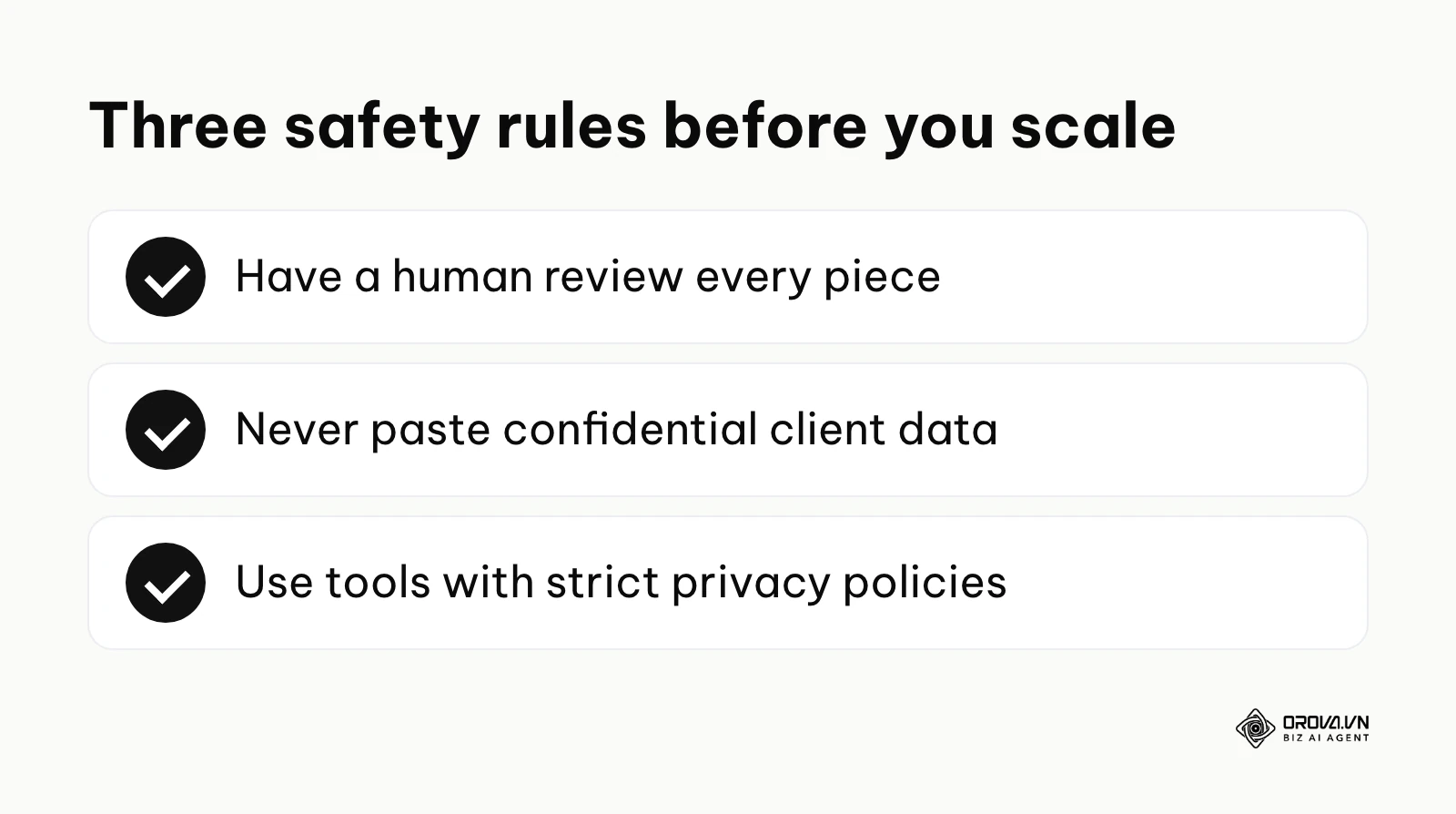
| Publishing without human review | Severe brand reputation damage due to hallucinations. | Implement the 10-point moderation checklist for every piece. |
| Using generic default prompts | Boring content that sounds exactly like competitors. | Develop and enforce a custom, contextual prompt library. |
| Feeding confidential client data | Potential legal breaches and privacy violations. | Use enterprise-grade tools with strict data privacy policies. |
Stop compiling spreadsheets by hand to see whether your content is working. With Orova Insight you can schedule periodic reports with your own custom metrics and share live dashboards with your team. Try it free until July 7, 2027, no credit card required.
Where AI-generated content is heading in the next few years: the author's take
The landscape of content creation is shifting rapidly. Based on the patterns emerging in the market, here is how I view the future of this technology.
The shift to hyper-personalized dynamic media
As of 2026, we are already seeing tools capable of altering website copy based on a visitor's location or browsing history. I think that in the next two to three years, AI-generated content will become far more dynamic, with articles, images and videos adapted to each visitor's context and preferences. I believe this will happen because consumer expectations for personalization are outgrowing static landing pages. To prepare for this, you should start organizing your customer data rigorously today, as future AI models will need clean, structured data to generate these personalized experiences accurately.
AI evolving into an autonomous strategic partner
Currently, as of 2026, most teams use AI as a passive assistant—you give it a prompt, and it writes a draft. I suspect that within the next few years, AI will move closer to the role of a strategist that suggests market gaps, drafts the content and proposes a schedule, with humans approving the plan rather than prompting every step. I foresee this transition because AI reasoning capabilities are improving much faster than basic text generation. You need to prepare by shifting your team's skills from basic copywriting to strategic oversight and editorial judgment.
Stricter digital watermarking regulations
Right now, as of 2026, distinguishing between AI-generated content vs human content is becoming increasingly difficult, leading to trust issues across digital platforms. My read is that more regulators and platforms will push for some form of labeling or watermarking of AI-generated assets used for commercial purposes. I lean towards this outcome because major social platforms and search engines are already experimenting with labeling AI content to combat misinformation. To stay ahead, you should maintain transparent records of your AI workflows and always ensure human verification before publishing. However, I could be wrong if open-source models refuse to adopt these watermarking standards broadly.
Frequently asked questions about AI-generated content
Below are the most common questions marketers have regarding the implementation and risks of AI-generated content.
How to humanize AI-generated content?
To humanize your outputs, you must move beyond generic prompts. Feed the AI specific anecdotes, unique company data, and a strict brand voice guideline that dictates pacing and vocabulary. Most importantly, always have a human editor inject personal opinions and real-life experiences into the final draft, as AI currently lacks genuine lived experience.
How are copyright risks handled in practice for AI images in ads?
Copyright rules for AI-generated images are still evolving and differ from country to country, and in many places purely machine-made output may not be protected by copyright on its own. In practice, teams lower their risk by reading each tool's terms for commercial use, avoiding prompts that imitate specific artists, brands or real people, and adding meaningful human design work to the final asset. This is general information, not legal advice; for high-stakes campaigns, check with a qualified lawyer in your market.
Are AI-generated content examples helpful for building a strategy?
Yes, studying successful AI-generated content examples is crucial for understanding what works. By analyzing how top brands use AI to scale their blog output or personalize email campaigns, you can reverse-engineer their prompts and workflows. This prevents you from making beginner mistakes and accelerates your team's learning curve.
Will search engines penalize my website for using AI?
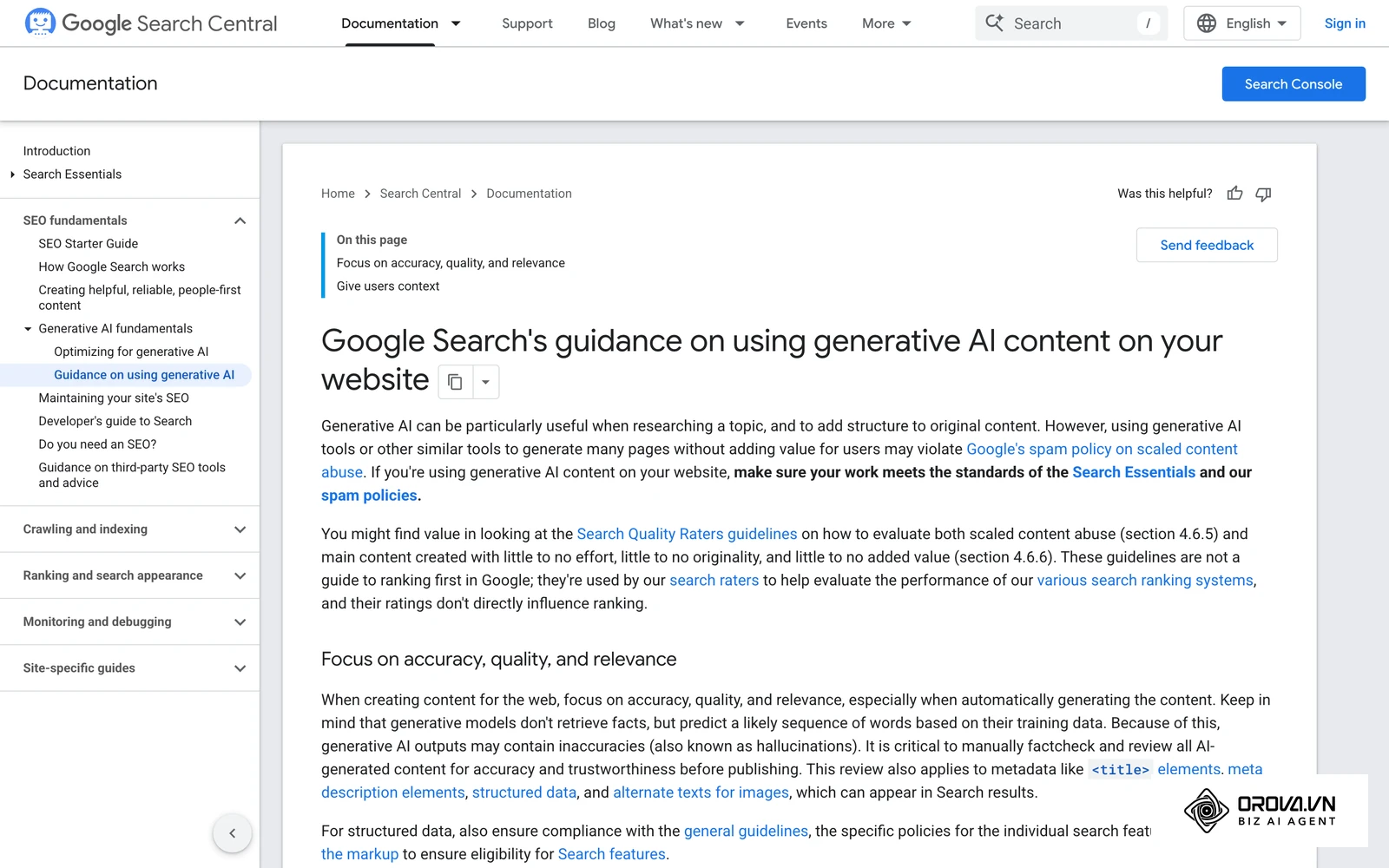
Google's public guidance says it focuses on the quality of content rather than how it was produced. What it acts against is low-quality, spammy content made mainly to manipulate rankings. If your AI-assisted content is highly informative, fact-checked, and provides genuine value to the reader, it will perform well in search results.
Is content marketing still needed with AI search engines?
Yes, content marketing is absolutely still needed, but its form is changing. As AI search engines synthesize answers directly on the results page, they still require authoritative, original source material to pull from. If you focus on providing unique insights and original data, your content will become the foundation that AI SEO strategies rely on to gain visibility.
Where to start with AI-generated content?
The best place to start your AI-generated content journey depends entirely on your current level of adoption and existing organizational processes. You do not need to overhaul your entire marketing department overnight. Instead, focus on a single, impactful action based on your current situation.
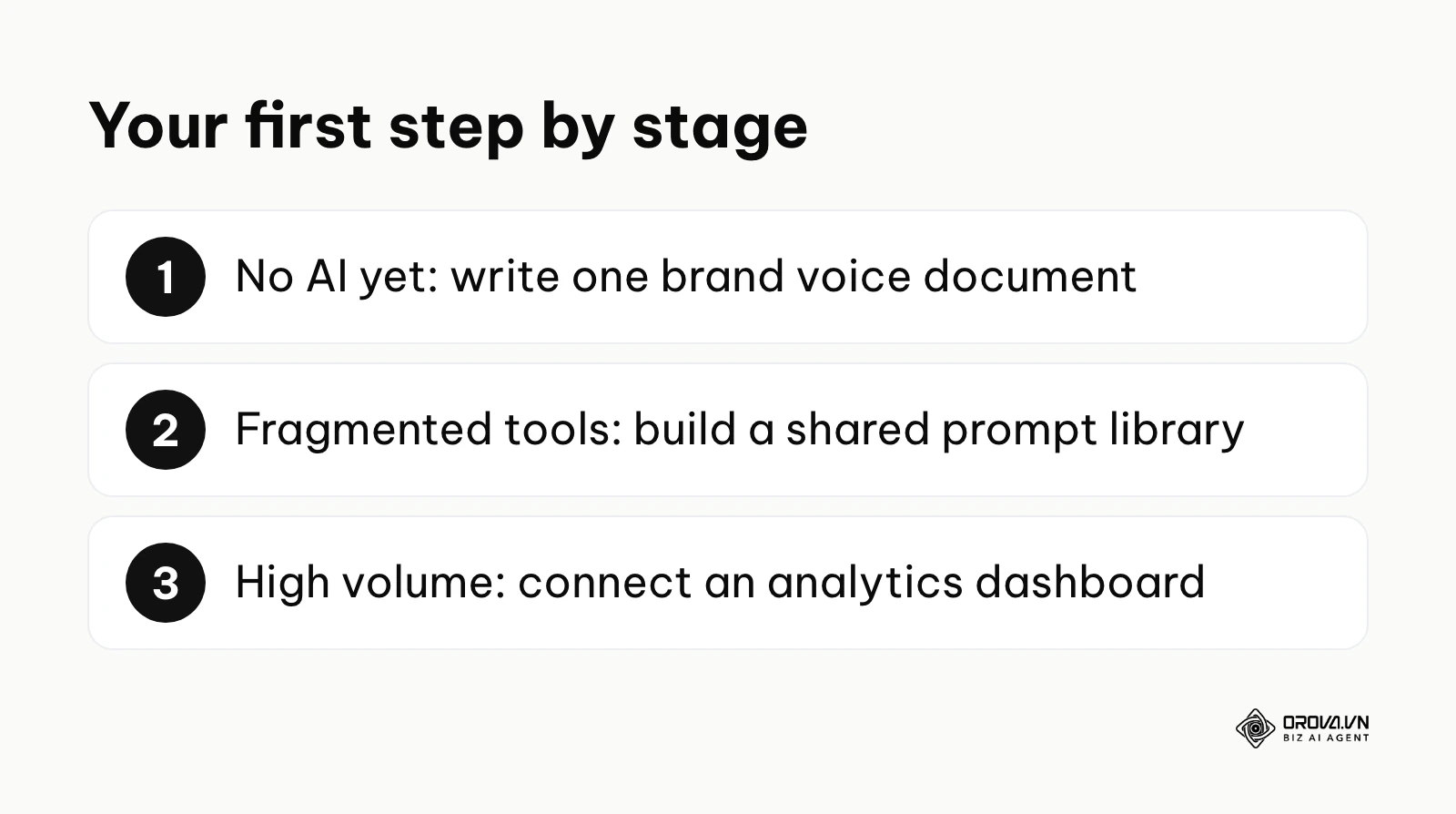
If you have no AI systems in place yet, your very first step is to create a single, well-documented brand voice guideline in a simple text document. Spend one afternoon writing down your company's core values, target audience, preferred tone, and a list of words you never use. This single document is the foundational asset you will need to feed into any AI tool before writing your first prompt, ensuring the output sounds like your brand from day one.
If you have a fragmented approach where different team members use separate tools haphazardly, your immediate next step is to establish a shared, centralized prompt library. Open a collaborative document today and ask everyone to paste their most successful prompts into it, categorizing them by task. This simple consolidation ensures that everyone generates content with consistent quality and prevents knowledge silos from forming within your marketing team.
If you are already generating high volumes of content but fail to measure its impact, your first step for this afternoon is to connect your publishing platforms to an automated analytics dashboard. Ensure that your web traffic, social media engagement, and conversion metrics are pulling into a centralized view. This allows you to definitively see which AI-generated content campaigns are actually driving business results rather than just vanity metrics.
About the author

Builder of Orova
Nguyễn Đỗ Trọng Ân has 8 years of experience in marketing, including 6 years managing market development across Asia. He builds Orova, a Biz AI Agent that never sleeps: it plans, runs and optimizes work for businesses.
Run your business with AI Agents
Orova is the always-on Biz AI Agent — it plans, runs, and optimizes the work for you.
Save time, unlock productivity.