
What is answer engine optimization? A practical AEO checklist for 2026

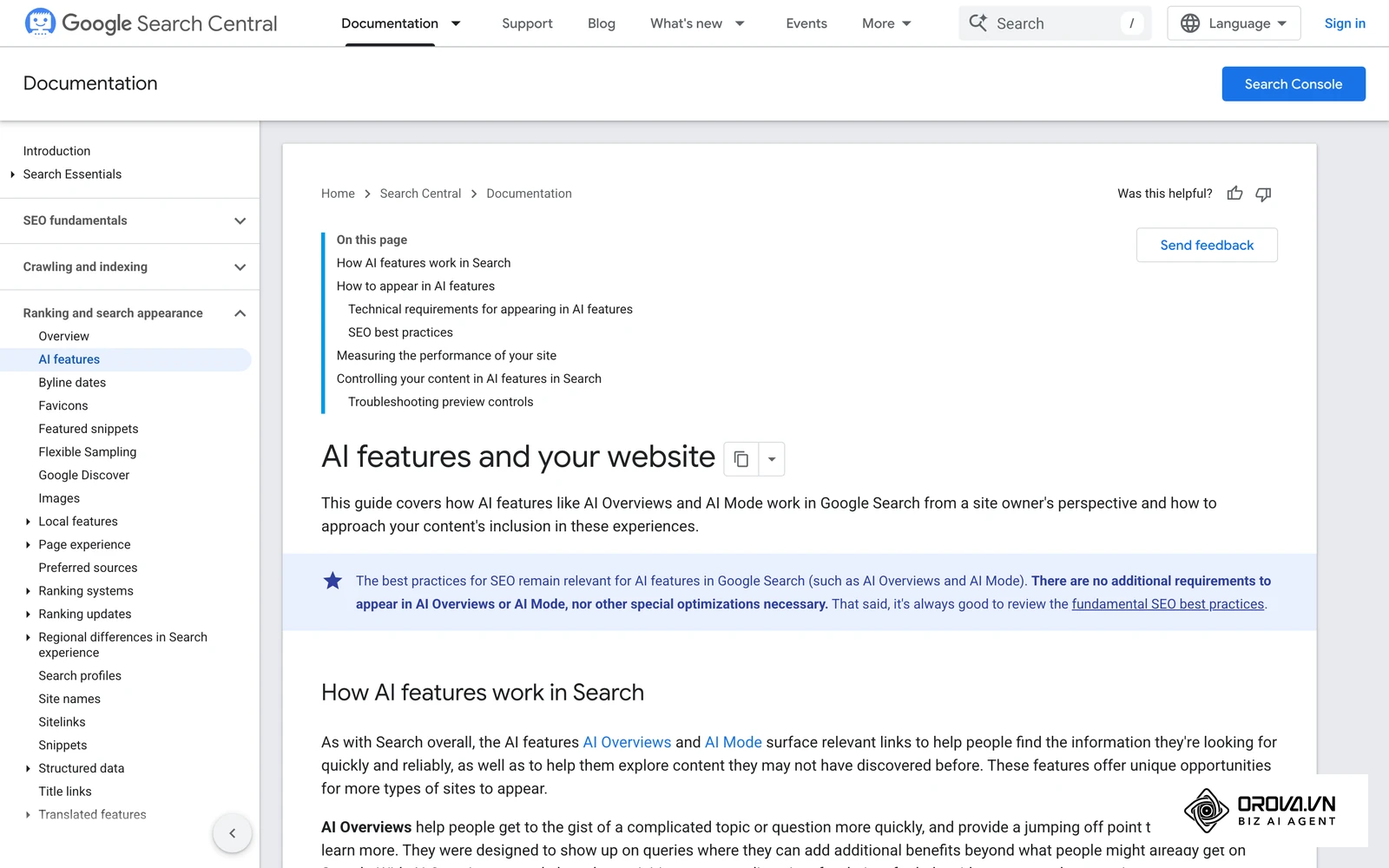
Answer engine optimization (AEO) is the practice of structuring content so AI systems such as ChatGPT, Perplexity and Google AI Overviews can understand it, lift it and present it as a direct answer. If your organic traffic is slipping while rankings look stable, this is often why: AI tools now answer many queries directly on the results page. In the past, optimizing for search meant inserting keywords and building links to secure a blue link, hoping searchers would click through to read your article. That approach is no longer sufficient. This guide explains how answer engine optimization works, offering a practical framework to help you regain visibility and drive meaningful engagement in an AI-first world. By the time you finish reading, you will have a clear, actionable blueprint to adapt your digital presence.
What is answer engine optimization?
Answer engine optimization is the strategic process of structuring and writing digital content so that artificial intelligence systems, like ChatGPT and Google AI Overviews, can easily understand, extract, and present your information as direct answers. It differs from traditional search optimization by prioritizing conversational context and entity relationships over keyword frequency.
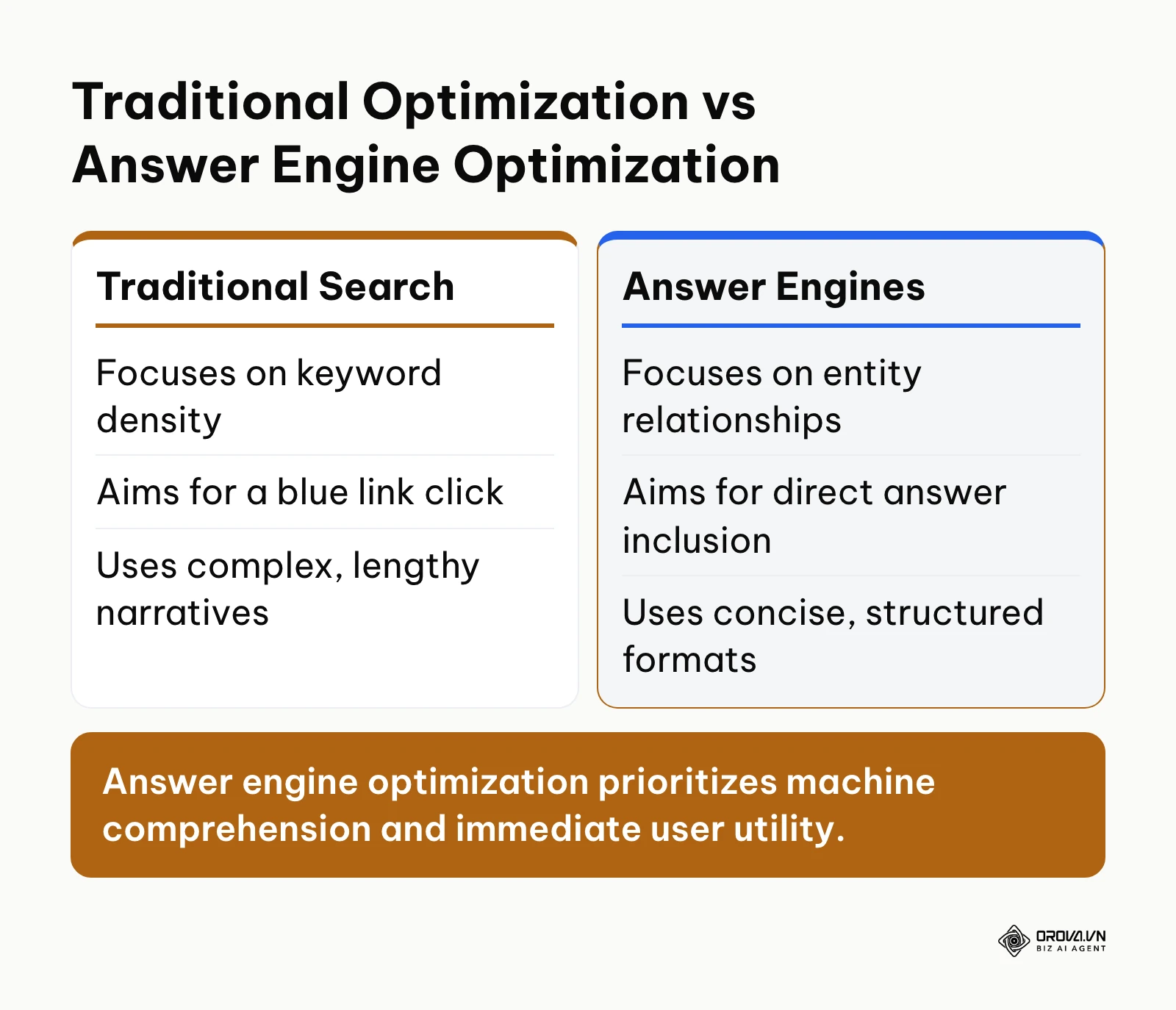
The term originated as conversational AI interfaces evolved from experimental novelties into daily habits for millions of internet users. As search engines transformed into sophisticated answering machines, marketers realized that simply appearing on a results page was meaningless if the AI did not select their specific data to formulate its response. To understand this shift, it is helpful to contrast it with related practices. You can learn more about the broader concept of generative engine optimization to see how these strategies overlap, and see how SEO, AEO and GEO fit into one content plan if you want the three disciplines side by side. This article stays on AEO alone: what it is, how it works and a checklist you can apply page by page.
| Concept | Core Differences | Practical Example |
|---|---|---|
| Traditional Optimization | Focuses on keyword density, backlink profiles, and securing a clickable blue link. | Writing a 2000-word essay targeting the exact phrase "best running shoes 2026". |
| Answer Engine Optimization | Focuses on semantic clarity, structured data markup, and providing concise, extractable facts. | Providing a clear bulleted list of running shoe features directly beneath a specific H2 question. |
| Voice Search Optimization | Focuses primarily on optimizing for spoken queries and local intent via mobile devices. | Optimizing for "where can I buy running shoes near me right now". |
Illustrative example: a user asks an AI assistant, "How do I reset the water pressure on a Boiler X200?" If the manufacturer's website contains a dense PDF manual, the AI might struggle to extract the steps. However, if a plumbing blog provides a webpage with the exact heading "How to reset water pressure on Boiler X200" followed immediately by a numbered list of five short steps, the AI is far more likely to pull that structured list and present it directly to the user, citing the blog as the authoritative source.
The significance of answer engine optimization in modern search behavior
The significance of answer engine optimization in modern search behavior lies in its ability to connect your brand directly with users who demand instant, accurate information without navigating multiple web pages. It serves as the critical bridge between unstructured website data and conversational AI interfaces.
This practice exists to solve the problem of information overload. Modern internet users are often impatient; they do not want to scroll through lengthy introductory paragraphs to find a single piece of data. Answer engine optimization caters to this demand for instant gratification by ensuring that when a user asks a complex question, your brand is the entity providing the immediate, verified answer. In the broader ecosystem, this strategy sits between initial content creation and technical site architecture. It requires both compelling writing and robust coding to function correctly.
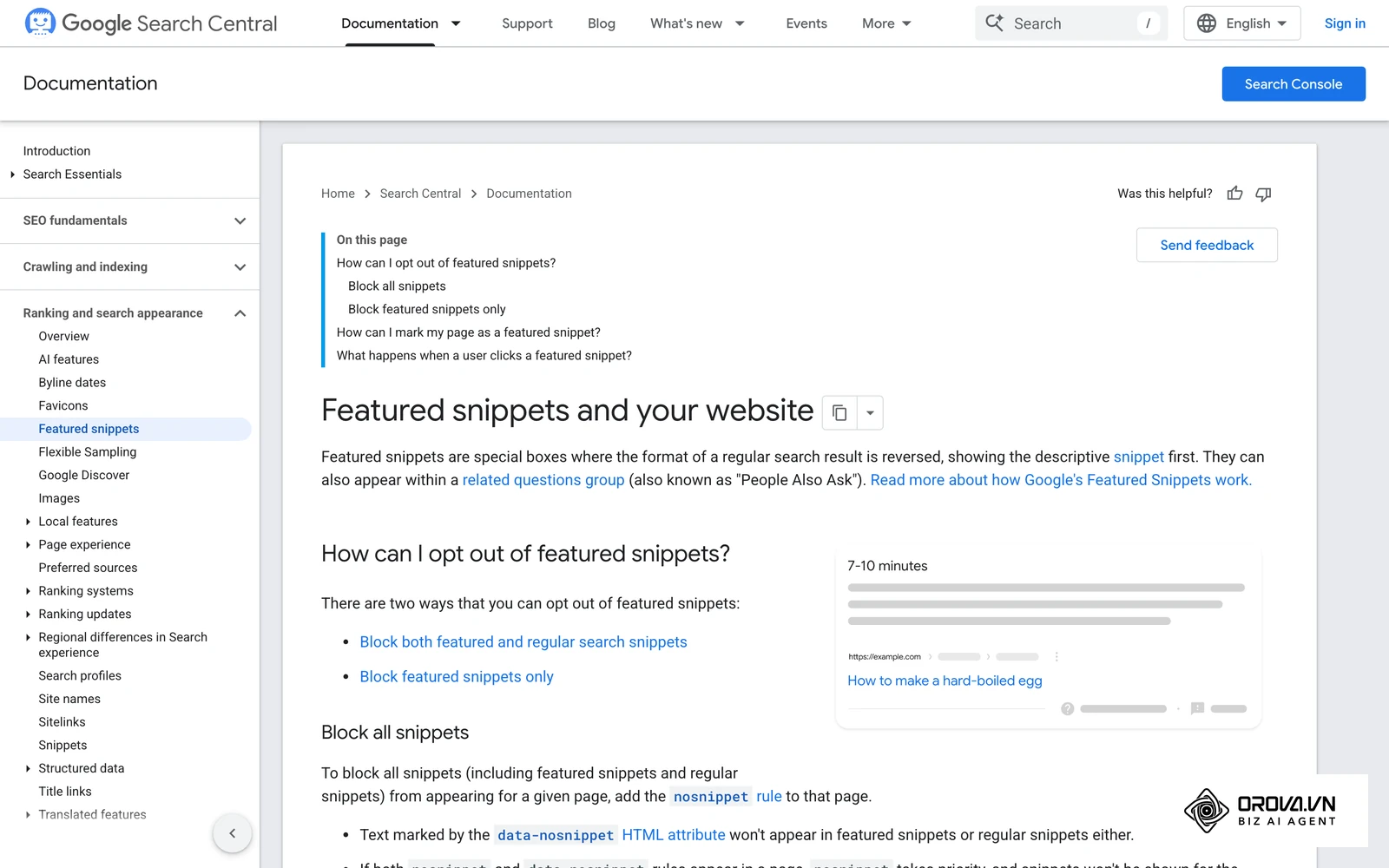
If you choose to ignore answer engine optimization, your website risks becoming an invisible archive. Search engines will still index your pages, but AI models will bypass your content in favor of competitors who have structured their data more efficiently. This leads to a severe drop in brand awareness and organic acquisition, as users receive their answers from competitors directly on the search interface.
Defending against zero-click traffic loss
One of the most significant concerns regarding AI search is the "zero-click" phenomenon, where users read the answer on the search page and never visit your website. To combat this, answer engine optimization requires a strategic defense mechanism often called the "information teaser" framework.
Instead of withholding information entirely, which tends to get you skipped,you must provide a complete, accurate, but surface-level answer. Then, you introduce a complex variable that requires deeper exploration. For example, you might answer the question "What are the tax brackets for small businesses?" directly. However, in the very next sentence, you state, "Because local deductions vary drastically, businesses often use a dynamic calculator to find their exact effective rate." This satisfies the AI's need for a direct answer while compelling the human user to click through to use your proprietary calculator. Detailed comparison pages can also earn the click, because a short AI summary rarely carries every variable of a multi-column comparison.
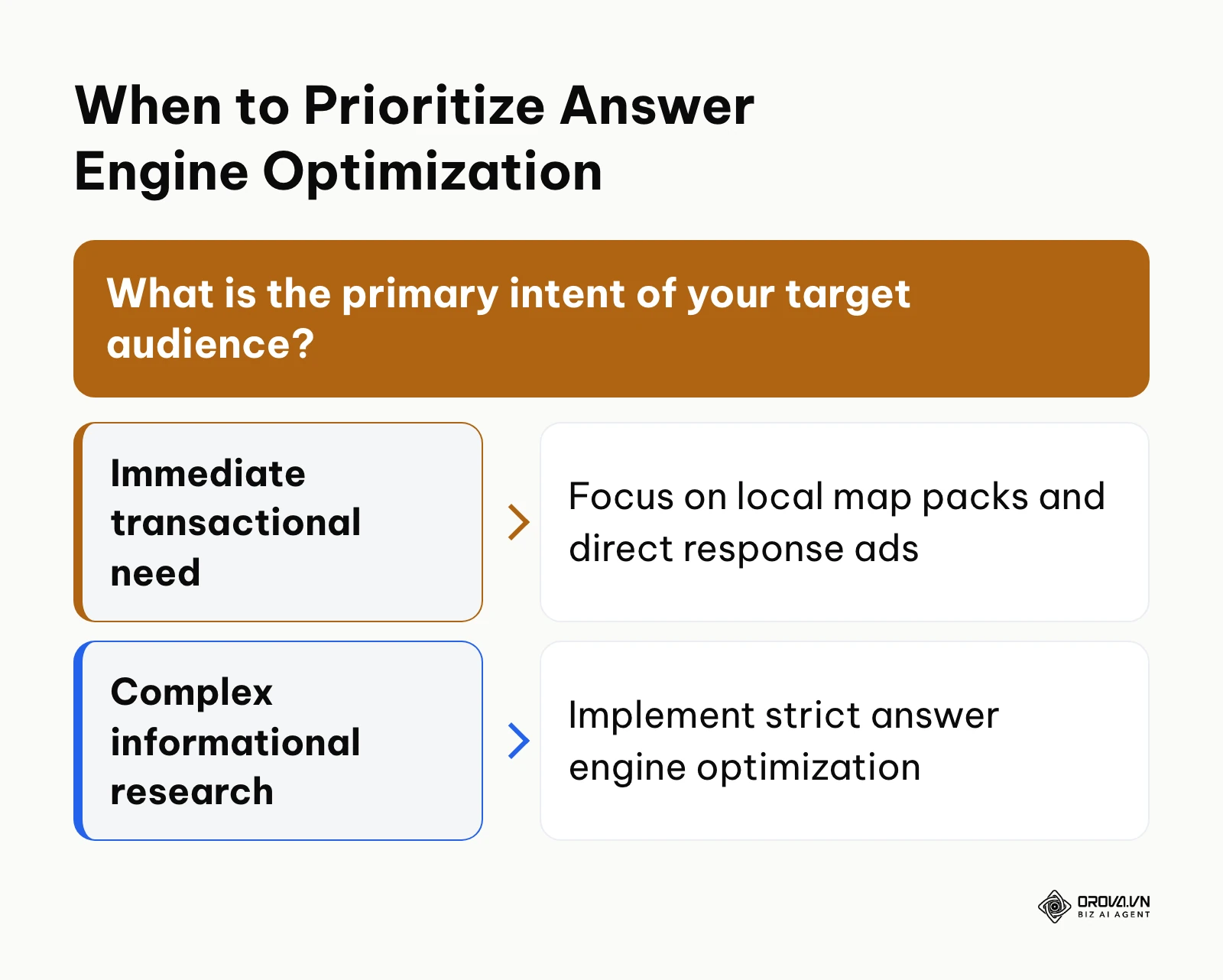
When you don't need answer engine optimization yet: If you run a purely transactional local business, like an emergency plumbing service, users want a phone number immediately, not a conversational explanation of pipe mechanics. In this case, standard local search map packs are far more critical. Additionally, if your website lacks basic technical health, mobile responsiveness, or foundational content, investing in answer engine optimization is premature. You should establish a solid technical baseline and clear site architecture before worrying about how artificial intelligence parses your unstructured text.
The values, benefits, and real ROI of answer engine optimization
The primary values and benefits of answer engine optimization include securing high-visibility placements in AI summaries, building profound brand authority, and capturing users at the exact moment of their highest intent. This strategy transforms passive readers into engaged prospects by delivering immediate utility.
From a business perspective, adapting to AI search mitigates the massive risk of traffic loss due to algorithmic shifts. It future-proofs your content investments by ensuring that your data remains readable regardless of which specific AI model becomes dominant. Financially, it often leads to capturing highly qualified leads; users who ask specific, complex questions are usually further down the purchasing funnel than those searching broad keywords.
For the individuals implementing the strategy—such as content creators and technical developers—the benefits are equally clear. It provides a highly structured framework for creating content, eliminating the guesswork of keyword stuffing. Writers can focus on clarity and logic, while developers have clear, standardized schema protocols to implement.
An illustrative answer engine optimization example
To understand the tangible return on investment (ROI), consider this illustrative scenario. Exact outcomes vary from site to site.
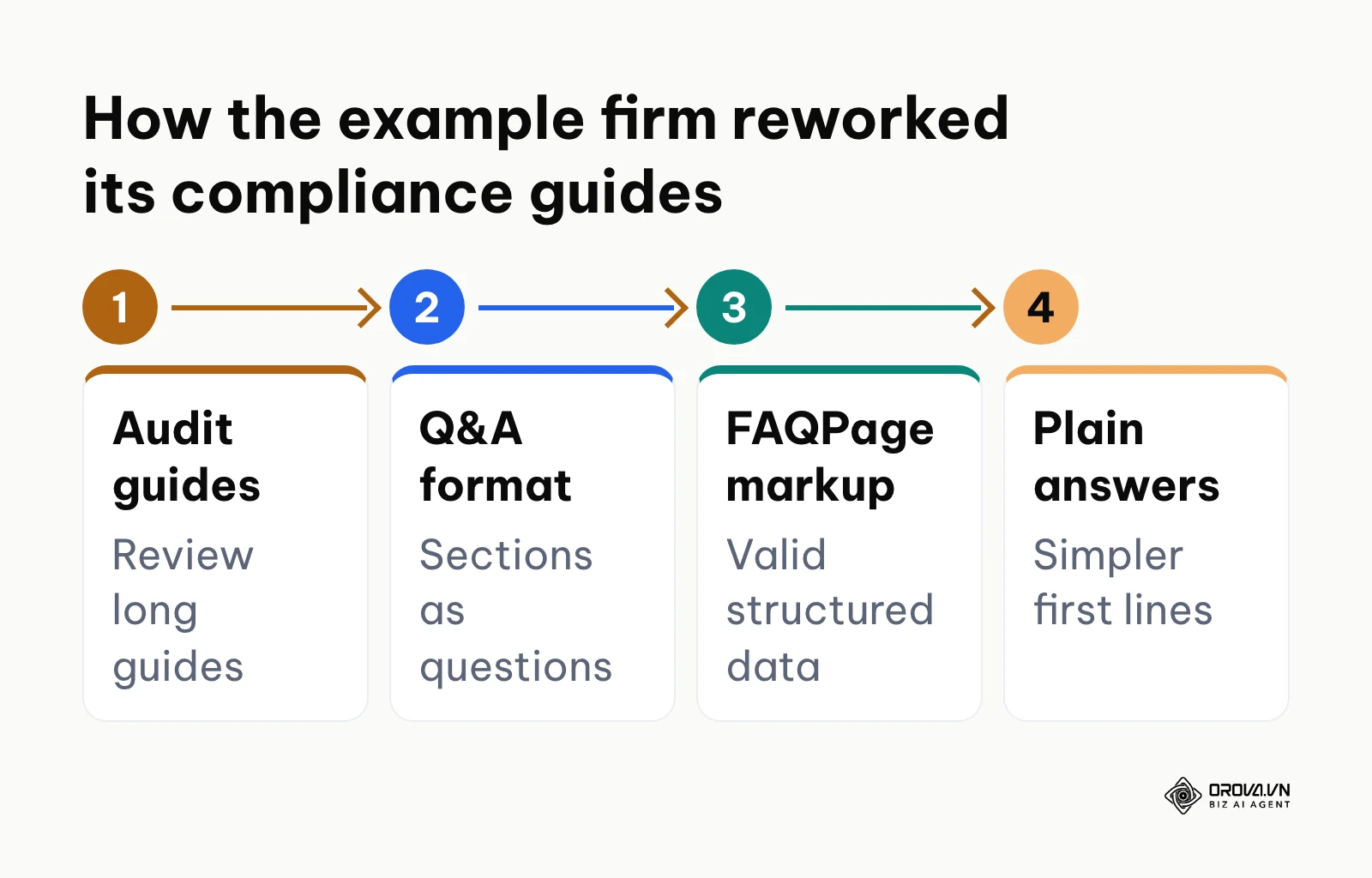
Illustrative example: A mid-sized B2B software consulting firm wanted to capture high-intent users asking about specific cybersecurity compliance regulations. They audited their existing, lengthy compliance guides. Their process involved restructuring the guides into a strict question-and-answer format and applying valid FAQPage schema markup to the code. Initially, the AI systems completely ignored the pages because the language used in the answers was too academic and convoluted. They fixed this hurdle by rewriting the first paragraph of every answer using simpler, highly direct language, stripping out unnecessary corporate jargon. The visible result was a clear increase in their brand name appearing as a cited source in AI-generated compliance summaries across major search platforms. Their internal analytics showed a significant lift in direct referral traffic originating specifically from conversational AI chatbots, leading directly to an increase in qualified consultation requests.
| Core Benefit | Measurement Metric | When It Usually Shows Up |
|---|---|---|
| AI Overview Inclusion | Impression share in generative search blocks | First, once pages are re-crawled |
| Brand Authority | Brand mentions in AI-generated answers | Later, as citations accumulate |
| Qualified Traffic | Conversion rate from organic AI referrals | Last, after enough AI referrals arrive |
Discover Orova.vn – a Biz AI Agent platform with OROVA SEO, a complete solution for every website. The system supports search engine optimization from A to Z with features including keyword research, writing new SEO-ready articles, optimizing existing content, rank tracking, plus competitor analysis and in-depth technical analysis. Sign up today to experience OROVA SEO completely free (offer valid through July 7, 2027).
How answer engine optimization works: The core mechanics and technical checklist
Answer engine optimization works by systematically breaking down complex information into distinct entities, establishing clear semantic relationships between them, and formatting the text to perfectly match natural conversational queries. The core mechanics rely on a combination of structured technical markup and highly descriptive, concise language.
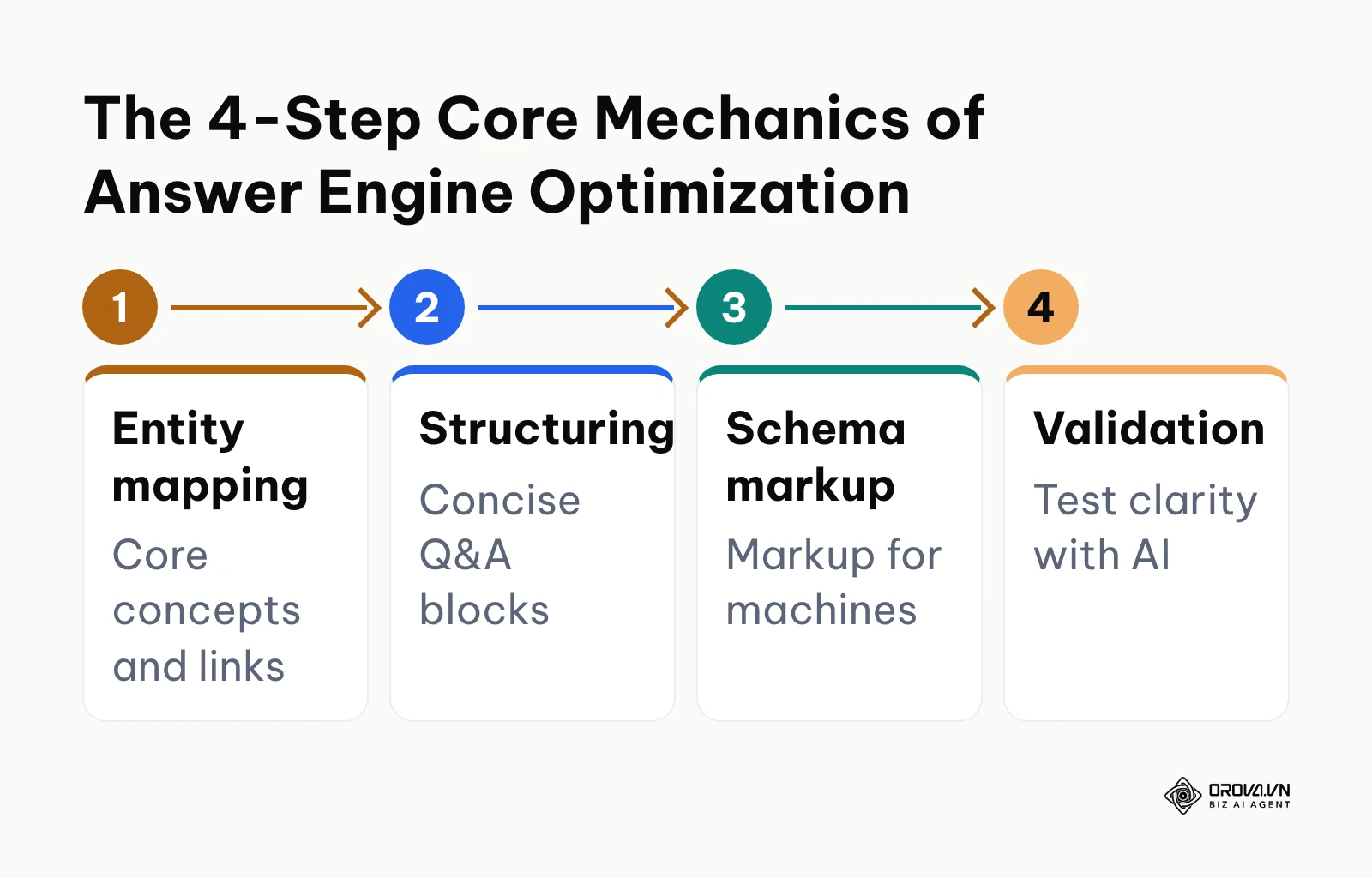
This section is the most critical part of the process. It requires bridging the gap between how humans read a story and how machines parse a database. We can dissect this into several functional components.
Entity Identification and Semantic Mapping
The first step in answer engine optimization is shifting your mindset from "keywords" to "entities." An entity is a distinct, well-defined concept—a person, place, organization, product, or abstract idea. Artificial intelligence systems build their knowledge bases by understanding how these entities relate to one another.
Your input here involves mapping out the core entities your business represents. The output is a content plan that clearly links your brand (Entity A) to a specific solution (Entity B) and a specific user problem (Entity C). A common failure point at this stage is ambiguity. If you use pronouns like "it" or "they" too frequently, the machine loses the thread of the entity relationship. You must be explicitly clear, repeating the noun rather than relying on pronouns.
Illustrative example: A regional e-commerce retailer selling specialized outdoor gear needed to map their product entities clearly for AI search. They updated their product category descriptions to explicitly state compatibility, materials, and specific weather use cases using short, declarative sentences. At first, search crawlers were slow to index the changes due to an overly complex site architecture with too many dynamic sorting parameters. They resolved this hurdle by simplifying the URL structure and submitting a clean, static sitemap. The visible result was their specific tent models consistently appearing in comparative AI queries regarding "lightweight camping equipment for alpine environments."
Conversational Content Structuring
Once entities are defined, the content must be formatted to match how humans ask questions and how AI prefers to read answers. This is where seo content writing intersects heavily with answer engine optimization.
The input is your raw subject matter expertise. The output is a highly structured page utilizing specific HTML tags to create a hierarchy. A common failure point is burying the direct answer in the middle of a long paragraph. The AI will often abandon parsing a paragraph if the answer is not immediately apparent in the first sentence.
A technical checklist for developers and SEO teams
To execute answer engine optimization properly, both the technical and content teams must align. Below is a concrete checklist that developers and SEO specialists must follow to ensure maximum machine readability.
For the Development Team:
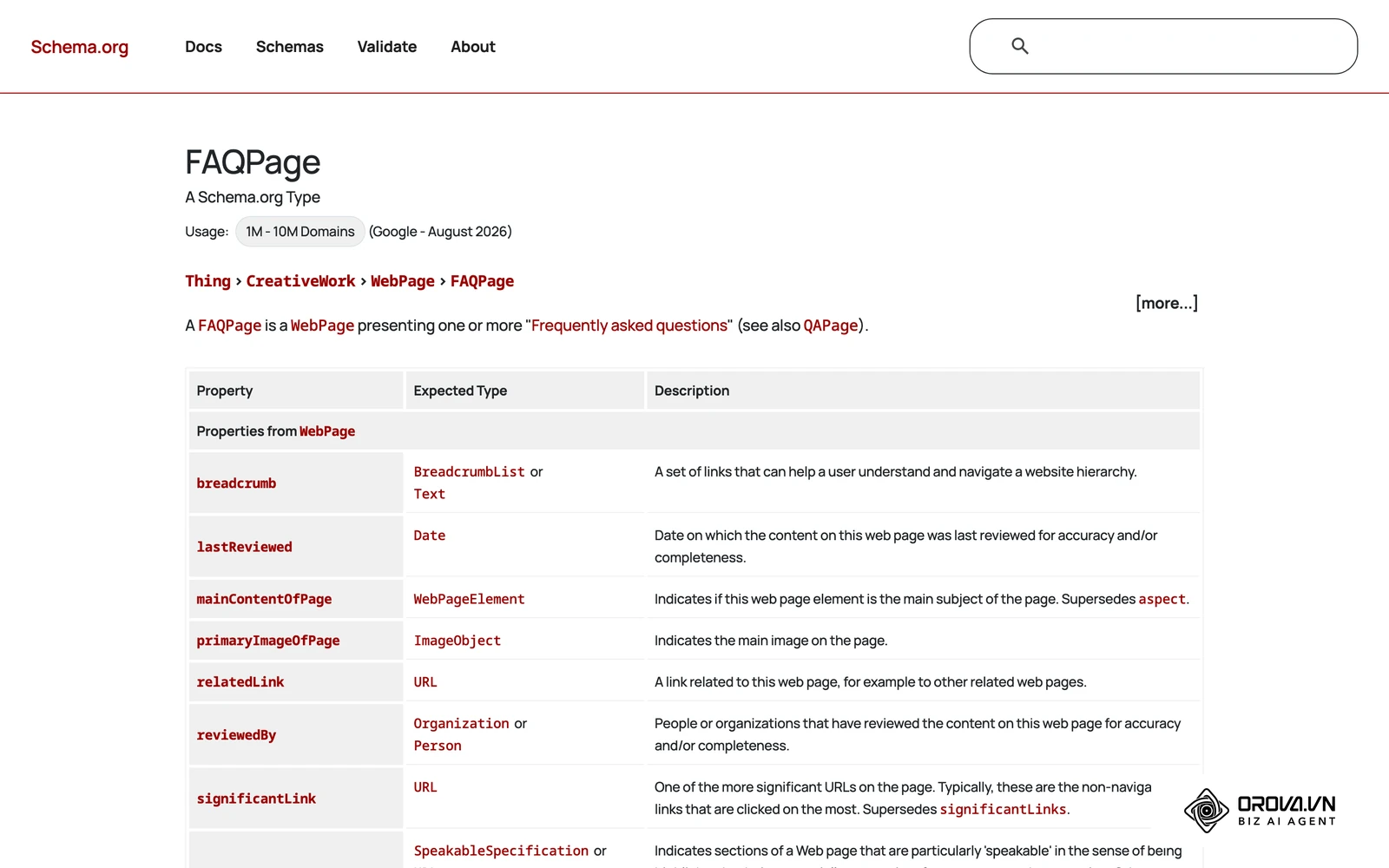
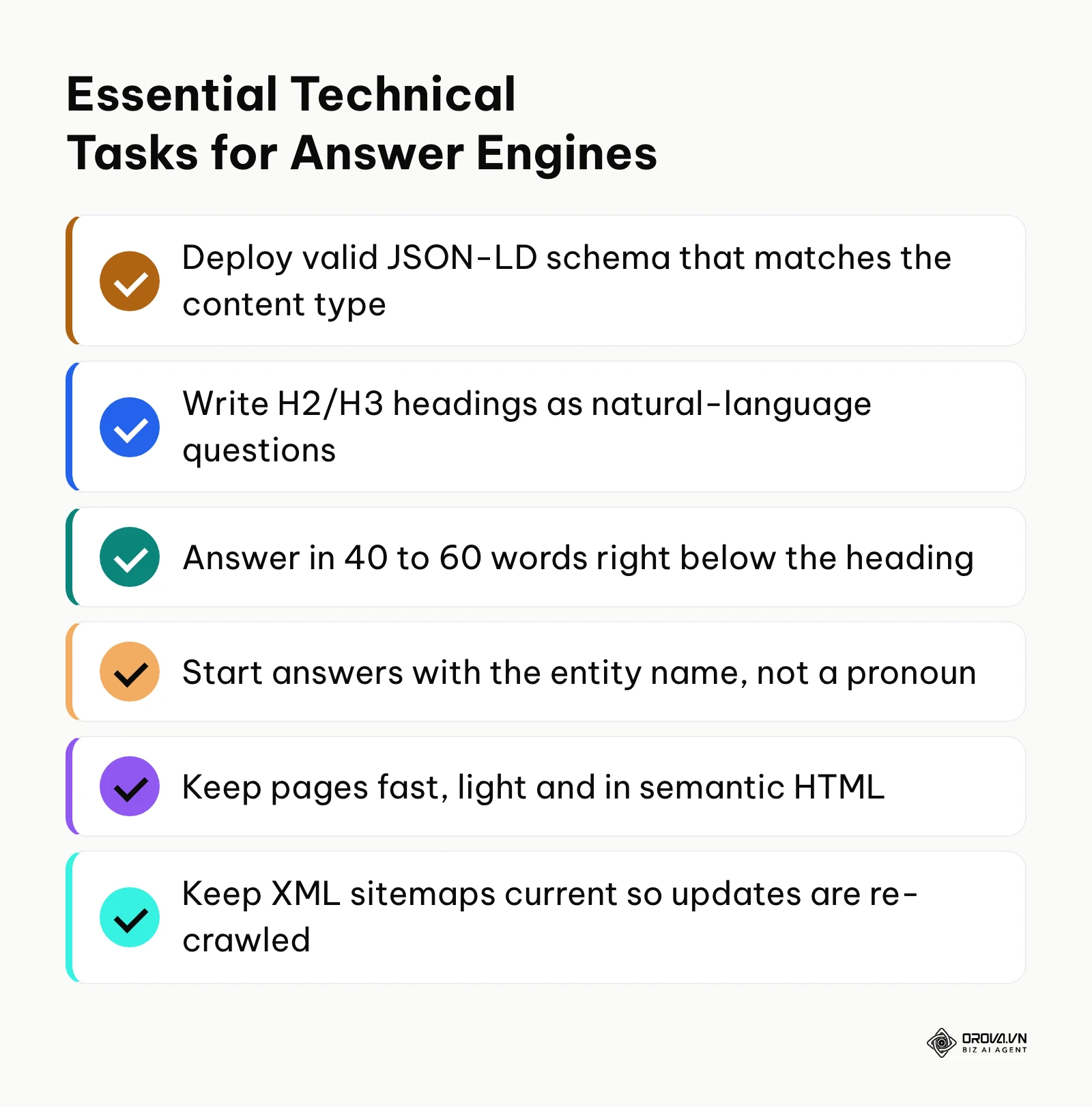
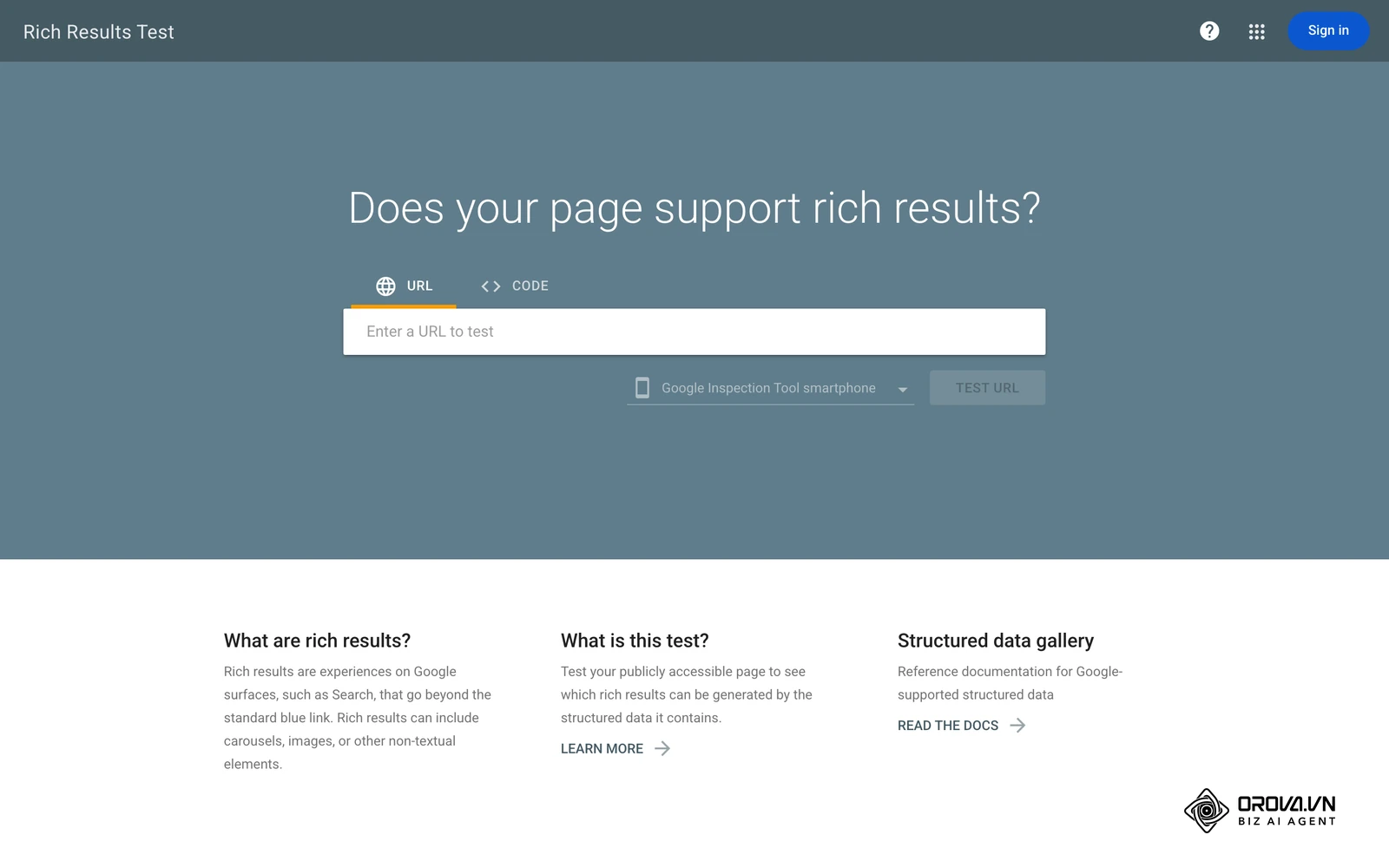
- Deploy JSON-LD Schema Markup: Implement schemas that match the content type (Article, FAQPage, Product, Organization). Validate the code using official testing tools. Note that Google now shows FAQ rich results only for a limited set of authoritative sites and no longer shows HowTo rich results, so treat this markup as a way to describe your page clearly, not as a guaranteed visual feature.
- Optimize Core Web Vitals: Keep pages fast and light. Slow, script-heavy pages are harder for crawlers to fetch and render reliably.
- Semantic HTML5 Structure: Ensure that <header>, <main>, <article>, and <footer> tags are used correctly. Avoid using <div> tags for elements that have semantic meaning.
- Fresh Sitemaps: Keep your XML sitemap current with accurate last-modified dates, and use IndexNow for search engines that support it, so updated answers are re-crawled sooner.
For the SEO and Content Team:
- Question-Based Headings: Format your <h2> and <h3> tags as complete, natural-language questions (e.g., "How much does a commercial roof replacement cost?").
- The 60-Word Rule: Immediately below the heading, provide a direct, unambiguous answer in 40 to 60 words. This block is specifically designed for the AI to extract.
- Eliminate Ambiguous Pronouns: In the direct answer block, never start with "It is..." or "They are...". Start with the exact entity name: "A commercial roof replacement is...".
- Utilize Bulleted and Numbered Lists: Machines parse lists easily. Whenever explaining a process or listing features, use standard <ul> or <ol> formatting.
For a deeper dive into evaluating your site's technical health, refer to a comprehensive google seo optimization tool guide to ensure your infrastructure supports these efforts.
How to audit your pages with AI tools: a prompt library
You do not necessarily need expensive enterprise software to check if your content is optimized. You can use standard AI models like ChatGPT or Claude to self-audit your pages. Below is a library of prompts you can use to test your answer engine optimization efforts.
Prompt 1: Entity Extraction Audit Purpose: To see if the AI can identify the core subjects of your article.
"Act as a search engine crawler. Read the text provided below. List the top 5 most important entities (people, places, concepts, products) you found in this text. For each entity, explain its relationship to the main topic in one sentence based strictly on the text provided. If a relationship is unclear, state 'ambiguous'."
Prompt 2: Conversational Tone Evaluation Purpose: To check if your direct answers are concise enough for extraction.
"Review the following section of text. I intend for this to be a direct answer to the query '[Insert Query Here]'. Evaluate this text based on brevity, clarity, and the absence of marketing fluff. Rewrite the text to be under 50 words, starting directly with the subject noun, making it optimal for an AI voice assistant to read aloud."
Prompt 3: Information Gap Analysis Purpose: To identify missing context that a user might ask a chatbot about.
"Analyze the following article about '[Insert Topic]'. Identify 3 logical follow-up questions a user would likely ask after reading this information. Then, point out where in the text these follow-up questions are answered. If they are not answered, explain what specific data is missing."
By feeding your drafted content into an AI with these prompts, you instantly see how a machine interprets your writing. If the AI struggles to extract entities or suggests massive rewrites for brevity, your answer engine optimization needs more work.
| Types of Answer Engine Optimization | Key Characteristics | Best Suited For |
|---|---|---|
| Informational / FAQ Optimization | High volume of structured Q&A, broad entity definitions, strong reliance on FAQPage schema. | SaaS companies, healthcare providers, educational institutions. |
| Transactional / Product Optimization | Deep technical specifications, comparative data, strong reliance on Product and Review schema. | E-commerce brands, software vendors, local service providers. |
| Navigational / Brand Optimization | Establishing clear corporate entities, leadership profiles, strong Organization and Person schema. | Large enterprises, public figures, franchise businesses. |
How to adapt and implement AEO strategies in 2026
To adapt and implement answer engine optimization strategies successfully as of 2026, organizations must shift their focus from keyword density to conversational intent, requiring tight coordination between technical developers and content creators. The starting point involves auditing existing assets to identify gaps in entity clarity and structured data.
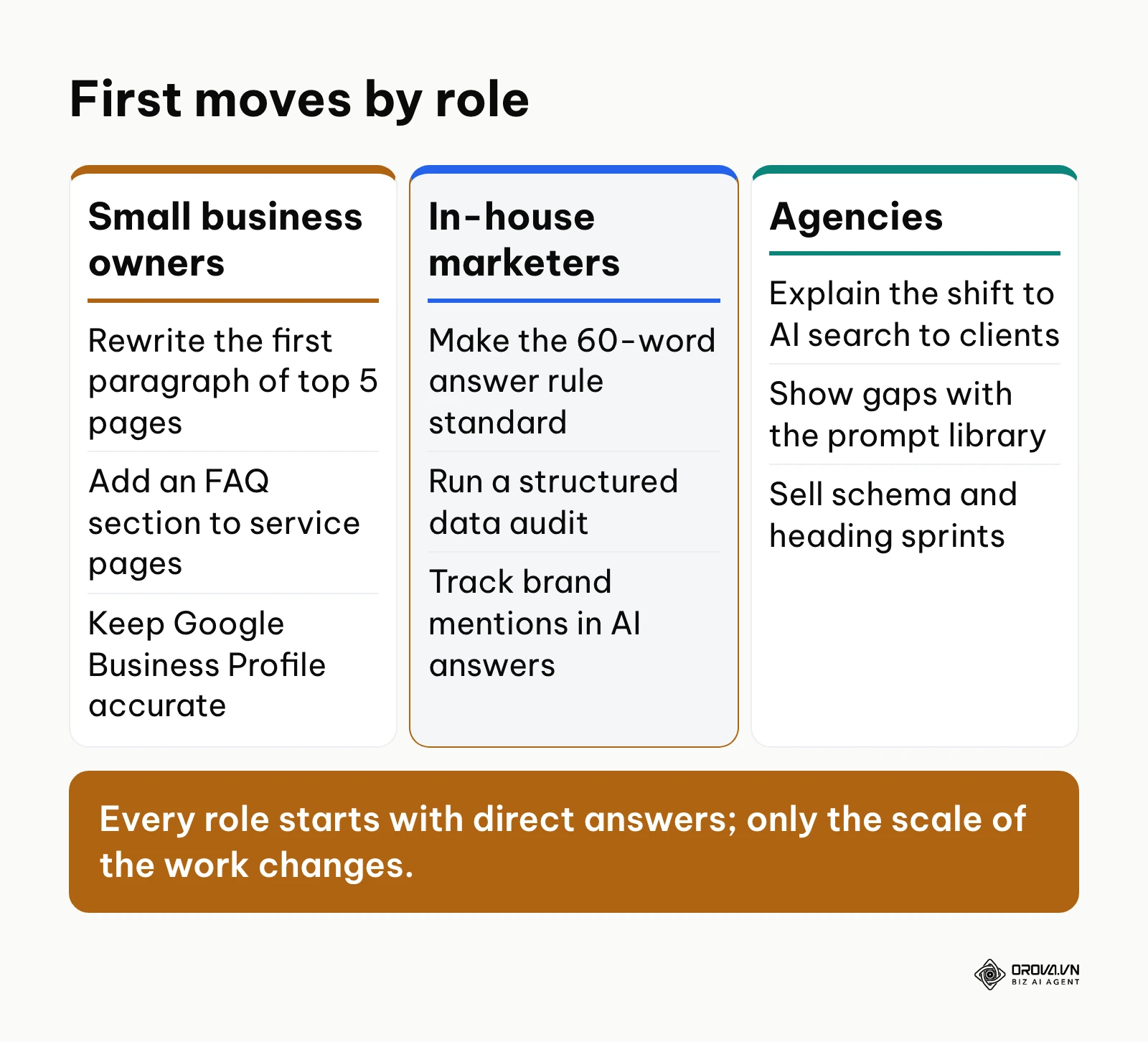
Different roles face unique challenges when adopting these strategies. Here is how various stakeholders should approach the implementation process this week.
For Small Business Owners
As a business owner, you cannot afford to waste time on complex technical overhauls without seeing a return. Your focus should be on practical, high-impact changes.
- Audit your top 5 pages: Identify the five pages on your site that drive the most revenue. Read the first paragraph of each. Does it directly answer a specific question? If not, rewrite it today.
- Implement an FAQ section: Add a dedicated, well-structured Frequently Asked Questions section to your main service pages.
- Claim your entities: Ensure your Google Business Profile and other local citations are hyper-accurate. AI systems can draw on these listings when they verify basic business information.
For In-House Marketing Leaders
Marketing leaders must manage the bridge between content writers and web developers, ensuring both teams are aligned on answer engine optimization goals.
- Update editorial guidelines: Mandate the "60-word direct answer" rule for all new blog posts and landing pages.
- Conduct a schema audit: Task your development team with running your site through a structured data testing tool to identify and fix missing or broken schema tags.
- Monitor AI visibility: Begin tracking how often your brand is mentioned in AI-generated answers, moving beyond standard rank tracking metrics. A practical starting point is this guide to AI visibility tracking.
For Agencies and Freelance Consultants
Agencies must prove the value of this new approach to clients who are still fixated on traditional blue-link rankings.
- Educate your clients: Create a presentation explaining the shift toward AI search and the concept of zero-click optimization.
- Perform gap analysis: Use the prompt library provided above to show clients exactly how AI models currently misunderstand their content.
- Offer structured data sprints: Package schema implementation and H2 restructuring as a distinct, fast-turnaround service to show quick wins.
Illustrative example: A local corporate law firm decided to adapt to conversational search by addressing common legal queries regarding business incorporation. They assigned a junior associate to write long, narrative articles about contract law. The hurdle was that these narratives lacked clear structure, causing AI engines to bypass them for more concise competitor pages. To fix this, the lead partner stepped in, breaking the content down into distinct question-based headings with bulleted summary lists at the top of each page. The visible outcome was their website being cited as a primary source when users queried local contract dispute procedures on AI chatbots.
| Common Mistake | Consequence | How to Avoid It |
|---|---|---|
| Burying the answer | The AI abandons parsing and selects a competitor. | Place the direct answer immediately below the heading. |
| Overusing jargon | The machine misinterprets the semantic meaning. | Use plain, eighth-grade level language for core definitions. |
| Ignoring page speed | Crawlers time out and fail to index the structured data. | Compress images and minimize heavy JavaScript execution. |
With OROVA.VN and the OROVA SEO module, you put an end to the exhausting days of manual work for good. Instead of struggling for hours to write articles and compile reports, the entire process is now optimized and completed in just 5 minutes.
Answer engine optimization trends in the next few years: Author's perspective
As we look toward the future of search, the landscape is shifting rapidly. Based on the current trajectory of artificial intelligence and user behavior, I believe several profound changes will redefine answer engine optimization over the next few years. While no prediction is absolute, these trends represent the most likely path forward.
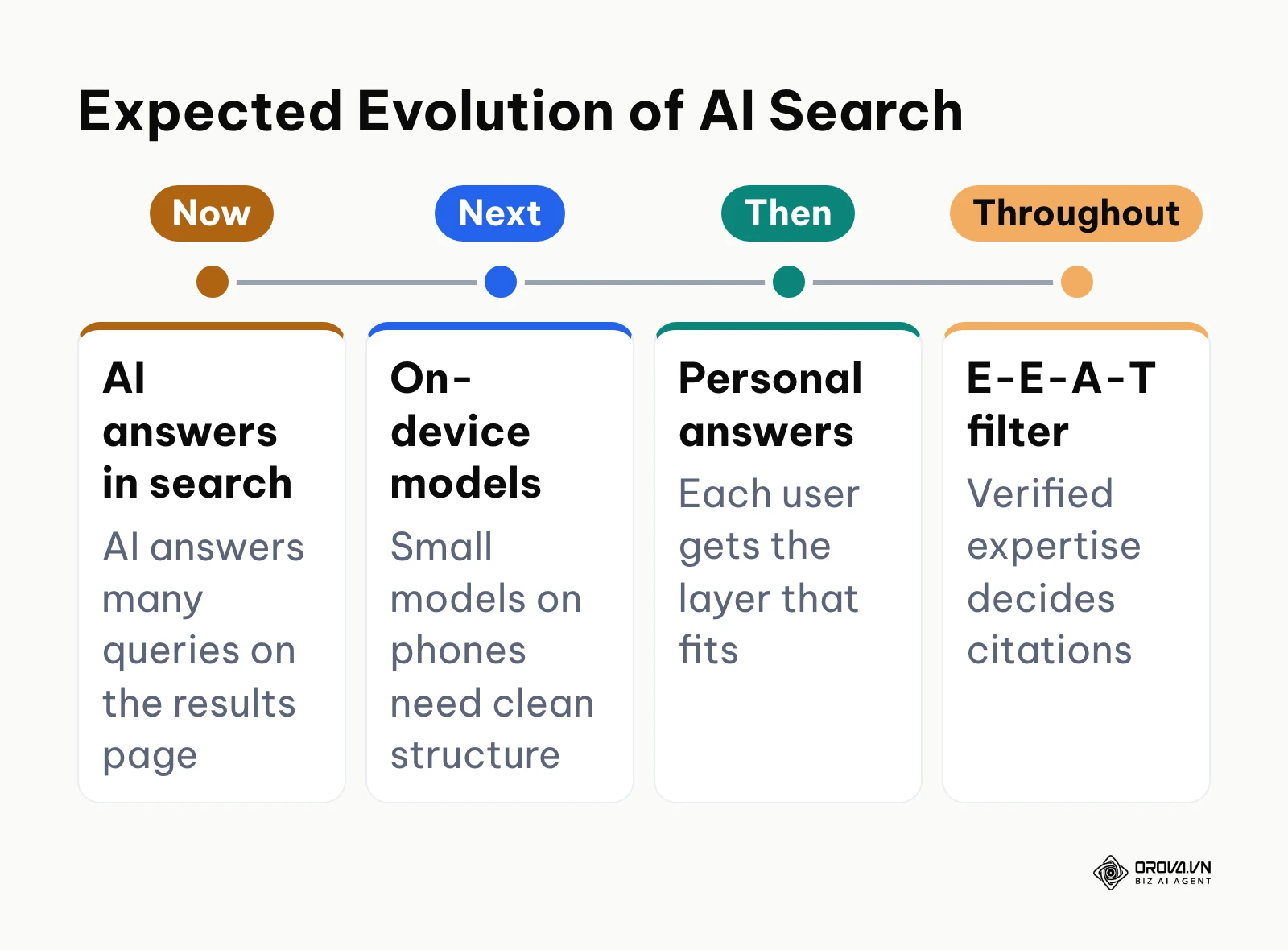
Small Language Models (SLMs) will decentralize search
As of 2026, we are already seeing the limitations of massive, cloud-based language models, specifically regarding cost and latency. I believe search will become more decentralized. Users will rely on Small Language Models (SLMs) running directly on their personal devices (smartphones, laptops) to parse information and generate answers. Because these on-device models will have less computing power than cloud behemoths, they will require content to be structured even more efficiently. Marketers should prepare now by ensuring their HTML is perfectly semantic and their schemas are flawless, as SLMs will struggle to comprehend messy, unstructured code. This prediction could be delayed if battery technology fails to support heavy on-device processing.
Hyper-personalized answers based on user context
Currently, AI search provides generally similar answers to different users asking the same question. I anticipate that answer engines will soon integrate deeply with a user's personal context—their location, purchase history, and technical proficiency. If a software engineer and a novice user both ask an AI "What is answer engine optimization?", the engine will instantly deliver a deeply technical response to the engineer and a simplified analogy to the novice. To prepare, content creators must build multi-layered content, offering both high-level summaries and deep technical specifications on the same page, allowing the AI to extract the appropriate layer.
E-E-A-T will become the ultimate currency for AI selection
Google added "Experience" to its Search Quality Rater Guidelines in December 2022, turning E-A-T into E-E-A-T. I strongly believe that as AI models become flooded with synthetic, machine-generated content, they will desperately seek out verified human expertise. Experience, Expertise, Authoritativeness, and Trustworthiness (E-E-A-T) will be the primary filters answer engines use to select sources. You must prepare by explicitly stating the credentials of your authors, securing high-quality digital PR, and embedding unique, original data that AI cannot hallucinate. If search algorithms fail to accurately distinguish between human and synthetic content, this trend could shift toward purely engagement-based metrics.
Frequently asked questions about answer engine optimization
Frequently asked questions about answer engine optimization typically revolve around its long-term viability, practical measurement techniques, and its relationship with traditional search practices. Below are detailed answers to the most common concerns shared by industry professionals.
Is answer engine optimization still needed with AI taking over?
Yes, it is more necessary than ever. Artificial intelligence does not generate facts out of thin air; it aggregates and synthesizes information from the internet. If you want the AI to synthesize your information, recommend your products, or cite your brand, you must structure your data so the AI can easily digest it. Ignoring this process means surrendering your digital visibility to competitors who are actively feeding the machines structured data.
How do you measure the ROI of answer engine optimization?
Measuring return on investment in an AI-first landscape requires a shift in analytics. Instead of solely looking at organic click-through rates, you must monitor your brand's impression share within AI-generated overviews. Additionally, tracking direct referral traffic from specific AI chatbot platforms (like ChatGPT or Claude) provides clear evidence of visibility. Utilizing advanced search engine rank monitoring tools that specifically track generative search features is essential to prove the value of your efforts.
Which content types or industries should prioritize this strategy?
Industries dealing with complex, informational queries should prioritize this immediately. Healthcare, financial services, B2B software, and legal consulting are prime candidates because users frequently ask highly specific, multi-layered questions in these fields. Content types that benefit the most include deep-dive tutorials, glossary definitions, troubleshooting guides, and direct comparison articles.
In the debate of SEO vs AEO, which one should a new website focus on?
A new website should not treat them as mutually exclusive; rather, one is an evolution of the other. Traditional SEO builds the necessary foundation—site speed, mobile responsiveness, and basic crawlability. Answer engine optimization builds upon that foundation by refining the semantic structure and formatting the content for machine extraction. A new site must secure its technical SEO basics first, but all new content should be written following the strict entity and conversational guidelines of AEO.
How do you optimize for answer engines on a tight budget?
You do not need an enterprise budget to start. The most cost-effective method is to focus entirely on content formatting. Review your top-performing blog posts and manually rewrite the headings into natural questions. Then, rewrite the first paragraph under each heading into a concise, 50-word direct answer. Adding basic FAQ markup and keeping your Google Business Profile fully updated are also low-cost tactics.
Where to start with your answer engine optimization journey?
To start your answer engine optimization journey effectively, you must first honestly assess your current technical baseline and content maturity. The initial step always depends on whether you are building from scratch, fixing fragmented efforts, or trying to measure an existing campaign accurately.
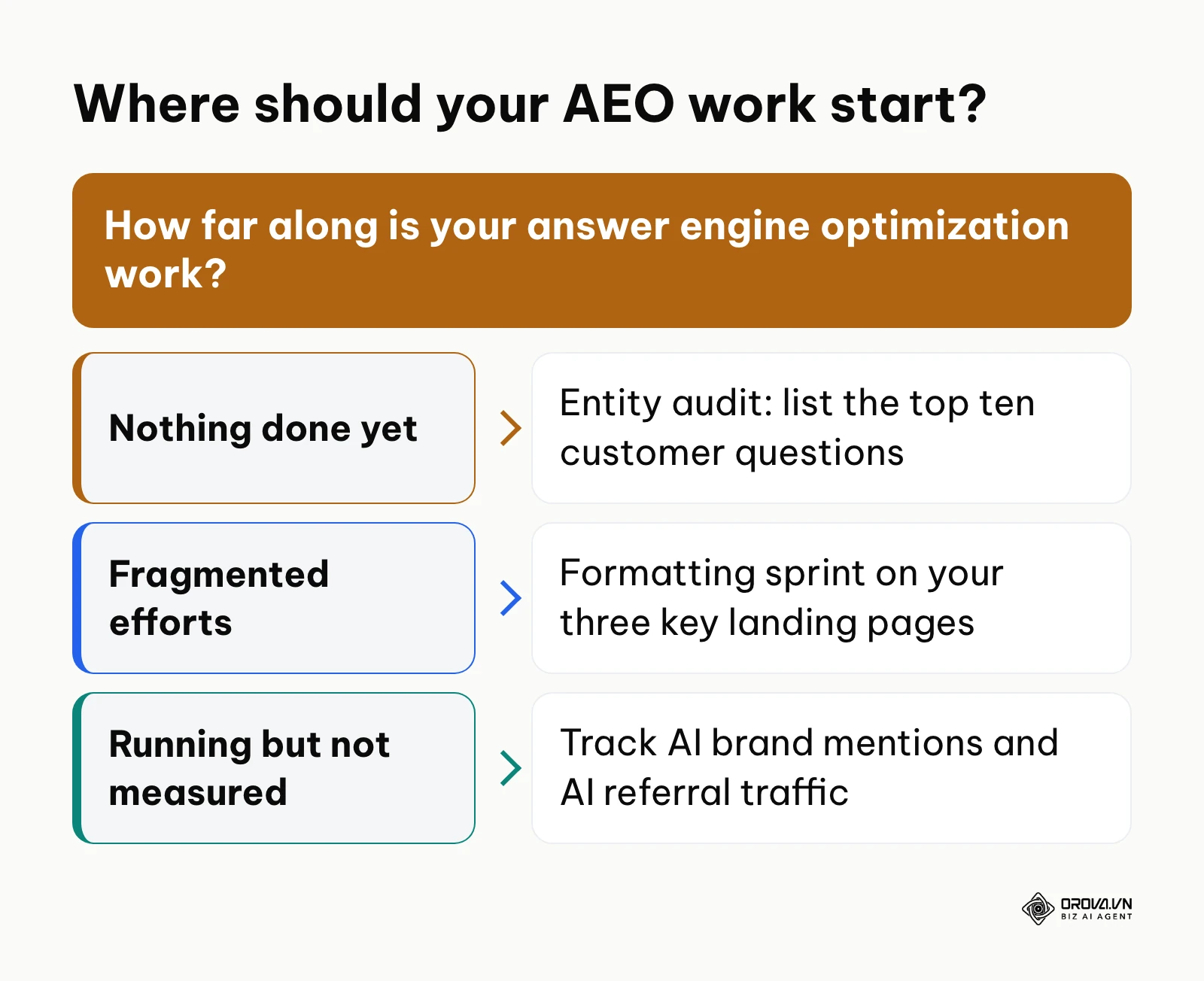
If you have done nothing yet, your very first step is to conduct an entity audit. Spend one afternoon listing the top ten questions your customers ask during a sales call or support ticket. Then, review your website to see if those exact questions appear as H2 headings on your site, followed by clear, concise answers. If they do not, you have found your starting point.
If you have fragmented efforts—perhaps you have some schema markup but your content is still dense and academic—your immediate step is a formatting sprint. Choose your three most important landing pages and rewrite the introductory paragraphs to strictly adhere to the 60-word direct answer rule. Remove all ambiguous pronouns from the opening sentences.
If you are already executing these strategies but are not measuring them, your first step is to update your analytics dashboard. Configure your tracking software to specifically monitor brand mentions and referral traffic originating from known AI domains. You cannot optimize what you do not accurately measure.
Embracing answer engine optimization will ensure your brand remains the authoritative voice in your industry for years to come.
About the author

Builder of Orova
Nguyễn Đỗ Trọng Ân has 8 years of experience in marketing, including 6 years managing market development across Asia. He builds Orova, a Biz AI Agent that never sleeps: it plans, runs and optimizes work for businesses.
Run your business with AI Agents
Orova is the always-on Biz AI Agent — it plans, runs, and optimizes the work for you.
Save time, unlock productivity.