
What is generative engine optimization? A practical guide

Generative engine optimization (GEO) is the practice of shaping your content so that AI search tools such as ChatGPT, Perplexity and Google AI Overviews can understand it, pull facts from it and cite it in the answers they write. Picture this: your organic traffic dips, yet your keyword rankings have not moved. So, where did the users go?
Search behavior is changing. Many users no longer scroll through a list of blue links to find answers; they ask AI assistants directly and receive a synthesized response. If your content is not cited as a source of those answers, your brand is invisible in that moment. That is the gap generative engine optimization is meant to close. By adapting how we structure and present information, we can ensure that our hard-earned content remains discoverable, authoritative, and frequently referenced by the next generation of intelligent search tools.
What is generative engine optimization?
Generative engine optimization is the practice of formatting and structuring web content so that artificial intelligence search engines and chatbots can easily understand, extract, and cite it as a source in their generated answers. It serves to secure brand visibility in AI-driven interfaces. It differs from traditional search engine optimization by prioritizing direct fact retrieval over link building.
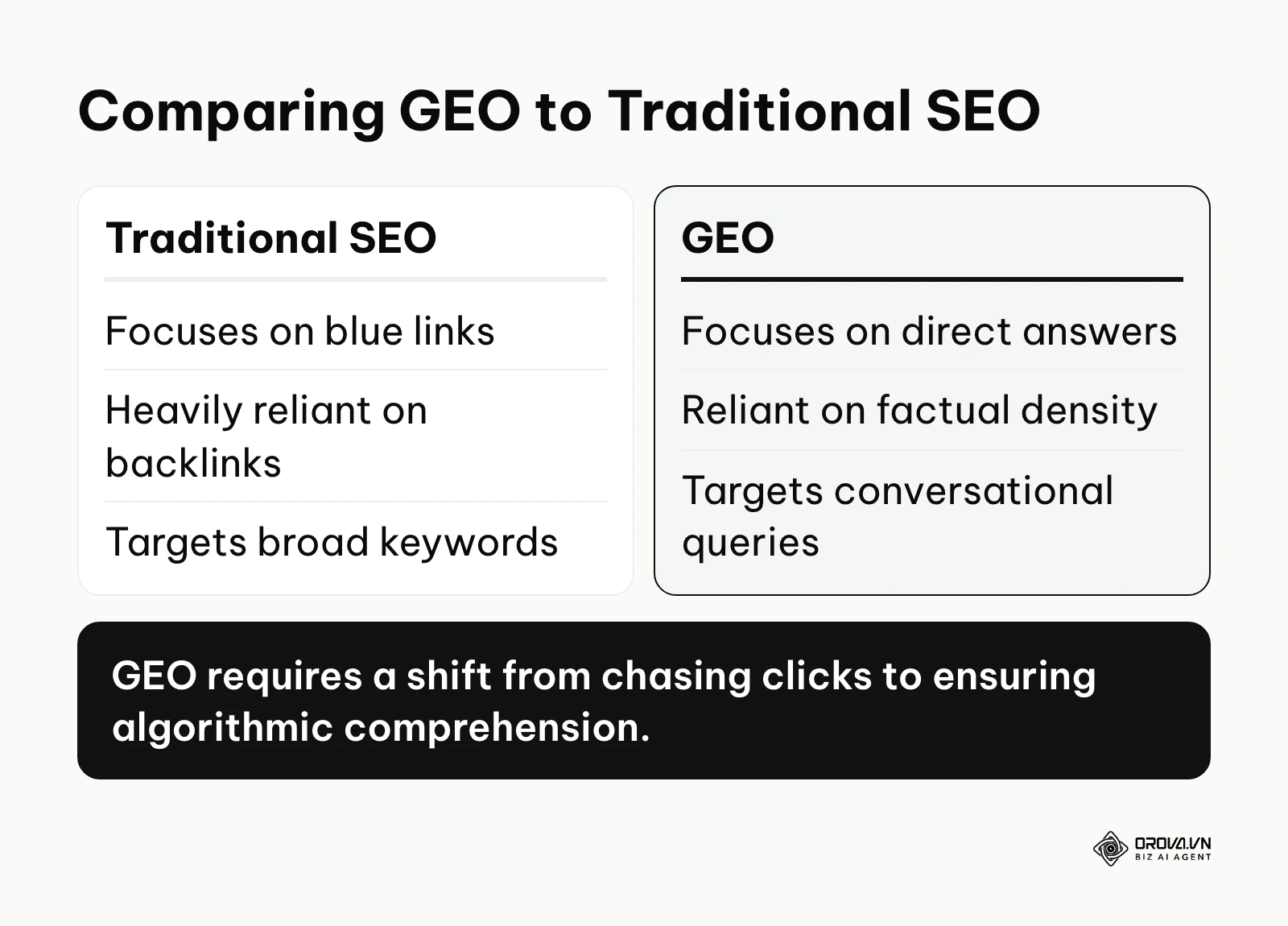
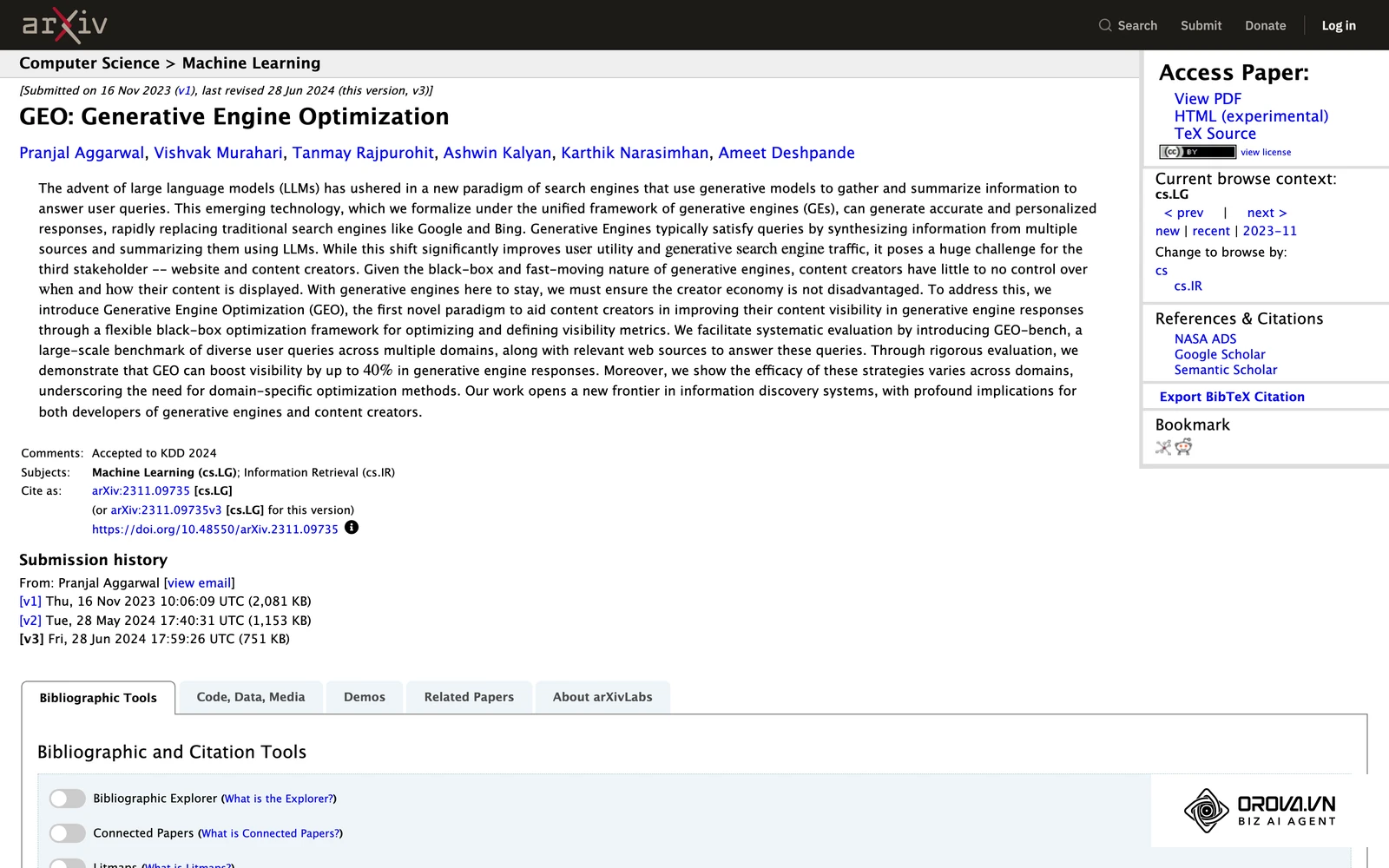
Historically, this concept evolved as large language models began to browse the live web to work around their knowledge cutoff dates. Marketers quickly realized that simply ranking high was insufficient if the AI could not confidently parse the underlying text. The term itself was popularized by the 2023 research paper "GEO: Generative Engine Optimization" from researchers at Princeton University and partner institutions, which found that adding citations, quotations from relevant sources and statistics to a page made it more visible in generative engine answers. It is crucial to distinguish this practice from other common industry terms to avoid strategic misalignment and ensure you are executing the right tactics for the right goals.
| Concept | How it differs | Practical Example |
|---|---|---|
| Generative Engine Optimization | Focuses on formatting content for AI extraction and direct citation in AI-generated answers that blend several sources. | Adding a clear table so an AI answer engine can quote your exact pricing data in its response. |
| Answer Engine Optimization (AEO) | A close cousin focused on getting one page chosen as the single direct answer in featured snippets, voice assistants and answer boxes. | Placing a 40-word answer directly under a question-style heading. |
| Traditional SEO | Focuses on ranking a specific URL in traditional search engine results pages to generate direct clicks. | Building authoritative backlinks to push a landing page from position four to position one on a Google search. |
| LLM Training | The backend engineering process of feeding massive datasets into a neural network to teach it language patterns. | An AI lab training a new model on large collections of public text, long before any user asks a question. |
In practice the three optimization disciplines overlap heavily, which is why many teams now plan them together, as explained in this guide to unifying SEO, AEO and GEO.
For a real-life example, consider a user asking an AI assistant for the baggage allowance of a specific airline. If the airline's website buries this information inside a dense, legally worded paragraph, the AI might struggle to extract a confident answer and instead cite a third-party travel blog. However, if the airline presents a clear, bulleted list detailing exact weight limits for economy and business class, the AI can instantly grab those facts and cite the airline directly. This delivers immediate value to the user while reinforcing the brand's authority as the primary source of truth.
Why Generative Engine Optimization Matters
Generative engine optimization exists to solve a massive visibility problem for modern businesses: the rise of zero-click searches that have evolved into comprehensive AI answers. When a user asks a complex question, they no longer want to open five different tabs, read through lengthy introductions, and synthesize the information themselves. They want an intelligent assistant to do the heavy lifting. By optimizing your content for generative engines, you are ensuring that your brand is the entity providing the raw material for those automated answers.
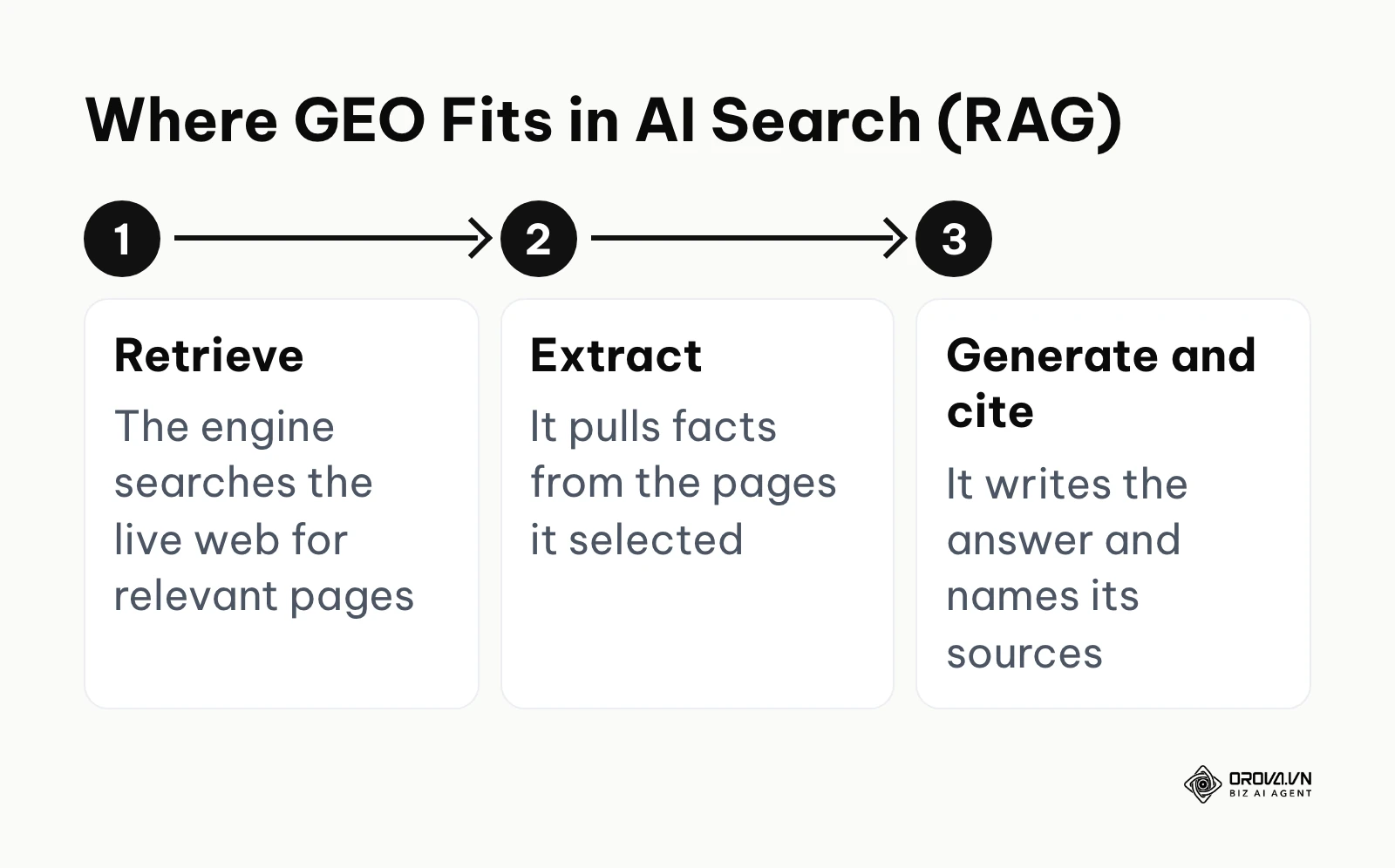
To understand where GEO fits into the big picture, you must understand the concept of Retrieval-Augmented Generation (RAG). Modern AI search engines do not just rely on their pre-trained memory to answer questions; they actively search the live web, retrieve relevant documents, and augment their generation process with those fresh facts. Traditional SEO gets your document into the retrieval pool, but GEO ensures that the AI actually selects your document, extracts the facts correctly, and displays your brand name as a trusted citation. Traditional SEO is the prerequisite; generative engine optimization is the final mile of conversion.
If you choose to ignore this shift, your business risks losing its digital footprint entirely. You might maintain high rankings for a while, but as user interfaces shift away from standard browsers and toward voice assistants, conversational interfaces, and integrated AI overlays, your traffic will slowly erode. You will lose the crucial top-of-funnel awareness that introduces new customers to your brand, as competitors who have structured their data for AI will monopolize the conversation.
When you don't need generative engine optimization yet: If you run a hyper-local business like a neighborhood cafe relying strictly on map directions, AI citations won't drive immediate foot traffic. Similarly, highly subjective personal blogs or op-ed portals focused purely on storytelling do not require structured data extraction, as they are not trying to provide factual answers. Finally, if your legacy website currently lacks basic mobile responsiveness or secure hosting, you should prioritize foundational technical health before attempting to influence sophisticated language models.
The Business Value and Creator Benefits of GEO
The value of generative engine optimization operates on two distinct layers. For the business at large, it is fundamentally an exercise in revenue protection and risk mitigation. As search traffic diversifies across multiple AI platforms, relying solely on one search engine's algorithm becomes a massive vulnerability. GEO protects your "share of voice" across conversational interfaces and, over time, can lower customer acquisition costs when your brand is regularly recommended as a credible solution.
For the individuals directly doing the work, adapting to these new standards brings immediate clarity and efficiency to their daily workflows.
Content Writers and Editors
Before the AI era, content writers were often forced into awkward practices like keyword stuffing, artificially inflating word counts, and writing lengthy, repetitive introductions just to appease older algorithms. The goal was to write for a machine that only understood keyword density. After adopting SEO content writing practices tailored for generative engines, writers can focus on clear, semantic structuring. The mandate is to be concise, factual, and highly structured, which ironically makes the writing process faster and the final product much more enjoyable for human readers as well.
SEO Strategists and Technical Leads
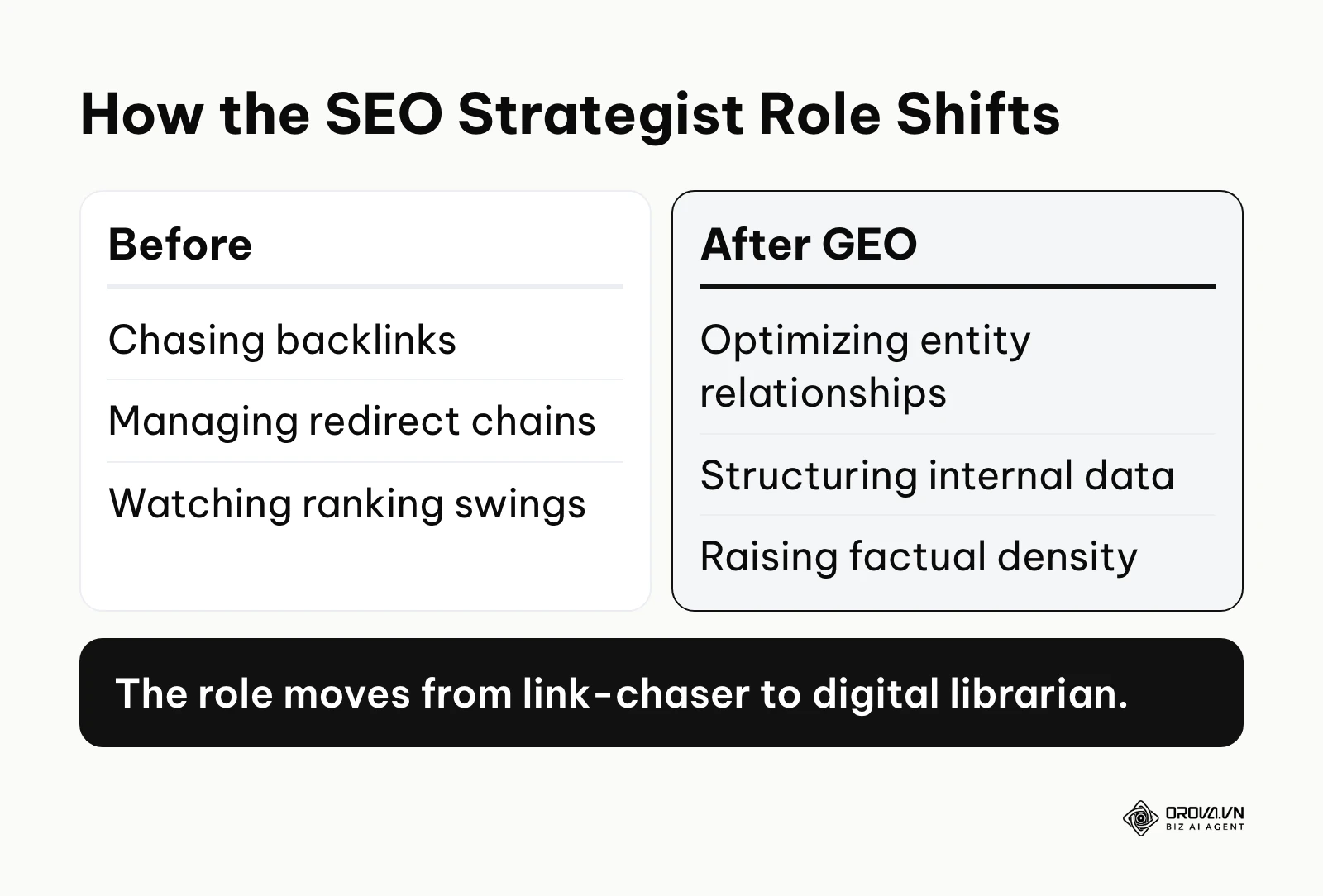
Before, SEO strategists spent the majority of their time chasing low-quality backlinks, managing complex redirect chains, and obsessing over minor fluctuations in keyword ranking positions. It was a highly reactive job focused on external signals. After pivoting to generative optimization, strategists focus on optimizing entity relationships, structuring internal data architectures, and ensuring that the factual density of the website is high. This shifts the role from a link-chaser to a true digital librarian, controlling how the brand's knowledge is categorized and understood by the wider web.
Data Analysts and Growth Marketers
Before the shift, analysts simply tracked total sessions, bounce rates, and direct clicks from a single dominant search engine. The attribution model was relatively linear. After the rise of conversational search, tracking becomes far more sophisticated. Analysts are now tasked with tracking brand mentions inside AI platforms, monitoring citation frequency, and finding creative ways to isolate AI bot traffic from human traffic in server logs. It elevates the analyst's role to discovering entirely new audience segments that were previously hidden in the dark metrics of zero-click interactions.
| Core Benefit | Measured By Which Metric |
|---|---|
| Increased AI Citation Frequency | Number of brand mentions in target AI platforms |
| Improved Factual Accuracy | Fewer wrong facts about your brand in AI answers |
| Higher Engagement on Page | Time on page and engagement rate (due to clear structure) |
Discover Orova.vn – a Biz AI Agent platform with OROVA SEO, a complete solution for every website. The system supports search engine optimization from A to Z with features including keyword research, writing new SEO-ready articles, optimizing existing content, rank tracking, plus competitor analysis and in-depth technical analysis. Sign up today to experience OROVA SEO completely free (offer valid through July 7, 2027).
How Generative Engine Optimization Works (The Anatomy)
Understanding how to optimize for AI requires breaking down the exact process these machines use to find, read, and utilize your content. Unlike a human reader who might skim a page visually, an AI system works from the underlying text, identifies entities and weighs how clearly each claim is stated. The exact internals differ by platform and are not published, so treat the three phases below as a simplified working model rather than a specification.
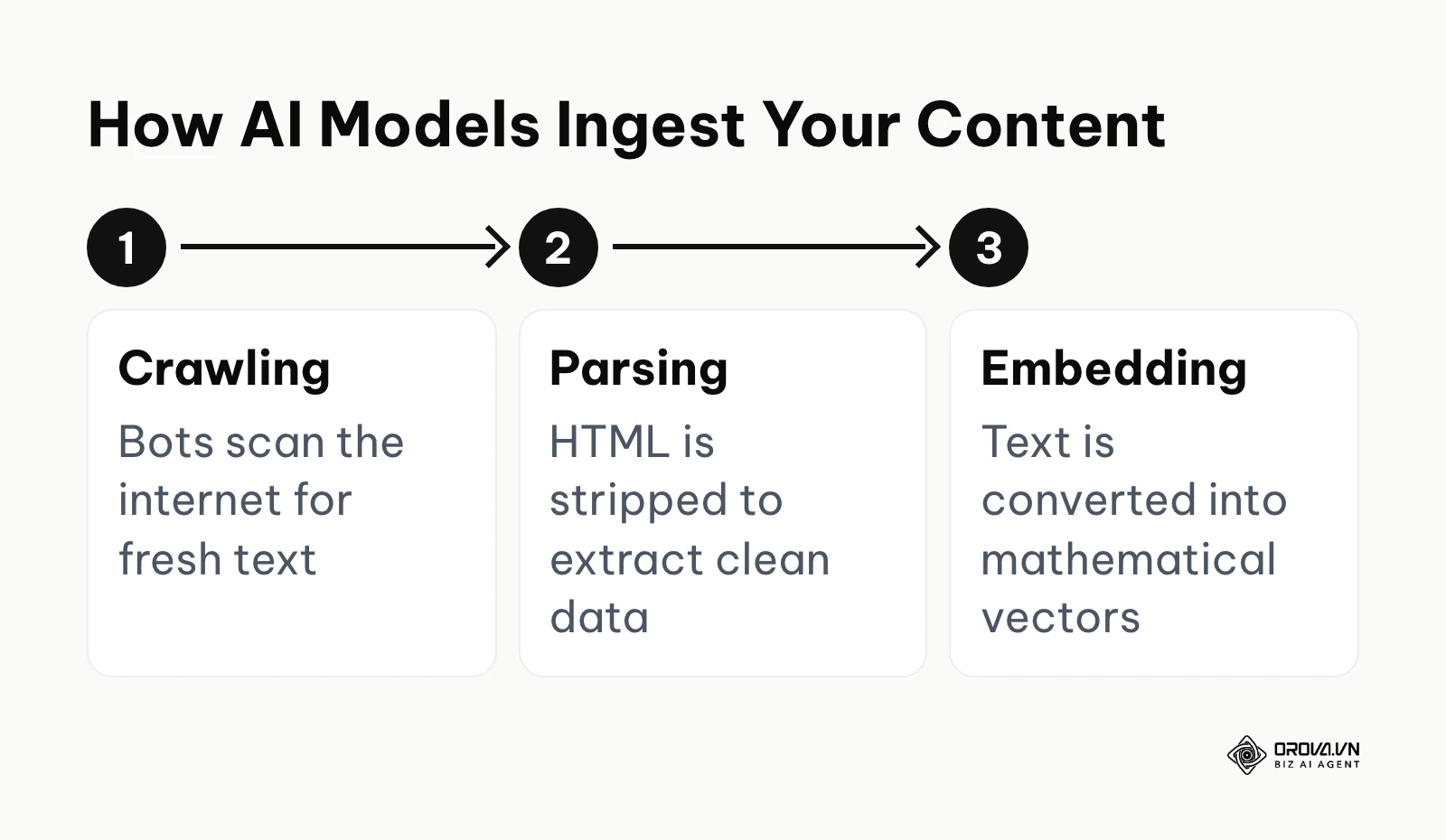
The Content Ingestion Phase
What it does: This is the foundational step where an AI engine's crawler visits your website and attempts to read the raw material. It must strip away all the visual styling, javascript elements, and heavy advertisements to reach the core text. Input: Your website's raw HTML, XML sitemaps, and server response codes. Output: A clean, text-only version of your document that is ready to be embedded into mathematical vectors for the AI to process. Failure point: If your main content only appears after client-side JavaScript runs, crawlers that do not execute JavaScript may see little or nothing; server-side rendering or static HTML is the safer choice. Similarly, if key content only loads after a click or sits behind pop-ups, ingestion can fail, and the AI will use a cleaner competitor instead. Understanding technical SEO is crucial to ensuring this phase runs smoothly without server timeouts.
The Fact Extraction and Validation Phase
What it does: Once the text is ingested, the AI breaks down the sentences to identify entities (people, places, concepts), statistics, and core claims. It then cross-references these claims against its existing training data and other documents it has retrieved to validate their accuracy and reliability. Input: The clean text document, specifically looking for structured elements like tables, bolded terms, and bulleted lists. Output: A structured graph of facts and relationships extracted from your page, assigned a confidence score based on the clarity of your writing and the authority of your domain. Failure point: Using vague language, failing to define acronyms, or presenting contradictory data points on the same page will cause the AI's confidence score to plummet, leading it to discard your document as a reliable source.
Illustrative example: A mid-sized B2B software company publishes an annual benchmark report full of original industry data, yet AI answer engines rarely cite it. A sensible fix is to audit the long report, convert dense text blocks into clear tables, and define every industry acronym the first time it appears. If the page is also slow and heavy, compressing large header images and caching static assets removes another reason for a crawler to give up. None of this guarantees a citation, but it removes the most common reasons a strong report gets skipped.
The Answer Generation and Citation Phase
What it does: When a user submits a prompt, the AI synthesizes an answer using the highest-confidence facts it extracted. It then generates citations, linking back to the documents that provided those specific facts, ensuring the user can verify the information. Input: The validated facts from the previous phase, combined with the context of the user's specific prompt. Output: A natural language response displayed to the user, complete with clickable reference links or footnote numbers pointing directly to your optimized content. Failure point: If your content only provides generic background information without answering specific, complex questions, the AI will use your page for context but will ultimately cite a more detailed, specific competitor for the actual answer.
Platform Nuances: ChatGPT vs. Perplexity vs. Google AI Overviews
Not all AI engines evaluate content the same way. Optimizing for a generative engine requires understanding the subtle algorithmic differences between the major players. You cannot treat them as a monolith.
ChatGPT search combines what the model already learned in training with live web results from search partners. In practice, it tends to work well with content that answers "how-to" and "what is" questions directly, without fluff. Because it aims for a conversational tone, it often synthesizes several sources, and a page whose key facts are easy to lift out stands a better chance of being among the cited ones.
Perplexity is built around Retrieval-Augmented Generation and presents itself as an answer engine rather than a conversational partner, showing its sources alongside every answer. It tends to surface fresh data, news articles and well-structured technical documentation, and a newer, lesser-known page can earn a citation when it states exactly the fact the question needs, formatted clearly.
Google AI Overviews (which grew out of the Search Generative Experience experiment) draws on Google's regular search systems and index. Google's own guidance on helpful content stresses E-E-A-T (Experience, Expertise, Authoritativeness, and Trustworthiness), with weight on firsthand experience and clear authorship. Pages that show who wrote them and demonstrate real, hands-on experience fit that guidance, which makes AI Overviews the hardest of the three to influence with purely structural tactics.
| Content Type | Best Suited For | What to Emphasize |
|---|---|---|
| Definitions and explainers | Educational hubs, glossaries | A one-sentence definition near the top, plus clear authorship |
| Specific facts and statistics | Benchmark reports, pricing pages | A dated table that names where each number comes from |
| Step-by-step how-to guides | SaaS tutorials, DIY blogs | Numbered steps with one action per step |
Tracking and Measurement: How to Prove GEO ROI
One of the biggest challenges in the generative era is proving the return on investment when users get their answers without ever clicking your link. Traditional analytics platforms are built around the concept of a session starting with a page view. When dealing with AI, you must look deeper into the server infrastructure and set up advanced filtering.
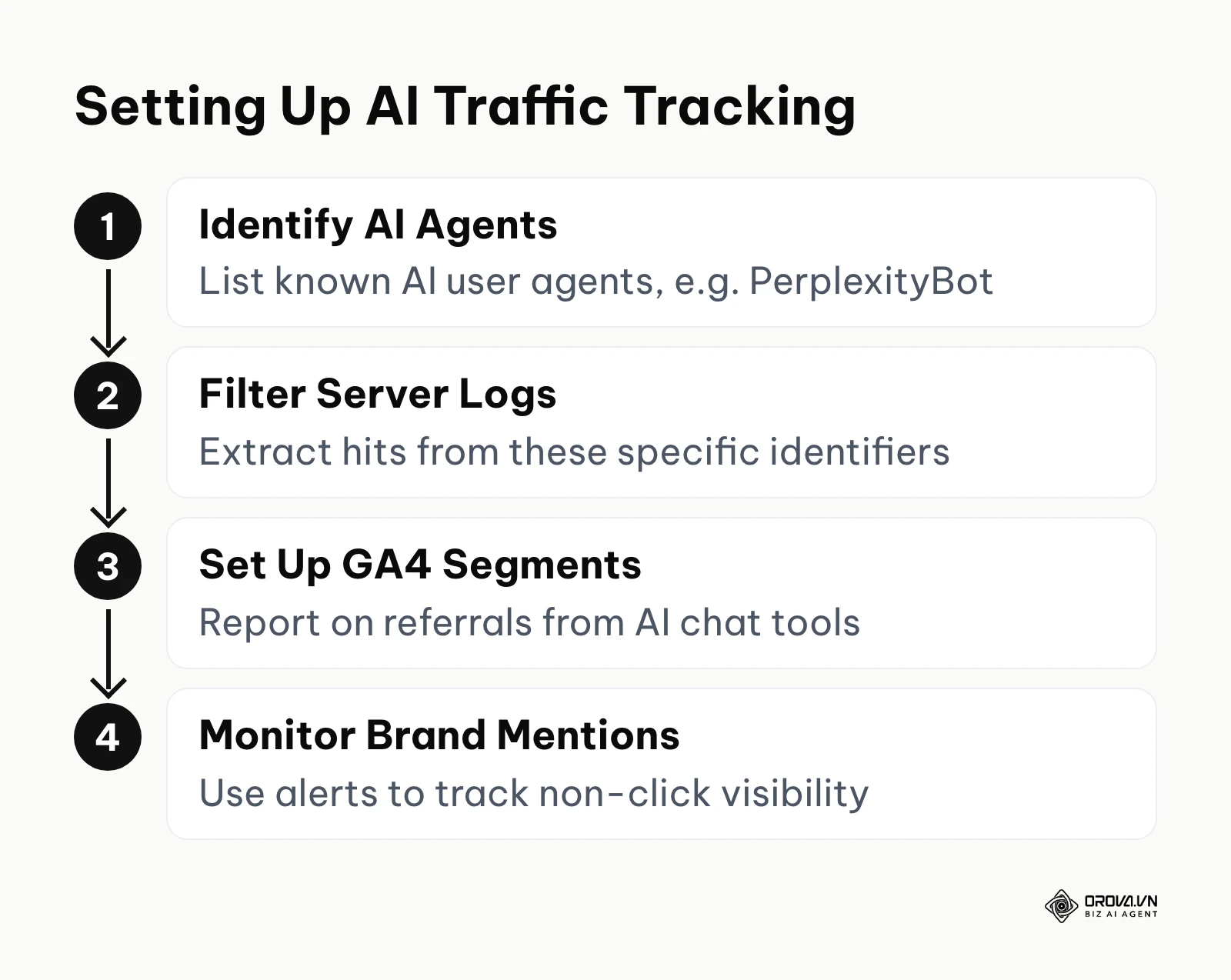
The most reliable method is server log analysis. Every time an AI bot, such as PerplexityBot or ChatGPT-User, accesses your site to retrieve information for an answer, it leaves a record in your server logs. By filtering for these specific user agents, you can see which pages AI tools are fetching and how often.
Additionally, you can set up Google Analytics 4 reports that filter referral sources such as chatgpt.com or perplexity.ai. While this only captures the users who actually click through the citation link, it helps you understand the downstream conversion rate of AI traffic compared to traditional organic traffic. Using Google Search Console in tandem with these custom GA4 reports provides a holistic view of your visibility. Finally, implementing robust brand mention alerts across the web is crucial. If an AI generates an answer recommending your brand, you need to track that as a successful impression, even if it doesn't immediately result in a direct click to your domain.
Illustrative example: An e-commerce analyst at a mid-sized retail brand needs to show leadership whether AI-focused content updates are doing anything while organic clicks stay flat. A workable setup has two parts: a referral report in Google Analytics 4 for visits coming from AI chat tools, and a daily pass over the server logs for AI user agents such as ChatGPT-User and PerplexityBot. Raw logs are too noisy to read by hand, so a short script that keeps only those user agents and feeds a simple dashboard does the heavy lifting. The output is a baseline the team can track month over month instead of a guess.
How to Adapt to the GEO Era
Adapting your strategy requires different tactics depending on your role, your budget, and the current state of your content architecture. Here is how different professionals should approach the transition.
Small Business Owners (Budget-Constrained)
If you are running a small business with limited resources and very few backlinks, you might wonder if you can even compete in the AI space. The answer is often yes, because AI engines can cite a smaller site when it holds a specific, original fact that larger sites do not publish.
- Focus entirely on gathering and publishing original, localized data that larger competitors do not have access to.
- Structure every piece of content with a strict Question and Answer format at the very top of the page.
- Remove any unnecessary corporate jargon that could confuse the parser.
- Ensure your business name, address, and contact details are identically formatted across all digital touchpoints.
Illustrative example: A solo financial advisor with a small local practice and no budget for backlinks can publish something national sites rarely cover, such as a clear table of local property tax deadlines and rates for their county, with a short Q&A at the top of the page summarizing the main points. Writing that Q&A in plain language, while keeping every number exact, makes it easier for an AI engine to quote. The goal is to become the clearest source on a narrow local question rather than to compete with national banks on broad topics.
In-House SEO and Content Managers
For managers overseeing a large existing content library, the dilemma is often whether to rewrite thousands of old posts or just apply new rules moving forward. The most effective approach is a hybrid model.
- Audit your top 20 highest-traffic pages and manually retrofit them with improved structuring.
- Implement a strict set of publishing guidelines for all future content.
- Ensure every writer on the team knows how to use headings, lists and tables properly.
- Add clear author bios with real credentials to every article to support E-E-A-T.
To streamline this process, editors should use a standardized checklist before publishing. This includes verifying that the primary keyword is contextualized, ensuring at least one data table is present for complex information, confirming that all external statistics have a cited source within the text, and checking that the reading level is accessible while maintaining technical accuracy.
Agency Leads and Freelancers
When pitching services to clients, the challenge is getting buy-in for a strategy where direct ROI tracking is still maturing. You must shift the conversation from guaranteed clicks to guaranteed share of voice in the new search ecosystem.
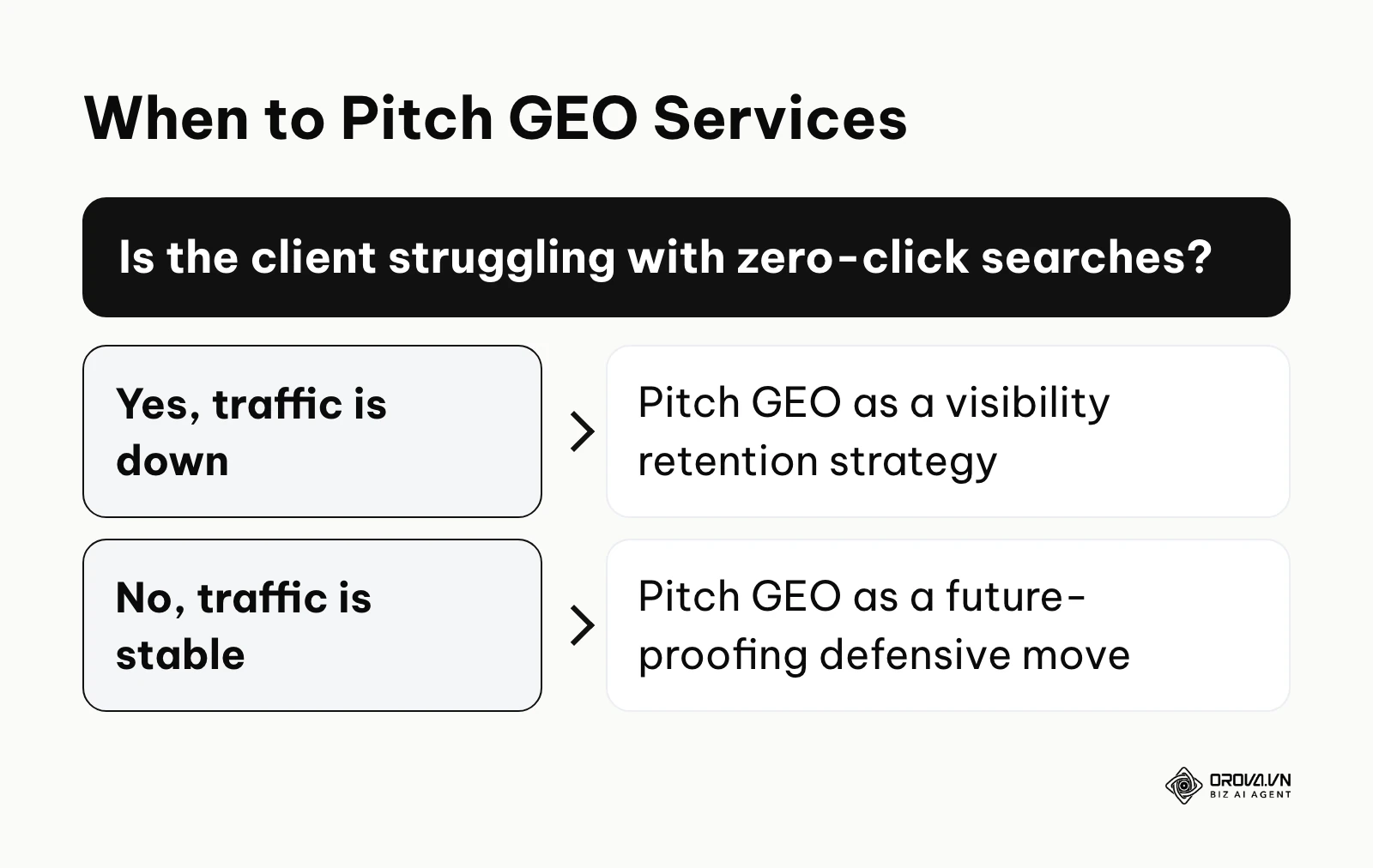
- Educate clients on the reality of zero-click searches and show them examples of their brand missing from AI answers.
- Pitch generative optimization as a defensive strategy to protect existing brand equity.
- Include server log analysis as a premium tier in your reporting to show concrete bot activity.
- Emphasize the long-term cost savings of avoiding reliance on paid advertising to maintain visibility.
| Common Mistake | Consequence | How to Avoid |
|---|---|---|
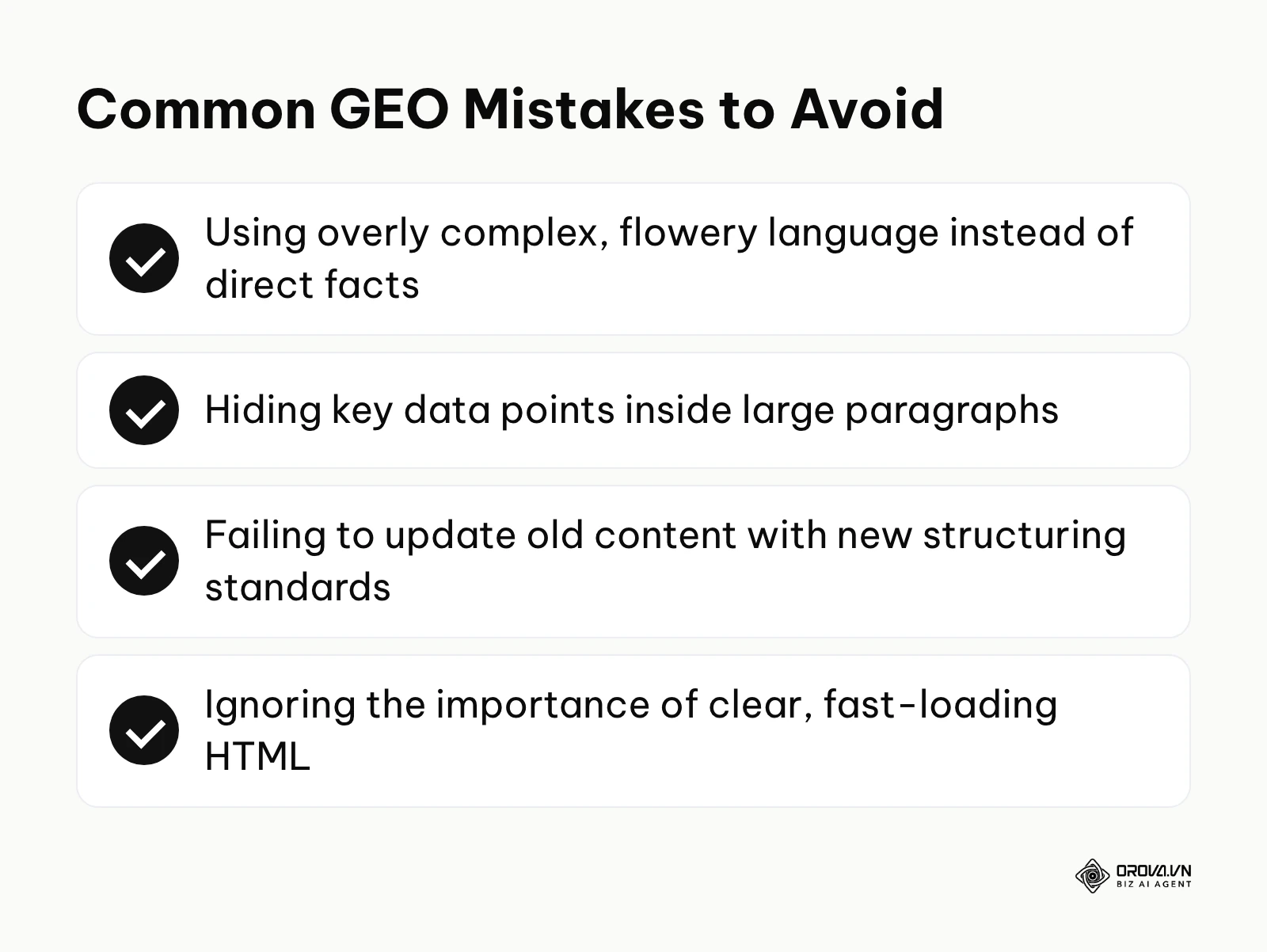
| Hiding data in long paragraphs | The AI fails to extract the specific fact and ignores your page. | Use bullet points and markdown tables for all statistics. |
| Overusing flowery, vague language | The AI is less likely to treat the page as a clear, trustworthy answer. | Write directly, use active voice, and define all industry terms. |
| Ignoring technical loading speed | The bot times out before parsing your structured data. | Compress images, minify code, and ensure fast server response times. |
With OROVA.VN and the OROVA SEO module, you put an end to the exhausting days of manual work for good. Instead of struggling for hours to write articles and compile reports, the entire process is now optimized and completed in just 5 minutes.
Where generative engine optimization is heading in the next few years: the author's take
These are opinions, not forecasts with numbers attached. Based on what is visible today, I see three shifts worth preparing for.
The Rise of Personalized AI Fact-Checking
AI assistants are already adding memory and personal context. I think that in the next two to three years, search tools will not just retrieve facts but also weigh your content against what they know about the user and their earlier questions. If your content contradicts what the assistant already "knows" for that user, my read is that it becomes less likely to be cited. Therefore, you should prepare by ensuring your content is incredibly rigorous and clearly cites primary sources to establish undeniable credibility, rather than relying on broad generalizations.
Real-Time API Indexing Over Traditional Crawling
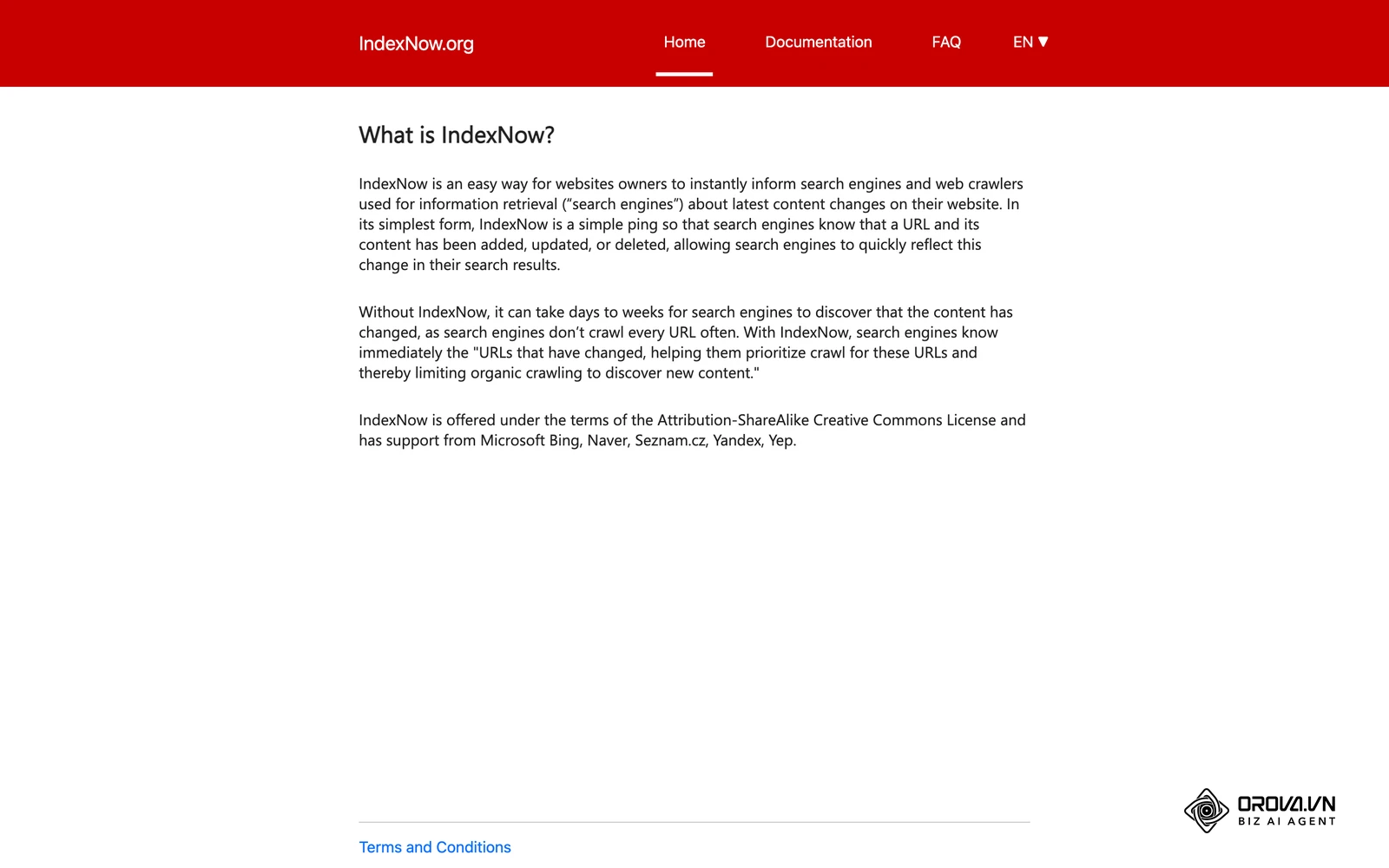
Today, AI tools still largely rely on bots crawling the web. Push-style protocols such as IndexNow already let sites notify some search engines when a page changes. I think that over the next few years more sites will push fresh, structured data to search and AI platforms instead of waiting to be crawled. It is worth checking now whether your key facts (prices, specs, dates) live in clean, structured fields that could be exposed through a feed or API later.
The Decline of the Bloated Long-Form Guide
For years, the gold standard in marketing was publishing a 5,000-word "ultimate guide" to capture broad queries. I strongly suspect this format will become obsolete for informational intent. AI engines do not want to parse a massive document just to find a single definition; they want concise, modular information. I advise content teams to begin breaking down their massive guides into hyper-focused, interconnected topical clusters that answer specific questions perfectly. However, this prediction assumes that user behavior continues to favor quick answers over deep reading, which could shift if users begin seeking more narrative depth to combat AI fatigue.
Frequently Asked Questions about Generative Engine Optimization
What is the difference between GEO and SEO?
While traditional SEO focuses on optimizing content to rank as a clickable link on a search engine results page, GEO focuses on structuring content so that an AI model can extract facts and cite your brand directly within a generated conversational answer. Both require technical health, but their end goals differ; this GEO vs SEO comparison goes deeper.
Is SEO still needed with AI?
Yes, absolutely. AI chatbots and generative search engines still rely on traditional crawling and indexing mechanisms to find content in the first place. If your website has broken links, slow loading times, or poor mobile responsiveness, the AI will never ingest your content to cite it.
Do I need to learn how to code to do this?
No, you do not need to become a software developer. However, you do need to understand how to format text properly in your editor, how to structure data into clear tables, and how to use basic HTML tags like headers (H2, H3) logically to create a hierarchy of information.
How quickly can I see results?
Answer engines that search the live web, such as Perplexity, can sometimes pick up a well-structured page quickly once it is indexed. Being cited consistently usually takes longer, because you need enough strong pages on the topic to look like a reliable source.
Will generative engines penalize AI-written content?
The engines do not strictly penalize content simply because it was generated by AI, provided that the content is factually accurate, structured well, and provides unique value. However, if you mass-produce generic AI content that adds no new information to the web, you will not be cited.
Where to start?
Transitioning your digital strategy to account for artificial intelligence can feel overwhelming, but the key is to take incremental, highly focused actions rather than attempting to rewrite your entire website overnight. Depending on where your organization currently stands, here is exactly what you should do next.
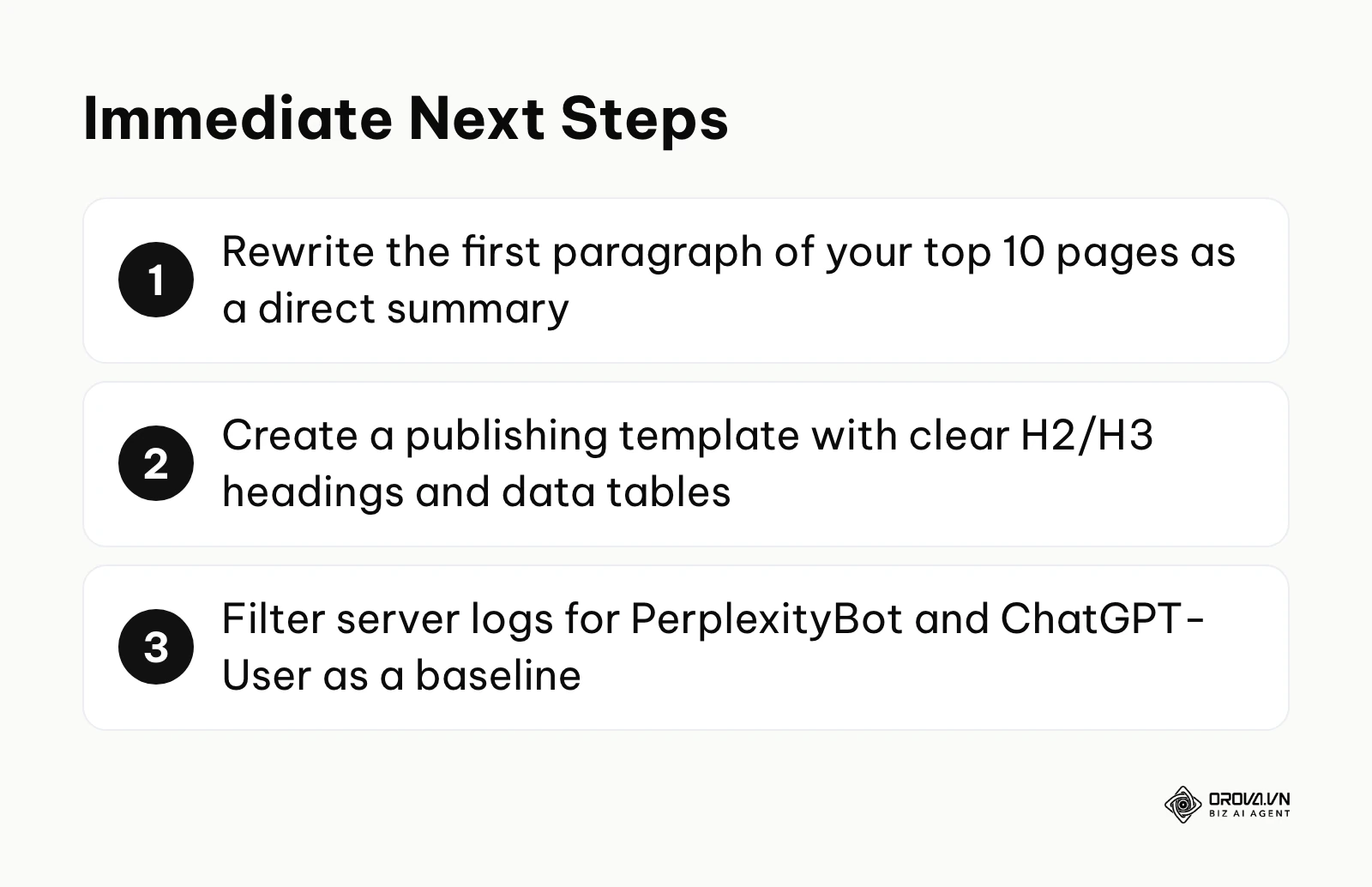
If you have done nothing and are starting from scratch: Do not attempt to learn every technical detail at once. Your single first step, which can be done in one afternoon, is to identify the top ten highest-traffic pages on your website and rewrite the first paragraph of each to provide a direct, concise summary of the entire page's core thesis, stripping out any unnecessary introductory fluff.
If you have tried optimizing but your efforts are scattered: Your team likely lacks a standardized approach to content creation. Your immediate next step is to create a mandatory publishing template for all new articles. This template must enforce the use of H2 and H3 tags for logical hierarchy and mandate that any data points or statistics are placed inside a clearly formatted table for easy extraction.
If you are doing the work but not measuring the impact: You are flying blind and will struggle to secure long-term budget. Your first technical task is to open your server logs and run a simple text filter searching for "PerplexityBot" and "ChatGPT-User". Documenting this baseline activity will give you the concrete proof you need to show that AI agents are already interacting with your domain.
About the author

Builder of Orova
Nguyễn Đỗ Trọng Ân has 8 years of experience in marketing, including 6 years managing market development across Asia. He builds Orova, a Biz AI Agent that never sleeps: it plans, runs and optimizes work for businesses.
Run your business with AI Agents
Orova is the always-on Biz AI Agent — it plans, runs, and optimizes the work for you.
Save time, unlock productivity.