
AI visibility tracking: a 2026 guide with a manual tracking template

AI visibility tracking means checking how often, and how favorably, ChatGPT, Gemini, Perplexity and Google AI Overviews mention your brand when people ask questions in your category. You log into your analytics dashboard and see a steady, unsettling decline in organic traffic. You immediately check your traditional rank tracker, fully expecting to see your top keywords plummeting. Instead, everything is green. You are still ranking in the number one spot for your most valuable commercial terms. Your technical health is perfect. Your backlinks are growing. Yet, the traffic is vanishing. This is the reality for many marketers today. Users are no longer scrolling through ten blue links; they are asking complex questions directly to Large Language Models (LLMs) and getting synthesized answers. If you are only tracking traditional search engine positions, you are looking at a map of a world that no longer exists. To survive and thrive in this new landscape, you must understand and implement ai visibility tracking. This guide will show you exactly how to track your brand inside AI engines, providing a free manual template and a rigorous framework for choosing the right automated tools.
What is AI visibility tracking and why do you need it?
AI visibility tracking is the systematic process of monitoring how often, and in what context, a specific brand, product, or entity is mentioned by generative AI engines when users input relevant queries. It tells you if you exist in the minds of the machines. Anyone relying on digital discovery—from local businesses to global enterprises—needs to measure this metric because AI search engines are rapidly intercepting top-of-funnel research traffic. You should not rely on this metric alone if your primary revenue comes from direct brand searches or offline word-of-mouth, but for organic discovery, it is becoming non-negotiable.
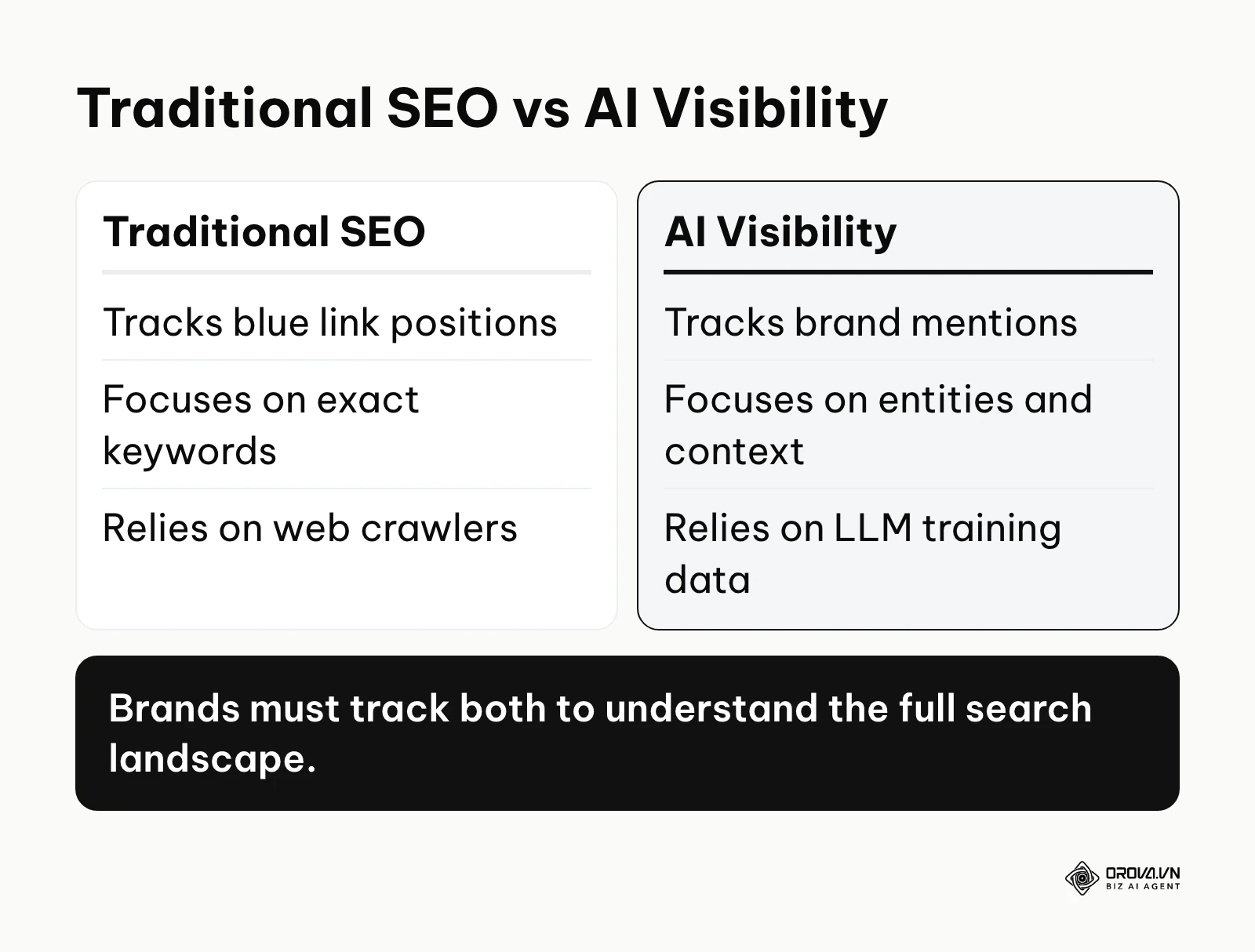
The core difference between traditional tracking and AI tracking lies in the architecture of the engines. Traditional SEO trackers ping Google to see where a specific URL ranks for a specific keyword phrase on a localized results page. It is a rigid, location-based snapshot. AI visibility tracking, however, deals with fluid, generative responses. You are not tracking a URL; you are tracking a concept. You are measuring the sentiment of the mention (positive, negative, or neutral) and the frequency of citation across multiple platforms like ChatGPT, Gemini, Perplexity and Google AI Overviews. For a fuller breakdown of how optimizing for the two kinds of engines differs, read our comparison of GEO vs SEO.
In a February 2024 press release, Gartner predicted that traditional search engine volume would drop 25 percent by 2026 as users shift to AI chatbots and other virtual agents. This fundamental shift requires a completely new set of measurement protocols. You cannot optimize what you do not measure, and you cannot measure an AI model with a keyword rank tracker.
Illustrative example:
- Context: A mid-sized B2B software provider noticed a steady 15 percent drop in top-of-funnel lead generation over three months, despite maintaining their top rankings on Google for key industry terms.
- Steps taken: The marketing team hypothesized their developer audience had shifted to asking Perplexity for architecture advice instead of Googling it. They manually entered their five most profitable category queries into Perplexity and ChatGPT every Friday for a month.
- Friction and fix: They discovered they were entirely absent from the AI-generated answers, while a newer, smaller competitor was consistently cited as the "best modern alternative." The friction was that the AI models could not easily read their legacy, heavily branded landing pages. They fixed this by creating a highly technical, stripped-down documentation hub structured specifically for AI web crawlers.
- Result: Within two months of publishing the new technical hub, their brand began appearing as a highly recommended option in Perplexity responses, leading to a visible return of product trial signups that surpassed their previous baseline.
The ROI of AI visibility tracking
Return on Investment (ROI) is the ultimate metric for any marketing technology. When you propose spending budget on new tracking software, the executive team will demand to know how it translates to revenue. Measuring the ROI of AI visibility tracking is inherently complex because AI chat interfaces rarely pass clean referral data back to your website analytics. You must rely on correlation and proxy metrics to build a compelling financial case.
You measure this by establishing a firm baseline of your current direct traffic and branded search volume. These are the two metrics most heavily influenced by positive AI recommendations. When a user asks an AI for the "best CRM software" and the AI recommends your brand, the user will often open a new tab and search for your brand directly. By tracking the correlation between an increase in your AI visibility score (which you calculate based on the frequency and sentiment of mentions) and a corresponding lift in branded search, you can isolate the financial impact.
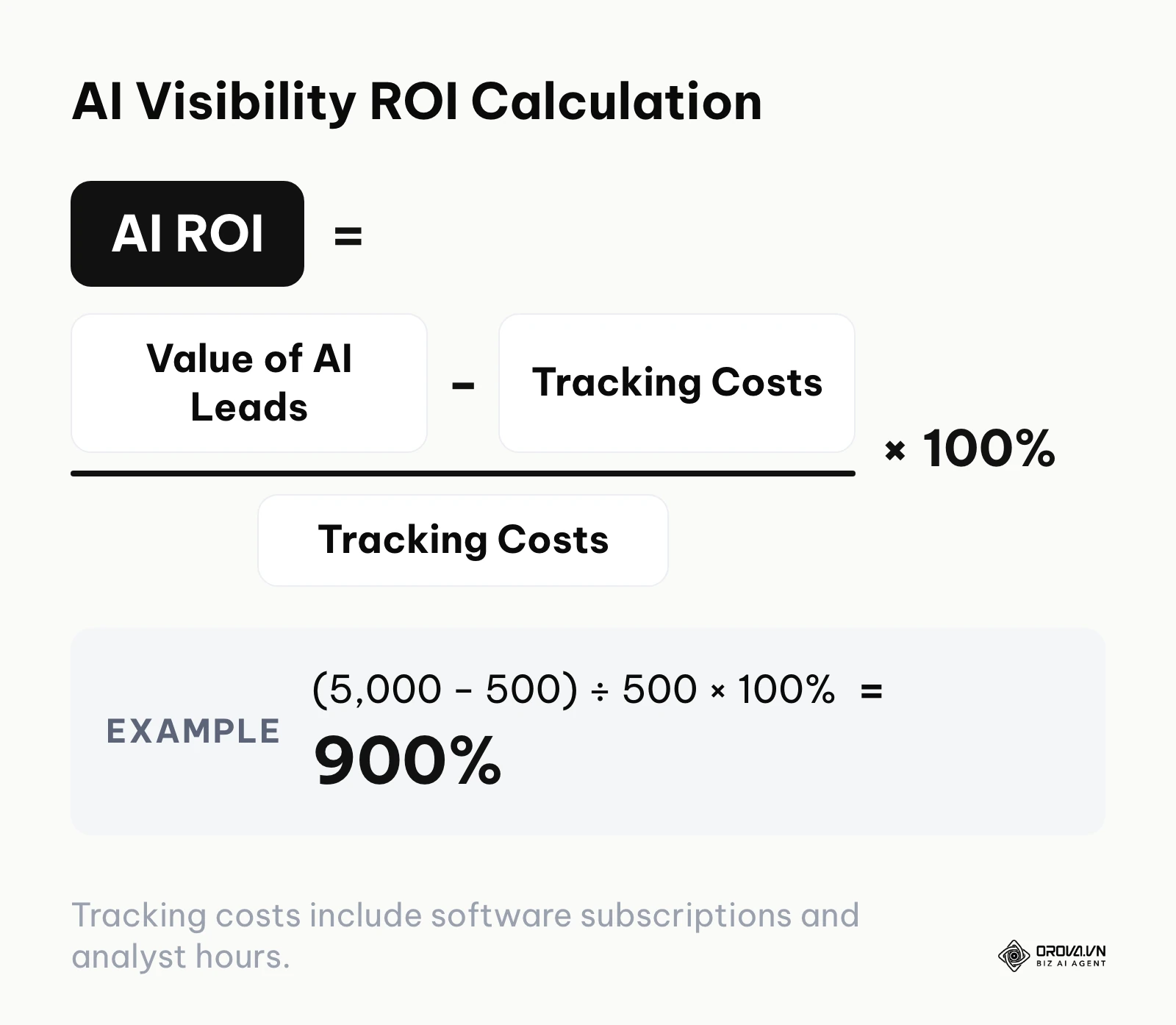
The formula for this requires defining the value of a single lead or sale generated from organic channels. If your AI tracking efforts lead you to optimize your content, which subsequently increases your brand mentions in ChatGPT by 20 percent, and you see a corresponding 10 percent lift in branded search that results in 50 new leads, you can calculate the direct revenue generated. You then subtract the cost of the tracking software and the human hours spent analyzing the data, and divide the result by that same cost. For example, if tracking costs 500 in a month and you attribute 5,000 of lead value to it (in the same currency), ROI = (5,000 − 500) ÷ 500 × 100% = 900%.
You should review these metrics on a monthly basis. Weekly fluctuations in AI responses are common due to the inherent randomness (temperature) of the models, but a monthly trend line will reveal true growth or decay. If your visibility drops below a designated threshold—for example, if you are completely removed from category recommendations for three consecutive weeks—this is a critical warning sign that your competitors have updated their digital PR or technical content to edge you out.
Illustrative example:
- Context: A specialized marketing agency needed to justify a monthly AI monitoring software subscription to a skeptical enterprise client who only believed in traditional SEO metrics.
- Steps taken: The agency established a one-month baseline using the tool, proving the client was only mentioned in 12 percent of relevant AI queries. They then executed a targeted digital PR campaign, securing mentions and backlinks on specific high-authority data sites that they knew AI models frequently used for Retrieval-Augmented Generation (RAG). They tracked the AI visibility score weekly alongside Google Search Console data.
- Friction and fix: Initially, the client complained that the PR placements did not generate direct referral clicks, questioning the strategy. The agency had to educate the client that the goal was not direct human clicks, but training the AI models.
- Result: After six weeks, the tracking software showed the client's positive AI recommendation rate had climbed to 45 percent. Concurrently, the agency demonstrated a sustained 18 percent increase in direct brand searches in Google Analytics, providing clear evidence that the tracking and optimization cycle was generating real-world brand equity and revenue.
How to set up manual AI visibility tracking for free
If you are not ready to commit budget to enterprise software, you can absolutely build a robust tracking system using nothing more than a spreadsheet and a disciplined routine. This manual approach is perfect for small businesses, independent consultants, or marketing teams looking to run a proof-of-concept before requesting software budget.
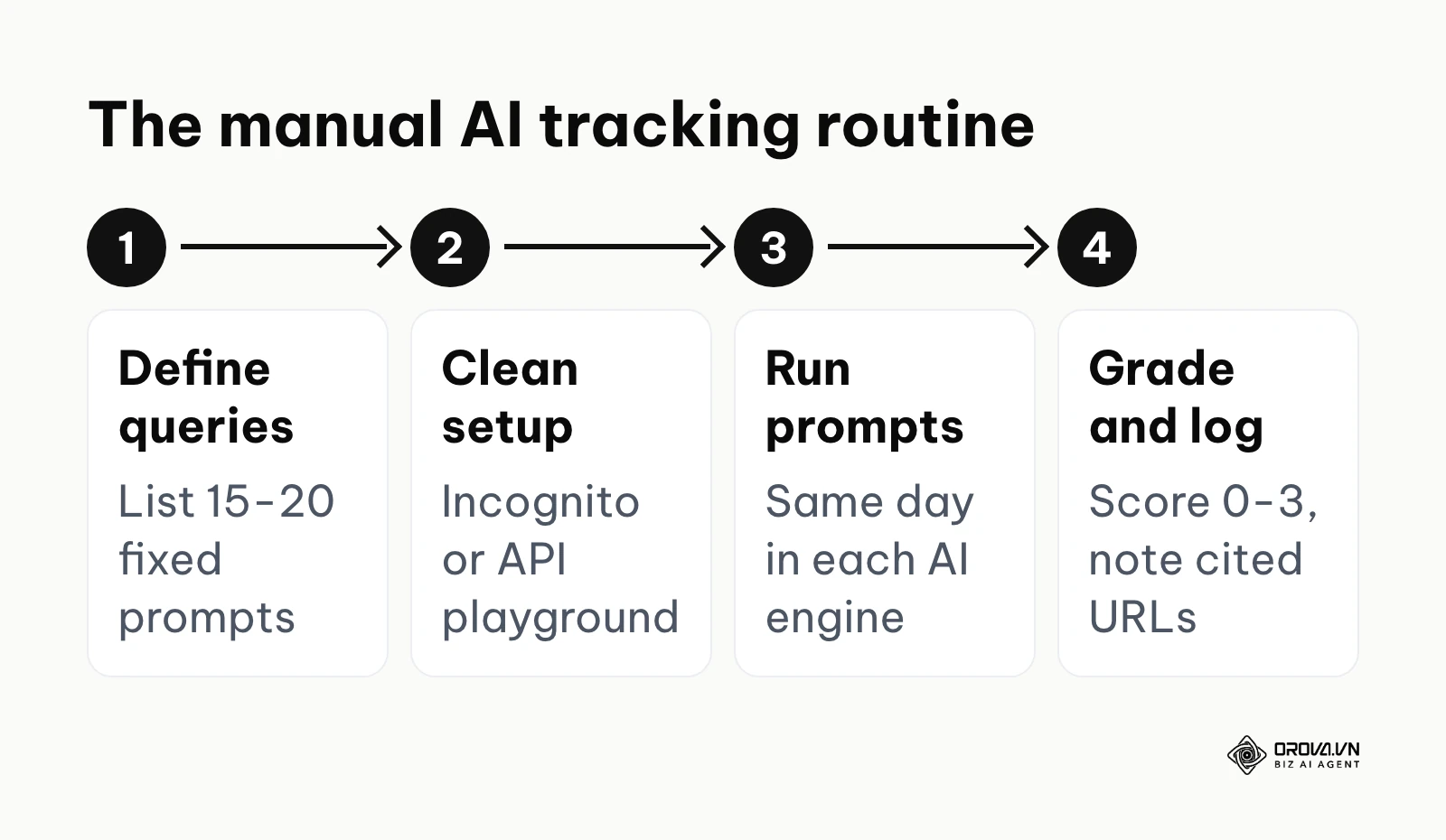
Step 1: Define your core query matrix
The most common mistake beginners make is asking the AI a single, overly broad question and assuming the answer represents their total visibility. LLMs process nuance deeply. You must build a matrix of prompts that cover different user intents. Start by listing five transactional queries (e.g., "What is the best project management tool for creative agencies?"), five informational queries (e.g., "How do I solve [Specific Problem] in my workflow?"), and five comparative queries (e.g., "Compare [Your Brand] vs [Top Competitor]"). This structured list of 15-20 prompts will serve as your unchangeable baseline for the next quarter.
Step 2: Establish a sterile testing environment
LLMs are designed to be helpful, which means they will often use your past conversation history and account data to personalize their answers. If you track your brand using your personal ChatGPT account where you talk about your company every day, the AI will heavily bias its answers in your favor, creating a dangerous false positive. You must use fresh, incognito browser sessions for web-based models, or better yet, use the API playgrounds for models like OpenAI or Anthropic. In an API playground, you can set the "temperature" setting to zero. Temperature controls the randomness of the output; setting it to zero ensures the model gives you the most deterministic, mathematically probable answer without trying to be creatively variable.
Step 3: Execute the tracking routine
Discipline is the engine of manual tracking. You must designate a specific day and time each week or month to run your query matrix. Run every single prompt through your chosen AI engines (e.g., ChatGPT, Gemini, Perplexity and Google AI Overviews). Do not change the wording of the prompts. You are looking for changes in the AI's response over time, which means the input must remain a constant variable.
Step 4: Grade and log the sentiment
When the AI generates a response, you must grade it subjectively but consistently. Create a simple rubric for your spreadsheet. A score of 0 means your brand was not mentioned. A score of 1 means your brand was mentioned, but only in passing or neutrally. A score of 2 means your brand was recommended as a viable option among others. A score of 3 means your brand was highlighted as the absolute best choice for that specific query. You must also note if the AI generated a clickable citation link (common in Perplexity or ChatGPT with Search enabled) and record the URL it cited.
Step 5: Build the tracking template
You need a centralized place to store this historical data. Below is the exact structure you should use to build your free Google Sheets tracking template. Create the following columns in your spreadsheet to ensure you capture all necessary data points for future analysis.
| Column Name | Purpose | Example Entry |
|---|---|---|
| Date | To track visibility trends over specific timeframes. | 2026-10-15 |
| AI Engine | To identify which specific model is favoring or ignoring you. | Claude 3.5 Sonnet |
| Query Intent | To categorize the prompt (Transactional, Informational, Comparison). | Transactional |
| Exact Prompt | The unchangeable text you input into the engine. | "What is the best CRM for small law firms?" |
| Mentioned? (Y/N) | A simple binary check for quick visual filtering. | Y |
| Sentiment Score (0-3) | The numerical grade based on your established rubric. | 2 |
| Cited Source URL | The specific web page the AI referenced to find your brand (if applicable). | https://example-review-site.com/law-crms |
| Notes | For recording specific contextual details, like negative hallucinations. | "Recommended us, but listed an outdated pricing tier." |
By faithfully updating this spreadsheet, you will quickly build a proprietary dataset that reveals exactly how the machines perceive your business, allowing you to identify which queries require immediate content optimization.
Discover Orova.vn – a Biz AI Agent platform with OROVA SEO, a complete solution for every website. The system supports search engine optimization from A to Z with features including keyword research, writing new SEO-ready articles, optimizing existing content, rank tracking, plus competitor analysis and in-depth technical analysis. Sign up today to experience OROVA SEO completely free (offer valid through July 7, 2027).
Beyond tracking: How to turn AI visibility data into real traffic
Tracking data in a vacuum is useless. The entire purpose of monitoring your visibility is to identify strategic gaps and deploy content to fill them. The process of optimizing your digital presence to be favored by LLMs is commonly referred to as Answer Engine Optimization (AEO), and it overlaps heavily with generative engine optimization (GEO). If you want one plan instead of three, see how to approach SEO, AEO and GEO together. While traditional SEO focuses on satisfying search algorithms to rank a page, AEO focuses on providing clear, authoritative data that an AI model can confidently synthesize into an answer.
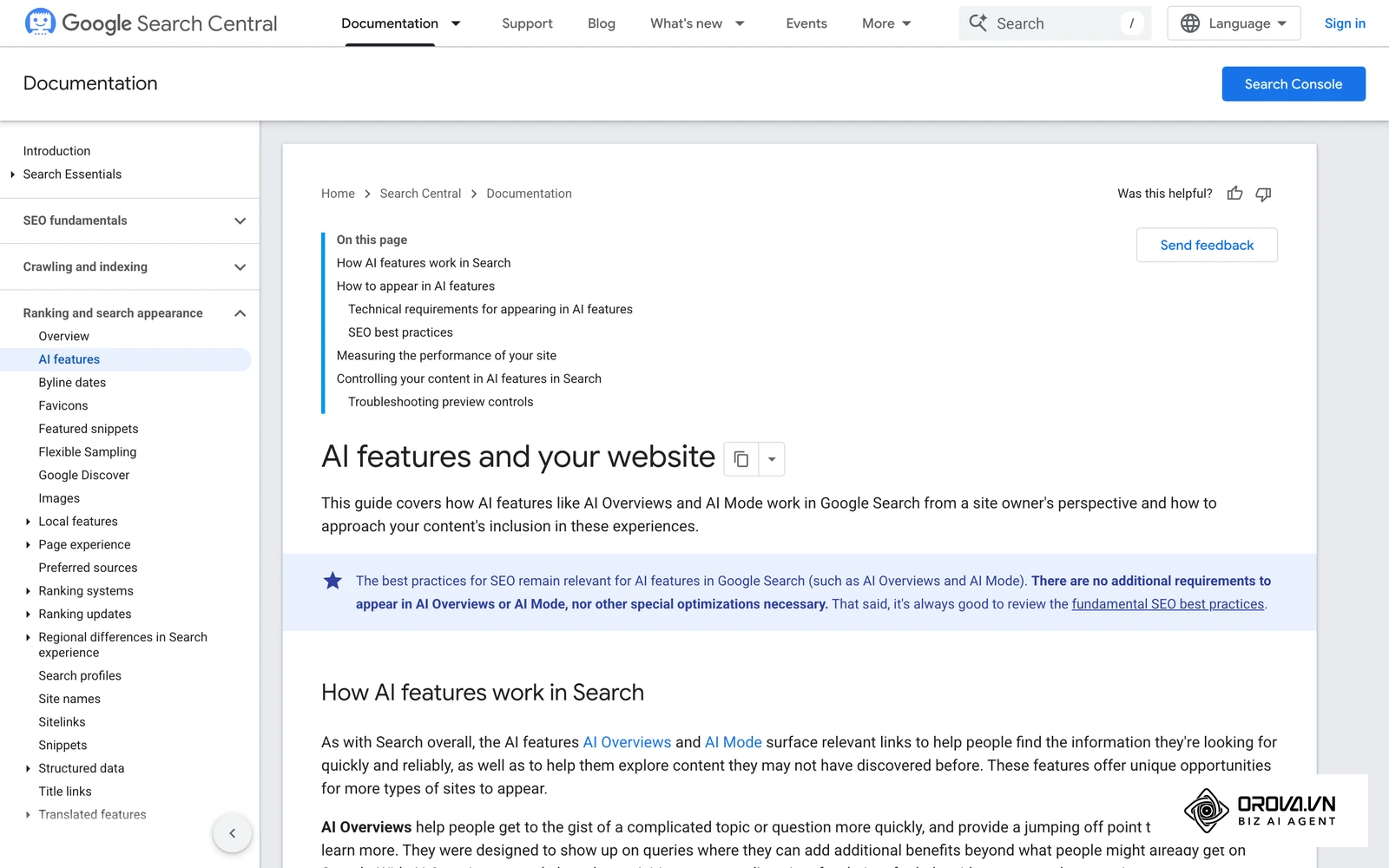
Google's Search Central documentation on AI features and your website notes that the same foundational SEO best practices apply to AI Overviews as to classic Search results. This means the fundamentals of good content remain, but the formatting and technical delivery must evolve.
Consider the reality of how RAG (Retrieval-Augmented Generation) works. When a user asks a complex question, the AI model does not just rely on its static training data; it reaches out to the live internet, searches for relevant documents, reads them in milliseconds, and synthesizes an answer. If your content is buried in massive blocks of unstructured text, clever metaphors, or hidden behind JavaScript walls, the AI will ignore you and cite your competitor who used simple bullet points. To succeed, you must structure your content to be as easily consumable by a machine as it is by a human. If you want to dive deeper into testing different content structures, check out our guide on How to do SEO split testing in 2026.
Illustrative example:
- Context: A fast-growing online retailer selling specialized ergonomic office furniture set up manual AI tracking and discovered a glaring problem. When users asked AI engines for "best ergonomic chairs for tall people," the retailer was never cited, despite having a massive catalog and good traditional search rankings.
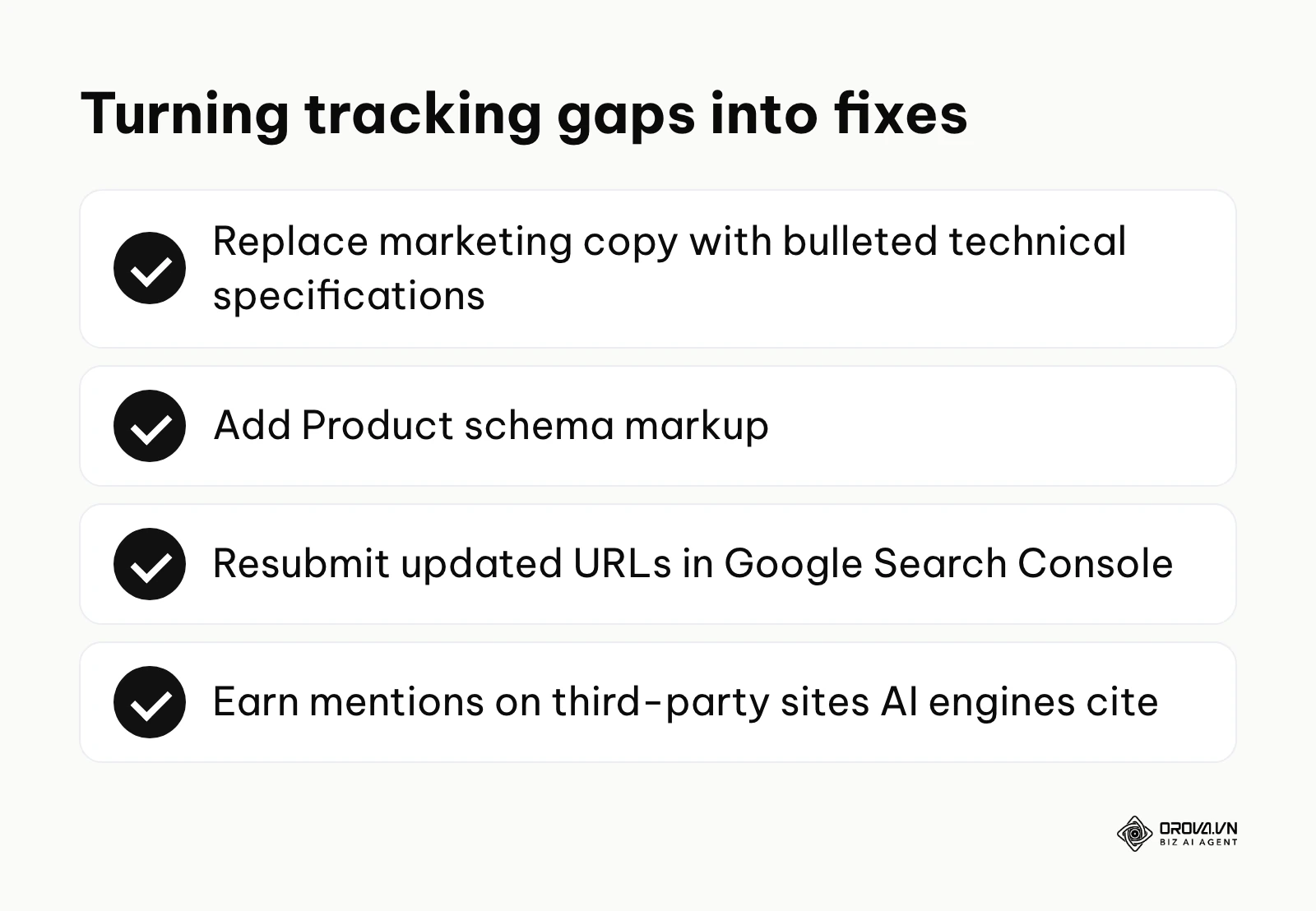
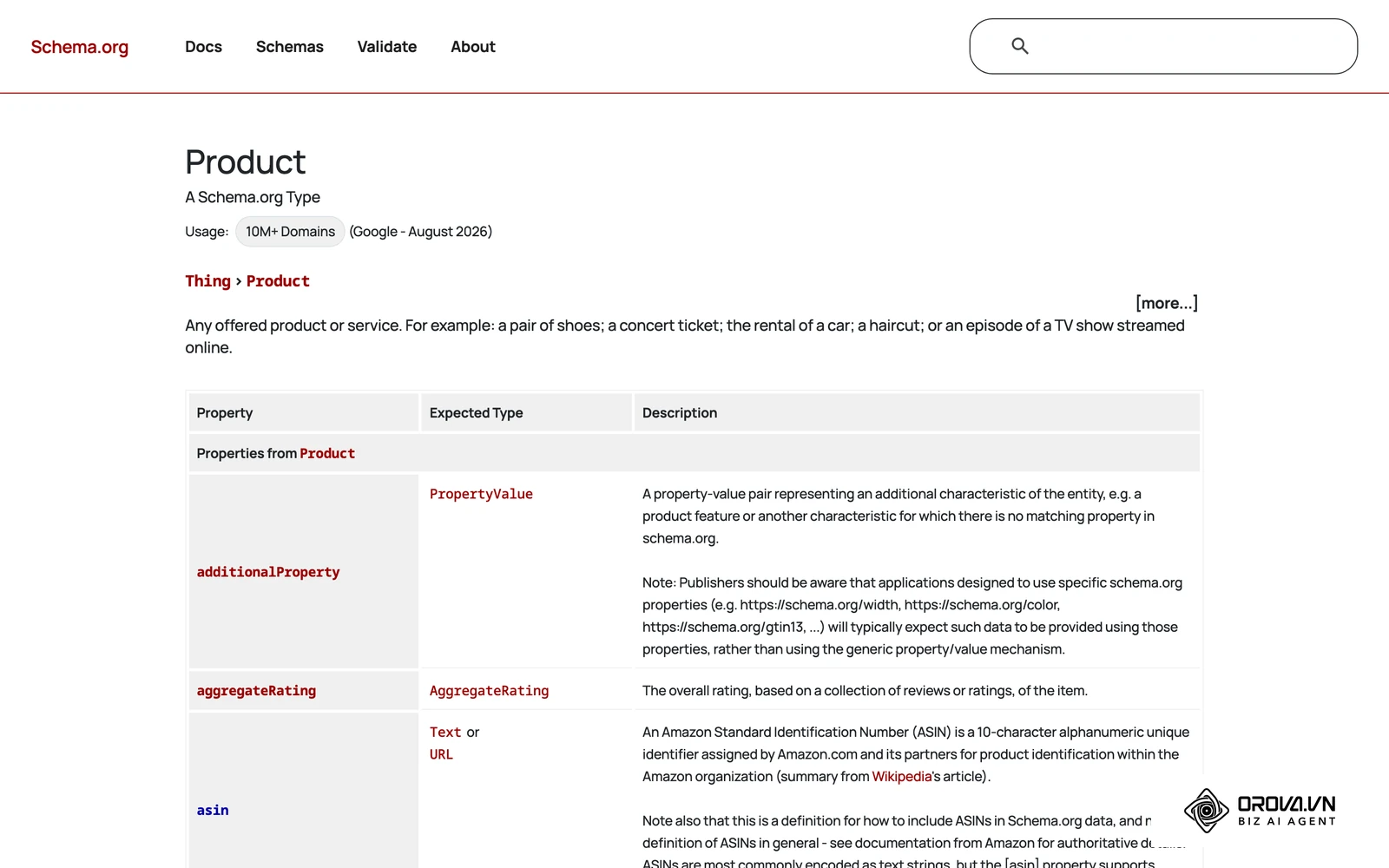
- Steps taken: The content team analyzed the sources the AI was citing. They noticed the AI heavily favored sites that listed specific, numerical dimensions. The retailer audited their own product pages and realized their descriptions were full of marketing copy ("feel like you are sitting on a cloud") but lacked structured technical data. They immediately rewrote the top 20 product pages, adding clear, bulleted technical specifications (exact seat depth, maximum height adjustments in inches) and implemented comprehensive Product schema markup across the site.
- Friction and fix: The initial rewrite did not yield immediate results because the pages had not been re-crawled by the major search indexers that feed the AI models. The team had to manually submit the updated URLs to Google Search Console and launch a small digital PR push to get third-party blogs to link to the new specifications, forcing the crawlers to recognize the updated entities.
- Result: Within four weeks of the forced re-crawling, the manual tracking spreadsheet showed a massive shift. The brand went from a visibility score of 0 to a consistent 2 or 3 across all tested AI engines for queries related to "tall people." More importantly, the server logs revealed a distinct spike in referral traffic originating from known AI bot user agents, validating the AEO strategy.
Master comparison table of AI visibility tools
The software market has exploded with tools claiming to track AI visibility. However, they vary wildly in their methodologies, pricing, and target audiences. Some are built for enterprise PR teams monitoring global sentiment, while others are designed for technical SEOs looking to optimize content. Before you spend a dime, you must understand the landscape.
The table below groups well-known tools that support AI visibility work as of 2026, from dedicated trackers to the SEO and content tools you use to act on the data, helping you cut through the marketing noise and identify the software that aligns with your specific operational needs.
| Tool Name | Primary Category | Core Function | User Value | Best For Scale |
|---|---|---|---|---|
| Profound | Dedicated AI visibility tracker | Monitors brand mentions and citations in AI answers | Seeing how AI engines describe your brand | Mid-size & Enterprise |
| Peec AI | Dedicated AI visibility tracker | Tracks brand visibility across AI search engines | Comparing your AI presence with competitors | Small to Mid-size Teams |
| Otterly.AI | Dedicated AI visibility tracker | Monitors brand mentions and cited links in AI answers | Watching prompts and citations over time | Solo & Small Teams |
| Semrush | SEO platform | Keyword, ranking and competitive research, with AI search features | Broad historical search data | Agencies & Enterprise |
| Ahrefs | SEO platform | Backlink and keyword research, with brand mention monitoring in AI search | Finding the sites that earn links and citations | Agencies & Enterprise |
| Brandwatch | Social listening | Monitoring consumer and brand conversations | Sentiment and reputation trends | Global Enterprise |
| Meltwater | Media intelligence | Media and social monitoring | Broad brand health and PR coverage | Global Enterprise |
| Mention | Brand monitoring | Alerts when your brand is mentioned on the web and social | Catching new third-party mentions early | Mid-size Teams |
| SparkToro | Audience research | Showing which websites, podcasts and accounts your audience follows | Finding sources worth earning mentions on | Agencies & Mid-size |
| AnswerThePublic | Query research | Visualizing the questions people search for | Building the prompt list for tracking | Solo & Small Teams |
| Clearscope | Content optimization | Grading topic and term coverage | Making content complete on a topic | Content Teams |
| Surfer | Content optimization | Content editor scored against top-ranking pages | Writing well-structured content | Content Teams |
| Screaming Frog | Technical crawler | Auditing site architecture and structured data | Keeping pages accessible to crawlers | Technical SEOs |
| Orova SEO | AI SEO suite | Writes and publishes SEO articles, optimizes old URLs, connects GSC and GA4, tracks competitors | Acting on the content gaps your tracking reveals (it does not monitor AI answers itself) | Small to Mid-size Teams |
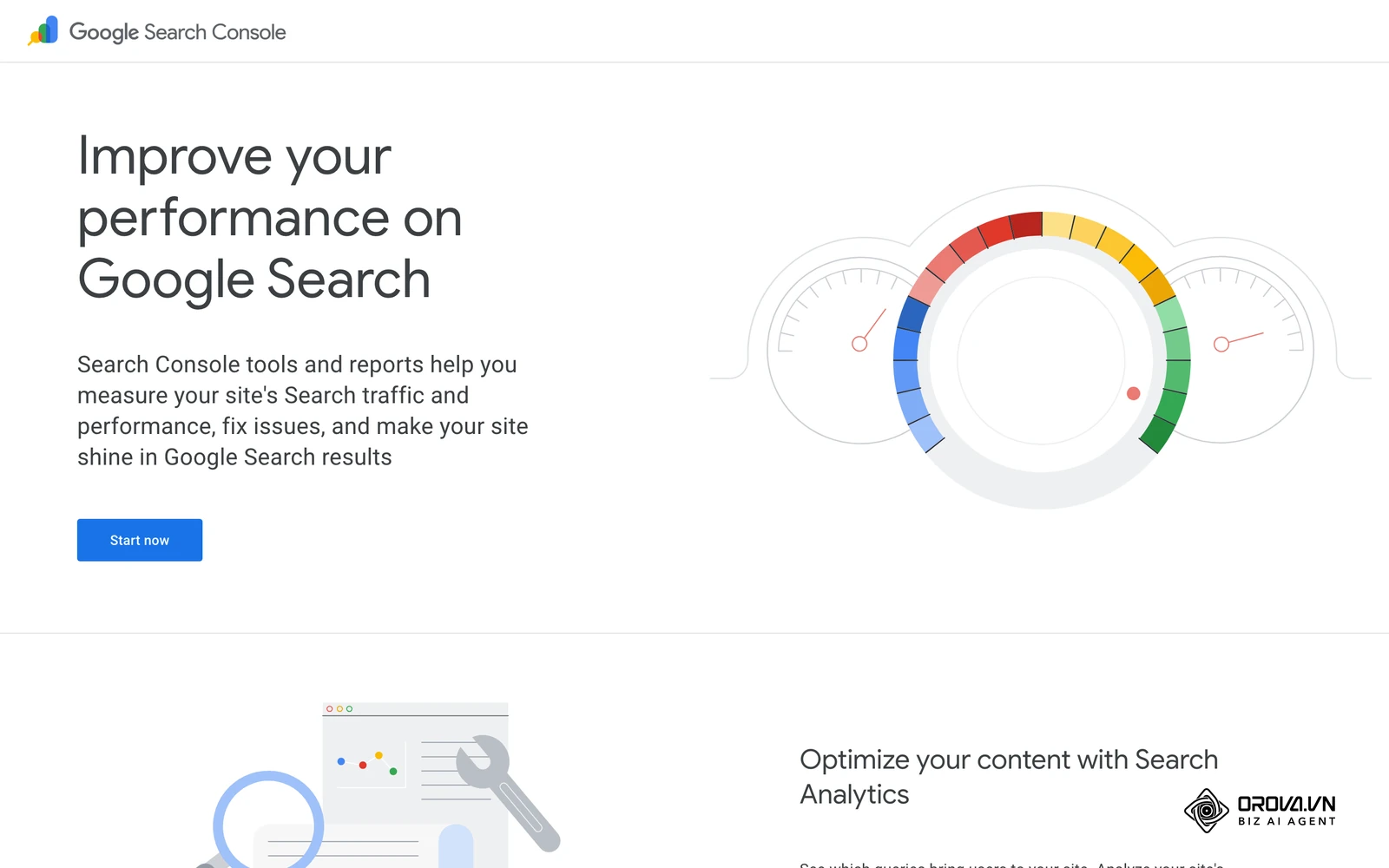
| Google Search Console | Free Google tool | Clicks, impressions and branded query data | Proving branded search lift | Everyone |
Deep dive into AI tracking software categories
Understanding the names of the tools is not enough; you must understand how these different categories of software actually function under the hood. The technology used to track AI visibility dictates what kind of data you will receive and, consequently, what strategic actions you can take. Choosing the wrong category will result in a flood of irrelevant data and a wasted budget.
AI SEO writing & optimization suites
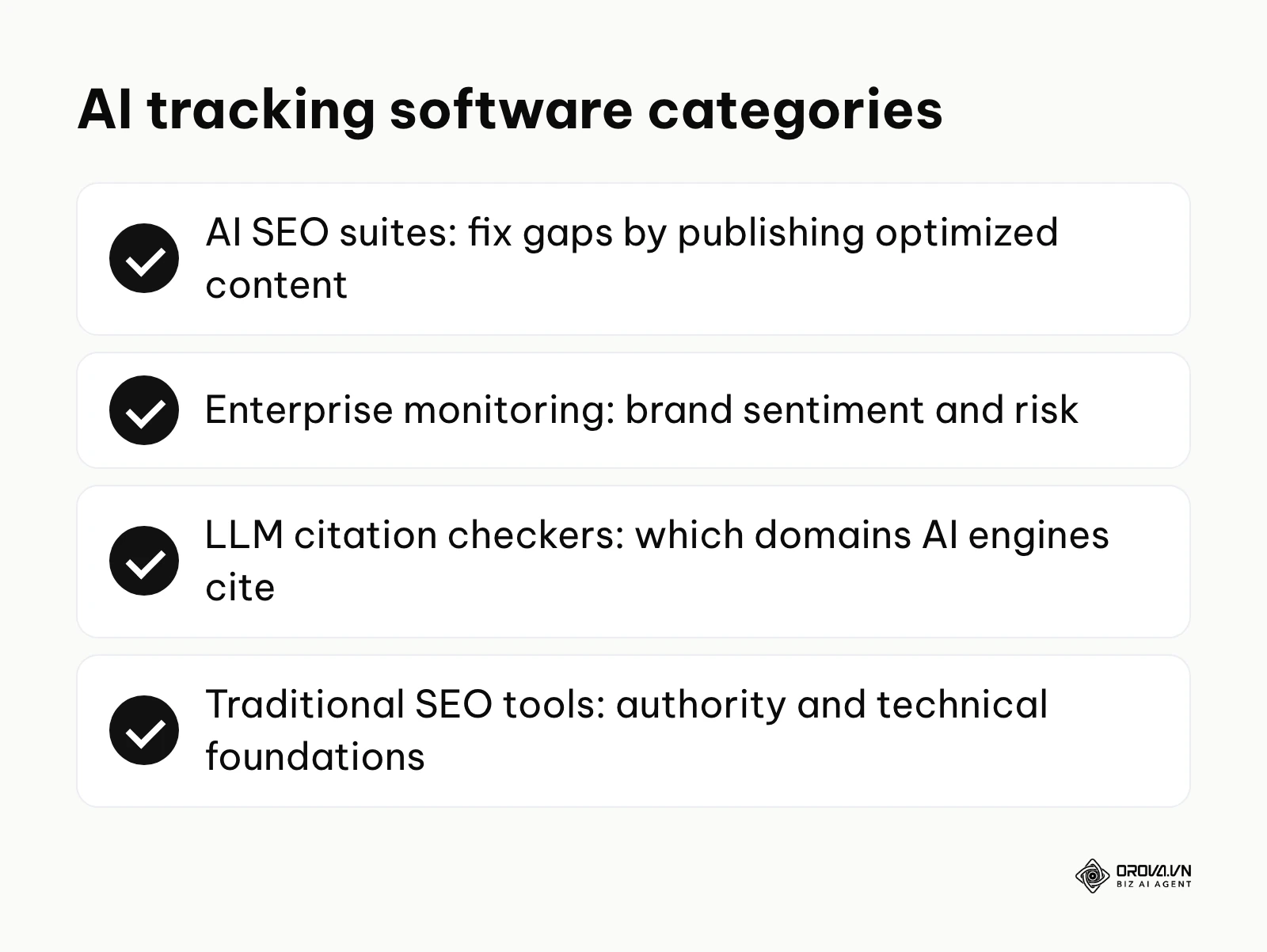
This category sits on the action side of the market. These tools are built to fix the gaps that tracking reveals. They are built on the premise that identifying a visibility gap is useless unless you can rapidly deploy optimized content to fill it. These suites integrate directly with your website infrastructure, blurring the lines between analytics and content management. If you want to learn more about how these tools are fundamentally changing content production, read our comprehensive guide on the Best AI Writing Tools for Website SEO.
These suites are designed for growth marketers and SEO managers who need to execute quickly without waiting on a massive development or editorial queue. The value proposition is total consolidation. Instead of using one tool to find the gap, a second tool to write the content, and a third tool to publish it, these suites handle the entire lifecycle. To get started, you typically connect your analytics accounts, define your core brand terms, and let the software audit your existing footprint before generating new assets.
For example, Orova SEO fits the content side of this category. It does not monitor AI answers itself; it writes SEO articles with images and publishes them directly to your site via a custom API. It optimizes old URLs while keeping the path intact, connects to GSC and GA4 to measure real impact, and suggests keywords with volume from four different sources. It also tracks competitors, runs technical health checks, and features a Visual Editor to edit articles on your connected website right inside the app. This level of integration is what defines a modern optimization suite.
Enterprise AI visibility monitoring platforms
At the opposite end of the spectrum are the massive, enterprise-grade monitoring platforms. These tools evolved from traditional social listening and PR tracking software. They are not built to help you write a better blog post; they are built to monitor the global conversation surrounding a Fortune 500 brand. They run large volumes of prompts and data sources, mapping sentiment, identifying emerging crises, and tracking the reputation of key executives across multiple languages and geographies.
The technology relies on complex Natural Language Processing (NLP) to understand the context of a mention. If an AI model hallucinates a scandal about a brand's CEO, these platforms are designed to catch it instantly. The value here is risk mitigation and global brand health monitoring. They usually require dedicated analysts to parse the data. They are suited exclusively for large PR teams, corporate communications departments, and global enterprises. To start using them, you must endure a lengthy sales process, define complex boolean logic queries, and train the platform's custom algorithms on your specific brand architecture.
Specialized LLM citation checkers
A newer, highly specialized category of tools focuses entirely on the mechanics of RAG (Retrieval-Augmented Generation). These citation checkers do not care about broad sentiment; they care about the exact mechanical pathways an AI uses to formulate an answer. When an AI generates a response and provides a footnote link, these tools track exactly which domains are winning those citations.
This category is invaluable for technical SEOs and digital PR professionals who are trying to reverse-engineer the algorithms. By understanding which third-party websites an AI trusts most for a specific topic, you can focus your PR efforts on getting your brand mentioned on those specific sites, thereby influencing the sources AI engines retrieve. The value is surgical precision in your outreach strategy. These tools are best for specialized agencies and advanced in-house SEO teams. To begin, you input your target keywords, and the software scrapes the AI outputs to build a map of the most frequently cited authoritative domains in your niche.
Traditional SEO tools adapting to AI
You cannot ignore the legacy giants of the SEO industry. Platforms that built their empires on tracking backlinks and keyword positions are aggressively adapting their feature sets to include AI visibility metrics. While they may not be native AI trackers, their massive historical databases give them a unique advantage. They understand that traditional metrics still heavily influence AI models. If a website has massive domain authority and millions of high-quality backlinks, a RAG-based AI model is mathematically far more likely to trust and cite that website's content.
These tools provide the foundational data necessary for any visibility campaign. They allow you to audit your technical architecture, analyze your competitor's backlink profiles, and ensure your site is perfectly structured for web crawlers. The value is depth and reliability. They are suited for anyone serious about digital marketing, from solo consultants to massive agencies. To start, you run a comprehensive technical audit of your site and begin tracking your core entity terms alongside your traditional keywords.
The decision matrix: How to pick the right AI visibility tracking tool
Choosing the right software is a critical decision that will dictate your strategy for the next year. You will face a paradox of choice, with dozens of vendors promising to solve your AI visibility problems. To avoid wasting thousands of dollars on a tool that does not fit your operational reality, you must use a rigorous decision matrix based on three unyielding pillars: your available budget, the specific AI engines you need to monitor, and your team's capacity to execute on the data provided.
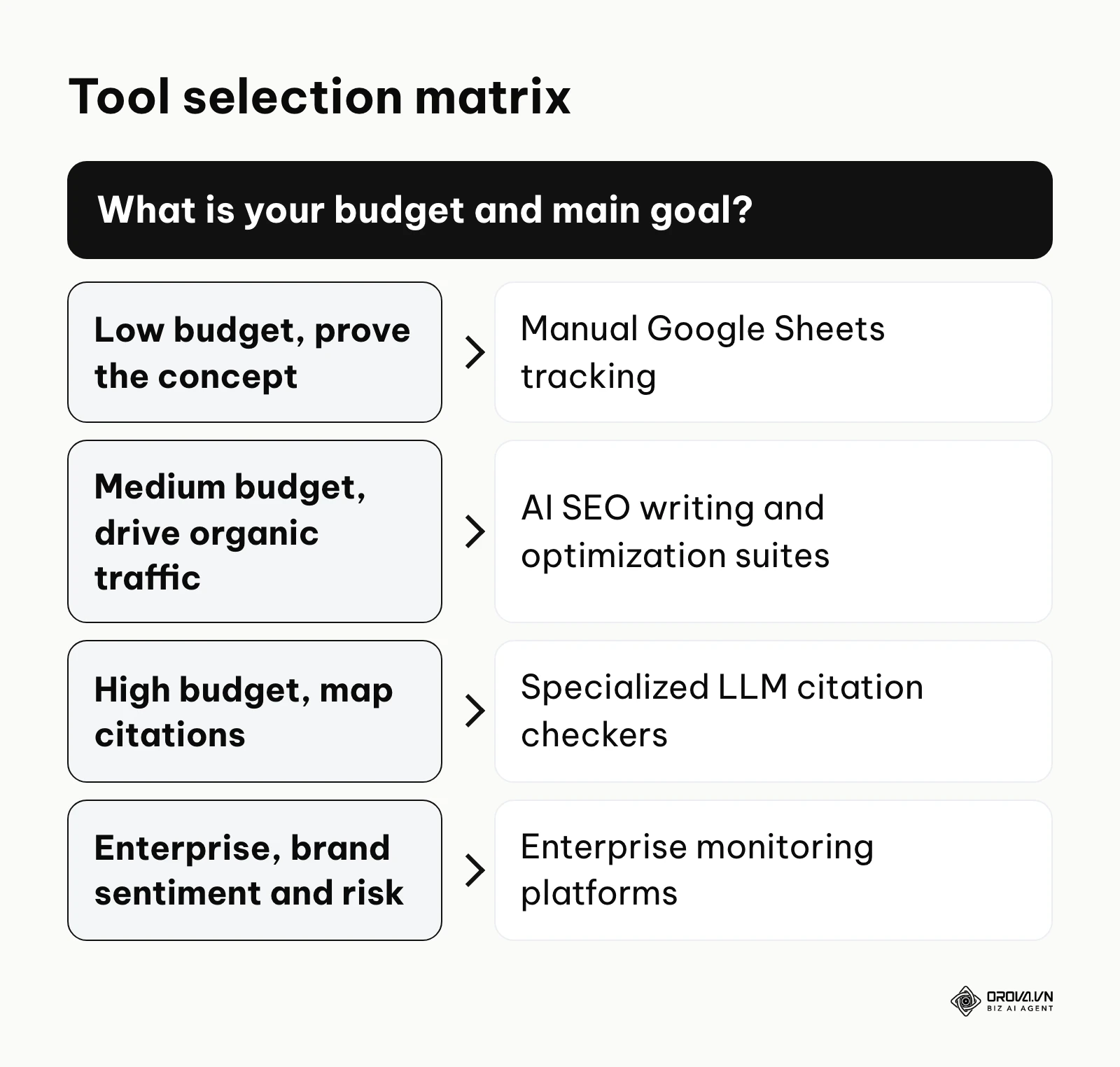
First, define your core objective. Are you trying to protect a global brand reputation from AI hallucinations, or are you trying to drive more organic product sales by optimizing your content? These are fundamentally different goals requiring fundamentally different software. Second, assess your resources honestly. If you buy a massive enterprise data platform but do not have a dedicated data analyst to read the reports or a content team to implement the changes, you have purchased an expensive dashboard, not a solution.
Use the decision matrix below to align your business reality with the correct software category.
| Budget Level | Primary Goal | Team Execution Capacity | Recommended Tool Category |
|---|---|---|---|
| Zero to Low | Prove the concept and find initial gaps | Solo marketer or founder | Manual Google Sheets Tracking |
| Medium | Drive organic traffic and optimize content | Small marketing or content team | AI SEO Writing & Optimization Suites |
| High | Map citations and reverse-engineer RAG | Specialized SEO agency | Specialized LLM Citation Checkers |
| Enterprise | Monitor global brand sentiment and risk | Dedicated PR and communications team | Enterprise Monitoring Platforms |
With OROVA.VN and the OROVA SEO module, you put an end to the exhausting days of manual work for good. Instead of struggling for hours to write articles and compile reports, the entire process is now optimized and completed in just 5 minutes.
Advice on choosing a tool based on your scale
The size of your organization dictates the complexity of the tool you should choose. A solo consultant using an enterprise platform will drown in irrelevant data, while a global agency relying on a manual spreadsheet will fail to scale. You must match the tool to your operational footprint. If you are debating whether to handle this in-house or hire outside help, consider reading our analysis on AI marketing agency vs DIY AI tools to understand the trade-offs.
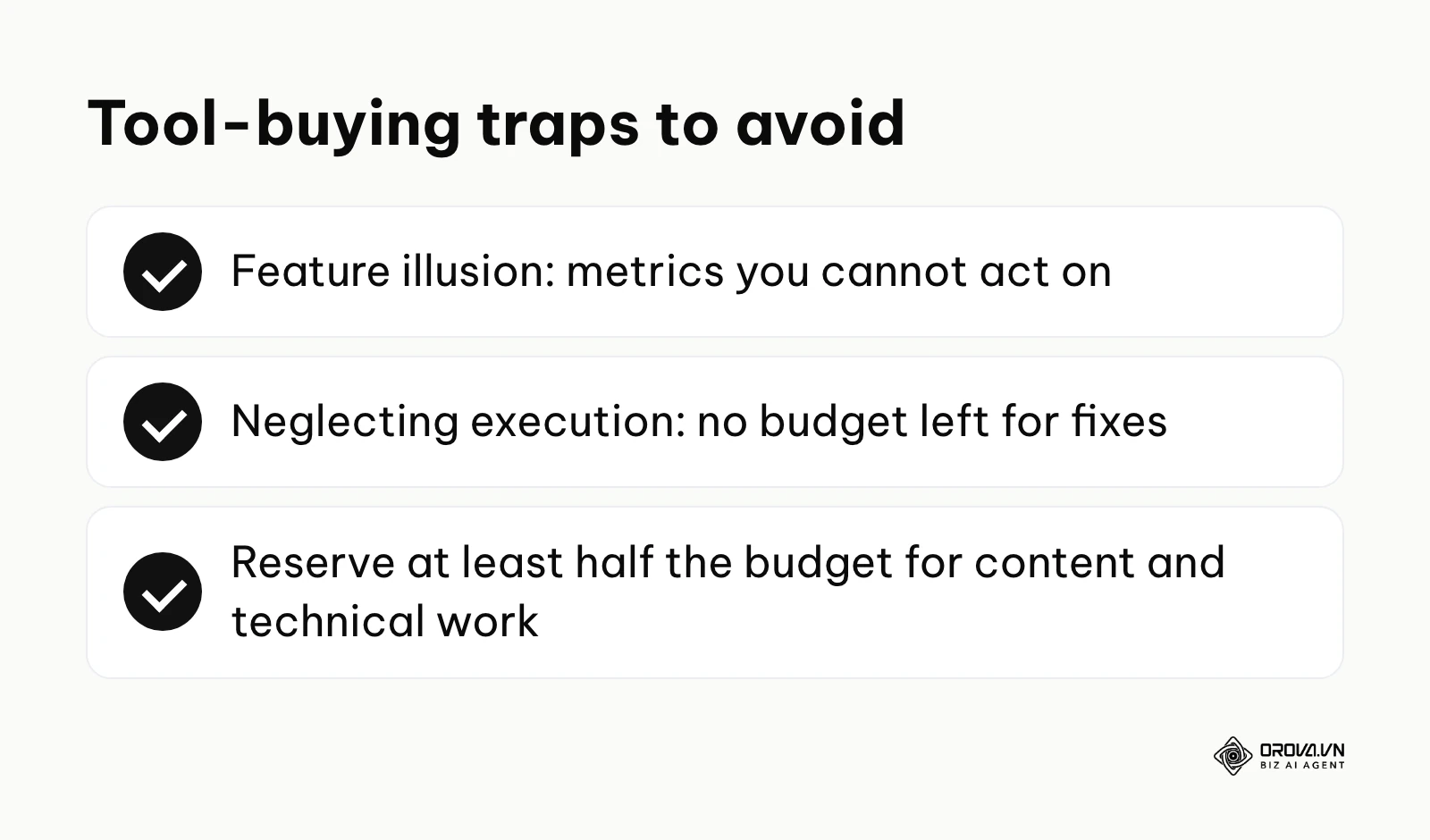
When selecting your tool stack, be aware of the common traps. The most dangerous trap is the "feature illusion." Vendors will sell you on dashboards featuring hundreds of proprietary metrics and complex graphs. If you cannot directly connect a metric to a specific action your team can take to improve revenue, that metric is useless vanity data. Do not pay for features you will never use.
Another major trap is neglecting the execution phase. Tracking is only 10 percent of the battle; fixing the content is the other 90 percent. If you spend your entire budget on a tracking tool and have no money left to pay writers or developers to optimize your site, your visibility will never improve. Always reserve at least half of your AI SEO budget for content production and technical implementation.
| Organizational Scale | Recommended Minimum Toolset | Primary Focus Area |
|---|---|---|
| Independent/Solo | Manual Spreadsheet + Google Search Console | Identifying baseline visibility gaps on core terms |
| Small Business | AI SEO Suite + Basic Technical Crawler | Rapidly updating legacy content to be AI-friendly |
| Mid-Size Team (3-5) | AI SEO Suite + Citation Checker | Building authoritative entities and tracking ROI |
| Large Agency | Enterprise Platform + Citation Checker | Managing multi-client sentiment and massive RAG manipulation |
AI visibility trends in the next few years: Author's perspective
As of 2026, the digital landscape is shifting quickly. The transition from search engines to answer engines is no longer a prediction; it is our operational reality. Based on how LLM architecture and AI search products are evolving, here is where I believe AI visibility tracking is heading in the next two to three years, and what you must do to prepare.
The death of "Share of Search" and the rise of "Share of Model"
Today, marketers still obsess over their share of voice on traditional search engine result pages. I think that in the coming years, this metric will be viewed as a secondary, lagging indicator. The primary KPI for brand dominance will become "Share of Model." We will measure how deeply embedded a brand's entities and facts are within the training weights of the foundational models themselves. Brands that fail to establish themselves as authoritative entities within the training data will simply cease to exist in the primary discovery channels of the future. You must start building dense, fact-based digital footprints now, ensuring your brand is inextricably linked to your core category concepts across the entire web.
RAG will force brands to become raw data publishers
Currently, content marketing relies heavily on storytelling, opinion, and subjective formatting. I believe that as Retrieval-Augmented Generation (RAG) becomes the dominant method for AI to answer niche queries, brands will have to fundamentally alter how they publish. AI models do not want your marketing spin; they want your raw, parsable data to synthesize their own answers. I think we will see a massive shift toward brands publishing open-access databases, comprehensive API documentation, and highly structured, schema-rich specification sheets designed explicitly for machine consumption rather than human reading. You must prepare by auditing your current content and stripping away the fluff, replacing it with hard, verifiable data points.
The emergence of defensive AI optimization
Right now, visibility tracking is largely an offensive strategy—trying to get cited more often. I predict that as AI models increasingly hallucinate or rely on outdated training data, we will see the rise of "defensive AI optimization." Brands will have to actively monitor models for false or damaging information generated about their products. When a hallucination occurs, brands will need dedicated protocols to rapidly publish corrective data structures across high-authority networks, essentially forcing the AI to update its understanding via RAG. You should prepare by establishing a crisis monitoring protocol specifically for AI outputs, treating a negative AI hallucination with the same urgency as a viral negative PR event.
Frequently asked questions about AI visibility tracking
Is AI visibility tracking just a new name for rank tracking?
No. Rank tracking measures the static position of a specific URL on a specific search engine results page for a specific keyword. AI visibility tracking measures the frequency and sentiment of your brand's overall concept being mentioned across fluid, generative answers provided by various Large Language Models. Rank tracking deals with links; AI tracking deals with entities and context.
How often do LLMs update their knowledge to reflect my optimizations?
It depends entirely on the architecture of the specific AI engine. Foundational models (like the base version of GPT-4) have strict training data cut-off dates and only update when the developers release a new version, which can take months. However, modern engines utilizing Retrieval-Augmented Generation (RAG), like Perplexity or ChatGPT with Search, browse the live internet to formulate answers. If you update your content and force a re-crawl from traditional search indexers, a RAG-based AI can reflect your optimizations within days.
What role does AI play in the future of brand reputation management?
AI will act as the ultimate gatekeeper and first touchpoint for consumer research. Before a user ever visits your website or reads a review, they will ask an AI for a summary of your brand's reputation. If the AI synthesizes a negative or indifferent response based on its training data, that user will never enter your sales funnel. Managing your AI visibility is indistinguishable from managing your overall brand reputation in the modern era.
Can I improve my AI visibility without spending massive amounts of money?
Yes, absolutely. The foundation of AI visibility is clear, structured, and authoritative data. You can improve your standing by restructuring your existing website content into clear Q&A formats, implementing robust schema markup, and ensuring your technical site speed is flawless. Furthermore, utilizing the free manual tracking template provided in this guide allows you to gather actionable data without spending any money on software subscriptions.
Do traditional backlinks still matter for AI visibility?
Yes, they matter immensely, particularly for RAG-based models. When an AI searches the live web to formulate an answer, it relies on traditional search engine indexes (like Bing or Google's index) to determine which websites are authoritative and trustworthy. A strong backlink profile signals to the AI that your domain contains reliable information, making it mathematically far more likely that the model will pull from your content to generate its response.
Where should you start?
Knowing that the landscape has changed is only the first step; taking decisive action is what separates successful brands from obsolete ones. You do not need to overhaul your entire marketing department overnight, but you must take a concrete step forward today based on your current reality.
If you have absolutely no data, no budget, and are completely blind to how AI perceives you, your first step is simple. Copy the manual Google Sheets tracking template provided in this guide. Spend one hour today defining your top 10 core business queries. Open an incognito browser, run those queries through ChatGPT and Perplexity, and log the results. You will immediately see where you stand, and this baseline data will serve as the foundation for every future strategy you build.
If you already have some data indicating that your organic traffic is dropping and you know you are losing ground to AI answers, your first step is a technical audit. Choose your five most important, revenue-generating landing pages. Strip away the complex marketing paragraphs and rewrite the core value propositions into clear, bulleted technical specifications. Ensure those pages have flawless structured data markup. Some teams also experiment with an llms.txt file; check what it can and cannot do before you rely on it. You must make it effortlessly easy for a machine to read and categorize your product.
If you have a dedicated budget and recognize that manual tracking and manual content updates will not scale across your enterprise, your first step is software evaluation. Begin trialing AI SEO writing and optimization suites. Look for platforms that consolidate the workflow—allowing you to identify the visibility gap and immediately generate the optimized content to fill it, shortening your time-to-execution.
About the author

Builder of Orova
Nguyễn Đỗ Trọng Ân has 8 years of experience in marketing, including 6 years managing market development across Asia. He builds Orova, a Biz AI Agent that never sleeps: it plans, runs and optimizes work for businesses.
Run your business with AI Agents
Orova is the always-on Biz AI Agent — it plans, runs, and optimizes the work for you.
Save time, unlock productivity.