
BambooHR ATS review: Pricing, TCO, limits, and setup guide

Selecting the right applicant tracking system often turns into an expensive compromise between feature complexity and administrative overhead. For growing businesses, deploying BambooHR ATS appears to be the most convenient path because it bundles recruitment directly into an established human resources information system (HRIS). However, buying an applicant tracking system based solely on brand reputation frequently leads to unbudgeted platform fees, rigid evaluation pipelines, and recruiter frustration when applicant volumes spike.
This comprehensive analysis deconstructs BambooHR ATS from an architectural, financial, and operational perspective. We examine its core hiring functionality, calculate the true total cost of ownership across various company sizes, identify the exact capacity limits where the system begins to bottleneck, and evaluate how legacy keyword-based tracking compares to modern, AI-driven recruitment workflows.
BambooHR ATS: Core Architecture, Ideal Users, and Operational Boundaries
BambooHR ATS is an integrated applicant tracking module built directly into the BambooHR cloud HRIS ecosystem, designed to help small and mid-sized businesses publish requisitions, track candidate stages, collaborate on applicant evaluations, and seamlessly transition hired candidates into core employee records without redundant data entry.
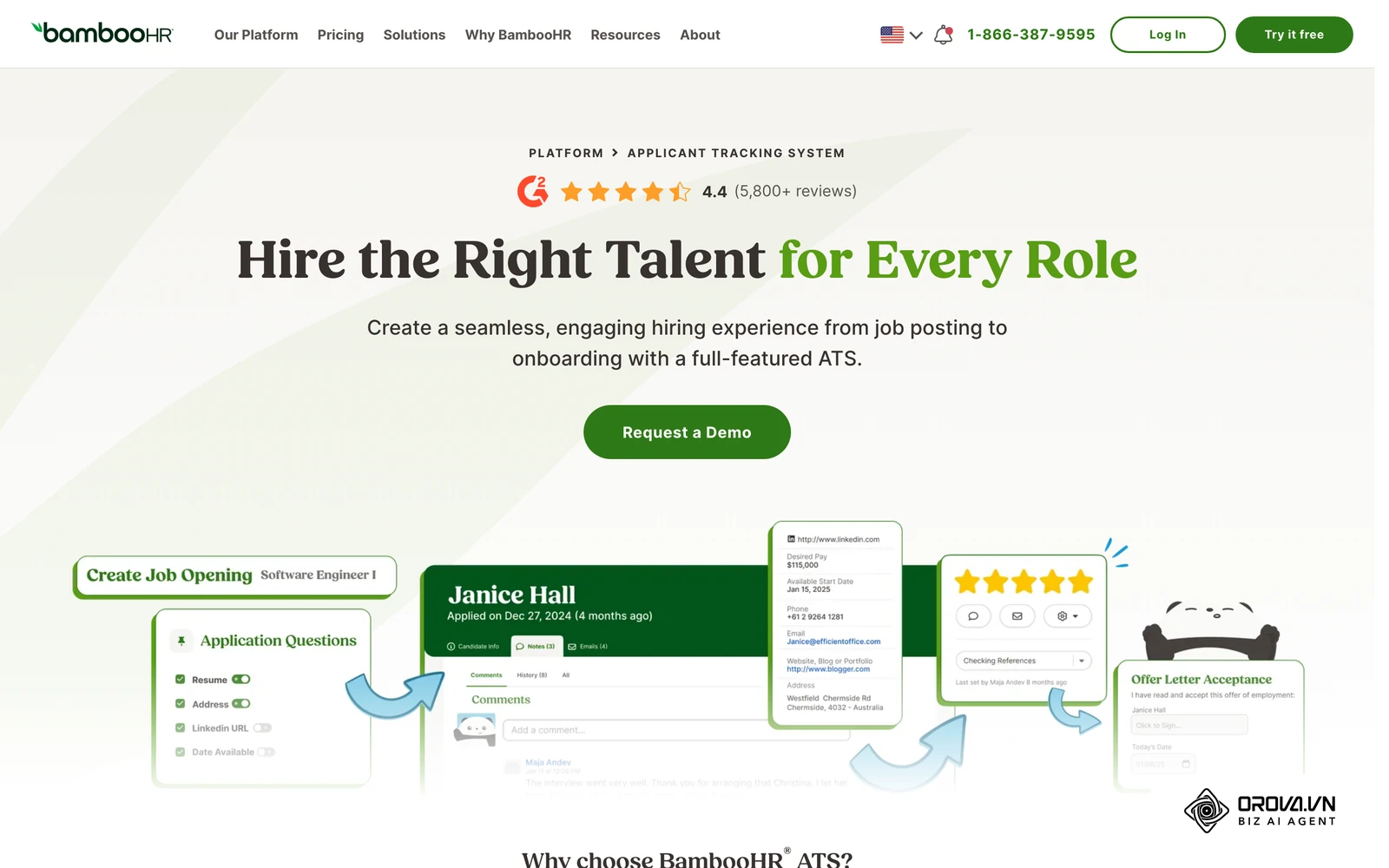
The system serves small-to-midsize businesses (SMBs) with 20 to 150 employees that prioritize centralized employee records, simple hiring collaboration, and basic candidate tracking without configuring enterprise-grade hiring architectures. It is particularly effective for teams hiring between two and five positions concurrently where hiring managers need a clean, intuitive interface rather than advanced recruitment automation.
Conversely, organizations should avoid relying on BambooHR ATS if they operate high-volume seasonal hiring, run technical recruiting pipelines requiring automated coding tests, manage specialized executive search workflows, or demand granular candidate rediscovery databases. Because BambooHR sells the ATS inside its HR platform plans (Core, Pro, and Elite) rather than as a separately priced product on its pricing page, companies that only need recruiting software will pay for HR seats they may not use. Understanding how this module operates within a broader HR software strategy is essential, as detailed in our guide on evaluating an ATS versus HRIS.
The recruitment engine functions through three structural pillars:
- Requisition and Job Distribution Engine: Publishes job openings and, according to BambooHR's ATS page, integrates with job boards such as Indeed, ZipRecruiter, and LinkedIn, plus a careers page for your website.
- Collaborative Pipeline Kanban: Visualizes candidate progression across standardized hiring milestones, allowing hiring leads to leave internal comments, rate candidates, and log email communications.
- Downstream Employee Handover: Converts approved candidate profiles into active employee records with a single click, transferring resume data, contact details, and signed offer letters directly into the personnel directory.
| System Component | Core Capability | What to Verify in a Demo | Ideal Team Fit |
|---|---|---|---|
| Job Openings Cap | 5 open jobs on Core, 25 on Pro, 50 on Elite (BambooHR pricing page) | How many roles you will have open at the same time at peak | Teams hiring a few roles at once |
| Job Distribution | Job board integrations such as Indeed, ZipRecruiter, and LinkedIn | Which boards are free versus paid promotion in your country | Generalist corporate hiring |
| Pipeline Tracking | Status progression with candidate cards | Whether stages can differ between departments | Standard linear interview processes |
| Candidate Collaboration | Ratings, shared notes, custom permissions, in-system messaging | Whether rating criteria can be set per role | Small hiring committees (2–4 interviewers) |
| Offer Management | Offer letter templates and e-signatures | How merge fields behave with your offer templates | Standard employment agreements |
| HRIS Handover | Direct conversion from candidate to employee record | How multi-entity companies are handled | Single-entity operating companies |
Essential Prerequisites for Deploying BambooHR ATS
Deploying BambooHR ATS successfully requires foundational data, administrative privileges, and structured hiring assets prepared in advance. Launching requisitions without standardized job descriptions and pre-established review scorecards causes fragmented candidate communication and inconsistent hiring decisions across departments.
Before enabling the ATS module, your talent operations team must audit current hiring workflows, gather company documentation, and establish user permissions. The table below outlines the necessary assets, their primary source, and the realistic timeline required to assemble them.
| Required Asset | Internal Source | Preparation Time | Purpose in BambooHR ATS |
|---|---|---|---|
| Standardized Job Descriptions | Department Heads / Hiring Managers | 3–5 business days | Populate requisition templates and automated job board syndication fields |
| Hiring Permission Matrix | HR Operations / Executive Leadership | 1–2 business days | Configure custom access levels (Admin, Hiring Lead, Collaborator) |
| Candidate Email Templates | Talent Acquisition Lead | 2–3 business days | Establish automated communication triggers for application, screening, and rejection |
| Evaluation Scorecard Criteria | Department Teams | 2–4 business days | Standardize interview assessment dimensions across technical and cultural competencies |
| Career Page Domain Access | IT / Web Development Team | 1 business day | Embed the BambooHR job widget or configure custom subdomain CNAME records |
| E-Signature Offer Documents | Legal / Human Resources | 2 business days | Upload standard employment agreements and set up dynamic merge tags |
How to Configure and Run BambooHR ATS in 6 Actionable Steps
Configuring BambooHR ATS involves a structured sequence of administrative steps to ensure job boards receive clean data, hiring managers access only appropriate records, and candidates experience prompt, professional communication.
Step 1: Define Requisitions and Hiring Lead Permissions
The configuration process begins by creating a structured job requisition within the Settings menu under Hiring. Define mandatory fields including job title, employment type (full-time, part-time, contractor), department, geographic location, and compensation visibility. Once the requisition template is drafted, navigate to Access Levels to assign specific team members as Hiring Leads.
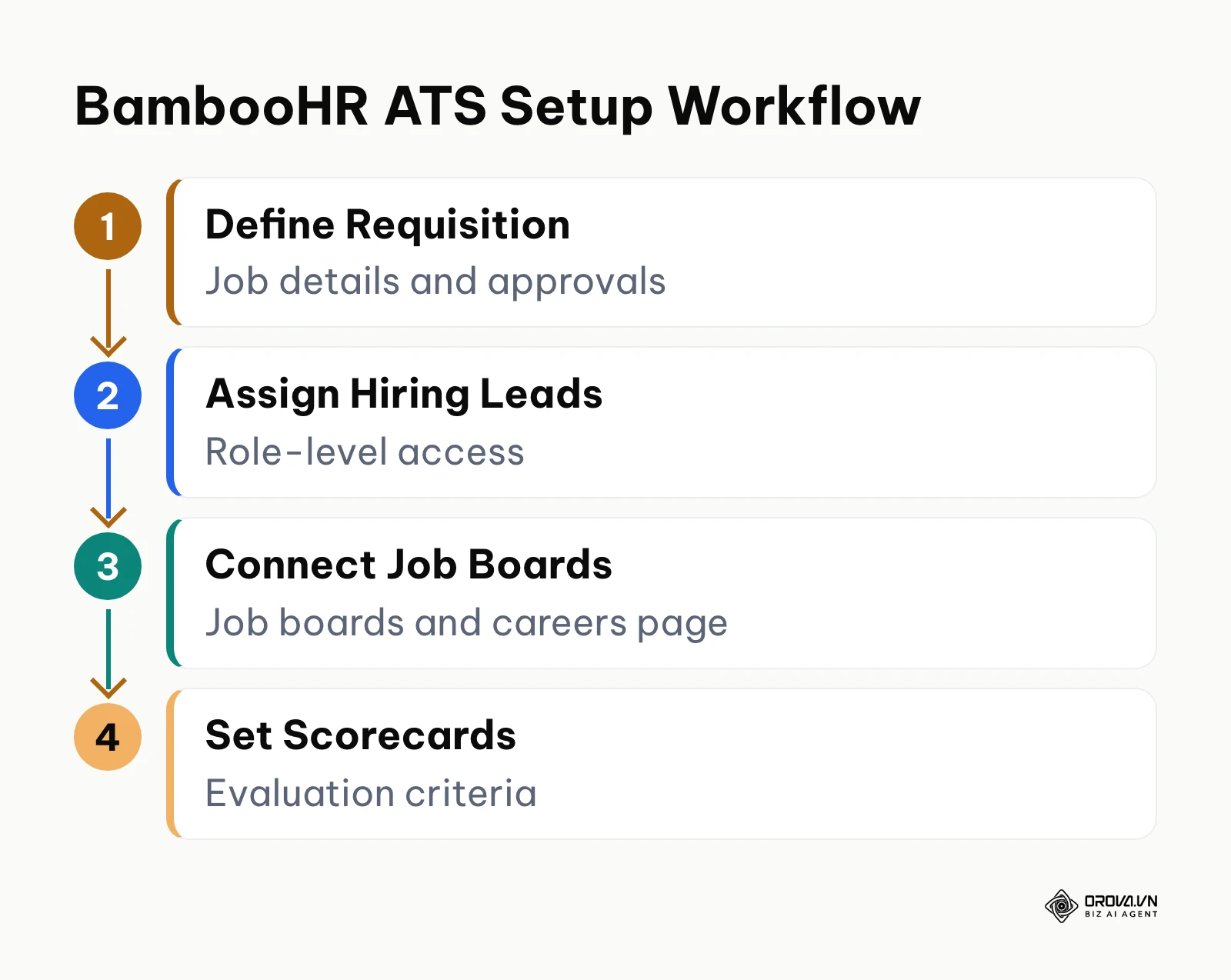
The diagram below summarizes the essential workflow for establishing new requisitions and role permissions.
To execute this step, open the Hiring Settings tab, click New Job Opening, enter the standardized job description, and select the designated hiring manager under the Hiring Lead dropdown menu. Set permission flags to ensure non-HR interviewers cannot view sensitive candidate data, such as salary expectations or background check notes.
You know this step is completed correctly when the job opening displays an Active draft status and the designated Hiring Lead receives an automated system notification granting them access exclusively to that specific candidate pipeline. A common mistake here is assigning administrative privileges to department managers, which unintentionally exposes compensation data across all company job openings.
Step 2: Establish Multi-Board Job Distribution and Careers Page Sync
With the requisition established, activate outbound distribution channels to attract applicant flow. BambooHR's ATS page lists job board integrations such as Indeed, ZipRecruiter, and LinkedIn, alongside a careers page you can link from your website.
To configure syndication, navigate to the Job Opening, select Job Board Distribution, and toggle on the partner integrations. Next, copy the provided iframe code or API script from the Career Site settings tab and deliver it to your web development team to embed into your company careers page.
| Setting | Where to Configure | How to Confirm It Works |
|---|---|---|
| Job board posting | Job opening > job board options | The opening appears on each selected board |
| Careers page link | Careers page settings | A test application arrives in BambooHR |
| Location fields | Job opening details | City and country are filled for every role |
| Source tracking | Candidate profile | Test applications show the correct source |
A successful setup is confirmed when test applications submitted through your live careers page appear instantly inside the BambooHR ATS incoming applications inbox with the source tag labeled correctly. The most frequent failure point is omitting the geographic city and country parameters in the job opening, which causes job boards like Indeed to reject the automated feed silently.
Step 3: Standardize Candidate Evaluation Scorecards
Objective evaluation requires consistent criteria. BambooHR ATS provides a candidate rating interface where team members submit star ratings and written feedback after each interview session.
To set up evaluation criteria, enter the Candidate Evaluation settings for the specific requisition. Input three to five core competency dimensions, such as technical execution, strategic problem solving, team communication, and role experience. Instruct your interview team to avoid free-form, unguided notes in favor of structured feedback tied directly to these dimensions.
The setup is operating correctly when all assigned interviewers submit their scorecards within 24 hours of completing an interview, enabling the hiring lead to view an aggregated average rating on the candidate profile. A common error is using generic, one-size-fits-all scorecards across divergent roles, which results in sales managers and software engineering leads scoring candidates against irrelevant performance standards.
STANDARD CANDIDATE EVALUATION SCORECARD
Candidate Name: [Candidate Full Name]
Position: [Job Title]
Evaluator: [Interviewer Name]
Interview Stage: [Technical Screen / Team Panel / Culture Alignment]

Evaluation Dimensions (Rated 1 to 5):
1. Role-Specific Competence (Weight: 30%)
   - Score: [1 - 5]
   - Concrete Evidence: [Document specific examples demonstrated by candidate]

2. Problem-Solving Methodology (Weight: 25%)
   - Score: [1 - 5]
   - Concrete Evidence: [Notes on structured thinking and analytical approach]

3. Communication and Cross-Functional Alignment (Weight: 25%)
   - Score: [1 - 5]
   - Concrete Evidence: [Clarity of articulation, listening ability, responsiveness]

4. Values and Working Style Alignment (Weight: 20%)
   - Score: [1 - 5]
   - Concrete Evidence: [Collaboration habits and workplace adaptability]

Recommendation:
[ ] Definite Hire  [ ] Hire with Reservations  [ ] Do Not Hire
Mandatory Justification: [2-3 sentences summarizing the hiring decision]
Step 4: Configure Automated Candidate Communication Stages
Candidate experience deteriorates rapidly when communication stalls. Configure automated email alerts inside BambooHR ATS to notify applicants when their resume is under review, when an interview is requested, or when a position has been filled.
Navigate to Hiring Settings > Email Templates. Create five standardized communication templates: application confirmation, initial screening invitation, interview prep packet, conditional offer letter, and respectful rejection. Map each template to trigger when a candidate card moves into a specific pipeline stage.
| Template | Pipeline Trigger | Send Mode | Merge Fields to Check |
|---|---|---|---|
| Application received | New application | Automatic | Candidate first name, job title, company name |
| Screening invitation | Moved to recruiter screen | Manual after review | Recruiter name, scheduling link |
| Interview preparation | Moved to team interview | Automatic | Interviewer names, interview length |
| Offer letter | Moved to offer | Manual with e-signature | Offer expiration date, signature link |
| Respectful rejection | Archived or not selected | Automatic after final decision | Candidate first name, job title |
Verify this step by moving an internal test candidate card through each pipeline stage and confirming receipt of the corresponding email within two minutes. A widespread error is failing to insert fallback defaults for dynamic merge tags like candidate first name or job title, resulting in embarrassing emails addressed to empty brackets or raw variable code.
1. Application Received (Automated Trigger: New Application)
Subject: We received your application for [Job Title] at [Company Name]
Hi [Candidate First Name],
Thank you for your interest in joining [Company Name]. We have successfully received your application for the [Job Title] position.
Our hiring team is currently reviewing qualifications against our role requirements. You can expect an update regarding your application status within 5 business days.
Best regards,
The Talent Team at [Company Name]

2. Screening Invitation (Manual Trigger: Recruiter Review)
Subject: Interview invitation: [Job Title] at [Company Name]
Hi [Candidate First Name],
Your background caught our attention, and we would like to invite you to an introductory 30-minute conversation to discuss the [Job Title] role.
Please select a convenient time using the scheduling link below:
[Scheduling Link]
We look forward to speaking with you.
Best regards,
[Recruiter Name]

3. Panel Interview Preparation (Trigger: Second Round Stage)
Subject: Preparing for your upcoming interview with [Company Name]
Hi [Candidate First Name],
We are excited to proceed to the next stage of our interview process for the [Job Title] opening.
Your upcoming session will last approximately 60 minutes and will include members of our department team: [Interviewer Names and Titles].
During this session, we will focus on practical scenario discussions and your past project execution. Please review the attached preparation brief prior to the call.
Best regards,
[Recruiter Name]

4. Official Offer Letter (Trigger: Offer Stage)
Subject: Offer of Employment: [Job Title] at [Company Name]
Dear [Candidate First Name],
On behalf of [Company Name], I am thrilled to offer you the position of [Job Title].
Please review the attached formal offer letter detailing your compensation structure, benefits package, and start date. You can review and execute the document directly through the secure link below.
[Electronic Signature Link]
This offer remains open for your review through [Offer Expiration Date].
Warm regards,
[Hiring Executive Name]

5. Respectful Rejection (Trigger: Archived / Unselected)
Subject: Update regarding your application for [Job Title] at [Company Name]
Dear [Candidate First Name],
Thank you for taking the time to share your background and interview with our team for the [Job Title] position.
While your experience is impressive, we have chosen to move forward with another candidate whose specific background aligns more closely with our current operational needs.
We appreciate your time and wish you continued success in your professional endeavors.
Sincerely,
The Talent Team at [Company Name]
Step 5: Execute Collaborative Team Reviews and In-App Notes
Once active applications populate the pipeline, maintain evaluation velocity by centralizing all reviewer feedback inside the BambooHR ATS interface rather than through external chat messages or emails.
| Reviewer Role | Access Level | What They Must Submit | Deadline |
|---|---|---|---|
| Hiring lead | Full access to assigned openings | Stage decisions and final recommendation | Same day as debrief |
| Interviewer | Limited collaborator access | Scorecard plus evidence-based notes | Within 24 hours |
| HR admin | Admin access | Offer data and compliance documents | Before the hire action |
Instruct all team interviewers to log into their limited-access accounts immediately following an interview. Have them record concrete behavioral notes under the Candidate Notes tab, tag colleagues using internal mentions, and submit their final scorecard rating.
Illustrative example: A 35-person logistics software agency with one internal talent lead configured BambooHR ATS for an urgent senior frontend developer search. The recruiter set up a multi-stage pipeline, assigned a five-point scorecard to three interviewers, and linked automated invitation templates. During week two, interview feedback stalled because technical evaluators found the native note fields cumbersome and submitted blank scorecards. The lead resolved this by simplifying the scorecard from 14 criteria down to 4 critical competencies and making scorecard completion mandatory before advancing candidates. The team successfully filtered 142 applicants down to three finalist interviews within 18 days, reaching an accepted offer on day 24 without administrative bottlenecks.
Step 6: Transition Hired Profiles into Downstream Employee Records
The final operational step transitions an accepted applicant into an active team member without manual data re-entry.
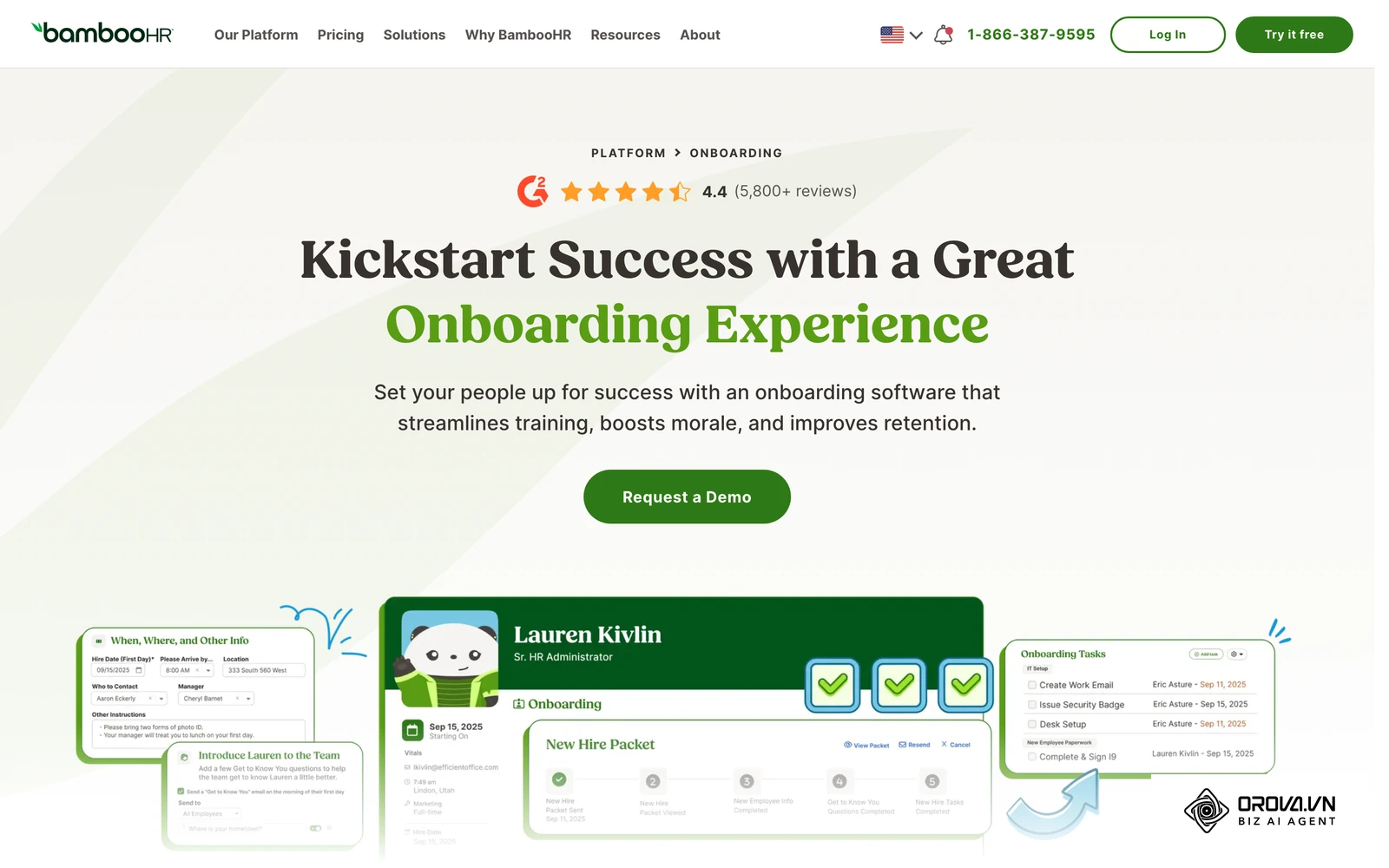
When a signed offer letter is returned, select the candidate profile and click Hire Candidate. The system presents a data mapping dialogue that transfers the candidate personal phone number, home address, personal email, resume file, and starting compensation into the BambooHR core employee database. Select an onboarding workflow template to schedule introductory tasks for IT provisioning, payroll enrollment, and direct deposit setup.
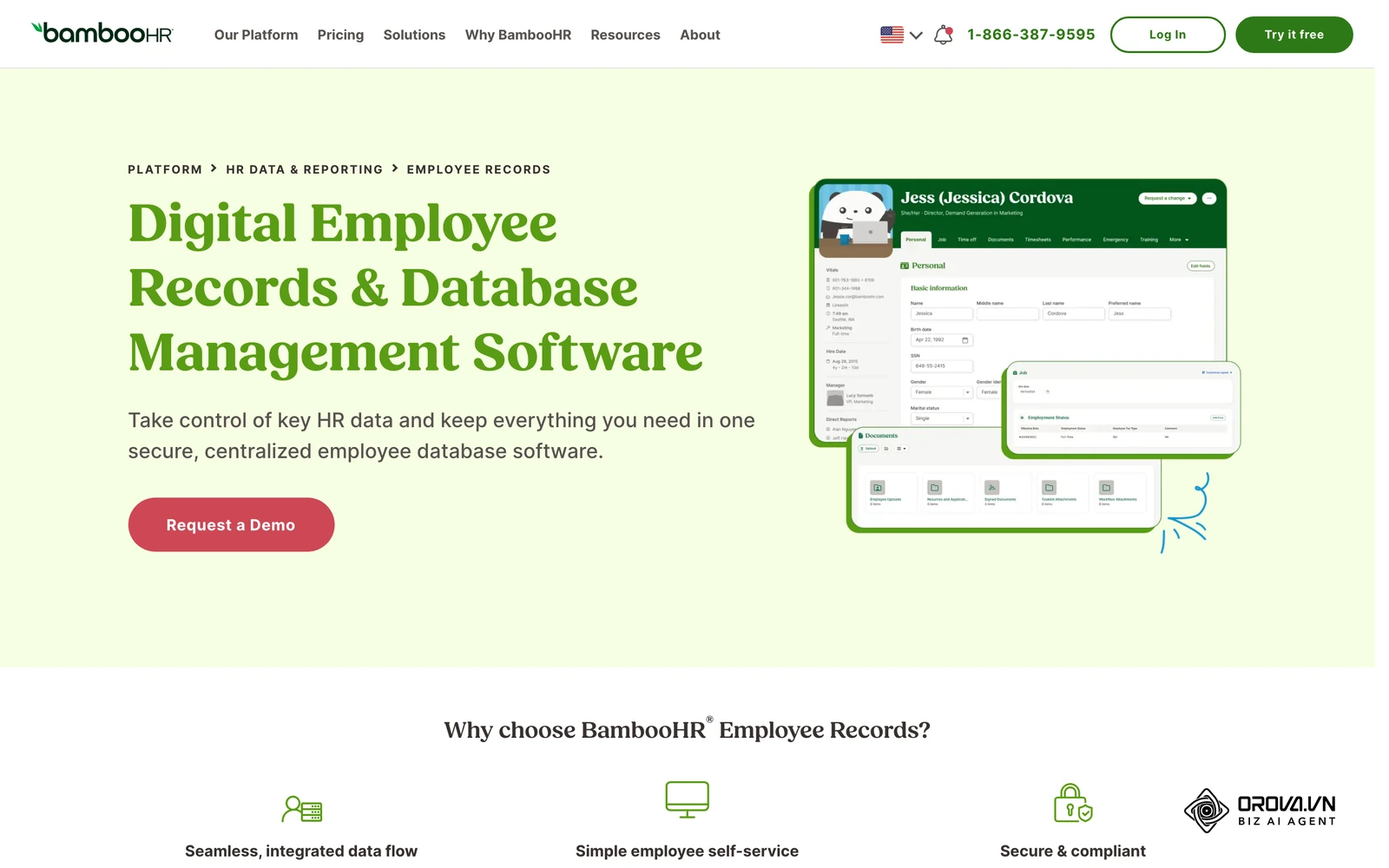
This step is working properly when the individual appears in the employee directory with an upcoming start date and the onboarding task checklist triggers automatically to system owners. A typical error is initiating the hire action before all compliance documents are executed, requiring HR administrators to manually alter system records post-creation.
Need faster screening without bloated HRIS fees? Orova Recruit extracts weighted criteria directly from your job description, scores up to 500 uploaded resumes against exact textual evidence, and drafts targeted interview questions in minutes.
In-Depth Operational Analysis: Hidden TCO, Legacy Parsing, and Modern AI Recruiting
Evaluating BambooHR ATS requires looking beyond its user interface to analyze the financial realities of bundled software, its structural architectural boundaries, and how legacy applicant tracking compares to emerging recruiting technologies.
Real-World TCO Analysis: Year-One Investment Across Company Sizes
The most important financial fact about BambooHR ATS is that it is sold as part of BambooHR's HR platform plans, not as a separately priced recruiting product. BambooHR's public pricing page (checked October 2026) lists three plans, all of which include the Applicant Tracking System. The difference for hiring is the number of open jobs: 5 job openings on Core, 25 on Pro, and 50 on Elite.
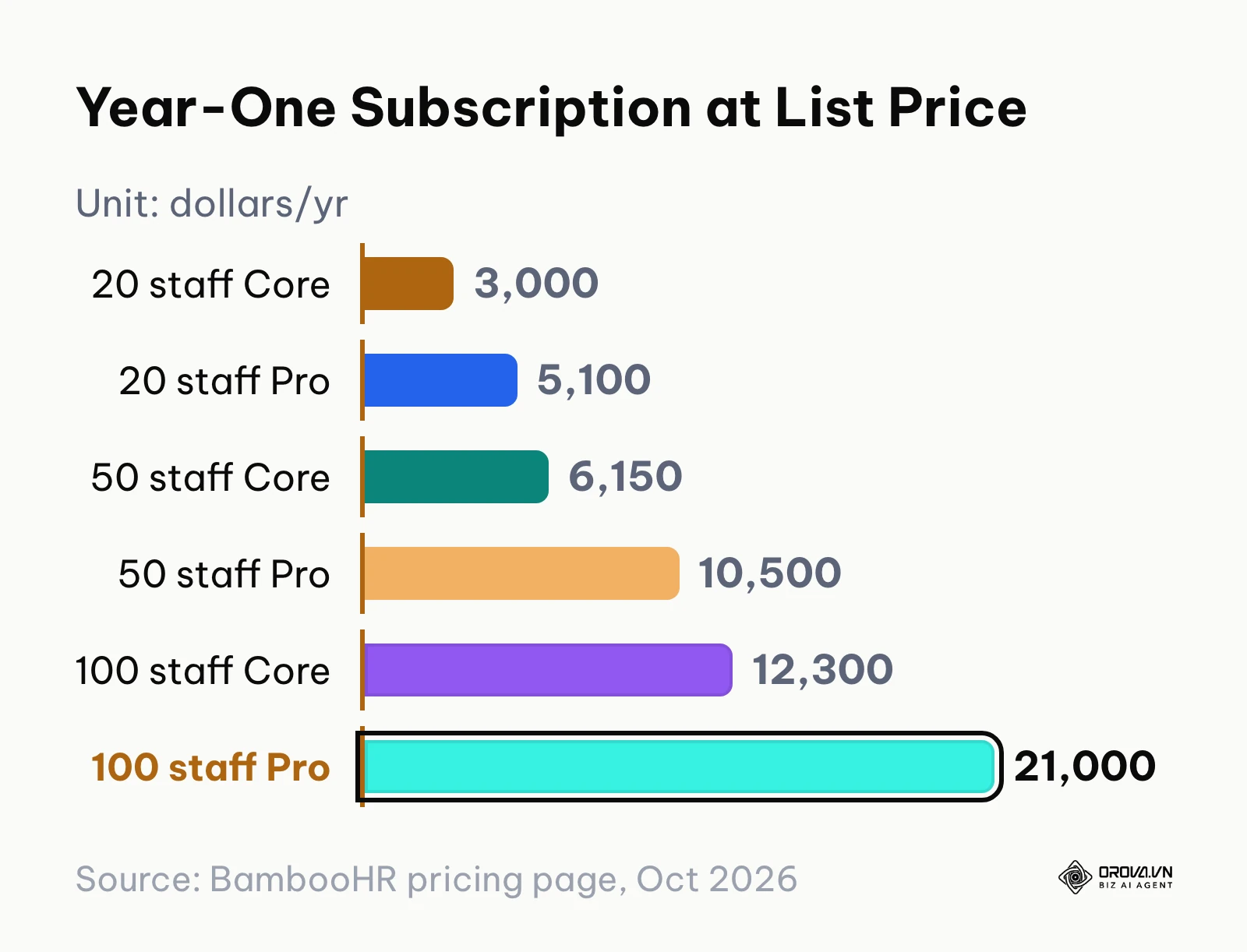
Published list prices: companies with 25 employees or fewer pay a flat monthly rate of 250 dollars for Core, 425 dollars for Pro, or 650 dollars for Elite. Above 25 employees, pricing starts at 10.25 dollars per employee per month for Core, 17.50 dollars for Pro, and 25 dollars for Elite, with volume discounts applied automatically. Setup or implementation charges are not published, so ask for them in writing in your quote. For a business hiring only occasionally, paying for every employee each month can cost more than a dedicated recruiting tool, as explored in our breakdown of recruitment CRM systems vs ATS.
The table below turns those list prices into a first-year estimate for three company sizes. Subscription rows use BambooHR's published prices before volume discounts; the job board row is an assumed example, not a BambooHR price.
| Cost Component | 20-Employee Organization | 50-Employee Organization | 100-Employee Organization |
|---|---|---|---|
| Lowest plan with ATS | Core (5 open jobs) | Core (5 open jobs) | Core (5 open jobs) |
| Published Core price | 250 dollars / month flat | 10.25 dollars × 50 = 512.50 dollars / month | 10.25 dollars × 100 = 1,025 dollars / month |
| Core annual subscription | 3,000 dollars | 6,150 dollars | 12,300 dollars |
| Pro annual subscription (25 open jobs) | 425 dollars × 12 = 5,100 dollars | 17.50 dollars × 50 × 12 = 10,500 dollars | 17.50 dollars × 100 × 12 = 21,000 dollars |
| Implementation / setup | Not published; ask in quote | Not published; ask in quote | Not published; ask in quote |
| Paid job board promotion (assumed example) | 300 dollars | 400 dollars | 800 dollars |
| Year-one estimate on Core | 3,300 dollars + setup | 6,550 dollars + setup | 13,100 dollars + setup |
Illustrative example: A 22-person fintech startup plans to hire three people this quarter. Because it has 25 employees or fewer, Core costs a flat 250 dollars per month, or 3,000 dollars for the year, whether it hires three people or none. If the team expects more than five open roles at the same time, it needs Pro at 425 dollars per month, or 5,100 dollars for the year. The founder compares that figure with the cost of a lighter recruiting tool before deciding whether the company also needs BambooHR's HR features right now.
The Red Flags Checklist: 5 Quantitative Signals That BambooHR ATS Is Maxed Out
As organizations expand, recruitment complexity can outgrow a simple linear pipeline. When teams hit specific operational thresholds, continuing to use a basic all-in-one ATS causes administrative slowdowns and lost candidate opportunities.
Use this quantitative checklist to evaluate whether your hiring volume has surpassed what your current BambooHR ATS setup handles well:
| Red Flag | Threshold | Why It Matters |
|---|---|---|
| Concurrent requisitions exceed 5 openings | 6+ open jobs at once | Core includes 5 job openings; a sixth role means Pro (25) or Elite (50), priced across your whole headcount |
| Applicant volume surpasses 150 resumes per requisition | 150+ applicants per role | If every resume is still read by hand, screening time grows with each applicant and backlogs build |
| Department-specific pipeline divergence | Teams need different stage counts | Technical roles may need five stages while sales needs three; check whether one shared setup still fits |
| Candidate rediscovery needs (talent pooling) | Re-engaging past finalists is routine | Recruiters need to search, tag, and re-contact strong past applicants from earlier roles |
| Multi-tiered review permissions | Confidential leadership hires | Sensitive requisitions must stay isolated from standard department hiring leads |
If your team checks three or more of these red flags, it is time to consider a dedicated recruitment workflow or an AI-augmented screening infrastructure, similar to the strategies discussed in our evaluation of Recruitee software vs AI hiring platforms.
Legacy Keyword Matching vs. Semantic AI Recruitment Agents
The main difference between traditional applicant tracking and newer AI screening tools lies in how candidate qualifications are analyzed. Traditional ATS workflows, including those in bundled HR suites, rely on recruiters reading resumes, filtering with application questions, and searching for exact keywords such as job titles, degrees, or tool names.
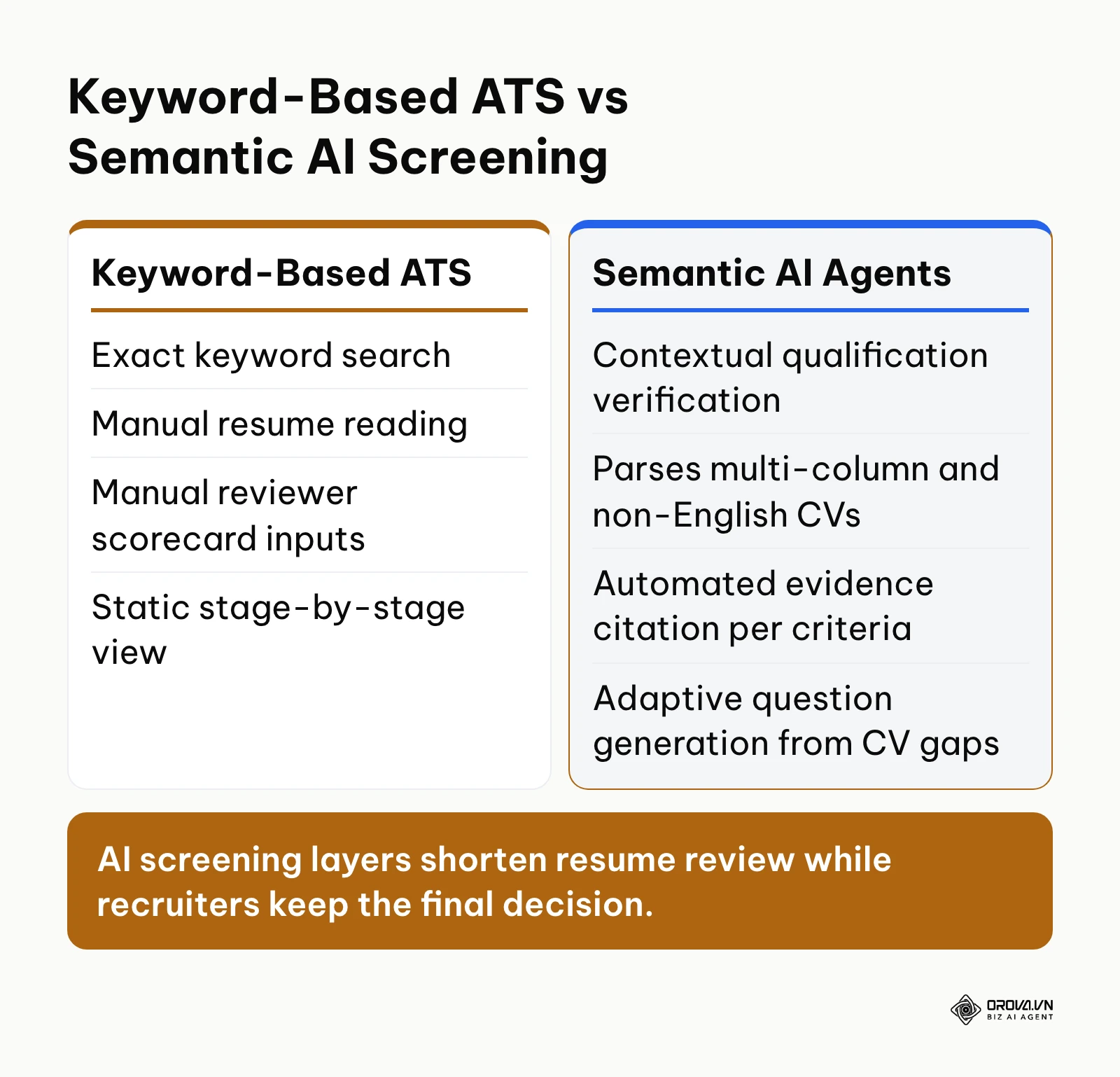
Manual screening is where small hiring teams lose the most time. Keyword search adds a second risk: candidates who format resumes into modern multi-column layouts, use graphical skill meters, or describe their accomplishments without exact keyword phrasing are frequently misparsed or buried at the bottom of the recruiter's inbox.
Modern AI recruitment agents solve this problem through semantic understanding. Instead of searching for exact string matches, semantic models evaluate candidate career trajectories, analyze project scope, and verify whether past accomplishments fulfill job requirements, regardless of formatting or phrasing.
| Evaluation Dimension | Traditional Keyword-Based ATS | Semantic AI Recruitment Agents |
|---|---|---|
| Parsing Mechanism | Text extraction and keyword search; test graphical or two-column PDFs before relying on it | Multi-modal semantic extraction; processes complex layouts, scans, and text |
| Candidate Matching | Boolean search and direct keyword frequency matching | Conceptual and contextual alignment against weighted criteria |
| Language Support | Test non-English and localized CV formats with your own samples | Native multi-language semantic understanding across localized terminology |
| Evaluation Evidence | Recruiters must manually locate supporting text inside the resume document | System cites exact textual evidence justifying why a requirement was passed or failed |
| Interview Questioning | Static question banks managed manually by recruiters | Generates 8–12 targeted interview questions based on specific candidate resume gaps |
| Recruiter Workload | High manual review time per applicant | Low manual review time; recruiters focus immediately on pre-evaluated candidates |
The comparison diagram below illustrates the fundamental workflow differences between traditional keyword tracking and modern semantic recruitment platforms.
Measuring Recruitment Performance: Key Metrics and Bottleneck Thresholds
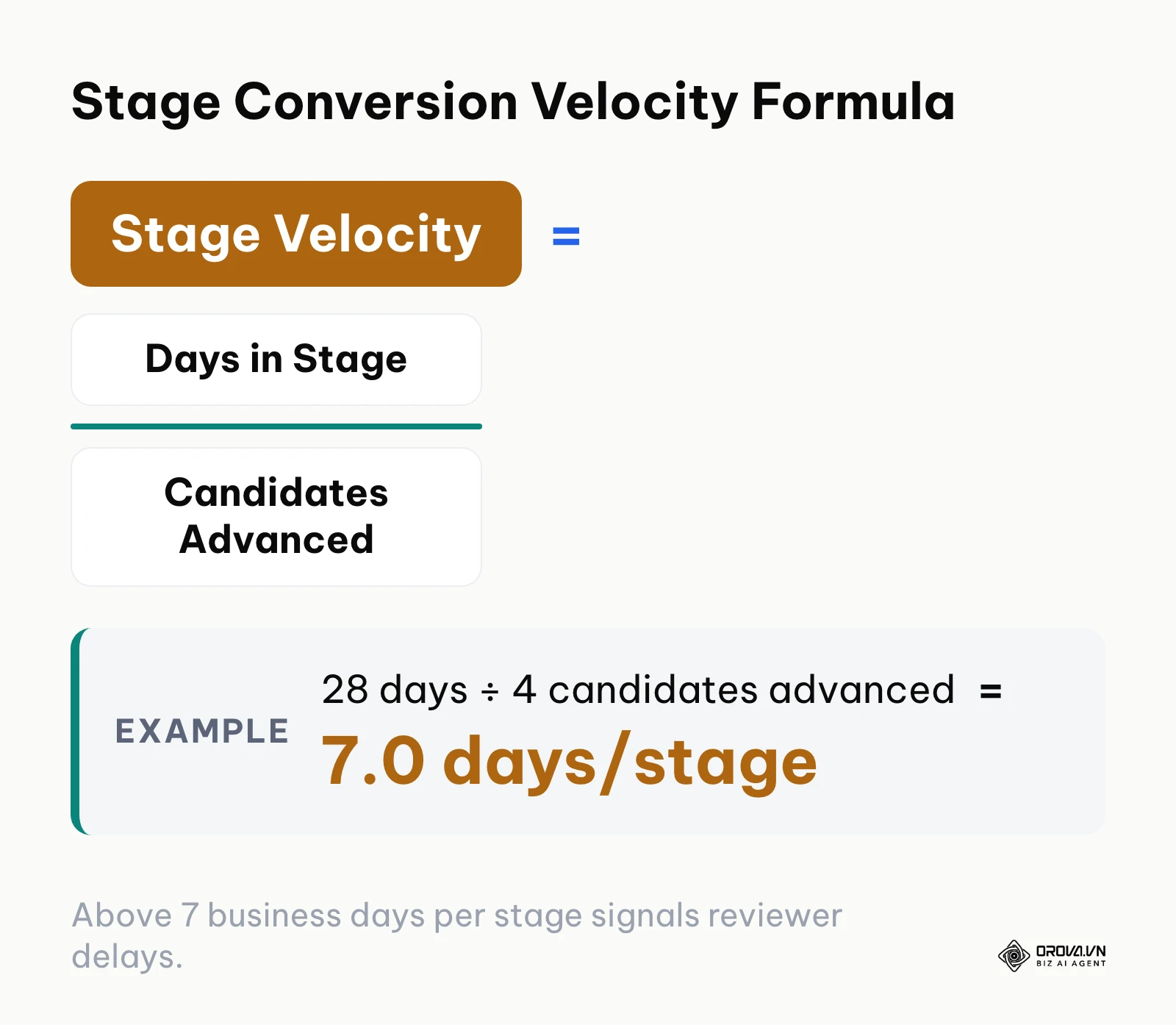
Operating BambooHR ATS effectively requires continuous monitoring of recruitment performance indicators. Talent leaders should actively track stage conversion rates and review times to prevent candidates from abandoning the process.
According to the Society for Human Resource Management (SHRM) in its 2022 Talent Acquisition Benchmarking Report, the average cost-per-hire was close to 4,700 dollars and the average time-to-fill was 44 days. Tracking operational metrics inside your ATS ensures your team stays well below these benchmark ceilings.
The formula diagram below illustrates how to calculate stage conversion velocity to pinpoint internal review bottlenecks before they harm your recruitment outcomes.
| Performance Metric | How to Calculate in BambooHR ATS | Analytical Meaning | Warning Threshold |
|---|---|---|---|
| Time to First Review | Days from candidate application submission to initial recruiter status update | Indicates whether incoming applications are being screened promptly | > 3 business days |
| Stage Conversion Velocity | Total days spent in a specific pipeline stage divided by candidates advanced | Reveals operational bottlenecks within specific interview teams | > 7 business days per stage |
| Offer Acceptance Rate | Total accepted offers divided by total formal offers extended multiplied by 100 | Reflects compensation competitiveness and candidate alignment | < 80% acceptance rate |
| Screening Rejection Ratio | Applicants archived at initial review divided by total applications received | High ratios indicate inaccurate job descriptions or misaligned distribution | > 92% initial rejection |
| Scorecard Completion Rate | Completed interview scorecards divided by total scheduled interviews | Measures internal hiring team engagement and accountability | < 85% completion rate |
Eliminate manual screening overhead and streamline your interview evaluations. Try Orova Recruit completely free through July 7, 2027, and experience automated candidate assessment tailored to your exact hiring standards.
6 Common Mistakes in BambooHR ATS Implementation
Deploying an applicant tracking system inside an existing HRIS frequently creates process traps. Here are six common operational mistakes teams make with BambooHR ATS, along with direct corrective actions.
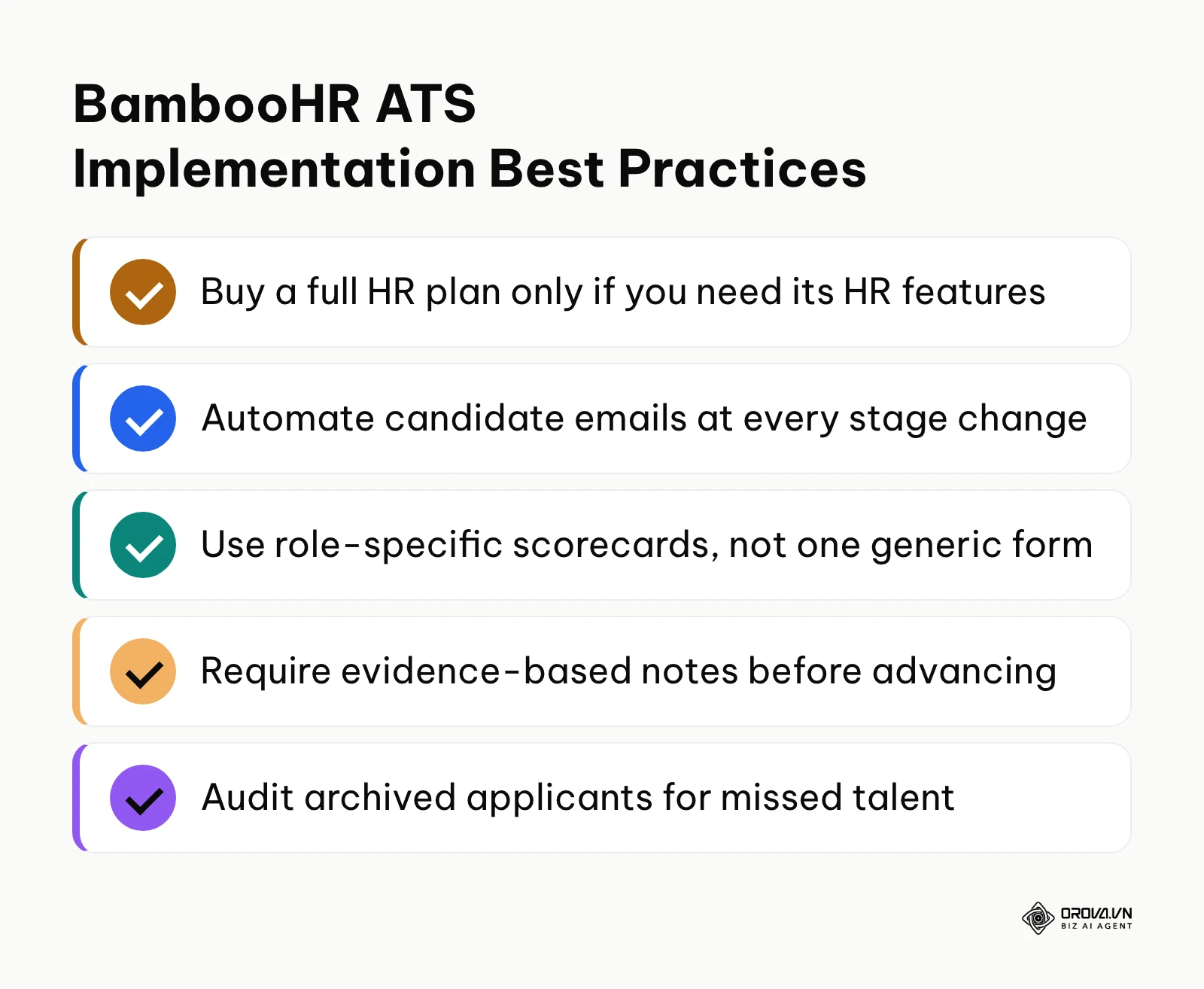
The summary diagram below outlines the core implementation best practices to observe throughout your setup.
- Buying a Full HR Plan Solely for the ATS
- The Consequence: Paying 10.25 dollars or more per employee per month (or the 250 dollars flat rate under 25 employees) for recruiting software that only two or three people use.
- The Fix: If your business does not require BambooHR's core HRIS modules (such as PTO tracking, employee directory, and performance management), procure a dedicated standalone applicant tracking system or modern AI recruitment screening tool.
- Leaving Stage-Gate Transitions Entirely Manual
- The Consequence: Candidates remain in review limbo for weeks because recruiters forget to manually send updates, leading to negative employer brand reviews and candidate drop-off.
- The Fix: Configure automated email rules in BambooHR ATS that trigger instantly when an applicant is moved to the next stage or archived.
| Mistake | Early Warning Sign | What to Check This Week |
|---|---|---|
| Full HR plan bought only for hiring | Only 2–3 people log in to the system | Compare plan cost with the HR features you actually use |
| Manual stage transitions | Candidates wait weeks without an update | Count candidates with no status change in 7 days |
| Generic scorecards | Sales and engineering use the same form | List roles still sharing one scorecard |
| Free-form notes | Feedback reads "good fit" with no evidence | Sample 5 recent notes for concrete evidence |
| Keyword-only filtering | Strong candidates found in the archive | Re-check 20 archived applicants per role |
| ATS used as an island | Feedback lives in chat threads | Check scorecard completion rate |
- Deploying One Generic Scorecard Across Divergent Roles
- The Consequence: Evaluators score candidates using vague personality impressions rather than objective skill assessments, leading to biased hiring and poor retention.
- The Fix: Build role-specific evaluation templates that assess four to five concrete competency dimensions tailored directly to the job description.
- Allowing Free-Form, Unstructured Interview Notes
- The Consequence: Interview feedback consists of unhelpful comments like "good cultural fit" or "did not feel right," providing no legal documentation or objective justification for hiring decisions.
- The Fix: Enforce a mandatory policy requiring interviewers to cite specific conversational evidence and complete all structured scorecard fields before a candidate can advance.
- Relying Exclusively on Legacy Keyword Search to Filter Candidates
- The Consequence: High-performing candidates who describe their background with non-traditional terminology or use modern visual resume formats are filtered out by legacy parsing rules.
- The Fix: Conduct random sampling audits of archived applicants to ensure qualified talent is not being discarded due to parsing errors.
Illustrative example: A 60-person digital marketing agency attempted to process 450 creative designer applicants by searching resumes for exact keywords. The hiring manager noticed that several experienced candidates were skipped because their portfolio-heavy PDF resumes used non-standard typography and graphic skill meters. A manual re-check of 120 archived files found three strong candidates, so the agency added plain-text application questions alongside file uploads.
- Treating the ATS as an Isolated Island from Daily Talent Assessment
- The Consequence: Hiring managers neglect the system interface, conduct unrecorded interviews, and leave HR administrators to piece together fragmented feedback from disconnected chat channels.
- The Fix: Connect modern recruitment productivity platforms that streamline the heavy operational burden of screening and evaluation. For example, Orova Recruit is an internal recruitment workspace organized by job openings: recruiters upload up to 500 resumes per position, AI checks each criterion with quoted evidence from the resume, and it drafts 8 to 12 interview questions aimed at gaps in each resume. The hiring decision stays with the recruiter.
Future Trends in ATS and Hiring Workflows: Author's Outlook
Looking at the current recruitment technology landscape as of 2026, I observe a distinct shift away from monolithic, bundled HRIS platforms toward specialized, modular intelligence layers. Small and mid-sized businesses are increasingly frustrated by paying recurring per-employee fees for static database tables that do not actively reduce the manual labor of reviewing applicants.
Over the next two to three years, I believe the traditional applicant tracking system will transition from a passive system of record into an active coordination agent. Today's standard Kanban board, where human recruiters manually drag candidate cards and copy-paste email templates, will likely be viewed as obsolete. Instead, recruitment platforms will automatically synthesize job requirements, evaluate candidate portfolios across disparate file formats, verify credentials contextually, and draft personalized interview guides before a recruiter ever opens the candidate file. This evolution will occur because hiring teams simply cannot keep pace with the massive volume of AI-generated job applications flooding corporate career pages without deploying automated intelligence on the intake side. However, if legal regulations heavily restrict automated candidate scoring or if proprietary data privacy concerns prevent SMBs from running cloud-based language models, this transition could slow down, forcing teams to rely on traditional, human-intensive review workflows.
To prepare for this shift, talent acquisition leaders should immediately begin standardizing their hiring criteria into objective, evidence-based competency matrices. Businesses that define explicit evaluation standards today will easily integrate future AI assessment layers, while organizations that continue to rely on subjective, gut-feel candidate reviews will find their hiring pipelines overwhelmed by noise and administrative delays.
Frequently Asked Questions About BambooHR ATS
Can You Buy BambooHR ATS as a Standalone Recruiting Tool?
No, BambooHR's pricing page does not list the ATS as a separate product. The Applicant Tracking System is included in the Core, Pro, and Elite plans, which are priced for your whole company: a flat monthly rate for 25 employees or fewer, and per employee per month above that.
What Is the Real Minimum Monthly Cost for Teams Under 20 Employees?
For companies with 25 employees or fewer, BambooHR's published price is a flat 250 dollars per month for Core, 425 dollars for Pro, and 650 dollars for Elite. On Core that is 3,000 dollars for the first year before any setup charge, which BambooHR does not publish, regardless of how few people you hire.
How Accurately Does BambooHR ATS Parse Complex and Non-English Resumes?
BambooHR does not publish parsing accuracy figures. Before you commit, run a test with your own samples: a multi-column design resume, a scanned PDF, and a non-English application, and check that job titles, dates, and contact details come through correctly.
At What Hiring Volume Does BambooHR ATS Face Performance Bottlenecks?
The first hard limit is plan-based: Core includes 5 job openings, Pro 25, and Elite 50. Teams also tend to feel pressure when a role attracts well over 150 applicants and every resume is still read by hand, which creates backlogs for hiring leads.
What Role Will Artificial Intelligence Play in Future ATS Platforms?
Artificial intelligence is shifting the ATS from a passive candidate filing cabinet into an active analytical assistant. Modern recruitment systems increasingly utilize semantic language models to parse unstructured resumes, compare demonstrated competencies against weighted job criteria with cited proof, and automatically generate candidate-specific behavioral interview questions to verify background claims.
Where Should You Start?
Optimizing your talent acquisition infrastructure depends on your current company size and hiring frequency:
- If you are currently evaluating BambooHR for your company: Request a written quote that separates the plan fee (Core, Pro, or Elite), any setup or implementation charges, and the number of job openings included. Calculate your true 12-month total cost of ownership against the number of hires you realistically plan to make this year before signing a bundled HRIS contract.
- If you already use BambooHR ATS but face review bottlenecks: Audit your active job requisitions this week and replace unstructured text boxes with standardized five-point candidate scorecards tied directly to specific role competencies. Limit hiring lead access strictly to assigned openings to streamline notifications and reduce review delays.
- If your application volume is overwhelming your recruitment team: Run an operational review on your candidate intake process to identify how many hours your staff spends reading unqualified resumes. Introduce structured, evidence-based screening benchmarks into your intake protocol to ensure objective evaluations before committing additional budget to BambooHR ATS.
About the author

Builder of Orova
Nguyễn Đỗ Trọng Ân has 8 years of experience in marketing, including 6 years managing market development across Asia. He builds Orova, a Biz AI Agent that never sleeps: it plans, runs and optimizes work for businesses.
Run your business with AI Agents
Orova is the always-on Biz AI Agent — it plans, runs, and optimizes the work for you.
Save time, unlock productivity.