
Sales forecasting software: 8 best tools in 2026 compared

Choosing the right sales forecasting software is often the difference between predictable quarter-over-quarter revenue growth and an unexpected cash runway crisis. When sales leadership relies on gut-feel estimates or disconnected spreadsheets, revenue projections routinely miss by 30% to 50%, throwing hiring plans, marketing budgets, and inventory commitments into chaos. A modern forecasting tool brings mathematical rigor to the sales pipeline by tracking historical conversion velocities and highlighting deals at risk before the quarter closes.
To help you avoid paying for expensive software shelfware, we evaluated platforms across five strict operational criteria: pipeline visibility and stage-weighting accuracy, CRM integration depth, automated pipeline data hygiene, reporting granularity across managerial hierarchies, and total cost of ownership including required tier upgrades.
This comprehensive guide analyzes the top platforms available in 2026, compares native CRM capabilities against standalone revenue intelligence platforms, and provides concrete mathematical models to forecast sales reliably without overpaying for unnecessary enterprise bloat.
Sales forecasting software comparison: 8 top platforms at a glance
Sales forecasting software predicts future closed revenue by analyzing current pipeline opportunities, historical win rates, and stage progression velocity. While enterprise platforms deploy predictive machine learning to evaluate deal engagement, agile teams frequently achieve superior forecast accuracy using disciplined stage-weighted CRM pipelines. The comparison table below outlines key capabilities, primary strengths, licensing structures, and quick verdicts across the 8 leading platforms in 2026.
| Platform | Best for | Core Strength | Pricing Model | Quick Verdict |
|---|---|---|---|---|
| Salesforce Sales Cloud | Enterprise & complex sales | Deep customizable forecast models | Tiered subscriptions; advanced forecasting restricted to Enterprise tier | Industry benchmark, steep learning curve |
| HubSpot Sales Hub | Inbound & scaling B2B teams | Intuitive pipeline and weighted forecast | Free tier available; structured forecasting requires Professional or Enterprise seats | Fast onboarding, tier jumps get expensive |
| Pipedrive | Small teams & visual deal tracking | Visual pipeline stage-weighted forecast | Per-user monthly subscriptions across tiered feature editions | Intuitive Kanban, limited complex reporting |
| Clari | Large enterprise RevOps teams | Predictive AI revenue cadence and signal analysis | Custom enterprise contract with annual commitment | Market leader for RevOps, high entry cost |
| Gong | High-velocity mid-market & enterprise | Conversation intelligence deal warnings | Annual platform base fee plus individual per-seat licenses | Exceptional call insights, requires call volume |
| Zoho CRM | Budget-conscious growing businesses | Customizable forecasting and territory quotas | Flexible tiered monthly plans; forecasting available from Standard tier | Highly adaptable, user interface feels fragmented |
| Orova CRM | Lean teams wanting clean pipeline data | Stage-weighted forecasting with auto-reclaim SLA | Free until the end of July 7, 2027; quota-based tiers thereafter | Clean workflow hygiene, no predictive AI |
| Monday Sales CRM | Cross-functional project & sales teams | Flexible board automations and deal rollups | Per-seat subscription model; custom board rollups on Pro tier | Highly visual, weak on advanced sales analytics |
Salesforce Sales Cloud: enterprise sales forecasting software
Salesforce Sales Cloud remains the default enterprise standard for revenue operations teams managing multi-layered sales organizations. As of 2026, its collaborative forecasting engine allows revenue leaders to model complex matrix hierarchies, overlay commission splits across multiple sales reps, and track commitments across custom fiscal periods. According to the Gartner Magic Quadrant for Sales Force Automation Platforms (2024), native opportunity scoring and predictive pipeline forecasting have transitioned from luxury add-ons into core evaluation requirements for modern sales platforms.
- Best for: Large enterprise organizations, global sales forces with matrix management structures, and companies requiring deeply customized revenue recognition logic.
- Strengths:
- Highly flexible forecast hierarchies that reflect complex corporate structures, territory alignments, and product overlay splits.
- Native Einstein 1 AI capabilities that analyze historical opportunity milestones to flag deal slippage before the quarter ends.
- Extensive developer ecosystem with deep ERP and data warehouse integrations.
- Weaknesses:
- Significant administrative overhead requiring dedicated Salesforce administrators to configure custom forecast models and keep data clean.
- Advanced collaborative forecasting features and AI insights require upgrading to expensive Enterprise or Unlimited editions.
- Pricing model: Salesforce offers tiered subscriptions across Starter, Pro, Enterprise, and Unlimited editions; enterprise-grade collaborative forecasting and customizable split hierarchies require the Enterprise tier or higher.
- When to choose: Choose Salesforce Sales Cloud when your organization requires complex multi-tier forecast rollups, custom territory splits, and has a dedicated CRM operations team.
HubSpot Sales Hub: inbound sales forecasting software
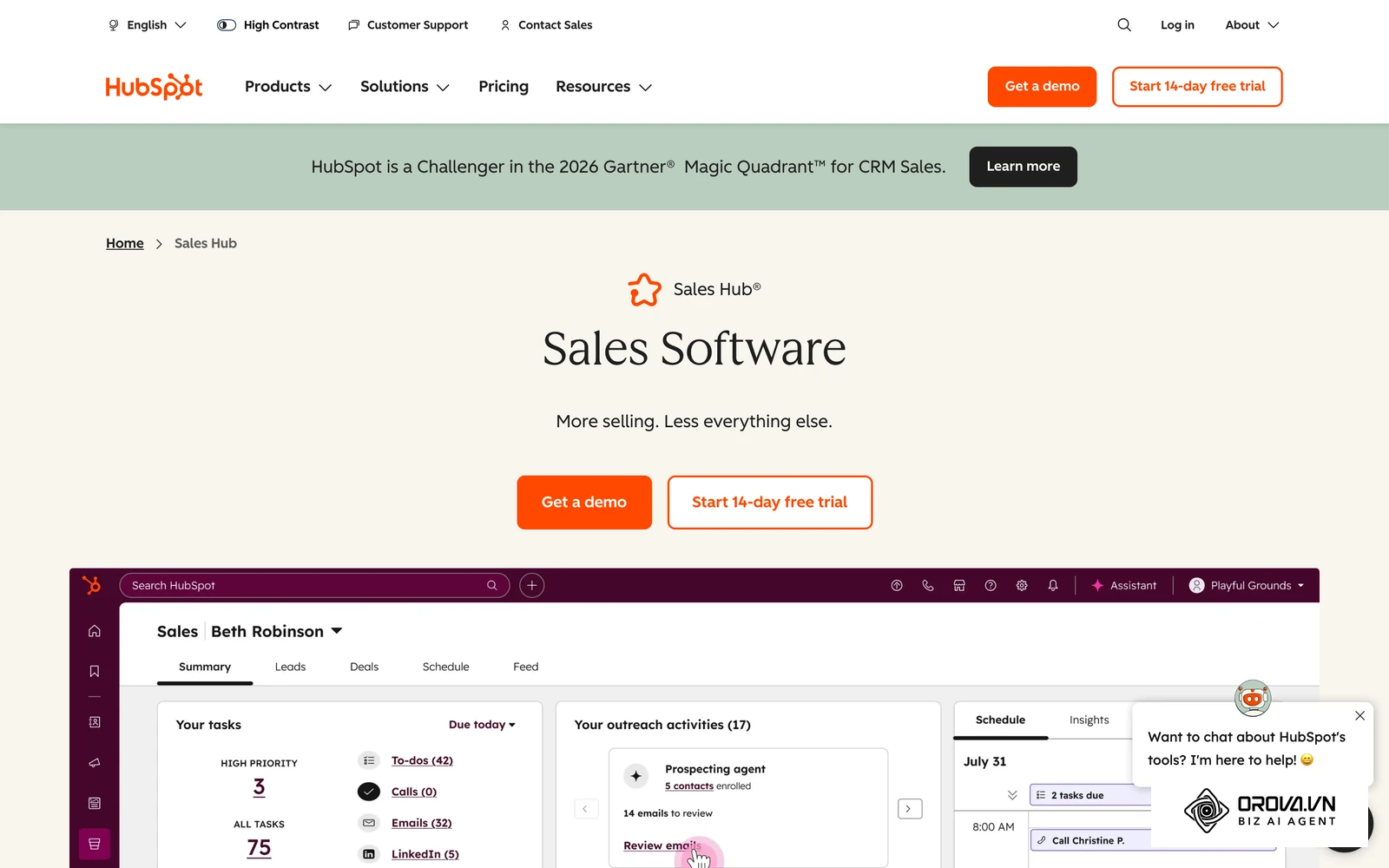
HubSpot Sales Hub delivers a modern, user-friendly approach to sales forecasting software that bridges marketing attribution with sales pipeline progression. The platform calculates weighted pipeline values by multiplying the total value of each open opportunity by its stage-specific closing probability. Sales managers can review monthly and quarterly projections side-by-side with individual rep quotas, enabling real-time coaching conversations.
- Best for: Inbound-focused B2B organizations, scaling technology startups, and mid-market teams seeking rapid user adoption without lengthy technical training.
- Strengths:
- Intuitive user interface that sales representatives actually update consistently, leading to superior baseline data quality.
- Unified data model connecting website touchpoints, email marketing engagement, and sales interactions directly to forecast stages.
- Out-of-the-box forecast rollup categories (Commit, Best Case, Pipeline) that require zero custom coding to deploy.
- Weaknesses:
- Advanced forecasting tools, custom goal tracking, and pipeline split capabilities are locked behind the Professional and Enterprise tiers.
- Formula customization for multi-year contract values and non-linear sales processes can feel restrictive compared to enterprise-grade tools.
- Pricing model: Sales Hub provides introductory free pipeline tools; configuring formal team forecast rollups, custom pipeline quotas, and advanced split attribution requires Professional or Enterprise seats.
- When to choose: Choose HubSpot Sales Hub if your revenue model relies heavily on inbound leads and your team values rapid software adoption over complex custom data architecture.
Pipedrive: visual pipeline sales forecasting software
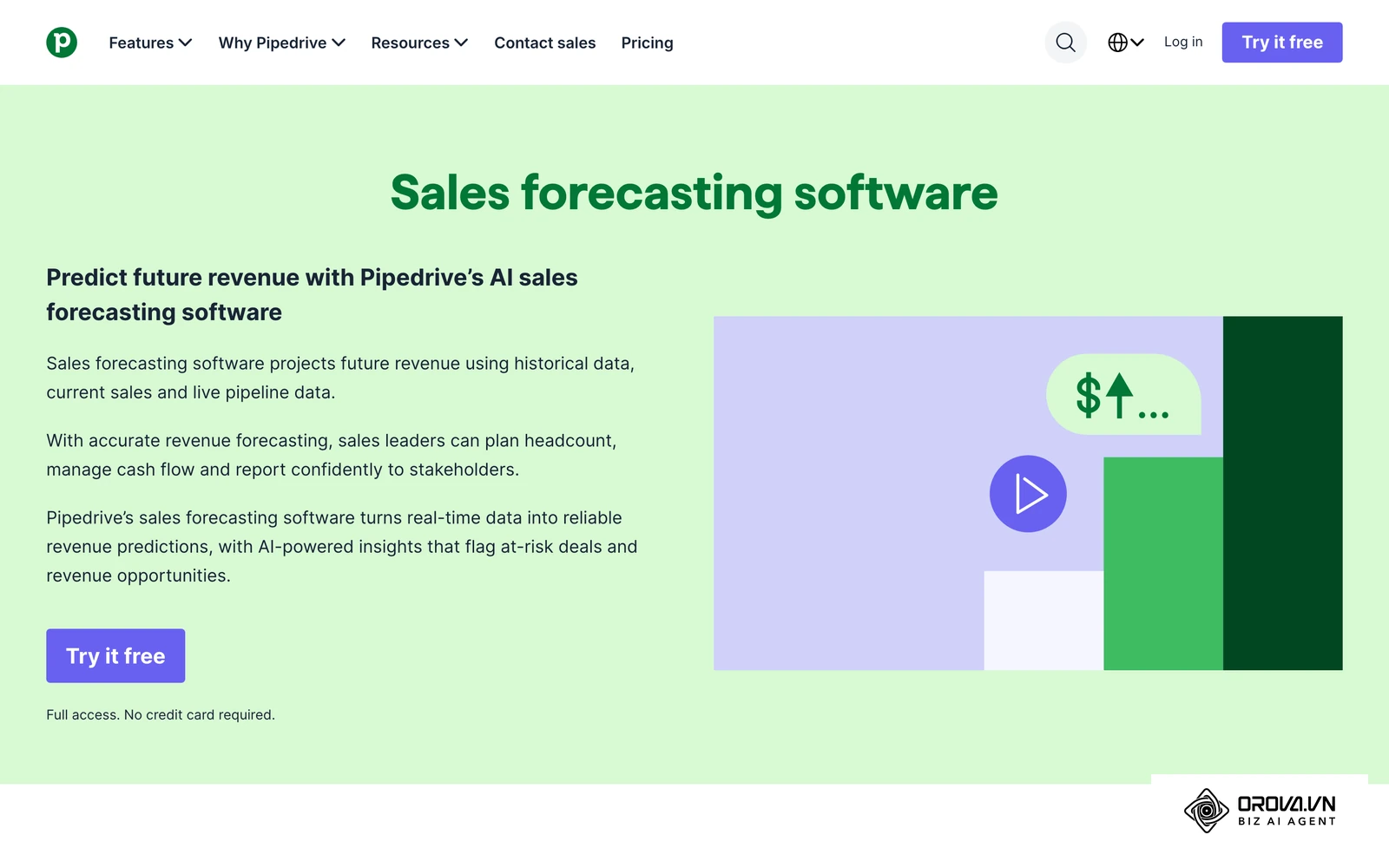
Pipedrive was designed around the visual Kanban board concept, focusing on individual sales activity management to drive revenue predictability. Its built-in forecast view allows reps and managers to visualize expected close dates on a dynamic timeline. By dragging and dropping opportunities across monthly columns, account executives can immediately observe how deal slippage alters their projected revenue for the quarter.
- Best for: Small to mid-sized sales teams, founder-led sales operations, and transactional B2B sales cycles with straightforward pipeline stages.
- Strengths:
- Clear visual representation of deal flow that makes pipeline bottlenecks and stalled opportunities obvious at a single glance.
- Straightforward activity-based selling philosophy that ties completed phone calls, emails, and meetings directly to closing velocity.
- Built-in cumulative revenue forecasting and stage-weighted revenue views available across standard pricing tiers.
- Weaknesses:
- Lacks advanced multi-tier managerial rollup hierarchies required by large organizations with regional director oversight.
- Does not offer native conversation intelligence, AI call transcription, or complex product-line split forecasting.
- Pricing model: Pipedrive is billed per user per month across tiered plans (Essential, Advanced, Professional, Power, and Enterprise), with cumulative forecast views included in core tiers.
- When to choose: Choose Pipedrive when you need an affordable, visually intuitive tool to manage individual rep activity and basic stage-weighted projections without complex administrative setup.
Clari: enterprise revenue intelligence sales forecasting software
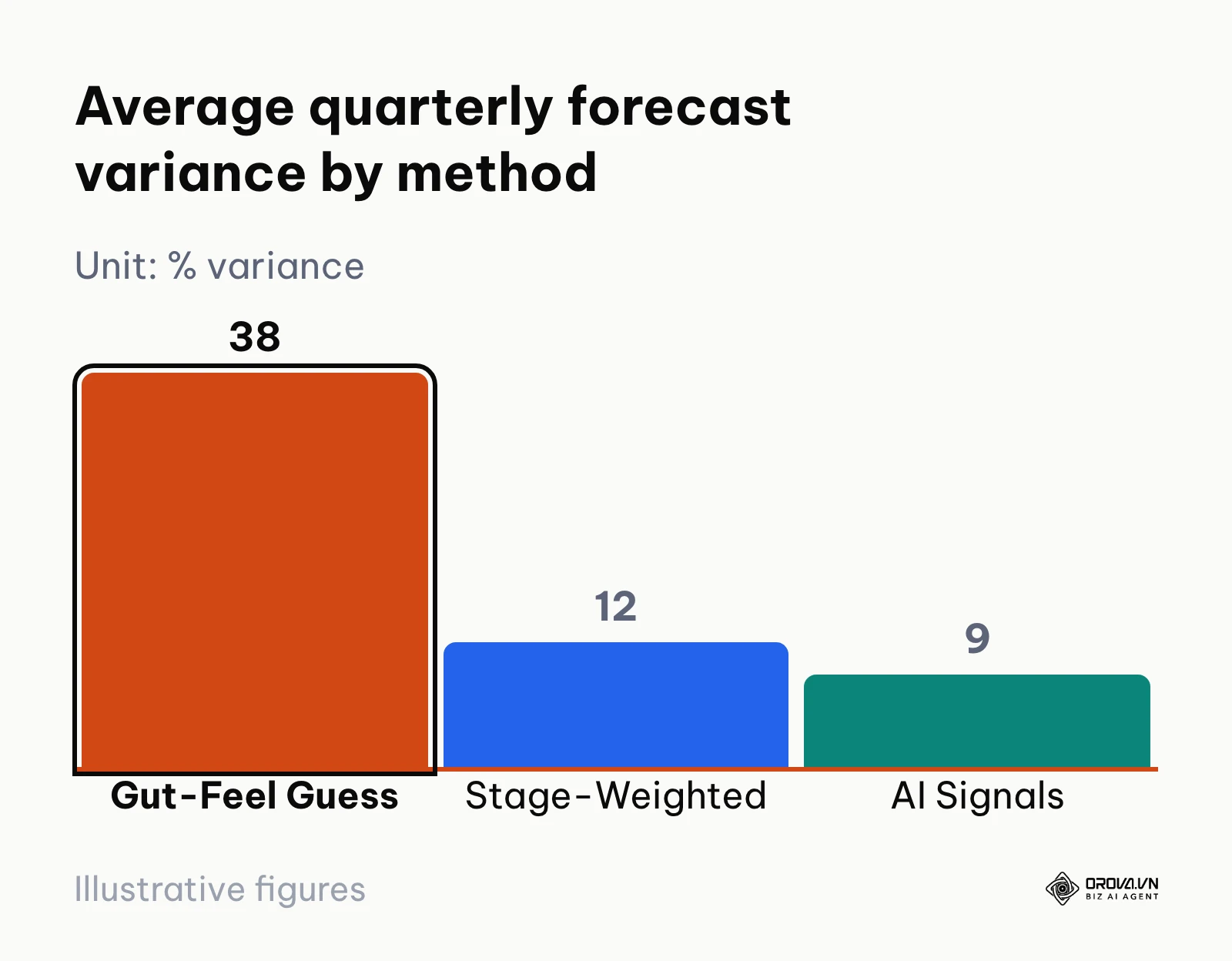
Clari pioneered the dedicated Revenue Operations (RevOps) platform category, transforming raw CRM data into an actionable revenue forecasting system. Rather than relying on rep-entered close dates, Clari ingests data from emails, calendar invites, and marketing touchpoints to evaluate buyer engagement objectively. As outlined by Forrester in The Forrester Wave: Revenue Operations And Intelligence (2024), revenue leaders who integrate buyer engagement signals with automated CRM stage hygiene achieve measurable reductions in quarterly forecast variance. The chart below highlights how projection variance progressively contracts as organizations move from subjective estimates to stage-weighted math and signal intelligence.
- Best for: Enterprise revenue teams, public software companies, and mature RevOps organizations managing high-stakes quarterly board projections.
- Strengths:
- AI-driven predictive forecasting algorithms that analyze historical deal momentum to identify sandbagging or false optimism.
- Rigorous forecast cadence management allowing leadership to run structured weekly commit calls across multiple business units.
- Real-time pipeline inspection capabilities that highlight exactly what changed in any deal since the previous week.
- Weaknesses:
- Operates as an overlay on top of existing CRMs (typically Salesforce or HubSpot), adding another substantial software contract.
- High annual cost and lengthy implementation cycles that make it inaccessible for businesses with fewer than 50 sales reps.
- Pricing model: Clari operates on custom enterprise quotes based on organization headcount and contracted revenue volume, structured as an annual software commitment.
- When to choose: Choose Clari if your enterprise already has a mature CRM implementation and you need a dedicated platform to run formal weekly revenue cadence reviews across dozens of sales teams.
Gong: conversation-driven sales forecasting software
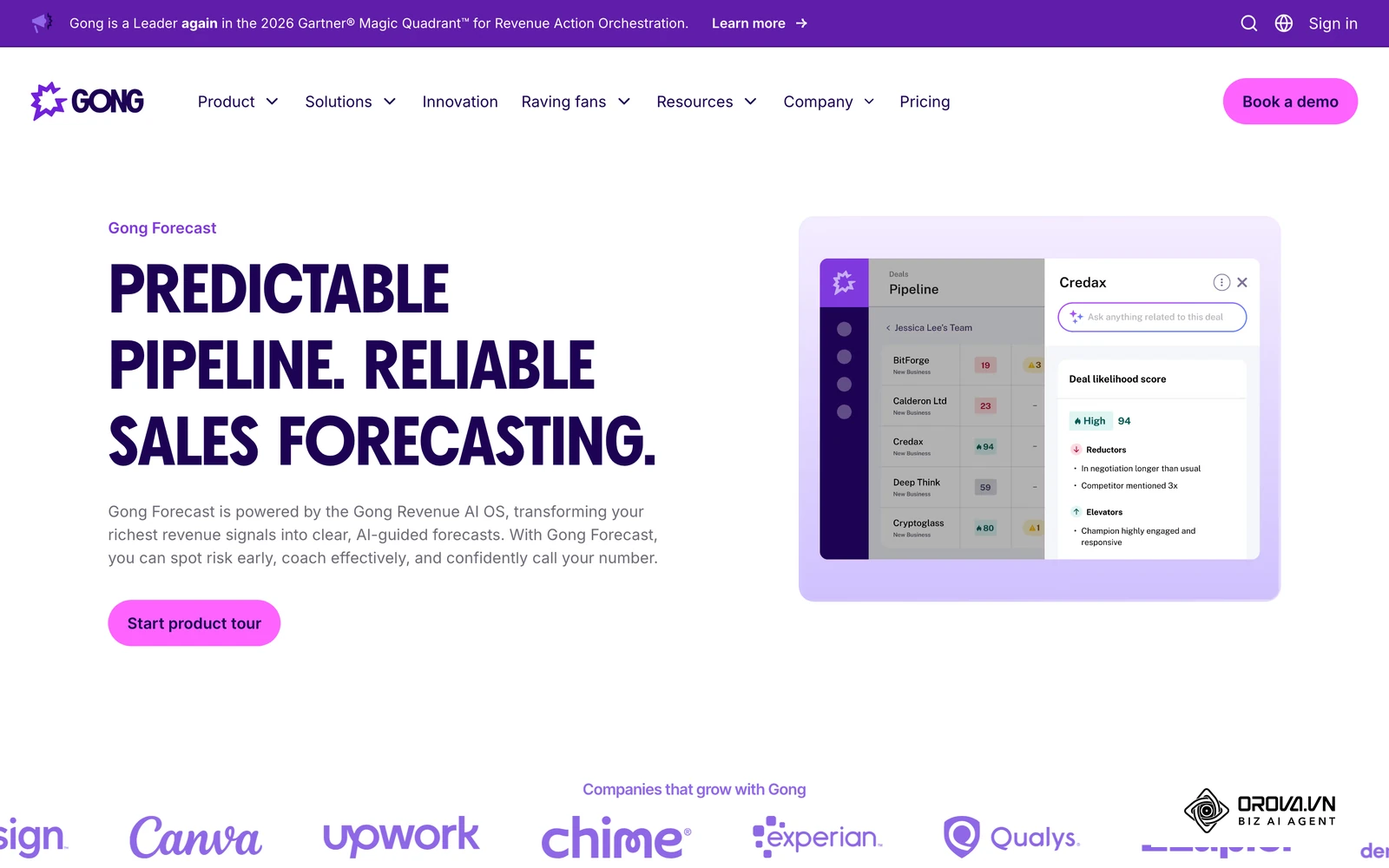
Gong revolutionized sales management by capturing customer interactions across telephone calls, video conferences, and emails using natural language processing. Its forecasting module connects what buyers actually say on calls to pipeline predictability. If a prospect mentions budget freezes, competitors, or procurement delays, Gong automatically flags the opportunity, warning managers that the deal is unlikely to close in the current quarter regardless of rep sentiment.
- Best for: Remote and hybrid B2B sales teams conducting high volumes of video discovery calls and product demonstrations.
- Strengths:
- Unfiltered reality checks on deal health based on actual customer dialogue rather than rep-written notes.
- Automatic tracking of buyer involvement, identifying single-threaded deals that lack executive stakeholder engagement.
- Comprehensive pipeline analytics showing deal progression velocity compared to historical winning benchmarks.
- Weaknesses:
- Substantial investment required, including platform base fees and per-user licensing costs.
- Provides diminished value for transactional sales models that rely primarily on quick in-person visits or self-serve checkouts.
- Pricing model: Gong uses tailored enterprise quotes structured around a base platform fee combined with individual per-seat user licenses.
- When to choose: Choose Gong if your sales cycle involves multi-stakeholder video meetings and you need customer-verified conversation data to eliminate rep bias from your forecast.
Zoho CRM: customizable sales forecasting software for growing teams
Zoho CRM delivers an extensive suite of revenue management features tailored for budget-conscious organizations that require deep customizability. The platform enables administrators to configure multiple forecast models, assign quarterly quotas across geographic territories, and define stage probability percentages. In the Salesforce State of Sales Report (6th Edition, 2024), research revealed that sales teams spend only 30% of their working hours actively selling, with inaccurate pipeline data and manual forecasting reports consuming significant managerial time; Zoho helps mitigate this through automated record scoring.
- Best for: Small to mid-sized businesses looking for an affordable, highly customizable platform that can scale into an all-in-one business software ecosystem.
- Strengths:
- Highly competitive pricing tiers that make territory management and pipeline forecasting accessible to small businesses.
- Zia AI assistant available in higher tiers to detect deal anomalies and suggest optimal contact times.
- Flexible custom modules that allow companies to tailor data schemas to unconventional industry workflows.
- Weaknesses:
- The user interface can feel disjointed and cluttered, presenting a steeper initial learning curve for everyday sales reps.
- Syncing forecasting metrics across complex multi-currency setups occasionally requires manual administrative adjustments.
- Pricing model: Zoho CRM provides tiered subscription options across Standard, Professional, Enterprise, and Ultimate plans, with quarterly territory quotas and forecasting available from the Standard edition upward.
- When to choose: Choose Zoho CRM when you require custom fields, territory management, and solid stage-weighted forecasting on a conservative software budget.
Orova CRM: stage-weighted sales forecasting software with automated hygiene
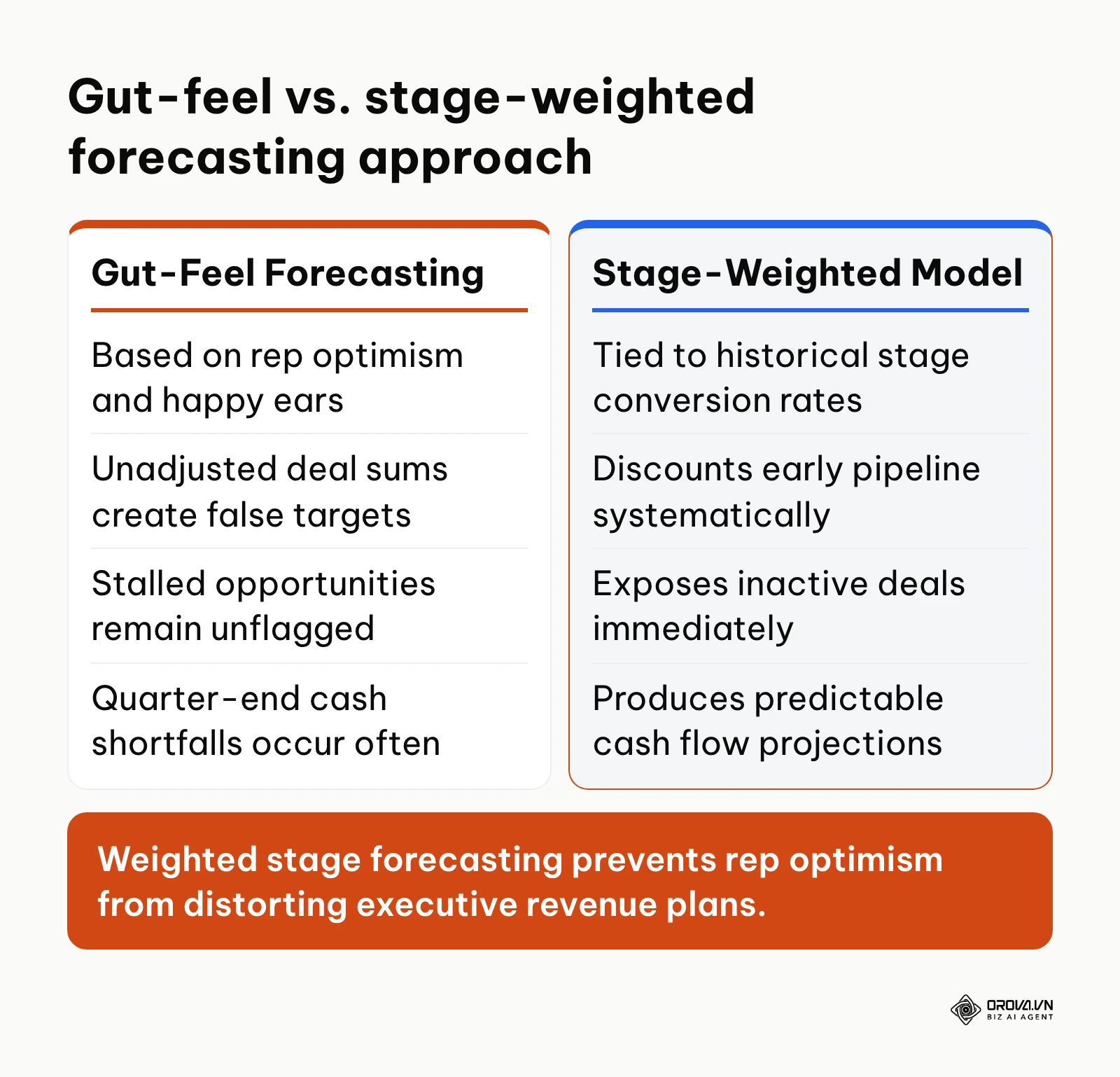
Orova CRM focuses on delivering a transparent, streamlined revenue management workspace that tracks buyer relationships from initial lead capture through formal invoicing and cash collection. Rather than relying on black-box predictive algorithms or unverified rep gut-feel, Orova CRM calculates weighted pipeline projections directly within its Overview dashboard based on verified historical conversion probabilities across customized pipeline stages. The comparison below contrasts the operational pitfalls of subjective gut-feel predictions with the reliability of mathematical stage-weighting.
- Best for: Small to mid-sized B2B companies, field sales organizations, and lean commercial teams seeking dependable stage-weighted forecasting, lead-to-cash tracking, and automated pipeline hygiene without enterprise software bloat.
- Strengths:
- Built-in stage-weighted revenue forecasting in the Overview dashboard that calculates expected cash flow across daily, weekly, monthly, quarterly, or custom date ranges (up to 366 days) without requiring expensive enterprise plan upgrades.
- Automated lead reclamation engine that continuously monitors pipeline velocity; when a sales rep neglects an opportunity past a stage-specific threshold (configured in minutes), the system automatically returns the customer to the shared pool for reallocation, protecting the forecast from dead deals.
- Department-tree quota tracking that allows business owners and sales directors to monitor revenue target attainment across sub-departments and individual reps, prorated automatically according to the actual number of calendar days in the viewed reporting period.
- Weaknesses:
- Does not offer predictive AI deal scoring, automated win-loss sentiment analysis, or call recording transcription.
- Lacks a dedicated standalone mobile application (operates via responsive mobile browser interface with push notifications) and does not support automated cross-currency exchange rate conversions.
- Pricing: Full access to all CRM capabilities is free until the end of July 7, 2027, with usage tiered purely by workspace quota rather than artificial feature gates.
- When to choose: Choose Orova CRM if you want an all-in-one sales operations system that enforces strict pipeline hygiene, calculates stage-weighted revenue projections, and tracks quotas without paying five-figure software subscriptions.
Tired of spreadsheet formulas that break whenever deals change? Orova CRM gives your team a clean overview dashboard with built-in stage-weighted revenue projections, automated lead redistribution to prevent deal stagnation, and department-tree quota tracking without requiring expensive enterprise plan upgrades or complex third-party revenue add-ons. Start building a predictable sales pipeline today.
Monday Sales CRM: flexible workflow sales forecasting software
Monday Sales CRM adapts the flexible, column-based work operating system of Monday.com into a dedicated sales platform. Teams can build custom forecasting boards where opportunities roll up into monthly and quarterly summary cards. Custom automation recipes allow sales managers to move deals across stages, recalculate probabilities, and notify finance when high-value opportunities enter the final negotiation phase.
- Best for: Cross-functional teams that need to coordinate pre-sales technical delivery, marketing projects, and pipeline tracking within a single collaborative interface.
- Strengths:
- Exceptional visual customization with drag-and-drop boards, color-coded status chips, and intuitive formula columns.
- Native automations that trigger tasks and notifications across departments when a deal advances toward closing.
- Easy onboarding for teams already familiar with project management spreadsheets and Kanban boards.
- Weaknesses:
- Lacks advanced out-of-the-box revenue intelligence, historical trend-line snapshotting, and enterprise territory splits.
- Calculating complex weighted forecasts with dynamic probability tables requires building custom board formulas manually.
- Pricing model: Monday Sales CRM operates on per-seat monthly subscriptions across Basic, Standard, and Pro tiers, with custom enterprise plans for larger organizations.
- When to choose: Choose Monday Sales CRM if your team prioritizes collaborative post-sale handoffs and simple board automations over deep mathematical forecasting algorithms.
| Pipeline Trigger Event | Automation Action | Impact on Revenue Forecast |
|---|---|---|
| Opportunity Stage Change | Auto-update deal probability | Recalculates weighted pipeline value in board summary |
| Inactivity Past 10 Days | Send alert notification to deal owner | Prevents dormant opportunities from distorting monthly forecast |
| Deal Value Override | Flag variance exceeding 20% | Prompts sales manager review before weekly commit call |
| Contract Stage Marked Won | Move record to fulfillment board | Converts forecasted pipeline revenue into booked ARR |
Weighted pipeline forecasting formula: gut-feel vs. data-backed sales forecasting software
Most sales teams fail to produce accurate revenue projections because they rely on unadjusted pipeline totals or subjective rep estimates. A sales representative carrying ten open opportunities valued at 372,000 dollars will often tell leadership that the entire sum is on track to close before quarter-end. This optimism, known in the industry as happy ears, masks the reality that deals at early stages rarely close at high percentages.
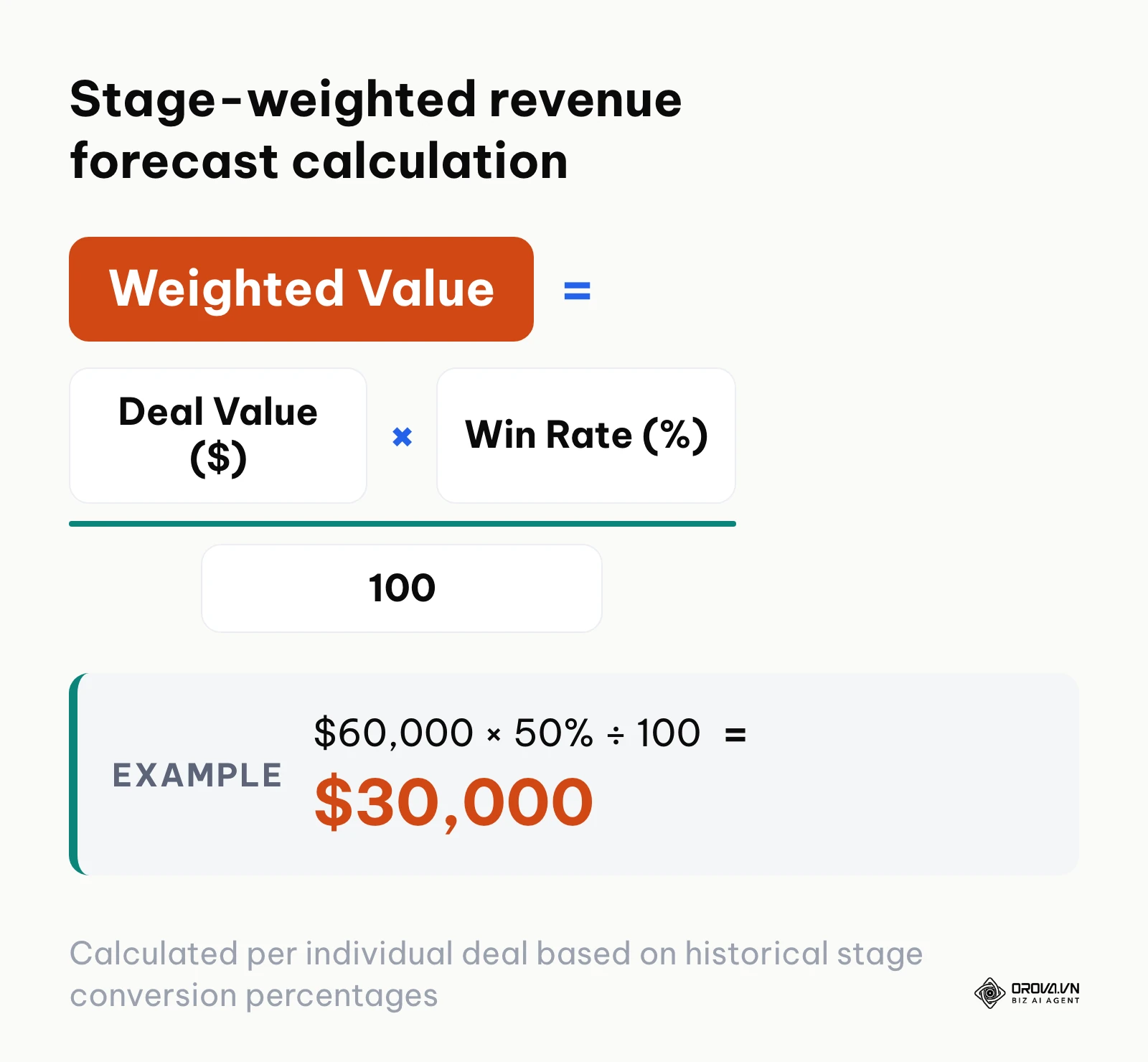
Disciplined revenue leaders implement stage-weighted pipeline forecasting. This method applies a mathematically verified win probability to every opportunity based on its current position in the sales cycle. To understand the foundational mechanics of pipeline stages, review our guide on sales pipeline management. The table below demonstrates the dramatic divergence between subjective pipeline values and an objective weighted forecast across ten active B2B opportunities.
| Opportunity Name | Deal Value (Dollars) | Pipeline Stage | Historical Win Probability (%) | Stage-Weighted Forecast (Dollars) |
|---|---|---|---|---|
| Acme Logistics Expansion | 45,000 | Discovery Call | 10% | 4,500 |
| BluePeak Cloud Migration | 30,000 | Demo Completed | 25% | 7,500 |
| Vanguard Health Systems | 80,000 | Proposal Delivered | 40% | 32,000 |
| Horizon Retail POS System | 15,000 | Qualification | 10% | 1,500 |
| Apex Manufacturing ERP | 60,000 | Technical Validation | 50% | 30,000 |
| Silverline Financial Audit | 25,000 | Final Negotiation | 75% | 18,750 |
| Summit Media Annual Retainer | 12,000 | Contract Out for Signature | 90% | 10,800 |
| Crestview Real Estate CRM | 20,000 | Proposal Delivered | 40% | 8,000 |
| Beacon Security Monitoring | 35,000 | Demo Completed | 25% | 8,750 |
| Atlas Freight Fleet Portal | 50,000 | Discovery Call | 10% | 5,000 |
| Total Unweighted Pipeline | 372,000 | — | Expected Revenue | 126,800 |
The mathematical contrast is striking. While an unweighted calculation suggests a massive 372,000-dollar revenue windfall, the verified stage-weighted forecast reveals that the business should anticipate approximately 126,800 dollars in realistic receipts. A sales director who plans operational expenditures around the unweighted total faces a catastrophic 245,200-dollar shortfall.
Illustrative example: Consider a B2B cloud infrastructure provider with 12 sales representatives who previously forecasted revenue by asking reps for their monthly commit totals during Friday morning meetings. Representatives routinely reported closing dates based on wishful thinking, resulting in average quarterly forecast errors exceeding 35%. The sales operations manager took three decisive corrective actions: first, she audited closed-lost data from the previous four quarters to establish objective win probabilities for each stage (Discovery at 10%, Demo at 25%, Proposal at 40%, Technical Review at 50%, Negotiation at 75%, and Legal at 90%). Second, she locked CRM stage permissions so reps could only advance opportunities when verifiable buyer milestones occurred, such as receipt of a technical requirements document. Third, she configured the CRM dashboard to calculate stage-weighted projections automatically. A major stumbling block arose when senior account executives resisted the lower forecast figures, claiming the formula discounted their closing skills; leadership resolved this by maintaining a separate rep commit field while using the stage-weighted total for official board reporting. Within two fiscal quarters, the company's forecast variance narrowed from 35% to less than 7%, enabling executive management to commit to capital equipment purchases without fear of unexpected revenue deficits.
The real cost of sales forecasting software: native CRM vs. dedicated revenue intelligence
When evaluating sales forecasting software, many organizations fall victim to deceptive entry-level pricing. Major CRM vendors frequently market entry tiers at 20 to 30 dollars per user per month. However, when sales managers attempt to configure collaborative forecast rollups, split commissions, or custom stage probabilities, they discover those features are locked behind Enterprise plans costing 150 to 330 dollars per user monthly.
Furthermore, enterprise vendors encourage teams to purchase standalone Revenue Intelligence platforms such as Clari or Gong. While these tools offer deep conversational analytics, they require a separate, substantial contract on top of your existing CRM licenses. For deeper insights into streamlining operational reporting costs, examine our breakdown on the automated sales report framework. The matrix below outlines the true Total Cost of Ownership (TCO) across different deployment models for a team of ten sales representatives.
| Platform Model | Minimum Tier Required for Forecasting | Licensing Model | Implementation & Add-on Architecture | Total Cost Profile (10 Reps) | Hidden Limitations & Gotchas |
|---|---|---|---|---|---|
| Salesforce Sales Cloud | Enterprise Edition | Per-user monthly license | Dedicated administrator setup required | Substantial enterprise investment | Lower tiers lack custom collaborative forecasting rollups |
| HubSpot Sales Hub | Professional Edition | Per-seat monthly license | Mandatory professional onboarding fee | Escalating seat-based cost | Advanced goal tracking and splits require Enterprise tier |
| Pipedrive | Professional Edition | Per-user monthly license | Self-service onboarding | Predictable SMB investment | Limited multi-level manager approval rollups |
| Clari (Standalone Overlay) | Enterprise Platform | Custom enterprise contract | Platform fee plus CRM integration | Enterprise overlay expenditure | Requires underlying Salesforce or HubSpot deployment |
| Gong (Conversation AI) | Revenue Platform | Custom enterprise contract | Annual platform fee plus user seats | Specialized high-velocity investment | High value only if reps conduct frequent video calls |
| Orova CRM (Native) | Full Platform Tier | Free until July 7, 2027 | Self-service onboarding | Zero software license fees until 7/7/2027 | Requires disciplined manual entry; no AI voice transcription |
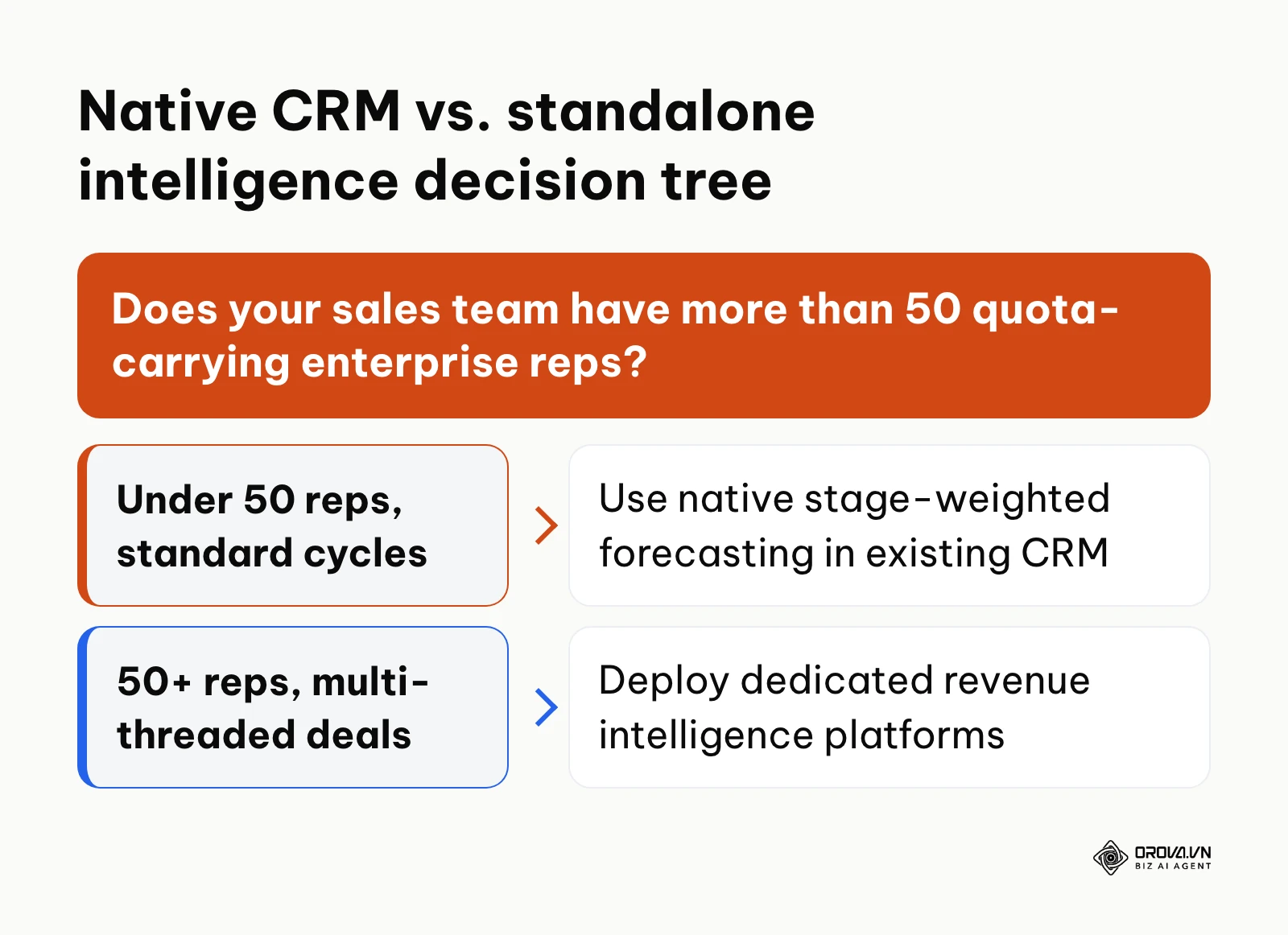
Before committing to expensive standalone revenue overlays, sales leaders must evaluate whether their core forecasting problem stems from a lack of machine learning algorithms or a failure of basic pipeline discipline. Teams with fewer than 50 representatives can almost always achieve their accuracy goals using native CRM stage-weighted models, provided they maintain clean, auditable deal records.
Pipeline hygiene: 4-step auto-reclaim SLA and 7-step forecast audit checklist
Even the most sophisticated sales forecasting software produces completely unreliable projections when fed corrupted or outdated pipeline data. In industry terminology, this is known as dirty CRM data. The two most common human behaviors that distort sales forecasts are deal sandbagging, where representatives hide close-ready opportunities until the end of the quarter to exceed lowered expectations, and happy ears, where reps allow dead opportunities with expired close dates to linger indefinitely in late pipeline stages.
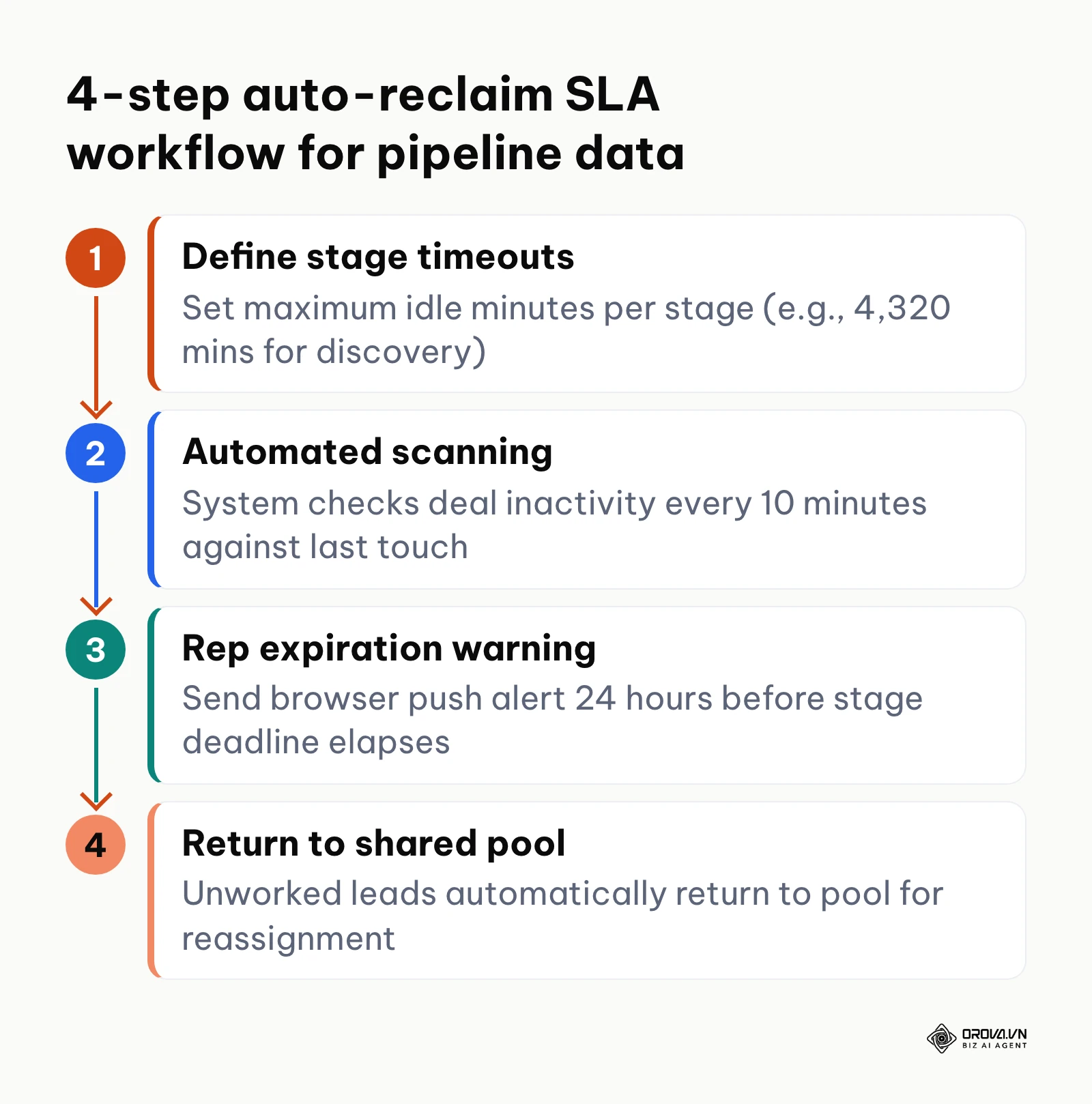
To maintain pristine forecast integrity without purchasing intrusive surveillance software, high-performing revenue teams implement an automated Service Level Agreement (SLA) coupled with strict lead reclamation rules. Learn practical data hygiene techniques in our guide on crm data quality. The diagram below illustrates how an automated SLA reclamation workflow operates to protect pipeline data.
The 4-step auto-reclaim SLA workflow
- Establish Stage Velocity Thresholds: Analyze historical sales cycles to determine the maximum acceptable holding duration for every pipeline step. In an agile B2B sales motion, appropriate thresholds might be 4,320 minutes (3 business days) for initial Discovery outreach, 10,080 minutes (7 business days) for Proposal review, and 20,160 minutes (14 business days) for Contract execution.
- Deploy Automated Inactivity Scanning: Configure the CRM to execute background sweeps across all active opportunities every 10 minutes. The system measures elapsed time since the most recent logged customer touchpoint, such as a call, email, or meeting note.
- Trigger Pre-Expiration Warnings: When an opportunity reaches 80% of its stage-specific holding limit without documented customer activity, the CRM issues an automated notification alerting the owner that the deal is at risk of forfeiture.
- Execute Automated Reassignment: If the holding threshold expires without verifiable sales activity, the software automatically strips the sales representative of ownership and returns the opportunity to the unassigned team pool. This mechanic immediately removes ghost deals from the active forecast and gives neglected prospects an opportunity to be worked by active reps.
| Pipeline Stage | Maximum Inactivity Threshold | Pre-Expiration Warning (80%) | Automated Reassignment Action |
|---|---|---|---|
| Discovery Outreach | 4,320 minutes (3 business days) | Alert sent at 3,456 minutes | Deal returned to unassigned SDR pool |
| Solution Demonstration | 7,200 minutes (5 business days) | Alert sent at 5,760 minutes | Alert sent to account executive & manager |
| Formal Proposal Delivered | 10,080 minutes (7 business days) | Alert sent at 8,064 minutes | Ownership revoked; reassigned to inside sales |
| Contract Out for Signature | 20,160 minutes (14 business days) | Alert sent at 16,128 minutes | Opportunity escalated to commercial sales VP |
Illustrative example: A regional industrial equipment distributor with eight field sales reps suffered from chronic forecast slippage; sales managers spent hours every week chasing deals marked commit that had not seen customer contact in over a month. The company implemented a 4-step automated SLA reclamation policy within their CRM. They established a strict rule: any opportunity remaining in Proposal Delivered stage for more than ten working days without a logged meeting or updated quote was automatically reclaimed into the unassigned company pool. The initial rollout encountered severe friction when a senior representative lost a 45,000-dollar prospective account after failing to log customer interactions for two weeks; management stood firm, reassigning the deal to an inside sales representative who contacted the client within four hours and discovered the buyer was waiting for an updated delivery specification. Seeing that the rule was applied equally across the entire roster, representatives began updating their opportunities immediately following every interaction. Within 60 days, stale pipeline deals dropped by 82%, and forecast variance on late-stage opportunities plummeted from 42% to under 5%.
The 7-step forecast hygiene audit checklist
Revenue leaders should execute this practical seven-step data audit 48 hours before every weekly pipeline review meeting to ensure all projections reflect reality:
| Audit Dimension | Target Inspection Criterion | Verification Check | Remediation Action |
|---|---|---|---|
| Close Date Validity | Zero expired close dates in current quarter | Deal close date ≥ current calendar date | Push date with justification or mark Closed-Lost |
| Customer Recency | Activity within past 14 calendar days | Logged call, email, or meeting note | Flag deal as stalled; prompt rep follow-up |
| Exit Gate Proof | Verifiable milestone documentation | Signed evaluation plan or quote request | Revert opportunity to preceding pipeline stage |
| Quota Attribution | Prorated by actual days in reporting period | Days elapsed ÷ total days in period | Adjust rep commit target to realistic baseline |
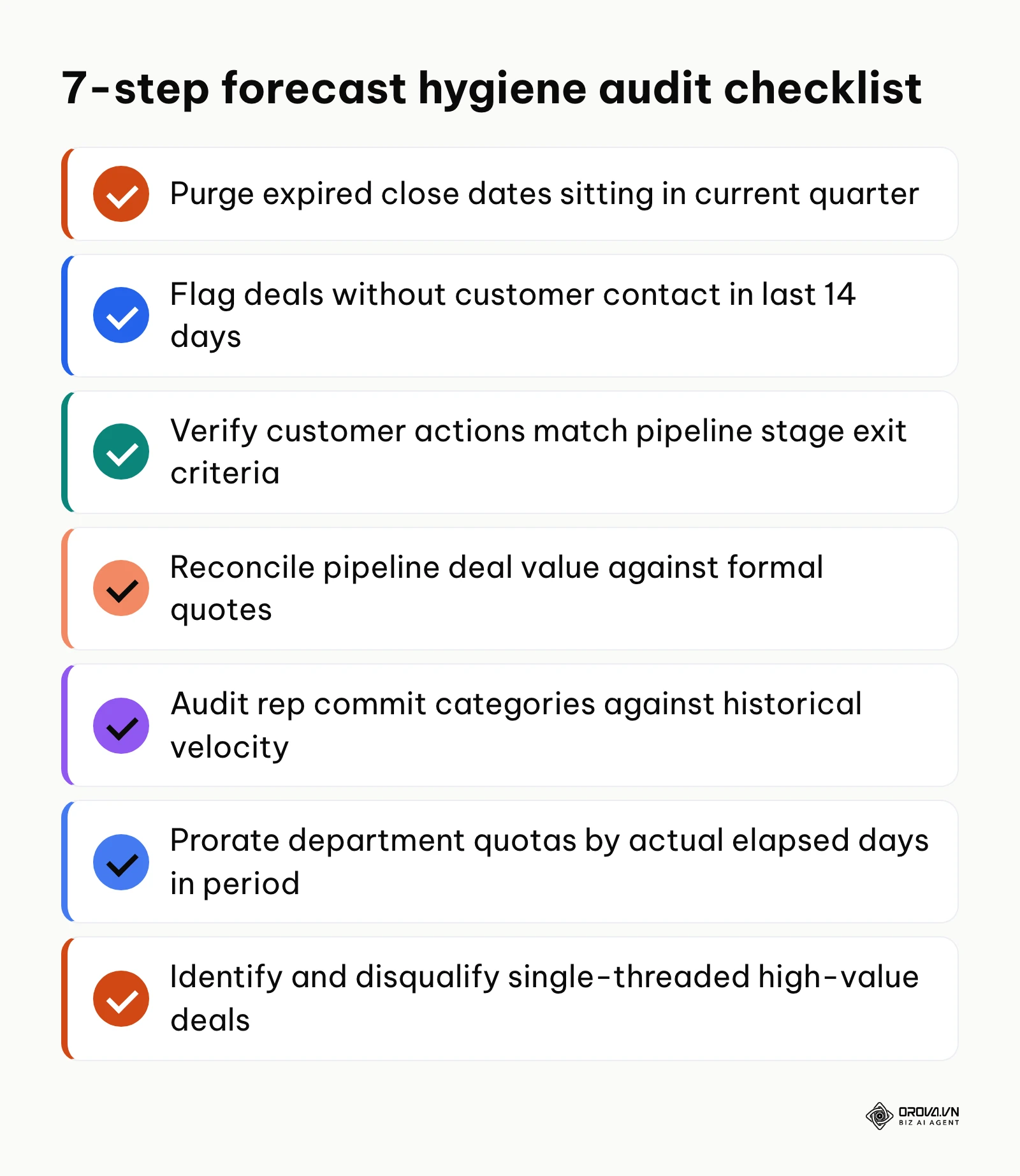
- [ ] Purge Expired Close Dates: Filter all active pipeline deals with close dates set in the past. Force representatives to either update the date with written justification or move the deal to Closed-Lost.
- [ ] Flag Inactive Opportunities: Isolate any deal in late stages (Proposal, Validation, Negotiation) that has recorded zero outbound or inbound touchpoints in the preceding 14 calendar days.
- [ ] Verify Stage Exit Criteria: Ensure deals have not advanced past milestone gates without physical documentation (e.g., verifying that a signed mutual evaluation plan exists before tagging an opportunity as Technical Validation).
- [ ] Reconcile Deal Values Against Formal Quotes: Audit pipeline deal values against formal generated quotes or draft order documents to eliminate inflated placeholder numbers.
- [ ] Audit Rep Commit Overrides: Cross-examine opportunities that representatives have manually tagged as Commit despite having closing probabilities under 50% according to historical stage velocity.
- [ ] Prorate Quota Attainment by Elapsed Calendar Days: When evaluating progress toward quarterly targets, calculate expected quota attainment based on the exact percentage of business days that have elapsed in the current period rather than assuming a linear monthly average.
- [ ] Disqualify Single-Threaded Enterprise Deals: Scrutinize high-value opportunities where the sales rep has established contact with only a single internal advocate, as single-threaded enterprise opportunities fail to close on time over 60% of the time.
Stop letting ghost deals distort your quarterly revenue projections. With Orova CRM, you can configure stage-specific holding limits that automatically reclaim abandoned leads, track individual quota achievement prorated by actual days, and run reliable weighted forecasts from lead to cash. Get started in minutes with all features free until the end of July 7, 2027 without entering a credit card.
How to choose sales forecasting software by business scenario
| Business Scenario | Recommended Tool | Core Selection Rationale |
|---|---|---|
| Early-stage B2B Startup (1–5 reps) | Pipedrive | Offers rapid visual pipeline setup, low per-user cost, and intuitive drag-and-drop forecast adjustments without administrative friction. |
| Inbound-driven Growth Company (10–30 reps) | HubSpot Sales Hub | Seamlessly connects marketing attribution to pipeline deal velocity, allowing leadership to forecast revenue based on inbound traffic patterns. |
| Lean B2B / Field Sales Team (5–40 reps) | Orova CRM | Combines stage-weighted revenue projections with automated SLA lead reclaim rules and quote-to-cash tracking without requiring expensive enterprise tiers. |
| Complex Enterprise Organization (100+ reps) | Salesforce Sales Cloud | Provides the necessary data architecture to model multi-layered managerial rollups, matrix territory quotas, and custom revenue splits. |
| Mature RevOps Team with High Call Volume | Gong or Clari | Ingests conversational customer signals to eliminate rep bias and flag deal risks across complex, multi-threaded enterprise cycles. |
| Multi-department Collaborative Sales | Monday Sales CRM | Enables marketing, pre-sales engineering, and account executives to align post-sale handoffs on flexible visual automation boards. |
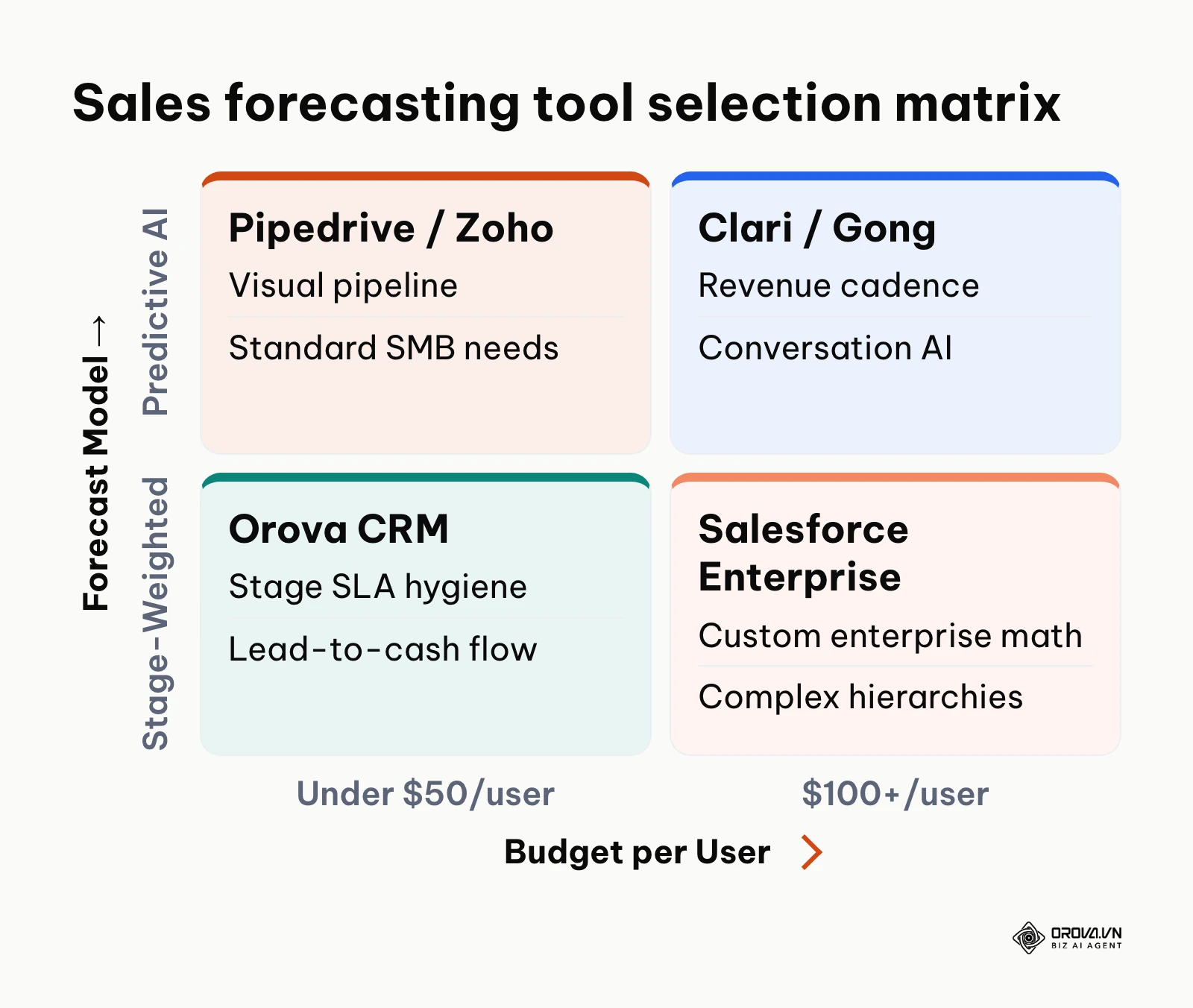
Every sales organization operates under distinct structural constraints. A high-velocity transactional sales model requires visual simplicity and automated lead recycling, while a complex enterprise software team demands deep matrix hierarchies and multi-stakeholder tracking. The decision matrix below visualizes where leading platforms fall across budget constraints and algorithmic complexity.
Illustrative example: A contract manufacturing firm employing six sales representatives was struggling with revenue planning; the business owner was paying for an enterprise-tier CRM that none of the representatives used correctly, resulting in blank deal records and zero forecast visibility. The leadership team conducted a complete sales tooling review: they cancelled the unused enterprise software, migrated customer contacts into an agile CRM featuring native stage-weighted forecasting, and established three clear pipeline stages with strictly defined historical probabilities (Sample Requested at 20%, Quote Issued at 50%, Final Specification at 80%). A stumbling block occurred during the data migration when duplicate company records obscured true account history; the operations coordinator spent two days standardizing tax IDs and merging legacy accounts to establish a single customer source of truth. Following the transition, representatives updated their pipeline daily because the interface required minimal clicks, and management was able to generate reliable 90-day cash flow projections directly from the overview dashboard, eliminating weekend spreadsheet reconciliations entirely.
Sales forecasting software trends in the coming years: author's perspective
Looking at the trajectory of sales forecasting software, I observe that traditional CRM interfaces are rapidly shifting from passive data repositories into active operational operating systems. Today, most sales organizations still struggle with the friction of manual data entry, forcing managers to spend their weekly one-on-one sessions interrogating reps about why specific deal dates were pushed back.
In the next two to three years, I believe we will witness the near-total obsolescence of manual CRM deal updates. Artificial intelligence agents embedded within communication channels will autonomously inspect email threads, contract revisions, and video recordings to advance pipeline stages without human intervention. When a prospective buyer states in an email that their procurement committee has approved the vendor agreement, the software will automatically advance the deal stage and adjust the weighted forecast accordingly. However, this trend could decelerate if heightened enterprise data privacy regulations restrict automated corporate email indexing across multinational jurisdictions.
In my assessment, revenue leaders should prepare for this shift today by simplifying their core pipeline architectures. Organizations that establish clear, auditable stage milestones right now will transition smoothly into automated agentic workflows, while companies with bloated, subjective 15-stage pipelines will merely generate automated confusion.
Frequently asked questions about sales forecasting software
How does artificial intelligence improve the accuracy of sales forecasting software?
Artificial intelligence improves forecast accuracy primarily by analyzing objective buyer engagement signals rather than relying on subjective sales rep opinions. By evaluating email response times, meeting attendance frequency, sentiment in call recordings, and the number of stakeholders involved in a deal, predictive algorithms can identify stalling opportunities weeks before a sales rep admits the close date has slipped.
What is the difference between pipeline-based forecasting and revenue intelligence?
Pipeline-based forecasting calculates projected revenue by applying historical win rates to the opportunities currently sitting in CRM pipeline stages. Revenue intelligence platforms go several steps further by capturing and analyzing real-time conversational data across emails, calls, and calendar invites, using external buyer engagement metrics to validate whether an opportunity is genuinely progressing toward closure.
Can small sales teams forecast accurately using spreadsheets instead of dedicated software?
Spreadsheets can manage basic pipeline calculations for a solo founder or a team with fewer than three opportunities per month. However, as deal volume expands, static spreadsheets suffer from broken formulas, version-control confusion, and a complete lack of real-time auditability. Transitioning to dedicated software ensures that historical stage velocity and probability adjustments are calculated automatically.
How do you calculate forecast accuracy in a sales organization?
Forecast accuracy is calculated by dividing your actual closed revenue at the end of a given period by the forecasted revenue figure predicted at the beginning of that period, multiplied by 100. For example, if your team projected 200,000 dollars in closed revenue at the start of the quarter and finished with 190,000 dollars, your forecast accuracy is 95%, representing a 5% variance.
What is the most effective way to prevent sales reps from sandbagging deals?
The most reliable way to eliminate deal sandbagging is to implement objective, verifiable milestone criteria for every pipeline stage and conduct weekly pipeline inspections. When stage progression is tied to documented buyer actions, such as an approved security review or a completed technical evaluation, representatives cannot artificially hold back opportunities without leadership noticing the discrepancy.
How often should sales management update the revenue forecast?
Sales teams operating in fast-paced B2B environments should review their pipeline forecast on a weekly cadence. While executive board updates typically occur monthly or quarterly, a weekly 30-minute forecast hygiene inspection allows sales managers to identify stalled deals, reallocate unworked leads, and adjust coaching strategies before minor pipeline anomalies derail the entire quarter.
Where should you start with sales forecasting software?
Improving your revenue predictability does not require an immediate, disruptive overhaul of your entire commercial technology stack. Identify which of the following three scenarios matches your current situation, and take the single practical first step that can be completed in a single working session:
- If your sales data is scattered across personal spreadsheets and email inboxes: Consolidate your active deal records into a single pipeline structure. Dedicate three hours to define four to five verifiable pipeline stages, map your current opportunities to those stages, and assign an estimated historical win probability to each step.
- If you already use a CRM but your revenue projections consistently miss targets: Conduct an emergency pipeline hygiene audit. Filter your database for all active deals showing close dates in the past or zero logged activity in the preceding 14 days, and move every unverified opportunity to Closed-Lost or return it to an unassigned pool.
- If you manage an established sales team and need to scale your forecast accuracy: Audit your true software licensing costs. Compare the price of your current CRM tier upgrades against the actual features your team uses daily, ensuring you are not overpaying for unused enterprise add-ons when transparent stage-weighted tools can solve your forecasting needs.
By matching your pipeline structure with the right sales forecasting software, your revenue team gains the clarity needed to invest confidently in hiring, inventory, and sustainable growth.
About the author

Builder of Orova
Nguyễn Đỗ Trọng Ân has 8 years of experience in marketing, including 6 years managing market development across Asia. He builds Orova, a Biz AI Agent that never sleeps: it plans, runs and optimizes work for businesses.
Run your business with AI Agents
Orova is the always-on Biz AI Agent — it plans, runs, and optimizes the work for you.
Save time, unlock productivity.