
Candidate relationship management systems: how they work and a nurture playbook

Candidate relationship management systems are software platforms that help recruiters source, segment, and nurture passive candidates before a job opens, so that a warm shortlist already exists when a requisition is approved. They sit in front of the applicant tracking system rather than replacing it. For years, hiring organizations relied almost exclusively on applicant tracking systems, assuming that publishing open job requisitions on public job boards would consistently yield exceptional professionals. However, as high-skill markets tighten and top performers rarely visit career sites, that passive post-and-pray model inevitably produces escalating agency fees, sluggish hiring velocity, and vacant executive seats. To sustain organizational momentum, modern talent leaders must engage prospective hires months before an official requisition receives budget approval. This guide is a practitioner playbook for running one day to day; if you are comparing vendors and pricing, see our separate buyer's guide. You will discover the operational distinctions between sourcing and tracking platforms, a quantitative financial ROI model, field-tested Silver Medalist nurture sequences, and the technical standards required to synchronize candidate records without generating messy database conflicts.
What Are Candidate Relationship Management Systems?
Candidate relationship management systems are specialized software platforms designed to source, engage, and nurture passive job seekers before an active hiring need emerges. Unlike transactional applicant tracking systems that manage formal applications, these platforms function like sales funnels, maintaining ongoing communication with pre-qualified talent communities across long-term recruitment cycles.
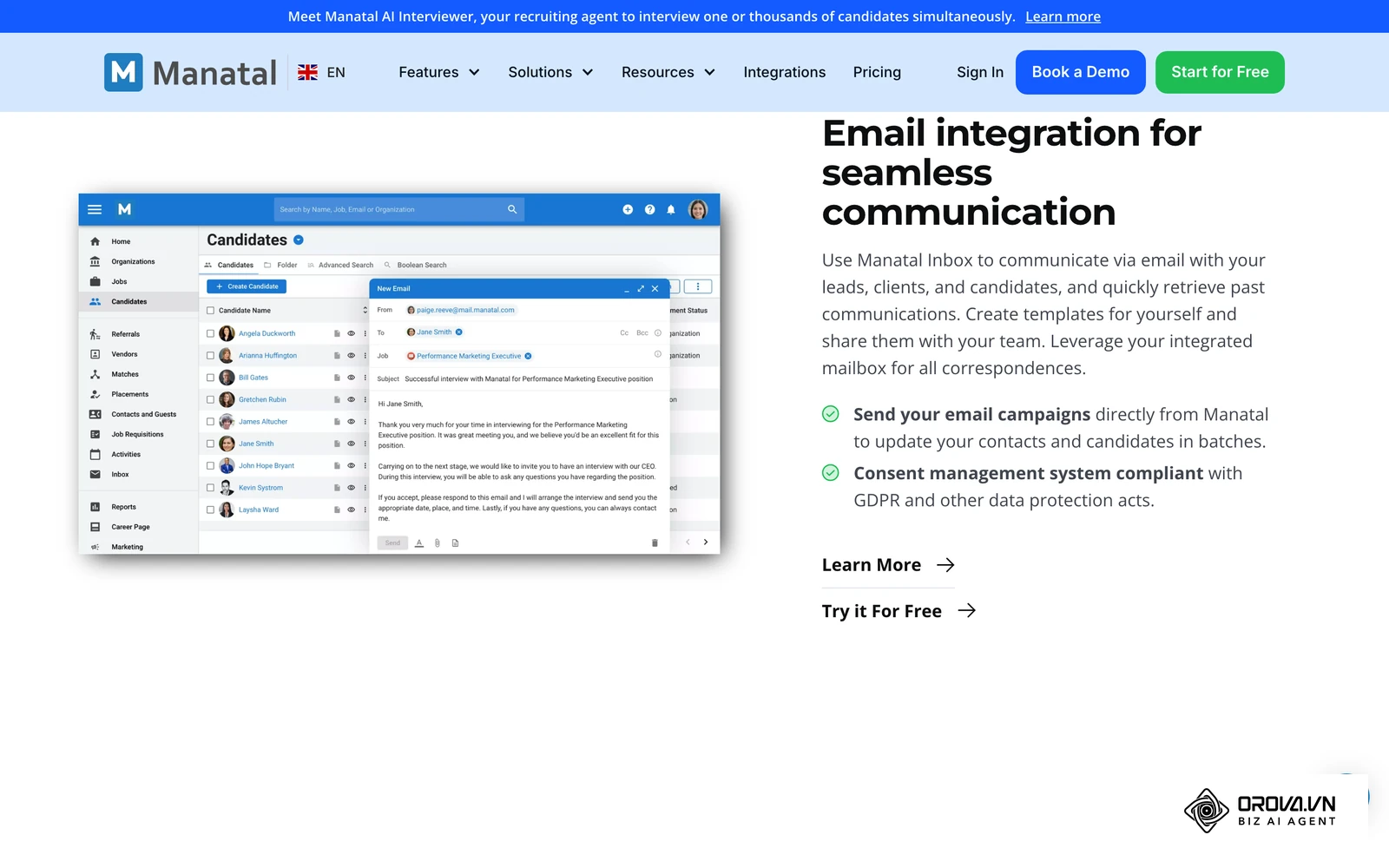
The phrase borrows directly from customer relationship management (CRM) software used in sales operations. In the early 2010s, corporate talent teams recognized that outbound cold calls and static job advertisements suffered diminishing returns. Just as enterprise sales organizations construct pipelines of prospective buyers long before a purchase order is signed, talent acquisition teams adopted candidate relationship management systems to treat high-caliber professionals as potential future employees rather than single-use applicants.
Many talent acquisition newcomers confuse a CRM with adjacent recruiting technologies. While these tools coexist inside modern HR tech stacks, their architectural purposes diverge fundamentally.
| Software Category | Primary Operational Objective | Practical Everyday Example |
|---|---|---|
| Recruitment CRM | Nurtures passive talent relationships before requisitions open | Sending a quarterly engineering architecture teardown to 200 senior developers |
| Applicant Tracking System (ATS) | Governs compliance, interview stages, and offers after application submission | Tracking interview scorecards and background checks for an active candidate |
| Sourcing Tool / Job Board | Identifies raw profiles and broadcasts point-in-time job advertisements | Running boolean search strings across professional social networks |
To understand this dynamic intuitively, consider how hospitality brands operate. An applicant tracking system functions like the hotel front desk checking in guests who have already booked rooms. A candidate relationship management system operates like the hotel loyalty program, sending curated invitations, lifestyle magazines, and event previews to prospective travelers months before they finalize their travel plans.
The Strategic Purpose of Candidate Relationship Management Systems
Candidate relationship management systems exist to eliminate reactive hiring panic. In traditional recruitment, a department head issues an urgent requisition, prompting the recruiting team to launch external searches from a standing start. This approach forces companies to compete for the small slice of the workforce actively reading job boards at that exact moment. By contrast, a CRM equips talent leaders to curate proprietary talent pools: structured groupings of vetted professionals who have expressed interest in the corporate brand but are not currently seeking immediate job changes.
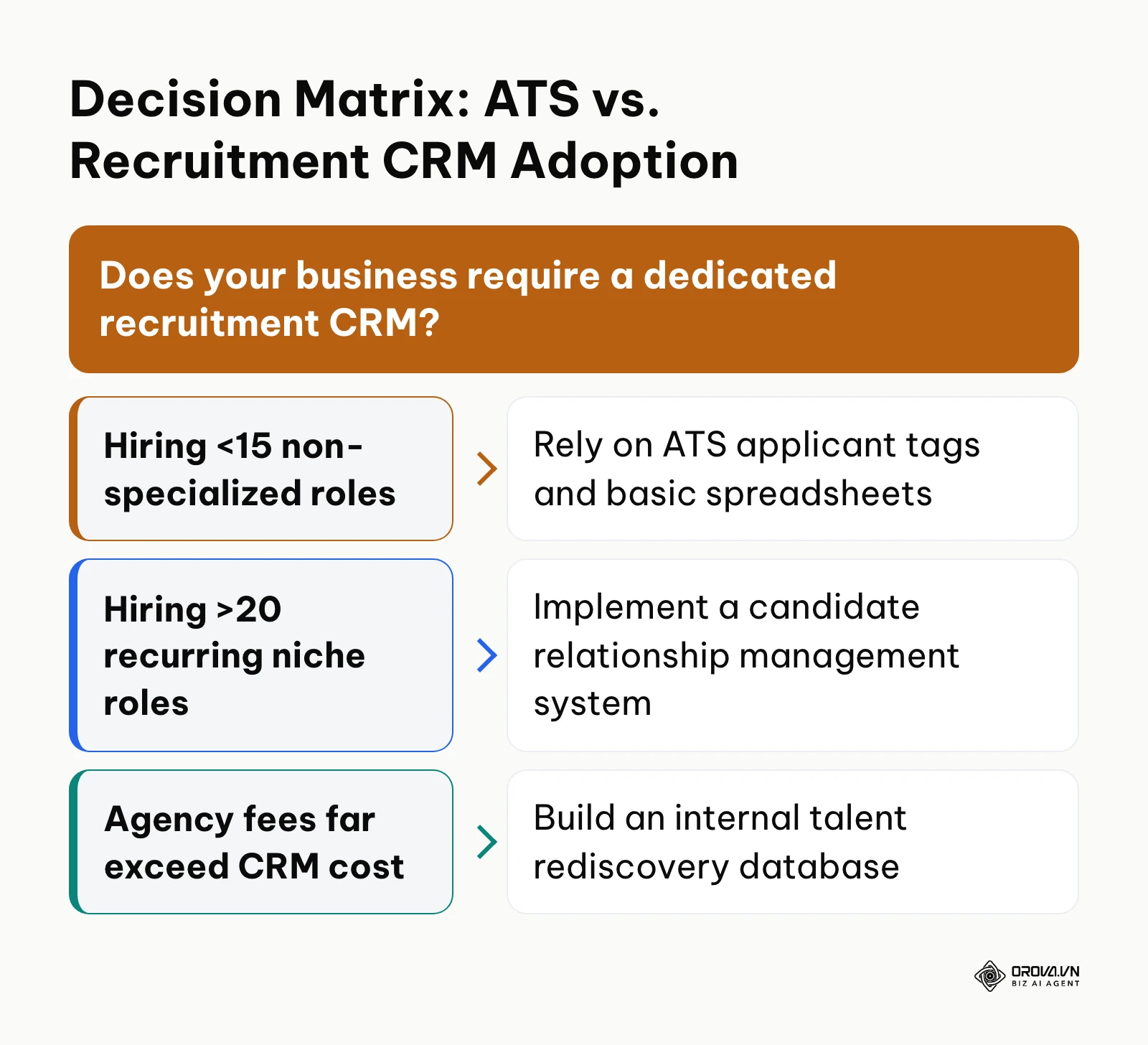
In the broader talent lifecycle, the CRM bridges the gap between top-of-funnel employer branding and bottom-of-funnel interview execution. Employer branding generates general awareness through conferences, technical blogs, and digital campaigns. Sourcing engines harvest contact details. The CRM captures those contacts, segments them into functional communities, and orchestrates continuous touchpoints. Only when a prospect expresses readiness for an interview does the record transition into the ATS for formal compliance, stage progression, and offer generation. The diagram below outlines how to evaluate whether your organization currently requires this dedicated infrastructure.
When organizations ignore this engagement layer, the penalties compound quietly. Recruiters re-source the same profiles repeatedly, discarding former finalists who were qualified but narrowly missed an offer. Furthermore, third-party staffing agency fees surge because internal teams lack direct access to pre-warmed specialists when unexpected turnover strikes.
Illustrative example: In a mid-sized financial technology firm with 380 employees, the lead technical recruiter aimed to build an advance pipeline for senior backend engineering roles before executive sign-off. The recruiter curated 65 passive software engineers from GitHub and open-source forums, tagged their domain expertise, and initiated personalized quarterly updates sharing architectural teardowns from the company's engineering blog. When an initial outreach campaign triggered deliverability warnings due to outdated contact records, the team introduced email validation checks before each send, maintaining an active 42% response rate and converting three pre-vetted engineers into formal hires within four weeks of requisition opening.
When You Do Not Need Candidate Relationship Management Systems Yet
When your organization hires fewer than 15 roles per year, operates with high turnover in general non-exempt positions, or lacks dedicated recruitment staff to craft personalized outreach, deploying a standalone CRM is premature. Managing passive leads in an advanced CRM without consistent nurturing creates dead databases and inflated software overhead. In these specific operating scenarios, maintaining organized talent tags inside your existing ATS or tracking prospects in a shared spreadsheet delivers sufficient visibility without incurring unnecessary licensing fees.
Business Value and Measurable ROI of Candidate Relationship Management Systems
Deploying candidate relationship management systems creates quantifiable business advantages at two distinct levels: executive balance sheets and everyday recruiting operations. For finance leaders and Chief People Officers, the platform functions as an insurance policy against vacant revenue-generating seats. For individual recruiters, it removes the daily grind of manual Boolean searches and cold outreach fatigue.
Many growing companies look at talent relationship platforms precisely to reduce their dependence on third-party agencies. Understanding these tangible operational outcomes helps teams build defensible business cases.
Direct Financial Return and Agency Fee Avoidance
The most transparent financial metric driving CRM adoption is the reduction of external recruitment agency spend. Organizations operating without internal talent pools often pay contingency placement fees calculated as a percentage of the candidate's first-year base salary. By maintaining ongoing relationships with pre-screened talent, recruiting teams convert passive contacts into direct applicants without third-party intermediaries. The formula below calculates the baseline return on investment for candidate relationship management systems.
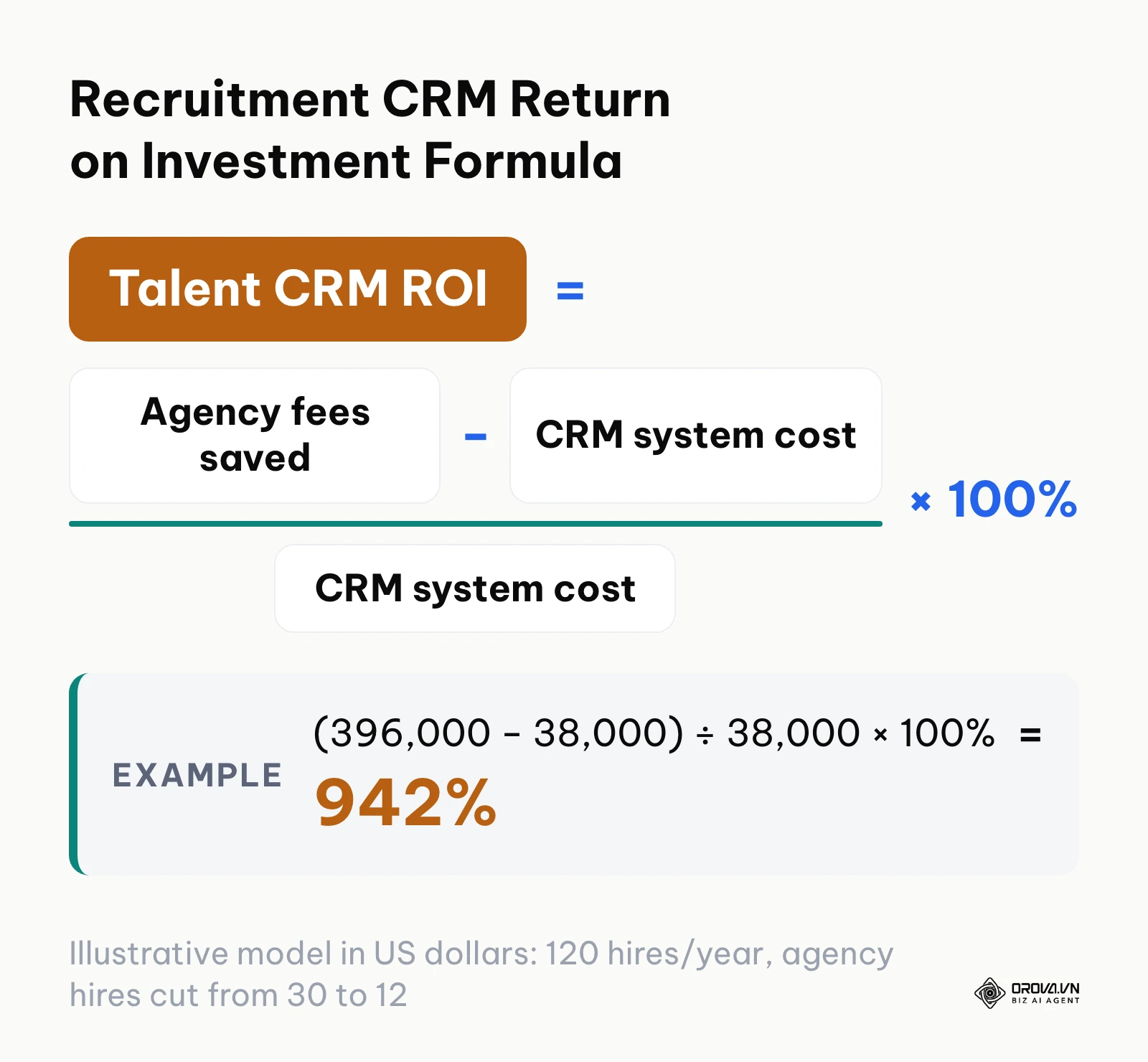
To illustrate this impact with realistic operating metrics, consider a mid-market technology business completing 120 professional hires annually. Prior to operating a CRM, the business relied heavily on contingency agencies for hard-to-fill technical and sales leadership roles. The illustrative model below uses assumed figures (not benchmark data) to contrast hiring economics before and after deploying an internal talent relationship system. Replace each number with your own to build your business case.
| Recruitment Performance Metric | Baseline Operation (Without CRM) | Mature Operation (With CRM) | Operational Variance |
|---|---|---|---|
| Annual Professional Hires | 120 positions | 120 positions | Constant |
| Agency-Assisted Hires | 30 hires (25% dependency) | 12 hires (10% dependency) | 18 fewer agency placements |
| Average Agency Placement Fee (US dollars) | 22,000 per placement | 22,000 per placement | Constant |
| Total Annual Agency Spend (US dollars) | 660,000 | 264,000 | 396,000 gross savings |
| Annual CRM Licensing & Setup (US dollars) | 0 | 38,000 | 38,000 platform cost |
| Net Annual Cash Savings (US dollars) | 0 | 358,000 | Positive cash flow |
| Average Time-to-Fill | 56 days | 34 days | 22 days faster per hire |
Evaluating software investments against comprehensive total cost of ownership models helps executives contrast specialized tools with all-in-one platforms, as detailed in our analysis of recruitment CRM systems vs ATS.
Recruiter Productivity and Search Velocity
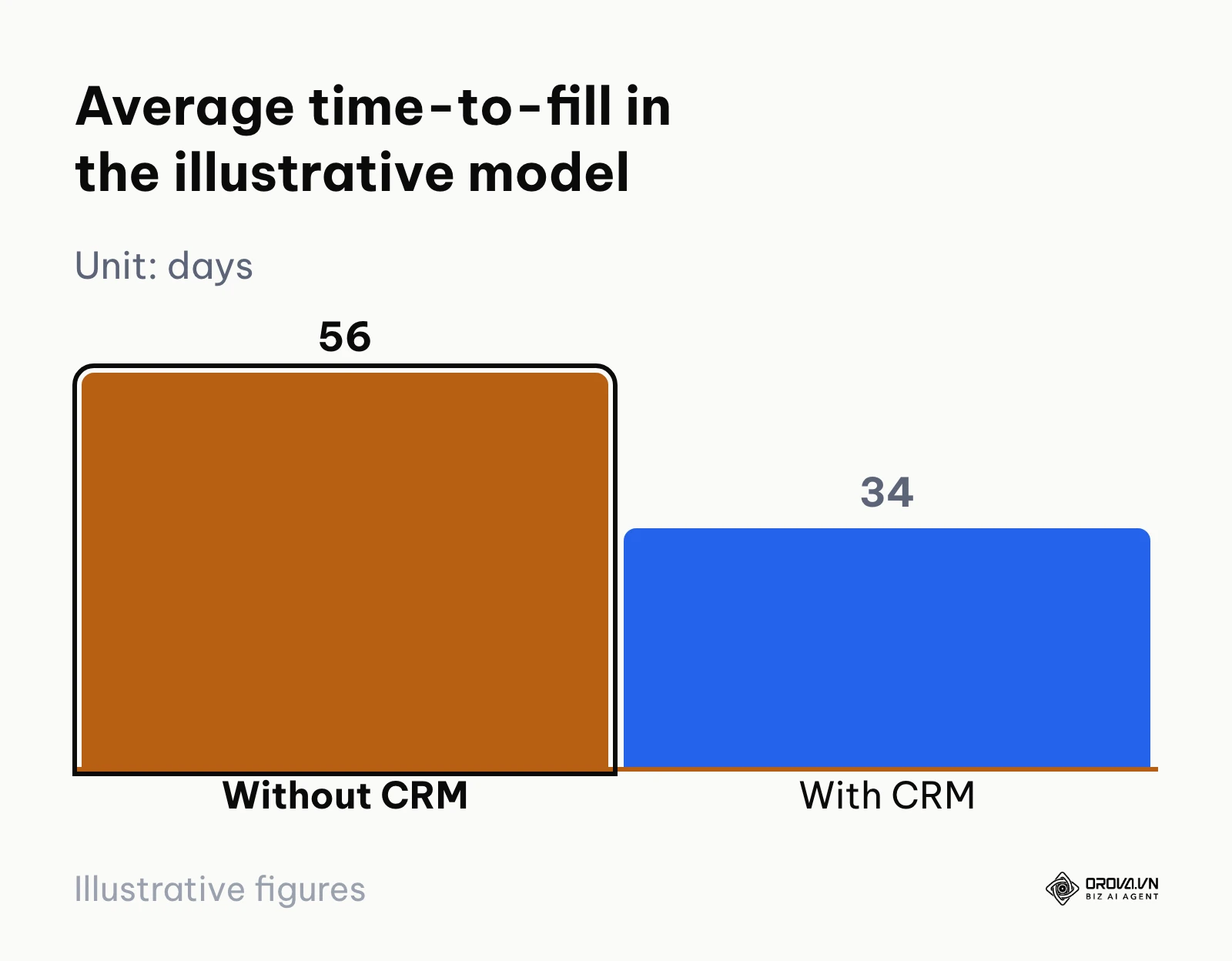
For practitioners, candidate relationship management systems automate administrative sourcing tasks. Instead of browsing external networks for hours, recruiters query an internal database enriched with past communication histories, portfolio links, and interview notes. Automated email drip campaigns keep hundreds of prospects warm simultaneously, allowing recruiters to focus exclusively on prospects who demonstrate active interest. The chart below compares average time-to-fill in the illustrative 120-hire model above.
Prior to CRM automation, a sourcer might spend fifteen hours each week drafting individual LinkedIn messages, with a modest reply rate. With segmented CRM campaigns, that same professional personalizes a single campaign sent to eighty qualified prospects, monitoring real-time open and engagement metrics.
Defending Against Executive Pipeline Vulnerability
When key contributors depart unexpectedly, traditional recruitment teams face a multi-week lag before initial candidate screening interviews occur. In critical operational roles, this vacancy creates lost revenue and project delays. Candidate relationship management systems mitigate this risk by providing instant access to pre-qualified successor slates. When a leadership seat opens, talent teams invite pre-warmed prospects directly into the interview process.
| Business Benefit Category | Quantitative Measurement Metric | Expected Observation Timeline |
|---|---|---|
| Agency Spend Reduction | Total dollar fees paid to contingency recruiters | 6 to 9 months post-launch |
| Sourcing Velocity | Days elapsed from requisition opening to first slate presentation | 60 to 90 days post-launch |
| Candidate Response Rates | Percentage of outbound outreach emails answered positively | 30 to 45 days post-launch |
| Talent Rediscovery Yield | Number of hires originating from historical applicant records | 90 to 180 days post-launch |
When talent pipelines stall, evaluating candidates manually consumes critical recruiting hours. Orova Recruit solves this by reading up to 500 resumes per requisition across PDF, Word, and scanned formats, benchmarking every applicant against customized job criteria and extracting exact text snippets as objective qualification evidence. Build structured hiring criteria and streamline candidate evaluation directly within your workflow.
How Candidate Relationship Management Systems Work
At its architectural core, a recruitment CRM manages state transitions for individuals who have not yet submitted a formal job application. The system ingests disparate profile data, unifies duplicate records, organizes contacts into logical talent pools, and triggers communications based on behavioral engagement. The diagram below illustrates the four continuous operational phases of a candidate relationship management pipeline.
Modern recruitment architectures increasingly decouple top-of-funnel candidate engagement from compliance-driven application tracking. To understand how these systems function in daily operations, we must examine their underlying technical components.
Multi-Channel Candidate Ingestion and Enrichment
Candidate relationship management systems collect candidate profiles from diverse digital channels. Browser extensions allow sourcers to import professional profiles directly from industry communities and GitHub repositories with a single click. Career site landing pages capture opt-in information from visitors who want corporate updates without completing a lengthy application form.
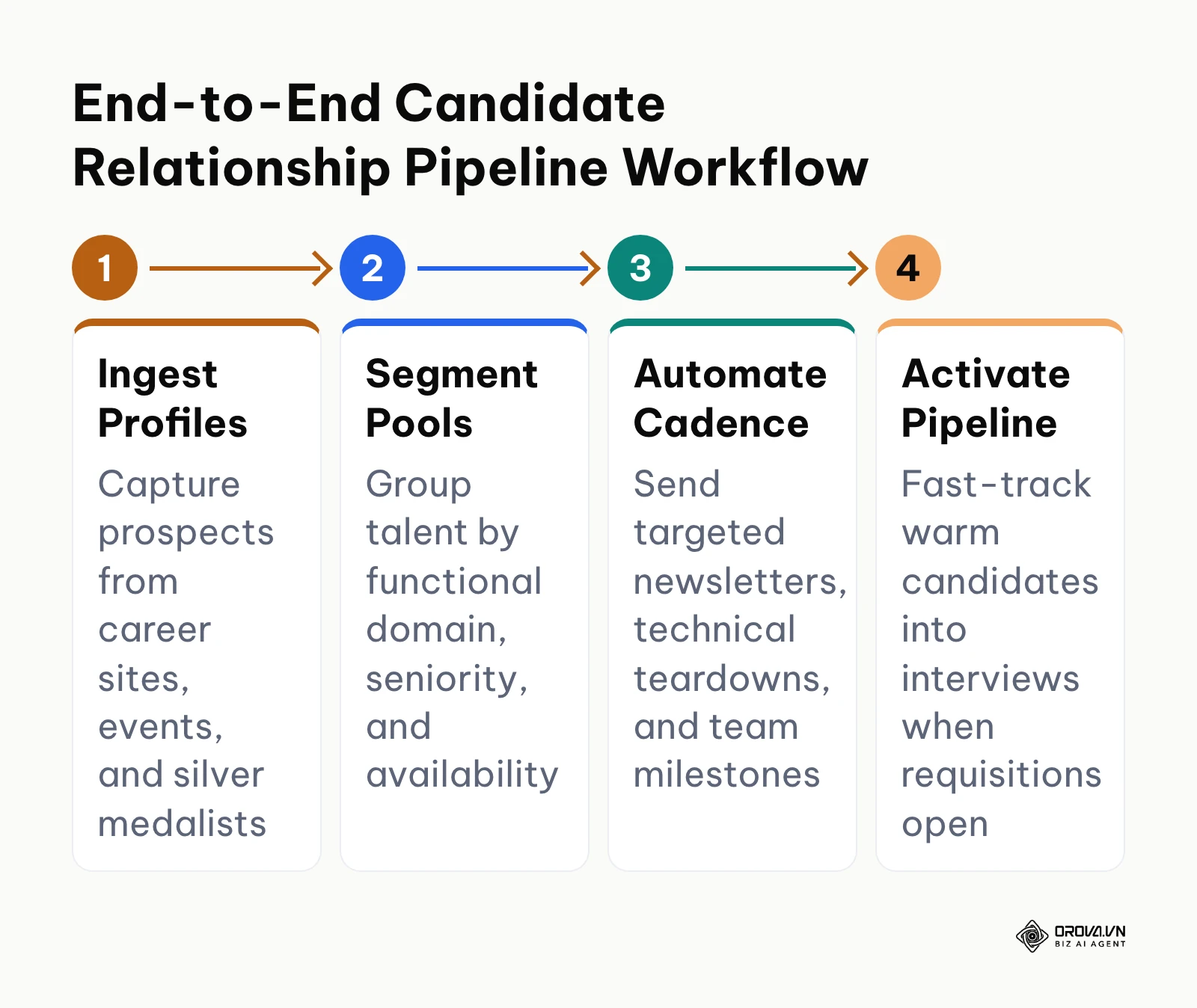
- Operational Function: Ingests unstructured candidate data and standardizes contact records.
- System Inputs: Resume files, browser extension profile scrapes, event attendee CSV uploads, and job fair QR code submissions.
- System Outputs: Standardized candidate profiles with verified email addresses, social profile links, and functional skill tags.
- Common Failure Point: Ingestion filters fail to clean invalid email addresses or scrapers grab outdated contact details, causing domain deliverability penalties.
Talent Pool Segmentation and Readiness Scoring
Once profiles enter the database, the CRM organizes them into distinct talent pools. Effective segmentation categorizes talent by functional discipline (such as DevOps or Product Marketing), seniority level, geographic preference, and engagement readiness. Without segmentation, recruiters end up blasting irrelevant mass emails to their entire contact list, prompting high unsubscription rates. The matrix below demonstrates how modern talent teams prioritize candidate touchpoints based on readiness and fit.
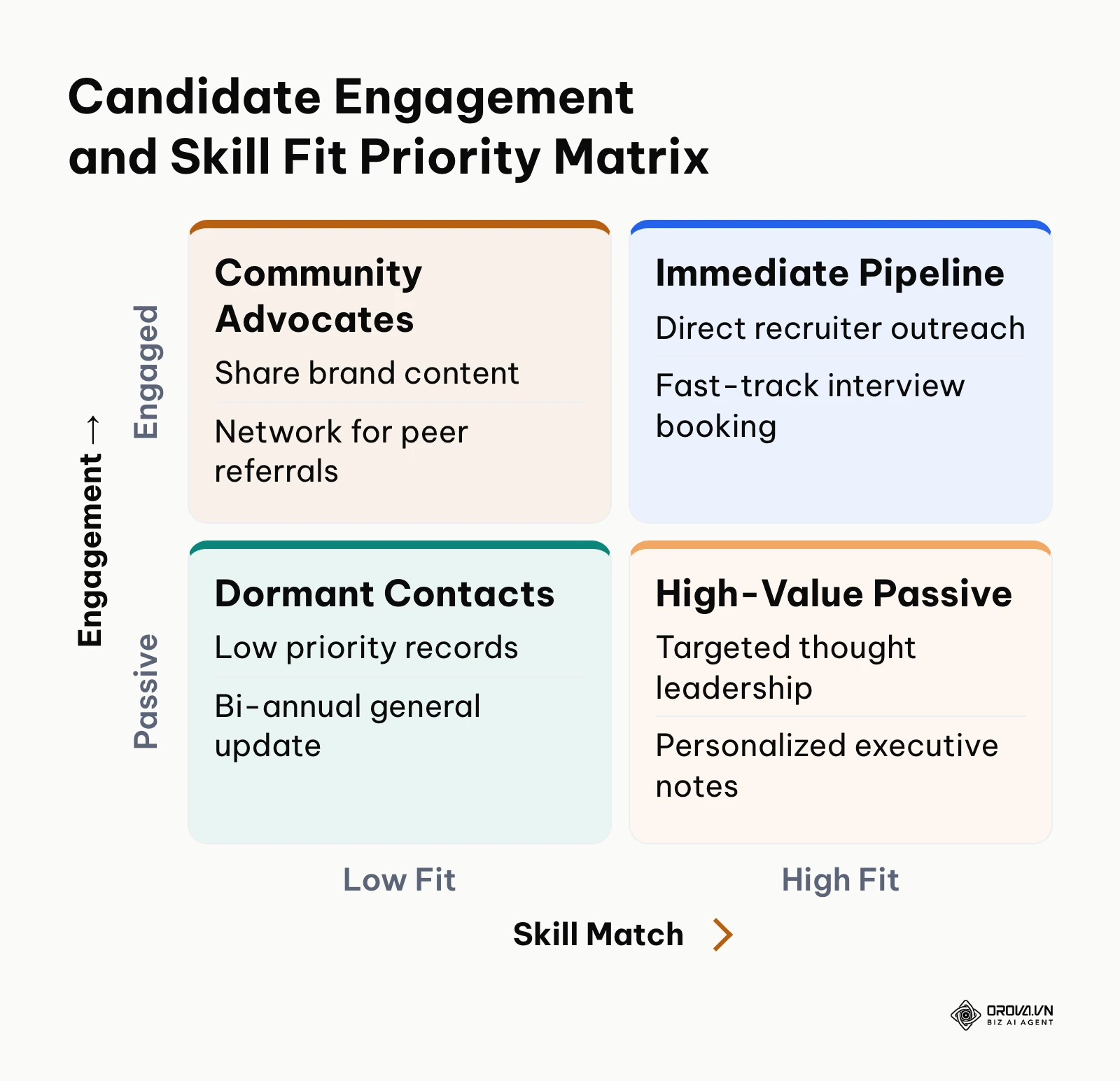
To prevent database degradation, mature teams implement an engagement scoring model. Contacts receive numerical points based on their digital interactions: opening a technical blog link (+5 points), visiting the corporate careers page (+15 points), or responding to an exploratory email (+25 points).
| Candidate Readiness Tier | Behavioral Engagement Criteria | Appropriate Recruiting Action |
|---|---|---|
| Hot (Ready-Now) | Opened recent emails, visited career page within 7 days, score >50 | Direct phone outreach or private message offering immediate requisition discussion |
| Warm (Nurture-Ready) | Opens occasional newsletters, clicked links in last 60 days, score 20–49 | Keep enrolled in bi-monthly technical updates and executive milestone newsletters |
| Cold (Dormant) | Zero email opens or profile updates across 120+ days, score <20 | Re-engagement verification campaign; archive record if inactive after 180 days |
Rigorous qualification criteria must guide every candidate interaction, a standard explored in depth within our guide to candidate screening.
Automated Multi-Touch Nurture Sequences
Automated nurture sequences deliver scheduled, personalized email messages over an extended timeline. Rather than sending isolated cold emails, recruiters build automated communication tracks that share company culture, engineering challenges, executive interviews, and open-source contributions.
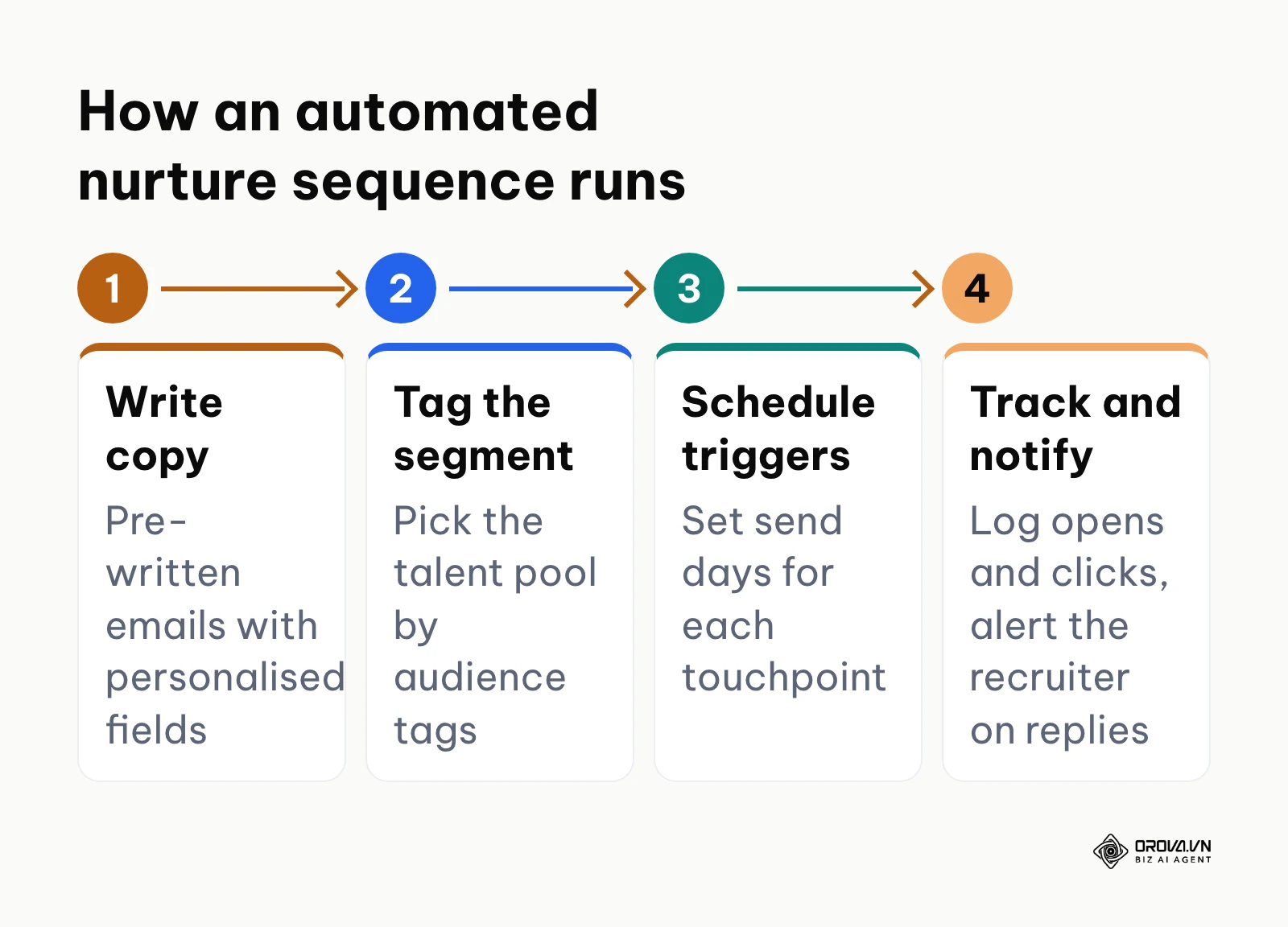
- Operational Function: Delivers timed content cadences to maintain brand awareness among passive prospects.
- System Inputs: Pre-written email copy, audience segmentation tags, and scheduling triggers.
- System Outputs: Automated email delivery, open and click-through event tracking, and response notifications sent to recruiters.
- Common Failure Point: Over-automating communications without personalizing dynamic fields, resulting in generic emails that damage employer credibility.
Talent Rediscovery and Database Activation
Most enterprise applicant tracking systems contain thousands of historical resumes that remain untouched after an initial search closes. Candidate relationship management systems index these historical files, matching past candidates against newly approved requisitions. Modern matching algorithms parse work histories and functional competencies to highlight previous applicants who now possess the seniority required for open positions.
- Operational Function: Scans dormant applicant files to identify qualified candidates for new requisitions.
- System Inputs: Historical resume archives, updated LinkedIn profile data, and new job description requirements.
- System Outputs: Ranked lists of past applicants who match active requisition criteria.
- Common Failure Point: Algorithmic bias or poor parsing engines matching on superficial keyword frequency rather than contextual skill capability.
Teams evaluating automated parsing engines should reference our practical analysis of AI resume screening tools to understand technical screening trade-offs.
| CRM Architecture Type | Core Technical Characteristics | Ideal Organizational Profile |
|---|---|---|
| Stand-Alone Sourcing CRM | Deep outbound automation, browser extensions, rich email drip workflows | Mid-market to enterprise teams with dedicated sourcing units |
| Integrated ATS-CRM Suite | Single database for pre-hire and post-hire, zero synchronization overhead | Fast-growing companies seeking unified tooling without integration maintenance |
| Agency Talent Platform | Multi-tenant client pipelines, billing integrations, rapid placement tracking | Third-party executive search firms and contingency staffing agencies |
The 4-Step Silver Medalist Nurture Cadence
Silver medalists are high-caliber candidates who successfully completed all interview stages but narrowly missed an offer because another finalist edged them out. In traditional recruitment, these individuals receive an impersonal rejection email and never hear from the company again. In high-performing teams, candidate relationship management systems enroll silver medalists into an exclusive, highly respectful nurture cadence. The timeline below illustrates the four scheduled touchpoints designed to preserve this relationship over six months.
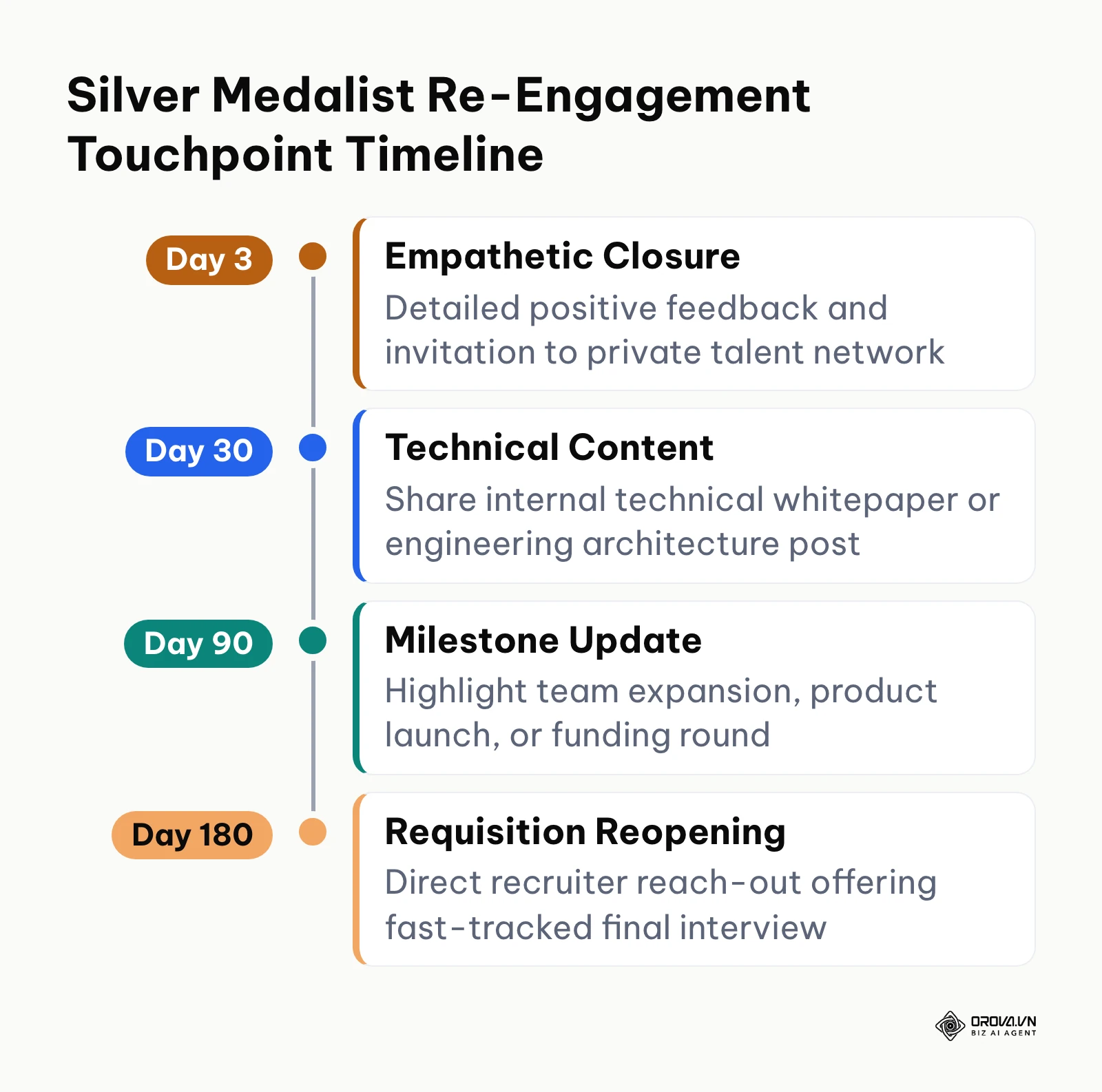
Day 3: High-Touch Gratitude and Talent Community Opt-In
- Subject Line: Thank you from the team at [Company Name]
- Cadence Trigger: Send 72 hours following the final rejection notification call.
Copy framework:
"Hi [First Name],
I wanted to follow up personally on our conversation earlier this week. The entire interview panel was genuinely impressed by your approach to [specific project or challenge discussed in final interview]. While we ultimately moved forward with another candidate whose background aligned slightly closer with our immediate quarterly objective, our team agreed you would be a phenomenal addition to [Company Name].
We are expanding our [Department Name] initiatives over the coming two quarters. With your permission, I would like to keep your profile in our private leadership network so I can share major team updates and reach out directly before we publicly post future roles.
Thank you again for investing your time with us."
Day 30: Educational and Technical Milestone Sharing
- Subject Line: Thought you might find this interesting: [Company Name]'s recent [Project/Paper]
- Cadence Trigger: Send 30 days post-rejection.
Copy framework:
"Hi [First Name],
I hope you are having a productive month. Our engineering team just published an architectural teardown detailing how we solved [specific technical problem or business milestone]. Remembering our discussion about your experience with [related technology or strategy], I immediately thought you might appreciate the approach: [Link to blog post or case study].
No response needed; I simply wanted to share this with you. I hope all is well on your side."
Day 90: Quarterly Check-In and Growth Announcement
- Subject Line: Quick update from [Company Name]
- Cadence Trigger: Send 90 days post-rejection.
Copy framework:
"Hi [First Name],
It has been a few months since we connected, and I wanted to check in. Our [Department Name] team recently achieved [mention a milestone: product launch, new market entry, or funding round], which is opening up new initiatives for the second half of the year.
How are things progressing with your current projects? If your priorities have shifted or if you are open to an informal coffee chat regarding what we are building next, I would love to reconnect for fifteen minutes."
Day 180: Direct Fast-Track Requisition Reopening
- Subject Line: Reconnecting regarding a new [Job Title] role at [Company Name]
- Cadence Trigger: Send 180 days post-rejection when headcount reopens.
Copy framework:
"Hi [First Name],
As our team plans for the upcoming quarter, we are officially opening an expanded [Job Title] position focused on [key initiative]. Given our past conversations and your deep expertise in [specific skill], you were the first person our leadership team thought of for this work.
Because you already completed our foundational interviews earlier this year, we would love to fast-track your evaluation directly to a working session with [Hiring Manager Name]. Do you have time for a brief call this Thursday or Friday to discuss the scope?"
Technical Bi-Directional Sync and ATS Compatibility Checklist
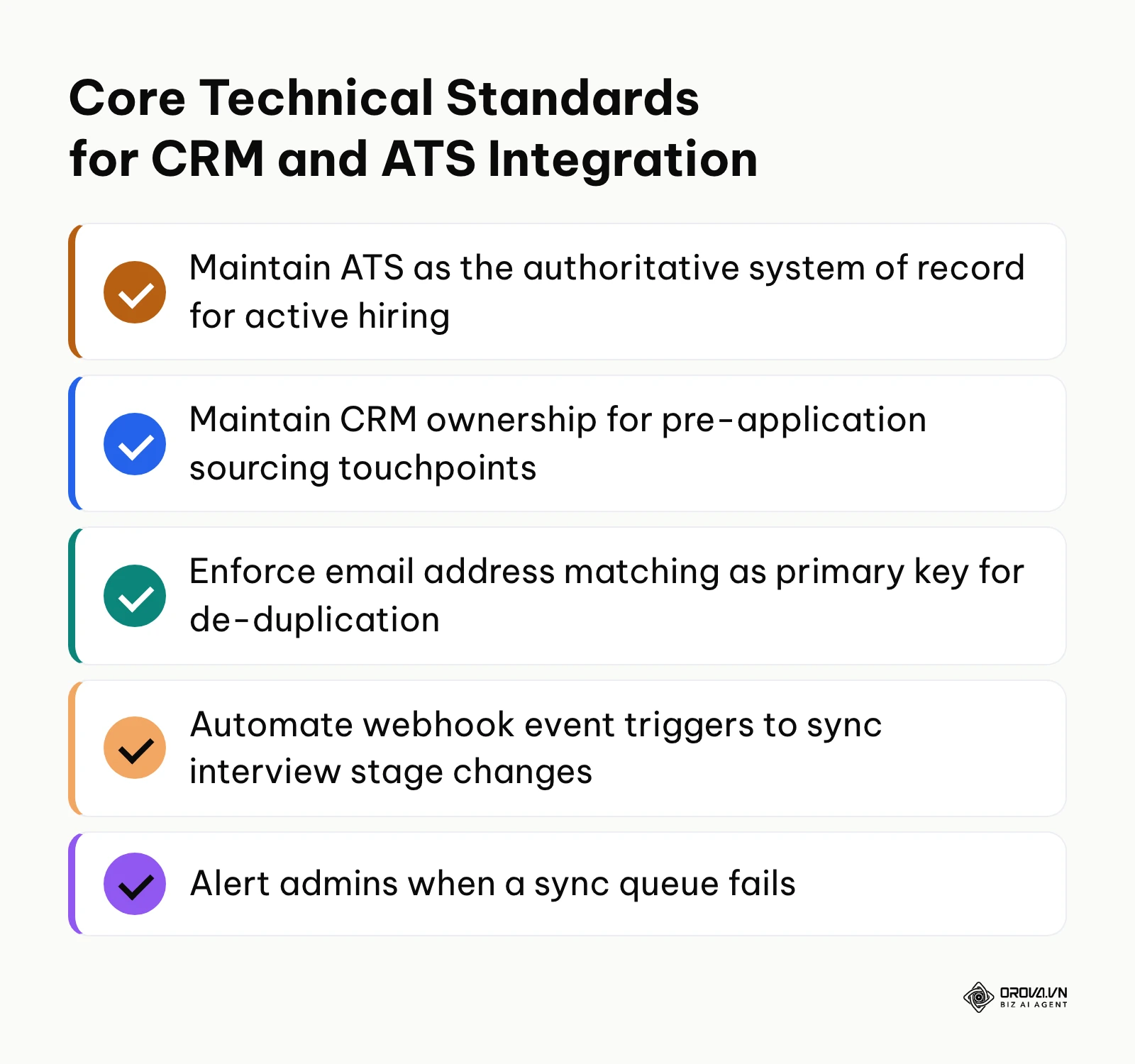
When deploying a stand-alone candidate relationship management system alongside an incumbent applicant tracking system, data conflicts inevitably occur if integration protocols are undefined. The summary below outlines the essential operational standards to review before enabling data exchange.
| # | Group | Check | What to verify | Done? |
|---|---|---|---|---|
| 1 | Candidate Data Synchronization Standards | Enforce Primary Key Mapping | Map unique candidate records using primary personal email addresses to prevent duplicate entries across platforms. | ☐ |
| 2 | Candidate Data Synchronization Standards | Define Field Authority Rules | Configure the CRM as the authoritative record for pre-application contact enrichment, and the ATS as authoritative for formal candidate stage progression. | ☐ |
| 3 | Candidate Data Synchronization Standards | Prevent Field Overwrites | Configure bi-directional sync rules so that empty fields in the CRM never overwrite populated compliance data inside the ATS. | ☐ |
| 4 | Candidate Data Synchronization Standards | Resume Parsing Harmonization | Ensure resume attachments uploaded to the CRM automatically parse into standard plain text fields in the ATS without truncation. | ☐ |
| 5 | Pipeline Stage Alignment and State Hand-offs | Automated Status Transitions | Trigger automated webhooks that transition CRM prospects from "Nurturing" to "Active Applicant" the moment they complete an ATS application form. | ☐ |
| 6 | Pipeline Stage Alignment and State Hand-offs | Disposition Syncing | Ensure candidates rejected in the final interview stage inside the ATS automatically sync back to the CRM with a "Silver Medalist" tag for long-term nurturing. | ☐ |
| 7 | Pipeline Stage Alignment and State Hand-offs | Recruiter Activity Logging | Sync outbound emails, notes, and call logs from the CRM into the ATS activity timeline so interview panels can review full outreach histories. | ☐ |
| 8 | Pipeline Stage Alignment and State Hand-offs | Attribution Source Tracking | Preserve original sourcing channel tags (e.g., specific career fairs, sourcing platforms) through the entire hiring pipeline into the final hire record. | ☐ |
| 9 | Security, Access Control, and Data Governance | Role-Based Permissions (RBAC) | Restrict permissions so sourcers can view and edit CRM talent pools without accessing sensitive offer details and salary histories inside the ATS. | ☐ |
| 10 | Security, Access Control, and Data Governance | Automated Consent Tracking | Synchronize GDPR, CCPA, and regional privacy consent statuses bi-directionally to respect candidate unsubscription preferences instantly. | ☐ |
| 11 | Security, Access Control, and Data Governance | Bi-Directional Error Alerting | Establish automated webhook failure notifications that alert system administrators whenever a sync queue fails for more than five minutes. | ☐ |
| 12 | Security, Access Control, and Data Governance | Quarterly Data Hygiene Audits | Schedule automated quarterly scripts to identify and merge duplicate candidate profiles across both systems. | ☐ |
Illustrative example: At an enterprise healthcare logistics company employing 1,500 staff, the recruitment operations specialist managed candidate data across both an existing applicant tracker and a newly implemented talent CRM. The specialist mapped custom application fields, built automated webhook integrations between platforms, and conducted bidirectional data audits. When concurrent profile edits between sourcers and interview coordinators caused duplicate applicant records, the specialist configured strict primary key matching based on candidate personal email addresses, automatically consolidating duplicate files into a unified candidate timeline without losing interview feedback notes.
Transform your hiring velocity by automating interview preparation and candidate follow-ups. With Orova Recruit, you can generate role-specific interview questions, transcribe recruiter notes, compare candidate scores side by side, and send automated step-by-step emails from your company mailbox. Experience the full platform free until 7 July 2027, with no credit card required to begin optimizing your recruitment operations.
Implementation Roadmap: How to Adopt Candidate Relationship Management Systems
Rolling out candidate relationship management systems requires operational alignment across team structures, communication cadences, and data governance. Technology alone cannot solve recruiting bottlenecks if recruiters treat the CRM as a passive storage locker.
Solo Talent Acquisition Leads and Small Businesses
Solo recruiters must focus on building lightweight, repeatable processes that run without ongoing administrative maintenance.
- Consolidate Existing Spreadsheets and Inboxes: Gather past applicant resumes, event attendee lists, and agency submissions into a single CSV file, removing corrupt rows and outdated entries during week one.
- Define Three High-Priority Talent Pools: Restrict your initial database setup to the three hardest-to-fill recurring roles in your business (e.g., Senior Full-Stack Engineer, Account Executive, Site Reliability Engineer).
- Draft a Simple Two-Part Email Sequence: Write an introductory message sharing your company's core mission, followed four weeks later by an update on team expansion milestones.
- Enroll Former Finalists Immediately: Identify the top twenty runner-up candidates from the past twelve months and initiate personalized reconnection messages.
In-House Talent Leaders and Corporate HR Teams
Corporate teams require structured change management to ensure adoption across specialized sourcing units and full-cycle recruiters.
- Establish Candidate Ownership Protocols: Establish clear operating rules defining how long a sourcer owns a prospect in the CRM before an active requisition opens, preventing internal conflict.
- Standardize System Integration and Field Mappings: Complete the twelve-point technical checklist to connect your CRM with your production ATS, testing bi-directional webhook updates in a sandbox environment during the first week.
- Train Sourcers on Audience Segmentation: Train your talent acquisition team on tagging conventions, engagement scoring thresholds, and message personalization guidelines.
- Launch a Talent Rediscovery Sprint: Audit your existing applicant database, segment dormant records, and deploy targeted re-engagement campaigns to reactivate qualified talent for active quarters.
Staffing Agency Founders and Executive Search Consultants
Agency environments require fast candidate placement cycles, multi-client talent pooling, and detailed placement attribution.
- Configure Multi-Tenant Candidate Portals: Segment your talent community by specific industry verticals and client requirements, ensuring candidate confidentiality across competing searches.
- Deploy Automated Availability Check-Ins: Create automated quarterly text and email triggers asking passive candidates if their compensation expectations or availability dates have shifted.
- Integrate Client Presentation Pipelines: Build standardized candidate submission profiles that allow your team to export anonymized candidate profiles and interview notes to hiring managers within minutes.
- Audit Inactive Candidate Records Regularly: Implement automated database maintenance scripts to refresh candidate employment histories and remove defunct contact details every ninety days.
Illustrative example: A boutique professional services consultancy with four internal recruiters set out to re-engage 2,200 past applicants archived in historical spreadsheets. The recruiting team segmented the talent pool into functional disciplines, drafted a three-part email series highlighting executive promotions and client wins, and scheduled staggered distributions over four weeks. When initial batches saw high unsubscription rates because of overly generic messaging, the team refined their audience filters by years of experience and personal location, which prompted 19 former applicants to book direct exploratory discovery calls with senior recruiters.
| Common Implementation Mistake | Operational Business Consequence | Practical Prevention Strategy |
|---|---|---|
| Mass-Blasting the Entire Database | High spam complaints, domain reputation damage, elevated opt-out rates | Enforce strict segmentation; never email contacts without matching functional tags |
| Treating the CRM as a Document Archive | Contact data goes stale every year, rendering candidate records obsolete | Schedule quarterly automated re-engagement verification campaigns |
| Neglecting Integration Rules | Duplicate candidate profiles, conflicting interview stages, lost notes | Implement bi-directional API rules with email matching as the primary key |
| Incentivizing Activity Over Engagement | Sourcers flood system with low-quality scraped profiles | Reward team members on qualified responses and pool conversions, not raw imports |
Future Trends in Candidate Relationship Management Systems: Author Perspectives
Examining the talent landscape as of 2026 reveals significant architectural shifts in how organizations discover and maintain relationships with prospective employees.
First, I believe that talent rediscovery will shift from manual keyword searching to continuous autonomous context enrichment within the next two to three years. Today, recruiters must manually run search queries to locate past applicants who match new requisitions. In the near future, recruitment CRMs will continuously monitor changes in professional repositories, public code contributions, and technical publications to automatically update internal candidate profiles. Talent acquisition teams should prepare for this shift by auditing their existing data hygiene now, because predictive enrichment models require structured, accurately tagged historical data to deliver reliable recommendations. However, this prediction could be delayed if major professional networks restrict programmatic access to profile data or introduce strict anti-scraping litigation.
Second, I anticipate that candidate privacy legislation and verified digital credentials will reshape how passive talent profiles are maintained. Currently, companies scrape and store candidate resumes for years without explicit, ongoing verification. As digital identity standards mature, candidates will likely manage their own cryptographically signed career profiles, granting temporary access to prospective employers on their own terms. Talent organizations should begin implementing transparent opt-in mechanisms and self-service candidate profile portals today. This trend may fail to materialize if cross-industry identity verification standards remain fragmented or fail to achieve widespread adoption among active job seekers.
Third, I observe a steady convergence between candidate relationship management and interview intelligence workflows. Historically, sourcing and interviewing operated as isolated silos with distinct toolsets. I believe that top-tier recruitment platforms will unify candidate relationship history with post-interview conversational analytics, giving interview panels real-time visibility into an applicant's long-term brand engagement during the live evaluation. Teams should prepare by integrating their communication histories directly into their interview scorecard templates. This consolidation could fall short if enterprise HR tech buyers continue to prefer specialized point solutions over unified talent management platforms.
Frequently Asked Questions About Candidate Relationship Management Systems
Are candidate relationship management systems still necessary in the age of generative AI?
Yes, candidate relationship management systems remain essential because AI algorithms require structured, high-quality relationship data to function effectively. While generative AI can draft personalized emails and parse resumes rapidly, the CRM serves as the centralized system of record that governs candidate consent, communication histories, and segmentation rules. Without a CRM, automated AI outreach lacks the organizational context needed to prevent duplicate messages and maintain employer brand credibility.
At what annual hiring volume should an organization invest in a standalone CRM?
Organizations hiring more than twenty to thirty specialized or high-impact professional roles per year typically achieve a positive return on investment from a dedicated CRM. Companies with lower annual hiring volumes or those recruiting primarily entry-level, non-exempt roles can generally manage candidate relationships using structured applicant tags within their existing ATS. When annual third-party agency fees are many times larger than the cost of a CRM, investing in one is usually a sound choice regardless of overall headcount; run the ROI formula above with your own numbers.
How should talent teams handle candidate ownership disputes between sourcers and recruiters?
Candidate ownership should be governed by clear operational service-level agreements established during system setup. A standard rule grants the sourcing professional ownership of a passive prospect for ninety to one hundred twenty days following the initial positive outreach response. If the prospect does not enter an active interview process for an approved requisition within that window, the profile returns to the shared talent pool, allowing full-cycle recruiters or other team members to initiate contact for new requisitions.
How can organizations maintain GDPR compliance when storing passive candidate data beyond 12 months?
Maintaining compliance with the General Data Protection Regulation (GDPR) and local data privacy frameworks requires configuring automated consent workflows inside your recruitment CRM. When importing passive profiles from public sources, teams should notify candidates within one month, explaining what personal data is stored and offering an immediate opt-out link. Furthermore, a common practice is to set retention rules that email passive contacts every twelve months to request explicit consent renewal, automatically purging records when candidates decline or fail to respond.
Can an applicant tracking system completely replace a recruitment CRM?
While several modern applicant tracking systems offer basic candidate pooling features, an ATS cannot fully replace a specialized CRM for organizations engaged in strategic, proactive recruitment. Applicant tracking systems are structurally designed to be transactional and compliance-focused, organizing candidates linearly around open job requisitions. Conversely, candidate relationship management systems are designed for multi-channel marketing, long-term talent segmentation, and automated drip communication across multi-month engagement cycles before requisitions exist.
Where Should You Start with Candidate Relationship Management Systems?
Building a proactive recruitment engine does not require an enterprise-wide overhaul overnight. Your immediate first step depends entirely on your team's current operational maturity.
If you are starting from zero with no centralized candidate database, dedicate a single afternoon to creating three targeted talent pools in your primary communications platform. Identify your organization's three most challenging recurring job profiles, gather the contact information of twenty top professionals you would love to hire in the coming year, and draft a short, personalized note introducing your team's long-term technical mission. Establishing this initial twenty-person community shifts your recruiting mindset from reactive firefighting to intentional pipeline development.
If your organization has accumulated candidate records across fragmented spreadsheets, recruiter inboxes, and disparate sourcing folders, focus your first afternoon on a data consolidation audit. Export your disparate spreadsheets into a unified workbook, filter by primary personal email addresses to eliminate duplicates, and delete incomplete records. Once your data is scrubbed, upload the clean contacts into your core recruitment system with uniform functional tags, creating an authoritative foundation for your first nurture campaign.
If your team is already sending outbound recruitment campaigns but operating without measurement, spend an afternoon reviewing your attribution metrics. Review your outreach analytics from the past two quarters to measure your open rates, response rates, and bounce rates across functional disciplines. Identify the single email sequence with the highest response rate, isolate what made that messaging resonant, and establish that structure as the baseline standard for your next candidate relationship management systems.
About the author

Builder of Orova
Nguyễn Đỗ Trọng Ân has 8 years of experience in marketing, including 6 years managing market development across Asia. He builds Orova, a Biz AI Agent that never sleeps: it plans, runs and optimizes work for businesses.
Run your business with AI Agents
Orova is the always-on Biz AI Agent — it plans, runs, and optimizes the work for you.
Save time, unlock productivity.