What are TikTok Spark Ads? A practical setup guide

You are running standard ad campaigns on TikTok, but your return on ad spend drops after a few days. Viewers scroll past traditional promotional videos within the first two seconds, budgets burn fast and creative fatigue sets in. Meanwhile, authentic organic videos, from your own brand channel or from customers, earn strong engagement but lack the targeted, predictable reach you need to scale sales. TikTok Spark Ads close that gap: they let you put paid budget behind an existing organic post while the likes, comments and shares stay on the original video. This guide explains what tiktok spark ads are, how the authorization workflow works from creator code to live campaign, and how the format compares with standard In-Feed ads in an illustrative test. You also get practical tools you can run by hand: a code expiration tracker, a pre-ad audit checklist, a creator outreach template and a troubleshooting list, with no paid third-party software required.
What are TikTok Spark Ads?
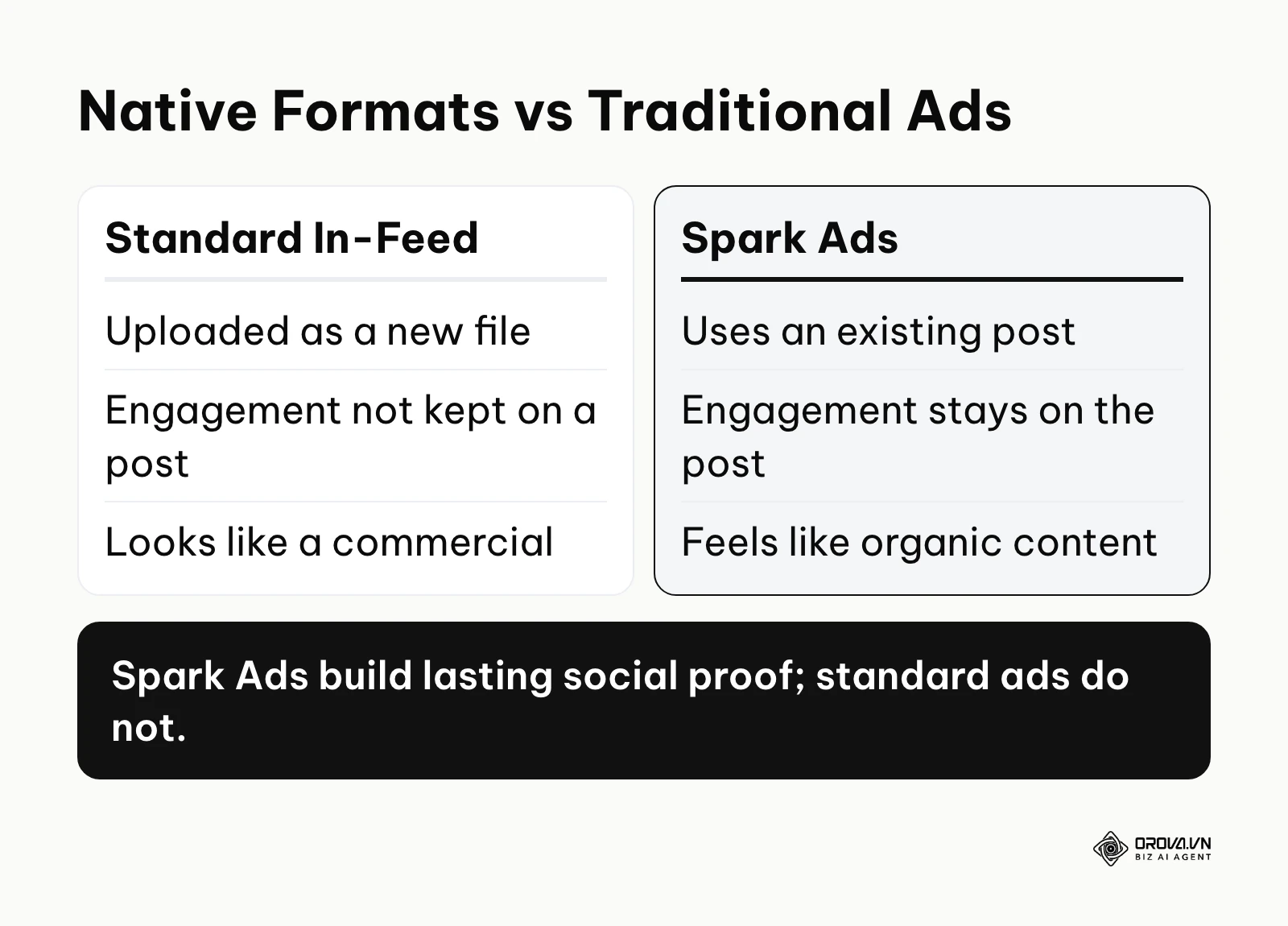
TikTok Spark Ads are a native ad format that lets brands boost existing organic videos from their own account or from other creators. All engagement stays on the original post. Unlike standard ads, the format runs on authentic content instead of promotional videos made from scratch.
TikTok introduced the format several years ago to tackle "ad blindness" by making sponsored content look like the rest of the For You feed. When you scroll, a Spark Ad looks and behaves like a normal video. The visible differences are a small "Sponsored" label and a call-to-action (CTA) button near the caption. Because it blends into the feed, viewers are less likely to swipe away the way they often do with heavily branded studio content.
Here is how the format differs from concepts marketers often confuse it with:
| Concept | Key difference | Everyday example |
|---|---|---|
| Spark Ads | Uses an existing organic post; engagement stays on the original video after the campaign ends. | Boosting a customer's unscripted review of your skincare serum straight from their profile. |
| Standard In-Feed Ads | Uploaded as a new file in Ads Manager; the ad's engagement does not live on an organic post. | Shooting a polished studio video and uploading it only as an ad. |
| Branded Mission | A TikTok program where brands invite many creators to make content for a campaign brief. | Posting a brief and promoting the best creator submissions. |
Everyday example: picture an independent coffee shop owner. A regular customer films an enthusiastic video about the shop's secret-menu latte, and it starts picking up views organically. Instead of hiring a videographer for a new commercial, the owner asks the customer for an authorization code and uses Ads Manager to show that same video to people within a few miles of the shop. The views, likes and comments from the paid push stay on the customer's original post, adding social proof that keeps working after the campaign.
The Meaning Behind the Format
Advertising on social platforms has shifted from interruptive broadcasts to native storytelling. This format exists to solve an expensive problem: producing authentic, high-converting creatives at scale. TikTok users tend to reject polished, corporate-looking ads; they respond to raw, entertaining and educational content. Spark Ads sit at the intersection of organic influencer marketing and performance media buying. They combine the social proof and authenticity of an organic creator with the targeting, bidding and reach of a paid platform.
Before this format, brands either downloaded a creator's video and re-uploaded it to their ad account, often losing quality and authenticity, or relied on unpredictable organic reach. If you ignore the format today, you risk spending your creative budget faster while cost per acquisition (CPA) climbs and click-through rates slide. You also lose the compounding value of social proof, because engagement on standard ads does not build up on a post your audience can find later.
When not to use TikTok Spark Ads The format is not always the right choice. First, if a campaign depends on a purpose-built landing experience and tightly scripted messaging, such as a technical B2B software offer, a standard In-Feed ad built for that page may serve you better. Second, during urgent flash sales that need text overlays and countdowns the organic video does not have, a purpose-built standard ad is usually more effective. Finally, brands in highly regulated industries often cannot use unscripted creator videos at all.
Value and Benefits of Native Amplification
The advantages go beyond vanity metrics. They fall into two layers: the business value for the organization and the day-to-day benefits for the people running the campaigns.
Business Value: Maximizing ROI and Reducing Risk
For a business, the main value is extending the profitable life of content that already works, lowering creative production costs and reducing the risk of launching untested creatives.
Illustrative example: a growing direct-to-consumer fitness apparel brand.
- Context: The brand, with 50 employees and a marketing director, was spending 10,000 dollars a month on agency-produced studio commercials, and their performance was slipping.
- What they did: The director moved 4,000 dollars of that budget to license four organic review videos from mid-tier fitness creators through authorization codes, targeting the same lookalike audiences used for the studio ads.
- Snags and fixes: The creators hesitated at first, worried about losing control of their accounts or spamming their followers. The brand sent a one-page agreement explaining that each creator keeps full ownership and only grants temporary amplification rights.
- Result: New customers came in quickly, and the newly launched leggings line sold out within two weeks, something the studio commercials had not achieved.
Practitioner Benefits: Efficiency for Media Buyers
For media buyers and performance marketers, the format simplifies the daily workflow, keeps the account healthier and reduces creative burnout, because a steady supply of organic videos can feed testing instead of a constant stream of new studio shoots.
Illustrative example: a senior media buyer at a digital marketing agency.
- Context: Managing a 50,000-dollar monthly budget for a mobile gaming client, the buyer struggled to hold ROAS because repetitive gameplay ads fatigued every 48 hours.
- What they did: The buyer switched to a native strategy, searched TikTok for organic screen recordings of real players, secured codes and set up a high-volume testing framework.
- Snags and fixes: Tracking dozens of expiring codes across many creators became a logistics problem. The buyer built a central spreadsheet with date-based color alerts to monitor every code.
- Result: The pressure to produce new creatives eased, campaign ROAS stabilized and new tests went live faster.
| Benefit | Measured by which metric | Time to see results |
|---|---|---|
| Extended content lifespan | Creative fatigue rate (days active before CPA spikes) | 7 to 14 days |
| Lower production costs | Average cost per newly deployed creative | Immediate |
| Increased social proof | Profile followers gained and likes kept on the video | 3 to 5 days |
| Higher conversion efficiency | Cost per action (CPA) and return on ad spend (ROAS) | 1 to 2 weeks |
OROVA ADS applies AI Agent to automate and optimize ad performance on Google, Meta and TikTok. Scale your budget safely, monitor 24/7 and expand your business quickly.
Experience the solution at orova.vn/ads
How TikTok Spark Ads Work: The Complete Anatomy and Setup
To use the format well, you need to know its parts, the two main variations and the step-by-step process for launching it. Skipping a detail here is the most common reason campaigns stall.
Anatomy of a Spark Ad
A Spark Ad is made of several elements that work together to drive engagement and conversions. Know what you can and cannot control as the advertiser.
- The original video: The core visual and audio asset, with its original music and effects. The input is the organic post; the output is a native-looking placement in the For You feed. The main point of failure: if the creator deletes the video or makes it private, your ad stops delivering.
- The creator handle and profile picture: Tapping the profile picture or handle takes viewers to the creator's real profile, not a branded landing page. This helps the creator (or your brand, if you boost your own posts) gain followers.
- The original caption: The caption stays exactly as the creator published it. You cannot add promotional text, fix typos or update promo codes. Campaigns often fail here when the caption contains restricted hashtags or off-topic text.
- The call-to-action (CTA) button: The paid element TikTok adds to the layout. Advertisers pick a standard CTA such as "Shop Now", "Learn More" or "Sign Up" and send traffic to a website, an app store page or a lead form.
- The audio track: The sound must be cleared for commercial use. A video built on mainstream copyrighted music usually cannot be boosted unless you hold the right license.
Types of Spark Ads
The setup and the strategy differ depending on where the content comes from.
| Type | Characteristics | Best suited for |
|---|---|---|
| Self-owned content | Videos already published on the brand's own TikTok account, linked to the ad account. Usually no authorization code is needed once the account is linked. | Brands with an active organic presence that want to amplify announcements, product showcases or behind-the-scenes content. |
| Creator-owned content | Videos published by external creators, affiliates or customers. Requires an authorization code the creator generates, valid for a set period. | Brands that want to use user-generated content (UGC), borrow authentic social proof and build third-party credibility at scale. |
How to set up tiktok spark ads: Step-by-Step Tutorial
Setup needs coordinated actions in the mobile app (where the creator generates the code) and in Ads Manager on desktop (where you build the campaign). TikTok updates menu names and layouts from time to time, so treat the labels below as a guide and look for the closest match in your version.
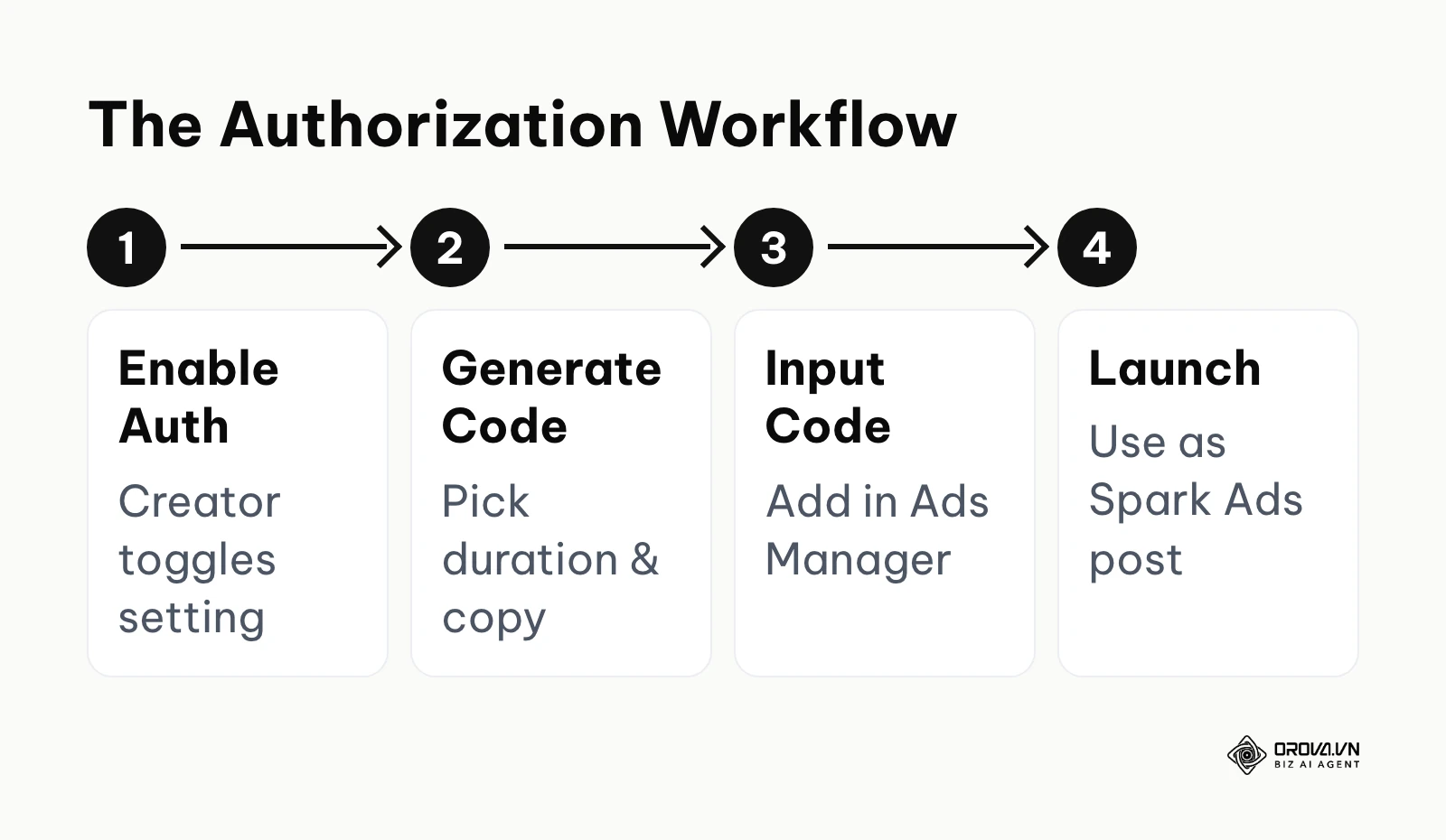
Step 1: Enabling ad authorization (creator side) The creator opens the video they want to authorize, opens its menu (the "..." or share options), and goes to the ad settings for that post. There they switch on ad authorization and accept TikTok's advertising terms if it is their first time.
Step 2: Generating the code and choosing a duration (creator side) With authorization on, the creator picks how long the authorization lasts from the options the app offers, generates the code, copies it and sends it to the advertiser by email or direct message.
Step 3: Adding the code in Ads Manager (advertiser side) The advertiser opens the creative or asset library in Ads Manager, finds the option to add a Spark Ads post by authorization code, pastes the code and confirms the video preview. The post is then available in the library for campaigns.
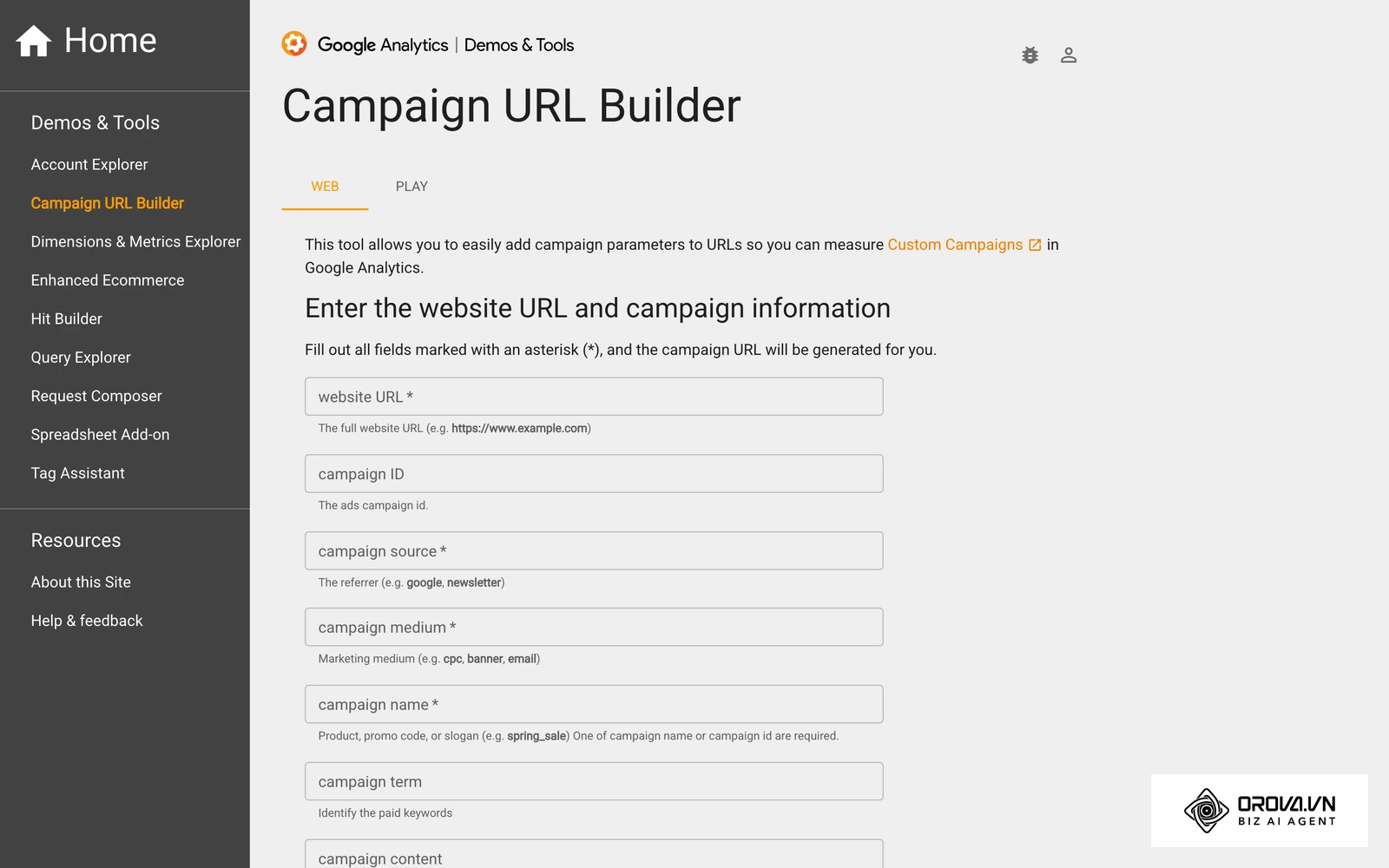
Step 4: Creating the campaign and ad group (advertiser side) The advertiser creates a new campaign and picks an objective that matches the goal, for example a conversion-focused objective for e-commerce or an app-promotion objective for apps. At the ad group level, they define the audience (age, location, interests), set the budget and choose a bid strategy just as they would for any other campaign. Check that the TikTok Pixel or events setup is selected and firing; otherwise TikTok cannot optimize delivery for downstream actions.
Step 5: Building the ad (advertiser side) At the ad level, the advertiser chooses to use an existing post or a Spark Ads post instead of uploading a new video, selects the authorized creator video, adds the destination URL with UTM parameters for analytics, picks the CTA button and submits the ad for review.
The Authorization Code Tracker (Asset)
Managing creator codes through scattered notes and chat threads leads to expired campaigns, lost learning and frustrated media buyers. A simple spreadsheet keeps high-volume campaigns running. Set up a sheet with the columns below, and use conditional formatting to highlight codes expiring within 7 days in yellow and expired codes in red.
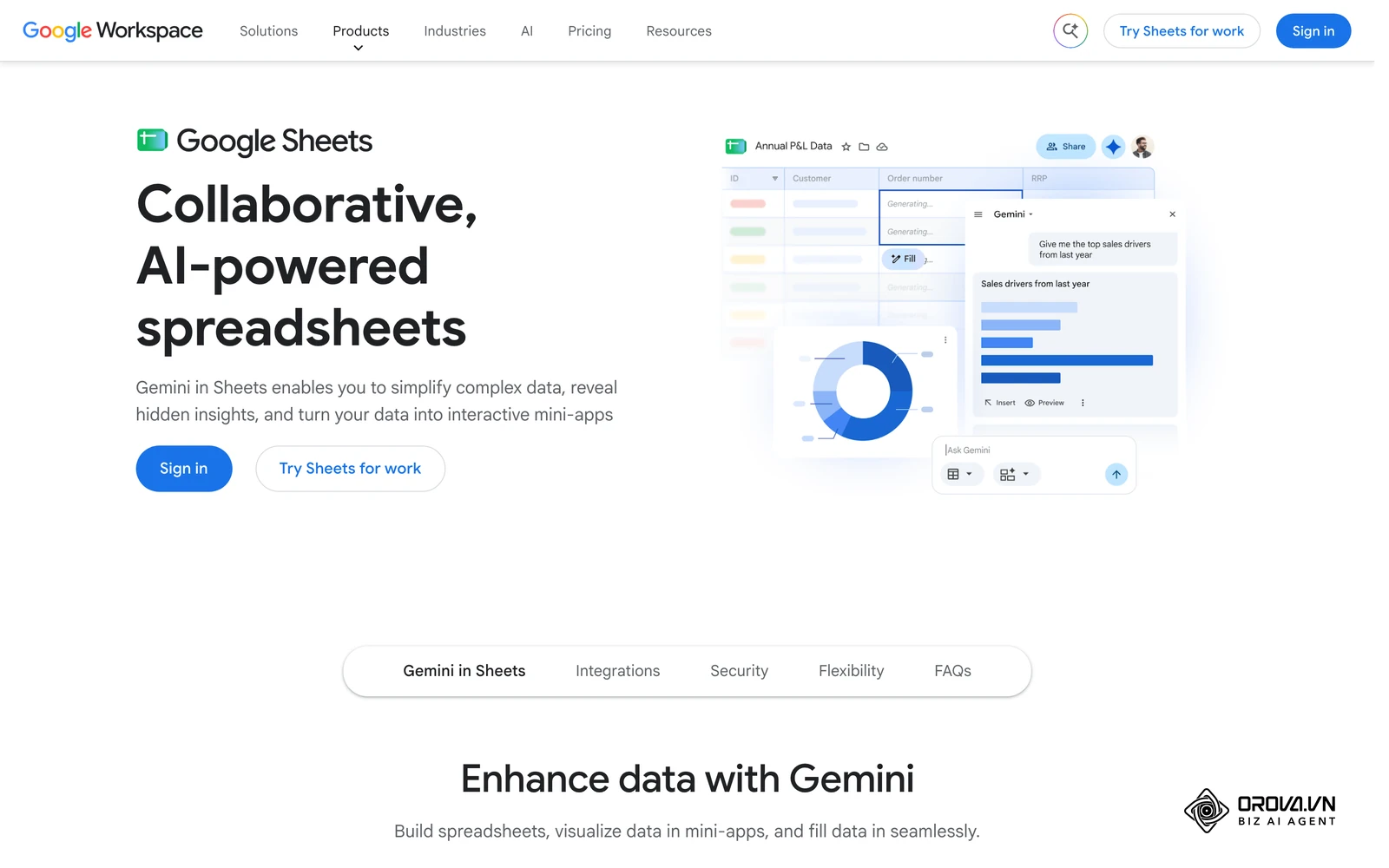
| Creator Handle | Video Description | Authorization Code | Start Date | Expiration Date | Days Remaining (Formula) | Campaign Status |
|---|---|---|---|---|---|---|
| @user_abc123 | Winter coat review | BQ123456789 | 2026-10-01 | 2026-10-31 | =DAYS(E2, TODAY()) | Active |
| @skincare_pro | Serum 30-day result | XY987654321 | 2026-09-15 | 2026-10-15 | =DAYS(E3, TODAY()) | Warning (Yellow) |
| @tech_guru | Headphone unboxing | AZ112233445 | 2026-08-01 | 2026-08-31 | =DAYS(E4, TODAY()) | Expired (Red) |
TikTok Spark Ads vs In-Feed Ads: An Illustrative Comparison
To judge the commercial impact, look at performance metrics rather than theory, and test the two formats side by side under the same conditions. Standard ads give you full control over the creative, effects and caption, but they often earn less engagement because viewers recognize them as ads.
Illustrative example: a mid-sized e-commerce apparel brand running a first-quarter growth campaign.
- Context: The brand, with a marketing team of three, relied on standard In-Feed ads and watched CPA rise past profitable levels.
- What they did: They ran an A/B test over 30 days, comparing polished standard ads with creator-made native ads for the same product line, using identical audience targeting and budgets.
- Snags and fixes: The standard ads converted faster on day one, which worried the team. They held through the learning phase, recognizing that the native ads needed time to gather engagement.
- Result: By day 30, the native ads reached a CPA of 12.50 dollars versus 18.20 dollars for the standard ads, about 31% lower. The creator's video also kept more than 15,000 likes, social proof that continued to support sales after the paid budget ran out.
Your own numbers will differ by product, audience and creative, which is why a controlled test on your account matters more than any outside figure. When content feels authentic, viewers are more receptive to the message, which tends to lift results across the funnel; see the guide to conversion rate optimization for what to fix after the click. To compare the two formats on profit rather than clicks, calculate return with the ROAS formula.
Pre-Ad Audit Checklist for Organic Videos
Not every viral organic video makes a profitable ad. A million views does not guarantee sales. Before you spend time negotiating for a code, run the video through this checklist.
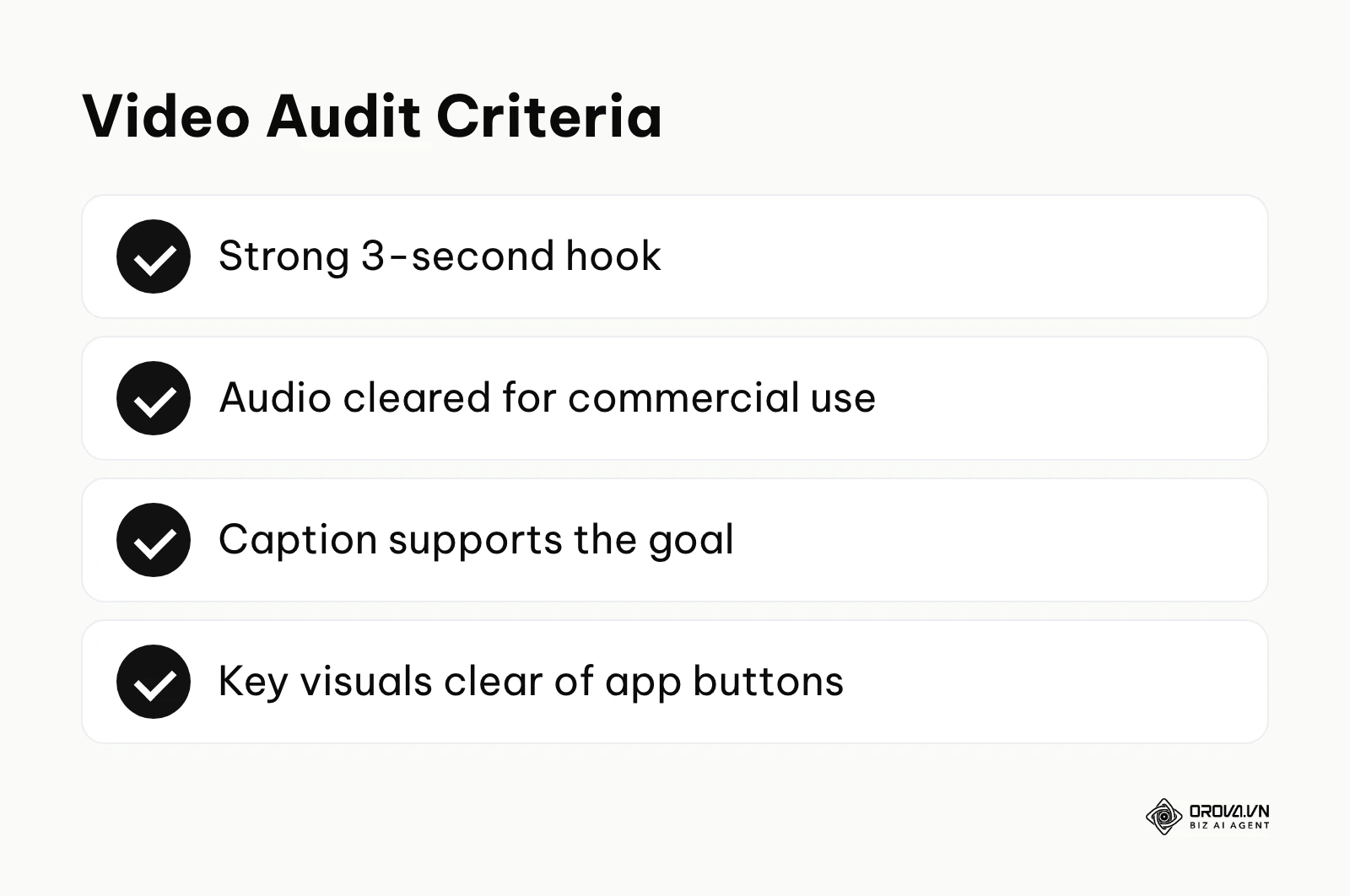
- The hook test: Does the video grab attention in the first 3 seconds without leaning only on a short-lived audio trend? If the product is not shown or teased early, skip it.
- The audio clearance: Is the audio an original voiceover or a track cleared for commercial use, such as one from TikTok's Commercial Music Library? Mainstream copyrighted music will usually get the ad rejected.
- The visual clarity: Is the product clearly visible, well lit and shown in use, or buried in a busy background?
- The caption check: Does the original caption support your marketing goal? You cannot edit it later. A caption like "This product is okay I guess" will drag down conversions no matter how good the video is.
- The safe zone check: Are key visuals, such as product labels or text overlays, clear of the right-side buttons (likes, comments, shares) and the caption area at the bottom? If the app interface covers them, the ad loses its point.
How to Negotiate with Creators for Authorization Codes
One of the hardest parts of the format is persuading external creators to share a code. Many worry that paid spend on their organic video will hurt their reach, get their account restricted or annoy followers with corporate messaging. A structured, empathetic approach eases those fears.
The strategy: Frame the request as a growth opportunity for both sides, not a takeover. Explain that the ad spend can bring new, targeted followers to their profile at no cost to them, that the video and caption stay untouched, and that the authorization ends on the date they choose.
Outreach template (email or DM): "Hi [Creator Name], our team loved your recent video about [Product]. It's doing really well and your delivery feels genuine. We'd like to put some of our ad budget behind it using TikTok's Spark Ads feature. That means we promote your original post exactly as it is: you keep all the likes, comments and views it earns, which often brings new followers to your account. We won't change the video or the caption. Would you be open to generating a 30-day authorization code for us? We'd like to offer [fee] for the licensing. Happy to send a short step-by-step guide on how to generate the code."
Troubleshooting Common Spark Ads Errors
Even with good preparation, technical issues come up during campaigns. Here are the most frequent ones and how to fix them without losing momentum.
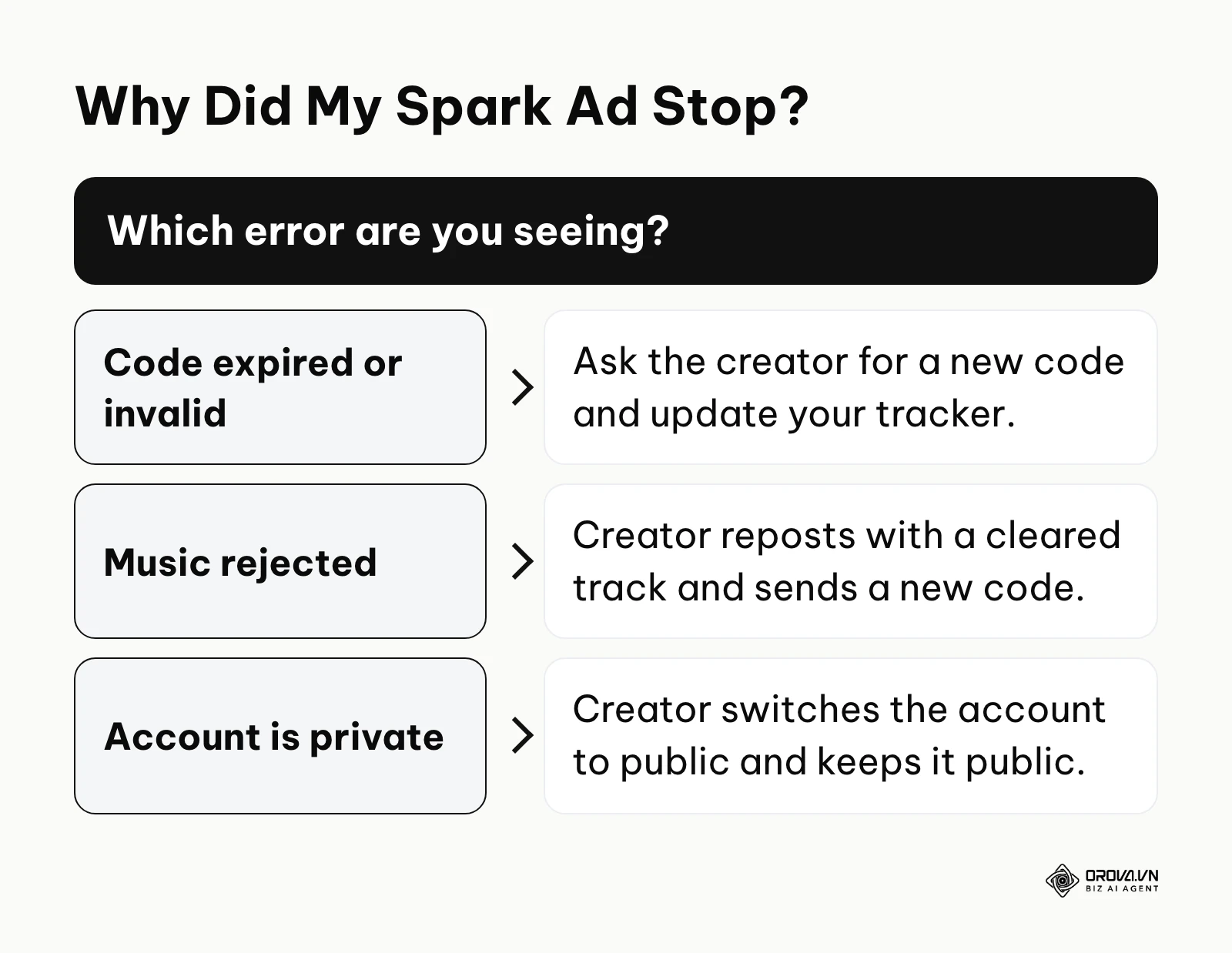
Code expired or invalid This happens when the creator revokes the authorization, the agreed period runs out, or the code was copied incorrectly. Fix: You cannot extend an expired code from Ads Manager. Ask the creator to generate a new code for the same video, add it to your library and update your tracker.
Video rejected for copyrighted music If the creator used a trending mainstream song, the video usually cannot run as an ad unless you hold a commercial license for that track. Fix: Check the audio before you request a code. If the track is a problem, ask whether the creator still has the raw footage. They can publish a version with a cleared track and generate a code for that version.
Account is private You cannot boost a video from a private account; the source account needs to be public. Fix: The creator switches the account to public. They need to keep it public while the campaign runs, because switching back to private will stop delivery.
Choosing the authorization duration For a short burst tied to one promotion, a 30-day code is usually enough. For evergreen product reviews or in-depth demos, ask for the longest duration the creator is comfortable with from the start, so your best-performing ads are not cut off by an expired code and you avoid repeated follow-ups.
Want to scale your budget but afraid of breaking performance? 📉
Integrate OROVA ADS now - an AI Agent that automatically monitors and optimizes Google, Meta, TikTok ads 24/7. Now, expanding and replicating your Performance Ads team is just one click away.
🚀 Try it now at: orova.vn/ads
What to do to start or adapt to this format
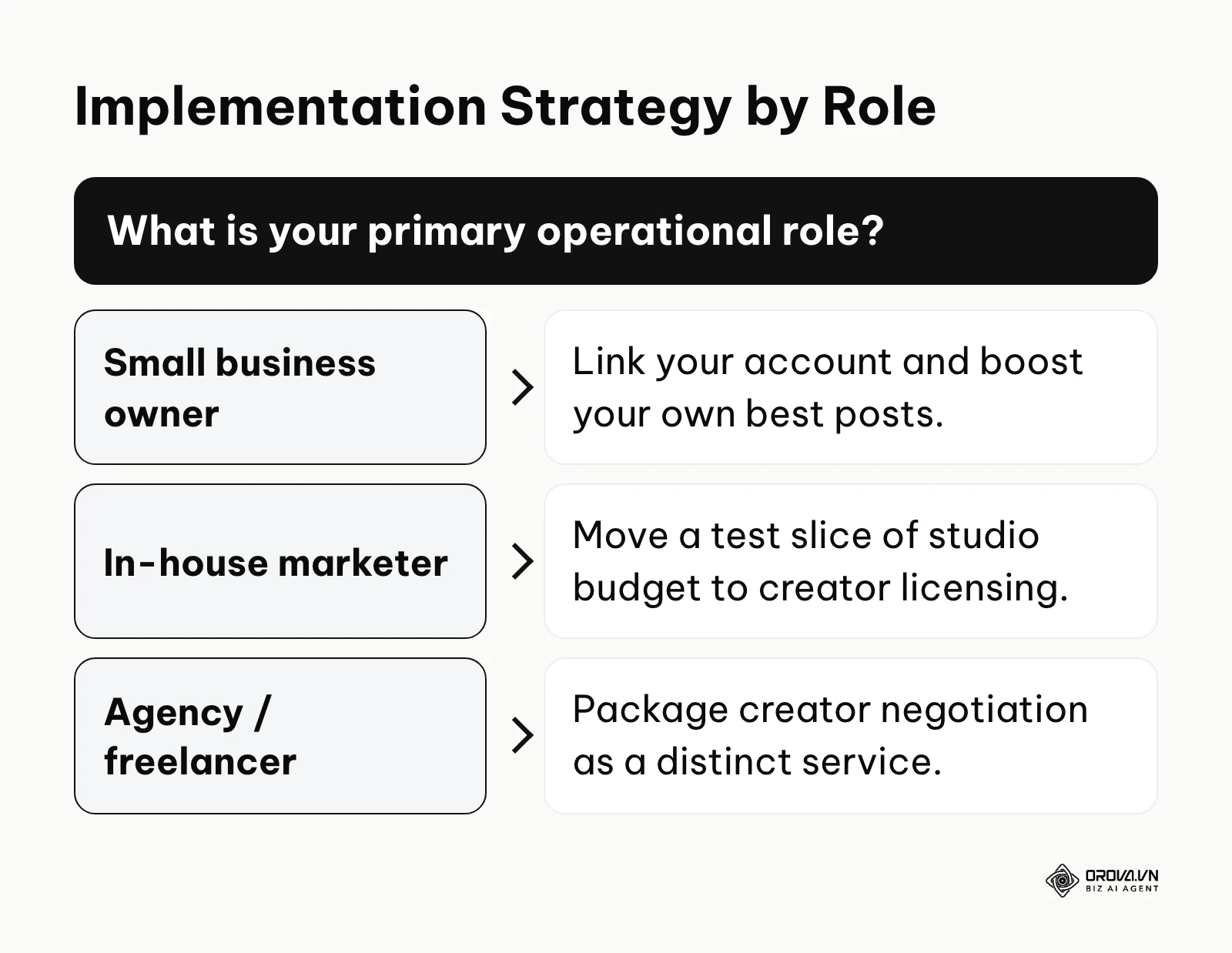
How you adopt the format depends on your role. A small business owner works with different constraints than an agency running many accounts.
E-commerce Small Business Owners
If you run your own budget without a team, speed and resourcefulness matter most. You do not need expensive software to start.
- List your best-performing organic posts from the last 30 days, focusing on videos whose comments ask "Where can I buy this?".
- Link your TikTok account to your ad account through Business Center, so you can boost your own posts without manual codes.
- Launch a small, controlled conversion campaign (for example 20 dollars a day) with your top three organic videos and let them compete to find a winner.
- Start the Authorization Code Tracker in Google Sheets as soon as you reach out to any micro-influencer, so the habit is in place early.
In-House Performance Marketing Leads
If you manage larger budgets and a team, the focus moves from manual execution to scale, workflow and cross-channel attribution.
- Review your current creative pipeline and move a test slice of the studio budget toward licensing authentic creator content.
- Train your influencer and PR teams to include licensing and ad authorization clauses in every new creator contract.
- Hold a weekly review comparing ROAS, CPA and retention for standard versus native campaigns, so you can show leadership what the shift delivers.
- Send CRM conversion data back to the platform through a Conversion API so delivery optimizes for high-value purchases, not cheap clicks.
Ad Agencies and Freelancers
Agencies and independent media buyers can package this capability as a distinct service that sets them apart from buyers who only upload standard videos.
- Build a standard "Creator Negotiation Package" with tested outreach templates, licensing guidelines and clear setup instructions for clients.
- Offer prospects a "Creative Amplification Audit" that finds missed opportunities in their existing tagged content and brand mentions.
- Document case studies from your own accounts that show the CPA and engagement change after moving clients from standard to native formats, and use them in your sales material.
| Common mistake | Consequence | How to avoid |
|---|---|---|
| Forgetting to renew authorization codes | Top campaigns stop spending, algorithm learning resets and revenue pauses. | Use a dedicated tracker and set calendar alerts 5 days before each expiration. |
| Using heavily scripted, unnatural UGC | Viewers spot it as an ad, swipe away quickly and costs rise. | License only videos that feel spontaneous and authentic. |
| Ignoring the original caption | Restricted hashtags or off-topic text hurt the ad's relevance. | Check the caption before requesting a code; pass on videos with weak or restricted copy. |
Where TikTok Spark Ads are heading in the next few years: the author's take
These are my opinions, not forecasts with numbers. They come from what I can see in how the platform and advertisers behave today.
AI-assisted creator matching and licensing
Today, finding the right creator, sending outreach, agreeing on a fee and waiting for a code is slow, manual work. I think that within two to three years much of this matching will be assisted by AI. Creator marketplaces already suggest creators by fit, and it is a short step to tools that surface organic videos matching a brief and handle the request flow. Privacy rules on how AI analyzes individual creators could slow this down. My advice: shift your team's time from admin to creative judgment, and read up on how AI is changing ad management so you can tell good automation from noise.
Tighter links between native videos and in-app shopping
The line between entertainment and checkout keeps blurring. My read is that native ads will lean more on in-app shopping features, so more people buy without leaving the feed. If that happens, the brands that benefit will be those whose product catalogs are clean and in sync with the platform. Preparing now means auditing product data, titles and images so they are ready whenever you switch those features on.
From single videos to creator series
Many advertisers still boost one standalone video and hope for a quick spike. I lean toward a future where brands license short series from the same creators: an unboxing for awareness, then a deeper product video shown to people who watched the first one. To prepare, start negotiating for bundles of videos and longer authorization periods instead of one-off codes.
Frequently asked questions about TikTok Spark Ads
What happens when the authorization code expires mid-campaign?
The ad stops delivering and stops spending. The organic video stays on the creator's profile with all the likes, comments and shares it collected, but you can no longer put paid budget behind it. To resume, you need a new code from the creator.
Can I edit the caption or video of a Spark Ad after linking it?
No. The format runs the post as it was published, so you cannot trim the video, add filters or change the caption. If the caption has a typo, your ad will show the same typo. If you need changes, the creator has to publish a new version and send a new code.
Are Spark Ads still necessary when we have advanced AI generation?
Yes, for most brands. AI tools can produce video variations quickly and help with bidding and targeting, but they find it hard to replicate the trust a real creator has built with their audience. Spark Ads let you borrow that trust in a transparent way.
How do I deal with Commercial Music Library restrictions effectively?
If the creator used copyrighted mainstream music, the ad will likely be rejected in review. Ask the creator to re-edit the raw footage with a track cleared for commercial use, such as one from TikTok's Commercial Music Library, publish that version and generate a new code for it.
How long should I set the authorization duration during negotiation?
Creators choose the duration from the options the app offers, and those options can change. For a short campaign tied to a holiday weekend, around 30 days is usually enough. For evergreen product reviews or detailed demos, ask for the longest period the creator is comfortable with from the start.
Where to start?
What you should do first depends on your current setup. Do not try to apply every idea in this guide at once; find your situation below and take the one next step.
If you are starting from scratch (no ads run yet) You have no campaign history, no pixel data and no creator relationships yet. Start with your own content so you can learn the mechanics safely. Spend one afternoon linking your TikTok account to Business Center and your ad account, then boost one of your best organic posts with a small budget.
If you have run standard ads but results are flat You are probably spending a large share of budget on polished creatives that suffer from ad blindness and falling ROAS. Your next step is a content audit. Spend two focused hours searching TikTok for organic mentions of your brand, then use the outreach template above to contact the creators.
If you run native ads but cannot measure ROI properly You are collecting codes and launching campaigns, and views are rising, but you cannot tie revenue to specific creators or campaigns. Your next step is server-side tracking. Spend a morning with your developer setting up the TikTok Pixel and Events API on your website, and set the same standard for other channels, such as campaigns you run in Facebook Ads Manager, so you can compare results fairly.
About the author

Builder of Orova
Nguyễn Đỗ Trọng Ân has 8 years of experience in marketing, including 6 years managing market development across Asia. He builds Orova, a Biz AI Agent that never sleeps: it plans, runs and optimizes work for businesses.
Run your business with AI Agents
Orova is the always-on Biz AI Agent — it plans, runs, and optimizes the work for you.
Save time, unlock productivity.