
Employee onboarding training plan: a 30-60-90 day guide with role templates

Imagine spending weeks recruiting the perfect candidate, only to watch them resign abruptly after their second month. This scenario is a recurring nightmare for HR professionals and department managers alike, yet it happens frequently when companies rely on a generic welcome checklist instead of a strategic roadmap. Building a comprehensive employee onboarding training plan is the most reliable way to transform a confused new hire into a confident, high-performing team member. If you are still relying on a basic day-one orientation filled with paperwork, you are actively risking your retention rates and bottom line. Employees need structure, clear expectations, and guided support to navigate their new environment successfully. This article provides a deep dive into creating a structured 30-60-90 day framework, complete with role-specific templates, intervention strategies for struggling employees, and clear metrics to measure your true return on investment.
What is an employee onboarding training plan?
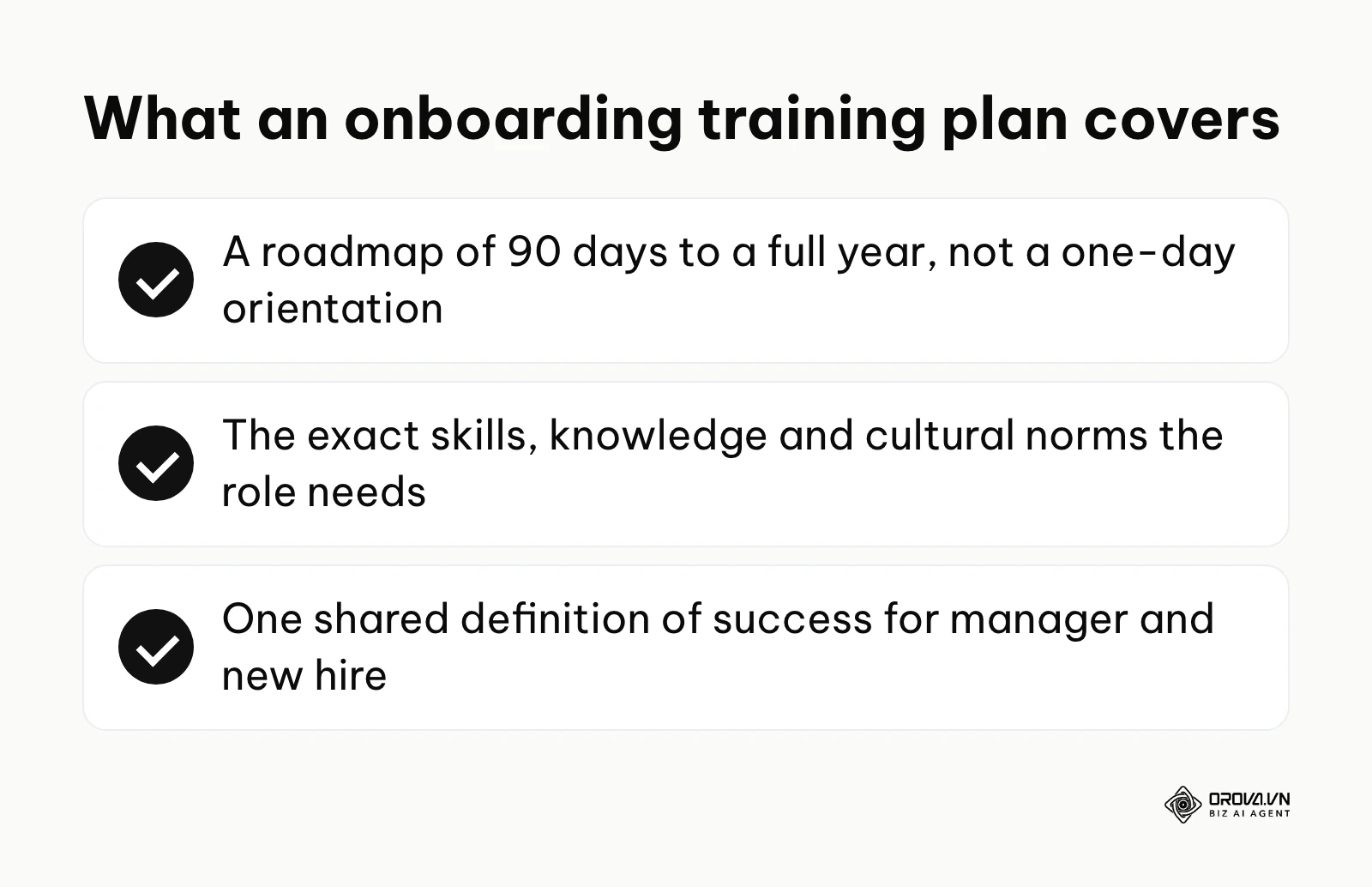
An employee onboarding training plan is a structured, long-term roadmap designed to integrate a new hire into your company over a period of 90 days to a full year. It goes far beyond a simple orientation—which only covers basic paperwork and office tours—by detailing the exact skills, knowledge, and cultural norms the employee must master to become fully productive in their specific role. A standardized onboarding process is widely linked to better new hire retention, because nobody has to guess what is expected of them. This plan ensures that both the manager and the employee share a unified vision of success from day one.
If you need the fundamentals first, such as what new hire training is, why it pays off and how to handle a PIP, read our guide to new hire training. This article focuses on the plan itself: week-by-week structure, 30-60-90 day goals and role-specific templates.
The summary below shows what a complete onboarding training plan covers.
Preparation: What you need before building your plan
You cannot build the airplane while you are flying it. Attempting to draft an employee onboarding training plan on the morning of a new hire's first day guarantees a chaotic and stressful experience. Before you even outline the first week's schedule, you must gather foundational documents and align with key stakeholders. This preparation phase is crucial because it forces managers to explicitly define what success looks like for the role, preventing subjective evaluations later on.
To prepare adequately, you must collaborate with the recruiting team, the IT department, and senior team members to ensure all resources are ready. If you skip this step, you risk leaving the new hire idle for days waiting for software access or struggling to understand outdated procedures.
| Preparation Item | Where to Source It | Time Required |
|---|---|---|
| Updated Job Description & Competency Map | HR Department & Hiring Manager | 2-3 hours |
| Standard Operating Procedures (SOPs) | Department Head / Internal Wiki | 3-5 days to update |
| Learning Management System (LMS) Access | IT & L&D Department | 1 hour |
| Hardware & Software Credentials | IT Helpdesk | 2-4 days |
| List of Key Internal Stakeholders | Direct Manager | 30 minutes |
Gathering the competency map is the most critical step in this phase. The competency map details the exact hard and soft skills required for the job, which serves as the blueprint for your training modules. If your organization relies heavily on digital learning, you must ensure your platforms are properly configured before the employee arrives. If you are currently evaluating software options, taking the time to understand how to choose an LMS will save you from adopting a tool that cannot scale with your training needs. Preparation is the unseen labor that makes the first 30 days feel seamless to the new employee.
6 steps to create a comprehensive employee onboarding training plan
Building a plan requires a methodical approach that balances long-term objectives with daily tactical execution. The following six steps will guide you through constructing a robust framework that supports the employee at every stage of their initial journey.
Step 1: Defining 30-60-90 day performance goals
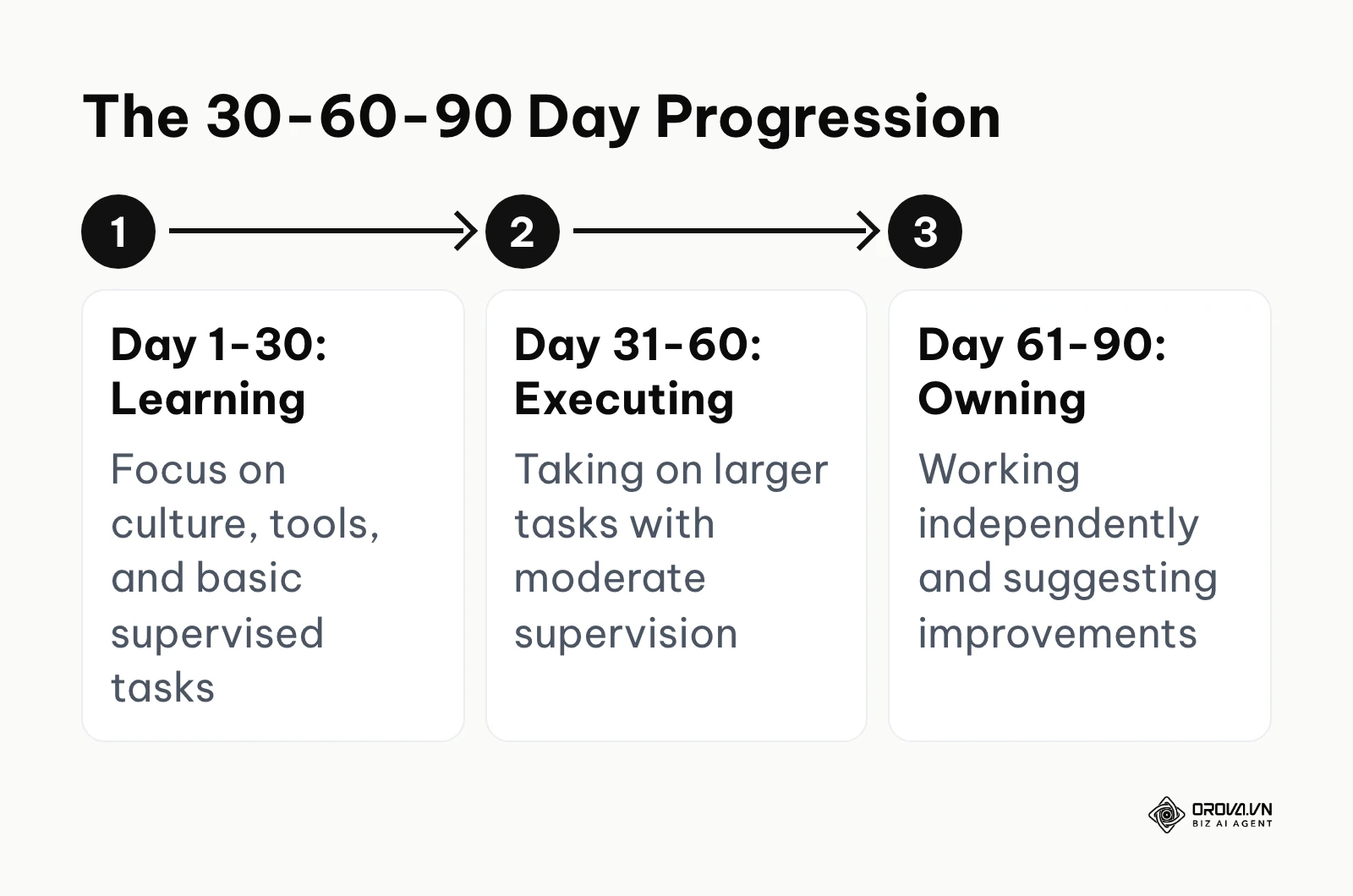
The core of any effective employee onboarding training plan is the 30-60-90 day framework. This structure breaks down the overwhelming process of starting a new job into manageable, focused milestones. During the first 30 days, the primary goal should be purely educational: understanding the company culture, mastering internal communication tools, and absorbing core product knowledge. The manager must set learning goals, not output goals. By day 60, the focus shifts to execution. The employee should begin taking on larger tasks with moderate supervision, applying what they learned in the first month. By day 90, the goal is ownership. The employee should be working independently, hitting standard performance metrics, and proactively suggesting process improvements.
To do this effectively, managers must write SMART (Specific, Measurable, Achievable, Relevant, Time-bound) goals for each phase. A clear sign that you have executed this step correctly is if the new hire can confidently recite their main objective for the current month without looking at their notes. A common error managers make at this stage is setting vague goals like "learn the system" or expecting immediate revenue generation in the first 30 days, which only leads to burnout and frustration.
The process below illustrates the gradual transition of expectations over the three-month period.
Step 2: Structuring the first 2 weeks and balancing theory versus practice
The first two weeks dictate the employee's long-term perception of your company. A critical and often unanswered question is how to balance the ratio of theoretical learning versus hands-on practice during this delicate period. If you provide too much theory, the employee becomes bored and overwhelmed by documentation; if you push too much practice early on, they will make costly mistakes and feel unsupported. A practical starting point is roughly 70% theory and 30% practice in week one, focusing on reading standard operating procedures and shadowing peers. In week two, this ratio should flip to 30% theory and 70% practice, allowing the employee to attempt low-risk tasks while being closely supervised. Formal theory should only fill a fraction of the first weeks; the faster you move the new hire into supervised, real work, the faster the knowledge sticks.
Illustrative example: Let us look at a mid-sized software agency trying to onboard a junior front-end developer. The context was that the agency expected new hires to push production code by day three, which resulted in massive anxiety and a high turnover rate during the probation period. The steps they took to resolve this involved completely restructuring the first two weeks. First, they assigned a dedicated technical buddy for pair programming. Second, they mandated that the first week was strictly for shadowing senior developers and reading documentation. Third, they introduced low-risk bug fixes only in week two. The obstacle they faced was that senior developers felt slowed down by the constant shadowing, which they fixed by rotating the buddy assignment every two days among the team. The result was a significantly smoother integration where the new hire comfortably submitted their first independent pull request by day twelve without breaking the build, demonstrating a clear and visible improvement in onboarding quality and team morale.
Step 3: Designing the learning materials and digital formats
Once the goals and timelines are set, you must curate the actual content the employee will consume. Relying solely on verbal instructions is a recipe for disaster, as new hires retain very little of what they hear during their overwhelming first week. You must design a mix of digital formats, including text-based documentation, pre-recorded video tutorials, and interactive quizzes. Using a variety of formats caters to different learning styles and allows the employee to revisit complex topics at their own pace.
When designing these materials, ensure they are easily accessible through a centralized digital hub. If you are unfamiliar with how to structure digital training modules, exploring what eLearning is and how it works can provide a solid foundation for building interactive courses. A common mistake here is handing the employee a massive, 100-page PDF manual and expecting them to read it in one sitting. Instead, break the materials down into micro-learning modules that take no more than 15 minutes to complete, followed by a brief knowledge check.
Step 4: Setting up the weekly one-on-one feedback loop
An employee onboarding training plan is entirely useless if it is not actively managed. Setting up a strict weekly one-on-one feedback loop between the manager and the new hire is non-negotiable. These meetings should not be status updates on tasks; they are dedicated spaces to discuss the onboarding experience, clarify confusion, and adjust the pacing of the training. Managers should come prepared with specific probing questions, such as: "What was the most confusing part of your training this week?" or "Do you feel you have the right access to the tools you need?"
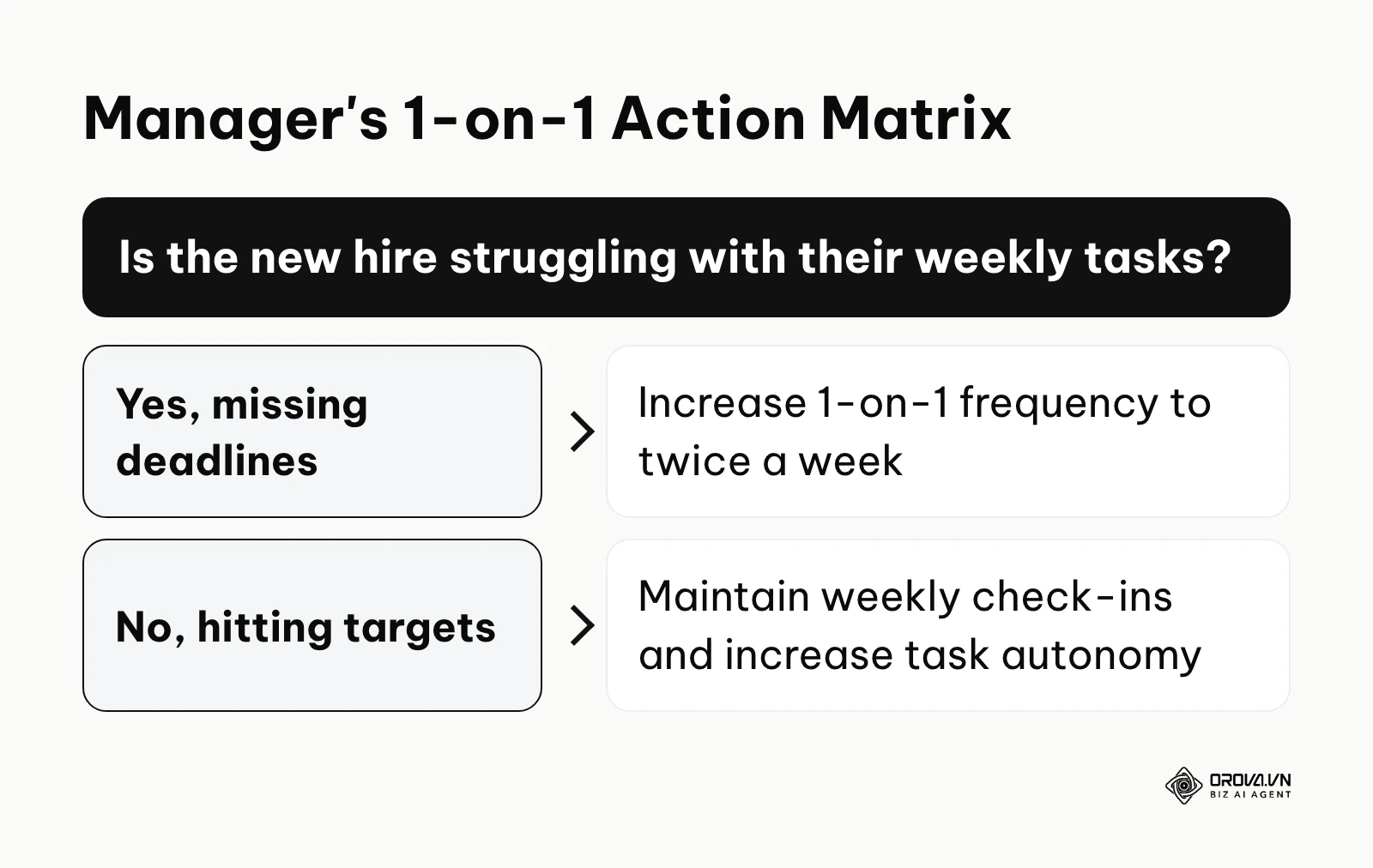
A sign of a healthy feedback loop is a new hire openly admitting when they do not understand a concept, knowing they will receive support rather than criticism. A fatal error managers make is consistently canceling or rescheduling these one-on-ones due to being "too busy." This signals to the new hire that their success is a low priority. A simple rule helps: if the new hire keeps missing weekly deadlines, increase the one-on-ones to twice a week; if they are hitting their targets, keep the weekly rhythm and hand over more autonomy.
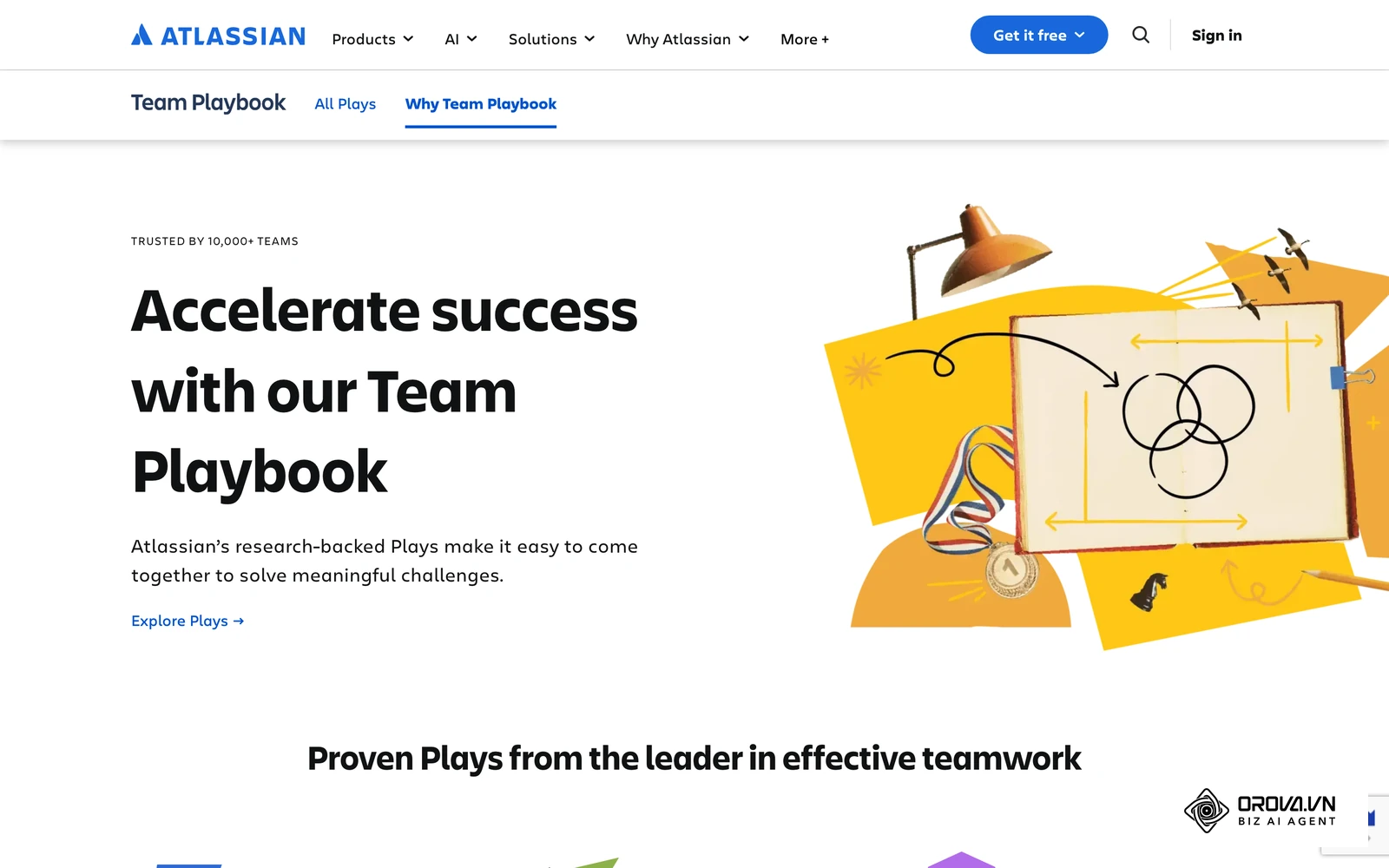
The decision matrix below helps managers determine how to adjust their check-in frequency based on early performance indicators.
Step 5: Assigning the onboarding buddy and shadowing tasks
While the manager handles performance and goal-setting, the new hire also needs a peer to help them navigate the unwritten rules of the workplace. Assigning an onboarding buddy—a tenured employee who is not their direct supervisor—provides a safe space for the new hire to ask basic questions, such as how to use the coffee machine or the proper etiquette for team group chats.
When setting up shadowing tasks, clearly define what the new hire should be observing. Do not just tell them to "watch John work." Give them an observation checklist. For example, instruct them to note how John handles objections on a client call or how he formats his daily reports. The downside of heavy shadowing is a temporary productivity loss for the senior staff member, so it is crucial to recognize and reward employees who take on the buddy role.
Step 6: Launching the plan and gathering day-one feedback
The execution of the plan begins the moment the candidate signs the offer letter. The pre-boarding phase should include sending a welcome packet, setting up their email account, and providing an itinerary for their first week. On day one, the focus should be on building a connection rather than diving straight into heavy training.
To ensure your plan is actually working, you must gather feedback immediately. Send a brief survey at the end of day one, and another at the end of week one. Ask simple questions about their clarity on their role and their comfort level with the team. Adjusting the plan based on this early feedback is the hallmark of a mature onboarding process.
Building a structured employee onboarding training plan from scratch takes weeks of manual effort. Orova Training lets you build courses, grade assessments and certify new hires with AI: it drafts lessons, slides, flashcards and podcasts in 30 voices, so your first 30 days of content is ready before the new hire starts.
Role-specific employee onboarding training plan examples and copy-ready templates
The biggest flaw in most onboarding programs is the attempt to use a one-size-fits-all approach. An engineer's learning curve looks vastly different from a salesperson's. Generic templates fail because they lack the tactical depth required for specialized daily tasks. Below, we provide in-depth analysis and concrete templates for three distinct departments. You can copy these tables directly into your Notion workspace or Google Sheets.
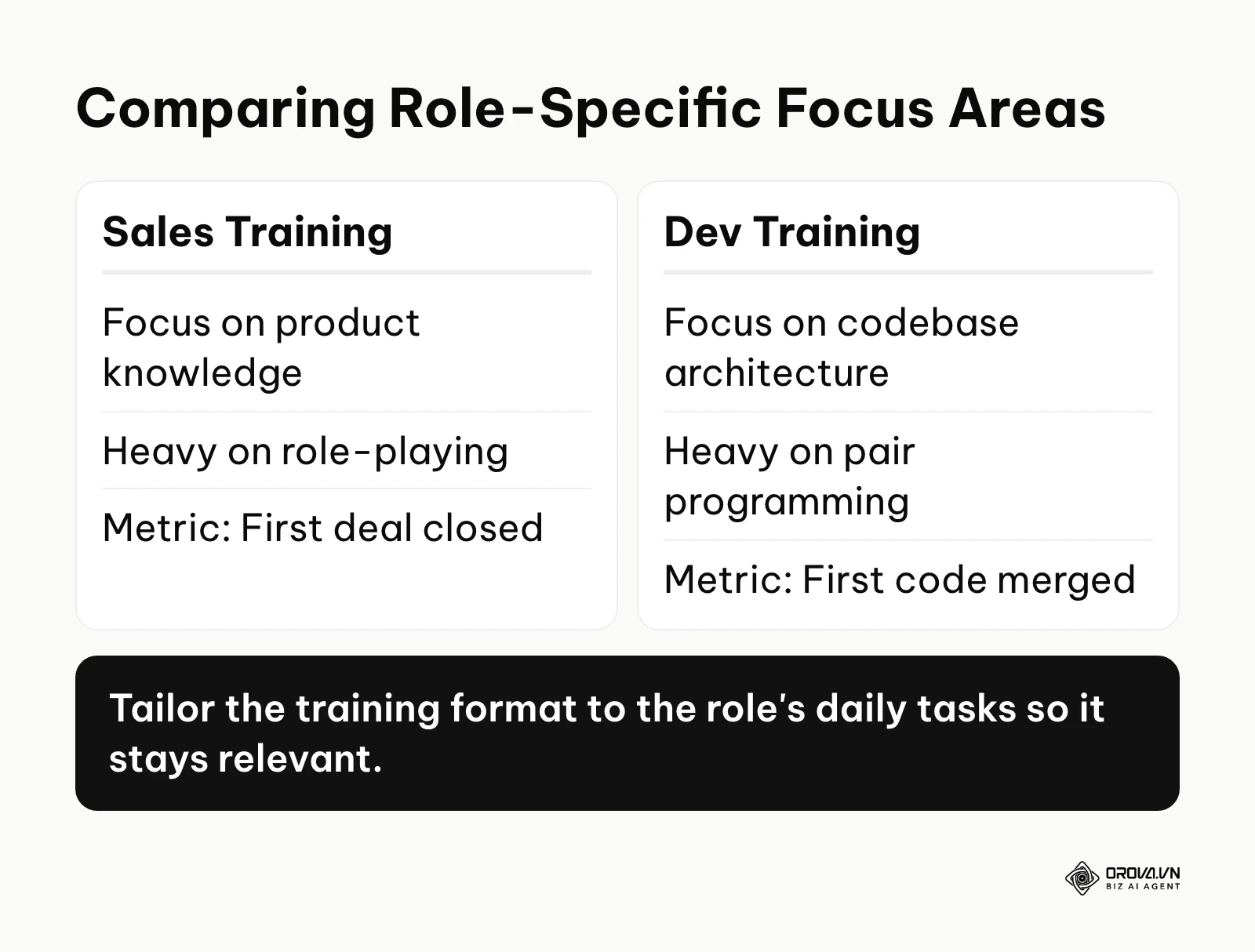
The comparison table below highlights why tailored training formats are essential for different departments.
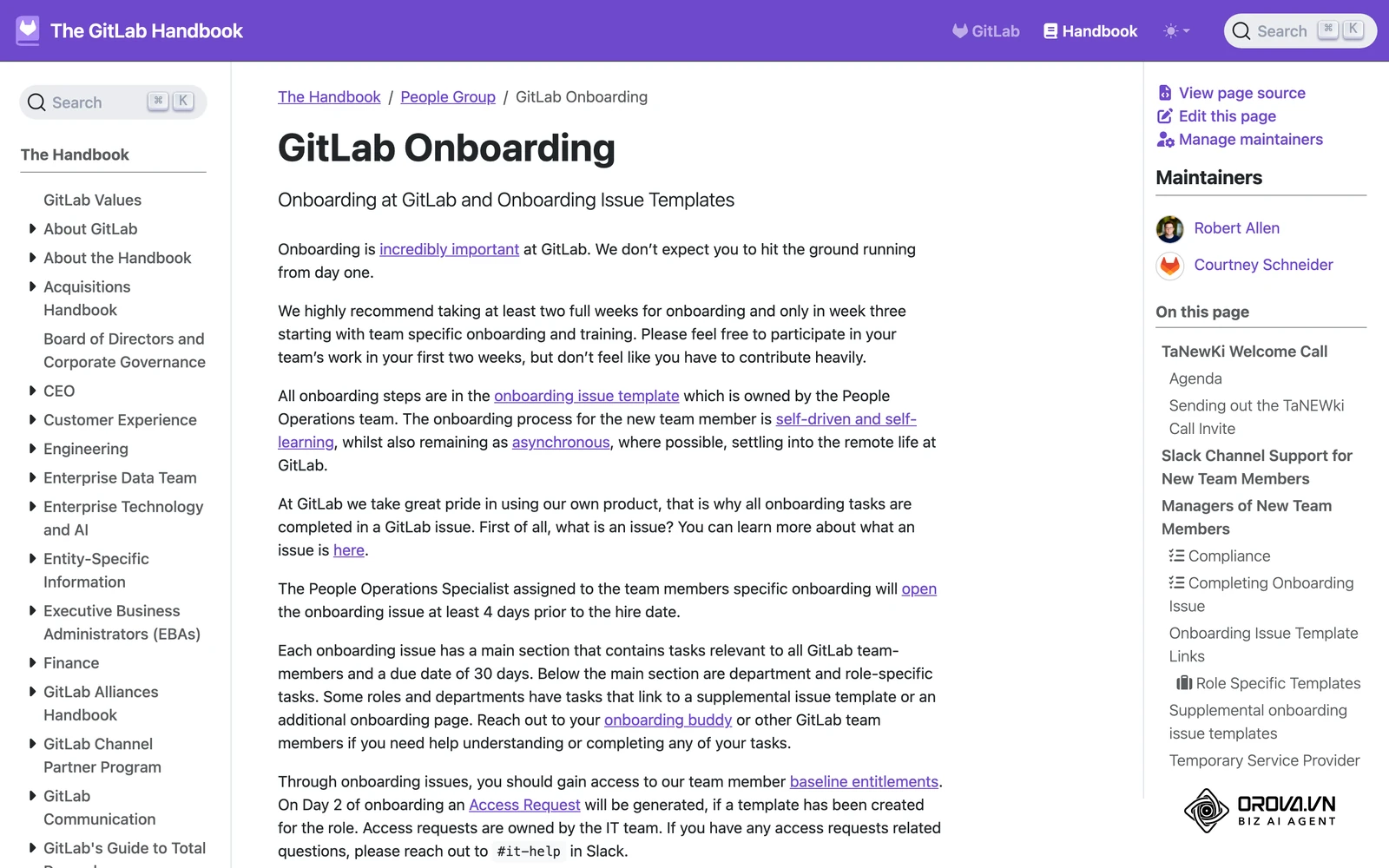
Sales department onboarding framework
Sales onboarding is highly product-centric and requires immense resilience. A new account executive must master the CRM software, internalize the product value proposition, and learn how to handle aggressive objections. The training ratio here heavily favors role-playing and mock scenarios.
Illustrative example: Consider a B2B SaaS startup building a sales onboarding program for their new account executives. The context was a complex enterprise product that required deep technical understanding, and new sales reps were failing to articulate the value proposition effectively. The steps the sales manager took included implementing a rigorous role-playing schedule. First, they provided a library of successful call recordings for the new hire to analyze. Second, they scheduled daily mock discovery calls where the manager acted as a difficult prospect. Third, they required the new hire to pass a technical product pitch certification before speaking to real clients. The obstacle was the new hires feeling intimidated by the daily role-play, which was resolved by providing a standardized grading rubric so feedback was objective, not personal. The result was that the new sales rep confidently navigated their first real enterprise pitch, successfully handling technical objections on the fly and moving the prospect to the negotiation stage.
Template for Sales:
| Timeframe | Focus Area | Specific Actions & Tasks | Success Metric |
|---|---|---|---|
| Week 1 | Company & Market | Read competitor analysis, complete product overview course | Pass product knowledge quiz |
| Week 2 | Sales Process | Shadow 5 discovery calls, learn CRM data entry standards | CRM workflow certification |
| Week 3-4 | Pitching & Objections | Daily role-play sessions, memorize objection handling scripts | Pass mock pitch with Manager |
| Month 2 | Supported Selling | Lead 10 calls with manager shadowing, send follow-up emails | Generate 5 qualified leads |
| Month 3 | Independent Quota | Manage full sales cycle independently, negotiate terms | Close first independent deal |
Engineering and development onboarding framework
Engineering onboarding requires extreme attention to detail regarding system architecture, security protocols, and codebase familiarity. The primary risk here is a new developer pushing bad code that breaks the production environment. Therefore, the focus is on safe, localized environments and extensive pair programming.
Template for Engineering:
| Timeframe | Focus Area | Specific Actions & Tasks | Success Metric |
|---|---|---|---|
| Week 1 | Environment Setup | Clone repositories, set up local database, read architecture docs | Local environment running smoothly |
| Week 2 | Codebase Familiarity | Pair program on low-priority bugs, review coding standards | First minor bug fix merged |
| Week 3-4 | Feature Development | Shadow code reviews, pick up first small feature ticket | Small feature deployed to staging |
| Month 2 | System Architecture | Write unit tests, participate in sprint planning, fix medium bugs | 80% test coverage on new code |
| Month 3 | Independent Execution | Lead development of a standard epic, review peer code | First major feature in production |
Customer service onboarding framework
Customer service representatives are the frontline voice of your company. Their onboarding must focus heavily on tone of voice, empathy, de-escalation techniques, and rapid navigation of the helpdesk software. The training must simulate high-stress customer interactions in a safe environment before they speak to real clients.
Template for Customer Service:
| Timeframe | Focus Area | Specific Actions & Tasks | Success Metric |
|---|---|---|---|
| Week 1 | Tool Mastery | Learn helpdesk software, review macro library, study SLAs | Helpdesk navigation speed test |
| Week 2 | Tone and Policy | Shadow senior reps, analyze 20 resolved tickets, learn refund policy | Policy comprehension check |
| Week 3-4 | Draft Responses | Draft replies for manager review, handle low-tier inquiries | 95% accuracy on drafted replies |
| Month 2 | Live Interactions | Handle live chat with supervision, manage standard phone calls | Average handling time < 10 mins |
| Month 3 | Full Caseload | Manage all channels independently, handle basic escalations | CSAT score > 90% consistently |
Measuring the ROI of your employee onboarding training plan
Building a comprehensive plan requires a significant investment of time and resources. Consequently, HR teams and managers must be able to prove the return on investment (ROI) to senior leadership. A common unanswered question is how to measure the ROI of an onboarding plan against actual business profit. To do this, you must calculate the exact cost of the onboarding period—including the new hire's salary during training, software licenses, and the hourly wage of the trainers—and subtract it from the gross profit generated by the employee once they reach full productivity, annualized over their tenure.
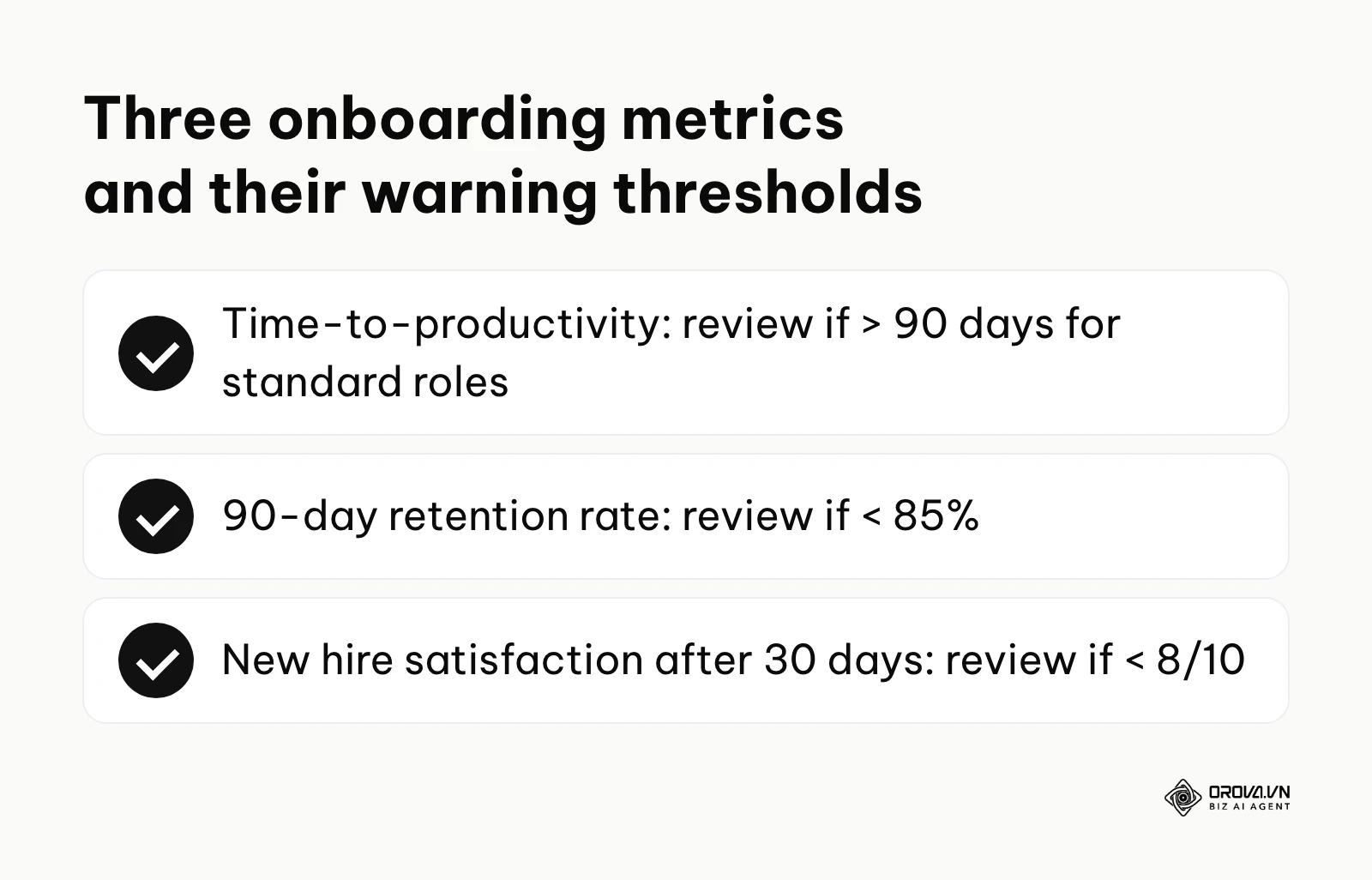
Engagement research consistently links a good onboarding experience to stronger commitment, but leadership will still ask for harder evidence. Beyond raw financial formulas, you must track specific Key Performance Indicators (KPIs) to gauge the effectiveness of your training plan. Understanding practical training evaluation methods will help you set up dashboards that track these metrics over time.
| Metric | Meaning | Warning Threshold |
|---|---|---|
| Time-to-Productivity | The number of days until the employee works independently without constant supervision. | > 90 days for standard roles. |
| 90-Day Retention Rate | The percentage of new hires who stay with the company past their probationary period. | < 85% indicates a systemic issue. |
| Employee Satisfaction Score | Survey results from new hires rating their confidence and clarity after the first 30 days. | < 8/10 requires immediate review. |
Measure your own baseline before the plan launches. If your onboarding plan consistently shortens time-to-productivity against that baseline, the financial savings in regained productivity will definitively prove the ROI of your efforts.
The summary below lists the three metrics and their warning thresholds.
7 common mistakes and how to fix a failing onboarding
Even with a beautifully crafted plan, execution can falter. Recognizing the early signs of a failing onboarding process allows you to intervene before the employee resigns. Here are the seven most common mistakes and exactly how to fix them.
Mistake 1: Delivering an information dump on day one
Many companies overwhelm new hires by forcing them to read the entire employee handbook and watch five hours of compliance videos on their first day. The consequence is immediate cognitive overload and burnout. The fix is to drip-feed information. Limit formal training to no more than three hours on the first day, dedicating the rest of the time to social integration and workspace setup.
Mistake 2: Assuming the HR department handles everything
HR is responsible for the pre-boarding logistics and benefits enrollment, but they cannot teach a developer how to write code or a salesperson how to pitch. The consequence of leaving everything to HR is a lack of functional, role-specific training. The fix is enforcing strict manager accountability, requiring direct supervisors to own the 30-60-90 day progression.
Mistake 3: Setting vague expectations for the first 30 days
Telling an employee to "get comfortable with the team" is not a measurable goal. The consequence is massive confusion, leading the new hire to feel like they are failing even when they are not. The fix is documenting explicit milestones, such as "Shadow five client calls and draft two follow-up emails by Friday."
Mistake 4: Ignoring employees who fall behind the schedule
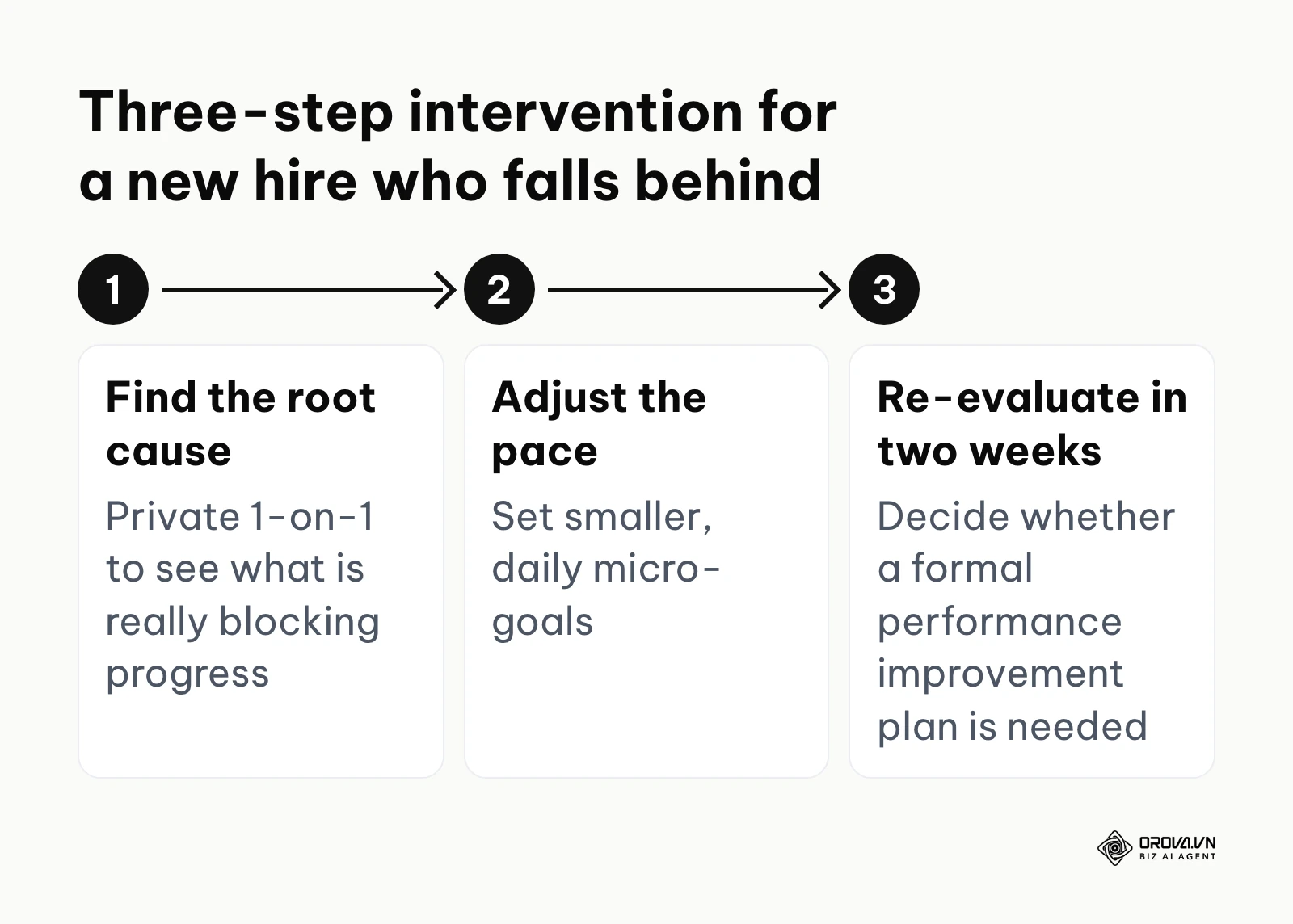
A critical challenge managers face is what to do when a new hire repeatedly misses their 30-day goals. Ignoring the issue and hoping they catch up by day 90 is a guaranteed path to termination. The fix requires a structured 3-step intervention process: first, analyze the root cause in a private 1-on-1; second, adjust the training pace by setting smaller, daily micro-goals; third, re-evaluate their progress after two weeks to decide if a formal performance improvement plan is needed.
Illustrative example: Imagine a regional logistics company where a newly hired operations coordinator was consistently missing their 30-day and 60-day process mastery targets. The context was a high-volume warehouse environment where speed was critical, and the manager was ready to terminate the employee for poor performance. The steps taken to intervene started with a frank 1-on-1 meeting to analyze the root cause. The manager discovered the employee was overwhelmed by the proprietary inventory software. They adjusted the pace by breaking down the software training into three smaller modules. They also temporarily reduced the employee's daily processing quota by 40% to allow time for retraining. The obstacle was the employee becoming defensive initially, which the manager handled by framing the intervention as a shared learning adjustment, not a punishment. The result was that the coordinator mastered the software within the next two weeks, caught up to the standard processing speed by day 90, and became a reliable shift leader.
The process below shows the three-step intervention a manager should follow when an employee falls behind.
Mistake 5: Failing to establish a continuous feedback mechanism
If a new hire is frustrated with their training pacing, they will rarely volunteer that information to a new boss. The consequence is hidden resentment that festers until they quit. The fix is implementing weekly, anonymous pulse surveys alongside the manager's 1-on-1 meetings to capture honest feedback about the onboarding experience.
Mistake 6: Skipping the cultural and social integration
Focusing entirely on task mastery while ignoring team dynamics leaves the new hire feeling isolated. The consequence is a lack of belonging, which is a primary driver of early turnover. The fix is mandating informal social touchpoints, such as a team welcome lunch in the first week and regular coffee chats with cross-functional peers.
Mistake 7: Executing a poor handover from the recruiting phase
If a recruiter promises a flexible schedule and a highly structured training program, but the manager delivers rigid hours and a chaotic first week, trust is instantly broken. The consequence is severe disillusionment. The fix requires tight alignment between talent acquisition and department heads. Utilizing effective candidate screening ensures that the expectations set during the interview perfectly match the reality of the onboarding plan.
A good plan still fails if nobody follows it. Orova Training lets you assign courses by workspace, group or person, block skipping, track each new hire's progress and award certificates with a public verification code when they pass. It is free until July 7, 2027. Sign up and build your first onboarding course today.
Future trends in onboarding training over the next few years: my perspective
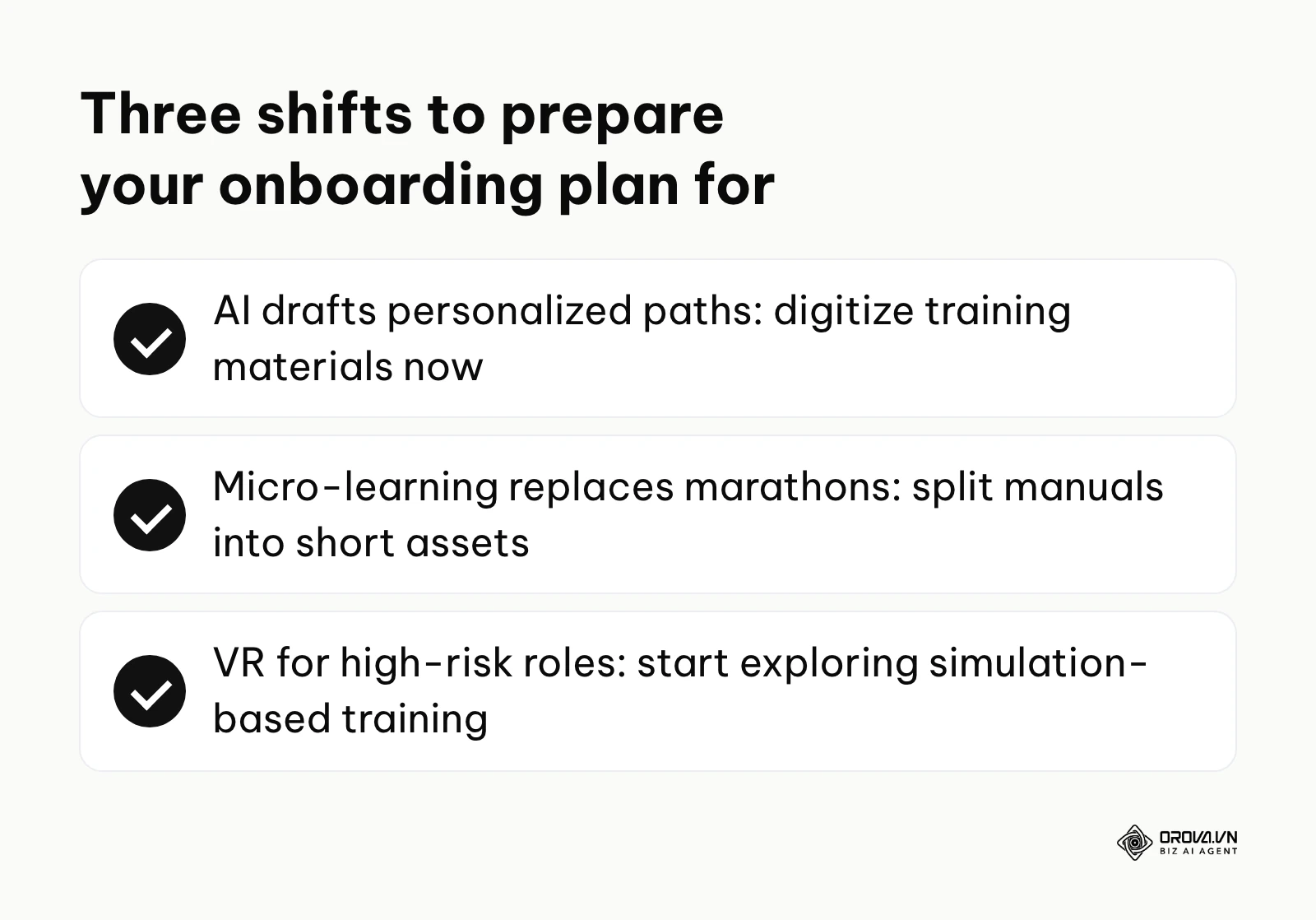
As the workplace continues to evolve rapidly, the methods we use to integrate new employees must also adapt. Looking ahead from 2026, I see three major shifts that will redefine how we build training plans.
AI will draft personalized learning paths
Currently, HR teams spend days manually tweaking templates for different roles. I expect AI to take over much of this heavy lifting within a few years. By feeding an AI the new hire's resume and the company's competency map, the system could draft a hyper-personalized 30-60-90 day plan. It could flag likely skill gaps and suggest the specific modules needed to close them. You should prepare for this by digitizing all your current training materials so they are ready to be ingested by AI systems.
Micro-learning will replace more week-long orientation bootcamps
The traditional week-long orientation classroom is losing ground. With remote work and busier schedules, I think dense, marathon training sessions will increasingly give way to micro-learning. Training will be delivered in the flow of work—three-minute videos or quick interactive prompts that appear exactly when the employee needs to execute a task. To prepare, you must start breaking your massive PDF manuals into small, searchable, single-topic digital assets.
Virtual reality will spread in high-risk role simulations
While currently viewed as a novelty, I expect virtual reality (VR) to become a more common onboarding tool, particularly for high-risk or customer-facing roles. Imagine a customer service rep practicing de-escalation techniques with an AI-driven VR avatar before ever touching a live phone line. However, this prediction could be delayed if VR hardware remains too heavy or expensive for widespread corporate deployment. Regardless, you should start exploring simulation-based training software today to build the foundation for immersive learning.
Frequently asked questions about employee onboarding training plans
How much time should managers spend on onboarding in the first week?
Managers should dedicate at least 20% to 30% of their schedule to the new hire during the first week. This includes daily 15-minute morning check-ins, setting up shadowing sessions, and conducting a formal end-of-week review. While this feels like a heavy time investment, it prevents weeks of corrective action later on.
What is the primary difference between orientation and onboarding?
Orientation is a one-time event, usually occurring on day one, focused on administrative tasks, compliance, and basic company policies. Onboarding is a strategic, long-term process lasting 90 days or more, focused on role-specific training, cultural integration, and achieving full productivity.
How can AI improve the employee onboarding training plan?
AI drastically reduces the administrative burden of onboarding. It can instantly generate quizzes from written documentation, translate training materials into multiple languages for global hires, and act as a 24/7 virtual assistant to answer basic questions, freeing up the manager's time for high-value coaching.
What happens if an employee fails the 90-day review despite the plan?
If an employee fails to meet the 90-day expectations despite receiving structured training, clear goals, and pacing adjustments, it generally indicates a poor hiring fit rather than an onboarding failure. At this stage, management must decide whether to extend the probationary period with a strict Performance Improvement Plan (PIP) or terminate the employment to minimize further losses.
Are spreadsheet templates enough, or do you need dedicated software?
Spreadsheet templates, like Google Sheets or Notion boards, are excellent starting points for small teams with zero budget. However, as headcount grows and several hires start at once, manual templates become hard to track effectively. At that point, transitioning to a dedicated LMS or onboarding software becomes necessary to automate assignments and ensure compliance.
Where should you start today?
Reading about a comprehensive 90-day roadmap can feel overwhelming, but you do not need to build the entire system overnight. Depending on your current situation, you should focus on taking just one high-impact step today.
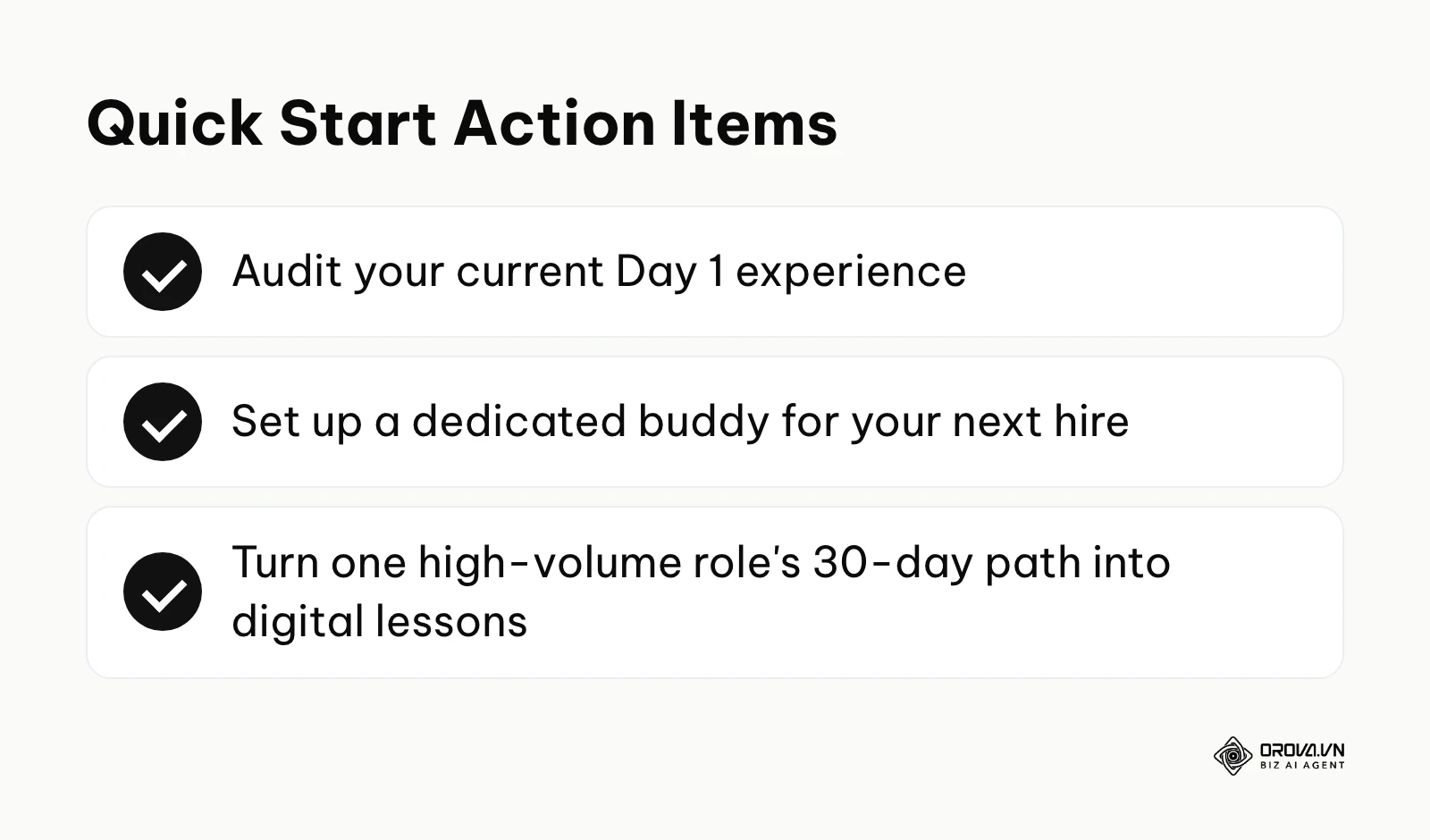
If you have absolutely zero documentation in place: Your first step should be to audit your Day 1 experience immediately. Sit down for one hour and document exactly what happens from the moment the employee logs in or walks through the door. Create a simple checklist ensuring they have hardware, software access, and a welcome meeting scheduled. Securing the first day buys you the goodwill needed to figure out the rest of the week.
If you have a basic plan but suffer from high early turnover: Your first step is to implement a dedicated buddy system for your next hire. You do not need new software for this. Simply identify a patient, tenured employee on the team and formally assign them to be the new hire's go-to person for cultural and basic operational questions for the first month. This immediately reduces isolation and frustration.
If you are scaling headcount fast and cannot train manually anymore: Your first step is to standardize one specific role's 30-day path into a digital format. Pick your highest-volume role (e.g., Sales Rep or Customer Support). Take their core tasks and record simple screen-share videos explaining how to do them. Move away from live, repetitive lecturing and start building a digital library that works while you sleep.
The summary checklist below outlines these immediate action items to get you started.
About the author

Builder of Orova
Nguyễn Đỗ Trọng Ân has 8 years of experience in marketing, including 6 years managing market development across Asia. He builds Orova, a Biz AI Agent that never sleeps: it plans, runs and optimizes work for businesses.
Run your business with AI Agents
Orova is the always-on Biz AI Agent — it plans, runs, and optimizes the work for you.
Save time, unlock productivity.