
How to run a pre employment background check in 7 steps (2026)

A pre employment background check is the process of verifying a candidate's identity, criminal records, employment history, education, and (for some roles) credit or driving records before a hire is finalized, usually through a consumer reporting agency and only with the candidate's written consent. Executing a thorough pre employment background check protects your organization from costly hiring mistakes, regulatory penalties, and workplace security risks. When you finish this operational guide, you will have a fully functioning, audit-ready screening workflow that balances turnaround speed with strict legal compliance. To implement this process, you need an administrative account with an accredited screening provider, standardized role profiles, and approved legal notice templates. You should budget approximately three to five business days per candidate file. If you are hiring short-term gig contractors with no access to company property, financial ledgers, or customer data, you do not need this full multi-tier screening sequence.
What is a Pre Employment Background Check and Why It Matters
A pre employment background check is a formalized investigation into a job applicant's commercial, criminal, financial, and professional records before extending an unconditional offer of employment. Setting up this workflow establishes an auditable seven-step sequence that protects company assets, verifies honest credentials, and takes between three and five business days to deliver a final hiring determination.
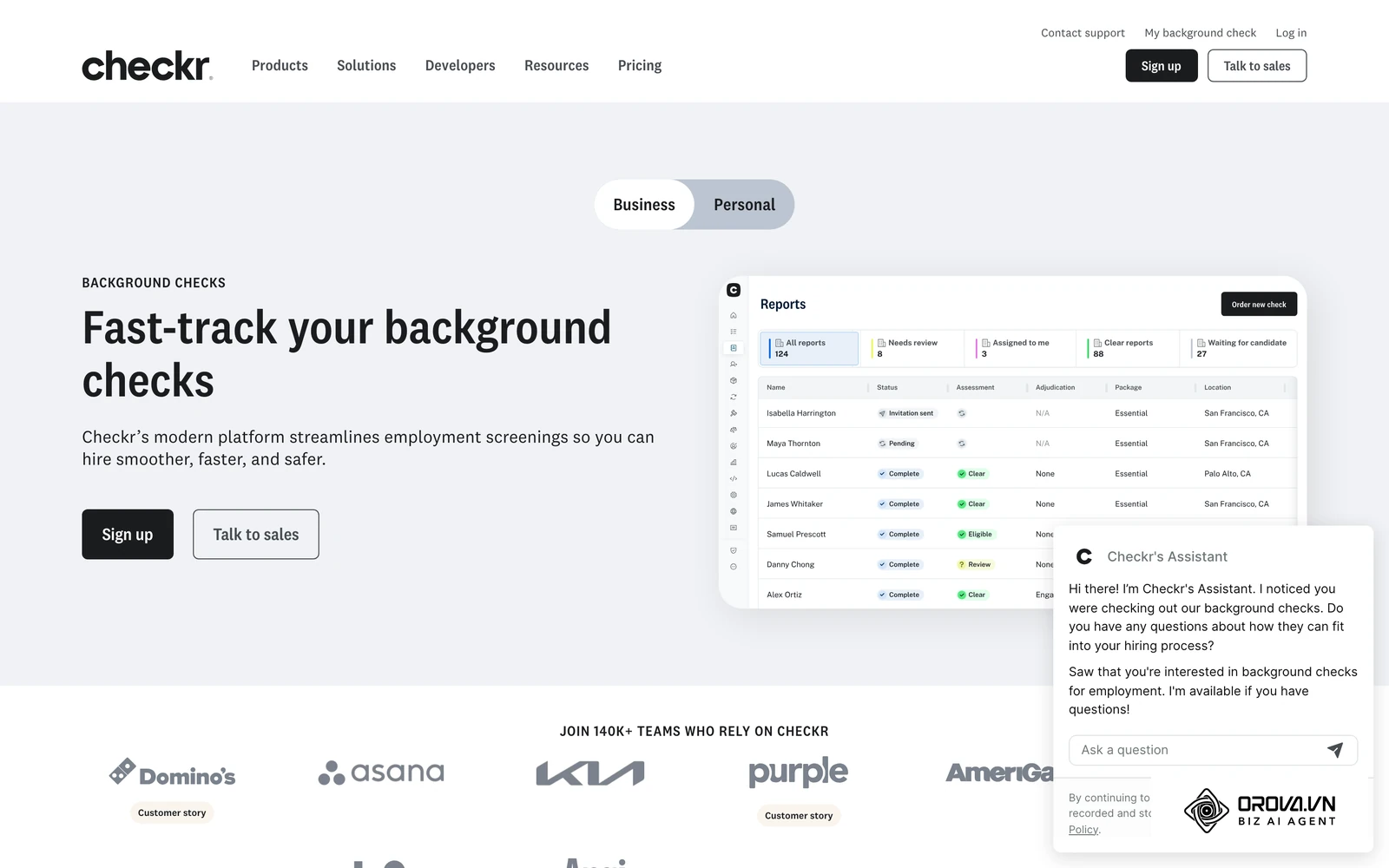
At its core, a pre employment background check verifies that the person you interviewed matches the identity, employment history, and qualifications listed on their application. Employers conduct these checks to shield their workforce from workplace violence, prevent embezzlement, and avoid negligent hiring lawsuits. Performing screenings without a structured framework exposes your business to federal fines and operational delays.
Industry surveys published by the Professional Background Screening Association (PBSA) consistently find that most employers screen candidates, mainly to protect workplace safety and reduce legal risk. The process verifies government records, educational databases, court dockets, and prior supervisor references while respecting federal consumer rights.
Preparation Before Conducting a Pre Employment Background Check
Before ordering your first background report, assemble the administrative resources, compliance templates, and job architecture needed to execute legally sound investigations. Launching screenings without these core assets leads to candidate friction, delayed start dates, and statutory damages under federal fair credit laws.
| Preparation Item | Source or Department | Estimated Setup Time | Impact if Missing |
|---|---|---|---|
| Consumer Reporting Agency (CRA) Account | A screening provider, ideally PBSA-accredited | 2–5 business days | No compliant channel to order criminal and employment checks. |
| Standalone FCRA Disclosure Template | Corporate Legal / Compliance Counsel | 2–4 hours | Legal exposure under the Fair Credit Reporting Act (FCRA) disclosure rules. |
| Electronic Signature Platform | Legal e-signature or ATS portal | 1–2 hours | Delayed candidate consent and unverified audit timestamps. |
| Role-Based Screening Matrix | Talent Acquisition & Department Heads | 3–6 hours | Over-screening entry-level staff or under-screening high-risk finance roles. |
| Adverse Action Letter Packet | Pre-drafted HR compliance notices | 2 hours | Exposure to statutory damages for procedural errors when rejecting candidates. |
Investing in these preparatory assets yields substantial returns compared to the financial devastation of a flawed hiring choice. A single bad hire damages team morale, wastes management hours, and introduces significant liability into the workplace.
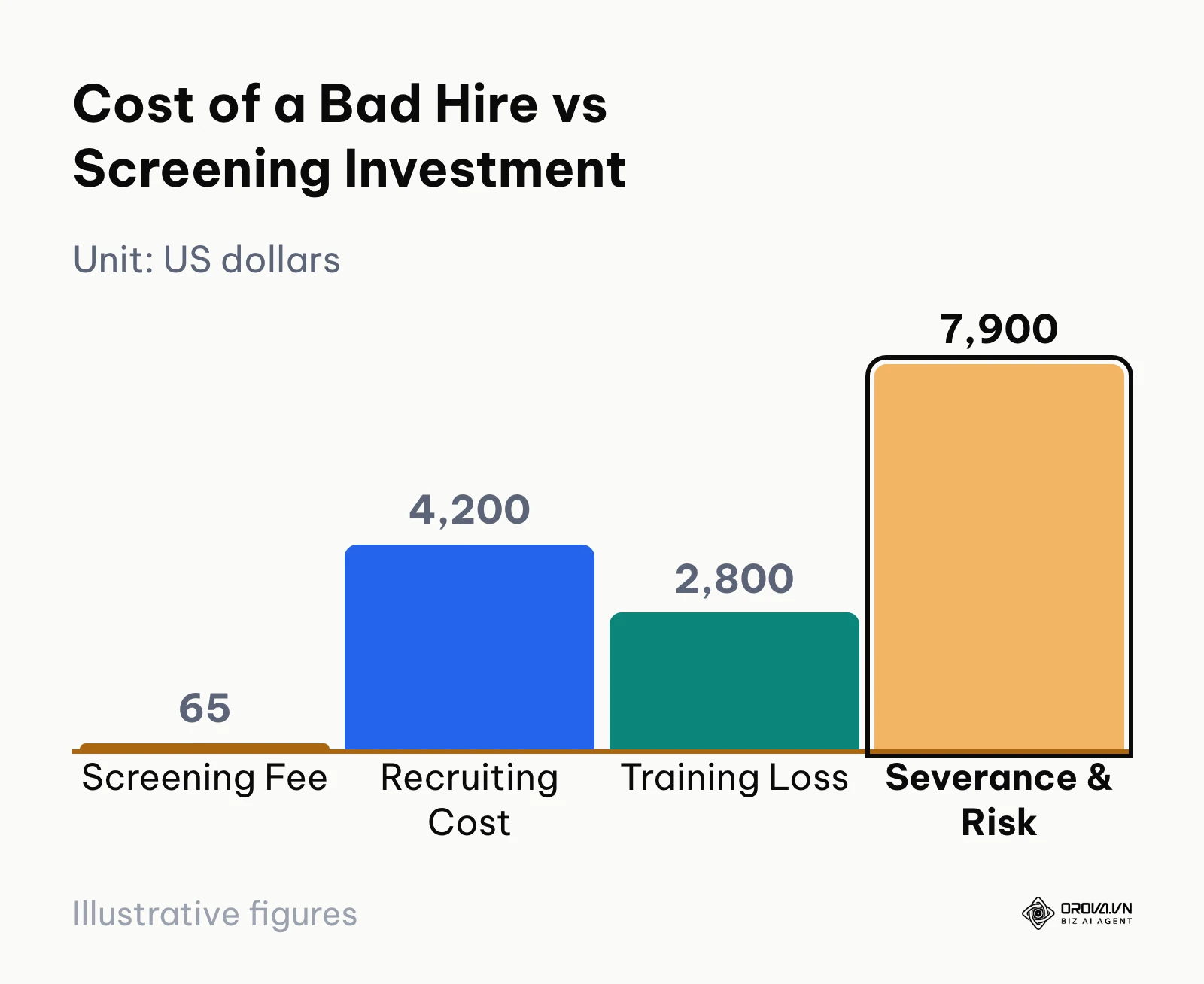
The table below is an illustrative example (not industry data) that contrasts the cost of a pre employment background check with the possible loss from an unvetted hiring failure for a mid-level financial specialist. Replace the figures with your own costs.
| Expense Category | Comprehensive Screening Workflow (Example) | Unvetted Bad Hire Impact (Example) | Operational Risk Description |
|---|---|---|---|
| Initial Assessment & Sourcing | 65 US dollars (Tier 3 verification package) | 4,200 US dollars (Re-recruiting & agency fees) | Agency fees, job board postings, and recruiter screening hours. |
| Onboarding & Training Investment | 0 US dollars (Routine process) | 2,800 US dollars (Wasted manager training hours) | Four weeks of department head onboarding and technical setup lost. |
| Severance & Operational Disruption | 0 US dollars (Mitigated through vetting) | 7,900 US dollars (Severance & error mitigation) | Six weeks of salary severance plus external forensic book reconciliation. |
| Total Financial Expenditure | 65 US dollars | 14,900 US dollars | Net financial savings of 14,835 US dollars per mitigated hiring error. |
The chart below summarizes the return on investment when comparing screening costs directly to bad hire liabilities.
Step 1: Establish Role-Based Pre Employment Background Check Packages
The objective of this step is to define customized screening packages matched to the security, safety, and financial risks of specific job descriptions rather than applying a blunt, one-size-fits-all check.
Categorize Positions into Standardized Risk Tiers
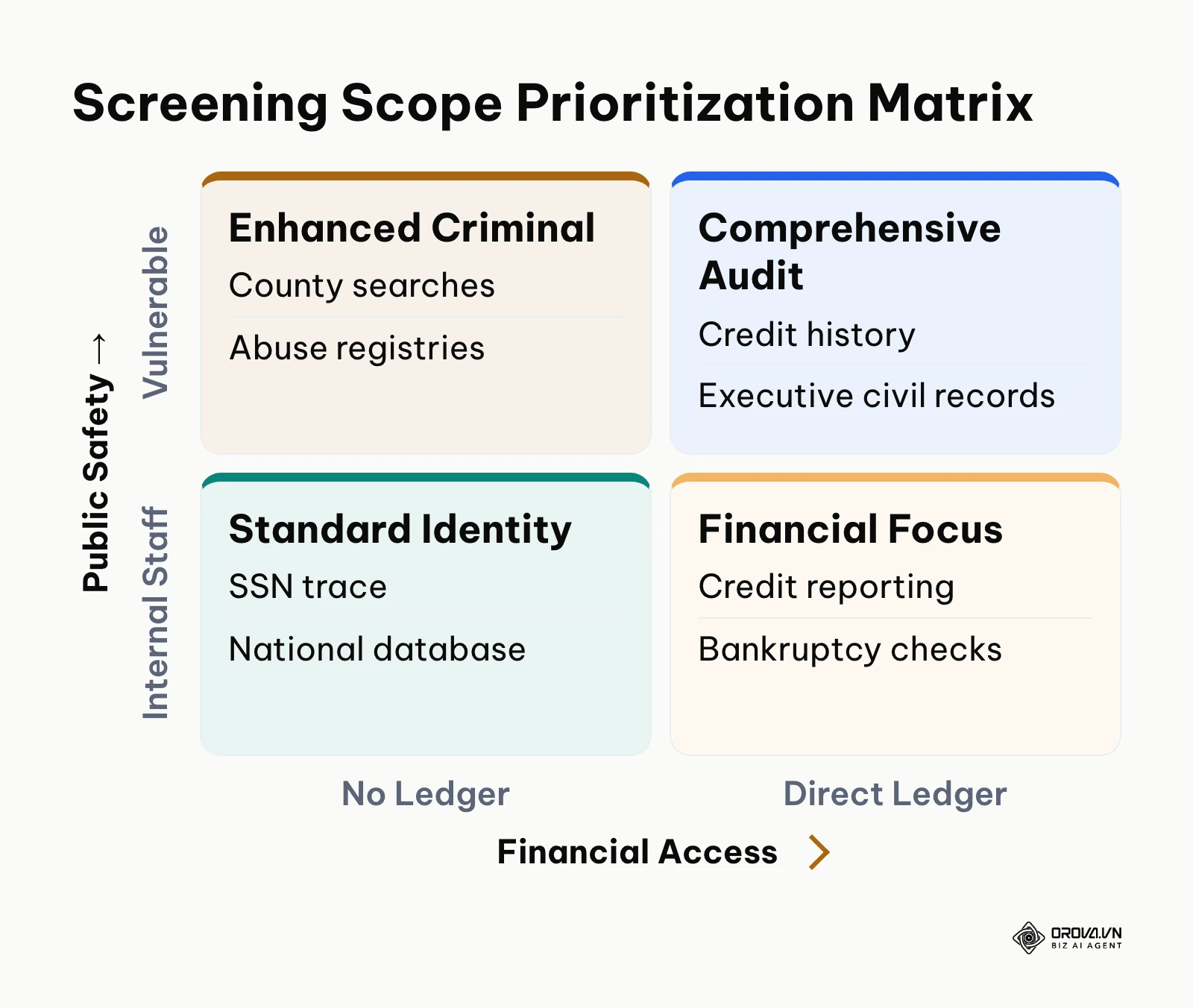
Navigate to your hiring portal or spreadsheet planning board. Review your open requisitions and categorize each role into one of four distinct tiers based on access to cash, intellectual property, customer homes, or vulnerable populations. Never order a deep credit check for a role that has no financial ledger authority, as several jurisdictions restrict employment credit checks.
The matrix below illustrates the recommended screening components, candidate documentation, and turnaround estimates across four organizational tiers.
| Position Tier | Core Verification Checks | Recommended Supplemental Checks | Typical Candidate Documents | Typical Turnaround |
|---|---|---|---|---|
| Tier 1: Entry-Level & Operational | SSN trace, 7-year county criminal search, national sex offender registry | 5-year employment verification | Government photo ID, Social Security Number, 5-year address history | 1–3 business days |
| Tier 2: Professional & Sales | SSN trace, county criminal, highest education verification, 7-year employment | Motor vehicle records (for driving roles), professional license verification | Diploma copy, professional license number, prior employer W-2s (if requested) | 2–4 business days |
| Tier 3: Finance & Accounting | All Tier 2 checks, plus employment credit report, federal bankruptcy records | Civil court litigation search, global sanctions & watchlist check | Written credit authorization, official university transcripts, tax filings | 3–5 business days |
| Tier 4: Executive & C-Suite | All Tier 3 checks, plus 10-year employment, media search, directorship check | International sanctions search, credential audit, regulatory registry check | Certified transcripts, passport, comprehensive curriculum vitae, reference contacts | 5–8 business days |
The prioritization matrix below highlights how financial and physical access determine appropriate screening levels.
Illustrative example:
- Context: A 45-person B2B software startup was hiring an Enterprise Account Executive handling contracts over 100,000 US dollars.
- Actions taken: The hiring team configured a Tier 2 package requiring an SSN trace, 7-year employment history, highest degree verification, and county criminal records. They issued the digital request through their screening dashboard.
- Stumbling block & resolution: The candidate's former employer had dissolved following a corporate acquisition, causing the screening agency's phone verification to stall for three days. Rather than delaying the hire, the recruiter requested the candidate's first and last pay stubs alongside W-2 statements via the candidate portal within 24 hours.
- Visually observable outcome: The verification dashboard updated the employment history badge from an amber "Pending Verification" icon to a green "Verified via Documentation" checkmark, enabling the team to issue the final start date.
A frequent error at this stage is ordering credit reports indiscriminately. Several states restrict employment credit checks unless the role is an executive, law enforcement officer, or directly manages financial accounts. If an unauthorized check is ordered, cancel the request in your CRA dashboard immediately and re-issue the role under a standard Tier 1 or Tier 2 package.
Step 2: Obtain Compliant Standalone Disclosure and Written Consent
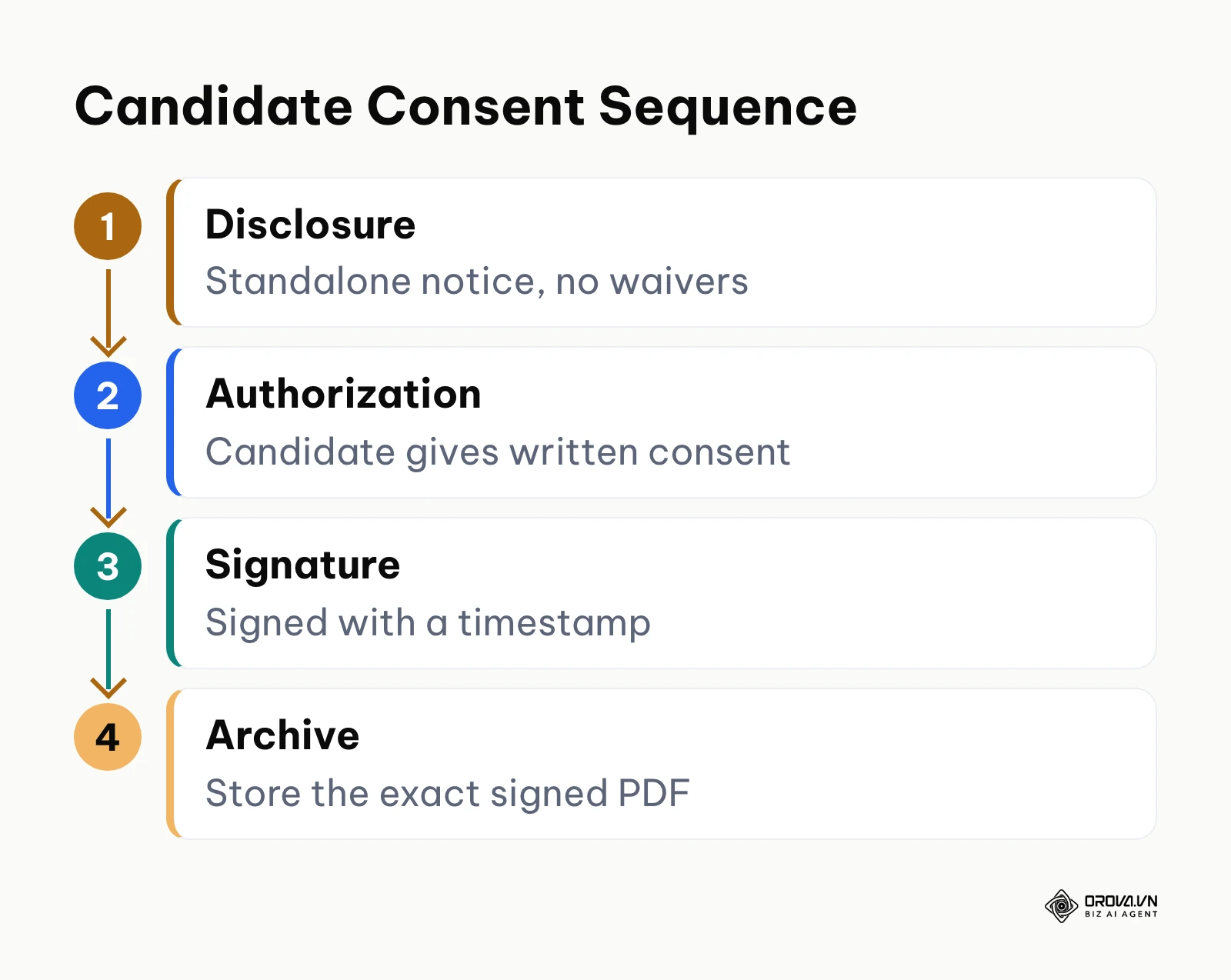
The objective of this step is to secure legally binding, explicit candidate consent through a document that consists solely of the background screening disclosure.
Present the Standalone Disclosure Document
Access your applicant onboarding portal or electronic document tool. Prepare two distinct documents: the Standalone Disclosure and the Authorization Form. Under federal Fair Credit Reporting Act (FCRA) guidelines, the disclosure informing the candidate that a consumer report will be obtained must be contained in a standalone document that contains no extraneous employment agreements, liability waivers, or job application questions.
According to the Federal Trade Commission (FTC) in its business guidance Using Consumer Reports: What Employers Need to Know, employers must certify compliance and provide clear standalone disclosures before procuring any consumer report. Ensure that your form contains plain language explaining that a report will be obtained for employment purposes.
STANDALONE DISCLOSURE REGARDING BACKGROUND INVESTIGATION
[Company Name] ("the Company") hereby discloses to you that a consumer report
and/or investigative consumer report may be obtained for employment purposes as
part of the pre-employment screening process and at any time throughout your
employment, if permitted by applicable law.

This report may include information regarding your character, general reputation,
personal characteristics, employment history, education, and criminal records.
These reports will be prepared by [Name of Consumer Reporting Agency], located at
[CRA Address], [CRA Telephone Number], [CRA Website].
Ensure the candidate provides the identifiers your provider requires, typically full legal name, date of birth, and Social Security Number, and provides a timestamped digital signature on the authorization form.
You know this step is completed correctly when your document storage system archives a PDF containing the exact standalone text, a verified audit trail displaying the candidate's IP address, and an unambiguous signature timestamp.
A common pitfall is inserting a liability waiver clause—such as "candidate releases employer from all claims"—into the disclosure text. Courts have repeatedly found that embedding waivers in disclosure notices can violate the FCRA's standalone requirement. If your template contains legal liability releases, strike those clauses immediately and execute a fresh, clean disclosure document before submitting the order.
Step 3: Select and Connect an Accredited Screening Partner
The objective of this step is to integrate a certified Consumer Reporting Agency (CRA) into your recruitment tech stack to automate screening orders and maintain secure candidate data transfers.
Establish Your Screening Partner Criteria
Open your procurement dashboard and evaluate background check vendors against Professional Background Screening Association (PBSA) accreditation standards. Providers that rely only on bulk database records may return outdated or mismatched entries, which creates false positives and delays onboarding.
Verify that your chosen provider can connect to, or at least export cleanly into, your candidate management tools. When evaluating candidate evaluation pipelines, utilizing modern ai resume screening tools helps talent acquisition teams verify resume claims against objective criteria long before ordering external background checks.
Use the table below to compare providers before you sign. Menu names differ by provider, so ask each one to show you where these settings live.
| What to check | Why it matters | Question to ask the provider |
|---|---|---|
| Accreditation | Shows the provider follows recognized screening standards. | "Are you accredited by the Professional Background Screening Association (PBSA)?" |
| Compliance filtering | Applies federal and state reporting limits, such as the restriction on reporting old non-conviction records. | "How do you apply state and local reporting limits to each report?" |
| Candidate submission | Mobile-friendly links let applicants upload identity documents from their phones. | "Can candidates complete their part on a phone without email attachments?" |
| Access control | Multi-factor authentication and role-based permissions keep reports away from people who should not see them. | "Can we limit report access by recruiter role?" |
| International checks | Remote hires abroad fall under local laws such as GDPR or PIPEDA. | "Which countries do you cover, and what checks are available in each?" |
| Connection to your hiring tools | Avoids copying candidate data by hand. | "Can orders and results connect to, or export cleanly into, our candidate tools?" |
You verify this step when a test order placed from your account reaches the provider and its status is visible to the right recruiters.
A common operational error is assigning global screening packages to cross-border remote hires without adjusting for local labor laws. If you hire a remote employee in the European Union or Canada, you cannot run standard United States criminal database sweeps. You must adhere to the candidate's local data protection regulations, such as GDPR or PIPEDA. To resolve this, configure localized international screening packages in your vendor portal that request certified local police clearance certificates instead of domestic consumer reports.
Step 4: Dispatch Screening Orders and Track Processing Milestones
The objective of this step is to transmit candidate data securely to your screening provider and monitor fulfillment milestones across court clerks, universities, and past employers.
Initiate the Screening Request
Navigate to your CRA order console, select New Screening Request, and choose the pre-configured package established in Step 1. Input the candidate's full legal name, email address, and assigned requisition number. Select Send Candidate Invite. The candidate receives an encrypted link inviting them to provide their personal identifiers directly through the vendor's secure portal, preventing sensitive Social Security numbers from sitting in unencrypted email inboxes.
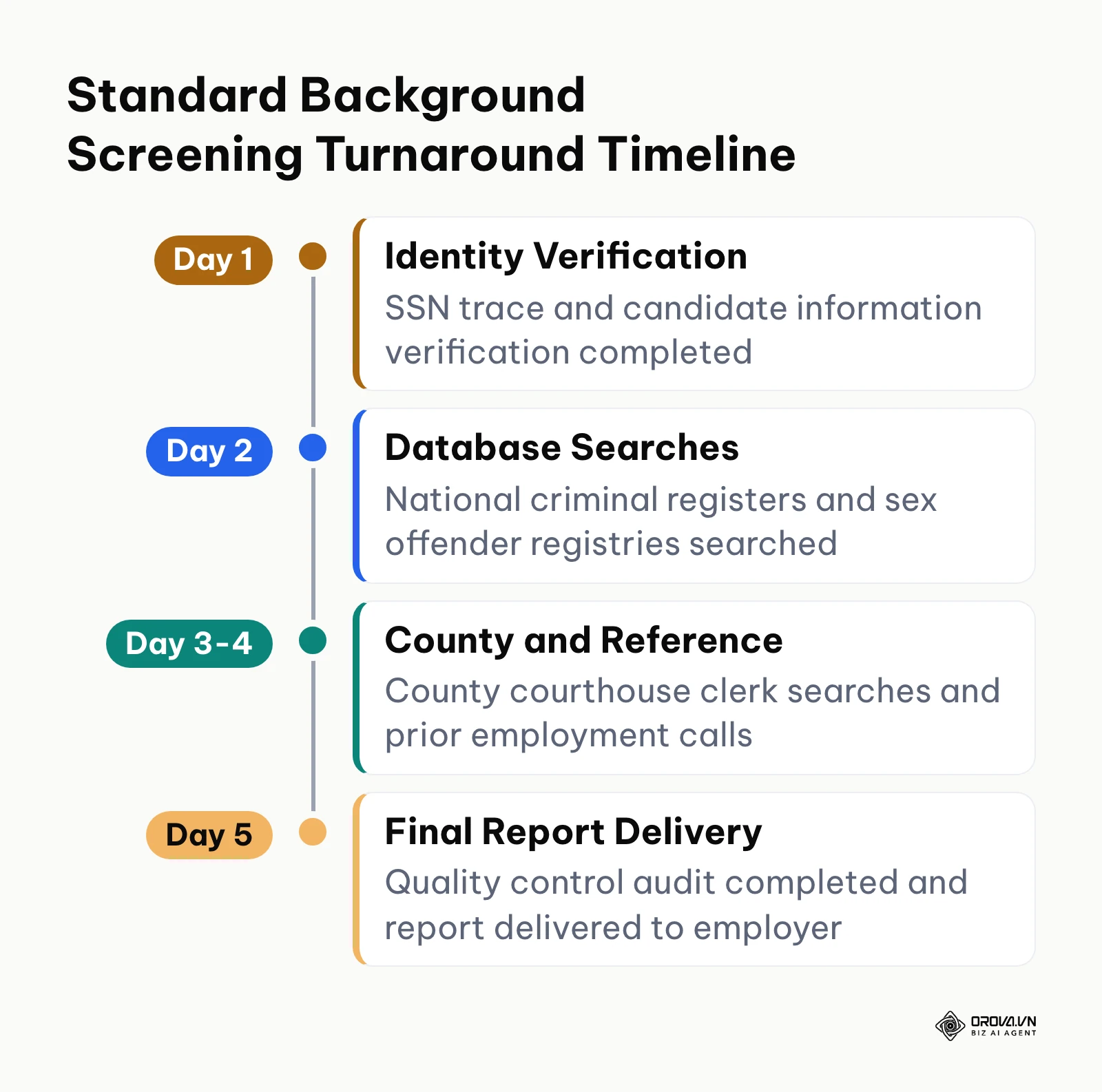
Once the applicant completes their portal submission, track the fulfillment stages across the five-day timeline outlined below.
The timeline below illustrates the standard progression of verification milestones across a typical screening workflow.
Mitigate Courthouse and Clerical Verification Delays
Monitor your dashboard daily for flagged status tags such as "Court Clerk Delay" or "Manual Record Search Required." Certain rural county courthouses and state repositories require physical in-person document retrieval by court runners.
If a candidate has a very common name (for example, "Michael Smith"), screening systems may surface false positive records matching individuals with similar names and birth years. When this happens, the CRA must perform secondary identifier verification using partial Social Security numbers, prior addresses, or middle names.
You confirm this step is running smoothly when the candidate's order status in your dashboard transitions from "Order Dispatched" to "In Progress," with each check component showing its own status.
A frequent error is failing to follow up on education and employment verification stalls after 48 hours. Many academic institutions route degree verification through third-party clearinghouses that stall if the applicant attended under a former maiden name. If a school verification stalls, prompt the candidate immediately through the portal to submit a scan of their official transcript or degree diploma to bypass the clearinghouse backlog.
Before you order a background check, make sure the right people reach that stage. Orova Recruit turns your job description into scoring criteria, scores each CV against them with quoted evidence from the CV, and suggests interview questions based on the JD and CV, so screening budget goes to your strongest finalists.
Step 5: Review Reports to Distinguish Data Discrepancies from Fraud
The objective of this step is to perform a systematic review of the completed consumer report, differentiating between honest clerical errors and deliberate application fraud.
Audit Completed Findings Against Original Resumes
Open the completed report in your screening portal. Review the status indicators: green checkmarks indicate records cleared without flags, amber shields highlight minor discrepancies, and red flags indicate criminal convictions, suspended licenses, or failed identity matches.
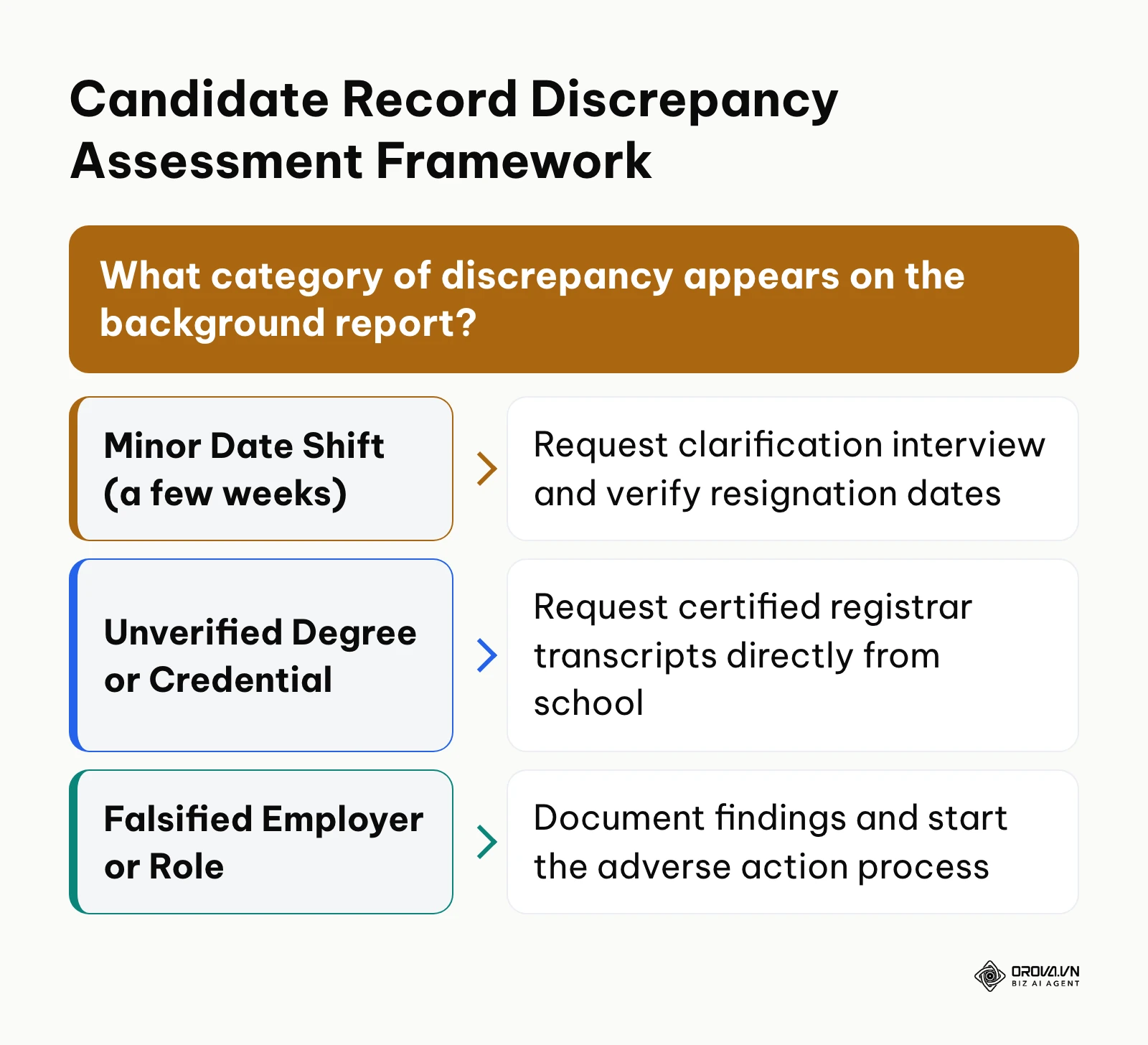
The U.S. Equal Employment Opportunity Commission (EEOC), in its Enforcement Guidance on the Consideration of Arrest and Conviction Records in Employment Decisions, recommends individualized assessments and warns against blanket disqualifications for past criminal history. Follow the decision framework below to evaluate discrepancies methodically.
The decision framework below outlines the appropriate investigative path based on the nature of the flagged discrepancy.
When an amber flag indicates a job title or employment date variance, conduct a structured clarification review by asking the following three objective questions:
- "The report reflects an official end date of March 2023, while your application indicated May 2023. Did your active tenure conclude in March with severance or unused leave extending through May?"
- "The former employer listed your payroll title as Specialist II, whereas your resume noted Senior Strategy Lead. Did that title represent an internal working designation or a formal promotion?"
- "Are there independent records, such as W-2 tax forms or signed separation agreements, that substantiate your reported timeline?"
Ví dụ minh hoạ (Practical scenario):
- Context: A regional retail chain with 320 employees was hiring a Store Operations Manager with inventory oversight.
- Actions taken: HR ran a standard Tier 2 package. The completed background report returned an amber criminal flag indicating an eight-year-old misdemeanor charge in a neighboring county.
- Stumbling block & resolution: The hiring coordinator noted the charge initially appeared as an active concern. However, the court record showed the charge had been dismissed without a conviction, and the team followed EEOC guidance on individualized assessment and the local fair chance hiring rules before deciding.
- Visually observable outcome: The HR coordinator completed the internal EEOC individualized assessment form, attached it to the digital candidate dossier, and toggled the internal review status to "Cleared - Eligible for Hire," advancing the candidate directly into onboarding.
A common mistake is treating minor date inaccuracies—such as a 45-day discrepancy due to employment gap confusion—as grounds for immediate disqualification. Top candidates frequently miscalculate past employment start dates by a few weeks. If an unintentional discrepancy appears, request written clarification and pay documentation before concluding intentional deception.
Step 6: Execute the Two-Stage Adverse Action Notification Protocol
The objective of this step is to follow the two-stage adverse action sequence the FCRA requires whenever report findings may lead to a rescinded offer. This guide is general information, not legal advice; confirm state and local rules with counsel.
Stage 1: Send the Pre-Adverse Action Notice
If report findings prompt you to consider withdrawing a conditional employment offer, do not reject the applicant verbally or issue an immediate termination letter. You must first issue a formal Pre-Adverse Action Notice.
Under the FCRA, the pre-adverse action packet must include a copy of the report and the summary of rights; most employers send them with a cover letter:
- The written Pre-Adverse Action Notice letter.
- A complete copy of the consumer report generated by your screening agency.
- A copy of the official FTC document titled "A Summary of Your Rights Under the Fair Credit Reporting Act."
Copy and customize the standardized template below:
PRE-ADVERSE ACTION NOTICE
Date: [Insert Date]
To: [Candidate Full Legal Name]

Dear [Candidate Name],

We are writing to inform you that we are considering taking adverse action
regarding your application for employment for the position of [Job Title] at
[Company Name], based in whole or in part on information contained in the
enclosed consumer report.

Enclosed with this notice, you will find:
1. A complete copy of your background screening report prepared by [CRA Name,
   Address, Phone Number].
2. A copy of "A Summary of Your Rights Under the Fair Credit Reporting Act."

Please review the enclosed report carefully. If you believe that any information
in this report is inaccurate, incomplete, or out of date, you have the right to
dispute the findings directly with the consumer reporting agency by contacting:
Agency Name: [CRA Name]
Phone: [CRA Phone Number]
Website: [CRA Dispute URL]

You have [number] business days from the receipt of this notice to contact the
reporting agency to dispute the findings or provide explanatory context to our
hiring team. No final employment decision has been made at this time.

Sincerely,
[Hiring Authority Name / Title]
[Company Name]
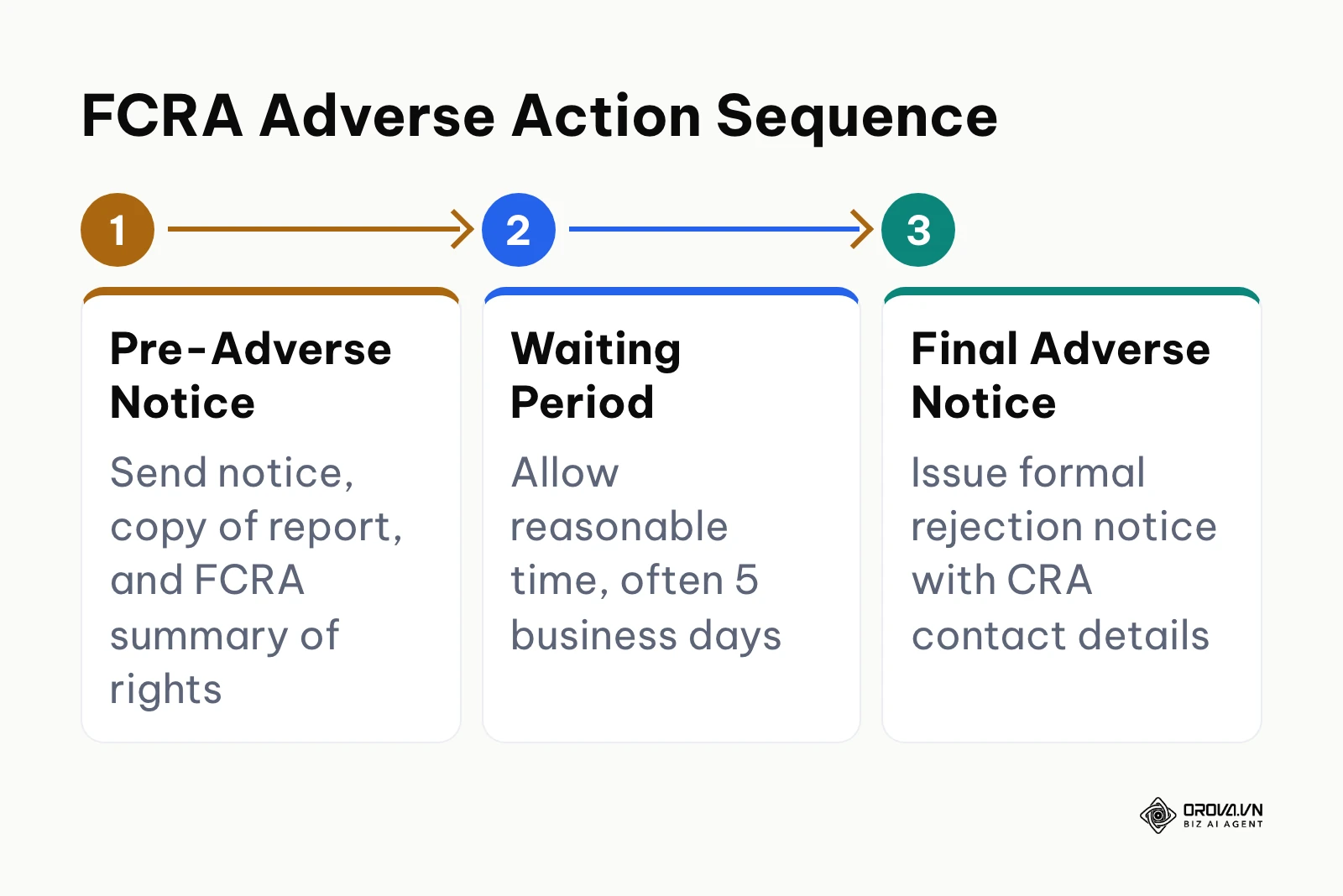
The process diagram below illustrates the mandatory progression and timeline required under federal adverse action law.
Stage 2: Allow a Reasonable Waiting Period and Issue Final Notice
You must pause for a reasonable period before making a final adverse determination. The FCRA does not fix the number of days; five business days is a widely used benchmark, and some state or local laws require longer. This window affords the applicant reasonable time to review the report, identify potential identity theft or reporting errors, and lodge a formal dispute with the screening agency. If the candidate files a dispute, the screening agency must reinvestigate the records with the source, which can take several weeks.
The table below shows what to do with each type of candidate response during the waiting period.
| Candidate response | What it usually means | Your next action |
|---|---|---|
| No response | The candidate does not contest the report. | Issue the final adverse action notice after the waiting period ends. |
| Explanation or context | The record is accurate, but there are circumstances to weigh. | Complete an individualized assessment and document the decision. |
| Formal dispute with the agency | The candidate believes the record is wrong or belongs to someone else. | Hold the decision until the agency finishes its reinvestigation. |
| Corrected report issued | The agency removed or changed the record. | Re-review the corrected report before any decision. |
If the waiting period elapses without a dispute or satisfactory explanation, proceed to issue the Final Adverse Action Notice using the template below:
FINAL ADVERSE ACTION NOTICE
Date: [Insert Date]
To: [Candidate Full Legal Name]

Dear [Candidate Name],

Further to our Pre-Adverse Action Notice dated [Date of Pre-Adverse Notice], we
regret to inform you that [Company Name] has decided to withdraw our conditional
offer of employment for the position of [Job Title].

This decision was influenced, in whole or in part, by information contained in a
consumer report provided by:
Agency: [CRA Name]
Address: [CRA Address]
Phone: [CRA Phone]

Please be advised that:
1. The consumer reporting agency listed above did not make this hiring decision
   and is unable to supply specific reasons why the decision was made.
2. You have the right under the Fair Credit Reporting Act to obtain a free
   copy of your report from the agency if requested within 60 days of this notice.
3. You have the right to dispute the accuracy or completeness of any information
   in the report by contacting the agency directly.

Sincerely,
[Hiring Authority Name / Title]
[Company Name]
Ví dụ minh hoạ (Practical scenario):
- Context: A fintech firm with 180 employees was hiring a Senior Staff Accountant with direct ledger access.
- Actions taken: HR ordered a Tier 3 screening package that returned an outstanding civil court judgment for 18,000 US dollars under the candidate's legal name.
- Stumbling block & resolution: The judgment belonged to an estranged relative with an identical first and last name who previously shared the candidate's historical address. Rather than rescinding the offer immediately, the HR manager dispatched the formal Pre-Adverse Action Notice packet with the full report. Within 48 hours, the candidate submitted court documentation showing different birth dates on the judgment docket directly to the CRA's dispute desk.
- Visually observable outcome: On business day four, the CRA published an amended background report removing the erroneous judgment record, the portal risk rating shifted from red to green, and the HR director generated the unconditional employment agreement.
The primary pitfall in this step is issuing the rejection email simultaneously with the report copy. Skipping the waiting period exposes organizations to FCRA claims. Record the date the pre-adverse notice was sent and the date the waiting period ends before sending any final rejection.
Step 7: Archive Verification Records and Log Compliance Audits
The objective of this step is to catalog screening documentation, consent forms, and dispute logs in secure, encrypted storage in accordance with statutory data retention mandates.
Secure Candidate Privacy and Enforce Retention Protocols
Open your human resources information system (HRIS) or compliance document vault. Do not store background screening reports in the candidate's general personnel file where direct supervisors or hiring managers can view sensitive personal history. Create a separate, restricted-access folder labeled "Confidential Screening Dossiers" accessible only to compliance administrators.
| Record | Where to store it | Who should have access |
|---|---|---|
| Signed disclosure and authorization | Restricted screening folder | HR compliance administrators |
| Background report | Restricted screening folder, never the general personnel file | HR compliance administrators and the final decision maker |
| Pre-adverse and final notices | Restricted screening folder, with send dates | HR compliance administrators and counsel |
| Individualized assessment notes | Restricted screening folder | HR compliance administrators and counsel |
| Offer letter and start date | General personnel file | HR and the hiring manager |
Under Equal Employment Opportunity Commission recordkeeping rules, employers generally must retain employment applications and related hiring records for at least one year from the date the record was created or the personnel action was taken. Federal contractors and some states require longer retention, and many employers keep adverse action files longer to cover the period in which a claim could be filed; confirm your retention schedule with counsel.
You verify completion of this final step when your document archive confirms that the candidate's background dossier is encrypted at rest, isolated from general personnel files, and assigned an automated retention destruction date.
Once records are archived, move the cleared hire into a structured employee onboarding training plan so the time saved in screening is not lost in the first weeks.
A common error is printing physical copies of background reports and leaving them in unsecured filing cabinets. Physical files containing Social Security numbers and date-of-birth records present severe data breach vulnerabilities. If physical documents were printed during committee reviews, shred them immediately once digital archiving is confirmed.
Pre Employment Background Check Master Checklist
Use the operational checklist below to audit your background screening workflow from initial candidate consent through final record retention.
| Implementation Step | Primary Operational Task | Completion Verification Signal | Estimated Turnaround |
|---|---|---|---|
| Step 1: Role-Based Packages | Define check depth matched to position responsibilities and financial risks. | Approved screening tier assigned in the job requisition profile. | 1–2 hours |
| Step 2: Standalone Disclosure | Deliver standalone FCRA disclosure and collect candidate electronic signature. | Signed authorization PDF with verified cryptographic audit trail. | 1 business day |
| Step 3: CRA System Connection | Select a PBSA-accredited screening vendor and configure filtering parameters. | Active API connection and verified webhook integration banner. | 2–3 business days |
| Step 4: Dispatch & Track Orders | Transmit candidate invite link and monitor county courthouse progress. | Portal status badge showing active verification percentages. | 3–5 business days |
| Step 5: Report Audit & Review | Distinguish clerical resume errors from deliberate application deception. | Completed discrepancy evaluation form and candidate interview log. | 1 business day |
| Step 6: Two-Stage Adverse Action | Send pre-adverse notice, observe 5-day dispute window, and log final action. | Timestamped delivery receipt logging 5 full business days. | 5–7 business days |
| Step 7: Record Archiving | Encrypt candidate files in isolated compliance vaults with retention rules. | File encryption confirmed with automated purge date scheduled. | 1 hour |
Keep the hiring steps before the background check in one place with Orova Recruit: score CVs against your criteria, schedule interviews, take voice or text interview notes, compare candidates, and send step-by-step candidate emails from your company mailbox. Sign up free until 7 July 2027, no card required.
Common Pre Employment Background Check Mistakes and How to Fix Them
Executing pre employment background screening requires navigating federal statutes, state privacy acts, and local fair-chance hiring ordinances. The table below outlines six common operational errors, their root causes, and clear remediation steps.
| Operational Mistake | Common Root Cause | Actionable Remediation Step |
|---|---|---|
| Extraneous Language in Disclosure | Using legacy legal templates that combine consent with employment agreements. | Separate disclosures into an isolated, standalone document containing zero liability waiver clauses. |
| Premature Offer Rescission | Issuing a final rejection email immediately upon receiving a flagged report. | Issue a formal Pre-Adverse Action notice and enforce a mandatory five-business-day waiting period. |
| Inappropriate Credit Checks | Ordering financial credit reports for operational roles without cash access. | Restrict credit checks exclusively to roles with direct financial authority or fiduciary duties. |
| Ignoring Ban the Box Timing | Inquiring about criminal convictions on the initial job application form. | Remove criminal history questions from initial applications where local law requires, and run checks at the stage the law allows. |
| Mishandling Common Name Matches | Accepting automated database flags without confirming secondary identifiers. | Instruct CRA to verify records against middle names, complete birth dates, and past addresses. |
| Unsecured Dossier Storage | Storing completed background reports in open employee personnel folders. | Migrate background records to an encrypted, restricted-access compliance folder with role-based permissions. |
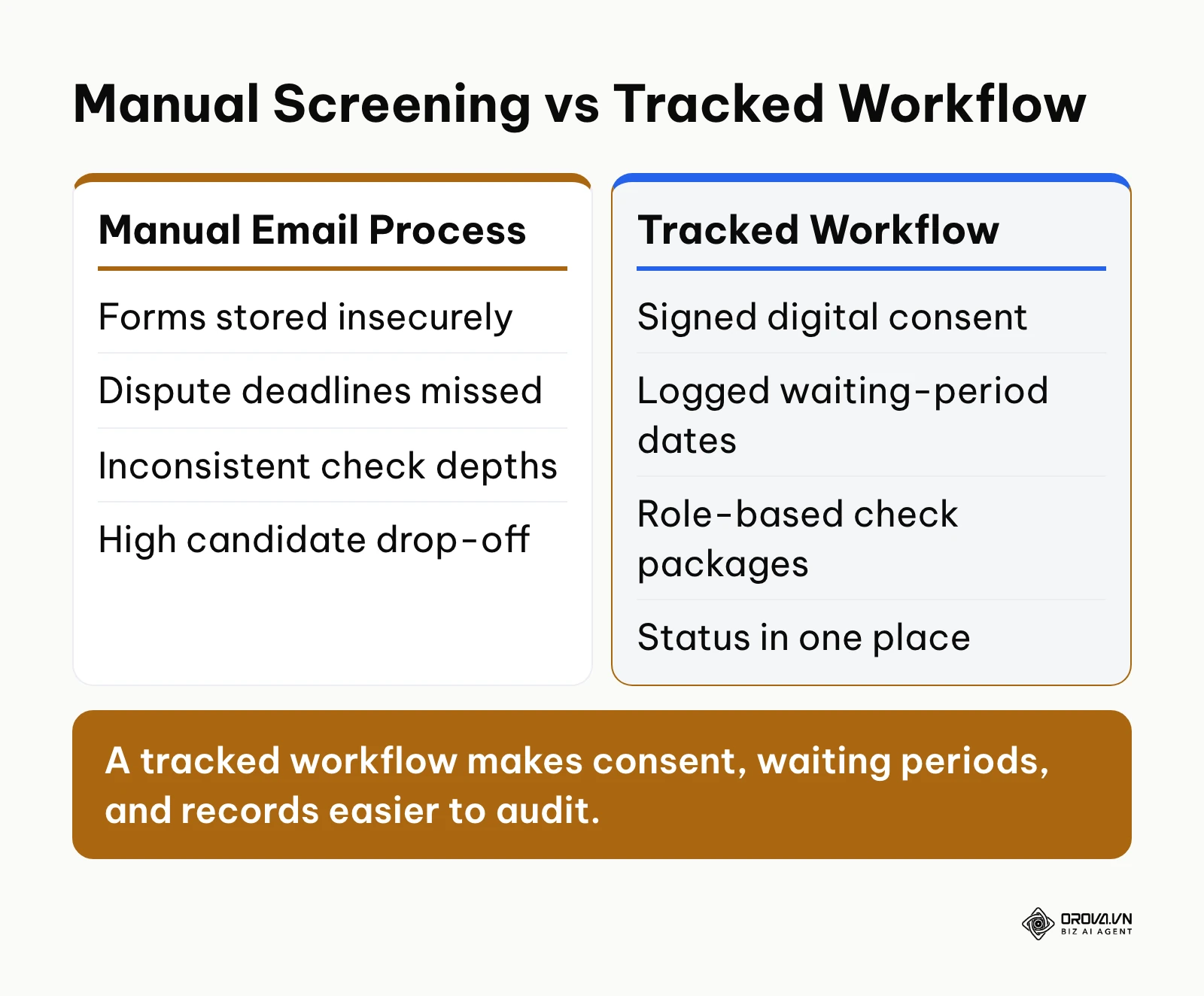
The comparison table below highlights why transitioning from fragmented email coordination to an integrated digital workflow mitigates compliance hazards.
Structured evaluation earlier in the funnel also means fewer finalists reach the costly screening stage; the candidate screening stage that comes before the background check is where most applicants should be filtered out. Orova Recruit covers the steps before the background check: it helps you write the job description and set criteria for each role, scores CVs (Word, PDF, or scanned images, up to 500 CVs per position) against those criteria with quoted evidence from each CV, and suggests interview questions based on the JD and CV. It does not run background checks; it helps you decide who should reach that stage.
Measuring Success After Implementing Your Background Check Workflow
To verify that your background screening process operates efficiently without exposing your business to regulatory liability, monitor your performance against three objective benchmarks.
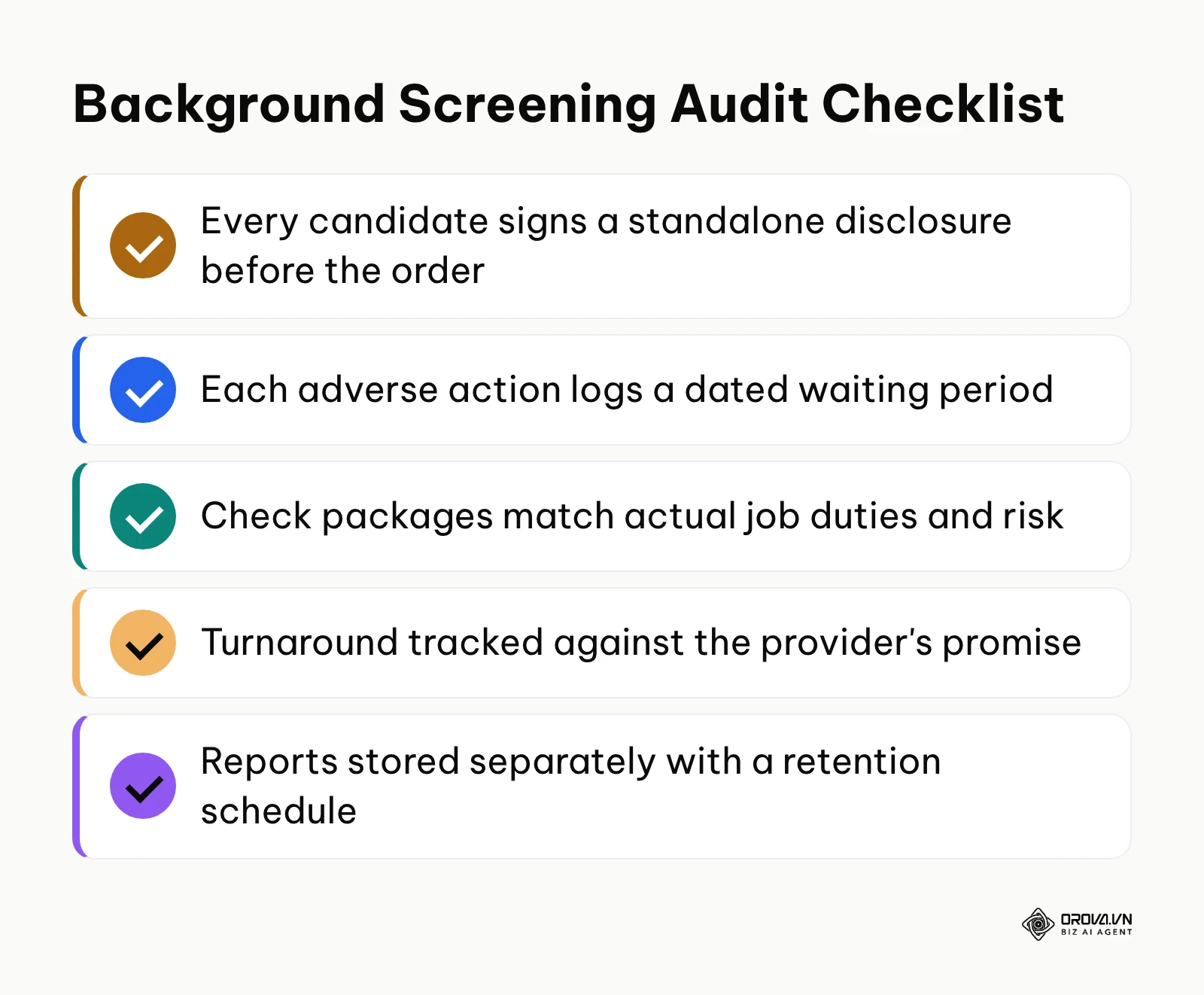
- Screening Turnaround Time (TAT): Track the business days elapsed from candidate consent submission to final report delivery. Compare Tier 1 and Tier 2 averages with the turnaround your provider promised. If turnaround consistently runs longer, audit your county court search parameters or contact your CRA partner to address clerk research backlogs.
- Candidate Dispute Rate: Measure the percentage of background reports contested by applicants. A rising dispute rate, especially disputes that end with corrected reports, indicates your screening provider may be surfacing inaccurate records or false positives.
- Audit Compliance Adherence: Conduct quarterly compliance reviews verifying that 100% of archived candidate files contain a valid standalone disclosure, a timestamped consent form, and a dated waiting-period log for any adverse actions taken.
The checklist below summarizes the essential audit milestones required for ongoing program governance.
Review these metrics monthly in your recruitment dashboard to shorten time-to-hire while keeping your records audit-ready.
Future Trends in Pre Employment Background Checks: Author's Perspective
Looking at the background screening landscape today, several regulatory and technological shifts are transforming how organizations evaluate talent. As of 2026, the convergence of automated candidate vetting, expanding privacy legislation, and distributed remote workforces is fundamentally altering conventional verification protocols.
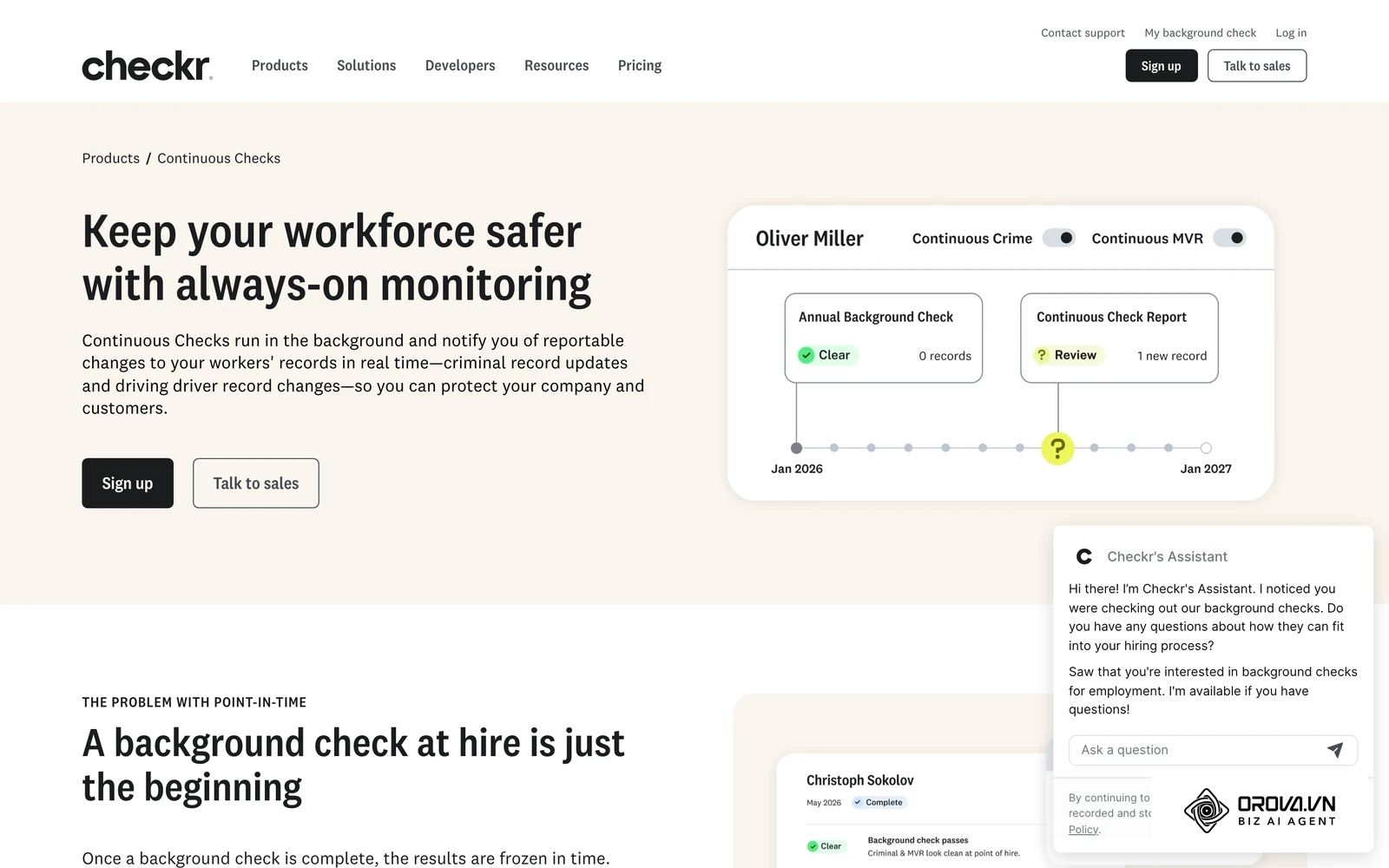
Continuous Workforce Monitoring Will Replace Point-in-Time Checks
Today, the standard pre employment background check functions as a single snapshot in time. Once an employee is hired, many organizations do not re-screen them unless an internal incident occurs. I believe that point-in-time pre-employment checks will evolve into continuous workforce monitoring across regulated sectors. Instead of occasional isolated re-checks, automated systems will monitor state licensing boards, criminal dockets, and sanctions registries more frequently, notifying compliance officers of relevant status changes. However, widespread adoption could be curtailed if organized labor pushback and state privacy statutes enact stringent employee monitoring restrictions. To prepare, human resources leaders should draft clear post-hire continuous monitoring policies and update their employment agreements to include recurring authorization clauses.
Cross-Border Verification Hubs Will Standardize Distributed Remote Hiring
As organizations hire talent across international jurisdictions, traditional domestic screening partners struggle with disparate data protection standards. I expect global verification platforms will consolidate around decentralized identity protocols and cross-border data clearinghouses. This transition will allow recruiters to verify overseas academic credentials, professional licenses, and employment histories much faster than today. This development could stall if international geopolitical tensions lead nations to enforce data localization laws that prohibit cross-border data transfers. HR teams should prepare today by auditing the geographic distribution of their workforce and vetting screening partners that maintain localized legal entities in their key hiring markets.
Artificial Intelligence Will Automate Discrepancy Reconciliation
Manual document verification remains one of the slowest components of traditional background screening. I believe artificial intelligence will increasingly handle the initial reconciliation of resume claims against official institutional records. Specialized machine learning models will analyze tax filings, payroll records, and registrar transcripts to resolve minor date and title variations automatically before human intervention is required. This projection would fail if regulators classify algorithmic document reconciliation as automated employment decision tools (AEDT), subjecting platforms to bias audits and consent constraints. Organizations should prepare now by establishing transparent discrepancy resolution guidelines and ensuring that all automated screening tools retain human-in-the-loop oversight.
Frequently Asked Questions About Pre Employment Background Check
How long does a pre employment background check take to complete?
A standard pre employment background check typically takes between one and five business days to complete. Turnaround time depends on the specific checks requested: automated identity verification and national database searches take less than 24 hours, while county courthouse clerk searches, international records, and past employer verifications often require three to five business days.
What causes a pre employment background check to take longer than expected?
Delays usually stem from county courthouses requiring physical clerk searches, past employers taking multiple days to return verification calls, incomplete candidate data, or common names that require manual secondary identifier matching. Academic holidays can also delay university registrar verifications.
How does Ban the Box legislation impact the pre employment background check process?
In jurisdictions that have adopted them, Ban the Box laws prohibit employers from asking about criminal history on initial job application forms. These rules typically require employers to defer criminal history checks until after an initial interview or a conditional offer of employment, allowing candidates to be evaluated on their qualifications first.
Can employers consider criminal records older than seven years?
Under the Fair Credit Reporting Act, consumer reporting agencies generally cannot report arrests or other non-conviction records older than seven years, with limited exceptions for some higher-salary positions. Federal law permits reporting criminal convictions without a time limit, but several states restrict how far back convictions can be reported. Check the rules where the candidate lives and works.
How should HR handle a candidate name match that is a false positive?
When a background check flags a record belonging to someone with the same name, HR must request secondary identifier verification from the screening agency. The CRA cross-references the candidate's complete date of birth, Social Security Number, and historical residential addresses against the court docket to eliminate unverified matches.
What role does artificial intelligence play in modern pre employment background checks?
Artificial intelligence assists screening providers by automating optical character recognition (OCR) on identity documents, flagging resume discrepancies, and speeding up record categorization. However, regulators expect employers to stay responsible for hiring decisions, and some local laws regulate automated decision tools, so keep a person reviewing flagged findings and performing individualized assessments.
Where Should You Start with Pre Employment Background Checks?
Transforming your background screening process does not require overhauling your entire human resources department in a single week. Focus on taking one decisive, high-leverage action today based on your current operational maturity.
If you currently have no formal screening policy and rely on informal reference calls (map where the check sits in your overall hiring process first), your first step this afternoon is to draft a clean role risk tiering document. Group your open positions into operational, professional, and financial tiers to determine which roles require criminal, credit, or credential checks before contacting a vendor.
If you already use a background screening provider but manage candidate consent through email, your immediate action is to audit your disclosure paperwork. Open your current consent form and review it for extraneous liability waivers, indemnification clauses, or application text. Strip out all non-essential language to ensure your standalone disclosure meets the FCRA standalone requirement.
If your organization has an established screening process but suffers from slow turnaround times and candidate friction, dedicate your afternoon to setting up automated notifications. Configure your screening portal to send automated text message or portal reminders to candidates who have not completed their identity submissions within 24 hours.
By implementing these standardized steps, your hiring team will build a secure, efficient, and audit-compliant hiring pipeline that protects your company while respecting candidate rights through every pre employment background check.
About the author

Builder of Orova
Nguyễn Đỗ Trọng Ân has 8 years of experience in marketing, including 6 years managing market development across Asia. He builds Orova, a Biz AI Agent that never sleeps: it plans, runs and optimizes work for businesses.
Run your business with AI Agents
Orova is the always-on Biz AI Agent — it plans, runs, and optimizes the work for you.
Save time, unlock productivity.