
What are TikTok hooks? The 3-layer science of the first 3 seconds

Have you ever spent hours filming a video, only to see users swipe past it before you even finish your first sentence because you lacked strong TikTok hooks? You are not alone in this frustration. In the fast-paced ecosystem of short-form video content, capturing and holding human attention is the hardest battle any creator faces. You might have tried searching for a generic list of templates online and pasting them onto your screen, desperately hoping for a viral hit. However, thoughtlessly copying generic phrases rarely works because they do not align with your specific niche or visual delivery style. To truly succeed and scale your brand, you must master the art of the opening sequence. This article moves entirely beyond mindless copying and basic advice. We will explore the rigorous, data-driven science of the first three seconds, breaking down the exact visual, audio, and text layers required to dramatically increase your viewer retention. You will learn how to read your analytics, run proper split tests, and construct openers that genuinely stop the scroll for any industry.
What are TikTok hooks?
TikTok hooks are strategic elements placed within the first three seconds of a video to instantly capture viewer attention and prevent them from scrolling away. They are used to build immediate curiosity or relevance, differing from traditional introductions by prioritizing rapid engagement over slow context building to maximize retention.
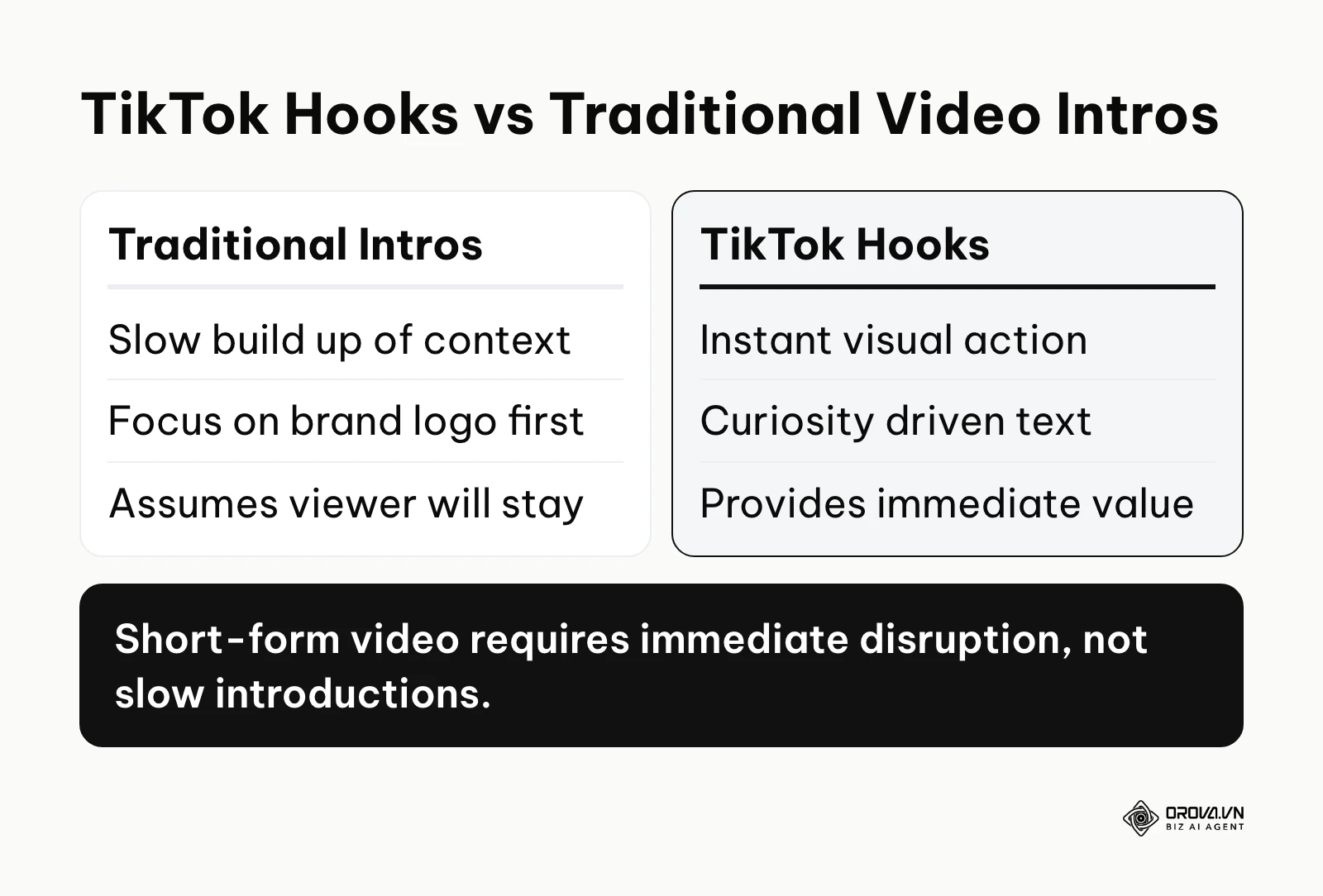
The concept originated from traditional copywriting and direct response marketing decades ago. In print media, the headline served as the hook to force people to read the first paragraph. On modern short-form video platforms, this concept has evolved dramatically from purely text-based headlines into a complex, fast-paced multimedia experience.
Because the digital landscape is crowded, TikTok hooks are often confused with other content elements. Here is a clear breakdown of the fundamental differences:
| Concept | How it differs | Example |
|---|---|---|
| TikTok hooks | Delivers immediate value or curiosity in 3 seconds across three synchronized layers (visual, audio, text). | "Stop scrolling if your back hurts every single morning." |
| Clickbait | Promises something outrageous but completely fails to deliver the promised value in the actual video content. | "This secret button gives you free money!" (The video is actually just about basic budgeting tips). |
| YouTube Intros | Slower, brand-building segments that establish the channel identity over a span of ten to fifteen seconds. | A spinning graphic logo with loud background music and a long "Welcome back to my channel" greeting. |
Illustrative example: Imagine you are walking through a busy, noisy street market. A vendor who quietly sits behind a table looking down will be completely ignored by the crowd. However, a vendor who suddenly tosses a flaming pan of food high into the air forces you to stop and watch immediately. That sudden, visually arresting action combined with the loud sizzling sound is a real-world hook. It interrupts your default walking pattern and demands your focused attention before you even realize what they are selling.
The Meaning Behind the First 3 Seconds
In the broader landscape of digital marketing and content creation, the hook exists to solve one massive, systemic problem: audience friction. Users open social media applications with a remarkably high degree of distraction. Their default, subconscious behavior is to continuously swipe upward to find the next hit of dopamine. A hook acts as a powerful friction mechanism, halting that default behavior instantly. It sits at the very top of your content funnel. Before your deep storytelling begins, before you state your unique value proposition, and long before you ask them to click a link in your bio, the hook must first earn the right to deliver the rest of your message. It is the gatekeeper to your expertise.
If you choose to ignore the hook, you lose the opportunity to showcase your knowledge entirely. You can possess the most profound industry insights, invest in the highest production quality cameras, and hire the best editors, but if the first three seconds fail to grab the viewer, your retention graph will flatline at the very beginning. The platform algorithm will rapidly register this early drop-off as a negative signal, assuming the content is uninteresting. Consequently, the algorithm will push your video further down the feed, severely limiting your organic reach. A broken hook essentially destroys the return on investment for your entire content production effort. Without it, your message is spoken into an empty room.
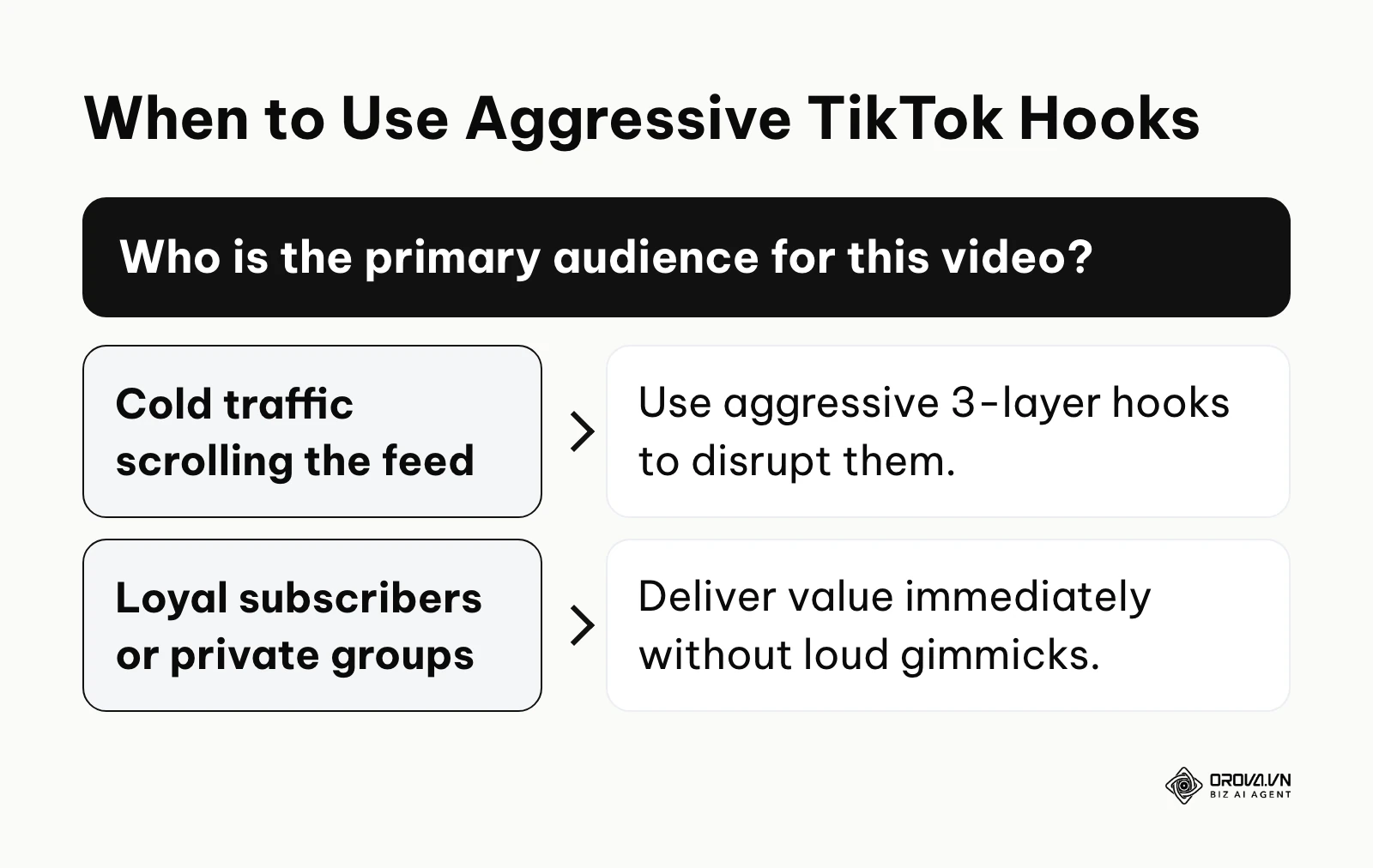
When you do not need TikTok hooks: There are specific scenarios where obsessing over an aggressive, loud hook is unnecessary and can actually harm your brand trust. If you are communicating internally within a closed community platform or a private employee training group, the viewers are already invested in the context, so a disruptive hook feels forced and unprofessional. Similarly, if you are publishing a highly anticipated product announcement to a loyal, existing subscriber base who actively seeks out your updates daily, a simple and direct greeting is much more respectful of their time. In these specific cases, focus on delivering the core information immediately rather than engineering artificial curiosity.
Value and Benefits of High-Retention Openers
Mastering the art of capturing attention delivers measurable, compounding impacts across the entire organization. We must divide these impacts into two distinct layers: the tangible business values that affect the bottom line, and the day-to-day practical benefits for the team executing the creative work.
Business Value: Lowering Acquisition Costs and Scaling Reach
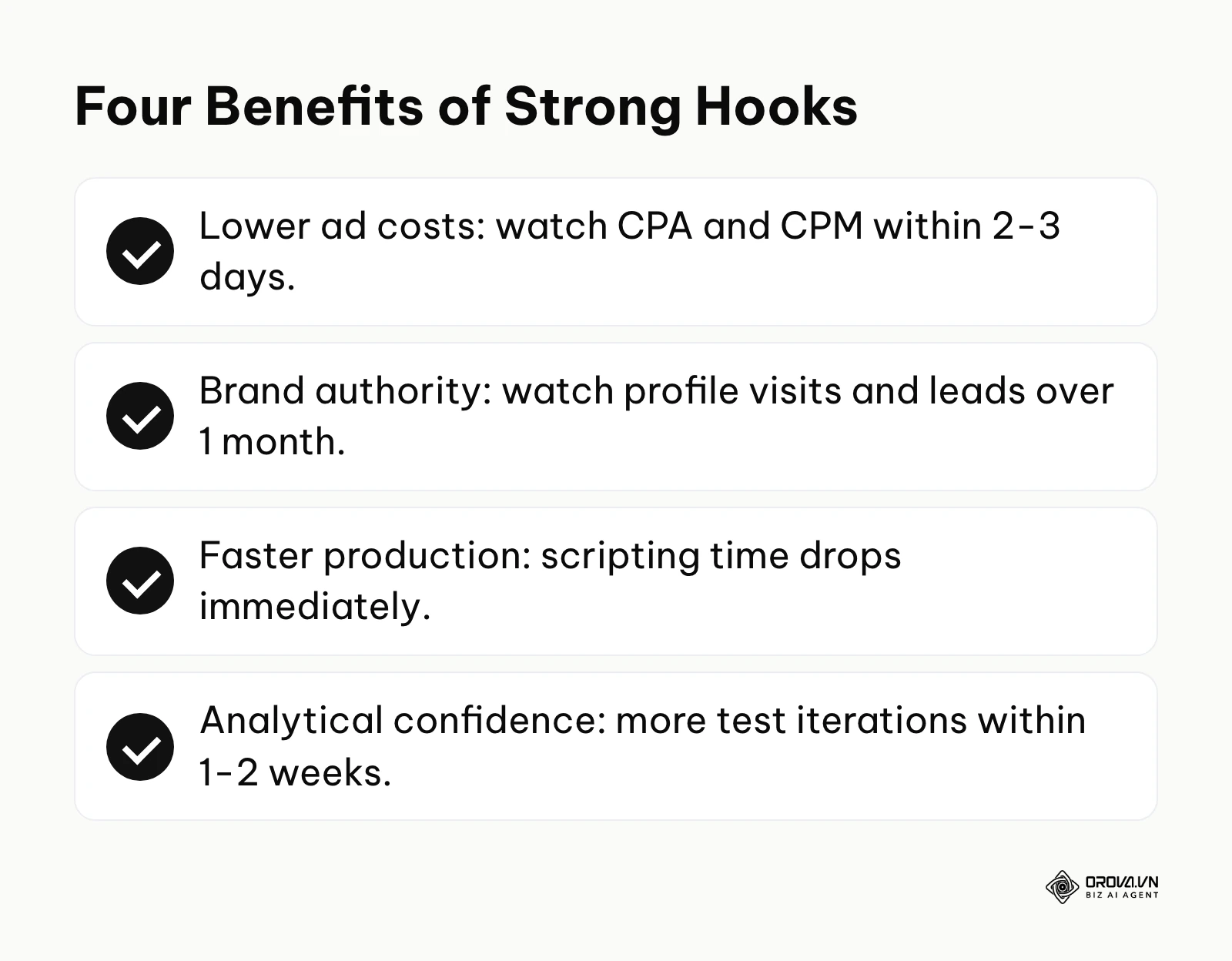
For any commercial business, a strong hook directly correlates with dramatically lower advertising costs and significantly higher organic distribution. When viewers watch past the initial seconds, the platform tends to give the video more distribution, which often makes each impression cheaper because you are keeping users on the app longer. This efficiency is critical when you are running hybrid campaigns like TikTok Spark Ads, where strong organic performance amplifies your paid advertising reach, lowering the overall cost to acquire a customer.
- Metric to measure: Cost per Mille (CPM) and Cost per Acquisition (CPA).
- Time to see results: You will notice distinct changes in these ad metrics within the first 48 to 72 hours of launching a new hook variation.
Business Value: Establishing Immediate Authority
In professional industries characterized by high trust barriers, such as finance, corporate law, or specialized healthcare, the opening seconds serve as an instant credibility check. A refined, professional, and confident hook signals deep competence, immediately separating your brand from amateur creators in the feed. It shows that you respect the viewer's time and know exactly what you are talking about.
- Metric to measure: Profile visits and inbound lead generation form completions.
- Time to see results: Typically visible after one full month of consistent, high-quality publishing.
Executor Benefit: Predictable Content Frameworks
For the content creator, video editor, or social media manager, relying on proven TikTok hook formulas completely removes the anxiety of staring at a blank page. Instead of waiting around for spontaneous inspiration to strike, you can follow a mathematical, structured approach to generate multiple script variations rapidly. This prevents creative burnout and standardizes the production workflow across the team.
- Metric to measure: Total time spent on scripting and ideation per individual video.
- Time to see results: Immediate, beginning with the very next batch of video scripts you write.
Executor Benefit: Data-Driven Confidence
When you truly understand how to read retention graphs, you stop taking low view counts personally. You realize that the core educational content might be excellent, but the opening sentence simply failed to connect. This shifts the focus from emotional disappointment to analytical, objective troubleshooting. You begin to treat every video as a data point rather than a personal reflection of your worth.
- Metric to measure: Number of specific A/B test iterations deployed per week.
- Time to see results: Within two weeks of actively tracking your analytics dashboard.
Illustrative example:
- Context: A mid-sized B2B software company struggled with terrible organic reach on their educational software tutorials. The marketing manager was frustrated because they spent hours filming each week.
- Actions taken: They stopped creating generic sixty-second tutorials that started with "Welcome to our software." Instead, they filmed three different five-second hooks for the exact same tutorial. One hook focused on a painful industry statistic, another asked a highly controversial question, and the third used a strong visual prop.
- Stumble and fix: The visual prop hook initially felt too goofy and out of place for their strict corporate brand guidelines. They fixed it by replacing the silly prop with a printed, heavily redacted legal contract, maintaining strict professionalism while keeping the visual curiosity high.
- Result: The retention curve no longer fell off a cliff at the start. The version with the redacted contract hook held noticeably more viewers at the three-second mark than the other two variations and than their earlier tutorials, so the team adopted it as the template for the next batch.
| Benefit | Measured by which metric | Time to see results |
|---|---|---|
| Lower ad costs | CPA, CPM | 2-3 days |
| Brand authority | Profile visits, lead volume | 1 month |
| Faster production | Scripting time per video | Immediate |
| Analytical confidence | Iterations per week | 1-2 weeks |
OROVA ADS applies AI Agent to automate and optimize ad performance on Google, Meta and TikTok. Scale your budget safely, monitor 24/7 and expand your business quickly.
Experience the solution at orova.vn/ads
How TikTok Hooks Actually Work (The 3-Layer Science)
The most common and destructive mistake creators make is treating the hook merely as a line of text written on a script. In reality, a successful opener is a highly synchronized event occurring simultaneously across three distinct sensory layers. If one layer contradicts the others, or if one layer is simply boring, the viewer experiences cognitive dissonance and immediately swipes away. This section dissects the anatomy of the first three seconds in exhaustive detail and introduces the core frameworks needed to construct them properly.
The Visual Layer (Action and Framing)
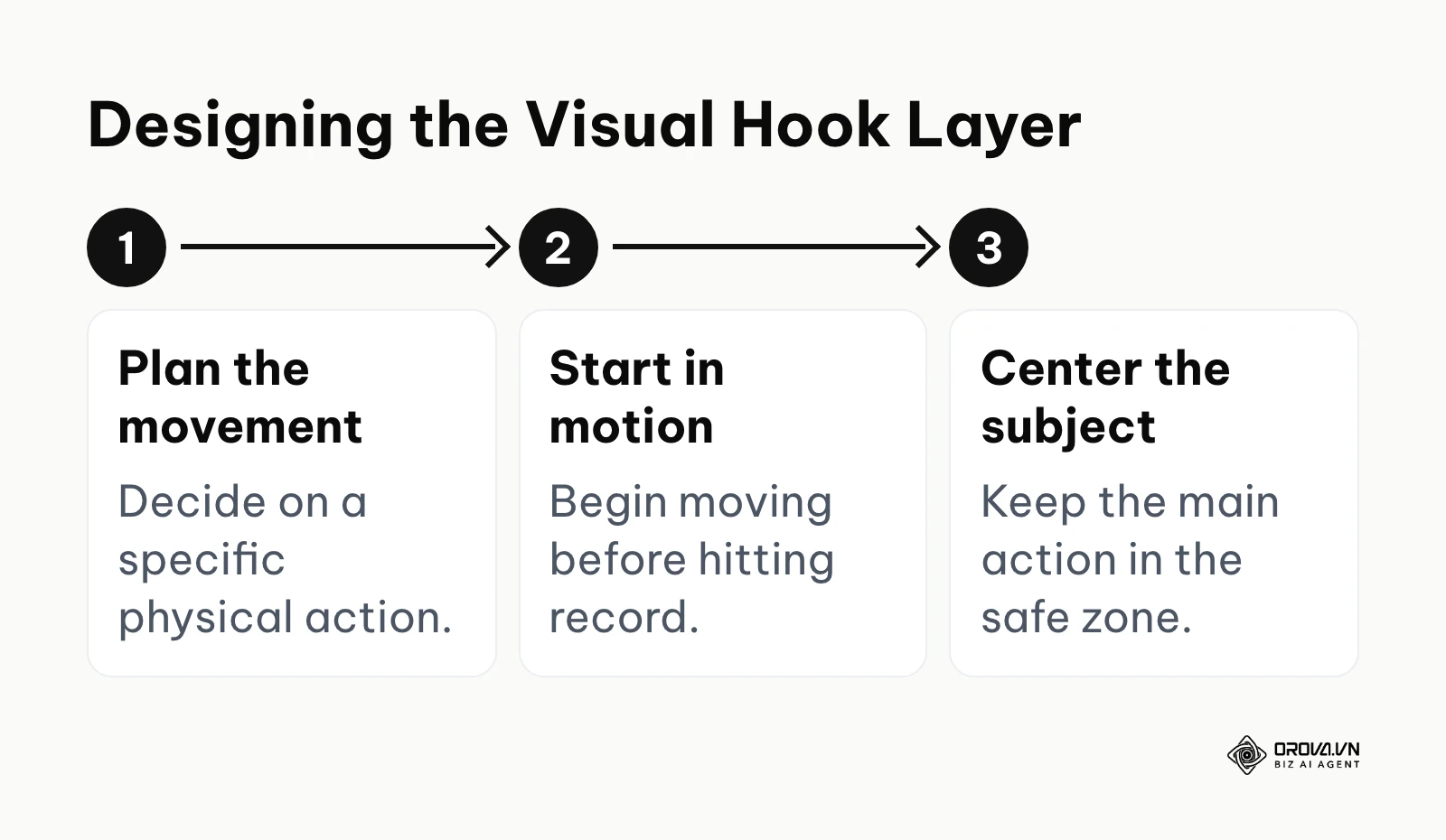
What it does: The visual layer is the absolute fastest element to register in the human brain. It often processes fully before the viewer even hears a single spoken word. It relies heavily on physical movement, camera framing, depth of field changes, and environmental disruption. Visual processing is vastly faster than text processing, meaning the decision to stay or swipe is often made on the visual layer alone. Input: The physical actions of the talent on screen, dynamic camera movement, adjustments in lighting, and the strategic introduction of props. Output: An immediate, unavoidable interruption of the user's scrolling pattern, forcing their eye to focus directly on the center of your video frame. Common failure: Starting the video by sitting perfectly still in a chair, staring blankly into the camera lens, and waiting a fraction of a second for the microphone to activate. This moment of "dead air" guarantees a massive drop-off. You must start moving your body or talking slightly before you even hit the record button to ensure the very first frame of the video is already in dynamic motion.
The Audio Layer (Voice and Sound)
What it does: The audio layer delivers the emotional tone, the urgency, and the core curiosity gap of your message. It dictates the pacing and energy of the entire video. While the visual layer stops the thumb from swiping, the audio layer gives the brain a logical reason to keep watching. Input: Voice inflection, speaking volume, strategic background sound effects (like a subtle whoosh or pop), and highly deliberate pauses placed right before revealing the most important word. Output: Auditory engagement that firmly confirms the initial promise made by the visual layer. Common failure: Using a robotic voice, reading from a teleprompter with monotone delivery, or lacking any sense of urgency. Another frequent, frustrating error is relying entirely on a loud trending sound that has absolutely no logical connection to the topic you are discussing, which simply annoys viewers seeking actual information.
The Text Overlay Layer (Position and Color)
What it does: The text overlay acts as a crucial anchor for the large percentage of viewers who are watching videos on public transit or in offices with their volume muted. It reinforces the spoken word and provides immediate context that the visuals alone cannot convey clearly. Input: Bold font choices, high-contrast background colors behind the text, precise text placement, and controlled reading duration. Output: Immediate clarity on exactly what the video is about, usually readable and digestible in under two seconds. Common failure: Writing a massive, blocky paragraph that covers the talent's face. Another major failure is placing the text too low on the screen, where the platform's caption UI and user handle completely obscure it. Text must be exceptionally concise, typically strictly under seven words, and placed safely in the upper middle third of the screen to avoid all interface buttons.
Illustrative example:
- Context: A freelance videographer wanted to teach local small business owners how to shoot significantly better product videos using only their smartphones.
- Actions taken: He designed a very specific three-layer hook. Visually, he rapidly wiped the camera lens with his shirt to create motion. Audibly, he stated in an urgent tone, "Your product videos look cheap because of this." Textually, the screen displayed "Stop making this camera mistake" in bold yellow text.
- Stumble and fix: Initially, the bright yellow text blended completely into his brightly lit white office background, making it unreadable. He fixed this by adding a solid, semi-transparent black background box directly behind the text to ensure maximum high contrast.
- Result: The comment section shifted from completely ignoring his past videos to actively asking specific questions about lighting and framing, proving the audience stayed past the hook and absorbed the core tutorial. Average view duration also rose compared with his earlier uploads.
Core Frameworks for B2B and Complex Niches
Unlike teenage entertainment creators, serious B2B brands and professional service providers cannot rely on extreme physical stunts or loud, chaotic dancing to gain views. They must use specialized tiktok hooks for business that emphasize deep intellectual curiosity and highly specific pain points. Here are core frameworks you can adapt by filling in the blanks:
- The Contrarian Truth Framework:
- Concept: Directly challenge a widely accepted, standard industry belief to create immediate friction and curiosity.
- Fill-in-the-blank: "Everyone in [Industry] tells you to do [Common Advice], but that is exactly why you are actively losing [Desired Outcome]."
- Example: "Everyone in real estate tells you to buy a starter home first, but that is exactly why you are actively losing long-term equity."
- The Specific Symptom Framework:
- Concept: Describe a very specific, annoying daily symptom the target audience experiences, instantly proving you deeply understand their struggles.
- Fill-in-the-blank: "If you constantly struggle with [Hyper-Specific Pain Point] when trying to [Task], here is the actual, hidden reason why."
- Example: "If you constantly struggle with formatting errors when trying to export your CRM data, here is the actual, hidden reason why."
- The Micro-Case Study Framework:
- Concept: Lead aggressively with a verifiable, impressive result to instantly establish unshakeable authority.
- Fill-in-the-blank: "Here is exactly how we helped [Client Type] achieve [Specific Result] in [Timeframe] without relying on [Common Objection]."
- Example: "Here is exactly how we helped a local dental clinic book forty new appointments in two weeks without relying on expensive agency retainers."
Analyzing Retention Rate for A/B Testing
You absolutely cannot improve what you do not measure accurately. Knowing how to increase TikTok retention rate starts with reading your data objectively, without emotion. When you open your analytics dashboard, look closely at the shape of the retention curve.
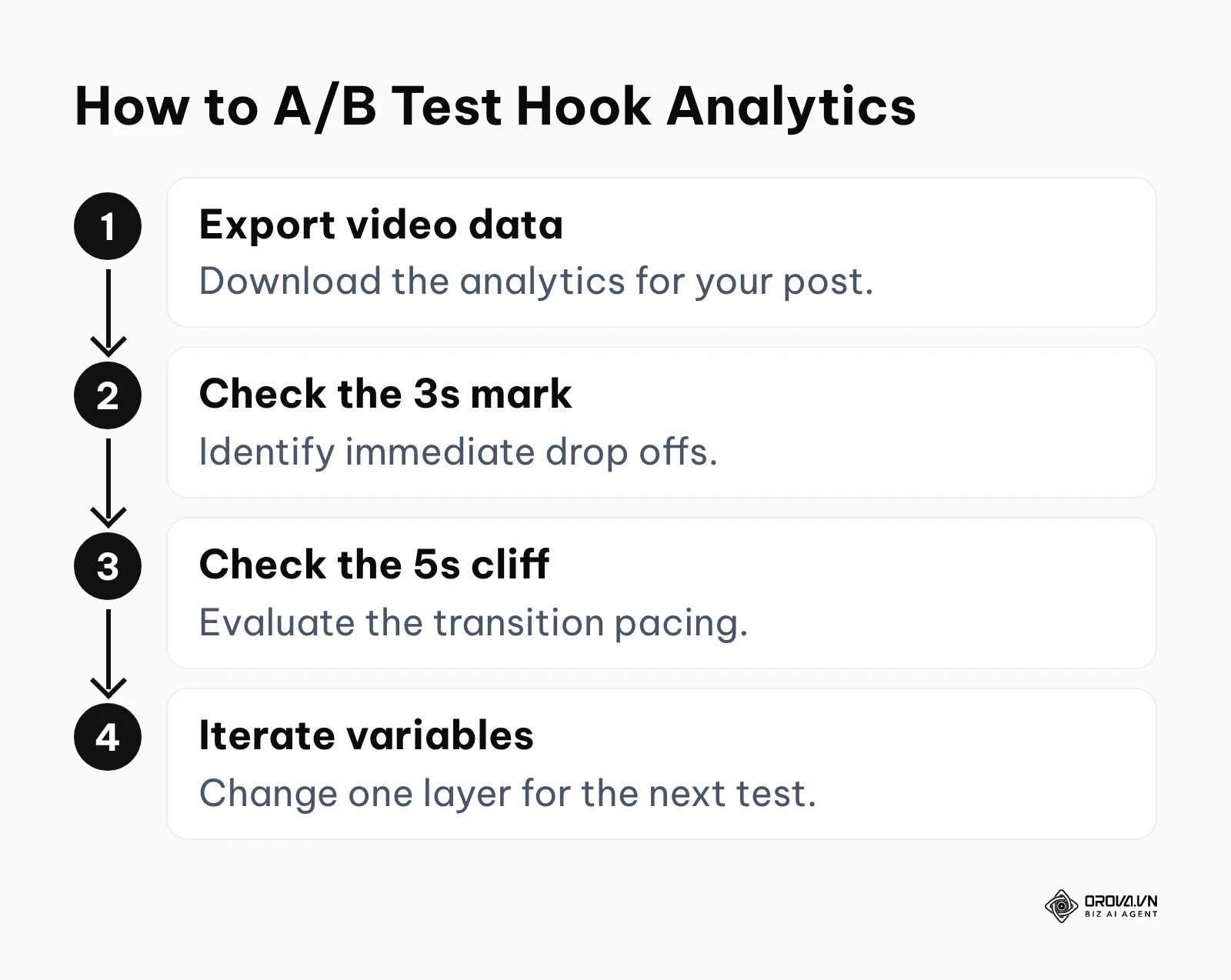
- The 3-Second Drop: If your retention graph falls steeply within the very first three seconds, noticeably harder than on your other videos, your visual layer or opening statement is the weak point. The hook failed to capture the right audience.
- The 5-Second Cliff: If viewers stay for three seconds but drop rapidly at the five-second mark, it means the hook itself was good, but your transition into the main body of the content was entirely too slow. You took too long to deliver on the initial promise, and the viewer felt deceived.
To execute a proper, scientific A/B test, you must film three completely different hooks for the exact same body content. Post them on different days and track which version maintains the highest percentage at the three-second mark. This is the only empirical, proven way to determine what actually resonates with your unique audience.
| Types of Hooks | Characteristics | Best Suited For |
|---|---|---|
| Curiosity Gap | Withholds a crucial piece of information to force viewers to wait for the final reveal. | Broad consumer products, general entertainment, lifestyle. |
| Negative Warning | Alerts viewers to a dangerous or costly mistake they might currently be making. | Finance, legal advice, B2B consulting services. |
| Direct Value Promise | States exactly what the viewer will learn without any unnecessary fluff or tricks. | Educational content, software tutorials, deep-dive reviews. |
| Visual Disruption | Relies heavily on an unexpected physical prop, rapid movement, or strange camera angle. | Physical products, fashion, food and beverage industries. |
What to Do to Start and Adapt
Different roles within the business world require very different approaches to integrating these retention frameworks. You cannot simply hand a generic list of text templates to a team and expect perfection. The workflow must be adapted carefully to the specific constraints, budget, and structure of your organization.
For Small Business Owners
As a small business owner, your time is your most limited resource. You cannot afford to spend days editing one video.
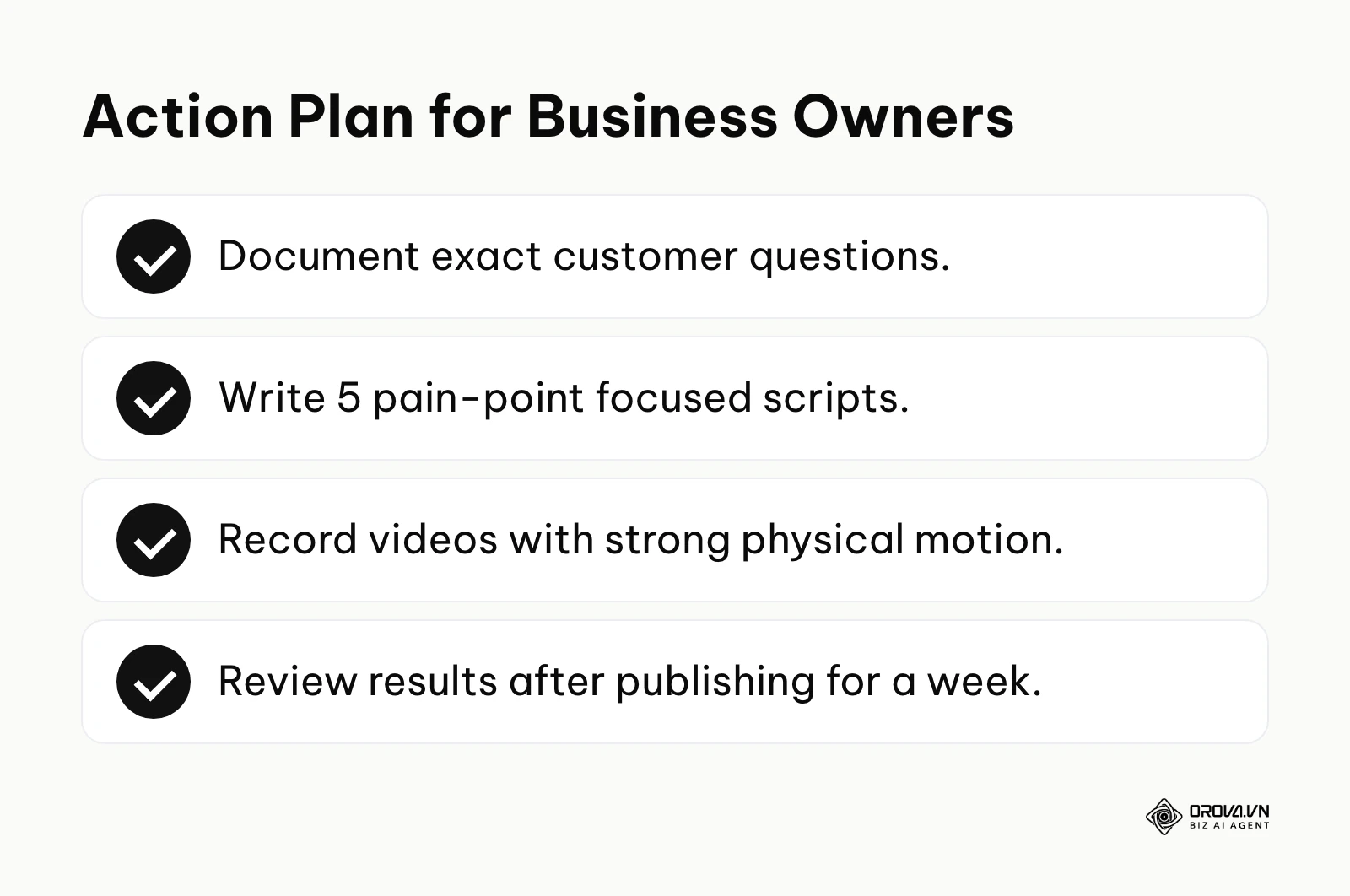
- Document exact customer questions: Spend one focused hour reviewing your emails, support tickets, and direct messages. Extract the exact phrasing your actual customers use when asking about their problems. Do not guess their pain points; read them.
- Draft five pain-point scripts: Use the "Specific Symptom" framework detailed above to write five short scripts based directly on the raw customer language you just extracted.
- Film with physical motion: Set up your phone on a tripod, press record, and physically walk into the frame as you deliver the opening line to ensure kinetic energy is present in the first visual frame. If customers already film clips of your product for you, run the same three-layer check on their openings; the user generated content ads playbook explains how to turn those clips into ads.
- Post and monitor weekly: Publish the videos steadily over a week and check the three-second retention metric for each one on Sunday evening to see which topic hit the hardest.
For In-House Marketers
In-house teams have more resources but often suffer from slow approval processes and brand guideline restrictions.
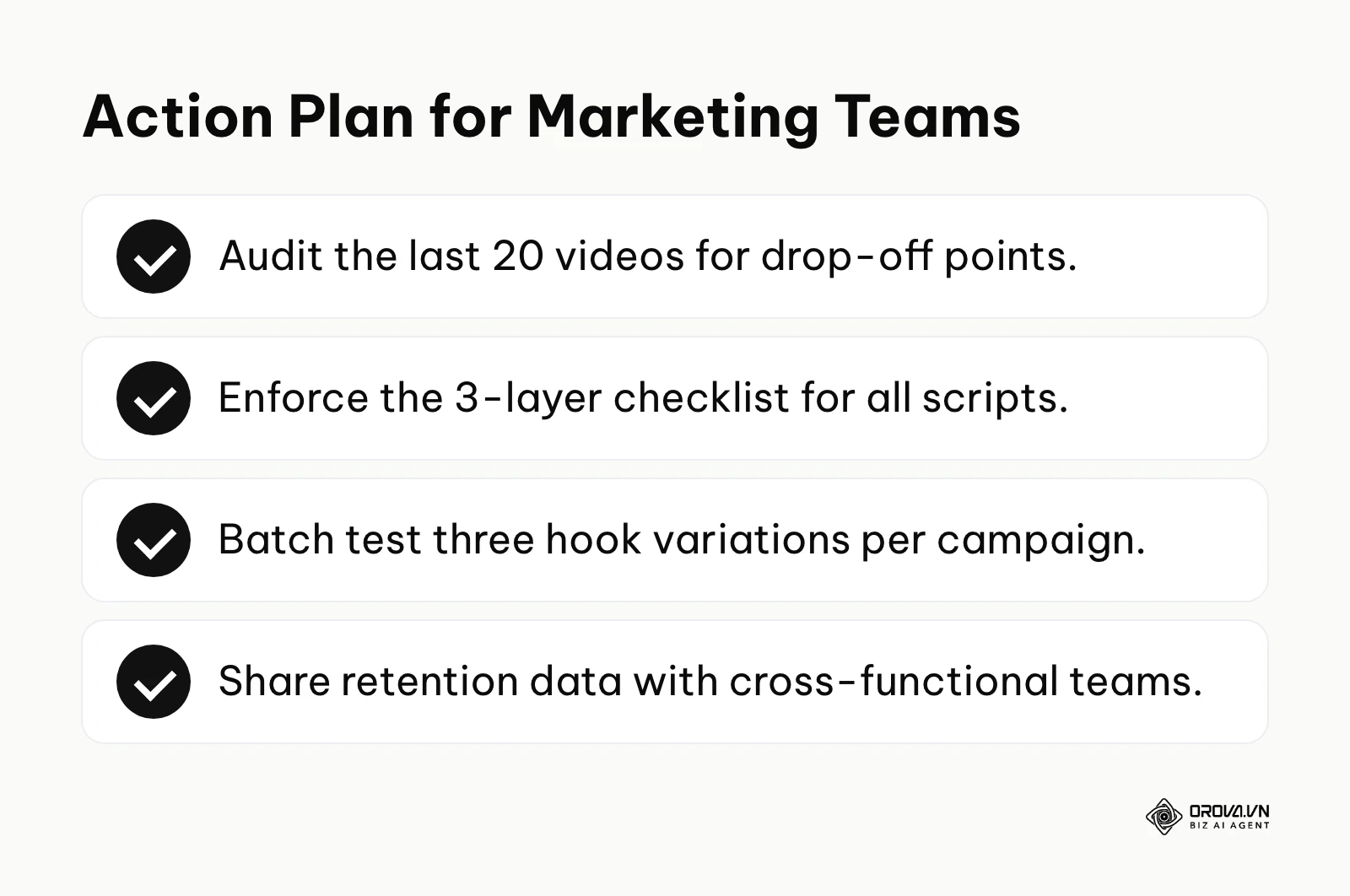
- Audit existing content deeply: Review the last twenty videos your brand published. Identify the exact second where the largest audience drop-off consistently occurs across the board.
- Implement the 3-Layer Checklist: Require all future video scripts to explicitly state the visual action, the spoken word, and the text overlay for the first three seconds before any director approves the shoot.
- Batch test variations at scale: For every major marketing campaign, mandate that the production team films three alternative hooks for the primary hero video while the studio lights are still set up.
- Share findings cross-functionally: Present the retention data clearly to the sales and product teams to show them which messaging angles and pain points capture the most market attention.
For Agencies and Freelancers
Agencies must prove ROI constantly and manage client expectations regarding viral success versus qualified lead generation.
- Establish a strict testing protocol: Educate your clients heavily on the absolute necessity of A/B testing before filming begins. Set firm expectations that some hooks will fail, and that failure is highly valuable data.
- Create a proprietary hook library: Build a massive internal database of winning formulas categorized precisely by industry (e.g., healthcare, tech, retail) to dramatically speed up the scripting phase for new accounts.
- Decouple hooks from body content: Edit the final videos so that the hook is a separate, modular file. This allows you to easily swap in a new hook if the original underperforms, without re-editing the entire timeline.
- Integrate with advanced paid strategies: Use the highest-retaining organic videos as the foundational creative for AI-assisted ad campaigns, so the client's budget goes behind openers that have already proven they hold attention. Campaign structure, tracking and scaling on the paid side are covered in our advanced TikTok ads guide.
| Common Mistake | Consequence | How to Avoid It |
|---|---|---|
| Using generic templates blindly | Videos sound robotic and completely fail to connect with a specific niche audience. | Adapt frameworks by inserting highly specific industry terminology and real pain points. |
| Ignoring the visual layer | Viewers scroll past before hearing the voice because the static frame looks boring. | Plan a specific physical movement (pointing, walking, showing a prop) for the very first frame. |
| Taking too long to transition | Viewers feel deceived by a good hook and drop off rapidly at the five-second mark. | Immediately start delivering the value or context right after the opening sentence ends. |
Want to scale your budget but afraid of breaking performance? 📉
Integrate OROVA ADS now - an AI Agent that automatically monitors and optimizes Google, Meta, TikTok ads 24/7. Now, expanding and replicating your Performance Ads team is just one click away.
🚀 Try it now at: orova.vn/ads
Future Trends of TikTok Hooks: My Perspective
As user behavior evolves rapidly and platform algorithms become significantly more sophisticated, the core mechanics of capturing attention will shift in major ways. Based on current platform developments leading into 2026, I foresee three major transformations in how we must approach the initial seconds of video content.
Hyper-Personalization Over Mass Appeal
I believe the era of the "one-size-fits-all" viral hook is rapidly ending. Currently, creators try to cast the widest net possible to gather millions of views. However, I expect algorithms to keep segmenting audiences more sharply, to the point where a hook designed for everyone may end up appealing to no one in particular. We will need to write hooks that intentionally and aggressively alienate the wrong audience in order to deeply engage the right one. For example, instead of saying, "Here is a great marketing tip," you will need to say, "If you manage a marketing team of five people and struggle with software adoption, listen closely." You should prepare for this shift by defining your micro-audience segments with extreme precision today, rather than chasing generic views.
AI-Generated Hook Iterations
We are already seeing the integration of generative technology in creative workflows. I strongly suspect that AI will not just assist in writing text scripts, but will dynamically generate visual and auditory hook variations entirely on the fly. An AI agent could test many digitally altered hooks (modifying the speaker's tone of voice, translating the text overlay, or changing the background colors) to find the version that holds attention best. Your focus as a marketer must shift away from writing the perfect single sentence, and toward setting the correct strategic parameters and guardrails for AI to test safely.
The Rise of the "Anti-Hook"
As mainstream audiences become heavily fatigued by aggressive, loud, and overly edited introductions, a quiet counter-culture is emerging. I am leaning toward the idea that the "anti-hook" could become a strong option for premium B2B brands. This approach involves starting a video with quiet confidence, a calm, static setting, and an immediate, thoughtful statement, directly contrasting the chaotic, noisy energy of the typical social feed. To prepare for this, you must cultivate deep, undeniable expertise so that your content holds attention through sheer, undeniable value, rather than relying solely on cheap psychological tricks. This approach demands a much higher quality of substance behind the camera.
Frequently Asked Questions About TikTok hooks
How long should a hook ideally be?
While the industry constantly refers to the "first three seconds," the decision to swipe is often made before the first sentence is even finished. Your visual disruption must happen instantly on frame one, and the core promise of your sentence should be completely clear before the clock hits three seconds. Anything longer risks a massive drop in retention.
Can I use trending audio as my only hook?
Using a trending sound can sometimes help with algorithmic categorization, but it should rarely, if ever, be your only hook. If the user does not understand exactly why they are watching the video visually or contextually, the background music alone will absolutely not keep them there. Trending audio should always act as a subtle supporting layer to a strong visual and text-based opening.
Are TikTok hooks still needed with AI?
Yes, absolutely. While AI can help you generate hundreds of ideas or even automate the tedious editing process, the fundamental human psychology of attention remains completely unchanged. AI tools might help you write a script faster, but you still need a strategic, compelling hook to stop a human user from scrolling. In fact, as AI floods the platforms with more average content, a deeply resonant, human-centric hook becomes your most critical competitive advantage.
Why does my retention graph drop to zero immediately?
If your retention curve looks like a sheer cliff diving to near zero within two seconds, it usually points to a severe technical flaw rather than a script issue. You might have terribly low-quality audio, terrible lighting, a confusing text overlay, or a long period of dead silence before you start speaking. Review the visual and audio layers carefully to ensure everything is synchronized.
Do text-based hooks work better than spoken hooks?
They do not replace each other; they must work together. Many people watch videos on mute, for example during a commute. For these viewers, the text overlay is the only hook they experience. If you only speak the hook without supporting on-screen text, muted viewers get no reason to stay.
How many variations should I test for one video?
For major hero content pieces, testing three distinct variations is the ideal balance between gathering enough data and maintaining production efficiency. Test one aggressive hook, one curiosity-based hook, and one direct-value hook to see which angle your specific audience prefers.
Where to Start?
Knowing the deep theory behind retention data is entirely useless without immediate, focused execution. Depending on your current situation and resources, you should not try to fix everything at once. Identify your current state below and take only the single, specific first step recommended. This focused approach prevents overwhelm and builds momentum quickly.
- If you have not started tracking data yet (No tracking): Your first step is to open the platform analytics on your desktop computer and locate the precise retention graph for your last five published videos. Do not write any new scripts today. Do not film anything new. Simply spend one afternoon writing down the exact second where the largest percentage of viewers left each video. You cannot possibly improve your creative approach until you establish this objective baseline metric.
- If you have ideas but lack a system (Scattered): Your first step is to build a basic Google Sheet to meticulously track your upcoming tests. Create clear columns labeled "Hook Concept," "Visual Action," "Spoken Text," and "3-Second Retention Result." For your very next video, force yourself to write three completely different variations in this sheet before you are allowed to turn on the camera. This constraint forces you to separate the ideation phase from the production phase, ensuring higher quality concepts.
- If you are paralyzed by generic advice (Nothing): Your first step is to invite one current, happy client or customer to a brief fifteen-minute interview. Ask them what specific, painful problem kept them awake at night before they found your product. Write down their exact phrasing word for word. Your very first hook will simply be repeating their exact words back to the camera, utilizing the "Specific Symptom" framework. Stop looking at what massive entertainment creators are doing and focus entirely on the language of your actual buyers.
The algorithms will constantly change and visual trends will eventually fade, but mastering human attention through strong TikTok hooks will remain your most valuable marketing asset.
About the author

Builder of Orova
Nguyễn Đỗ Trọng Ân has 8 years of experience in marketing, including 6 years managing market development across Asia. He builds Orova, a Biz AI Agent that never sleeps: it plans, runs and optimizes work for businesses.
Run your business with AI Agents
Orova is the always-on Biz AI Agent — it plans, runs, and optimizes the work for you.
Save time, unlock productivity.