
What are user generated content ads? A practical playbook for small businesses

You are scrolling through your social media feed, passively absorbing content, when suddenly a highly polished, celebrity-endorsed commercial disrupts your experience. Your immediate reaction is likely to skip it. This is the exact situation modern brands face: consumers are entirely numb to traditional, studio-quality advertising. The old approach of throwing a massive budget at a pristine production simply does not yield the clicks it used to, leaving businesses frustrated with climbing acquisition costs.
This is where user generated content ads completely flip the script. Instead of shouting at your audience with a corporate megaphone, you leverage the voices of real people who look and sound just like your target customers. This guide will dismantle the theory and give you the exact, actionable playbook you need. You will discover the practical script frameworks, the precise tracking methods, and the legal templates required to turn casual smartphone videos into your most profitable revenue engine.
What are user generated content ads?
User generated content ads are paid advertising campaigns that utilize authentic videos, photos, or reviews created by everyday customers rather than professional agencies. They are designed to blend organically into social media feeds, reducing ad fatigue, building immediate trust, and driving higher conversion rates compared to highly polished corporate commercials.
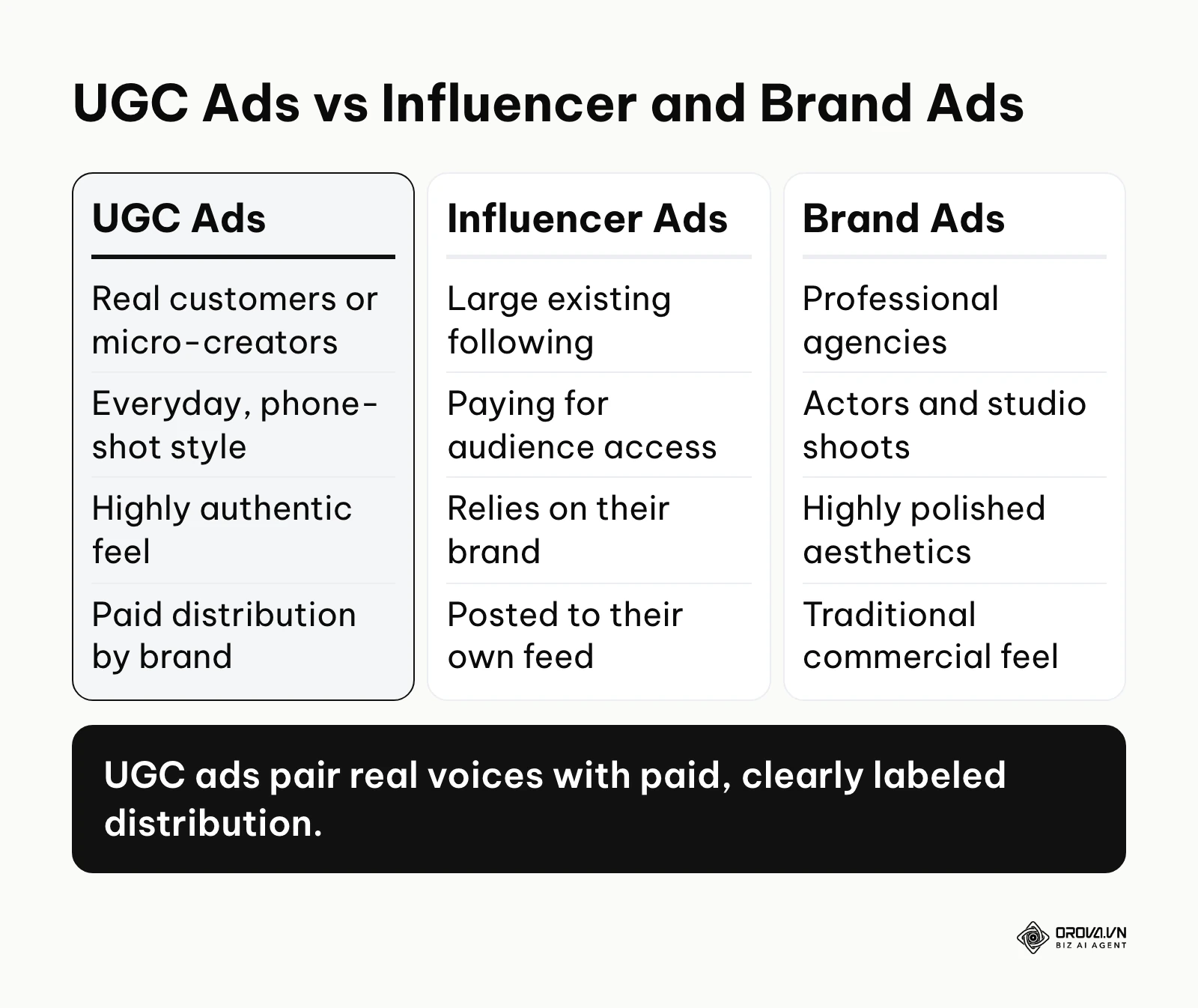
The origin of this concept stems directly from organic word-of-mouth marketing. Before the internet, a genuine recommendation from a neighbor was the absolute strongest driver of sales. As digital platforms evolved and algorithmic feeds took over, marketers realized they could take that raw, unfiltered endorsement, put paid media budget behind it, and distribute it to millions of targeted users. This evolution shifted the power dynamic entirely from the brand dictating the narrative to the consumer validating the product.
However, because the digital landscape is crowded, it is incredibly easy to confuse this specific strategy with other loosely related marketing concepts. You must understand the distinct boundaries to execute it properly.
| Concept | How it differs fundamentally | Real-world example |
|---|---|---|
| User Generated Content Ads | Paid distribution of content made by real customers or micro-creators filming in an everyday, phone-shot style. | A sponsored TikTok video of a mom showing how she cleans her couch with your product. |
| Influencer Marketing | Paying a personality for access to their existing, large organic following and established brand. | Paying a famous celebrity to post your new skincare product to their 5 million Instagram followers. |
| Traditional Brand Ads | Highly produced, studio-quality content created by professional advertising agencies with actors. | A television commercial featuring perfect lighting, a written script, and a professional voiceover. |
To picture this clearly, imagine a real-life example: You are browsing your morning feed and see a video of a woman sitting in her car, holding a coffee cup, talking directly to the camera about a new drive-thru she just found. It feels like a video call with a friend, and it still carries the platform's "Sponsored" label, because it is a paid ad. That native feel, clearly labeled, is the core mechanism of this approach.
The Meaning Behind the Strategy
This strategy exists fundamentally to solve the critical problem of ad blindness and escalating customer acquisition costs for businesses of all sizes. Today’s consumers possess a highly tuned radar for being sold to; they instantly recognize the artificial lighting, the forced pacing, and the unnatural tone of a traditional commercial. When a brand speaks highly about itself, consumer skepticism is automatically high. The underlying meaning of this shift is that raw authenticity has become the primary currency of trust. The strategy sits exactly at the intersection of organic social proof and highly targeted paid distribution, acting as the ultimate bridge between awareness and conversion.
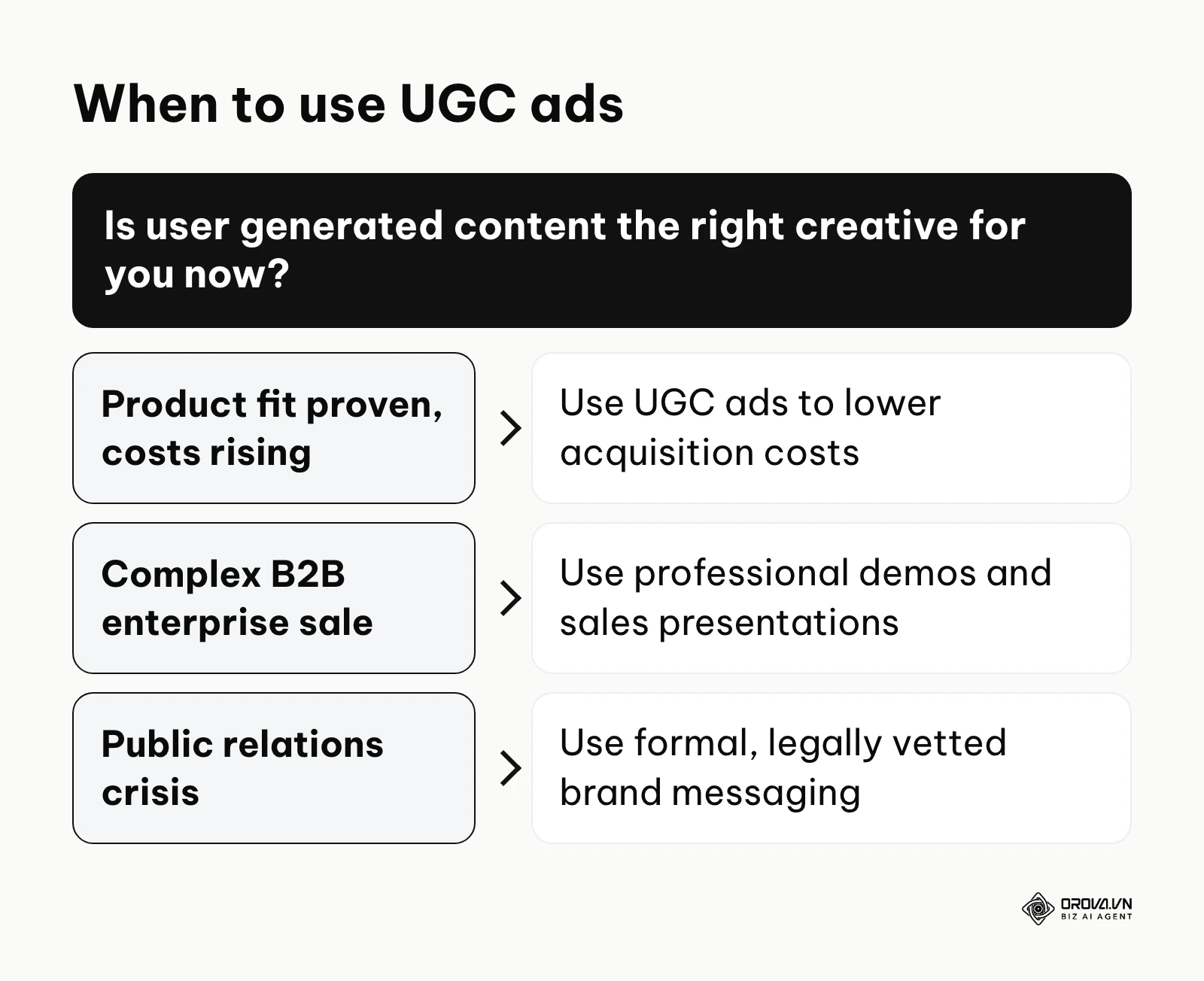
In the broader picture of your marketing funnel, this tactic comes right after you have validated your product-market fit but before you attempt to scale to mass-market television buys. It is a core component of modern lead generation content marketing because it significantly lowers the barrier to entry for prospect trust. If you skip this approach, you risk burning through your entire media budget on creatives that look too much like ads, resulting in remarkably low click-through rates and unsustainably high costs per acquisition. You are essentially paying a massive premium to interrupt people, rather than paying a fraction of that cost to join their conversation naturally.
When you don't need user generated content ads: If you are launching a highly technical B2B enterprise software that requires complex demonstrations to Chief Information Officers, relying on shaky smartphone videos from casual users will damage your credibility. Similarly, during a severe public relations crisis where you need to issue a formal, legally vetted corporate apology, using casual creator content is entirely inappropriate. In these cases, professionally produced, highly controlled brand messaging or direct sales presentations are the only viable alternatives to maintain authority and clarity.
The Business and Operational Value
Deploying user generated content ads provides value on two distinct levels: it dramatically improves the financial health of the business, and it radically simplifies the daily operations for the people doing the work. Understanding both layers is crucial for securing budget and team buy-in.
Value for the Business: Financial Efficiency and Risk Mitigation
For the business owner or executive team, the primary value is financial efficiency. Traditional ad creatives require massive upfront investment before you even know if the market cares about the message. You might spend ten thousand dollars on a studio shoot only to find out the hook does not resonate. By shifting to a decentralized creator model, you drastically lower the cost of creative production. This allows you to test dozens of different hooks, angles, and value propositions for the exact same price as one traditional commercial. Furthermore, when real customers carry the message, viewers tend to trust it more, which can make each ad dollar go further. You are fundamentally mitigating the financial risk of creative failure.
Value for the Direct Worker: Speed and Creative Freedom
For the in-house marketer, agency media buyer, or social media manager, the value is operational velocity. Your biggest bottleneck is usually waiting for graphic designers or video editors to deliver polished assets. By utilizing external creators, you build a massive, parallel creative pipeline. You no longer have to stress over perfect lighting or flawless transitions. The "rough" look is actually the goal. This frees up your schedule to focus entirely on analyzing data, adjusting bids, and optimizing the funnel, rather than agonizing over video production logistics.
To visualize how you measure these benefits, look at the precise metrics you should track:
| Benefit | Measured by which metric | Time to see results |
|---|---|---|
| Reduced Creative Bottlenecks | Number of new creatives launched per week | Immediate (Week 1) |
| Increased Initial Engagement | Hook Rate (3-second views) | 3 to 7 Days |
| Lower Acquisition Costs | Cost Per Acquisition (CPA) | 14 to 30 Days |
| Improved Overall Profitability | Return on Ad Spend (ROAS) | 30 to 60 Days |
OROVA ADS applies AI Agent to automate and optimize ad performance on Google, Meta and TikTok. Scale your budget safely, monitor 24/7 and expand your business quickly.
Experience the solution at orova.vn/ads
How It Works: The Complete SMB Playbook
This is the most critical phase. Understanding the theory is useless without a rigorous execution plan. The anatomy of a successful campaign involves five distinct stages: sourcing the right talent, securing air-tight legal permissions, writing scripts that actually convert, setting up robust tracking, and finally launching the ads. We will dissect each component thoroughly.
How It Works: Sourcing and Hiring Creators on a Budget
The biggest misconception is that you need expensive influencers to make this work. You do not want influencers; you want content creators. Influencers charge a massive premium for access to their audience. Content creators charge a small fee simply for their time and video production skills.
To find them cheaply, avoid major agency platforms initially. Instead, search TikTok and Instagram for micro-creators using hashtags related to your niche (e.g., #skincareroutine, #homeoffice setup). Look for people who have fewer than 5,000 followers but produce clear, well-lit, and energetic videos. Reach out via direct message. Only work with creators who will actually use the product before filming. Offer a free product and a modest flat fee for the content; agree the fee in advance and keep it the same whether or not the creator likes the product. Do not ask them to post it on their own feed; clarify that you are buying the raw video file to use in your own paid campaigns. This drastically lowers the price because the creator does not have to worry about alienating their own small audience with a sponsored post. The video will still run from your account as a labeled ad.
Illustrative example: Context: A regional fitness equipment retailer needed fresh video content to promote a new line of products but lacked the budget for massive agency shoots or celebrity endorsements. Steps taken: First, they searched local Instagram hashtags for fitness micro-creators who posted daily workout clips. Second, they sent direct messages offering a free set of heavy resistance bands in exchange for a raw, 30-second video demonstrating a home workout. Third, they provided a basic bullet-point list of product benefits to guide the narrative rather than forcing a rigid, unnatural script. Friction and solution: Initially, the creators submitted videos with terrible audio quality due to loud gym background noise; the retailer quickly resolved this by shipping an inexpensive lavalier microphone alongside the product to all subsequent creators to ensure crisp audio. Visible result: The resulting campaigns drove a noticeable surge in physical foot traffic, with customers explicitly walking into the store and showing the exact user videos on their smartphone screens to the clerks when asking for the bands.
How It Works: Legal & Permissions Swipe File
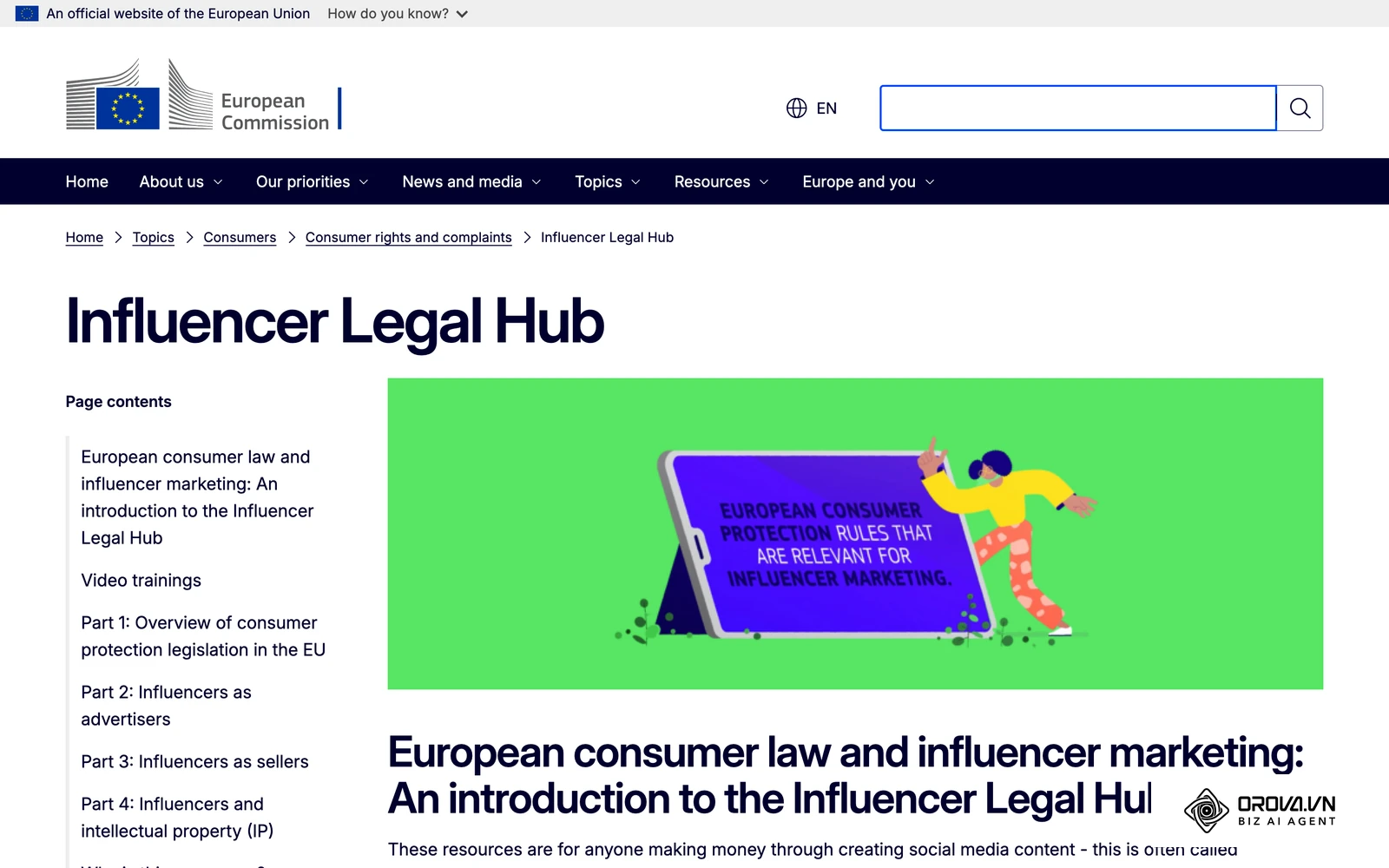
You cannot simply download a video from the internet and run it as an ad. Doing so exposes your business to massive copyright infringement liabilities. You must secure explicit commercial usage rights. The same applies when a customer has already posted about your product: ask for written permission before you reuse that post in an ad, and never edit it to say something they did not say. For small creators, a simple written agreement via email or direct message is often enough; for larger deals or specific legal questions, check the rules in your country with a lawyer.
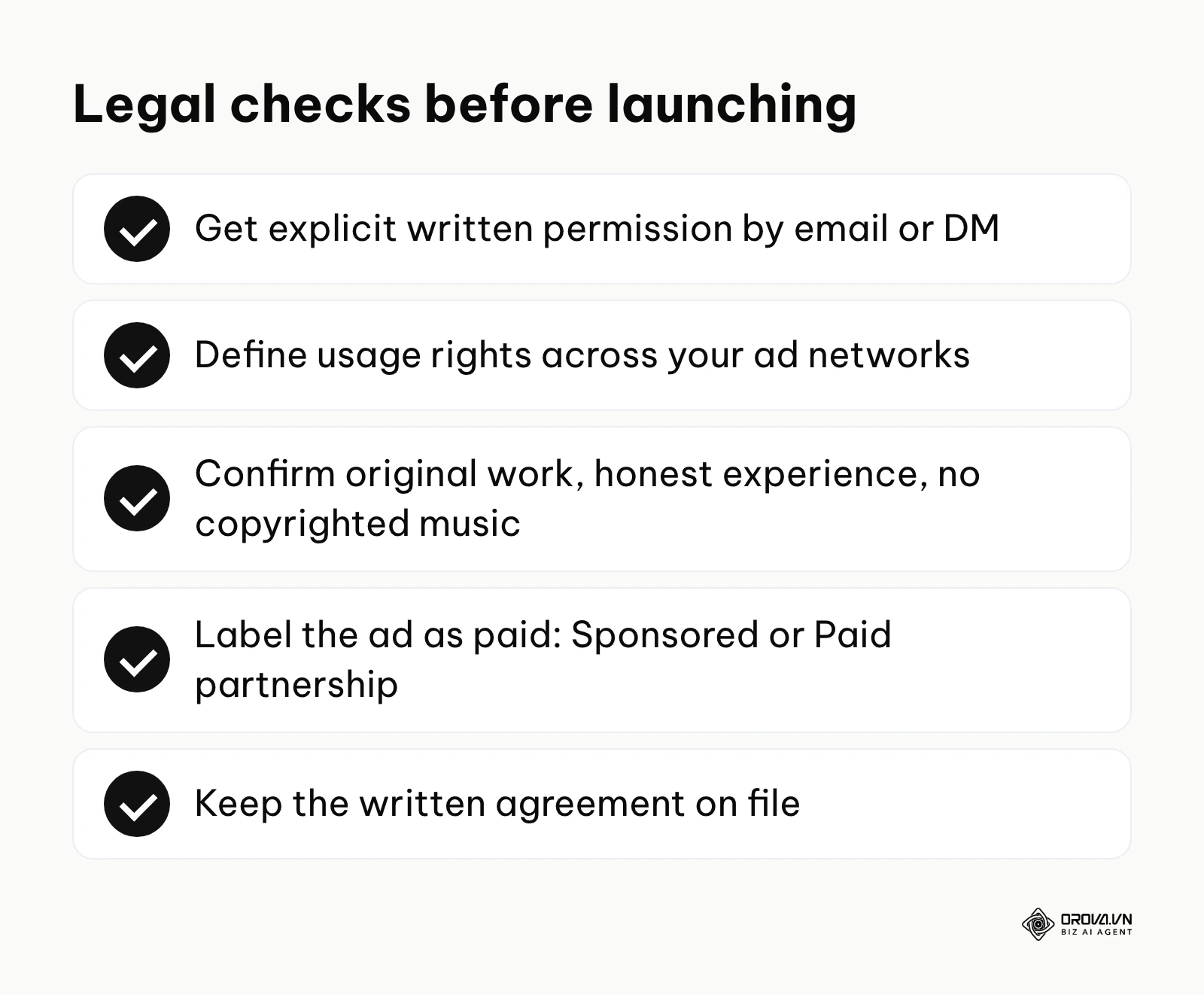
Here is a straightforward, non-intimidating swipe file template you can copy and paste into your emails. It clearly outlines the boundaries in plain language instead of a 10-page contract.
The SMB Creator Rights Agreement Template: Subject: Video Collaboration with [Your Brand Name] Hi [Creator Name], We absolutely love the style of your recent videos! We would love to pay you to create a video about [Product] for us to use in our marketing campaigns. If we move forward, by accepting the payment of [Amount/Product], you agree to the following simple terms: 1. Usage Rights: You grant [Company Name] a perpetual, worldwide, royalty-free license to use, edit, and distribute the video across our paid advertising channels (Facebook, Instagram, TikTok, YouTube). 2. Ownership: You keep the copyright in the original video; we are simply licensing the commercial right to run this specific video as an ad. 3. Originality: You confirm that this is your original work, reflects your honest experience with the product, and does not include any copyrighted music or third-party intellectual property. 4. Disclosure: We will run the video as a clearly labeled ad (for example "Sponsored" or "Paid partnership"), and you will not describe it as unpaid. If this sounds fair, please reply "I agree" and we will send the product and payment details!
By securing this "I agree" response in writing, you establish a clear paper trail that helps protect your ad accounts from intellectual property disputes.
How It Works: Scripting for Conversion: 5 Fill-in-the-Blank Frameworks
The biggest mistake businesses make is letting creators talk aimlessly. While you want authenticity, a direct response ad still requires a psychological structure to generate sales. You must provide the creator with a "Script Framework." This is not a word-for-word script, but a structured path they must follow in their own words.
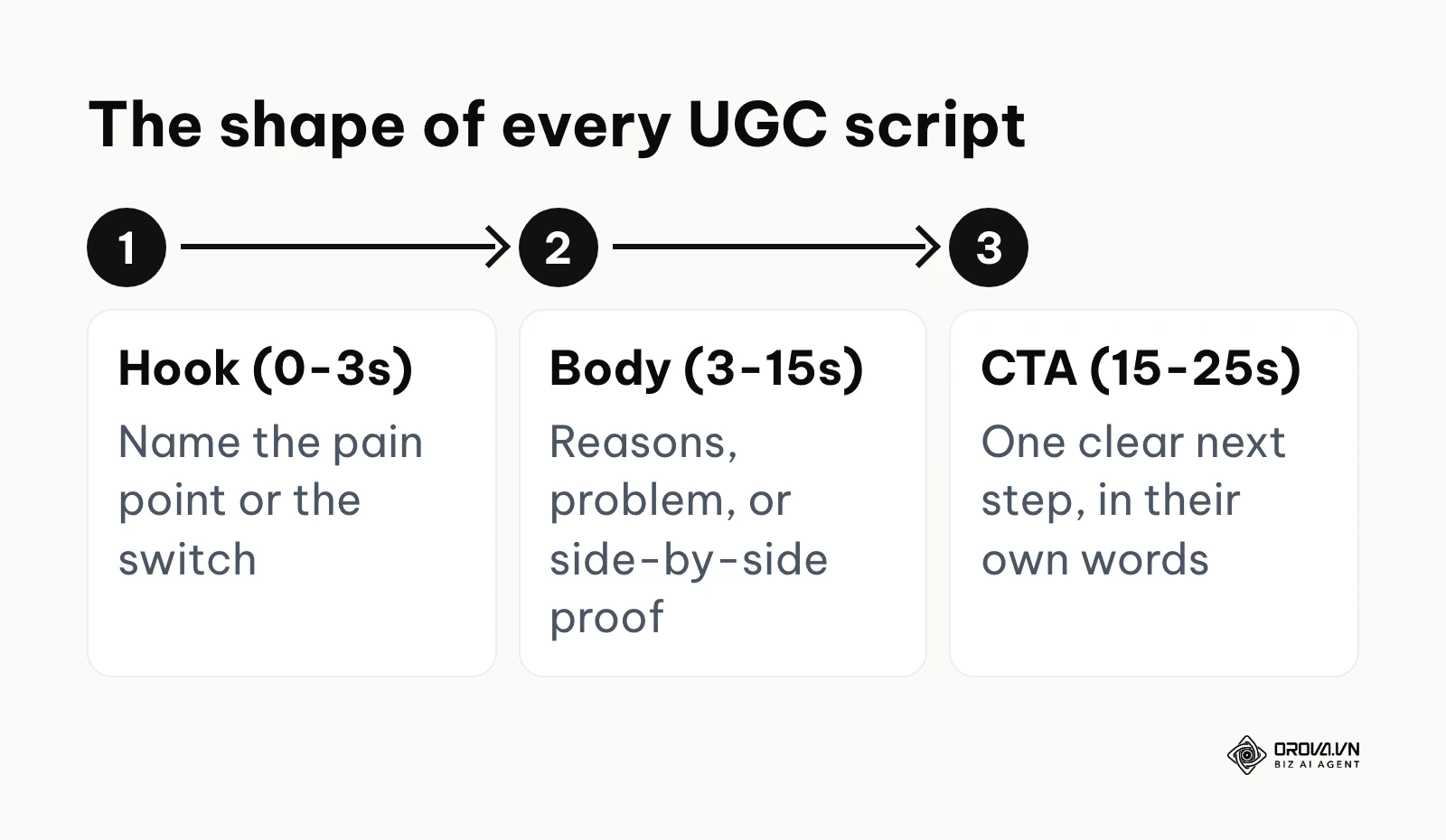
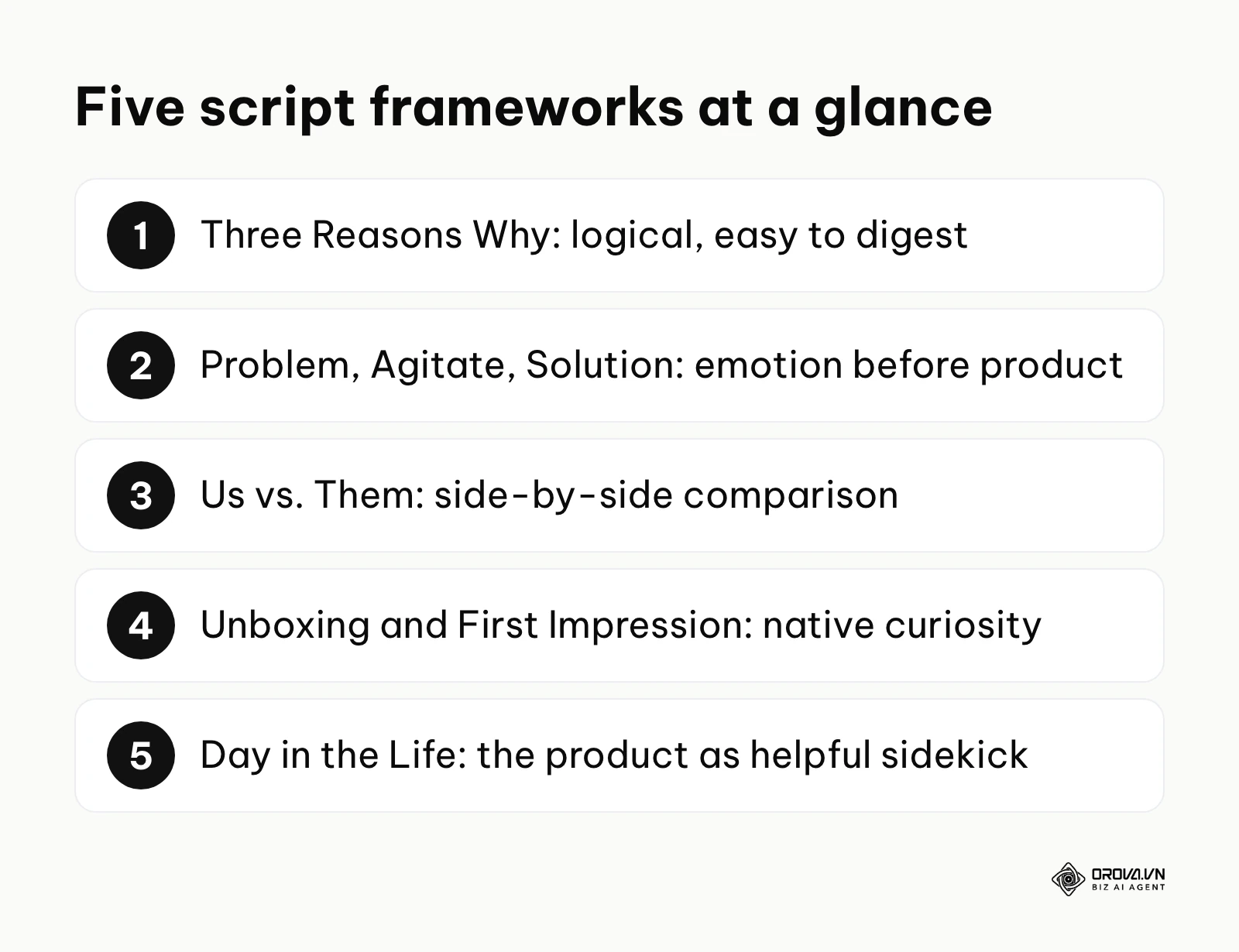
Here are five frameworks, complete with fill-in-the-blank structures, that you can deploy immediately. One rule applies to all of them: the creator must have actually used the product, and every claim must match their real experience. Never hand a creator a testimonial to recite about results they have not had, and never pay for reviews on the condition that they are positive.
Framework 1: The "Three Reasons Why" This structure works because it is highly logical and easy to digest. It quickly establishes a premise and backs it up with rapid-fire points.
- The Hook (0-3s): "Here are the top 3 reasons why I finally switched my [Old Product/Habit] to [Your Product]."
- The Body (3-15s): "Reason number one: [State the biggest pain point your product solves]. Reason number two: [State a unique feature]. And reason number three: [State a surprising benefit or price advantage]."
- The CTA (15-20s): "If you are struggling with [Pain Point], you need to try this. Click the link to get yours."
Framework 2: Problem, Agitate, Solution (PAS) This is a classic copywriting formula adapted for video. It builds emotional resonance before presenting the product.
- The Hook (0-3s): "If you are constantly dealing with [Major Pain Point], stop scrolling."
- The Agitation (3-10s): "I used to deal with [Symptom of the pain] every single day. I tried [Competitor Solution] and it completely failed because [Reason it failed]."
- The Solution (10-20s): "Then I found [Your Product]. It completely changed the game because [Core Mechanism]. Look at how easy this is to use."
- The CTA (20-25s): "Don't suffer through [Pain Point] anymore. Grab it right now."
Framework 3: The "Us vs. Them" Comparison Visual comparisons are incredibly powerful on algorithmic feeds because they require very little mental effort from the viewer to understand the value proposition.
- The Hook (0-3s): "Stop using [Traditional/Old Method]. Do this instead."
- The Body (3-15s): (Visually show the product side-by-side if possible). "With the old way, you have to deal with [Negative aspect]. But with [Your Product], you simply [Positive action], and it takes half the time."
- The CTA (15-20s): "Make the switch today. Click below to see the difference yourself."
Framework 4: The Authentic Unboxing and First Impression This leverages the natural human curiosity of opening a package. It feels highly native to platforms like TikTok.
- The Hook (0-3s): "My package from [Your Brand] finally arrived, let's see if it is actually worth the hype."
- The Body (3-15s): (Creator physically opens the box and shows raw reaction). "Wow, the quality of this [Product Component] is insane. I ordered the [Specific Variant] and it looks exactly like the pictures. Let me try it out right now."
- The CTA (15-20s): "They are running a sale right now, so check the link if you want one." (Only mention a sale or limited stock if it is true.)
Framework 5: The "Day in the Life" Integration This is a softer sell. The product is not the main character; it is the helpful sidekick to the creator's lifestyle.
- The Hook (0-3s): "Come with me on a highly productive morning routine as a [Creator's Profession]."
- The Body (3-20s): (Creator shows making coffee, organizing desk). "The secret to getting all this done is my [Your Product]. Before I start working, I always use it to [Specific Benefit]. It just makes my whole workflow smoother."
- The CTA (20-25s): "If you want to upgrade your daily routine, check out the link below."
Illustrative example: Context: An online language tutoring service with a small marketing team needed to test new ad creatives quickly to lower their soaring lead costs. Steps taken: They asked three current, satisfied students for permission to record and reuse videos of themselves on their webcams talking about their learning experience. They explicitly provided the "Problem, Agitate, Solution" framework to ensure the videos had a logical flow. They then launched these videos as separate ad sets targeting lookalike audiences. Friction and solution: The students kept looking at their computer screens instead of the camera lens, making the videos feel disconnected and unengaging; the team solved this by asking them to stick a brightly colored post-it note right next to the webcam hole to direct their eye contact. Visible result: The new framework-driven videos visibly increased the volume of daily booked trial lessons, filling up the tutors' calendar slots completely by Thursday morning of the launch week.
How It Works: Measuring ROI and Setting Up Tracking
Creating the content is only half the battle. If you cannot mathematically prove that a video is generating profit, you are flying blind. Because user generated content ads often look messy, subjective opinions about "quality" are useless. You must rely entirely on hard data.
If you are running campaigns on Meta, navigating the Facebook Ads Manager is essential to set up your custom columns for tracking. You need to configure your dashboard to show the journey from the first second of the video to the final purchase.
Here are the critical metrics you must track to evaluate your campaign's true ROI:
- Hook Rate: (3-second video plays divided by total impressions). This tells you if the first sentence of your script is actually stopping the scroll. Many media buyers treat a rate under roughly 25% as a sign the hook needs work, regardless of how good the rest of the video is.
- Hold Rate: (ThruPlays or 15-second plays divided by 3-second plays). This tells you if the body of your script is keeping their attention.
- Outbound Click-Through Rate (CTR): (Link clicks divided by impressions). This indicates if your Call to Action was strong enough to make them leave the social platform. Aim for above 1%.
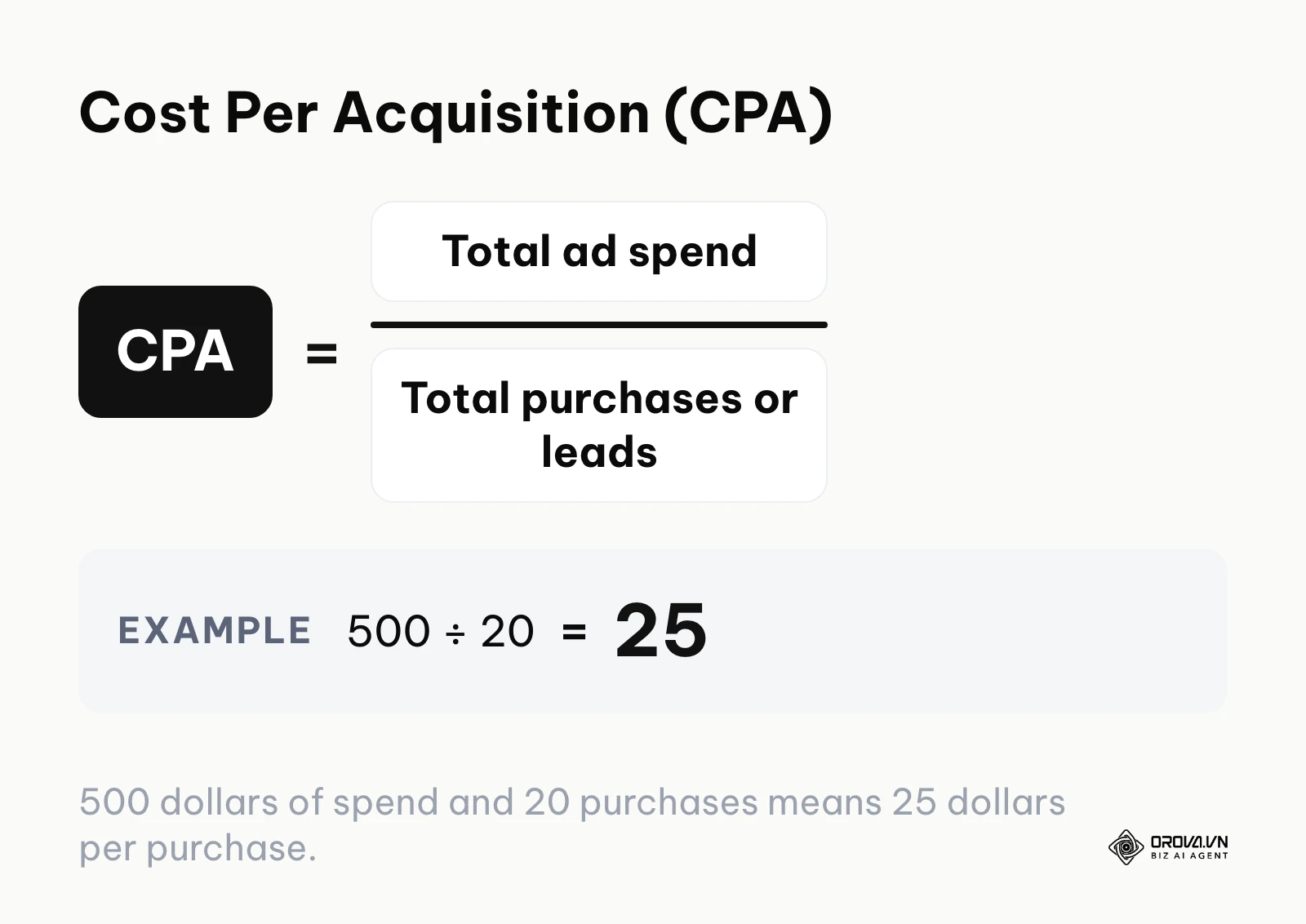
- Cost Per Acquisition (CPA): (Total spend divided by total purchases or leads). This is your ultimate metric for survival. For example, 500 dollars in spend that brings in 20 purchases is a CPA of 25 dollars. If your CPA is lower than your profit per sale, you are making money.
How It Works: Launching and Scaling the Campaign
Once you have the videos and the tracking in place, you must launch strategically. Do not dump your entire budget on day one. Start by placing all your new videos into a single testing campaign with a campaign-level budget (on Meta, Advantage+ campaign budget, formerly called CBO). Let the algorithm determine which video gets the most traction. If you want a more structured approach, follow a clear ad testing framework so you change one variable at a time.
After 48 to 72 hours, the platform will often favor one or two videos. Once your video is a proven winner, and the creator has posted it and given you an authorization code, you might want to boost it directly from the creator's profile using TikTok Spark Ads for maximum authenticity and engagement. Turn off the losing videos immediately to prevent budget bleed. Take the winning video and scale its budget by 15% to 20% every few days. Do not scale aggressively all at once, or you risk resetting the platform's learning phase and ruining your CPA.
Illustrative example: Context: A local home cleaning service run by a solo operator wanted to scale through paid social but struggled with tracking the effectiveness of their sporadic photo posts. Steps taken: The owner asked a loyal client for written permission to film and advertise with a video of their messy kitchen being rapidly cleaned. They set up a dedicated landing page just for this video campaign. They implemented standard event pixel tracking for the final lead form submission to measure the exact Cost Per Acquisition. Friction and solution: Initially, the leads coming in were entirely outside their operational service radius, wasting time on follow-ups; they fixed this by strictly narrowing the location targeting in the ad platform settings to an exact 10-mile radius around their office. Visible result: The heavily tracked campaign generated a steady, predictable flow of qualified inquiries, resulting in three new recognizable company vans being added to the neighborhood routes within two months.
To fully grasp the landscape, here is a breakdown of the various formats you might test during your launch phase:
| Type of UGC Format | Key Characteristics | Best Suited For |
|---|---|---|
| Talking Head Review | Direct eye contact, testimonial style, high trust. | Service businesses, software, high-ticket items. |
| Unboxing / ASMR | Focus on packaging sounds, visual reveals, aesthetic appeal. | E-commerce, cosmetics, tech gadgets, apparel. |
| Product Demonstration | Fast-paced, shows the mechanism, highly visual. | Cleaning supplies, fitness gear, kitchen tools. |
| Voiceover Vlog | B-roll footage of lifestyle with an overlaid narrative track. | Travel, hospitality, lifestyle brands, apps. |
Want to scale your budget but afraid of breaking performance? 📉
Integrate OROVA ADS now - an AI Agent that automatically monitors and optimizes Google, Meta, TikTok ads 24/7. Now, expanding and replicating your Performance Ads team is just one click away.
🚀 Try it now at: orova.vn/ads
Adapting to the Model
Transitioning from traditional graphic banners to a heavy video strategy requires a shift in how you operate daily. Different roles within the organization must adapt to specific new realities. Teams that align their internal operations with creator-led content usually find it easier to keep fresh ads running instead of letting campaigns go stale.
For Small Business Owners
As the owner, you must let go of perfectionism. Your brand does not need to look like Apple.
- Accept that slightly unpolished videos often perform as well as, or better than, expensive studio shoots.
- Allocate a specific monthly budget exclusively for buying creator content, treating it as an operational expense.
- Trust the data over your personal aesthetic preferences; if a "ugly" video generates sales, let it run.
- Focus on the core value proposition of your product rather than the production quality of the ad.
For In-House Marketers and Marketing Managers
Your role shifts from "creator" to "orchestrator" and data analyst.
- Build a robust roster of reliable micro-creators you can tap into monthly.
- Develop standard operating procedures for sending out products and tracking deliverables.
- Master the art of writing concise, clear script frameworks rather than rigid scripts.
- Before you launch, you must thoroughly understand Google Ads pricing and Meta auction dynamics to ensure you aren't overbidding on your newly acquired creatives.
For Freelance Media Buyers and Agencies
Your value proposition to clients must evolve. Simply pushing buttons in the ad manager is no longer enough.
- Offer creative sourcing as a core part of your retainer package to guarantee you have good inputs for your campaigns.
- Educate your clients on the necessity of high creative volume and rapid testing.
- Build automated dashboards to show the direct correlation between new UGC launches and CPA reduction.
If you fail to adapt correctly, you will encounter painful setbacks.
| Common Mistakes | The Consequence | How to Avoid It |
|---|---|---|
| Forcing a rigid script | The video sounds robotic and viewers swipe away immediately. | Provide bullet points and let creators use their natural vocabulary. |
| Ignoring the Hook | You spend money on impressions, but nobody watches past 3 seconds. | Test at least three different hooks for every single video body. |
| Failing to secure rights | Your ad account gets flagged or banned for copyright strikes. | Always use a clear written permission agreement before uploading. |
When you are ready to scale these campaigns, managing testing budgets across multiple networks gets complex quickly. A tool such as Orova Ads lets you manage Google Ads, Meta, and TikTok Ads in one dashboard, send real conversions back through the Conversion API, and review the optimization history of every change.
The Future of User Generated Content Ads: Author's Perspectives
As we move toward a future heavily influenced by automation, the landscape of digital advertising is preparing for a massive shift. Based on the technological leaps I am observing today, here is how I anticipate user generated content ads will evolve over the next few years.
The Merging of AI Hooks and Human Authenticity
Today, we are already seeing AI generate impressive voiceovers and synthetic avatars, but they still lack the nuanced micro-expressions of real humans. I believe a common workflow may become using AI to generate and swap the first three seconds (the hook) of a video, then cutting to a real human creator for the main body and demonstration. AI could test many vocal tones and text overlays far faster than a human team. To prepare for this, marketers must start building vast libraries of modular video clips—recording the hook separately from the product demonstration—so their creative assets are ready to be remixed by AI algorithms automatically.
The Shift from Macro-Influencers to Customer Networks
Currently, brands still chase creators with decent followings. I suspect the line between "UGC creator" and "customer" will blur as more brands invite real buyers to share videos. Platforms may make it easier for a customer to share a clip and grant the brand permission to run it as a labeled ad. You can prepare by adding a polite request to your post-purchase emails: invite your happiest buyers to share an honest video, ask for permission to reuse it in ads, and disclose any thank-you incentive.
Real-Time Dynamic Scripting Driven by Performance Data
Right now, human media buyers analyze a video's failure and write a new script for next week. I lean towards a future where ad platforms will read the real-time drop-off data of a video, identify exactly which word caused the user to scroll away, and instantly generate a corrected script variation for the creator to re-record. The feedback loop could shrink dramatically. Of course, this prediction could be entirely wrong if strict data privacy regulations prevent platforms from analyzing granular user audio retention at scale. Regardless, you must start treating your ad copywriting as a data-driven science rather than pure creative art.
Frequently Asked Questions about user generated content ads
How much budget should I allocate for my first campaign?
For a small business, you do not need a large budget to start. Split a small test budget into two parts: a smaller share to acquire three raw videos from micro-creators, and the larger share to run those videos in a structured test on Meta or TikTok for about a week. That is usually enough data to see which hook resonates.
Are user generated content ads still needed when AI can generate video commercials?
Yes, absolutely. While AI can create stunning visuals and perfect voiceovers, it currently struggles to replicate genuine human messiness—the slight stutter, the messy background, the authentic excitement in a customer's eye. As the internet floods with AI-generated perfection, raw human authenticity will actually become more valuable because it will be the only thing that stands out as credible to a skeptical consumer.
Where is the best place to find cheap, reliable creators?
Avoid premium influencer platforms initially. The most cost-effective method is manual outreach on platforms like Instagram and TikTok. Search for niche hashtags, find creators with a few thousand followers who post high-quality content but lack major sponsorships, and direct message them with a straightforward cash or free-product offer for a single video file.
How do I know if my video ad is actually working?
Do not look at likes or comments; those are vanity metrics. You must look at the Cost Per Acquisition (CPA) inside your ad manager. If you spend 50 dollars on the video ad and it generates two sales that yield 100 dollars in profit each, the ad is highly successful, regardless of how many people liked the post.
Can I run these ads on Google or just social media?
While they feel most native on Meta and TikTok, they work on Google too. If you run Google Performance Max (PMax) campaigns or YouTube Shorts ads, uploading your own vertical, user-style video assets means your ads can show in Shorts placements with real footage instead of relying on videos generated automatically from your images and text.
Where to start?
Knowing the theory is one thing, but execution is where revenue is generated. Do not try to implement everything in this playbook simultaneously. Depending on your current situation, here is the exact next step you should take today to build momentum.
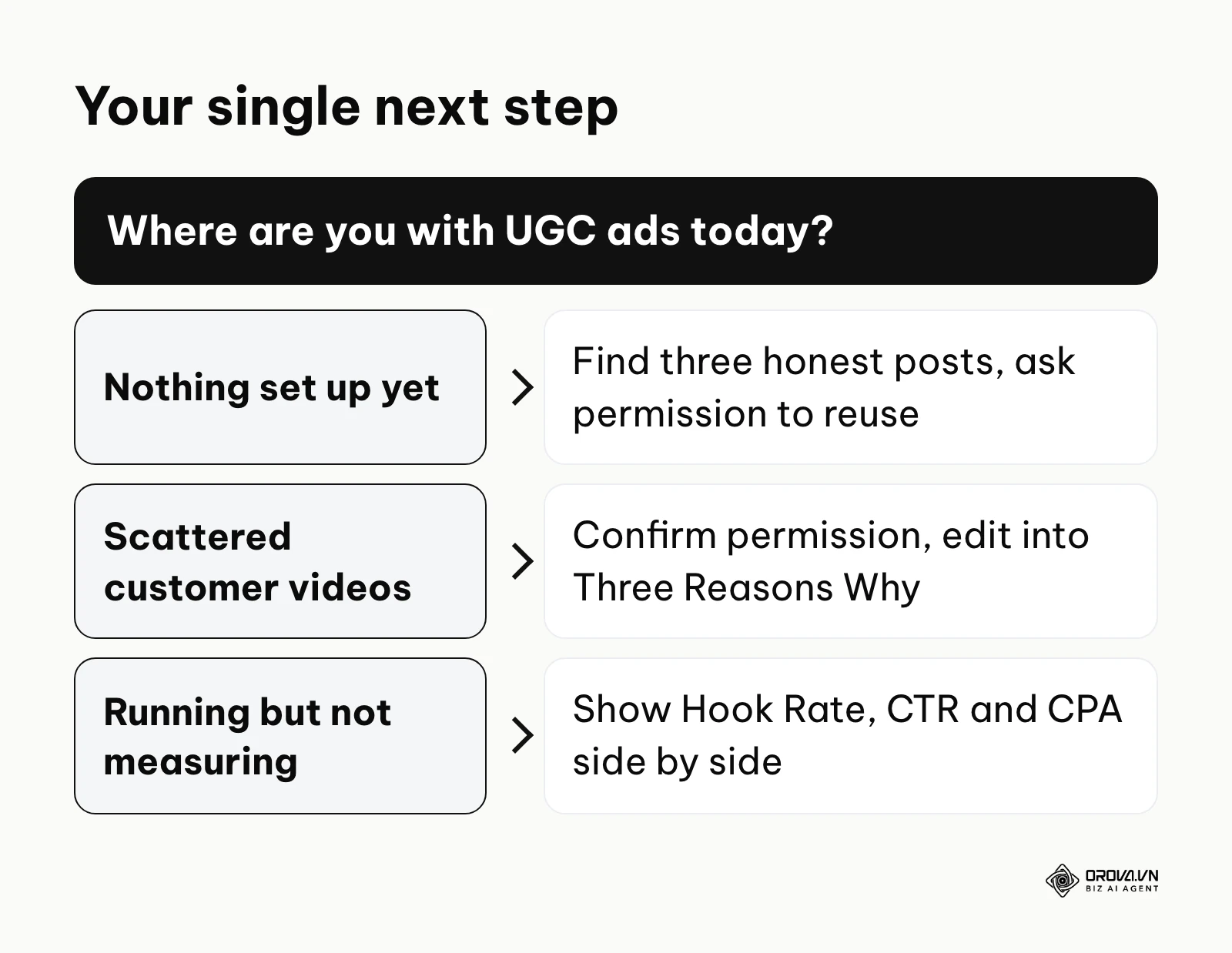
If you have absolutely nothing set up yet: Your single step for today is to open your social media apps and spend 30 minutes searching your brand name, your product name, or your specific niche hashtag. Find three everyday users who have already posted honestly about your product, send them a direct message, and ask for written permission to reuse their post in your ads, offering a fair thank-you fee or free product and labeling the ad as paid. Do not overcomplicate the script; just get the raw assets flowing into your business.
If you already have some scattered video content from customers: Your single step for today is to confirm you have permission to use each clip in ads, gather those raw video files into one folder, then spend an afternoon editing them into the "Three Reasons Why" framework. Use a free mobile editing app to add bold, high-contrast text captions to the first three seconds of every video. This simple formatting tweak can lift your hook rate when you launch them as ads.
If you are already running these video campaigns but are not measuring them properly: Your single step for today is to log into your ad manager and configure your custom reporting columns. Ensure you have Hook Rate (3-second views), CTR (Link Click-Through Rate), and CPA (Cost Per Result) visible side-by-side. You cannot optimize what you cannot clearly see, and fixing your dashboard is a prerequisite to scaling your budget safely.
About the author

Builder of Orova
Nguyễn Đỗ Trọng Ân has 8 years of experience in marketing, including 6 years managing market development across Asia. He builds Orova, a Biz AI Agent that never sleeps: it plans, runs and optimizes work for businesses.
Run your business with AI Agents
Orova is the always-on Biz AI Agent — it plans, runs, and optimizes the work for you.
Save time, unlock productivity.