
What is audience overlap? A 2026 guide for Meta, Google and TikTok

Imagine you have spent hours crafting distinct ad campaigns, yet your cost per acquisition keeps climbing while reach stalls. The hidden cause is often audience overlap: two or more of your ad sets or campaigns can reach the same people at the same time, so they split budget, learning and conversions instead of finding new buyers. Many marketers still treat this as a minor annoyance where a few users see the same ad twice. That view misses how today's ad platforms handle it.
When several of your ad sets are eligible for the same person, Meta's public documentation says it does not let them bid against each other; it enters only one of them, so the others can under-deliver and your tests become hard to read. This comprehensive guide will transform how you approach audience architecture entirely. We will systematically dismantle exactly how this overlap functions across all major platforms, distinguish between harmful internal cannibalization and strategic omnichannel saturation, and provide a rigorous monthly audit framework. By implementing these precise structural strategies, you will stop wasting your advertising budget on self-competition and finally scale your campaigns with predictable efficiency.
What is audience overlap?
Audience overlap is a structural condition where multiple campaigns or ad sets target the same group of users at the same time, so your own ads compete for the same people's attention and budget. It is used to diagnose delivery inefficiencies, and it differs from ad fatigue because it comes from targeting setup rather than worn-out creative assets.
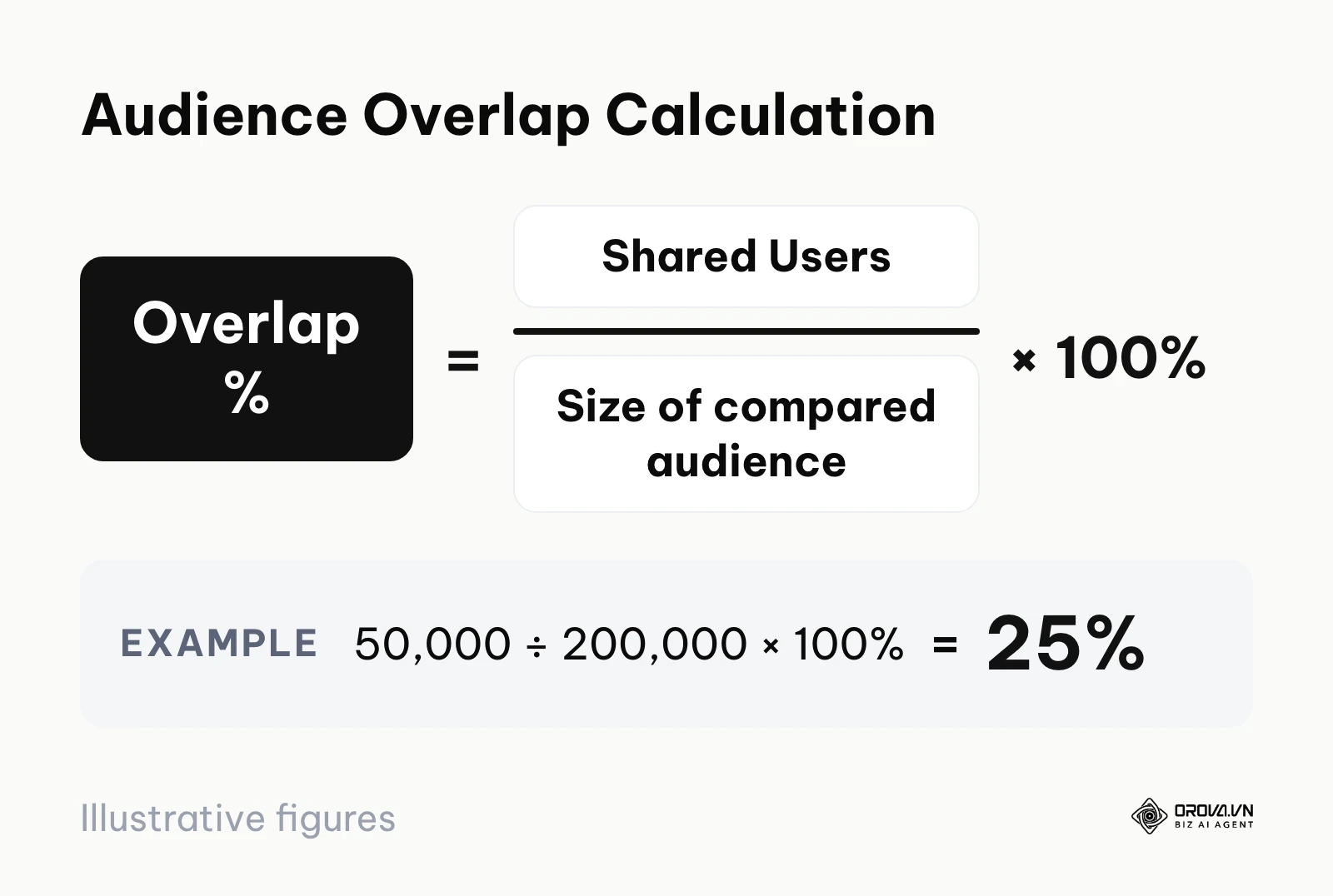
Overlap is usually expressed as a percentage: the number of people two audiences share, divided by the size of the audience you are comparing from. For example, if 50,000 people in a 200,000-person audience also sit in another audience, the overlap for that audience is 25%.
To understand it fully, it helps to separate it from other common advertising issues.
| Concept | How it differs | Example |
|---|---|---|
| Audience Overlap | Occurs when different ad sets target the identical user base simultaneously. | Ad Set A targets "Marketing Managers" and Ad Set B targets "B2B Software Buyers," but both lists contain the exact same 10,000 professionals. |
| Ad Fatigue | Occurs when the target user has seen the exact same creative too many times. | A user sees the same video ad 15 times in one week and stops clicking. |
| Keyword Cannibalization | Occurs specifically in search when multiple campaigns bid on identical search terms. | Campaign A bids on "buy shoes" and Campaign B bids on "buy red shoes," splitting the traffic. |
Consider a real-life example: Imagine you own a local bakery and you hire two different people to hand out flyers on the same street corner at the exact same time. They end up approaching the same pedestrians, wasting paper, confusing the potential customers, and essentially competing with each other for the pedestrians' attention. In digital advertising, the cost shows up as split budgets, ad sets that cannot deliver, and the same people seeing your ads far too often.
Why does audience overlap matter in the digital ecosystem?
Audience overlap exists as a critical diagnostic metric for a common problem: your own ad sets competing for the same people. It addresses the needs of performance marketers, media buyers, and financial controllers who demand absolute efficiency from their advertising spend. In the broader ecosystem of a digital strategy, audience overlap sits right in the middle of the planning phase and the execution phase; it is the vital bridge between defining your ideal customer profile and actually launching your creative assets into the wild.
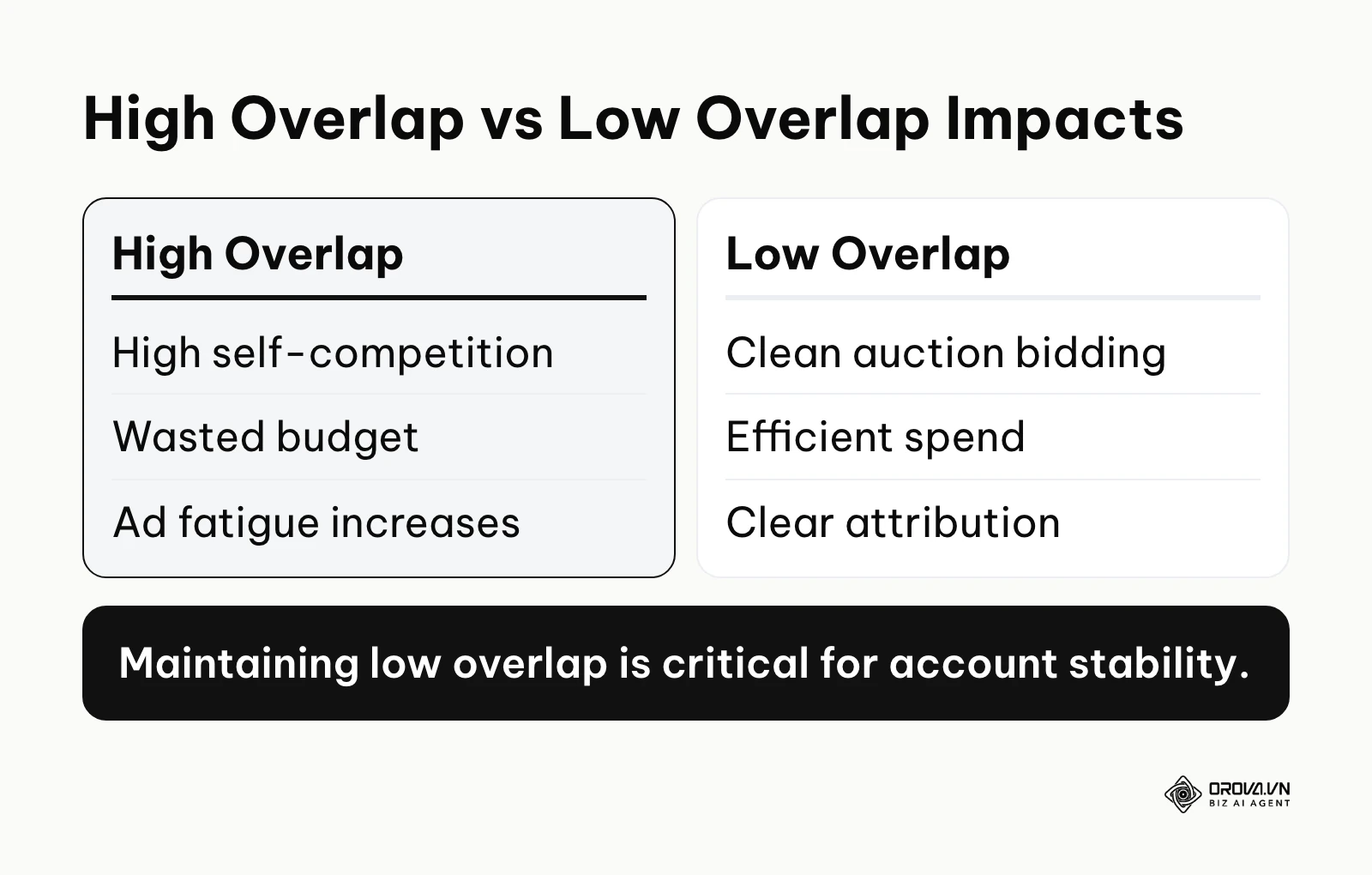
If you ignore it, budget leaks through uneven delivery, higher frequency and wasted impressions. When your ad sets overlap heavily, the platform has to choose which of your ads should enter the auction. Meta's help documentation on auction overlap explains that when ad sets from the same account are eligible for the same auction, it enters only the one with the highest total value, so the other ad sets can under-deliver. This means your budget will not pace correctly, your tests will be fundamentally flawed, and your overall account health will degrade.
However, there are explicit scenarios where targeting the same user multiple times is actually beneficial, commonly referred to as positive overlap. If you are executing a comprehensive omnichannel strategy, showing a broad brand awareness video on TikTok and subsequently delivering a direct response search ad on Google to the identical person effectively builds trust and intent. Additionally, during a massive product launch or a highly constrained Black Friday weekend sale, maximizing your overall impression share becomes vastly more critical than meticulously optimizing frequency caps. In these short-term, high-impact windows, deliberately overlapping your audiences ensures your core message completely dominates their digital feed, and your focus should shift entirely toward aggressive bidding rather than implementing strict exclusions.
The true business value of controlling audience overlap
Controlling and mitigating overlap provides immense value that trickles down through two distinct layers: the overarching business value and the practical benefits for the team executing the daily work. For the business, the value is heavily quantified in saved financial resources, maximized return on investment, and significantly reduced risk of brand dilution. For the practitioners, it eliminates the tedious hours spent troubleshooting stalled ad sets and provides a clear, logical account structure that is easy to manage and scale.
Reducing wasted ad spend and lowering CPA
The most immediate financial impact of controlling this issue is a direct reduction in your Cost Per Acquisition (CPA). By forcing ad sets to operate in isolated environments, you ensure that every dollar is spent reaching new, highly qualified prospects rather than repeatedly pinging a saturated micro-segment.
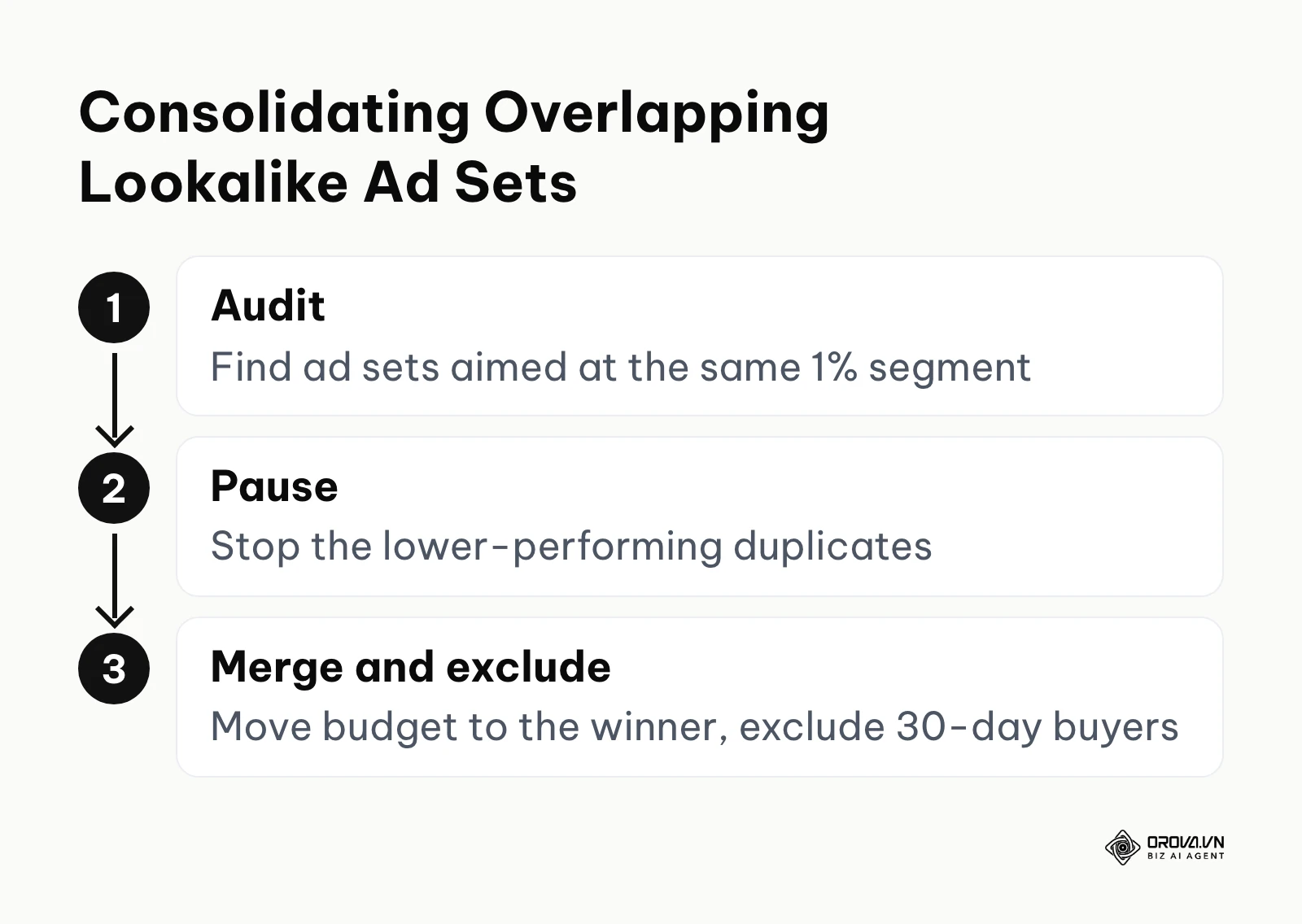
Illustrative example: For a mid-sized e-commerce apparel brand aiming to aggressively scale their daily ad spend without tanking their ROAS, the marketing team took a strict consolidation approach. The execution involved three specific steps: auditing the account to identify five separate lookalike ad sets targeting the exact same 1% demographic segment, pausing the four lower-performing ad sets, and merging all remaining budget into the single historical winner while actively excluding past 30-day purchasers. The main stumble occurred when this massive structural change forced the remaining ad set back into the algorithmic learning phase, causing the cost-per-click to temporarily double for two days before the system finally recalibrated. The visible result was a stabilized advertising dashboard featuring a single ad set that generated a highly consistent stream of daily shipping notifications, completely eliminating the erratic day-to-day delivery swings seen previously.
Preventing ad fatigue and maintaining brand reputation
When overlap is rampant, frequency metrics often spiral out of control because the platform pushes multiple variations of your messaging to the exact same cluster of highly responsive users. This rapidly leads to ad fatigue, where users become completely blind to your branding, or worse, become actively annoyed and hide your advertisements.
Illustrative example: In a rapidly growing B2B SaaS company generating enterprise leads, the core issue was vital prospects frequently complaining about seeing the identical webinar promotion constantly on both LinkedIn and Meta. The operations team meticulously mapped out the targeting structure and discovered that their bottom-of-funnel retargeting audiences were heavily overlapping with their broad top-of-funnel list uploads. They executed three distinct steps: isolating all recent website visitors into a dedicated bottom-funnel conversion campaign, applying strict negative audience exclusions to the top-funnel awareness campaigns, and rotating the creative assets bi-weekly. A major stumbling block was the immediate, severe drop in overall account reach, which was systematically resolved by slightly expanding the geographic targeting parameters to adequately compensate for the excluded users. The final outcome was a significant drop in negative ad comments across platforms and a notably faster pipeline velocity, as sales representatives reported prospects were actively engaging with diverse educational content rather than just one repetitive video.
Gaining accurate attribution and data clarity
Clean audience architecture guarantees that when a conversion occurs, you know exactly which demographic targeting strategy drove that specific action. Without strict boundaries, multiple ad sets will attempt to claim credit for the same conversion, muddying the waters of your marketing data.
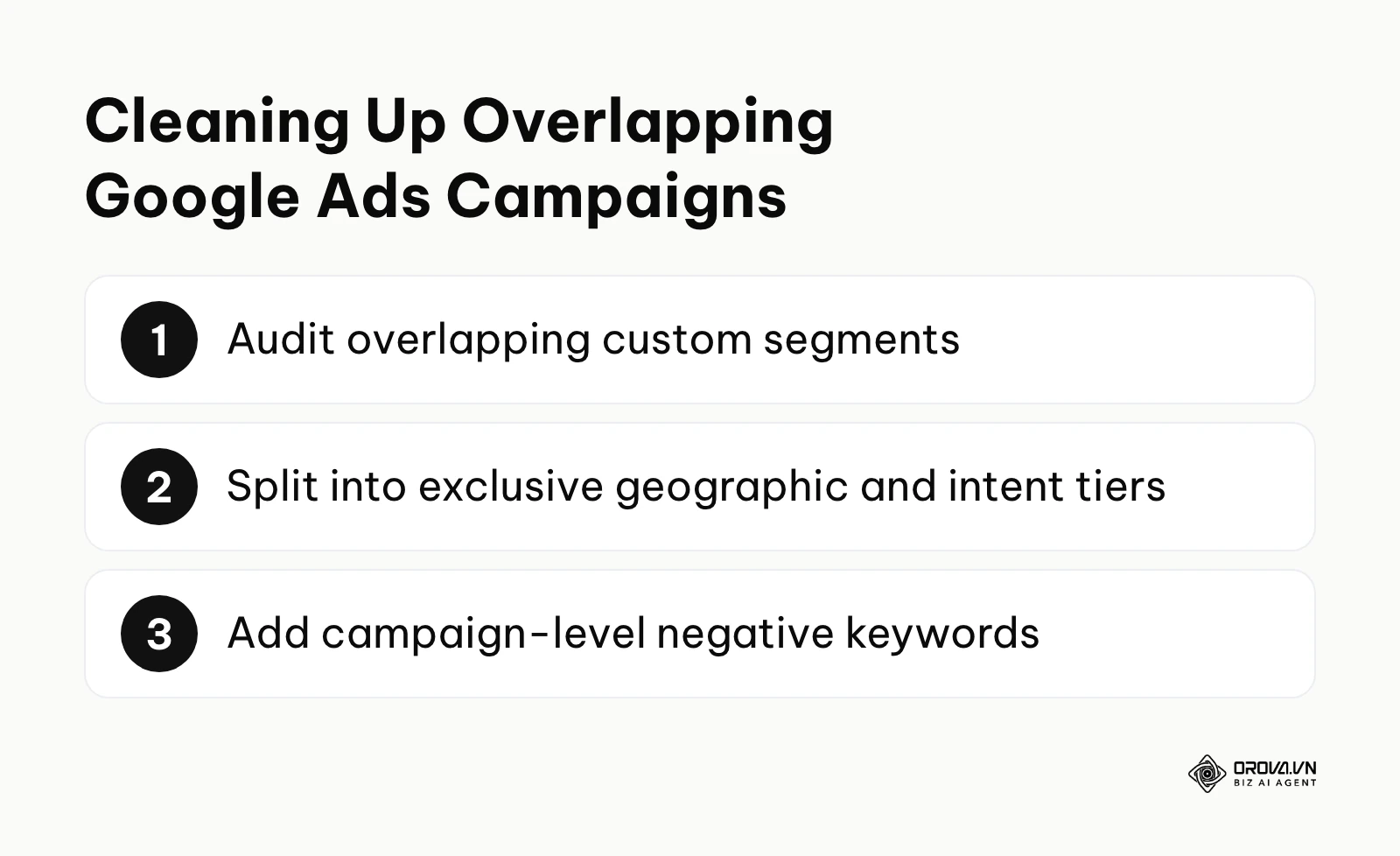
Illustrative example: A regional fitness franchise running simultaneous promotional offers on Google Ads faced chaotic attribution data where the exact same customer sign-ups were being claimed by multiple overlapping search and display campaigns. The execution involved three targeted steps: thoroughly auditing the Google Ads account to uncover heavily overlapping custom segments, restructuring the account into mutually exclusive geographic and intent-based tiers, and applying strict campaign-level negative keywords. The initial hurdle was that the newly restrictive structure caused a temporary dip in total lead volume because the exact match parameters were simply too tight, which was effectively fixed by selectively reintroducing phrase match types coupled with very careful exclusions. The resulting outcome was a perfectly clear, unambiguous analytics report where the marketing manager could easily trace every new gym membership to one specific ad interaction, completely clearing up the previous double-counting mess in their CRM system. You can learn more about structuring data cleanly in our marketing report guide.
| Benefit | Metric to measure | Time to see result |
|---|---|---|
| Fewer ad sets competing for the same people | Spend pacing against daily budget, delivery status | Review once the learning phase has settled |
| Preserving Creative Lifespan | Frequency metric stabilizes | Review weekly |
| Accurate Lead Attribution | Discrepancy between Ad Platform and CRM drops | Review after one full reporting cycle |
OROVA ADS applies AI Agent to automate and optimize ad performance on Google, Meta and TikTok. Scale your budget safely, monitor 24/7 and expand your business quickly.
Experience the solution at orova.vn/ads
How audience overlap works across platforms: The anatomy
To master overlap, you need to understand how different advertising platforms process target audiences. Every time a user opens a digital application, an instantaneous auction occurs. If you have multiple ad sets eligible to serve an ad to that specific user, the system has to intervene. The way it intervenes, however, varies drastically depending on the architectural rules of the specific network.
Meta Ads: The auction overlap and self-competition
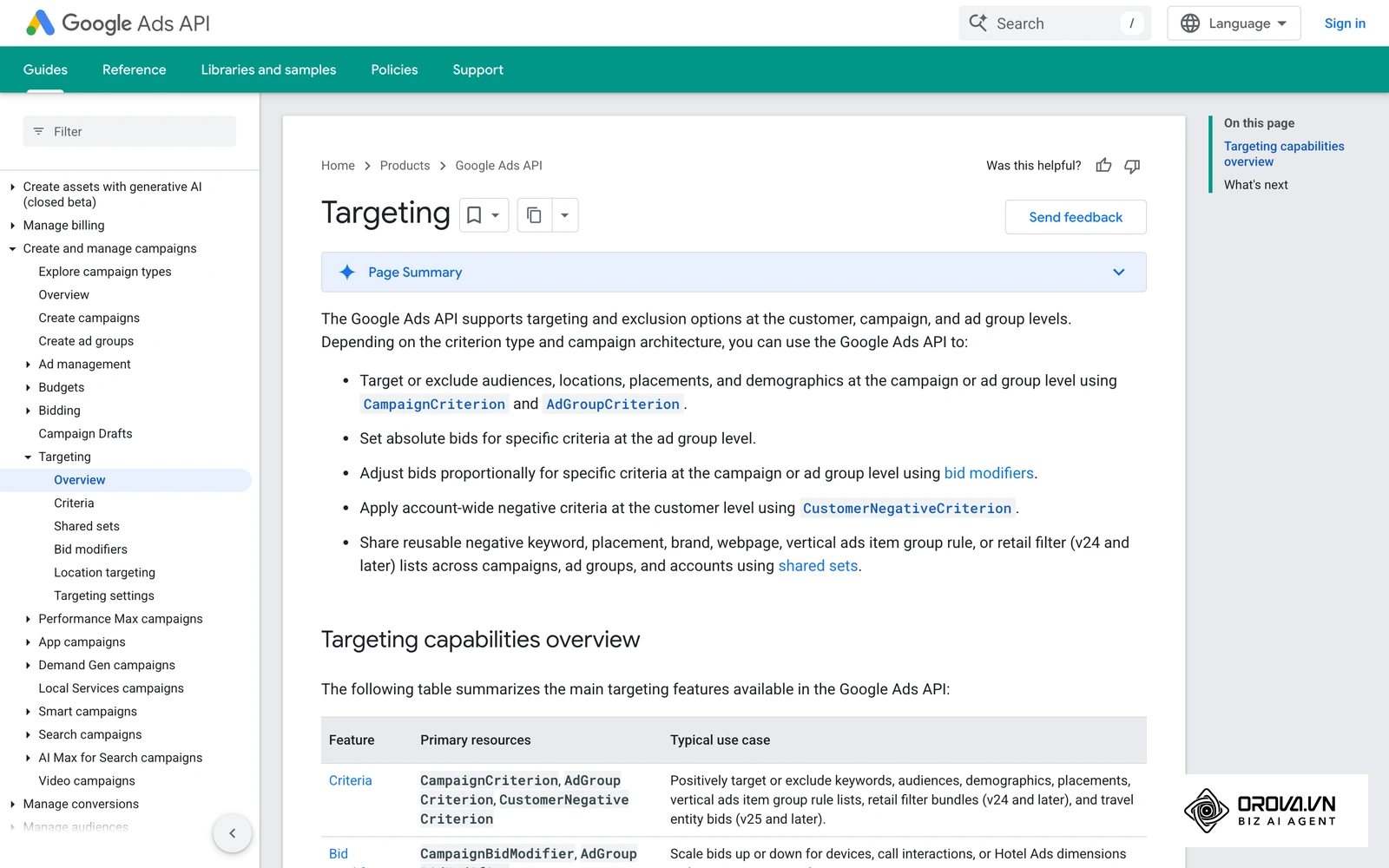
Meta's public documentation describes what happens when several of your ad sets are eligible for the same person. Rather than letting them bid against each other, Meta compares them by "total value", which its help pages describe as a combination of your bid, estimated action rates and ad quality, and enters only the highest-value ad set from your account into the auction against other advertisers.
The consequence is that your less competitive ad sets can be held back from delivery. This shows up as ad sets that do not spend their daily budgets and stay longer in the learning phase. Meta's guidance is to combine similar ad sets so delivery and learning are not fragmented across many small ones. If the overlapping ad sets are lookalike tiers, such as a 1% and a 1-3% lookalike of the same seed, our guide to scaling Meta lookalike audiences shows how to set mutual exclusions between percentage ranges; this guide stays on the account-wide audit across platforms.
Google Ads: Keyword overlap and remarketing conflicts
Google Ads operates across vastly different inventory types, making overlap a multi-dimensional challenge. In Google Search, overlap primarily occurs as keyword cannibalization. If Campaign A targets the broad match keyword "business software" and Campaign B targets the exact match keyword "[enterprise business software]," both campaigns can trigger for the same user query. Google's keyword prioritization prefers an eligible exact match keyword that is identical to the search term; when no keyword is identical, relevance and Ad Rank decide, so a broad keyword in another campaign can win queries you meant for a different campaign and shift your intended budget allocation. When overlapping targeting is left unconsolidated, conversions and spend are split across campaigns, which makes reporting and budget pacing harder to read.
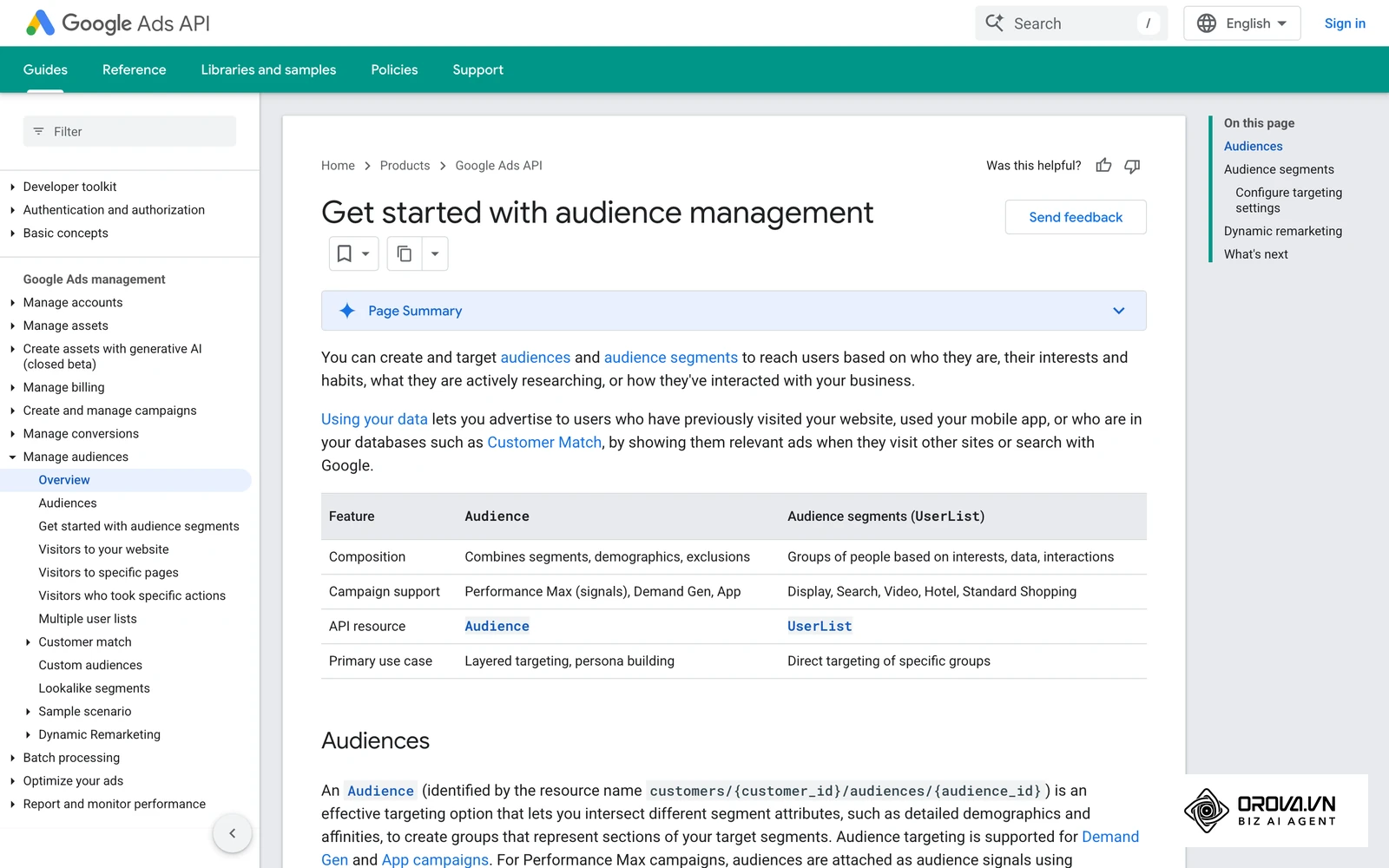
In Display and Demand Gen campaigns, overlap shows up when different campaigns target segments that contain many of the same people, for example an in-market segment and a custom segment built around similar interests. Those campaigns can end up reaching the same users on YouTube or partner sites. The solution in Google requires rigorous use of negative keyword lists applied at the campaign level and meticulous audience exclusion rules to ensure strict compartmentalization.
TikTok Ads: Broad targeting overlap in the For You Page
TikTok's platform architecture is fundamentally different from legacy social networks because the primary feed—the For You Page—is driven largely by viewing behavior and interest signals rather than by who follows whom. TikTok's own guidance leans toward broad targeting, relying on the actual creative video to find the right audience.
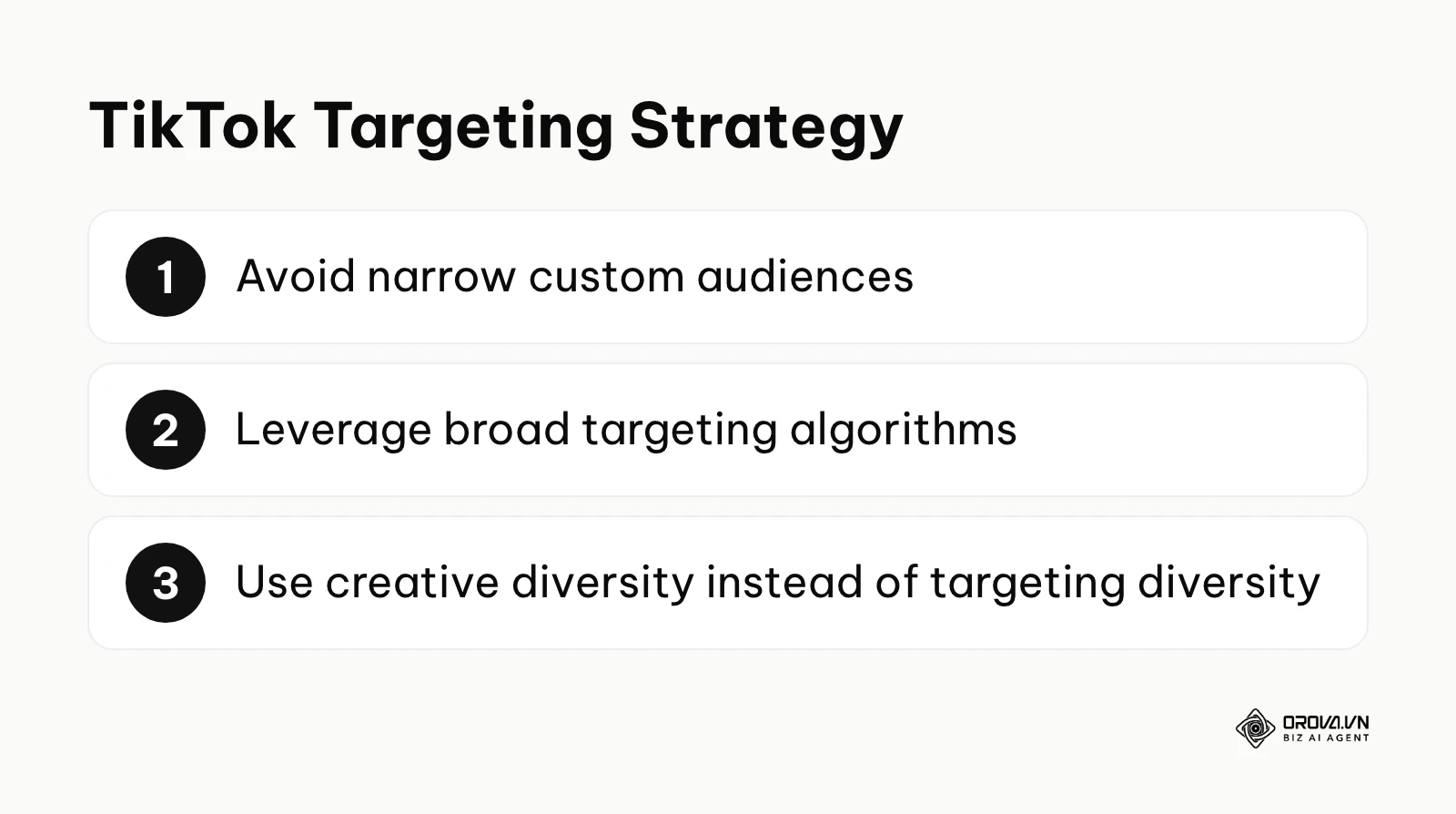
When advertisers attempt to apply legacy Facebook strategies to TikTok by creating dozens of tight, overlapping custom audiences (e.g., separating "Beauty Enthusiasts" from "Cosmetics Shoppers"), they restrict the delivery system. Narrow lists that overlap heavily leave the algorithm less room to explore and can limit overall reach. On TikTok, overlapping ad groups can saturate a small shared user base quickly and push your CPA up. The ideal anatomy of a TikTok campaign involves highly consolidated ad groups with extremely broad targeting, allowing the machine learning models to map users dynamically based on video watch time rather than static profile tags.
| Overlap Type | Characteristics | Best suited for |
|---|---|---|
| Auction Overlap (Meta) | Meta enters only one of your eligible ad sets per auction, so the others under-deliver. | Highly consolidated account structures with massive broad audiences. |
| Search Cannibalization (Google) | Broad match keywords steal traffic from highly specific exact match campaigns. | Strict tiered structures utilizing exhaustive negative keyword lists. |
| Exploration Restriction (TikTok) | Algorithm fails to scale due to artificial constraints on custom audience lists. | Broad targeting approaches relying solely on creative diversification. |
The 5-step monthly audit checklist for audience overlap
To maintain exceptional account health, conducting a thorough audit must become a recurring operational habit. As accounts grow, new campaigns are layered on top of old ones, inevitably creating invisible intersections. Follow this strict five-step diagnostic process at the beginning of every month to keep your architecture perfectly clean.
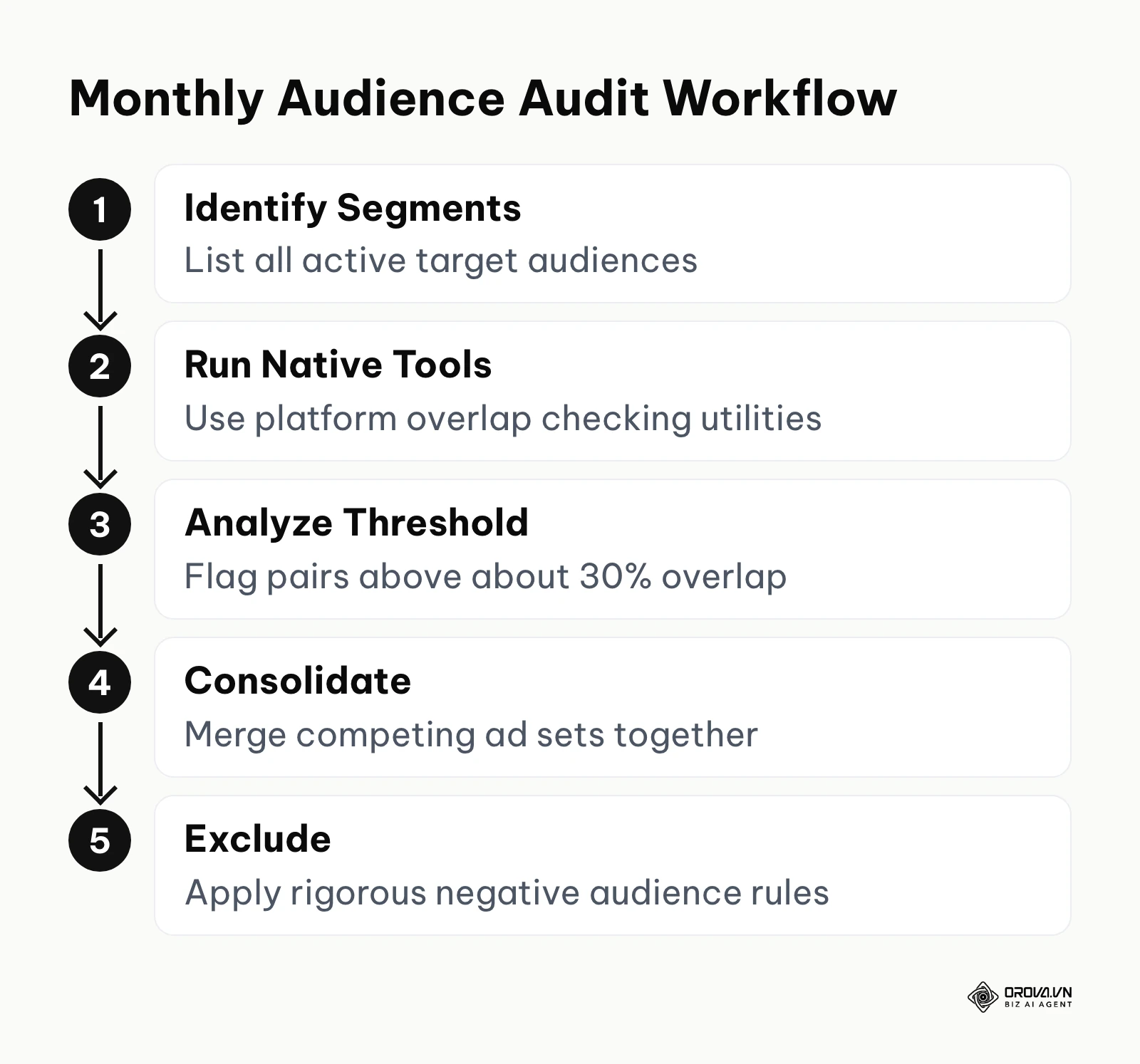
Step 1: Map the Active Target Segments Begin by pulling a comprehensive export of all currently active ad sets across your platforms. Document precisely what demographic, interest, and custom list parameters define each specific ad set. If you cannot explain the distinct difference between two ad sets in one sentence, you have already identified a structural risk.
Step 2: Deploy Native Inspection Tools Open the platform's native tools. In Facebook Ads Manager, go to the Audiences area, select two or more saved or custom audiences and use the audience overlap option where it is available. In Google Ads, review each campaign's audience segments and the search terms report to see which campaigns serve the same people and queries. Cross-reference your largest prospecting lists against your core retargeting lists.
Step 3: Establish the Action Threshold Not all overlap is fatal, and the platforms do not publish an official threshold. A common working rule among media buyers is to leave pairs below about twenty percent alone, watch pairs between twenty and thirty percent, and flag anything above about thirty percent for structural changes. Treat these numbers as a starting point and adjust them to your account.
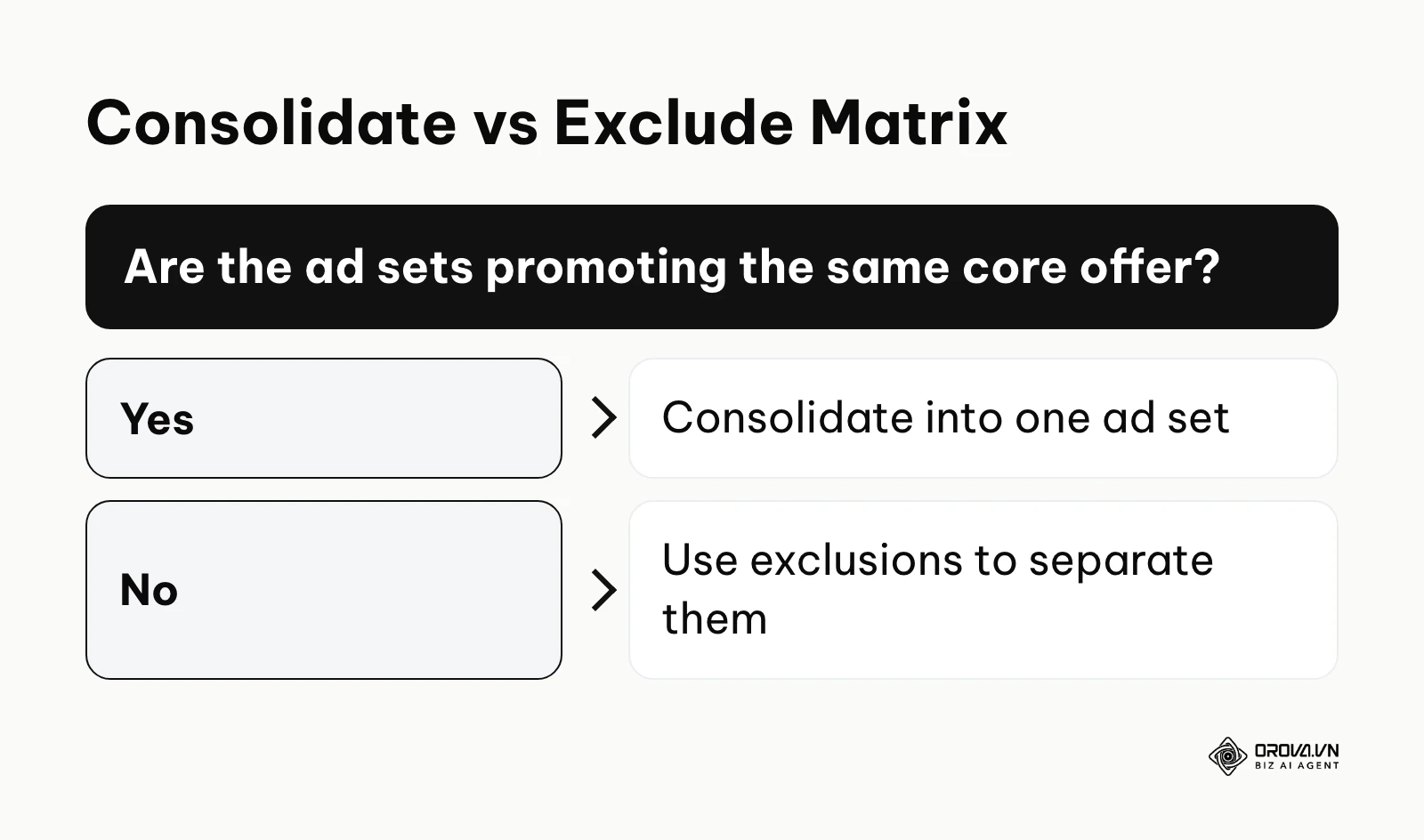
Step 4: Execute the Consolidation Protocol For any flagged ad sets that are promoting the identical core offer or product, consolidation is the optimal path. Pause the underperforming segments entirely and shift their allocated budgets directly into the single most efficient ad set. This feeds the algorithm a unified, massive data stream.
Step 5: Implement Rigorous Exclusions For flagged ad sets that are promoting entirely different offers—such as a top-of-funnel awareness video versus a bottom-of-funnel discount code—you cannot consolidate them. Instead, apply strict negative audience exclusions. Ensure that anyone who has visited the pricing page is excluded from the top-of-funnel awareness video and handled by your ad retargeting campaign instead.
Spreadsheet template structure for overlap prediction
Building a dedicated spreadsheet to predict overlap before you ever launch your campaigns is an absolute game-changer for professional media buyers. You need to meticulously construct a matrix that maps out every single audience segment you intend to deploy.
Start by creating a primary column for the Campaign Name, ensuring you utilize extremely strict, standard naming conventions for easy filtering later. The second column should intensely detail the Ad Set Target, specifying exact demographics, behavioral interests, and specific CRM lists. Next, and most critically, you must build a column dedicated strictly to Exclusions Applied. This is where you document exactly which lists are being explicitly blocked from the ad set. Finally, create a column for Estimated Overlap Risk, assigning a high, medium, or low rating strictly based on the logic of your structural setup. By forcing your team to fill out this precise sheet before hitting the publish button, you visually expose potential conflicts. If you see three separate ad sets targeting 'Enterprise Marketing Professionals' without any exclusions applied in the third column, you instantly know you have a high overlap risk and must adjust the structure proactively.
| Campaign Name | Ad Set Target | Exclusions Applied | Estimated Overlap Risk |
|---|---|---|---|
| TOFU_Awareness | Broad US, Ages 25-45 | 30-Day Web Visitors, Past Purchasers | Low |
| BOFU_Retargeting | 30-Day Web Visitors | Past Purchasers | Low |
| PROMO_Lookalike | 1% LAL Past Purchasers | None | High (Conflicts with TOFU) |
How to handle audience overlap: Actionable steps for every team
Adapting to the realities of audience overlap requires distinct operational workflows depending on the scale and complexity of your organization. A solo entrepreneur approaches this fundamentally differently than a sprawling enterprise agency. The key is implementing the right level of structural discipline that matches your resources.
For small business owners with limited budgets
When operating with tight budgets, you absolutely cannot afford to waste a single dollar competing against yourself. Your strategy must focus heavily on extreme simplicity.
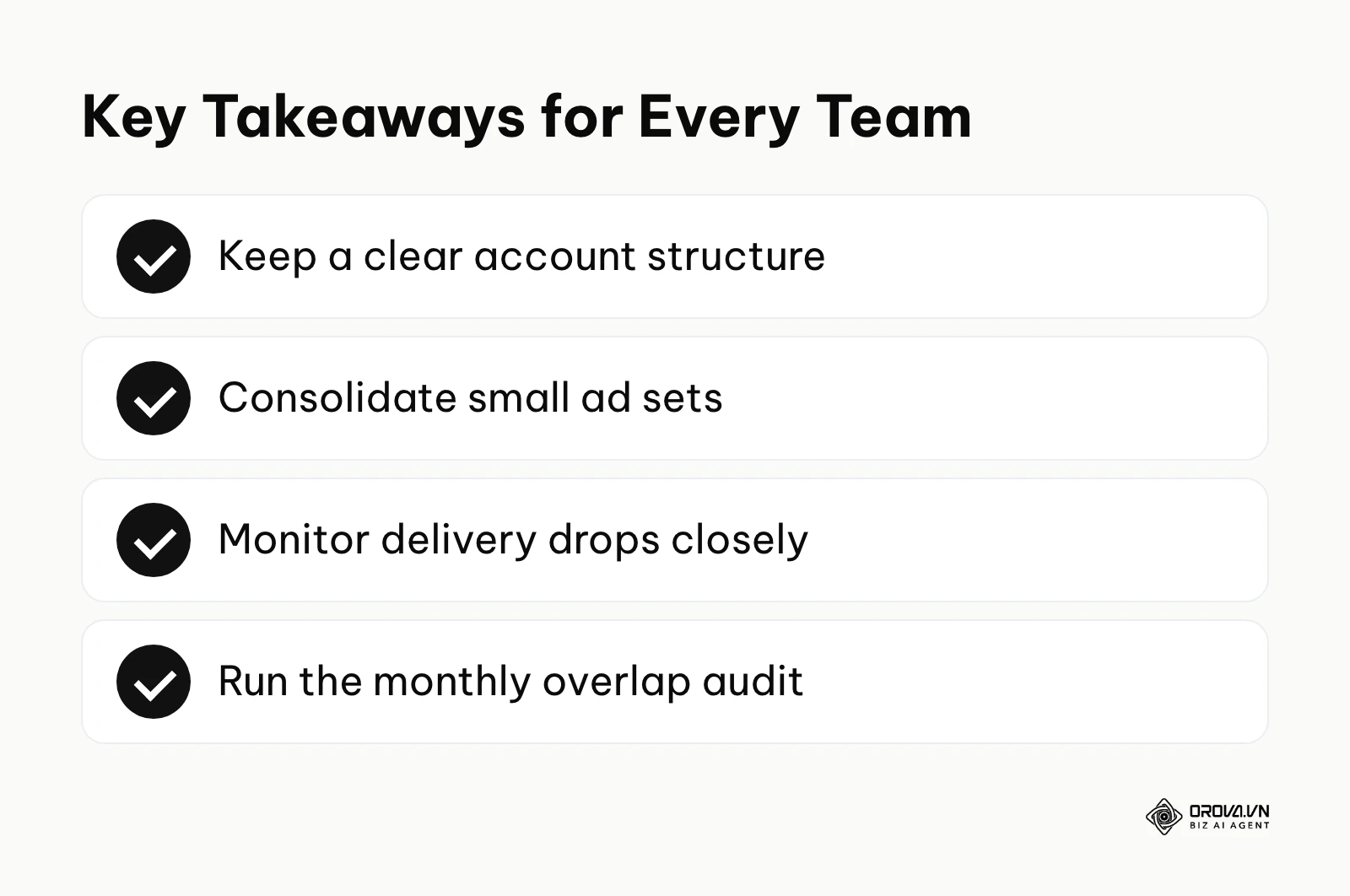
- Consolidate your entire account into a maximum of three ad sets: one broad prospecting, one targeted lookalike, and one retargeting list.
- Utilize native exclusion rules meticulously. Ensure your prospecting campaigns constantly exclude anyone who has engaged with your page in the last thirty days.
- Review your delivery metrics weekly. If an ad set suddenly stops spending its daily budget, immediately check if you recently launched a competing campaign.
For in-house marketing managers scaling campaigns
In-house managers handle larger budgets and face intense pressure to scale without increasing the CPA. Your approach requires rigorous documentation and strategic compartmentalization.
- Implement the monthly 5-step audit checklist detailed previously to ensure your account structure remains perfectly hygienic as you scale.
- Separate your funnel stages rigidly. Never allow top-of-funnel awareness budgets to bleed into bottom-of-funnel conversion campaigns; use strict CRM-based exclusions.
- Transition your mindset from "audience testing" to "creative testing". Rely on massive, consolidated broad audiences and let varied creative assets naturally filter the different buyer personas.
- Establish a unified tracking protocol across your analytics platforms to monitor cross-platform saturation effectively.
For performance agencies handling multiple accounts
Agencies face the unique challenge of inheriting messy, fragmented ad accounts from new clients. Your primary action is executing massive clean-up operations to instantly demonstrate value. For a deeper dive into agency operations, review our PPC ad management breakdown.
- Mandate the use of the overlap prediction spreadsheet template for every single media buyer before any new campaign goes live.
- Perform aggressive consolidation during the first thirty days of taking over a client account, pausing dozens of micro-ad sets to reset the algorithmic learning phases.
- Automate the monitoring process. Deploy third-party scripts or advanced rules that automatically flag ad sets exhibiting severe delivery drops associated with auction overlap.
- Educate clients on why pausing their hyper-specific, highly segmented ad sets is necessary for long-term algorithmic stability.
| Common Mistake | Consequence | How to Avoid |
|---|---|---|
| Creating dozens of micro-audiences | High self-competition and permanent learning phase stalling. | Consolidate budgets into large, broad audiences. |
| Forgetting to exclude past purchasers | Wasting budget on users who already own the product. | Set automated CRM syncs to exclude buyers dynamically. |
| Over-segmenting by age and gender | Artificially restricting the algorithm from finding cheap conversions. | Leave demographic settings broad and test different creative angles. |
Want to scale your budget but afraid of breaking performance? 📉
Integrate OROVA ADS now - an AI Agent that automatically monitors and optimizes Google, Meta, TikTok ads 24/7. Now, expanding and replicating your Performance Ads team is just one click away.
🚀 Try it now at: orova.vn/ads
Audience overlap trends: My predictions for 2026 and beyond
The digital advertising ecosystem evolves at a blistering pace, largely driven by advances in machine learning and shifting data privacy paradigms. Analyzing the trajectory of these platforms reveals distinct shifts in how we will manage targeting architectures in the near future.
AI-driven automatic audience consolidation
As of 2026, the clear sign we are seeing today is that all major advertising platforms are aggressively removing manual targeting levers in favor of opaque, black-box algorithms like Performance Max and Meta Advantage+. I expect manual audience consolidation to matter less over the next few years, as AI systems take on more of the work of detecting overlapping segments and pooling them. The underlying reason for this massive shift is that advanced machine learning models demand enormous, unsegmented data pools to function efficiently, making granular human interference actively detrimental. However, this prediction could be entirely wrong if global data privacy regulations become so strict that AI algorithms permanently lose access to the broad behavioral signals necessary for automated merging. To prepare for this shift, you must focus heavily on feeding high-quality, verified first-party data into your ad accounts today, rather than obsessing over complex manual exclusions. For further insights on this shift, explore our analysis of the Google Ads agent.
The death of hyper-granular targeting
The signal I see today, in 2026, is the consistently declining performance of hyper-niche, small-scale ad sets across all social networks. I think that in the next few years, heavily restricted micro-audiences will keep losing ground, and most advertisers will end up on broad targeting by default. This will happen primarily because advertising platforms desperately want to maximize their inventory yield, and broad targeting provides them with the ultimate flexibility to serve ads anywhere they have space. This specific theory might fail if new, heavily decentralized social platforms rise to prominence and demand highly specific, contextual targeting based on user-owned data silos. You should prepare immediately by completely shifting your creative strategy; your ad creative must become your primary targeting tool, designed to attract your specific buyer persona out of a massive, untargeted pool.
Cross-platform overlap visualization will become standard
Currently, in 2026, a major operational pain point is that you can check overlap within Meta or within Google independently, but cross-platform blind spots remain massive and costly. I anticipate that cross-platform overlap visualization will become far more common in the next few years, either through native API alliances between major networks or through highly advanced third-party AI agents. This capability is absolutely necessary because modern omnichannel marketing requires holistic frequency capping to prevent wasting massive budgets on users who have already converted on another channel. This outlook might be incorrect if walled gardens like Google and Meta refuse to share aggregate anonymized data due to intense competitive friction. Therefore, you need to start building robust, centralized data warehouses now to independently map your complex user journeys across multiple touchpoints.
Frequently asked questions about audience overlap
Navigating the nuances of audience architecture often generates specific, tactical questions from media buyers attempting to optimize their daily spend.
What percentage of audience overlap is acceptable?
There is no official number from Meta, Google or TikTok. A common working rule is that overlap below about twenty percent rarely needs action, twenty to thirty percent is worth watching, and above about thirty percent is a signal to intervene by consolidating the ad sets or applying exclusions. Check delivery as well: a pair with moderate overlap where one ad set stops spending deserves attention sooner.
Will audience overlap still be relevant with AI agents?
Yes, but the nature of how you manage it will fundamentally change. While AI agents will increasingly handle the micro-adjustments and real-time bidding, setting the high-level boundaries and strategic guardrails remains a human task. If you command an AI agent to aggressively scale two separate campaigns that target the same core demographic without defining proper exclusion parameters, the AI will perfectly execute your flawed strategy and waste your budget faster than a human ever could. Human oversight of the overarching architecture remains critical.
How to tell if CPA is increasing due to overlap or creative fatigue?
You must isolate the variables by checking your ad delivery and frequency metrics. If your CPA is rising while frequency stays low and flat, and an ad set is not spending its daily budget, overlap holding that ad set back from auctions is the likely cause. If your CPA is rising alongside frequency that climbs week over week, and your CTR is falling, your audience is more likely saturated with the same creative, which points to creative fatigue.
Should I consolidate audiences or use exclusions?
The decision hinges entirely on the specific offer being presented. If both ad sets are promoting the exact same product, core offer, or lead magnet, you should immediately consolidate them into a single ad set to feed the algorithm more conversion data. However, if the ad sets are promoting fundamentally different offers—such as a top-of-funnel educational blog post versus a bottom-of-funnel aggressive discount code—you absolutely must use exclusions to keep the user journeys separate and logical.
Does audience overlap exist in email marketing?
Yes, though it manifests differently than in algorithmic ad auctions. In email marketing, overlap occurs when a user resides on multiple segmentation lists (e.g., "Weekly Newsletter" and "Holiday Promo List") and subsequently receives five emails in a single day. While it does not cost you a bidding premium like it does in paid media, it drastically increases your unsubscribe rates and damages your domain sender reputation. It must be managed using strict suppression lists and dynamic frequency capping inside your CRM.
Where to start analyzing your campaigns?
Taking the very first step toward efficient audience architecture depends entirely on your current operational maturity and the state of your existing ad accounts.
If you are starting completely from scratch and have not yet built out complex targeting structures, your immediate action for today is to logically map out your core customer personas on a simple planning document. Before you ever launch a single campaign, rigorously define mutually exclusive parameters for each persona based on core demographics or distinct behavioral interests. By setting these strict boundaries before you spend any money, you actively prevent overlap from ever forming at the foundational level of your account.
If your campaigns are already running but the targeting strategy is highly fragmented across dozens of platforms and micro-ad sets, your primary task for this afternoon is to aggressively consolidate your smallest, underperforming ad sets into your proven historical winners. Go directly into your ad accounts, identify specific segments that are spending less than twenty percent of your daily allocated budget, pause them entirely, and shift that budget to your strongest performer. This single action immediately reduces self-competition and feeds significantly more data into a stable learning phase.
Finally, if you have structured your audiences carefully over time but have not actively measured the cross-contamination between them, your immediate step is to pull an audience overlap report natively within your primary advertising platform. Select your top three highest-spending ad sets and run them through the native comparison utility. If the data reveals an overlap above your working threshold (for example, about thirty percent), you know exactly where to apply your first negative exclusion list. This targeted diagnostic check takes only minutes but highlights the exact leaks in your current budget allocation, giving you a clear starting point for managing audience overlap.
About the author

Builder of Orova
Nguyễn Đỗ Trọng Ân has 8 years of experience in marketing, including 6 years managing market development across Asia. He builds Orova, a Biz AI Agent that never sleeps: it plans, runs and optimizes work for businesses.
Run your business with AI Agents
Orova is the always-on Biz AI Agent — it plans, runs, and optimizes the work for you.
Save time, unlock productivity.