
What are Meta lookalike audiences? A 2026 guide to scaling

Advertisers constantly struggle to find new, profitable customers once their initial retargeting lists and core interest groups dry up. You might have tried guessing demographic traits or expanding locations, only to watch your cost per acquisition skyrocket while lead quality plummets. The traditional method of manually hunting for buyers is no longer sufficient when algorithms can process millions of data points per second. This guide explains how to use Meta lookalike audiences to scale your campaigns efficiently without bleeding your budget dry. We will explore how the underlying matching algorithm processes your seed data, how to structure your ad sets to limit overlap, and why updating your fundamental strategy is critical in the era of automated Advantage+ campaigns. By mastering these technical mechanics, you can stop wasting impressions on irrelevant users and start feeding the platform exactly what it needs to find high-intent buyers.
What are Meta Lookalike Audiences?
Meta lookalike audiences are algorithmic targeting segments created by analyzing a source group of your best customers, known as a seed audience, and finding new users with similar behaviors and demographics. They are used to scale advertising reach to highly qualified prospects, differing from interest targeting by relying on first-party data rather than platform assumptions.
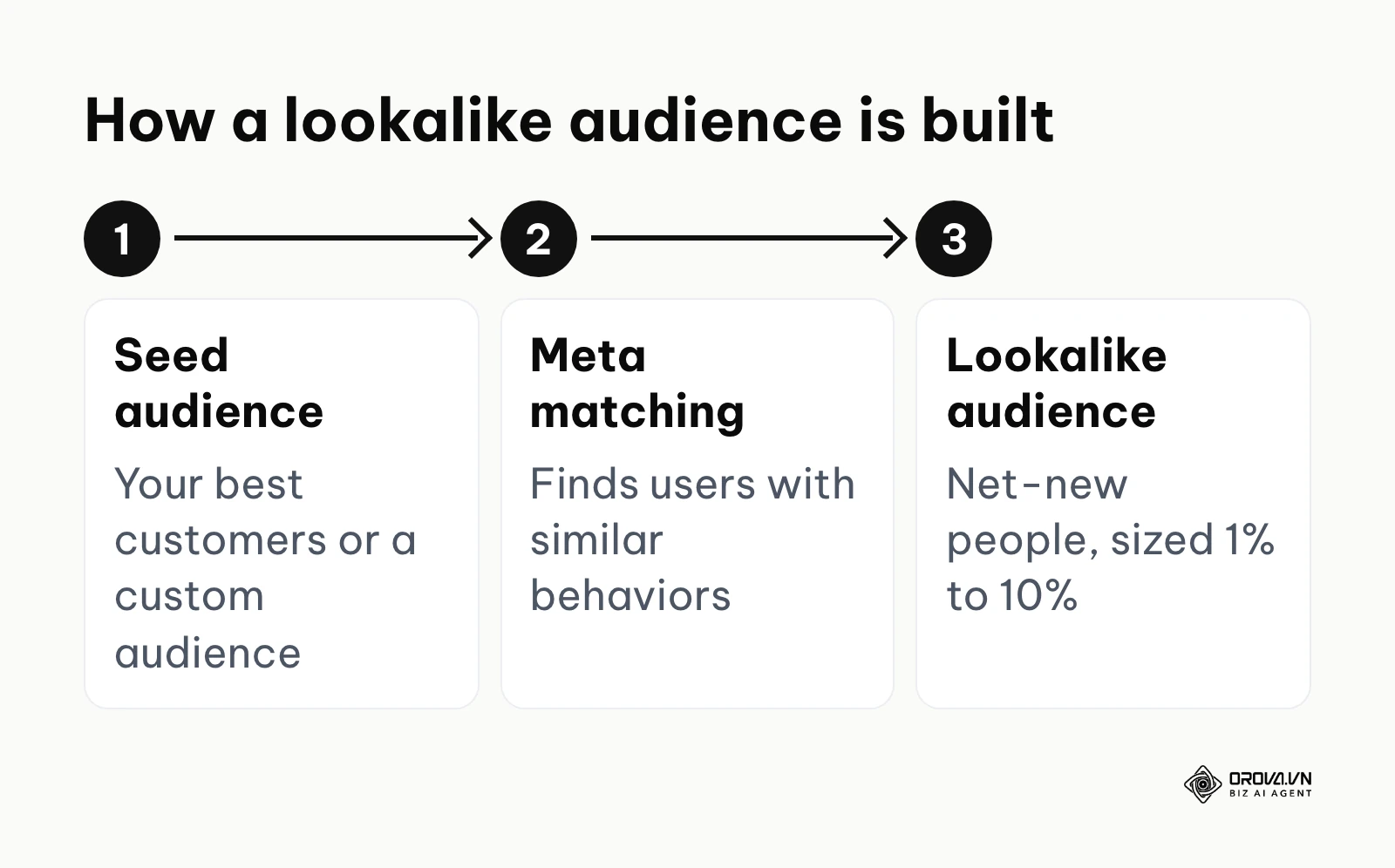
The feature originated as a way for performance marketers to expand their reach beyond basic, often inaccurate, demographic filters provided by the platform. It revolutionized digital advertising by allowing businesses to clone their best buyers.
| Concept | How it differs | Example |
|---|---|---|
| Lookalike Audience | Finds net-new people who act like your source group. | Finding 1 million new users who share traits with your past buyers. |
| Custom Audience | Targets the exact specific people in your source group. | Retargeting 5,000 people who abandoned their shopping carts yesterday. |
| Core Audience | Targets based on manual rules you select (age, location). | Targeting women aged 25-34 in New York who like yoga. |
Think of it like Spotify's Discover Weekly playlist. You provide the seed data (the songs you actively listen to), and the algorithm analyzes thousands of hidden attributes to serve you entirely new songs that you are statistically highly likely to enjoy.
The Meaning and Role of Meta Lookalike Audiences
In the broader architecture of an advertising account, this targeting methodology exists to solve the fundamental problem of scale. When a business first launches ads, they usually rely on warm audiences (website visitors, social media engagers) or broad interest categories. Eventually, the warm audiences become exhausted, leading to ad fatigue, while interest categories become too competitive and expensive. This mechanism serves as the vital bridge between the safety of retargeting and the vast, untamed wilderness of the entire platform user base. It acts as a compass, allowing the system to navigate billions of active users and zero in on the precise behavioral clusters that mirror your most profitable cohorts. If you ignore this tool, you risk trapping your business in a state of stagnation, where acquiring every marginal new customer costs exponentially more because the algorithm lacks a distinct mathematical pattern to follow.
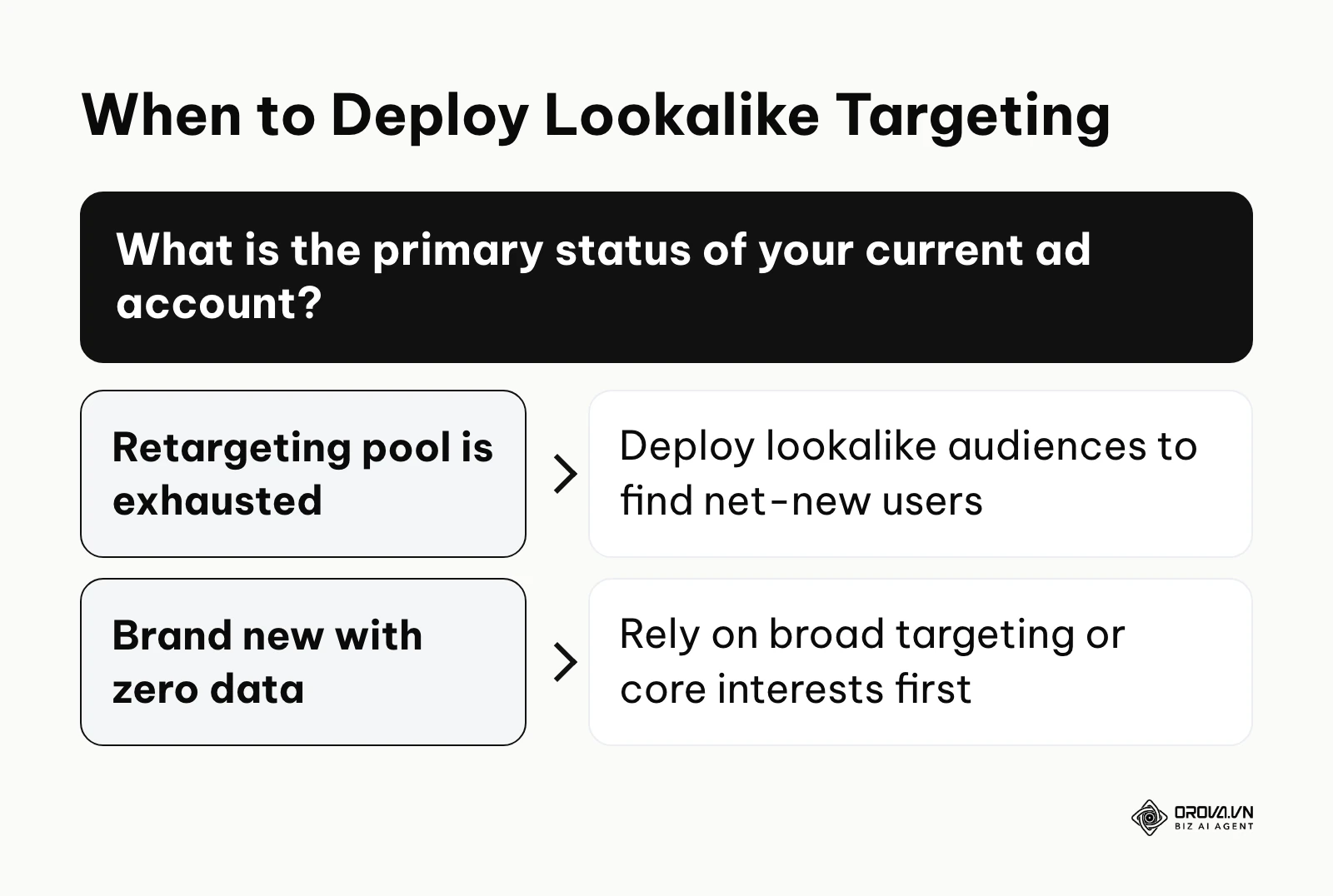
When you should not use this targeting method: There are specific scenarios where deploying this tool is wasteful. If you run a hyper-local retail business serving a tiny geographic radius, algorithmic expansion will likely target people too far away to visit. Similarly, brand new startups with only a handful of past customers usually lack the data volume to build a reliable seed, which leads to weak matching. Finally, for pure brand awareness campaigns aiming for maximum sheer volume, basic demographic targeting is cheaper and faster to set up.
The Value and Benefits of Meta Lookalike Audiences
Leveraging this technology provides distinct layers of value: substantial financial growth for the enterprise and significant workflow efficiency for the individual operating the ad accounts.
Lowering Customer Acquisition Costs (CAC)
For the business, the most immediate impact is a reduction in the blended cost per acquisition. Before implementation, a company might rely on broad prospecting that wastes money serving impressions to users with zero purchase intent. After providing a high-quality seed, the algorithm filters out the noise, ensuring that ad spend is heavily concentrated on individuals who exhibit buying signals similar to your existing customers.
Illustrative example:
- Context: A regional mid-sized furniture retailer employing an in-house digital marketing specialist.
- Steps taken: The specialist exported the email list of customers who had purchased high-margin sofas in the last six months. They uploaded this list to the platform, mapped the identifiers, and generated a 2% lookalike audience to use in a new prospecting campaign.
- Obstacle and fix: Initially, the match rate of the uploaded file was only 30% because the data was poorly formatted. The specialist standardized the phone numbers to include country codes and separated first and last names into different columns before re-uploading, increasing the match rate to 75%.
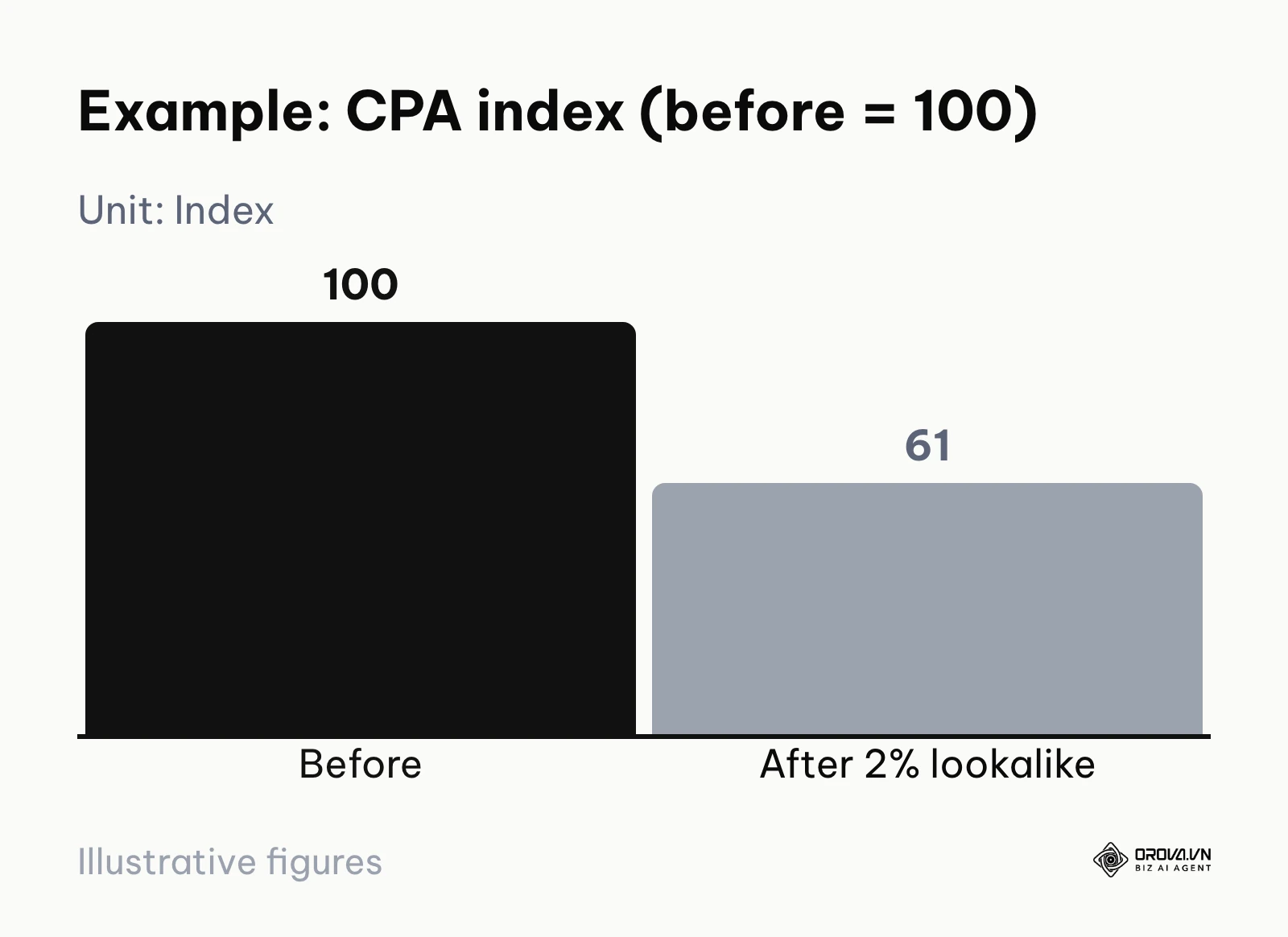
- Result: The new campaign stabilized after the learning phase, yielding a consistent stream of new leads and cutting the overall cost per acquisition by nearly 40% (an index of 100 before the change and 61 after).
Reducing Manual Optimization Time
For the performance marketer, managing campaigns shifts from a grueling manual task to a strategic oversight role. Before, you might spend hours cross-referencing audience insights, testing dozens of overlapping interest combinations, and constantly pausing underperforming ad sets. After shifting to algorithmic targeting, the system handles the micro-adjustments continuously. You no longer dictate who sees the ad based on rigid rules; you simply feed the engine the right parameters and let the machine execute the heavy lifting.
Improving Lifetime Value with Meta Value-Based Lookalike Audiences
Standard lookalikes treat every user in your seed file equally. A customer who bought a cheap pair of socks holds the same weight as a customer who bought an expensive jacket. A meta value based lookalike audience changes this paradigm by assigning a monetary value to every user in the seed. This allows the algorithm to prioritize finding people who resemble your highest-spending VIP customers, which can raise the lifetime value (LTV) of the newly acquired cohorts.
| Benefit | Primary Metric to Measure | When to Judge It |
|---|---|---|
| Reduced acquisition cost | Cost Per Action (CPA) | After the ad set leaves the learning phase |
| Higher average order size | Return on Ad Spend (ROAS) | After several weeks of purchase data |
| Time saved on account management | Hours logged in ads manager | From the first weeks of the new structure |
OROVA ADS applies AI Agent to automate and optimize ad performance on Google, Meta and TikTok. Scale your budget safely, monitor 24/7 and expand your business quickly.
Experience the solution at orova.vn/ads
How Meta Lookalike Audiences Work in Practice
To master this targeting approach, you must deconstruct the engine into its core components. Understanding the underlying mechanics prevents costly architectural mistakes when setting up your account.
Sourcing the Seed Audience (The Foundation)
The entire system relies on the quality of your source data. The algorithm is incredibly powerful, but it adheres strictly to the rule of "garbage in, garbage out." Meta's Business Help Center sets a minimum size for the source audience, and meeting that minimum only makes the lookalike possible, not good. A larger source made of genuinely high-value customers gives the system more variation to learn from, so check Meta's current requirements when you build the audience and favor quality over raw volume.
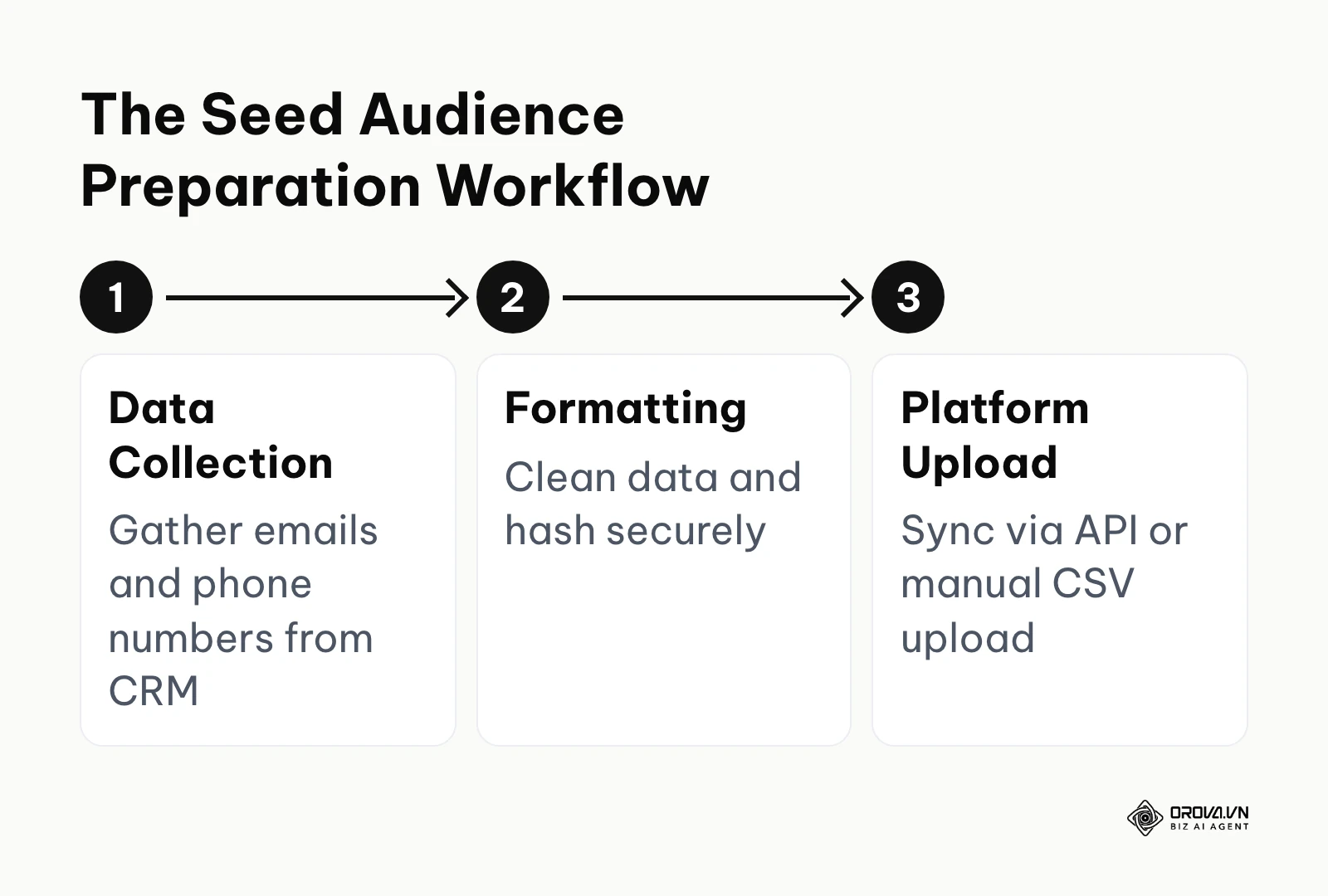
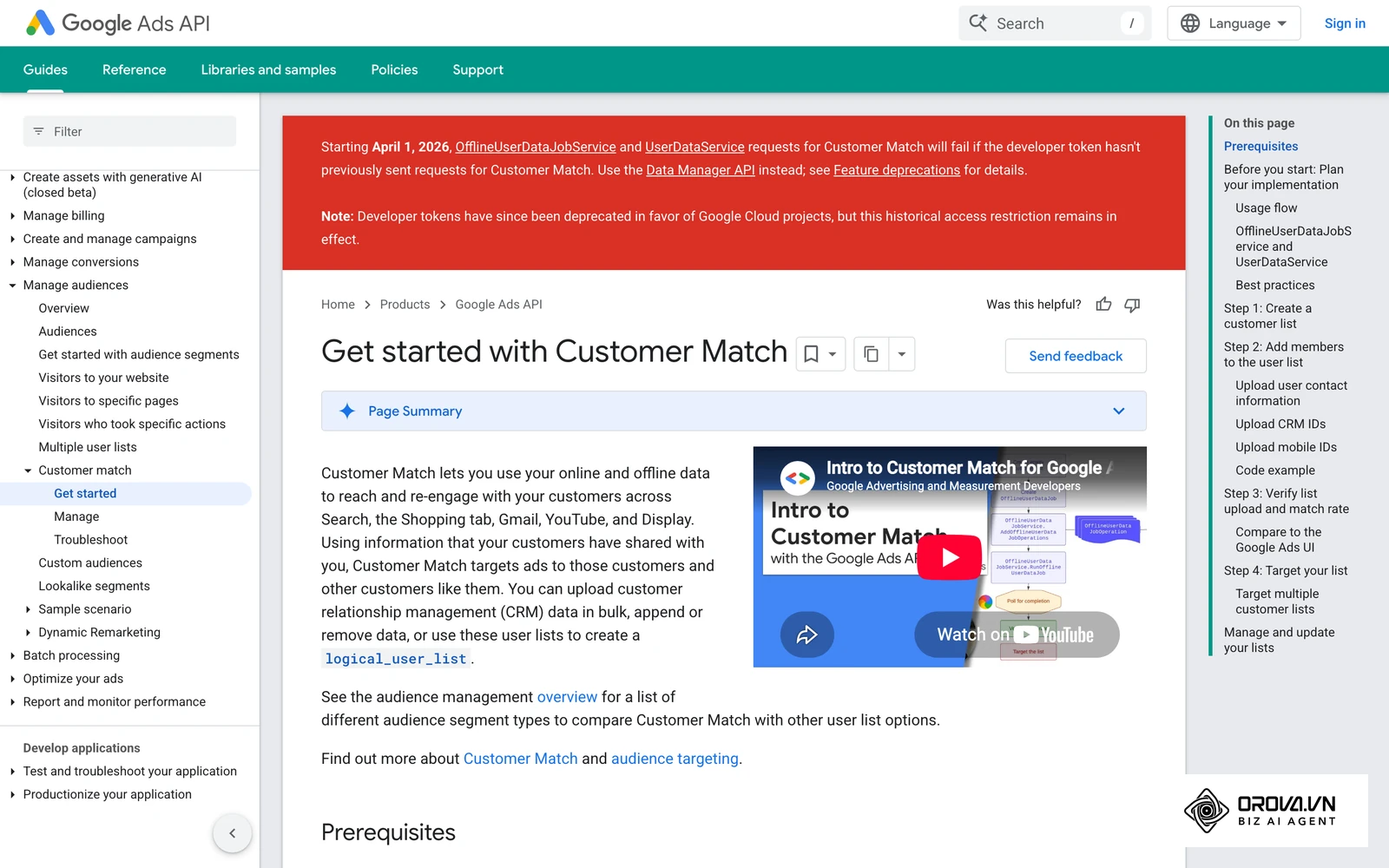
You can source this data from multiple places. The most common is the platform's native pixel, tracking events like standard purchases, add-to-carts, or lead submissions. Alternatively, you can upload static customer lists (CSV files) containing hashed emails, phone numbers, and zip codes. Collecting customer data with clear consent supports privacy compliance, and complete, well-formatted fields (email, phone with country code, name, location) generally improve the match rate when the list is hashed and uploaded. If you want a more dynamic approach that depends less on the browser, combining click tracking with the Conversions API (CAPI) helps keep a steadier flow of conversion data reaching the platform.
The Matching Algorithm and Percentage Ranges
Once the seed is established, the system cross-references those users against its massive database of billions of active profiles. It analyzes thousands of hidden data points: what posts they engage with, what times of day they log in, what external websites they browse, and their historical purchase behavior.
After identifying the patterns, it generates the audience based on a percentage scale from 1% to 10% of the target country's population. A 1% audience represents the people who most closely match your seed. A 10% audience is much broader and less precise but offers significantly more scale. A common question among beginners is whether a 1% audience is always superior. In the early days of the platform, the answer was yes. Today, that is far less certain. A broader 3% or 5% audience can outperform a strict 1% group because it gives the delivery system more room to navigate the daily fluctuations of the auction environment.
Overcoming Audience Overlap to Prevent Self-Competition
One of the most destructive and common errors in campaign architecture is ignoring audience overlap. When you create multiple ad sets (for example, one targeting a 1% lookalike of purchasers, and another targeting a 1-3% lookalike of website visitors), there is a high chance that the same users exist in both groups.
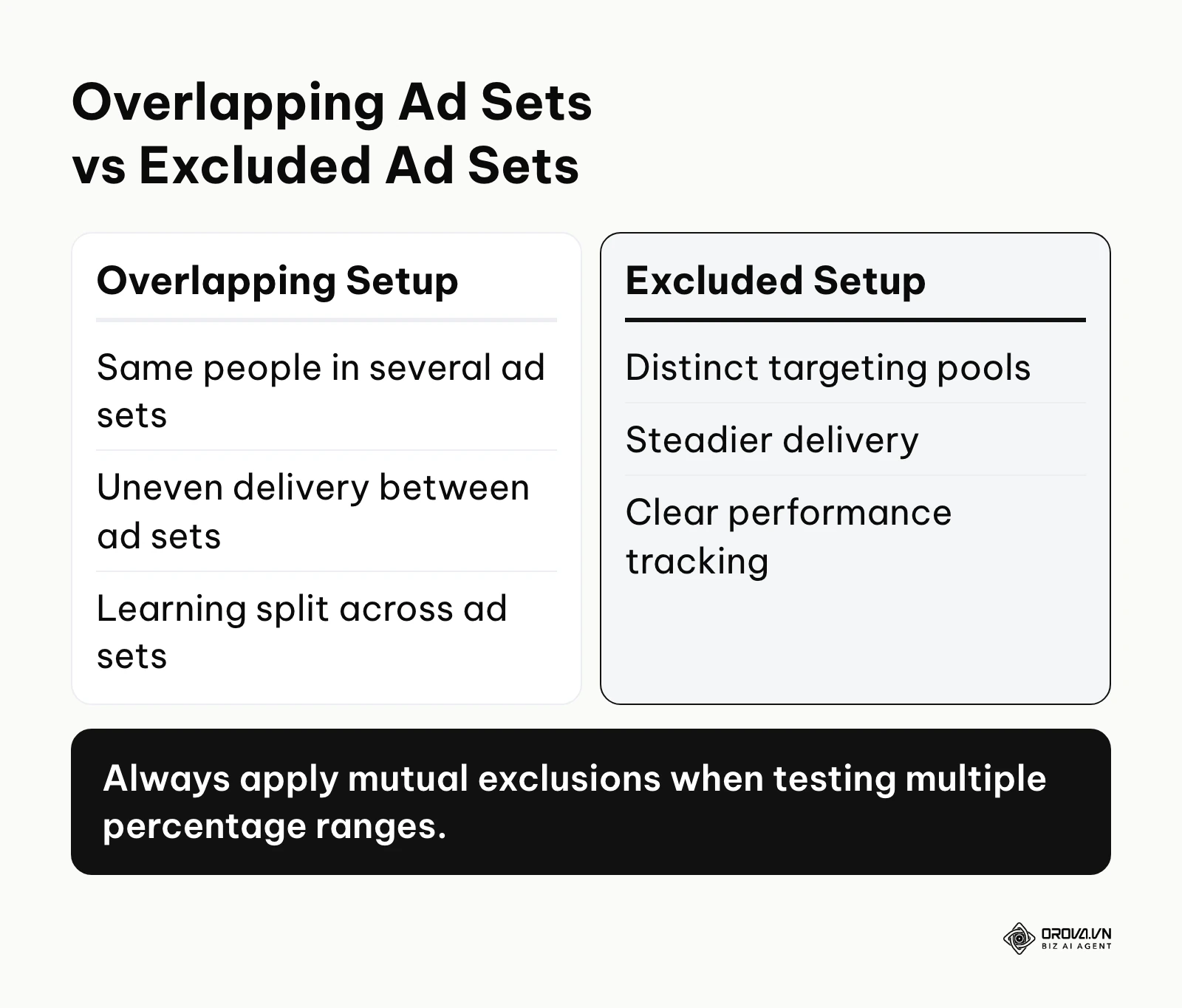
Meta's documentation on audience overlap explains that it does not let your own ad sets bid against each other in the same auction; instead it chooses which of them to enter. The practical result is that one overlapping ad set can under-deliver, learning is split across ad sets, and it becomes hard to tell which percentage tier is really working. To fix this, use mutual exclusions. If Ad Set A targets the 1% group, Ad Set B (targeting the 2% group) must explicitly exclude the 1% audience in its settings. This forces the system to find distinctly different pockets of users for each ad set, stabilizing costs and allowing you to accurately judge the performance of different percentage tiers.
Illustrative example:
- Context: A B2B SaaS startup running multiple lead generation campaigns managed by a solo founder.
- Steps taken: The founder launched three separate ad sets simultaneously: a 1% lookalike of past leads, a 2% lookalike of blog readers, and a broad interest audience. They let the campaigns run for five days with a high daily budget.
- Obstacle and fix: Delivery stalled completely on the second ad set, and the cost per lead on the first set spiked to an unsustainable level. The founder compared the audiences in the platform's audience overlap view and found that a large share of people sat in both pools. They immediately restructured the campaign, applying strict negative exclusions to separate the tiers perfectly.
- Result: Within a few days, delivery evened out across the ad sets and the blended cost per lead came down noticeably.
Meta Advantage Plus vs Lookalike Audience: The Modern Strategy
The most significant shift in digital advertising recently is the push toward full automation. Many advertisers wonder how traditional lookalikes fit into this new ecosystem, specifically concerning the meta advantage plus vs lookalike audience debate. Meta's Advantage+ campaigns and the Advantage+ audience setting hand much of the targeting, placement, and budget work to Meta's delivery system, which reduces the manual controls that media buyers are used to.
You might assume this renders standard lookalikes obsolete, but they actually serve a critical new function. With Advantage+ audience, Meta lets you add audiences, including lookalikes, as audience suggestions rather than hard limits, and the system may show ads to people outside them when it predicts better results. Meta has also changed how lookalikes behave in its original audience options, where lookalike expansion may apply depending on the campaign objective, so check the current setting in Ads Manager instead of assuming a lookalike is a fixed boundary. In practice, your best lookalikes (especially value-based ones) work as a starting signal that points the system toward the right people early. Running both side by side gives you a portfolio approach: Advantage+ for scale, plus manually excluded lookalike ad sets where your account still offers that control, as a comparison point. If you are deeply interested in how this automation affects overall strategy across networks, reading a comprehensive guide on ai ads is highly recommended.
Managing Ad Fatigue and Refreshing Data
Even the best algorithmic audience will eventually suffer from ad fatigue. This occurs when the system has successfully extracted all the easy, low-hanging conversions from the group, and is now repeatedly showing your creative to the remaining users who have zero intention of buying. Frequency metrics will spike, and ROAS will plummet.
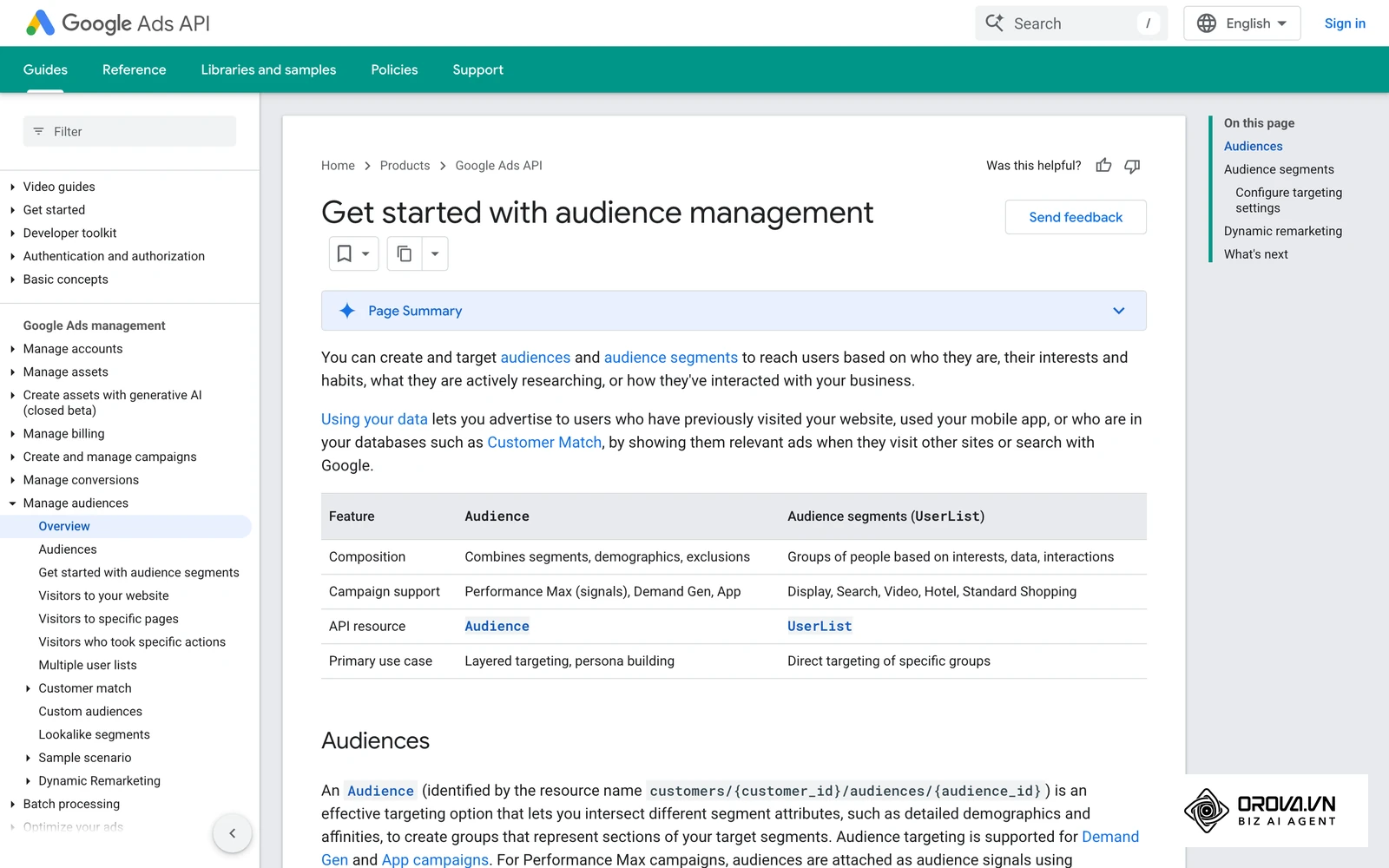
To combat this, your seed data cannot be static. If you manually uploaded a CSV file six months ago, the resulting lookalike is hunting for patterns that may no longer be relevant to your current business reality. You must establish a pipeline for continuous data refreshing. The most reliable option is a source that refreshes itself: a website or app custom audience fed by the pixel and the Conversions API, or a customer list that your CRM updates through Meta's API. If you lack the technical infrastructure for a dynamic connection, you should institute a rigid operating procedure to manually re-export and re-upload your customer lists every 14 to 30 days to keep the signals fresh.
| Type of Lookalike | Defining Characteristic | Best Suited For |
|---|---|---|
| Standard (Action-based) | Built on binary events (e.g., did they purchase or not). | Rapidly scaling lead generation or low-ticket e-commerce. |
| Value-Based (LTV) | Weighs users by the monetary amount they spent. | High-ticket items, subscriptions, or stores with huge disparities in order values. |
| Engagement-Based | Built on platform actions (e.g., watched 75% of a video). | Building top-of-funnel awareness when pixel data is sparse. |
What to Do to Adapt and Start Scaling
To properly execute a strategy for how to scale meta lookalike audiences, you must tailor your approach to your specific role and organizational capacity. The technical steps differ wildly depending on whether you are managing your own small business or handling a massive corporate budget.
For Small Business Owners: The Foundation
If you are managing operations and running ads simultaneously, complexity is your enemy.
- Consolidate your customer data into a single, clean spreadsheet (names, emails, phone numbers).
- Upload this list to the platform as your primary Custom Audience.
- Generate a single, broad 1-5% lookalike audience from this list.
- Launch a campaign with Advantage campaign budget (formerly Campaign Budget Optimization) enabled, using this single audience against a broad targeting ad set to test baseline performance.
For In-House Performance Marketers: The Testing Framework
When you have the budget and mandate to scale aggressively, you need a structured, scientific approach to avoid overlapping and self-sabotage.
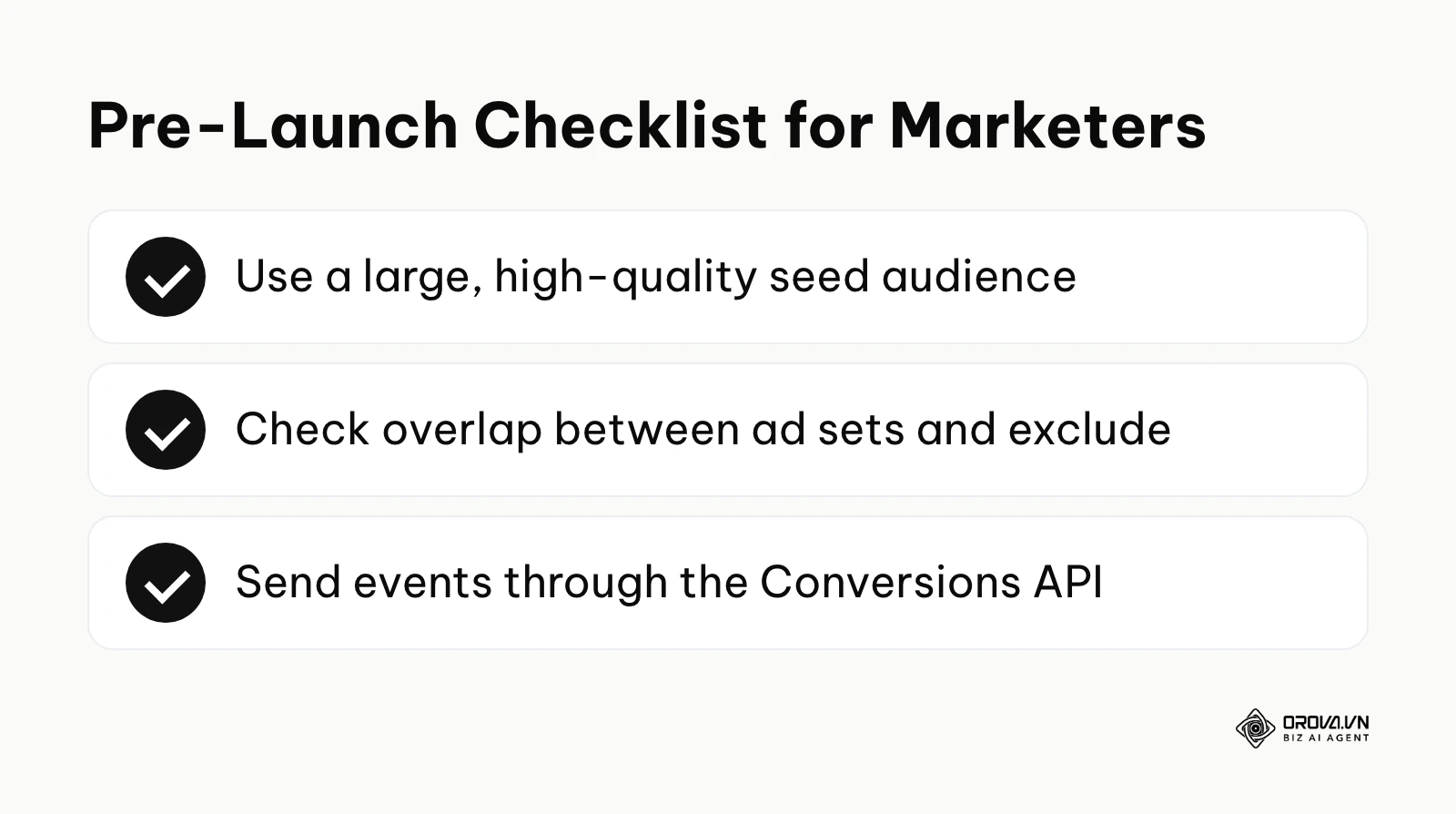
- Implement the Conversions API so your website-based seed audiences depend less on browser cookies.
- Create distinct percentage tiers (e.g., 0-1%, 1-3%, 3-5%).
- Set up a testing campaign where each tier has its own ad set.
- Crucially, apply cascading exclusions. Exclude the 0-1% from the 1-3% set, and exclude both from the 3-5% set.
- Monitor the CPA across the tiers for at least a week to see which tier delivers most efficiently. For deeper insights into managing complex ad structures, consulting a ppc ad management framework is essential.
For Agencies and Freelancers: The Advanced Setup
When managing client money, proving incrementality and mitigating risk are the highest priorities.
- Conduct an audit of the client's historical pixel data to ensure the events firing are actually tied to verified business revenue.
- Build Value-Based seeds by importing the client's historical Lifetime Value metrics.
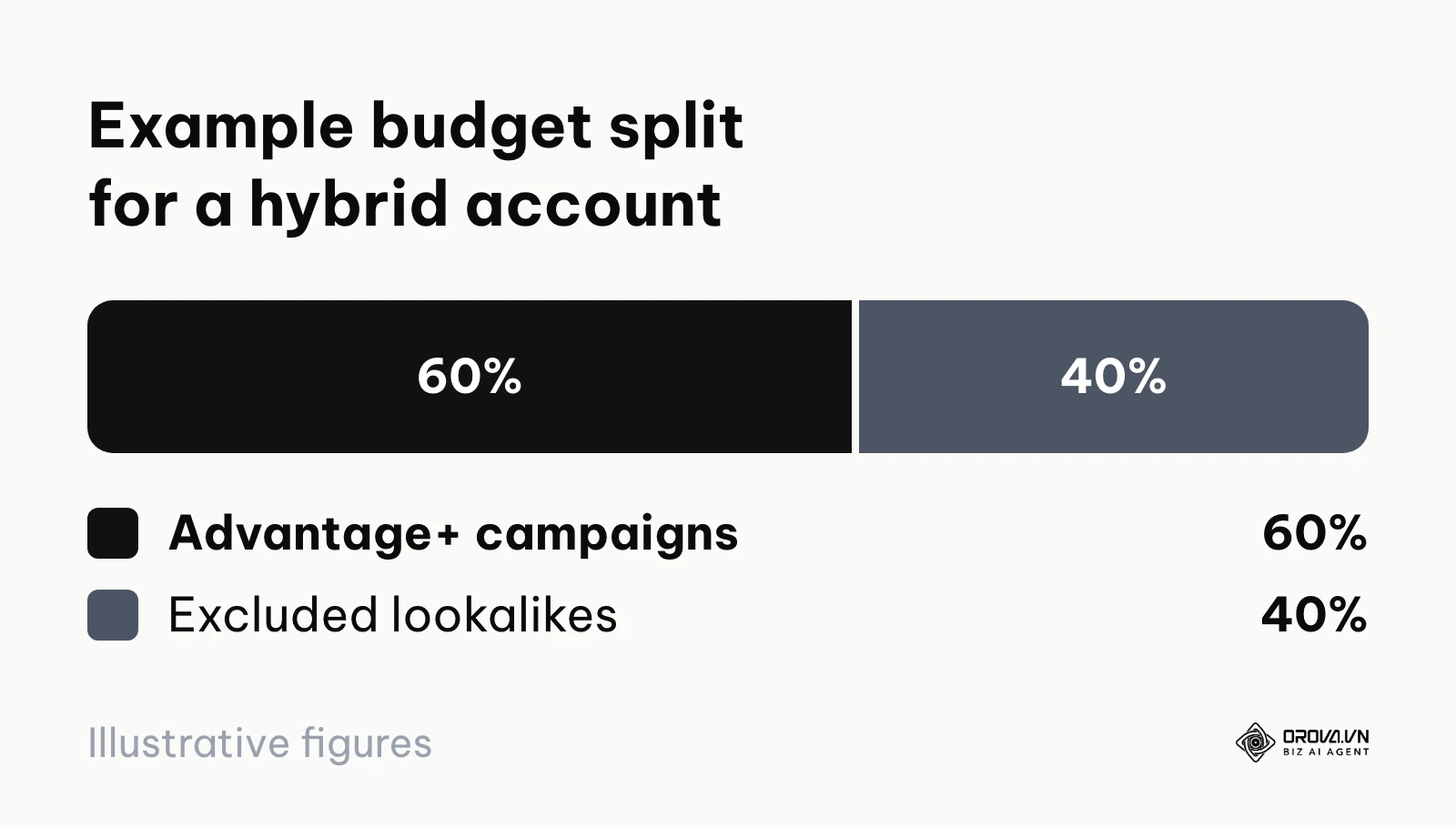
- Deploy a hybrid account structure, for example 60% of the budget to Advantage+ campaigns using the value-based lookalike as an audience suggestion, and 40% to manually excluded lookalike ad sets as a comparison and safety net. Adjust the split to the client's results.
- Regularly cycle new, disruptive creative assets into the winning ad sets to combat algorithmic fatigue. To better understand the nuances of the platform interface where these tasks are executed, reviewing a breakdown of facebook ads manager can be very helpful.
| Common Mistake | Consequence | How to Avoid It |
|---|---|---|
| Using a very small or low-quality seed audience. | Algorithm fails to find strong patterns; poor ad delivery. | Wait until you have enough organic or lower-funnel data before building the lookalike. |
| Creating overlapping ad sets without exclusions. | Uneven delivery and learning split across ad sets. | Check overlap between audiences and exclude them from one another. |
| Never updating a manual CSV seed file. | Audience goes stale; CPA slowly climbs week over week. | Schedule bi-weekly manual uploads or build an automated API pipeline from your CRM. |
Illustrative example:
- Context: A freelance media buyer taking over an established local gym's ad account.
- Steps taken: The freelancer noticed the previous agency had created twenty different 1% lookalikes based on various minor website actions (page views, button clicks) and ran them all simultaneously. The freelancer paused all these sets, exported the definitive list of members who had paid for an annual contract, and created a single 3% value-based lookalike.
- Obstacle and fix: After launching, the campaign struggled to spend on the weekends due to aggressive manual bid caps left over from the old account structure. The freelancer removed the rigid bid caps, switching to lowest cost bidding to allow the algorithm to freely explore the new audience pool.
- Result: By the end of the second week, lead volume had clearly increased and the cost per booked gym tour fell, a sign that one consolidated, high-quality audience can beat dozens of fragmented, overlapping ones.
Want to scale your budget but afraid of breaking performance? 📉
Integrate OROVA ADS now - an AI Agent that automatically monitors and optimizes Google, Meta, TikTok ads 24/7. Now, expanding and replicating your Performance Ads team is just one click away.
🚀 Try it now at: orova.vn/ads
Meta Lookalike Audience Trends in the Next Few Years: My Perspective
Looking at the direction of Meta's platform updates and broader data privacy rules, I believe the way we use algorithmic expansion will keep changing. These are my views, not forecasts with numbers.
The Complete Shift from Strict Rules to AI Signals
Meta has already moved lookalikes toward suggestions in Advantage+ audience. I believe the "hard boundary" lookalike will keep shrinking in importance, and that lookalikes will increasingly act as signals you feed a more automated engine. The system will likely treat your seed list not as a boundary it must stay within, but as a starting blueprint to analyze before it makes its own unconstrained targeting decisions. Advertisers should prepare by learning how to evaluate broad campaign performance holistically, rather than obsessing over hyper-segmented ad set metrics.
Zero-Party Data Becoming the Most Reliable Seed
We are already seeing the degradation of pixel-based tracking due to aggressive privacy blockers and operating system updates. I believe that relying only on browser-side events (like standard pixel add-to-carts) to build your seed audiences will become less and less dependable. The future belongs to zero-party data—information the customer intentionally and proactively shares with you, stored securely in your own data warehouse. Building value-based lookalikes will require robust, server-side infrastructure where you pass encrypted, offline purchase data directly back to the platform. If your business is not investing in a way to capture and own customer data independently of ad platforms, I think building effective lookalikes will get harder.
Cross-Platform Algorithmic Syncing
While Meta operates its own closed ecosystem, I expect more advertisers to manage lookalike-style audiences across several paid ad platforms together rather than one network at a time. TikTok offers its own lookalike audiences, and Google Ads relies on Customer Match lists and optimized targeting, so the same clean first-party customer list can seed audiences on more than one network. In my view, the advantage will go to teams whose data is consistent enough to reuse everywhere.
Note: These predictions are based on current technological trajectories and could be rendered inaccurate by sudden, severe international regulatory changes regarding data privacy and AI usage.
Frequently Asked Questions about Meta Lookalike Audiences
Do we still need Meta lookalike audiences now that AI is taking over?
Yes, in most accounts. Advantage+ audience handles much of the distribution, but it still benefits from good starting signals. Adding a high-quality lookalike as an audience suggestion can point the system toward the right people earlier than starting with no signal at all.
How often should I update my manual seed audience?
If you are not utilizing an automated API connection, you should manually update your CSV seed files at least once every 14 to 30 days. Stale data forces the algorithm to look for patterns that match your historical customers, completely missing out on shifts in current consumer behavior or recent seasonal trends.
What is the minimum audience size for a reliable lookalike?
Meta publishes a minimum size for the source audience in its Business Help Center, and that requirement can change, so check it when you build the audience. Meeting the minimum is not the same as having a reliable seed: the larger and more representative your list of high-value customers, the clearer the patterns the system can learn from.
Can I use a lookalike audience across different countries?
Yes, you can upload a seed list of your best customers from the United States and ask the platform to generate a lookalike audience of users in the United Kingdom or Australia. The algorithm will analyze the behavioral traits of your American buyers and seek out people in the target country who share similar characteristics.
Why is my lookalike audience not delivering impressions?
A common reason is audience overlap: when ad sets in the same account target the same people, Meta picks which one enters the auction, so one of them can barely deliver. Other causes are bid caps set too low or a seed audience that is too small or too mixed to produce a useful lookalike pool.
Where to Start?
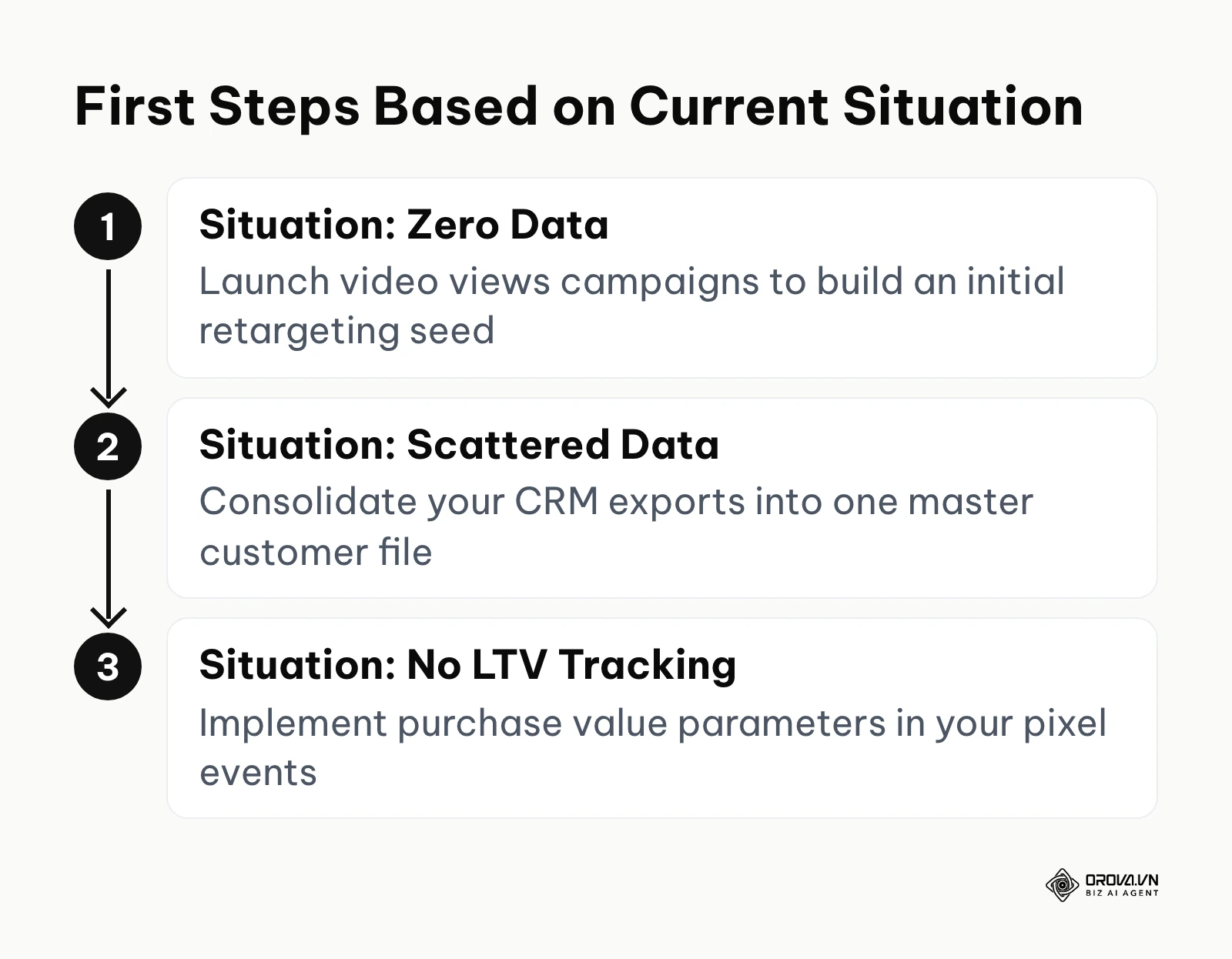
Jumping straight into complex, multi-tiered algorithmic targeting without a solid foundation will only result in wasted budget and frustration. Your first step depends entirely on the current state of your data infrastructure.
Situation: You Have Zero Historical Data
If you are launching a brand new business and have no customer list, do not attempt to guess or buy shady third-party email lists to use as a seed. Your first step is to run broad, low-cost video view campaigns or lead generation forms to build an initial pool of highly engaged users natively on the platform. Once that engaged audience is large enough to meet Meta's source requirements and reflects real interest, you can use it as your very first seed.
Situation: You Have Data, But It Is Scattered
If you have been operating for a while but your data is split between an old email platform, a messy CRM, and a broken website pixel, fix the data before scaling conversion ads. Your first actionable step, which you can complete in a single afternoon, is to export all historical buyers from every disconnected platform, consolidate them into one standardized spreadsheet, format the columns correctly, and upload it as a master customer list to serve as your definitive seed.
Situation: You Are Running Ads, But Not Measuring LTV
If you already use lookalikes based on standard pixel purchases, you are leaving money on the table by treating all buyers equally. Your immediate next step is to coordinate with your web developer to modify your standard events to pass dynamic purchase values back to the platform. By passing the exact dollar amount of every transaction, you upgrade your account's capability, allowing you to build value-based lookalikes that hunt for high-spenders rather than just casual shoppers.
About the author

Builder of Orova
Nguyễn Đỗ Trọng Ân has 8 years of experience in marketing, including 6 years managing market development across Asia. He builds Orova, a Biz AI Agent that never sleeps: it plans, runs and optimizes work for businesses.
Run your business with AI Agents
Orova is the always-on Biz AI Agent — it plans, runs, and optimizes the work for you.
Save time, unlock productivity.