
Facebook ad library guide: how to learn from competitor ads

Navigating the modern digital advertising landscape without understanding your competitors is a fast track to wasted budget. In the early days of social media marketing, you could often launch a basic image with a generic message and see positive returns. Today, advertising costs are rising, user attention is heavily fragmented, and the algorithms demand highly relevant content. When you type the phrase facebook ad library into your search bar, you are looking for more than just a directory of images; you are seeking a strategic advantage. The short answer: the Facebook Ad Library (officially the Meta Ad Library) is Meta's free, public archive of ads running across its apps, and the smartest way to use it is a short, repeatable weekly routine that turns what competitors run into your own test ideas, not into copies of their ads.
Many marketers approach competitor research the wrong way. They scroll aimlessly through active campaigns, find a visually appealing video, and try to copy its exact style. This surface-level imitation usually fails because it ignores the underlying strategy, the specific audience targeting, and the historical testing that led to that specific creative choice. This guide provides a systematic, highly structured approach to learning from competitor ads. You will learn how to look past the superficial design elements, extract the core psychological triggers driving their copy, and build a repeatable workflow that turns raw data into profitable campaign hypotheses.
What is the Facebook Ad Library and Why Does It Matter?
The Meta transparency database is a public, searchable archive provided by the platform that allows anyone to view ads currently running across Meta's apps, such as Facebook and Instagram. It matters because it provides unprecedented visibility into the exact messaging, visual formats, and structural strategies your direct rivals are paying to promote, allowing you to bypass expensive trial and error.
For media buyers, agency owners, and internal marketing teams, this database is a primary intelligence tool. It democratizes access to creative strategy. Before this tool existed, identifying what competitors were doing required relying on expensive third-party scraping tools or manually creating dummy accounts to trigger specific retargeting pixels. Now, the information is freely available and officially sanctioned.
However, it is crucial to understand who should not rely heavily on this tool. If you are a brand new business that has not yet established Product-Market Fit (the degree to which a product satisfies a strong market demand), spending hours analyzing competitor ads can be a dangerous distraction. You must first understand your own unique value proposition and your specific customer pain points. Copying a competitor when your underlying business mechanics are different will lead to misaligned messaging and poor conversion rates. This tool is best utilized when you have a functioning baseline and are looking to scale, optimize, or pivot your existing creative angles based on verified market trends.
As advertising costs rise, efficient creative testing matters more than ever. By studying the database, you let the market show you which approaches advertisers keep paying for, so you can learn the thinking behind them and build your own original concepts.
Preparation: What You Need Before You Start Researching
Before diving into the platform, you need a curated list of competitors, a clear understanding of your own core offers, and a structured system for logging data. This preparation ensures you collect actionable intelligence rather than just browsing aimlessly.
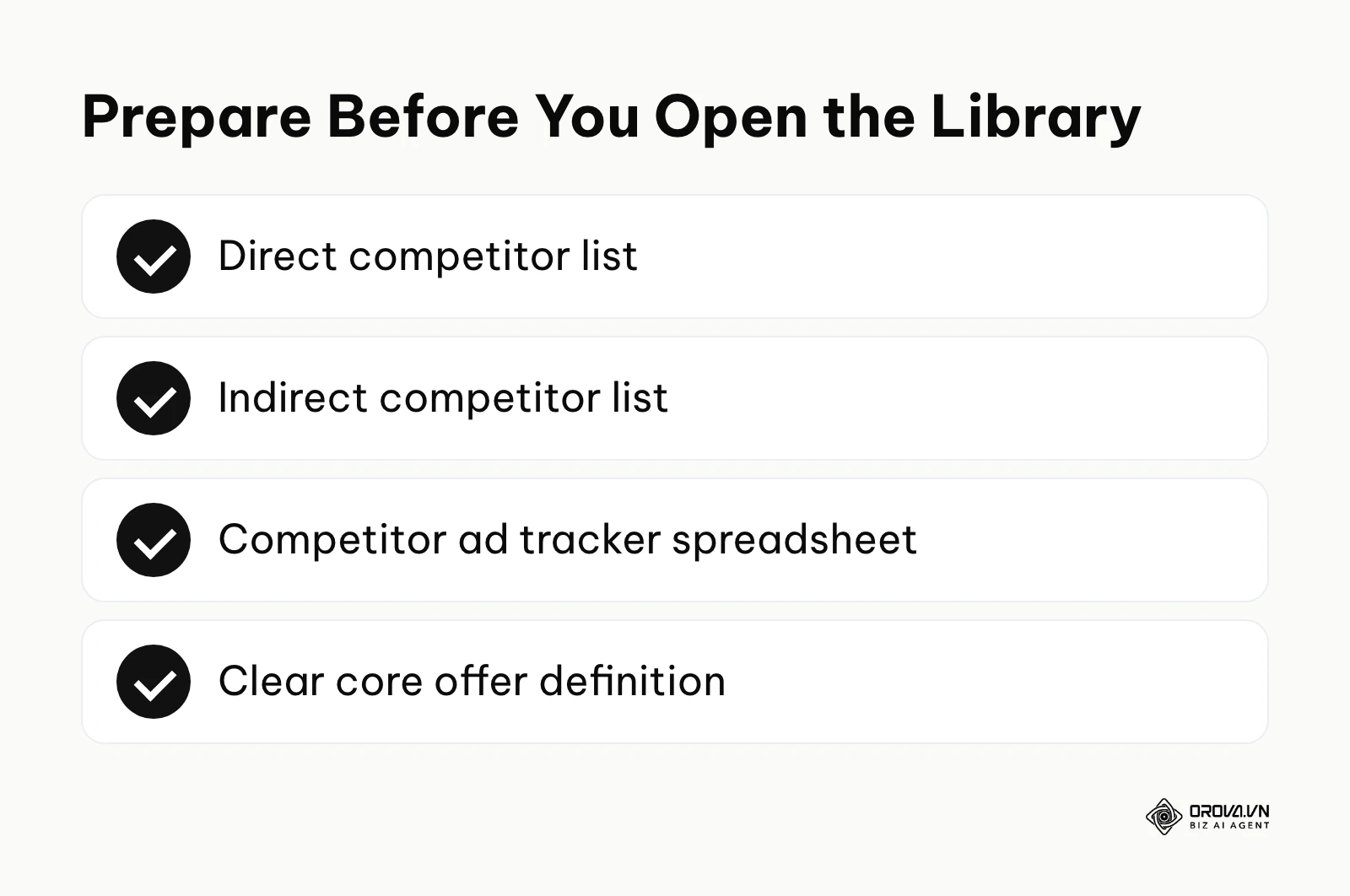
The most common error marketers make is opening the database without a plan. They type in a few famous brand names, look at the pretty pictures, and close the tab feeling inspired but lacking any concrete action steps. To perform a proper facebook ad library competitor analysis, you must treat the process as a structured data gathering exercise.
You need to prepare a dedicated environment to store your findings. Relying on memory or random screenshots saved to your desktop will lead to fragmented insights. You must set up a tracking document that forces you to categorize what you see into distinct psychological and structural components. Furthermore, you must clearly define what you are selling. If you do not have a firm grasp on your own product's features, advantages, and benefits, you will not be able to identify how your competitor's approach differs from yours.
Below is a breakdown of the specific elements you must prepare before you begin your research session.
| Preparation Item | Where to find it or create it | Estimated Time Required |
|---|---|---|
| Direct Competitor List | Search engines, industry reports, customer feedback | 20 minutes |
| Indirect Competitor List | Brands solving the same problem with different products | 20 minutes |
| Competitor Ad Tracker | A spreadsheet tool (Google Sheets or Excel) | 10 minutes |
| Core Offer Definition | Internal brand guidelines or sales documentation | 30 minutes |
Having these assets ready transforms the database from a simple gallery of images into a strategic diagnostic tool.
Step-by-Step Guide: The 15-Minute Competitor Analysis SOP
This standard operating procedure is a structured weekly workflow designed to quickly extract actionable insights from competitor advertisements. It involves filtering for long-running ads, analyzing the messaging components, and logging the data efficiently.
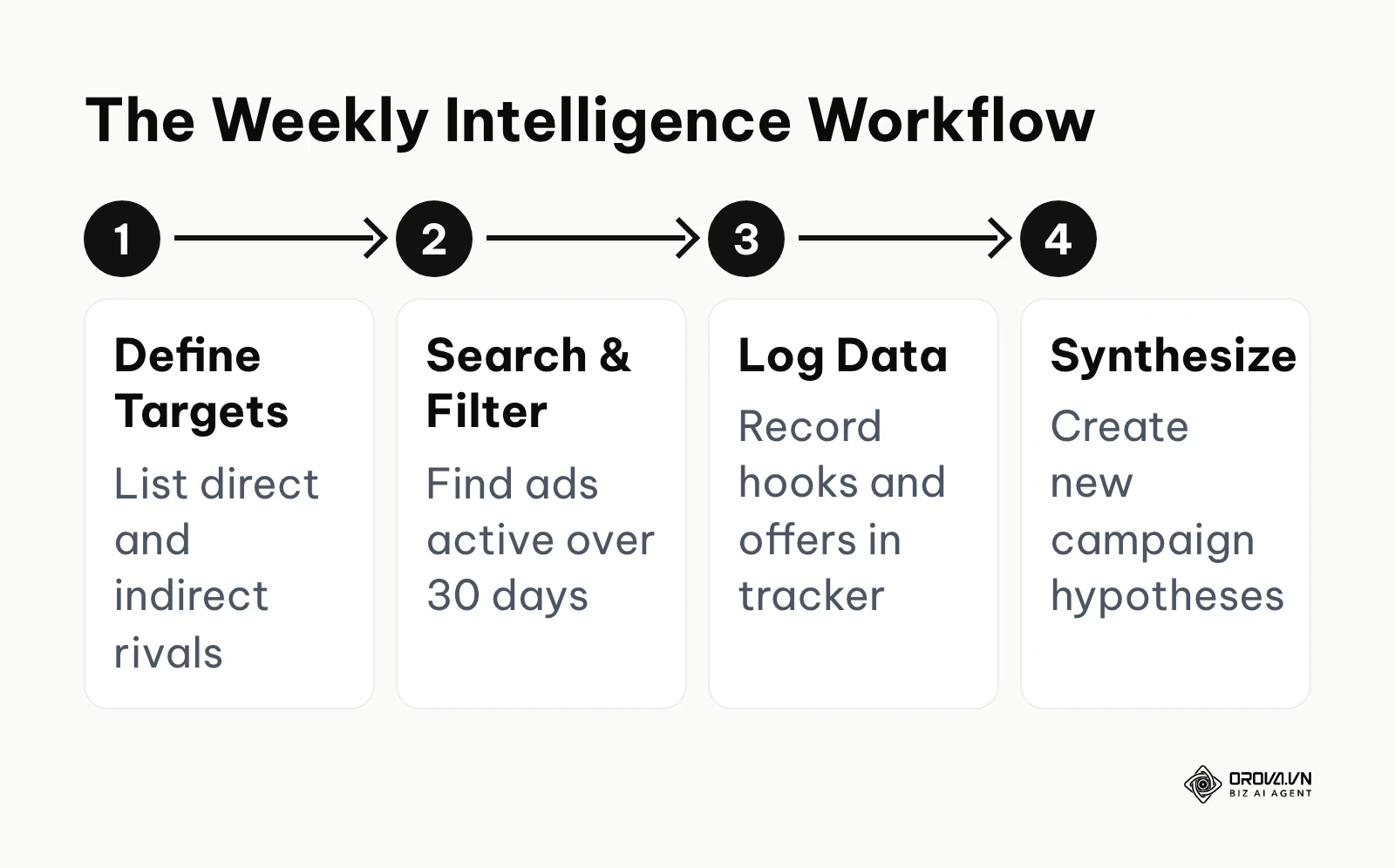
To avoid wasting hours scrolling through irrelevant variations, professional marketers use a strict Standard Operating Procedure (a set of step-by-step instructions compiled by an organization to help workers carry out routine operations). This specific workflow is designed to take no more than fifteen minutes per week once you have established your initial tracking document. The goal is consistency over intensity. Checking the database briefly but regularly yields far better intelligence than a single, exhaustive five-hour session every six months.
The steps below will guide you through the exact process of identifying, filtering, and deconstructing the campaigns that are actively shaping your industry.
Step 1: Define Your True Competitors and Benchmarks
You must begin by explicitly listing the entities you plan to monitor. Do not rely on remembering them on the fly. Open your tracking document and create a dedicated tab for your target list.
You should divide this list into three distinct categories. First, list your direct competitors. These are businesses that sell a nearly identical product or service to the exact same demographic. If you sell accounting software for small businesses, another company selling accounting software for small businesses is a direct competitor. Second, list your indirect competitors. These businesses solve the same underlying problem but use a different mechanism. For the accounting software example, a local bookkeeping agency is an indirect competitor. They are targeting the same pain point (financial management) but offering a service instead of software. Finally, list aspirational benchmarks. These are massive, highly successful companies outside of your immediate niche that are known for exceptional marketing. Studying them helps you spot broader macroeconomic advertising trends before they hit your specific industry.
The common mistake at this step is only looking at direct rivals. By studying indirect competitors and aspirational brands, you can borrow proven psychological angles and introduce them to an audience that has not seen them yet, giving you a distinct creative advantage.
Step 2: Navigate the Facebook Ad Library Interface Like a Pro
Once your list is ready, navigate to the official database website. The interface is relatively simple, but using the specific filters correctly is the difference between finding noise and finding gold. The ideas you collect here will later be built and launched inside Facebook Ads Manager, so keep your own account structure in mind while you search.
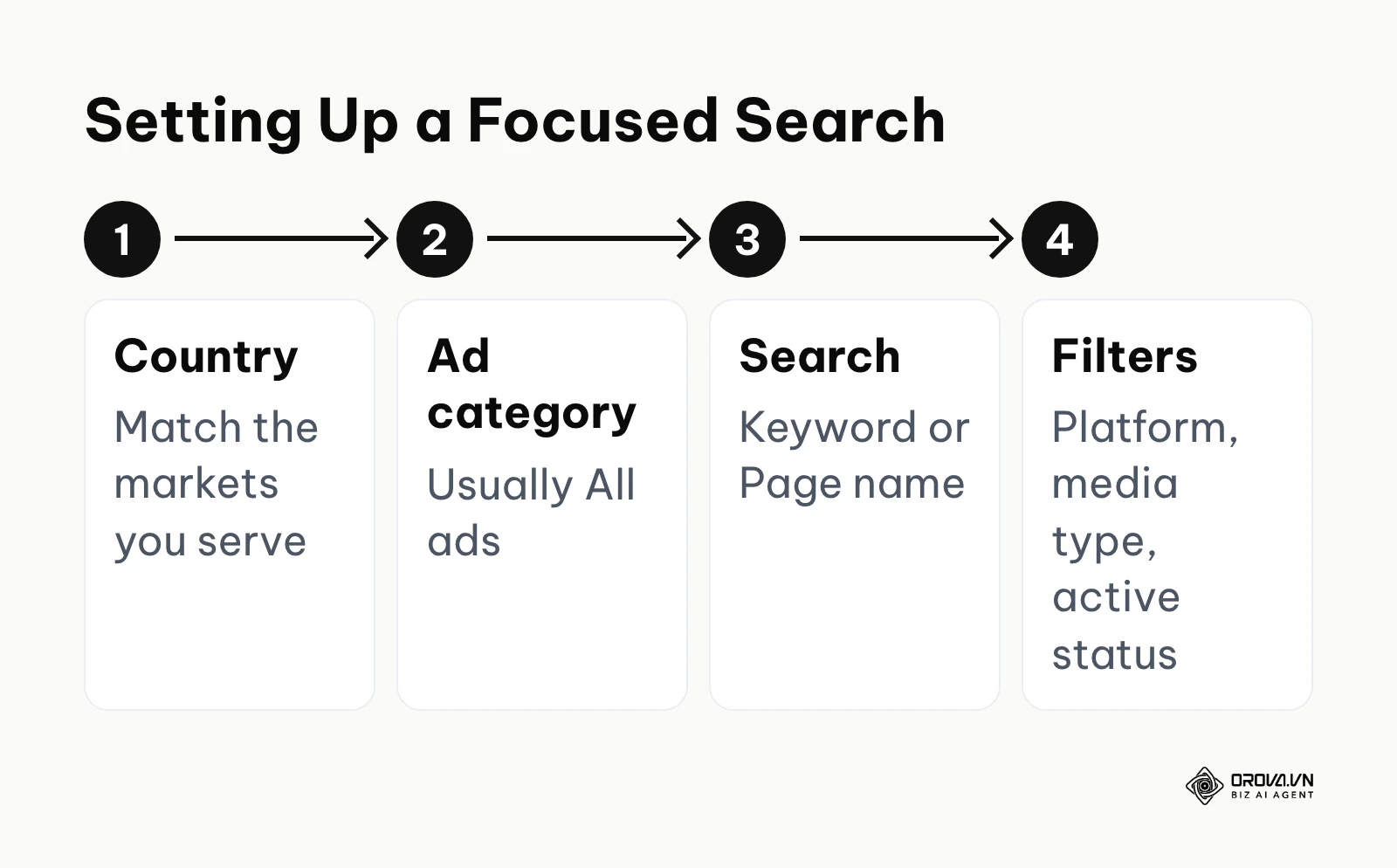
First, ensure you have the correct geographic region selected. If your business operates strictly in the United Kingdom, searching for global campaigns might yield messaging strategies that do not resonate with local cultural nuances. Second, select the ad category. For most commercial businesses, you will select "All ads"; the other main option covers issue, electoral or political ads, which carry extra disclosure details. If you operate in housing, employment or credit, remember that Meta's advertising policies apply special category restrictions to those ads, so a competitor's approach may not be available to you in the same form.
When searching, you can query by the specific Page name or by keyword. Searching by keyword is an excellent way to discover new, unknown competitors who are bidding on your core industry terms. When you search by Page name, make sure you are clicking on the verified, official page, as many large brands have multiple regional pages or franchise accounts. After searching, the filter panel lets you narrow results by options such as language, advertiser, platform (for example Facebook or Instagram), media type, active status and the date range in which ads were shown.
Step 3: Filter for Longevity to Find True Winning Ads
The most critical skill in competitor research is distinguishing between a brand new test and a proven, profitable winner. Since the platform does not reveal metrics like impressions, clicks, or cost per acquisition, you must use time as a proxy for profitability.
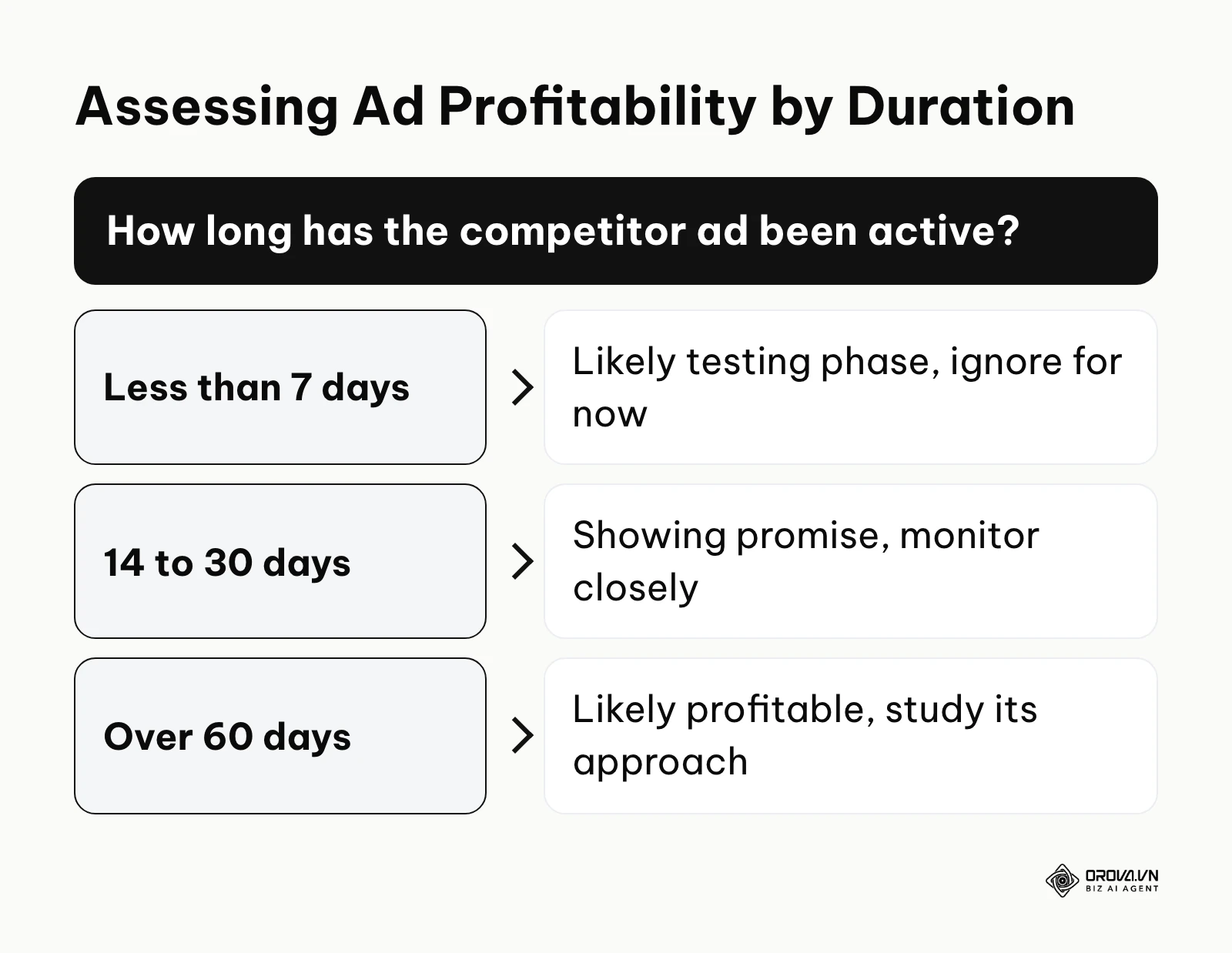
Each ad card in the database shows the date the ad started running, and some cards note that the ad has multiple versions. Set the campaigns launched in the last few days aside for now. These are likely initial tests. A business will often launch ten different variations, and after a week, they will turn off the nine that are losing money. Therefore, an advertisement that has been actively running for more than thirty or sixty days is highly likely to be profitable. No rational business continues to spend money on a campaign that does not generate a return for months on end.
Illustrative example: A regional home services agency acting as a localized provider for HVAC repair wanted to improve their lead generation. The marketing manager searched for national competitors in the library. They reviewed the active ads and noted only those whose start date was more than sixty days earlier. Initially, they found no long-running ads because competitors cycled creative images every month to prevent banner blindness. They fixed this by looking at the core offer text instead of the visual, noticing that the "Free Winter Inspection" angle was constantly active across dozens of different images over a three-month period. The team took the underlying idea, a low-risk first step for the customer, and built their own offer around their own service, resulting in a steady influx of qualified leads that were visibly trackable in their customer relationship management software.
Step 4: Extract and Log Data into the Competitor Ad Tracker
Finding a great concept is useless if you forget it the next day. You must log the specific details of the long-running ads into your structured tracking document immediately.
Your spreadsheet should contain specific columns designed to force you to analyze the ad, not just look at it. Do not just take a screenshot; break the ad down into its component parts.
Here is a recommended structure for your tracker.
| Date Found | Competitor | Primary Format | The Hook Angle | The Core Offer | Landing Page Link | Active Duration |
|---|---|---|---|---|---|---|
| 2026-10-01 | Brand A | Short Video | Question / Pain | 20% Off First Order | branda.com/offer | > 45 Days |
| 2026-10-08 | Brand B | Static Image | Bold Statistic | Free Consultation | brandb.com/consult | > 60 Days |
| 2026-10-15 | Brand C | Carousel | Feature Benefit | Free Shipping | brandc.com/shop | > 30 Days |
By filling out this table weekly, you will begin to see mathematical patterns. You might notice that Brand A has completely stopped running static images and shifted entirely to short-form video. This operational shift costs them money to execute, which means they likely have internal data proving video is more profitable for their specific audience. You can leverage their expensive learning curve.
Step 5: Analyze the Psychology Behind the Ad Copy
Copywriting is not about writing pretty words; it is about assembling psychological triggers in a specific sequence to provoke an action. You must deconstruct the competitor's text into four distinct phases: the Hook, the Body, the Offer, and the Call to Action.
The Hook is the first sentence of the text or the first three seconds of a video. Its only job is to stop the user from scrolling. Identify what type of hook the competitor is using. Are they asking a polarizing question? Are they stating a shocking statistic? Are they calling out a specific job title? Note this down.
The Body is where the logical argument or emotional appeal is built. Look for common frameworks. Are they using Problem-Agitate-Solve (identifying a pain point, making it feel worse, then introducing the product as the cure)? Are they using a heavy testimonial approach, relying on social proof?
The Offer is what the user actually gets in exchange for their click or money. Is it a discount, a free trial, a bundled package, or a valuable piece of educational content?
The Call to Action (CTA) is the specific instruction given at the end. Note if they use soft language like "Learn More" or direct language like "Buy Now." Learning how to build an ad testing process around these four variables will drastically improve your own creative success rate.
Step 6: Reverse-Engineer the Creative Strategy (Visuals and Formats)
The visual component of the advertisement often dictates the initial cost of acquiring attention. You must analyze the creative format critically, separating aesthetic preferences from functional performance.
If the competitor is running a video, watch it with the sound off. Does it still make sense? Most users browse on mobile devices in public spaces with their audio muted. Successful advertisers use heavy text overlays and clear visual demonstrations to convey the message silently. If the video is highly polished and produced in a studio, note that. If it looks like it was shot on a smartphone in a messy living room (user-generated content, covered in depth in our UGC ads playbook), note that as well. Often, the less polished, more authentic-looking content performs better because it blends natively into the social media feed rather than looking like a disruptive commercial.
If they are using static images, analyze the contrast and the focal point. Does the product stand out clearly against the background? Are there specific trust badges, like a five-star review graphic or an "As Seen On" banner, embedded directly into the image? These visual cues are deliberately designed to establish authority quickly.
Step 7: Map the Post-Click Experience (Landing Page Analysis)
The advertisement is only the first half of the equation. The click is meaningless if the destination fails to convert. A comprehensive facebook ads library tutorial must include analyzing where the advertisement sends the user.
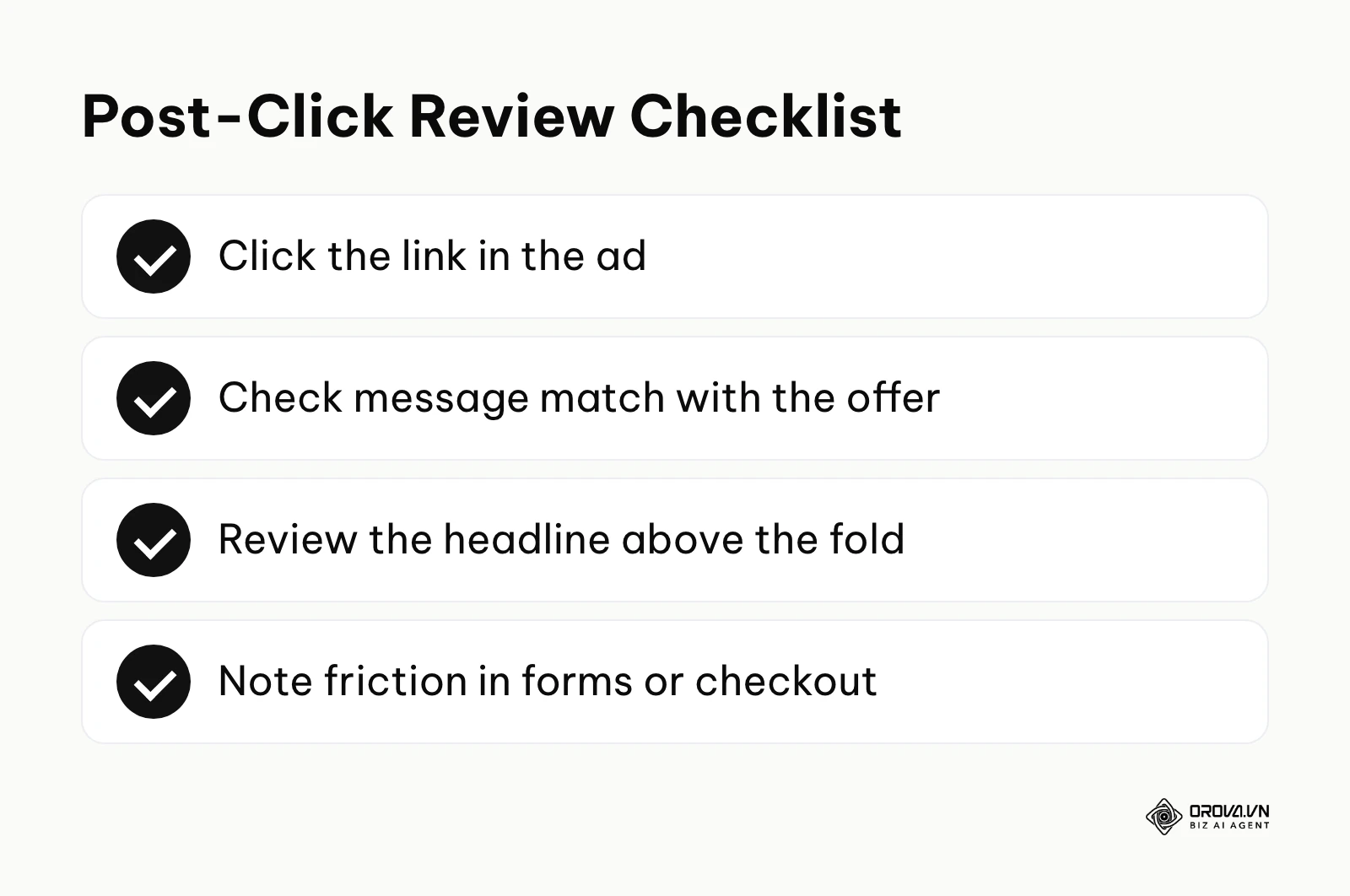
Always click the link in the competitor's ad. This requires you to step outside the database and analyze their web property. Check the "message match." If the ad promised a specific fifty percent discount on a blue shirt, does the landing page immediately show that blue shirt with the discount applied? If the user has to search for the product after clicking, the conversion rate will plummet.
Analyze the structure of their landing page above the fold (the area of a web page visible before scrolling). What is the main headline? What is the primary button? Do they require an email address immediately, or do they allow the user to browse freely? Look for friction points in their checkout or lead generation forms. By understanding their post-click strategy, you can identify weaknesses in their funnel that you can capitalize on in your own.
Step 8: Synthesize Findings into Actionable Campaign Hypotheses
The final step of the weekly procedure is taking the raw data logged in your spreadsheet and translating it into a concrete action plan for your own media buying efforts.
Do not attempt to change everything in your account at once based on one week of research. Instead, formulate a specific hypothesis. A hypothesis should be structured clearly: "Because I observed Competitor X running a video hook targeting beginners for 60 days, I believe that changing our current advanced technical hook to a beginner-friendly hook will lower our cost per click."
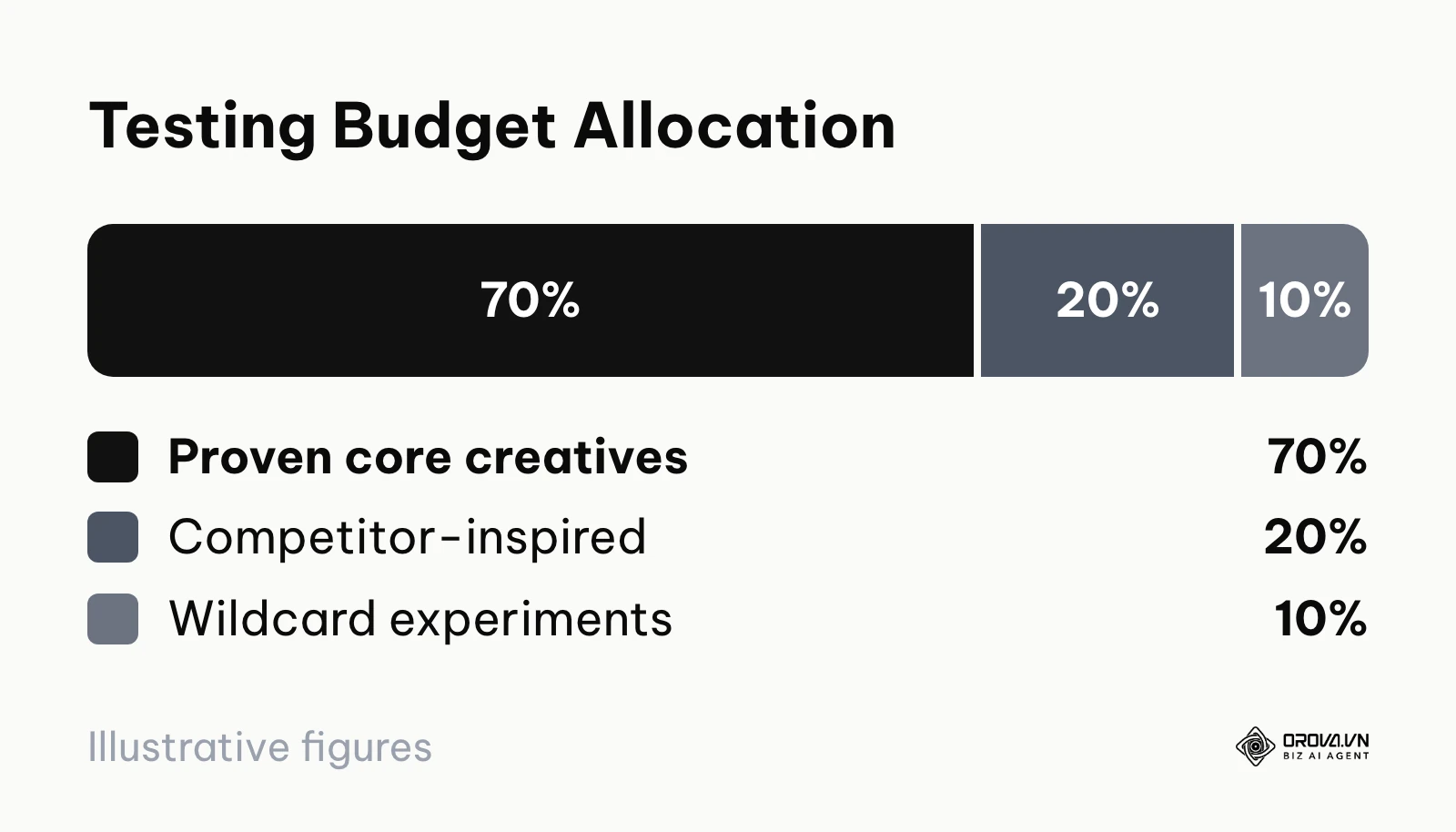
Once you have a hypothesis, you must allocate a specific portion of your budget to test it. This process ties directly into how you structure an ad campaign. A sound approach is to keep the majority of your budget on your proven creatives while setting aside a smaller percentage specifically for testing these new, competitor-inspired concepts. One illustrative split is about 70 percent on proven core creatives, 20 percent on competitor-inspired tests and 10 percent on wildcard experimental ideas; adjust it to your own risk tolerance. This protects your baseline revenue while still allowing for aggressive exploration.
OROVA ADS applies AI Agent to automate and optimize ad performance on Google, Meta and TikTok. Scale your budget safely, monitor 24/7 and expand your business quickly.
Experience the solution at orova.vn/ads
Deep Dive Analysis: Decoding Winning Ads vs. Money Pits
Distinguishing a profitable campaign from a failing one requires analyzing the duration the ad has been active and observing the variations the competitor is testing. A true winning ad typically runs for weeks without major structural changes while testing minor variables.
When a brand finds a winning concept, they rarely abandon it completely. Instead, they iterate. If you see a competitor running five versions of the same video, where the only difference is the color of the text overlay in the first three seconds, that is a massive signal. It means the core video is highly profitable, and they are now engaging in multivariate testing to squeeze out minor efficiency gains. Conversely, if a competitor launches a completely different visual style, new messaging, and a new offer every single week, they are likely struggling to find a baseline that works. This frantic testing often indicates a "money pit"—a campaign style that is burning cash without generating a return.
Different research methodologies yield different levels of insight.
| Analysis Method | Best used when | Core Weakness |
|---|---|---|
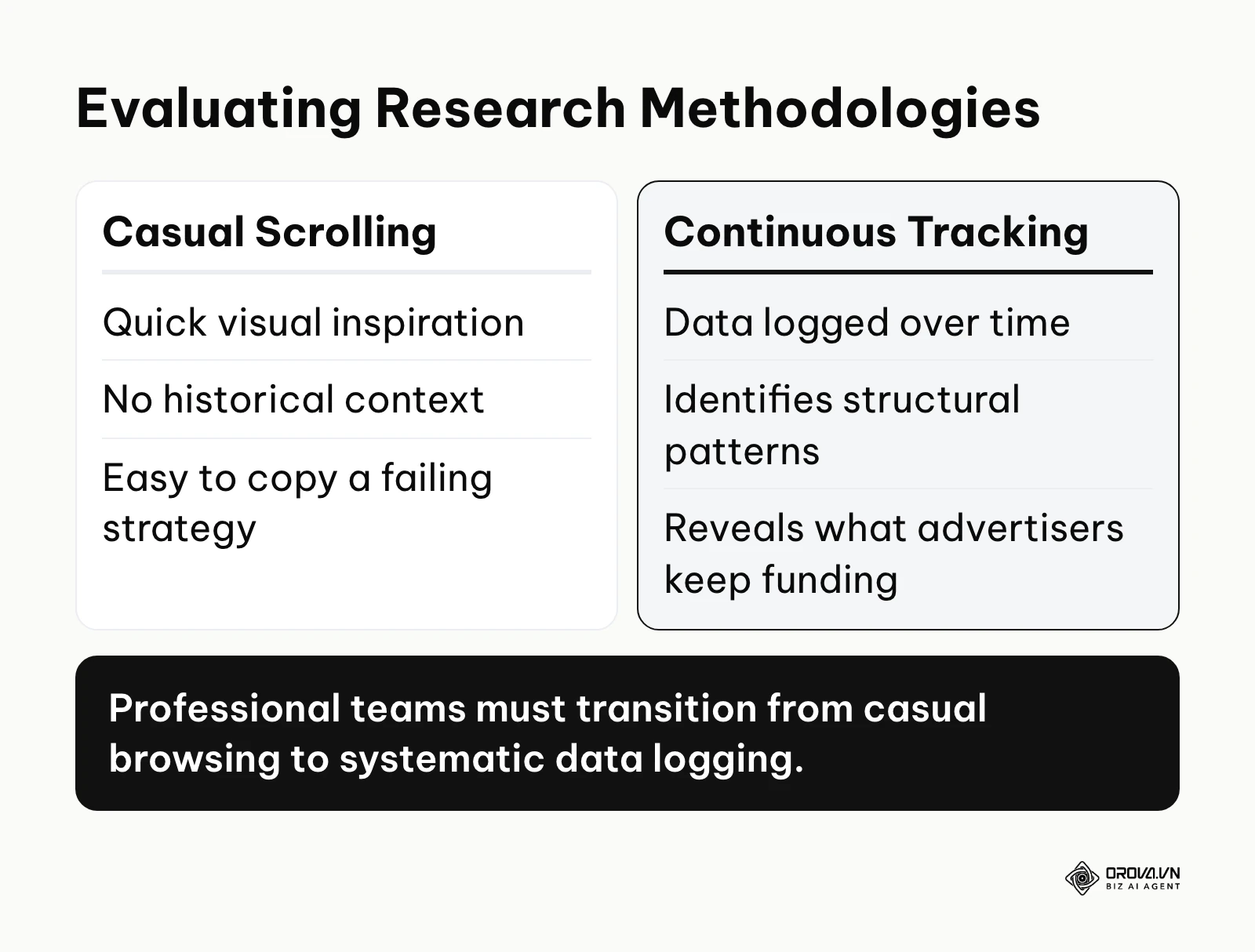
| Casual Scrolling | Seeking quick design inspiration before a brainstorm | Lacks context; easy to copy a failing strategy |
| Point-in-Time Review | Launching a brand new product to see current market state | Does not show the evolution or optimization process |
| Continuous Tracking | Managing significant budgets and needing ongoing intelligence | Time-consuming; requires strict discipline to maintain |
Illustrative example: A small internal marketing team was managing lead generation for a direct-to-consumer online education brand. They used the continuous tracking framework to compare three rival course creators. They charted the placement strategies and noted that rivals were heavily favoring long-form text ads in the main feed over short videos. They closely mirrored a competitor's long-form structure, but their campaign failed to gain traction and received poor feedback. They realized the competitor's ad relied heavily on a recognizable industry influencer to hold attention through the long text. They fixed this by adapting the long-form structure to be deeply educational, teaching a micro-skill directly in the ad text rather than relying on personality. The revised campaign generated a steady flow of highly qualified email sign-ups, and users frequently mentioned how helpful the initial advertisement was during sales calls.
Measuring Success: How to Know Your Competitor Analysis Paid Off
You can determine the success of your research by tracking specific engagement and conversion metrics against a historical baseline. If your new creative concepts lower the cost of acquiring a customer, the analysis was effective.
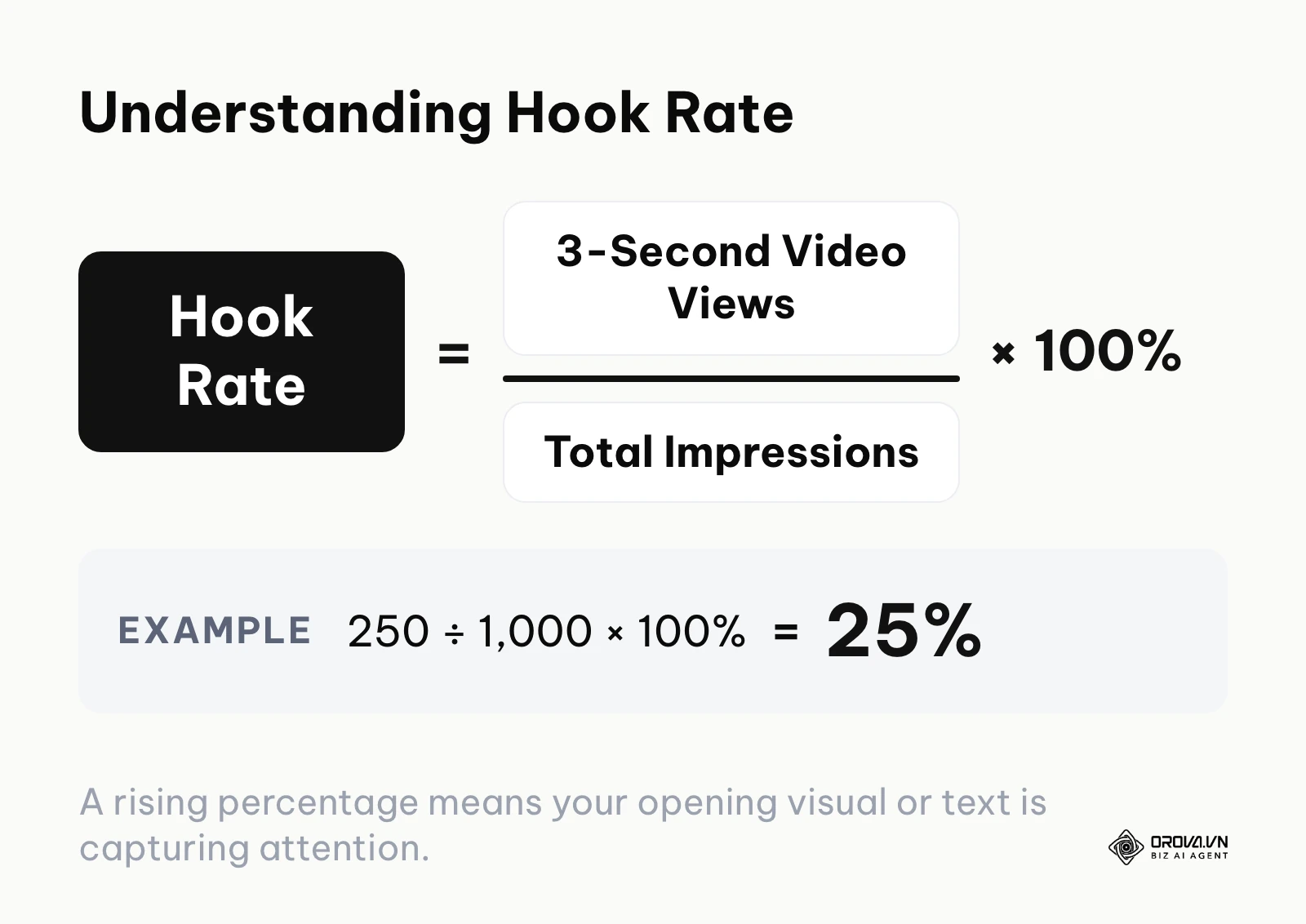
Implementation without measurement is just guesswork. After you launch a new campaign based on your research, you must monitor its performance rigorously. The most critical metric at the top of the funnel is the Hook Rate (often measured as the percentage of people who watch the first three seconds of a video divided by total impressions). For example, 250 three-second views from 1,000 impressions gives a hook rate of 25 percent. If your research led you to test a new question-based hook and your hook rate rises clearly above your previous baseline, you know the psychological angle captured attention.
However, attention does not equal revenue. You must track the user journey all the way through the funnel. Monitor your Click-Through Rate (CTR) to see if the body copy is compelling enough to drive traffic. Most importantly, track your Cost Per Acquisition (CPA). Reading your ad performance metrics properly ensures you do not optimize for cheap clicks that never convert. If a competitor-inspired ad generates highly expensive clicks but those users convert at a massive rate, the high initial cost is justified.
| Metric | Business Meaning | Worrying Threshold |
|---|---|---|
| Hook Rate | How effectively the first impression grabs attention | Consistently dropping below your own historical baseline |
| Outbound CTR | The percentage of viewers compelled to leave the platform | Falling while impressions and spend stay flat |
| Cost Per Acquisition | The true financial cost to generate one desired action | Exceeding the established break-even margin |
Illustrative example: A dedicated media buyer was working for a business software startup targeting enterprise clients. The buyer established a strict baseline cost per lead based on historical data. They deployed three new creative angles inspired by the approaches behind long-running competitor ads in the transparency database and tracked the early engagement metrics daily. The initial traffic volume was exceptionally high, but the sales team reported that lead quality was poor because the new hook was too sensational and attracted small business owners instead of enterprise clients. They fixed this by keeping the visual format but narrowing the ad copy to specifically call out the enterprise job title ("VP of Operations") in the very first sentence. The specific targeting adjustment brought in fewer total clicks, but the sales team reported a noticeable shift toward highly relevant, pipeline-ready conversations, ultimately lowering the final cost per qualified opportunity.
Want to scale your budget but afraid of breaking performance? 📉
Integrate OROVA ADS now - an AI Agent that automatically monitors and optimizes Google, Meta, TikTok ads 24/7. Now, expanding and replicating your Performance Ads team is just one click away.
🚀 Try it now at: orova.vn/ads
Common Mistakes When Using the Facebook Ad Library
The most frequent errors include blindly copying competitor creatives without understanding their strategy and failing to analyze the corresponding landing pages. These mistakes often lead to wasted budget and disconnected customer journeys.
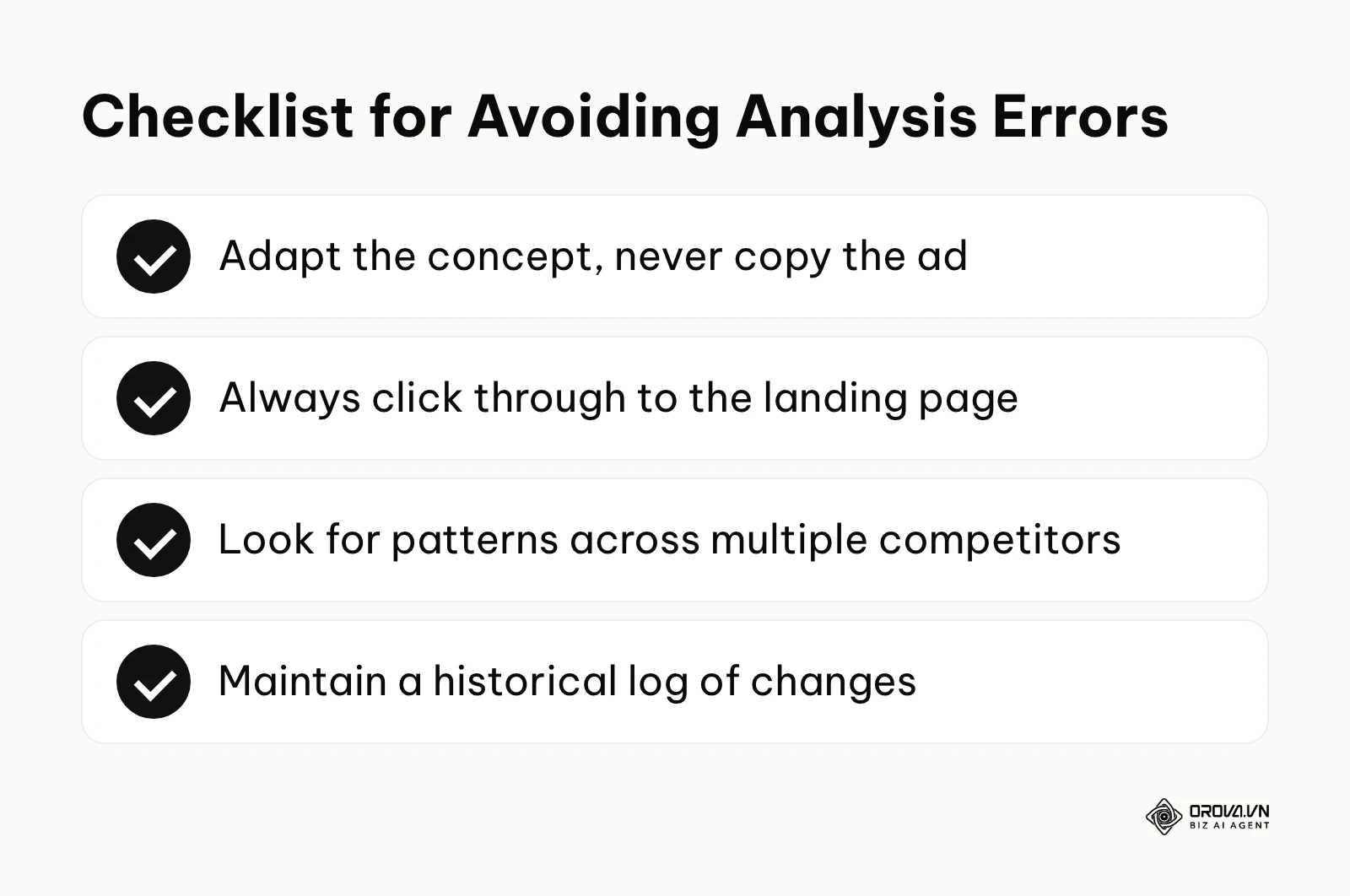
The first major mistake is plagiarism. Lifting a competitor's exact wording or duplicating their specific graphic design is not only unethical and potentially illegal, but it is also strategically foolish. Your business has a different backend, different profit margins, and a different brand voice. When you copy exactly, you adopt their weaknesses along with their strengths. Instead, abstract the concept. If they use a customer story about saving time, you should also use a customer story, but focus on the specific metric your software improves.
The second mistake is ignoring the broader context of the account. You might see a highly successful retargeting ad that simply says, "Forgot to check out? Here is 10% off." If you launch that ad to a cold audience who has never heard of your brand, it will fail miserably. You must use logical deduction to estimate where an ad sits in the funnel based on its messaging. Ads explaining basic concepts are likely top-of-funnel; ads offering urgent discounts are likely bottom-of-funnel retargeting.
The third mistake is checking the database obsessively every single day. The advertising ecosystem does not move that fast. Checking daily leads to micro-managing your own campaigns. You might see a competitor launch a new ad on Tuesday, panic, and change your own strategy on Wednesday, interrupting your platform's learning phase. Stick to the weekly 15-minute SOP to maintain a strategic distance.
The fourth mistake is assuming that massive brands know exactly what they are doing. Often, large corporations have massive budgets dedicated solely to "brand awareness." They can afford to run campaigns that lose money on direct attribution just to keep their logo visible. If you are a small business attempting to mimic a Fortune 500 company's vague, artistic branding campaign, you will likely burn your limited direct-response budget quickly. Always look for competitors who have a similar financial structure to yours.
The fifth mistake is neglecting the technical infrastructure. You can have the best ad creative in the world, inspired by flawless research, but if your backend tracking is broken, the algorithm cannot optimize delivery. Understanding the basics of implementing facebook pixel tracking is mandatory. Without accurate data feeding back into the system, the platform does not know who your ideal customer is, rendering all your creative research useless.
Future Trends of Competitor Analysis in Paid Media: My Perspective
In the coming years, competitor analysis will shift heavily toward artificial intelligence pattern recognition and cross-channel strategy mapping. I believe marketers will need to focus more on underlying psychological triggers rather than surface-level visual trends.
The era of manual, spreadsheet-based data entry is likely coming to an end. The automation of creative deconstruction is the first major trend I observe gaining traction today. As of 2026, we already see tools capable of scraping visual data, but I believe the next few years will bring widespread adoption of AI systems that can automatically ingest hundreds of competitor ads and output structural insights. These systems will not just say "they use red backgrounds"; they will identify that "this competitor uses a fear-based hook followed by a logical pricing argument." Consequently, marketers must prepare by elevating their skills from data gathering to strategic interpretation. If a machine can tell you what the competitor is doing, your value lies in knowing what to do with that information.
Cross-platform strategy mapping is the second shift I expect. Currently, many buyers look at Meta in isolation, even though campaigns that tell a consistent story across several touchpoints tend to feel more coherent to buyers. I believe that analyzing a brand's Meta presence will soon be deeply integrated with analyzing their search intent capture on Google and their organic viral velocity on TikTok. Advertisers who understand how a competitor sequences a story across different platforms will likely hold an advantage over those who only look at one database. You should begin mapping your competitors' entire digital footprint today, noting how their messaging shifts depending on the platform's context.
Finally, privacy-first intelligence gathering will become the standard. As platforms restrict the amount of granular targeting data available to advertisers, creative becomes the primary targeting mechanism. I suspect that analyzing competitor creative will shift from being a "growth hack" to being the fundamental foundation of audience definition. When you can no longer target users by their specific interests, the words and images you use must do the filtering for you. Marketers would do well to strengthen their copywriting frameworks now, because in a privacy-restricted future, your ad copy may act as much of your targeting.
Frequently Asked Questions About Facebook Ad Library
Users frequently ask about finding exact conversion metrics, maintaining privacy while browsing, and understanding why certain advertisements are hidden. These questions highlight the limitations and operational realities of the transparency database.
How can I find the exact conversion numbers for a competitor's ad?
You cannot find exact conversion data, click-through rates, or return on ad spend within the public transparency database. For regular commercial ads, the clearest public signal is the date the ad started running; spend and impression ranges are disclosed mainly for issue, electoral or political ads. You must rely on the longevity principle discussed earlier—using the active duration of an ad as a proxy to estimate its profitability.
Will my competitors receive a notification when I view their campaigns?
No, the database is completely anonymous. Competitors are not notified when you search for their brand, view their active campaigns, or click on their links within the library interface. It functions essentially as a public search engine for advertising assets. You can conduct deep research without alerting your rivals to your activities.
How does AI change the way we analyze the Facebook Ad Library?
Artificial intelligence significantly accelerates the synthesis of data. While the database itself remains a manual search tool, marketers are increasingly using AI to analyze the text they extract. For instance, you can paste the text from several competitor ads you logged into a large language model and ask it to summarize the recurring psychological themes, then write original messages for your own product based on those themes rather than reworded versions of their ads. AI shifts the bottleneck from data processing to strategic execution.
Why are some active ads I saw in my feed not showing in the library?
There are several reasons an ad might not appear immediately. First, a campaign launched very recently may not be indexed yet, so check again later. Second, dynamic creative configurations—where the system automatically mixes and matches headlines, images, and text based on the user—sometimes display uniquely in the feed and are aggregated differently in the library. Finally, ensure you have selected the correct geographic region and category filters, as overly restrictive filters will hide active campaigns.
Where Should You Start?
Your starting point depends entirely on your current level of experience and the specific challenges your campaigns face. Beginners should focus on building a basic tracking habit, while experienced buyers should refine their analytical frameworks.
If you are an overwhelmed beginner struggling to launch your first profitable campaign, your immediate action should be establishing a baseline understanding of your industry's visual language. Spend one focused hour this week finding five direct competitors. Do not worry about advanced copywriting frameworks or cross-platform mapping yet. Simply create the tracking spreadsheet, log the primary visual formats (image vs. video), and note the primary offer (e.g., 10% off vs. free shipping). Your goal is merely to avoid launching an ad that looks completely alien to your target market.
If you are an experienced buyer stuck in a rut with declining return on ad spend, your priority is uncovering new psychological angles. Your creatives have likely suffered from ad fatigue. Stop looking at your direct competitors, as you are likely already operating in an echo chamber. Instead, identify three aspirational brands in completely different industries that target a similar demographic. Spend your session specifically dissecting their "Hook" structures. Extract the conceptual angle—whether it is a contrarian statement, a unique statistical breakdown, or a specific storytelling format—and adapt that precise psychological trigger to your own product's messaging.
If you are an agency owner building a process for your team, your first step is standardizing the data collection. You cannot manage what you do not measure uniformly. Create a strict template for the Competitor Ad Tracker and record a five-minute internal video demonstrating exactly how you expect your media buyers to extract and log the data. Make this 15-minute analysis a mandatory recurring calendar event every Monday morning. By systematizing the research, you ensure your agency's creative strategy is continuously fueled by objective market data rather than subjective internal brainstorming.
About the author

Builder of Orova
Nguyễn Đỗ Trọng Ân has 8 years of experience in marketing, including 6 years managing market development across Asia. He builds Orova, a Biz AI Agent that never sleeps: it plans, runs and optimizes work for businesses.
Run your business with AI Agents
Orova is the always-on Biz AI Agent — it plans, runs, and optimizes the work for you.
Save time, unlock productivity.