
What are Facebook video ads? A complete 2026 scaling guide

Are you struggling to capture your target audience's attention as they scroll mindlessly through their crowded social feeds? You might be pouring thousands of dollars into static image campaigns, only to watch your click-through rates plummet month over month. The old digital playbook of pairing a generic stock photo with a witty caption is simply no longer sufficient to stop the scroll.
This is exactly where facebook video ads come into the picture, offering a dynamic and highly engaging way to connect with potential customers. Modern consumers demand entertainment and immediate value before they consider clicking a link or making a purchase. In this comprehensive guide, we will break down exactly how to structure your creative scripts, outline the critical technical specifications for 2026, and provide a foolproof setup workflow. Our primary goal is to equip you with the knowledge to stop wasting your advertising budget on static assets that do not convert, helping you build highly profitable campaigns instead.
What are Facebook video ads?
Facebook video ads are paid promotional content formats on Meta's network that use motion, sound, and text to capture user attention. They are used to build brand awareness or drive direct sales, differing from static image ads by offering dynamic storytelling capabilities and requiring higher technical production effort.
Video has been part of Meta's ad system for years, and the format has changed a lot since it first appeared. We have moved from silent, auto-playing clips buried in the desktop feed to highly immersive, full-screen vertical experiences complete with interactive elements. Delivery now leans toward creatives that keep people watching, so a stronger video often reaches more people for the same budget.
To fully understand the landscape, we must distinguish this format from other popular digital marketing channels. The table below highlights the core differences you need to consider before allocating your budget.
| Concept | Key difference | Example |
|---|---|---|
| Facebook video ads | Prioritizes silent viewing and fast-paced hooks. | A local bakery showing a 10-second silent clip of chocolate pouring over a cake. |
| YouTube Pre-roll | Requires audio and caters to a captive, longer-attention audience. | A two-minute software tutorial playing before a related marketing vlog. |
| TikTok In-feed | Demands native, raw, and highly trend-driven creator styles. | A teenager dancing while pointing to floating text about a skincare product. |
Consider a local bathroom renovation company. A static photo of a finished bathroom simply blends into a busy newsfeed. A short clip that turns a cramped, outdated bathroom into a bright new one in under ten seconds triggers curiosity and makes the viewer far more likely to tap the "Get Quote" button.
Why they matter
The primary problem these campaigns solve is the severe scarcity of human attention in the modern digital age. People scroll through their social feeds at a blistering pace, experiencing severe "ad blindness" to anything that looks like a traditional corporate banner. Motion creates a pattern interrupt, forcing the brain to pause and process the visual stimuli before moving on. That is why motion usually holds attention longer than a static image in the same feed.
In the broader picture of your marketing strategy, these assets fit perfectly at every stage of the customer journey. At the top of the funnel, they excel at generating cheap, widespread awareness by introducing your brand to completely cold audiences. In the middle of the funnel, they serve as powerful retargeting tools, reminding users who previously visited your website about the specific products they left in their shopping cart.
If you completely ignore this shift in consumer behavior, you risk facing steadily increasing acquisition costs. Your competitors who adopt motion formats will build trust faster, explain their value propositions more clearly, and ultimately steal your market share by creating stronger emotional connections with your ideal customers.
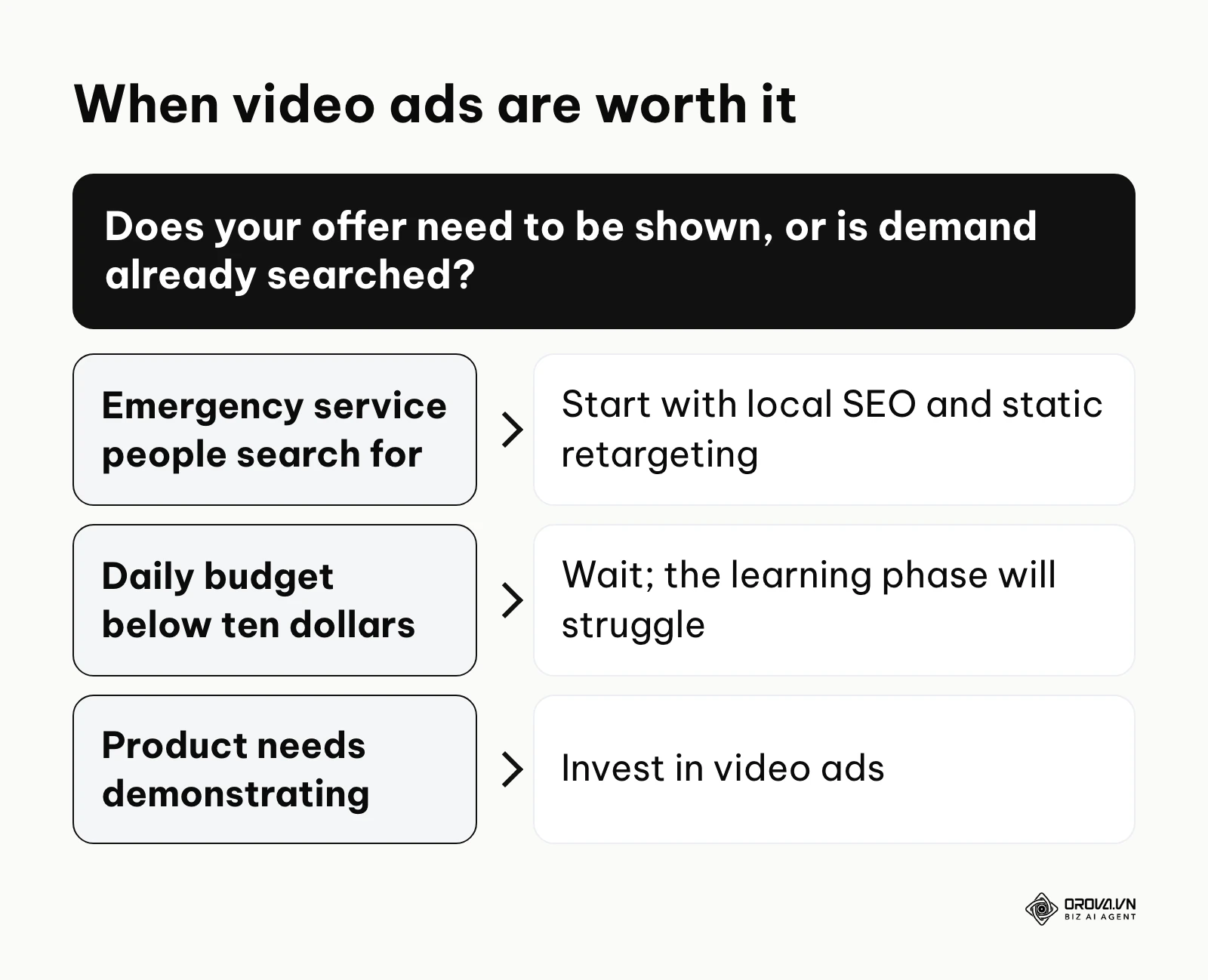
The decision matrix below summarizes when video ads are worth it and when they can wait.
When you don't need them yet: You should pause on video creation if your core offer is a highly commoditized emergency service, such as immediate plumbing repairs or locksmithing, where direct search intent captures demand much better than social interruption. Additionally, if your total daily budget falls below ten dollars, the algorithmic learning phase will struggle to optimize dynamic delivery efficiently. In these specific scenarios, prioritizing local search engine optimization or deploying basic static image retargeting will yield a significantly better return on investment.
Value and benefits
Deploying motion-based campaigns offers two distinct layers of value: tangible business outcomes and immediate operational benefits. For the business, the primary value lies in risk mitigation and financial scaling. By testing multiple creative angles quickly, companies can identify winning messages before exhausting their quarterly marketing budgets.
For the operators, the individuals actually building and managing the campaigns daily, the benefits revolve around efficiency and communication clarity.
Breaking down complex product messaging
One of the greatest struggles for marketers is explaining a complicated or innovative product in a single image. Text-heavy banners look cluttered and are hard to read on a small screen. Motion allows you to demonstrate functionality in real-time, removing confusion and overcoming purchase objections before the user even clicks the link.
Illustrative example: As the e-commerce manager for an ergonomic office furniture brand, you need to explain how a new chair supports the lower back dynamically. You decide to film a 3D rotation of the chair and add text overlays explaining the advanced lumbar support feature. However, the initial launch fails miserably because the clip starts too slowly, and viewers scroll past before ever reading the first text prompt. You fix this by editing the timeline to start immediately with a tight close-up of a person rubbing their sore back in agony, followed instantly by the chair's soothing solution. As a result, you see the daily order volume for that specific premium chair jump from two units to fifteen units within a single week.
Building instant social proof
Consumers are inherently skeptical of brand claims. They trust other humans far more than they trust corporate logos. Integrating customer testimonials into your assets provides immediate social proof, validating your product's effectiveness through authentic voices and recognizable faces.
To effectively measure these advantages, you must track specific performance indicators. The table below outlines the core benefits, the metrics used to track them, and the expected timeline for visible results.
| Benefit | Metric to measure | Time to see results |
|---|---|---|
| Cheaper audience reach | Cost Per Mille (CPM) | First few days |
| Higher engagement depth | ThruPlays (views of 15 seconds or the full video if shorter) | First week |
| Improved conversion efficiency | Cost Per Acquisition (CPA) | Several weeks |
OROVA ADS applies AI Agent to automate and optimize ad performance on Google, Meta and TikTok. Scale your budget safely, monitor 24/7 and expand your business quickly.
Experience the solution at orova.vn/ads
How they work
Understanding the mechanics of these campaigns requires breaking them down into actionable components. A successful campaign is not just a good piece of art; it is a highly engineered machine designed to trigger specific psychological responses and satisfy algorithmic delivery rules.
We must dissect the technical requirements, the storytelling structures, the real-world applications, and the actual software configuration process. If any one of these structural pillars is weak, your advertising budget will be consumed without generating meaningful pipeline or revenue.
The technical specifications cheat sheet
Before you ever write a script or turn on a camera, you must understand the canvas you are painting on. Creating a beautiful, cinematic landscape shot is entirely useless if the platform automatically crops the edges out, hiding your primary call to action. Meta’s algorithm heavily favors assets that feel native to the specific placement where they are being displayed. Meta's own creative guidance recommends vertical video for mobile placements, because it fills more of the screen.
The table below keeps only the aspect ratios Meta recommends in its Ads Guide. Length limits and file limits change from time to time, so check the current Ads Guide for each placement before you export.
| Placement type | Recommended aspect ratio | Practical requirement |
|---|---|---|
| Facebook Feed (mobile) | 4:5 or 1:1 | Keep the most important action centered so the interface does not cover it. |
| Stories & Reels | 9:16 (vertical) | Keep text and logos away from the top and bottom edges, where profile info and buttons sit. |
| In-stream video | 16:9 (landscape) | Make sure the message still works when the ad plays inside someone else's video. |
Three script frameworks that actually convert
A common fatal mistake is turning on a camera and speaking freely about how great your company is. The cold audience does not care about your company history; they only care about how you can solve their immediate problems. To reliably capture attention, you must use proven psychological scripting frameworks.
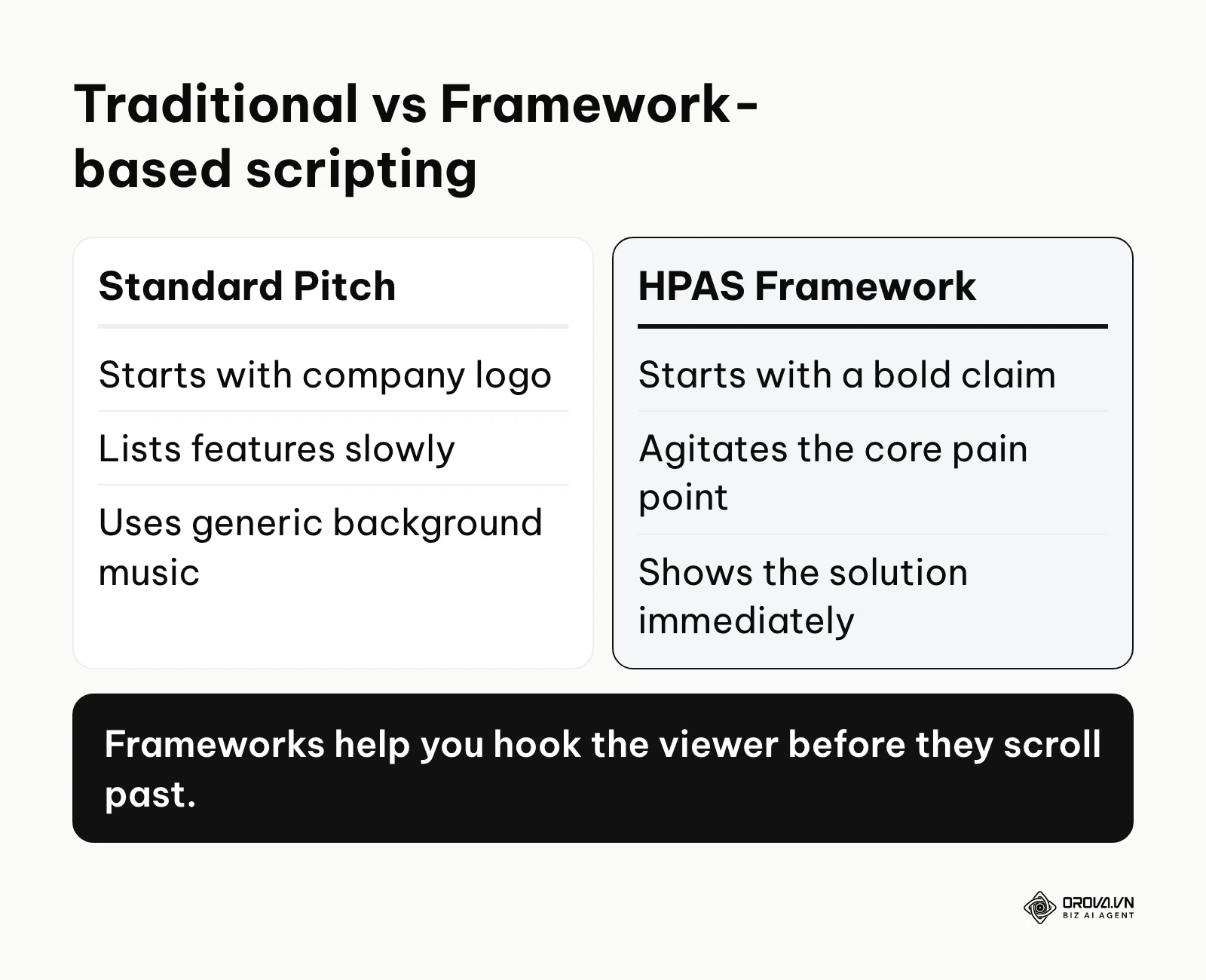
The comparison below highlights why structured frameworks outperform improvised pitches.
Here are three highly effective frameworks you can adapt for your business immediately:
- The HPAS Framework (Hook, Problem, Agitate, Solution)
This is the most reliable structure for cold traffic. You start with a jarring visual or statement (Hook; see these TikTok hook examples for openers that also work in Reels). You name the exact issue the viewer is facing (Problem). You explain how terrible life is if they do not fix it (Agitate). Finally, you introduce your product as the obvious savior (Solution).
- The Testimonial Sandwich
This framework relies entirely on borrowed credibility. You open with a highly enthusiastic customer delivering a shocking result claim. Next, the brand voice steps in to explain the technical features that made the result possible. Finally, you close with another customer summarizing their overall satisfaction. This is incredibly potent for middle-of-funnel retargeting audiences who are still on the fence.
- The Feature-Benefit-Proof Structure
Best used for highly technical or B2B products, this framework is relentlessly logical. You state a specific feature clearly. You immediately translate that feature into a tangible emotional or financial benefit for the user. You then follow up with undeniable statistical proof or a rapid on-screen demonstration validating the claim.
Case study teardowns
The three teardowns below are illustrative composites of patterns you can spot again and again when browsing the Meta Ad Library. Brands and results are not named, so treat them as models to study, not as reported case data.
Teardown 1: The fitness app A home workout app runs a campaign utilizing a split-screen format. The left side shows a chaotic, crowded gym, while the right side shows a calm user working out in their living room. The hook is entirely visual, requiring no sound to understand the contrast. The text overlay simply reads, "Skip the commute." This works flawlessly because it instantly agitates a universally understood pain point without requiring the user to turn their volume up.
Teardown 2: The B2B SaaS tool A project management software company utilizes the Feature-Benefit-Proof structure brilliantly. They open with a frustrated office worker drowning in sticky notes. The screen rapidly transitions to their sleek digital dashboard organizing tasks automatically. The voiceover states, in one sentence, how much time the team gets back each week. The pacing is intentionally fast, preventing the professional viewer from losing interest during their brief lunch break scroll.
Teardown 3: The e-commerce apparel brand An outdoor clothing company abandons professional studio lighting entirely. Instead, they run raw, shaky smartphone footage of a customer pouring a bucket of water over their new waterproof jacket. The water beads and rolls off instantly. There is no background music, just the authentic sound of splashing water. This raw demonstration builds trust because it feels like organic, unfiltered content rather than a polished corporate advertisement.
Step-by-step campaign setup workflow
Even with a perfect script and flawless technical execution, improper configuration within the advertising platform will ruin your performance. The interface is notoriously complex and frequently updated, requiring strict adherence to a logical setup sequence. Before diving into the platform, make sure you are comfortable navigating the Facebook Ads Manager effectively.
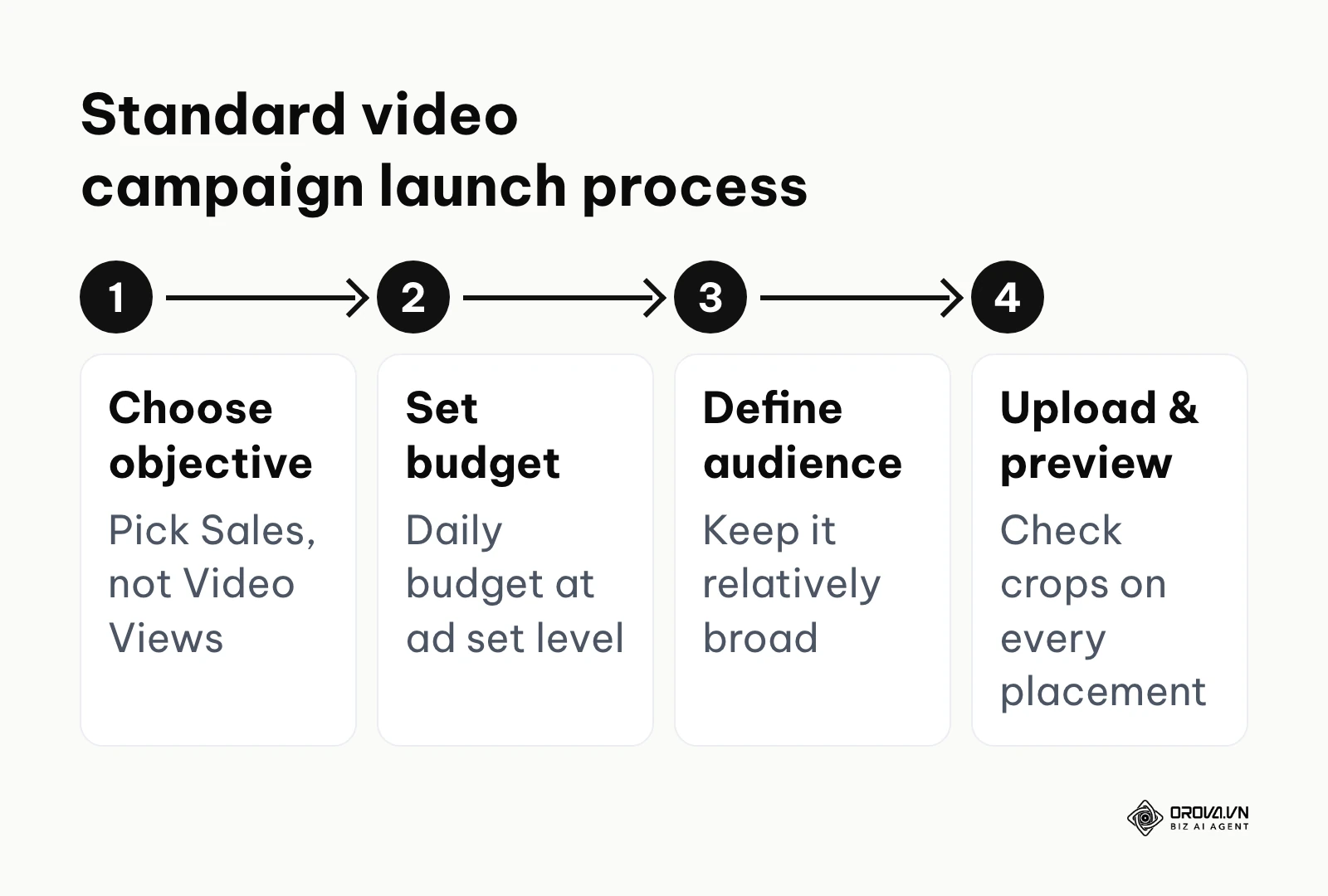
The flowchart below outlines the standard setup process you should follow.
Illustrative example: Operating as a B2B software marketer, your goal is to launch a product demo campaign targeting mid-level managers. You create the campaign in Ads Manager, upload a standard widescreen 16:9 video, and select the default Advantage+ automatic placements option. The campaign struggles immediately because the widescreen video is awkwardly cropped on mobile Reels, hiding the software's main interface buttons entirely. To resolve this, you pause the ad, separate the campaign by placement, and upload a dedicated 9:16 vertical version specifically designed for the Stories and Reels environment. Consequently, you notice a flood of new demo request notifications pinging in your inbox, completely filling your sales team's calendar for the week.
Here is the exact setup workflow to ensure proper delivery: First, select your campaign objective carefully. If you want sales, choose the Sales objective; do not choose Video Views hoping they will magically convert. Second, configure your daily budget at the ad set level to control spending precisely. Third, define your core audience parameters, keeping them relatively broad to allow the algorithm room to explore. Fourth, upload your creative assets, ensuring you use the built-in cropping tools to verify they look perfect across every selected placement before hitting the publish button.
How to get started and adapt
Transitioning away from static images requires a fundamental shift in your production mindset. The approach you take depends entirely on your current resources, team structure, and organizational role.
Small business owners
As a founder or small business owner, your primary advantage is agility and authenticity. You do not need a massive production budget; you just need a smartphone and a deep understanding of your customers.
- Start by documenting your daily operations, capturing the behind-the-scenes reality of your business.
- Identify the most common questions your customers ask and answer them directly on camera.
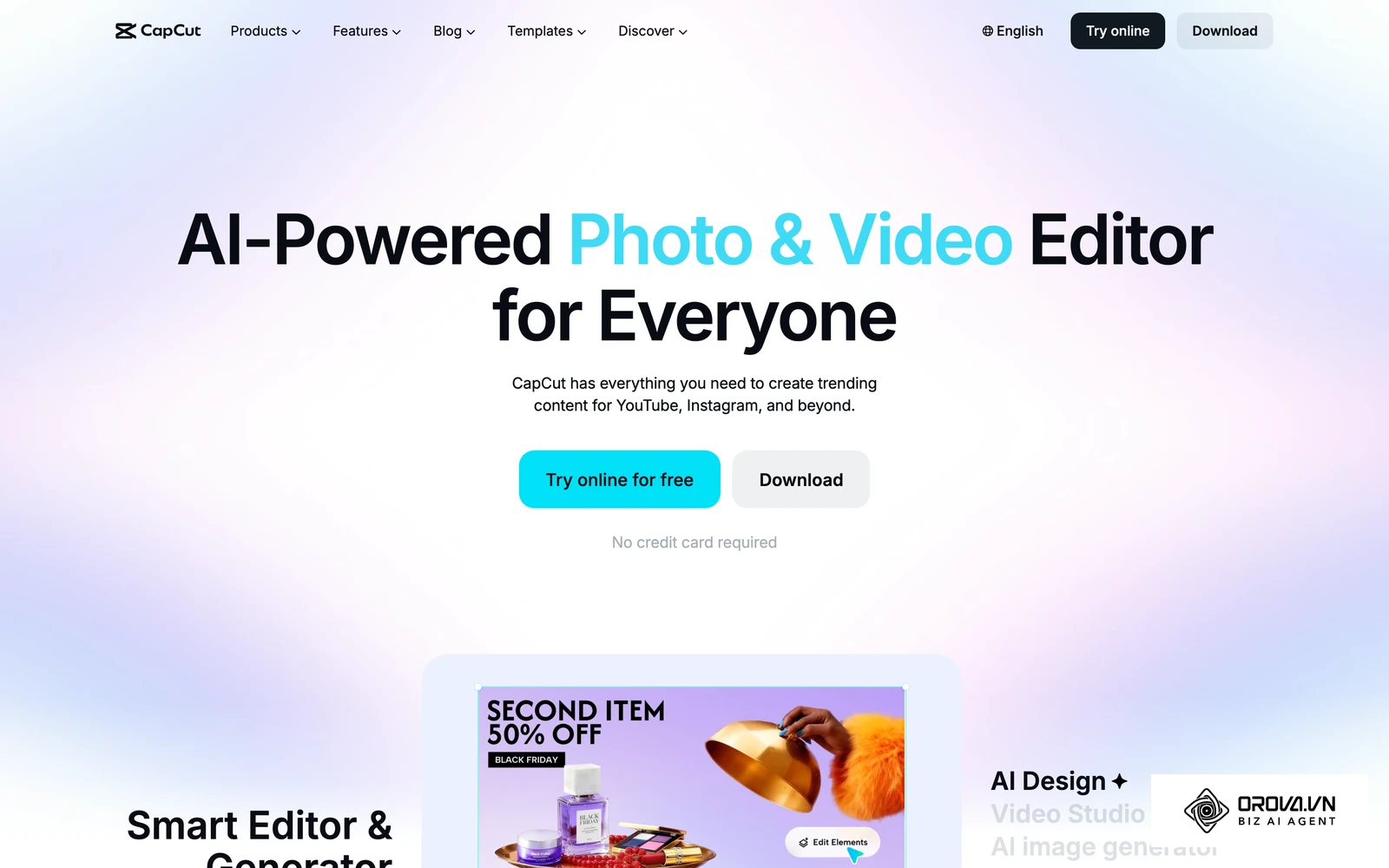
- Use simple, free editing software on your phone to trim pauses and add basic captions.
- Launch your first test campaign with a small daily budget to gather baseline data.
- Review the performance after one week and determine your ads budget allocation for the following month.
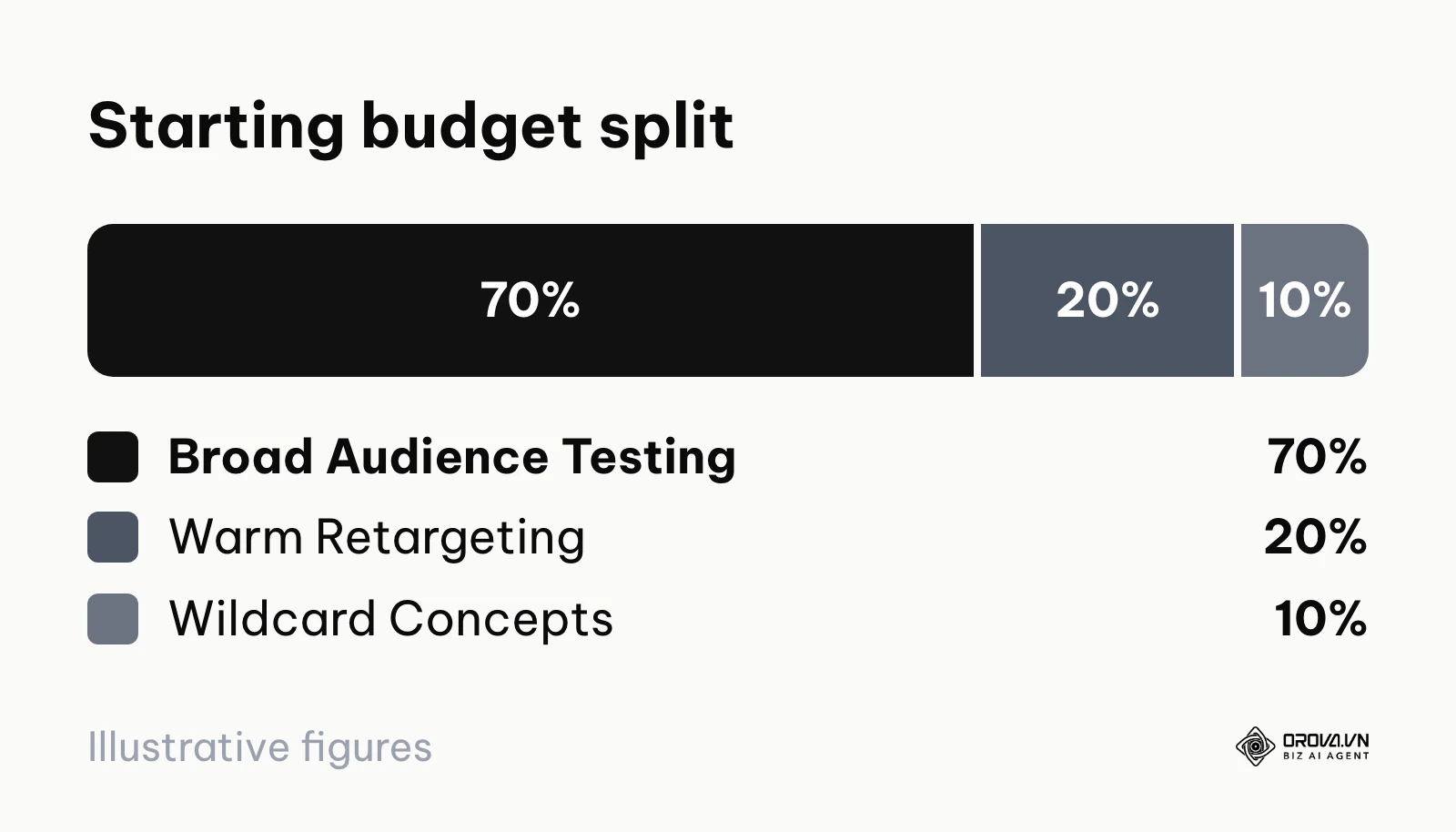
A simple starting split many small advertisers use: about 70% of the budget for broad audience testing, 20% for warm retargeting and 10% for wildcard concepts. Adjust it once you have your own data.
The chart below shows that initial budget split.
In-house marketers
Internal marketing teams often struggle with producing enough volume to prevent creative fatigue. Your goal is to build a scalable system for generating variations rapidly.
- Audit your existing static imagery to identify the messaging angles that have historically performed best.
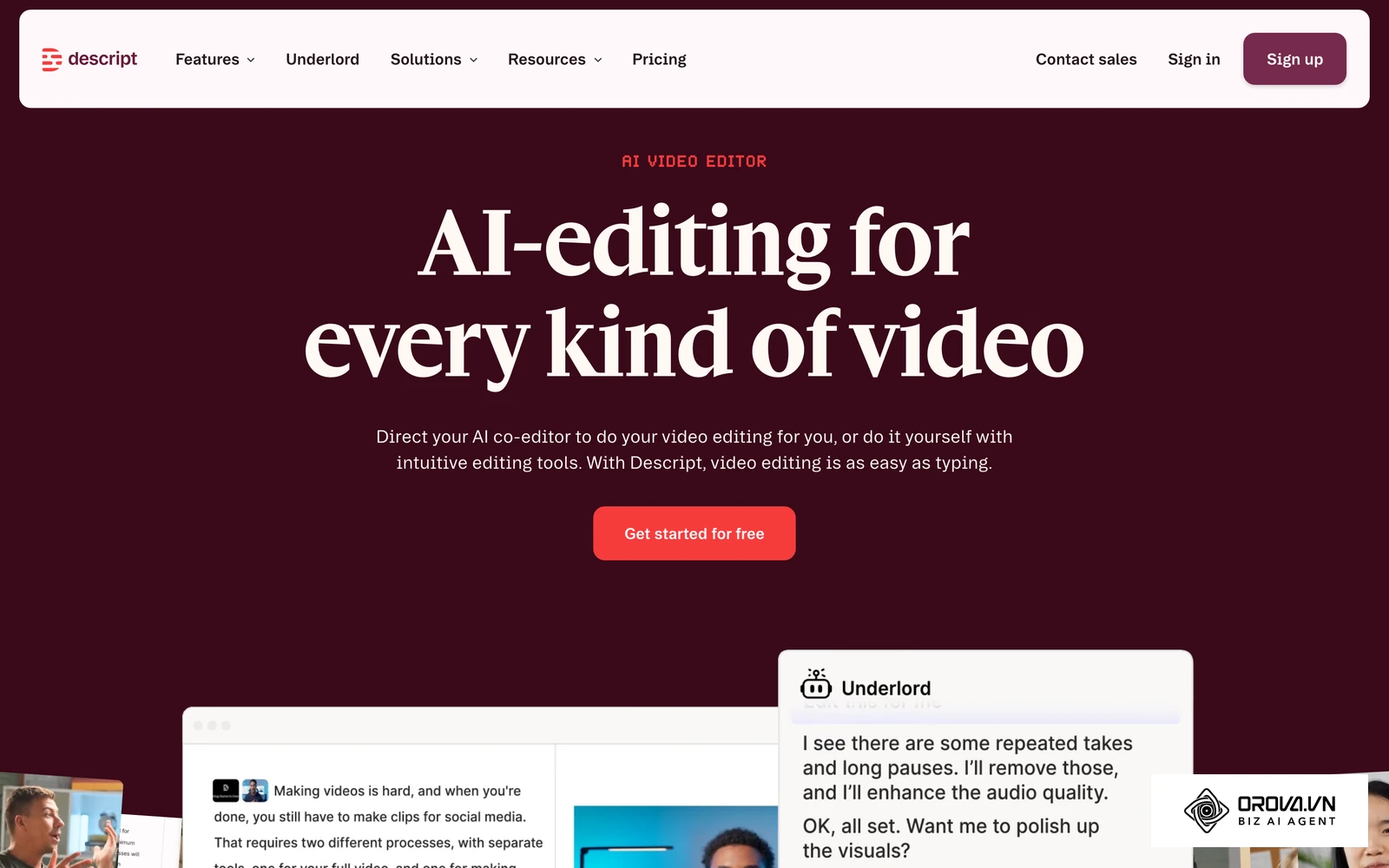
- Collaborate with your design team to convert those winning static concepts into simple motion graphics.
- Ensure you completely configure your Facebook pixel tracking to measure down-funnel actions accurately.
- Establish a weekly review meeting specifically dedicated to analyzing creative performance metrics.
- Develop a centralized library of b-roll footage that can be endlessly remixed into new concepts.
Agency account managers
For agencies managing multiple clients, the challenge is maintaining quality while scaling operations across different industries. You must educate your clients on why raw content often outperforms highly polished commercials.
- Create a standardized creative brief template to extract precise value propositions from your clients during onboarding.
- Coach your clients on how to shoot their own raw footage using specific lighting and framing guidelines.
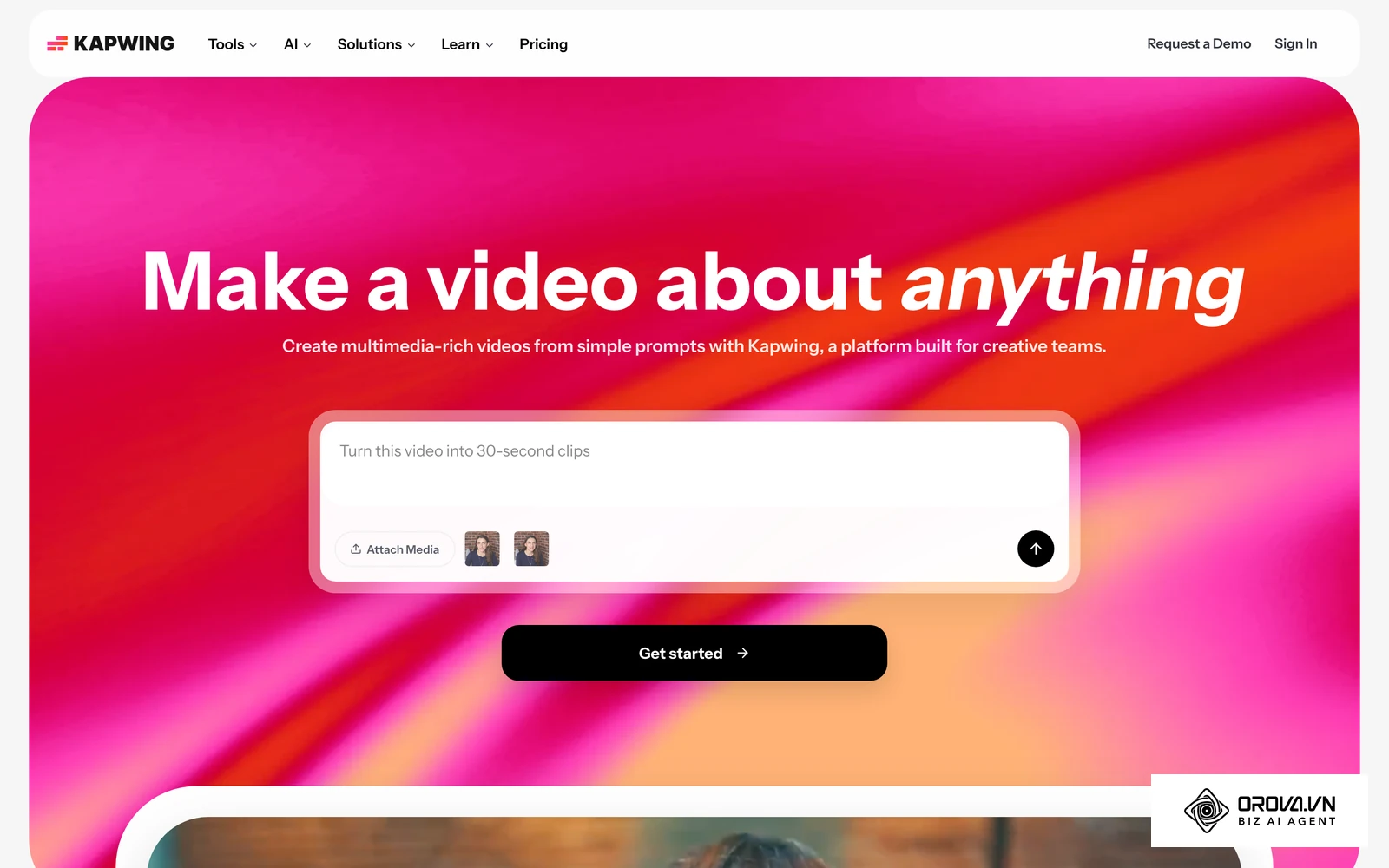
- Build a robust workflow to leverage user generated content ads by collaborating with micro-influencers.
- Implement rigorous naming conventions within the ad accounts to track variant performance systematically.
- Provide clients with transparent reporting that clearly ties creative testing directly to their revenue goals.
Illustrative example: Taking on the role of an agency account lead, you are tasked with generating membership inquiries for a local fitness center. You hire a videographer to shoot a highly polished, two-minute cinematic gym tour and run it to a broad ten-mile radius. The campaign falls flat, generating thousands of cheap views but zero actual people walking through the gym doors. You pivot entirely by handing a smartphone to a charismatic personal trainer and having them film a raw, 15-second invitation to a free weekend class from the gym floor. Within forty-eight hours, the gym owner calls you to report a line of thirty people waiting at the reception desk clutching their smartphones with your ad displayed.
The table below outlines the most common pitfalls you must avoid across any role.
| Common mistake | Consequence | Prevention strategy |
|---|---|---|
| Ignoring the first three seconds | Viewers scroll past immediately, wasting impressions. | Front-load your most compelling visual or boldest statement instantly. |
| Relying entirely on audio | The message is lost for the many people who scroll with the sound off. | Burn large, highly readable captions directly into the final export file. |
| Mixing aspect ratios poorly | Black bars appear on mobile screens, looking unprofessional. | Customize assets for specific placements using platform-level cropping tools. |
To guarantee success, here is a mandatory 10-step checklist to review before launching:
- Verify the primary hook occurs within the first three seconds.
- Ensure all spoken dialogue has accurate, readable on-screen captions.
- Confirm the aspect ratio matches the intended delivery placement.
- Check that no critical visuals are hidden behind the platform's UI buttons.
- Validate that the call-to-action is clear and actionable.
- Review the audio levels to prevent distortion or extremely low volume.
- Confirm the ad copy perfectly complements the visual messaging.
- Ensure the destination landing page matches the creative promise.
- Verify tracking parameters are correctly appended to the URL.
- Double-check the daily budget settings to prevent accidental overspending.
Want to scale your budget but afraid of breaking performance? 📉
Integrate OROVA ADS now - an AI Agent that automatically monitors and optimizes Google, Meta, TikTok ads 24/7. Now, expanding and replicating your Performance Ads team is just one click away.
🚀 Try it now at: orova.vn/ads
Facebook video ads trends: author's predictions
Looking ahead, the landscape of digital advertising is poised for massive disruption. As platforms evolve and consumer patience dwindles, the strategies that work today will inevitably become obsolete. Based on the current trajectory of technology and user behavior, here are my thoughts on where the industry is heading.
AI will generate full creatives on the fly
I expect manually rendering a single fixed file to become less common for large brands. I believe artificial intelligence will analyze a user's real-time browsing context and instantly generate a customized video addressing their specific needs. We are already seeing primitive versions of this with automated text variations, and I suspect AI-generated motion sequences will become a normal part of the creative mix. Marketers should prepare by shifting their focus from manual editing to mastering prompt engineering and creative strategy.
Short-form dominance will force hybrid formats
I lean towards the idea that traditional 60-second commercials are steadily losing ground on social media. The relentless rise of short-form, rapid-consumption content has rewired the consumer brain. I think we will see the emergence of hybrid formats where a very short hook immediately transitions into an interactive, shoppable catalog layer without the user ever leaving the feed. Advertisers can prepare by practicing how to cut their messages down to the bare essentials.
First-party data will dictate creative angles
I consider ongoing privacy changes and signal loss to be one of the biggest drivers of creative innovation. As targeting becomes less precise, the creative itself must do the heavy lifting of finding the right audience. I believe brands will need to rely heavily on their own first-party data to uncover unique customer insights. If you know exactly why your best customers bought from you, you can build hyper-specific scripts that act as a magnet for similar profiles, bypassing the need for granular algorithmic targeting.
Frequently asked questions about Facebook video ads
As marketers transition into this format, several recurring technical and strategic questions arise.
What is the minimum budget for A/B testing video variants?
You need enough budget to generate at least fifty conversion events per week to exit the algorithmic learning phase. If your average cost per lead is ten dollars, you should aim for a minimum of five hundred dollars per week per ad set to ensure your testing yields statistically significant and reliable data.
Should I use Video Views or Conversions for a new product?
Always choose the Conversions objective if your ultimate goal is to generate revenue or qualified leads. The Video Views objective simply tells the algorithm to find people who like watching content, which rarely translates into actual buyers. Only use engagement objectives if you are purely optimizing for cheap, top-of-funnel brand awareness.
How do I fix creative fatigue when frequency increases?
When your frequency keeps climbing while your acquisition costs rise, your audience is tired of the asset. You do not necessarily need a completely new shoot; instead, try swapping the first three seconds (the hook), changing the text overlays, or applying a different background music track to refresh the asset's lifespan.
Are Facebook video ads still needed with AI?
Yes, absolutely. While AI tools can assist in writing scripts or editing clips, the core requirement of using motion to interrupt scrolling behavior remains unchanged. AI acts as a powerful amplifier for your production capabilities, but it does not replace the fundamental need to deploy dynamic storytelling within the Meta ecosystem to capture human attention effectively.
How long should my video be for cold audiences?
For audiences who have never heard of your brand, brevity is crucial. Aim to deliver your entire core message within fifteen to thirty seconds. If you cannot explain the value proposition in that timeframe, your script is too complex and needs to be refined before you spend money promoting it.
Where to start?
The sheer volume of technical requirements and storytelling frameworks can easily cause analysis paralysis. The best approach is to identify exactly where your organization currently stands and take one immediate, practical step forward.
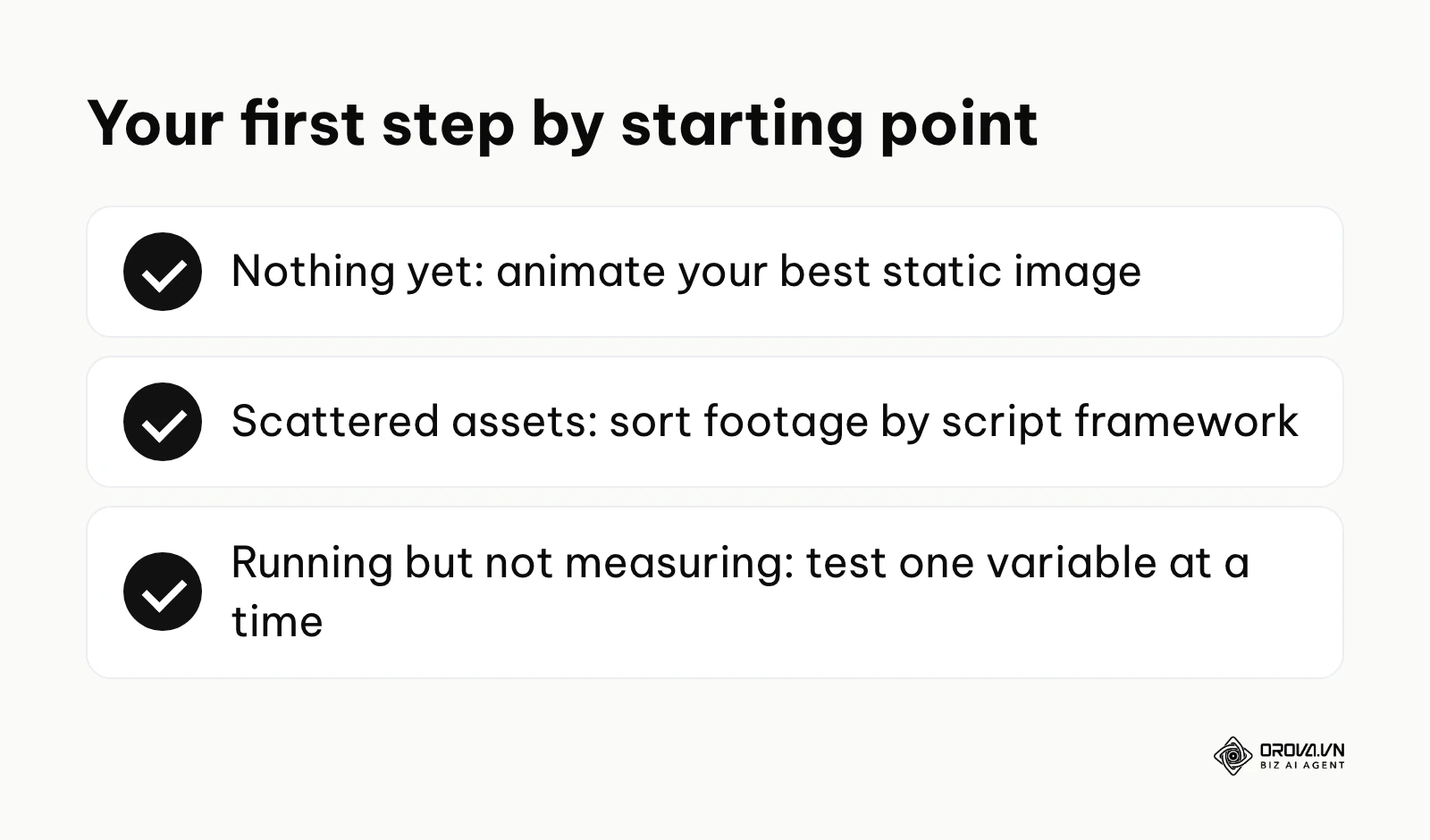
If you have nothing yet: You are starting from zero with no motion assets in your library. Your first step should be taking your best-performing static image and using a free mobile app to add simple motion effects, such as a panning zoom or animated text headlines. This allows you to test the waters without investing any money in complex production.
If you have assets but they are scattered: Your team has created content in the past, but it lives across various hard drives and was never systematically tested. Spend an afternoon organizing all existing footage into a central folder, categorizing them by the psychological frameworks discussed earlier. This audit will instantly reveal gaps in your messaging strategy.
If you are running campaigns but not measuring properly: You have active campaigns, but you have no idea which specific hook is driving the sales. Pause your consolidated ad sets and duplicate them, isolating only one creative variable per test, as laid out in this ad testing framework. This structured isolation is the only way to gather the clean data necessary to scale your facebook video ads effectively.
About the author

Builder of Orova
Nguyễn Đỗ Trọng Ân has 8 years of experience in marketing, including 6 years managing market development across Asia. He builds Orova, a Biz AI Agent that never sleeps: it plans, runs and optimizes work for businesses.
Run your business with AI Agents
Orova is the always-on Biz AI Agent — it plans, runs, and optimizes the work for you.
Save time, unlock productivity.