
What is Google Ads Quality Score? A guide to lowering your costs

You launch a search campaign, set a generous daily budget, but your ads barely receive impressions. Alternatively, you pay double what your direct competitors pay for the exact same click. This is a common and frustrating situation for many advertisers struggling with their google ads quality score. Quality Score is Google's 1 to 10 diagnostic rating of how relevant your keyword, ad and landing page are to the person searching, and it strongly shapes what you pay per click. The old understanding is that you simply need to stuff more keywords into your ad text to fix this issue. That approach is no longer sufficient and often backfires. The modern advertising ecosystem evaluates much more than just text matching. This guide helps you diagnose the root causes of high costs, understand the hidden metrics the platform uses, and build a logical campaign structure that naturally lowers your acquisition costs over time.
Google Ads Quality Score: What Is It?
Google Ads Quality Score is a diagnostic metric on a 1 to 10 scale indicating how relevant your ad, keyword, and landing page are to a search query. It serves to guide optimization efforts, differing fundamentally from Ad Rank which is the live auction calculation determining your final position.
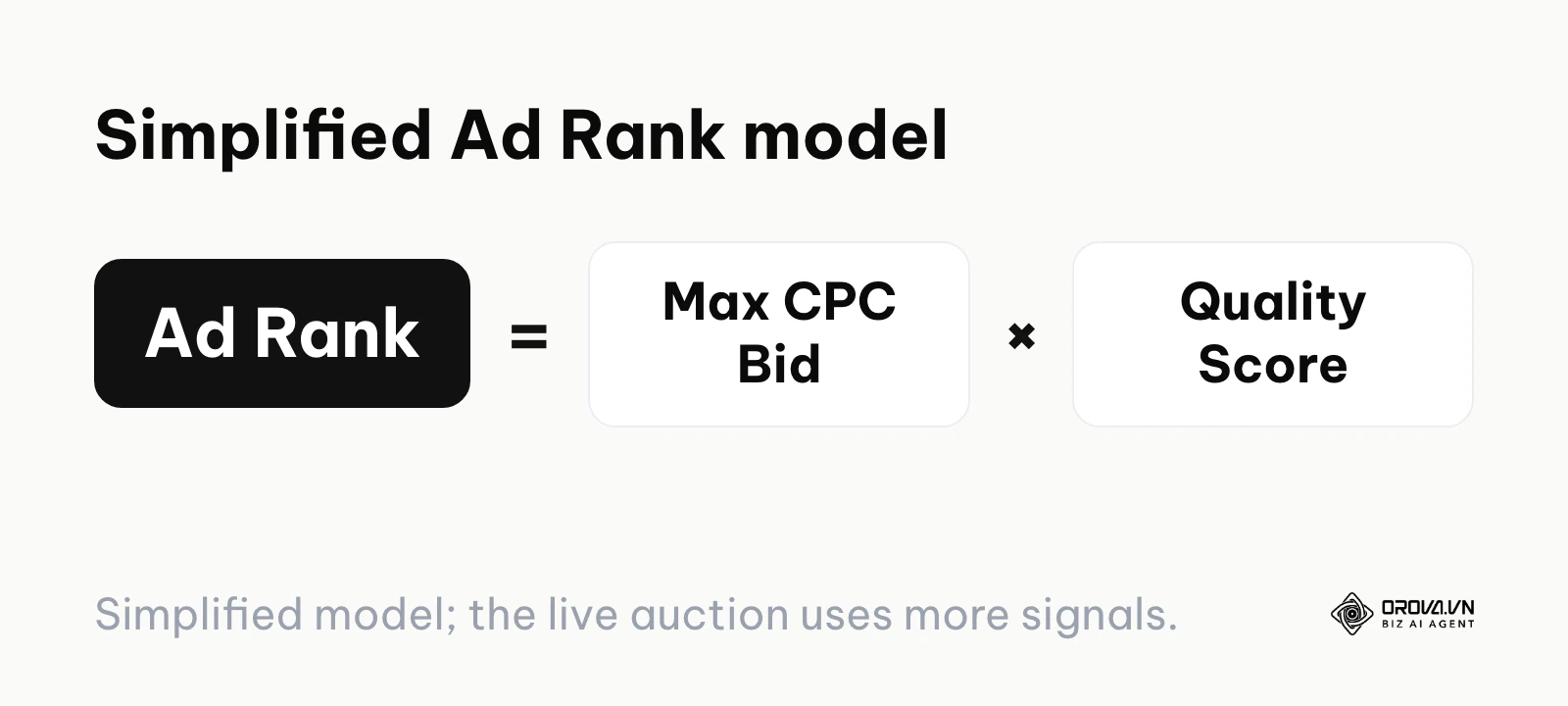
The diagram below shows a simplified version of the calculation and why higher bids cannot always overcome poor relevance.
This metric originated in the early days of search advertising. Initially, advertisers could buy the top spot for any keyword simply by offering the highest bid, regardless of relevance. This led to a terrible user experience, where a search for "running shoes" might show an ad for a completely unrelated software product. To protect the integrity of the search results, Google introduced this scoring mechanism to penalize irrelevant ads and reward highly targeted ones.
To understand its precise role, you must distinguish it from similar concepts within the platform.
| Concept | Difference from Quality Score | Example |
|---|---|---|
| Ad Rank | The actual formula used at the exact moment of a search to determine position and cost. Quality Score is just a historical aggregate. | In a simplified model, a score of 8 with a 2-dollar bid beats a score of 4 with a 3-dollar bid. |
| Expected CTR | A predictive sub-component of the overall score based on past click performance, not the final score itself. | Your ad has great text (high Expected CTR) but a slow website (low overall score). |
| Optimization Score | A 0-100% metric suggesting account settings and budget changes, entirely unrelated to ad relevance. | Applying a suggested budget increase raises Optimization Score but ignores ad relevance. |
Consider a real-world example. Imagine buying a billboard space. If you want to place a billboard selling snowboards in the middle of a hot desert, the landowner might charge you double because the ad is irrelevant to the local audience and looks out of place. Conversely, if you place that same snowboard billboard right next to a popular ski resort, the landowner gives you a prime spot at a fair rate because it perfectly matches the environment. The search engine acts exactly like that landowner.
Why Does It Exist in the Advertising Ecosystem?
This scoring system exists primarily to solve a user experience problem for the search engine. Google's core product is its search functionality. If users click on ads and consistently find broken websites, irrelevant products, or confusing messaging, they will eventually stop clicking ads altogether. By enforcing a relevance standard, the platform ensures that the interests of the user, the advertiser, and the search engine remain aligned.
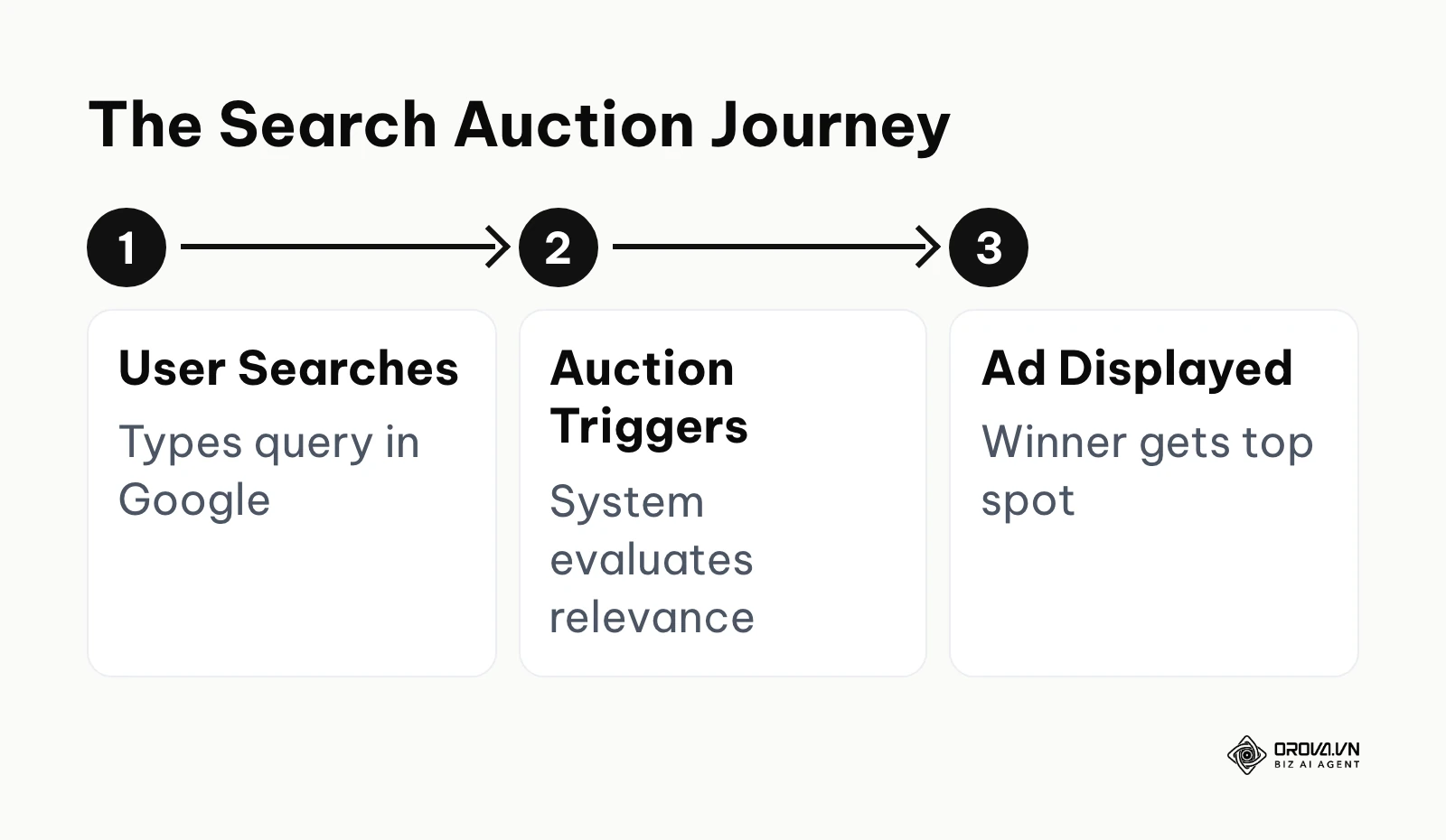
The search auction journey diagram below summarizes how the engine evaluates relevance at the moment of each search.
In the broader picture of your marketing funnel, this metric sits right at the intersection of keyword selection and ad display. First, you select a keyword. Then, the system evaluates your historical relevance (your score). This evaluation feeds into your Ad Rank, which ultimately dictates your cost per click (CPC) and your overall visibility. If you ignore this metric, you pay a financial penalty: advertisers with very low scores typically pay noticeably more per click than advertisers with high scores for the same keyword. Furthermore, a consistently low score means your ads will simply be restricted from entering many auctions, suffocating your traffic volume regardless of how high you raise your daily budget. You cannot brute-force your way to the top with money alone if your relevance is fundamentally broken.
There are, however, specific scenarios where you should not focus heavily on this metric. You do not need to obsess over this number in a few specific situations. First, if you launch a brand new campaign, the system needs a few weeks to gather impressions; checking the score on day two is useless. Second, when running broad match discovery campaigns solely to harvest new search terms, relevance will naturally fluctuate. Finally, for extremely niche B2B keywords with zero competitors, you will win the auction cheaply regardless of a mediocre score. In these cases, focus entirely on conversion tracking instead.
Illustration: A regional HVAC repair company was spending 5,000 dollars a month but barely getting calls. The business owner acted as the marketer. First, they audited the search terms report and found their ads showed for "buy HVAC parts," not "HVAC repair near me." They added negative keywords and rewrote the ad copy to highlight 24/7 emergency service. The initial hurdle was a slow mobile site causing a 'Below Average' landing page experience rating. They compressed images and removed a heavy video background. The result was a drop in average CPC from 12 dollars to 7 dollars, while daily service calls doubled within three weeks.
The Business Value and Direct Benefits
The value of optimizing this metric extends beyond theoretical marketing concepts; it translates directly to your bottom line and your daily workflow.
For the Business
For the business owner or financial director, the primary value is risk reduction and cost efficiency. A higher score acts as a direct discount applied to your auction bids. This means you achieve a lower Cost Per Acquisition (CPA) without needing to negotiate better vendor rates or cut product quality. Additionally, it increases your impression share. When the system trusts your ads, it shows them more frequently and in better positions, allowing you to capture market share that was previously blocked by artificial algorithm gates. It makes your marketing budget behave predictably.
For the Practitioner
For the person actively managing the account, a strong focus on relevance removes the guesswork from daily tasks. Before optimizing structure, a practitioner often stares at a dashboard of expensive keywords, unsure if they should lower bids, change targeting, or write new text. After establishing a clean structure that naturally yields high scores, troubleshooting becomes binary. If a keyword is expensive but highly relevant, it is a market reality; if it is expensive and has a low score, it requires a structural fix. This clarity saves hours of manual auditing. It also ensures that when you report to stakeholders, you can definitively prove that the account architecture is sound.
| Benefit | Measured by Which Metric | Time to See Results |
|---|---|---|
| Reduced Cost Per Click | Average CPC | 1 to 2 weeks |
| Increased Visibility | Search Impression Share | 2 to 4 weeks |
| Better User Engagement | Landing Page Bounce Rate | 3 to 7 days |
If your landing page is the bottleneck, you will need to look beyond basic ad copy and dive into technical performance. A slow site ruins relevance regardless of great ad text, so reviewing technical fundamentals is crucial.
OROVA ADS applies AI Agent to automate and optimize ad performance on Google, Meta and TikTok. Scale your budget safely, monitor 24/7 and expand your business quickly.
Experience the solution at orova.vn/ads
How It Works: The Mechanics Behind the Score
Understanding the google ads quality score formula requires looking beyond simple addition. The metric you see in your dashboard is an aggregated historical indicator composed of three distinct pillars. Google evaluates each pillar individually and assigns it a status of 'Above Average', 'Average', or 'Below Average'. Google's own help documentation describes the reported score as a diagnostic tool rather than a direct input into the live auction.

Expected Click-Through Rate
This component measures the likelihood that your ad will be clicked when shown for a specific keyword, independent of your ad's position or the presence of extensions. The system looks at the historical performance of your exact keyword across the entire platform and compares your specific performance against it. The primary input here is historical click data. If your ad consistently receives fewer clicks than competitors bidding on the same term, your rating drops. The output is a simple health check on your ad's ability to grab attention. The most common failure point here is writing boring, generic ad copy that looks identical to the three other ads on the page. If you offer nothing unique—no distinct value proposition, no clear pricing, no compelling call to action—users will scroll past you, damaging your expected CTR.
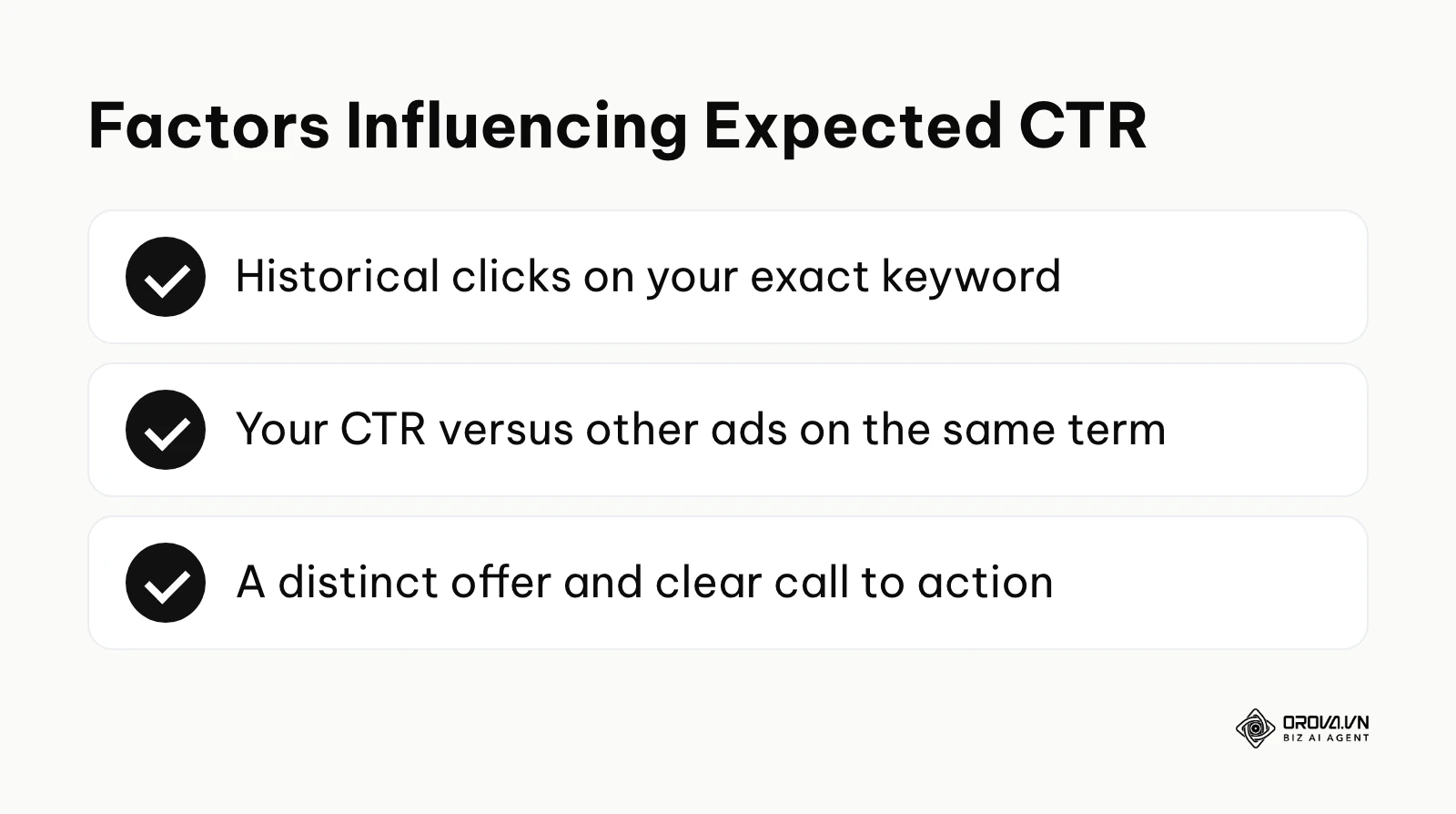
The checklist below summarizes the elements that affect this specific component.
Ad Relevance
Ad Relevance measures how closely your ad text matches the intent behind a user's search. The algorithm reads your headlines, descriptions, and display paths to see if they logically connect to the keyword triggering the ad. The input is purely semantic matching and intent alignment. The output tells you if your ad group structure is too broad. The biggest failure point here is the lazy grouping of keywords. For example, if you place "running shoes," "basketball sneakers," and "hiking boots" into a single ad group with one generic ad that says "Buy Great Shoes," your ad relevance will tank. The system recognizes that a user searching for hiking boots is not being served a specific, relevant message.
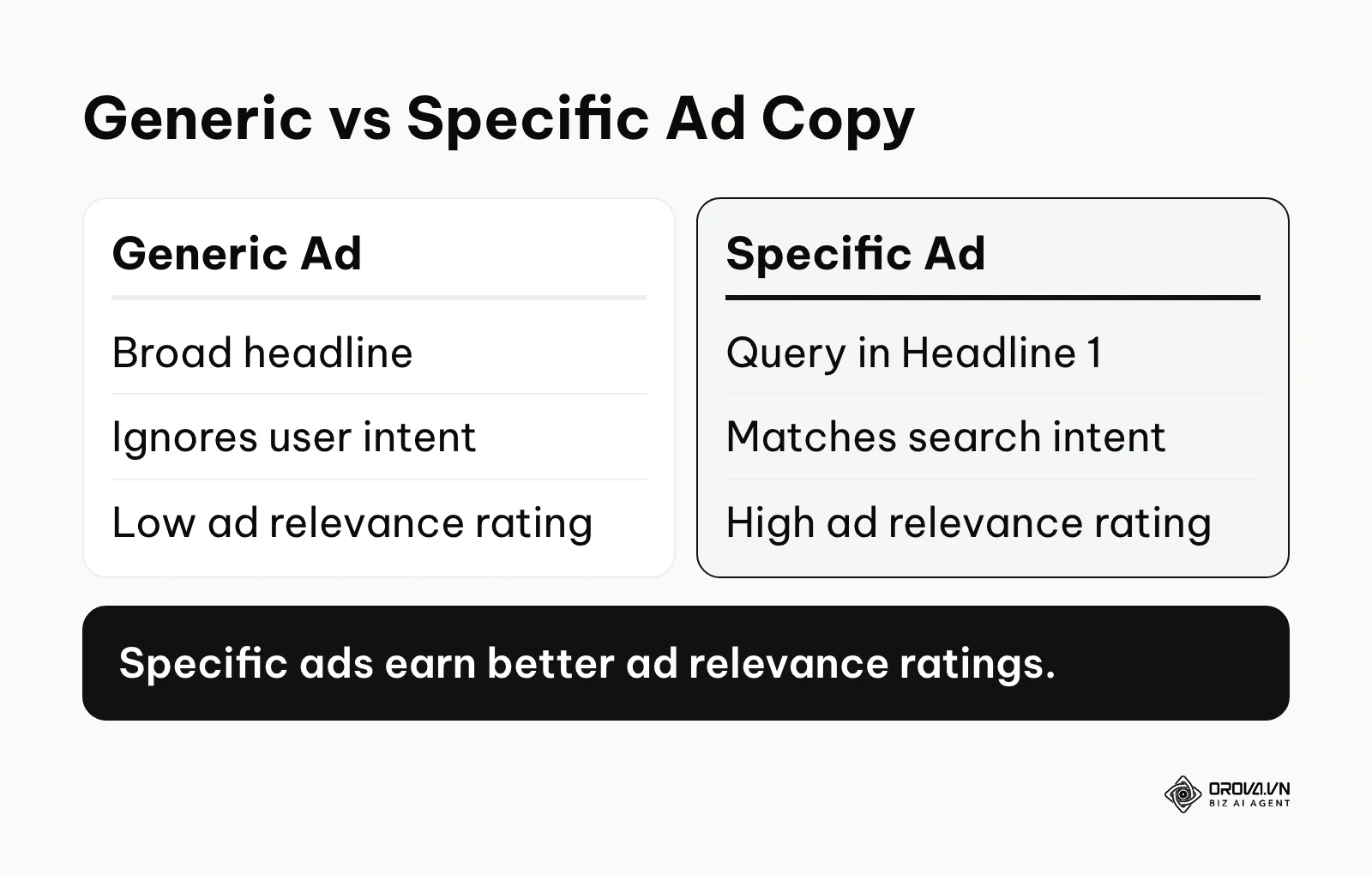
The comparison table below summarizes the differences between generic and specific ad copy.
Landing Page Experience
This is arguably the most critical component because it dictates what happens after you pay for the click. Landing page experience measures how relevant and useful your website is to the user who clicked your ad. The inputs include technical performance (mobile load speed, Core Web Vitals), navigational ease (clear menus, no intrusive pop-ups), and textual relevance (does the page mention the product promised in the ad?). The output indicates whether you are wasting traffic. The failure point here is often organizational; marketers control the ads but lack access to change the website. Sending highly specific search traffic to a generic homepage is a guaranteed way to earn a 'Below Average' rating. If you want to dive deeper into technical page requirements, reviewing What is Technical SEO? A Practical Guide to Crawling, Rendering and Indexing can clarify how search engines parse page content.
There are also different levels at which this score operates conceptually, even if only one is explicitly displayed.
| Type of Score | Characteristics | Who Needs to Care |
|---|---|---|
| Keyword-Level | The visible 1-10 number in your dashboard. Highly actionable. | Daily practitioners and campaign managers. |
| Ad Group-Level | Not shown as a number; practitioners read it as the average health of the keywords in the group. | Strategists planning account structure. |
| Account-Level | Not reported by Google; many practitioners believe overall account history influences new keywords. | Business owners launching new accounts. |
The interaction between quality score smart bidding algorithms is often misunderstood. Many advertisers assume that if they use Target CPA (tCPA) or Target ROAS (tROAS), relevance metrics no longer matter because the AI sets the bid. This is false. While smart bidding sets the bid based on conversion probability, the quality metrics dictate the minimum bid required to enter the auction. If your relevance is terrible, the algorithm might determine that the required bid to win the auction is too high to meet your target CPA. As a result, the AI simply stops entering your ads into auctions, causing your campaign to stall and stop spending entirely. High relevance gives the smart bidding algorithm more room to operate aggressively without breaking your cost limits. For a broader look at AI campaign scaling, refer to AI Ads: The Ultimate 2026 Master Guide to Scaling Google, Meta, and TikTok Campaigns.
Consider a simple scenario using the simplified formula above. Imagine you and a competitor both want the top spot. Your competitor has a score of 4 and bids 5 dollars, so their simulated Ad Rank is 20. If you have a score of 8, a bid of about 2.51 dollars is enough to beat them. In this model, doubling your score roughly halves the bid you need for the same position, which is why relevance work can lower your CPC without cutting traffic. Real auctions use more signals, so treat this as a direction, not a guarantee.
Furthermore, many practitioners talk about an Account-Level Quality Score, which matters most for new advertisers. Google does not publish such a number, but the common view is that the historical performance of your ads and keywords shapes how new ones start. A new campaign in an account with a strong history of high click-through rates and good landing pages will start with a baseline advantage. Conversely, if you constantly launch terrible ads that get rejected or generate high bounce rates, your account trust drops. In that view, new keywords in a weak account start with lower scores until they prove themselves, making the first few months of advertising incredibly expensive.
Illustration: An in-house marketer at a SaaS company noticed their brand campaigns were getting expensive. They managed a 50,000-dollar monthly budget across multiple software categories. First, they split a generic "accounting software" ad group into three specific intent groups: "small business accounting," "enterprise invoice software," and "freelance tax tracker." The hurdle occurred when the new ads still received average relevance scores because the landing page text did not match the new granular ad copy. They built three distinct landing pages mirroring the exact phrasing of each ad group. The result was a 40% increase in conversion rate and a return to the top ad position without raising the target CPA.
How to Adapt and Improve Your Campaigns
When practitioners ask how to improve quality score google ads, they often start with the wrong variables, like tweaking bids or changing match types. Improving relevance requires a structural approach tailored to your specific role and resources.
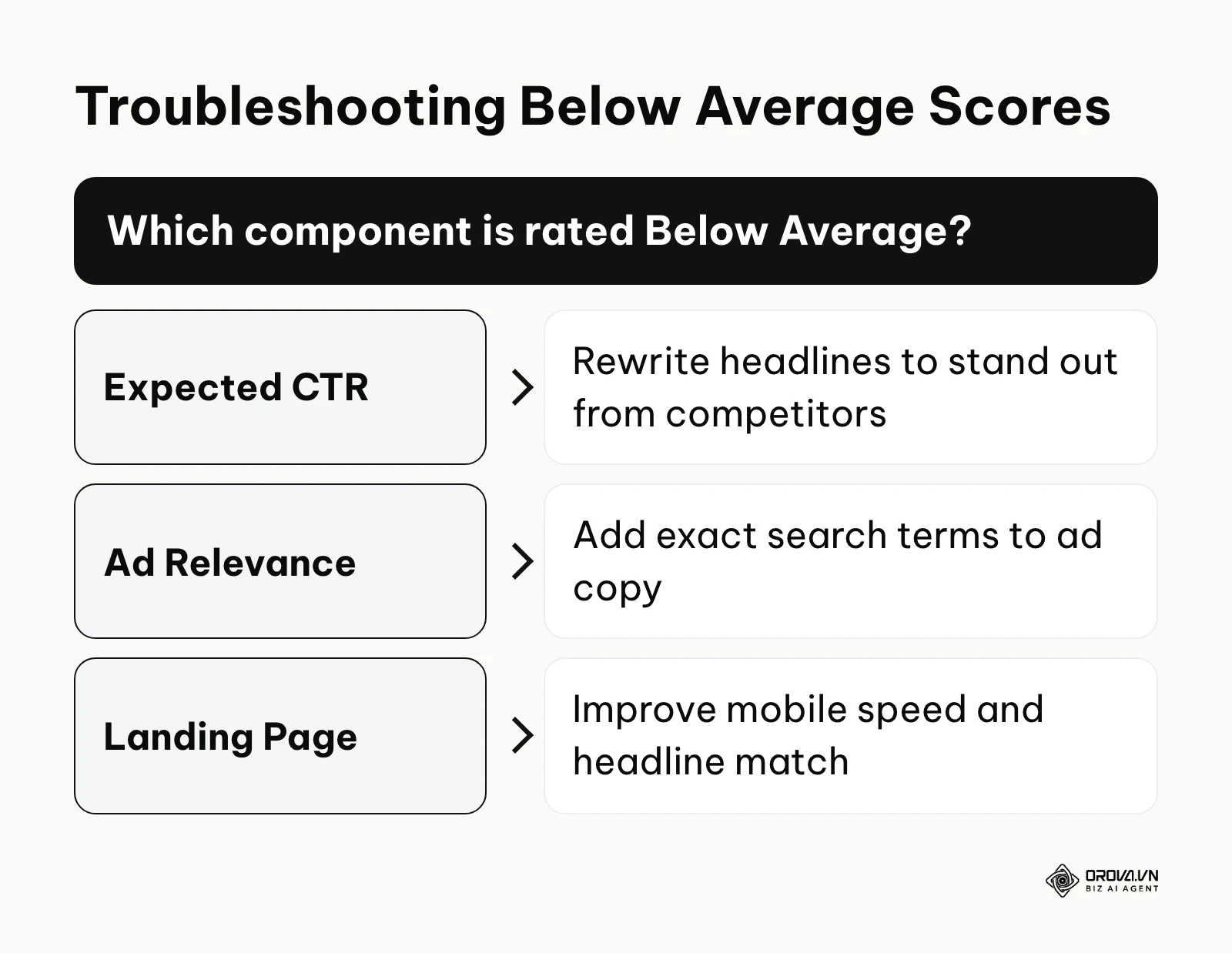
The decision tree below summarizes how to troubleshoot specific components rated as below average.
The troubleshooting process requires a systematic approach. Do not guess; follow a diagnostic path. First, check the three component columns in your dashboard. If Expected CTR is 'Below Average', your ad is failing to attract attention. You must immediately review your competitors' ads and rewrite your headlines to include strong verbs and distinct offers that stand out. If Ad Relevance is the issue, your ad does not match the search term. You must check if the user's exact phrase appears in Headline 1. If it does not, break that keyword out into a new, smaller ad group with highly specific copy. If Landing Page Experience is the issue, the user is abandoning your site. You must run a speed test and ensure the exact promise made in the ad is visible immediately upon page load.
Small Business Owners
As a small business owner, your time is limited, and you likely manage the account yourself. First, stop trying to bid on hundreds of keywords. Select the top twenty search terms that actually drive phone calls or sales. Second, organize these twenty keywords into four or five tight ad groups based on the specific service requested. Third, ensure your website loads quickly on a mobile phone, as the vast majority of local searches happen on mobile devices. Finally, check that your phone number is clickable on your landing page.
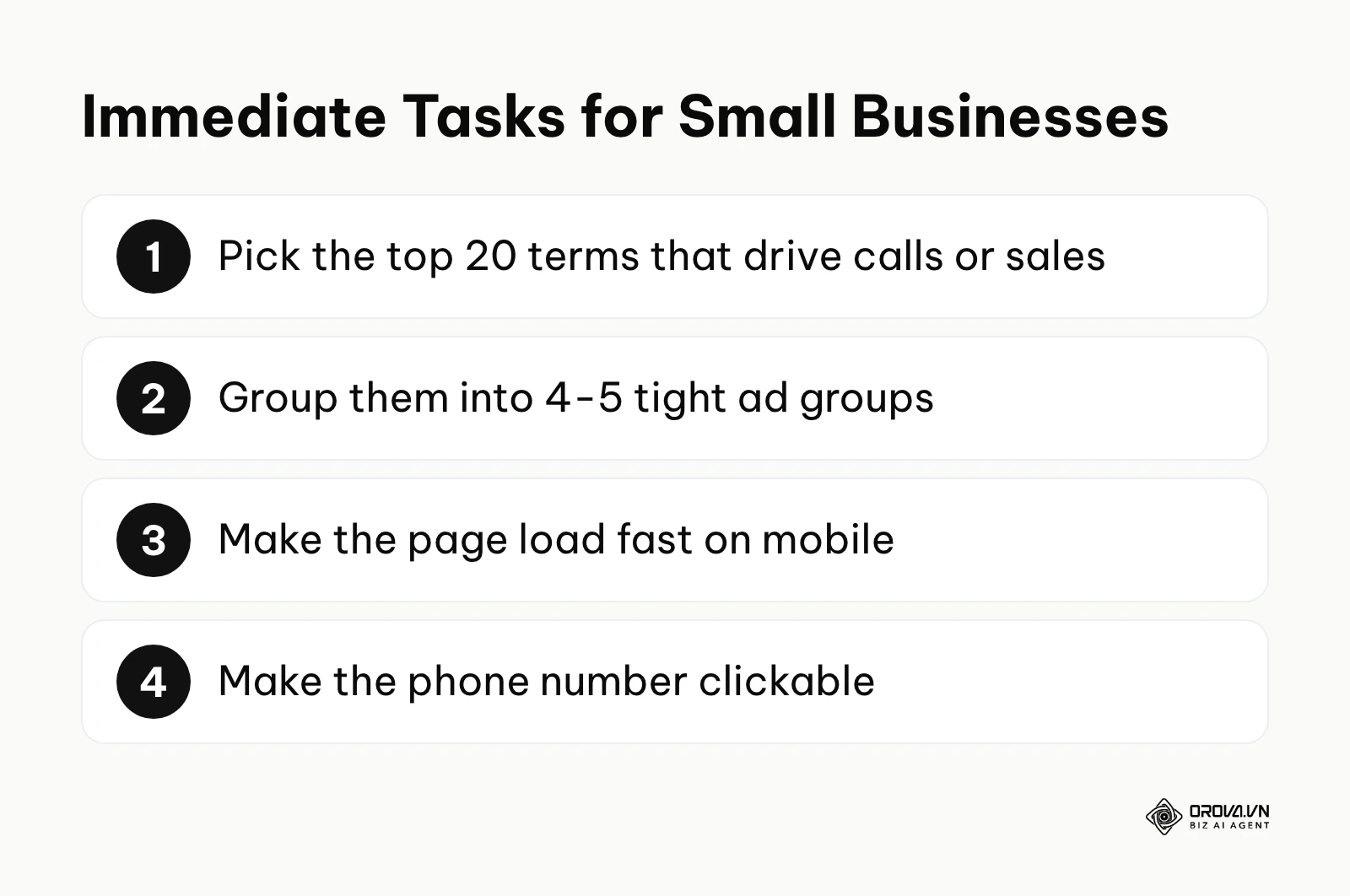
The list below summarizes priority tasks for small business owners managing ads.
In-house Marketers
If you manage a dedicated marketing budget internally, your focus must be on alignment between the ad copy and the product experience. First, audit your search terms report weekly to add negative keywords, preventing your ads from showing for irrelevant queries. Second, implement dynamic keyword insertion carefully on your highest-volume ad groups to guarantee exact semantic matches in your headlines. Third, work with your web development team to improve core technical metrics, ensuring a seamless post-click experience. Fourth, run continuous A/B tests on your ad copy to slowly increment your Expected CTR against historical baselines.
Agencies and Freelancers
Agencies inherit messy accounts and must prove value quickly by reducing wasted spend. First, perform a complete account audit, pausing historical keywords with scores of 1 or 2 that have not converted in the last six months. Second, restructure massive, legacy ad groups into tight thematic clusters. Third, build dedicated reporting dashboards for clients that separate out performance by relevance score, proving that structural work lowers CPA. Fourth, push clients aggressively on landing page improvements, refusing to send traffic to broken or outdated homepages. If you need a playbook on how to frame these landing page changes, reviewing Conversion rate optimization: a practical guide with a B2B and SaaS playbook can help you structure your arguments.
| Common Mistake | Immediate Consequence | How to Avoid It |
|---|---|---|
| Putting 50 keywords in one ad group | Low Ad Relevance and generic copy | Keep ad groups to 5-10 tightly related terms |
| Sending all traffic to the homepage | Low Landing Page Experience and high bounce rate | Build dedicated landing pages for specific offers |
| Ignoring negative keywords | Paying for irrelevant clicks and lowering CTR | Review search terms weekly and exclude bad queries |
Want to scale your budget but afraid of breaking performance? 📉
Integrate OROVA ADS now - an AI Agent that automatically monitors and optimizes Google, Meta, TikTok ads 24/7. Now, expanding and replicating your Performance Ads team is just one click away.
🚀 Try it now at: orova.vn/ads
Where Google Ads Quality Score is heading in the next few years: the author's take
Trend 1: AI may hide keyword-level relevance scores
As of 2026, we are already seeing Google push advertisers heavily toward broad match targeting combined with smart bidding. I think that over the next two to three years, the visible 1-10 keyword score could lose importance or give way to campaign-level health signals. As Google's models get better at reading intent, tying a static score to one keyword makes less sense. The system dynamically assembles ad assets on the fly. You should prepare for this by focusing less on granular keyword isolation and more on feeding high-quality conversion data into the platform so the AI accurately understands your ideal customer profile.
Trend 2: Account-level trust may matter more for costs
Many advertisers report that new accounts take a while to gain traction. My read is that Google will keep giving account history more weight relative to the relevance of any single ad. The engine wants to protect users from fly-by-night operations and deceptive marketing. If your account has a history of high bounce rates, rejected ads, or policy violations, your baseline costs are likely to be higher, even for a good new ad group. You should prepare by never using a single account to test wildly different, risky business models, and instead cultivate a single, clean account history.
Trend 3: Post-click signals may reshape landing page evaluation
Right now, the landing page experience component relies heavily on basic speed metrics and text matching. I believe Google will lean more on signals about what users do after the click, such as whether they quickly return to the results page or engage with the page. As AI evaluates overall user satisfaction, simply having the target keyword in your H1 tag will not suffice. You should prepare by auditing your landing pages for actual usability, ensuring that the next logical step for the user is frictionless, visually clear, and immediately accessible on mobile devices.
Frequently Asked Questions about Google Ads Quality Score
Is Quality Score still relevant with AI?
Yes, it is still highly relevant, though its application has shifted. While AI handles the bidding and asset matching, your relevance metrics dictate the floor price you must pay to enter the auction. Poor relevance restricts the AI's ability to find cheap conversions, throttling your campaign volume entirely.
Does pausing 1/10 keywords help the account overall?
Pausing historically poor keywords stops wasted spend, and many practitioners believe it also protects overall account health. While pausing a bad keyword does not instantly boost the score of a good keyword, it stops the bleeding of wasted impressions and clicks, and keeps your reports focused on the terms that matter.
How does the displayed score differ from auction-time score?
The 1-10 number you see in your dashboard is a historical estimate based on searches that exactly match your keyword. The auction-time quality is calculated during each live search and can factor in context such as the user's exact location, time of day, device, and the specific nuances of their long-tail search query.
Where is the score in Performance Max campaigns?
Performance Max campaigns do not display traditional keyword-level scores because they operate across multiple networks (Search, Display, YouTube) without manual keyword targeting. However, the underlying principles of relevance still apply; you optimize for it by ensuring your asset groups (text, images, video) are tightly themed around specific audience signals.
How often does Google update the score?
Google refreshes the visible 1-10 metric regularly once a keyword has enough exact match impressions to evaluate. If a keyword has very low search volume, the score may remain stagnant for weeks simply due to a lack of new data.
Where to Start?
The best way to begin improving your account is not to blindly change bids, but to assess your current structural reality. Your immediate next steps depend entirely on the state of your existing data.
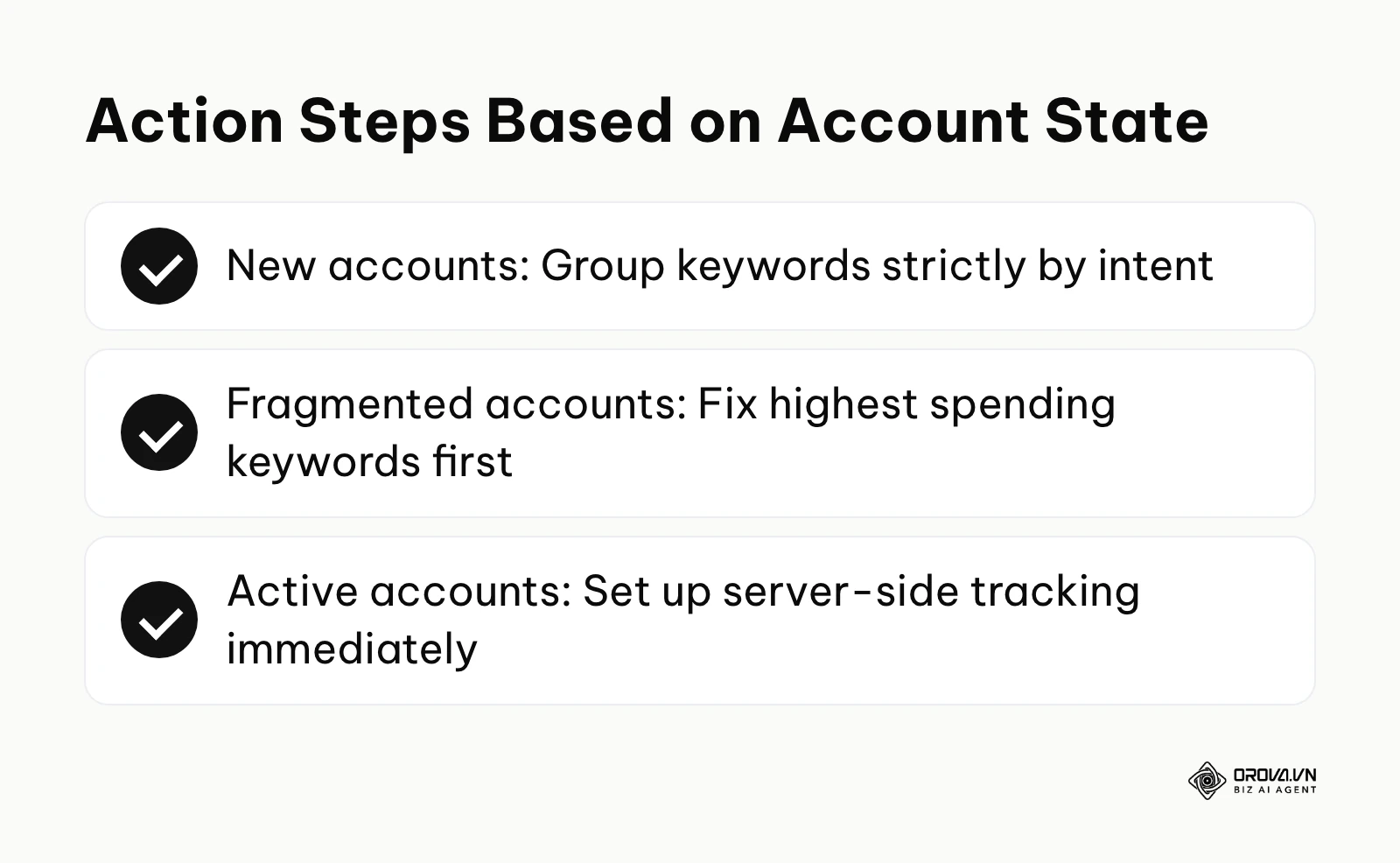
The list below summarizes action steps tailored to different campaign states.
Starting from scratch
If you are launching a brand new account and have zero historical data, your first step is to group your initial keyword list strictly by user intent rather than broad topics. Spend one afternoon organizing your spreadsheet so that every ad group contains no more than five tightly related keywords. This ensures your first batch of ads will achieve 'Above Average' ad relevance right out of the gate, setting a positive baseline for your account history.
Fragmented setup
If you have an existing account with dozens of ad groups but erratic performance, your first step is to filter your keywords by cost and sort them in descending order. Identify the top five keywords spending the most money that have a score of 4 or lower. Pause everything else for a moment and spend your afternoon rewriting the ad copy and adjusting the landing page headlines specifically for these five keywords. Fixing the biggest financial leaks yields the fastest return on your time.
Running but not tracking
If your campaigns are active and generating clicks but you are not tracking conversions, your first step is to halt optimization of the 1-10 metric entirely and install robust tracking. Spend your afternoon setting up server-side conversion tracking or Google Tag Manager to capture form submissions and purchases. Without conversion data, any improvement in your google ads quality score is meaningless because you cannot prove it impacts your actual business revenue.
About the author

Builder of Orova
Nguyễn Đỗ Trọng Ân has 8 years of experience in marketing, including 6 years managing market development across Asia. He builds Orova, a Biz AI Agent that never sleeps: it plans, runs and optimizes work for businesses.
Run your business with AI Agents
Orova is the always-on Biz AI Agent — it plans, runs, and optimizes the work for you.
Save time, unlock productivity.