
Google PPC AdWords: what it is, how it became Google Ads, and how to bid profitably

Google PPC AdWords is the name many people still use for Google Ads, Google's pay-per-click advertising platform that was called AdWords until July 2018. Managing google ppc adwords campaigns often feels like watching your marketing budget vanish into a black box without clear customer acquisition to show for it. Founders and marketing leads frequently launch their first search campaigns by accepting Google's automated recommendations, setting default broad match keywords, and expecting profitable inbound leads within forty-eight hours. What actually happens is rapid budget depletion driven by irrelevant search queries, aggressive bidding on branded terms you already own organically, and vague dashboard metrics that fail to correlate with net revenue in your bank account. The traditional advice to simply increase your budget or trust Google's automated bidding algorithms without foundational controls is fundamentally flawed. This practical guide breaks down how paid search auctions operate, how to calculate your break-even cost-per-click thresholds before spending capital, and how to structure search campaigns that deliver profitable, measurable customer acquisition.
What is Google PPC AdWords?
Google PPC AdWords is Google's intent-driven paid search advertising platform that bills advertisers only when users click their ads. Designed to capture active search demand rather than passive interest, it differentiates from social advertising and organic search by delivering immediate, keyword-targeted SERP visibility governed by a real-time auction combining bid price with ad relevance.
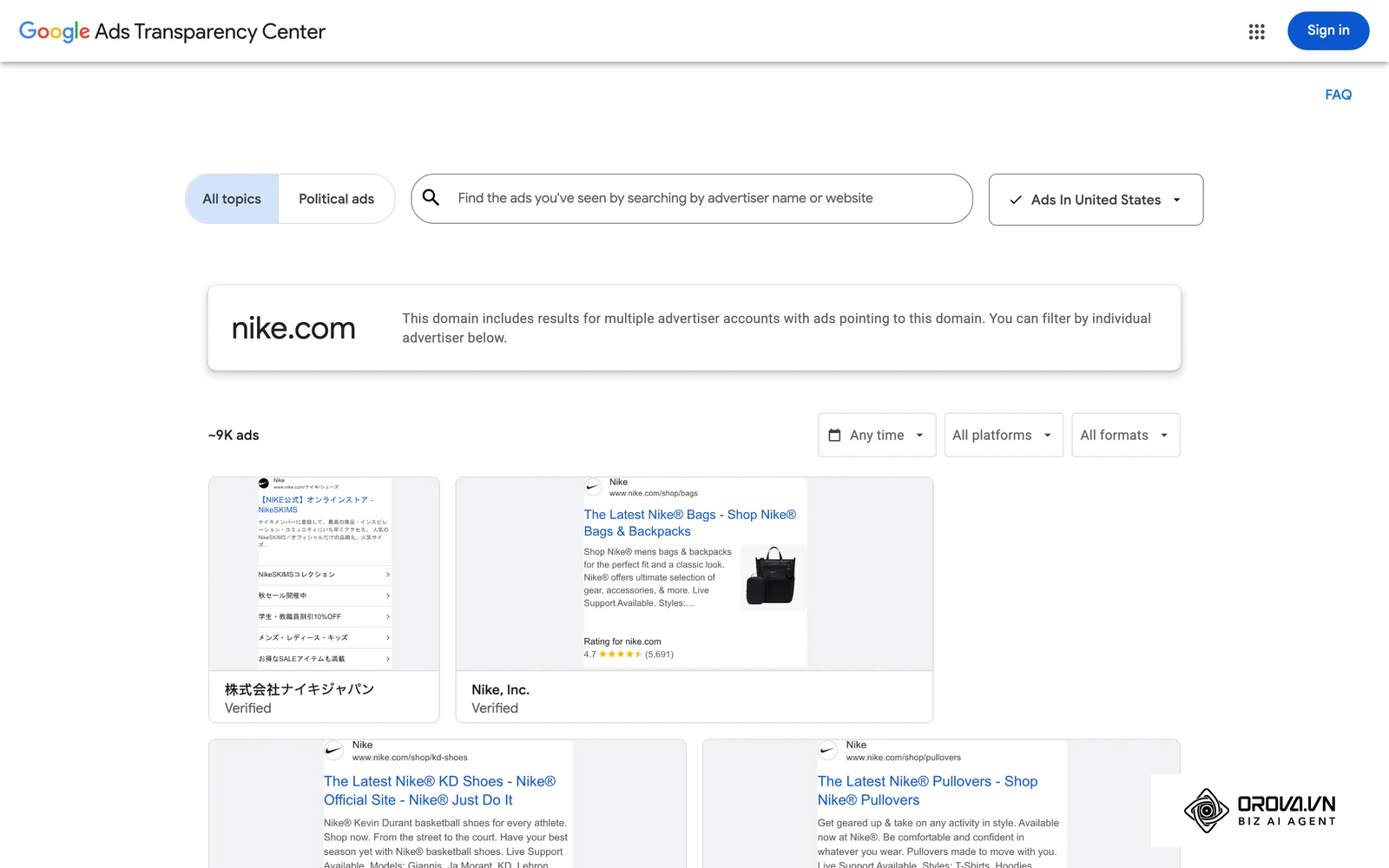
Google launched AdWords in October 2000 with approximately 350 advertisers using a monthly billing model. In 2002, Google introduced the cost-per-click auction model that defined modern pay-per-click (PPC) advertising, charging advertisers only when a prospective buyer clicked their sponsored listing. In July 2018, Google formally rebranded Google AdWords to Google Ads to reflect multi-channel inventory encompassing search, display networks, YouTube video, and automated campaign types. Despite the official rebrand, practitioners frequently refer to search network campaigns as Google PPC AdWords because search queries remain the platform's core commercial engine.
| Concept | Key Difference | Practical Example |
|---|---|---|
| Google PPC AdWords | Charges on user click for high-intent search queries with immediate SERP positioning. | Paying 4.20 dollars when a prospective client clicks an ad for "enterprise cloud backup software". |
| Search Engine Optimization (SEO) | Earns organic search placement through technical structure, content, and backlinks without media fees. | Publishing technical documentation that ranks naturally on page one over six months of indexing. |
| Social Advertising (Meta / TikTok) | Interrupts passive feed browsing using demographic and interest targeting rather than explicit search queries. | Showing an automated video ad for project management software to marketing directors scrolling Instagram. |
| Programmatic Display Networks | Buys banner and video impressions across third-party websites based on audience behavior, paying per thousand impressions (CPM). | Retargeting past website visitors with banner ads across news portals to sustain brand recall. |
Think of Google PPC AdWords as leasing premium retail frontage directly at the exit of a transit hub where consumers arrive holding specific shopping lists. Traditional billboard advertising shows products to everyone passing by on the highway regardless of need, while organic retail placement takes years of city zoning approvals to construct. With Google PPC AdWords, you bid on the exact storefront sign that matches the shopper's immediate query, opening your doors instantly and paying rent only when an interested shopper walks through your entryway.
The Real Business Purpose of Google PPC AdWords
Google PPC AdWords exists to solve the single most pressing constraint in customer acquisition: intercepting buyers at the exact moment of explicit purchase intent. Building organic traffic takes months of continuous publication, while outbound outreach faces declining reply rates. Search advertising provides immediate access to buyers who are actively searching for a vendor, giving businesses predictable control over their inbound pipeline.
The Strategic Position of Search Intent
The diagram below summarizes how explicit search intent filters audience volume from broad market awareness down to transactional buyer actions, separating commercial search from casual web browsing.
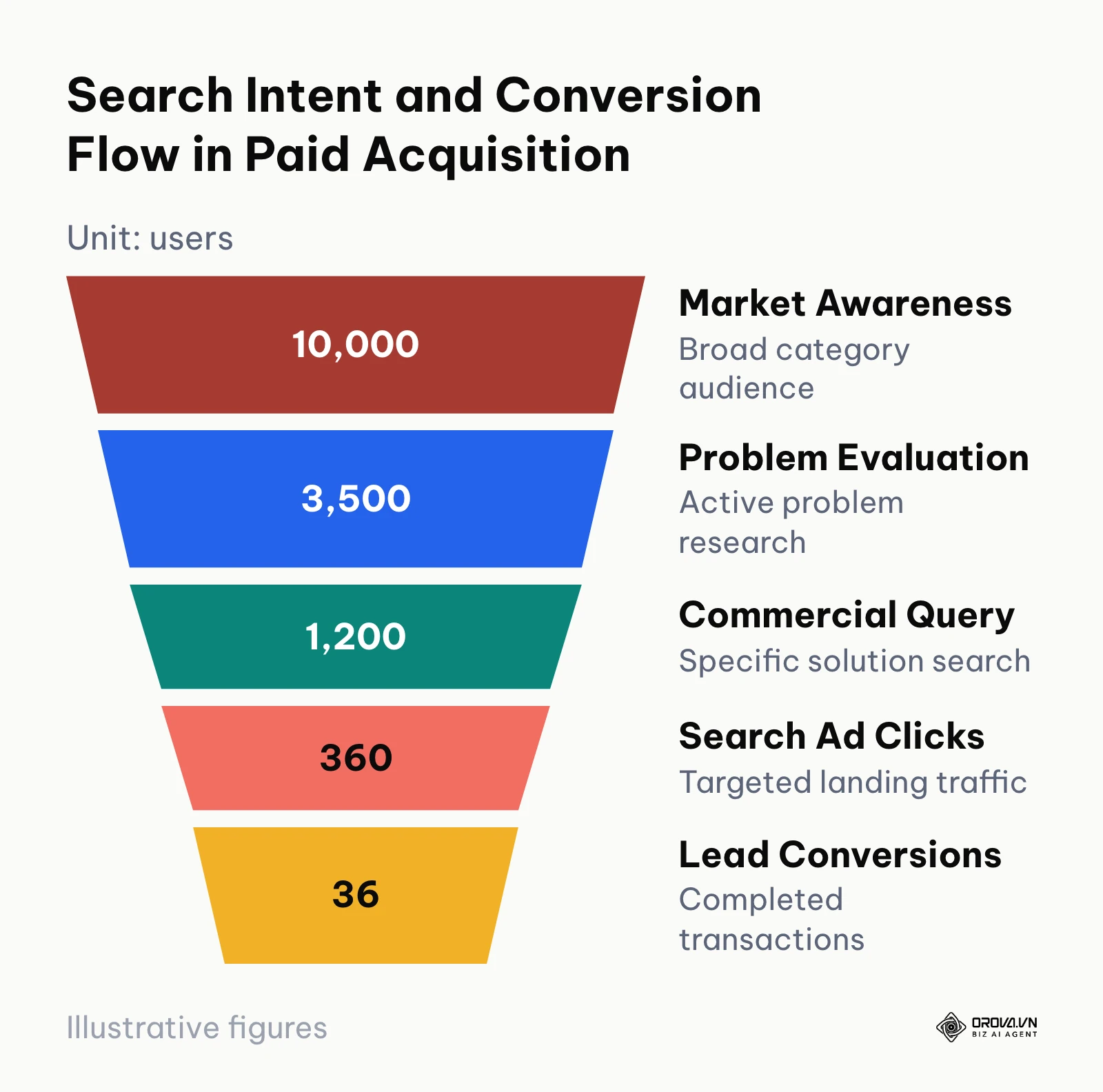
In modern go-to-market architecture, search advertising does not exist in isolation. Before launching paid search, a business must have an offer with verified market viability, clear pricing economics, and a functional conversion funnel. Paid search sits directly between active problem recognition and commercial evaluation. What comes before Google PPC AdWords is market validation and landing page optimization; what comes after is conversion rate optimization, customer onboarding, and customer lifetime value expansion. According to the Interactive Advertising Bureau (IAB) in their IAB Internet Advertising Revenue Report published in 2024, search formats continue to represent the largest individual share of digital ad revenues due to direct intent capture.
Surrendering search engine real estate carries severe commercial consequences. When prospective buyers search for category solutions and cannot find your business, they default to competitors bidding on those exact commercial terms. Furthermore, competitors can bid on your brand name, siphoning away high-converting prospects who were looking specifically for your product. Neglecting search advertising effectively cedes bottom-of-funnel transaction volume to whatever competitor is willing to place a bid.
When You Do Not Need Google PPC AdWords Yet
Running Google PPC AdWords is premature when your product category has zero existing search volume, such as an entirely novel invention where consumers do not yet know the problem exists. In that scenario, spend your capital on social video discovery or targeted outbound outreach to generate initial category awareness. Similarly, if your landing page fails to convert warm referral traffic or your gross margins cannot support minimum industry cost-per-click thresholds, paid search will accelerate cash burn without producing sustainable customer acquisition. Fix your unit economics and conversion tracking before funding paid search clicks.
Business Value and Operational Benefits of Google PPC AdWords
Deploying paid search delivers distinct value across two operational layers: financial risk mitigation for business owners, and granular acquisition control for marketing practitioners.
Capital Efficiency and Accelerated Market Validation
For business leadership, paid search replaces speculative media commitments with performance-based capital allocation. Instead of signing six-month media sponsorships or committing capital to unproven sales territories, paid search allows leadership to test new commercial offers within seventy-two hours. Capital risk is capped by strict daily budget ceilings, ensuring that customer acquisition costs remain bounded by measurable financial limits.
Before implementing paid search, leadership teams often spend months developing products based on assumed customer demand, only to discover that commercial conversion rates are insufficient to support growth. After deploying disciplined search campaigns, businesses test multiple value propositions and price points against live buyer searches, establishing empirical customer acquisition cost benchmarks before committing expansion capital.
Query-Level Transparency and Intent Capture
For operational marketers, Google PPC AdWords provides unmatched visibility into buyer behavior. Unlike social platforms that optimize based on opaque demographic affinity groups, paid search provides granular query data through the Search Terms report. Marketers observe the exact phrasing, intent depth, and problem terminology utilized by prospective buyers at the point of conversion.
Before gaining query-level transparency, marketing specialists rely on subjective surveys or broad industry research to guess buyer terminology. After auditing live search query reports, practitioners align website copy, ad headlines, and sales collateral with verified customer vocabulary, directly improving landing page relevance and downstream conversion rates.
Predictable Pipeline and Scalable Acquisition Risk Management
Paid search transforms pipeline generation from unpredictable peaks and valleys into a measurable acquisition engine. When conversion tracking is calibrated accurately, increasing daily ad spend directly expands qualified inbound sales inquiries, providing predictable pipeline coverage for revenue teams.
Illustrative example: A mid-market B2B industrial component manufacturer with 45 employees relied entirely on annual trade expos and outbound cold calling, facing seasonal pipeline volatility. The marketing specialist set up a targeted search campaign targeting high-intent commercial keywords ("custom hydraulic valves manufacturer", "industrial pneumatic cylinders supplier"), established exact and phrase match ad groups, and configured lead form submission tracking linked to their CRM. In the initial two weeks, the campaign generated clicks for DIY repair queries and job seekers ("hydraulic valve repair jobs", "how to fix cylinder leak"). The team audited the Search Terms report, added 42 negative keywords at the campaign level, and tightened ad copy to specify "B2B Minimum Order Quantity 50 Units". Inbound qualified quote requests shifted from zero digital leads to an average of 14 verified engineering requests for quote logged directly in the CRM monthly, establishing a predictable inbound sales channel alongside trade expos.
Operational Value Metrics and Realization Horizons
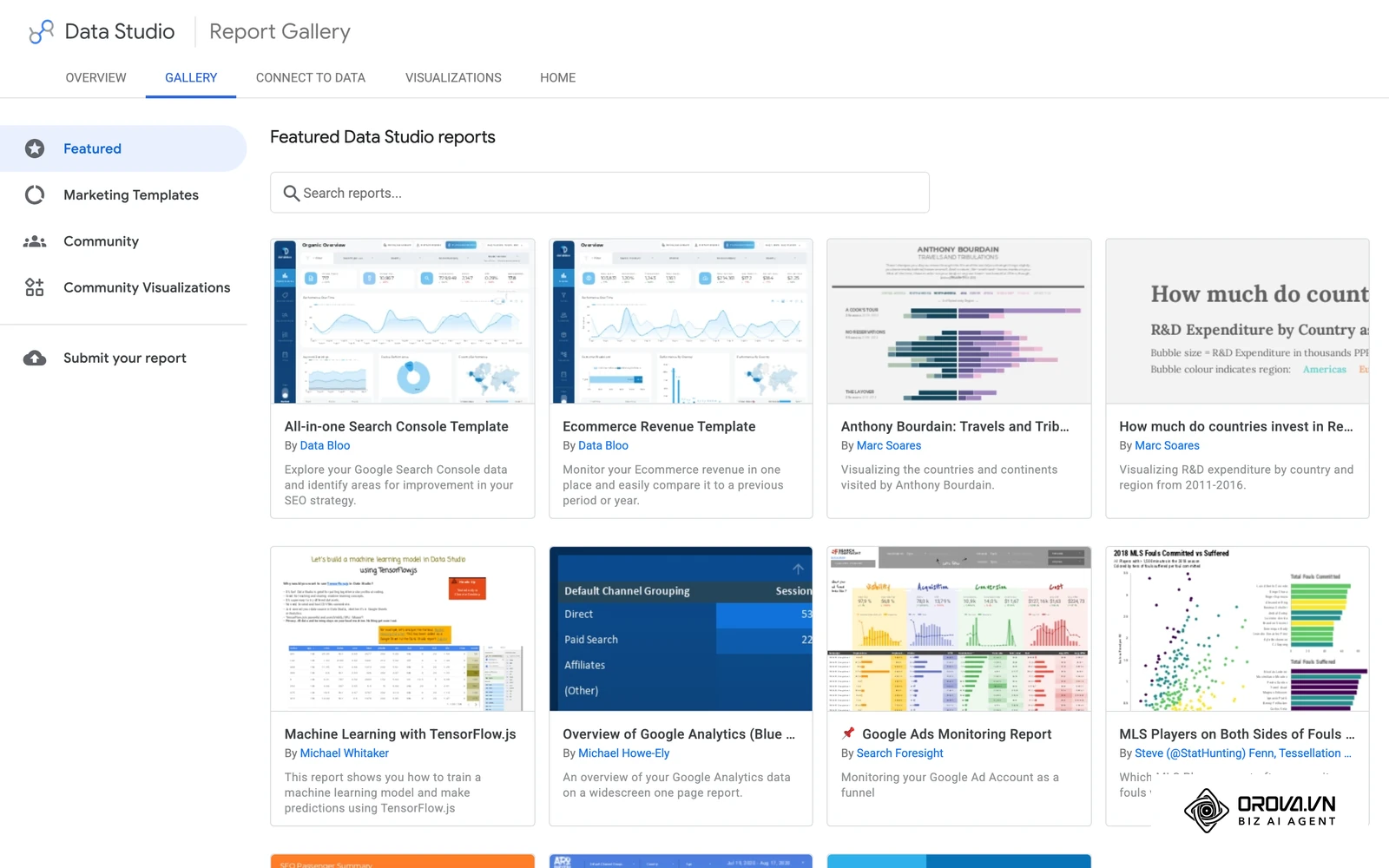
Evaluating campaign health requires structured PPC reporting that translates click volume and impression share into verified pipeline metrics rather than isolated dashboard vanity figures.
| Value Dimension | Key Performance Metric | Typical Horizon to Realize | Primary Stakeholder |
|---|---|---|---|
| Customer Acquisition Velocity | Days to First Qualified Lead | 3 to 7 Days | Sales and Growth Teams |
| Capital Efficiency | Cost Per Acquisition (CPA) vs Target | 4 to 8 Weeks | Finance and Executive Leadership |
| Intent Match Accuracy | Search Term Match Relevance Rate | 2 to 4 Weeks | PPC Campaign Managers |
| Revenue Scalability | Return on Ad Spend (ROAS) | 8 to 12 Weeks | Business Owners and Marketing Directors |
OROVA ADS applies AI Agent to automate and optimize ad performance on Google, Meta and TikTok. Scale your budget safely, monitor 24/7 and expand your business quickly.
Experience the solution at orova.vn/ads
How Google PPC AdWords Works: The Core Auction and Campaign Architecture
Understanding paid search requires dissecting the mathematical engine governing ad placement and auction clearing prices. Google does not sell ad space to the highest bidder; it runs a generalized second-price auction modified by ad quality calculations.
The Google PPC Auction Mechanism and Ad Rank Anatomy
Every time a user enters a search query, Google runs an instant auction to determine which ads appear and in what visual order. According to Google's Google Ads Help documentation on Ad Rank, an ad's position in the search results is determined not by bid amount alone, but by a real-time calculation combining Max CPC, Quality Score components, and the expected impact of ad assets.
The core auction mechanism evaluates three primary inputs:
- Max CPC Bid: The absolute maximum amount an advertiser specifies they are willing to pay for a click.
- Quality Score (1-10): A diagnostic score reflecting expected click-through rate (CTR), ad relevance to the search query, and landing page user experience.
- Ad Asset Impact: The expected performance lift provided by structured assets, including sitelinks, callouts, and structured snippets.
The resulting output is Ad Rank. In simplified auction mechanics, your actual cost-per-click is calculated as:
Actual CPC = (Ad Rank of the next competitor below you ÷ your Quality Score) + one cent
The common failure point in this mechanism occurs when advertisers attempt to overcome poor ad relevance or slow, generic landing pages by raising their CPC bids. Because a competitor with a Quality Score of 9 can beat an advertiser with a Quality Score of 3 while paying less than half the bid price, neglecting ad relevance creates severe cost penalties.
Financial Economics and Break-Even Max CPC Modeling
The most dangerous mistake beginners make in Google PPC AdWords is setting bids based on platform suggestions rather than unit economics. Google's interface frequently recommends raising bids to capture additional impression share, without considering your product gross margin or sales conversion rates.
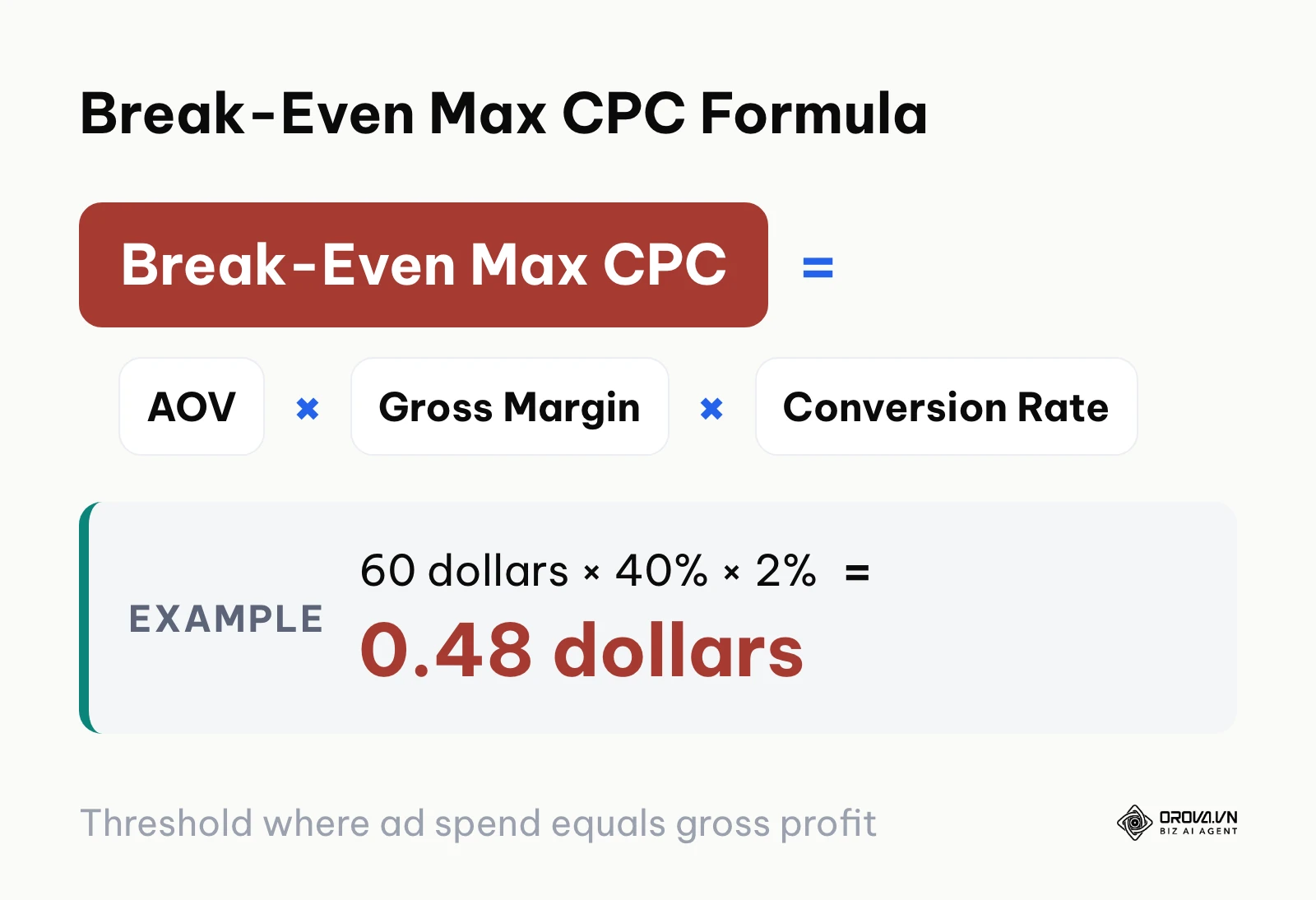
The diagram below summarizes the mathematical relationship governing break-even cost-per-click thresholds, illustrating how average order value and conversion efficiency establish safe bid ceilings.
To prevent spending capital at a net loss, calculate your Break-Even Max CPC before launching any campaign:
Break-Even Max CPC = Average Order Value (AOV) × Gross Margin % × Landing Page Conversion Rate (CVR)
Setting your maximum bid below this threshold guarantees that each acquisition remains profitable on a transactional gross profit basis.
| Business Model | Average Order Value (AOV) | Gross Profit Margin | Landing Page CVR | Break-Even Max CPC | Safe Target CPC (30% Profit Buffer) |
|---|---|---|---|---|---|
| Fashion E-Commerce | 60 dollars | 40% (24 dollars gross profit) | 2.0% | 0.48 dollars | 0.34 dollars |
| Local Dental Practice | 400 dollars | 50% (200 dollars gross profit) | 5.0% | 10 dollars | 7 dollars |
| B2B SaaS Enterprise | 1,200 dollars | 80% (960 dollars gross profit) | 1.5% | 14.40 dollars | 10.08 dollars |
If keyword tools indicate that average CPCs for dental implant terms are 14 dollars, but your clinic converts landing traffic at 5% with 200 dollars of gross profit per patient, your break-even threshold is 10 dollars. Bidding 14 dollars loses about 4 dollars of gross profit on every click, which is roughly 80 dollars per acquired patient (4 dollars divided by a 5% conversion rate), unless you improve your conversion rate or increase your average patient lifetime value.
Strategic Match Type Selection and Query Control
Structuring your initial ad groups requires a disciplined Google Ads campaign setup that isolates high-intent keywords from exploratory discovery queries. Google categorizes search keywords into three distinct match types, each representing a trade-off between control and query volume.
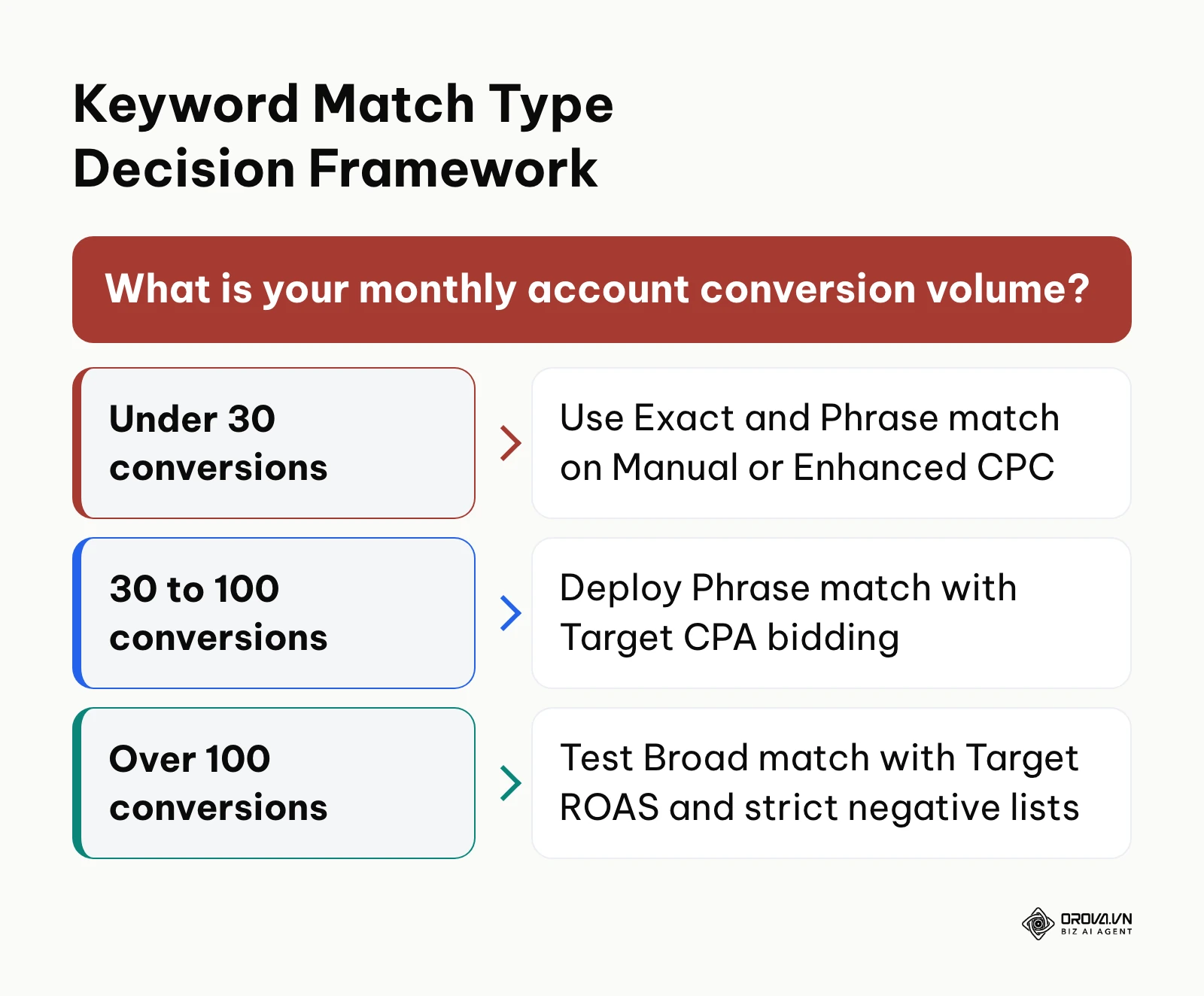
The diagram below summarizes how account conversion volume dictates match type selection, helping operators avoid premature broad match adoption.
| Match Type | Syntax Example | Intent Precision | Optimal Bidding Architecture |
|---|---|---|---|
| Exact Match | [emergency dental clinic] | High precision, low query drift | Manual CPC, Enhanced CPC, Target CPA |
| Phrase Match | "emergency dental clinic" | Moderate precision, preserves word intent | Target CPA, Target ROAS |
| Broad Match | emergency dental clinic | Expansive discovery, semantic variants | Smart Bidding with extensive negative lists only |
As of 2026, Google's machine learning aggressively matches Broad Match keywords to semantic intent variations. Running Broad Match on a new account without established conversion history allows Google to match your ads to loosely related, low-converting queries, draining daily budgets within hours.
Negative Keyword Tiering and Broad Match Control
Negative keywords prevent your ads from showing for search queries that contain your keywords but lack commercial purchase intent. Effective account management organizes negative keywords into three distinct hierarchical tiers:
- Account-Level Negative Lists: Universal non-commercial terms applied across every campaign in the account. Standard lists include terms like "free", "crack", "torrent", "jobs", "salary", "internship", "pdf", and "login".
- Campaign-Level Negative Lists: Category-specific exclusions that prevent cross-campaign competition. For example, adding "residential" as a negative keyword in a commercial cleaning campaign.
- Ad Group-Level Negatives: Granular query steering that directs specific search terms into dedicated ad groups containing tailored ad copy.
Implement a mandatory weekly Search Terms report audit routine. Filter queries that have accumulated spend equal to your target CPA without generating a conversion, and add those terms directly to your negative keyword lists.
Standard Search Versus Performance Max: Cannibalization Defense
Performance Max (PMax) campaigns utilize automated asset combinations across Search, Display, YouTube, Gmail, and Discover. However, when deployed alongside standard Search campaigns, PMax frequently creates internal keyword cannibalization.
Because PMax has access to expansive multi-channel inventory and automated bidding, it often bids aggressively on your brand name and high-converting generic search queries, claiming credit for conversions that standard Search campaigns would have captured at lower cost.
To defend your account against cannibalization:
- Apply Brand Exclusion Lists: Inside PMax campaign settings, attach an explicit Brand Exclusion list containing your trademarked terms to force PMax to find incremental, non-brand customers.
- Maintain a 70/30 Budget Ratio: Allocate 70% of your paid search budget to standard Search campaigns with exact and phrase match controls, reserving 30% for Performance Max discovery.
- Turn Off Final URL Expansion: In PMax asset groups, disable URL Expansion to prevent the algorithm from driving search traffic to low-converting blog posts or privacy policy pages.
Illustrative example: A direct-to-consumer athletic apparel brand spending 15,000 dollars a month launched a Performance Max campaign alongside their legacy Search campaigns. The ad manager analyzed attribution reports and noticed Search campaign impression share dropped by 38% while PMax reported surging conversions. They created a Brand Exclusion list inside PMax asset group settings, applied negative keyword lists for their trademarked brand terms to PMax via account-level negative lists, and reallocated budget to a 70/30 split favoring exact match Search ad groups. PMax initially reported a lower conversion rate once branded queries were stripped away, exposing that automated algorithms had been taking credit for returning brand customers. The team restructured PMax asset groups around specific product categories with unique lifestyle video and image assets rather than generic brand copy. The account restored non-brand prospecting volume in Search while PMax began acquiring genuine net-new customers across YouTube and Shopping, reflected in first-time customer acquisition metrics in their backend e-commerce dashboard.
Competitive Intelligence via Google Ads Transparency Center
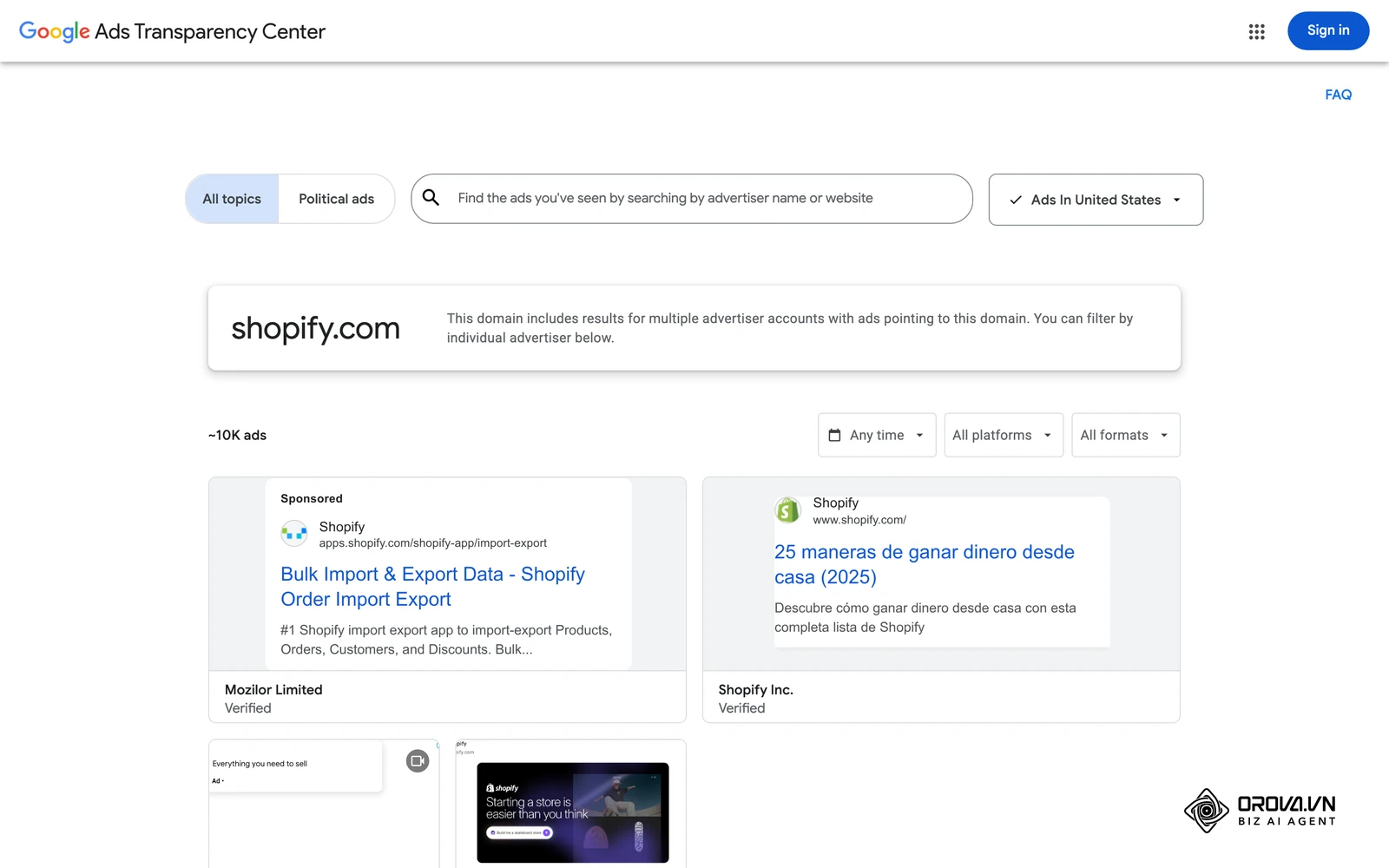
Writing compelling ad copy does not require guesswork. Google maintains a publicly accessible ad repository that allows advertisers to inspect verified competitor campaigns across global markets.
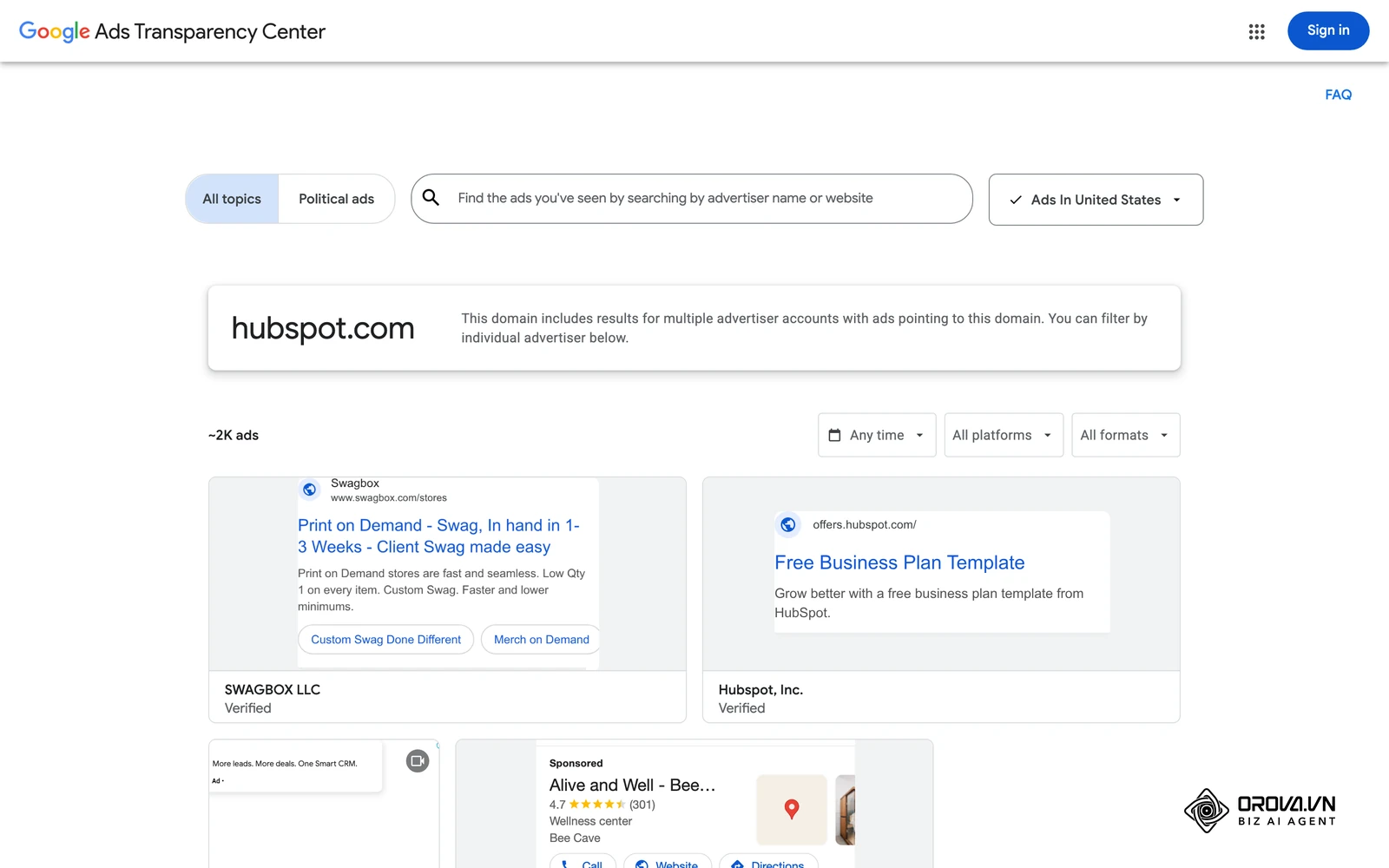
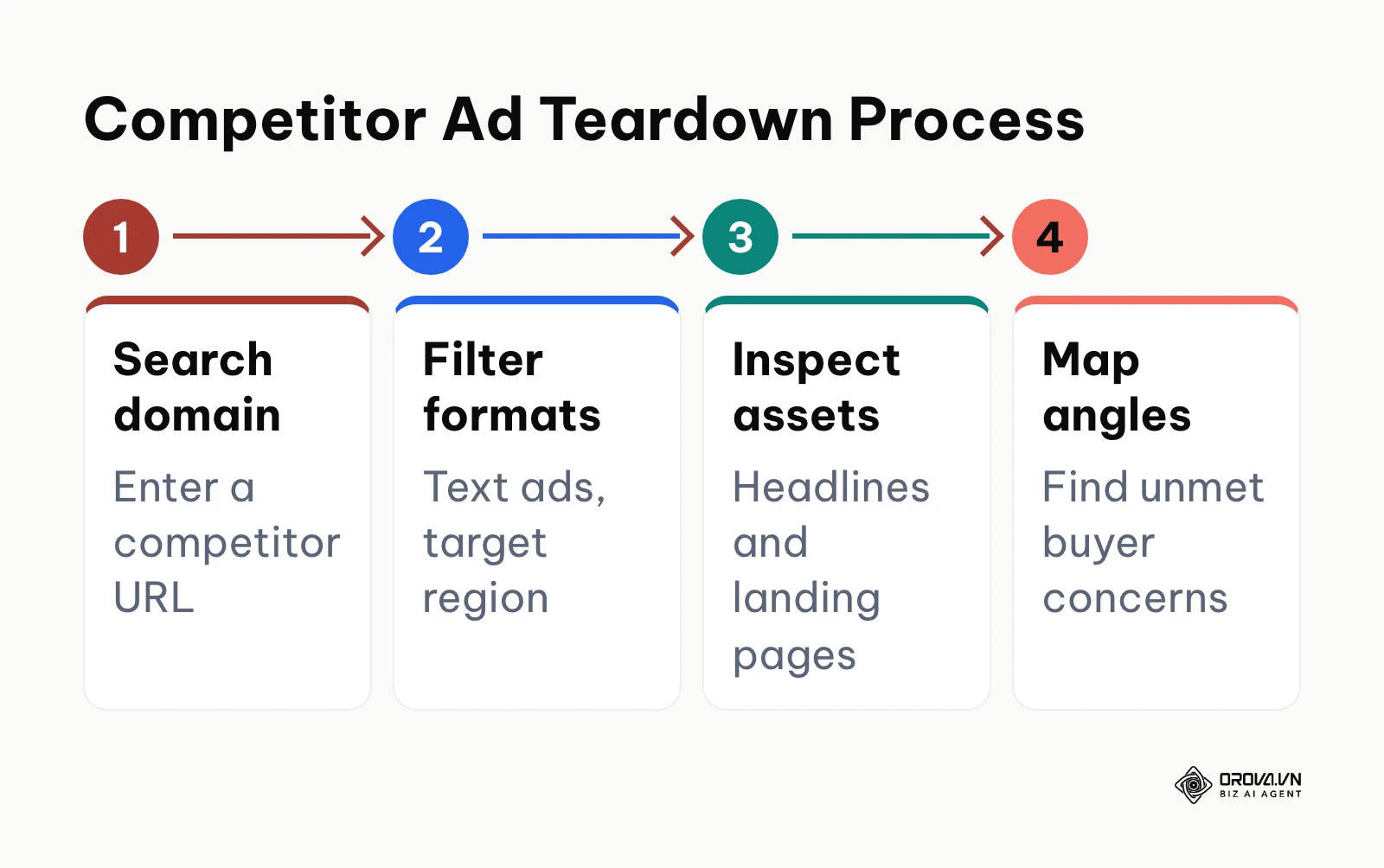
The diagram below summarizes the four-step competitor intelligence workflow for reverse-engineering competitor messaging and landing page positioning.
Follow this systematic four-step teardown process before writing ad copy:
- Navigate to adstransparency.google.com and enter your competitor's registered domain name.
- Filter active ads by format ("Text") and target geographic location to isolate their active search campaigns.
- Inspect their active headlines, promotional callouts, value propositions, and landing page destinations.
- Identify messaging gaps in their value proposition (such as unaddressed shipping costs, lack of clear warranties, or vague technical specifications) and write ad copy that directly addresses those customer hesitations.
Campaign Types in Google PPC AdWords
Understanding the broader network environment ensures you deploy the right campaign type for your specific commercial objective.
| Campaign Type | Key Characteristics | Best Suited For |
|---|---|---|
| Search Campaigns | Text ads triggered by explicit search keywords on Google SERP; highest purchase intent. | Capturing active solution seekers, service businesses, and B2B lead generation. |
| Performance Max (PMax) | Goal-based automated campaign serving across Search, Display, YouTube, Gmail, Maps, and Discover. | Scaled e-commerce catalog promotion and multi-channel conversion harvesting with established data. |
| Google Shopping | Product listing ads displaying image, price, title, and store name directly on search pages. | Retailers with physical inventory and competitive pricing structures. |
| Display & Video | Visual banner and video inventory across Google Display Network and YouTube; audience-focused. | Top-of-funnel brand awareness, visual product demonstration, and audience retargeting. |
What to Do to Launch and Adapt Google PPC AdWords
Implementing a profitable search campaign requires structured execution tailored to your team's operational resources and technical maturity.
Small Business Founders and Lean Operators
The diagram below summarizes the prioritization matrix for early-stage search campaigns, highlighting high-impact safeguards that protect lean budgets.
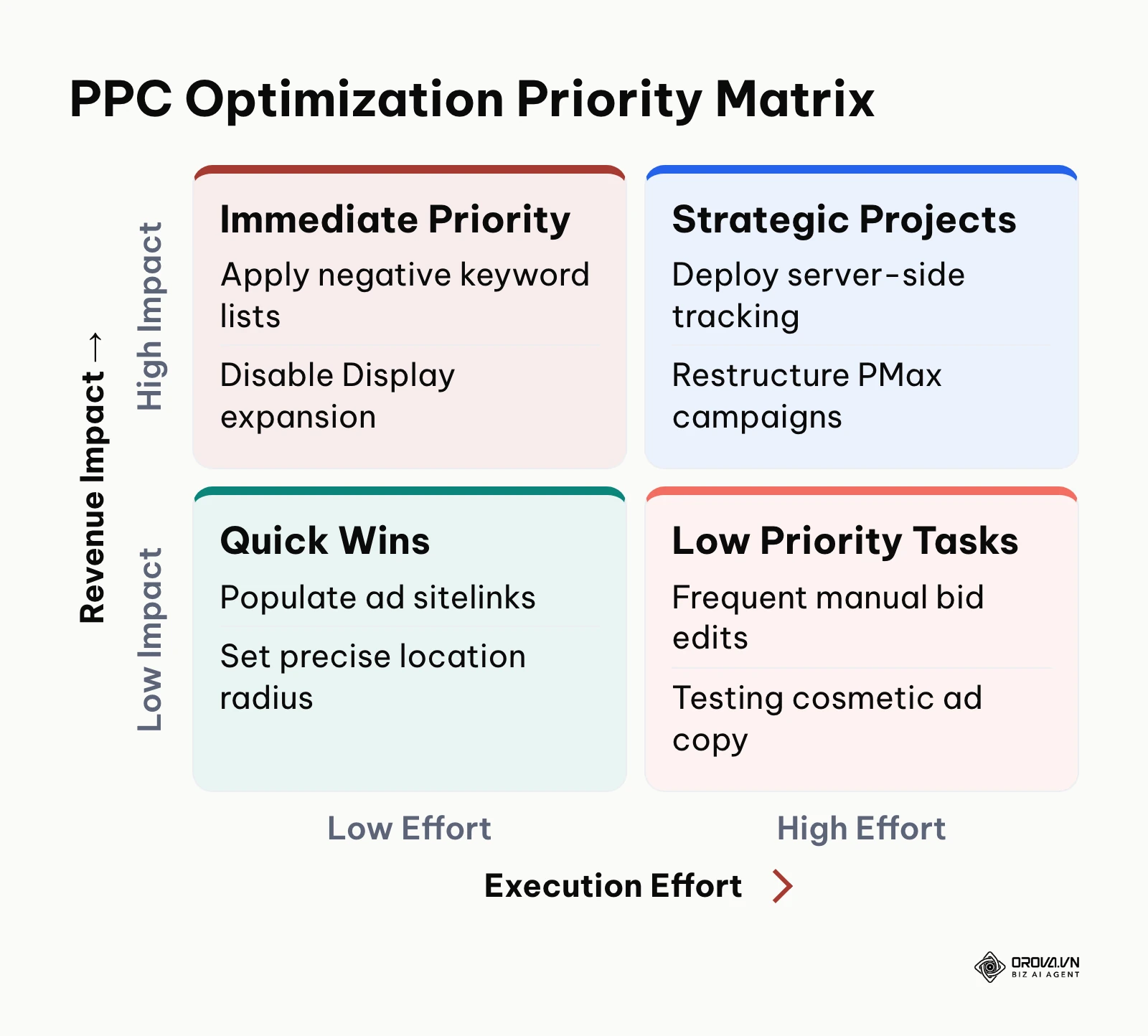
Founders operating without dedicated marketing personnel must prioritize budget protection over campaign complexity:
- Calculate Break-Even CPC First: Complete the break-even math detailed in the break-even section above to establish hard bid limits before activating ad billing.
- Build a Single Exact-Match Campaign: Select 5 to 10 tightly focused exact-match keywords that represent your highest-margin solution. Avoid broad match entirely during your first thirty days.
- Configure Direct Lead Form Tracking: Link your website form submissions to Google Ads as a primary conversion action. Test form submissions in Google Tag Assistant to verify that tracking triggers accurately before launching.
- Schedule a Weekly 15-Minute Audit: Check your Search Terms report every Friday morning to add negative keywords and verify daily spend caps.
Mid-Market In-House Marketing Leads
In-house marketing leads must establish scalable account structures that balance pipeline growth with cost control:
- Implement Server-Side Conversion Tracking: Deploy Google Tag Manager Server Container and Enhanced Conversions to transmit hashed customer conversion signals, counteracting browser tracking limitations.
- Segment Search Campaigns by Product Margin: Restructure blended campaigns into dedicated campaigns grouped by product gross margin, assigning higher Target CPA thresholds to high-value product lines.
- Enforce Campaign-Level Negative Lists: Audit query drift across multiple ad groups, deploying shared negative keyword lists to prevent internal auction competition.
- Align Bidding Strategy with Sales Velocity: If your sales cycle exceeds sixty days, configure offline conversion imports to feed qualified CRM milestone stages (such as Opportunity Created or Contract Sent) back into Google Ads bidding models.
Illustrative example: An in-house marketing manager at a regional home renovation service with 8 field locations was managing a single blended search campaign with a monthly budget of 6,000 dollars. The manager split the account into 8 distinct location-based campaigns, configured radius targeting around each showroom, applied dedicated location extensions, and set up call tracking metrics to separate showroom appointment requests from supplier inquiries. The default location settings used "Presence or Interest", causing ads to trigger for people searching about regional architecture from other states. The manager updated location options to "Presence: People in or regularly in your included locations" across all 8 campaigns and excluded neighboring state zip codes. Ad spend stopped leaking to out-of-service areas, and field branch managers reported that incoming phone inquiries matched their specific local service territories.
Agencies and Performance Marketing Specialists
Agency specialists managing multi-account portfolios require structured governance protocols:
- Deploy Universal Negative Master Lists: Attach agency-standard master negative lists to new client accounts on day one, immediately neutralizing thousands of universal junk search queries.
- Establish Tiered Bidding Frameworks: Migrate client accounts from Manual CPC to Target CPA or Target ROAS only after verifying that monthly conversion volume exceeds the 30-to-50 conversion threshold.
- Standardize Competitor Teardowns: Audit client competitors quarterly in the Google Ads Transparency Center to refresh ad creative angles and counter aggressive promotional offers.
- Implement Continuous Diagnostic Blueprints: Follow a systematic Google Ads optimization workflow to identify anomalies in Quality Score components, search lost impression share, and conversion lag across all client properties.
Ten-Point Pre-Launch Budget Protection Checklist
The diagram below summarizes the six core safeguards that must be verified before releasing ad spend, eliminating automated spend traps.
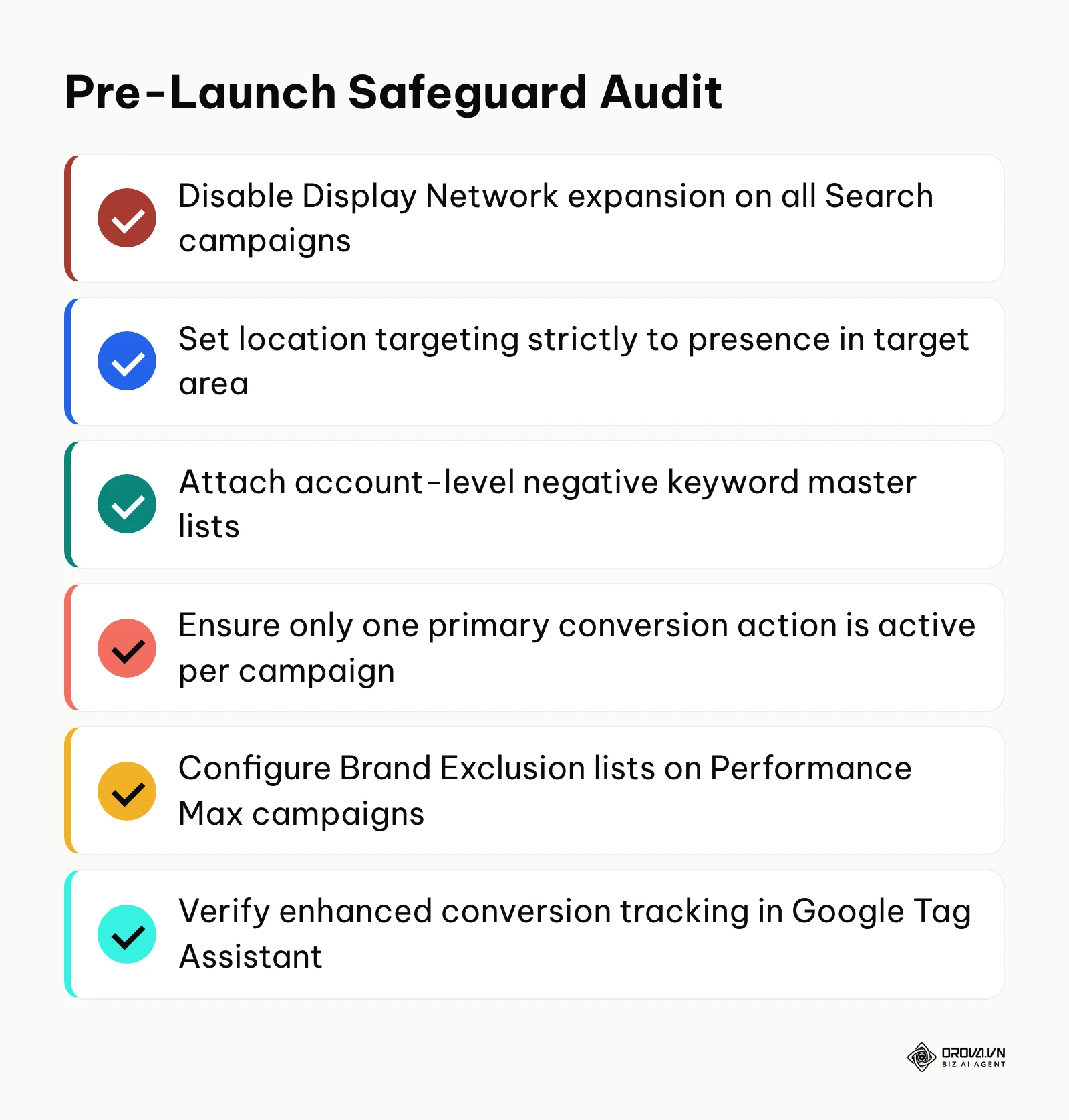
Verify each configuration item in this checklist before enabling ad delivery:
| Check Item | Passing Standard | Risk If Ignored |
|---|---|---|
| Search Display Expansion | Unchecked (Disabled) | Wastes part of the search budget on low-quality mobile app banners and accidental clicks. |
| Location Targeting Option | Set strictly to "Presence: People in or regularly in your included locations" | Ads trigger for users outside your service region who included your city name in casual queries. |
| Initial Match Type Selection | Exact and Phrase match only; no uncalibrated Broad Match | Google matches ads to tangential semantic queries, exhausting daily budgets without conversions. |
| Negative Keyword Master List | Account-level negative list attached (minimum 100+ standard junk queries) | Immediate spend loss to job seekers, student researchers, and free file download searches. |
| Ad Asset Completeness | Minimum 4 sitelinks, 3 callouts, and 1 structured snippet active | Lowers Ad Rank, depresses click-through rates, and increases required CPC auction clearing prices. |
| Primary Conversion Action | Exactly one primary conversion action active per campaign | Smart Bidding double-counts micro-actions, skewing machine learning algorithms. |
| PMax URL Expansion | Disabled or restricted to specific landing page categories | PMax routes paid clicks to irrelevant blog archives, terms of service pages, or career listings. |
| PMax Brand Exclusion | Brand Exclusion list applied to Performance Max | PMax cannibalizes core branded search traffic, inflating reported ROAS while masking true prospecting loss. |
| Daily Budget Ceiling | Set to 10x to 15x estimated CPC | Rapid budget depletion during morning auction surges before afternoon buyer traffic arrives. |
| Enhanced Conversions | Verified active in Google Tag Assistant with first-party data hashing | Loses part of the conversion attribution data under modern browser privacy controls. |
Common Pitfalls and Mitigation Protocols
| Common Pitfall | Business Consequence | Prevention Protocol |
|---|---|---|
| Leaving Display Network enabled on Search | Wastes budget on low-intent mobile gaming apps and accidental banner clicks. | Deselect "Include Google Display Network" in Search campaign settings during setup. |
| Using default broad match on uncalibrated accounts | Google triggers ads for tangential search queries, exhausting daily budget in hours. | Restrict initial campaign keywords to Exact and Phrase match until conversion baseline is established. |
| Ignoring location intent settings | Ads display to searchers outside your delivery area who merely included your city name. | Switch location settings from "Presence or interest" to "Presence: People in your included locations". |
| Bidding without conversion tracking verified | Smart Bidding optimizes for clicks or unverified micro-actions rather than paying customers. | Validate primary conversion events with test transactions in Google Tag Assistant before launch. |
When scaling multi-channel acquisition across Google Ads, Meta, and TikTok, maintaining manual oversight across fragmented ad accounts creates significant operational drag. Modern teams leverage dedicated Google Ads management tools to bridge execution gaps.
Want to scale your budget but afraid of breaking performance?
Integrate OROVA ADS now - an AI Agent that automatically monitors and optimizes Google, Meta, TikTok ads 24/7. Now, expanding and replicating your Performance Ads team is just one click away.
Try it now at: orova.vn/ads
Trends in Google PPC AdWords Over the Next Few Years: Author's Perspective
Looking ahead at paid search evolution, the operational mechanics of Google PPC AdWords are shifting rapidly away from manual keyword mechanics toward synthetic data architecture.
Transition from Keyword Query Matching to Generative AI Search Responses
As of 2026, Google Search is actively embedding AI Overviews and conversational answer modules directly above traditional sponsored listings, compressing physical SERP real estate for standard text ads. In my view, over the next two to three years, Google PPC will shift from standalone keyword auctions toward conversational ad placements embedded directly within synthetic answer flows. Advertisers will bid on commercial intent states and semantic topic clusters rather than isolated exact-match keyword strings, because generative search interfaces synthesize multiple query intents into single response interfaces. Advertisers should prepare by optimizing landing page informational depth, feeding comprehensive structured schema to search crawlers, and organizing campaign structures around core customer problems rather than hyper-fragmented keyword ad groups. This prediction could prove inaccurate if user backlash against synthetic search results or antitrust regulatory pressures compel Google to preserve traditional link-based SERP layouts and distinct keyword ad tiers.
First-Party Data Ingestion as the Decisive Bidding Advantage
As of 2026, third-party cookie deprecation, privacy regulations, and Consent Mode v2 protocols have diminished client-side pixel attribution, leaving bid algorithms dependent on modeled data. I anticipate that within the next two years, the performance gap between advertisers relying on standard client-side tags and those feeding verified offline CRM revenue data back into Google Ads via Conversion APIs will widen substantially. As Smart Bidding algorithms become universally accessible, ad performance will no longer be determined by bidding tactics, but by the qualitative integrity of the conversion signals fed into Google's machine learning models. Marketing teams must establish server-side tracking pipelines, integrate CRM revenue milestones into Google Ads conversion actions, and prioritize qualified customer lifetime value signals over raw lead counts. This shift could be delayed if browser-level privacy sandboxes provide viable aggregated attribution standards that restore client-side measurement reliability without requiring proprietary CRM server pipelines.
Autonomous Campaign Execution Supervised by Strategic Governance
Campaign types like Performance Max and automated Smart Bidding already handle micro-second bid adjustments, asset combinations, and cross-channel placement selection without manual bid entry. I believe that within the next three years, routine campaign management tasks such as keyword bidding, ad copy rotation, and daily budget adjustments will become fully automated by platform-level AI agents. The role of the performance marketer will evolve from tactical execution operator to strategic risk governor, focused on setting profit boundaries, auditing negative search terms, and validating offer economics. Practitioners should transition their skillsets away from manual bid manipulation toward unit economic modeling, persuasive copywriting, offer differentiation, and cross-platform governance frameworks. If platform automated bidding models continue to suffer from query drift and budget misallocation on niche B2B verticals, manual bid controls and granular match type management will remain mandatory operational necessities.
Frequently Asked Questions About Google PPC AdWords
Is Google PPC AdWords still necessary when AI search engines and answer bots exist?
Yes, because commercial buyers still turn to search engines when they need to evaluate vendors, compare commercial pricing, or execute transactional purchases. Commercial search queries signal stronger purchase intent than passive scrolling through social feeds. While conversational AI handles broad informational queries, high-intent transactional search remains the primary mechanism connecting active buyers with verified providers.
Should you use Manual CPC or Smart Bidding if your daily budget is under 20 dollars?
If your daily budget is under 20 dollars, you should use Manual CPC or Enhanced CPC rather than fully automated Smart Bidding. With limited daily budgets, your account will not generate the conversion volume required for Google's machine learning models to adjust bids accurately. Manual bidding establishes strict cost ceilings, preventing the algorithm from spending half your daily budget on a single speculative click.
How many monthly conversions are required before Google Ads Smart Bidding works accurately?
Google does not publish one universal minimum, but a common practitioner rule of thumb is 30 to 50 verified conversions per month within a single campaign before relying on Smart Bidding. Below this threshold, bid automation experiences high statistical variance, frequently chasing low-intent queries that fail to generate repeatable customer acquisition. If your monthly conversion volume is below 30, rely on Manual CPC or Target CPA with conservative bid caps while your conversion baseline accumulates.
How do you measure true ROAS under Consent Mode v2 and browser tracking limits?
Measuring accurate return on ad spend requires implementing server-side conversion tracking paired with Google Enhanced Conversions and offline CRM conversion imports. Relying strictly on client-side browser pixels results in a measurable loss of conversion visibility due to ad blockers, cookie consent rejections, and browser storage restrictions. Uploading verified transaction values directly from your payment processor or CRM ensures your bidding algorithms optimize against actual bank revenue rather than modeled estimations.
What is the difference between Google PPC AdWords and Google Shopping ads?
Google PPC AdWords Search ads are text-based listings triggered by specific keyword queries, directing traffic to designated landing pages. Google Shopping ads are visual product cards displaying product imagery, merchant names, pricing, and ratings, populated dynamically through a Google Merchant Center product inventory feed. Search ads excel at service industries, software, and custom B2B offerings, whereas Shopping ads are essential for physical retail e-commerce.
How often should you audit your negative keyword lists in Google PPC AdWords?
For new campaigns with under ninety days of history, audit your Search Terms report weekly to identify irrelevant queries and add negative keywords. For mature, stable campaigns with established query negative libraries, a bi-weekly or monthly audit is sufficient to identify emerging seasonal search queries and prevent unwanted budget spend.
Where Should You Start with Google PPC AdWords?
Embarking on paid search requires a structured roadmap tailored to your account's operational maturity rather than generic execution advice.
If you are starting from scratch without an existing account or campaigns, your single afternoon task is to calculate your break-even Max CPC using your historical average order value and profit margins, then set up your Google Ads account with conversion tracking verified through Google Tag Assistant. Do not create complex campaign structures or write multiple ad variations until your primary conversion event records a successful test transaction.
If you are already running fragmented campaigns that lack disciplined structure, spend your afternoon auditing your Search Terms report from the past thirty days to extract irrelevant queries and compile an account-level negative keyword list. Immediately pause underperforming broad match keywords in uncalibrated ad groups and consolidate your budget into two tightly themed exact and phrase match ad groups focused exclusively on your highest-margin solution.
If you are running active campaigns with consistent click volume but lack reliable conversion measurement, dedicate one afternoon to auditing your conversion actions and implementing Google Enhanced Conversions or server-side tracking pipelines. Disconnect unverified micro-conversions from your primary bidding goals so Google's optimization algorithms calibrate strictly against verified revenue and qualified inbound leads.
Taking control of your customer acquisition economics and implementing disciplined negative keyword governance is the most dependable path to generating profitable returns from google ppc adwords.
About the author

Builder of Orova
Nguyễn Đỗ Trọng Ân has 8 years of experience in marketing, including 6 years managing market development across Asia. He builds Orova, a Biz AI Agent that never sleeps: it plans, runs and optimizes work for businesses.
Run your business with AI Agents
Orova is the always-on Biz AI Agent — it plans, runs, and optimizes the work for you.
Save time, unlock productivity.