
What is high volume recruiting? The automation blueprint
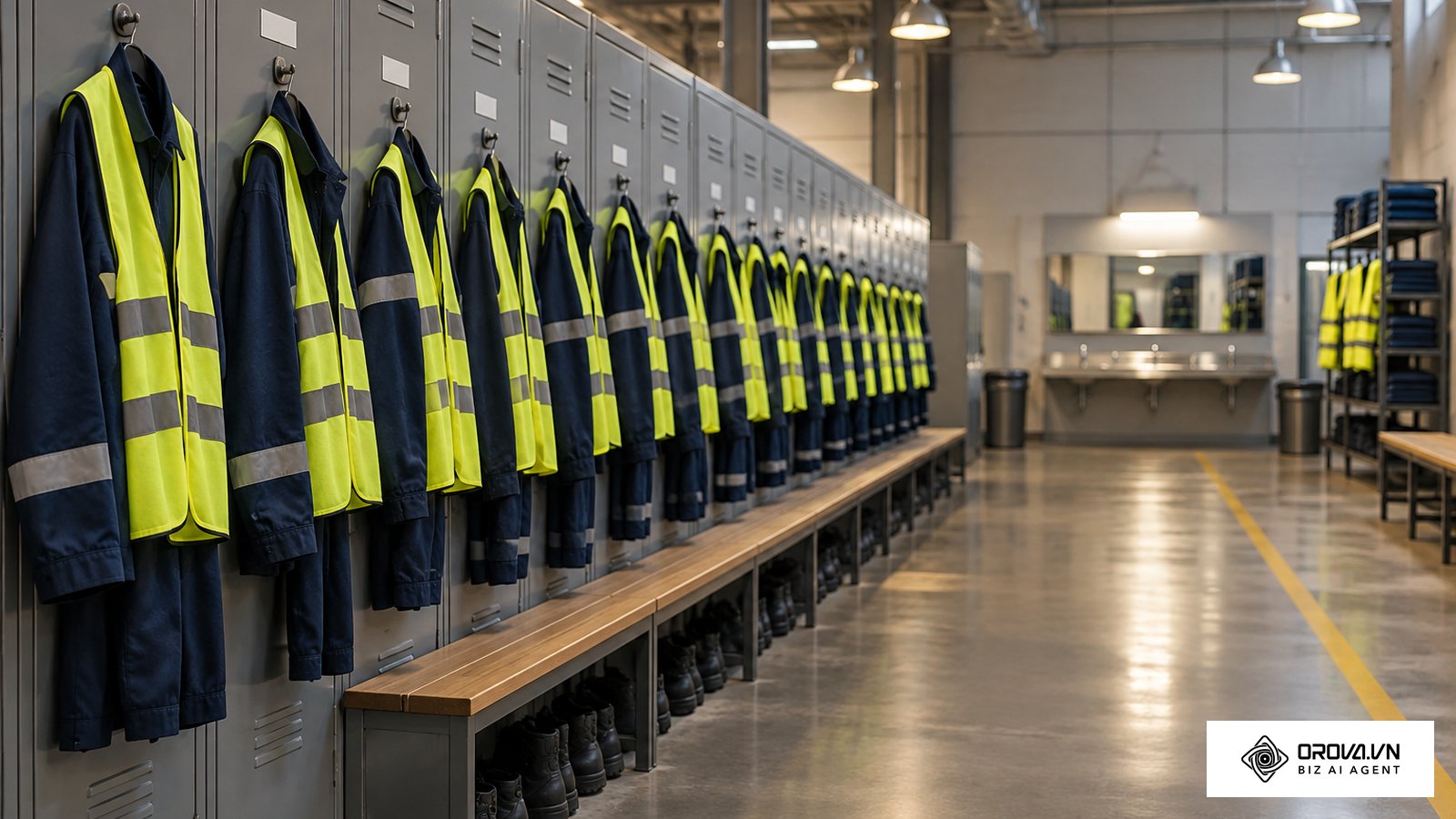
High volume recruiting is the practice of hiring a large number of people for similar roles in a short window, using standardized criteria, fast screening and largely automated scheduling and communication instead of case-by-case review. Picture the situation: your company has just secured a massive seasonal contract, or perhaps you are opening twenty new retail locations across the country. You are suddenly tasked with hiring 500 reliable workers within the next three weeks. If you rely on the traditional method—reading every single resume, sending individual emails to schedule phone screens, and conducting hour-long behavioral interviews—your HR department will completely collapse under the administrative weight. Worse, while you are busy shuffling paperwork, your best candidates will grow impatient, abandon the process, and accept offers from your competitors who move faster.
This is the exact situation where conventional hiring practices break down, and a specialized approach is required. You need a system that acts less like a handcrafted artisanal workshop and more like a highly efficient, automated assembly line. This blueprint will guide you through the complexities of high volume recruiting, providing you with actionable strategies, proven workflows, and the templates necessary to build a scalable hiring machine that secures top talent without sacrificing quality.
What is high volume recruiting? A definition and breakdown
High volume recruiting is the process of hiring a large number of employees in a short timeframe, typically for roles with high turnover or seasonal demand. It is used to fill operational gaps quickly and differs from traditional hiring by prioritizing speed and standardized workflows over deep, individualized candidate assessments.
The origin of this concept can be traced back to the early days of industrial manufacturing and mass retail expansion, where businesses realized that traditional "white-collar" hiring methods were too slow and expensive for frontline workers. As e-commerce and gig economies exploded over the last decade, the need to hire thousands of people in mere days became a critical survival metric for modern enterprises.
To truly grasp this concept, you must understand how it differs from other familiar recruitment methodologies. The table below outlines these key distinctions:
| Concept | How it differs | Example |
|---|---|---|
| High Volume Recruiting | Focuses on speed, standardized knockouts, and filling hundreds of identical roles simultaneously. | A logistics center hiring 800 warehouse associates for the holiday peak season. |
| Executive Search | Focuses on deep networking, extreme personalization, and months of vetting for a single, high-impact leadership role. | A corporate board spending six months to find a new Chief Executive Officer. |
| Campus Recruiting | Focuses on employer branding at universities and hiring entry-level talent in annual cohorts, often with long lead times. | A consulting firm hiring a class of 50 fresh graduates to start next summer. |
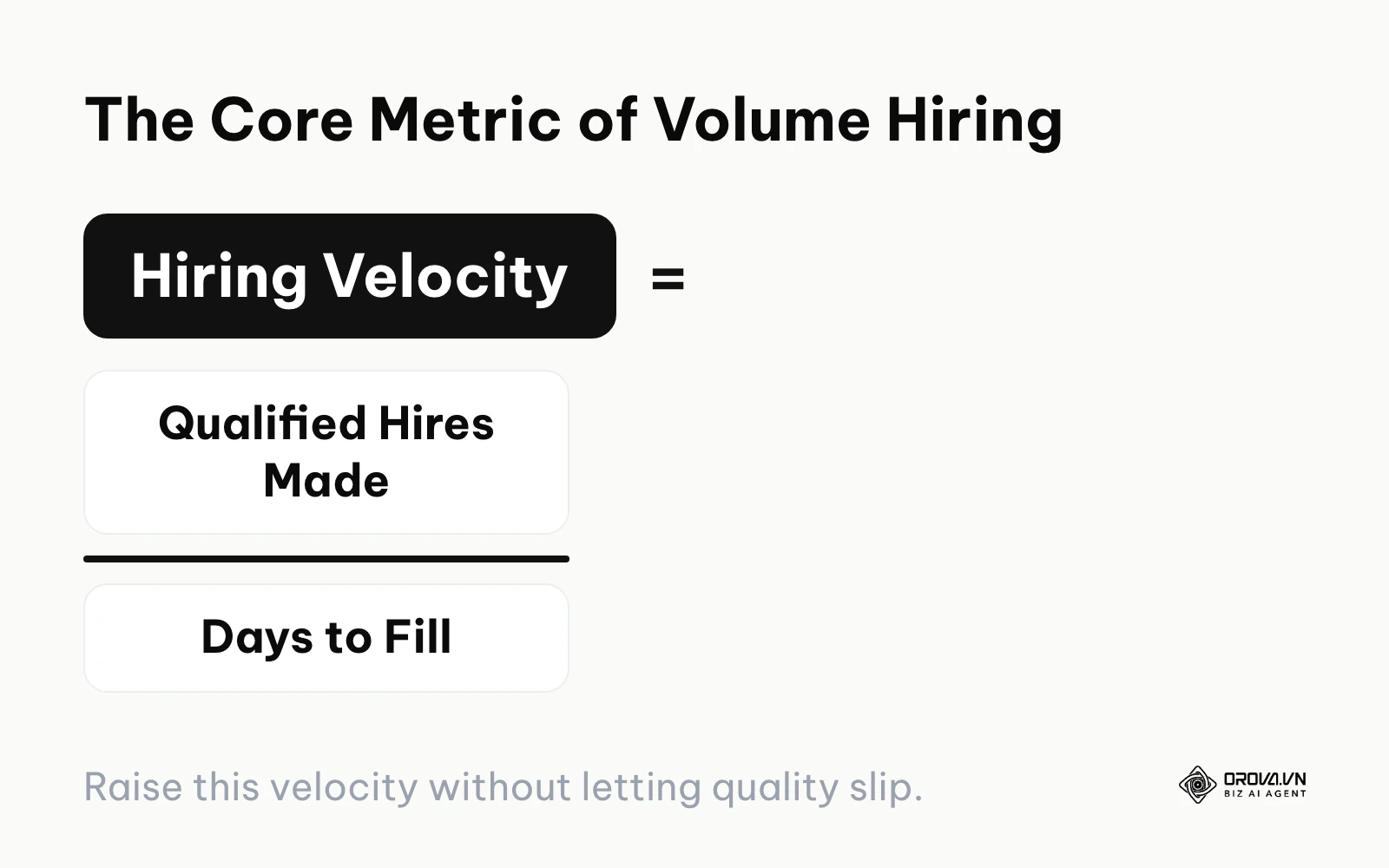
A useful way to track this is hiring velocity: the number of qualified hires made divided by the days it took to fill those roles.
Example: Consider a large e-commerce retailer preparing for Black Friday. It does not have the luxury of spending three weeks assessing whether a candidate has the perfect long-term career ambition. It needs to know immediately: Can you legally work? Can you safely lift packages? Can you start on Monday? High volume recruiting lets it filter a very large applicant pool through these binary questions automatically, so its warehouses are fully staffed to handle the holiday rush.
The formula diagram below summarizes the core metric you must manage.
The strategic meaning of high volume recruiting
High volume recruiting exists to solve a very specific, high-stakes problem: ensuring uninterrupted business continuity during periods of rapid expansion or intense seasonal demand. The primary audience for this strategy isn't just the HR department; it is the operations directors, store managers, and supply chain leaders whose daily output depends entirely on having enough hands on deck.
In the broader picture of talent management, volume recruiting sits squarely between high-level workforce planning and the crucial onboarding phase. Workforce planning dictates the sheer numbers needed (e.g., "We need 500 heads by October"), while the volume recruiting system is the engine that actually executes that demand. Once the candidates are selected, they are immediately passed into bulk onboarding systems. If you view volume recruiting simply as "doing normal hiring, but faster," you will fail. It requires a fundamental shift in mindset from "finding the absolute perfect candidate" to "finding a highly capable, reliable candidate as quickly as possible."
If you ignore the necessity of building a dedicated high volume system when your business demands it, the consequences are severe. You will inevitably face lost revenue because you cannot meet customer demand, massive overtime costs as your existing staff is stretched to the breaking point, and severe recruiter burnout as your team attempts to manually process thousands of unqualified applications.
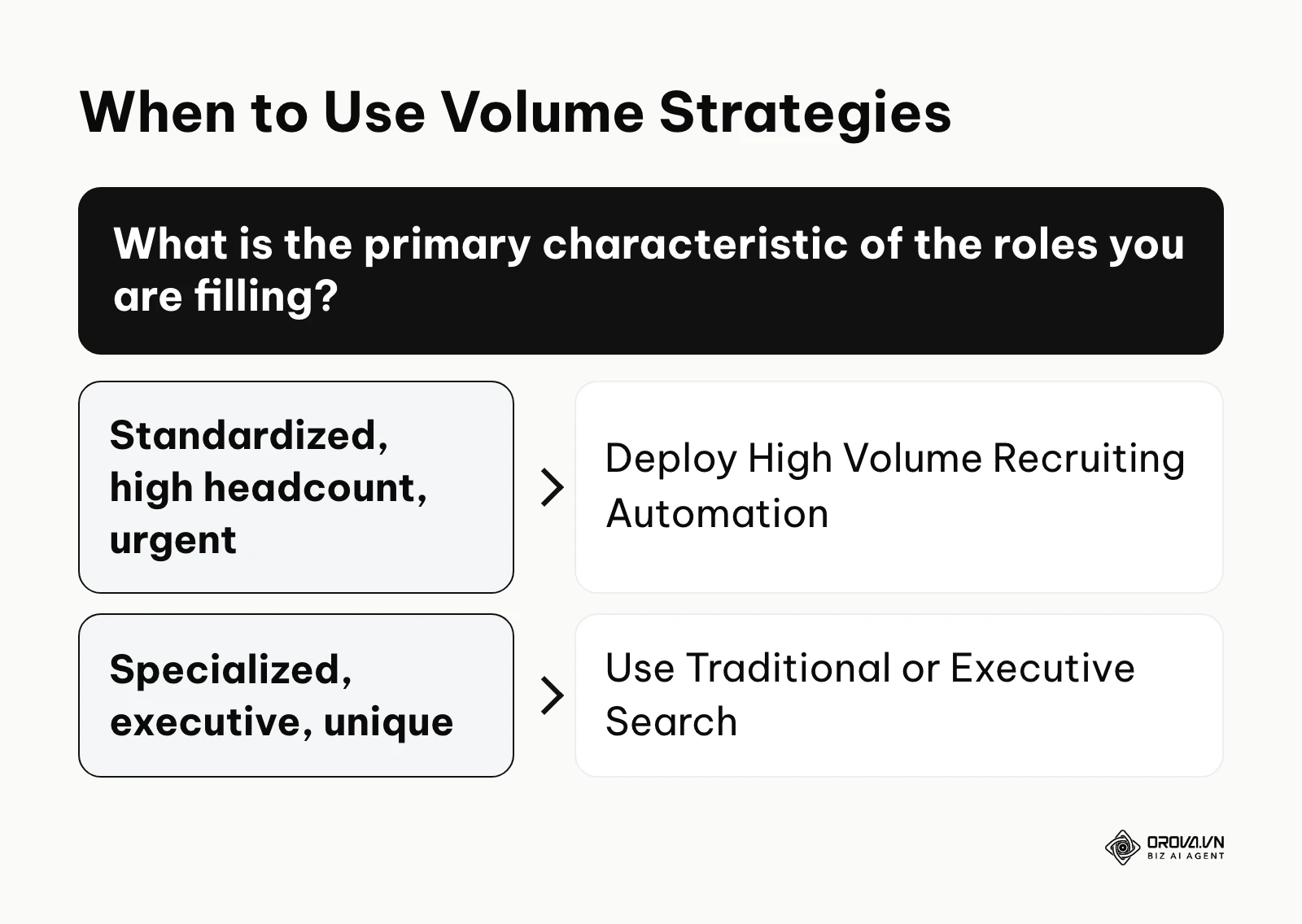
The decision framework below outlines exactly when this strategy should be applied.
When is high volume recruiting not needed yet? If your company is hiring for highly specialized knowledge workers, such as senior software architects or C-level executives, applying volume tactics is a critical mistake. Similarly, if your organization has a highly fragile culture that requires intimate, multi-stage vetting for every single hire, or if your overall headcount growth is slow and predictable, you should avoid these systems. Instead, focus on traditional, highly personalized recruitment methods, executive search firms, or targeted networking to find the perfect fit. Using an automated volume system for a bespoke role will only alienate top-tier candidates.
Business value: Protecting revenue and reducing risk
The true value of a robust high volume recruiting system extends far beyond simply making the HR department's life easier. It is a strategic lever that directly protects corporate revenue and mitigates significant operational risks. We can divide these benefits into two distinct layers: the macro business value and the operational benefits for the people doing the work.
Protecting Revenue and Reducing Time-to-Productivity
For the wider business, every day a critical frontline role remains unfilled is a day of lost productivity, missed sales, or delayed shipments. High volume systems drastically compress the time-to-fill metric. By utilizing recruitment automation to handle the top of the funnel, businesses can secure the best candidates before competitors do. Without automated screening, slow responses during seasonal hiring spikes push many candidates to drop out, so keeping them engaged through speed translates directly into operational readiness.
Eliminating Administrative Collapse for HR Teams
For the recruiters and hiring managers, the primary benefit is the elimination of low-value, repetitive administrative tasks. When dealing with thousands of applicants, manually scheduling interviews or sending rejection emails is not just inefficient; it is impossible. A volume system automates these touchpoints, allowing recruiters to focus on what actually matters: evaluating the final pool of qualified candidates and selling them on the company.
Illustrative example: A national supermarket chain needed to hire 1,200 seasonal stockers across 50 locations. Historically, the regional HR directors used manual spreadsheet tracking and phone calls, leading to lost resumes and a time-to-fill measured in weeks. They implemented an automated volume system featuring self-scheduling linked directly to their career page. The initial hurdle was that store managers resisted trusting the automated calendar blocks, fearing double bookings. The HR team resolved this by holding a mandatory 15-minute training session demonstrating how managers could easily block out their unavailable times on their phones. Once managers trusted the calendar, interviews were booked faster, recruiters spent less time chasing schedules, and stores were better staffed going into the holiday rush.
To clearly understand what you stand to gain, review this breakdown of specific benefits, how to measure them, and when you can expect to see results:
| Benefit | Measured By Which Metric | Time to See Results |
|---|---|---|
| Faster hiring speed | Average Days to Fill | 2 to 4 weeks |
| Reduced administrative burden | Hours spent on manual scheduling | Immediately upon launch |
| Lower cost per hire | Total recruitment spend / Total hires | 3 to 6 months |
| Improved candidate quality at interview stage | Interview-to-Offer Ratio | 4 to 8 weeks |
| Decreased early turnover | 30-Day and 90-Day Retention Rates | 3 to 6 months |
If manual screening is slowing down your hiring pipeline, Orova Recruit lets you set specific criteria for each role and scores up to 500 CVs per role against them, quoting the exact lines from each resume as evidence so you know why a candidate matched.
How high volume recruiting works: The step-by-step blueprint
Executing a high volume hiring campaign requires moving away from ad-hoc decisions and strictly adhering to a defined blueprint. The high volume hiring process works by building an automated funnel that attracts, screens, and schedules candidates with minimal human intervention at the earliest stages.
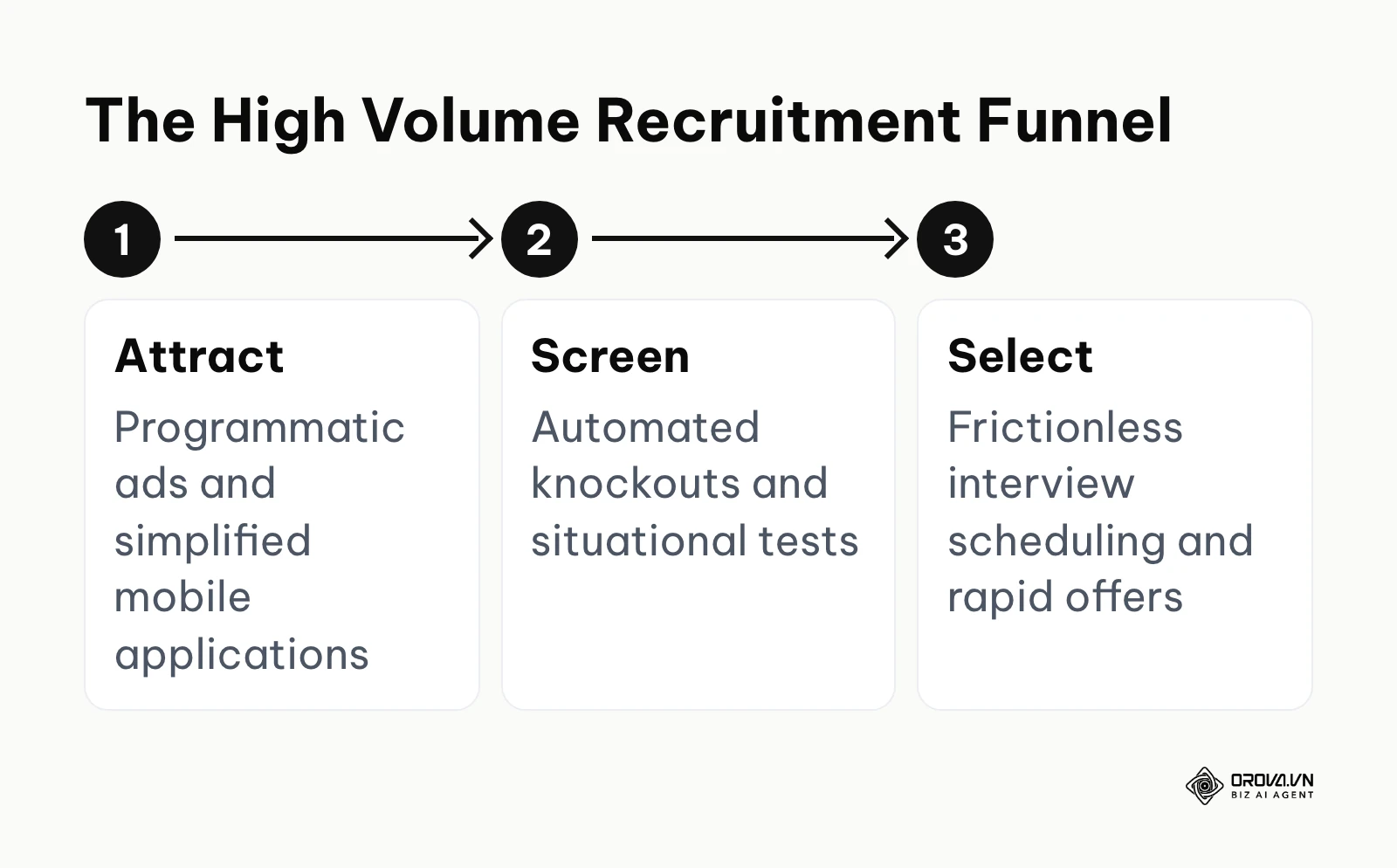
This section will dissect the anatomy of a successful volume campaign. Think of this as constructing a wide net combined with a highly intelligent sorting machine.
The diagram below summarizes the overarching workflow you must build.
Step 1: Programmatic job advertising and sourcing
- What you do: Instead of manually posting to individual job boards and hoping for the best, you use software to distribute your job ads across multiple networks simultaneously. You set rules so that your budget is automatically reallocated to the platforms yielding the best candidates.
- Inputs: A clearly defined job description, an optimized job title (using terms people actually search for, not internal jargon), and a strict advertising budget.
- Outputs: A massive, continuous flow of top-of-funnel applicants directly into your tracking system.
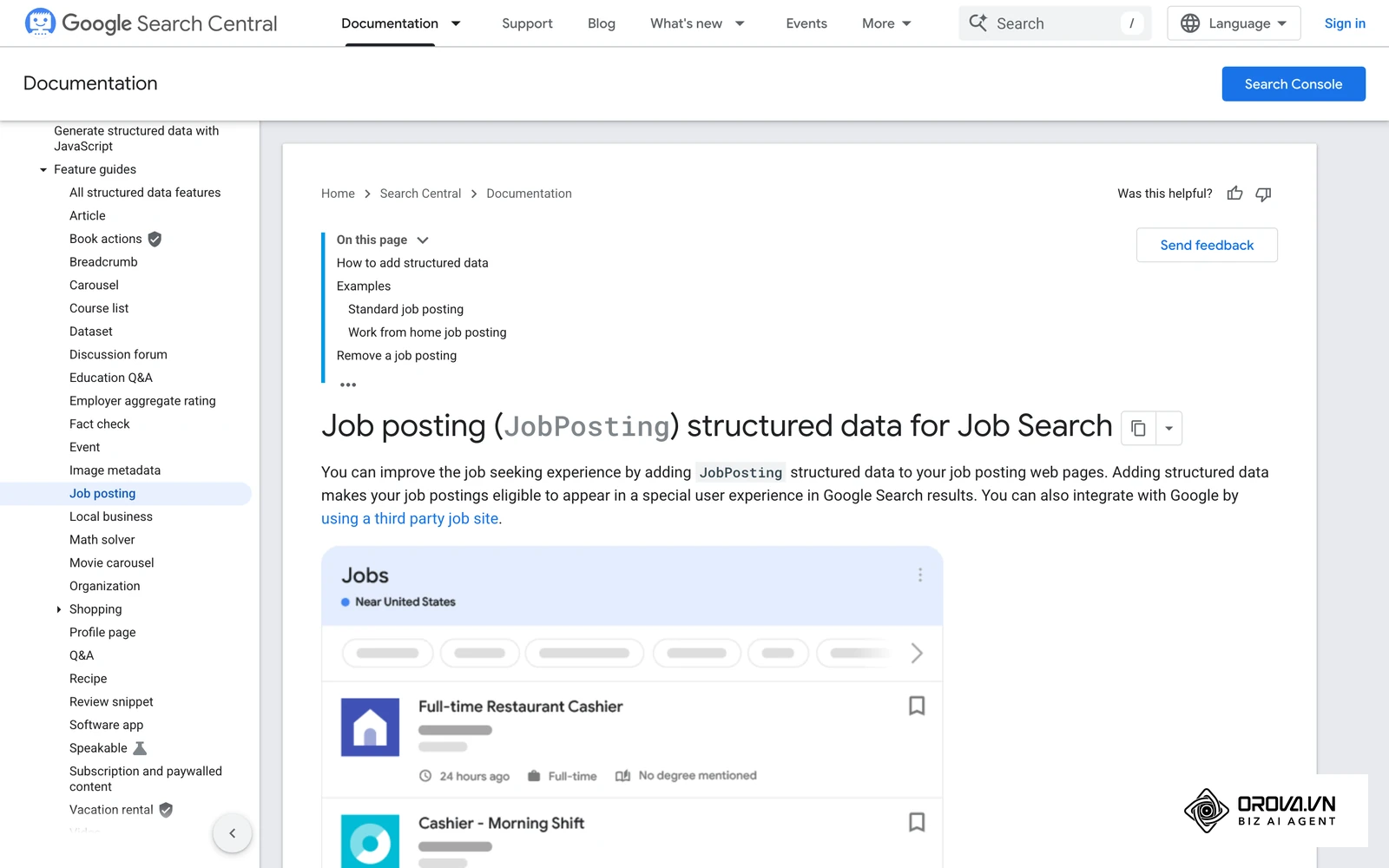
- Where it often breaks: Companies fail here by writing long, boring job descriptions and using convoluted titles (e.g., "Customer Happiness Ninja Level 2" instead of "Customer Service Representative"). This destroys search visibility and kills applicant volume before the process even begins.
Step 2: Automated screening and culture fit evaluation
- What you do: This is the most critical phase. You implement strict, automated "knockout questions" that candidates must answer immediately upon applying. If they fail a critical question, the system automatically sends a polite rejection. If they pass, they move forward. To maintain company culture, you weave one or two core behavioral questions into this automated flow.
- Inputs: A predefined list of non-negotiable requirements (e.g., legal working age, specific certifications, shift availability).
- Outputs: A refined pool of candidates who meet all baseline criteria, requiring zero manual resume review.
- Where it often breaks: Asking too many questions. If your initial application takes more than three minutes to complete on a mobile phone, many candidates will abandon it before they finish.
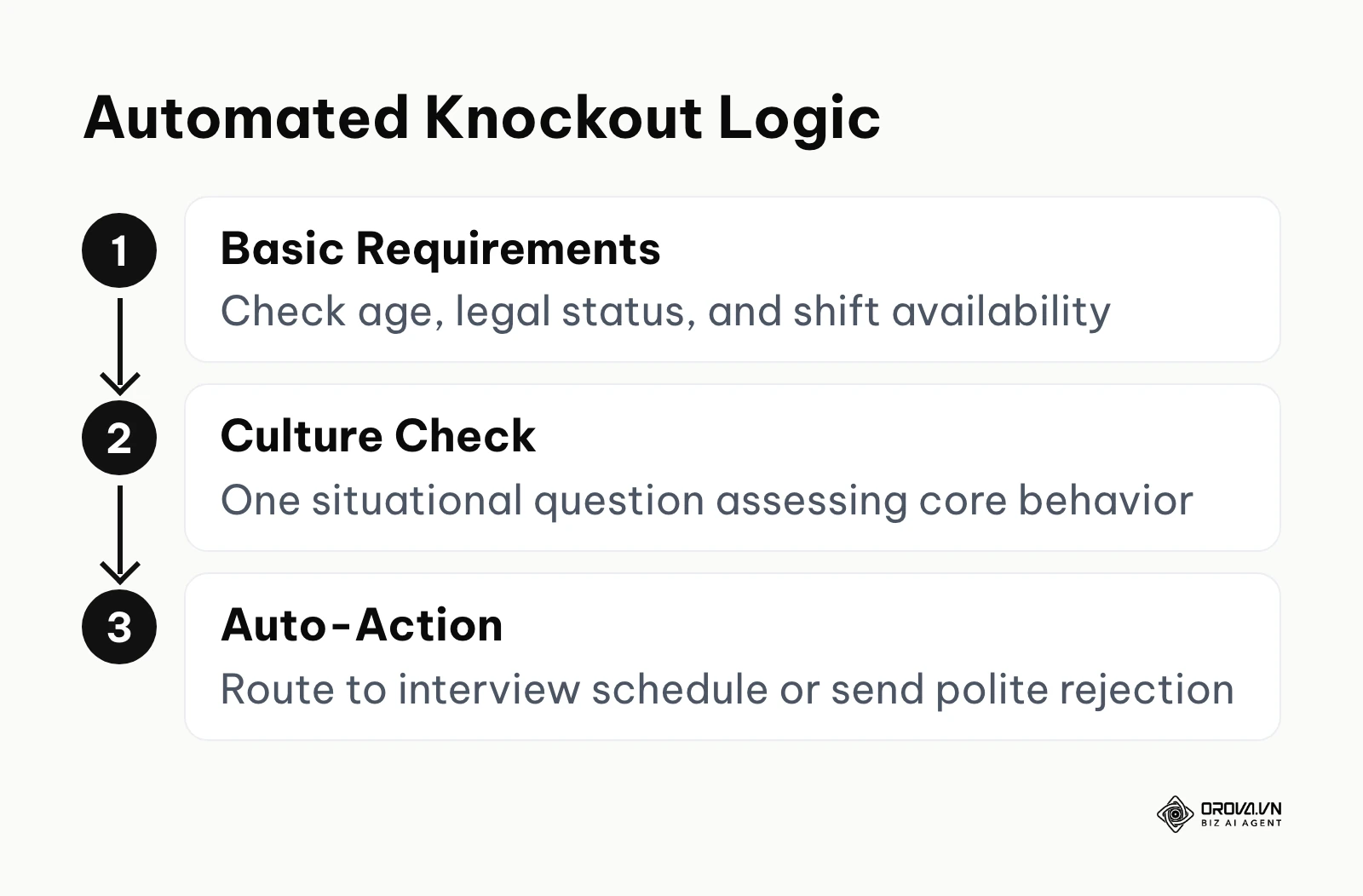
The process flow below details exactly how this automated knockout logic should be structured.
Addressing the Culture Gap in Volume Hiring A common fear is that hiring fast means you will ruin your company culture by letting toxic employees slip through. To prevent this, you must build culture checks into your automated knockouts. For example, if safety is your core culture, you might use an online quiz maker integrated into your application to ask a single situational question: Question: "You notice a spill in aisle 4, but your manager asked you to urgently restock aisle 6. What do you do?" A) Ignore the spill and rush to aisle 6. B) Find someone else to clean the spill. C) Stand by the spill to secure the area and immediately alert maintenance, then inform your manager of the delay. If they do not choose C, they are automatically rejected. You have just scaled your culture screening without a single human interview.
Illustrative example: A regional logistics provider faced a severe turnover crisis among delivery drivers, receiving roughly 3,000 applications a month but struggling to find reliable, safe staff. The lead recruiter realized they were wasting hundreds of hours phone-screening candidates who ultimately did not possess valid commercial driver's licenses. They introduced a mobile-friendly application with immediate knockout questions regarding licensing and basic safety culture scenarios. A major hurdle arose when they initially saw a massive drop-off rate because the situational assessment was too long. They quickly fixed this by reducing the assessment from twenty questions to just three critical safety scenarios. This single change produced a better-qualified interview pool and freed recruiters from screening calls with candidates who could never have been hired.
Step 3: Streamlined interviewing and selection
- What you do: For candidates who pass the automated screening, the system immediately presents them with a calendar link to self-schedule an interview slot. You utilize group interviews or rapid-fire 15-minute standardized interviews to process them quickly.
- Inputs: Pre-defined calendar availability from hiring managers and a standardized interview scoring rubric.
- Outputs: Completed interviews, scored objectively, leading to immediate job offers.
- Where it often breaks: Delaying the interview. In high volume scenarios, if you do not interview a candidate within 48 hours of their application, they will likely accept a job elsewhere.
Step 4: Automated onboarding for early retention
- What you do: The high volume process does not end at the offer letter. Because volume hires are prone to "early attrition" (quitting within the first week), you must automate the onboarding experience. You deploy mobile checklists that guide the new hire through document signing, uniform ordering, and basic training videos before their first day.
- Inputs: Signed offer letters and digital onboarding materials (handbooks, compliance videos).
- Outputs: Fully compliant, engaged new hires who show up on day one ready to work.
- Where it often breaks: Providing zero communication between the offer acceptance and the start date, causing the candidate to feel forgotten and ultimately ghost the employer on day one.
Not all volume hiring is identical. Depending on your business model, you will likely employ one of these specific variations:
| Type of Volume Recruiting | Key Characteristics | Best Suited For |
|---|---|---|
| Seasonal Spikes | Highly predictable, intense bursts of hiring tied to holidays or weather (e.g., retail in November, agriculture in summer). | Retailers, logistics companies, hospitality resorts. |
| Hyper-Growth Expansion | Rapid hiring required to staff new geographic locations or support a massive new client contract. | Startups scaling nationally, BPO/call centers winning new accounts. |
| Evergreen / Continuous | Constant, ongoing hiring to combat naturally high turnover rates in specific industries, requiring a permanent pipeline. | Warehousing, fast food chains, healthcare aides. |
How to adapt and implement high volume recruiting strategies
Adapting to a volume mindset requires a fundamental shift in both technology and workflow design. You cannot simply ask your HR team to "work faster." You must rebuild the infrastructure. Here is how different stakeholders should approach this implementation.
For small business owners facing sudden growth
When a small business suddenly wins a large contract, the owner is often the sole recruiter.
- Centralize applicant traffic: Stop accepting applications via direct messages, emails, and walk-ins. Create a single, simple landing page form.
- Implement basic text messaging: Use low-cost text messaging tools to instantly text candidates when they apply. Speed is your biggest advantage over large, slow corporations.
- Run group orientation interviews: Instead of 20 individual interviews, invite all qualified candidates to a single 1-hour session to observe their punctuality and basic interaction skills.
Illustrative example: A local restaurant group was opening three new locations simultaneously and needed 90 staff members in just three weeks. The owner, acting as the main recruiter, was entirely overwhelmed by direct messages across various social media platforms. They decided to centralize all traffic by creating a single landing page with a basic application form. Initially, applicants were confused because the form didn't clearly specify which of the three locations they were applying for. The owner quickly adapted by adding a mandatory location dropdown and automated a text message confirming receipt of the application. This simple structure allowed them to seamlessly organize candidates by location and complete all hiring five days ahead of the grand openings, ensuring fully trained staff for the launch.
For HR leaders in mid-sized to enterprise companies
Enterprise leaders must focus on deep systems integration and change management across multiple departments.
- Audit your current tech stack: Ensure your systems can handle the load. You may need to upgrade to more robust recruitment crm systems to manage the massive candidate pipelines effectively.
- Train frontline managers on speed: Managers are accustomed to taking days to review resumes. Mandate Service Level Agreements (SLAs) requiring them to conduct interviews and make decisions within 24 hours of receiving a qualified candidate.
- Automate the reference and background checks: Integrate third-party vendors directly into your tracking system to initiate background checks the moment an offer is verbally accepted.
For recruitment agencies handling volume accounts
Agencies must prove their value through speed and candidate quality to retain massive corporate accounts.
- Build pre-qualified talent pools: Do not wait for a requisition to open. Constantly run evergreen ads to build a database of pre-screened candidates ready to deploy instantly.
- Implement predictive analytics: Track exactly which sourcing channels yield candidates who stay past 90 days, and shift all budget to those specific channels.
- Provide white-labeled onboarding: Offer to handle the initial digital onboarding steps for your client, adding immense value and reducing candidate drop-off before the start date.
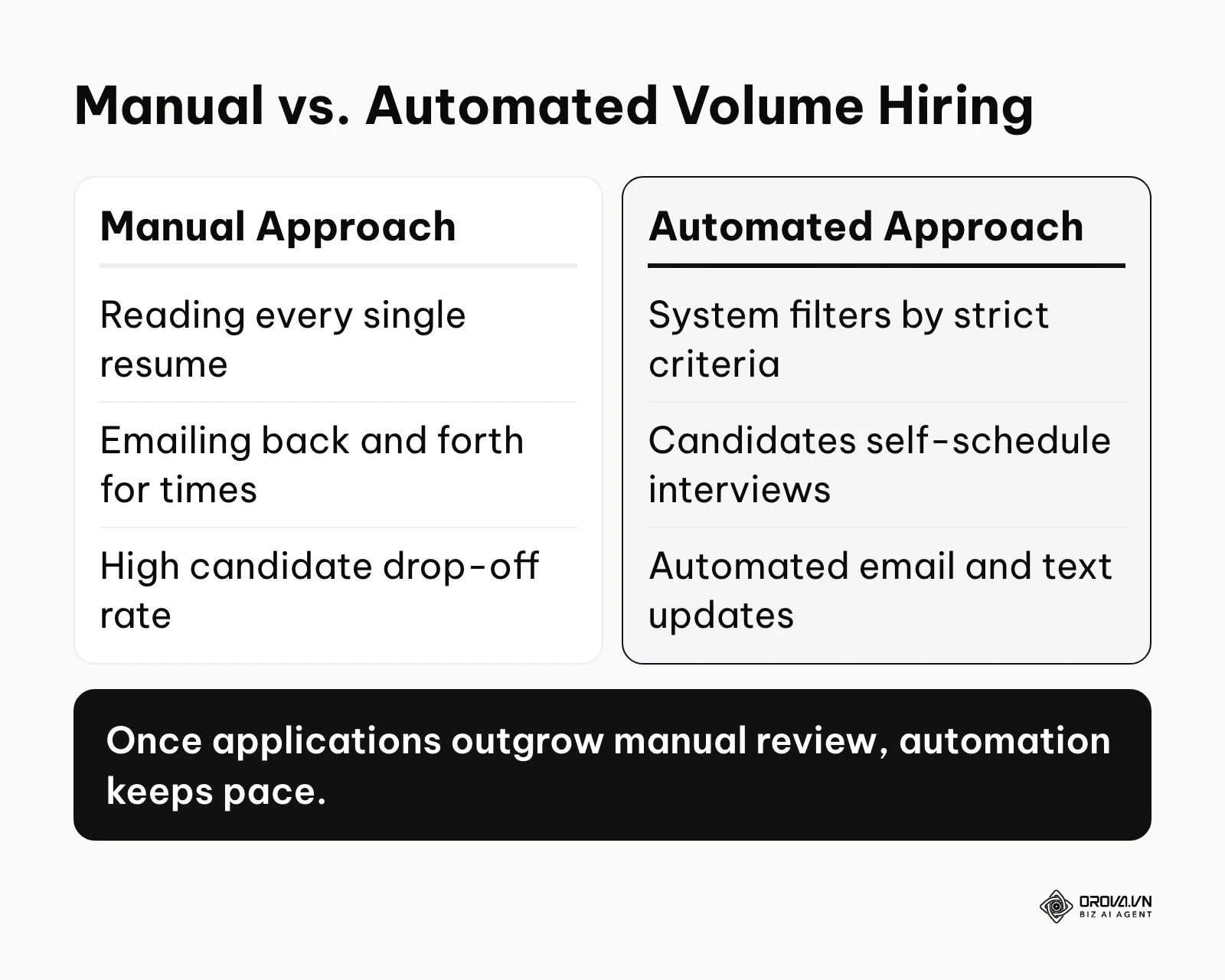
The comparison table below highlights why adapting to an automated approach is non-negotiable.
Regardless of your role, you must avoid the common pitfalls that derail volume campaigns:
| Common Mistake | Immediate Consequence | How to Avoid It |
|---|---|---|
| Ignoring mobile users | You lose a large share of hourly workers who apply from a phone and do not own a desktop computer. | Test your entire application process on your own smartphone before launching. |
| Creating complex logins | Candidates abandon the application when asked to create an account and remember a password just to apply. | Use "guest checkout" style applications or one-click apply options via LinkedIn or Indeed. |
| Failing to communicate | Candidates assume they were rejected and accept offers elsewhere. | Set up automated email or text message triggers at every single stage of the funnel (received, reviewing, interview, offer). |
Ready to stop losing candidates to slow processes? Orova Recruit helps you schedule interviews and automatically sends candidates step-by-step emails from your company inbox. It is free to use until July 7, 2027, so you can build a faster hiring workflow today.
Trends in high volume recruiting: The author's perspective
Having observed the rapid evolution of talent acquisition technology, I believe the landscape of high volume recruiting is undergoing a permanent transformation. The days of simply posting a job and waiting are over; the future belongs to proactive automation. Here are my three core predictions for where this industry is heading.
The shift towards zero-touch initial screening driven by AI
I consider this the most significant shift to watch. I expect human recruiters to spend far less time reading inbound resumes for high volume roles, while AI-driven chat tools and matching algorithms take over much of the top of the funnel. Such systems may not only parse resumes but also chat with candidates by text message to check basic qualifications and shift availability. To prepare, you must begin digitizing your specific knockout criteria now so that when you adopt these AI tools, they have accurate rules to follow.
Mobile-first applications becoming the only option
Many hourly workers already apply from a smartphone, so a mobile-first application experience is quickly becoming the baseline. I expect desktop-only applications for frontline roles to look increasingly outdated. We are moving toward a reality where applying for a job must be as frictionless as ordering food on an app. If your application process requires a candidate to pinch and zoom on their phone screen to read a PDF, you are already losing the talent war. You should immediately audit and redesign your application flow specifically for a six-inch screen.
Predictive analytics for early attrition
Currently, most volume hiring metrics stop at the "cost per hire" or "time to fill" stages. I expect the focus to shift toward predicting early attrition—identifying candidates who are likely to quit within the first 30 days. By analyzing historical hiring data, newer tools may flag application patterns that correlate with high turnover. That would push companies to optimize their sourcing spend not just for volume, but for long-term reliability. You should prepare by starting to meticulously track not just where your hires come from, but which specific sourcing channels produce the employees who stay the longest.
Note: These predictions are based on current technological trajectories and market demands. A sudden, massive shift in global labor laws or data privacy regulations regarding AI usage could significantly alter this timeline.
FAQs about high volume recruiting
Is high volume recruiting still needed with AI?
Yes, absolutely. AI is a tool that powers high volume recruiting; it does not replace the strategic need for it. While AI can handle the repetitive screening and communication tasks, the underlying strategy of designing workflows to process hundreds of people efficiently remains a distinctly human, operational challenge. AI simply makes your volume system vastly faster and more accurate.
How do you reduce candidate ghosting at scale?
Ghosting (when candidates abandon the process or fail to show up for interviews) is a critical issue. You reduce it through hyper-fast communication and extreme convenience. Send automated text message or email reminders 24 hours and 2 hours before an interview. Furthermore, allow candidates to self-schedule their interviews immediately after passing the screening stage. If you wait three days to contact them, they will ghost you.
What is the investment for volume software and how is ROI calculated?
The cost varies wildly from a few hundred dollars a month for basic tools to tens of thousands annually for enterprise suites. You justify the cost by applying the same thinking used for marketing ROI to your talent acquisition funnel. Do not just measure software cost against recruiter salaries saved. Calculate the ROI based on the reduction of open shift days (lost revenue) and the decrease in early turnover (wasted training costs).
Can small budgets afford volume hiring tools?
Yes. If you cannot afford enterprise platforms, you can build a highly effective volume system using low-cost or free tools. A simple Google Form acting as a screener, linked via Zapier to a free Trello board for applicant tracking, combined with a basic Calendly link for interview scheduling, can handle a surprisingly high volume of applicants for a fraction of the cost.
How do you measure the true success of a volume campaign?
Success is not just about hitting the hiring target number. It must be measured by the quality and retention of those hires. The ultimate metric is the "90-Day Survival Rate"—the percentage of your volume hires who are still employed and productive after three months. Structured, automated onboarding is one of the main levers for improving that early retention.
Where to start with high volume recruiting?
Implementing a high volume strategy can feel overwhelming, but the key is to avoid trying to fix everything at once. Your starting point depends entirely on your current operational reality. Identify which of the three states below best describes your organization, and take the single, corresponding first step.
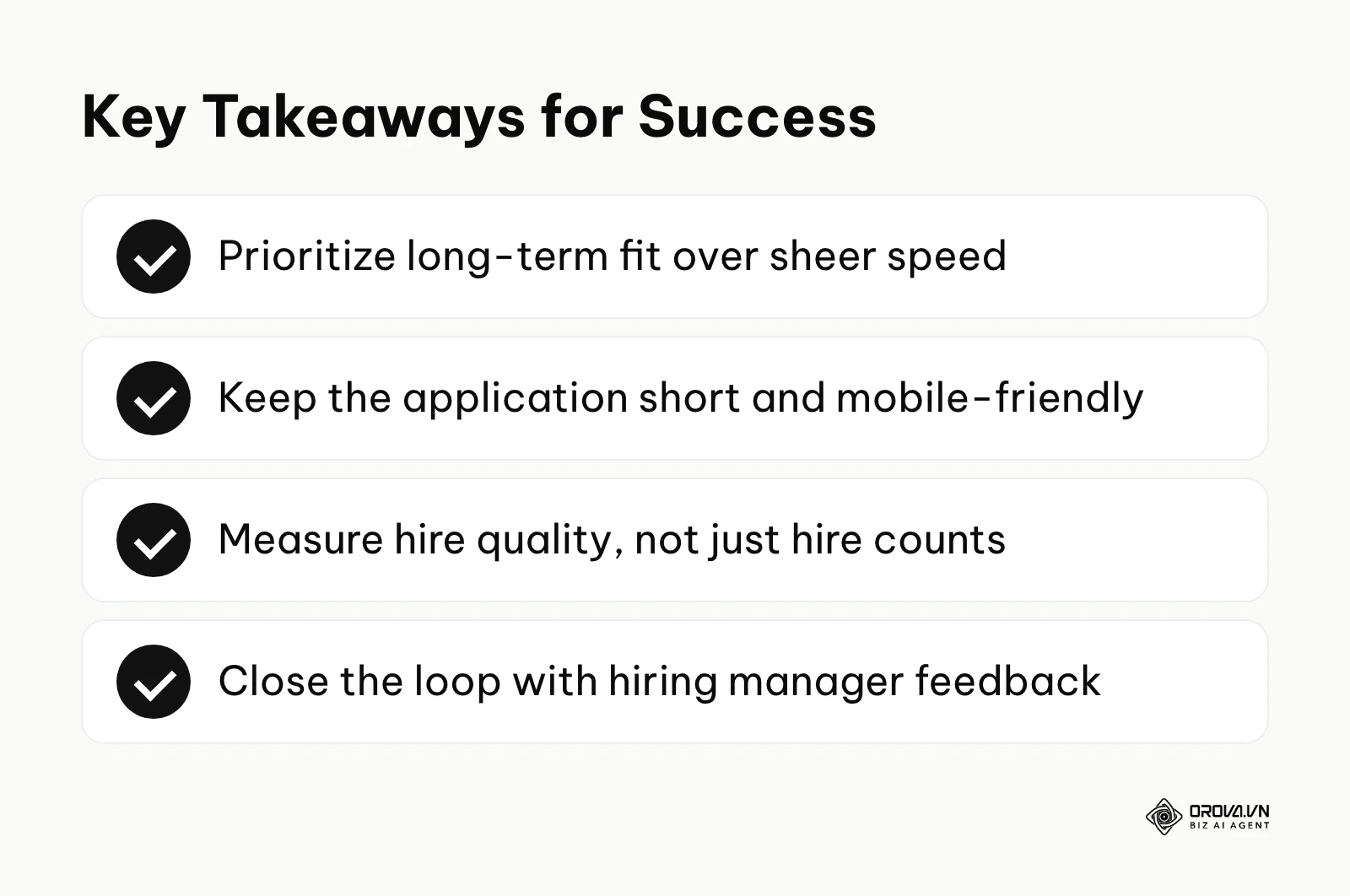
The checklist below summarizes the core takeaways you should keep in mind as you begin this journey.
State 1: You are starting from zero (No systems in place)
If you are currently relying on an email inbox overflowing with PDF resumes and tracking candidates on a chaotic whiteboard, do not immediately buy expensive enterprise software. Your first step: Map out your ideal workflow on a piece of paper. Define the absolute minimum requirements a candidate must have to do the job safely and legally. Create a single, standardized application form that asks exactly those three or four knockout questions, and nothing else. Force all traffic through that single form to immediately stop the chaos in your inbox.
State 2: You have tools, but they are disjointed
Many companies have an Applicant Tracking System, a separate calendar tool, and perhaps a disconnected assessment platform. Recruiters are wasting time manually moving data between these silos. Your first step: Conduct a "candidate friction audit." Apply for your own company's job using only a smartphone. Document every click, every slow-loading page, and every time you are asked to upload a document you already provided information for. Your immediate goal is to integrate these tools (or replace them) to remove that friction, aiming for an application time of under three minutes.
State 3: You are operating at volume, but not measuring quality
If you are successfully hiring hundreds of people quickly, but your operational managers are complaining that the new hires quit within a week or lack basic skills, your volume system is broken at the selection phase. Your first step: Implement a mandatory feedback loop. Require hiring managers to complete a simple, two-question survey on every new hire after their first 14 days. Use this data to immediately adjust your top-of-funnel knockout questions. If people are failing on the floor, your initial screening criteria are wrong, and you must refine your high volume recruiting engine to prioritize long-term fit over immediate speed.
About the author

Builder of Orova
Nguyễn Đỗ Trọng Ân has 8 years of experience in marketing, including 6 years managing market development across Asia. He builds Orova, a Biz AI Agent that never sleeps: it plans, runs and optimizes work for businesses.
Run your business with AI Agents
Orova is the always-on Biz AI Agent — it plans, runs, and optimizes the work for you.
Save time, unlock productivity.