
Search volume in 2026: how to evaluate true keyword value

You invest forty hours crafting a comprehensive, 3,000-word guide targeting a keyword that your favorite SEO tool claims has a search volume of 15,000 per month. After three months of aggressive link building and optimization, you finally secure the number two spot on Google. You open your analytics dashboard, expecting a flood of visitors, only to find the page generated exactly twenty-four clicks last month. This scenario is playing out across the internet right now. The culprit is rarely bad content; it is a fundamental misunderstanding of what a high search volume metric actually represents in today's search landscape. Between AI Overviews pushing organic links below the fold, aggressive ad placements, and zero-click SERP features, traditional keyword metrics have become highly deceptive. This guide will dismantle the old way of looking at search volume and provide you with a rigorous, mathematical framework to evaluate true traffic potential, ensuring you only invest resources in keywords that will actually convert.
What is keyword search volume and who still needs it?
Keyword search volume is the average number of times a specific query is entered into a search engine per month, usually averaged over the previous twelve months. It represents theoretical demand, not guaranteed website traffic.
Anyone involved in content creation, digital marketing, or business strategy needs to understand this metric, but they must use it as a directional indicator rather than a strict forecast. You should care about search volume when you are mapping out a broad holistic SEO strategy or trying to understand the overall market size for a new product category. However, you should completely ignore raw search volume when dealing with hyper-niche B2B services where a single closed deal is worth thousands of dollars. In those scenarios, user intent drastically outweighs the number of monthly searches. A metric of zero does not mean zero customers; it often just means the third-party tools lack the clickstream data to measure that specific micro-niche accurately.
Pre-research preparation: Tools and mindsets
Before you start analyzing keyword metrics, you need to set up the right environment and adopt a realistic mindset. Looking at raw numbers without context is the fastest way to waste a marketing budget. You need a combination of first-party data sources, third-party estimation tools, and a clear understanding of your own website's current authority. If your website is brand new, aiming for high-volume keywords is akin to opening a small coffee stand and trying to immediately outspend Starbucks on national television ads. You must prepare your toolset to look for achievable, high-intent opportunities rather than vanity metrics.
| Asset Needed | Where to Source It | Time to Setup |
|---|---|---|
| First-Party Data | Google Search Console (GSC) | 15 minutes |
| Broad Ideation | Google Keyword Planner (GKP) | 10 minutes |
| Granular Analysis | Semrush, Ahrefs, or similar paid tools | Immediate |
| SERP Reality Check | Chrome Incognito Window / Manual Search | 1 minute per keyword |
| Business Metrics | Average Order Value (AOV), Lead Conversion Rate | Variable (requires historical data) |
You must have Google Search Console configured and collecting data. It is the closest thing you have to first-hand data on how Google shows your website. Third-party tools are essential for competitive research and finding new topics, but their volume numbers are modelled estimates, not counts. If you are still choosing which ones to use, this overview of keyword research tools compares the main options. Your mindset must shift from "How many people search for this?" to "How many qualified buyers can I realistically capture from this search?"
6-step framework to evaluate true search volume
The days of exporting a list of keywords, sorting by the highest volume, and handing it to a writer are over. To succeed, you must put every target keyword through a rigorous screening process. This framework will help you identify the true value of a query.
Step 1: Filter out AI-dominated "phantom" search volume
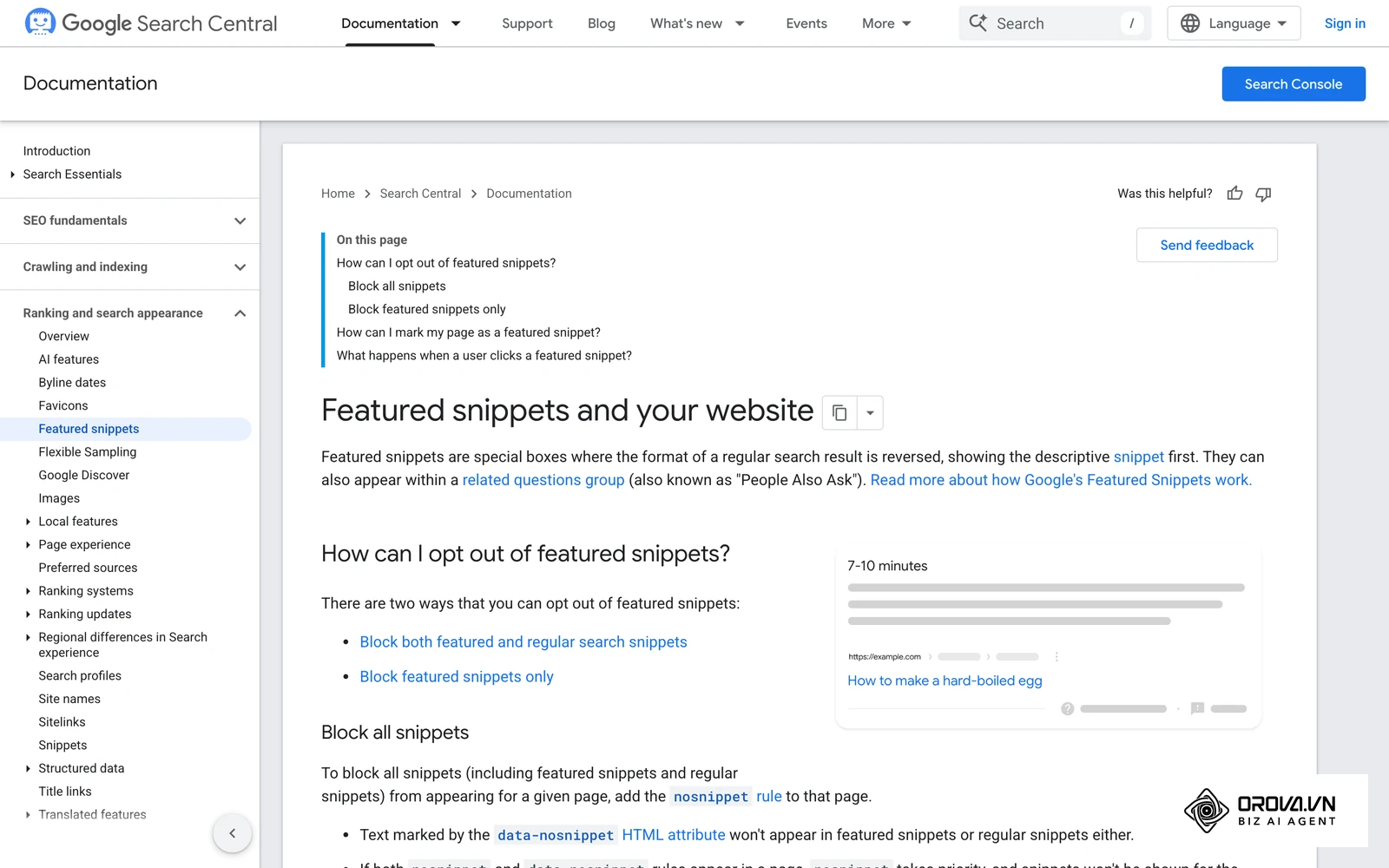
The most critical step in evaluating a keyword today is determining if the search volume actually results in clicks. With AI Overviews (which grew out of Google's Search Generative Experience experiment), more questions are answered directly on the search results page. If a keyword asks a simple, factual question (e.g., "what is the capital of Australia" or "how many ounces in a cup"), the AI will answer it directly. The search volume might be 100,000, but the available clicks for organic results will be near zero.
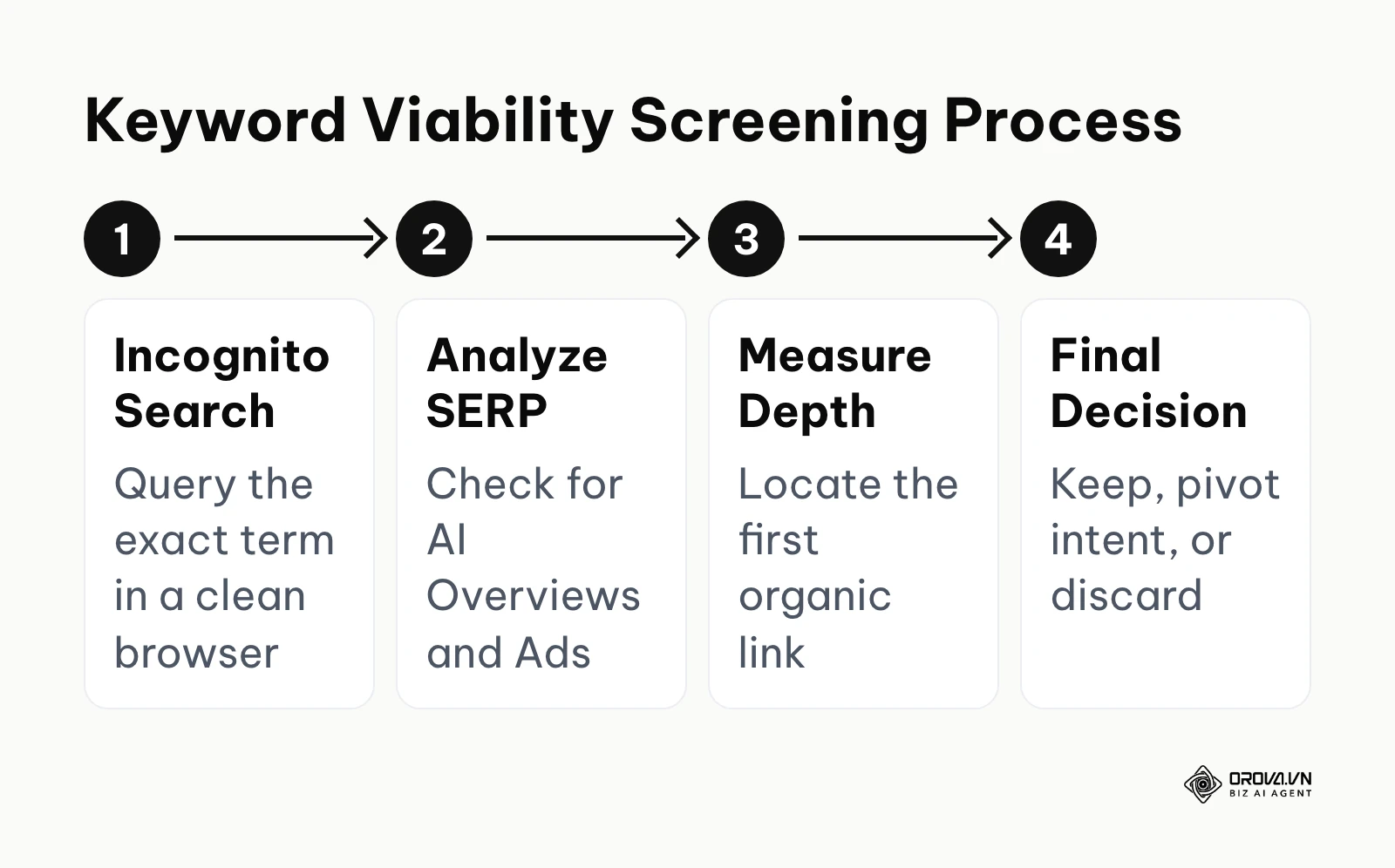
To filter out phantom volume, you must manually inspect the Search Engine Results Page (SERP). Open an incognito browser window to prevent your past search history from personalizing the results. Ensure your location settings match your target audience. Enter your target keyword and meticulously analyze the layout. Does an AI Overview immediately populate and take up the entire first screen? Are there four Sponsored ads stacked beneath it? Is there a massive Featured Snippet, followed by a "People Also Ask" box?
If the first actual organic link requires the user to scroll down two full page lengths, the search volume is heavily compromised. You must then make a strategic decision. You can drop the keyword entirely, saving your resources. Alternatively, you can pivot the intent. Instead of targeting "what is X" (which AI answers), you target "best X software for small business," which requires human curation and reviews that AI struggles to replicate authentically. The more SERP features stack above the first organic result, the lower the click-through rate that result can expect, even in position one.
Step 2: Cross-reference data between Google Keyword Planner and third-party tools
One of the most confusing experiences for an SEO professional is looking up a keyword in Google Keyword Planner and seeing a volume of 10,000, then looking up the exact same keyword in Ahrefs and seeing a volume of 800. This massive discrepancy causes widespread panic and poor decision-making. You must understand how these tools source their data to use them correctly.
Google Keyword Planner (GKP) is designed for advertisers, not SEOs. Its primary goal is to sell ads. Therefore, GKP groups closely related variants together, and accounts without active ad spend often see only broad volume ranges. If you search for "SEO software," GKP might lump the search volumes for "SEO tools," "software for SEO," and "search engine optimization platforms" into one single, massive number. It gives you the total addressable market for a topic cluster, but it blurs the specific string's volume.
Third-party tools like Semrush and Ahrefs build their numbers from their own data sources and models, including clickstream-style panel data. They attempt to un-group Google's data to give you a volume for a specific string of words. However, because they model from samples rather than count every search, they often underestimate the volume of long-tail, highly specific, or newly emerging keywords. The best practice is to use GKP to identify broad, lucrative topic clusters, and then use third-party tools to verify the specific, long-tail variations you will actually write content for. Never trust one single tool as the absolute truth; always look for the consensus between multiple data points.
Step 3: Assess the true "Click Potential" against SERP features
Raw search volume is a theoretical maximum. Click Potential is the practical reality. Click Potential is calculated by multiplying the raw search volume by your expected Click-Through Rate (CTR). In the past, the top organic spot could count on a large share of clicks. Today, that share swings widely depending on which features are present on the SERP.
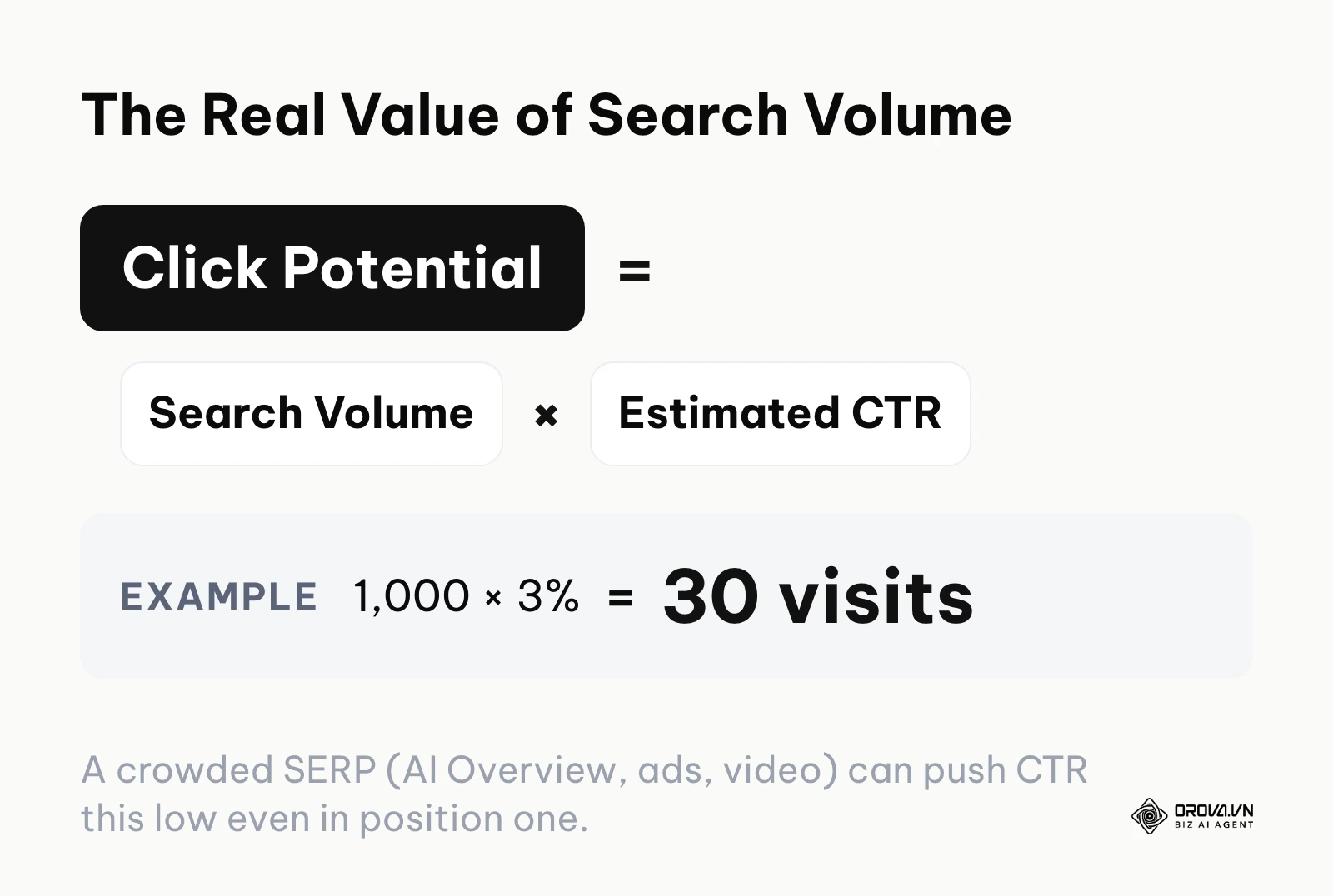
If you are targeting a keyword with 1,000 searches a month, and the SERP contains an AI Overview, four ads, and a video carousel, the number one organic spot might only yield a 3% CTR. Your true Click Potential is 30 visitors, not 1,000. Conversely, if you target a highly specific, transactional keyword with only 200 searches a month, but the SERP is completely clean with just ten blue links, the number one spot might command a 35% CTR, yielding 70 visitors. The "lower volume" keyword actually delivers more than double the traffic. You must evaluate the SERP features and drastically adjust your CTR expectations downward when the page is crowded. Learning robust on page SEO techniques is crucial to formatting your content to win those featured snippets and reclaim some of that lost CTR.
Illustrative example: A B2B SaaS company offering enterprise HR solutions targeted the high-volume keyword "employee retention strategies". The marketing team created a comprehensive 3,000-word guide and successfully built links to reach position #2. However, they noticed a significant hurdle: the page was only generating 40 clicks per month because a massive Google Featured Snippet and four Sponsored ads completely obscured the organic results. To fix this, they restructured the content format to directly answer the snippet's implicit question using a concise, bulleted list at the very top of the article. As a result, they captured the Featured Snippet themselves, pushing their visibility above the fold, which led to a visible increase in daily newsletter sign-ups from enterprise HR managers within two weeks.
Step 4: Apply the Decision Matrix based on Domain Rating
Knowing the true click potential is useless if your website lacks the authority to rank for the keyword in the first place. A common mistake is a brand-new website owner targeting a keyword with 50,000 searches a month, competing against Wikipedia, Forbes, and established industry giants. You need a systematic way to match your ambition with your current reality. This requires aligning your target search volume with your website's Domain Rating (DR) or Domain Authority (DA).
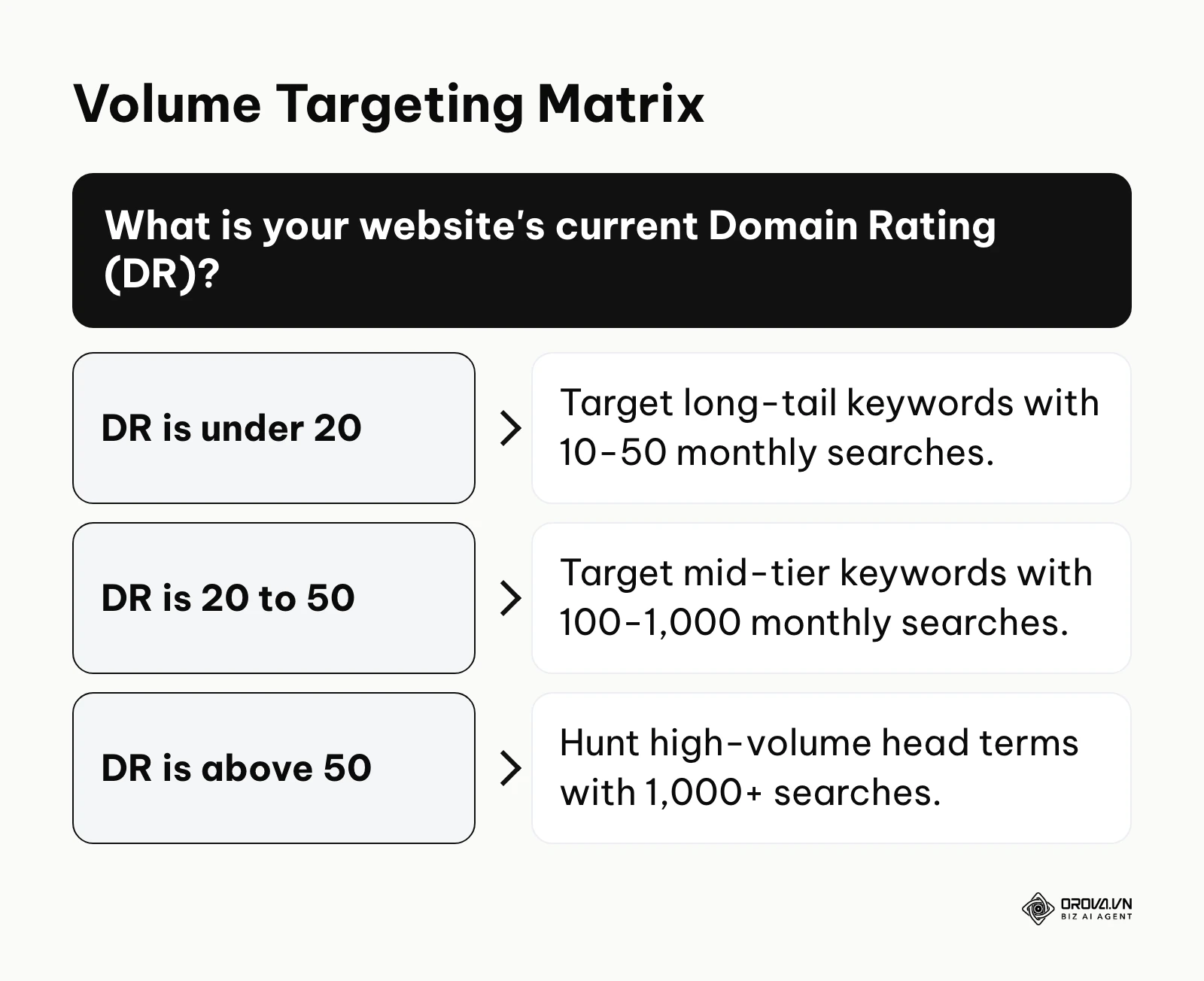
If your website is new (DR under 20), you have almost zero established trust with search engines. You must target keywords with extremely low search volumes—often between 10 and 50 searches per month. These are highly specific, long-tail queries that major publications ignore because the volume is too small to move their needle. However, these keywords have incredibly low competition. By dominating dozens of these micro-queries, you build topical authority and generate initial, highly qualified traffic.
As your website grows (DR 20-50), you can begin targeting mid-tier keywords with volumes between 100 and 1,000. You now have enough authority to compete with other specialized blogs and mid-sized businesses. Only when your website reaches enterprise-level authority (DR 50+) should you consistently dedicate resources to hunting high-volume head terms (1,000+ searches). Applying this matrix prevents you from writing excellent content that is doomed to sit on page eight of the search results simply because your domain lacks the requisite strength.
Step 5: Calculate the expected ROI of a keyword
Traffic without revenue is just server cost. Before you assign a keyword to a writer, you must calculate its potential Return on Investment (ROI). This transforms SEO from a mysterious marketing expense into a predictable business acquisition channel. You need to gather three specific business metrics: your average website conversion rate (how many visitors turn into leads), your lead-to-close rate (how many leads turn into paying customers), and your Average Order Value (AOV) or Customer Lifetime Value (CLV).
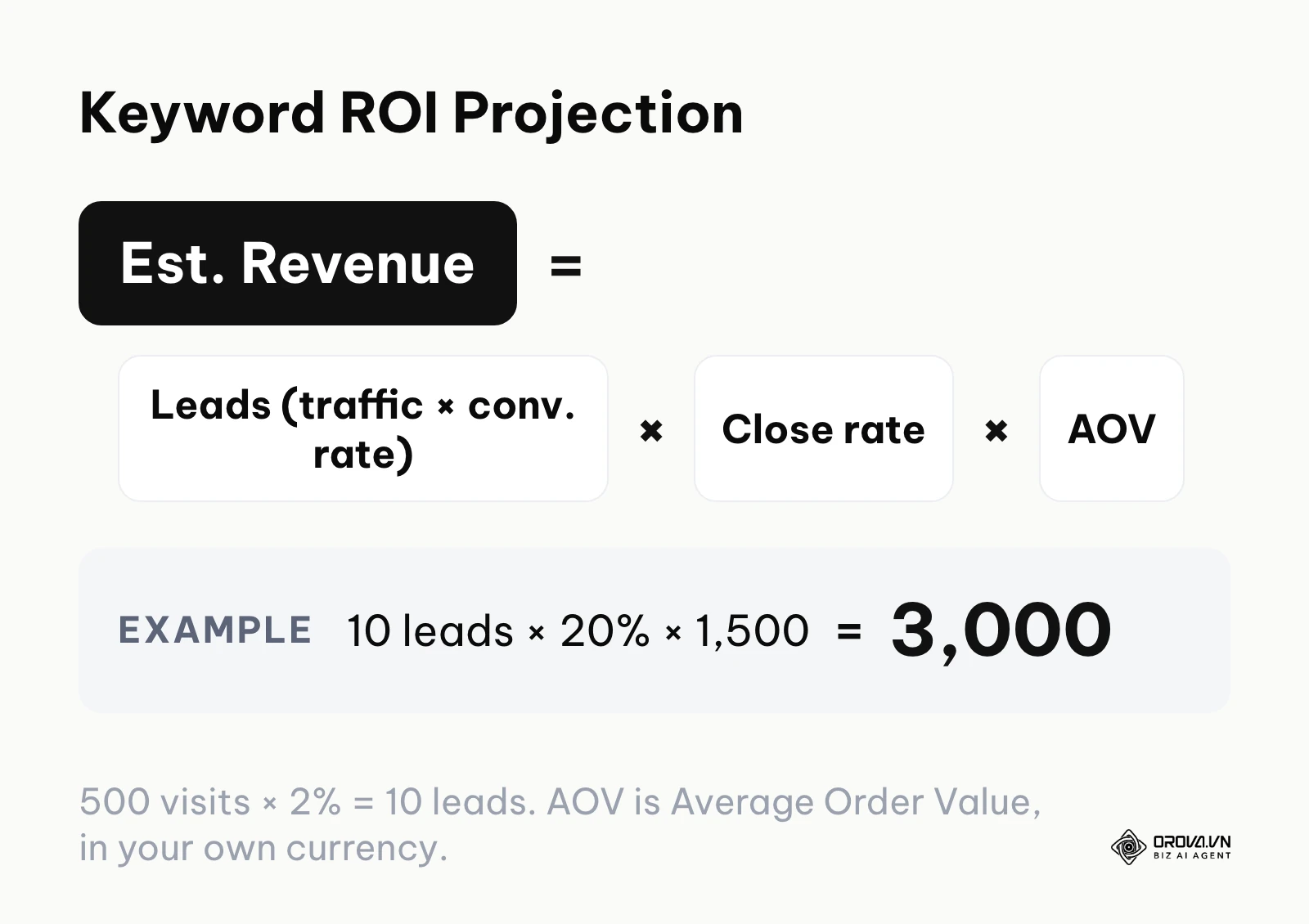
Create a simple spreadsheet. In column A, list your target keyword. In column B, input the estimated true traffic (Search Volume multiplied by your estimated CTR from Step 3). In column C, multiply that traffic by your conversion rate to estimate the number of leads. In column D, multiply those leads by your close rate to get expected sales. Finally, in column E, multiply expected sales by your AOV to project expected revenue.
For example, a keyword generates an estimated 500 visits. Your site converts at 2% (10 leads). Your sales team closes 20% of leads (2 sales). Your average order is worth 1,500 (in whatever currency you sell in). The expected monthly revenue for ranking well on this keyword is 3,000 in that same currency. By doing this math, you will frequently discover that a "boring" transactional keyword with only 150 searches a month projects drastically higher revenue than a broad informational keyword with 10,000 searches. This calculation allows you to allocate your content budget where it will actually drive business growth.
Step 6: Identify hidden zero search volume keywords
One of the most lucrative strategies in modern SEO is deliberately targeting keywords that all major tools report as having zero search volume. How can a keyword with zero searches be valuable? Because the tools are frequently wrong, particularly in B2B, highly technical niches, or newly emerging trends. Third-party tools rely on clickstream data. If a specific query is only searched 15 times a month by highly specialized procurement managers, it will likely fall below the data threshold of the tool, causing it to report a flat zero.
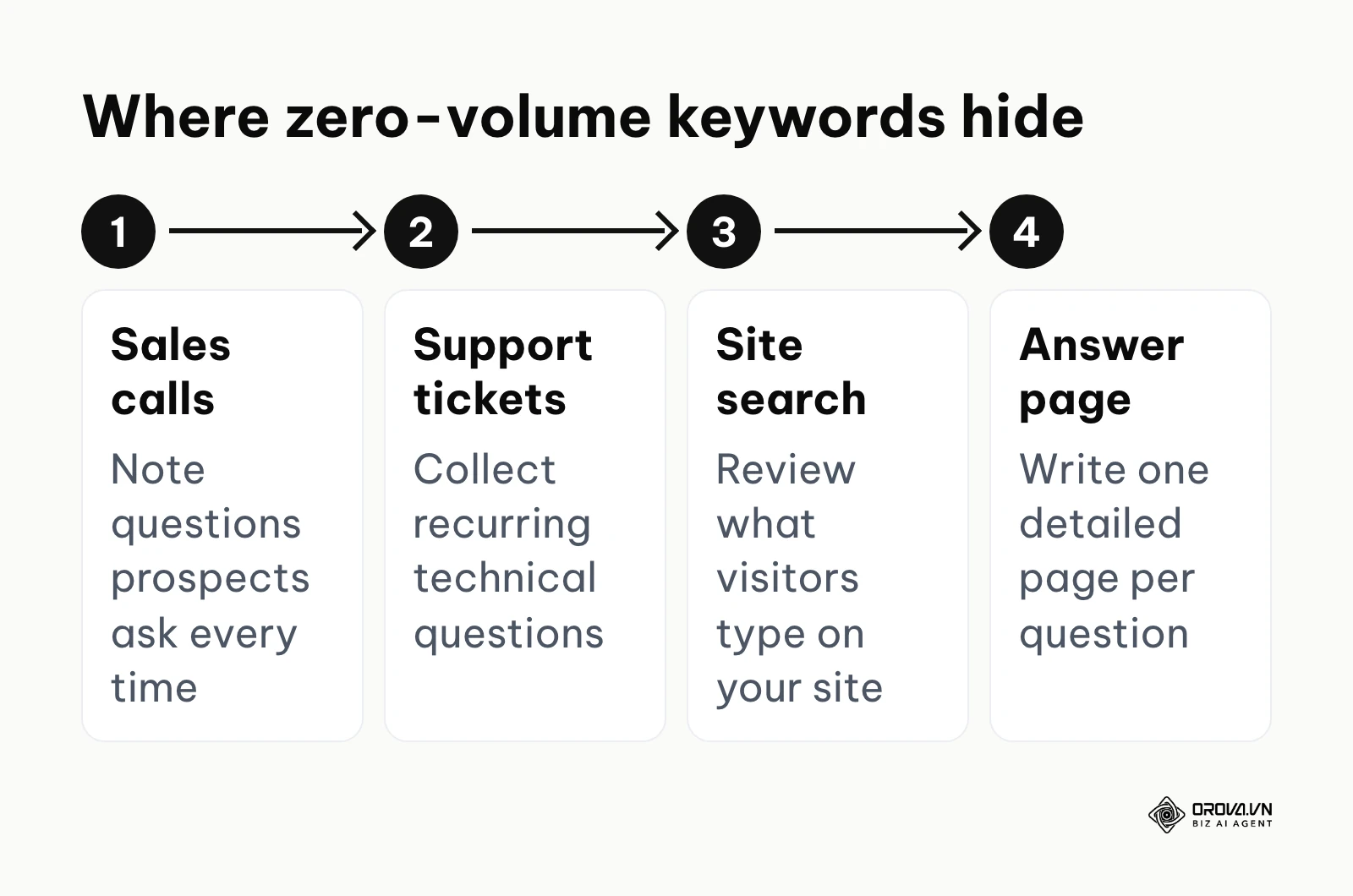
To find these hidden gems, you must step away from traditional keyword tools and look at proprietary data. Talk to your sales team and ask them what specific, hyper-technical questions prospects ask on every single introductory call. Look through your customer support tickets. Analyze the internal search queries on your own website. If real humans are asking these questions in your sales process, they are absolutely searching for them on Google. Because the SEO tools report zero volume, your competitors will ignore these topics entirely. This leaves the SERP wide open for you to rank number one with minimal effort, capturing a small but incredibly high-converting audience.
Illustrative example: An industrial manufacturing firm specializing in specialized air filtration systems wanted to capture highly qualified leads. They researched the keyword "HEPA filter specifications for cleanroom class 100", which their keyword tools reported as having zero search volume. Despite this, they proceeded by interviewing their top sales engineers to document the exact technical requirements and compliance standards customers always asked about. The hurdle was convincing the executive team to invest budget in a "zero-traffic" topic. They resolved this by framing it as a sales enablement asset rather than a traditional SEO play. The result was that while the page only receives about 15 organic visits a month, those visits directly translated into three signed enterprise contracts in the first quarter, visible directly in their CRM pipeline.
Discover Orova.vn – a Biz AI Agent platform with OROVA SEO, a complete solution for every website. The system supports search engine optimization from A to Z with features including keyword research, writing new SEO-ready articles, optimizing existing content, rank tracking, plus competitor analysis and in-depth technical analysis. Sign up today to experience OROVA SEO completely free (offer valid through July 7, 2027).
Deep analysis: Search volume vs. Traffic potential in the AI era
The fundamental conflict in content strategy today is the choice between chasing maximum search volume and targeting maximum user intent. For the past decade, the standard operating procedure was to secure the highest volume keywords possible. More volume meant more top-of-funnel traffic, which theoretically trickled down into sales. This model is fundamentally breaking down in the AI era. Google's stated aim is to satisfy the searcher's need, and for simple questions it increasingly does so on the results page itself.
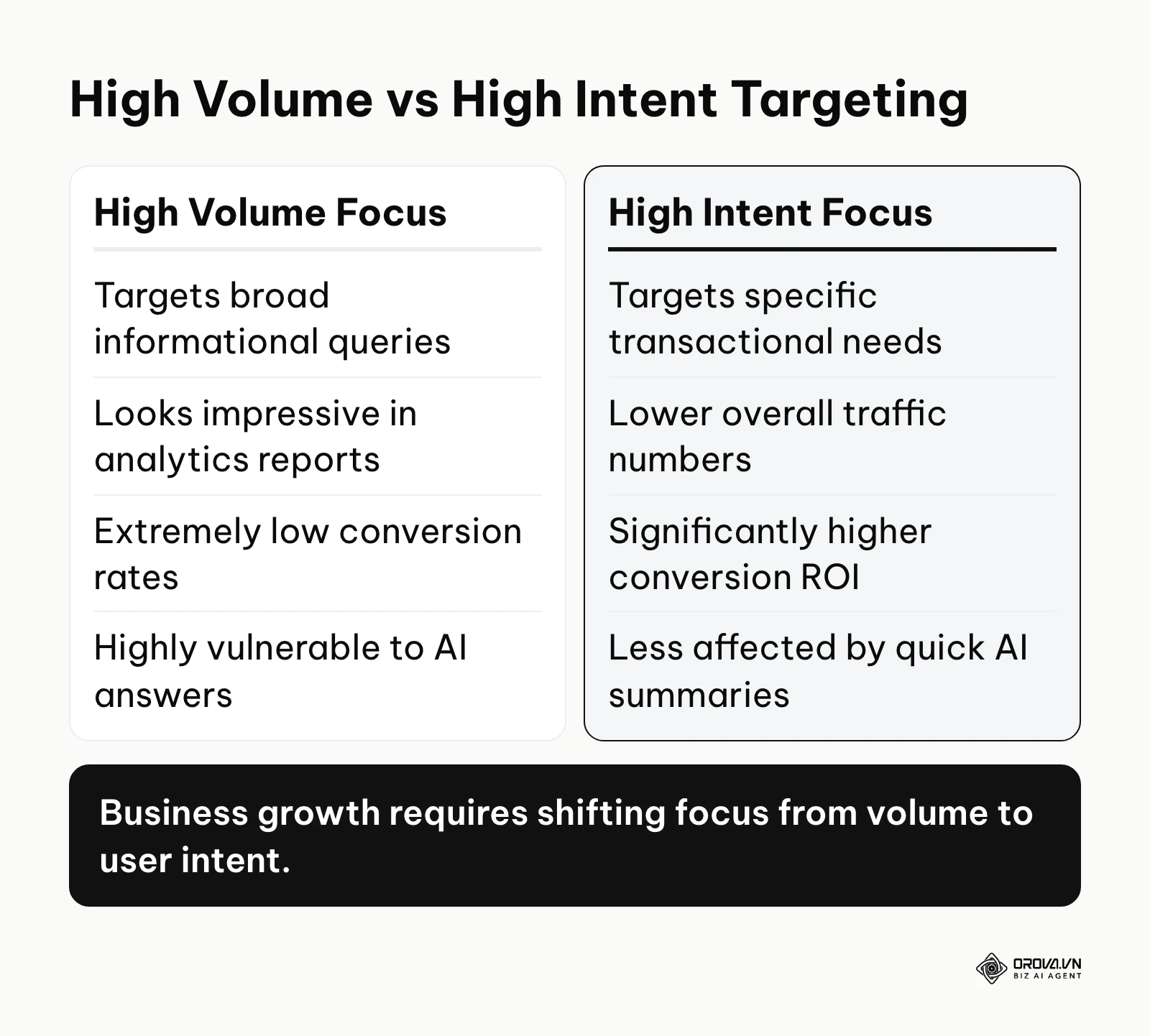
When you target a broad, high-volume keyword like "digital marketing," the keyword intent is fractured. Some users want a definition, some want to hire an agency, and some are students writing a paper. Google recognizes this ambiguity and often serves a diverse, generic SERP, frequently heavily featuring AI summaries to cover all bases quickly. Even if you rank, the traffic you receive is largely unqualified and bounces quickly when your specific offering doesn't match their vague intent.
| Approach | Best Used For | Primary Weakness |
|---|---|---|
| High Volume / Broad Intent | Brand awareness, generating programmatic ad revenue, establishing broad topical clusters. | Extremely low conversion rates; highly susceptible to being replaced by AI direct answers. |
| Low Volume / High Intent | B2B lead generation, e-commerce product sales, niche authority building. | Lower total traffic numbers; requires patience to explain the strategy to executives who only want big numbers. |
Conversely, targeting low-volume, high-intent queries aligns perfectly with how modern search engines operate. A query like "B2B digital marketing agency for SaaS startups in Austin" has a microscopic search volume. However, the intent is laser-focused. The user is actively looking to hire a specific type of vendor. Google will rarely serve an AI overview for this; it will serve localized, highly relevant agency websites. The traffic potential is low, but the revenue potential is massive. In the AI era, true traffic potential is determined not by how many people search for a term, but by how strongly the search engine believes your specific page fulfills the exact commercial intent of the user. To survive, you must map your efforts to website ranking in 2026 standards, which prioritize deep expertise over broad definitions.
Measuring the actual impact of your keywords
Once you have published content based on your volume analysis, you must ruthlessly measure its actual performance. Do not rely on third-party rank trackers to tell you if a strategy is working. Rank trackers show you where you sit, but they do not show you if that position is actually generating business value. You must turn to your first-party analytics.
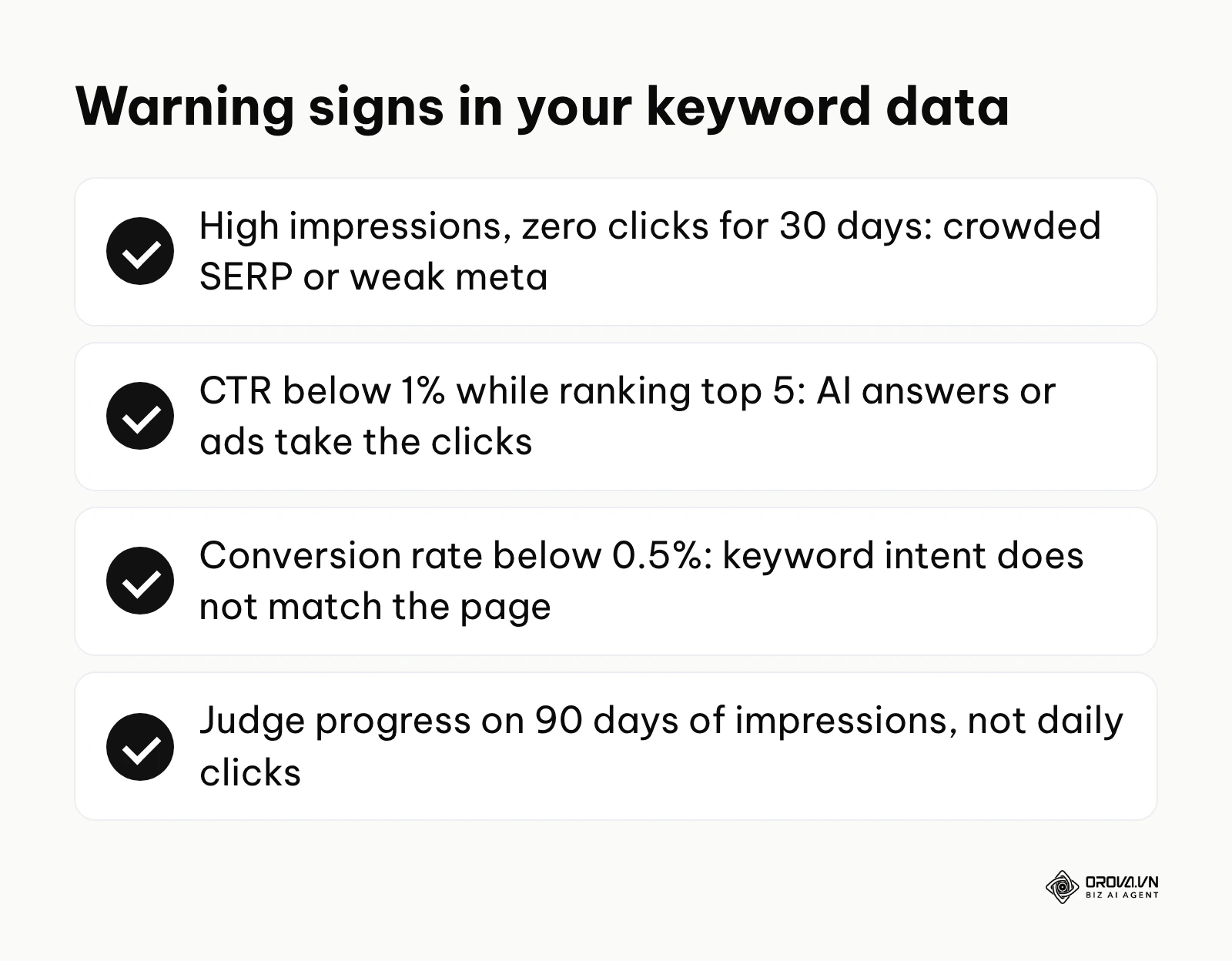
You need to monitor the relationship between Impressions (how many times your link was visible on the SERP) and Clicks (how many times it was actually clicked) inside Google Search Console. If a keyword is generating massive impressions but negligible clicks, you have diagnosed a SERP feature problem. Your snippet might be unappealing, or you might be buried beneath an AI Overview. This tells you that your initial CTR estimation was wrong, and you need to adjust your title tags and meta descriptions, or perhaps accept that the keyword is a lost cause.
| Metric | Meaning | Warning Threshold |
|---|---|---|
| Impressions (GSC) | The number of times your URL appeared in search results for a user. | High impressions with zero clicks over 30 days indicates a severely crowded SERP or poor metadata. |
| Average CTR (GSC) | The percentage of impressions that resulted in a click. | A CTR below 1% for a page ranking in the top 5 often means AI answers or ads are taking the clicks. |
| Conversion Rate (GA4) | The percentage of visitors from that URL who completed a desired action. | A rate below 0.5% often signals a mismatch between the keyword's intent and your page content. |
You must also measure the time to rank. SEO is a lagging indicator. If you target a highly competitive, medium-volume keyword, you should not expect meaningful traffic in the first month. Monitoring the slow, steady climb of impressions over a 90-day period is the true indicator of health, rather than obsessing over daily click fluctuations. Utilizing Google Search Console for SEO workflows is mandatory to accurately track this progression and distinguish between a failing strategy and one that just needs more time to mature.
Common mistakes when analyzing search volume
Even experienced marketers fall into traps when analyzing keyword data. The allure of big numbers often overrides strategic thinking. Avoiding these common mistakes will save you months of wasted effort.
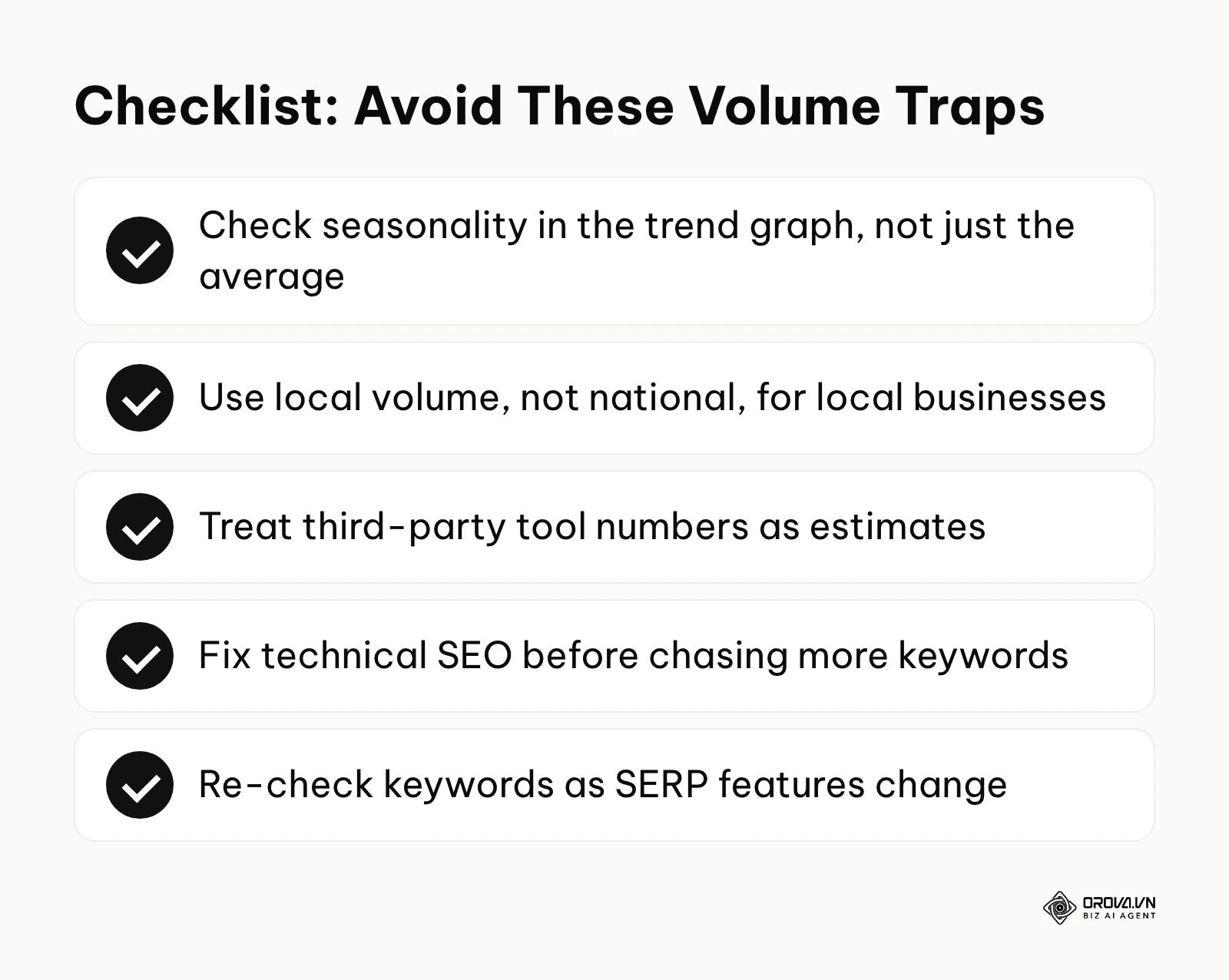
First, ignoring seasonality is a massive error. A tool might report a large average monthly search volume for a keyword like "buy winter tires". If you look at this data in July, you might prioritize it heavily, only to launch the content in August and see zero traffic. The average is skewed by massive spikes in November and December. You must always check the historical trend graph to understand when the volume actually occurs.
Second, failing to account for local intent destroys campaigns. A local plumbing company in Chicago might target the broad term "emergency plumber" because it shows a large national volume. However, Google tailors this SERP to the searcher's location. The plumber will never rank nationally; they can only capture the small fraction of that volume originating from Chicago. Using global volume to project local revenue is a recipe for disaster.
Third, treating third-party tool data as gospel truth. As discussed, tools like Ahrefs and Semrush provide estimates based on samples. Basing critical business decisions on minor fluctuations in these estimates (e.g., abandoning a keyword because its volume dropped from 300 to 250 in a tool) is micromanagement of inaccurate data.
Illustrative example: A mid-sized e-commerce retailer selling athletic gear heavily invested in ranking for the broad, very high-volume term "running shoes". They spent six months and thousands of dollars on content and technical optimization, eventually breaking into the bottom of page one. The major hurdle was that the traffic they received had an abysmal conversion rate, as users were mostly browsing or looking for major brand sites like Nike or Amazon. They corrected this mistake by shifting their entire content strategy to long-tail, highly specific queries like "best wide toe box running shoes for flat feet", which have far smaller volumes. This resulted in a massive drop in overall raw traffic, but a highly visible and immediate spike in actual shoe sales, as the visitors landing on those specific pages had clear transactional intent.
Fourth, writing content solely for volume without considering technical health. You can target the best keywords in the world, but if your website has severe technical flaws, poor internal linking, or slow load times, search engines will throttle your visibility. Keyword strategy must operate in tandem with technical SEO.
Finally, failing to iterate. The search landscape changes constantly. A keyword that yielded 500 clicks a month last year might yield 50 this year due to a new SERP feature. You must continuously monitor performance and update or consolidate content as search behaviors evolve, especially when several of your pages start competing for the same query, a problem known as keyword cannibalization.
With OROVA.VN and the OROVA SEO module, you put an end to the exhausting days of manual work for good. Instead of struggling for hours to write articles and compile reports, the entire process is now optimized and completed in just 5 minutes.
Future trends of search volume metrics: My predictions
As search engines rapidly evolve to integrate generative AI, the metrics we rely on to evaluate content strategy will undergo massive transformations. Based on what I see in search results today, I expect a few shifts in how we understand and utilize keyword data.
The rise of the "Zero-Search" paradigm
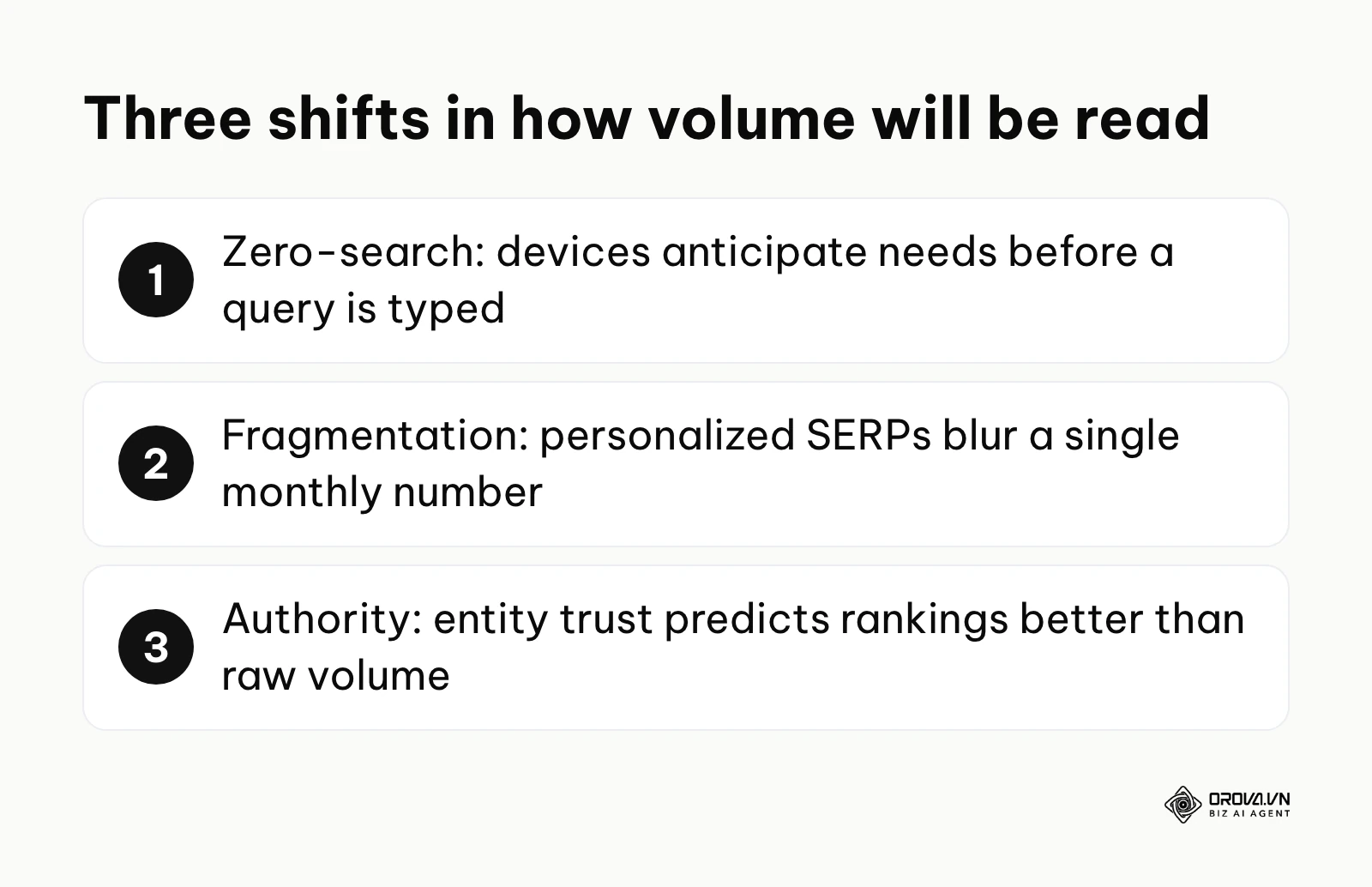
I believe we will gradually see a shift from "zero-click" searches to "zero-search" interactions. Predictive AI, deeply integrated into our operating systems and mobile devices, may increasingly anticipate user needs before they even type a query into a search box. If your calendar shows a flight to Tokyo tomorrow, your device may proactively serve you weather updates, currency exchange rates, and train schedules. The traditional search volume for some of these informational queries could shrink because users will not need to actively search for them. Marketers need to prepare by shifting their content away from simple informational answers and towards complex, experiential content that AI cannot predict or synthesize, such as deep-dive tutorials, opinionated reviews, and proprietary research. Zero-click searches are already common for simple informational queries, and I expect that pattern to keep growing.
The fragmentation of global search volume
I expect the idea of a single, definitive "monthly search volume" number to matter less over time. Search results are becoming hyper-personalized based on user history, real-time location, device type, and even current micro-trends. Two users searching for "project management software" may see noticeably different SERPs based on their company size and past software usage. Consequently, keyword tools may struggle to provide a unified volume metric. Instead, I foresee a shift towards "audience penetration" metrics, where the focus will be on the percentage of a highly specific target demographic you are reaching, rather than a raw, generalized volume number. You should begin segmenting your analytics now to understand how different user cohorts interact with your content, preparing for a future where broad volume numbers say less. You will need to start unifying SEO, AEO, and GEO strategies to remain visible across these fragmented touchpoints.
Authority metrics will supersede volume metrics
I suspect that as generative AI makes it far easier to produce vast quantities of content, search engines will lean more on source authority and entity trust, since surface relevance is easy to produce. The decision to target a topic will increasingly start not with "how many people search for this?" but rather "are we the most qualified entity on the internet to discuss this?" When a medical software company writes about a low-volume, highly complex regulatory change, its established trust in the medical field can help that content stand out. Marketers must start aggressively building digital PR, securing high-quality backlinks, and establishing their authors as recognized experts, because I expect authority to become a stronger predictor of ranking success than raw search volume.
Frequently asked questions about search volume
How do I accurately estimate CTR when an AI Overview is present?
Estimating CTR with an AI Overview requires manual SERP analysis. If the AI directly answers a simple factual query, assume organic results will receive very few clicks, regardless of volume. If the query is complex and requires deep research, the AI Overview often serves as a jumping-off point rather than a final destination. In these cases, if your title tag is compelling and promises depth not found in the summary, you can still earn a meaningful share of clicks when you rank directly below the AI Overview. Check the real figure in Google Search Console after publishing.
Why is there such a massive difference between Google Keyword Planner and Semrush data?
Google Keyword Planner groups similar variants together to show advertisers the total addressable market for a cluster, inflating the numbers. Semrush and Ahrefs attempt to isolate specific string queries using third-party clickstream data, which often results in lower, but theoretically more precise, numbers. For SEO purposes, rely on third-party tools for specific targeting, but always use GKP to understand the broader topic's popularity.
Are keywords with 10-50 search volume really worth the investment for a brand-new website?
Yes. For a new website with little domain authority, targeting keywords with 10-50 volume is usually the most realistic strategy. These keywords are ignored by major competitors. Ranking number one for twenty different 50-volume keywords puts you in front of up to 1,000 highly targeted searches a month. More importantly, it signals to Google that your site is an authority in a specific micro-niche, establishing the foundation needed to eventually target higher-volume terms.
Will AI search engines eventually make search volume tracking completely useless?
It will not make it useless, but it will change how we use it. Search volume will remain an indicator of human curiosity and demand. However, it will cease to be a direct proxy for website traffic. We will use search volume to understand what topics our audience cares about, but we will use different metrics, such as brand mentions, direct traffic, and lead quality, to measure the actual success of our content in satisfying that demand.
Where to start?
If you are a new website owner staring at a blank content calendar, do not open a keyword research tool yet. Start by interviewing three of your best customers or looking at your most recent sales inquiries. Identify one highly specific, complex question they asked before buying your product, and write a detailed, authoritative article answering exactly that question. Ignore the search volume; focus on the buyer intent.
If you are a marketing manager overwhelmed by conflicting data from different tools, your first step is to establish a baseline of truth. Open Google Search Console, navigate to the Performance report, and export the last 90 days of data. Sort by Impressions to find the keywords Google already associates with your brand, and look for queries where you rank on page two or three. Optimizing these existing pages will yield faster results than chasing entirely new high-volume targets.
If you are an agency professional tired of explaining low traffic numbers to executives, change the reporting framework. Stop reporting on keyword rankings and raw traffic. Build the ROI projection spreadsheet detailed in Step 5 of this guide. In your next meeting, present the projected revenue of a low-volume, high-intent keyword versus a high-volume vanity metric. Shifting the conversation from traffic to dollars changes the entire strategic dynamic.
About the author

Builder of Orova
Nguyễn Đỗ Trọng Ân has 8 years of experience in marketing, including 6 years managing market development across Asia. He builds Orova, a Biz AI Agent that never sleeps: it plans, runs and optimizes work for businesses.
Run your business with AI Agents
Orova is the always-on Biz AI Agent — it plans, runs, and optimizes the work for you.
Save time, unlock productivity.