
HR administrator job description template: full JD, 3 variants and interview rubric

When you are looking to hire a reliable human resources professional to organize your back-office operations, starting with a solid hr administrator job description template can make the difference between attracting a strategic partner and receiving hundreds of unqualified resumes. Finding the exact wording that balances administrative duties with employee support is often the hardest part of launching your hiring campaign.
Many hiring managers simply copy old templates from the internet, only to realize months later that the person they hired lacks the specific technical skills required for modern HR software. This guide provides an in-depth breakdown of how to build an effective job description from scratch. You will find a complete copy-ready HR administrator JD, modular templates tailored to different company sizes, practical interview rubrics, and the exact steps needed to attract high-quality candidates who can truly organize your administrative chaos.
The Core Value of an HR Administrator Job Description Template
An HR Administrator job description template is a structured document that clearly outlines the daily administrative tasks, compliance responsibilities, and required skill sets for a human resources administrative role. By using a well-crafted template, you establish clear expectations from day one, ensuring candidates know exactly what they are signing up for.
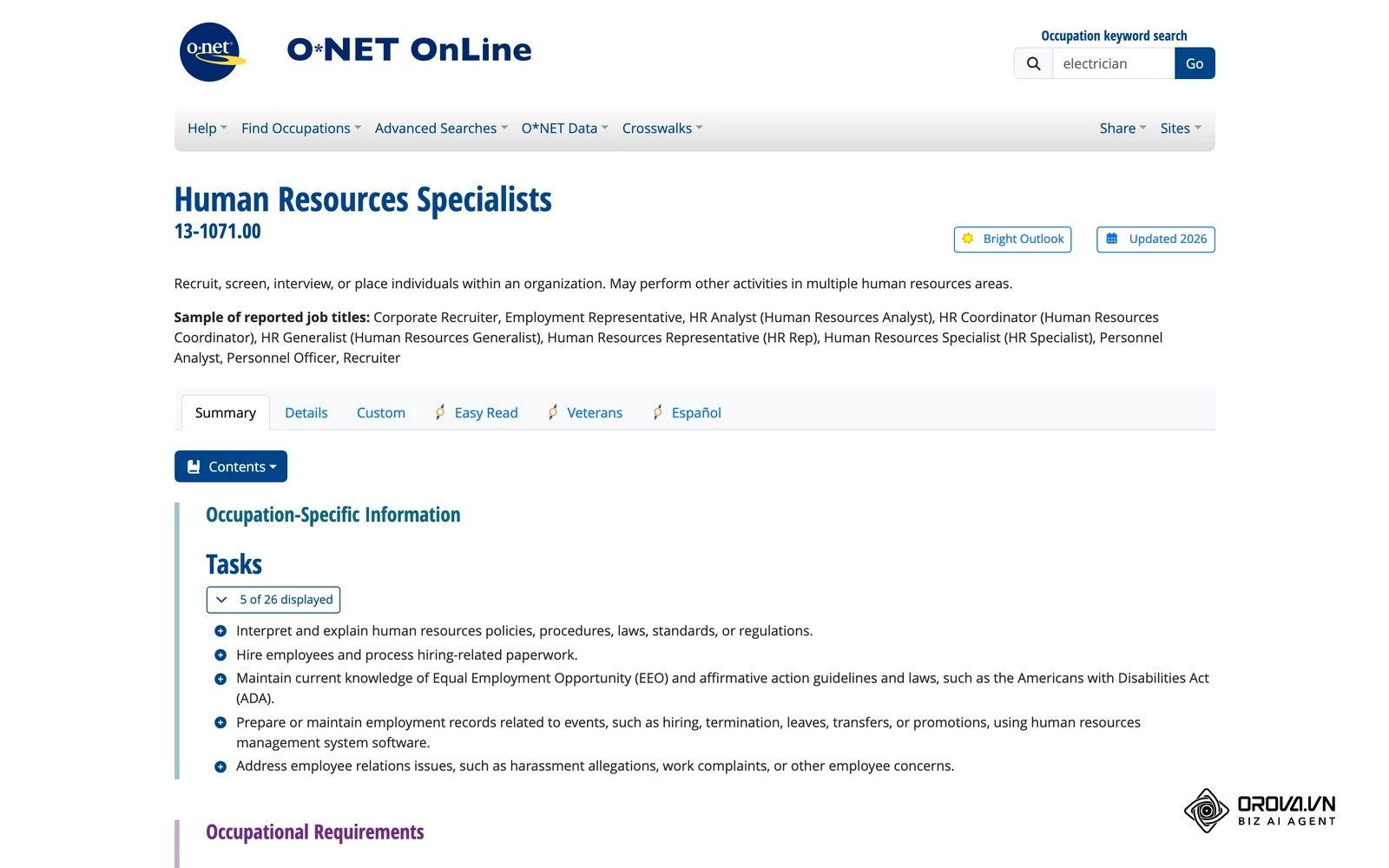
This template is designed for HR Managers, Talent Acquisition Leads, and small business founders who need to hire an administrative backbone for their operations. You should use these templates when you need a dedicated person to handle employee records, payroll preparation, and onboarding logistics. Conversely, if you are looking for someone to build company strategy, design compensation frameworks, or handle complex labor disputes, you should not use an HR Administrator template. Those duties fall under the role of an HR Business Partner or HR Director.
While you can find a general comprehensive job description template for various roles, an HR Admin requires a highly specific approach because their daily work revolves entirely around data accuracy and compliance. Defining clear administrative boundaries also prevents task overlap with strategic HR business partners. This targeted approach prevents confusion and ensures you attract candidates who actually enjoy the meticulous nature of administrative work.
Full HR Administrator Job Description Template (Copy and Paste)
Below is a complete hr administrator job description template you can paste into your careers page or applicant tracking system today. Replace every item in square brackets with your own details, then delete any duty your new hire will not actually do.
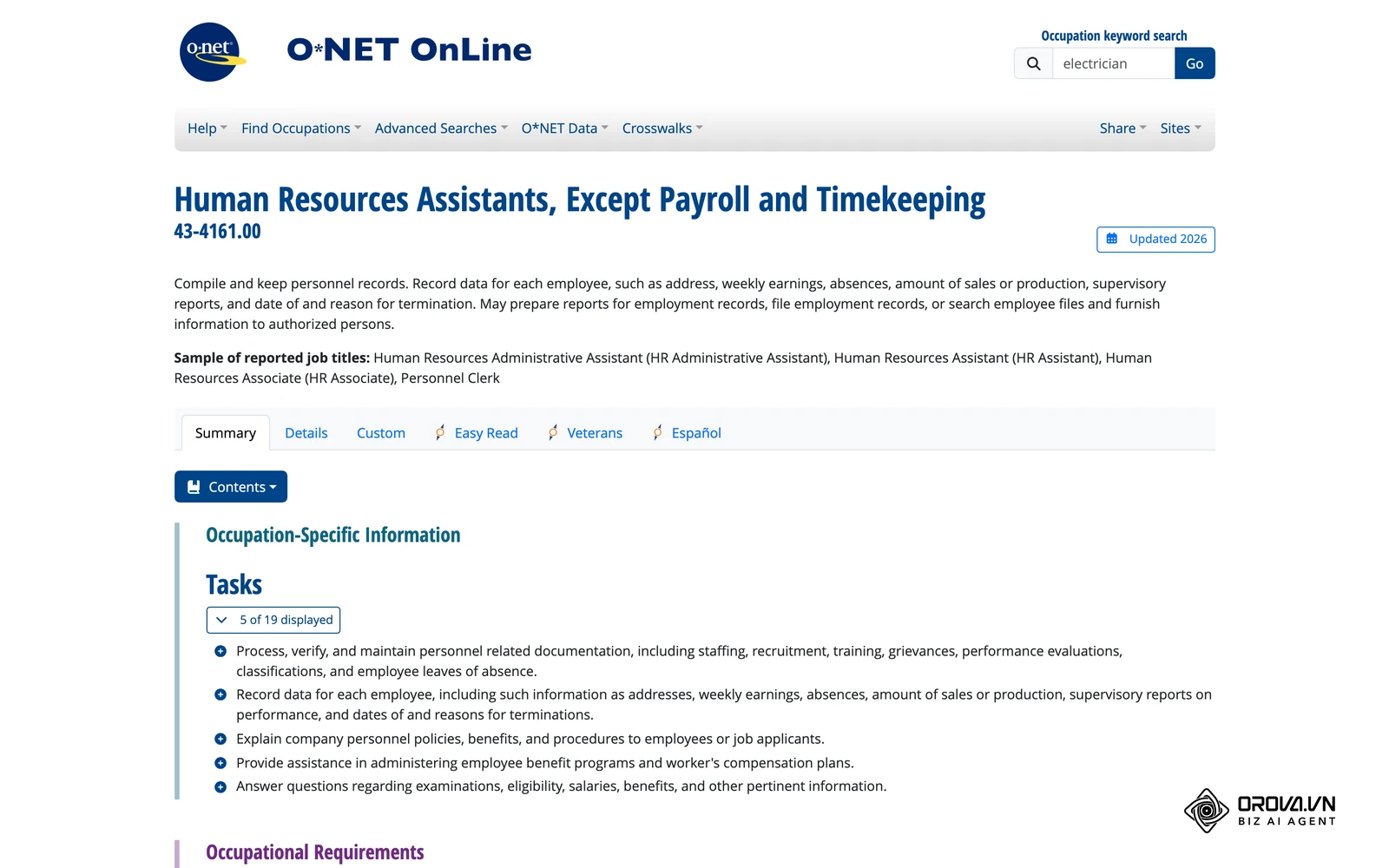
Job title: HR Administrator Department: Human Resources / People Operations Reports to: [HR Manager / Head of People / Operations Director] Location: [City, office address] · [On-site / Hybrid / Remote] Employment type: Full-time Salary range: [Minimum] to [Maximum] per [month/year], plus [bonus or allowance]
Job summary [Company name] is looking for an organized and discreet HR Administrator to keep our people operations accurate and running on time. You will own employee records in our HR system, prepare payroll inputs, coordinate onboarding and offboarding, and act as the first point of contact for employee questions about policies, leave and benefits. Your work makes sure every employee is paid correctly, every file is complete, and every audit finds clean records.
Key responsibilities
- HR records and HRIS: create and update employee files (new hires, promotions, transfers, address and salary changes) in [HRIS name]; keep digital and paper files complete and securely stored.
- Payroll and benefits support: collect timesheets, overtime, leave and commission data; cross-check figures and send payroll inputs to [Finance/payroll provider] by [day] each [period]; handle benefits enrollment paperwork.
- Onboarding and offboarding: prepare contracts and offer letters from approved templates, verify right-to-work and identity documents, schedule orientation, request equipment and accounts, and process exit paperwork.
- Compliance and documentation: track contract renewals, probation end dates, mandatory certifications and training records; prepare documents for internal and external labor audits.
- Employee support: answer first-line questions about leave, policies and benefits within [24/48] hours and route complex cases to the HR Manager.
- Reporting: produce monthly headcount, turnover and leave reports for management.
Requirements (must-have)
- [1 to 3] years of experience in HR administration or a similar office administration role.
- Working knowledge of local labor law on contracts, working hours, leave and payroll deductions.
- Confident with spreadsheets (filters, lookups, pivot tables) and at least one HR system.
- Very high attention to detail and a proven record of handling confidential data.
- Clear written and spoken [language(s)] for employee communication.
Nice-to-have
- Experience with [your HRIS or payroll software].
- An HR or payroll certificate, or a degree in Human Resources, Business or a related field.
- Experience supporting a company during fast headcount growth.
What we offer
- [Paid leave days], [health insurance], [retirement or social insurance contributions].
- [Working hours, e.g. Monday to Friday, 9:00 to 18:00, core hours 10:00 to 15:00].
- [Learning budget, equipment, remote work allowance or other perks].
How to apply Send your CV and a short note describing one HR process you improved to [email or application link] before [deadline]. Shortlisted candidates will complete a [30-minute] practical data-accuracy task and a structured interview.
This full version fits most companies with an existing HR manager. If your company is much smaller or much larger, use the three size-based variants further down to adjust the responsibilities and requirements.
What to Prepare Before Writing Your JD
Before you begin copying and pasting text, you need to gather specific internal information. Writing a job description without knowing your internal constraints is a recipe for high turnover. You need to know exactly what tools the new hire will use, who they will report to, and what the budget is.
| Item to Prepare | Where to Get It | Time to Prepare |
|---|---|---|
| Approved Salary Range | Finance Department or Executive Board | 2 to 3 days |
| Exact Software Stack List | Current HR Team or IT Department | 1 day |
| Direct Reporting Line | Operations Director or HR Director | 1 day |
| Core 30-Day Objective | The Hiring Manager | 1 day |
| List of Missing Compliance Tasks | Recent HR Audit Reports | 2 to 4 days |
Skipping this preparation phase usually results in a generic job description. For example, if you do not define the software stack beforehand, you might forget to list specific database management skills. Later, you will have to spend weeks training the new hire on basic software navigation, severely delaying their productivity. Take the time to gather these five items to build a robust foundation for your recruitment effort.
6 Steps to Build the Perfect HR Administrator Job Description
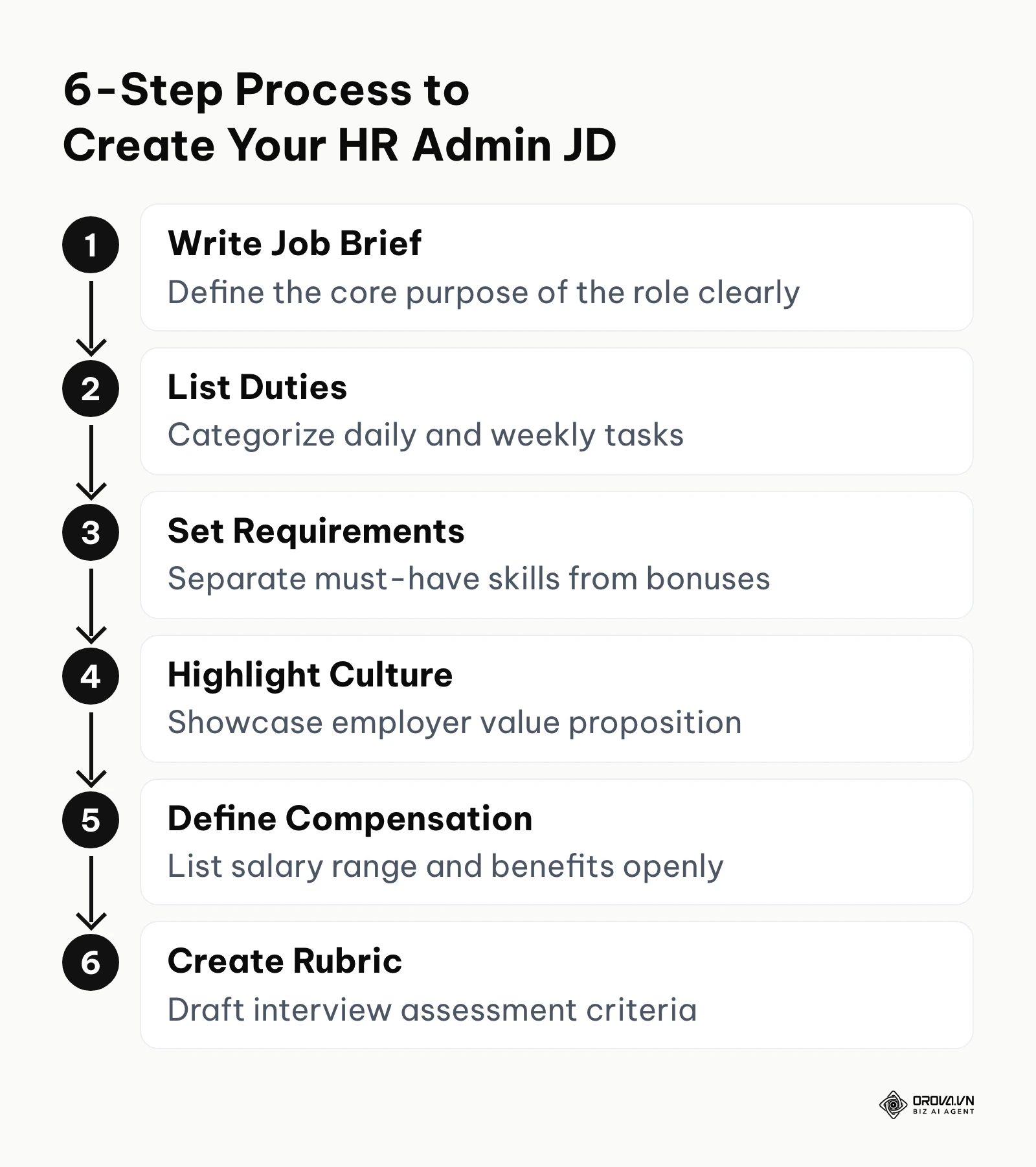
Creating a document that accurately reflects the daily reality of your office requires a systematic approach. The diagram below summarizes the six sequential steps you need to take to ensure your job posting is complete, attractive, and highly functional.
Step 1: Crafting a Compelling Job Brief
The job brief is the introductory paragraph of your job description. It serves as the "hook" to grab the candidate's attention. Instead of starting with a boring list of demands, you should use this section to explain why the role exists and how it contributes to the company's overall success.
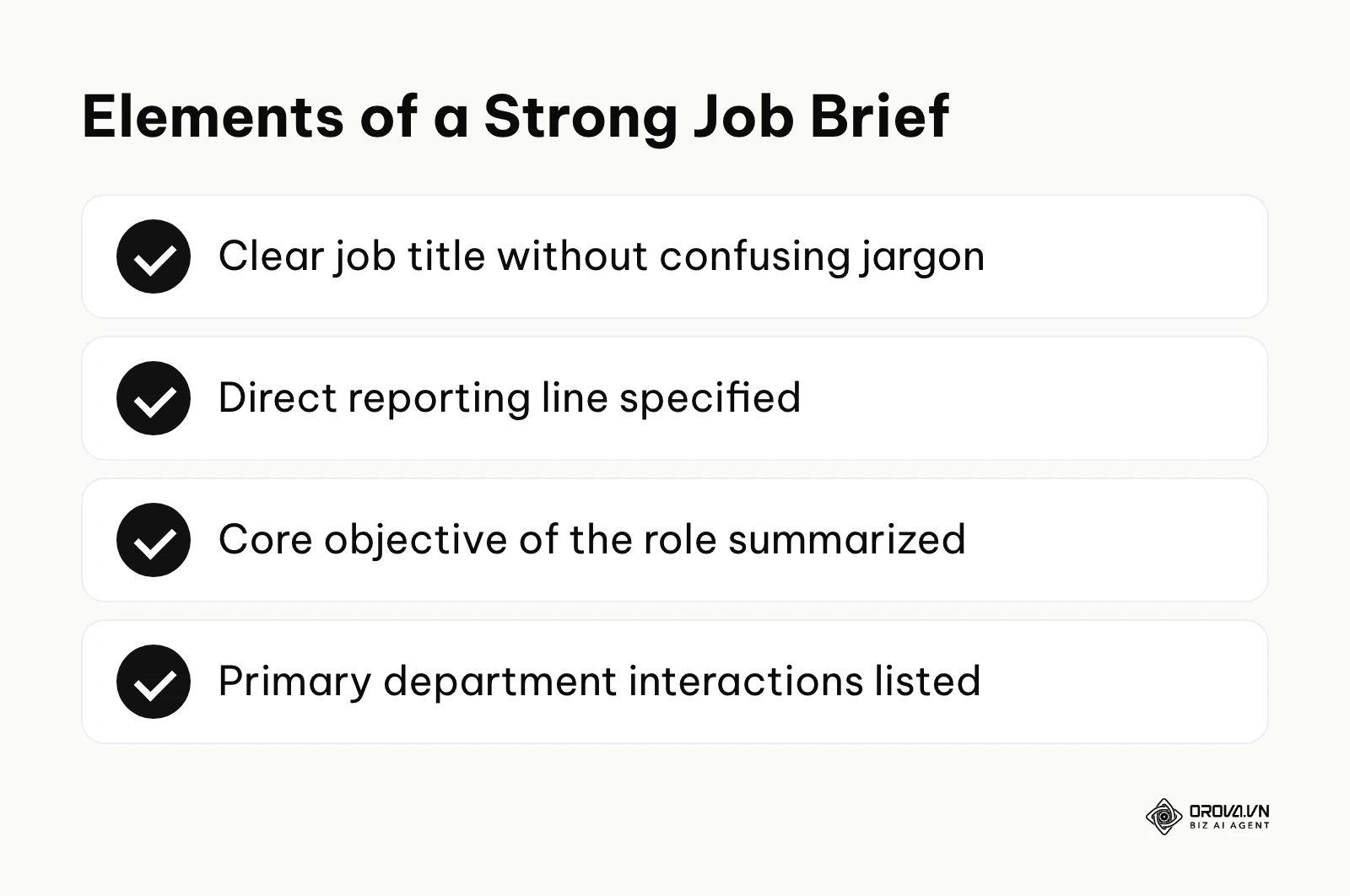
To write a strong job brief, start by stating the exact job title clearly. Avoid using creative but confusing titles like "HR Ninja" or "People Operations Rockstar." Stick to standard terms like "HR Administrator" or "Human Resources Administrator" so your job posting appears in search engine results. Next, specify exactly who this person will report to. Finally, summarize the primary objective of the role in two or three sentences.
A sign that you have written a good job brief is if a candidate can read it and immediately tell you what their primary goal will be on their first day. A common mistake in this step is writing a brief that is entirely focused on the company's history rather than the candidate's daily reality.
Example of a strong Job Brief: "We are seeking a highly organized HR Administrator to join our growing People Team. Reporting directly to the HR Manager, you will serve as the primary point of contact for all employee administrative queries. Your main objective will be to ensure our employee records are one hundred percent accurate and that our weekly payroll data is prepared flawlessly. You will act as the crucial link between our employees and our HR Information System."
Step 2: Detailing Responsibilities and Daily Duties
The responsibilities section is the core of your job description. This is where you list exactly what the person will be doing every single day. The diagram below summarizes the three duty groups that work well for this role.
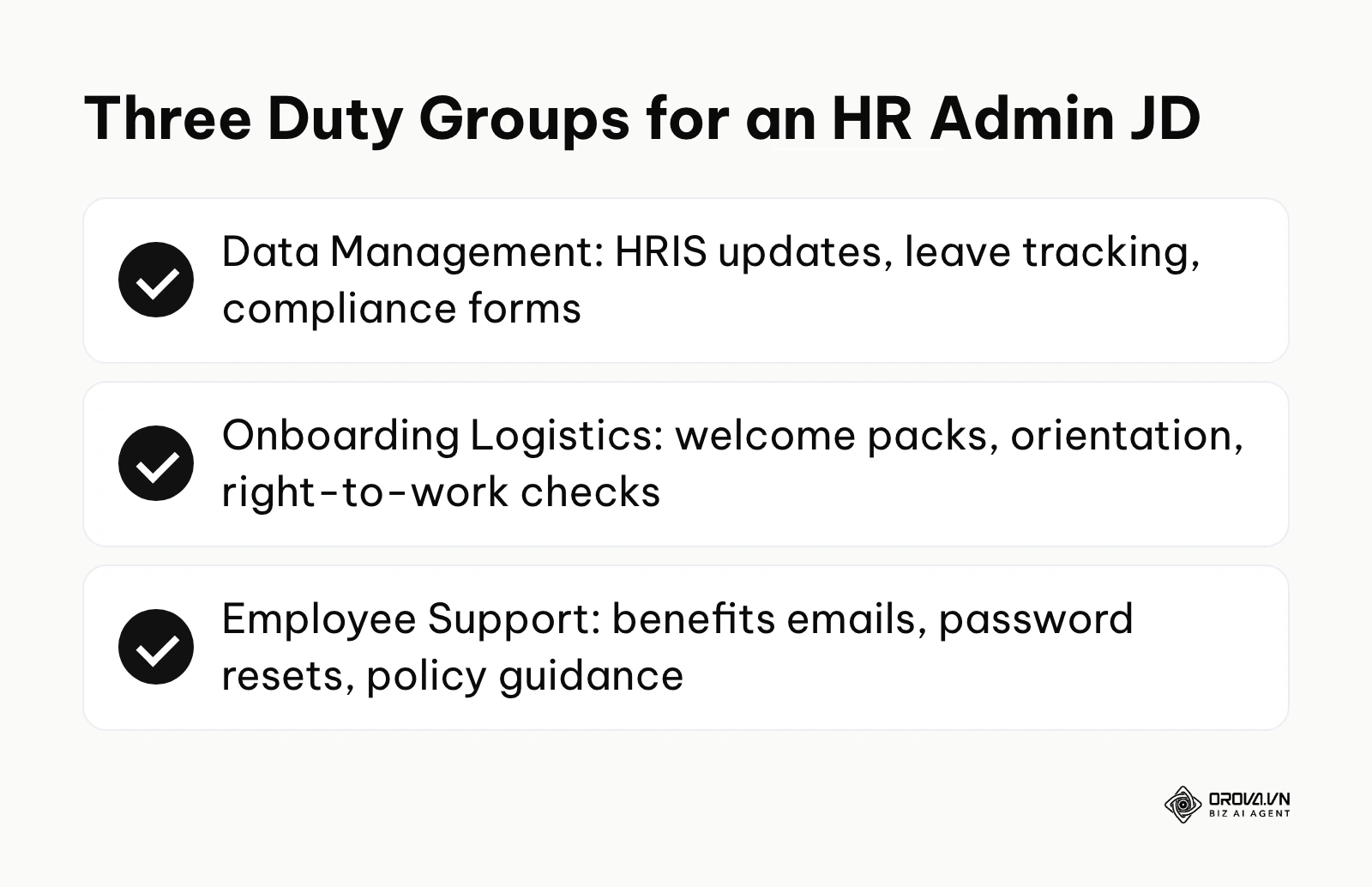
To make this section readable, you must categorize the tasks. Do not present a massive, intimidating wall of thirty bullet points. Instead, group them into logical buckets such as "Data Management", "Onboarding Logistics", and "Employee Support".
Under "Data Management", detail the tasks related to updating the Human Resources Information System (HRIS). Mention tracking vacation days, updating addresses, and filing digital compliance forms. Under "Onboarding Logistics", list tasks like preparing welcome packages, scheduling orientation sessions, and verifying right-to-work documents. Under "Employee Support", explain that they will answer emails regarding benefits, reset software passwords, and guide employees to the correct policy documents. For companies in manufacturing or construction, the HR Admin might also track workplace safety training initiatives to maintain compliance and avoid penalties.
Illustrated example:
- Context: A regional logistics SME with 85 employees needed an HR Administrator to standardize their messy onboarding process.
- Steps taken: The HR Manager audited the existing disorganized onboarding checklist. They rewrote the duties section of the JD to specifically highlight "managing the 30-60-90 day new hire check-in process" and "auditing driver certification files monthly."
- Hurdles & fixes: The initial phrasing attracted candidates who only wanted to do silent data entry and avoided employee interaction. They fixed this by changing the duty title from "Data Management" to "Employee Onboarding Experience & Compliance."
- Visible results: The hired candidate successfully transitioned the company from a paper-based filing system to a fully digitized onboarding portal, resulting in zero missing certification documents during the next state compliance audit.
Step 3: Setting Realistic Requirements and Qualifications
This step determines who actually clicks the "Apply" button. The most crucial action here is strictly separating your "Must-Have" requirements from your "Nice-to-Have" bonuses.
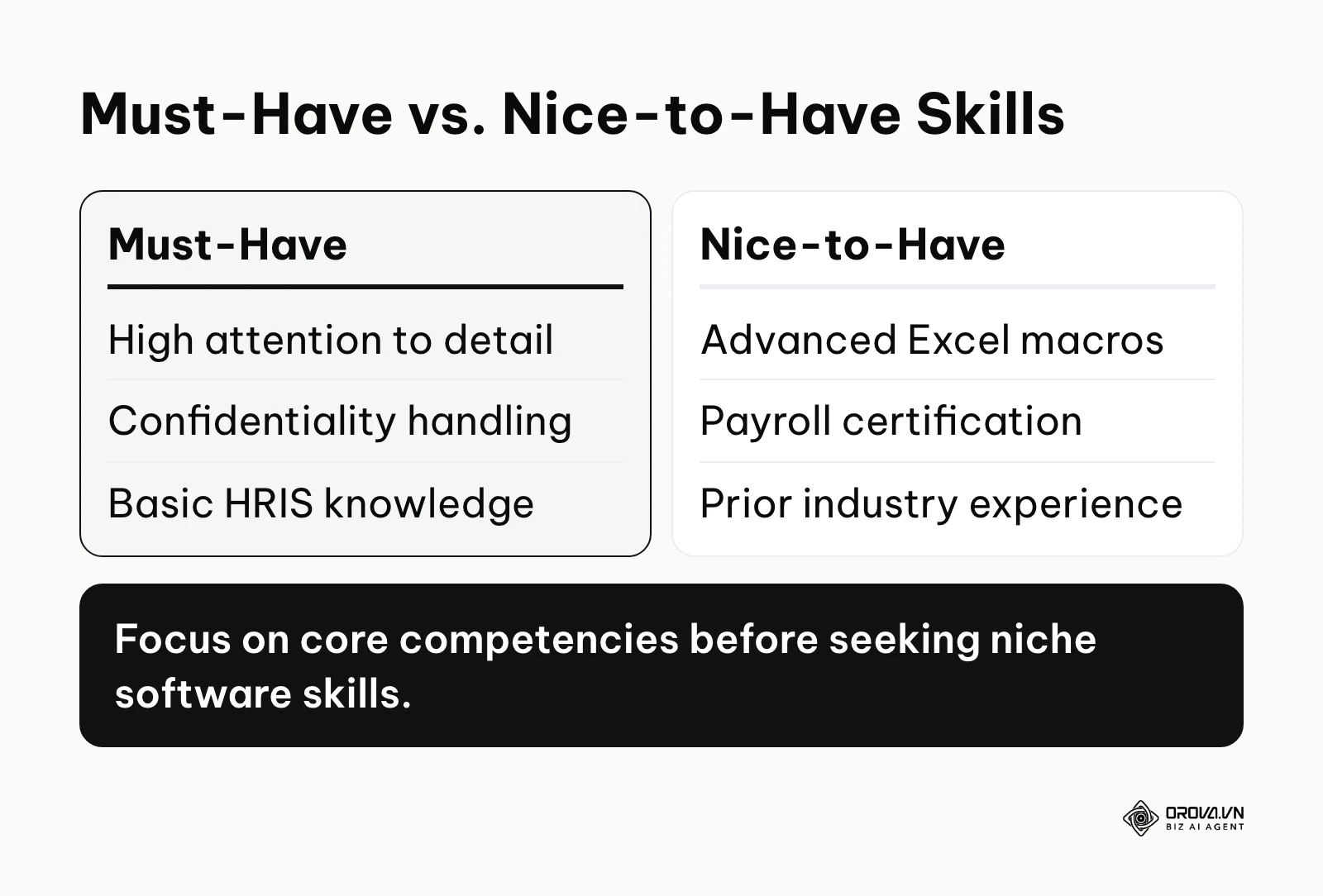
Must-haves are the skills a candidate absolutely needs on day one to avoid breaking your processes. These usually include high attention to detail, strict understanding of confidentiality, and basic proficiency with spreadsheet software. Nice-to-haves are skills that would be great, but that you can easily teach a smart candidate within a month. These might include experience with your specific niche payroll software or advanced macro writing in Excel.
Asking for basic data literacy is a reasonable must-have, but demanding mastery of complex data visualization tools is an overreach. A common mistake here is demanding five to seven years of experience for what is fundamentally an entry-to-mid-level administrative role. This artificially shrinks your talent pool and drives up your salary costs unnecessarily.
Step 4: Showcasing Employer Branding and Company Culture
Administrative roles can sound dry on paper. To stand out, you must weave your company culture into the job description. This is where you explain the working environment.
Are you a fully remote team that relies heavily on asynchronous communication? State that clearly. Are you an in-office manufacturing company where the HR Admin will interact with factory floor workers every day? Highlight that dynamic. You should include a brief section titled "Why You Will Love Working Here" or "Our Team Culture."
List practical cultural benefits. Do you offer protected focus time on Wednesdays? Do you have a strict no-contact policy after working hours? These operational details speak much louder than generic phrases like "we work hard and play hard." A sign that you have done this correctly is when candidates bring up specific cultural points during the interview, showing that your branding resonated with them.
Step 5: Structuring Compensation, Benefits, and Perks
Transparency is no longer optional in modern recruitment. You must list a realistic salary range in your job description. Hiding the salary behind phrases like "competitive compensation based on experience" frustrates candidates and leads to a high drop-off rate during the final interview stages when expectations do not align.
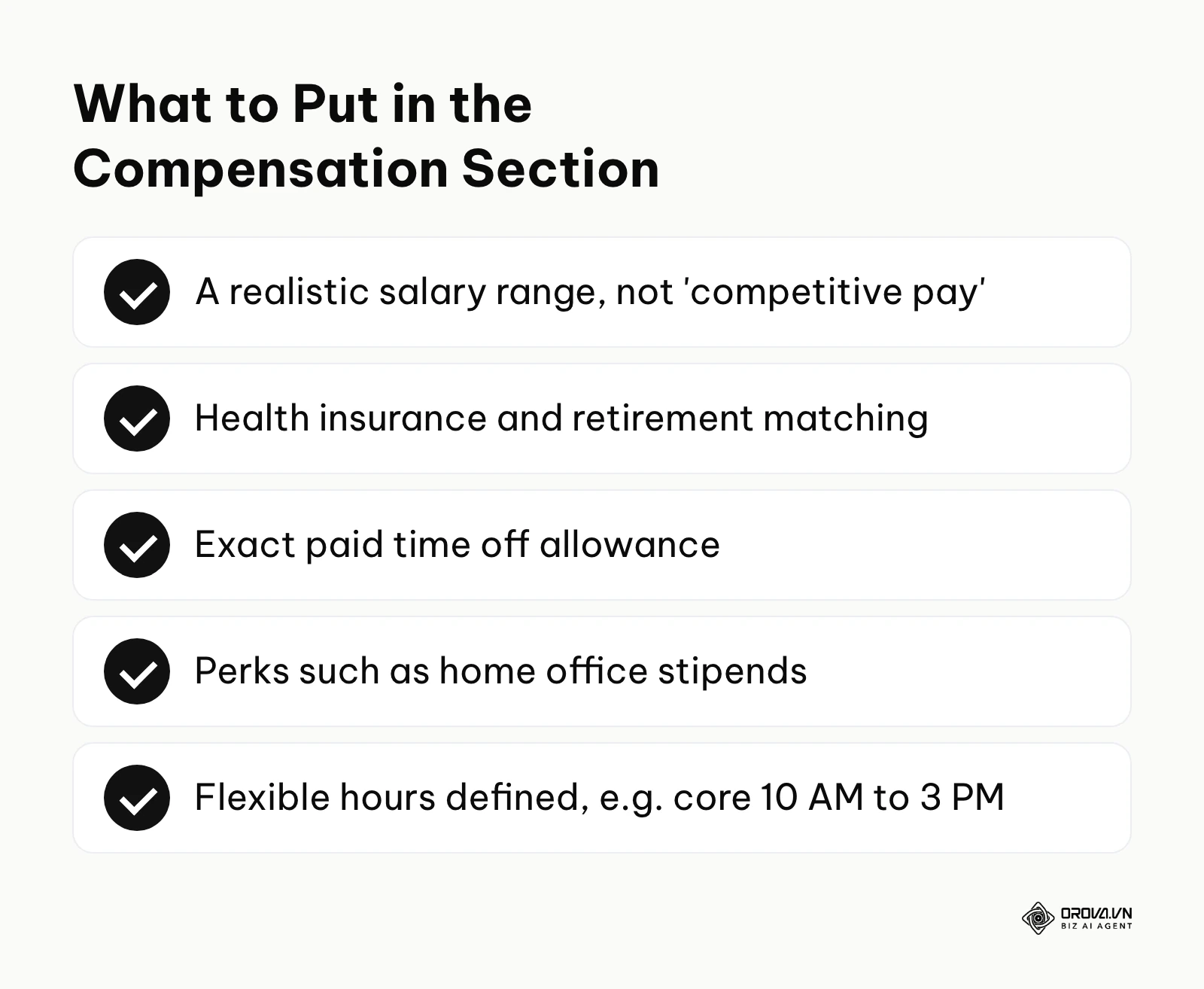
Detail the tangible benefits alongside the salary. List your health insurance coverage, retirement matching percentages, and exact paid time off (PTO) allowances. Do not forget to include operational perks, such as stipends for home office setups or monthly allowances for wellness apps. If you offer flexible working hours, define exactly what that means. For instance, state "Core hours are 10 AM to 3 PM, the rest is up to you," rather than just saying "flexible schedule." Being highly specific builds immediate trust with the applicant.
Step 6: Pairing the JD with a Practical Interview Rubric
A job description is useless if you do not have a corresponding method to evaluate the candidates it attracts. Before you publish the JD, you must create an interview rubric. This ensures you ask every candidate the exact same questions and grade them on the same criteria, reducing unconscious bias in your structured hiring process.
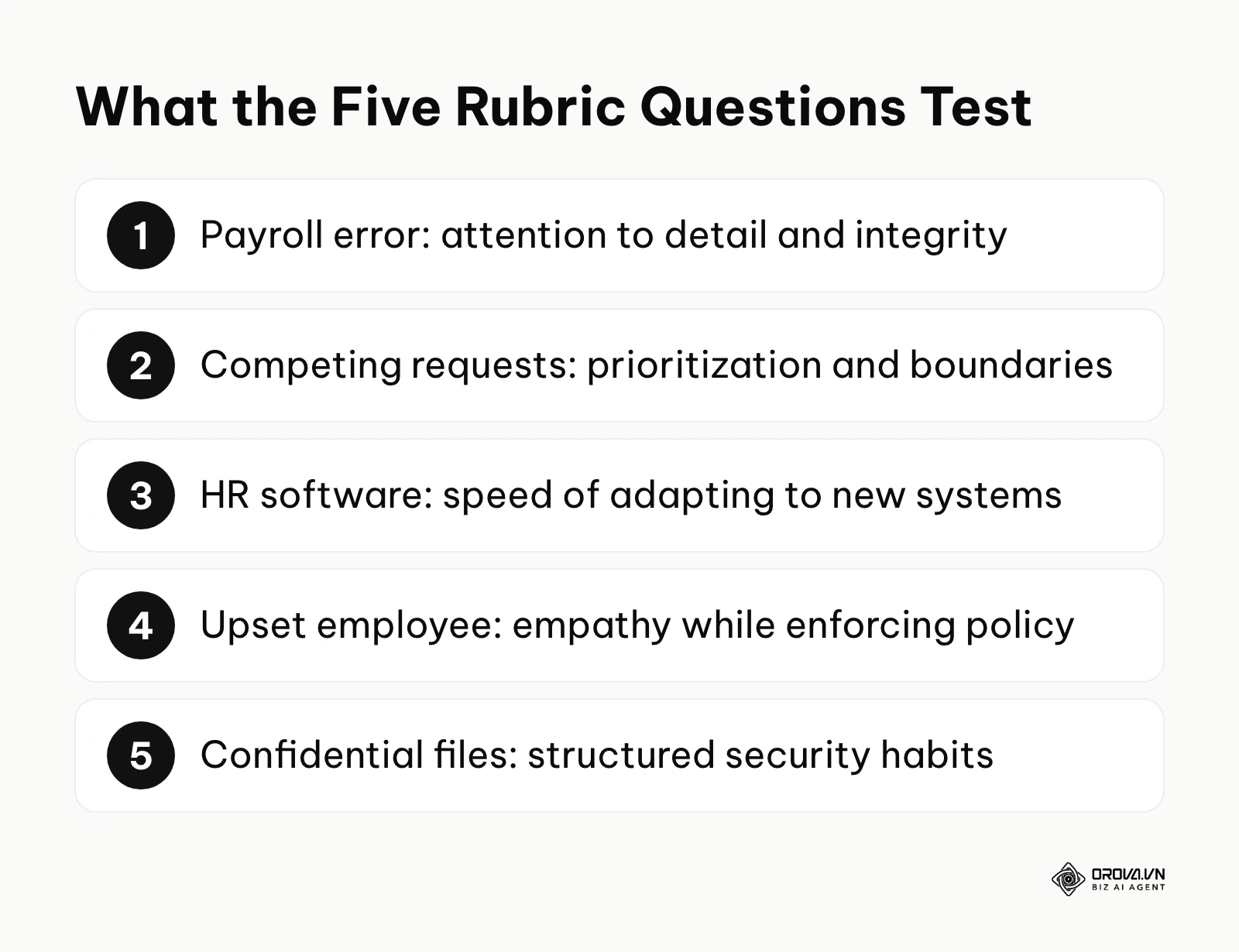
Below is a detailed set of five situational interview questions specifically designed for evaluating HR Administrators, complete with the intent behind the question, the green flags to look for, and the red flags to avoid.
Question 1: "Tell me about a time you noticed an error in an employee's record or payroll data. How did you handle it?"
- Intent: This tests attention to detail, integrity, and problem-solving.
- Green Flags: They found the root cause, informed the affected employee with empathy, corrected the HRIS record, and added a double-check to prevent repeats.
- Red Flags: The candidate says they just fixed it silently without telling anyone, or they blame the software entirely without taking personal accountability for auditing the data output.
Question 2: "How do you prioritize your tasks when multiple managers give you urgent administrative requests on the same day?"
- Intent: HR Admins are constantly pulled in different directions. This question tests their time management and boundary-setting skills.
- Green Flags: They mention using a specific triage system (like the Eisenhower Matrix), communicating realistic deadlines back to the managers, and assessing which task has the highest compliance risk if delayed.
- Red Flags: They say they just work faster or stay late to finish everything, which is a fast track to burnout and high error rates.
Question 3: "Describe your experience with HR software. How quickly do you adapt to new systems?"
- Intent: You need to know how quickly they learn cloud-based HR tools.
- Green Flags: They provide specific examples of systems they have used, explain how they utilized help documentation or forums to learn a new tool independently, and express enthusiasm for automation.
- Red Flags: They express a strong preference for paper files, or they require step-by-step hand-holding to learn basic software navigation.
Question 4: "An employee comes to you upset about a missing benefit enrollment, but it was their own fault for missing the deadline. What do you say to them?"
- Intent: This evaluates their emotional intelligence, empathy, and ability to enforce company policy without sounding robotic or aggressive.
- Green Flags: They listen to de-escalate, explain the policy clearly, and offer alternatives (like a qualifying life event or the next open enrollment).
- Red Flags: They immediately quote the rulebook defensively, act dismissive of the employee's feelings, or promise to break the rules to fix it just to avoid conflict.
Question 5: "What is your system for ensuring highly confidential documents are not accidentally shared or left unsecured?"
- Intent: HR Admins handle salaries, medical notes, and disciplinary records, so a breach is a major liability.
- Green Flags: They mention locking screens when stepping away from the desk, using secure password managers, double-checking email attachments before sending, and securely shredding physical notes.
- Red Flags: They give a vague answer about "just being careful," indicating they lack structured security habits.
Creating a robust job description is just the beginning of your hiring journey. Once applications arrive, you need an efficient processing system. With Orova Recruit, you can score CVs against your specific criteria and extract exact sentences as evidence of skills, saving you countless hours of manual resume screening and shortlisting.
Deep Dive: Adjusting the HR Admin Role by Company Size
A one-size-fits-all approach to job descriptions guarantees failure. An HR Administrator at a 20-person startup does vastly different work than one at a 2,000-person enterprise. As your company grows, understanding how to build your HR and recruitment software stack becomes crucial for the HR Admin, as their daily tools will change dramatically. The diagram below summarizes which JD model you should choose based on your current operational scale.
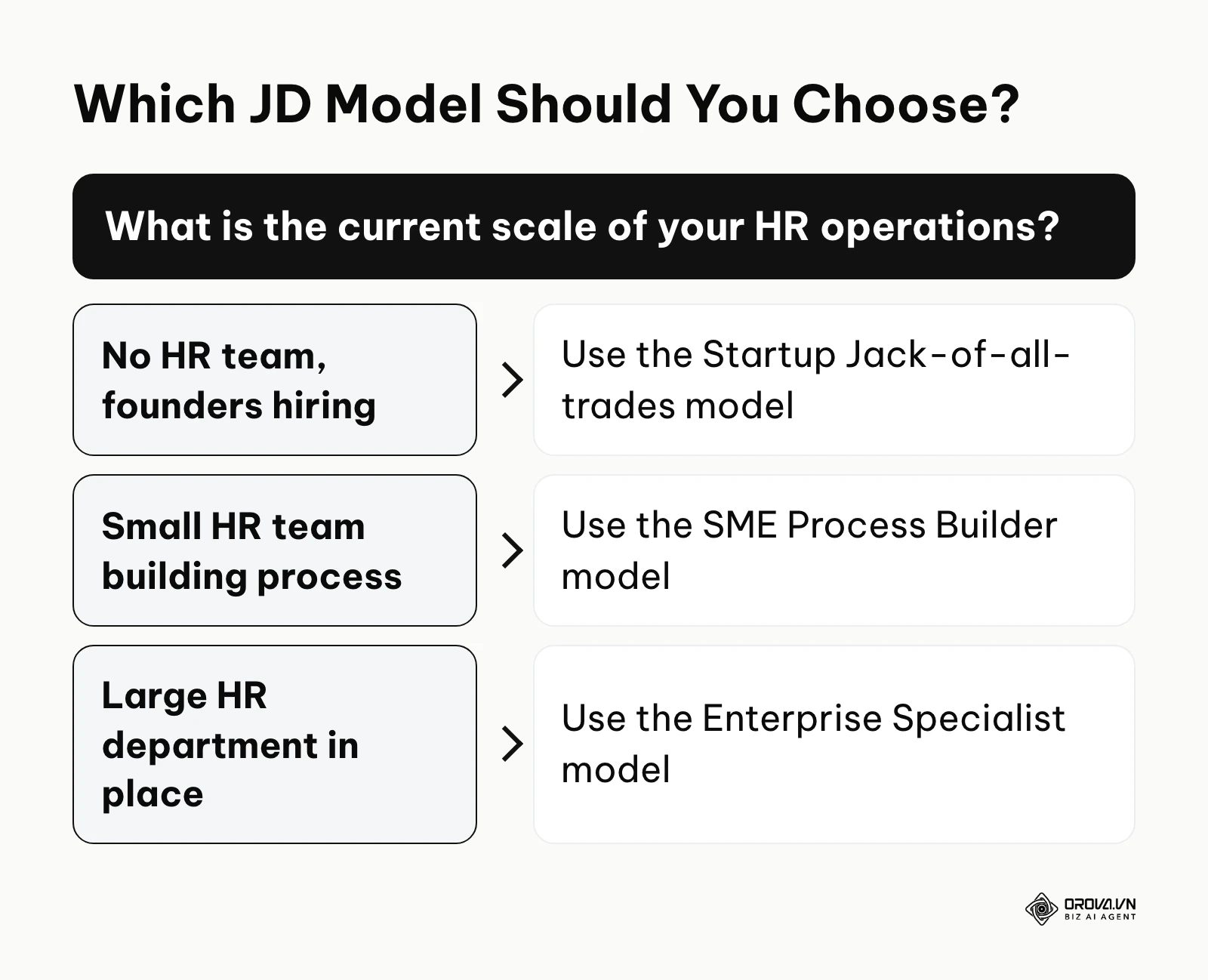
To help you build the perfect JD, here are three complete, modular templates. You can copy the exact text that matches your company's current stage.
Template 1: The Startup "Jack-of-all-Trades" Model (Under 50 Employees)
In a startup, the HR Admin is often the very first dedicated HR hire. They will support the founders directly and handle a mix of culture-building and basic administration.
Job Brief: We are looking for a highly adaptable HR Administrator to build our foundational people processes. Reporting directly to the CEO, you will be the go-to person for everything related to employee experience, office operations, and basic HR compliance. You will thrive here if you love building systems from scratch and enjoy wearing multiple hats in a fast-paced environment.
Key Responsibilities:
- Set up and manage the core HR Information System for the first time.
- Coordinate the end-to-end onboarding experience, including ordering laptops, setting up software accounts, and leading office tours.
- Organize monthly team-building events, manage office snacks, and maintain a positive physical workspace.
- Assist the founders in drafting the very first employee handbook and basic company policies.
- Manage the shared team calendar and track basic vacation requests via spreadsheets until automated systems are implemented.
Requirements:
- 1 to 2 years of general administrative or office management experience.
- High comfort level with modern communication tools like Slack, Notion, and Google Workspace.
- Extreme adaptability; a sudden change in priorities does not frustrate you.
- A proactive mindset; you see a broken process and fix it before being asked.
Template 2: The SME "Process Builder" Model (50 to 250 Employees)
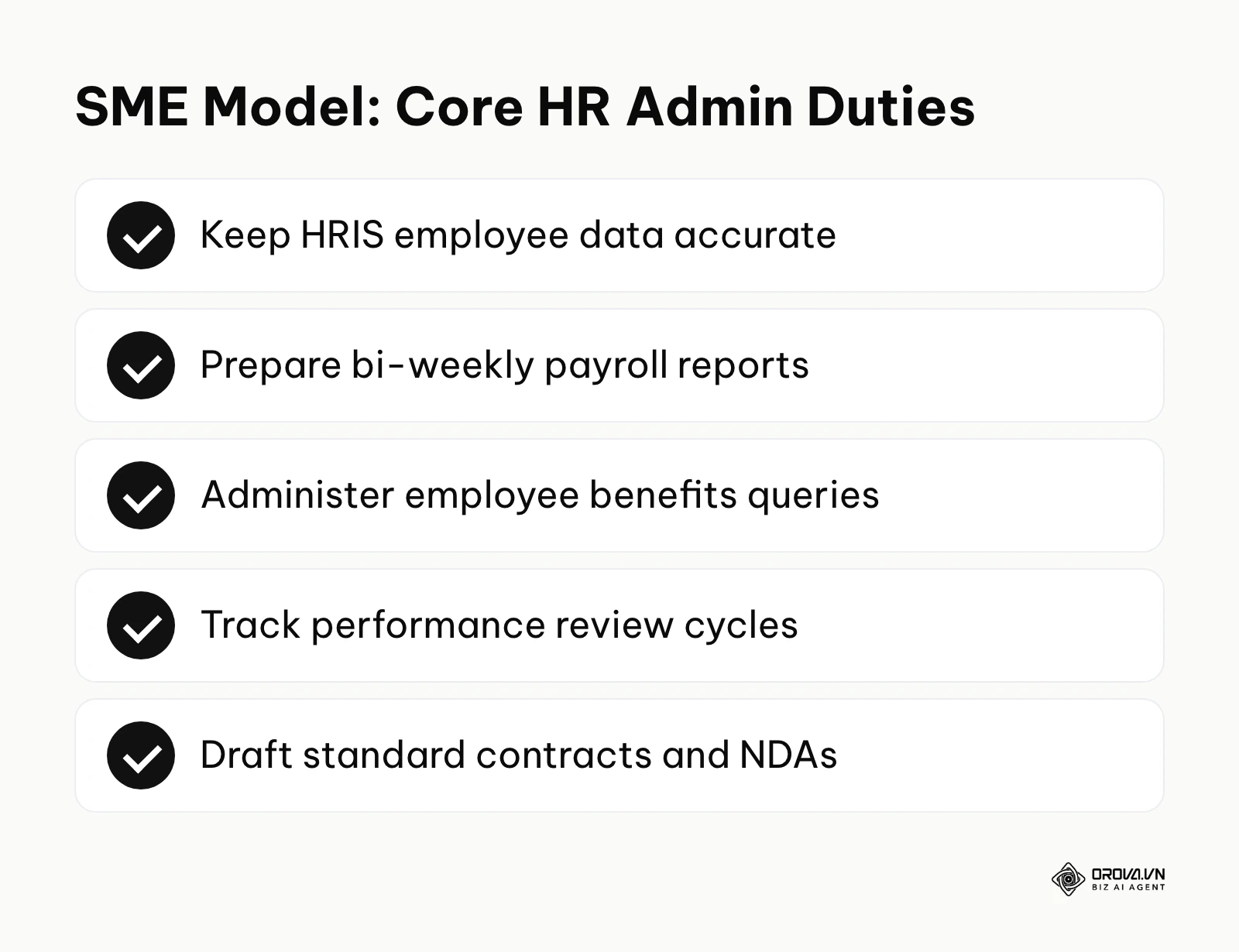
In a Small to Medium Enterprise (SME), the chaos of the startup phase must be structured. The HR Admin here supports an HR Manager and focuses heavily on standardizing compliance and maintaining clean data.
Illustrated example:
- Context: A rapidly scaling e-commerce startup expanding from 40 to 120 employees required their first dedicated HR Administrator to take over duties from the founders.
- Steps taken: The founders utilized a modular SME template. They selected specific blocks for payroll preparation and benefits administration, purposefully leaving out complex labor union relations. They clearly defined the reporting line directly to the newly hired Chief Operating Officer.
- Hurdles & fixes: They originally included "office management and snacks ordering" in the JD, which diluted the professional HR focus and attracted office managers rather than HR professionals. They removed the facility tasks and shifted the focus entirely to HR tech stack management.
- Visible results: They hired an individual who immediately implemented a centralized leave tracking system, eliminating the messy shared spreadsheet previously used by the team and reducing payroll errors to zero in the first quarter.
Job Brief: We are seeking a detail-oriented HR Administrator to ensure our people operations run flawlessly. Reporting to the HR Manager, you will take ownership of our data integrity, compliance tracking, and payroll preparation. Your goal is to ensure every employee record is accurate, every benefit query is answered promptly, and our internal HR processes scale smoothly as we grow.
Key Responsibilities:
- Act as the primary administrator for our HRIS, ensuring all employee data (promotions, address changes, salary updates) is entered accurately and promptly.
- Prepare bi-weekly payroll reports, cross-checking timesheets, overtime logs, and commission spreadsheets before submission to the finance team.
- Manage the administration of employee benefits, assisting staff with open enrollment queries and liaising with insurance brokers.
- Track performance review cycles, sending reminders to managers and filing completed evaluations.
- Draft standard employment contracts and non-disclosure agreements based on approved legal templates.
Requirements:
- 2 to 4 years of dedicated Human Resources administrative experience.
- Proven experience operating a mid-market HRIS platform (e.g., BambooHR, Gusto).
- Strong understanding of local labor laws regarding working hours, mandatory leave, and payroll taxes.
- Exceptional attention to detail and strict adherence to data privacy protocols.
Template 3: The Enterprise "Specialist" Model (Over 250 Employees)
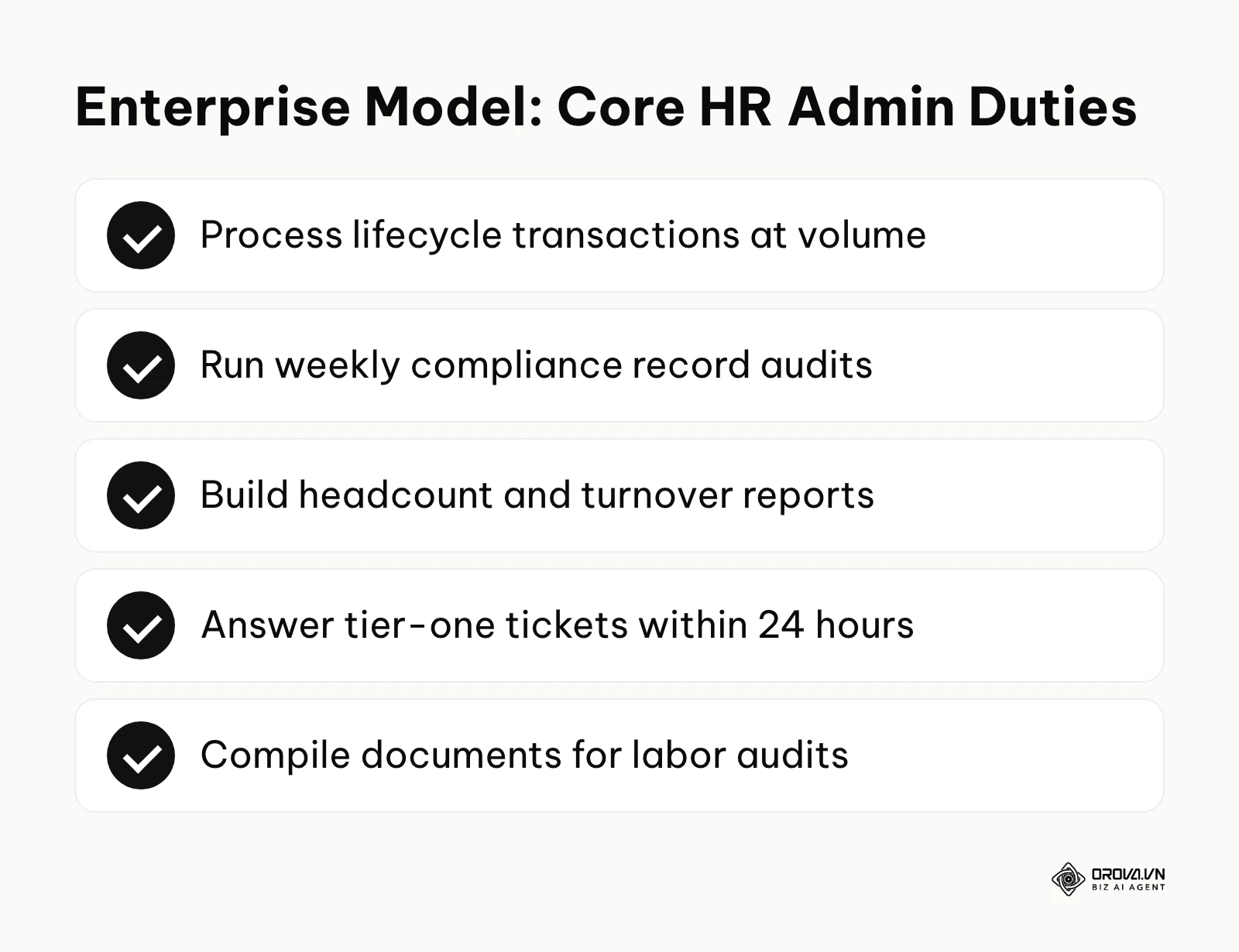
In a large enterprise, the HR Admin works within a specific silo (like compensation, benefits, or compliance) as part of a large Shared Services Center. The ISO 30408:2016 guidelines on human governance stress that transparent administrative processes support organizational accountability, which is why this version leans heavily on auditing and documentation.
Job Brief: We are hiring an HR Data Administrator to join our Global HR Shared Services team. Reporting to the HR Operations Lead, you will handle high-volume data processing and compliance auditing for your designated business unit. You will be responsible for executing complex administrative workflows within our enterprise resource planning software while strictly adhering to internal Service Level Agreements (SLAs).
Key Responsibilities:
- Process high volumes of employee lifecycle transactions (new hires, transfers, terminations) within the enterprise HR database.
- Conduct weekly audits of compliance records, ensuring all mandatory certifications and right-to-work documents are valid and securely stored.
- Generate complex headcount, turnover, and absenteeism reports for senior leadership using advanced database queries.
- Respond to tier-one employee inquiries via the internal HR ticketing system within a 24-hour SLA.
- Coordinate with the legal department to compile documentation required for external labor audits.
Requirements:
- 3+ years of HR data processing experience within a large corporate environment.
- Mandatory certification or extensive hands-on experience with enterprise-level systems (e.g., Workday, SAP SuccessFactors).
- Advanced Microsoft Excel skills, including the ability to utilize VLOOKUPs, pivot tables, and basic macros to manipulate large datasets.
- Ability to maintain high accuracy and focus while processing repetitive, high-volume transactional work.
Measuring Hiring Success: KPIs for Your Job Description
Writing a great job description is not an artistic endeavor; it is a measurable business process. You must track specific Key Performance Indicators (KPIs) to determine if your job description is actually working.
To understand how your job posting is performing, track these three vital metrics throughout your hiring campaign.
Tracking Time-to-Fill
Time-to-fill measures the number of days between publishing the job description and the day the candidate accepts the offer. You can pull this data from your applicant tracking software. If your time-to-fill exceeds 45 days for an administrative role, it usually indicates that your requirements are too strict or your salary is below market rate.
Monitoring Application Conversion Rate
The application conversion rate tells you if your job description is appealing. The formula below shows how to calculate this metric.
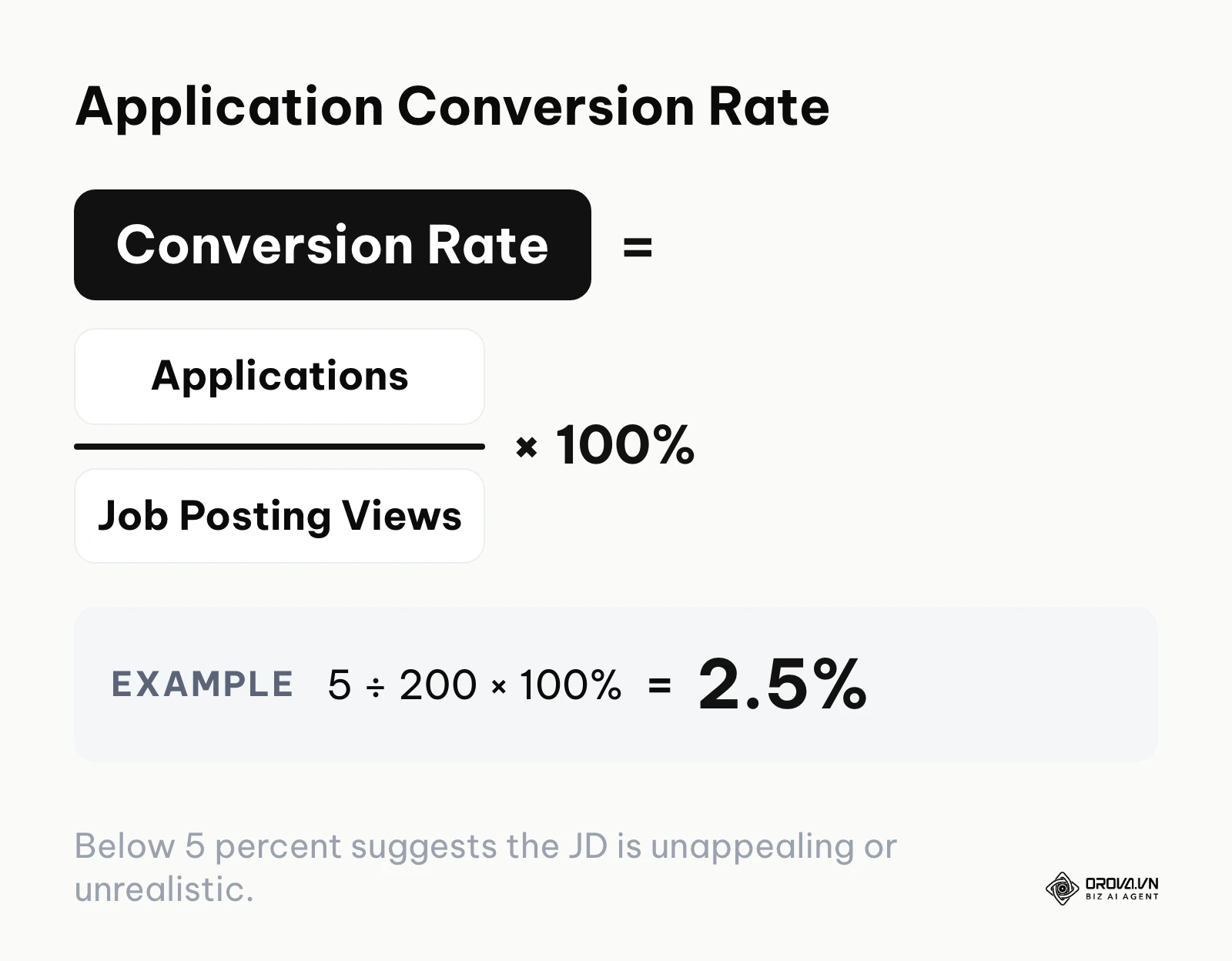
If you have two hundred views on your job posting but only five applications, your conversion rate is 2.5 percent (5 ÷ 200 × 100%), well under the 5 percent warning threshold. This usually happens when the job brief is boring, or the responsibilities section is overwhelmingly long. You should see a noticeable improvement in this metric within the first week of tweaking your job description formatting.
Quality of Hire
This is the ultimate metric, but it takes time to measure. You evaluate the quality of hire by looking at the new HR Admin's performance review scores after 90 days on the job. If the candidate struggles with basic tasks outlined in the JD, it means your interview rubric failed to test the requirements you listed.
| Metric | Meaning | Warning Threshold |
|---|---|---|
| Application Conversion Rate | Percentage of viewers who actually apply. | Below 5% indicates the JD is unappealing or requirements are unrealistic. |
| Time-to-Fill | Days taken to secure a signed offer letter. | Over 45 days suggests salary misalignment or a slow interview process. |
| 90-Day Retention Rate | Percentage of hires who pass probation. | Below 90% indicates a severe mismatch between the JD and the actual daily work. |
Stop drowning in unstructured resumes and manual interview scheduling. Orova Recruit allows you to evaluate candidates, record interview notes, export comparison PDFs, and automatically send customized email updates directly from your company inbox. You can start optimizing your entire hiring pipeline today, completely free until July 7, 2027.
5 Common Mistakes When Writing HR Admin JDs
Even experienced HR Managers fall into predictable traps here, leading to poor candidate quality, wasted interview hours, and high early turnover. The diagram below shows how to fix one of the most common issues: vague requirements.
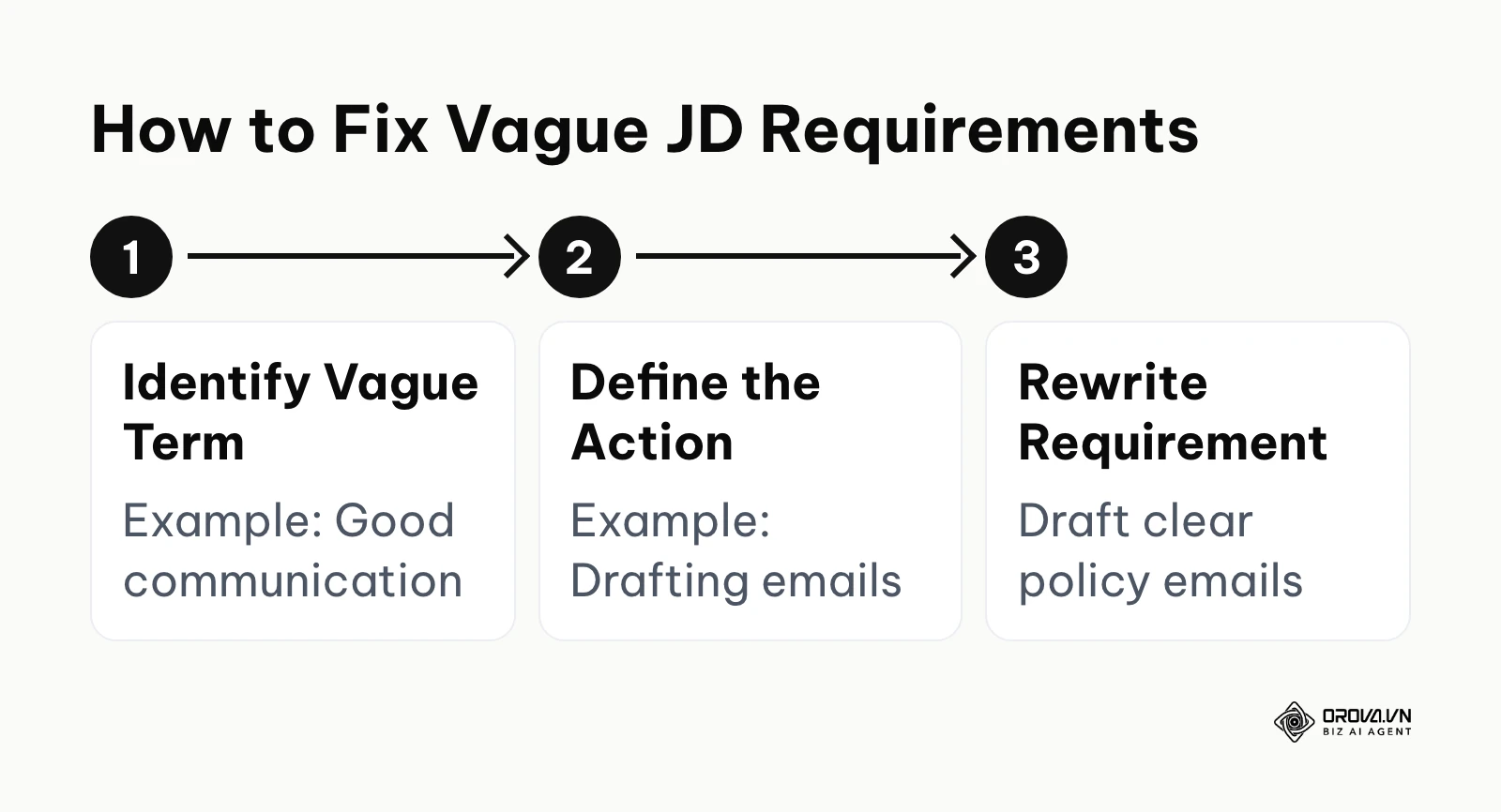
Here are the five most frequent mistakes and how to fix them immediately.
Mistake 1: Confusing the role with an HR Assistant. These titles are not interchangeable. An HR Assistant is usually an entry-level role focused entirely on filing papers and scheduling meetings. An HR Administrator is a step higher, requiring system management skills and independent problem-solving regarding basic policies.
- Consequence: You attract candidates who lack the technical skills to manage your HR software.
- Fix: Ensure the job title and the technical requirements align. If you need system management, call it an Administrator.
Mistake 2: Copy-pasting generic templates without adapting to the tech stack. Publishing an internet template without your specific software requirements is a critical error.
- Consequence: You hire someone who has only used paper files when your entire company runs on cloud databases.
- Fix: Explicitly list the exact software tools (e.g., "Must be proficient in BambooHR and Google Workspace").
Mistake 3: Overloading the requirements with unrealistic expectations. Demanding a Master's degree in HR and five years of strategic experience for a role focused on data entry is absurd.
- Consequence: Qualified administrators feel underqualified and skip it, while strategic professionals apply, get hired, and leave out of boredom.
- Fix: Cut requirements to what the daily tasks truly need.
Mistake 4: Failing to specify the reporting structure. Candidates want to know who their boss will be.
- Consequence: Candidates assume the company is disorganized or highly political.
- Fix: Add a single line in the job brief: "This role reports directly to the [Title]."
Mistake 5: Ignoring the "selling" aspect of the JD. Treating the JD as a list of demands rather than a marketing document is a costly mistake.
- Consequence: Top candidates with multiple offers choose companies that sound more supportive.
- Fix: Dedicate at least twenty percent of the word count to describing the company culture, the benefits, and the specific impact the role will have on the team.
Illustrated example:
- Context: A healthcare clinic network with 250 staff members struggled to find a qualified HR Administrator to handle complex medical staff credentialing.
- Steps taken: The recruitment team realized their failing posting demanded "10 years of general HR experience" instead of focusing on specific credentialing knowledge. They rewrote the requirements to ask for "proven experience handling medical certifications" and reduced the general experience requirement to 3 years.
- Hurdles & fixes: Candidates were still deterred by an unstructured list of 25 responsibility bullets, so the team grouped the duties into three clear categories: Credentialing, General Administration, and Employee Support.
- Visible results: The revised JD attracted specialized candidates from competing clinics, and the new hire successfully cleared a massive backlog of pending staff re-certifications within their first quarter.
The Future of HR Administration: My Predictions for the Next Few Years
AI Will Automate Basic Data Entry, Shifting the Role to Data Auditing In many small teams, I still see HR Administrators spending a large share of their week manually keying data from spreadsheets into HRIS platforms. I believe that within the next two to three years, artificial intelligence will take over much of this rote data entry. AI tools will pull data directly from emails, chat messages, and scanned forms, updating databases with far less manual typing. Because of this, you should prepare your future HR Admins to transition from being "data creators" to "data auditors." They will need stronger analytical skills to verify AI outputs and ensure compliance, rather than just fast typing skills. This prediction could be delayed if strict data privacy laws prevent AI from processing sensitive employee medical or financial data in certain regions.
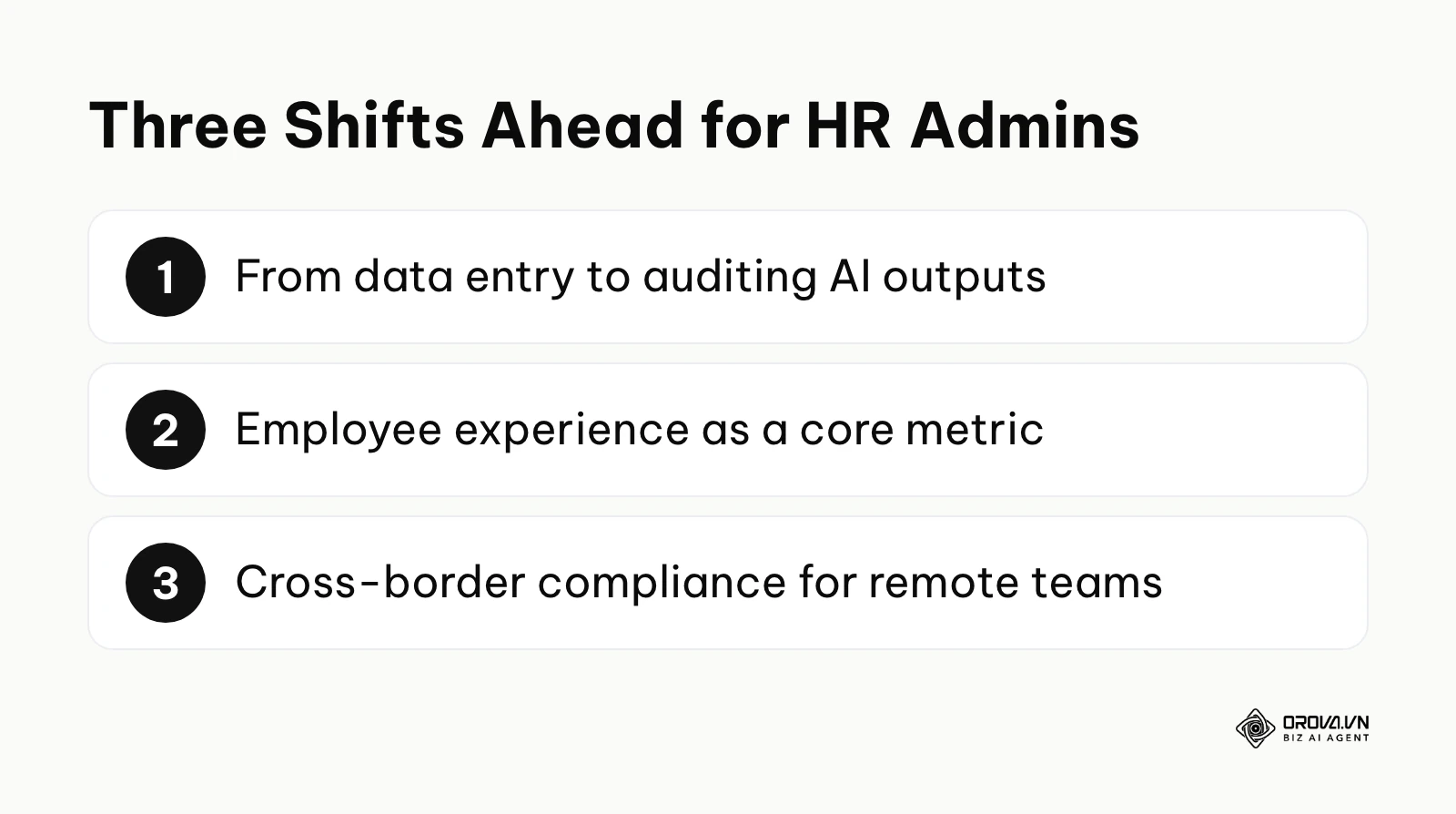
Employee Experience (EX) Will Become a Primary Administrative Metric Right now, administrative success is judged almost entirely by error rates and processing speed. I foresee a shift where the administrative role becomes heavily integrated with Employee Experience (EX). Instead of just processing a leave request accurately, the HR Admin will be evaluated on how seamless and pleasant that process was for the employee. I think the line between HR administration and internal customer service will keep blurring. You should start updating your job descriptions now to include empathy and customer service skills as core competencies, rather than just focusing on spreadsheet mastery.
Global Asynchronous Work Will Demand Cross-Border Compliance Knowledge More companies now hire remote talent across different countries. I expect that many HR Administrator roles will increasingly require a baseline understanding of international labor compliance, rather than just local state laws. Admins will need to navigate multi-currency payroll prep and asynchronous onboarding schedules. If my assumption holds true, you must begin training your administrative staff on global HR platforms and international contract management today. However, this trend might reverse if major corporations enforce strict return-to-office mandates that centralize workforces back to single physical locations.
Frequently Asked Questions About the HR Administrator Job Description Template
What is the actual difference between an HR Administrator and an HR Assistant?
An HR Assistant is an entry-level role focused on physical filing, scheduling interviews, and answering phone calls. An HR Administrator is a mid-level operational role requiring system management skills, the ability to interpret basic labor policies, and the autonomy to manage payroll data preparation. The Administrator handles the systems, while the Assistant handles the logistics.
How much should we offer an HR Administrator in 2026?
As of 2026, compensation varies drastically by location and required software expertise. However, you should expect to pay a premium for candidates who possess strong data analytics and HRIS management skills. Always consult recent local salary surveys for administrative roles and factor in the cost of the specific technical certifications you are demanding in your job description.
Can an HR Administrator transition into an HR Business Partner (HRBP)?
Yes, but it requires intentional development. The administrative role teaches excellent compliance and data management skills. To transition to an HRBP, the individual must develop strategic skills, such as conflict resolution, organizational design, and leadership coaching.
How does AI impact the daily workload of an HR Administrator?
AI drastically reduces the time spent on repetitive tasks like parsing CVs, drafting standard emails, and generating basic reports. This allows the HR Administrator to focus on higher-value tasks, such as resolving complex employee grievances, analyzing turnover trends, and improving the human elements of the onboarding experience.
Where Should You Start?
Reading about job descriptions is easy; executing a hiring campaign is hard. Depending on your current situation, you should not try to do everything at once. The diagram below outlines the immediate next steps you should take.
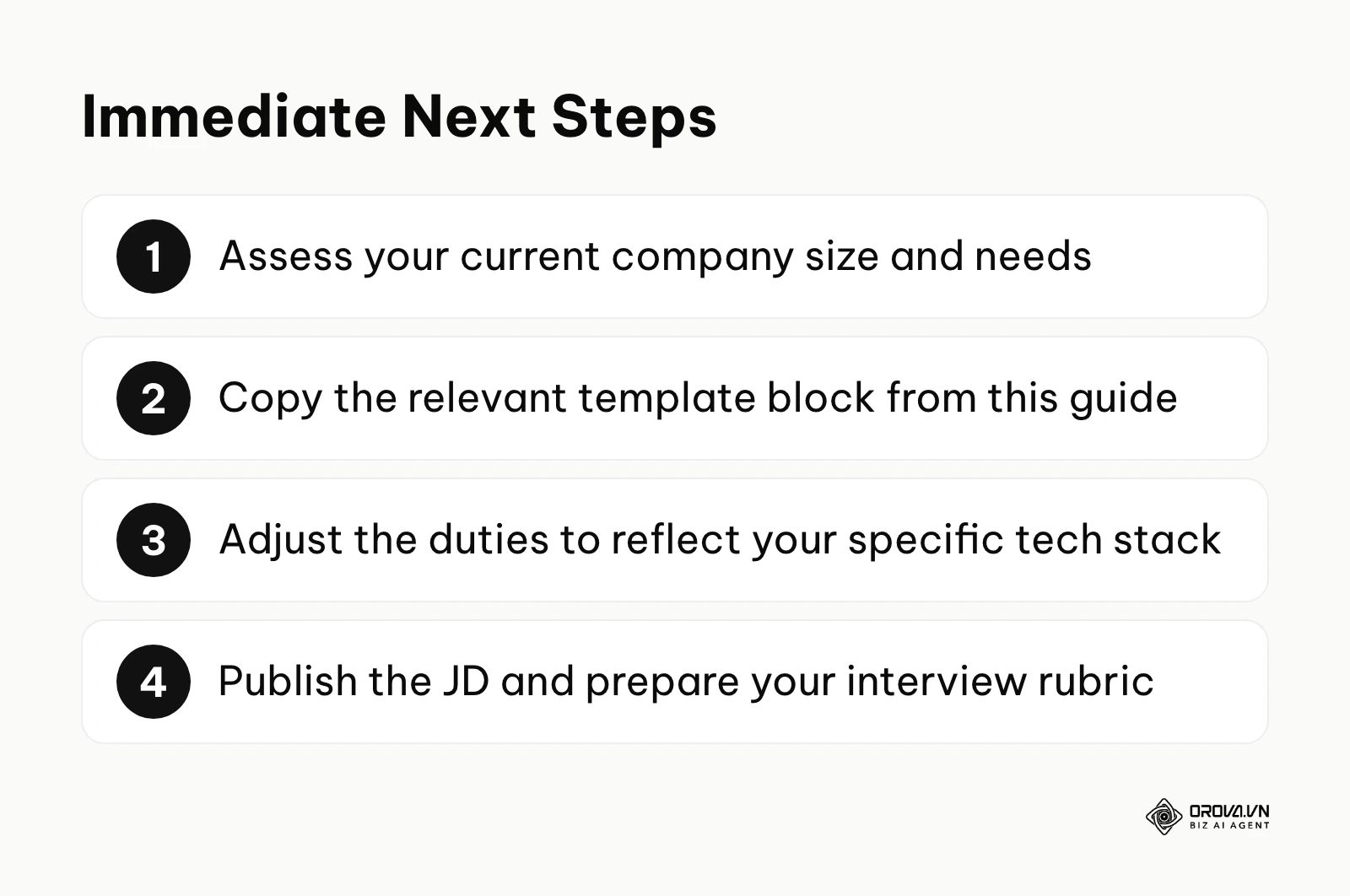
If you are a startup founder with no HR department yet, your first step is to sit down and list the top five administrative tasks that are currently draining your time. Once you have that list, copy the "Startup Template" block (or the full template above) from this guide and replace the generic duties with your specific five tasks to ensure the new hire directly relieves your workload.
If you are an HR Manager replacing a departing HR Admin, your first step is to conduct a short exit interview with the departing employee specifically about their daily tasks. Ask them what tools they actually use versus what is on the old job description. Use their honest feedback to update the "SME Template" before posting the job online.
If you are the Operations Director of a company scaling from 50 to 150 employees, your first step is to audit your software stack. You are entering the phase where manual spreadsheets will break. Define exactly which HRIS and payroll software you plan to implement this year, and ensure the "SME Template" you draft asks for experience with that specific software tier.
By tailoring the hr administrator job description template to your exact operational reality, you guarantee that you will attract a professional capable of managing your company's growth smoothly.
About the author

Builder of Orova
Nguyễn Đỗ Trọng Ân has 8 years of experience in marketing, including 6 years managing market development across Asia. He builds Orova, a Biz AI Agent that never sleeps: it plans, runs and optimizes work for businesses.
Run your business with AI Agents
Orova is the always-on Biz AI Agent — it plans, runs, and optimizes the work for you.
Save time, unlock productivity.