
Keyword gap analysis: how to outrank rivals in 7 steps (2026)

Executing a structured keyword gap analysis allows you to uncover the exact search queries your direct competitors rank for that your site completely misses. By following this guide, you will produce a validated 7-column spreadsheet matrix scoring opportunities by business value, an audit checklist that stops self-competing content, and a 90-day publishing calendar. You will need access to Google Search Console, a standard spreadsheet application such as Google Sheets, a list of 3 to 5 organic search competitors, and roughly three to four hours of focused analysis time. If your website launched less than thirty days ago with zero indexed pages, or if you run a hyper-local service business relying exclusively on Google Business Profile rather than organic search content, you do not need to perform this process today.
What is a keyword gap analysis and how the workflow functions
A keyword gap analysis identifies search queries where competing websites secure organic impressions and clicks while your domain either ranks poorly or remains completely unindexed. Completing this seven-step process takes approximately three to four hours and produces an actionable publishing roadmap that captures qualified search traffic.
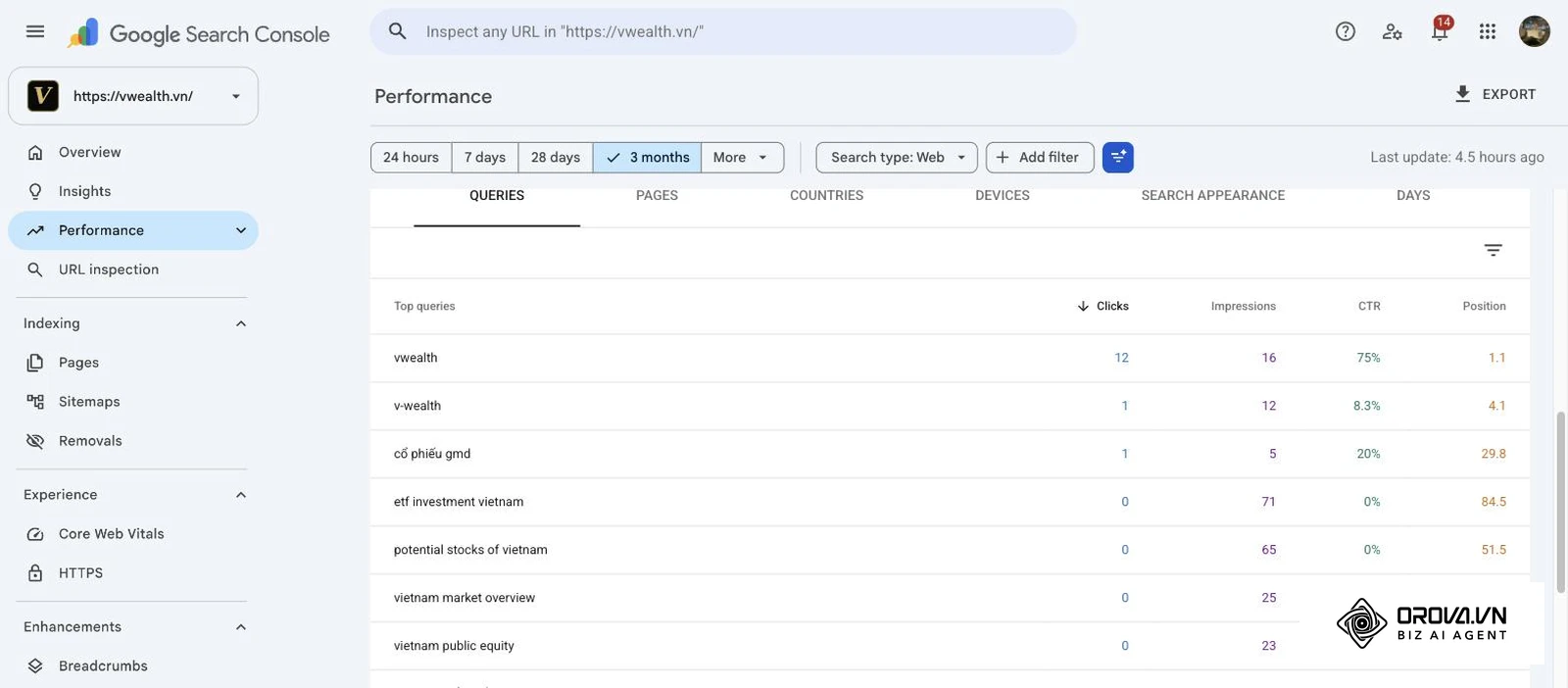
In organic search marketing, a gap appears in three distinct forms: missing keywords where your site has no relevant URL, weak keywords where you linger on page two, and format gaps where competitors win rich search snippets through better page structure. Rather than guessing what topics your audience values, this analysis extracts proven market demand directly from search engine result pages.
Prerequisites before starting your keyword gap analysis
Before running exports or analyzing competitor domains, gather your credentials and data assets. Missing access or incomplete data will distort your findings and lead to wasted writing effort.
| Item needed | Where to get it | Estimated time | What happens if missing |
|---|---|---|---|
| Google Search Console access | Webmaster administrator or IT team | 5 minutes | Cannot analyze internal striking distance queries or existing impressions |
| List of 3 to 5 organic competitors | Organic SERP research on core service queries | 20 minutes | Analysis reflects commercial rivals rather than true search ranking competitors |
| Google Sheets or spreadsheet tool | Google Drive or local desktop suite | 2 minutes | Cannot calculate priority scores or filter multi-domain datasets |
| Clean URL list of your current site | XML sitemap or CMS content export | 10 minutes | Risk creating duplicate pages that cause internal search cannibalization |
Step 1: Identify organic competitors for your keyword gap analysis
To start, you must distinguish between your direct commercial competitors and your organic search competitors. The diagram below illustrates how to evaluate potential domains for your keyword gap analysis.
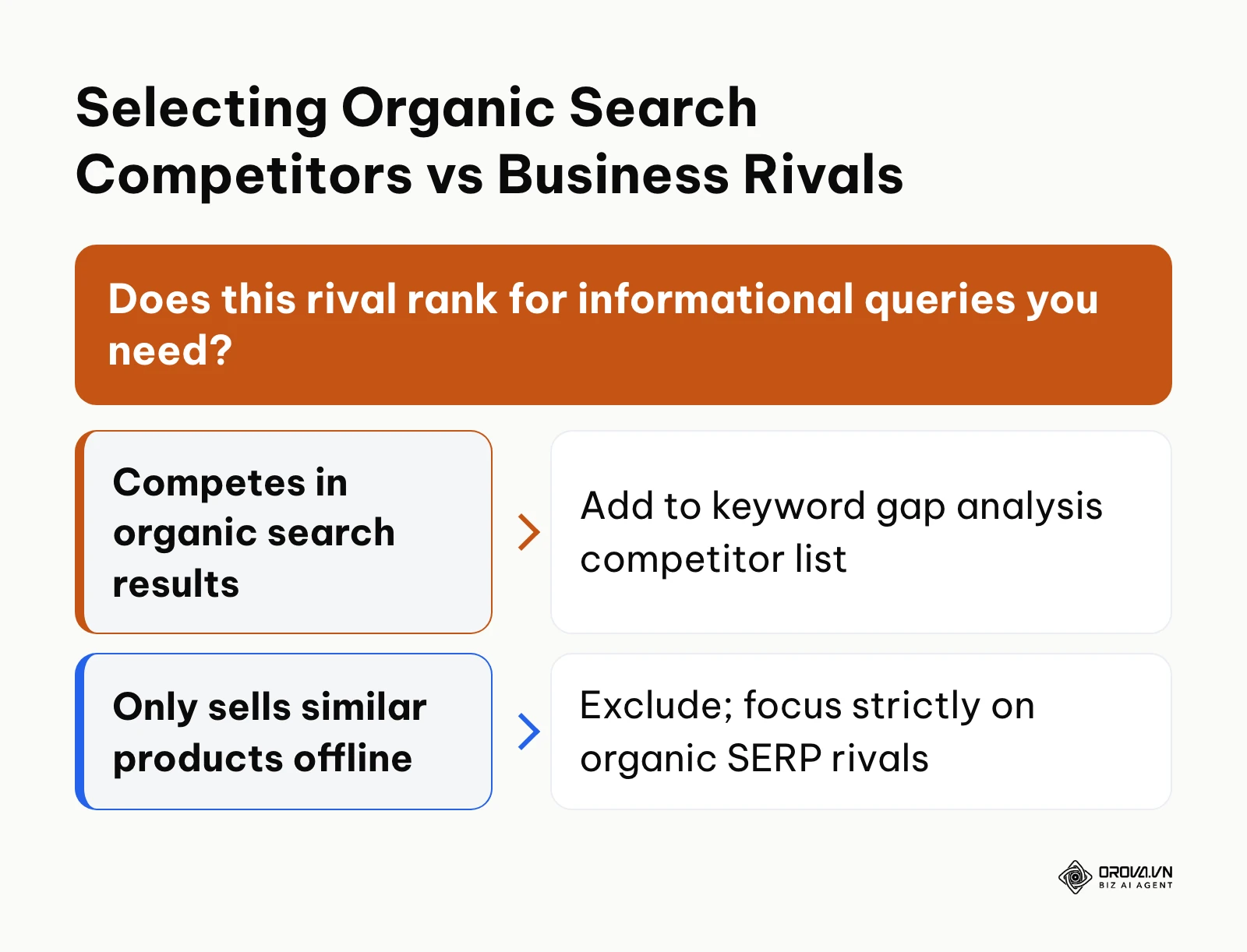
Distinguishing direct business rivals from search landscape competitors
Your real-world business competitors sell identical products to the same target audience. Your organic search competitors are any domains currently occupying the top ten ranking positions for your target informational, commercial, and transactional search terms. For example, a specialized project management platform competes commercially with niche SaaS tools, but its organic competitors often include educational hubs, independent software review directories, and industry resource libraries.
Open a private browser window. Search for five of your core product or category terms, such as "cloud inventory tracking" or "warehouse automation workflows". Record the domains occupying positions one through five for each search query. Select the three to five domains that appear repeatedly across multiple commercial and educational queries. These websites represent your true organic benchmarks for this exercise. If you want to audit how their entire site is constructed, review our guide on competitor site analysis before proceeding.
Verification and troubleshooting
To verify your list, ensure each chosen competitor maintains comparable topical relevance. If a massive generalist platform like Wikipedia or an international news publication holds position one, do not add it to your primary spreadsheet. Generalist publishers possess domain-level authority signals that skew keyword difficulty ratings and obscure achievable content gaps for specialized websites.
If you mistakenly pick direct business competitors that do not invest in content marketing, your comparison will yield zero meaningful query data. Always verify that your selected domains regularly publish blog posts, guides, or feature comparison pages before proceeding to data extraction.
Step 2: Uncover internal keyword gaps in Google Search Console
Before spending budget on new competitor research, look inside your own search performance data to extract hidden wins. The process diagram below outlines the Google Search Console workflow for capturing striking distance opportunities.
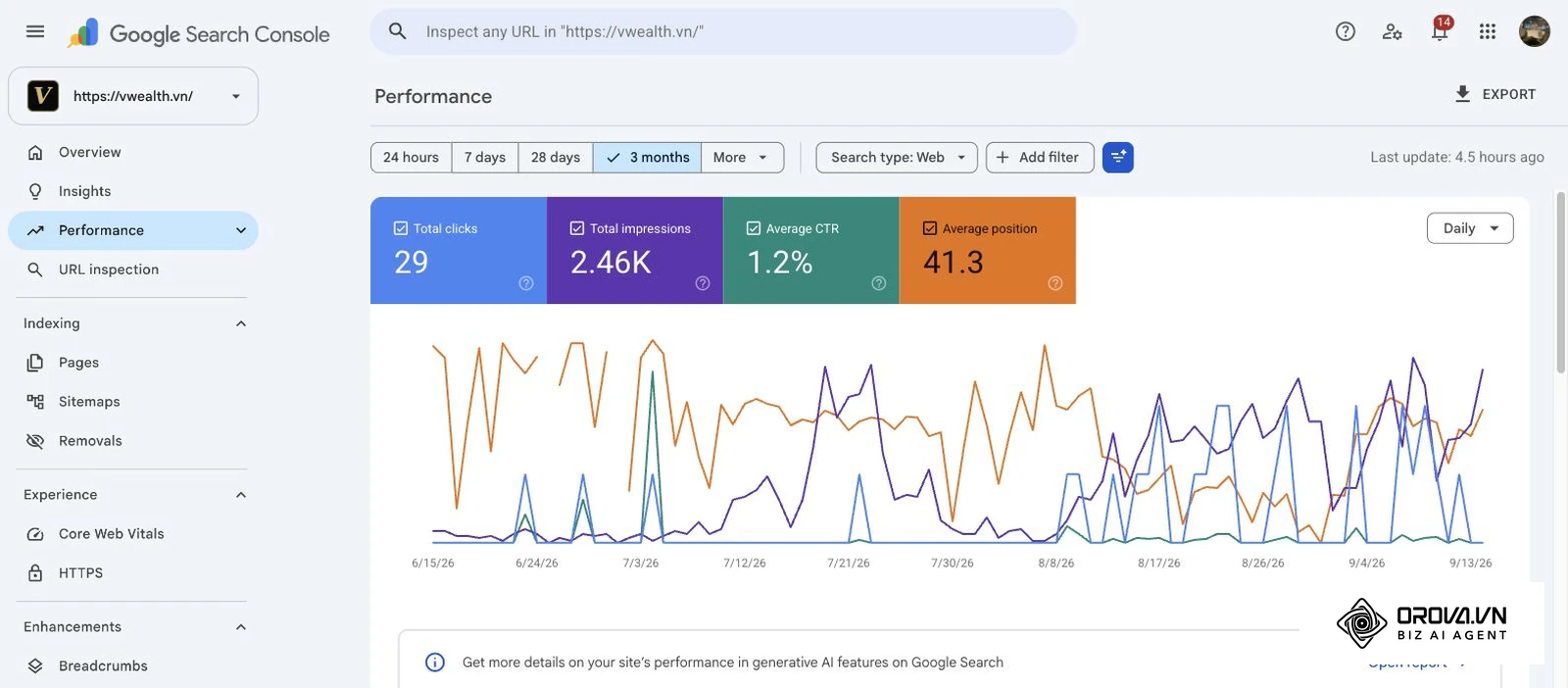

Filtering striking distance queries
Google Search Console records queries where your site already earns impressions, even if you never intentionally targeted them. Many of these terms sit in striking distance, which means positions 8 through 20. These represent immediate keyword gaps because Google already views your domain as semantically relevant, but your existing content lacks the depth required to reach the top three positions.
Open Google Search Console. Navigate to the Performance report and select Search results. Set the date range to the last three months to capture recent search patterns. Enable all four metric checkboxes: Total clicks, Total impressions, Average CTR, and Average position. Click on the Filter bar above the chart, select Position, choose Greater than, and enter 7.9. Add a second filter for Position, choose Smaller than, and enter 20.1. Finally, add an Impressions filter and set it to Greater than 1,000.
Sort the resulting table by Impressions in descending order. Export this dataset directly into a CSV or Google Sheets file. These queries represent low-hanging search demand where you do not need to create brand-new URLs; instead, you need to update existing pages or create dedicated child landing pages.
Example scenario (hypothetical illustration):
A mid-market B2B software site with 45 published articles had an in-house content editor review its search analytics. The editor exported 1,000 queries from Google Search Console, filtered for average positions between 11 and 20 with impressions above 800, and mapped queries to existing URLs. They discovered that an important commercial query cluster, "automated invoice matching software," was sending impressions to an outdated 2021 blog post rather than the dedicated product page. To solve this, the editor added a comprehensive comparison section to the product page, updated internal anchor text across three related articles, and requested re-indexing. Within three weeks, the product page replaced the outdated blog post in search results, average position jumped from 14.2 to 3.8, and monthly organic impressions for that query cluster expanded by 1,200 views.
Visual verification and error prevention
Review the exported spreadsheet to confirm that every row displays a positive impression count alongside an average position between 8 and 20. If your export shows zero rows, check your filter settings. Entering contradictory position filters or setting an excessively high impression threshold for a low-traffic domain will wipe out the dataset. If your site receives modest traffic, lower the impression threshold from 1,000 to 250 to reveal viable striking distance terms.
Step 3: Extract competitor keyword gap data across domains
Now that you have isolated internal performance gaps, extract the external search queries that your selected competitors rank for but your site does not.
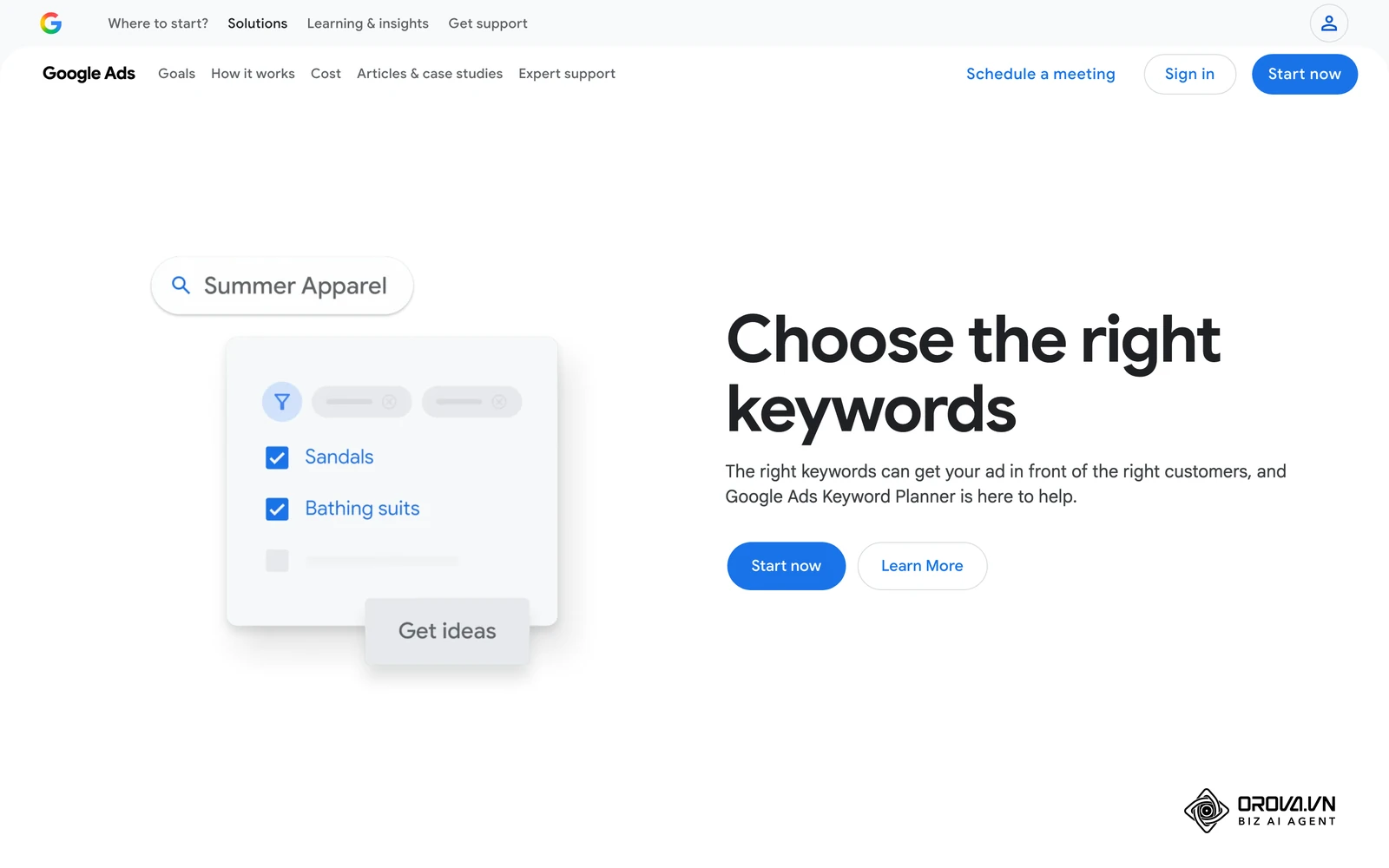
Manual extraction using search operators and free research tools
If you do not utilize premium multi-domain research tools, you can extract competitor keywords using targeted search operators and free search planners. Open Google and use the site: operator combined with specific category terms. For instance, searching site:competitor.com "inventory management" reveals the exact page titles, subheadings, and URL paths your rival uses to rank for that topic.
Cross-reference these topics using Google Keyword Planner or public autocomplete data. Enter the competitor URL into Google Keyword Planner under the "Start with a website" option to view the search terms Google associates with that specific page. Record the discovered search queries, their estimated monthly search volume, and their ranking competitor URL into your master research spreadsheet.
Segmenting keywords into missing and weak buckets
Create two dedicated columns in your spreadsheet: Status and Competitor Position. Categorize every extracted query into one of three distinct buckets:
- Missing: Your site holds no ranking position inside the top 100, while one or more competitors hold positions 1 through 10.
- Weak: Your site ranks between positions 11 and 50, while competitors occupy the top 5.
- Shared: Both your domain and competitor domains rank inside the top 10.
Flag all Shared terms and hide them from your active gap list. Your operational focus must remain entirely on Missing and Weak terms.
Verify that your export contains clean data without branded competitor terms. A frequent mistake is collecting hundreds of queries containing your competitor trade name, such as "competitor login" or "competitor customer support phone". Filter your spreadsheet using text filters to exclude competitor brand names entirely, as ranking for navigational branded terms belonging to other companies yields zero commercial conversion value.
Step 4: Run a keyword cannibalization check on your gap targets
Before writing a single paragraph of content for a discovered keyword gap, you must verify that your domain does not already feature a competing page. The summary checklist below outlines the verification rules required before planning new content.
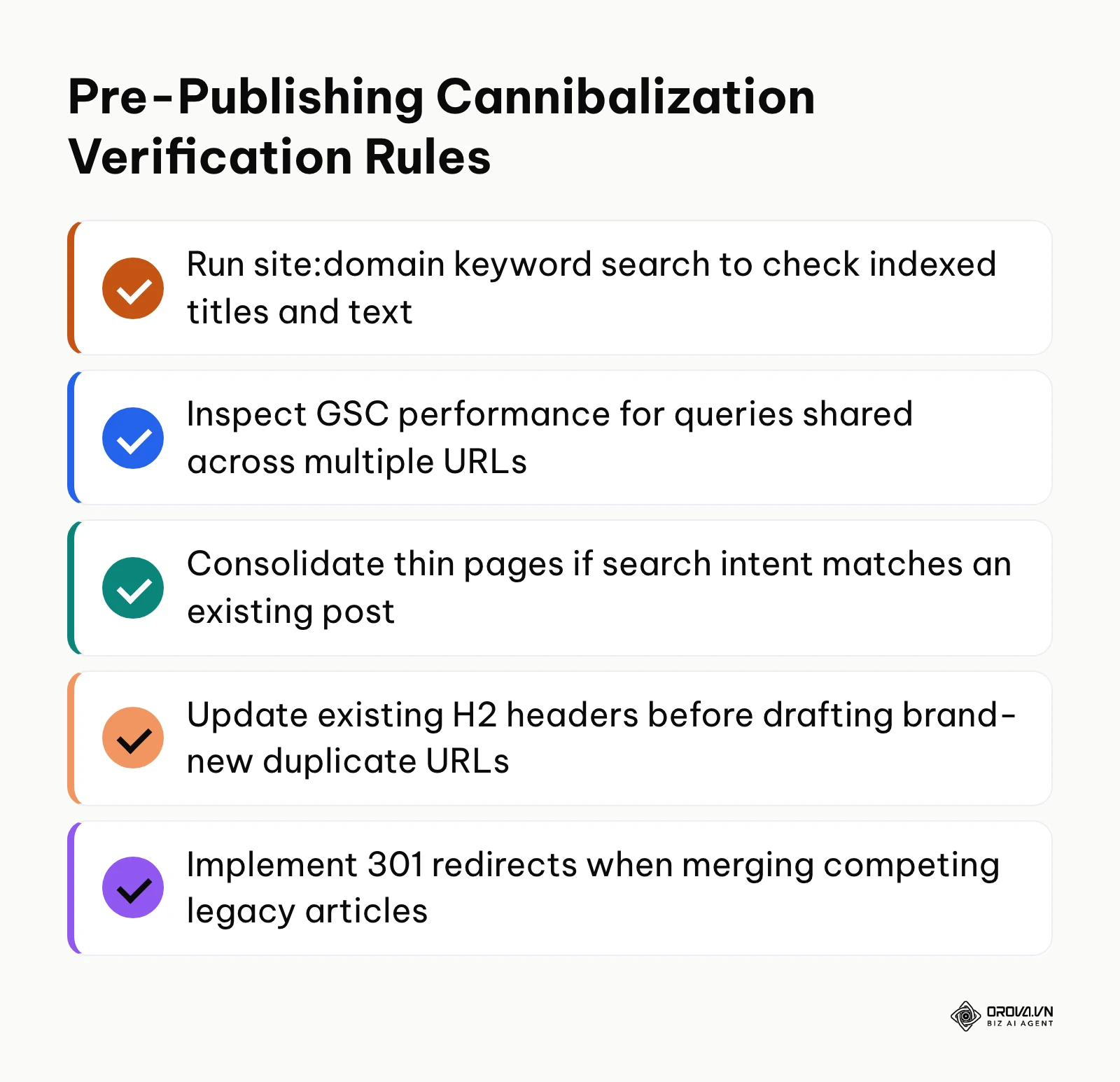
Performing pre-publishing cannibalization audits
Publishing a new article that targets an intent your website already covers divides your organic signals, confusing search engine crawlers and depressing rankings across both pages. You must verify whether your site already contains a partial match for each candidate keyword. Understanding keyword cannibalization ensures that your content expansion efforts build domain authority rather than diluting it.
Execute a precise search query in Google: site:yourdomain.com "target keyword". Examine the top three URLs returned. If your site already has an indexed page with that exact phrase in the title tag, URL slug, or main H1 heading, you must not publish a separate post. Instead, plan to update and expand that existing URL.
Example scenario (hypothetical illustration):
An HR technology blog with 180 published articles planned a new guide targeting "remote team onboarding checklist." Before briefing a freelance writer, the content strategist ran a site-specific search and inspected query performance in Google Search Console. They discovered that an existing 2022 guide titled "Virtual Employee Orientation Best Practices" was already receiving 450 monthly impressions for "remote team onboarding checklist" at an average position of 18.4. Instead of commissioning a duplicate 2,000-word article, the strategist refreshed the 2022 guide, updated the main subheadings to reflect modern onboarding checklists, added an interactive table, and redirected an obsolete short checklist page into the primary URL. Within 25 days, the consolidated page advanced to position 4.2 in Google search results without creating internal competition.
Cannibalization decision framework
Follow this decision table whenever you evaluate an existing page against a discovered competitor keyword gap:
| Audit finding | Search intent match | Technical status | Recommended action |
|---|---|---|---|
| Existing page ranks in positions 11 to 25 | Matches search intent perfectly | Page is thin or outdated | Refresh and expand the existing URL; do not create a new page |
| Two separate legacy pages rank for the same query | Both pages target identical search intent | Split impressions and low CTR | Merge high-performing sections into one URL; 301 redirect the weaker page |
| Existing page touches topic briefly | Target query requires a dedicated deep-dive | Core page covers broader parent topic | Create a dedicated child guide; add internal link from parent page |
| Zero indexed pages appear for the query | No existing coverage found | Complete keyword gap | Draft and publish a brand-new, comprehensive article |
According to Google Search Central's Search Engine Optimization Starter Guide (2024), search engines prioritize content that organizes information logically and satisfies specific user queries rather than pages built around repetitive keyword variations.
Verify your audit by documenting the target URL alongside each candidate query in your spreadsheet. If the column displays an existing URL, label the action item as "Content Refresh". If the column is blank, label the action item as "New Article Draft".
Discover Orova.vn – a Biz AI Agent platform with OROVA SEO, a complete solution for every website. The system supports search engine optimization from A to Z with features including keyword research, writing new SEO-ready articles, optimizing existing content, rank tracking, plus competitor analysis and in-depth technical analysis. Sign up today to experience OROVA SEO completely free (offer valid through July 7, 2027).
Step 5: Prioritize keyword gap opportunities with a business value matrix
Once you have gathered hundreds of missing and weak queries, you must prioritize them systematically. Chasing high search volume without assessing commercial value wastes editorial resources on vanity traffic.
The 7-column keyword gap prioritization matrix
Build a 7-column spreadsheet to score every search query objectively. The mathematical formula below details how each factor contributes to the final priority score.
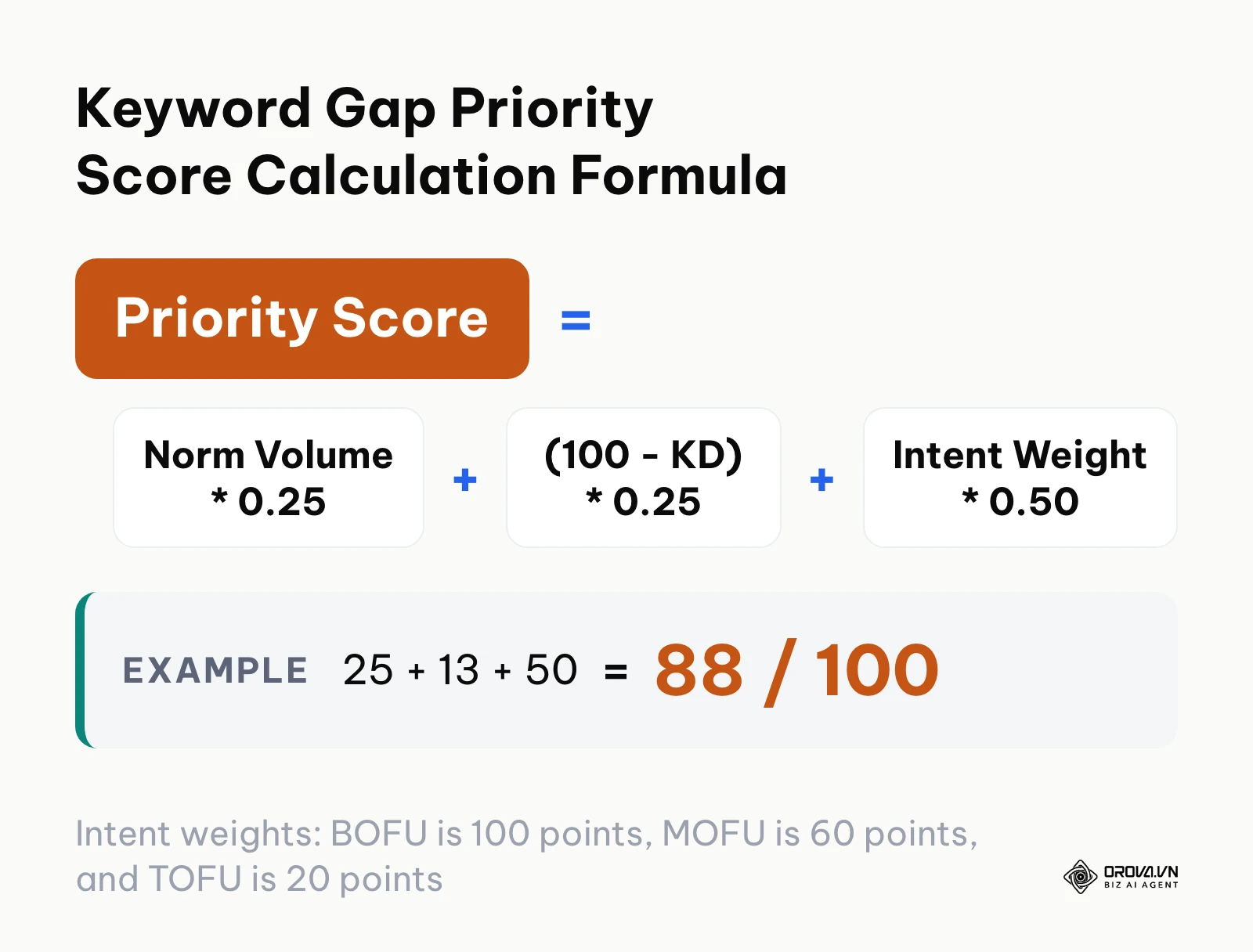
The priority score balances search demand, competitive difficulty, and business intent. The formula scales from 1 to 100:
$$\text{Priority Score} = (\text{Normalized Volume} \times 0.25) + ((100 - \text{KD}) \times 0.25) + (\text{Intent Weight} \times 0.50)$$
Where Normalized Volume scales monthly searches from 1 to 100 (where 1,000+ monthly searches equals 100), KD represents the estimated keyword difficulty score, and Intent Weight assigns points based on conversion likelihood:
- Bottom of Funnel (BOFU): High commercial intent (buy, pricing, software, provider) = 100 points
- Middle of Funnel (MOFU): Evaluation intent (best, comparison, alternative, template) = 60 points
- Top of Funnel (TOFU): Informational intent (what is, how to, definition) = 20 points
Evaluating your realistic ability to rank requires understanding what constitutes a viable keyword difficulty score for your specific domain authority level.
Here is an operational layout of the prioritization matrix (hypothetical example rows; scores calculated with the formula above):
| Keyword | Funnel stage | Monthly volume | KD (1-100) | Competitor ranking URL | Recommended action | Priority score (1-100) |
|---|---|---|---|---|---|---|
| warehouse inventory software | BOFU | 1,400 | 48 | competitor.com/product/inventory | Create New | 88.0 |
| best barcode scanners for warehouse | MOFU | 850 | 32 | rival.com/blog/barcode-scanners | Create New | 68.3 |
| how to organize warehouse shelves | TOFU | 2,200 | 25 | logisticshub.com/shelf-storage | Create New | 53.7 |
| inventory control spreadsheet template | MOFU | 1,100 | 18 | inventorypro.com/excel-sheet | Update Existing | 75.5 |
| what is inventory turnover | TOFU | 4,500 | 55 | investopedia.com/terms/i/inventory | Deprioritize | 46.3 |
Weak keywords vs. missing keywords: realistic ROI comparison
Content teams often default to writing new articles for completely missing keywords while ignoring weak keywords already ranking on page two. The comparison table below highlights why optimizing weak terms delivers faster business results at lower production cost (hours and click figures are illustrative estimates, not benchmark data):
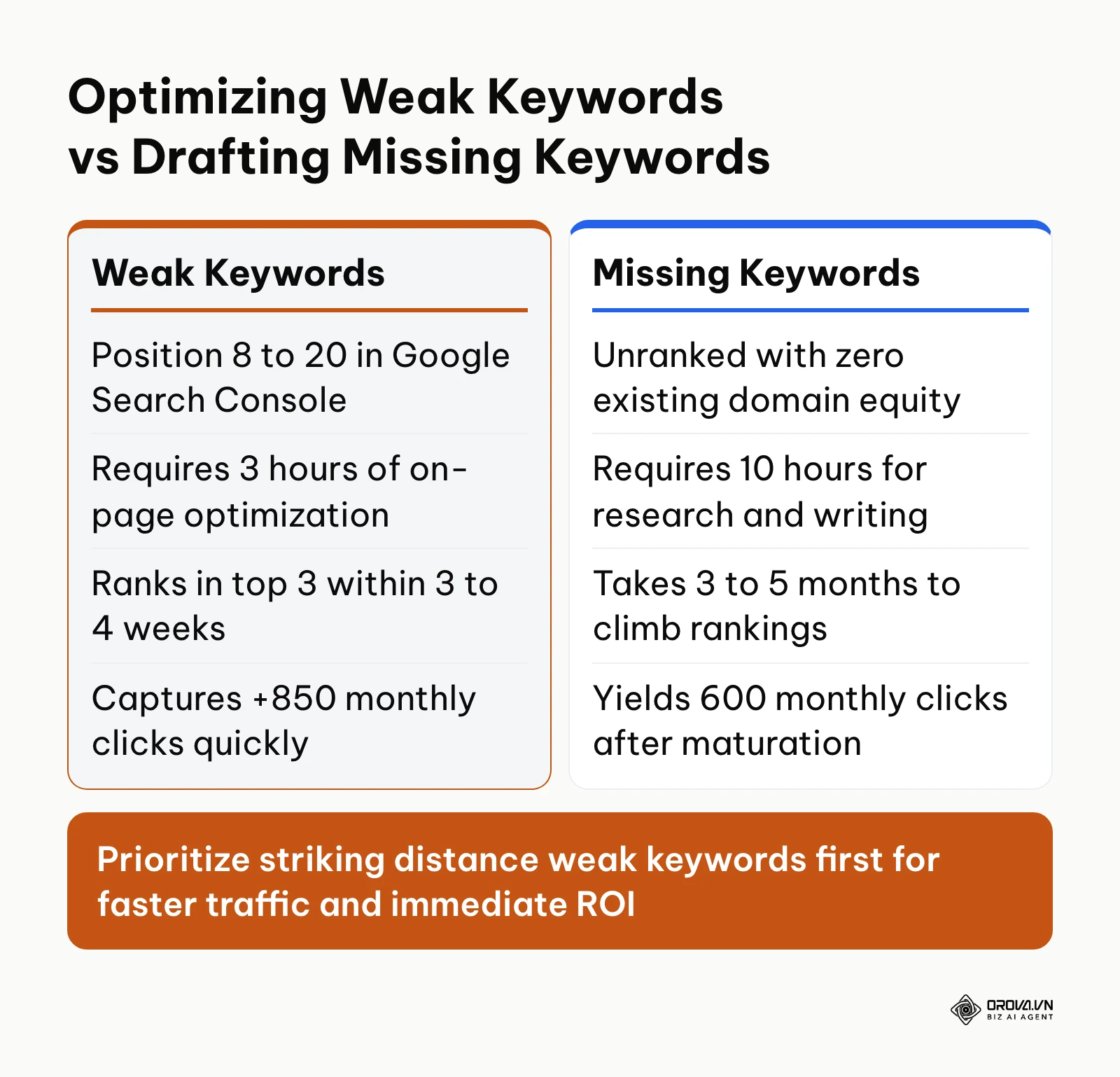
| Strategic attribute | Optimizing weak keywords (positions 8 to 20) | Drafting new content for missing keywords |
|---|---|---|
| Average editorial production time | 3 hours of focused updating and restructuring | 10 hours of research, drafting, and design |
| Time required to see ranking changes | 3 to 4 weeks following re-indexing | 3 to 5 months to establish crawling and authority |
| Baseline domain trust required | Existing URL already carries crawling trust | Must build new internal links and relevance |
| Typical monthly traffic yield | +850 organic clicks gained in first 30 days | 600 monthly clicks achieved after maturation |
| Immediate return on investment | High; capitalizes on existing search impressions | Moderate; requires patience and continuous links |
Always allocate at least 40 percent of your monthly editorial capacity to updating weak keywords before deploying resources into new missing topics.
Step 6: Analyze SERP feature and AI Overview keyword gaps
In organic search, holding a traditional blue link is no longer sufficient. Search engines increasingly display Featured Snippets, structured comparison modules, and AI Overviews at the top of the page. The decision matrix below categorizes SERP feature opportunities based on execution effort and organic visibility impact.
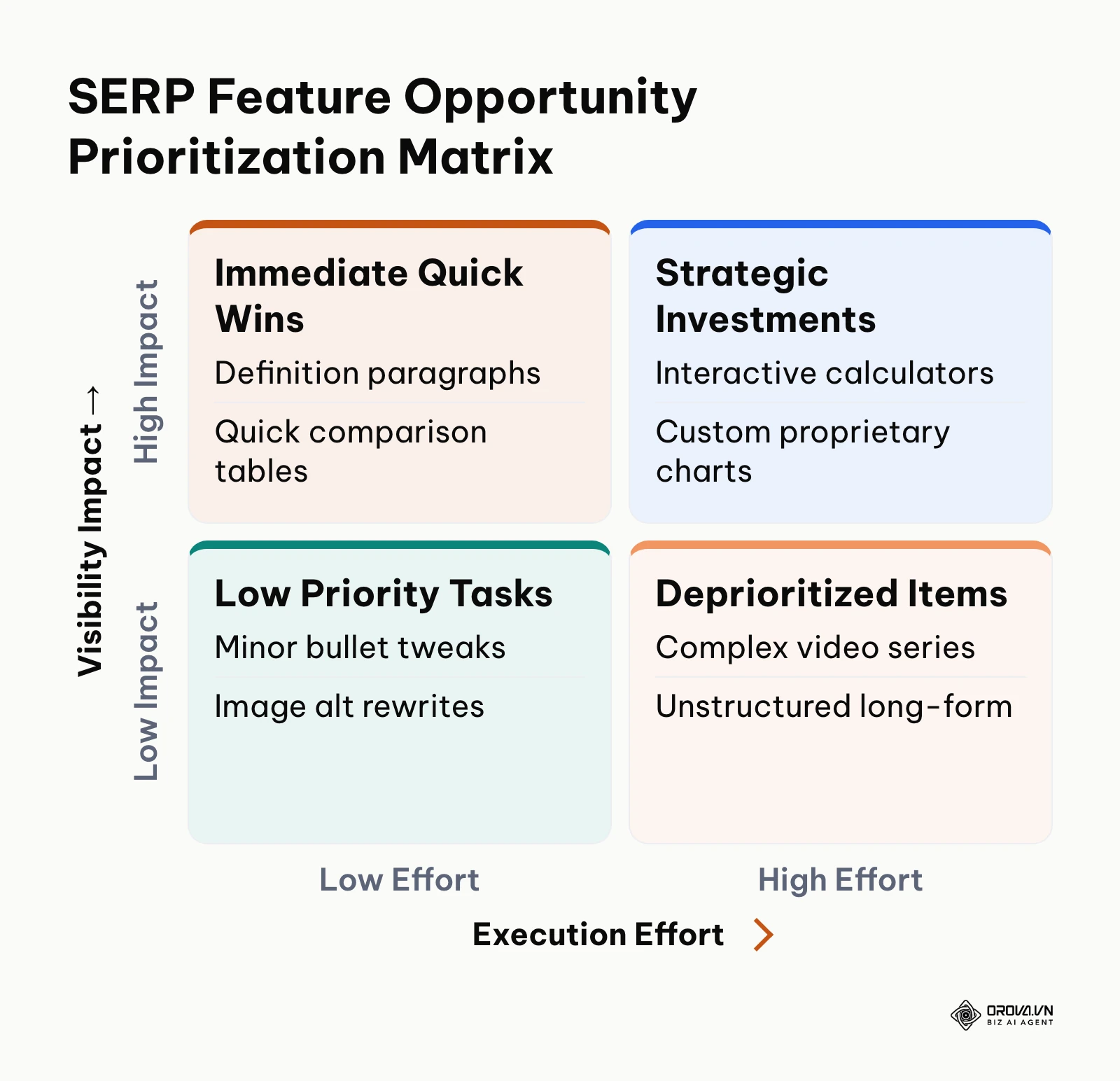
Evaluating SERP layout and competitor formatting
Search for your top-priority gap keywords in Google. Document the specific layout elements occupying the top of the search engine results page. Are competitors securing a position zero Featured Snippet? Does an AI Overview generate a summarized direct response?
Examine the structural formatting of the page currently winning the snippet. If the competitor holds position one with an ordered list, Google has determined that searchers prefer step-by-step instructions. If they win with a comparison table, searchers demand structured data comparisons. Identifying this format gap ensures you do not produce generic narrative paragraphs when the search engine requires tabular specifications.
Example scenario (hypothetical illustration):
A niche cyber insurance advisory site with 30 topical guides analyzed search results for "cyber liability insurance coverage checklist." Competitors were capturing both an AI Overview reference and a position zero Featured Snippet. The advisory site held position 9 with an in-depth 2,500-word narrative article. The SEO specialist examined the winning competitor page and noted it featured an explicit 5-point comparison table and a concise 45-word introductory definition. The specialist re-formatted the advisory guide by placing a summary definition block directly beneath the H2 and inserting a semantic comparison table comparing policy inclusions. Sixteen days after submitting the updated URL via Google Search Console, the page secured the Featured Snippet spot and earned a direct citation link inside the AI Overview answer.
Structuring content to capture extracted features
To outrank competitor formatting, match the format Google already shows for each gap keyword:
| SERP feature you see | Format to publish | How to apply it |
|---|---|---|
| Paragraph snippet or AI Overview answer | Concise direct answer | Place a 40 to 60 word definition immediately beneath your primary H2 heading |
| Table snippet or comparison module | Semantic HTML or markdown table | Organize pricing, criteria, and multi-factor comparisons in a table rather than bulleted lists |
| List snippet for a how-to query | Ordered step headings | Structure sequential instructions as H3 headings labeled "Step 1", "Step 2", and "Step 3" |
As documented in Google Search Central's Creating helpful, reliable, people-first content (2023), search evaluation systems look for substantial, comprehensive coverage that provides original information and clear value beyond what competitor pages already offer. Furthermore, in line with standards outlined by the World Wide Web Consortium (W3C) in Web Content Accessibility Guidelines (WCAG) 2.2 (2023), structuring data into semantic tables and descriptive subheadings ensures search engine parsers and assistive readers extract table data accurately.
Step 7: Build an editorial workflow to close your keyword gap
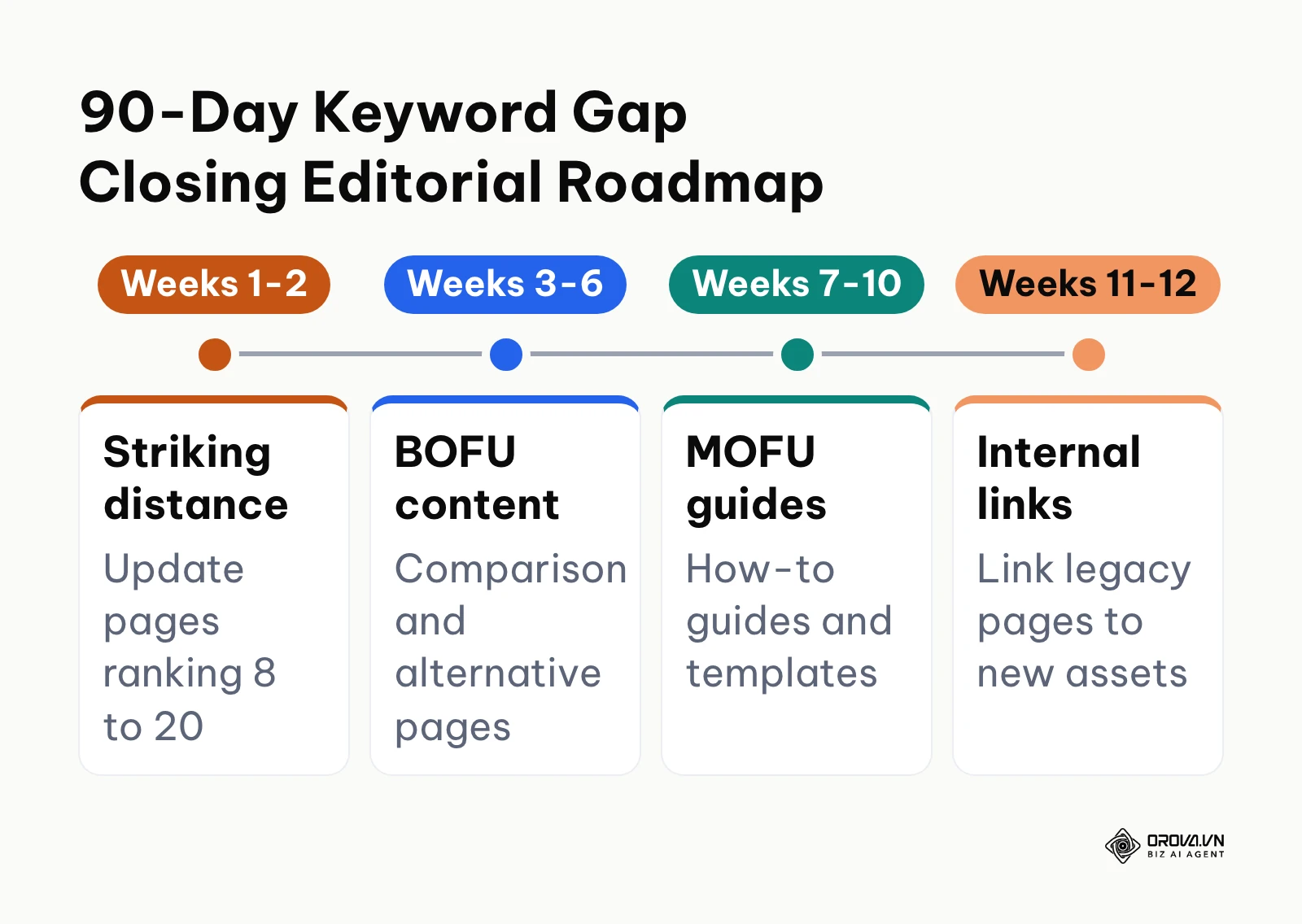
Data collection without an execution framework produces dead spreadsheets. You must convert your prioritized matrix into an editorial production schedule spanning a 90-day execution cycle. The timeline below illustrates a phased implementation roadmap designed to generate fast traffic gains.
Phased implementation schedule
Divide your prioritized gap keywords into four distinct execution phases:
- Phase 1 (Weeks 1 to 2): Striking distance optimizations. Update and expand existing URLs ranking between positions 8 and 20. Add missing semantic subheadings, embed structured comparison tables, and refresh outdated figures.
- Phase 2 (Weeks 3 to 6): High-priority BOFU content. Draft and publish core bottom-of-funnel comparison guides, pricing analyses, and alternative pages where your site has zero presence.
- Phase 3 (Weeks 7 to 10): Educational MOFU guides. Publish comprehensive how-to tutorials and practical template pages that solve defined customer workflows.
- Phase 4 (Weeks 11 to 12): Internal linking reinforcement. Audit all newly published and refreshed URLs. Insert contextual internal links from your high-authority legacy pages into your new content assets to pass PageRank and accelerate crawling.
Editorial production brief requirements
Every keyword assigned to a writer or editor must include a standardized brief containing:
- Primary keyword and search intent classification (TOFU, MOFU, or BOFU).
- Exact target URL (designating whether it is a content refresh or a new URL slug).
- SERP feature target (paragraph snippet, structured table, or sequential list).
- List of 3 top-ranking competitor URLs to analyze for information depth.
- Required internal links to insert pointing toward relevant core product pages.
Verify completion of this step by ensuring every keyword with a Priority Score above 70 has an assigned writer, an agreed delivery date, and a designated URL path in your master tracking sheet.
Complete checklist for conducting a keyword gap analysis
Print or duplicate this comprehensive workflow checklist to track your team's execution from initial setup to final publishing.
| Step | Key operational task | Verification sign of completion | Estimated time |
|---|---|---|---|
| Step 1 | Select 3 to 5 true organic competitors | Competitor list verified by SERP presence across 5 core queries | 25 minutes |
| Step 2 | Extract internal striking distance queries | CSV export from GSC with impressions > 1,000 and positions 8 to 20 | 20 minutes |
| Step 3 | Harvest competitor ranking data | Master spreadsheet populated with missing and weak search queries | 60 minutes |
| Step 4 | Execute cannibalization audit | Every row labeled as "Content Refresh" or "New Article Draft" | 45 minutes |
| Step 5 | Score terms with prioritization matrix | Priority scores calculated using the volume, KD, and intent formula | 30 minutes |
| Step 6 | Audit SERP features and AI Overviews | Required structural format (table, list, snippet) noted in brief | 30 minutes |
| Step 7 | Build 90-day publishing calendar | Every high-scoring term assigned an editor, URL slug, and deadline | 30 minutes |
With OROVA.VN and the OROVA SEO module, you put an end to the exhausting days of manual work for good. Instead of struggling for hours to write articles and compile reports, the entire process is now optimized and completed in just 5 minutes.
Common keyword gap analysis mistakes and how to fix them
Even experienced search marketers make recurring tactical errors when auditing competitor content. Review this troubleshooting reference to identify and correct mistakes early in your workflow.
| Common error | Underlying root cause | Corrective action |
|---|---|---|
| Chasing high search volume terms with extreme difficulty | Overemphasizing raw impressions rather than achievable ranking potential | Filter out queries with KD scores above your domain authority threshold; prioritize MOFU and BOFU terms |
| Writing new posts for existing URLs | Failing to run site: search operator checks before briefing writers | Consolidate the topic into your existing page and expand subheadings rather than publishing duplicate pages |
| Targeting competitor branded navigation queries | Exporting raw competitor datasets without applying negative keyword filters | Apply text filters to exclude competitor brand names, software logins, and support phone numbers |
| Ignoring modern SERP layout formats | Drafting narrative text blocks when the search engine displays tables or lists | Inspect the live SERP; format direct answers into structured comparison tables or ordered lists |
| Selecting purely commercial competitors with no SEO footprint | Assuming business rivals match organic search competitors | Choose competitor domains based on actual search ranking overlap rather than corporate industry lists |
| Abandoning updated pages after publishing | Expecting immediate ranking shifts without monitoring indexation | Track GSC performance weekly; submit URLs for manual re-indexing if impressions stay flat after 30 days |
If you prefer not to run every stage by hand, Orova SEO covers part of this workflow: it tracks competitor sites, connects to Google Search Console and GA4, suggests new keywords from Search Console, Google Keyword Planner, Google suggestions and AI with monthly searches and intent, and lets you optimize existing articles in bulk while keeping their URLs.
How to measure ROI after completing a keyword gap analysis
Tracking the commercial return of your gap analysis requires monitoring leading and lagging search indicators. The bar chart below illustrates an example monthly traffic recovery trajectory when optimizing striking distance queries.
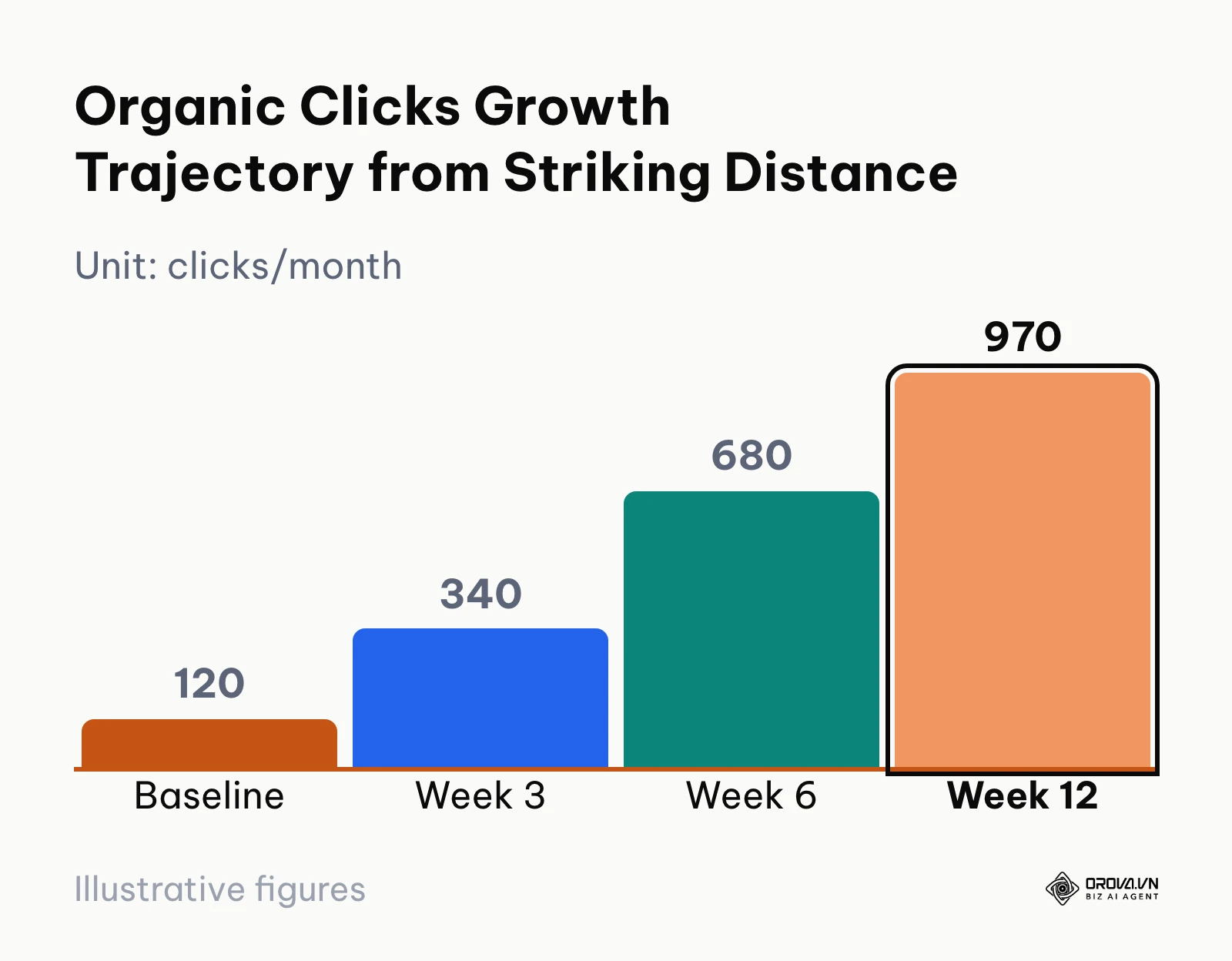
Review performance metrics across three distinct intervals:
- Week 3 to 4 (Leading indicators): Inspect Google Search Console performance for updated striking distance pages. Look for upward trajectory in average position (advancing from positions 12-15 into positions 4-7) and growth in search impressions.
- Week 8 to 12 (Traffic indicators): Measure organic click gains across newly published and refreshed URLs. Verify that primary keywords have secured top-five rankings and that rich snippets or AI Overview citations are active.
- Month 4 to 6 (Lagging commercial indicators): Evaluate conversions, newsletter signups, demo requests, and direct sales generated by newly targeted commercial intent pages.
If an updated page does not show impression growth after four weeks, inspect your indexation status in Google Search Console to verify crawlers have processed the updated content.
Trends in keyword gap analysis over the next few years: author perspectives
The search landscape is undergoing substantial structural evolution. As of 2026, modern search engines combine multi-source intent models and automated generative overviews, making pure volume hunting an outdated practice. Here are my three perspectives on how this discipline will evolve over the coming years:
The shift from exact-match keyword gaps to informational entity coverage
Today, we observe search engines answering multi-part queries directly by synthesizing unstructured paragraphs into structured summaries. Over the next two to three years, I believe keyword gap analysis will transition from identifying missing keyword strings to identifying entity and topical completeness gaps. Search algorithms evaluate whether your domain thoroughly covers an entire subject ecosystem rather than whether a specific phrase appears in your title tag. To prepare for this shift, practitioners should stop creating standalone short articles for minor phrase variations. Instead, build comprehensive topic hubs that thoroughly address all adjacent sub-topics and practical application scenarios.
The rise of automated AI-driven SERP synthesis and format-first ranking
Generative overviews and direct AI answers are currently claiming substantial above-the-fold screen space for informational queries. In my view, the next phase of search competition will center on information gain and structured formatting. Websites that provide unique, proprietary datasets, hands-on experimentation results, and structured comparison tables will win primary citation slots inside automated AI answers, while sites publishing generic summaries will see organic click-through rates decline. Marketers should immediately audit their high-value pages to embed proprietary data tables, original calculations, and concise definition blocks that search engines can easily parse.
Algorithmic devaluation of programmatic surface-level gap pages
Many organizations currently use automated scripts to publish hundreds of thin landing pages targeting minor geographical or categorical keyword permutations. I anticipate that major search platforms will increasingly devalue and de-index content hubs that merely duplicate competitor outlines without introducing unique perspective or practical utility. What could prove my perspective wrong is if generative search agents continue to crawl and index commodity content to feed language models without penalizing thin editorial structures. Even so, the safest strategic investment today is to prioritize substantive, deeply researched content that solves customer problems better than any existing competitor page.
Frequently asked questions about keyword gap analysis
How can you perform a keyword gap analysis completely free without paid subscriptions?
You can execute a comprehensive gap analysis at zero software cost by combining Google Search Console with Google Keyword Planner and standard search operators. Export your internal performance report from Search Console to identify striking distance queries ranking between positions 8 and 20. Next, run site: operator searches on competitor domains alongside public Google autocomplete suggestions to map missing competitor topics into a free Google Sheets prioritization matrix.
Should you prioritize optimizing weak keywords or creating new content for missing keywords?
You should prioritize weak keywords that currently rank on page two of search results. Optimizing an existing URL typically requires about three hours of editorial updating and can yield top-three rankings within three to four weeks because the page already possesses crawling history and domain trust. Drafting a brand-new article for a missing keyword often demands ten hours of production and takes three to five months to achieve comparable organic visibility.
How can you tell if competitor ranking traffic has genuine commercial value or vanity volume?
Evaluate the commercial value of a competitor keyword by classifying its underlying keyword intent within your buyer journey. Informational terms that explain basic definitions often generate high search volume but minimal conversions. Keywords containing evaluation modifiers such as "pricing," "alternatives," "software," or "workflow" signal active purchase evaluation and deliver significantly higher revenue per organic visit.
How long does it take to see ranking improvements after closing a keyword gap?
For updated content addressing weak striking distance keywords, ranking improvements typically appear within three to four weeks following re-indexing. For brand-new articles targeting previously unranked missing topics, search engines usually require eight to sixteen weeks to crawl, index, and assess the domain topical authority before awarding stable first-page positions.
What is the role of artificial intelligence in modern keyword gap analysis?
Artificial intelligence streamlines keyword gap analysis by clustering thousands of disparate search queries into coherent topical categories and identifying semantic content omissions across competitor pages. Rather than manually grouping synonyms, machine learning models analyze search intent patterns, evaluate competitor subheadings, and highlight specific information gain elements required to capture modern AI Overviews.
Where should you start with your keyword gap analysis?
Your immediate first step depends entirely on your current organic search footprint and content maturity:
If your website already receives consistent search traffic but conversions have plateaued, your single immediate action is to open Google Search Console and export all queries where your site averages between positions 8 and 20 with over 1,000 monthly impressions. Choose your top three striking distance terms and update the matching existing pages with structured comparison tables this afternoon.
If you have a library of older articles that are slowly losing rankings to competitors, your immediate priority is to conduct a site-wide cannibalization check. Run site:yourdomain.com queries for your five most important commercial terms to determine if multiple legacy posts are competing against each other. Merge any overlapping thin articles into one authoritative pillar page and implement 301 redirects to consolidate search equity.
If you are expanding into a brand-new service category with zero existing content, pick your single strongest organic search competitor. Use targeted search operators to map their primary topic clusters, plug those queries into our 7-column prioritization matrix, and draft your first bottom-of-funnel comparison guide. With a systematic workflow, your keyword gap analysis becomes an ongoing engine for organic customer acquisition.
About the author

Builder of Orova
Nguyễn Đỗ Trọng Ân has 8 years of experience in marketing, including 6 years managing market development across Asia. He builds Orova, a Biz AI Agent that never sleeps: it plans, runs and optimizes work for businesses.
Run your business with AI Agents
Orova is the always-on Biz AI Agent — it plans, runs, and optimizes the work for you.
Save time, unlock productivity.