
What is SEO advice? How to prioritize what actually works

Imagine staring at a perfectly designed website that receives zero daily visitors. You have read countless guides and watched numerous videos, but the traffic remains stagnant. The traditional approach to optimizing a website, which relied heavily on keyword stuffing and acquiring random backlinks, is no longer sufficient. As search engines evolve to feature AI-generated summaries directly in the results, relying on outdated tactics will leave you invisible. In short, SEO advice is the set of recommendations that tells you what to change on a website, and in what order, so search engines and AI answer engines can find, understand and trust it. This article turns that advice into a plan for the modern search landscape. You will learn how to improve your rankings by aligning your content with both machine algorithms and human psychology. We will explore a prioritized framework that tells you exactly what to do first, how to balance artificial intelligence with genuine expertise, and how to survive in an era where zero-click searches are increasingly common.
What is SEO advice in the AI search era?
SEO advice is a set of strategic recommendations and technical practices designed to help websites achieve higher organic visibility on search engines and AI-driven answer engines. It is used to align content with user intent, differing from paid advertising by focusing on sustainable traffic growth rather than immediate placements.
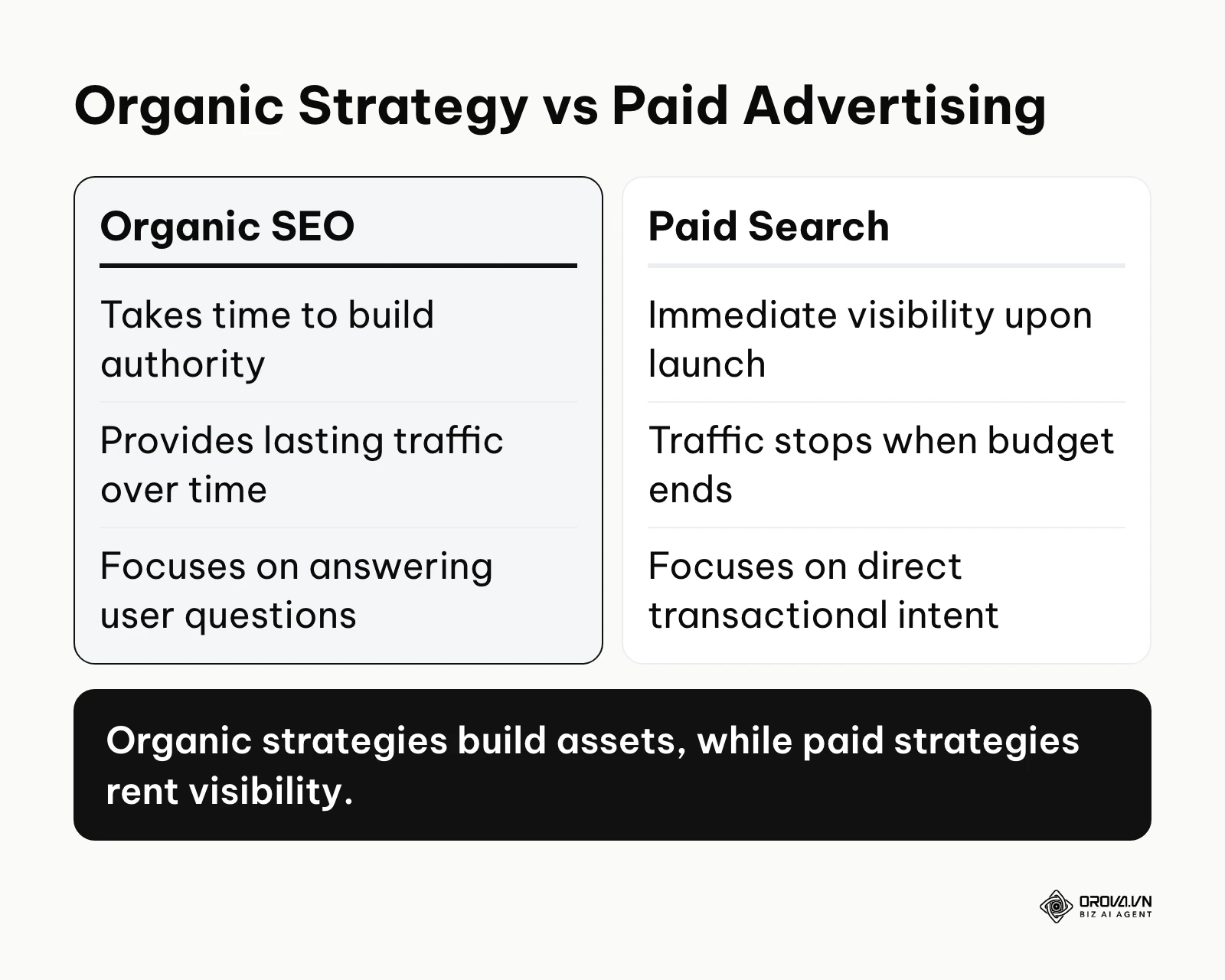
Historically, this guidance centered around manipulating keyword density to trick early search engine algorithms. Over time, it has evolved into a complex discipline involving technical architecture, semantic entities, and user experience signals. As of 2026, the focus has shifted toward establishing topical authority and satisfying deep informational needs.
The diagram below summarizes the differences between organic optimization and paid advertising.
Consider a local hardware store trying to attract more foot traffic. If they follow solid organic strategies, their website will naturally appear when a neighbor searches for "how to fix a leaky faucet," establishing trust and authority before a purchase is even made.
The meaning and purpose of strategic SEO guidance
Strategic SEO guidance exists to connect a business's valuable solutions with the specific, unprompted questions of potential customers. It serves organizations of all sizes by ensuring that their digital assets are visible exactly when users are actively seeking information.
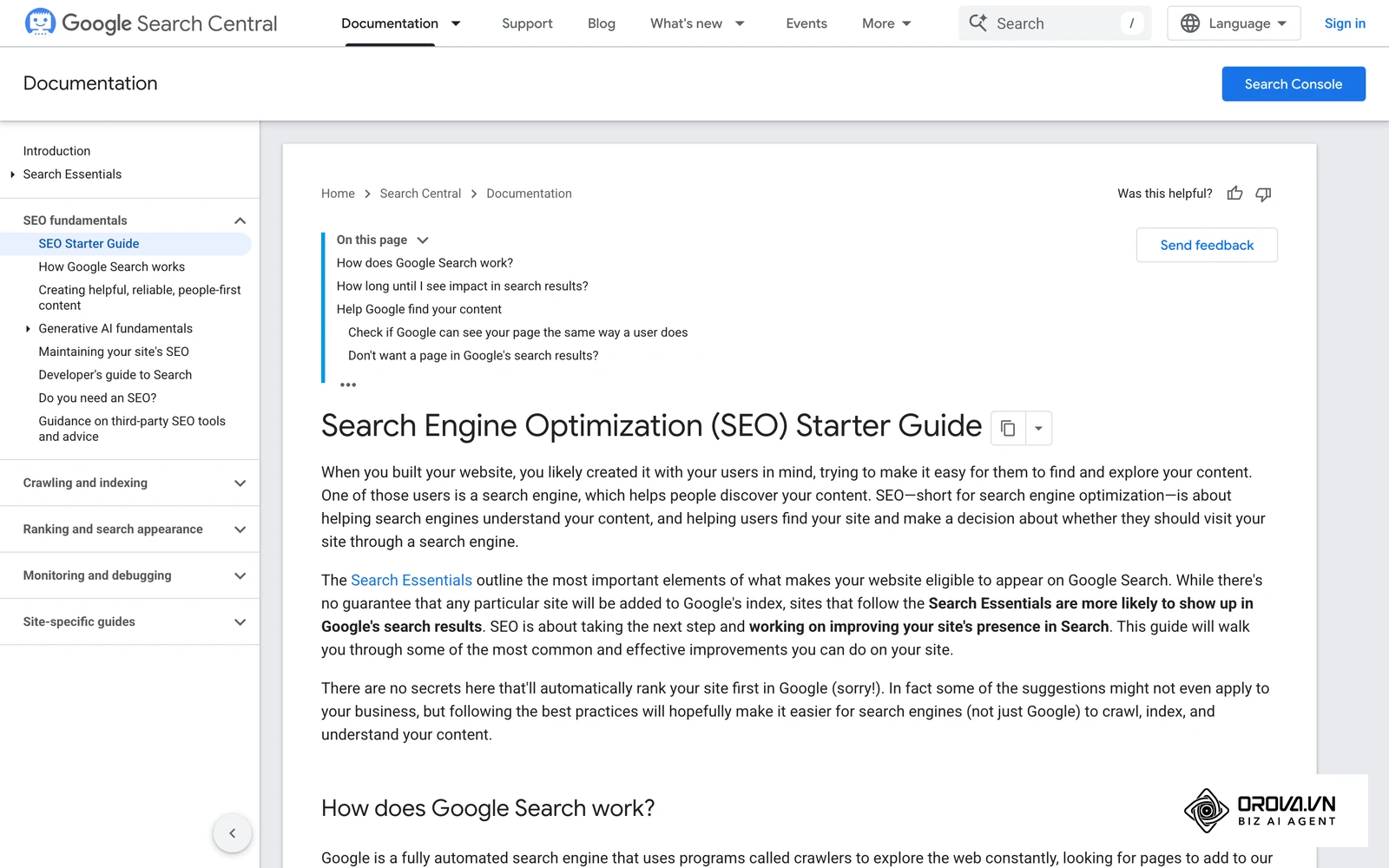
In the broader marketing ecosystem, organic search sits at the top and middle of the funnel. It typically follows product development and precedes direct sales efforts. Without a foundational organic strategy, a business relies entirely on rented channels like social media algorithms or paid advertising networks. If you ignore this discipline, you lose the ability to capture high-intent users who are ready to take action but are unaware of your brand. You essentially hand over your most qualified leads to competitors who have invested in their search presence.
When is it too early to rely on SEO advice? There are specific cases where applying SEO strategies is a waste of resources. First, if you have a completely novel product with zero existing search demand, people aren't looking for it yet; you need demand generation through social ads instead. Second, if your website is a temporary landing page for a three-day flash event, the time required for indexing makes SEO ineffective. In scenarios like these, prioritize paid acquisition, direct outreach, or PR campaigns over long-term organic strategies.
The tangible value and benefits of proper SEO execution
Proper search optimization delivers measurable financial returns for the business while simultaneously creating a smoother, more efficient workflow for the individuals executing the strategy. It transforms a website from an electronic brochure into a persistent lead generation engine.
Reducing customer acquisition costs (CAC)
For the business, the most significant financial value lies in lowering the average cost to acquire a new customer. Unlike paid campaigns where every click costs money, organic traffic provides a compounding return on the initial investment of content creation.
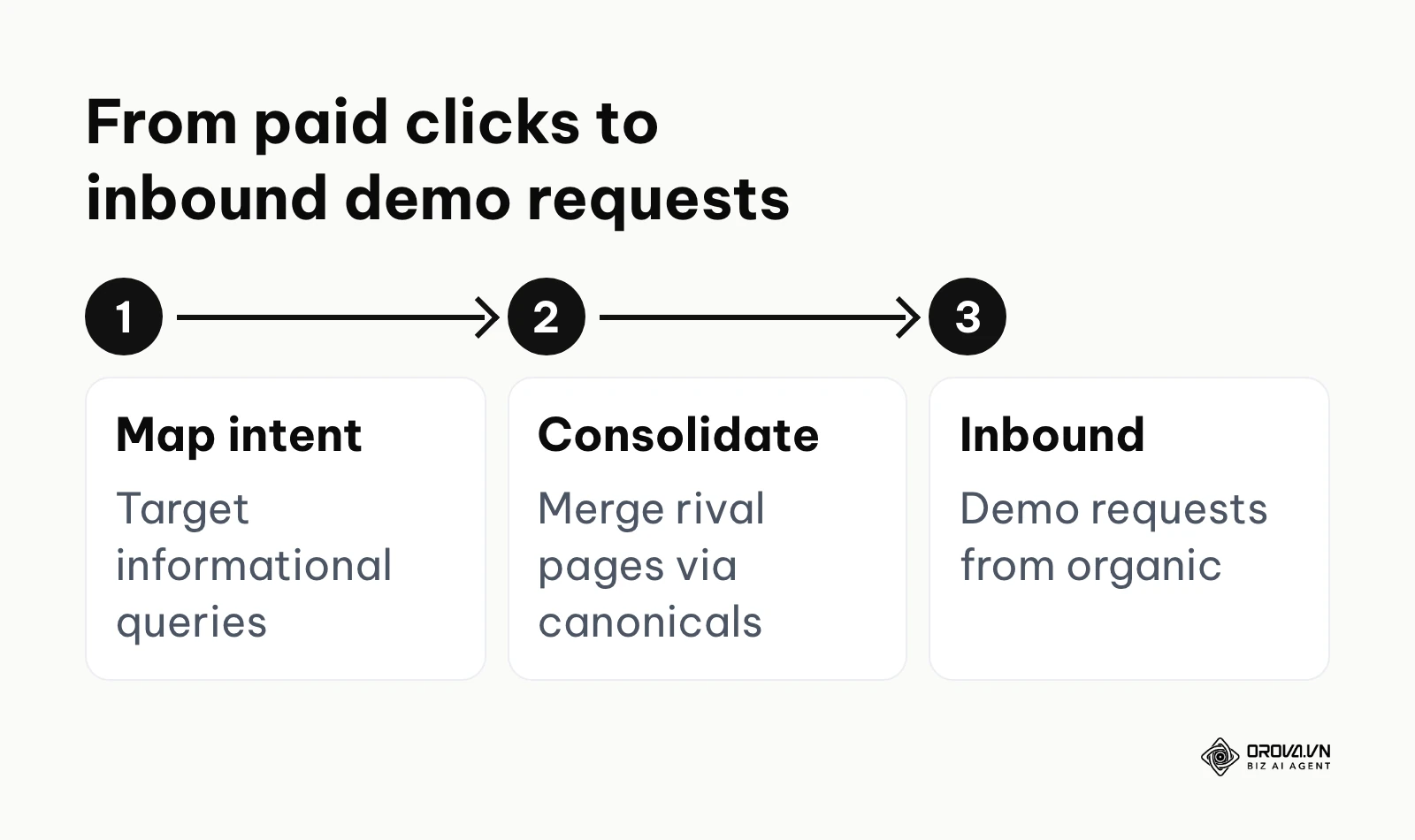
The diagram below traces the steps in the example that follows.
Illustrative example: A mid-sized software company was spending heavily on search ads to acquire users. The marketing lead conducted detailed keyword intent mapping and structured the website's architecture to capture informational queries. The team initially struggled because multiple pages were competing for the same terms, confusing the search engines. They fixed this by implementing canonical tags to consolidate ranking signals. As a result, the sales team received consistent inbound demo requests every morning directly from organic search, reducing their reliance on expensive outbound cold calls and lowering the overall CAC significantly.
Building long-term asset value
A highly visible website acts as a digital real estate asset that appreciates over time. The content you publish today continues to attract visitors months and years into the future, providing a layer of stability against market fluctuations.
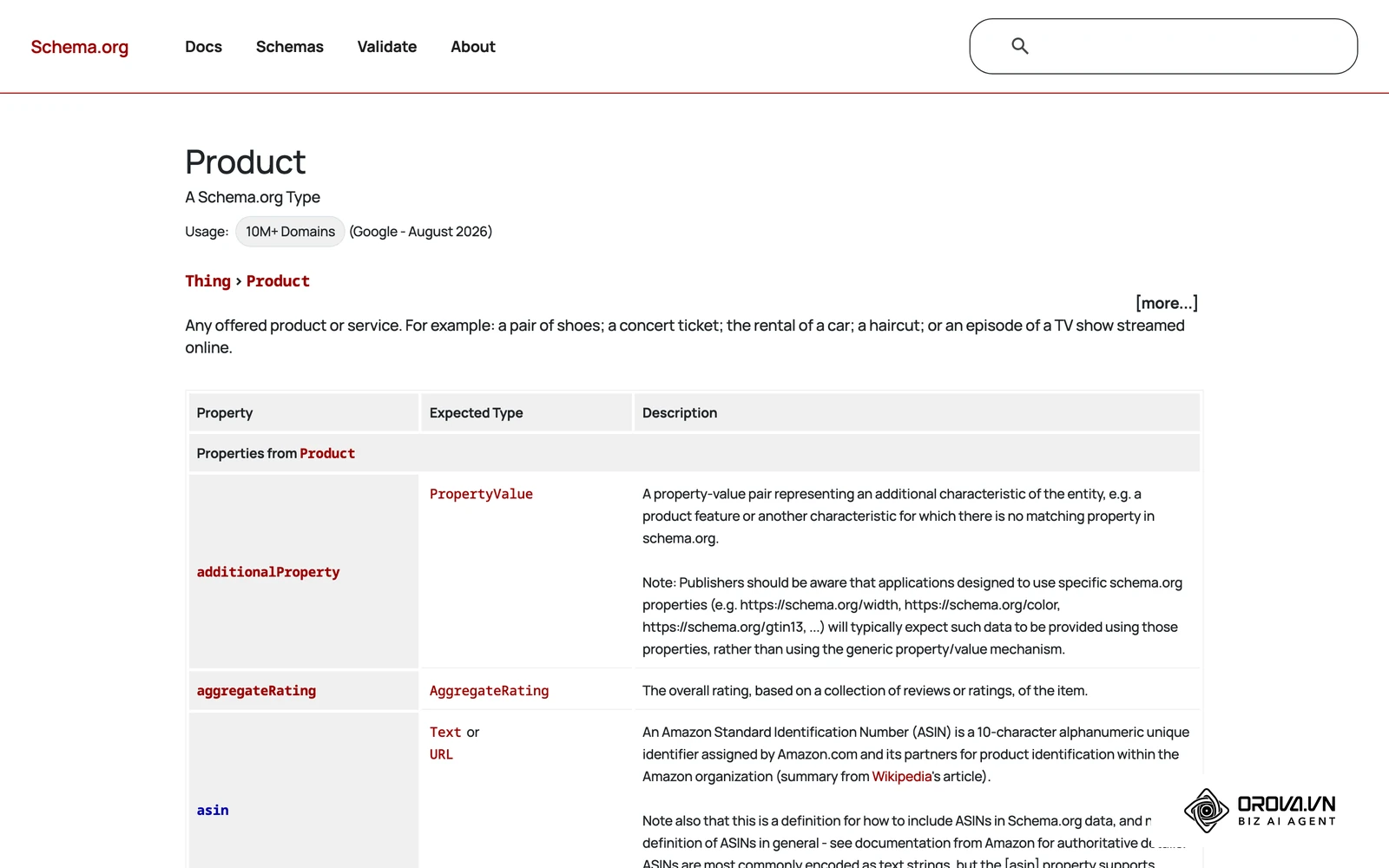
Illustrative example: The owner of a small e-commerce retailer wanted to reduce dependence on seasonal ad spending. They systematically optimized hundreds of product descriptions and implemented structured data markup to highlight product specifications. A major stumbling block occurred when the site's loading speed plummeted due to high-resolution product images. They resolved this by compressing the media and implementing lazy loading. The visible result was that the warehouse team packed a steady daily stream of orders arriving from organic search, maintaining a stable operational rhythm even during historically slow off-seasons.
Streamlining the marketer's daily workflow
For the individual marketer, following established optimization principles removes the guesswork from content creation. It provides a clear roadmap of what topics to cover and how to structure the information for maximum impact.
Illustrative example: A content manager at a ten-person agency struggled with unpredictable content performance. They developed standard operating procedures incorporating rigorous search guidelines into every brief. Initially, freelance writers ignored the technical requirements, leading to frustrating revisions. The manager fixed this by integrating an automated checklist that writers had to complete before submission. The visible result was that the editing team could approve drafts in a single reading pass, freeing up their afternoons for strategic campaign planning instead of fixing basic formatting errors.
| Benefit | Measured by | Time to see results |
|---|---|---|
| Reduced CAC | Cost per lead metrics | Several months |
| Asset value | Steady organic session volume | Six months or longer |
| Workflow efficiency | Hours spent editing content | A few weeks |
Discover Orova.vn – a Biz AI Agent platform with OROVA SEO, a complete solution for every website. The system supports search engine optimization from A to Z with features including keyword research, writing new SEO-ready articles, optimizing existing content, rank tracking, plus competitor analysis and in-depth technical analysis. Sign up today to experience OROVA SEO completely free (offer valid through July 7, 2027).
How modern SEO works: a component breakdown
Modern search engine optimization operates as an interconnected system of technical health, content relevance, and brand authority. Understanding the individual components is crucial for diagnosing issues and scaling your digital presence effectively.
Technical foundation and Core Web Vitals
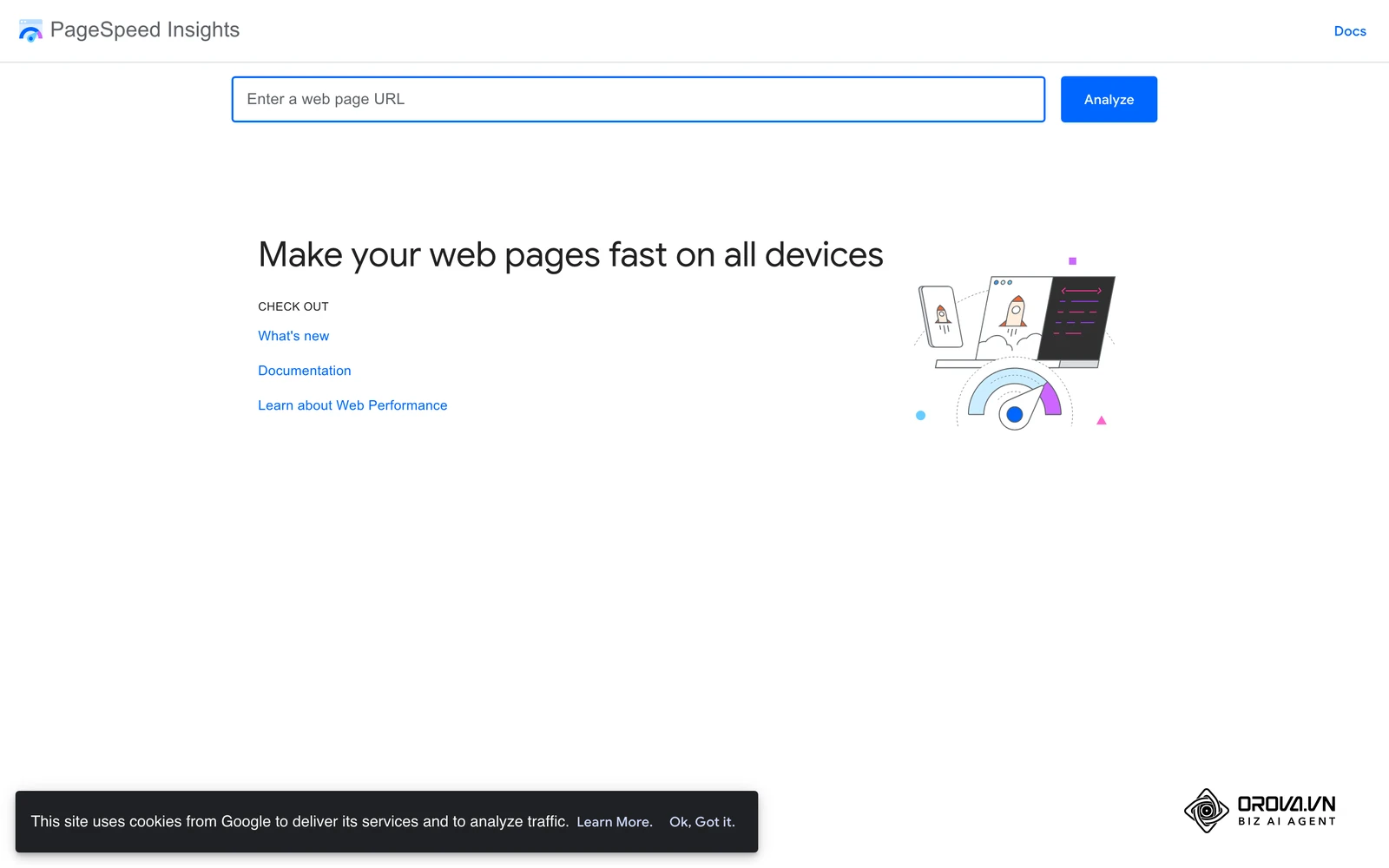
Technical optimization ensures that search engine crawlers can access, understand, and index your website without encountering roadblocks. It forms the invisible infrastructure that supports all other marketing efforts. Clean, predictable rendering is part of that foundation. If you want a deep dive into crawling and rendering, you should review a comprehensive guide on technical SEO.
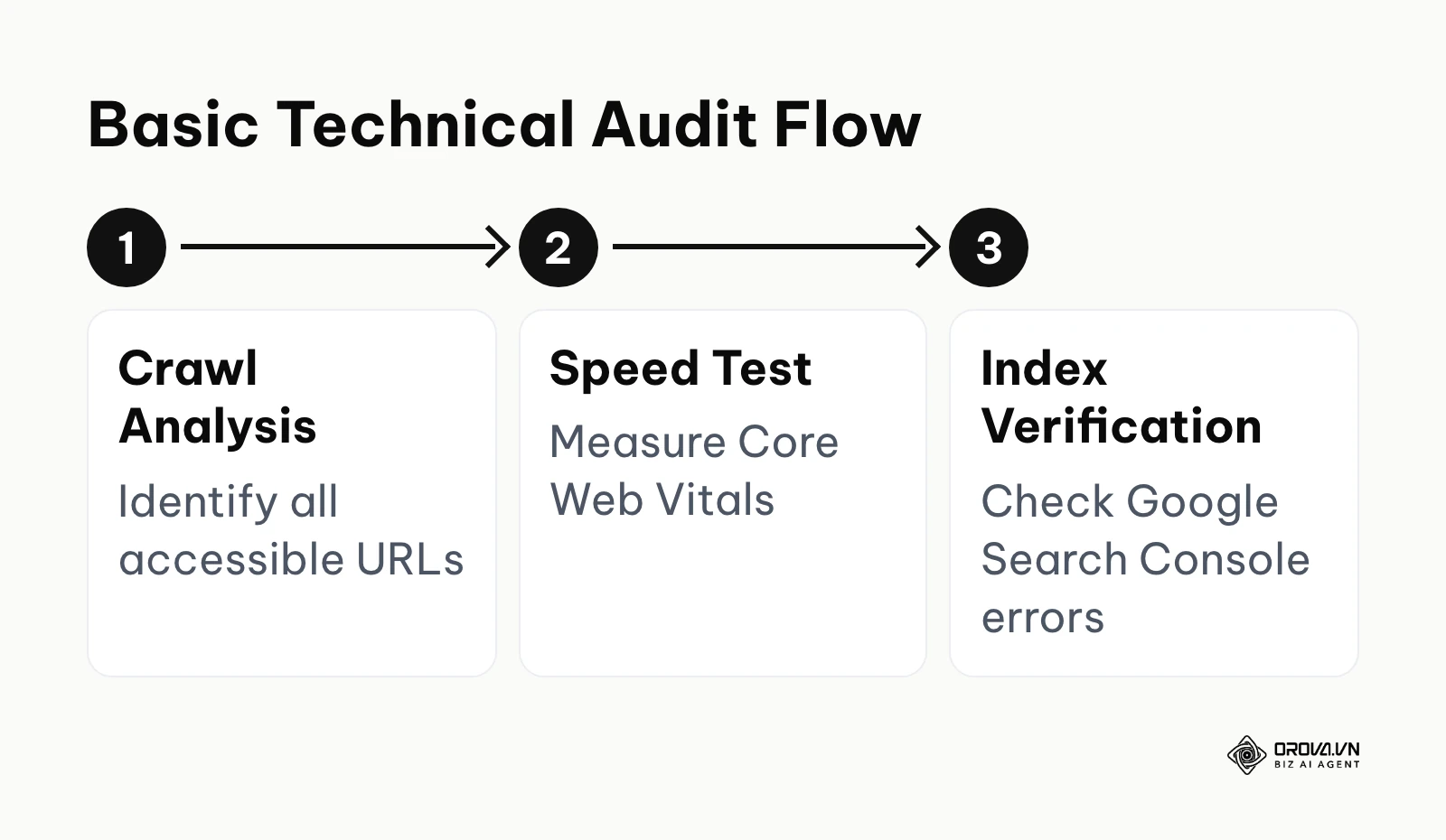
The diagram below outlines the core steps of a technical audit.
This component involves optimizing server responses, managing URL structures, and ensuring the site meets Core Web Vitals standards, such as loading speed and visual stability. The input consists of clean code and efficient server configurations, while the output is a fully indexed website that search engines trust. A common failure point is poor JavaScript rendering, where important content is hidden behind interactive elements that crawlers cannot parse.
Content structure for AI Overviews (AIOs)
With the rise of generative AI summaries at the top of search results, structuring content for machine extraction has become paramount. You must format your information so that AI models can easily identify the most accurate and concise answers to user queries. If you are updating existing pages, applying solid on-page SEO principles is the critical first step.
The goal is to provide a clear, unambiguous definition immediately followed by supporting context. The input requires deep subject matter expertise, while the output is a high probability of being cited as a source in an AI-generated overview. A frequent point of failure is writing overly flowery or vague introductions that confuse the extraction algorithms.
To optimize effectively, use the following Content Structure Template for AI Overviews:
| Section | Purpose | Formatting Rule |
|---|---|---|
| Direct Answer | Satisfy AI extraction | 40-60 words, bold the main concept, no fluff |
| Supporting Data | Build trust for the algorithm | Use bullet points with exact statistics and citations |
| Expert Insight | Demonstrate genuine human experience | A uniquely human perspective, clearly labeled |
| Contextual Link | Connect related concepts naturally | Natural anchor text leading to a deeper topical page |
"Search everywhere" optimization
Modern users no longer rely exclusively on a single search engine. The "Search Everywhere" mindset acknowledges that discovery happens across various platforms, requiring a diversified approach to content distribution.
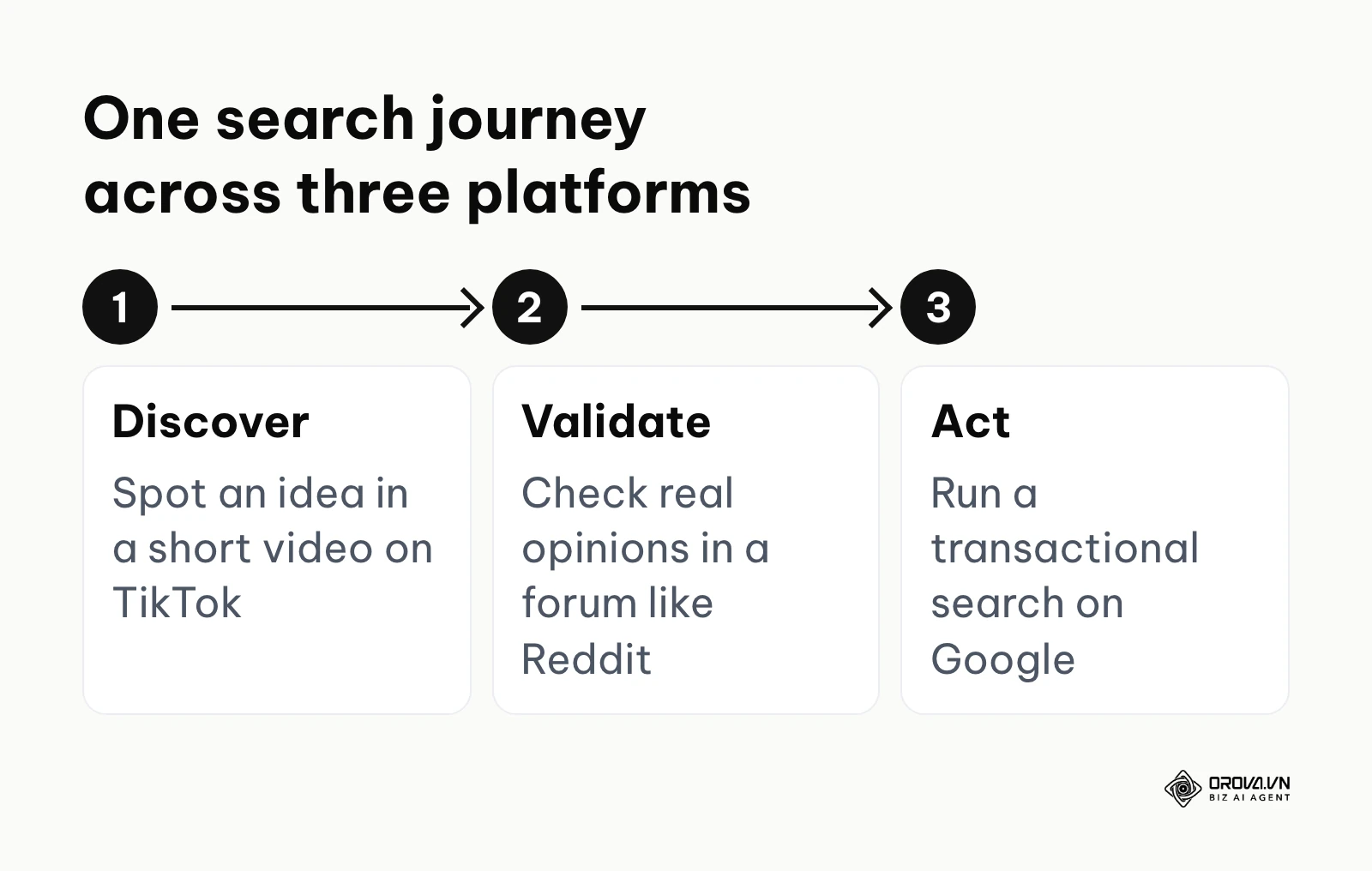
The diagram below follows one typical search journey across platforms.
This component involves mapping the user journey across different mediums. For instance, a user might discover a concept on TikTok, validate the information on Reddit, and finally execute a transactional search on Google. The input is adaptable content formats like short-form videos, detailed forum responses, and long-form articles. The output is brand visibility across the entire digital ecosystem. The most common failure point is copy-pasting the exact same content across all platforms without adapting to the specific format and community expectations of each network.
AI integration with E-E-A-T standards
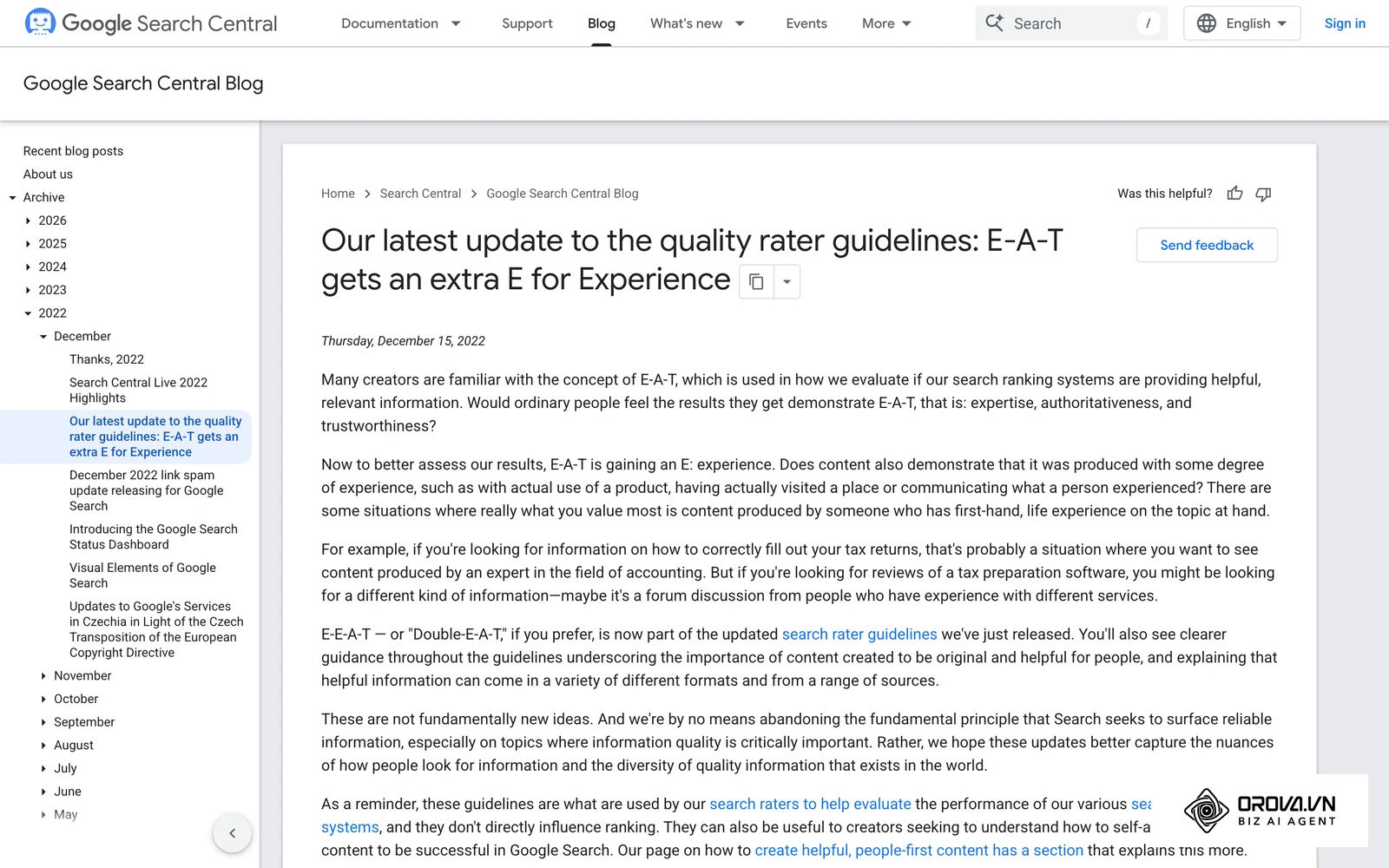
Artificial intelligence has revolutionized content creation, but it must be used as a strategic assistant rather than a wholesale replacement for human thought. Integrating AI SEO tools effectively means using them to scale research while relying on human experts to provide Experience, Expertise, Authoritativeness, and Trustworthiness. Google's Search Quality Rater Guidelines use E-E-A-T as a framework for judging content quality, and they weigh it most heavily for topics that affect people's health, money or safety.
This process involves leveraging AI for intent analysis, outlining, and structural formatting. The input is a series of highly specific prompts, and the output is a comprehensive, well-structured draft ready for human refinement. A major failure point is publishing raw, unedited AI content, which often lacks nuance and fails to demonstrate real-world experience, and tends to perform poorly in search.
To use AI as an assistant rather than a ghostwriter, try these 5 prompts with ChatGPT or a similar tool:
- Intent Mapping Prompt: "Act as a senior search strategist. Analyze the keyword [insert keyword] and map out the primary, secondary, and hidden user intents behind this query."
- Topic Cluster Prompt: "Generate a comprehensive topical map for the subject [insert topic]. Group the subtopics into logical pillars and suggest specific article titles for each."
- E-E-A-T Outline Prompt: "Create a detailed blog post outline for [insert title]. Ensure the structure includes dedicated sections for sharing real-world examples, expert quotes, and contrary opinions to satisfy E-E-A-T guidelines."
- Gap Analysis Prompt: "Compare my current draft against the top 3 ranking articles for [insert keyword]. Identify any missing subtopics, questions, or data points that I need to include to make my piece the most comprehensive resource."
- Direct Answer Prompt: "Rewrite the following paragraph to be exactly 50 words long, answering the question [insert question] directly without any introductory fluff, so it is optimized for AI extraction."
| Types of SEO Advice | Core Characteristic | Best Suited For |
|---|---|---|
| Technical Guidance | Focuses on code, speed, and server health | Large enterprise sites with complex architecture |
| Content Strategy | Focuses on writing, entity optimization, and intent | Blogs, publishers, and informational hubs |
| Off-page Tactics | Focuses on digital PR and brand mentions | Businesses in highly competitive, mature niches |
| AI/AEO Adaptation | Focuses on structuring data for machine learning models | Forward-thinking brands preparing for zero-click search |
What to do to start and adapt to search in 2026
Knowing the theory is useless without a practical execution plan. To succeed in the current landscape, you must aggressively prioritize tasks based on their potential impact versus the resources required. If you need a comprehensive list of tasks to check off, utilizing an seo checklist can keep your efforts organized without feeling overwhelming.
To manage your workload, apply the SEO Task Prioritization Matrix below. It categorizes activities to help you decide what needs immediate attention and what can wait.
| Task Category | Effort Required | Potential Impact | Priority Level |
|---|---|---|---|
| Optimizing Google Business Profile | Low | High | Do It Now |
| Fixing broken internal links | Low | Medium | Do It Now |
| Building topical authority hubs | High | High | Long-term Project |
| Disavowing low-quality backlinks | High | Low | Optimize Later |
Small business owners
If you are running a small operation with zero budget for external agencies, you must focus on high-impact, manual tasks that build local relevance.
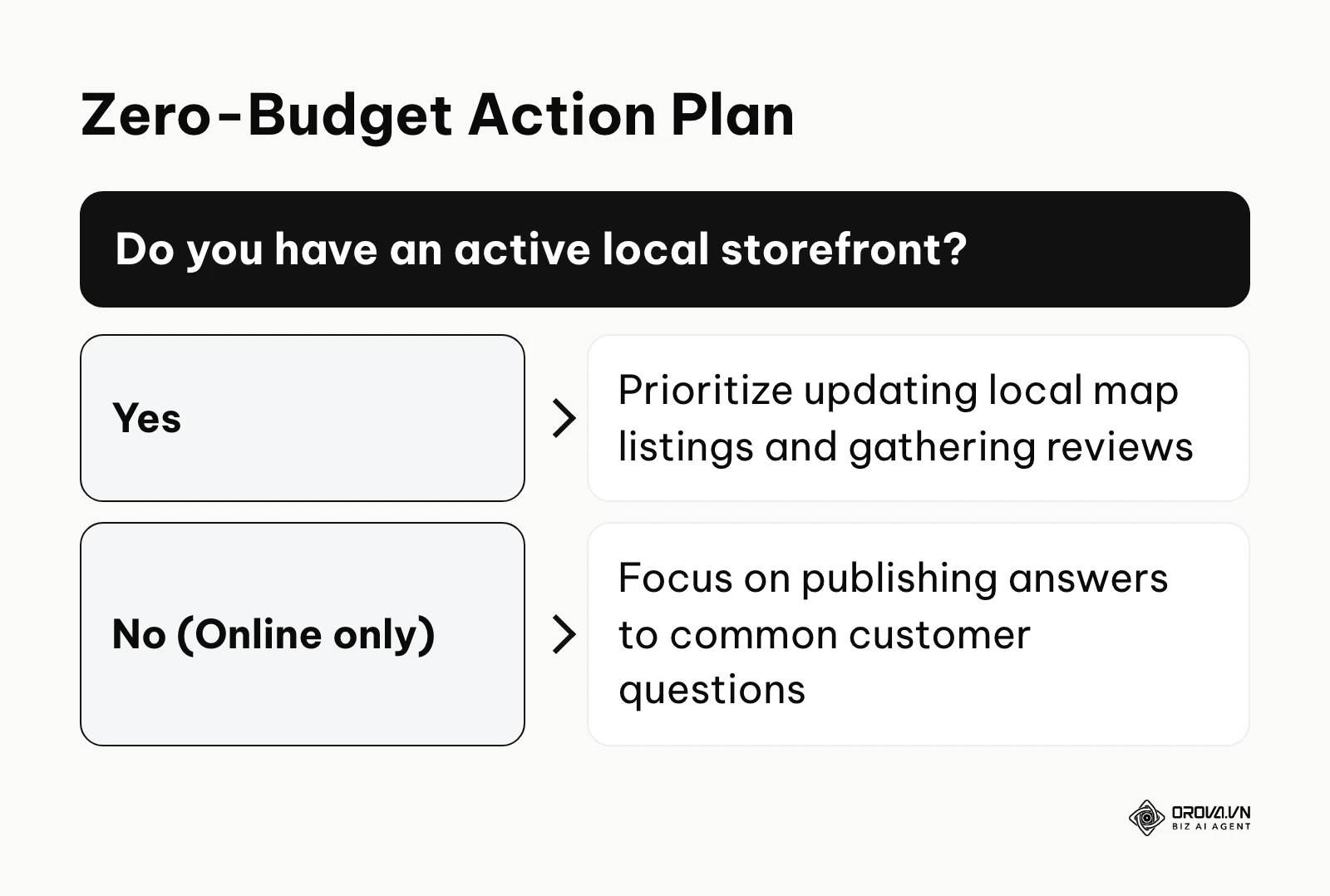
The diagram below provides a framework for small business owners to decide where to invest their time.
- Claim and update your local listings: Ensure your business name, address, and phone number are perfectly consistent across the web. This can be done immediately this week.
- Answer customer questions publicly: Take the exact questions your customers ask on the phone and turn them into detailed FAQ pages on your website.
- Encourage detailed reviews: Ask satisfied customers to mention specific products or services in their online reviews to build semantic relevance naturally.
In-house marketers
For professionals managing a company's internal strategy, the focus should shift toward building scalable processes and demonstrating measurable return on investment.
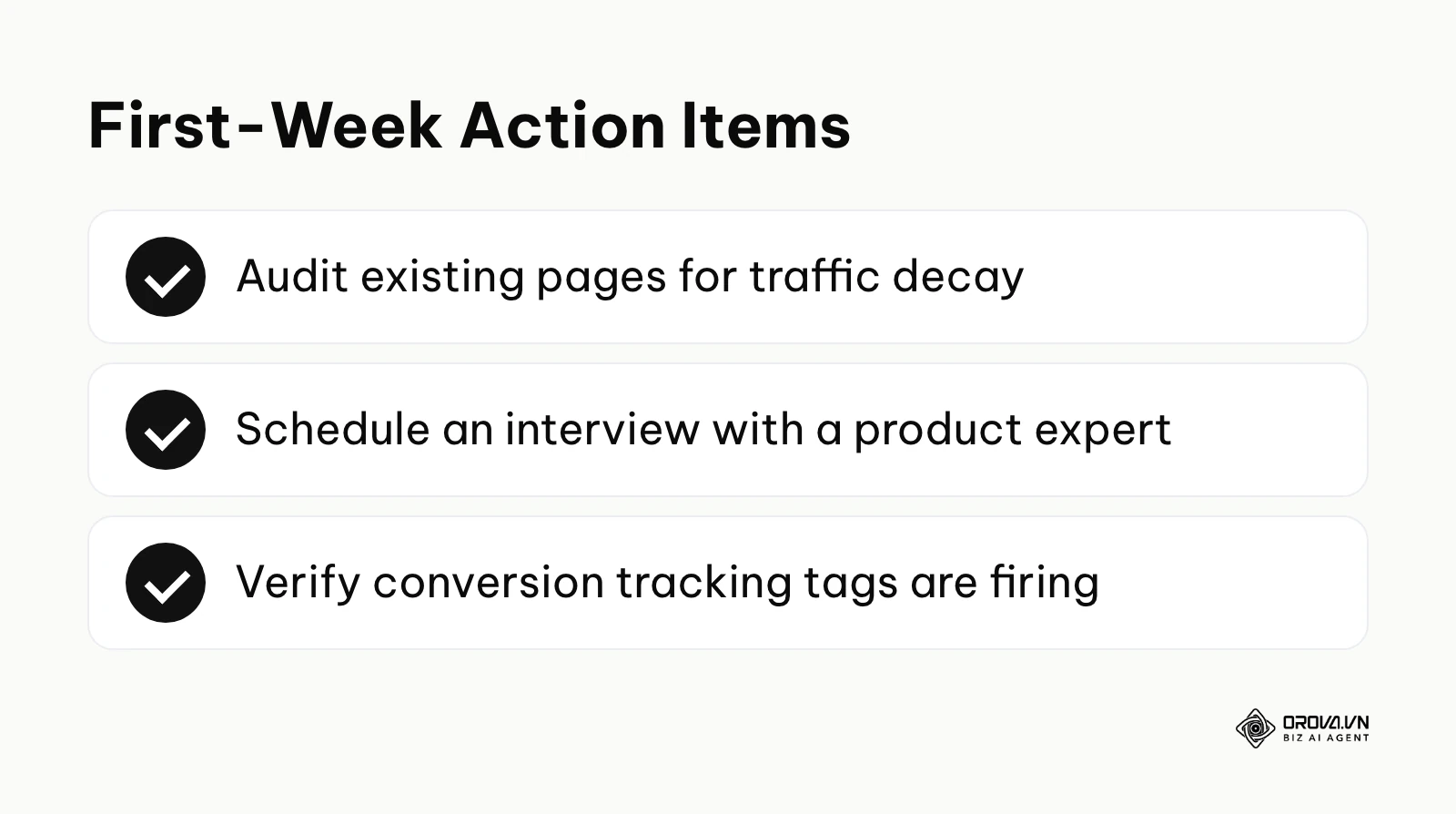
The diagram below summarizes the immediate action items for in-house teams.
- Audit existing content for decay: Identify pages that used to drive traffic but have recently dropped. Update them with fresh statistics and a better structure. You can start this analysis this week.
- Establish a subject matter expert interview process: Schedule monthly calls with your internal product teams to extract unique insights that AI cannot replicate, and turn those into authoritative content.
- Implement robust tracking: Ensure your analytics platforms are correctly configured to measure specific conversion events, not just overall traffic volume.
Freelancers and SEO agencies
External consultants must evolve beyond delivering basic technical audits and shift towards holistic growth consulting.
- Transition to entity-based reporting: Stop reporting solely on individual keyword rankings and start demonstrating growth across entire topical clusters. Begin updating your reporting templates this week.
- Integrate conversion rate optimization (CRO): Traffic is only valuable if it converts. Offer basic A/B testing on landing pages as part of your standard retainer.
- Develop proprietary data assets: Create original surveys or industry reports that naturally attract citations and brand mentions without relying on traditional outreach.
| Common Mistake | Consequence | How to Avoid |
|---|---|---|
| Changing URLs without redirects | Massive loss of existing traffic and authority | Always implement 301 redirects when altering site structure |
| Ignoring mobile usability | Poor rankings due to mobile-first indexing | Test all page templates on physical mobile devices |
| Over-optimizing anchor text | Algorithmic penalties for unnatural linking | Use a diverse mix of branded, descriptive, and generic anchors |
With OROVA.VN and the OROVA SEO module, you put an end to the exhausting days of manual work for good. Instead of struggling for hours to write articles and compile reports, the entire process is now optimized and completed in just 5 minutes.
Where SEO advice is heading in the next few years: the author's take
The landscape of digital discovery is shifting quickly. Here is how I read the current signals and what I expect over the next two to three years. These are opinions, not forecasts with numbers attached.
Zero-click visibility will matter as much as sessions
Today, a growing share of informational queries is answered directly on the results page, through AI Overviews and other rich features, without a click to any website. I believe that in the next two to three years, measuring success only by website sessions will feel incomplete, and brands will also track how often they are cited or mentioned inside AI answers. You should prepare for this now by structuring your content to be the clearest, most easily extractable source of truth in your niche. If you want one framework that covers classic rankings and AI answers together, reading about unifying SEO, AEO, and GEO is a good next step. This view could be wrong if search engines change how they display and credit summarized content.
The convergence of social and search
We are currently seeing younger audiences use video platforms and community forums as search engines. I strongly suspect that over the next two to three years, traditional search engines will lean more heavily on signals of real-world reputation, such as creator authority and genuine community discussion, when deciding what to surface. To prepare, start building a cohesive brand presence across multiple platforms today, making sure your video content supports your written articles and vice versa.
AI agents will take over routine technical checks
Currently, technical audits still require significant manual configuration and analysis. My read is that within the next two to three years, AI agents will routinely find technical issues and propose, or even stage, the code fixes, with a person approving what goes live. To prepare, professionals in this field should shift more of their time away from routine diagnostics and toward content strategy, audience psychology and user experience design.
Frequently asked questions about SEO advice
Is SEO advice still necessary with AI answering everything?
Yes, it is more critical than ever, though its nature has changed. AI models require authoritative data sources to generate their answers; if you do not optimize your content to be found and understood by these models, your brand will not be cited as a source. Optimization ensures you remain the foundational layer of information that feeds the AI.
How do I balance human E-E-A-T writing with machine SEO standards?
The key is structural discipline combined with creative freedom. Use strict, machine-friendly formatting for your headings and introductory definitions, but allow genuine human voice, personal anecdotes, and unique expert opinions to flourish in the body paragraphs. This satisfies the algorithm's need for clarity while fulfilling the reader's need for authenticity.
What is the average time to see results from scratch in the AI era?
If you are starting a completely new website with zero existing authority, it usually takes several months to a year of consistent effort to see significant, compounding organic traffic. The timeline depends heavily on the competitiveness of your industry and the technical health of your platform.
What are the best SEO tips for beginners?
Beginners should focus entirely on understanding user intent and answering questions better than anyone else on the internet. Do not get bogged down in complex technical jargon initially; instead, ensure your website is fast, mobile-friendly, and filled with highly relevant, well-structured content that solves real problems.
How should I use an SEO checklist in 2026?
A modern checklist should not be treated as a rigid set of rules that guarantee a top ranking. Instead, use it as a diagnostic tool to ensure you haven't missed any foundational elements, such as proper indexing or mobile usability, before you invest heavy resources into scaling your content creation.
Where should you start your SEO journey?
Knowing where to begin is often the hardest part, especially when you are overwhelmed with information. Your first step depends entirely on the current state of your digital assets. Do not try to execute a massive strategy all at once; focus on a single, impactful action.
If you have absolutely nothing yet, your first step is to clearly define your target audience and map out the top five questions they ask before making a purchase. Write down these questions in a simple document. This foundational research will dictate every piece of content you create moving forward. You can easily complete this brainstorming session in a single afternoon.
If you have existing content but your efforts feel disjointed, your immediate task is to conduct a content inventory. Export a list of all your published pages and categorize them by topic. This will help you identify gaps in your coverage and highlight areas where you have accidentally created duplicate content that competes against itself.
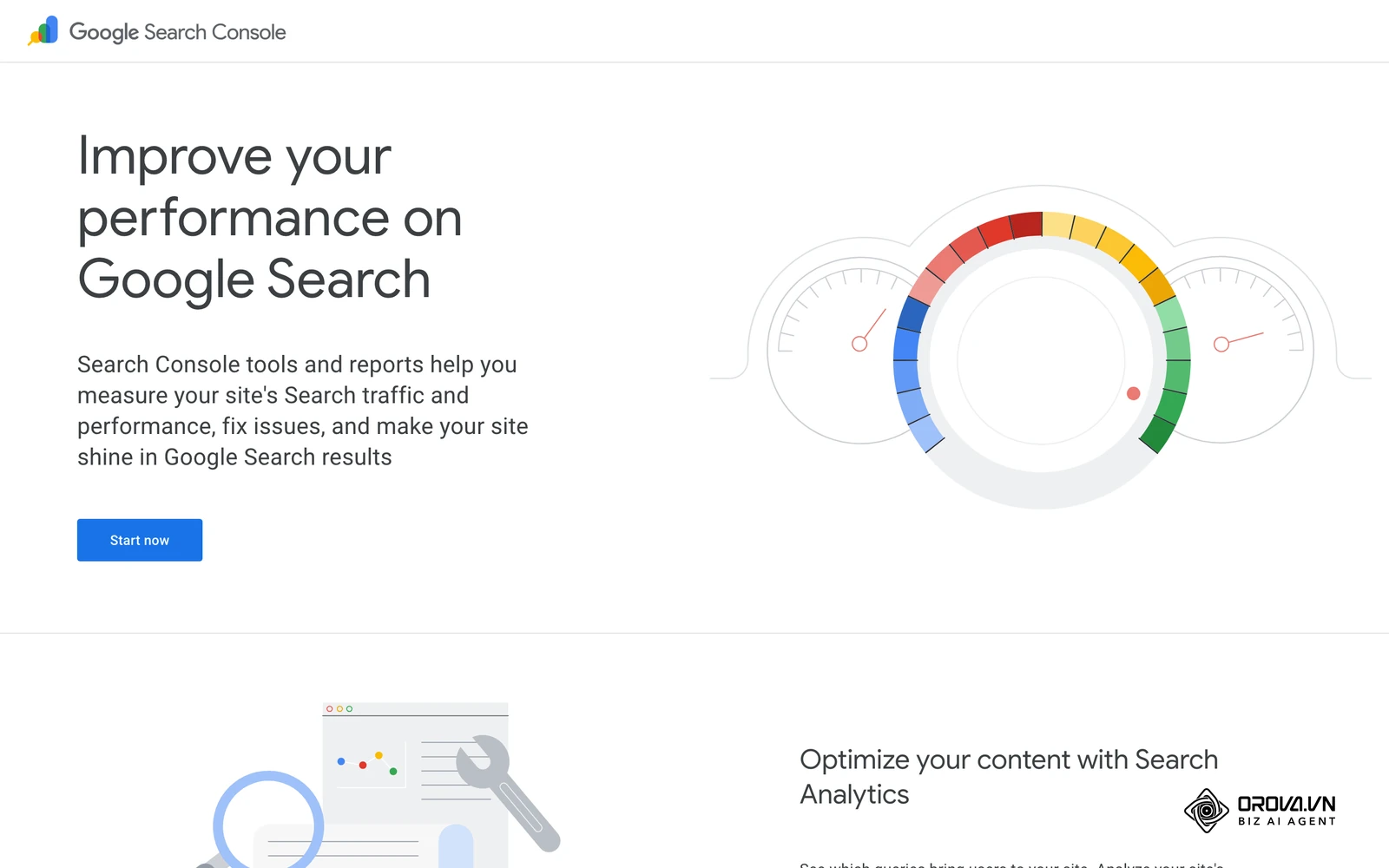
If you have been publishing consistently but are not measuring the results, your crucial first step is to configure your tracking infrastructure. Set up Google Search Console and ensure it is properly linked to your website. This will finally give you visibility into which specific queries are bringing users to your pages, allowing you to make data-driven decisions rather than relying on gut feelings when executing your SEO advice.
About the author

Builder of Orova
Nguyễn Đỗ Trọng Ân has 8 years of experience in marketing, including 6 years managing market development across Asia. He builds Orova, a Biz AI Agent that never sleeps: it plans, runs and optimizes work for businesses.
Run your business with AI Agents
Orova is the always-on Biz AI Agent — it plans, runs, and optimizes the work for you.
Save time, unlock productivity.