
What is topical authority? A practical semantic SEO guide for niche sites

Imagine you spend weeks publishing 50 detailed articles about "corporate leadership training", yet a smaller competitor with only 15 articles consistently outranks you on Google. Why does this happen? The answer lies in how search engines have evolved. They no longer look for the website that repeats a keyword the most. Instead, they look for the website that covers the entire ecosystem of a topic most deeply. This is where topical authority becomes your most powerful asset. Topical authority is the trust a search engine places in a website for one specific subject, earned by covering that subject more completely and coherently than competing sites. Building topical authority is the exact strategy that shifts your website from a random publisher of disparate articles into a trusted, go-to library for your industry. In this guide, we break down how to build a topical authority SEO strategy without relying on expensive monthly software subscriptions. You will learn how to map out semantic entities, structure your internal links logically, and prune outdated content so search engines can see you as a go-to resource in your niche.
What is topical authority?
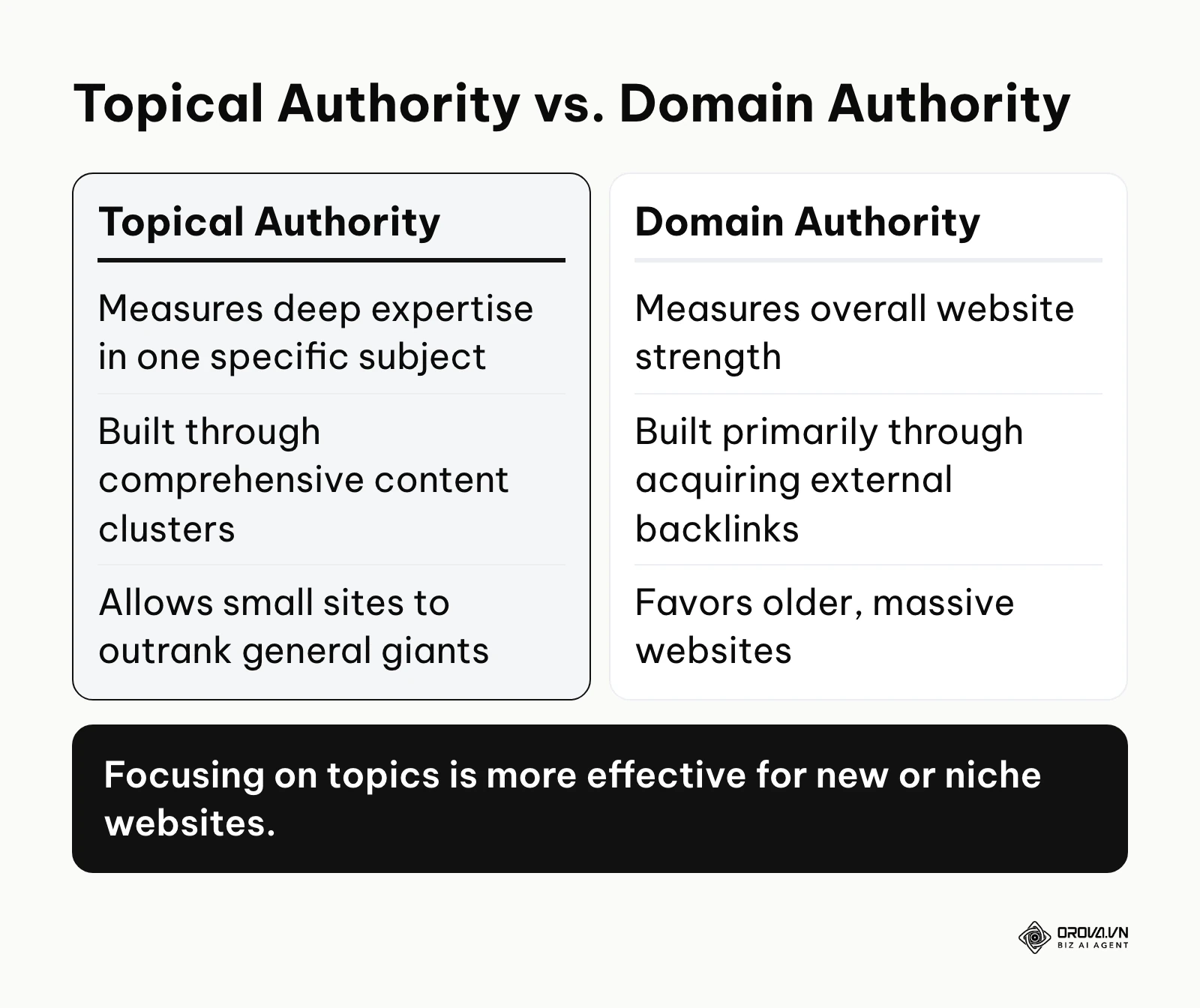
Topical authority is a measure of trust and deep expertise that search engines assign to a website for a specific subject area. It is used to evaluate how comprehensively a domain covers a topic, differing from traditional metrics that rely primarily on external backlinks to determine ranking potential.
The concept gained traction as Google moved away from simple string-matching (looking for exact keywords) toward "things, not strings" (understanding the entities behind the words).
People often confuse topical authority with other SEO metrics. Let us break down the exact differences so you know what you are measuring.
| Concept | How it differs | Example |
|---|---|---|
| Topical Authority | Measures depth of knowledge on one specific subject. | A small coffee blog ranking #1 for "how to roast robusta beans". |
| Domain Authority | Measures overall website strength based on external backlinks. | A massive news site with millions of links ranking highly across various topics. |
| Page Authority | Measures the strength of one single URL based on links pointing directly to it. | A viral article on a brand new website that got linked by a major news outlet. |
For a real-world example, consider a local hardware store website. They might have very few external links pointing to their domain. However, because they have published 80 in-depth guides detailing every possible nuance of "hardwood floor installation", Google trusts them specifically for flooring queries over a massive, high-authority general home improvement site that only has one thin article on the subject.
The Meaning Behind Topical Authority
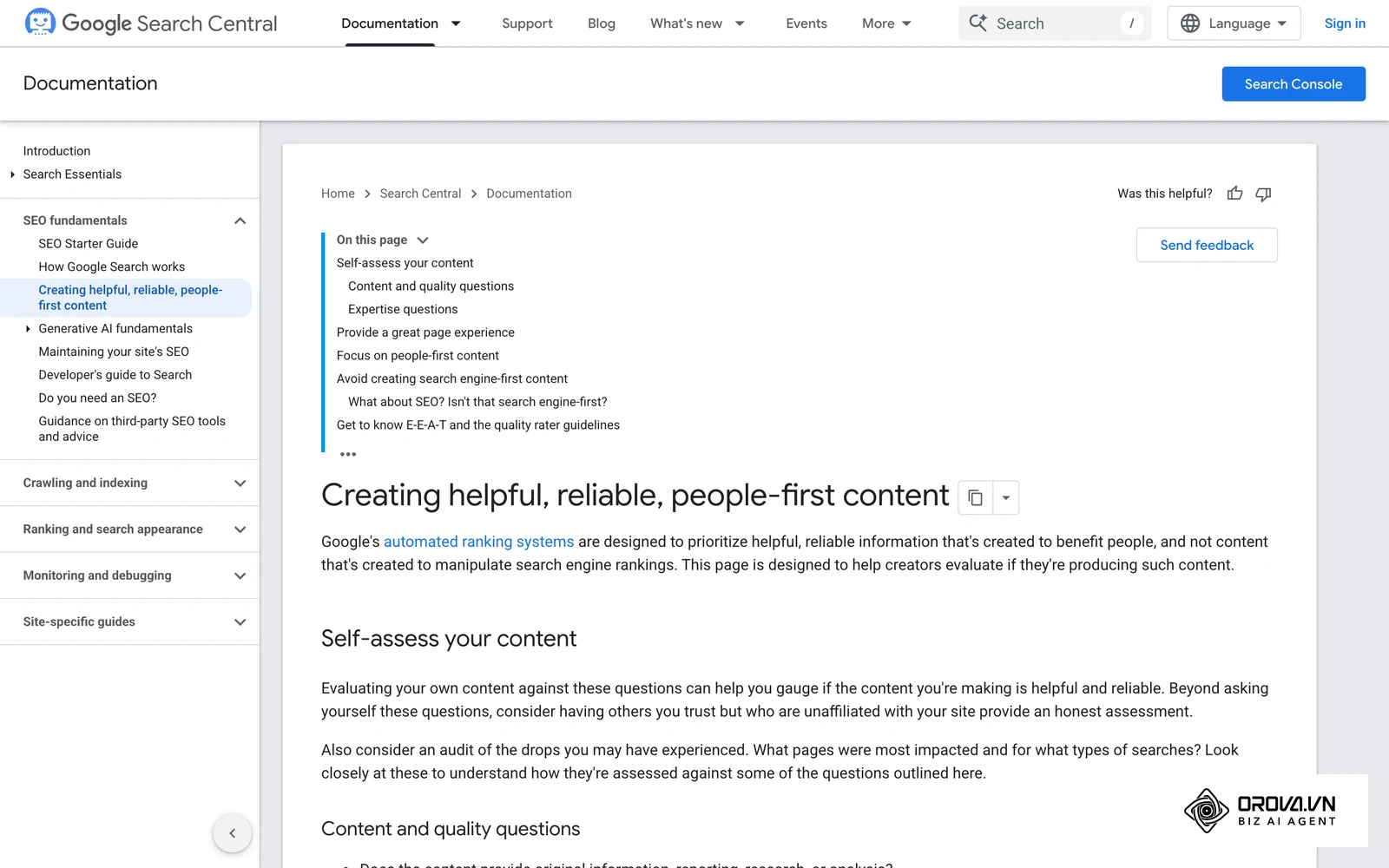
Topical authority exists to solve a fundamental problem for search engines: determining who actually knows what they are talking about. Google's own guidelines for its search quality raters treat the creator's expertise as a core part of judging page quality. Search algorithms need a scalable way to measure this expertise. By analyzing how thoroughly a website covers all the sub-topics, questions, and entities related to a core subject, search engines can estimate whether the site is an authentic expert.
In the broader picture of your digital marketing strategy, topical authority sits squarely in the middle. It comes after you have secured your technical foundation. If you are still wondering about the technical setup required before building clusters, read our guide on What Is Technical SEO? to ensure search engines can actually crawl your new pages. It comes before you aggressively pursue external link building. In fact, possessing high topical authority often naturally attracts backlinks because other writers view your comprehensive site as the ultimate reference point.
If you ignore topical authority, you risk wasting your content budget entirely. You might write 100 articles targeting high-volume keywords, but because those articles are disjointed and span too many unrelated categories, Google will view your site as a generic content farm rather than a specialized authority. You will likely remain stuck on page two or three of the search results, unable to break through the trust barrier.
When you do not need topical authority: Building deep topical authority requires significant time and content investment. You should bypass this strategy if you run a hyper-local service business (like a single-city plumbing service) where local map pack optimization is enough. It is also unnecessary for short-term event landing pages, single-product splash pages, or temporary campaign sites that only rely on paid advertising traffic. In these cases, focus on conversion rate optimization and paid acquisition instead of semantic content clustering.
Values and Benefits of Building Topic Clusters
The effort required to build a topical authority SEO strategy pays dividends across two distinct layers: the macro business level and the daily operational level for SEO practitioners.
Tangible Business Value
For the business as a whole, focusing on topics rather than isolated keywords reduces risk and increases the return on investment for content creation.
First, it creates highly predictable traffic growth. When you own a topic entirely, you capture traffic from thousands of long-tail variations that you never even explicitly targeted. Second, it reduces your reliance on expensive link-building campaigns. A site with strong topical relevance can sometimes outrank a site with a much bigger backlink profile. Finally, it helps cushion your business against algorithmic volatility, because sites that demonstrate genuine, comprehensive expertise tend to hold up better through broad core updates.
Example scenario: A mid-sized B2B software vendor struggled to rank for "inventory management software" despite having a high domain rating. They mapped out 40 informational sub-topics, published them over three months, and interlinked them to the main sales page. Initially, internal links were haphazard, causing Googlebot to miss deep pages; they fixed this by adopting a strict hub-and-spoke internal linking architecture. Three months later, organic impressions for the core product page increased visibly, and non-brand search traffic grew steadily without acquiring any new external backlinks.
Direct Benefits for SEO Practitioners
For the people actually doing the work, a topical approach removes the guesswork from content planning. Instead of staring at a keyword research tool wondering what to write next, your roadmap is practically built for you by the boundaries of the topic itself.
It also makes reporting much easier. Instead of reporting on individual keyword rankings, which fluctuate daily, you can report on the overall visibility and traffic growth of an entire cluster. This paints a much more accurate picture of success.
| Benefit | Measured By | When to Check |
|---|---|---|
| Reduced Content Waste | Number of published pages generating zero traffic | Right after each pruning round |
| Faster Indexing | Average time from publication to first Google impression | After every new cluster article |
| Higher Conversion Intent | Lead generation rate from informational blog posts | Once the cluster is fully published |
Discover Orova.vn – a Biz AI Agent platform with OROVA SEO, a complete solution for every website. The system supports search engine optimization from A to Z with features including keyword research, writing new SEO-ready articles, optimizing existing content, rank tracking, plus competitor analysis and in-depth technical analysis. Sign up today to experience OROVA SEO completely free (offer valid through July 7, 2027).
How Topical Authority Works in Practice
Building topical authority is not about guessing what keywords to write. It is a systematic process of mapping concepts, structuring your website architecture, and rigorously cleaning up your past mistakes. Here is the detailed breakdown of how to execute this strategy effectively.
Semantic SEO and Entities in Writing
To understand topical authority, you must first understand Semantic SEO. Search engines no longer read text linearly to count keywords; they use Natural Language Processing to extract "entities". An entity is a singular, unique, well-defined thing or concept. For example, "Apple" the fruit is a completely different entity from "Apple" the technology company.
When optimizing individual pages within your cluster, applying robust entity optimization is key. You can learn more about this in our breakdown of What is on page SEO?. To build authority, your writing must connect related entities exactly how a human expert would. If you write an article about "espresso machines", search engines expect to see related entities like "portafilter", "bar pressure", "tamping", and "crema". If these related entities are missing, the search engine is more likely to conclude that your content lacks expert depth.
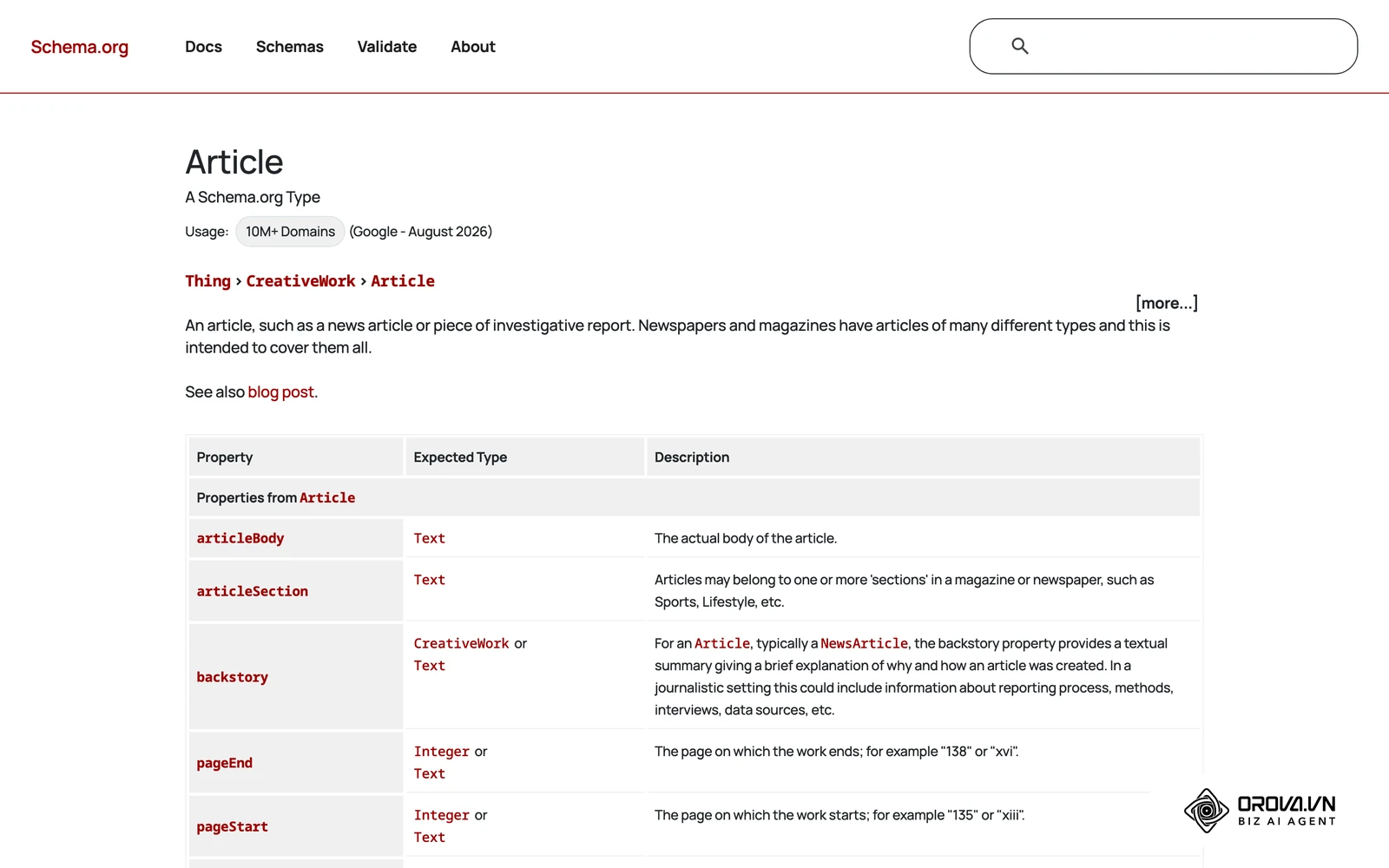
You can explicitly declare these entities to search engines using structured data. The Schema.org vocabulary lets you define exactly what a page is about, which helps search engines resolve ambiguities. By using the about and mentions properties in your JSON-LD schema markup, and pointing each entity to its Wikipedia or Wikidata URL with sameAs, you tell search engines exactly which entity you are discussing.
Structuring with Topic Clusters and Pillar Pages
You cannot just publish 50 related articles and hope Google connects the dots. You must physically connect them using the topic cluster model. This model consists of three main components: the pillar page, the sub-pillars, and the spoke content.
| Content Type | Primary Characteristic | Best Suited For |
|---|---|---|
| Pillar Page | A broad, comprehensive overview of the core topic (e.g., "The Ultimate Guide to Email Marketing"). | High-volume, broad keywords and serving as the main internal linking hub. |
| Sub-pillar | A detailed guide on a major section of the pillar (e.g., "Email Marketing Automation Strategies"). | Medium-volume keywords that require their own deep dive. |
| Spoke Content | Highly specific, narrow questions and long-tail topics (e.g., "How to automate abandoned cart emails in WooCommerce"). | Answering specific user queries and building extreme topical depth. |
The pillar page sits at the top of your hierarchy. It covers the topic broadly but not deeply. It then links out to all the spoke content, and all the spoke content links back to the pillar page. This creates a closed semantic loop, passing link equity back and forth and clearly signaling the boundaries of your topical expertise to search engine crawlers.
The Internal Linking Flowchart Decision Matrix
Internal linking is the glue that holds your topical authority strategy together. Without it, your articles are just isolated islands. However, linking randomly can dilute your authority. You must link logically based on the hierarchy of your topic cluster; our guide to internal and external linking strategies for SEO covers anchor text and link placement in more detail.
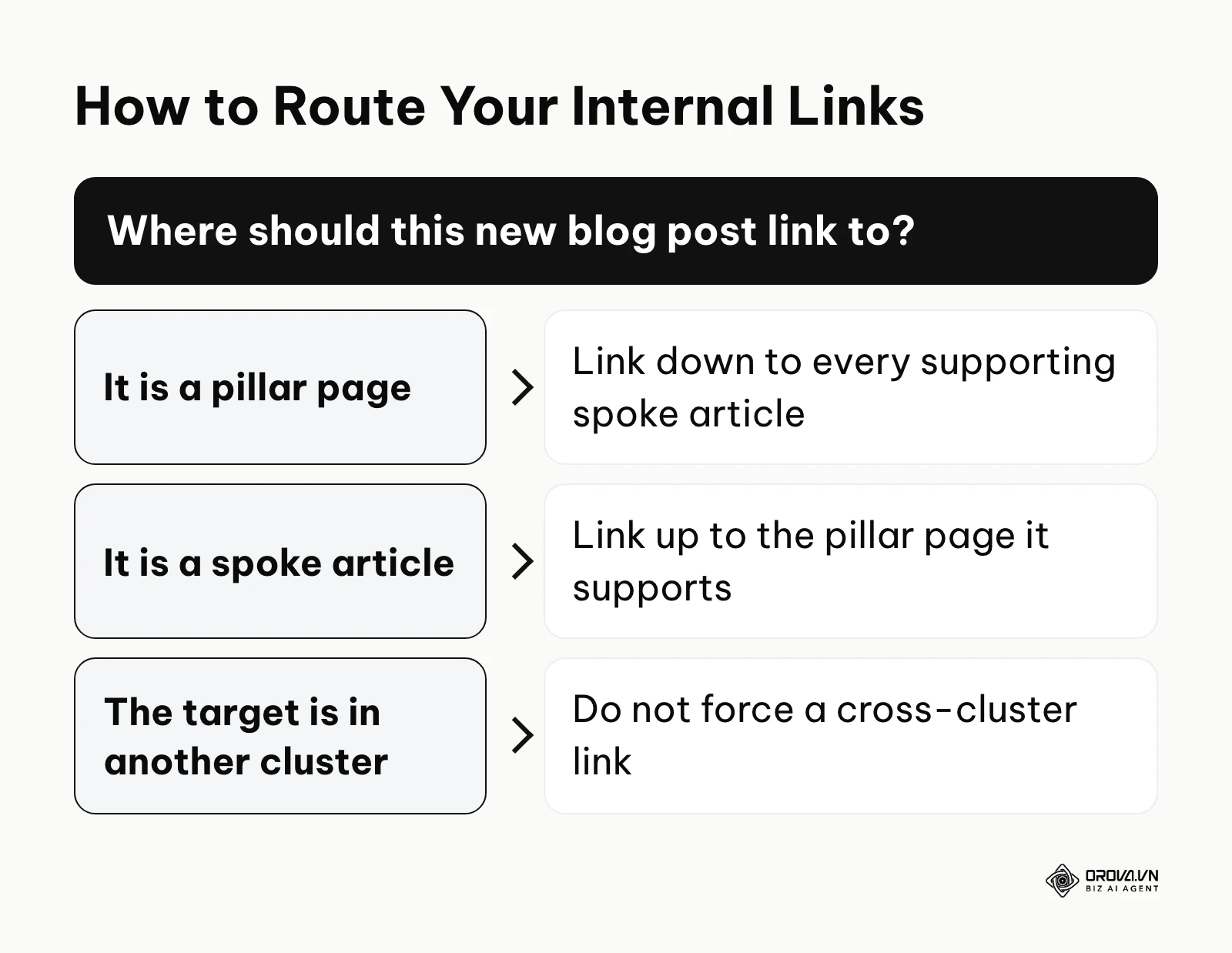
If you are writing a new piece of spoke content, your primary internal link must point upward to the pillar page it supports. If you are updating a pillar page, you must ensure it links downward to all supporting spoke articles. Crucially, you should avoid cross-linking between completely unrelated clusters. For example, if your website covers both "SEO" and "Accounting Software", an article about "Keyword Research" should rarely, if ever, link to an article about "Payroll Taxes", as this confuses the semantic boundaries you are trying to establish.
Auditing Your Current Authority Using Google Search Console
Before you start writing new content, you must audit what you already have. Many website owners pay for expensive third-party tools to do this, but you can build a highly accurate map of your current topical authority using just Google Search Console and Google Sheets. Analyzing the data exported from your site is crucial for mapping clusters. For detailed reporting workflows, explore Google Search Console for SEO.
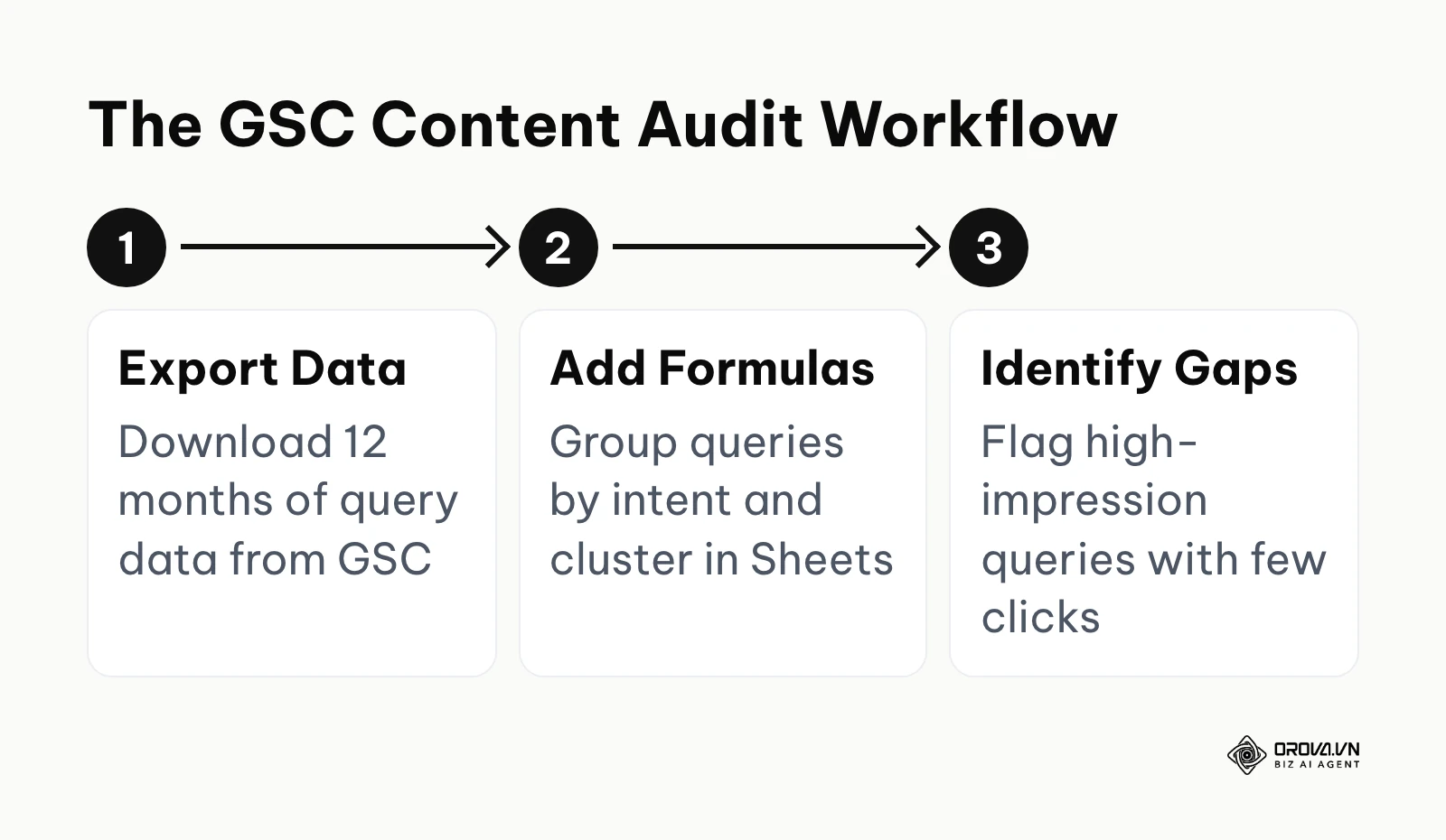
Here is the exact workflow to measure your current authority:
- Open Google Search Console and navigate to the Search Results performance report.
- Set the date range to the last 12 months to get a robust dataset.
- Export the "Queries" report to a CSV file.
- Import this data into a new Google Sheet.
- Set up columns to automatically categorize your data based on your core topics.
To automate the grouping, you can use a specific Google Sheets setup. Here is a practical template you can recreate:
| Column | Column Name | Action or Formula | Purpose |
|---|---|---|---|
| A | Query | Exported directly from GSC | The base keyword you are ranking for |
| B | Clicks | Exported directly from GSC | Shows how often searchers chose your result |
| C | Impressions | Exported directly from GSC | Indicates the total search visibility for the query |
| D | Intent Categorization | =IF(OR(ISNUMBER(SEARCH("how",A2)),ISNUMBER(SEARCH("what",A2)),ISNUMBER(SEARCH("guide",A2))),"Informational","Other") | Splits informational queries from the rest |
| E | Cluster Grouping | =IF(OR(ISNUMBER(SEARCH("dog",A2)),ISNUMBER(SEARCH("puppy",A2))),"Dog Cluster",IF(OR(ISNUMBER(SEARCH("cat",A2)),ISNUMBER(SEARCH("kitten",A2))),"Cat Cluster","Other")) | Groups keywords into your predefined topics |
| F | Gap Flag | =IF(AND(C2>1000,B2<10),"Action Required","OK") | Flags high-impression queries where you lack the authority to win clicks |
Example row: the query "how to train a puppy" with 12 clicks and 4,800 impressions lands in column D as "Informational", in column E as "Dog Cluster", and in column F as "OK"; the same query with 6 clicks would be flagged "Action Required".
By pivoting this table, you can quickly see which clusters generate the most impressions versus clicks. For example, if your "Dog Cluster" has 500,000 impressions but a 0.1% click-through rate, you know you have broad visibility but lack the deep topical authority required to rank high enough to win the click.
Content Pruning: Cleaning Up Old Content
Building topical authority is not just about adding new content; it is equally about removing content that dilutes your focus. This process is called content pruning. If your website has been active for years, you likely have hundreds of articles that are outdated, off-topic, or generating zero traffic. These pages consume your crawl budget and confuse search engines about your actual area of expertise.
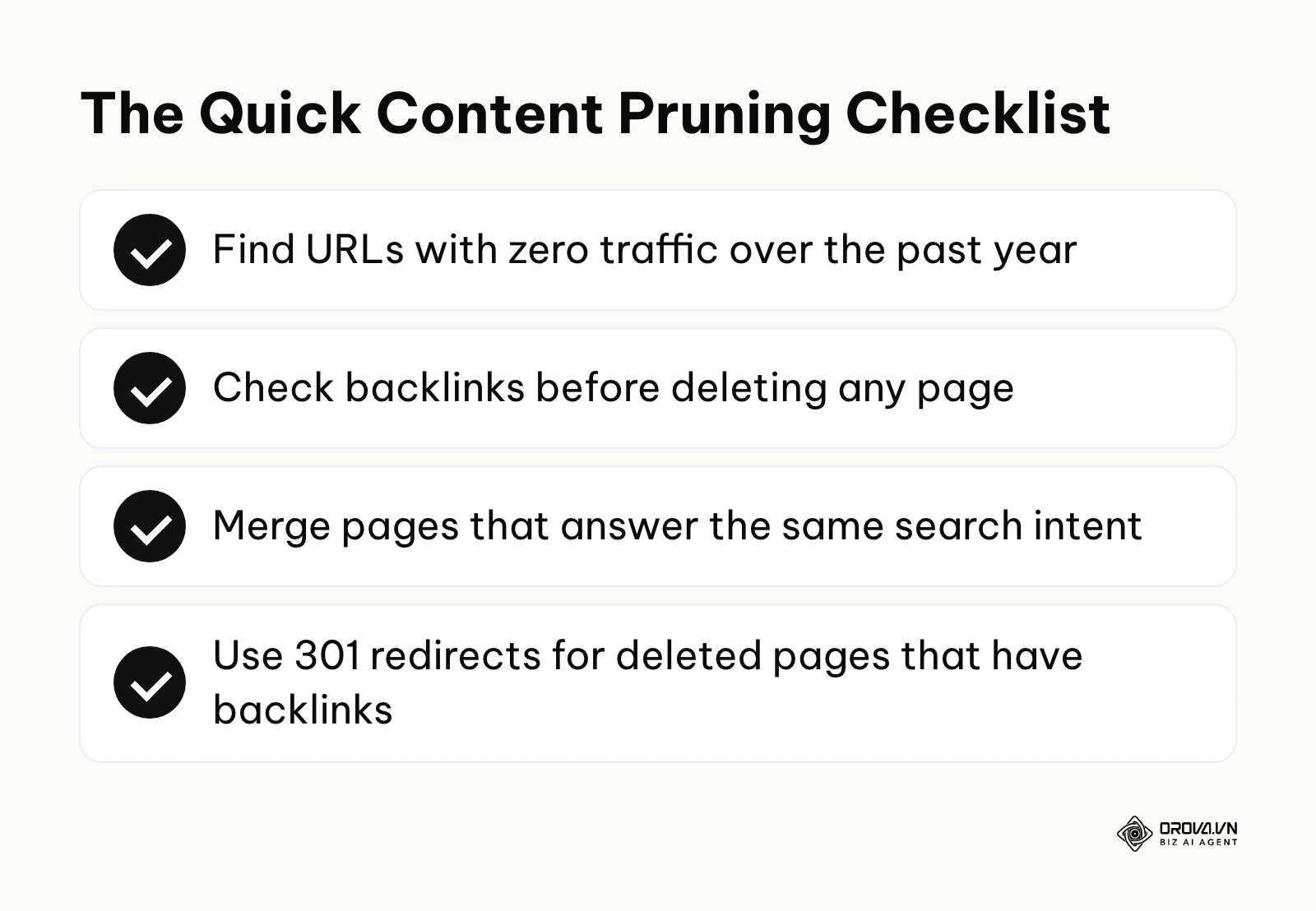
Here is the comprehensive 10-step content pruning checklist to clean up your site safely:
- Export a list of all published URLs from your Content Management System.
- Cross-reference this list with Google Analytics to identify pages with zero traffic over the past year.
- Check the backlink profile of these zero-traffic pages using any free backlink checker.
- Assess the topical relevance: Does this article firmly belong in one of your core topic clusters?
- Identify duplicate intents: Do you have three different articles answering the exact same question?
- Make the Merge decision: Combine multiple thin, competing articles into one comprehensive master guide.
- Make the Update decision: Refresh outdated statistics and rewrite poor content that still holds a relevant position in a cluster.
- Make the Delete decision: For pages that are completely off-topic, have zero traffic, and zero external backlinks, issue a 410 (Gone) status code.
- Map your Redirects: For pages you delete that do have valuable backlinks, implement a 301 redirect to the most relevant parent pillar page.
- Remove orphaned internal links: Search your remaining site for any internal links that point to the pages you just deleted, and remove or update them.
Example scenario: An established health blog managed by a small editorial team noticed a plateau in organic traffic following a core algorithm update. They audited the site, identified 300 outdated articles, merged 150 overlapping posts, and deleted the completely irrelevant pages. During the process, they accidentally deleted pages with high-quality legacy backlinks; they corrected this by restoring those specific URLs and using 301 redirects to point them to the new comprehensive pillar pages. After six weeks, the overall site crawl frequency improved visibly, and the remaining 500 pages began capturing featured snippets in search results.
What to Do to Adapt to the Semantic Web
Adapting your strategy to focus on topics rather than individual keywords requires a shift in how you plan and execute your daily work. The approach varies slightly depending on your role and resources.
Action Plan for Small Business Owners
If you are running a small business, you likely have limited time and budget. You cannot write 100 articles a month.
- Define your absolute core competency. Pick the one single service or product that drives the most revenue.
- List out the 20 most common questions customers ask you on sales calls regarding that specific product.
- Write one highly detailed, accurate article answering each of those 20 questions.
- Create one main overview page that links to all 20 of those articles. You can build this initial structure within your first week.
Strategy for In-House SEO Managers
In-house managers have more resources but often struggle with internal alignment and legacy content issues.
- Pause the production of random, loosely related blog posts immediately.
- Run the GSC and Google Sheets audit detailed above to map your current strengths and weaknesses.
- Develop a strict 6-month content calendar focused exclusively on filling the gaps in your most profitable topic cluster.
- Execute a thorough content pruning sprint to remove legacy pages that do not align with the new cluster strategy.
Playbook for Agency Consultants
Freelance consultants and agency owners must focus on scalable frameworks that deliver measurable results for clients.
- Audit the client's existing internal linking structure to identify orphaned pages and broken semantic loops.
- Build custom entity maps using Schema.org guidelines for the client's specific industry.
- Train the client's writing team on how to cover entities comprehensively rather than just stuffing target keywords.
Example scenario: A freelance consultant took over a fragmented local law firm website that published random news updates instead of legal guides. The consultant mapped out a "personal injury" topic cluster, outlining 15 specific sub-topics, and trained the in-house paralegals to write them. At first, the writers stuffed exact-match keywords, making the text unreadable; the consultant adjusted the guidelines to focus on answering user questions naturally and citing legal statutes. Within four months, the firm became a recognized entity for local personal injury queries, capturing featured snippets and reducing their reliance on expensive paid search ads.
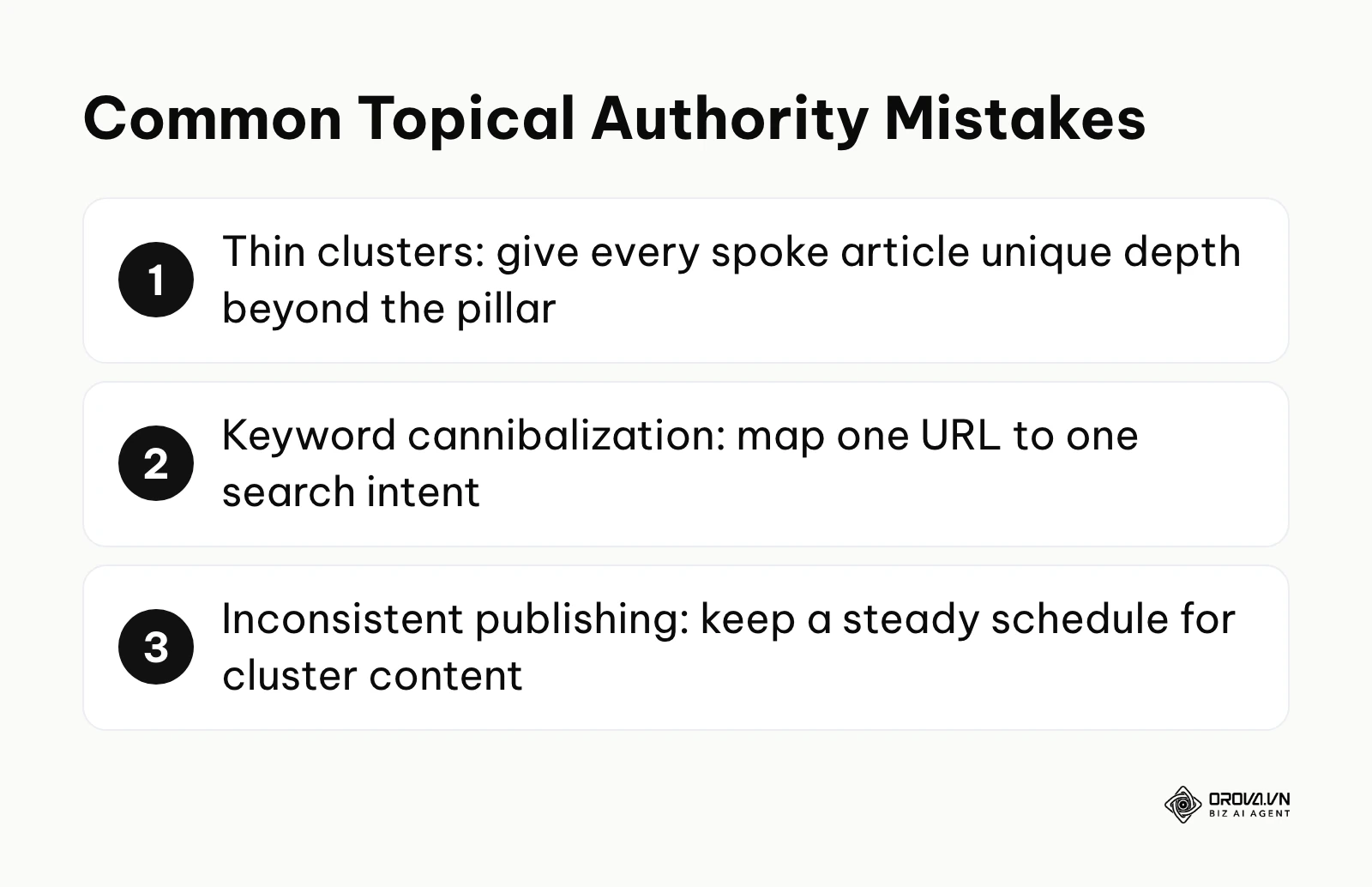
As you implement these changes, you must be careful to avoid common pitfalls that can derail your progress.
| Common Mistake | The Consequence | How to Avoid It |
|---|---|---|
| Creating "Thin" Clusters | Search engines classify your site as superficial and lower your rankings. | Ensure every spoke article provides unique, deep value beyond the pillar page. |
| Keyword Cannibalization | Multiple pages on your site compete against each other, confusing the algorithm. | Map search intents strictly; only one URL should target one specific intent. |
| Inconsistent Publishing | Crawlers may visit your site less often and pick up new cluster pages more slowly. | Maintain a steady, predictable publishing schedule for your cluster content. |
With OROVA.VN and the OROVA SEO module, you put an end to the exhausting days of manual work for good. Instead of struggling for hours to write articles and compile reports, the entire process is now optimized and completed in just 5 minutes.
Where Topical Authority Is Heading in the Next Few Years: The Author's Take
As of 2026, the landscape of search is rapidly shifting from basic keyword-matching to deep entity-understanding. Based on the signals visible today, I think topical authority will evolve in three directions over the next few years. These are opinions, not certainties.
Trend 1: AI Search Will Demand Deeper Niche Expertise
Currently, AI Overviews and generative search features aggregate basic information very efficiently. My read is that in the next two to three years, broad, surface-level content is likely to lose much of its visibility in search results, and AI answers will lean toward citing domains that demonstrate extreme, hyper-specific expertise that the model cannot generate on its own. To prepare for this, you should start narrowing your content focus today, producing original research, proprietary data, and expert interviews rather than simply rewriting what is already ranking on page one. However, this prediction could be entirely wrong if AI search engines decide to prioritize massive publisher networks with high domain authority over specialized niche sites, regardless of actual content depth.
Trend 2: The Rise of Micro-Clusters
Today, large and sprawling websites often report more pages left unindexed than tightly focused sites do. I believe that successful SEOs over the next two to three years will pivot toward building "micro-clusters"—tightly knit groups of 5 to 10 highly technical articles—rather than massive 100-page hubs that try to cover everything. This micro approach can make indexing easier and entity signals sharper. You should begin auditing your massive clusters now and breaking them down into highly focused sub-directories. This assumption might fail if search algorithms revert to favoring monolithic, endlessly scrolling pillar pages that keep users on a single URL for longer periods.
Trend 3: Content Velocity Will Require Stricter Quality Control
With the widespread adoption of automated writing tools, the web is flooding with mediocre, repetitive content. I think that in the next two to three years search engines will lean more on topical focus as a quality filter, making it harder for sites that publish off-topic or generic content at high speed to rank. To protect your site, you must implement strict editorial guardrails now, ensuring every piece strictly aligns with your core entities. Of course, this could change if search engines develop more advanced, lenient ways to evaluate individual page quality in isolation without heavily weighing the surrounding domain context.
Frequently Asked Questions About Topical Authority
How to build topical authority for multi-niche websites?
Multi-niche platforms face unique challenges when attempting to build topical authority across diverse categories. The key is strict compartmentalization. You must use clear URL structures (like /category-name/topic-name/) and prevent cross-linking between unrelated niches. Each category must operate as its own isolated topic cluster, effectively building multiple mini-authorities within a single domain.
Can you measure topical authority directly in GSC?
You cannot find a single metric called "topical authority" inside Google Search Console. However, you can measure the symptoms of it. By exporting your query data and grouping it by topic using Google Sheets, you can calculate the total impressions and average click-through rate for a specific cluster. A rapid increase in impressions for long-tail keywords within a single category is the clearest direct indicator that Google is beginning to view your site as a topical authority.
Does content pruning really help topical authority?
Yes, content pruning is often the fastest way to improve your topical authority, especially for older domains. Google's guidance on creating helpful, people-first content asks site owners whether their site has a clear primary purpose or focus. By removing or merging low-quality, off-topic pages, you increase the average quality and topical concentration of your overall domain, making your core expertise much more obvious to search crawlers.
Is topical authority still relevant with AI search?
Yes, it is more relevant than ever. AI search engines and large language models need reliable sources to ground their generated answers. They are designed to extract facts from domains that exhibit a high density of related entities and deep topical coverage. If your site lacks topical authority, AI search tools are more likely to bypass your content in favor of a more comprehensive niche expert.
What is the difference between topical authority and domain authority?
Domain authority is a third-party metric that estimates a website's ranking power based primarily on the quantity and quality of external backlinks pointing to it. Topical authority is a conceptual measure of how deeply and comprehensively a website covers a specific subject. A new website can have very low domain authority but exceptionally high topical authority if it has mapped out and answered every possible question within a tight, specific niche.
Where to Start with Your Topical Authority Strategy?
You do not need to overhaul your entire website overnight. The best way to start building a topical authority SEO strategy depends entirely on the current state of your digital assets. Identify which of these three situations best describes you, and take the single corresponding action.
If you are starting completely from scratch with a brand new domain, your first step is to map your entities. Sit down with a blank document and write down the absolute core product or service you offer. From there, brainstorm the 10 most fundamental questions a beginner would ask about that product. This list becomes the exact blueprint for your first tightly-knit topic cluster. You can complete this mapping exercise in a single afternoon.
If you already have a blog but your content is fragmented across dozens of unrelated topics, your immediate action is to stop publishing new content and start auditing. Your first step is to group all your existing URLs into categories using a spreadsheet. Identify which category has the highest volume of quality articles, and declare that your primary topic cluster.
If you have been publishing consistently within a niche but are not measuring the results, your first step is to establish your baseline data. Export your last 12 months of query data from Google Search Console into a spreadsheet and apply the grouping formulas discussed earlier. Finding out exactly which sub-topics are generating high impressions but zero clicks will immediately tell you where your topical authority is currently failing, giving you a clear target for your next content update.
About the author

Builder of Orova
Nguyễn Đỗ Trọng Ân has 8 years of experience in marketing, including 6 years managing market development across Asia. He builds Orova, a Biz AI Agent that never sleeps: it plans, runs and optimizes work for businesses.
Run your business with AI Agents
Orova is the always-on Biz AI Agent — it plans, runs, and optimizes the work for you.
Save time, unlock productivity.