
The cost of TikTok ads in 2026: minimum budgets, creative costs and a budget formula

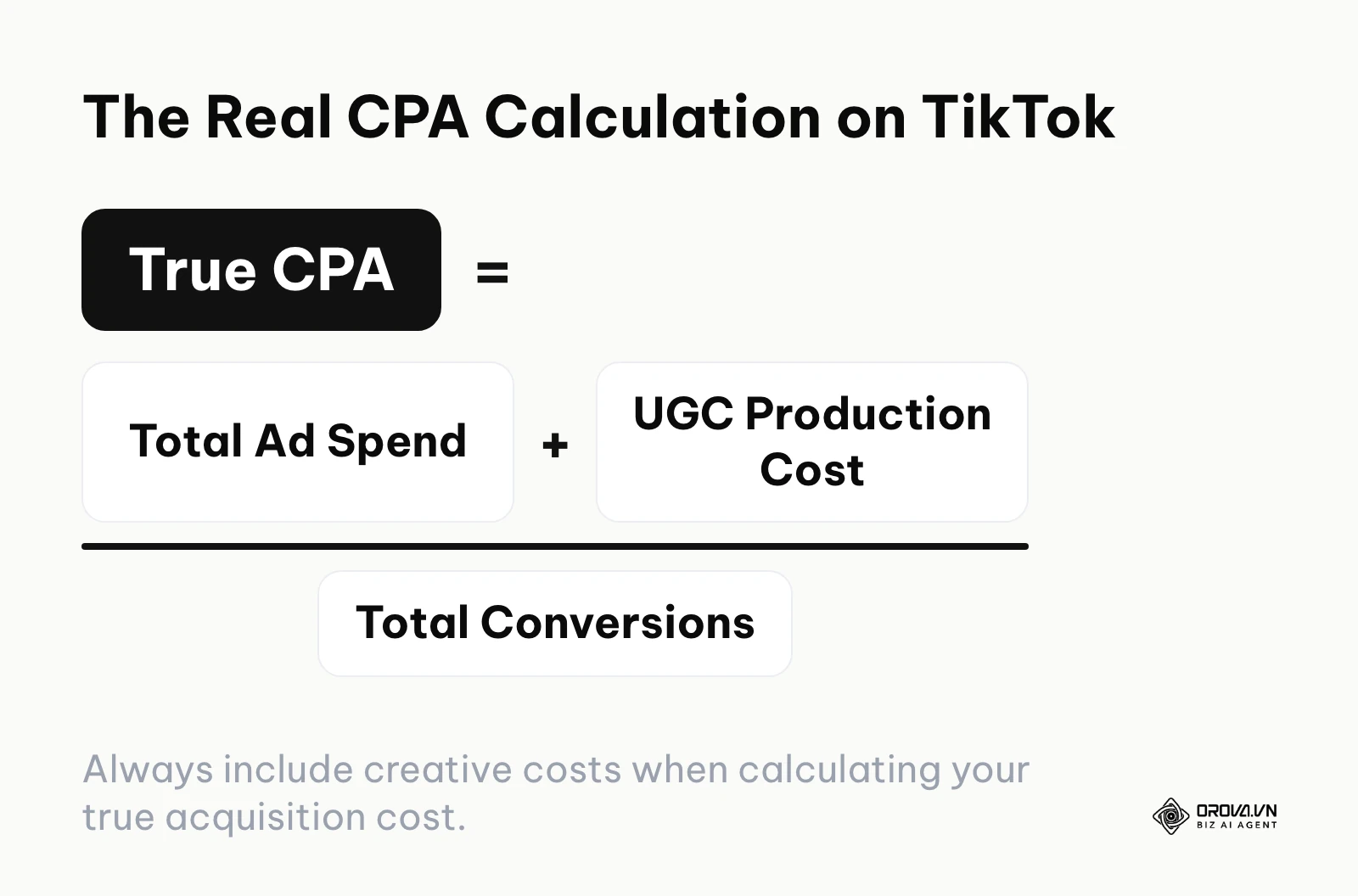
The cost of TikTok ads has two parts. The first is media spend paid to TikTok: there is no fixed price per ad, because you buy impressions and clicks in an auction, but TikTok does set minimum daily budgets of 50 dollars per campaign and 20 dollars per ad group (figures for US dollar accounts). The second part is the cost of producing native vertical videos, which many advertisers forget to budget. Your real cost per customer is the sum of both, divided by the customers you win. This article breaks down each part, shows a step-by-step framework to launch with a small 500 dollars test budget, and gives you a formula you can copy into a spreadsheet to estimate your own cost per acquisition and Return on Ad Spend (ROAS) before you spend.
Understanding the real cost of TikTok ads
The cost of TikTok ads is the total financial investment required to launch, sustain, and optimize campaigns on the TikTok advertising network, encompassing both the mandatory media spend paid directly to the platform and the operational costs of producing native video content. Grasping this true cost prevents you from prematurely burning through your budget and failing to exit the algorithmic learning phase. Any brand aiming to capture the attention of a younger, highly engaged demographic should factor this into their planning. Conversely, businesses selling hyper-niche B2B enterprise software or those unwilling to invest in constant video production should strongly reconsider before jumping in.
To fully understand how you will be charged, you must first separate the platform's minimum requirements from the actual auction costs. TikTok enforces floor limits on budgets. In TikTok Ads Manager, a campaign budget must be at least 50 dollars per day, and an ad group daily budget must be at least 20 dollars per day; accounts in other currencies have their own equivalents, and TikTok can update these rules, so confirm the current figures in Ads Manager before you plan. If you attempt to set anything lower, the interface will not let you publish. This means that if you run one campaign with two ad groups for 30 days, you commit to at least 1,200 dollars of media spend (2 ad groups × 20 dollars × 30 days), or 1,500 dollars if you also set a campaign-level budget (50 dollars × 30 days).
Beyond the minimums, TikTok sells ad delivery through an auction, and most advertisers judge cost with Cost Per Mille (CPM), the cost per 1,000 impressions. There is no official average CPM you can rely on: the price changes with your target country, audience, industry, season and, above all, how well your video holds attention. Broad audiences with entertainment-style creatives tend to cost less per impression than competitive niches such as finance or beauty, and when CPM rises your Cost Per Click (CPC) and Cost Per Acquisition (CPA) rise with it. The primary mistake marketers make is treating benchmark numbers from blog posts as fixed prices, when the only CPM that matters is the one your own account reports after a few days of spend.
Preparing your budget: The hidden costs of UGC and creatives
Before you even touch the ads manager, you must assemble the necessary assets. The biggest shock for new advertisers is discovering that the media spend is only one half of the equation. Because TikTok is an entertainment platform first, traditional corporate commercials are immediately swiped away. You need native, authentic-looking videos, commonly referred to as User Generated Content (UGC). Producing this content requires either paying creators, hiring an agency, or investing heavily in in-house equipment and talent.
If you are planning your overall strategy, you must dive deep into the ads budget to allocate funds specifically for creative testing. A video that performs wonderfully today will suffer from "ad fatigue" in a matter of weeks, sometimes days. The platform's audience consumes content so rapidly that your ads become stale at an unprecedented rate. Therefore, your budget preparation must account for a continuous pipeline of new video assets.
| Necessary Asset | Where to Source It | Estimated Time to Prepare |
|---|---|---|
| UGC Video Scripts | In-house marketing team or freelance copywriters | 2 to 4 days |
| Authentic Video Footage | KOCs (Key Opinion Consumers), influencer marketplaces, or in-house staff | 7 to 14 days |
| Video Editing & Hooks | Freelance video editors or dedicated agency | 3 to 5 days |
| Tracking Pixel Implementation | Web developer or e-commerce platform integration | 1 to 2 days |
| Minimum Initial Media Budget | Your corporate credit card (minimum 50 dollars/day) | Immediate upon launch |
Illustrative example:
- Context: A mid-sized indie skincare brand wanted to launch their first major TikTok campaign with a budget of 3,000 dollars. They assumed this was plenty of money to generate sales for their new acne serum.
- Steps Taken: They put the whole budget into media spend and nothing into new creative, promoting a highly polished commercial they had already used on television. They ignored the need for native content.
- Hurdle & Fix: The ad was skipped instantly. Their CPM was artificially inflated by the algorithm because the engagement rate was abysmal, leading to a CPA of 85 dollars (their product only cost 30 dollars). They paused the campaign, reallocated 1,000 dollars to hire five different micro-influencers to shoot raw, selfie-style reviews in their bathrooms, and relaunched.
- Result: By balancing the budget and prioritizing native production, their engagement skyrocketed. The algorithm rewarded the high watch time with lower auction costs, bringing their CPA down to a highly profitable 12 dollars within two weeks.
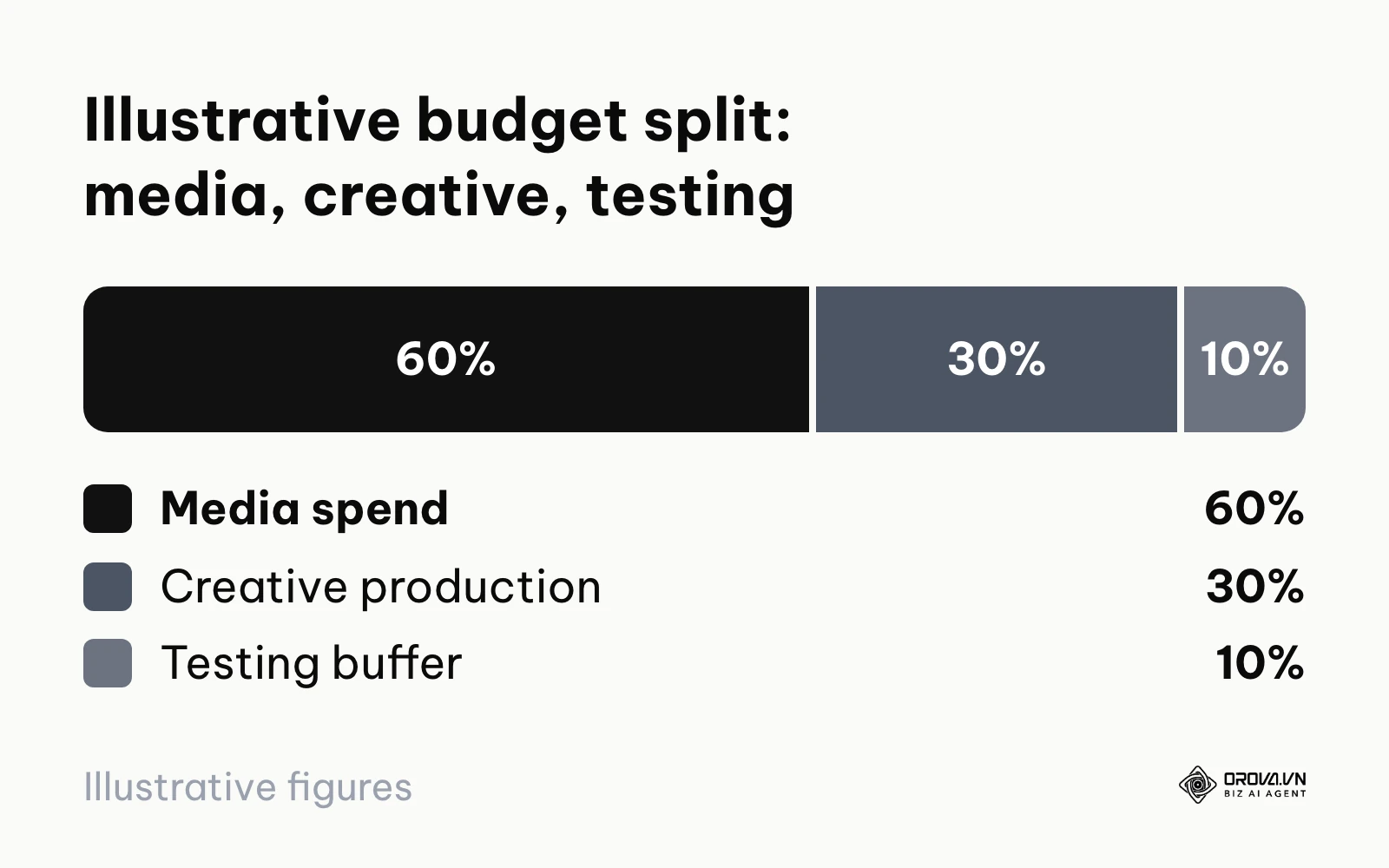
Creator rates vary widely by market, follower count and usage rights, so collect two or three real quotes before you set the number. Then do the arithmetic. Illustrative example: if a creator quotes 200 dollars per video and you want to test five different angles, the creative line is 5 × 200 = 1,000 dollars before a single impression is bought. One simple way to structure the plan is an illustrative split of 60% media spend, 30% creative production and 10% testing buffer; with a 2,000 dollars monthly plan that is 1,200, 600 and 200 dollars. Adjust the ratio to your own quotes rather than treating it as a rule. Neither number includes the time spent negotiating, shipping physical products to the creators, and managing revisions. You must treat creative production as a recurring monthly operating expense, not a one-time setup fee.
6 steps to launch your first campaign with a 500 dollars budget
Launching with a massive budget covers up a lot of mistakes, but when you are working with exactly 500 dollars, every single dollar must be optimized. You do not have the luxury of letting the algorithm wander aimlessly. This section provides a meticulous, chronological framework for setting up an efficient test. If you want a broader overview of advanced tactics, you can explore the comprehensive TikTok ads guide.
Step 1: Mapping the 500 dollars budget allocation across ad groups
The very first action is deciding exactly how the money will be divided over time. With a strict 500 dollars limit, you cannot run a month-long campaign.
To execute this, you must accept the platform's minimums. Each ad group needs at least 20 dollars per day, so two ad groups at 25 dollars each spend 50 dollars per day, which also meets the 50 dollars campaign minimum if you set a campaign budget. At this rate, your 500 dollars will last exactly 10 days (500 ÷ 50 = 10). Do not create more than two ad groups; doing so will spread your budget too thin, preventing any single group from gathering enough data. In the ad group settings, you will input the daily budget limit.
A clear sign that you have done this correctly is when Ads Manager accepts both budgets without warnings and your estimated audience is not flagged as too narrow. A common error at this stage is choosing a lifetime budget of 500 dollars spread over a long schedule, which paces delivery so thinly that you get very little meaningful data on any given day.
Step 2: Selecting the right campaign objective to avoid wasted spend
Choosing the wrong objective is the fastest way to burn your 500 dollars. The platform will give you exactly what you ask for. If you ask for traffic, it will find people who click links but never buy.
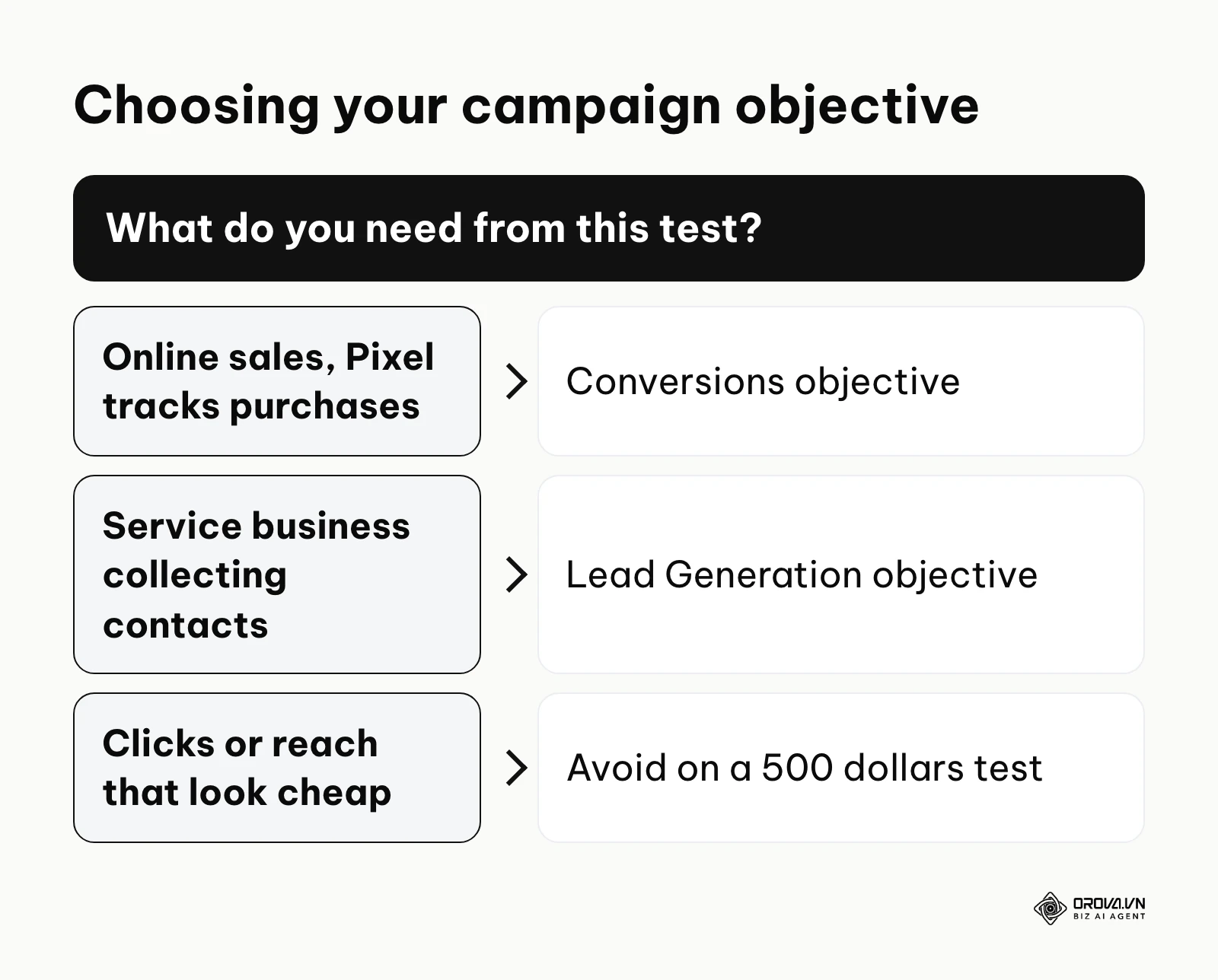
To choose correctly, navigate to the campaign creation screen. If you are an e-commerce brand seeking immediate sales, you must select "Conversions". If you are a service-based business collecting emails, select "Lead Generation". You must ensure your TikTok Pixel is fully installed and tracking the specific event (like "Complete Payment" or "Submit Form") before selecting these objectives.
You will know you have made the right choice when your reporting dashboard begins populating with actual bottom-funnel events rather than just superficial clicks. The most frequent mistake beginners make is selecting "Reach" or "Traffic" because the estimated costs per result look incredibly cheap. They end up with 10,000 visitors and zero dollars in revenue, completely wasting the test budget.
| Objective | Best Use Case | Risk with Small Budget |
|---|---|---|
| Reach / Awareness | Large corporations wanting brand visibility | Burns money without driving any measurable sales. |
| Traffic | Content sites monetizing via ad impressions | Drives low-intent users who click and immediately bounce. |
| Conversions | E-commerce stores with functional pixels | Might fail to deliver if the budget is too low to find buyers. |
| Lead Generation | B2B or high-ticket service providers | Can yield low-quality leads if the form is too short. |
Step 3: Setting the bids and daily budgets to pass the learning phase
A new ad group goes through a learning phase while the system collects optimization events, and TikTok's guidance is that it needs roughly 50 of them to stabilize; check the Help Center for the current rule. With a small budget, hitting this threshold is mathematically difficult: at a 25 dollars CPA, 50 conversions already cost 1,250 dollars.
To optimize your chances, use the lowest-cost bid strategy (labeled "Maximum Delivery" in recent versions of Ads Manager). This tells the system to get as many results as possible for your 25 dollars daily ad group budget. Do not use Cost Cap bidding when you only have 500 dollars. Cost Cap restricts the algorithm from exploring, and if your cap is even slightly too low, the platform will simply refuse to spend your money.
The success metric here is consistent daily spending. If you check your account at 5 PM and see that the platform has spent the appropriate fraction of your daily budget, the bidding is working. The worst mistake you can make is setting a strict manual bid (e.g., bidding 5 dollars per purchase when your product costs 100 dollars). The system will realize it cannot win any auctions at that price and your campaign delivery will completely stall, leaving your budget unspent and your data empty.
Step 4: Sourcing and testing UGC creatives within the budget
Since you cannot afford a Hollywood production on a 500 dollars budget, you must rely on gritty, authentic user generated content ads. The creative is the most critical variable in determining your ad cost.
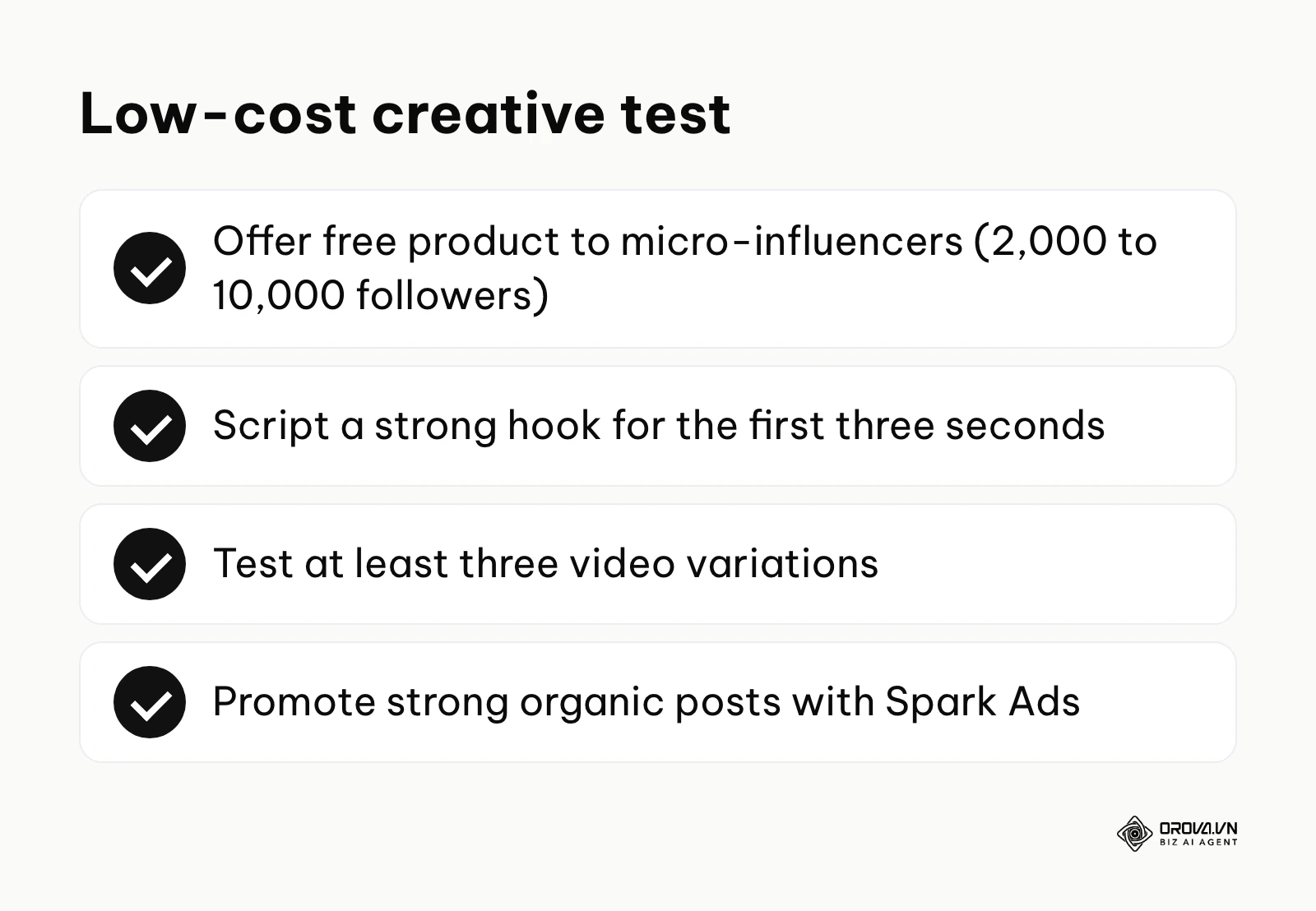
To execute this cheaply, bypass expensive influencer agencies. Instead, offer free products to micro-influencers (creators with 2,000 to 10,000 followers) in exchange for raw video footage. Give them a strict script focusing on a strong "hook" in the first three seconds, followed by a demonstration of the product solving a specific problem. You need at least three distinct video variations to test. Upload these three videos into your ad groups and let them compete against each other. If a creator has already posted a video that performs well organically, you can also promote that post with TikTok Spark Ads instead of paying for a fresh edit.
You will know the creative is working when its hook rate (video views at 2 seconds divided by impressions, a ratio you calculate from the reporting columns) is clearly higher than the rest of your creatives. There is no universal pass mark, so compare your videos against each other rather than against a number from someone else's account. The most common failure point is uploading a single video that looks too polished, triggering the user's "ad blindness" and resulting in immediate swipes, which drastically inflates your CPM and drains the budget instantly.
Illustrative example:
- Context: An independent game developer had a hard cap of 500 dollars to promote their new mobile puzzle game. They had no money to hire actors or professional editors.
- Steps Taken: Instead of buying expensive cinematic trailers, the developer used their own smartphone to film themselves playing the game while talking directly to the camera about how frustrating a specific level was. They edited three slightly different variations of the opening sentence natively in the TikTok app, added trending background music, and launched the campaign using the lowest-cost (Maximum Delivery) strategy.
- Hurdle & Fix: On day two, one video was consuming 90% of the budget but generating very expensive installs. The developer did not panic or pause the campaign; instead, they let the algorithm finish its initial exploration.
- Result: By day four, the algorithm shifted the budget to the second video variation, which had a much stronger hook. The Cost Per Install dropped from 4.50 dollars to 0.80 dollars, allowing the developer to acquire over 400 new players within their strict 500 dollars limit.
Step 5: Configuring targeting without restricting the algorithm
Advertisers often believe that hyper-specific targeting is the key to cost efficiency. On TikTok, the exact opposite is true. The algorithm's content recommendation engine is incredibly powerful; it knows who wants your product based on how they interact with the video itself.
To configure this, leave your targeting surprisingly broad. Select your target country and perhaps an age restriction if your product legally requires it (e.g., 18+). Do not layer dozens of specific interests and behaviors. When you stack interests like "Loves dogs", "Reads sci-fi", and "Drinks espresso", you drastically shrink the audience pool.
You have set it up correctly when the estimated audience size in Ads Manager is large and not flagged as narrow. A classic mistake is stacking filters until the audience estimate shrinks to a small fraction of the country. When the pool is that small, the system has to aggressively bid against competitors to reach those specific users, driving your auction costs through the roof and depleting your small budget rapidly.
| Targeting Element | Recommendation for 500 dollars Budget | Reason |
|---|---|---|
| Demographics (Age/Gender) | Keep broad unless absolutely necessary | Let the creative filter the audience. |
| Interests | Leave blank or pick one major category | Over-segmentation increases CPM. |
| Behaviors (Video Interactions) | Leave blank | Limits the system's exploration phase. |
| Custom Audiences (Retargeting) | Avoid for this specific test | You need fresh data, not a small pool. |
Step 6: Monitoring the first week of learning and cutting losses
The final step is the psychological battle of monitoring the campaign without interfering. The learning phase is volatile. Your CPA might double one day and drop the next as the system tests different user pockets.
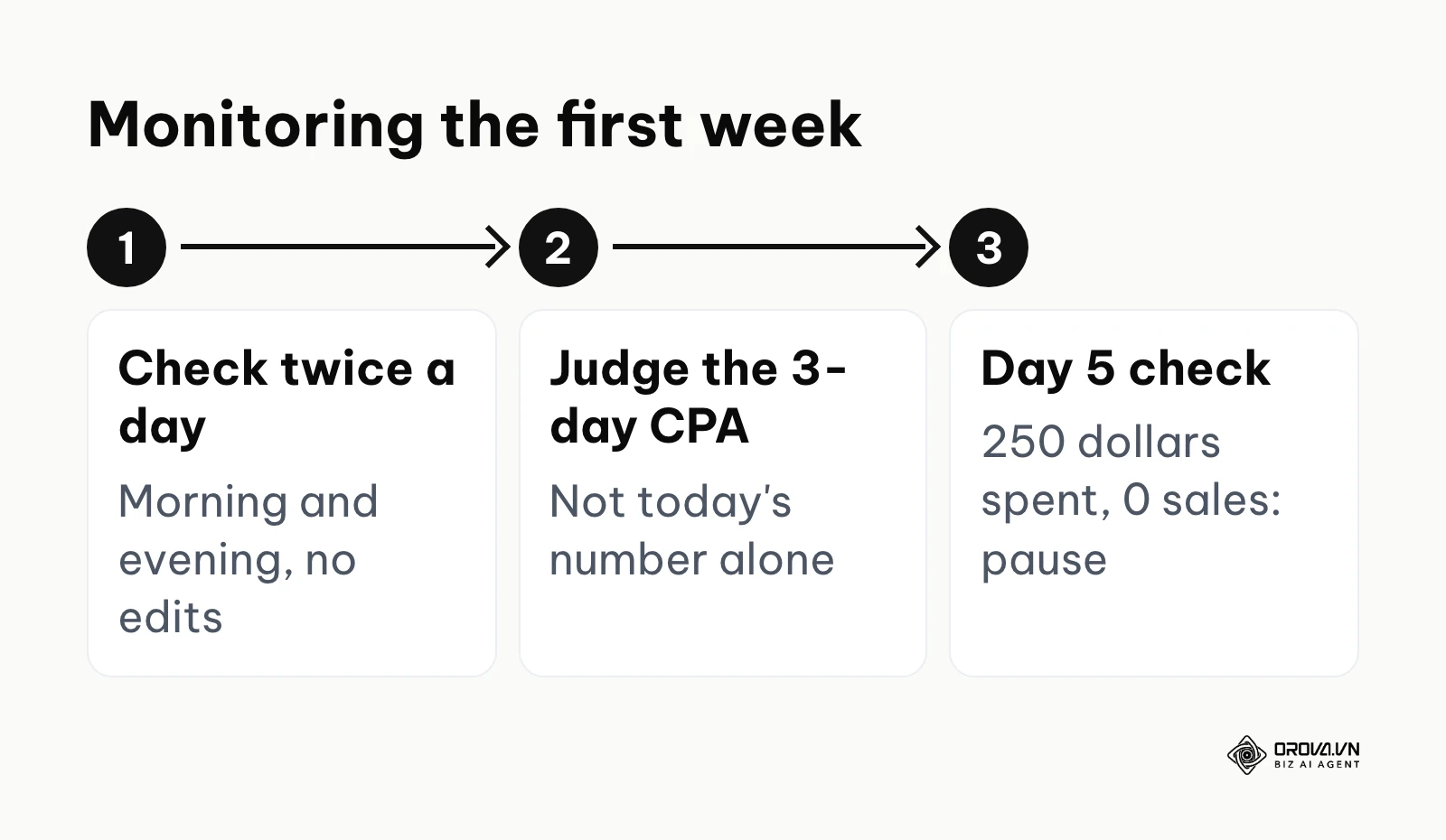
To monitor effectively, set up a daily routine to check the dashboard once in the morning and once in the evening. Look at the aggregate CPA over the past 3 days, not just today's performance. The golden rule is: do not change the budget, do not swap the creatives, and do not tweak the targeting during these first 7 days. Any significant edit will completely reset the learning phase back to zero, wasting the money you have already spent.
A sign of success is seeing the CPA slowly stabilize and trend downwards as conversions accumulate. The most fatal error advertisers make is pausing the campaign on day three because the costs look slightly higher than expected. By panicking and pulling the plug early, they guarantee that the 500 dollars was wasted on incomplete machine learning. If, however, by day five you have spent 250 dollars and have zero conversions, it is time to manually intervene, pause the ads, and realize your creative completely failed the market test.
OROVA ADS applies AI Agent to automate and optimize ad performance on Google, Meta and TikTok. Scale your budget safely, monitor 24/7 and expand your business quickly.
Experience the solution at orova.vn/ads
Deep dive analysis: TikTok ads cost vs Facebook ads
Understanding the platform's cost structure is impossible without comparing it to the industry giant. Marketers frequently debate whether to allocate budget to Meta or TikTok. Both operate on dynamic auctions, but the underlying user psychology and ad delivery mechanisms dictate vastly different cost realities. For an intricate look at how Meta handles strict budgeting, you can review how to manage a Facebook ads cost cap, and for a wider view of where each network fits, see this overview of paid ad platforms.
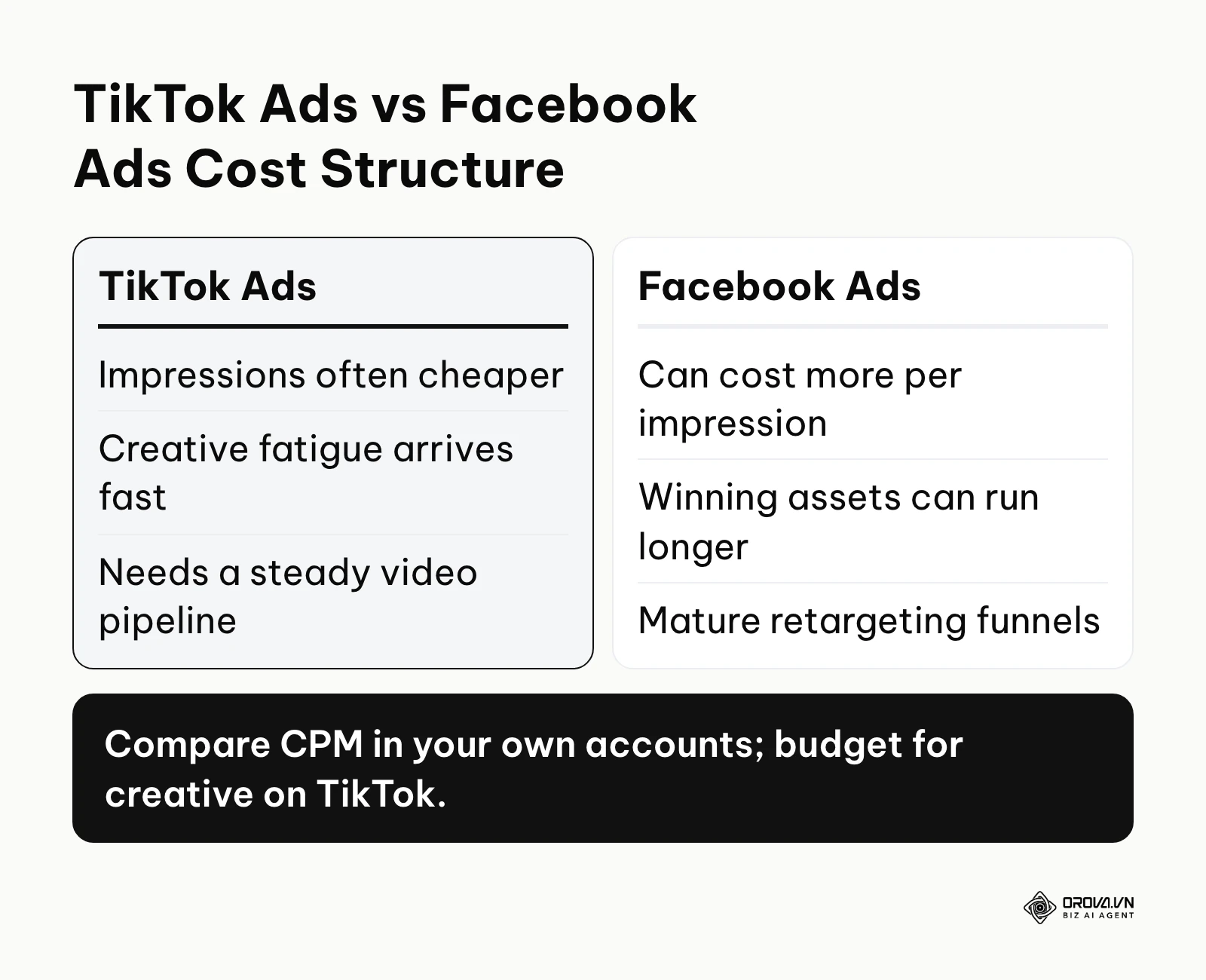
The primary difference lies in the cost of impressions versus the cost of creative maintenance. Many advertisers find TikTok impressions cheaper than Facebook and Instagram feed impressions, because users swipe through a large number of videos in each session and the platform has plenty of inventory to serve ads. That is a tendency, not a guarantee: neither platform publishes an official average CPM, and the gap depends on your country, audience and season. The only reliable comparison is running both with similar budgets and reading the CPM each one reports for your account.
However, this cheap distribution comes with a severe trade-off: ad fatigue. On Facebook, a highly effective image banner or a well-produced video can sometimes run profitably for months. The Meta algorithm is exceptionally skilled at finding new pockets of buyers for the same asset. On TikTok, the culture demands novelty. An ad that generates a 10 dollars CPA on Monday might suddenly shoot up to a 40 dollars CPA the following week because the audience has grown entirely blind to it.
| Advertising Platform | Best Suited For | Primary Cost Weakness |
|---|---|---|
| TikTok Ads | Rapid awareness, Gen Z/Millennial targeting, trend-driven products | Extremely high creative fatigue; requires constant video production budget. |
| Facebook Ads (Meta) | Stable scaling, older demographics, complex retargeting funnels | Impressions can cost more in competitive markets; reaching new users may be pricier. |
| Instagram Reels | Visual aesthetics, influencer whitelisting, lifestyle brands | High competition for premium ad inventory drives up costs during peak seasons. |
Illustrative example:
- Context: A popular e-commerce apparel store was spending 10,000 dollars a month on Meta ads but noticed their CPA creeping up as the audience aged. They decided to migrate 3,000 dollars of that budget to test TikTok ads.
- Steps Taken: They built a dedicated TikTok campaign using the exact same video assets that were currently winning on Instagram Reels. They set up the tracking pixel and mirrored their Meta targeting strategy, expecting similar results but with cheaper impressions.
- Hurdle & Fix: While the CPM in their TikTok account was lower than in their Meta account, their conversion rate was abysmal. The Instagram videos felt too polished and "salesy" for the TikTok feed. They paused the campaign, spent a week filming lo-fi, unboxing-style videos with raw audio, and relaunched.
- Result: The raw, platform-native videos resonated immediately. Not only did they maintain the low CPM, but the click-through rate doubled. They successfully unlocked a new revenue stream, realizing that the platform shift required a total creative overhaul to achieve profitability.
When deciding where to put your money, you must look at your internal resources. If you have a strong graphic design team but weak video capabilities, the cheap CPMs on TikTok will be entirely offset by your inability to produce content. Conversely, if you have a charismatic founder or a network of creators ready to churn out authentic clips daily, TikTok offers a significantly more cost-effective entry point for massive reach.
Measuring ROI: a do-it-yourself TikTok ads budget formula
You cannot manage what you do not measure. A frequent pitfall for marketers is looking solely at the platform's reported CPA and assuming it reflects their actual business profit. To truly evaluate the cost of your advertising efforts, you must build a comprehensive calculation framework that includes your profit margins, media spend, and creative expenses.
The most important metric to track is your Return on Ad Spend (ROAS). ROAS tells you how many dollars in revenue you generate for every dollar spent on ads. However, you must differentiate between Platform ROAS (the number the dashboard shows you) and True ROAS (your actual business reality). Platform ROAS often takes credit for sales that might have happened anyway, or it fails to account for the 500 dollars you paid an editor.
To calculate your True CPA and determine your break-even point, you must follow this specific mathematical process. First, determine your product's gross margin. If you sell a pair of shoes for 100 dollars and it costs you 40 dollars to manufacture and ship them, your gross profit is 60 dollars. This 60 dollars is your Break-Even CPA. If you spend exactly 60 dollars on ads to acquire a customer, you make zero profit. Therefore, your Target CPA on the TikTok dashboard must be significantly lower than 60 dollars to maintain a healthy business.
| Key Metric | What It Means in Practice | Warning Threshold (When to worry) |
|---|---|---|
| Cost Per Mille (CPM) | The baseline cost for platform visibility. Dictated by competition and creative quality. | A sharp jump compared with your own last 7 days, with no change in targeting or budget. |
| Click-Through Rate (CTR) | The percentage of viewers who actually tap your link. Measures hook effectiveness. | A steady decline on the same creative over several days. |
| Cost Per Click (CPC) | How much you pay for a site visitor. Calculated as CPM ÷ (1,000 × CTR). | Higher than the CPC at which your break-even CPA still works (see the formula below). |
| True Cost Per Acquisition (CPA) | Total spend (Media + Creative) divided by Total Purchases. | Exceeds your product's gross profit per sale (you are losing money). |
There is no official TikTok calculator for this, but you can build your own budget calculator in a spreadsheet in a few minutes. Create columns for: Daily Budget, Expected CPM, Expected CTR, Expected Conversion Rate (from your website), and Gross Profit Per Item. The figures below are an illustrative example, not benchmarks; replace them with numbers from your own account.
- Input your Daily Budget (e.g., 100 dollars).
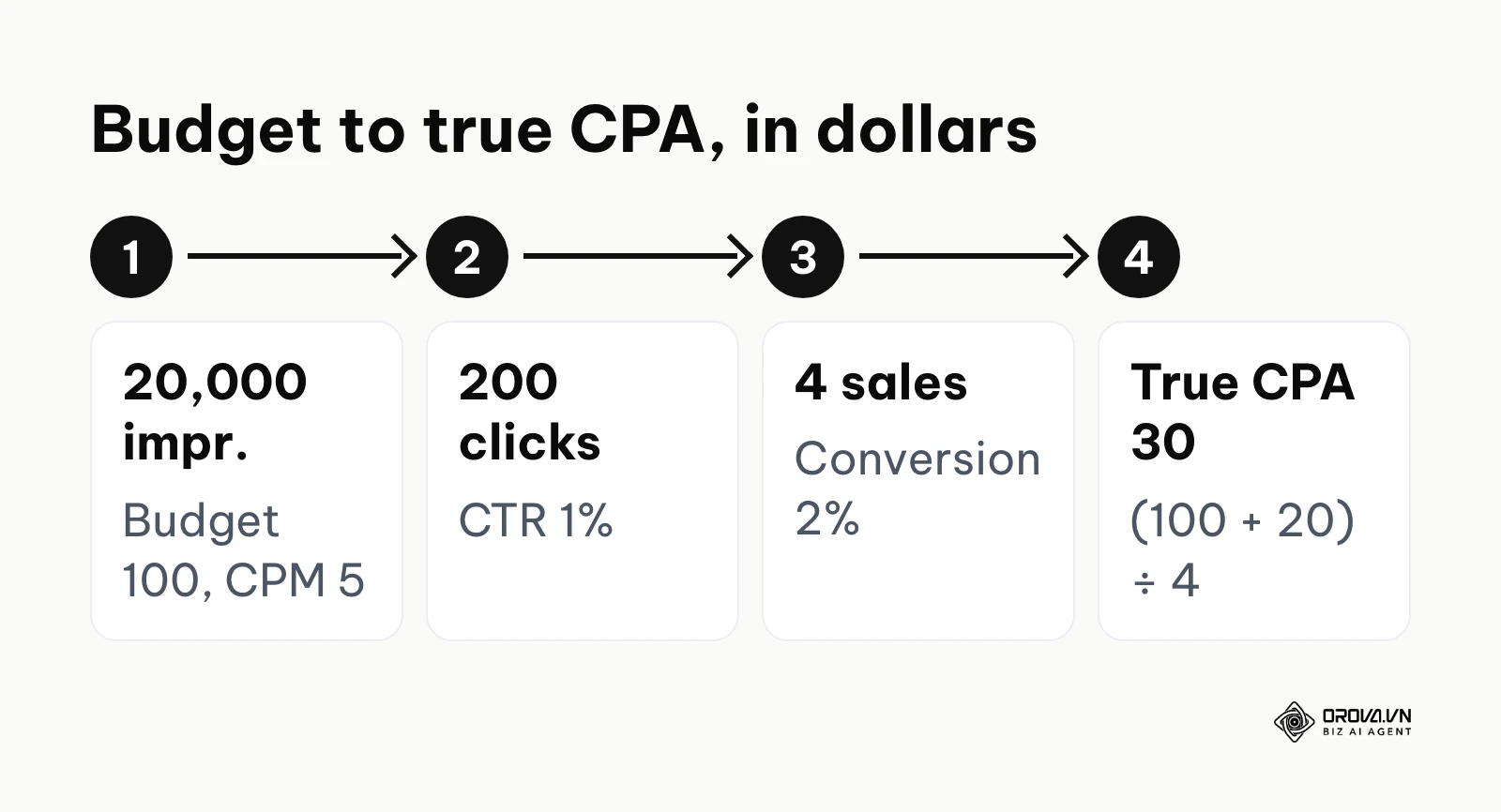
- Input an estimated CPM (e.g., 5 dollars). Impressions = Budget ÷ CPM × 1,000, so 100 ÷ 5 × 1,000 = 20,000 impressions.
- Apply your CTR (e.g., 1%). 20,000 impressions × 1% = 200 clicks, which means a CPC of 100 ÷ 200 = 0.50 dollars.
- Apply your Website Conversion Rate (e.g., 2%). 200 clicks × 2% = 4 purchases.
- Calculate your media CPA: 100 dollars spend ÷ 4 purchases = 25 dollars CPA.
- Add creative cost to get the true CPA. If this day carries 20 dollars of your monthly creative budget, the true CPA is (100 + 20) ÷ 4 = 30 dollars.
If your gross profit is 60 dollars per item, 4 sales bring 240 dollars of gross profit; after 120 dollars of media and creative cost, you keep 120 dollars. By modeling these numbers before launching, you establish clear thresholds for when to scale up or pause a campaign.
Want to scale your budget but afraid of breaking performance? 📉
Integrate OROVA ADS now - an AI Agent that automatically monitors and optimizes Google, Meta, TikTok ads 24/7. Now, expanding and replicating your Performance Ads team is just one click away.
🚀 Try it now at: orova.vn/ads
Common mistakes that inflate your TikTok ads cost
Even with a perfect calculator and excellent creatives, operational mistakes within the ad account can quietly drain your budget. The platform's algorithm is sensitive, and user behavior is unforgiving. Below are the most frequent errors that artificially inflate advertising costs, along with actionable steps to correct them.
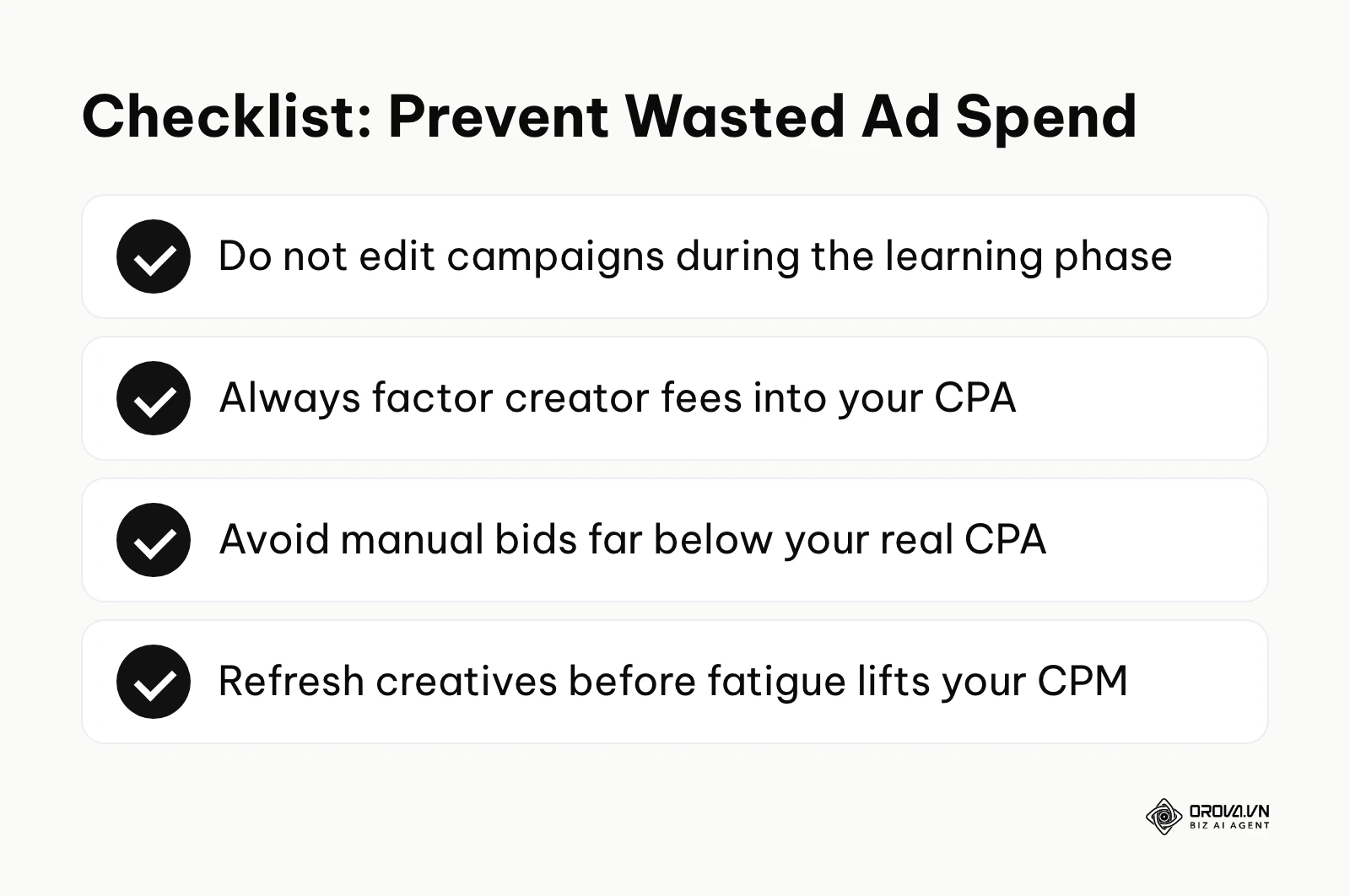
Mistake 1: Editing campaigns during the learning phase. Advertisers are notoriously impatient. When you launch a new ad group, the algorithm enters a highly volatile state where it actively tests different segments of your broad audience. This is the learning phase. If you change the budget, adjust the targeting, or swap out a creative on day three, you force the algorithm to start completely over. The consequence is that you pay the "tax" of exploration multiple times without ever reaping the benefits of optimization. The fix is absolute discipline: do not touch an ad group until it has spent at least three times your target CPA or passed the 7-day mark.
Mistake 2: Ignoring the hook rate. Many media buyers obsess over the final CPA and ignore the top-of-funnel metrics. On a video platform, the first three seconds dictate the cost of the entire auction. If users instantly scroll past your ad, the auction treats your video as less relevant, and you usually end up paying more for each impression you win. The consequence is that your clicks become unaffordably expensive. The fix is to meticulously track the percentage of users who watch past three seconds and relentlessly test new visual hooks until one creative clearly beats your current best.
Mistake 3: Scaling budgets too aggressively. When an advertiser sees a profitable 15 dollars CPA on a 50 dollars daily budget, their immediate instinct is to change the budget to 500 dollars the next day. The algorithm breaks under this pressure. It suddenly has to find ten times as many buyers in the same 24-hour window, forcing it to enter highly competitive, expensive auctions. The consequence is that the CPA skyrockets, entirely wiping out profitability. The fix is to scale vertically in small steps (for example, around 20% at a time, then wait a couple of days), or to scale horizontally by duplicating the successful ad group and running it alongside the original.
Mistake 4: Running the same creative without watching frequency. If you are targeting a smaller local audience or a highly specific niche, the algorithm will eventually run out of new people to show your ad to. It will start serving the same video to the same users multiple times a day. This builds active resentment toward your brand and guarantees no new conversions, while still charging you for the impressions. The consequence is a soaring CPA and a damaged brand reputation. The fix is to closely monitor the "Frequency" metric in your reporting and refresh the creatives when frequency keeps climbing while CTR keeps falling.
Mistake 5: Failing to implement robust pixel tracking. Relying solely on the platform's basic pixel often leads to data loss, especially with modern browser restrictions and ad blockers. If the algorithm cannot accurately "see" the purchases happening on your website, it cannot learn who the right buyers are. The consequence is that it optimizes blindly, throwing your budget at low-intent users. The fix is to implement server-side tracking (on TikTok, the Events API) to ensure maximum data fidelity is fed back into the system.
Future trends in TikTok advertising cost: my predictions
The digital advertising landscape is shifting rapidly, and the strategies that yield cheap conversions today will inevitably evolve. Based on what I see in the market today, here is how I think the cost dynamics may change over the next few years.
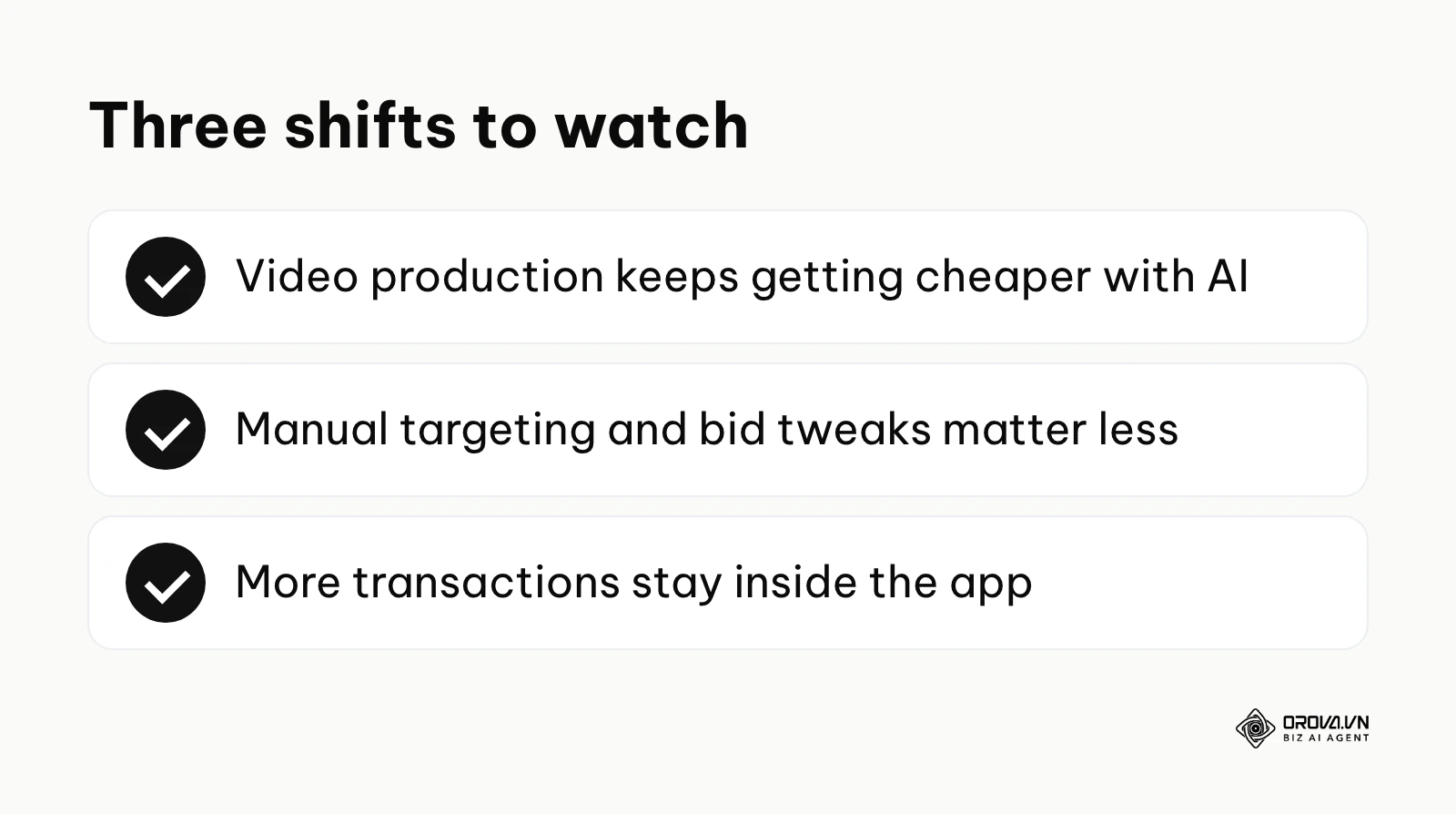
The total commoditization of video production
Currently, a significant portion of an advertiser's budget is locked up in hiring human creators for UGC. We are already seeing the early signs of AI-driven video generation entering the mainstream. I expect the cost of producing native-looking video content to keep falling. Advertisers will likely use AI to generate many video variations quickly. As production costs fall, the barrier to entry will lower, which means more competitors will flood the auction. You should prepare by mastering prompt engineering and building internal systems to rapidly test AI creatives, rather than relying solely on expensive agency retainers.
The death of manual bidding and audience targeting
We are witnessing a clear trend across all major platforms: the removal of manual controls. The algorithms are simply better at predicting user behavior than human media buyers. I believe that intricate interest targeting and granular bid adjustments will matter less and less. The cost of ads will increasingly be dictated by the platform's internal machine learning assessing the quality of your product and your creative asset. Advertisers should stop wasting time trying to "hack" the targeting settings and instead focus entirely on deep consumer psychology and offer creation.
The rise of mandatory full-funnel platform integration
As privacy rules and browser restrictions tighten, ad platforms are losing visibility into off-platform actions. I think keeping more of the transaction inside the TikTok ecosystem (for example, through TikTok Shop where it is available) will become an increasingly important way to protect your CPA, while sending traffic to an external website may get harder to optimize. If you want to keep costs down, it is worth testing in-app checkout options alongside your website, embracing a frictionless, in-app purchasing model.
Frequently asked questions about TikTok ads cost
Is there a minimum budget required to start?
Yes, TikTok enforces strict minimum daily budgets to ensure its algorithm has enough data to learn and optimize. For US dollar accounts, a campaign budget must be at least 50 dollars per day and an ad group daily budget at least 20 dollars per day; other currencies have their own equivalents. Ads Manager will not let you publish below these limits, so confirm the current figures there.
How much should I allocate for video production?
Your media spend is only part of the equation. There is no official ratio, but you should plan a separate creative line. In the illustrative 60/30/10 split above, creative takes 30% of the total plan, which equals half of the media spend. This covers hiring UGC creators, video editing, and constantly refreshing assets to combat aggressive ad fatigue.
Why is my Cost Per Click (CPC) suddenly spiking?
A sudden spike in CPC is almost always a symptom of creative fatigue. On fast-paced video platforms, users develop "ad blindness" very quickly. When your click-through rate drops because users are swiping past your stale video, the algorithm increases your CPM to compensate, which directly inflates your CPC. The immediate fix is to upload entirely new video creatives.
Does the algorithm favor higher budgets?
While the algorithm does not inherently "favor" wealthy accounts, a higher budget allows the system to exit the volatile learning phase much faster. With a larger budget, you reach the roughly 50 optimization events the learning phase needs sooner, allowing the machine learning models to stabilize and reliably find cheaper pockets of audiences.
Where should you start?
If you are a solo entrepreneur with zero assets: Do not open the ads manager yet. Your first step is to spend one afternoon thoroughly researching your competitors' organic content on the platform. Identify the visual hooks and script structures they use. Then, use your smartphone to record three raw, authentic videos demonstrating your product. You must have the creative assets ready before you commit a single dollar to the advertising auction.
If you have a small 500 dollars budget and are ready to test: Focus entirely on structuring a disciplined test environment. Spend an hour configuring a single campaign with two ad groups. Set the daily budget to 25 dollars per ad group and apply the lowest-cost (Maximum Delivery) bid strategy. Launch the campaign and commit to not touching any settings, pausing any ads, or altering the budget for the first full week to allow the learning phase to execute.
If you are currently running Meta ads and want to expand: Do not simply copy and paste your Instagram Reels into a new dashboard. Spend a day rebuilding your tracking infrastructure, ensuring your server-side pixel is firing correctly. Then, take your best-performing Meta concepts and hire a native creator to reshoot them specifically for the faster, less polished aesthetic of this new platform. Establish a separate creative pipeline before you shift significant budget over.
About the author

Builder of Orova
Nguyễn Đỗ Trọng Ân has 8 years of experience in marketing, including 6 years managing market development across Asia. He builds Orova, a Biz AI Agent that never sleeps: it plans, runs and optimizes work for businesses.
Run your business with AI Agents
Orova is the always-on Biz AI Agent — it plans, runs, and optimizes the work for you.
Save time, unlock productivity.