
Facebook ads cost cap: how to set it and fix delivery

You launch a highly anticipated digital marketing campaign, and you get incredibly cheap sales on day one. You feel like a genius. Then, the costs inevitably skyrocket on day three, completely destroying your profit margins. You attempt to scale the daily budget, but the algorithm just burns through your money without bringing any conversions. This agonizing cycle of boom and bust is the exact scenario where mastering facebook ads cost cap becomes absolutely critical. In short, cost cap is a Meta bid strategy that tries to get you as many results as possible while keeping your average cost per result around the amount you set. Instead of letting the platform dictate your customer acquisition cost based on auction volatility, this specialized bidding strategy forces the algorithmic machine to prioritize your specific business profit margins. However, many ambitious advertisers actively avoid it because their campaigns simply stop delivering when the cap is applied—leaving them staring at zero impressions. This deep-dive guide provides a highly technical, step-by-step breakdown of how to accurately calculate your break-even point, build a sustainable campaign structure, and troubleshoot delivery freezes so you can scale profitably.
What is Facebook ads cost cap and who should use it?
Facebook ads cost cap is an advanced, automated bidding strategy designed to tell the Meta algorithm to maximize your conversion volume while keeping the average cost per action (CPA) around a specific financial target you set. Meta's own help pages are clear that the cost of individual results can go above the cap on some days; the goal is the average, not a hard limit on every sale.
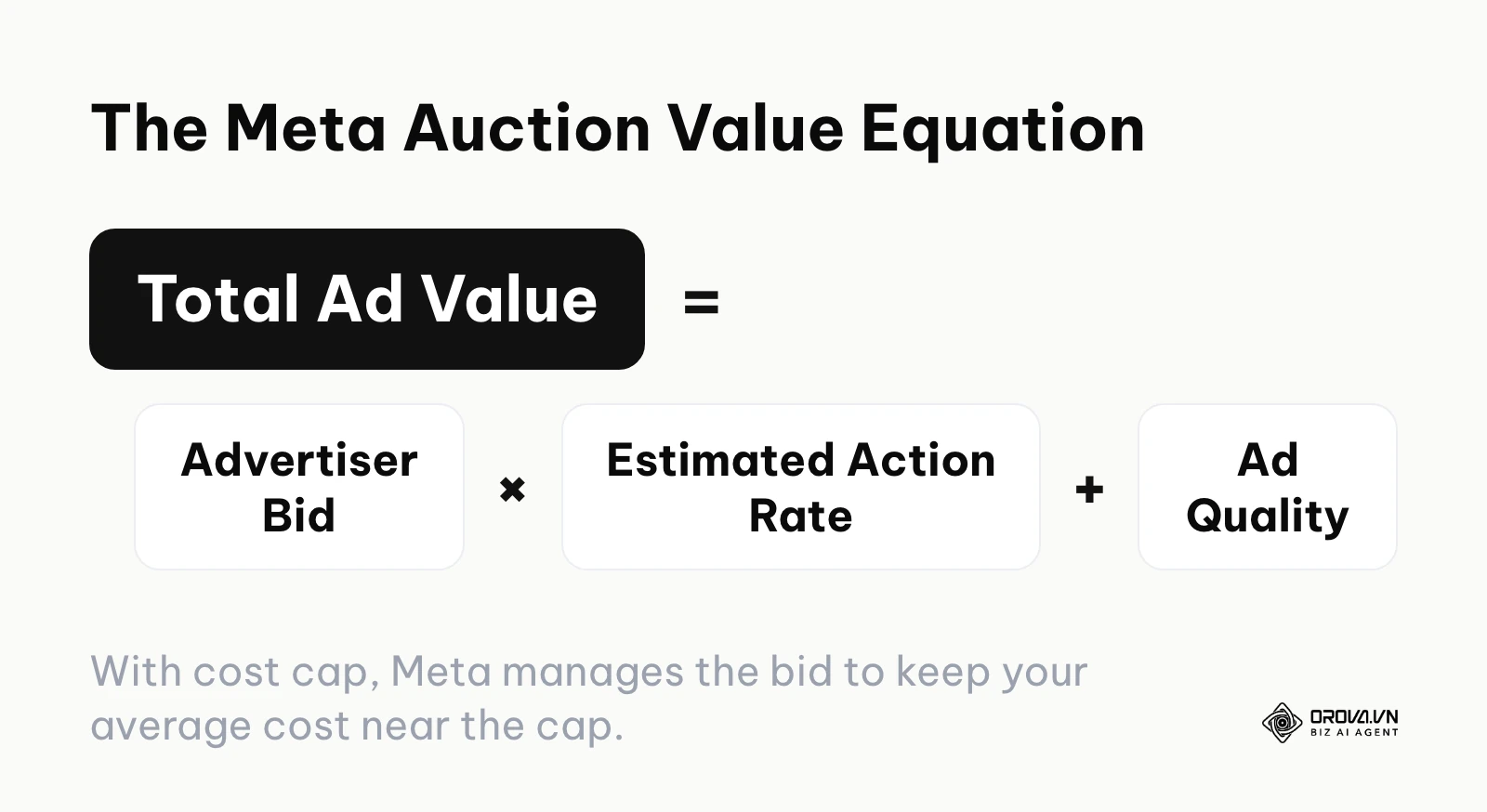
To truly understand how this mechanism operates, you have to look under the hood of the Meta auction system. Every single time a user scrolls through their feed, an auction takes place in milliseconds. Meta publicly describes the winner as the ad with the highest total value, calculated as the advertiser's bid multiplied by the estimated action rate (how likely this person is to take your chosen action), plus a measure of ad quality. With cost cap, Meta manages the bid part of that formula for you so that your average cost stays near your cap. When you utilize the default "Highest Volume" strategy, you are essentially telling the algorithm, "Spend my entire 100-dollar daily budget, and get me as many sales as possible, regardless of whether the final cost per sale is 5 or 50 dollars." The algorithm will aggressively bid in the auction to ensure your money is spent.
Conversely, when you apply a cost cap, you are placing a strict psychological and mathematical ceiling on the algorithm's behavior. You are commanding it, "Get me as many sales as possible, but ensure the average cost does not stray too far from my 30-dollar target." The system will now actively avoid participating in highly competitive, expensive auctions where the probability of a conversion is low.
Who should definitely use this strategy?
- Bootstrapped E-commerce Brands: Businesses with razor-thin margins that simply cannot afford an unprofitable week of ad spend. If a 40-dollar acquisition cost bankrupts you, you need a boundary.
- Lead Generation Agencies: Marketers who are contractually obligated to deliver qualified leads to their clients below a specific dollar threshold.
- High-Volume Sellers Scaling Aggressively: Advertisers who want to increase their daily budgets from 500 to 5,000 dollars without watching their efficiency plummet off a cliff.
When should you absolutely NOT use it?
- Brand New Ad Accounts: If your Meta Pixel has zero historical data, the algorithm has no baseline to estimate conversion probabilities, so a capped ad set will often struggle to spend.
- Micro Budgets: If your daily budget is 10 dollars, and your product costs 100 dollars, the system lacks the liquidity to maneuver through the auction dynamics.
- Ultra-Niche Audiences: When targeting a tiny audience of 5,000 people, the algorithm cannot find enough cheap opportunities to balance out the expensive ones, leading to immediate delivery failure.
Preparation: What you need before using cost cap Facebook ads
Transitioning to advanced bidding strategies is not a casual flick of a switch; it requires a robust foundation of data hygiene and historical account maturity. If you attempt to force boundaries onto an uneducated algorithmic model, it will paralyze your campaigns.
Before you even touch the drop-down menu in your ad set settings, you must guarantee that your tracking infrastructure is flawless. The algorithm relies entirely on the signals you send it to determine the Estimated Action Rate—the mathematical probability that a specific user will perform your desired action after seeing your ad. If your tracking is broken, the machine is blind, and cost constraints will instantly choke your delivery.
| What you need | Where to obtain or configure it | Estimated time required |
|---|---|---|
| Historical Conversion Data | Meta Pixel & Conversions API dashboard. You need at least 50 optimization events per week, consistently. | 2–4 weeks of running default Highest Volume campaigns. |
| Flawless Signal Quality | Event Match Quality score in Events Manager. Send hashed customer information, such as email and phone, through the Conversions API. | 1–3 days of developer implementation for server-side tracking. |
| Broad Audience Assets | Saved Audiences or Advantage+ settings with minimum constraints (e.g., nationwide targeting, broad age ranges). | 30 minutes to conceptualize and build the audience framework. |
| Proven Creative Winners | Ads Reporting. You need ads that have already demonstrated high click-through and conversion rates. | 2–4 weeks of continuous creative testing and iteration. |
| Financial Margin Clarity | Your internal accounting spreadsheet. You must know your absolute break-even cost down to the cent. | 2–4 hours of consulting with your finance team or reviewing P&L. |
The most critical element in this preparation phase is achieving the 50 conversions per week threshold. Meta's Business Help Center explains that an ad set generally needs about 50 optimization events within 7 days of its last significant edit to exit the learning phase. Without this volume, the statistical models cannot accurately predict user behavior, making any restrictive bidding strategy highly volatile. If you are struggling to hit this number with purchases, you may need to optimize for an event higher up the funnel initially, such as "Add to Cart," just to feed the machine enough data. Furthermore, implementing robust click tracking mechanisms ensures you can verify that the data Meta claims it is driving actually matches your internal analytics.
How to use cost cap Facebook ads: The 6-step execution guide
Deploying this strategy requires surgical precision. A single misstep in audience definition or budget allocation can result in a completely stalled ad account. Follow this deep-dive execution framework to build a resilient, profitable campaign structure.
Step 1: Calculate your true break-even CPA
The vast majority of media buyers fail at this strategy before they even log into the platform. They fail because they select a target CPA based on a gut feeling, an arbitrary industry benchmark, or a naive desire for high profitability. You cannot dictate economics to the market; you must calculate your actual break-even point.
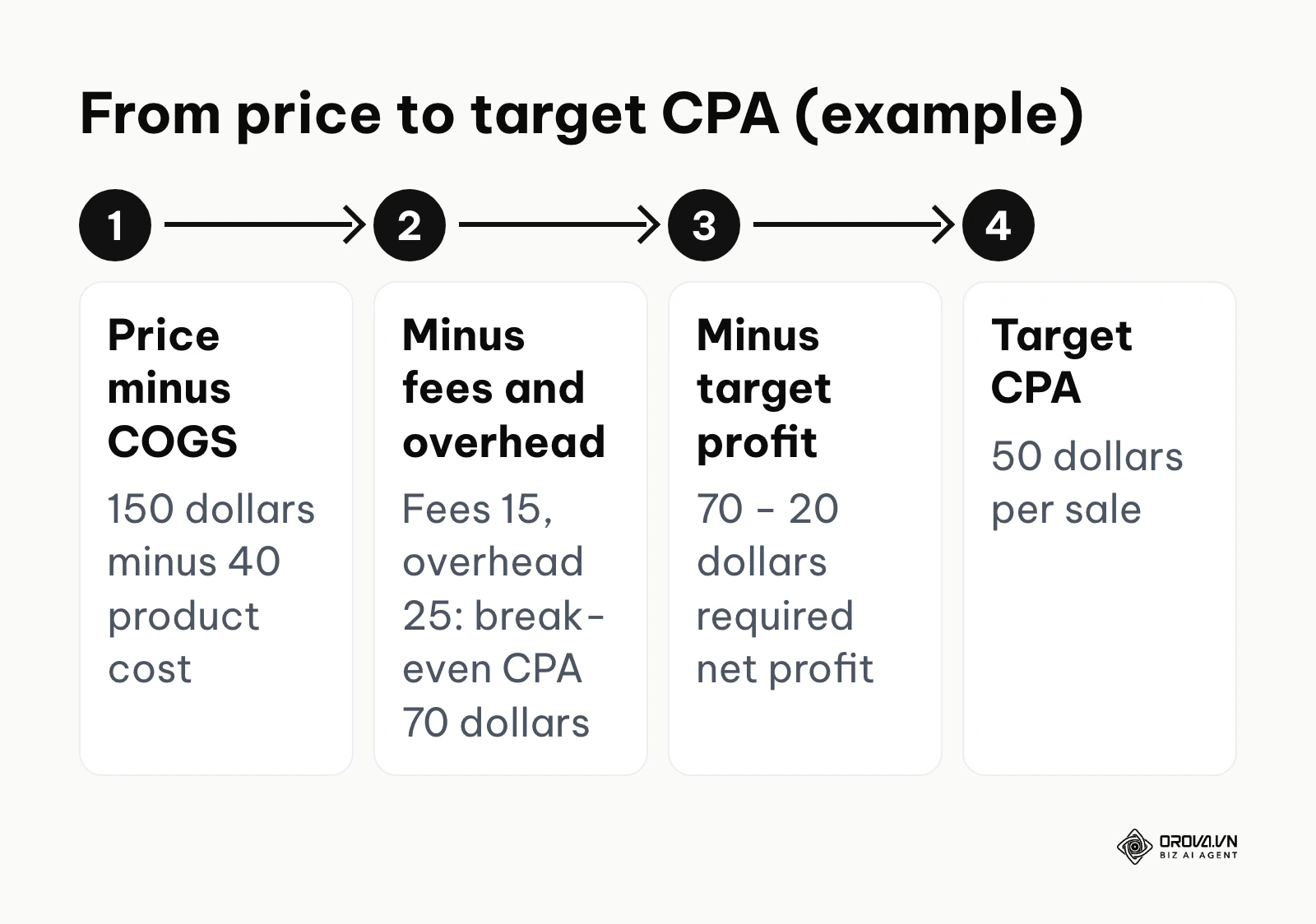
Your break-even CPA is the exact dollar amount you can spend to acquire a customer while making exactly zero dollars in profit, but covering all expenses.
To calculate this, open a simple spreadsheet and conduct a rigorous dissection of your unit economics. Let’s assume you sell a premium software subscription or a physical product that retails for 150 dollars. You must subtract the Cost of Goods Sold (COGS), which might be 40 dollars. Then, you subtract fulfillment, shipping, and payment gateway fees, let's say 15 dollars. You must also factor in a percentage of fixed operational overhead (salaries, server costs), which we will estimate at 25 dollars per unit sold. Your gross profit before marketing is: 150 - 40 - 15 - 25 = 70 dollars.
This 70 dollars is your absolute ceiling. If your CPA hits 71 dollars, your business is bleeding cash. However, you are not running a charity; you require a net profit. If your business mandates a minimum 20-dollar net profit per sale to remain viable, you subtract that from the ceiling. Therefore, your final, scientifically calculated target CPA is 50 dollars. This specific number must dictate your bidding strategy, not a theoretical wish.
Step 2: Establish the baseline with Highest Volume
You should never deploy a restrictive bidding strategy on an untested concept. The Meta algorithm is incredibly powerful, but it requires momentum. If you launch a brand new campaign, with brand new creatives, targeting a brand new audience, and immediately slap a tight financial constraint on it, the system will look at the auction, calculate that it doesn't have enough data to guarantee a 50-dollar conversion, and simply refuse to bid. Your budget will remain untouched.
Instead, you must first build a baseline of performance using the standard Highest Volume bidding strategy. This strategy allows the algorithm to bid aggressively, gather data quickly, and figure out exactly who your buyers are. You should run your ads on Highest Volume until the ad set successfully generates 50 conversions within a single week and officially exits the "Learning Phase."
During this period, you will observe the natural market CPA. Perhaps your target is 50 dollars, but on Highest Volume, the algorithm is acquiring customers at 65 dollars. This discrepancy provides critical intelligence. It tells you that the market is highly competitive, or your creatives are not resonant enough to achieve your dream CPA yet. Once the baseline is established, you can begin the transition. Before launching this baseline, ensure you are deeply familiar with the facebook ads manager interface to monitor the daily fluctuations accurately.
Step 3: Give the initial cap some headroom above your target
This is the most counter-intuitive, yet crucial step in the entire process. When you finally transition to a cost cap, your instinct will be to set the limit exactly at your desired target (e.g., 50 dollars). Many experienced media buyers prefer to start with a little headroom instead. Some use a rough rule of thumb of 10% to 20% above the goal (around 55 to 60 dollars in this case), but this is a practitioner habit, not a figure published by Meta. Whatever headroom you choose, keep the cap below your break-even CPA (70 dollars here), and use your Highest Volume baseline as the reality check.
Why? Because the algorithm needs breathing room to navigate the volatile landscape of the daily auction. Meta's system does not guarantee that every single conversion will cost exactly your set amount; it aims for an average over time. By setting the cap slightly higher, you give the algorithm room to occasionally win expensive, high-intent auctions that it can balance out with cheaper ones. If you set the cap too tightly from day one, delivery is likely to slow down or stall.
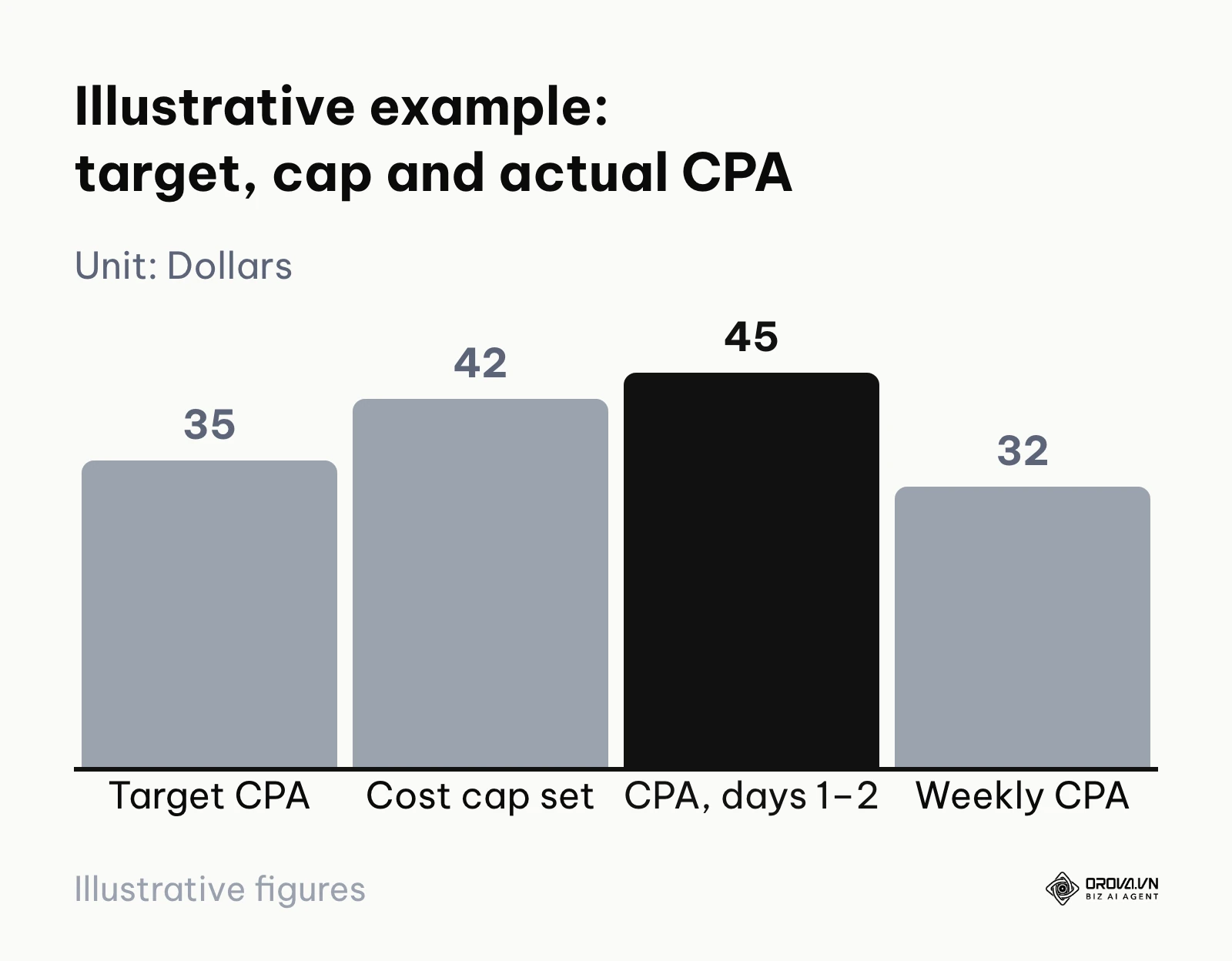
Illustrative example:
- Context: An e-commerce brand selling 120-dollar high-performance athletic wear was struggling with fluctuating acquisition costs. The media buyer calculated their strict break-even point and determined they needed a 35-dollar CPA to maintain their desired net margins.
- Steps taken: Instead of launching with a 35-dollar cap, the media buyer duplicated their best-performing ad set, switched the bid strategy, and strategically set the cap at 42 dollars. They also allocated a daily budget of 200 dollars.
- Stumbling block and fix: On the first two days, the CPA spiked to 45 dollars, and the client panicked, demanding the campaign be paused. The media buyer refused, explaining that editing the campaign would reset the learning phase. They held their nerve and let the algorithm process the data.
- Visible result: By day five, the algorithm had gathered sufficient data points and optimized its delivery path. The weekly CPA stabilized at a highly profitable 32 dollars, delivering a consistent volume of 6 sales per day while fully respecting the financial boundaries set by the business.
Step 4: Configure budget at the campaign or ad set level
The architecture of your campaign dictates how the algorithm distributes your money. When using controlled bidding, you face a critical decision: should you use Campaign Budget Optimization (CBO) or Ad Set Budget Optimization (ABO)?
If you use CBO (now called Advantage campaign budget), you set the budget at the top level, and Meta shifts the money toward the ad sets it expects to perform best. This is generally the recommended approach when scaling. However, when combining it with cost constraints, the budget tends to concentrate in whichever ad set can deliver results under the cap most easily, which can leave the others with very little spend.
If you are testing new audiences or new creatives against your proven winners, you must use ABO. By setting the budget at the ad set level, you force the algorithm to attempt delivery for each specific concept, rather than ignoring them in favor of the path of least resistance. Set your daily budget high enough to theoretically achieve 5 to 10 conversions per day based on your target CPA. If your cap is 50 dollars, your daily budget should be at least 250 dollars.
Step 5: Implement diverse creative angles
When you constrain the algorithm financially, you place an immense burden on the quality of your advertisements. Under a Highest Volume strategy, a mediocre ad can still generate sales because the system simply outbids competitors to force your ad into the feed. When you apply a cap, the system loses the ability to outbid with brute financial force. It must win auctions based on relevance and predicted engagement.
Meta does not publish a fixed conversion-rate threshold, but the logic follows from the total value formula above: a lower estimated action rate means your ad needs a higher bid to win the same auction. Under a cost cap that bid is constrained, so a weak creative loses more auctions and delivery slows down, sometimes to almost nothing.
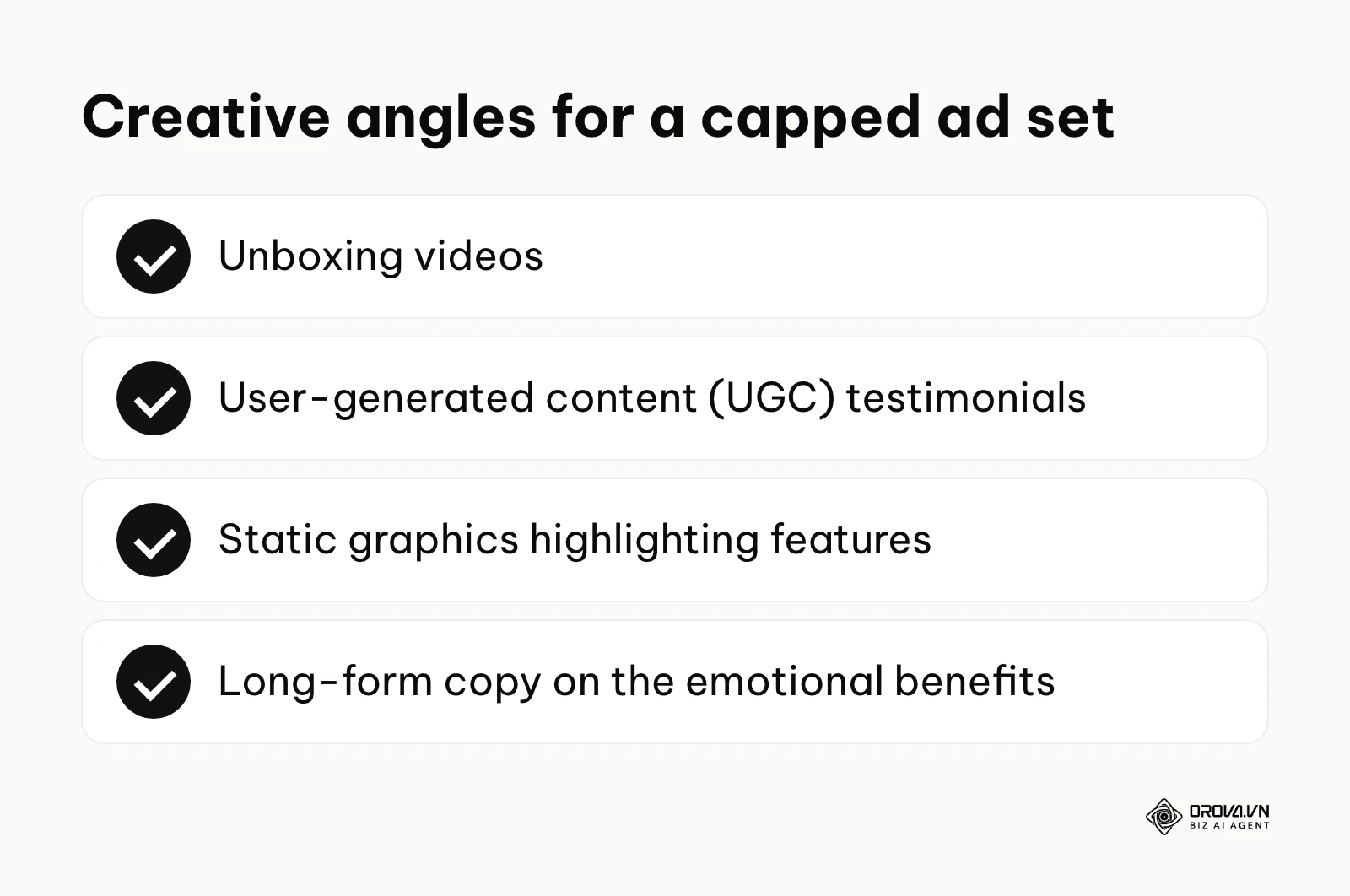
Therefore, you must constantly feed the ad set a diverse array of creative angles. You need unboxing videos, user-generated content (UGC) testimonials, stark static graphics highlighting features, and long-form copy explaining the emotional benefits. Different users react to different stimuli. By providing a wide variety of high-quality creatives, you give the algorithm multiple "hooks" to capture different segments of the audience cheaply, thereby maintaining your average acquisition cost.
Step 6: Scale the budget horizontally and vertically
The ultimate goal of establishing these boundaries is the ability to scale your ad spend aggressively without destroying your profitability. Once your campaign has exited the learning phase and has stabilized at your target CPA for a minimum of 7 consecutive days, you can begin to scale.
Vertical scaling involves increasing the daily budget of the existing ad set. The golden rule here is to proceed with caution. Meta lists significant budget changes among the edits that can send an ad set back into the learning phase, so doubling the budget overnight is risky. Many media buyers prefer gradual steps instead (a common habit is roughly 15% to 20% every couple of days, a rule of thumb rather than a Meta rule). This incremental approach allows the machine to gradually find new pockets of inventory.
Horizontal scaling involves duplicating the successful campaign and targeting entirely new, broad audiences (e.g., expanding from a lookalike audience to a completely open Advantage+ audience). When horizontal scaling, you can often start the new copy with a larger budget, provided the cap still sits below your break-even CPA. Before you launch several copies, check the audience overlap between them so your own ad sets do not end up competing in the same auctions. If you manage multiple complex campaigns across different networks, mastering ppc ad management principles is essential for maintaining governance over your total marketing spend.
OROVA ADS applies AI Agent to automate and optimize ad performance on Google, Meta and TikTok. Scale your budget safely, monitor 24/7 and expand your business quickly.
Experience the solution at orova.vn/ads
Cost cap vs bid cap Facebook: A decision framework for scalable ROAS
The terminology within the Meta Ads Manager can be dense and confusing, leading many advertisers to conflate different bidding strategies. Understanding the precise mechanical differences between a cost cap and a bid cap is the difference between a campaign that scales seamlessly and one that inexplicably dies on day two.
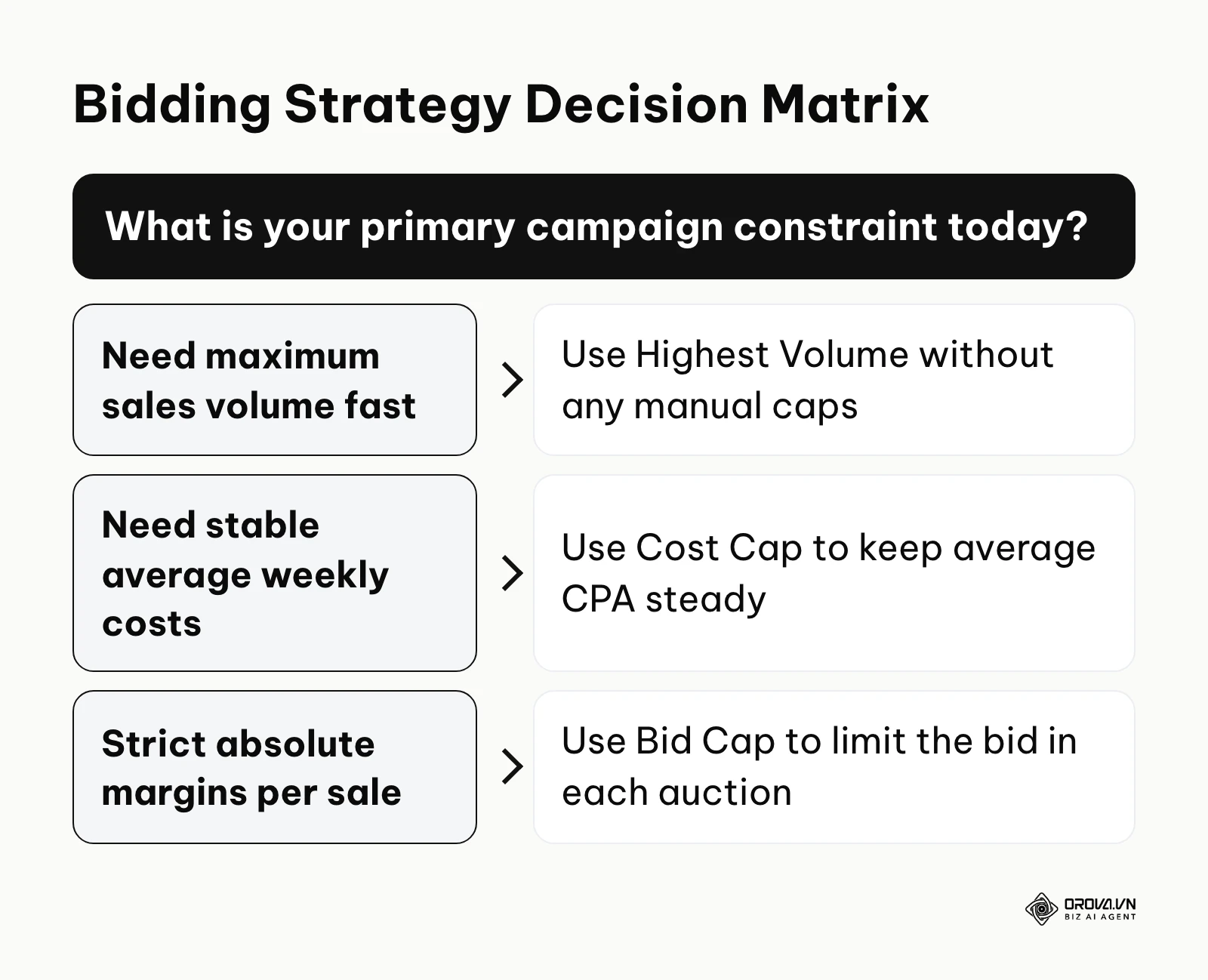
While both strategies are designed to protect your profit margins, they operate on entirely different mathematical principles within the micro-auctions.
Cost Cap acts as a flexible, long-term boundary. When you set this at 50 dollars, you are instructing the algorithm: "I want my average cost per acquisition to stay around 50 dollars." The algorithm is granted the autonomy to occasionally pay more in an auction if it identifies a user with extremely high intent, knowing it can offset that expensive acquisition with cheaper conversions later. It prioritizes maximizing total conversion volume while keeping the average cost stable. It is the ideal strategy for businesses that need steady, predictable growth and can tolerate minor daily fluctuations.
Bid Cap, on the other hand, is a strict, inflexible iron ceiling. When you set a bid cap of 50 dollars, you are dictating: "Under absolutely no circumstances are you allowed to bid more than 50 dollars in any single individual auction." If the algorithm calculates that winning a highly qualified user will require a bid of 50.01 dollars, it will instantly drop out of the auction. Bid cap provides ultimate, granular control over your absolute maximum payout, but it severely throttles delivery. It is typically utilized by highly sophisticated advertisers running massive budgets who want to aggressively scoop up only the cheapest possible conversions in the market, fully accepting that the campaign might barely spend on highly competitive days.
| Bidding Strategy | Core Algorithmic Behavior | Ideal Use Case Scenarios | Primary Weakness |
|---|---|---|---|
| Highest Volume | Spends the entire daily budget aggressively to maximize total results. | Testing new creatives; rapidly building pixel data; broad brand awareness. | Zero margin protection; costs can skyrocket unpredictably during competitive seasons. |
| Cost Cap | Aims to keep the average cost per result around your cap over time. | Scaling profitable campaigns; maintaining steady ROAS for e-commerce stores. | Can experience daily volatility; may occasionally stop spending if the target is unrealistic. |
| Bid Cap | Enforces a strict, absolute maximum bid in every single micro-auction. | Strict lead generation targets; sweeping up cheap inventory; massive budgets. | Severe delivery restriction; campaigns will frequently flatline and fail to spend budget. |
Illustrative example:
- Context: A B2B SaaS company was scaling a high-ticket software funnel. Their target lead acquisition cost was 100 dollars. The marketing director wanted aggressive control and initially chose a strict bid strategy.
- Steps taken: They launched a campaign with a bid cap set precisely at 100 dollars. They loaded it with their best-performing whitepaper download creatives and set a hefty 1,000-dollar daily budget.
- Stumbling block and fix: For three consecutive days, the campaign generated exactly zero impressions. The auction for B2B decision-makers was too competitive, frequently requiring bids of 115 dollars, which the algorithm was forbidden from making. The director switched the strategy to a cost cap of 110 dollars.
- Visible result: The campaign immediately began delivering. While some days saw leads costing 125 dollars, the algorithm balanced it out, and the weekly average smoothed out to a highly profitable 98 dollars, generating a consistent flow of 40 qualified leads per week.
Measuring success: Metrics to watch when running cost cap campaigns
When you transition away from default bidding strategies, your daily reporting routine must evolve. You can no longer merely look at the amount spent and the number of purchases. Because you are artificially constraining the delivery system, you must constantly monitor the health of the algorithm to ensure it isn't quietly suffocating.
If you obsess over the daily CPA, you will inevitably make emotional decisions and ruin the machine learning models. Instead, you must analyze performance in 3-day and 7-day rolling windows. The algorithm needs time to average out the high and low-cost conversions.
| Key Metric to Monitor | Strategic Meaning & Implication | Warning sign (rule of thumb) |
|---|---|---|
| Delivery / Impressions | Indicates if your bid is high enough to enter the auction. If this drops to zero, the algorithm has determined it cannot win within your constraints. | Less than 500 impressions within a 24-hour period on a scaled budget. |
| Frequency | Shows how often the same user sees your ad. High frequency combined with low CTR means severe creative fatigue, which will spike your costs. | Approaching 2.5 or higher within a 7-day window. |
| Link Click-Through Rate (CTR) | Measures creative resonance. A low CTR mathematically forces the algorithm to bid higher to achieve the same number of conversions. | Dropping below 1.0% for e-commerce or broad consumer products. |
| Cost Per Mille (CPM) | The cost to reach 1,000 people. A suddenly spiking CPM indicates audience saturation or intense seasonal competitor bidding. | A sudden 40%+ spike sustained over a 3-day period. |
| Weekly Average CPA | The ultimate measure of success. Evaluates if the algorithm is successfully balancing expensive and cheap auctions. | Exceeding your target boundary by more than 15% over a 7-day average. |
Furthermore, the data you feed back into Meta is the lifeblood of this strategy. If your pixel is only capturing 60% of your actual sales due to iOS tracking restrictions or ad blockers, Meta's algorithm will falsely believe the CPA is much higher than it is, and it will drastically reduce delivery. You must implement the Conversions API to send server-side data directly back to the platform. Additionally, tagging every ad with consistent UTM codes ensures that your Google Analytics 4 (GA4) data remains pristine, allowing you to independently verify the traffic quality and offline conversion rates that Meta is reporting.
Facebook ads cost cap not spending: 6 common mistakes and troubleshooting steps
The single most terrifying moment for a media buyer is switching a highly profitable campaign to a controlled bid strategy, only to watch the delivery flatline completely. The dashboard shows zero spend, zero impressions, and zero sales. This is not a glitch; it is the algorithm operating exactly as programmed. When campaigns stop spending, it indicates a fundamental misalignment between your financial desires and the harsh realities of the auction marketplace.
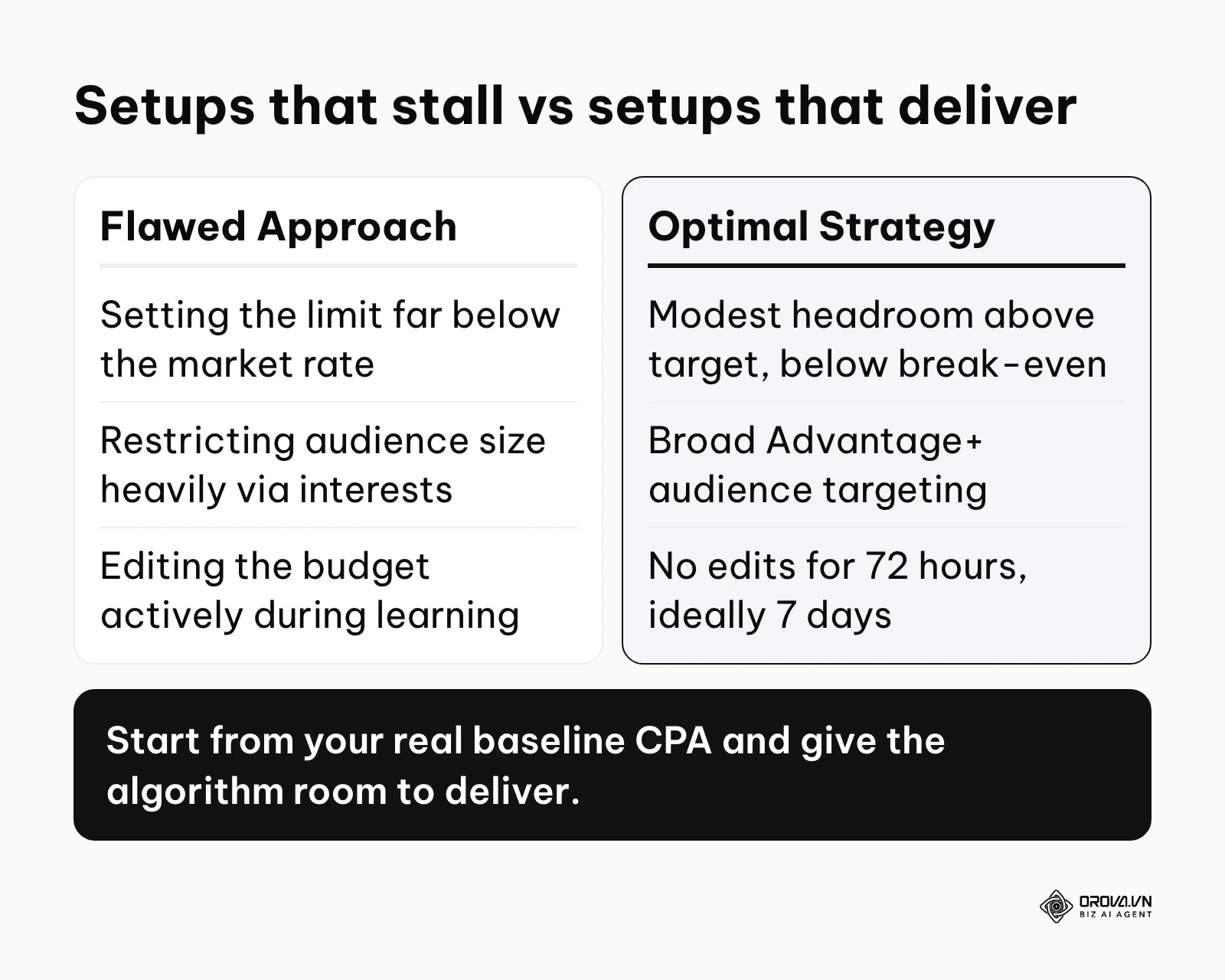
You must diagnose the specific bottleneck before blindly adjusting the budget.
Mistake 1: Setting the cap at your dream CPA, not the market reality
This is the foundational error. Advertisers often decide they want to acquire customers for 10 dollars because it would make them incredibly wealthy. However, if the historical data, competitor bidding, and average conversion rates dictate that a customer in this niche costs 35 dollars to acquire, setting a 10-dollar limit will instantly kill the campaign. The system calculates the Estimated Action Rate, looks at the 10-dollar ceiling, realizes the math is impossible, and refuses to enter the auction. Always ground your initial boundaries in historical reality: start from the CPA your Highest Volume baseline actually achieved, leave modest headroom above your target, and stay below your break-even CPA.
Mistake 2: Constraining the audience too tightly
When you use financial boundaries, you are already putting a massive restriction on the algorithm. If you combine a tight bid with a highly restricted audience—such as a small Lookalike audience layered with three specific interests—you create a scenario called "Over-constraint." The algorithm needs maximum liquidity (a massive pool of users) to find those rare, cheap conversion opportunities that balance out the expensive ones. If the audience is tiny, there simply aren't enough cheap auctions available to maintain the average. If delivery stops, immediately broaden your targeting using Advantage+ audiences or entirely open demographics.
Mistake 3: Changing the budget or cap during the learning phase
The Meta algorithm is highly sensitive to manual interference. When you launch a new strategy, it enters the learning phase, actively exploring different pockets of the audience to understand who converts. During this period (until it reaches roughly 50 optimization events), the CPA will wildly fluctuate. If you panic on day two because the cost is high, and you lower the cap or slash the budget, Meta treats that as a significant edit and the ad set can go back into the learning phase. You must possess the psychological fortitude to not touch the campaign for at least 72 hours, preferably a full seven days.
Mistake 4: Running stale creatives with low engagement rates
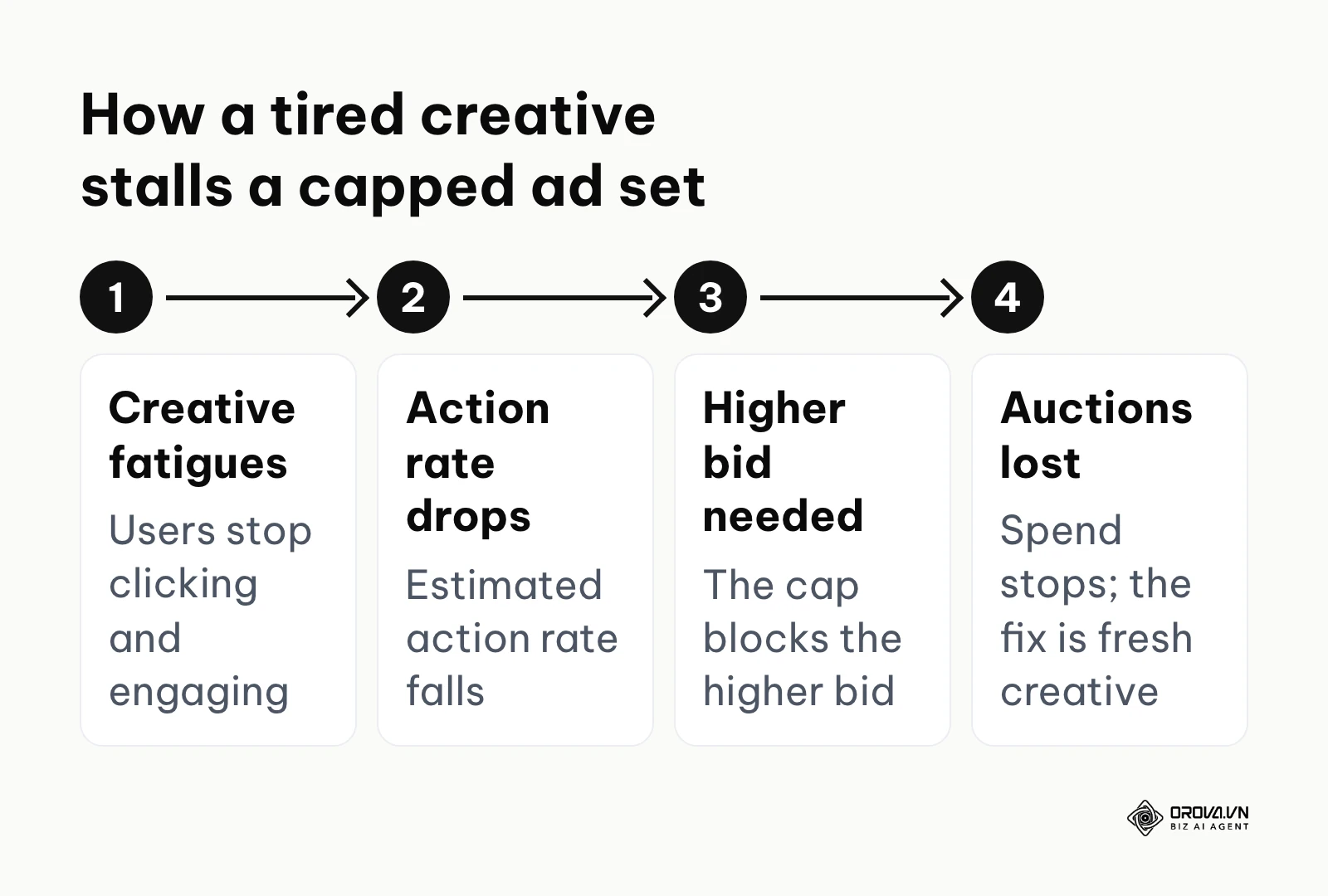
As explained at the start of this guide, the total value in the auction combines your bid multiplied by the estimated action rate, plus ad quality. If your creatives are fatigued, boring, or irrelevant, users will stop clicking on them. Consequently, your historical action rate plummets. To maintain the same Total Ad Value and win auctions, the algorithm is forced to increase your bid. But because you have a strict cost ceiling in place, it cannot increase the bid. Therefore, it loses the auction, and your campaign stops spending. The solution is rarely to increase the bid; it is almost always to launch fresh, highly engaging video creatives to boost the action rate.
Mistake 5: Using cost cap on Advantage+ campaigns too early
Meta's Advantage+ sales campaigns (formerly Advantage+ shopping campaigns) are its most automated option, and they lean heavily on account-level data. Meta does let you add a cost cap to them, but doing so on an account with little purchase history is risky. These campaigns rely on broad freedom to find buyers; choke one with a tight cap before the account has a solid purchase history and delivery is likely to stall. A safer order is to let the campaign build results first, then add a cap once you know its natural CPA.
Mistake 6: Pausing and unpausing campaigns frequently
Media buyers often try to "daypart" manually by pausing campaigns overnight and unpausing them in the morning. This is catastrophic for advanced bid strategies. The algorithm relies on continuous 24-hour pacing models to distribute the budget efficiently. Frequently pausing the campaign destroys its pacing algorithm, forcing it to constantly restart its calculations, leading to erratic spend and eventual delivery failure. Leave the campaigns on permanently.
Illustrative example:
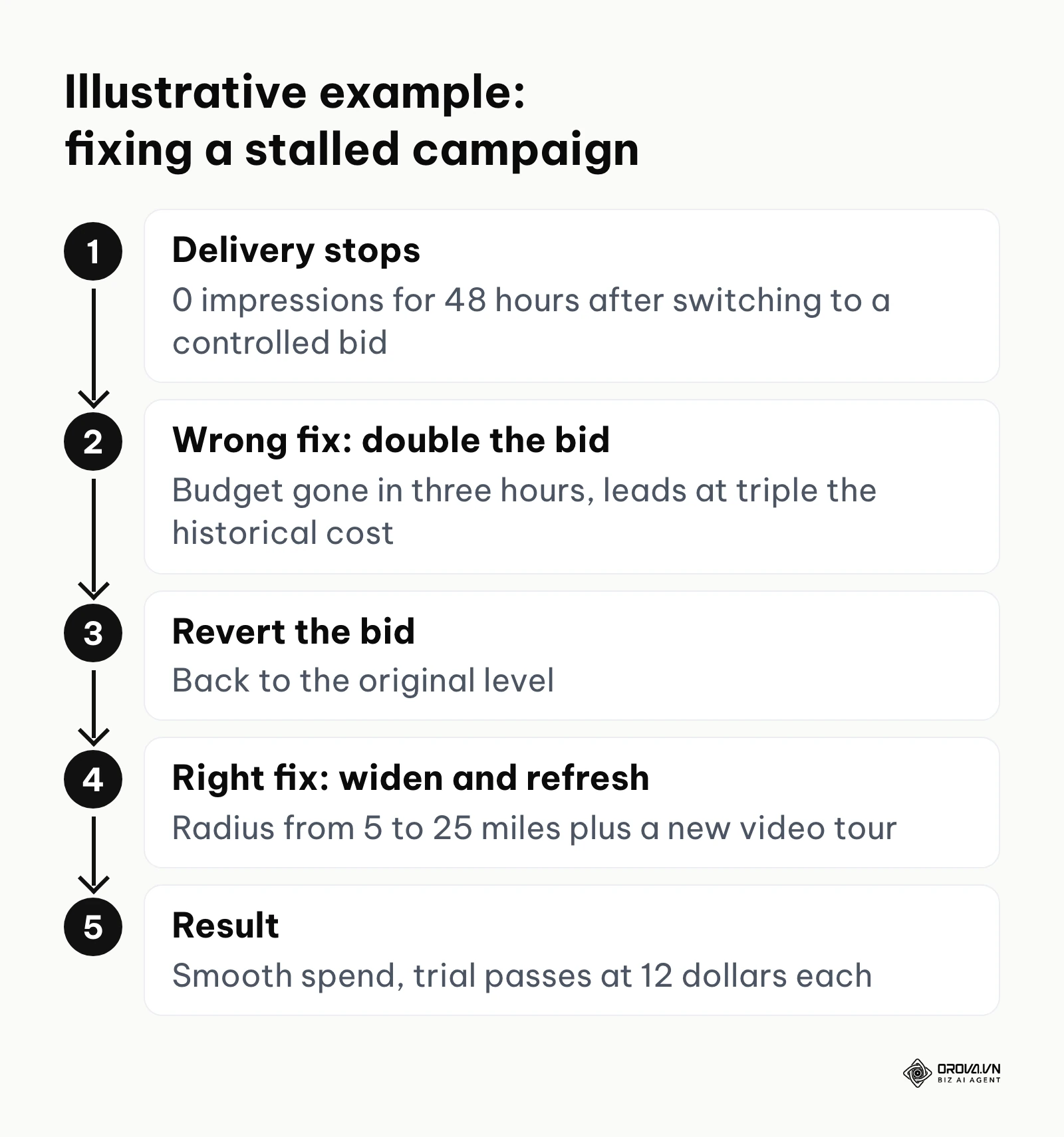
- Context: A local fitness franchise generating trial passes saw their primary acquisition campaign stop spending completely after switching to a controlled bid.
- Steps taken: The franchise owner reviewed the ad delivery report and saw exactly 0 impressions for 48 hours. Assuming the market had just gotten more expensive, he recklessly doubled the bid limit.
- Stumbling block and fix: The campaign immediately began spending violently, blowing through the daily budget in three hours while generating leads at triple the historical cost. Realizing the error, the owner reverted the bid to the original level. Instead of forcing the bid, he expanded the targeting radius from 5 miles to a broad 25 miles and uploaded a new, highly engaging video tour of the gym.
- Visible result: The expanded audience liquidity and the high-engagement video allowed the algorithm to find cheaper auctions. The campaign resumed smooth spending immediately, acquiring high-quality trial passes at 12 dollars each, well within their original profitable boundaries.
Want to scale your budget but afraid of breaking performance? 📉
Integrate OROVA ADS now - an AI Agent that automatically monitors and optimizes Google, Meta, TikTok ads 24/7. Now, expanding and replicating your Performance Ads team is just one click away.
🚀 Try it now at: orova.vn/ads
Facebook ads cost cap trends in the next few years: the author's perspective
As we analyze the trajectory of machine learning in digital advertising up to 2026, it is evident that manual campaign manipulation is rapidly becoming obsolete. The platforms are aggressively pushing advertisers toward total automation. Based on the current technological signals, here is how I foresee the landscape evolving over the next two to three years.
The complete automation of the bidding tier
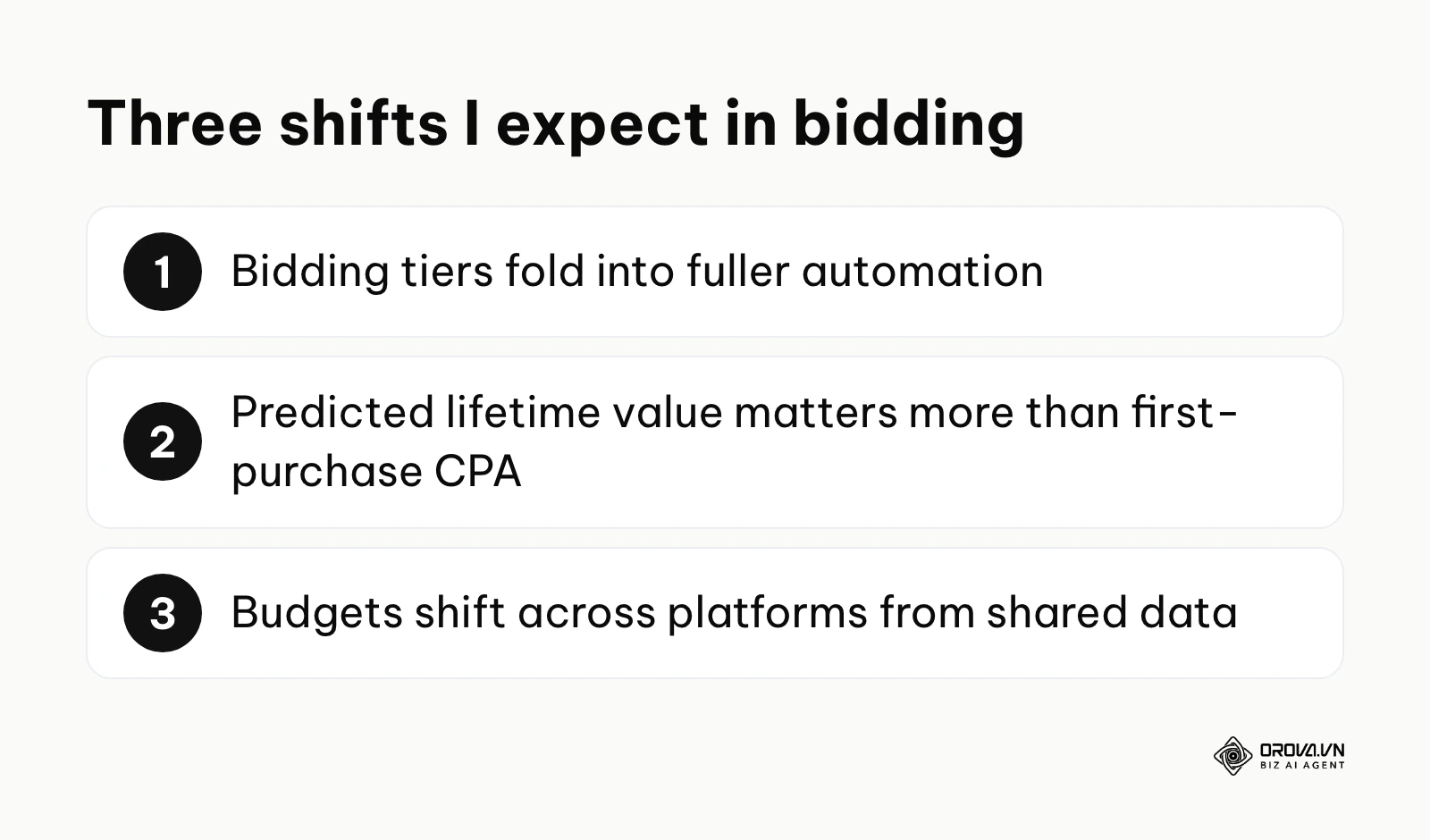
We are currently seeing Meta push its Advantage+ suite relentlessly, systematically removing manual targeting levers from the dashboard. I believe that within the next two to three years, the granular, manual bidding tiers we use today will disappear almost entirely. Instead of inputting a specific numerical cap, advertisers will simply input their desired Return on Ad Spend (ROAS) or a blended business margin, and the AI will dynamically govern all auction behavior invisibly. To prepare for this shift, you must stop viewing yourself as a "media buyer" who clicks buttons, and start operating as a creative strategist. Your competitive advantage will not be in micro-managing bids, but in feeding the autonomous system the highest quality creative assets possible.
Predictive lifetime value (LTV) replacing immediate CPA
Right now, most financial boundaries are focused entirely on the cost of the first purchase. If a user costs 60 dollars to acquire but only spends 50 dollars initially, the campaign is deemed a failure. However, we are seeing a massive shift toward first-party data integration. I suspect that the algorithm will increasingly look beyond immediate CPA and lean on your first-party data to estimate predicted lifetime value (LTV). In that world, the system could accept a higher acquisition cost for a user it expects to keep buying, and a lower one for a likely one-time buyer. You should prepare by meticulously building your backend data infrastructure today, ensuring every customer cohort is rigorously tracked.
Cross-platform algorithmic synchronization
Currently, advertising platforms operate in isolated silos. Meta does not know what Google is doing, and TikTok is blind to Meta's performance. As API integrations deepen, I foresee a future where AI will dynamically shift your total marketing budget across all platforms simultaneously based on real-time cost boundaries. If Meta's auction becomes too expensive on a Tuesday, a centralized AI will instantly throttle the Meta budget and redirect it to TikTok, where the CPA is currently lower, without any human intervention. To survive this transition, you must begin centralizing your data architecture immediately, moving away from platform-specific reporting toward a holistic AI ads mindset. Note that this prediction relies heavily on platforms willingly opening their APIs, which remains a significant geopolitical and corporate hurdle.
Frequently asked questions about Facebook ads cost cap
Does cost cap guarantee my CPA won't exceed the limit?
No, it is not a rigid guarantee. Meta treats it as a target for your average cost, and individual results can cost more. You will inevitably see days where the cost spikes above your limit, and days where it drops below. The algorithm aims for long-term stability, so you must evaluate performance over a 7-day minimum window rather than panicking over a single expensive Tuesday.
How much daily budget should I set for a cost cap campaign?
Your daily budget must provide the algorithm with enough financial liquidity to exit the learning phase. A common rule of thumb among media buyers (not an official Meta requirement) is to set your daily budget to at least 5 times your target CPA. If your goal is a 40-dollar acquisition, your daily budget should be no less than 200 dollars. Anything smaller suffocates the machine learning exploration process.
Can AI help stabilize cost cap delivery?
Yes, modern AI tools can significantly aid in stabilization by monitoring auction volatility 24/7. While the native Meta algorithm handles the micro-bidding, external AI agents can automatically adjust the daily budget constraints, pause fatiguing creatives before they spike your costs, and dynamically shift funds to ad sets that are actively respecting the boundaries.
Should I use cost cap on retargeting campaigns?
Generally, no. Retargeting audiences (e.g., website visitors in the last 30 days) are inherently small and constrained. Applying a financial boundary to an already tiny audience creates massive over-constraint, almost guaranteeing that the campaign will stop delivering entirely. Use default Highest Volume for small retargeting pools.
How long does it take for cost cap to stabilize?
You must expect high volatility during the initial learning phase. It typically takes the algorithm between 3 to 7 days, or roughly 50 conversion events, to accurately map the auction landscape and stabilize the delivery. Do not make any edits to the budget or targeting during this critical window.
Where to start?
Reading a comprehensive guide is meaningless without immediate, decisive action. Depending on the current maturity of your ad account, here is exactly where you should focus your energy in your very next work session.
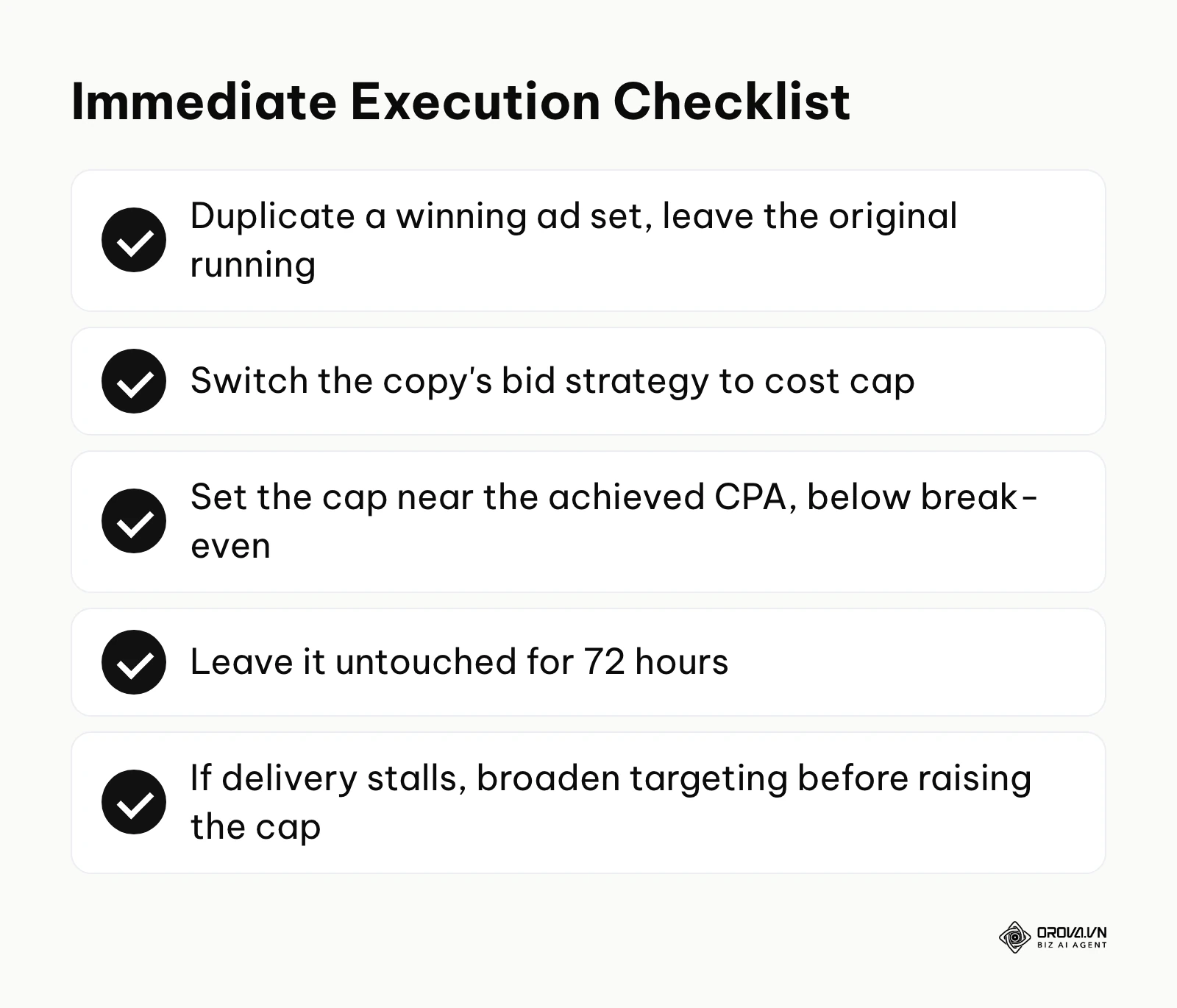
- If you currently have a highly profitable ad running on Highest Volume: Do not touch the original campaign. Instead, duplicate the winning ad set. In the duplicated version, change the bid strategy to cost cap. Calculate your strict break-even point, then set the cap close to the average CPA the original ad set already achieves, with a little breathing room, and never above break-even. Launch it, and do not look at the metrics for 72 hours.
- If your current cost cap campaign has suddenly stopped spending: Stop blindly increasing the bid limit in a panic. Go into the ad set settings and drastically broaden your audience targeting. Remove all specific interest constraints, widen the age range, and allow the Advantage+ targeting system to find cheaper pockets of inventory that you previously restricted it from accessing.
- If you are preparing to scale a massive new budget for Q4: Close the Ads Manager immediately. Open your financial spreadsheet and map out your exact, scientifically calculated break-even margin using the gross profit formula detailed in Step 1. You cannot instruct the Meta algorithm to protect your margins if you do not intimately know what those margins actually are.
About the author

Builder of Orova
Nguyễn Đỗ Trọng Ân has 8 years of experience in marketing, including 6 years managing market development across Asia. He builds Orova, a Biz AI Agent that never sleeps: it plans, runs and optimizes work for businesses.
Run your business with AI Agents
Orova is the always-on Biz AI Agent — it plans, runs, and optimizes the work for you.
Save time, unlock productivity.