
Drive traffic to your website: the 90-day resource framework

Imagine launching a beautifully engineered software product or a meticulously curated online store, only to open the doors and hear complete silence. You have built the perfect destination, but absolutely no roads lead to it. In the modern digital landscape, this is the brutal reality for millions of businesses. If you want to drive traffic to your website, you cannot rely on the outdated playbook of randomly publishing articles and praying for the algorithms to favor you. The internet is heavily saturated, user attention is fragmented, and search engines have evolved beyond simple keyword matching.
Many site owners fall into the trap of chasing raw pageviews—a vanity metric that looks impressive on a dashboard but does nothing to pay the bills. A thousand visitors who leave after three seconds are worth less than ten visitors who read your content, trust your authority, and click your call-to-action. This guide dismantles the theoretical fluff and provides a hardened, resource-based framework designed to acquire high-intent visitors. Whether you have zero budget or a dedicated marketing team, we will explore exactly how to engineer a predictable, compounding traffic acquisition engine.
Drive traffic to your website: Moving beyond empty pageviews
Driving traffic to your website is the deliberate, strategic execution of marketing campaigns across organic, paid, and referral channels to attract targeted human visitors to your web pages. The ultimate goal is not merely to increase a number on a graph, but to guide those visitors into a structured funnel where they can be converted into subscribers, qualified leads, or paying customers.
This process is absolutely essential for anyone operating a commercial digital presence. If you run a SaaS platform, an e-commerce storefront, a B2B consultancy, or a media publication monetized through ads, traffic is the lifeblood of your revenue model. Without a consistent influx of new users, your pipeline dries up, and growth stagnates.
However, mindlessly driving traffic is detrimental. You should not invest heavily in acquisition if your website lacks clear conversion mechanisms, suffers from severe technical instability, or if your operational capacity cannot handle an influx of new business. Pumping visitors into a broken funnel is equivalent to pouring water into a leaky bucket—it burns resources and damages your brand reputation. The objective must always shift from acquiring any traffic to acquiring high-intent traffic: users who are actively seeking the exact solution or information you provide.
Preparation: Building a foundation for high-intent traffic
Before you spend a single dollar on ads or write your first piece of content, you must establish a rigid technical and analytical foundation. Attempting to drive traffic to a website without proper tracking infrastructure is a massive unforced error. You will have no idea which channels are working, what content resonates, or where users are dropping off.
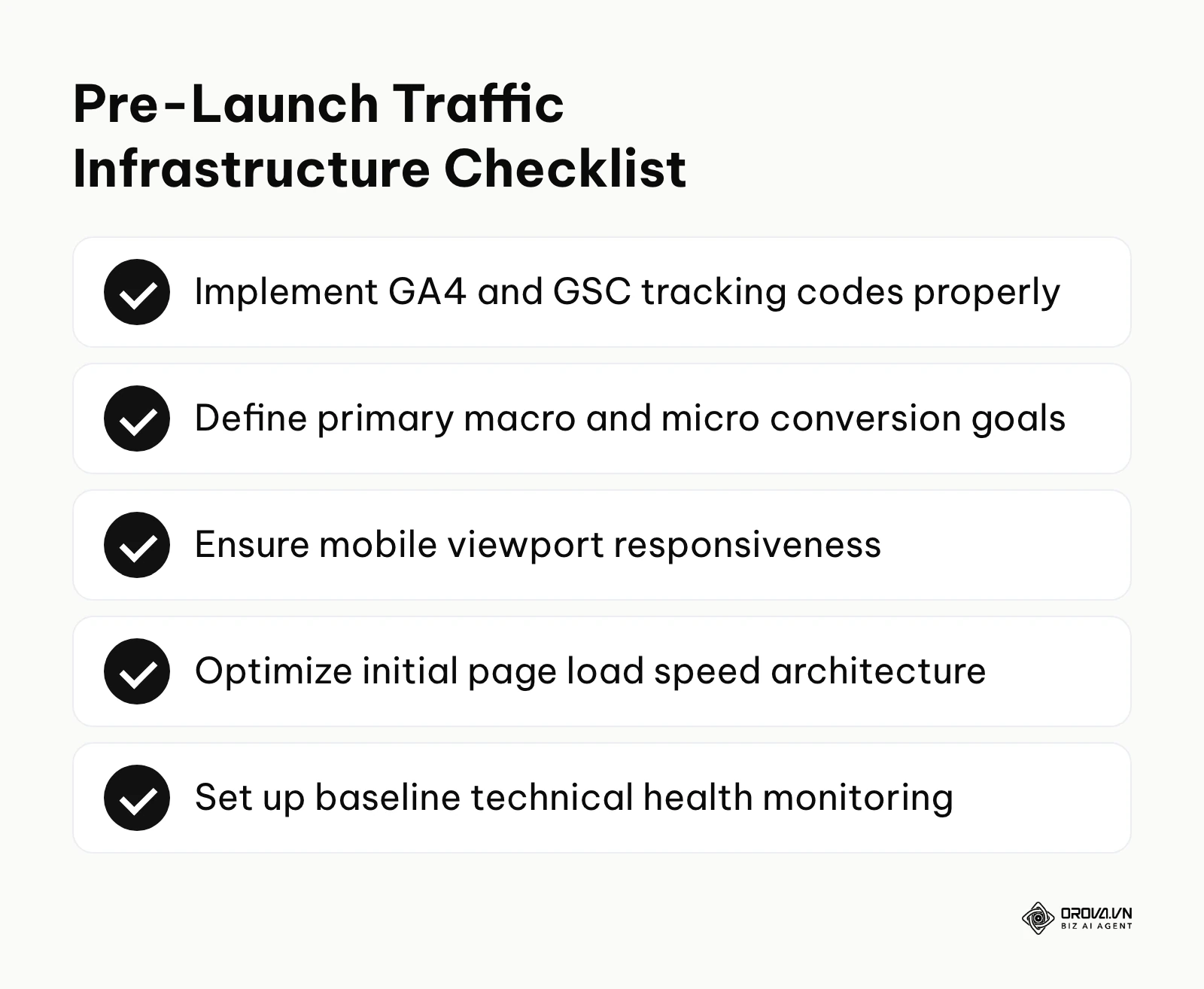
The preparation phase involves three core pillars: analytics, technical health, and conversion architecture.
First, you must install and properly configure robust analytics tools. Google Analytics 4 (GA4) and Google Search Console (GSC) are non-negotiable baselines. GA4 tracks user behavior once they land on your site, while GSC tells you exactly how search engines perceive your pages and which queries trigger your site in organic results.
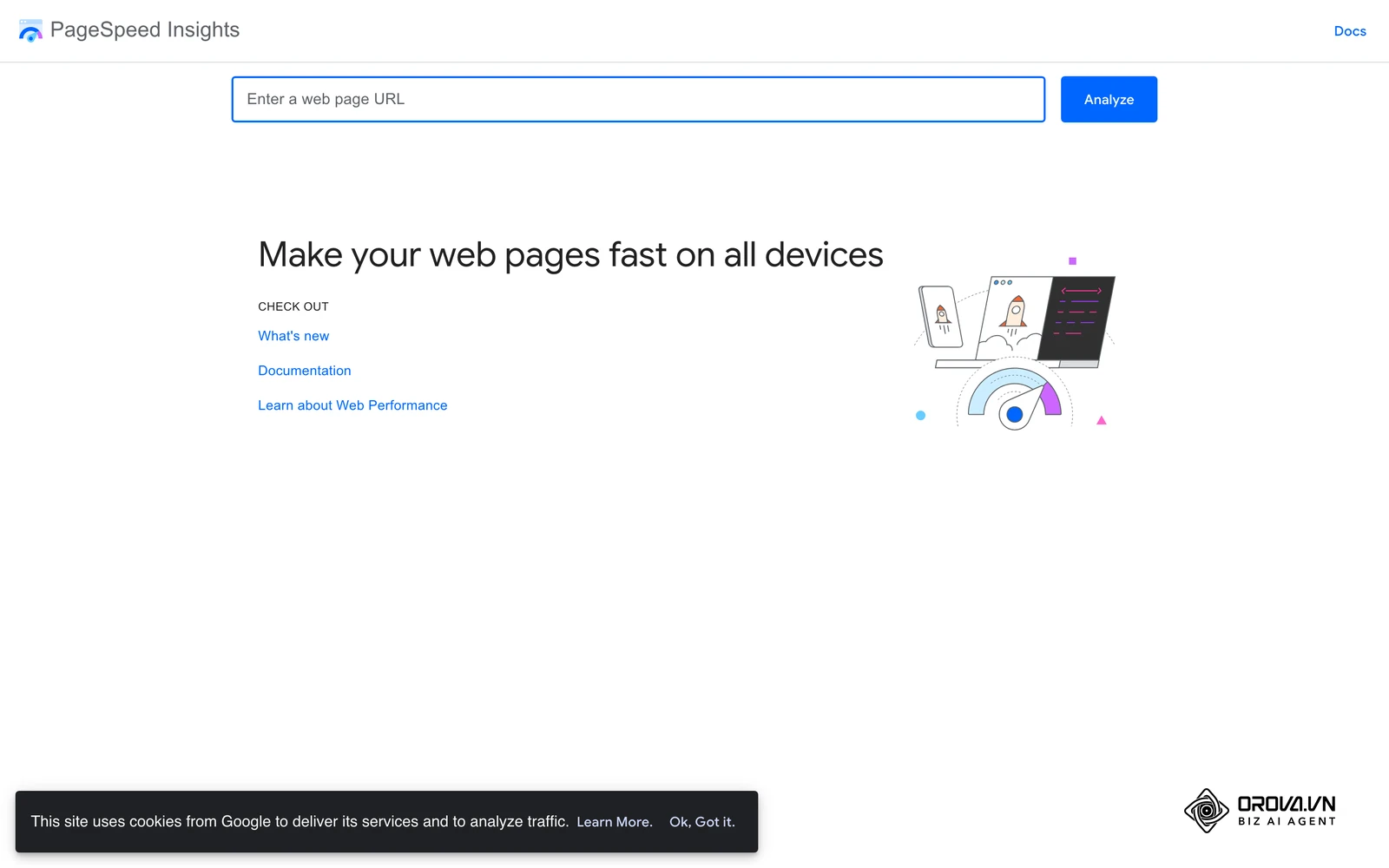
Second, your technical health must be pristine. According to the Google Search Quality Evaluator Guidelines (2024), content must explicitly demonstrate Experience, Expertise, Authoritativeness, and Trustworthiness (E-E-A-T) to be considered high quality by human raters. But even the best E-E-A-T content will fail if the site is fundamentally broken: pages that cannot be crawled or indexed properly never get the chance to rank. Work through an SEO checklist before you invest in acquisition. Mobile responsiveness and aggressive page load speed optimization are mandatory.
Finally, you need conversion architecture. Every single page on your site must have a designated job. What do you want the user to do after reading? Subscribe? Buy? Book a call? If these paths are not clearly defined, the traffic you drive will simply bounce.
| Preparation Item | Where to get it / Tool required | Estimated Setup Time |
|---|---|---|
| Core Analytics Tracking | Google Analytics 4 (GA4) | 2–4 hours |
| Search Performance Data | Google Search Console (GSC) | 1 hour |
| Technical Speed Audit | PageSpeed Insights / GTmetrix | 3–5 hours (for fixes) |
| Mobile Usability Check | Lighthouse in Chrome DevTools | 1 hour |
| Conversion Goal Setup | GA4 Custom Events / GTM | 4–6 hours |
The 90-day roadmap: Actionable steps to drive traffic
This roadmap is not a collection of random "hacks." It is a sequential, structured approach to building a resilient traffic acquisition machine. By executing these steps over a 90-day period, you move from an invisible entity to a recognized authority in your niche.
Step 1: Establish semantic topical authority
Gone are the days when you could rank a single page by awkwardly repeating a target keyword thirty times. If you are new to the discipline, start with what SEO is and how it works. Search engines now rely on complex knowledge graphs to understand the relationships between concepts, known as entities. To drive sustainable organic traffic, you must prove that you are the definitive expert on a specific subject, not just a single keyword.
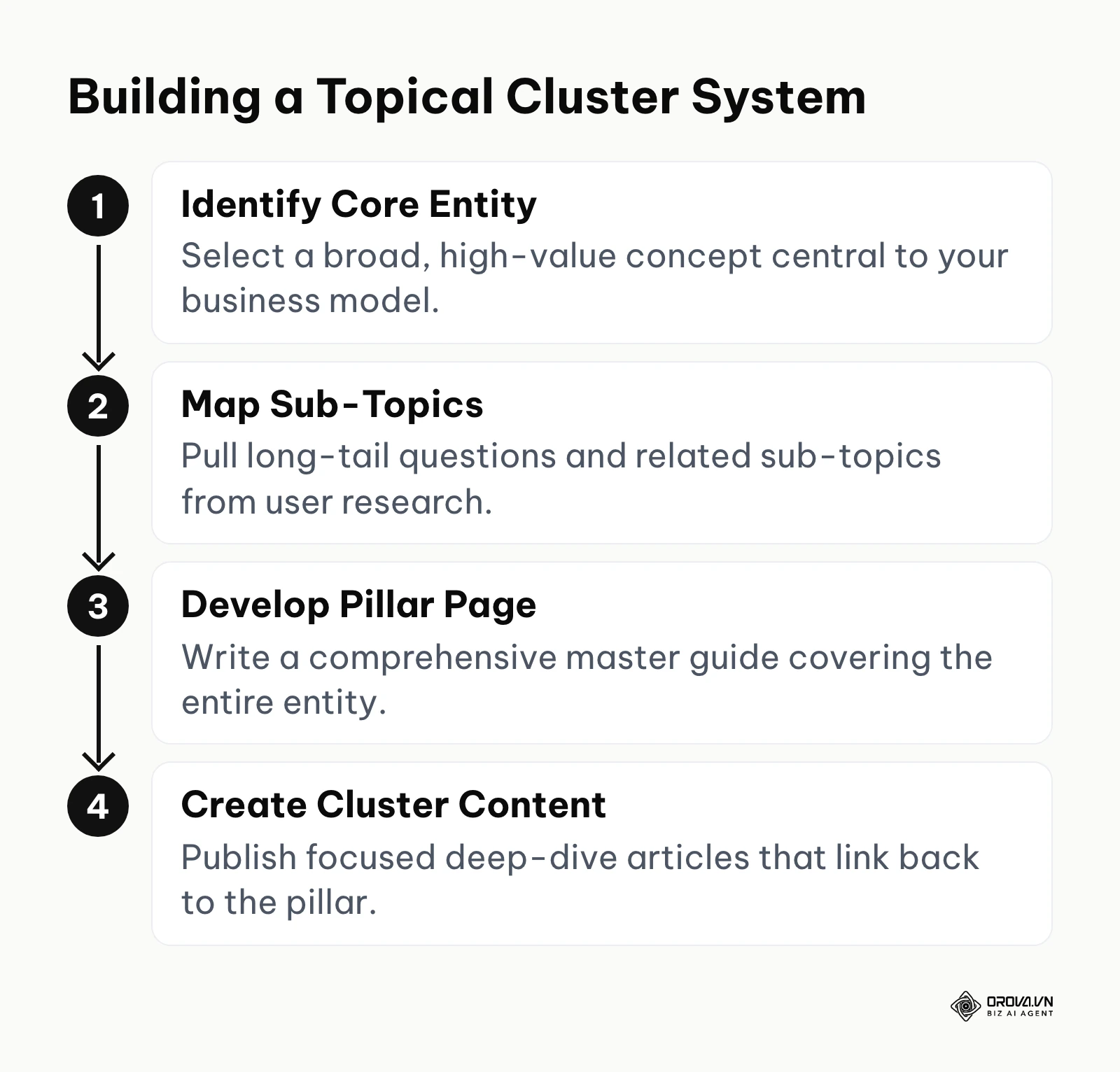
What to do: You need to map out your core business offering and build a "Hub and Spoke" content model. This involves creating one massive, comprehensive pillar page (the hub) that covers a broad topic, supported by dozens of highly specific, deeply researched articles (the spokes) that link back to the pillar. For a deep dive into this architecture, read our guide on what is entity SEO.
How to do it:
- Identify your core entity (e.g., "Project Management Software").
- Use tools to scrape "People Also Ask" boxes and forums to find 20-30 highly specific sub-topics (e.g., "how to manage remote dev teams," "agile sprint planning templates").
- Publish the sub-topic articles first, ensuring each explores the nuance of the problem deeply.
- Publish the pillar page and meticulously interlink them using exact-match and descriptive anchor text.
Signs of success: You will know this is working when your pages start ranking for hundreds of long-tail keyword variations that you never explicitly included in the text, simply because search engines understand the semantic context of your entire cluster.
Mistakes to avoid: The most common failure point is creating "orphan pages"—publishing articles that do not link logically to your pillar pages. An isolated article provides zero topical authority signals to the rest of your domain.
Step 2: Implement Generative Engine Optimization (GEO)
As of 2026, the way users search for information is undergoing a massive paradigm shift. Instead of typing fragmented keywords into a search bar and clicking blue links, users are asking complex, conversational questions to AI-driven search engines (like Perplexity, ChatGPT Search, and Google's AI Overviews) and expecting immediate, synthesized answers.
What to do: You must optimize your content to be easily digested, extracted, and cited by Large Language Models (LLMs). This practice is called Generative Engine Optimization (GEO). Your goal is to become the primary source material that these AI engines reference when generating answers for users.
How to do it:
- Structure your articles with highly descriptive, question-based H2 and H3 headings.
- Directly under every heading, provide a concise, factual 40-50 word answer before expanding into detailed analysis. AI models favor high information density early in the text.
- Incorporate hard data, original research, and proprietary frameworks that LLMs cannot simply hallucinate. For advanced workflows on this, consult our resource on what is ChatGPT for SEO.
- Use standard HTML tables and bulleted lists heavily, as LLMs parse structured data much more efficiently than massive blocks of text.
Signs of success: The primary indicator of successful GEO is seeing your brand name and website linked as a citation footnote within the responses generated by major AI search interfaces.
Mistakes to avoid: Writing long, meandering introductions filled with fluff. If you take four paragraphs to get to the point, an AI crawler will abandon your page for a more direct, structured competitor.
Step 3: Capture zero-dollar organic demand
If you are wondering how to drive traffic to a new website with no money, the answer lies in manual, high-friction community engagement and targeting ultra-low competition search queries that major publications ignore. You must trade your time and expertise for initial visibility.
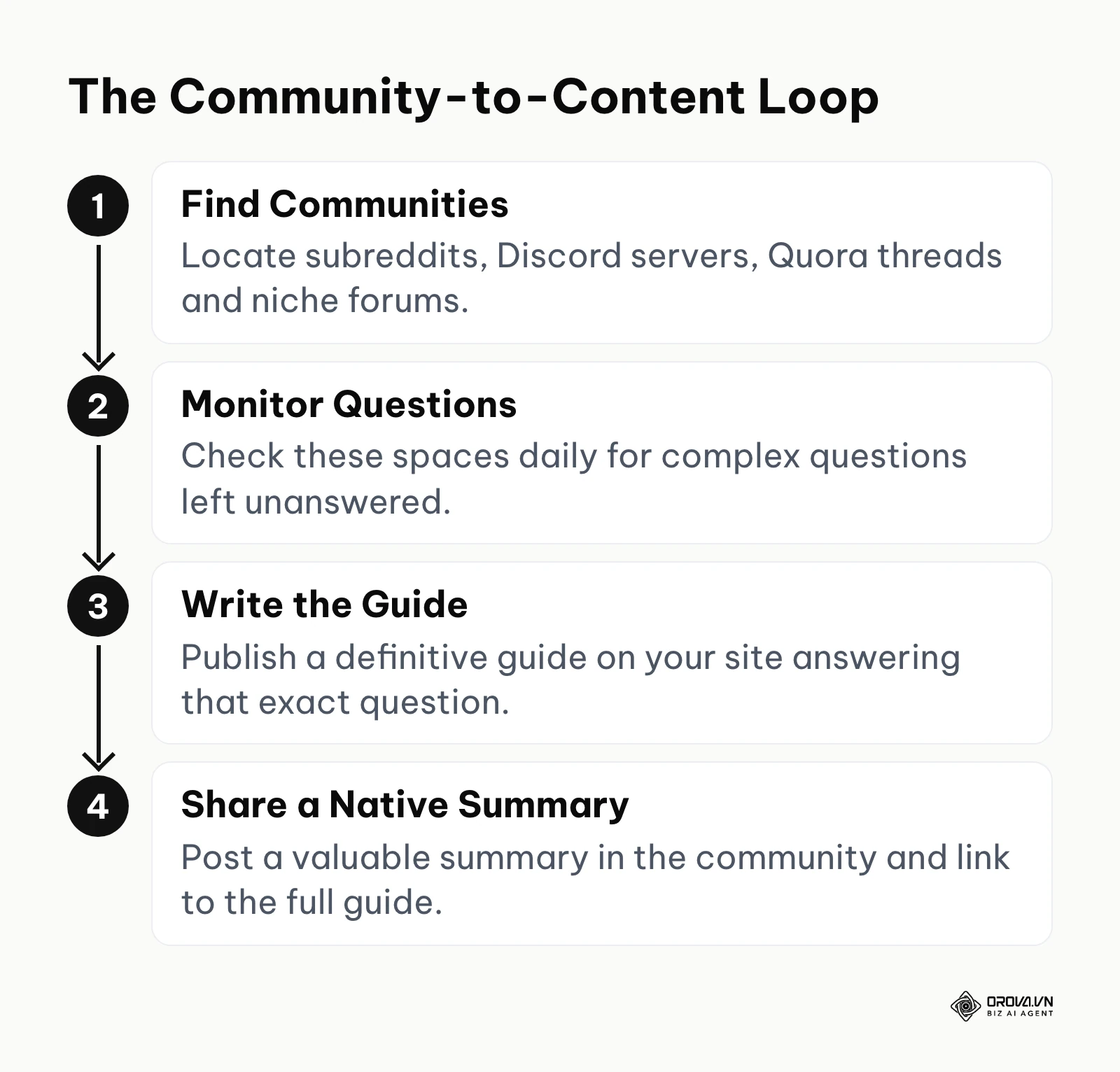
What to do: Identify niche communities where your target audience actively discusses their problems. Simultaneously, map out "zero-volume" keywords—highly specific, long-tail queries that SEO tools claim have no search volume, but are intensely relevant to your ideal customer.
How to do it:
- Find relevant subreddits, specialized Discord servers, Quora threads, and niche industry forums.
- Monitor these spaces daily for complex questions that go unanswered.
- Write a definitive, high-quality guide on your website answering that exact specific question.
- Return to the community and write a highly valuable, native summary of the answer, naturally linking back to your full article for those who want the technical deep dive.
Illustrative example:
- Context: A solo founder launched a B2B SaaS tool for inventory forecasting with zero marketing budget.
- Steps taken: They monitored an e-commerce operations Subreddit. They noticed repeated questions about calculating safety stock for highly seasonal items. They wrote a 3,000-word technical guide on their site with free Google Sheets templates. They then posted a 500-word summary of the math directly on Reddit, linking to the template on their site.
- Hurdle & Fix: The first Reddit post was removed by moderators for being overly promotional. The founder adjusted the strategy to ensure 95% of the value was contained within the Reddit post itself, making the website link purely optional for downloading the template.
- Tangible result: The single optimized Reddit post drove 800 highly targeted visitors over three days, resulting in 45 template downloads and 6 trial signups, establishing the initial user base without spending a dollar on ads.
Signs of success: A steady, predictable trickle of highly engaged users who spend significant time on your page, often navigating to multiple other pages on your site.
Mistakes to avoid: Treating communities like link-dumping grounds. If you drop links without providing immense upfront value natively within the platform, you will be banned instantly, and your brand reputation will suffer.
Step 4: Engineer high-converting commerce funnels
If your goal is learning how to drive traffic to your ecommerce website, the strategy shifts heavily toward transactional intent. Users searching for e-commerce terms are usually in the evaluation or purchase phase of the buying cycle. Your architecture must reflect this urgency.
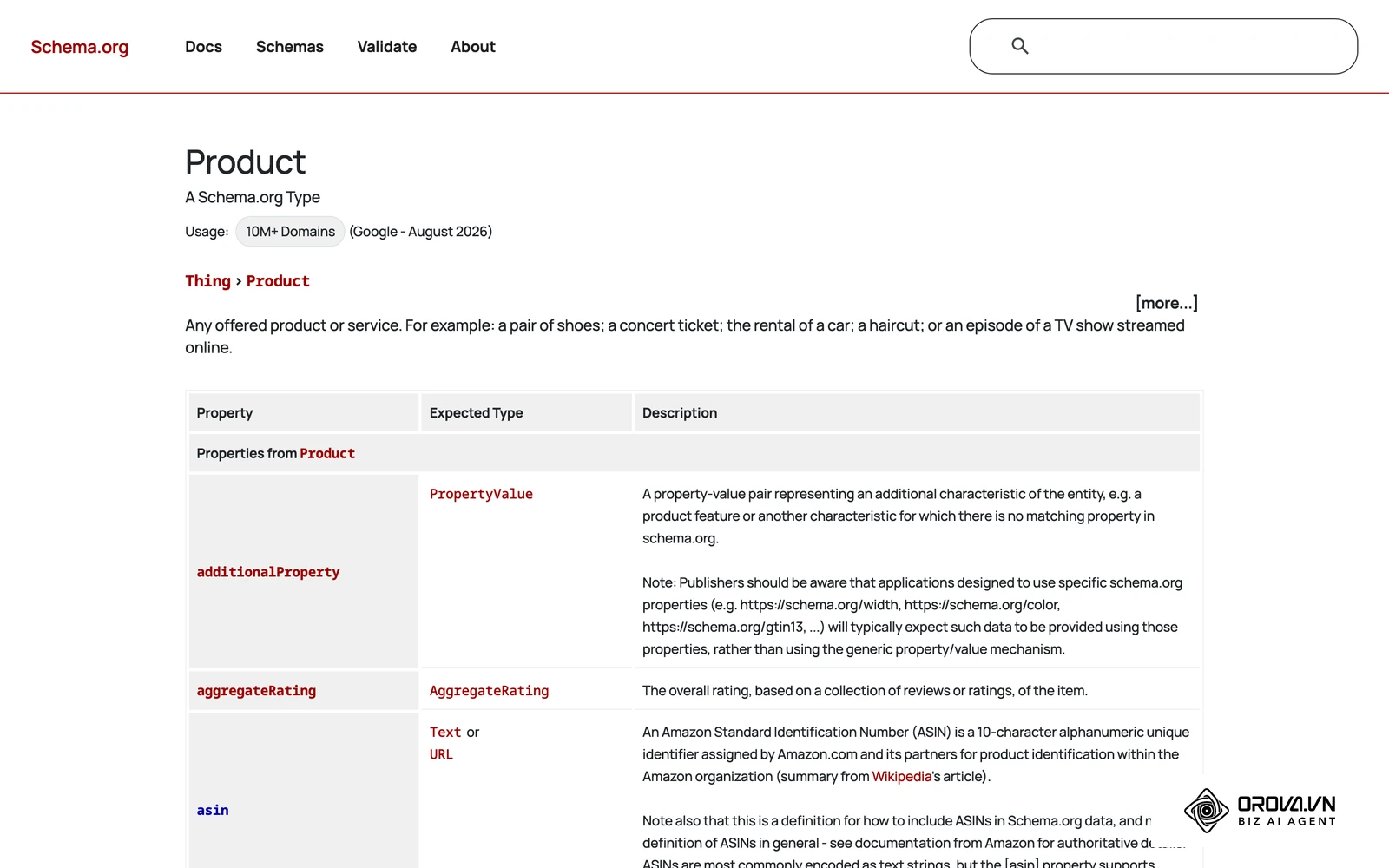
What to do: You must optimize your category pages and individual product pages to capture bottom-of-funnel search intent. E-commerce traffic is highly competitive, so technical execution and structured data markup are your primary weapons.
How to do it:
- Implement flawless faceted navigation that does not create millions of duplicate, thin parameter URLs that waste crawl budget.
- Add comprehensive Product Schema markup to every item, ensuring price, availability, and review aggregates are perfectly formatted to trigger rich snippets in search results.
- Write unique, benefit-driven product descriptions. Never rely on the manufacturer's default boilerplate text, as you will immediately be filtered out for duplicate content.
- Optimize category pages by treating them like landing pages—add 300-500 words of highly relevant buying guide text below the product grid.
Signs of success: An increase in organic impressions for queries containing modifiers like "buy," "best," "discount," or specific SKU numbers, accompanied by the appearance of star ratings directly in your search listings.
Mistakes to avoid: Allowing out-of-stock product pages to return a 404 error. This destroys accrued link equity. Always redirect them to the most relevant parent category or leave them live with an email capture for restock notifications.
Step 5: Diversify with the best free traffic sources for website stability
Relying entirely on one search engine algorithm is a catastrophic business risk. The most resilient websites treat SEO as a primary acquisition engine but actively siphon that traffic into owned channels. You must identify the best free traffic sources for website stability and integrate them into your workflow.
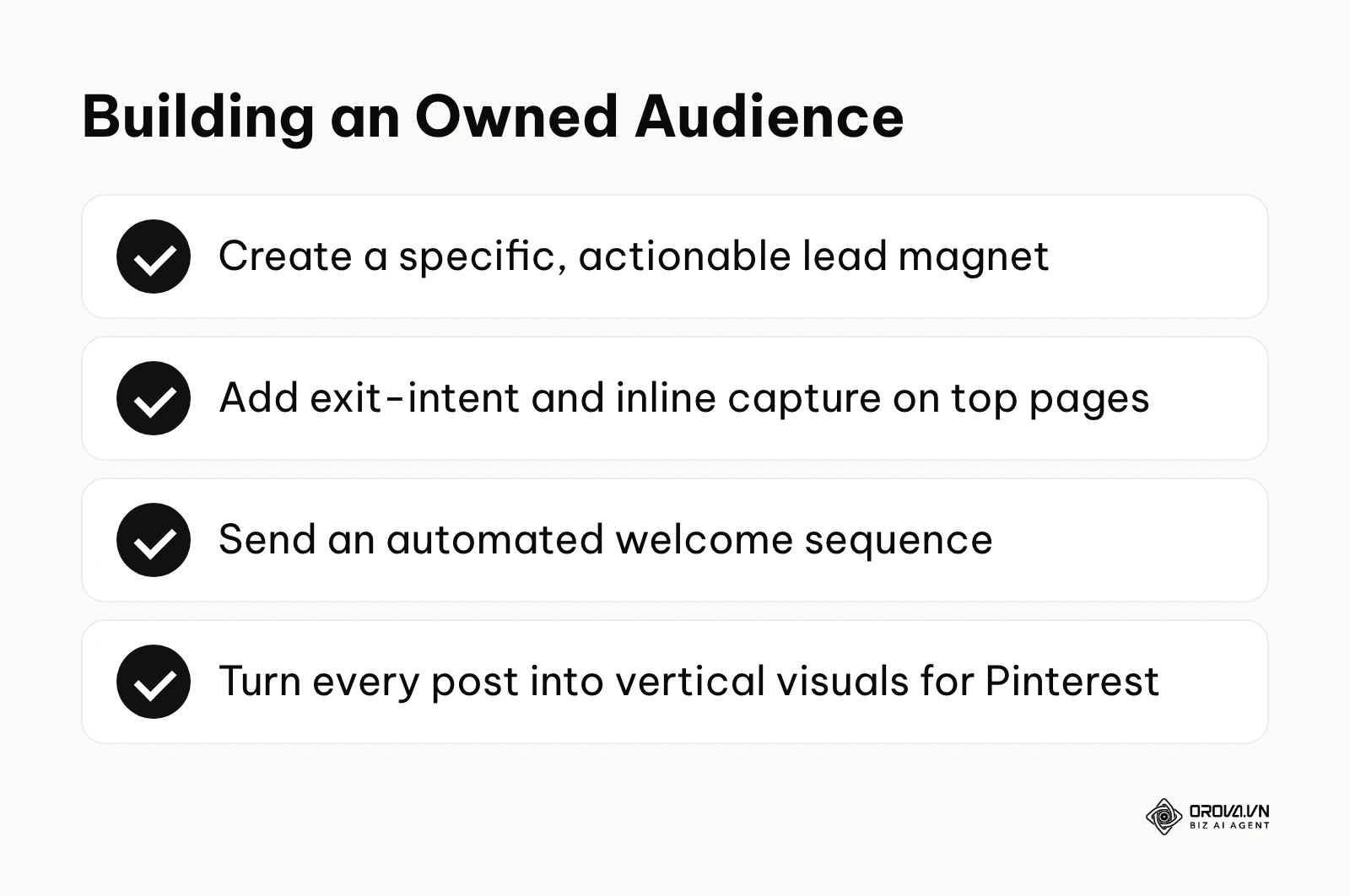
What to do: Build an owned audience that you can reach on demand, immune to algorithmic updates. The most valuable asset you can build is an engaged email newsletter, supplemented by strategic organic social media presence on platforms suited to your niche (e.g., LinkedIn for B2B, Pinterest for visual D2C).
How to do it:
- Create a highly specific, immediately actionable lead magnet (e.g., a technical checklist, a calculator spreadsheet) that solves an acute problem.
- Deploy aggressive but non-intrusive capture mechanisms (exit-intent popups, inline content upgrades) across your highest-traffic pages.
- Establish an automated welcome sequence that delivers the value immediately and sets expectations for future communications.
- Leverage platforms like Pinterest by creating vertical visual assets for every blog post, treating it as a visual search engine rather than a social network.
Illustrative example:
- Context: A mid-sized digital marketing agency generating 20,000 monthly organic visitors but suffering from low lead conversion.
- Steps taken: They analyzed their top 5 highest-traffic blog posts. For a post about "Facebook Ad Budgets," they created a highly complex, downloadable budget allocation calculator in Excel. They gated this specific calculator behind an email opt-in placed directly within the article text.
- Hurdle & Fix: Initially, they used a generic "Subscribe to our newsletter" popup sitewide, which converted at 0.5%. They replaced it with the hyper-relevant, context-specific calculator offer on just that one page.
- Tangible result: The specific page's conversion rate jumped from 0.5% to 8%. They captured 400 highly qualified emails in a month, completely insulated from any future search engine ranking drops.
Signs of success: Your traffic analytics show a predictable, massive spike in direct or referral traffic on the exact days you broadcast an email or publish to your primary social channel.
Mistakes to avoid: Treating an email list as a one-way promotional megaphone. If you only email your list to announce sales or demand they read your new blog post without providing standalone value in the email itself, your open rates will plummet to zero.
Step 6: Build a content repurposing engine
Creating high-quality content requires immense resources. To maximize the return on that investment, you cannot afford to publish a piece of content once and forget about it. You must build a system to extract maximum value from every asset.
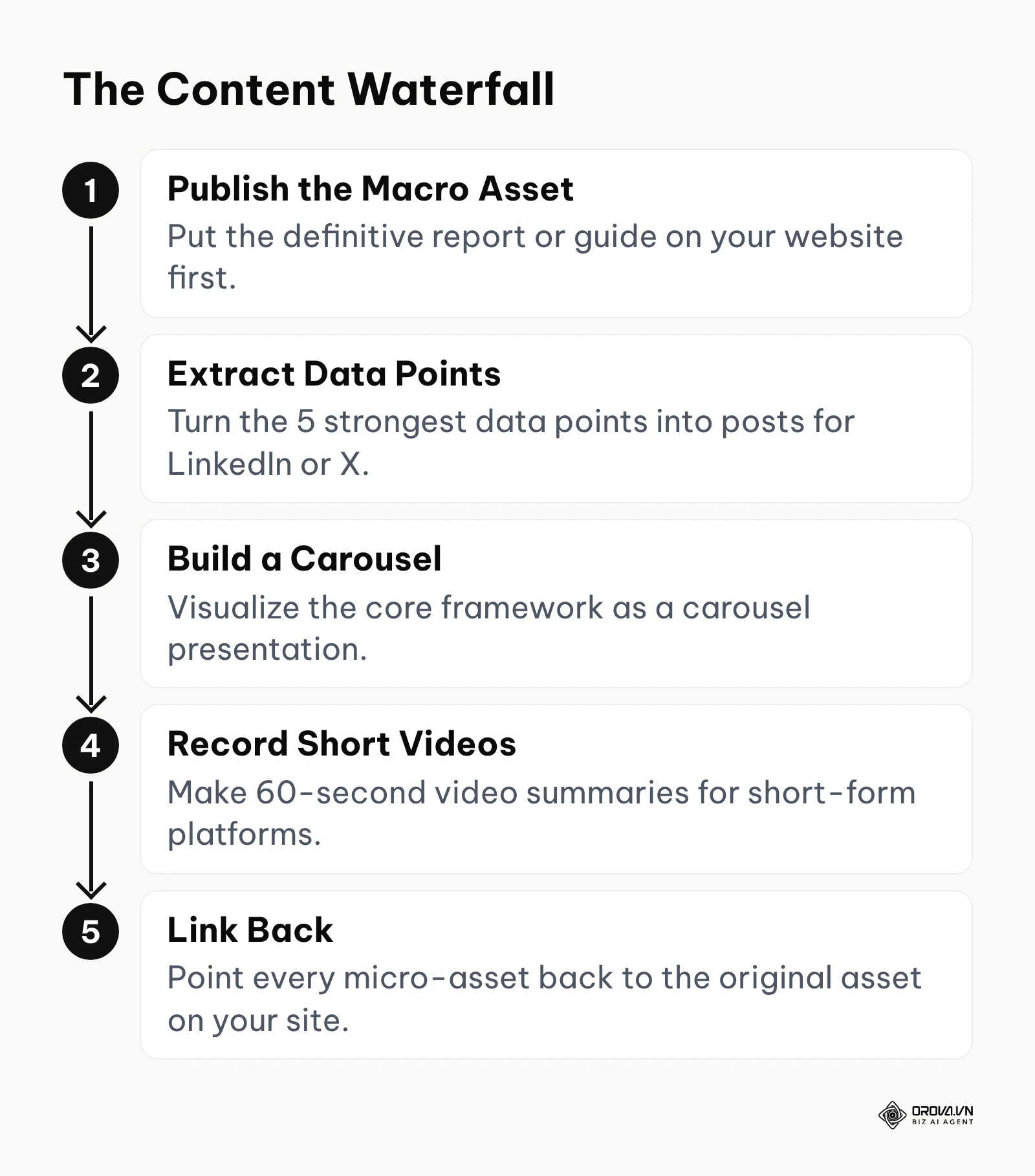
What to do: Implement a "Content Waterfall" strategy. This means taking one massive, high-effort macro asset (like a 4,000-word industry report or a 1-hour webinar) and systematically breaking it down into dozens of micro-assets tailored for different platforms.
How to do it:
- Publish your definitive macro asset on your website to anchor your SEO strategy.
- Extract the 5 most compelling data points and turn them into individual text posts for LinkedIn or X (formerly Twitter).
- Take the core framework and visualize it as a carousel presentation.
- Record short, 60-second video summaries of the most controversial points for short-form video platforms.
- Link all these micro-assets back to the original macro asset on your website.
Signs of success: You maintain a high-frequency posting schedule across multiple platforms, driving referral traffic back to your site, without experiencing a linear increase in content production costs.
Mistakes to avoid: Blindly copy-pasting the exact same format across different platforms. A 300-word excerpt from a blog post will fail on a highly visual platform. You must translate the core message into the native language and format of each specific channel.
Discover Orova.vn – a Biz AI Agent platform with OROVA SEO, a complete solution for every website. The system supports search engine optimization from A to Z with features including keyword research, writing new SEO-ready articles, optimizing existing content, rank tracking, plus competitor analysis and in-depth technical analysis. Sign up today to experience OROVA SEO completely free (offer valid through July 7, 2027).
Strategic deep dive: The traffic resource decision matrix
One of the most dangerous myths in digital marketing is that there is a universal "best" way to drive traffic. In reality, the optimal strategy is entirely dependent on two critical constraints: your available financial budget and your timeline for expecting a Return on Investment (ROI).
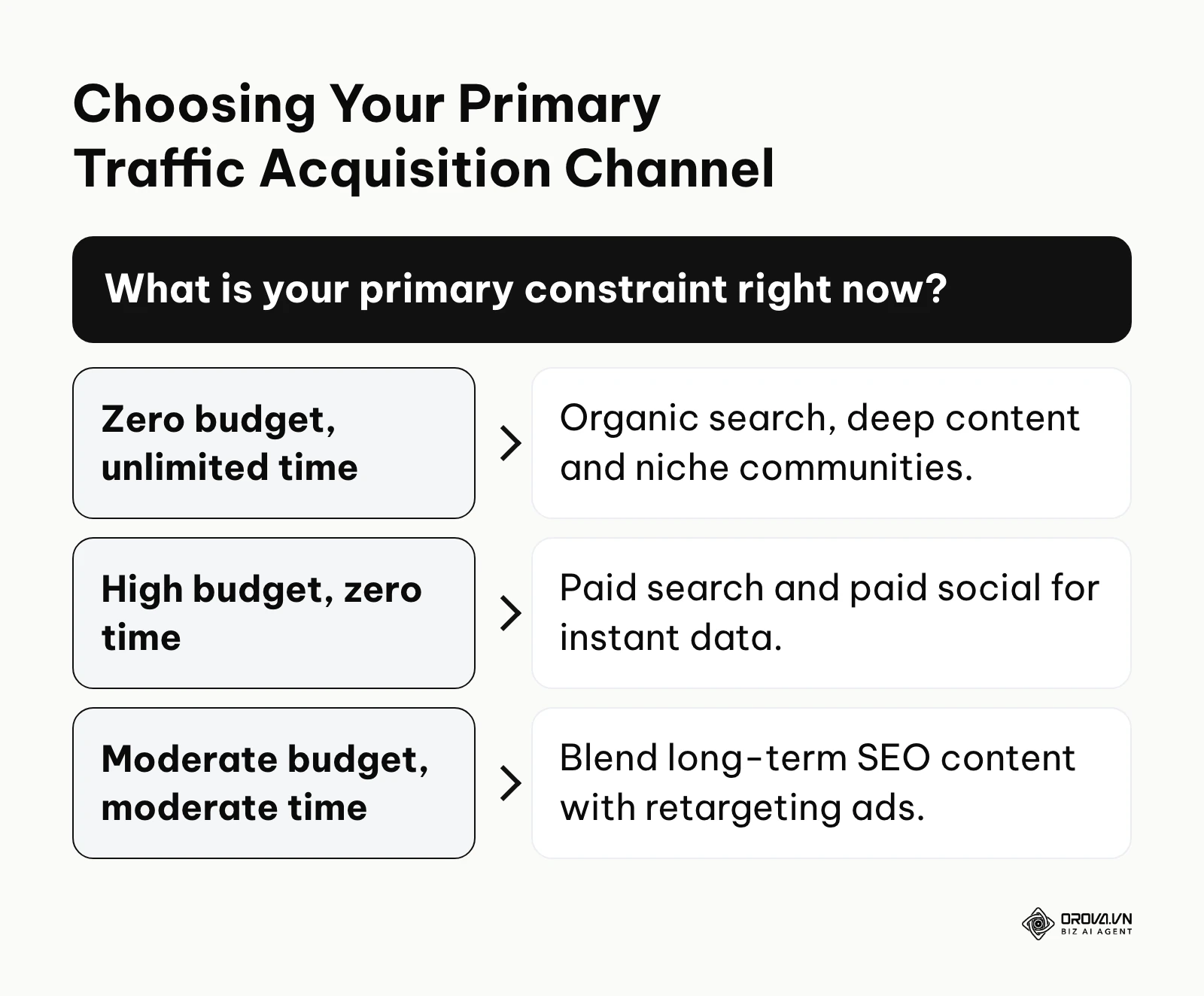
Founders often burn out because they choose a strategy that misaligns with their resources. If you need sales this week to keep the lights on, investing in a 6-month SEO strategy will kill your business. Conversely, if you have patience but zero cash, running expensive programmatic ads will drain your runway instantly.
| Acquisition Channel | Best Fit For (Scenario) | Core Weakness / Trade-off |
|---|---|---|
| Organic Search (SEO) | Bootstrapped startups; High patience, low budget. | Exceptionally slow ROI (often 6-12 months); requires massive initial labor. |
| Paid Search (PPC) | Well-funded businesses needing immediate validation. | Traffic instantly drops to zero the second you stop spending money. |
| Social Media (Organic) | Highly visual brands; B2B thought leaders. | Rented audience; algorithms can suppress your reach overnight. |
| Niche Communities | Zero budget; highly technical or specialized products. | Not easily scalable; high risk of being banned if perceived as spam. |
| Email Marketing | Any business with returning buyers or a long sales cycle. | Only reaches people who already know you; the list must be built first. |
| Digital PR | Brands with a genuine story, data, or expert opinion to share. | Coverage is never guaranteed; results are lumpy and hard to schedule. |
The right mix also changes with your stage. At launch, lean on niche communities, founder-led social posts, and a few paid tests to learn what resonates. In the growth stage, shift effort into SEO content and email capture so that every visitor you pay or work for can be reached again. Once you are established, add digital PR and partnerships to earn mentions and links that strengthen both brand searches and organic rankings. Whatever the stage, avoid shortcuts such as buying bot traffic: it inflates pageviews, pollutes your analytics, and never converts.
You must map your current situation to the correct quadrant. For B2B companies, the decision matrix often skews toward high-value, long-term content and targeted outbound, because the customer lifetime value justifies the high acquisition cost. For B2C e-commerce, the matrix often demands immediate paid acquisition to test product-market fit rapidly, shifting to SEO and email marketing only after validation occurs.
Illustrative example:
- Context: A funded tech startup needed to validate a new enterprise compliance feature before committing engineering resources to a full build.
- Steps taken: Instead of writing dozens of SEO articles and waiting months, they allocated a modest test budget to highly targeted LinkedIn Ads aimed specifically at Chief Compliance Officers. The ads directed users to a detailed landing page explaining the feature.
- Hurdle & Fix: The initial ad creative generated clicks but zero sign-ups. They realized the messaging was too technical. They paused the campaign, adjusted the copy to focus purely on the financial risk of non-compliance, and relaunched.
- Tangible result: The revised paid campaign generated 40 demo requests in two weeks. This immediate, high-intent traffic provided enough qualitative feedback to greenlight the engineering build, something organic traffic could not have delivered in that timeframe.
Measuring success: Tracking ROI over vanity metrics
If you cannot definitively prove that your traffic is generating revenue, your traffic strategy is a failure. The era of reporting raw pageviews to stakeholders is over. You must connect the top of the funnel (visitors) to the bottom of the funnel (cash).
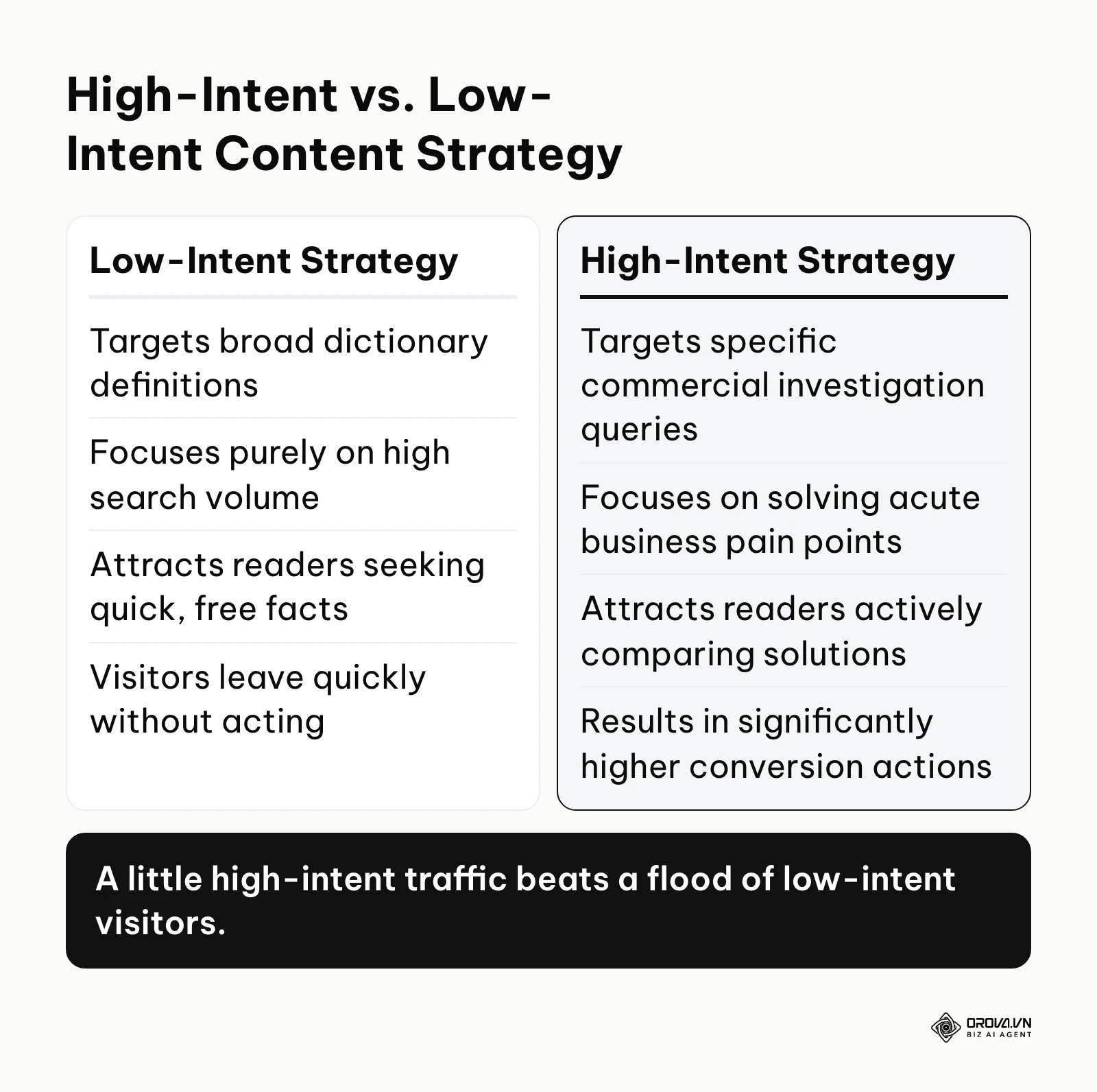
This requires shifting your focus away from volume and toward intent and conversion. You need to build a Traffic Quality Scorecard that tracks the meaningful actions users take. For a comprehensive breakdown of setting up these tracking frameworks, review our guide on how to measure website traffic.
| Critical Metric | What It Actually Means | Warning Threshold |
|---|---|---|
| Engagement Rate (GA4) | The percentage of users who stayed longer than 10 seconds, viewed multiple pages, or triggered a conversion event. | A rate well below your own site average signals a mismatch between search intent and your content. |
| Micro-Conversions | Actions that indicate high interest but aren't sales (e.g., newsletter signups, PDF downloads, video views). | Stagnant growth despite increasing traffic volume. |
| Customer Acquisition Cost (CAC) | The total amount of money and labor spent divided by the number of paying customers acquired. | When CAC exceeds the Customer Lifetime Value (LTV), your model is financially unviable. |
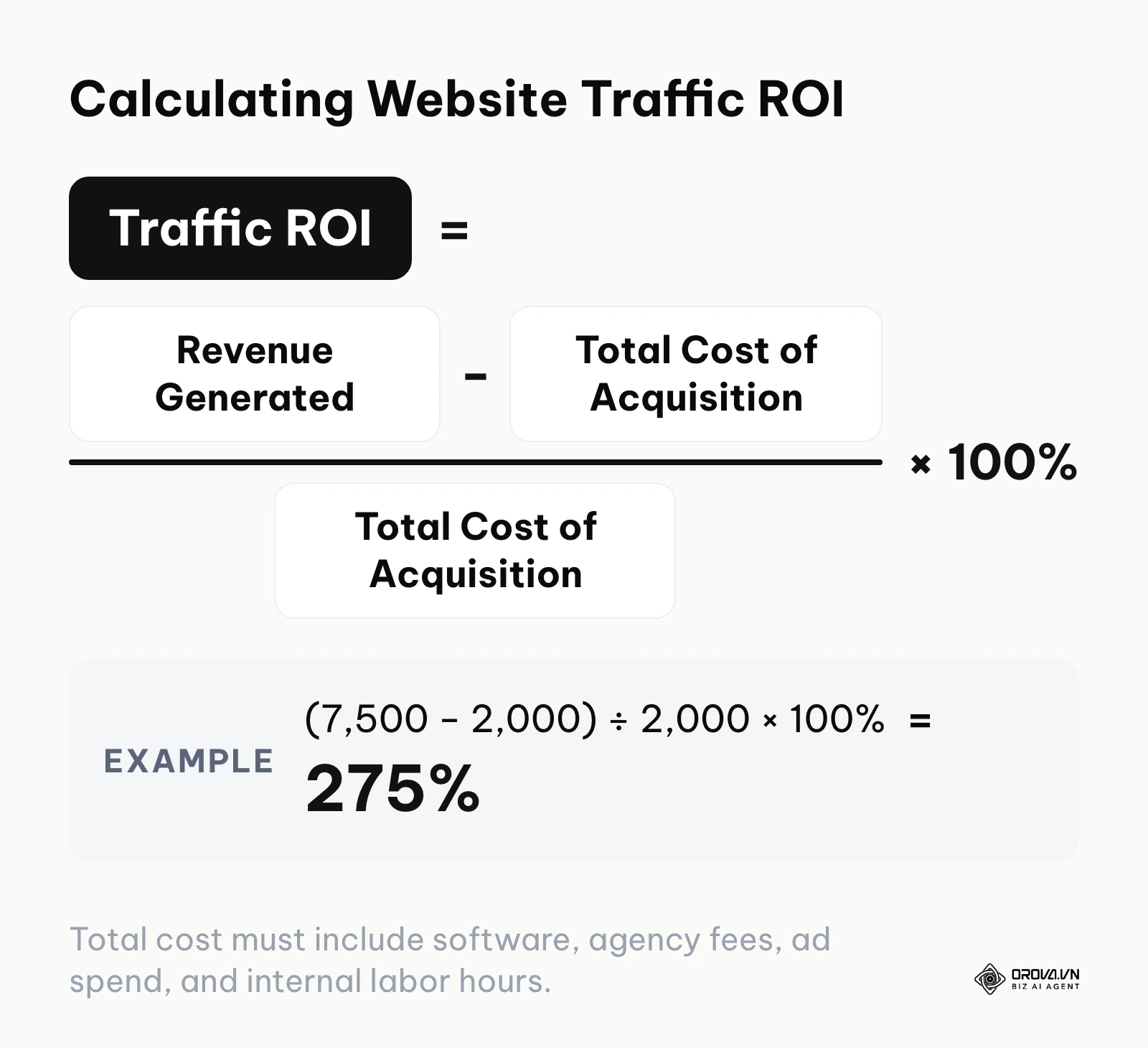
Measuring the financial impact of organic content can be notoriously difficult due to complex attribution paths. However, calculating a baseline return is mandatory to justify continued investment. For a detailed breakdown of the mathematical models used to evaluate this, see our deep dive on SEO ROI. You must track the cost of content production and software against the eventual closed revenue sourced from organic channels. The basic formula is Traffic ROI = (Revenue Generated − Total Cost of Acquisition) ÷ Total Cost of Acquisition × 100%. For example, if a campaign costs 2,000 in total and generates 7,500 in revenue (in the same currency), the ROI is (7,500 − 2,000) ÷ 2,000 × 100% = 275%.
With OROVA.VN and the OROVA SEO module, you put an end to the exhausting days of manual work for good. Instead of struggling for hours to write articles and compile reports, the entire process is now optimized and completed in just 5 minutes.
Critical mistakes that destroy website traffic
Most websites fail to generate meaningful traffic not because the algorithms are unfair, but because the site owners repeatedly commit fundamental strategic errors. Avoiding these common traps is often more impactful than discovering a new "growth hack."
Mistake 1: Ignoring search intent entirely
The most common error is targeting a keyword with massive volume without analyzing why the user typed it. If a user searches for "CRM software," they want a list comparing options. If you try to rank a landing page forcing them to buy your CRM software for that term, you will fail. Search engines actively demote pages that do not satisfy the underlying psychological intent of the query. The Fix: Always manually search your target keyword in an incognito window before creating content. Look at the top 5 results. If they are all comparison tables, you must build a comparison table. If they are all how-to guides, you must write a how-to guide.
Mistake 2: Relying on a single point of failure
Building your entire business model on Google organic search is playing Russian roulette with your revenue. A single core algorithmic update can wipe out most of your visibility overnight. The same applies to relying solely on Facebook Ads or a single TikTok account. The Fix: Implement a strict diversification mandate. Ensure that no single channel accounts for more than 50% of your total acquisition. Actively build your email list and experiment with secondary channels continuously.
Mistake 3: Publishing thin, unhelpful content
Producing 500-word articles that merely summarize what is already on the first page of Google is a waste of server space. Search engines have sophisticated systems designed to aggressively filter out unoriginal, low-effort content. For insights on navigating this while scaling production, read about the best AI writing tools. The Fix: Adopt a "10x Content" philosophy. Your article must be demonstrably better, more comprehensive, better formatted, and contain more original insight than anything currently ranking.
Mistake 4: Neglecting technical foundations
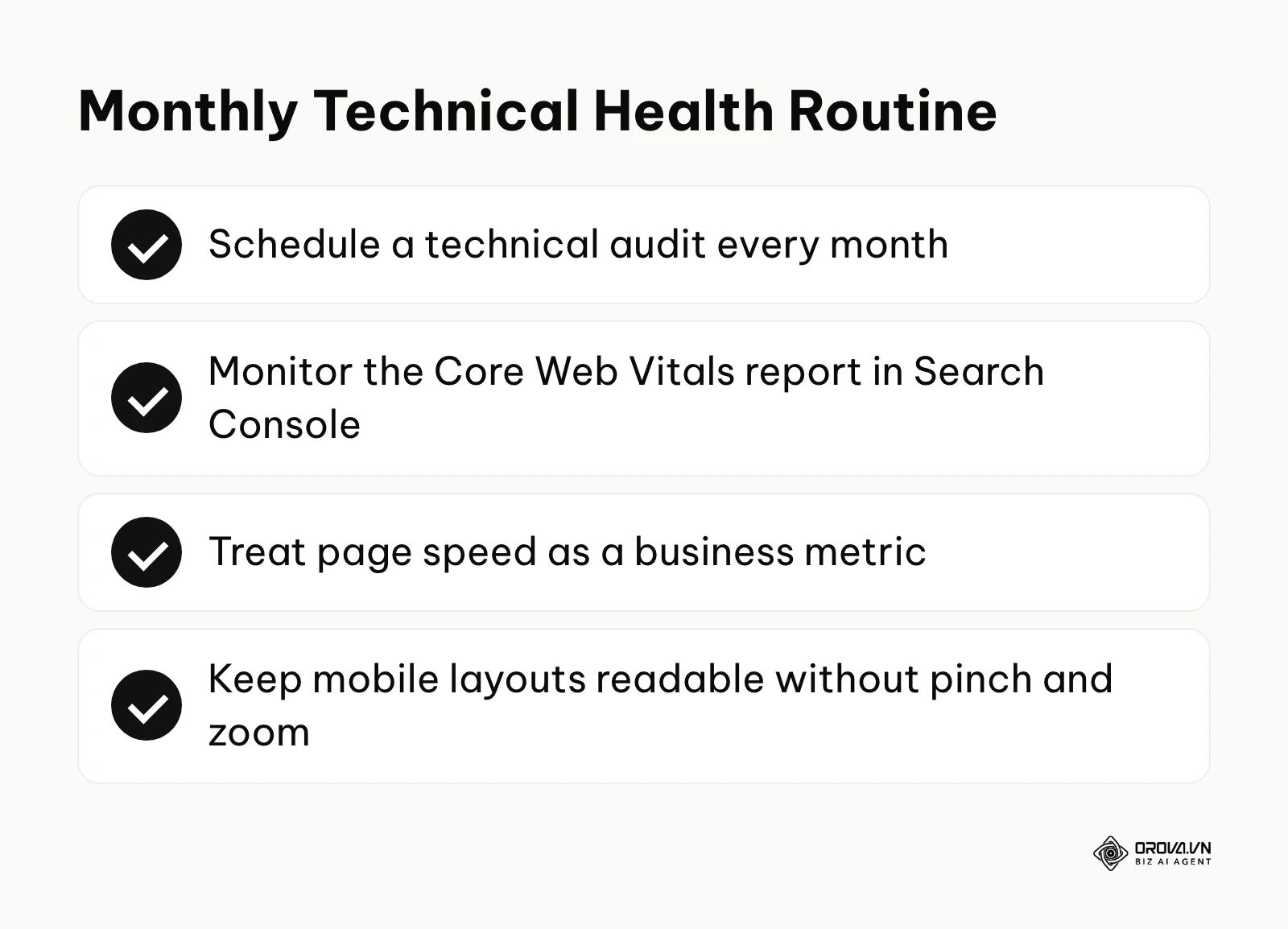
You can write the greatest content in the world, but if your server takes 8 seconds to respond, or if your mobile layout requires users to pinch and zoom to read the text, visitors will instantly bounce. High bounce rates signal to search engines that your site is a poor result. The Fix: Schedule monthly technical audits. Monitor Google Search Console's Core Web Vitals report obsessively. Treat page speed and mobile usability as critical business metrics, not just IT problems.
Mistake 5: Setting unrealistic timeframes for organic growth
Founders routinely abandon SEO strategies after 60 days because they "aren't seeing results." Organic search is a flywheel. It takes months of consistent effort to overcome the initial inertia, establish trust, and begin seeing compounding returns. The Fix: Set expectations correctly. Do not expect meaningful organic revenue for the first 6 months of a new campaign. Use paid acquisition or direct sales to survive the short term while building the long-term organic asset.
Website traffic trends in the coming years: My perspective
As we look toward the future of digital acquisition, the landscape is shifting violently. The old models of interruption marketing and simple keyword matching are deteriorating rapidly. Based on current trajectories, I anticipate three major paradigm shifts that will dictate how traffic is acquired.
The absolute dominance of zero-click and brand authority
I strongly believe that within the next few years, traditional organic click-through rates for informational queries will plummet. AI engines and search platforms are increasingly synthesizing answers directly on the results page. If a user asks a simple question, they will get the answer immediately without ever clicking your link. Therefore, I argue that brand authority will become the ultimate currency. You must pivot from answering simple questions to providing deep, proprietary insights that build brand affinity, so users explicitly search for your brand name rather than a generic term.
AI-driven hyper-personalization in discovery
I foresee the concept of a static "search results page" becoming obsolete. As of 2026, AI algorithms are becoming terrifyingly adept at predicting intent before a search even occurs. Traffic will increasingly come from hyper-personalized discovery feeds (similar to how TikTok operates, but applied to professional and commercial content). I expect that optimizing for engagement signals—dwell time, deep scrolling, and interactive elements—will become far more important than optimizing for specific keywords, as algorithms will proactively push highly engaging content to relevant users.
The resurgence of dark social and micro-communities
As the open internet becomes flooded with AI-generated noise, I am confident that high-value users will retreat into private, gated communities—Slack groups, Discord servers, and private newsletters. This phenomenon, often called "dark social," means that a massive portion of your highest-converting traffic will become untrackable by standard analytics software. I suggest that marketers must prepare for this by building their own micro-communities and relying on self-reported attribution ("How did you hear about us?" surveys) rather than relying exclusively on flawed tracking pixels.
Frequently asked questions about website traffic
How long does it take to see traffic from SEO?
For a brand new website, it typically takes 6 to 12 months of consistent, high-quality content publication and technical optimization to see significant, business-impacting organic traffic. For an established site with existing authority, optimizing existing content can yield results in 4 to 8 weeks. It is a long-term compounding asset, not a short-term fix.
What is the most effective free traffic source?
The most effective free traffic source is a highly optimized, opt-in email list. Unlike organic search or social media platforms where algorithms control your reach, an email list is an owned asset. You have direct access to an audience that has explicitly asked to hear from you, allowing you to generate traffic on demand without paying gatekeepers.
How do AI search engines impact website traffic?
AI search engines (like Perplexity and ChatGPT Search) reduce the volume of low-intent, informational traffic because they answer simple queries directly. However, they can drive highly qualified referral traffic if your content is structured correctly (using Generative Engine Optimization) to be cited as a primary source for complex, nuanced queries.
Should I focus on social media or SEO first?
This depends entirely on your product and audience. If you have a highly visual product (e.g., fashion, home decor) or a product that relies on impulse buying, social media is often the better starting point. If you sell B2B software, consulting services, or high-ticket items where buyers conduct extensive research, SEO should be your primary focus.
How many visitors do I need to make a sale?
There is no universal number, as it depends entirely on your conversion rate and the intent of the traffic. A site with a 2% conversion rate needs 50 targeted visitors to make one sale. A site with a 0.5% conversion rate needs 200 visitors. Focusing on improving the conversion rate of your existing traffic is almost always more profitable than simply doubling your traffic volume.
Where should you start?
Knowing how to drive traffic to your website is useless without execution. The sheer volume of available tactics often leads to analysis paralysis. Your immediate next step depends entirely on the current state of your digital presence. Do not attempt to execute every strategy simultaneously; focus on the single action that addresses your most critical bottleneck.
State 1: You have a brand new site with zero traffic. Your immediate priority is validation, not scaling. Do not spend weeks writing 50 mediocre blog posts. Instead, interview three people in your exact target demographic. Identify their single most painful problem. Spend one entire week writing the most comprehensive, definitive guide on the internet solving that specific problem. Then, manually distribute that guide in the niche communities where those users hang out.
State 2: Your traffic is stagnant and refuses to grow. You likely have a technical ceiling or content decay issue. Your first action should be a ruthless content audit. Identify the top 20 pages that used to drive traffic but have slowly declined over the past year. Do not write anything new. Spend your next working session completely rewriting, updating, and re-formatting those 20 historical pages to match the current search intent and technical standards.
State 3: You have high traffic volume but zero conversions. You have an intent mismatch or a broken funnel. Stop focusing on acquisition entirely. Your immediate step is to implement aggressive capture mechanisms on your highest-trafficked pages. Design a highly specific lead magnet (a checklist or template) that is directly relevant to the topic of your most popular article, and gate it behind an email capture form. Fix the leaks in your bucket before pouring more water into it.
About the author

Builder of Orova
Nguyễn Đỗ Trọng Ân has 8 years of experience in marketing, including 6 years managing market development across Asia. He builds Orova, a Biz AI Agent that never sleeps: it plans, runs and optimizes work for businesses.
Run your business with AI Agents
Orova is the always-on Biz AI Agent — it plans, runs, and optimizes the work for you.
Save time, unlock productivity.