
What are responsive search ads? A complete copywriting framework

Responsive search ads (RSAs) are the standard text ad format in Google Ads Search campaigns: you supply up to 15 headlines and 4 descriptions, and Google assembles them into the combination it predicts will work best for each search. Before this format, crafting the perfect advertisement was a rigid exercise in character counting and manual guesswork. You would write two distinct messages, run them side-by-side, wait three weeks, and hope you correctly guessed what the audience wanted to read. If you guessed wrong, you wasted budget on the inferior message. As search queries became more complex and user intent more fragmented, this manual testing methodology broke down. Advertisers needed a way to dynamically match their messaging to the specific context of a user's search in real-time. This is exactly the problem that modern automated ad formats were designed to solve. In this guide, we will dissect what responsive search ads are and give you a practical copywriting framework to ensure you feed the algorithm exactly what it needs to drive profitable conversions, rather than just chasing arbitrary platform scores.
What are responsive search ads?
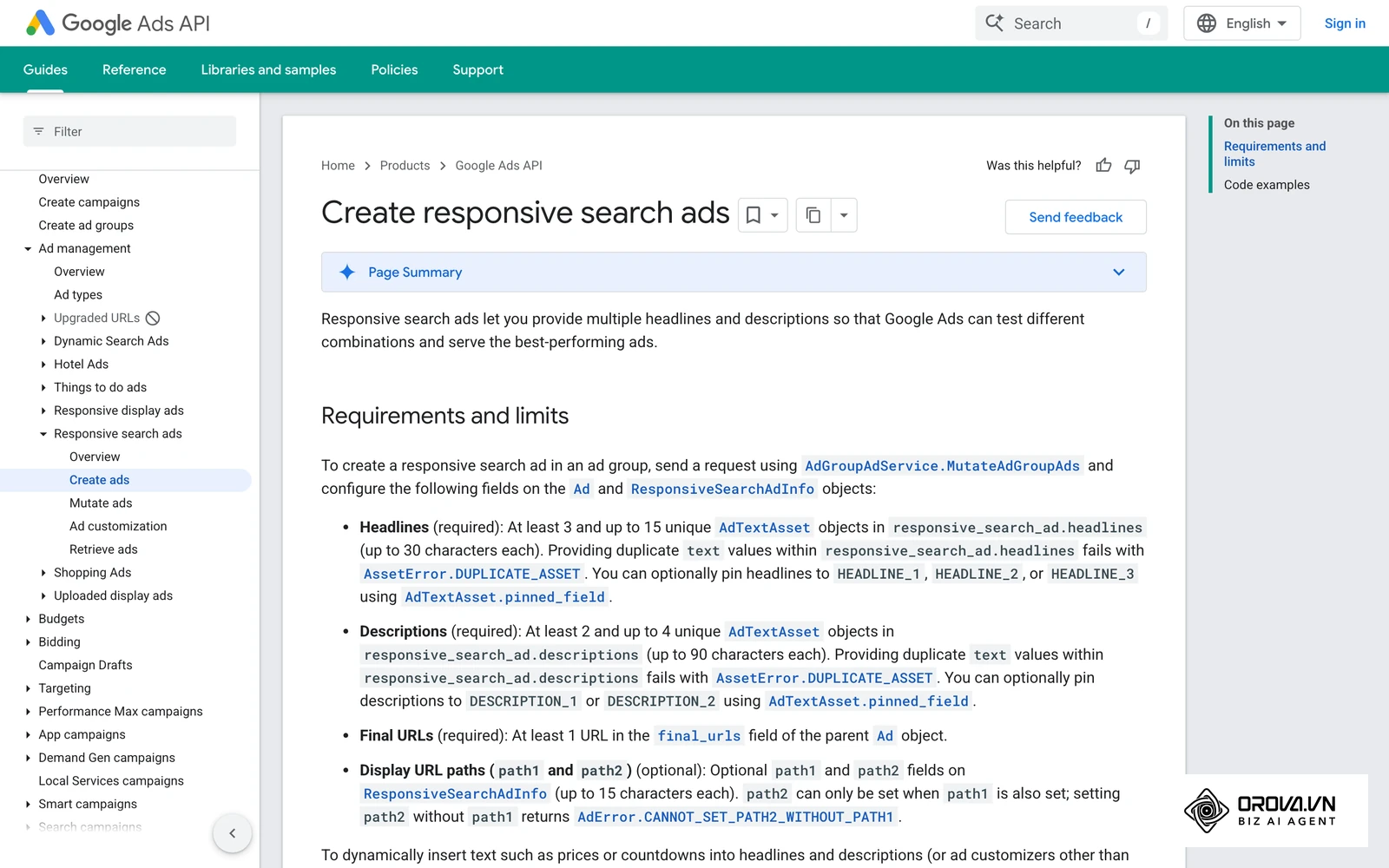
Responsive search ads are Google's default search campaign format that automatically tests multiple text combinations. According to Google's own documentation, you can provide up to fifteen headlines (30 characters each) and four descriptions (90 characters each), and the machine learning algorithm dynamically assembles them to show the most relevant ad to individual searchers based on their query context.
This format represents a massive shift from the legacy Expanded Text Ads (ETA), which Google stopped letting advertisers create or edit in mid-2022. In the ETA era, marketers wrote a static combination of Headline 1, Headline 2, and a description. What you wrote was exactly what appeared on the search engine results page (SERP). Today, you are no longer writing ads; you are providing an inventory of assets.
To understand how this differs from other concepts, consider this comparison:
| Format Type | Core Difference | Example Use Case |
|---|---|---|
| Responsive Search Ads | You provide text assets; system mixes them dynamically based on user intent. | Promoting a SaaS product with multiple distinct features and benefits. |
| Expanded Text Ads (Legacy) | Static text block. The system displays exactly what you wrote, in that exact order. | Replaced entirely, but formerly used for strict, unchangeable brand messaging. |
| Dynamic Search Ads (DSA) | System generates headlines automatically by scraping your website content. | An e-commerce store with 10,000 changing inventory SKUs. |
Think of this format like a modular sofa. With a traditional couch (ETA), the shape is fixed. If you move to a new apartment, it might not fit the room. With a modular sofa (RSA), you have individual pieces—corner units, middle seats, ottomans. You can rearrange these pieces infinitely to perfectly fit whatever room you place them in. The search algorithm is the interior designer, rearranging your text "pieces" to perfectly fit the "room" of the user's specific search query.
The purpose of responsive search ads in digital marketing
The primary purpose of this dynamic format is to bridge the gap between static brand messaging and fluid consumer intent at immense scale. Modern consumers search in highly unpredictable ways; a single product might be searched using thousands of different long-tail keyword variations. It is humanly impossible for a copywriter to manually create a perfectly tailored static ad for every possible search permutation.
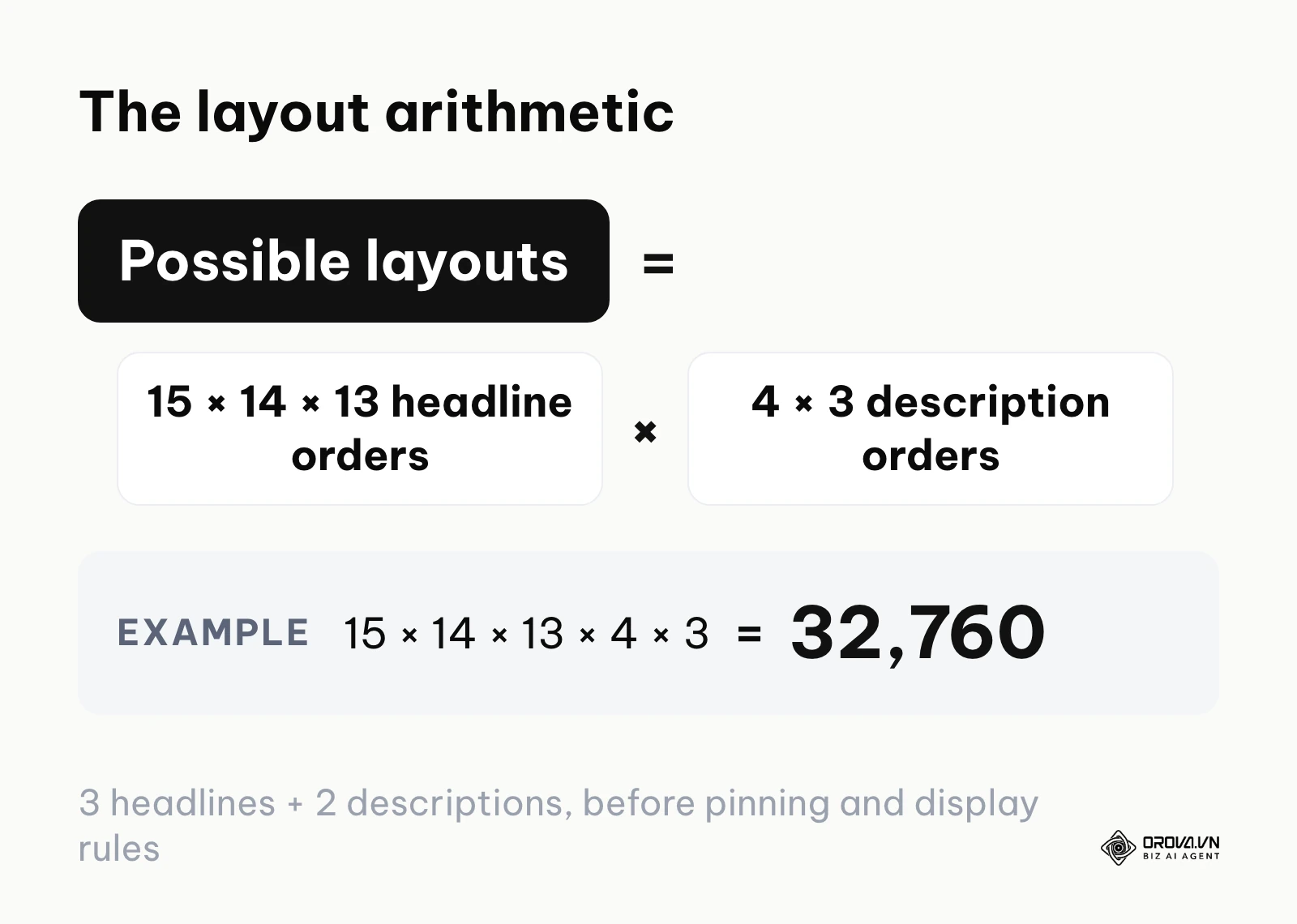
This format exists at the very bottom of the marketing funnel. After your brand awareness campaigns on social media have generated interest, the search ad is the mechanism that captures high-intent demand. Simple arithmetic shows the scale: picking 3 of 15 headlines in order and 2 of 4 descriptions in order gives 15 × 14 × 13 × 4 × 3 = 32,760 possible layouts for one fully populated ad, before pinning and Google's display rules narrow it down.
If you skip implementing a robust asset strategy and only upload two or three headlines, you severely handicap the machine learning algorithm. Google notes that more headline and description options give your ads the opportunity to compete in more auctions and match more queries. With only a handful of assets, you give up that reach, and weaker ad relevance can also drag down your Quality Score and push up your Cost Per Click (CPC).
When to skip dynamic formatting: There are specific scenarios where utilizing fluid text combinations is unnecessary or poses significant risks. For legal, financial, or pharmaceutical companies, compliance requires strict message control. In these highly regulated industries, randomly generated text combinations could violate industry advertising standards. Instead of using fluid combinations, marketers can pin exactly one approved headline to each of Positions 1, 2 and 3 and one approved description to each description position. This effectively turns the responsive format into a static advertisement, ensuring absolute control over the final messaging while remaining compliant with network requirements.
Business value and marketer benefits of dynamic optimization
The shift from manual ad writing to dynamic asset management delivers value across two distinct layers: the financial impact on the business and the operational benefits for the people running the campaigns.
Lowering Cost Per Acquisition (CPA)
For the business, the ultimate value lies in financial efficiency. Because the algorithm continuously tests combinations and favors those that generate engagement, it naturally filters out messaging that doesn't resonate. Over time, this can lift click-through rates (CTR) and, more importantly, lower CPA, saving the business money on wasted clicks. For a deep dive on budget efficiency, you might explore our guide on Google Ads pricing.
Reclaiming strategic time
For the marketer, the benefit is time. Instead of spending ten hours a week manually pausing losing ads and writing new variants to test A against B, the marketer can spend that time on deeper strategic work, such as analyzing audience demographics or improving the landing page experience.
Illustrative example:
- Context: A B2B software company employing a single in-house marketer to manage a sizeable monthly search budget.
- Steps Taken: The marketer transitioned from running 40 separate static ads to 4 consolidated ad groups utilizing fully populated dynamic assets. They implemented an automated script to report on asset-level performance weekly.
- Challenge: Initially, leadership was nervous about losing control over the exact phrasing shown to enterprise clients. The marketer had to create a strict approval matrix for all raw text components before inputting them.
- Result: The marketer reclaimed most of the hours previously spent on manual split testing, while ad relevance in niche auctions improved because each ad group had a full set of distinct assets.
Discovering unexpected audience insights
When you provide a diverse array of headlines, the system's reporting will eventually tell you which assets drive the most conversions. Marketers often discover that the benefit they thought was most important (e.g., "Fast Setup") actually performs worse than a secondary feature (e.g., "Data Export Options"), providing valuable feedback for the wider business strategy.
| Benefit Category | Measured By Which Metric | Expected Timeframe to See Results |
|---|---|---|
| Efficiency | Cost Per Acquisition (CPA) | After the learning period, once conversions accumulate |
| Engagement | Click-Through Rate (CTR) | Once each asset has gathered enough impressions |
| Productivity | Hours spent on campaign maintenance | Immediate |
OROVA ADS applies AI Agent to automate and optimize ad performance on Google, Meta and TikTok. Scale your budget safely, monitor 24/7 and expand your business quickly.
Experience the solution at orova.vn/ads
How responsive search ads work: A complete optimization playbook
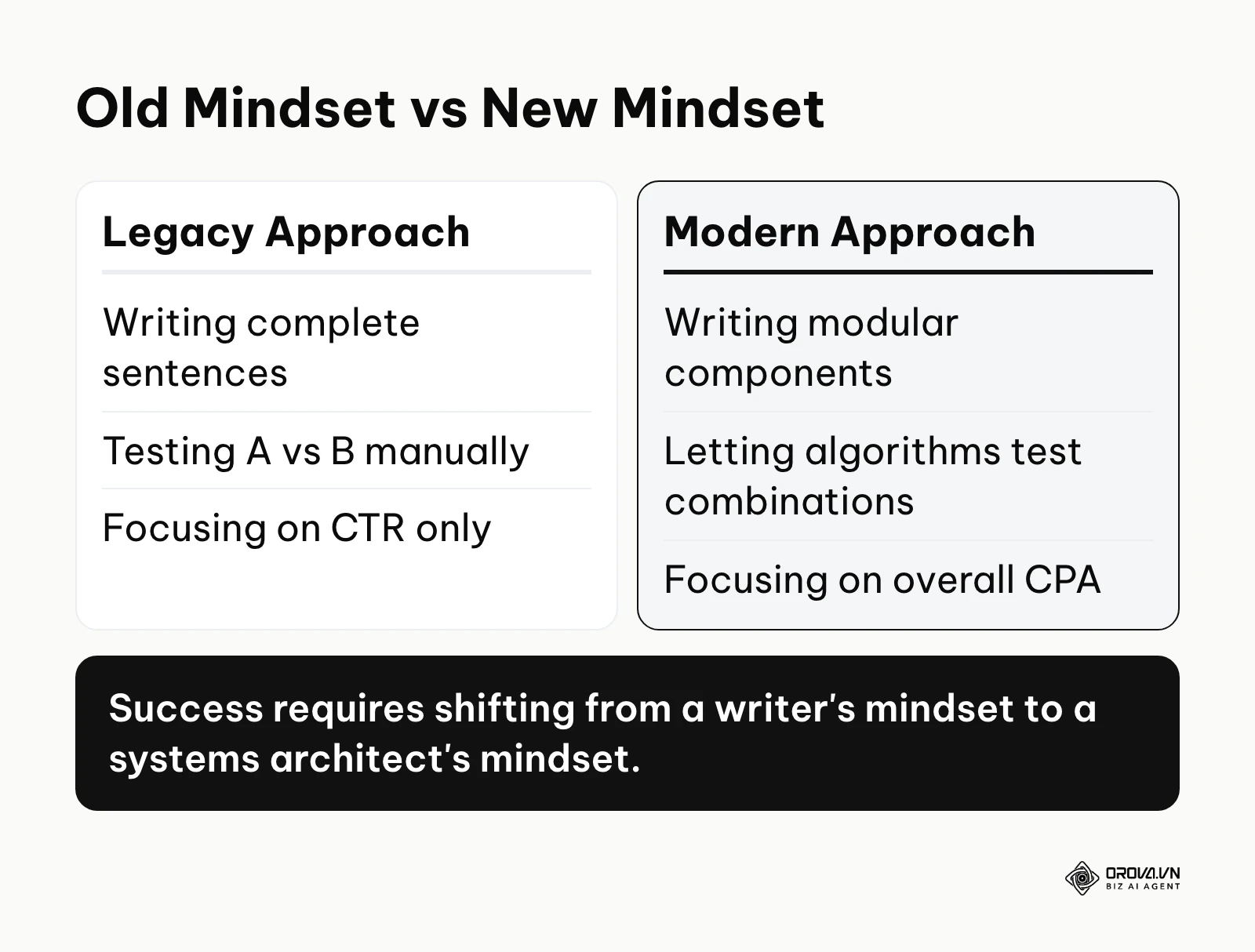
To master this format, you must stop thinking like a traditional copywriter and start thinking like a systems architect. You are building a machine, and the headlines are the fuel. If you put bad fuel in, the output will be poor, regardless of how advanced the algorithm is.
The algorithm's assembly process
The core mechanism operates on a simple input-output loop.
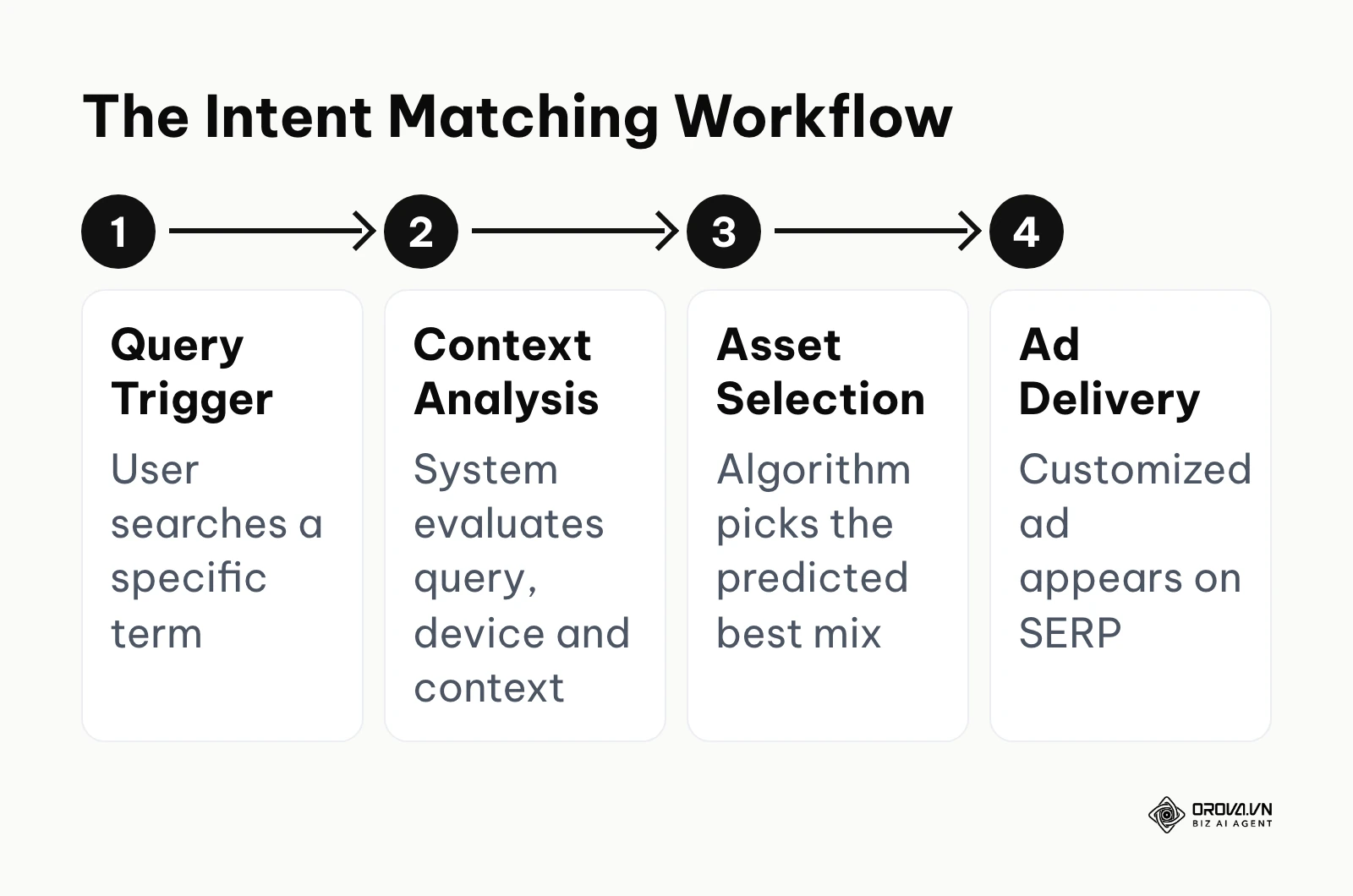
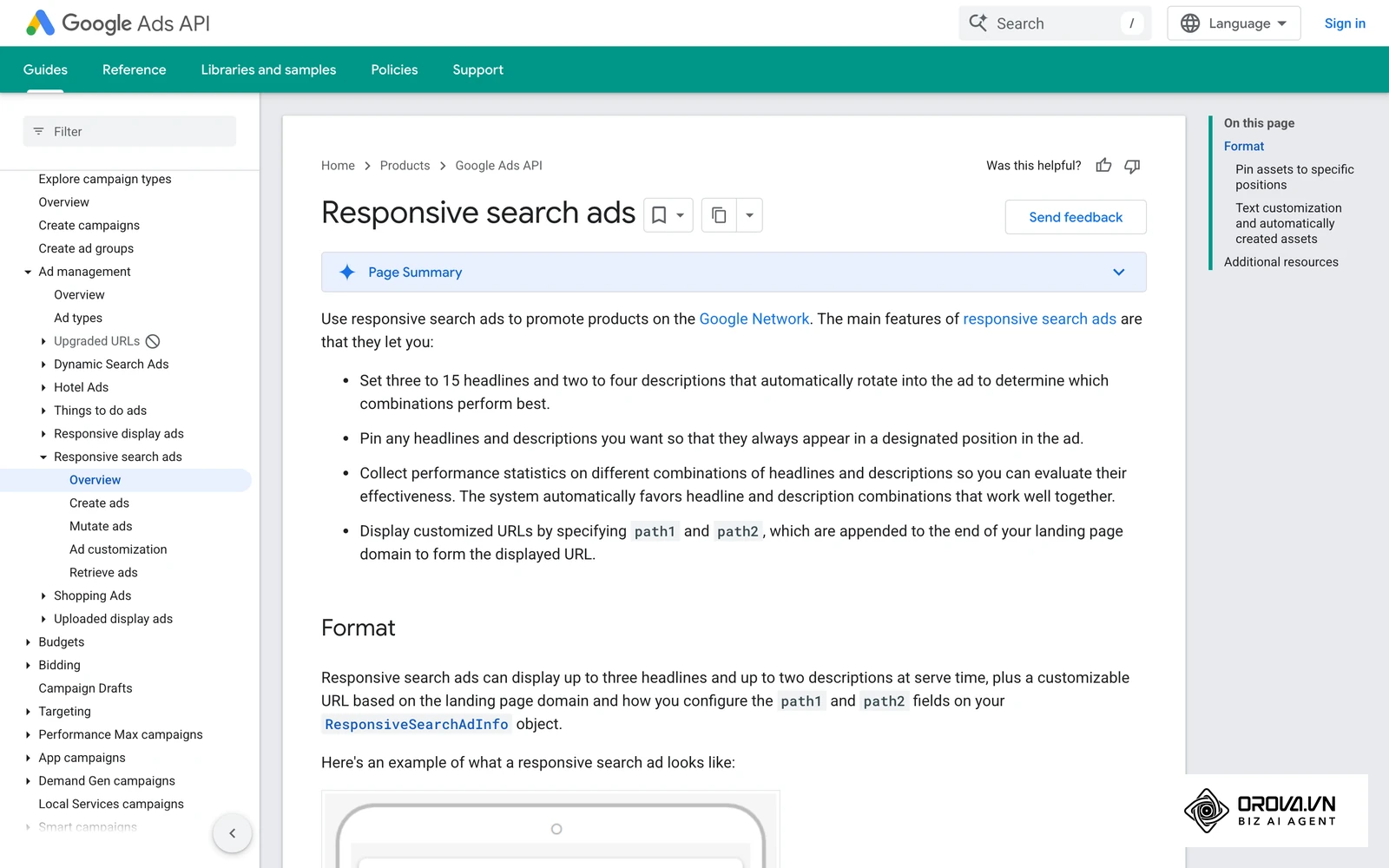
- Input: Per Google's documentation, you provide up to 15 headlines (maximum 30 characters each) and up to 4 descriptions (maximum 90 characters each), with a required minimum of 3 headlines and 2 descriptions.
- Process: When a user enters a search query, the system evaluates their query, their device, their past behavior, and context. In milliseconds, it selects the combination of your inputs it predicts will yield the highest engagement.
- Output: The user sees an ad with up to three headlines separated by vertical pipes and up to two descriptions; Google may show as few as one headline and one description.
- Failure point: The system breaks down when advertisers provide redundant inputs. If you write "Buy Shoes Online," "Purchase Footwear Online," and "Get Shoes Online," the algorithm has no meaningful variations to test. It is merely testing synonyms rather than different psychological triggers.
| Strategy Type | Core Characteristic | Best Suited For |
|---|---|---|
| Fully Fluid | Zero pins used. Algorithm has 100% control over placement. | High-volume lead generation, broad non-branded terms. |
| Semi-Pinned | Position 1 or 2 is pinned for brand consistency, rest is fluid. | Brand campaigns where the company name must be visible. |
| Strictly Pinned | All assets locked into specific positions. | Highly regulated industries (finance, healthcare). |
The Message Allocation Matrix
The most common struggle marketers face is figuring out how to write 15 distinct headlines without repeating themselves. If you sit down and try to brainstorm a list sequentially, you will run out of ideas by headline number seven. To solve this, you must use a structural framework.
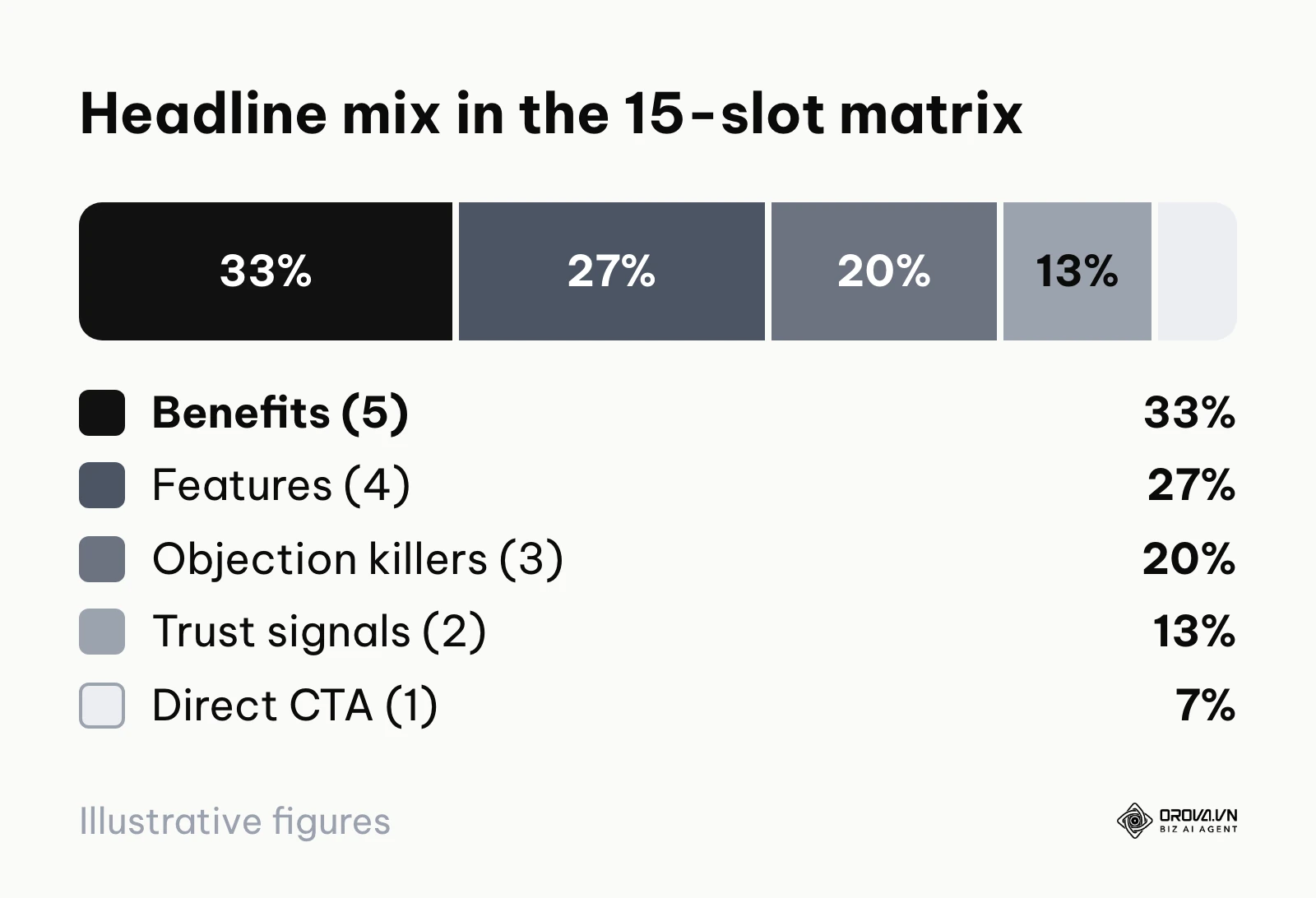
The Message Allocation Matrix forces you to divide your 15 slots into specific psychological categories. This ensures the algorithm has different types of messages to mix and match.
| Asset Type | Target Quantity | Purpose in the Ad | Example for CRM Software |
|---|---|---|---|
| Features | 4 Headlines | States exactly what the product does or has. | "Drag-and-Drop Pipelines" |
| Benefits | 5 Headlines | Explains how the feature improves the user's life. | "Close Deals 30% Faster" |
| Objection Killers | 3 Headlines | Addresses the primary reason people hesitate to buy. | "No Credit Card Required" |
| Trust/Authority | 2 Headlines | Provides social proof or credibility. | "Trusted by 10,000+ Teams" |
| Direct CTA | 1 Headline | Explicitly tells them what to do next. | "Start Your Free Trial" |
In percentage terms, that is roughly 27% features, 33% benefits, 20% objection killers, 13% trust signals and 7% direct CTA. When the algorithm combines these, it naturally creates compelling narratives. It might combine a Benefit, a Feature, and a Trust signal: Close Deals 30% Faster · Drag-and-Drop Pipelines · Trusted by 10,000+ Teams.
Beyond Ad Strength: When to ignore the score
Google provides an 'Ad Strength' indicator, grading your setup from 'Poor' to 'Excellent'. The platform heavily encourages you to achieve 'Excellent' by adding popular keywords to your headlines. However, Google describes Ad Strength as feedback on your assets: an 'Excellent' rating indicates alignment with Google's best-practice checklist, not guaranteed business profitability.
Sometimes, to get an 'Excellent' score, you have to stuff keywords into headlines in a way that sounds robotic or detracts from your unique selling proposition. Does a 'Poor' score automatically increase your CPC? Not necessarily. Ad Strength is a separate rating from Quality Score, and your CPC is shaped by auction factors such as your bid, expected CTR, ad relevance and landing page experience. If your 'Poor' ad has a compelling headline that users click on frequently, that real engagement is what the auction sees.
Illustrative example:
- Context: A boutique luxury watch retailer running ads on the keyword "men's automatic watches".
- Steps Taken: The agency initially followed all system recommendations, stuffing keywords to get an 'Excellent' score (e.g., "Buy Men's Automatic Watches"). They then created a challenger ad with a 'Poor' score that ignored keywords and focused purely on exclusivity (e.g., "Handcrafted Swiss Heritage").
- Challenge: The 'Poor' ad initially received fewer impressions as the system favored the 'Excellent' ad. The team had to let the test run for a full month to gather statistical significance.
- Result: The 'Poor' ad with emotional copy converted better and delivered a lower final CPA, showing that human psychology sometimes trumps algorithmic checklists.
For more insights on how these metrics interplay, understanding your Google Ads Quality Score is crucial.
The science of pinning positions 1 and 2
A major unanswered question for many beginners is whether they should use the 'pin' feature. Pinning allows you to force a specific headline to always appear in Position 1, Position 2, or Position 3.
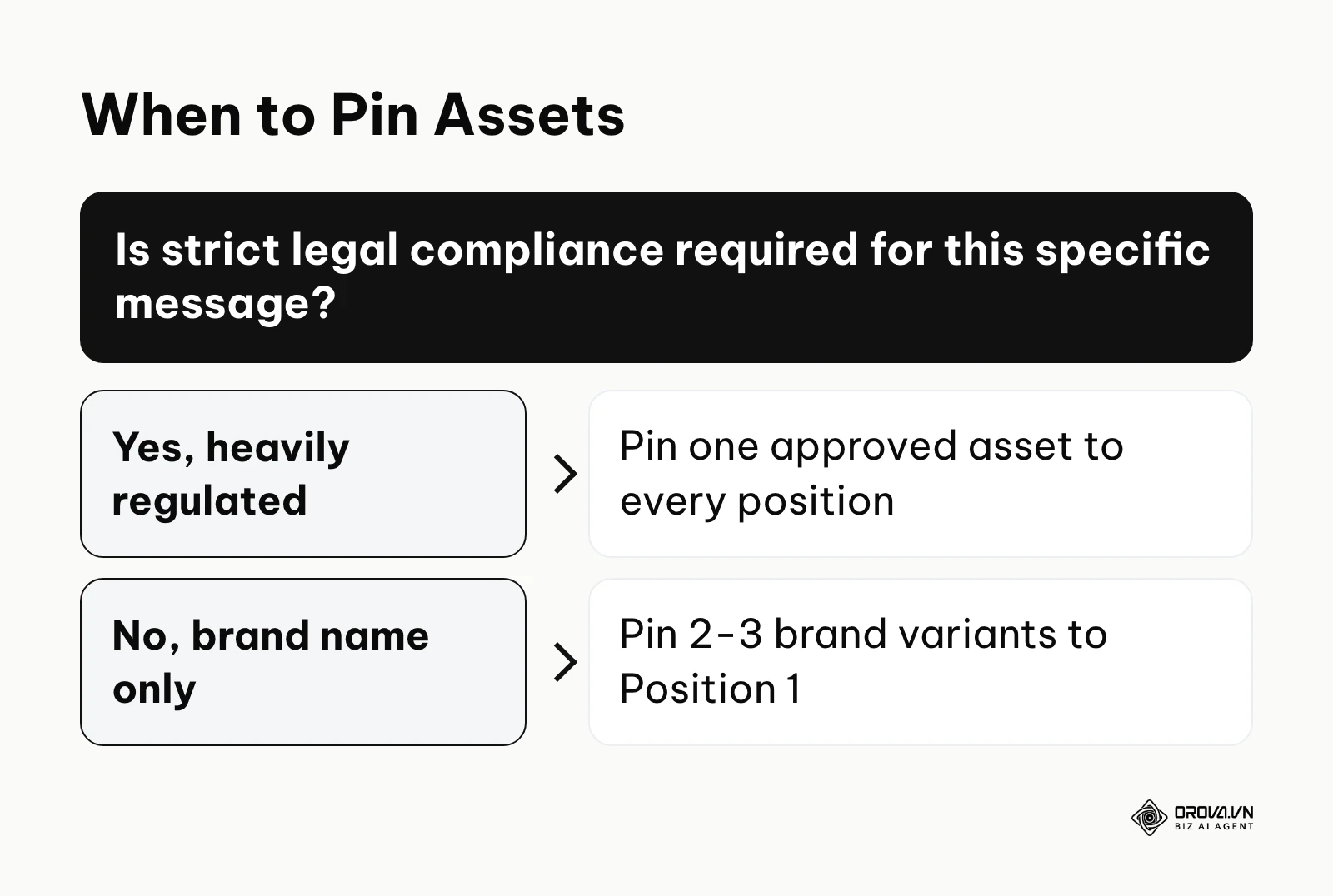
Pinning provides control, but it fundamentally restricts the machine learning algorithm. Google's own help page warns that pinning reduces the number of headlines and descriptions that can be matched to a search. On the other hand, advertisers who rely strictly on automated combinations without any strategic pinning can end up with ads whose brand message reads inconsistently. If you do not pin anything, the algorithm might show a CTA in position 1 and a feature in position 2.
If you must pin, the best practice is to pin multiple assets to the same position. For example, pin three different variations of your brand name to Position 1. This guarantees your brand name is always first, but still gives the algorithm three options to test against each other.
Illustrative example:
- Context: A local plumbing service transitioning to dynamic formats.
- Steps Taken: The owner pinned "Call Us Today" to position 1, thinking it was a strong opening. They left the service descriptions fluid in positions 2 and 3.
- Challenge: Click-through rates plummeted. Users were seeing ads that started with a demand ("Call Us Today") before even stating what the company did ("Emergency Plumbing").
- Result: After unpinning the CTA and pinning three variations of the core service to position 1 instead, the CTR recovered, demonstrating that context must precede action in search layouts.
A/B testing responsive search ads effectively
How do you A/B test something that is constantly changing its own appearance? You cannot simply look at asset-level performance, because each headline appears in many different combinations, so its numbers never tell you which complete message wins.
The only scientifically valid way to test is through Campaign Experiments. You must test overarching themes rather than individual words.
- Create a base campaign utilizing your standard Message Allocation Matrix.
- Create an Experiment campaign.
- In the Experiment, change the entire theme of the assets. For example, Base focuses on "Speed and Efficiency," while the Experiment focuses on "Security and Reliability."
- Run the experiment with a 50/50 budget split for at least four weeks.
- Evaluate the overall CPA of the ad groups, not the individual text snippets.
For a wider method that also covers creative testing outside search, see our ad testing framework.
The pre-publish checklist
Before you hit publish, run your assets through this final logic check to ensure the algorithm won't generate nonsensical combinations.
- The Punctuation Check: Ensure no headlines end in a period, as the system will add vertical pipes.
- The Standalone Rule: Read every single headline by itself. Does it make sense if it appears entirely alone? (Google says it may show as few as one headline and one description).
- The Duplication Test: Will the ad look foolish if Headline 4 and Headline 12 are shown together? (e.g., "Save 20% Today" next to "Get 20% Off Now").
- The Keyword Insertion Review: If using Dynamic Keyword Insertion (DKI), ensure your default text fits within the character limits.
- The Capitalization Standard: Use Title Case consistently across all headlines for a professional appearance.
- The Description Overlap: Ensure your descriptions do not simply repeat the exact phrases used in your prominent headlines.
How to adapt to automated search formatting
Transitioning your mindset and operations to accommodate fluid asset management requires different approaches depending on your role in the ecosystem.
Small business owners
For the owner-operator, the goal is simplicity. You do not need to max out all 15 headlines immediately if you don't have the mental bandwidth. Start by filling out 8 to 10 high-quality headlines. Focus heavily on clear benefits and your local or unique differentiators. Don't stress over achieving a perfect Ad Strength score on day one; focus on whether the phone is ringing.
In-house digital marketers
Corporate marketers must manage internal expectations. When a manager asks, "What does our search ad look like?", you can no longer show them a single screenshot. You must educate stakeholders on the concept of modular messaging. Your daily tasks shift from writing ads to analyzing the 'Asset Report' to see which text snippets are receiving 'Low' performance grades from the algorithm and replacing them systematically.
Advertising agency specialists
Agencies must overhaul their client approval processes. Sending a spreadsheet with hundreds of potential combinations is overwhelming for clients. Instead, agencies should utilize the Message Allocation Matrix as a framework for approval. Get the client to approve the categories of messaging (the features, the benefits, the brand guidelines) and secure the freedom to test variations within those approved bounds. If you want to dive deeper into how agencies are evolving, review our thoughts on the Google Ads agent dynamic.
| Common Mistake | Immediate Consequence | How to Fix It |
|---|---|---|
| Pinning one headline to every single position | Reverts the ad back to a rigid format, killing machine learning. | Pin 3-4 variations to a single position instead of just one. |
| Writing 15 slightly different versions of the exact same feature | Algorithm fails to find meaningful performance differences. | Use the Allocation Matrix to ensure thematic diversity. |
| Using "Title Case" in descriptions | Looks spammy and unnatural in longer text blocks. | Use standard sentence case for all 90-character descriptions. |
Responsive search ads are only one layer of a paid search account. For the day-to-day work around them (budgets, bids, rules and reporting), our PPC ad management execution guide goes deeper.
Want to scale your budget but afraid of breaking performance? 📉
Integrate OROVA ADS now - an AI Agent that automatically monitors and optimizes Google, Meta, TikTok ads 24/7. Now, expanding and replicating your Performance Ads team is just one click away.
🚀 Try it now at: orova.vn/ads
Search automation trends: the author's view
Looking ahead, I believe the landscape of search advertising is going to shift even further away from manual human input. As of 2026, we are already seeing the friction points in hybrid systems where humans try to outsmart the algorithm.
The end of manual asset drafting
I think the requirement to manually type 15 headlines will gradually fade. We already see early signs of this in Google's text customization feature (formerly called automatically created assets). My guess is that advertisers will increasingly provide a landing page URL and a core business objective, and the platform's AI will generate, test, and discard many text variations with less human drafting. Marketers should prepare by shifting their skills toward landing page experience and deep conversion tracking, rather than copywriting.
The shift from keywords to pure intent
I also believe traditional keyword matching will keep losing weight. Currently, we still anchor our dynamic ads to specific keywords. However, I expect platforms to keep moving toward intent-based targeting, where the ad is matched to the user's psychological state and historical behavior rather than the specific letters they typed into the search bar. This means your text assets will need to address broad emotional needs rather than just containing specific product queries.
Visual components overtaking text
Finally, I lean toward the idea that pure text ads will become a minority format. The SERP is becoming increasingly visual. While we discuss text optimization today, I anticipate that image assets and dynamically generated video snippets will carry more and more weight alongside the headlines themselves. If this prediction holds true, creative asset production (images/video) will become the primary bottleneck for search marketers, replacing the current copywriting bottleneck. Note that these are projections, and regulatory pushback on AI-generated content could certainly delay this timeline.
Frequently asked questions about responsive search ads
Are responsive search ads still needed with AI?
Yes, absolutely. While generative AI can write the text for you, the responsive ad format is the delivery mechanism that the platform uses to test and display that text. Even if an AI writes your headlines, you still need the responsive framework to allow Google's machine learning to select the right combination for the right user in real-time. For a broader view on integrating AI into your strategy, see our AI Ads master guide.
How do you ensure headlines make sense when combined randomly?
The secret is writing modularly. Every single headline must be a complete thought that does not rely on another headline for context. Never write "Save 20% on our..." in Headline 1 and "...Premium Shoes Today" in Headline 2. The system might show them out of order, or not show Headline 2 at all. Every asset must stand alone.
Does a 'Poor' Ad Strength automatically increase my CPC?
Not inherently. Ad Strength is a diagnostic rating of your assets, separate from Quality Score. While a 'Poor' score means you aren't following Google's best practices (usually by lacking keyword density), your CPC is shaped by auction factors such as your bid, expected CTR, ad relevance and landing page experience. If users love your 'Poor' ad and click it constantly, your costs will remain efficient.
What are responsive search ads best practices for transitioning from old formats?
Do not delete your old, successful static ads immediately. Pause them, extract the exact headlines and descriptions that drove the highest conversions historically, and use those as the foundational assets in your new responsive matrix. Build your new variations around those proven winners to ensure a baseline of performance during the learning phase.
Where to start analyzing your current setup?
If you are staring at an account filled with dynamic ads and unsure how to improve them, you must diagnose your current state before making sweeping changes. Action without analysis will only reset the algorithm's learning phase, damaging your short-term performance.
For accounts starting from scratch
If you have not built any campaigns yet, your first step is to open a simple spreadsheet. Do not build inside the ad platform's interface. Create columns matching the Message Allocation Matrix (Features, Benefits, CTAs) and force yourself to draft 15 distinct lines of text before you ever log into the advertising portal.
For fragmented campaigns with too many assets
If you have an account where someone has built 10 different ad groups for highly similar products, your immediate step is consolidation. The algorithm needs data density to learn. Identify ad groups that share the same landing page and core intent, and merge them. The system usually learns faster from one ad group with concentrated data than from ten ad groups that each collect only a trickle of clicks.
For active campaigns with unmeasured performance
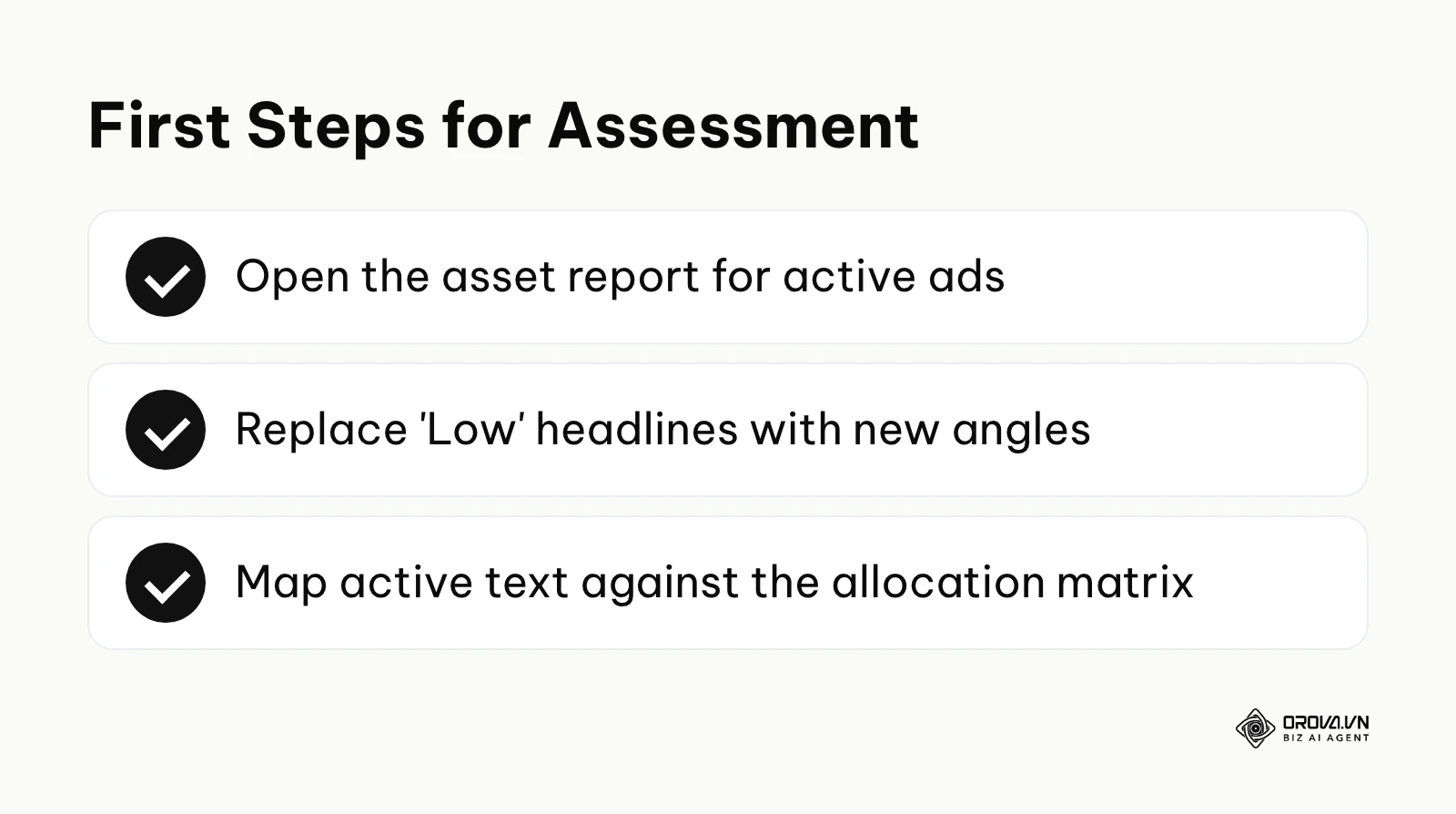
If your ads are running but you don't know what is working, your first task today is to open the asset report for your responsive search ads. This will show you the performance labels (Low, Good, Best) for your individual text snippets. Identify the headlines marked 'Low' that have already collected a meaningful number of impressions, remove them, and replace them with completely different psychological angles. Do not change the 'Best' performing assets.
About the author

Builder of Orova
Nguyễn Đỗ Trọng Ân has 8 years of experience in marketing, including 6 years managing market development across Asia. He builds Orova, a Biz AI Agent that never sleeps: it plans, runs and optimizes work for businesses.
Run your business with AI Agents
Orova is the always-on Biz AI Agent — it plans, runs, and optimizes the work for you.
Save time, unlock productivity.