
What are messenger ads? The complete playbook for conversational sales

Messenger ads are Meta ads that open a Messenger conversation with your business instead of sending people to a website. To see why they matter, imagine pouring thousands of dollars into a digital advertising campaign, watching the impressions climb steadily, and seeing clicks flood into your dashboard, only to realize your actual conversion rate is sitting near zero. You check your analytics, inspect the landing page, and find that people are bouncing within seconds. This is the exact situation many businesses face when they rely solely on traditional traffic-driving methods. The old understanding is that if you can just get enough eyeballs onto your website, sales will naturally follow. However, this outdated model ignores a massive shift in modern consumer behavior: people want immediate, personalized, conversational interactions before they commit to a purchase. They have highly specific questions, and they absolutely do not want to hunt for answers in a sprawling, confusing FAQ section.
This is where messenger ads change the game completely. Instead of sending potential customers to a static webpage where they might get lost or distracted, you route them directly into a personalized, interactive conversation. This comprehensive guide will walk you through exactly how to stop losing high-intent prospects and start turning passive ad clicks into active dialogues, providing you with a structured approach to conversational marketing that actually scales.
What are messenger ads?
Messenger ads are Meta ads (shown on Facebook, Instagram and Messenger) that prompt people to start a one-on-one conversation with a business Page in Messenger, rather than directing them to a website. They are used to capture leads, answer objections instantly, and drive sales, differing from traditional ads by prioritizing immediate two-way communication over passive browsing.
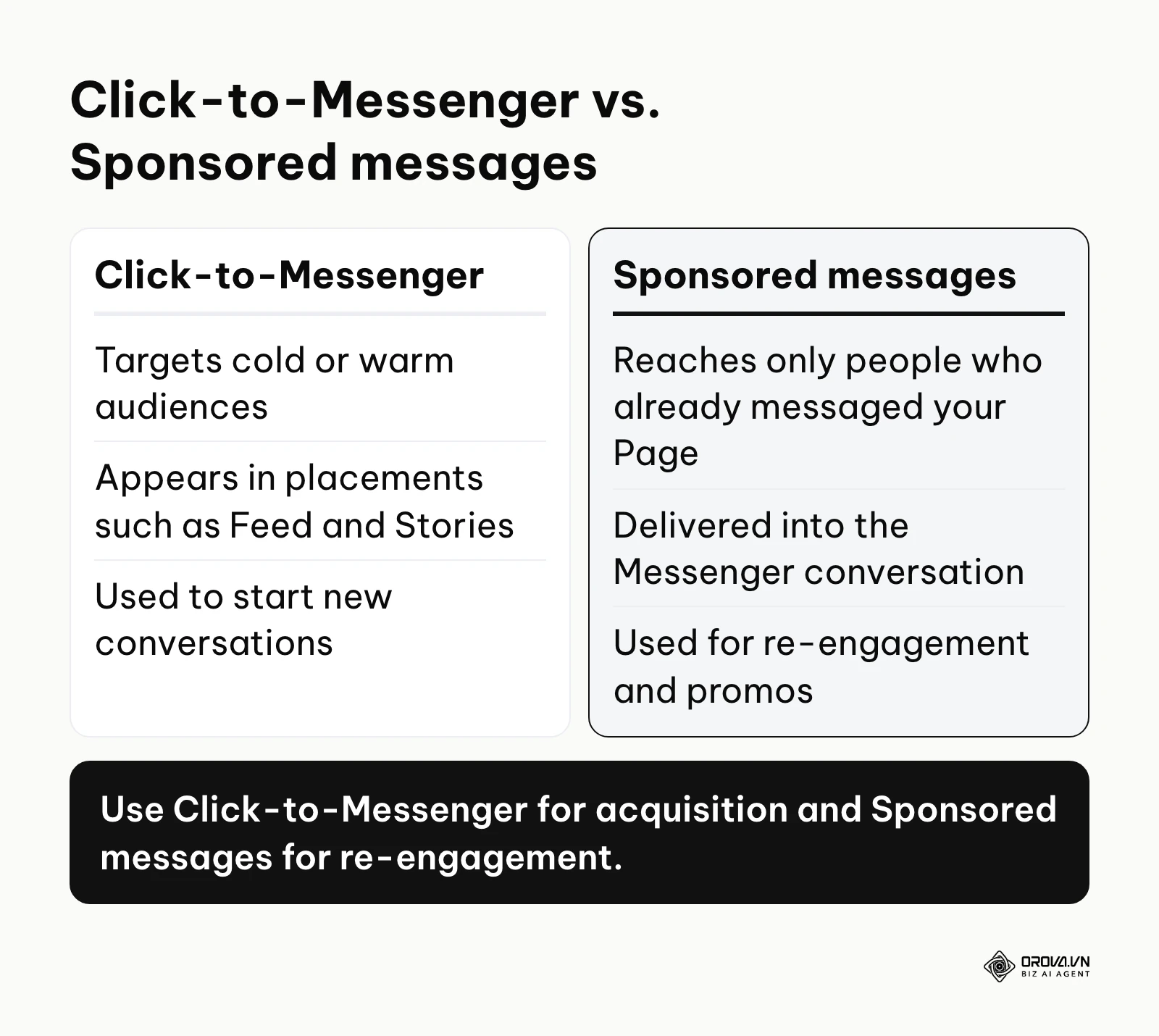
In Meta Ads Manager, this usually means choosing a campaign objective such as Engagement, Leads or Sales and setting Messenger as the message destination. The two formats you will meet most often are Click-to-Messenger ads, which start new conversations, and Sponsored messages, which reach people who have already messaged your Page. If you are new to the interface, start with this overview of what Facebook Ads Manager is.
To clearly understand the distinction, let us look at how conversational formats differ from other common advertising methods:
| Concept | How it differs from Messenger Ads | Real-world example |
|---|---|---|
| Lead Form Ads | Collects static data via a form without any immediate, back-and-forth dialogue. | A user fills out a Facebook form to register for a webinar but has to wait hours for an email confirmation. |
| Traffic Ads | Redirects users entirely out of the social platform and forces them to navigate a website URL. | Clicking an ad opens a mobile browser tab loading a slow, cluttered e-commerce product page. |
| Chatbots (Organic) | Operates strictly on organic traffic visiting your page, not triggered or amplified by paid reach. | A customer proactively searches for your business page and clicks the "Send Message" button directly. |
If you mainly need contact details rather than a live dialogue, lead form ads may be the simpler choice.
A simple everyday example: Imagine you are scrolling through your feed and see an ad for a custom skincare routine. Instead of clicking a link to a website, you tap the ad, and your Messenger app instantly opens. The brand's automated system immediately asks, "Is your skin generally oily or dry?" You tap the "Oily" button, and they instantly reply with a recommendation for the exact serum you need.
The meaning of conversational advertising in your funnel
Conversational advertising exists to solve the modern crisis of the "leaky funnel." For business owners and marketing directors, the biggest problem in digital acquisition today is friction. Every time you ask a user to wait for a page to load, navigate a complex menu, or hunt for a specific product variant, you introduce friction. Messenger ads eliminate this by collapsing the traditional marketing funnel into a single, seamless chat interface.
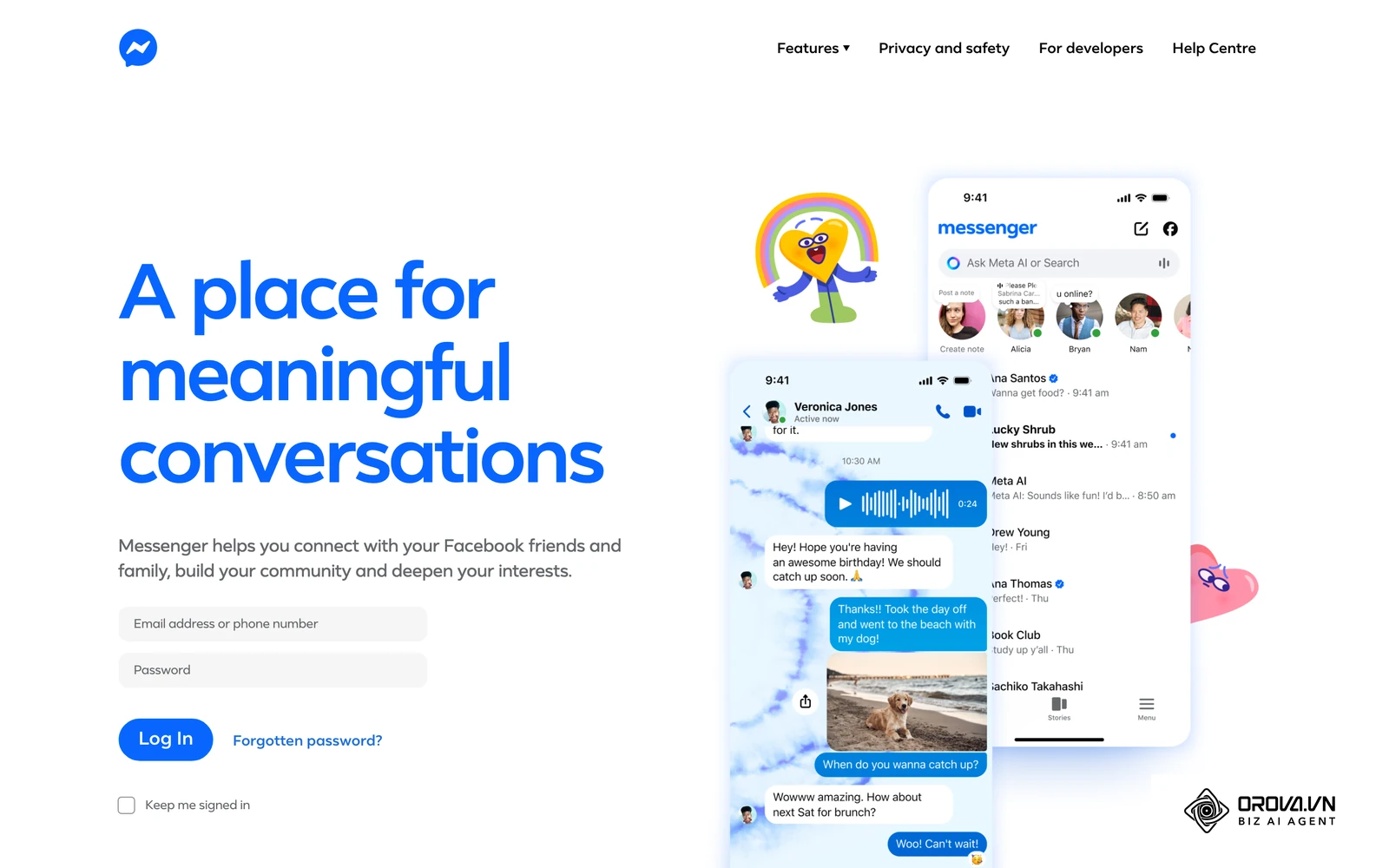
In the big picture of your digital strategy, these campaigns sit directly at the intersection of demand generation and customer support. They take the initial awareness generated by creative assets (which comes first) and immediately transition the user into the qualification and conversion phase (which comes after), completely bypassing the middleman of a traditional landing page. If you ignore this channel, you are essentially leaving money on the table by abandoning customers who have high intent but low patience. You lose the ability to capture their contact information the moment they click, meaning if they bounce from your website, they are gone forever unless you spend more money to retarget them. Many buyers now prefer to ask their pre-purchase questions in a chat rather than through a form or email.
When you do not need messenger ads yet: If you are selling extremely low-ticket, impulse-buy commodities (like a basic, cheap phone case) where the profit margin simply cannot support the cost of back-and-forth communication, these campaigns are a waste of budget. Similarly, if your sales team is non-existent and you have absolutely no automated chatbot infrastructure ready to handle incoming queries, launching these ads will only result in frustrated customers waiting hours for a human reply. In these specific cases, you should stick to standard direct-response traffic campaigns pushing directly to an optimized checkout page until your team's operational infrastructure is mature enough to handle real-time inquiries.
The core value and benefits of conversational ads
The true value of this advertising format must be viewed through two distinct lenses: the overarching financial value for the business, and the practical, day-to-day benefits for the marketing practitioner running the campaigns.
Decreasing customer acquisition costs
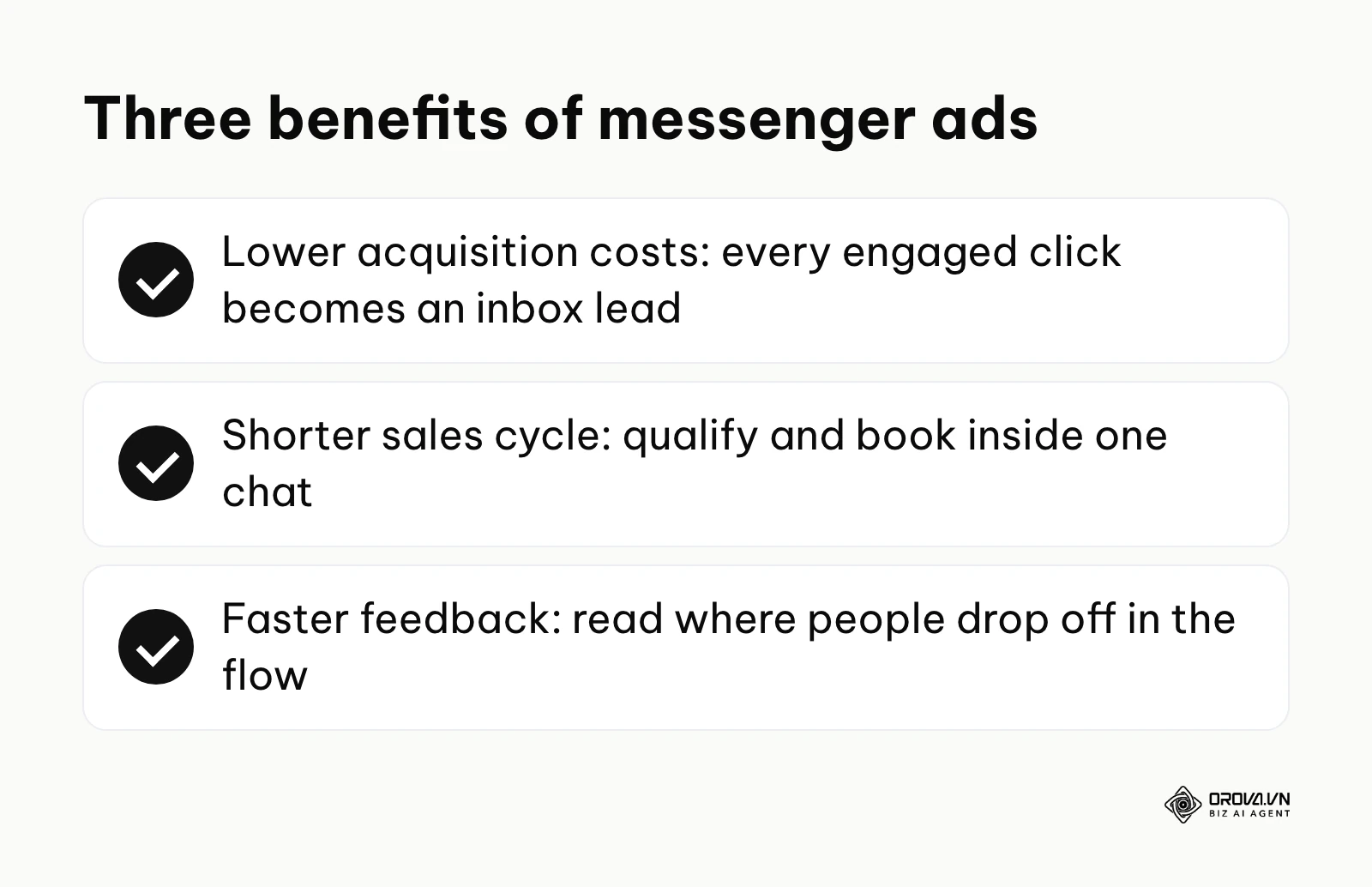
For the business, the primary value is financial efficiency. Traditional campaigns often suffer from high cost-per-acquisition (CPA) because users click the ad (costing you money) but fail to convert on the website. With conversational formats, the moment a user engages with the ad, they become a captured subscriber in your messaging inbox. Even if they do not buy on day one, you have acquired a lead that you can nurture without paying for another expensive click.
Shortening the sales cycle
Before using conversational strategies, a B2B or high-ticket B2C company might rely on a user filling out a form, an email being sent, a sales rep making a phone call, and eventually booking a meeting. This cycle can take weeks. After implementing messaging ads, a user can click an ad, answer three automated qualification questions, and book a calendar appointment directly within the chat interface in under two minutes.
Creating immediate feedback loops
For the marketing practitioner, the benefit is instant data. When running standard traffic campaigns, if a landing page fails, you only see a high bounce rate; you have to guess why people left. With messaging campaigns, if users drop off at a specific question in your chatbot flow, you can literally read the conversation and see exactly where the friction occurred, allowing for rapid iteration.
| Benefit | Measured by which metric | How often to review |
|---|---|---|
| Lower acquisition costs | Cost per qualified lead (CPL) | Monthly, once enough chats have closed |
| Faster sales velocity | Time from click to purchase | Weekly |
| Better campaign insights | Chat drop-off rate by question | Daily during the first weeks |
Illustrative example:
- Context: A mid-sized local spa was struggling to fill their premium weekend massage appointments, acting in the role of a local service provider with a limited marketing budget.
- Actions: They launched a basic messaging campaign targeting local women, asking them to click the ad to book a session. The initial automated message simply asked, "What time would you like to come in?"
- Stumble & fix: Users clicked the ad but immediately abandoned the chat when forced to manually type out their preferred times and check availability. The spa fixed this by replacing the open-ended text question with three distinct quick-reply buttons offering specific, available time slots (e.g., "Saturday 10 AM", "Sunday 2 PM").
- Result: The booking calendar filled up completely for the next three consecutive weekends, radically reducing empty slot overhead without requiring the front desk receptionist to make endless, time-consuming phone calls.
OROVA ADS applies AI Agent to automate and optimize ad performance on Google, Meta and TikTok. Scale your budget safely, monitor 24/7 and expand your business quickly.
Experience the solution at orova.vn/ads
How messenger ads work: from setup to scale
Understanding how these campaigns operate requires looking past the basic Facebook Ads Manager interface and diving into the actual mechanics of user routing, automated conversations, and backend data tracking.
The anatomy of a conversational campaign
Every successful campaign is built on three foundational pillars: the trigger, the entry point, and the flow.
- The Trigger (What it does): This is the ad creative itself (video, image, or carousel) that appears in the user's feed. Its sole job is to stop the scroll and create enough curiosity to generate a click. Input: Compelling ad copy and media. Output: A user click. Failure point: Weak creatives will result in a high Cost per Click (CPC), ruining the economics before the chat even starts.
- The Entry Point (What it does): Once clicked, the platform routes the user seamlessly into the native messaging app (like Facebook Messenger or Instagram Direct). This transition must be frictionless. Input: Platform routing rules. Output: The opening of the chat window. Failure point: If the internet connection is slow or the platform glitches, the user might abandon the loading screen.
- The Flow (What it does): This is the automated sequence of messages that greets the user. It is responsible for qualifying the lead and driving the conversion. Input: Pre-written scripts and conditional logic. Output: A qualified lead or a completed sale. Failure point: Overwhelming the user with too much text or too many questions at once will cause immediate abandonment.
Types of conversational formats
Not all messaging campaigns are built the same. You must choose the right format based on the user's current relationship with your brand.
| Type | Characteristics | Best suited for |
|---|---|---|
| Click-to-Messenger | Appears in standard feeds; triggers a new chat session when clicked. | Cold audiences and new customer acquisition. |
| Sponsored messages | Delivered into Messenger, only to people who already have a conversation with your Page. | Warm audiences; re-engaging past conversations. |
| Click-to-WhatsApp | Routes users from Facebook/Instagram ads directly into a WhatsApp chat. | Regions where WhatsApp is the dominant communication app. |
Chatbot flow scripts for 5 industries
The biggest mistake marketers make is using the default platform greetings. If a user clicks an ad and sees a generic "Hi, how can we help you?", they will leave. You must architect specific flows that guide the user toward a micro-commitment. Here are proven script templates you can implement immediately:
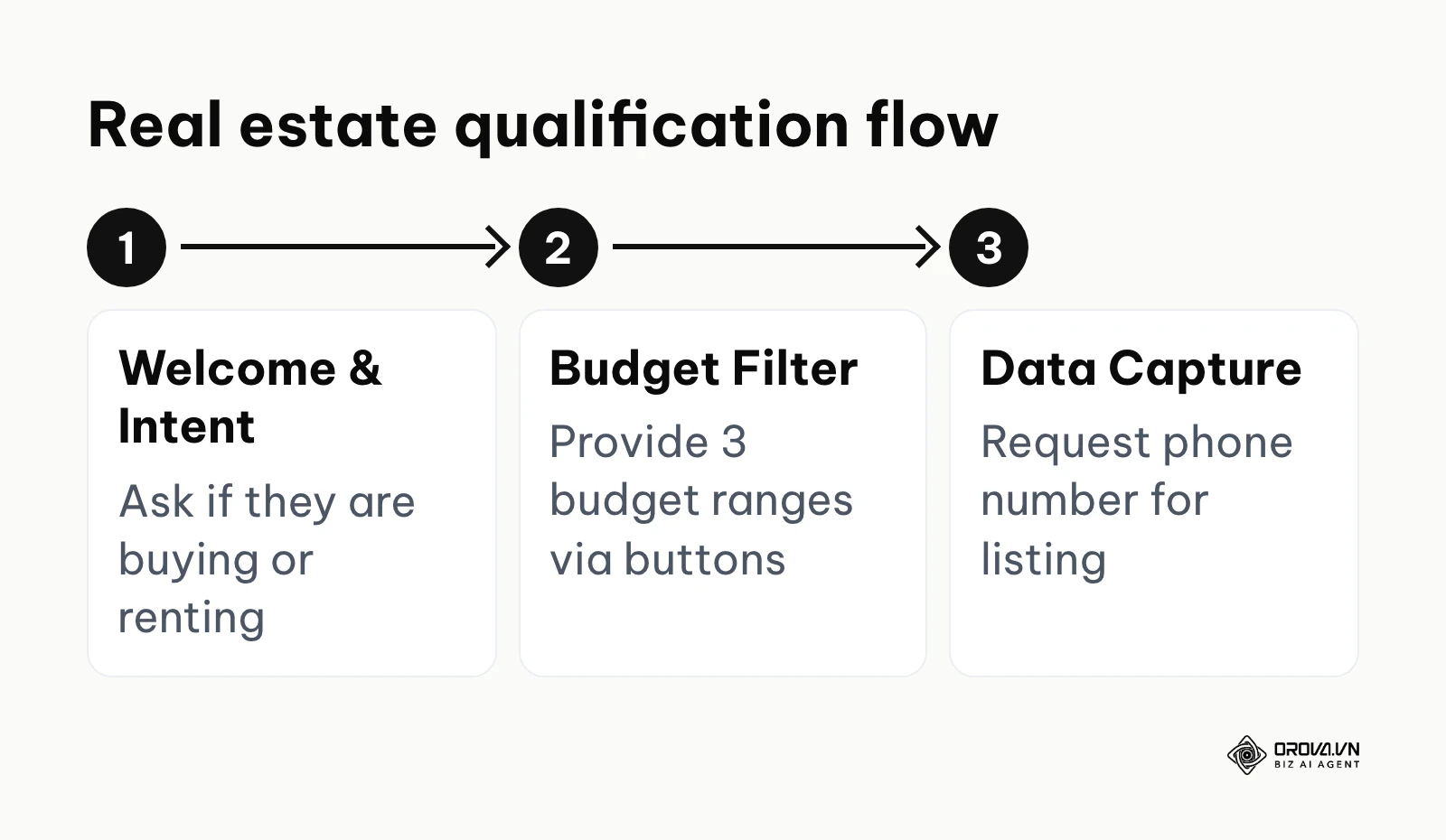
1. Real Estate (Focus: Qualification & Sorting)
- Bot: "Hi [Name]! Thanks for checking out our new listings in downtown. Are you currently looking to buy or rent?"
- User: [Clicks "Buy"]
- Bot: "Great! To send you the best off-market matches, what is your approximate budget?"
- Options: [Entry level] [Mid-range] [Premium]
- User: [Clicks "Mid-range"]
- Bot: "Perfect. We have 3 unlisted properties that fit that exactly. Tap below to share your phone number so our senior agent can text you the virtual tours right now."
2. Spa & Beauty Clinics (Focus: Overcoming hesitation & Booking)
- Bot: "Welcome [Name]! Our laser hair removal package is currently 30% off. Have you ever had laser treatments before?"
- Options: [Yes, I have] [No, I'm a beginner]
- User: [Clicks "No, I'm a beginner"]
- Bot: "No worries at all! It's completely painless. Would you like to see a quick 10-second video showing how it works, or do you want to check available times for a free consultation?"
- Options: [Watch Video] [Check Times]
3. E-commerce Retail (Focus: Product matching)
- Bot: "Hey [Name]! Ready to find your perfect running shoe? Are you running mostly on paved roads or rugged trails?"
- Options: [Paved Roads] [Trails]
- User: [Clicks "Trails"]
- Bot: "Awesome. Do you prefer a shoe with maximum cushioning or a lightweight, fast feel?"
- Options: [Max Cushion] [Lightweight]
- User: [Clicks "Max Cushion"]
- Bot: "We highly recommend the TrailBlazer Pro. It is currently in stock. Click here to view it on the site with your 10% welcome discount automatically applied!"
4. B2B SaaS (Focus: Demo scheduling & Lead scoring)
- Bot: "Hi [Name], thanks for downloading our 2026 Industry Report. Before I send the PDF, are you currently using a CRM system?"
- Options: [Yes] [No]
- User: [Clicks "Yes"]
- Bot: "Got it. Are you generally happy with it, or looking for an upgrade?"
- Options: [Happy] [Looking to upgrade]
- User: [Clicks "Looking to upgrade"]
- Bot: "We'd love to show you how we compare. Here is the PDF you requested! Also, would you be open to a 10-minute zero-pressure demo this Thursday?"
5. Online Education / Info Products (Focus: Teasing value)
- Bot: "Hey [Name]! Ready to master digital marketing? Which area are you struggling with the most right now?"
- Options: [Running Ads] [Writing Content] [Finding Clients]
- User: [Clicks "Running Ads"]
- Bot: "Ads can be tricky! I actually have a free 15-minute mini-class specifically on lowering ad costs. Do you want me to send the link right here in the chat?"
- Options: [Yes, send it!]
Advanced retargeting strategy
Most advertisers think of ad retargeting only in terms of website pixels. However, when you use conversational campaigns, you also build a list of people who have messaged your Page, right inside the platform, and you can re-engage them with Sponsored messages.
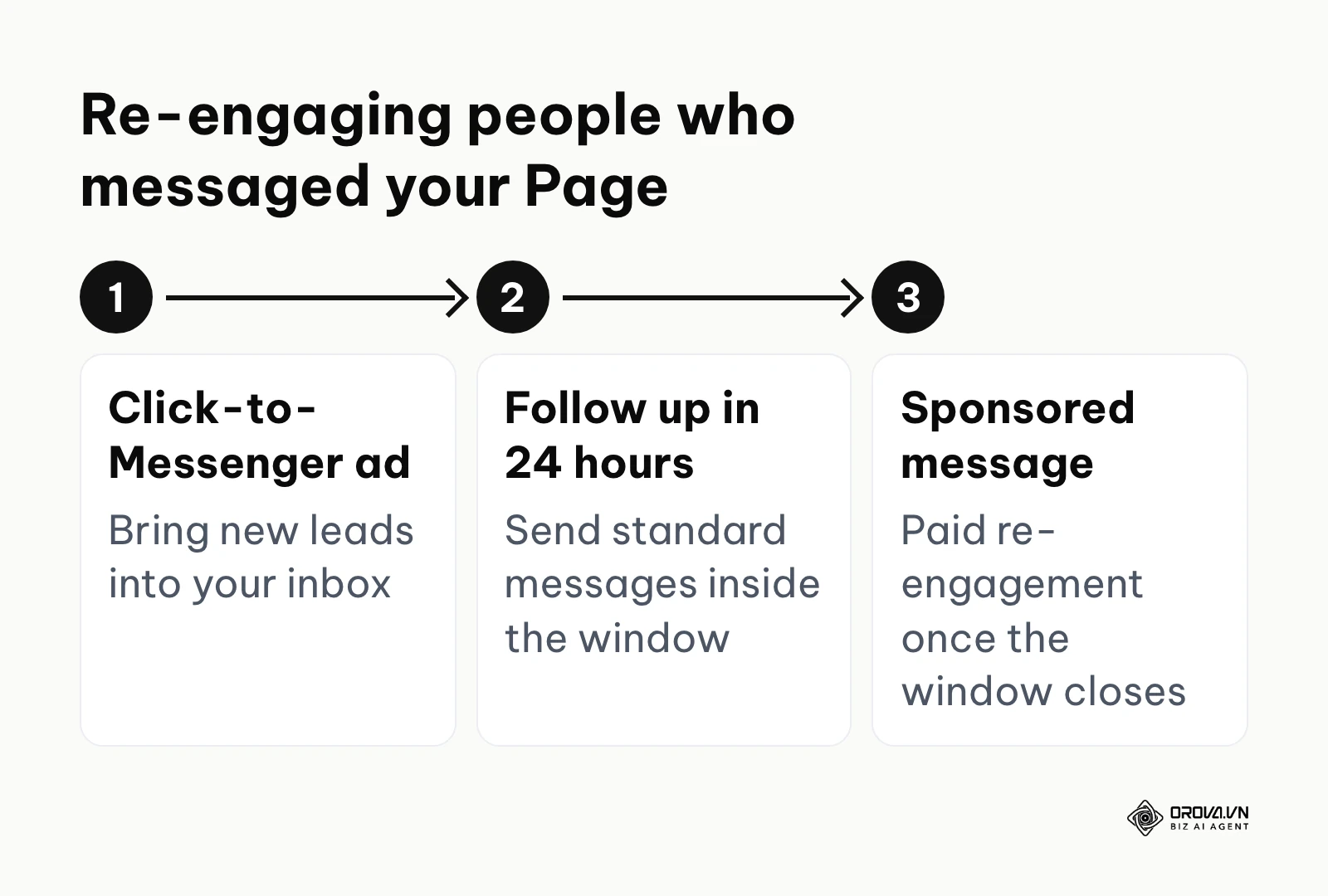
The strategy is simple: use Click-to-Messenger ads to bring leads into your inbox. Send your follow-up while you are still inside Meta's 24-hour standard messaging window, which opens each time the person messages you. Once that window has closed, routine promotions can no longer be sent as standard messages; if you want to reach those people later (for example during a seasonal sale), use a paid Sponsored message, which is delivered only to people who already have a conversation with your Page. To ensure your initial acquisition pool is high quality, you should rigorously audit your advanced Facebook ads targeting to prevent your inbox from filling up with unqualified prospects.
Swipe file of ad copy that starts conversations
Great ad copy for these campaigns does not try to sell the product; it sells the conversation. If your copy sounds like a traditional billboard, users will not click.
- The Curiosity Hook: "There is one setting that quietly drains many ad budgets. Tap 'Send Message' and I'll ask you 3 quick questions to see if your account has this leak."
- The Quiz Approach: "What is your unique skin type? Many people pick a moisturizer by guesswork. Tap below to take our 4-question Messenger Quiz and get your personalized routine."
- The Direct Offer: "Want our best-selling coffee table for 20% off? Tap 'Send Message' and our bot will instantly send you the secret promo code."
- The Resource Delivery: "Stop struggling with meal prep. I put together a 7-day high-protein recipe guide. Tap 'Send Message' and I'll drop the PDF right into your inbox."
- The Diagnostic: "Is your dog pulling on the leash? Tap below, tell us your dog's breed in the chat, and we will send you a specific training technique tailored for them."
To find more inspiration and see what is currently working for your competitors, you should actively monitor the Facebook ad library and filter specifically for ads that utilize the messaging call-to-action.
ROI tracking and offline conversions
A critical failure point for conversational campaigns is the inability to track actual revenue. Many marketers celebrate a cheap "Cost per Message" without realizing those messages are not converting into sales.
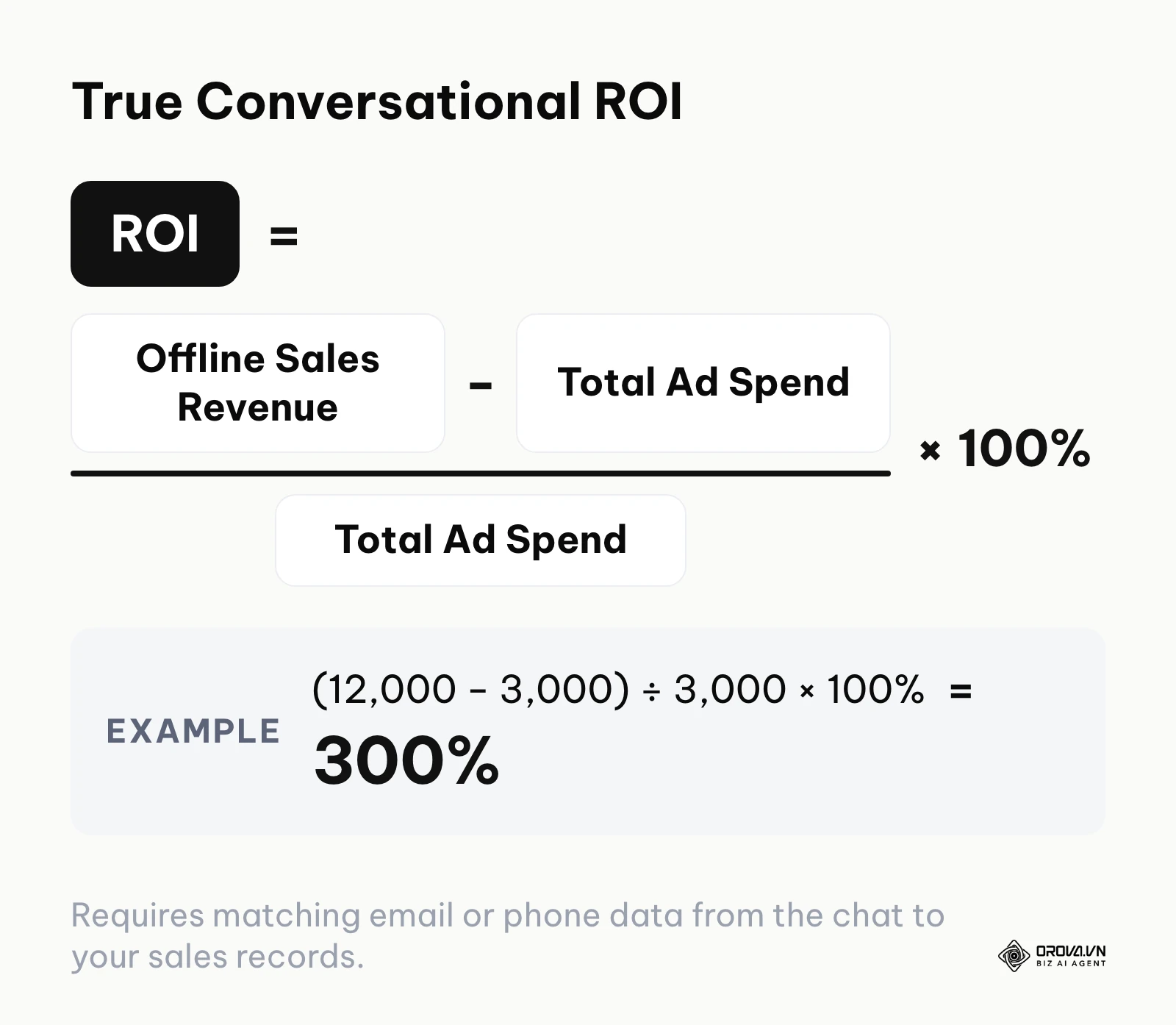
To fix this, you must implement strict data matching. First, inside your chatbot software (such as ManyChat or Chatfuel), you must configure the flow to capture the user's email address or phone number. Once captured, this data can be sent back to Meta as a lead or purchase event through the Conversions API.
If the final sale happens in a physical store or over a manual phone call (offline), you must send your paying customers' emails or phone numbers back to Meta as offline events, either by uploading them to your dataset in Events Manager or through the Conversions API. The platform will then match those identifiers against the people who clicked your messenger ads, allowing you to see which ad creative drove the final offline revenue. Then calculate ROI as (offline sales revenue − total ad spend) ÷ total ad spend × 100%. For example, 12,000 in matched sales on 3,000 of ad spend gives (12,000 − 3,000) ÷ 3,000 × 100% = 300%. If your data seems disjointed, running a thorough diagnostic on your Facebook ads report will help identify where the tracking tags are failing.
Illustrative example:
- Context: An online premium furniture retailer was spending a significant monthly budget on conversational ads but acting blindly, entirely unable to prove which chat conversations actually led to expensive, high-ticket purchases on their website.
- Actions: The marketing director overhauled the tracking by sending lead events from the chatbot flow through the Conversions API and setting up a weekly offline-event upload that synced their sales spreadsheet back to the ad platform at the end of every week.
- Stumble & fix: The initial data match rate was terrible (under 20%) because the bot was only collecting first names and vague preferences. The director updated the flow to offer a highly desirable 5% discount code in strict exchange for an email address, which served as the exact matching key needed by the platform.
- Result: Within a month, they could accurately attribute 40 high-ticket sofa sales directly back to specific ad variations, proving the campaign was wildly profitable and justifying a budget increase.
What to do to adapt and launch your strategy
Adopting this conversational framework requires different approaches depending on your organizational size and role.
Small business owners
As a small business, you do not need complex, multi-tiered AI flows. Your advantage is authenticity and speed.
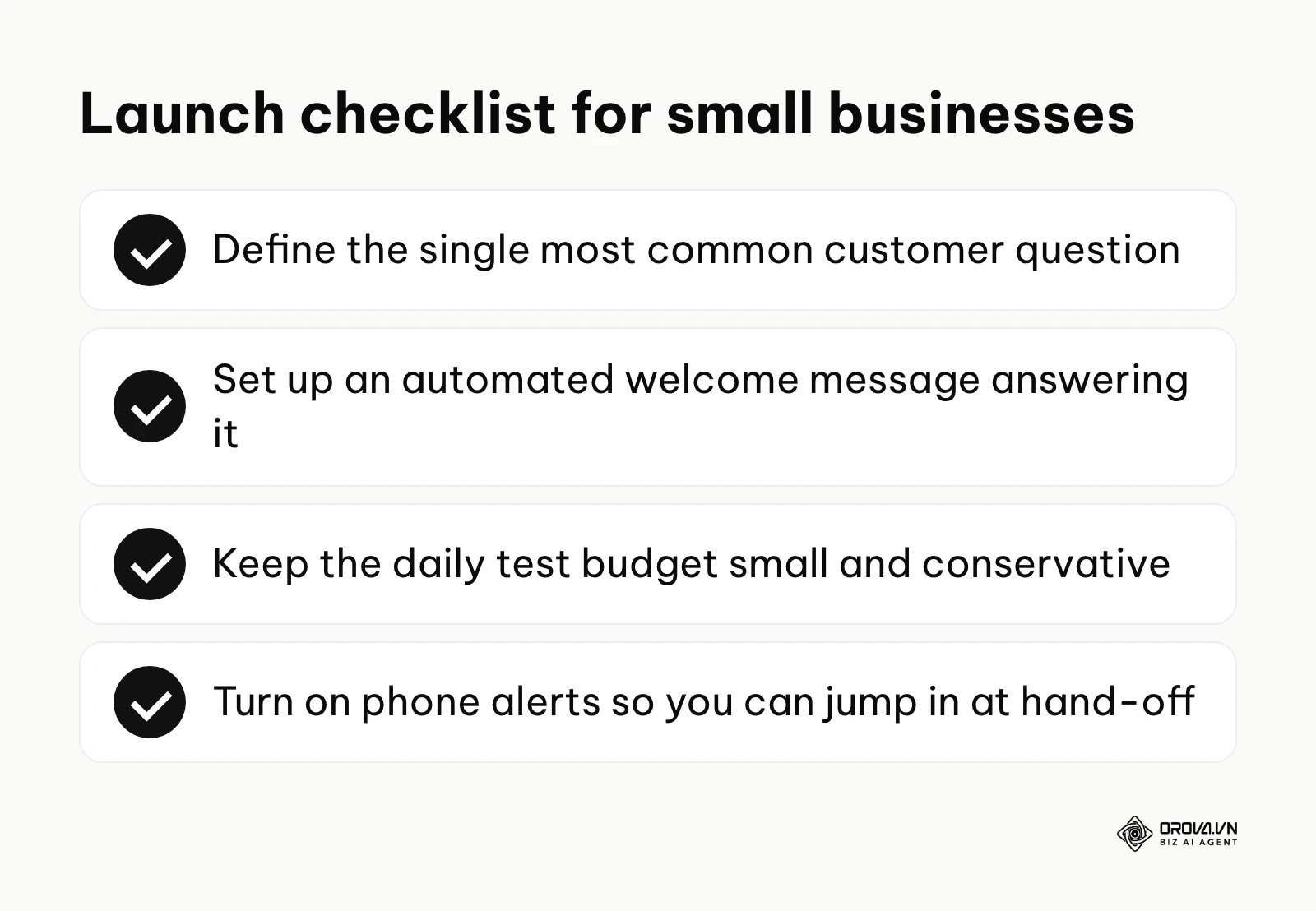
- Identify the single most common question customers ask before buying from you.
- Build a highly focused, one-step automated flow that answers that exact question immediately.
- Keep your daily budget small and conservative while you test the quality of incoming leads.
- Set up push notifications on your phone so you can jump in manually the moment the bot hands the conversation over to a human.
In-house marketing teams
For in-house teams, the focus shifts to lead qualification and CRM integration.
- Map out your sales team's exact qualification criteria.
- Build a 4-step bot flow that strictly filters out unqualified leads before they ever reach a human sales representative.
- Integrate the chat platform directly with your company's CRM via API so lead data flows seamlessly without manual data entry.
- Establish clear Service Level Agreements (SLAs) with the sales team regarding how fast they must reply to a qualified chat handoff.
Agency media buyers
Agencies must focus on scale, tracking, and proving ROI to their clients.
- Standardize your chatbot templates across different client industries so you can deploy new campaigns rapidly.
- Enforce strict offline conversion tracking for every client to ensure you are judged on revenue, not just cheap message metrics.
- Use Sponsored Messages as a high-margin upsell service to re-engage the client's dormant subscriber list.
- Continuously run split tests on the opening hook of the chat flow to maximize the percentage of people who click past the first automated message.
| Common mistakes | Consequences | How to avoid |
|---|---|---|
| Asking too many questions | Users abandon the chat halfway through. | Keep qualification flows to a maximum of 3-4 steps. |
| Slow human hand-off | The user loses interest and buys from a competitor. | Set up automated alerts to ping staff immediately. |
| Ignoring retargeting | You pay for leads but fail to maximize their lifetime value. | Schedule broadcast messages to non-buyers after 24 hours. |
Illustrative example:
- Context: An in-house marketer for a growing B2B software company was tasked with generating high-quality software demo requests using paid media.
- Actions: They launched a click-to-message campaign offering a free industry benchmark report, paired with a basic qualification flow asking for the user's company size.
- Stumble & fix: The sales representatives complained bitterly that the leads were terrible—mostly university students doing research. The marketer immediately adjusted the flow, adding a strict disqualification question ("Are you currently using an enterprise CRM?"). Anyone who answered "No" was automatically routed to a free blog post instead of a sales rep's calendar.
- Result: The sales team received 15 highly qualified, enterprise-level demo bookings the following month, and morale between the marketing and sales departments improved drastically.
Want to scale your budget but afraid of breaking performance? 📉
Integrate OROVA ADS now - an AI Agent that automatically monitors and optimizes Google, Meta, TikTok ads 24/7. Now, expanding and replicating your Performance Ads team is just one click away.
🚀 Try it now at: orova.vn/ads
Future trends of messenger ads: author's predictions
As we navigate the rapidly shifting digital landscape, conversational commerce is evolving faster than traditional web formats. Based on current platform updates and consumer behavior shifts, here is where I see this ecosystem heading.
AI agents will replace rigid decision trees
As of 2026, the era of the "dumb," rules-based chatbot is coming to a close. Currently, most advertisers still use rigid decision trees ("Press 1 for Sales, Press 2 for Support"). If a user types a complex sentence that deviates from the script, the bot breaks and sends a frustrating error message. I believe that, over the next few years, native Large Language Model (LLM) integration will become standard within the ad platform's own messaging tools. Instead of building rigid flows, you will simply upload your company's knowledge base and product catalog, and the AI agent will fluidly handle complex negotiations, answer nuanced objections, and close sales dynamically. Advertisers should prepare by meticulously documenting their best sales transcripts today, as these will become the training data for your future AI sales reps.
Cross-platform inbox consolidation
We are already seeing signs of Meta forcing tighter integration between Messenger, Instagram Direct, and WhatsApp. I predict that the concept of running isolated campaigns for specific messaging apps will disappear. Instead, the ad platform will dynamically route the user to whichever app they are most likely to convert in, based on machine learning predictions. For practitioners, this means you must stop optimizing for specific inbox environments and start focusing purely on universal conversational psychology.
The death of the traditional landing page for local services
For local businesses—like plumbers, dentists, and boutique fitness studios—the traditional landing page is becoming obsolete. I suspect that a growing share of local service lead generation will happen entirely within the chat interface. Consumers no longer have the patience to navigate a localized website just to find a phone number or a booking calendar. They expect to tap an ad, say "I need a plumber tomorrow at 9 AM," and receive an instant confirmation. If you run a local business, it is worth testing messaging flows as your primary conversion path now, or you risk losing ground to faster competitors. Note that this prediction relies on platforms continuing to lower the technical barrier for chat integration; if API costs rise significantly, this transition may stall.
Frequently asked questions about messenger ads
Are messenger ads still needed with AI?
Absolutely. AI is the brain that powers the conversation, but the ad itself is the vehicle that brings the user to the table. Without paid messaging campaigns to drive targeted traffic into the chat, your highly intelligent AI agent will simply have no one to talk to. They work perfectly in tandem: the ad buys the attention, and the AI converts it.
What is a good Cost per Message?
There is no universal benchmark because it varies widely by industry, country and offer. A high-ticket B2B company can afford a much higher Cost per Message than a local shop, as long as the lead quality is high. You should focus entirely on your Cost per Qualified Lead and ultimate ROI rather than obsessing over the superficial cost of initiating the chat.
How do I avoid getting my ad account banned?
Messaging platforms are incredibly strict about spam. To protect your account, ensure your automated flows explicitly ask for permission before sending promotional material. Furthermore, respect the 24-hour standard messaging window: promotional messages sent as standard messages must go out within 24 hours of the person's last message to you. Outside that window, use a paid Sponsored message or another format Meta allows. Breaking these rules can lead Meta to restrict your Page's messaging.
Can I run these without a third-party chatbot tool?
Yes. When you set up a Click-to-Messenger ad in Ads Manager, you can create a message template with a greeting and quick-reply questions, and Meta Business Suite offers basic automated responses for your inbox. However, these native tools are best for simple greetings and quick replies. If you want complex conditional logic, API integrations with your CRM, or advanced lead scoring, you will eventually need to invest in a dedicated third-party conversational platform.
How should I divide my budget between messages and website traffic?
Do not guess; test it. For example, start by allocating 20% of your total acquisition budget to messaging campaigns while keeping 80% on traditional traffic or conversion campaigns. Monitor the end-to-end ROI over a 30-day period. If the messaging campaigns yield a lower Cost per Acquisition, systematically shift 10% of your budget over every week until you find the point of diminishing returns.
Where to start your conversational journey?
Depending on your current marketing maturity, the way you adopt these strategies will differ. Here is exactly what you should do next based on your specific situation.
Situation 1: You have nothing set up yet. If you have never run a conversational campaign, your first step is strictly foundational. Spend one afternoon analyzing your customer support inbox or talking to your sales team to identify the single most frequent objection stopping people from buying. Tomorrow, build a simple Click-to-Messenger campaign with an automated welcome message designed to address that one specific objection head-on. Do not overcomplicate it with branching logic; just get comfortable handling the influx of real-time inquiries.
Situation 2: You are running ads, but the replies are disjointed. If you are getting messages but users are dropping off halfway through the conversation, your flow is broken. Your immediate task is to ruthlessly cut down the number of questions you are asking. Look at your current script and remove any question that is not absolutely critical for qualification. Replace open-ended text inputs with multiple-choice buttons to reduce user friction. The goal is to make the path to the final conversion require as few screen taps as humanly possible.
Situation 3: You are getting chats, but cannot track the revenue. If your inbox is full but you cannot tie chats to actual sales, you have a data siloing problem. Stop scaling your budget immediately. Your next step is to send offline sales events back to Meta (via Events Manager uploads or the Conversions API) or integrate your chatbot directly with your CRM. Ensure your bot is capturing a unique identifier (like an email or phone number) so you can definitively match the chat user to the final point-of-sale transaction.
About the author

Builder of Orova
Nguyễn Đỗ Trọng Ân has 8 years of experience in marketing, including 6 years managing market development across Asia. He builds Orova, a Biz AI Agent that never sleeps: it plans, runs and optimizes work for businesses.
Run your business with AI Agents
Orova is the always-on Biz AI Agent — it plans, runs, and optimizes the work for you.
Save time, unlock productivity.