
Facebook ads targeting in 2026: why broad fails and how to fix it

Facebook ads targeting in 2026 is less about stacking interests and more about guiding Meta's algorithm with clean conversion data, firm exclusions and creative that clearly signals who the offer is for. You are staring at your Ads Manager dashboard, watching your cost per acquisition (CPA) climb higher every single day. You have tried splitting your audiences by interests, creating 1% lookalikes, and layering detailed behaviors, yet the algorithm seems entirely unresponsive to your manual adjustments. The frustration is palpable because the tactics that reliably generated predictable revenue two years ago are now actively burning your budget.
The reality is that the underlying mechanics of how Meta finds buyers have fundamentally transformed. The platform's machine learning models have evolved, rendering granular, manual micro-segmentation not just ineffective, but actively harmful to your campaign's performance. As of 2026, forcing the algorithm into tight, restrictive boxes prevents it from finding the most cost-effective conversions across its vast network.
This deep dive analysis will deconstruct exactly how facebook ads targeting operates in the current landscape. We will explore why relying solely on broad automation can lead to dangerous budget waste, how to structure your campaigns to prevent self-competition, and the precise methods to regain control over who sees your ads. By the end of this guide, you will have a clear, actionable blueprint to align your audience strategy with Meta's modern algorithm, regardless of your budget size or industry.
What is Facebook ads targeting?
Facebook ads targeting is the technical and strategic process of defining the specific parameters—such as demographics, behaviors, data lists, and geographic boundaries—that dictate who is eligible to be served your advertisements across the Meta ecosystem.
Historically, this involved advertisers manually selecting hundreds of micro-interests to guess their ideal customer profile. Today, it primarily revolves around providing the artificial intelligence with clean data signals, setting strict negative boundaries (exclusions), and allowing the machine learning models to dynamically seek out high-probability buyers. This approach is essential for any modern brand, e-commerce store, or local business looking to scale revenue, but it should not be attempted without a solid foundation of server-side tracking and a deep understanding of automated budget caps.
What you need before configuring your audience
Before you even think about adjusting toggles or launching an Advantage+ campaign, your account infrastructure must be flawless. Meta's targeting algorithm is entirely dependent on the quality of the data it receives. If you feed it garbage, it will enthusiastically optimize for garbage, draining your budget in search of users who have no intention of buying. The era of relying on the simple browser pixel alone is long gone, and that shift changes how advertisers must approach audience definition.
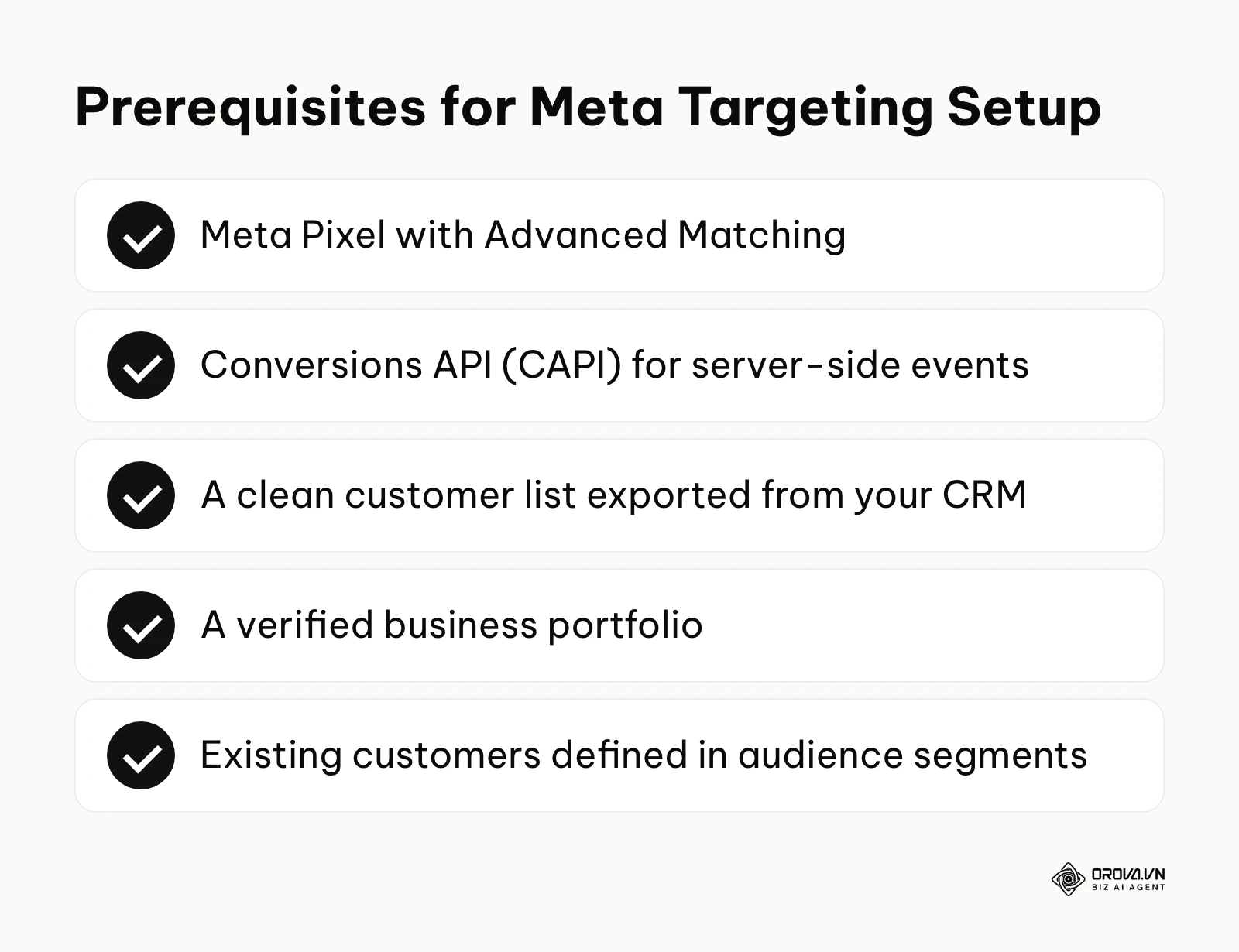
You cannot rely on third-party cookies to track users across the web anymore. Signal loss from browser restrictions and privacy updates means that setting up a robust data pipeline is the only way to ensure the algorithm knows what a successful conversion looks like. Furthermore, you need to have a clear understanding of your unit economics; the AI does not know your profit margins unless you configure your bidding strategies correctly.
| Essential Component | Where to Configure It | Why It Matters for Targeting |
|---|---|---|
| Meta Pixel (Advanced Matching) | Events Manager > Data Sources | Captures on-site events the algorithm learns from |
| Conversions API (CAPI) | Events Manager > Partner Integrations / Server | Sends conversions that browser tracking misses |
| Clean Customer List Export | Your CRM (Shopify, Salesforce, Hubspot) | Powers custom audiences and exclusions |
| Business Portfolio Verification | Business Settings > Security Center | Keeps account access and assets stable |
| Existing Customer Definition | Advertising settings > Audience segments | Tells Advantage+ who counts as a current customer |
If you attempt to run broad targeting without the Conversions API functioning correctly, the algorithm will suffer from severe signal degradation. It will assume your ads are not working because it cannot see the purchases happening on the backend, leading to a catastrophic drop in delivery and an artificially inflated CPA.
The 6-step blueprint for Facebook ads targeting in 2026
To succeed in the current environment, you must stop treating the Ads Manager like a scalpel and start treating it like a high-powered engine that requires guardrails. This six-step blueprint will guide you through establishing the right audience framework, utilizing creative assets as targeting tools, protecting your budget from overlap, and troubleshooting the inevitable hiccups that come with machine learning.
Step 1: Using the audience decision matrix
The most critical mistake an advertiser can make is applying an e-commerce playbook to a local service business, or vice versa. The Meta algorithm thrives on data liquidity—the volume of conversions it can register within a given timeframe. If you have a massive budget and a product with broad appeal, the algorithm has immense liquidity. If you are a local chiropractor with a small budget, your liquidity is constrained by both geography and cash.
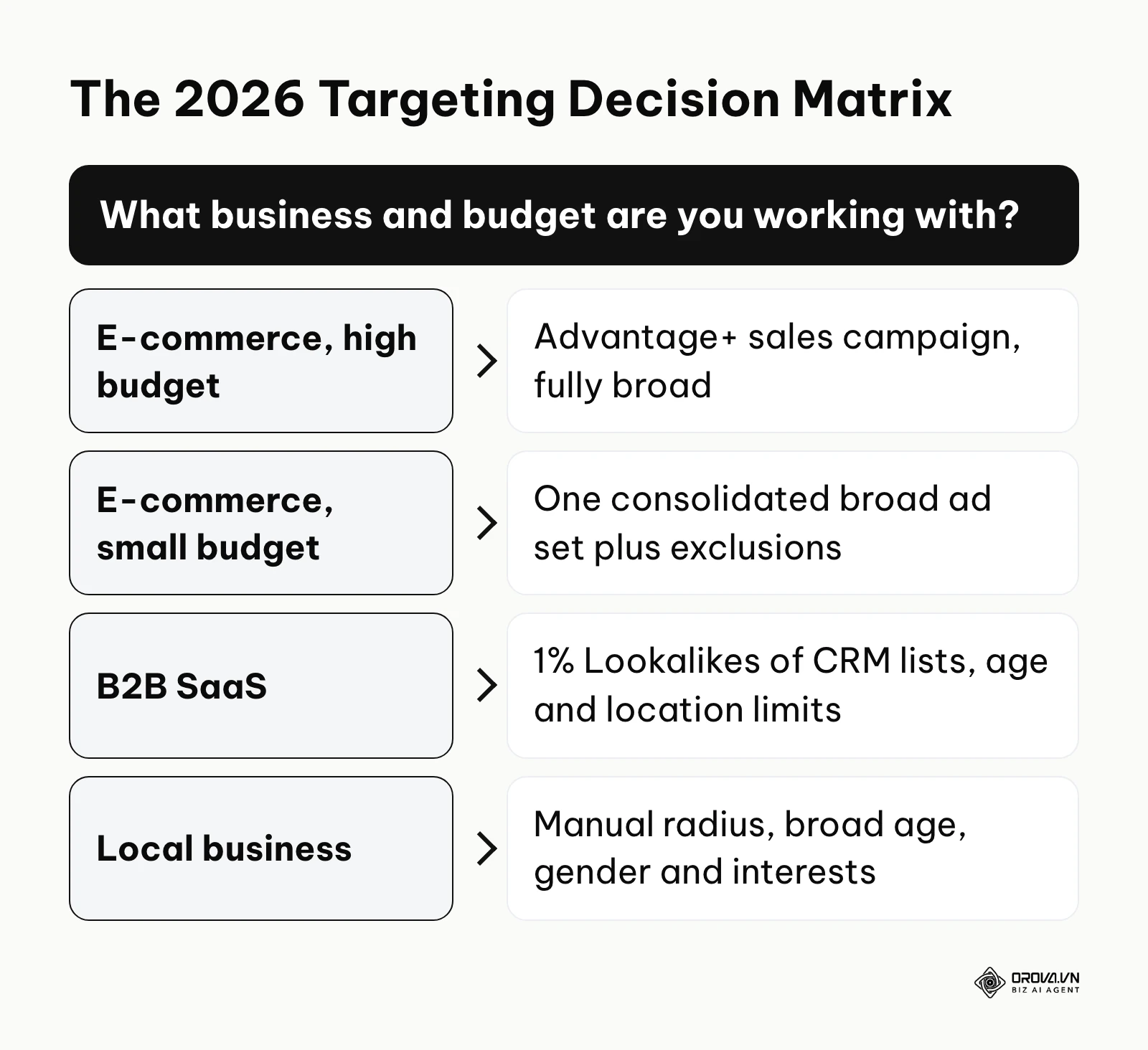
This is why you must consult the audience decision matrix before launching. If you are an e-commerce brand spending heavily, Advantage+ sales campaigns (formerly Advantage+ Shopping Campaigns, or ASC) with purely broad settings are usually optimal. The AI has enough budget to test thousands of pockets of users globally and quickly identify the buyers. However, if you are running a B2B SaaS company, a purely broad approach will likely waste your budget on students or unqualified hobbyists clicking your ads out of curiosity. In this scenario, utilizing 1% Lookalike audiences based on high-value CRM lists, combined with strict age and geographic layering, is mandatory to constrain the AI.
If you are wondering how to target local customers on facebook ads effectively, the matrix dictates a hybrid approach. You cannot use Advantage+ broadly across a whole state. You must use manual targeting to drop a strict 10-kilometer radius around your brick-and-mortar location. Within that tight geographic fence, you should leave the age, gender, and interests completely broad. The geographic limit protects your budget from being spent on people who will never drive to your store, while the broad demographic settings give the algorithm the maximum possible liquidity within that local pool to find the cheapest leads. If you sell online on a small budget, the matrix points to one consolidated broad ad set protected by exclusions, which Step 6 covers in detail.
Step 2: Designing creatives as the primary filter
In 2018, you targeted people by selecting "Interested in Yoga" in the Ad Set level. In 2026, you target them by putting the words "Attention Yoga Studio Owners" directly on your video thumbnail. Meta has removed many detailed targeting options over the past few years, and in Advantage+ audience the interests you add act as suggestions rather than hard limits. Meta describes its delivery system as using the ad itself, alongside engagement signals, to decide who is likely to respond, so what your image, text and video say about the buyer carries much of the targeting weight. Your creative is now your targeting.
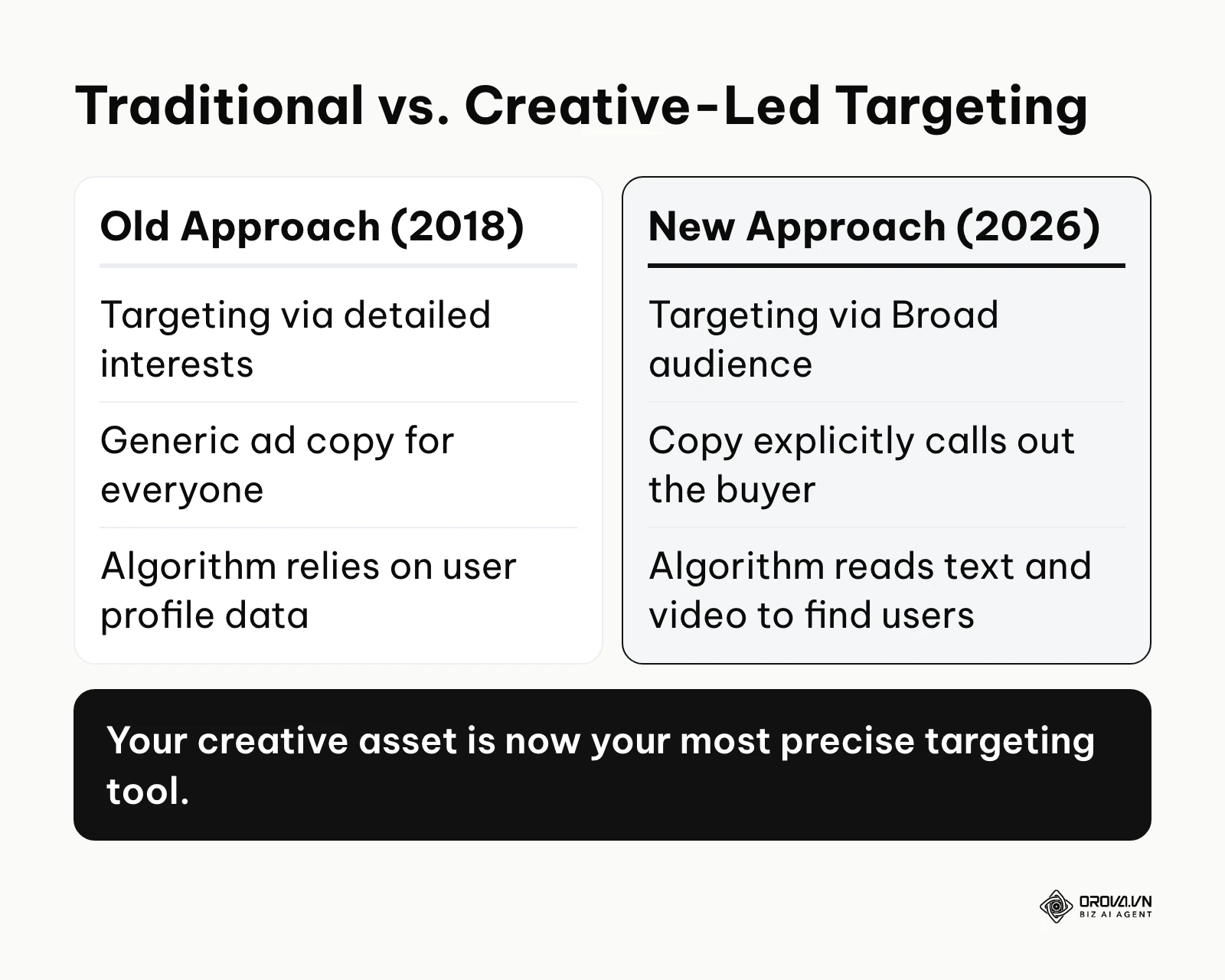
If you run a broad audience, the only thing telling the algorithm who to go after is the ad itself. This means your copywriting and design must act as aggressive filters. You must actively repel unqualified users. If you sell high-ticket enterprise software, and your ad looks like a fun consumer app, you will get thousands of cheap clicks from consumers, and the AI will think it is doing a great job because the Click-Through Rate (CTR) is high. You must use your headline to disqualify the wrong people.
Illustrative example: Creative filtering for a high-ticket brand.
- Context: A mid-sized Direct-to-Consumer (D2C) brand was selling premium ergonomic office chairs at a premium price point. They were struggling with low conversion rates.
- Steps done: 1. They abandoned their granular interest targeting based on "Office Furniture" and switched to a purely Broad campaign. 2. They redesigned their video creatives. Instead of a generic lifestyle shot, the new video started with a text overlay: "If you manage procurement for an office of 20+ people..." 3. They prominently displayed the price tag in the first three seconds of the video.
- Hurdle and Fix: Initially, the overall engagement rate and CTR plummeted because casual scrollers ignored the ad. The marketing team panicked and almost paused the campaign. The fix was holding steady and looking deeper at the funnel; the cost per click (CPC) was higher, but the bounce rate on the landing page dropped drastically.
- Visible Result: By the second week, the CPA stabilized at a level the brand considered profitable, and the CRM showed a massive influx of qualified B2B buyers making bulk orders, proving that the creative had successfully filtered out the window shoppers and guided the broad algorithm perfectly.
Step 3: Implementing the 5-step exclusion protocol
The darkest secret of AI-driven targeting is its inherent laziness. Machine learning models are designed to find the path of least resistance to achieve the objective you set. If you ask for a purchase, the absolute easiest way for the AI to get a purchase is to show the ad to someone who has already bought from you, or someone who added to cart yesterday but hasn't checked out yet. If you do not set strict exclusions, your "prospecting" campaign will quietly transform into an aggressive retargeting campaign, inflating your frequency and wasting money on people who were going to buy anyway.
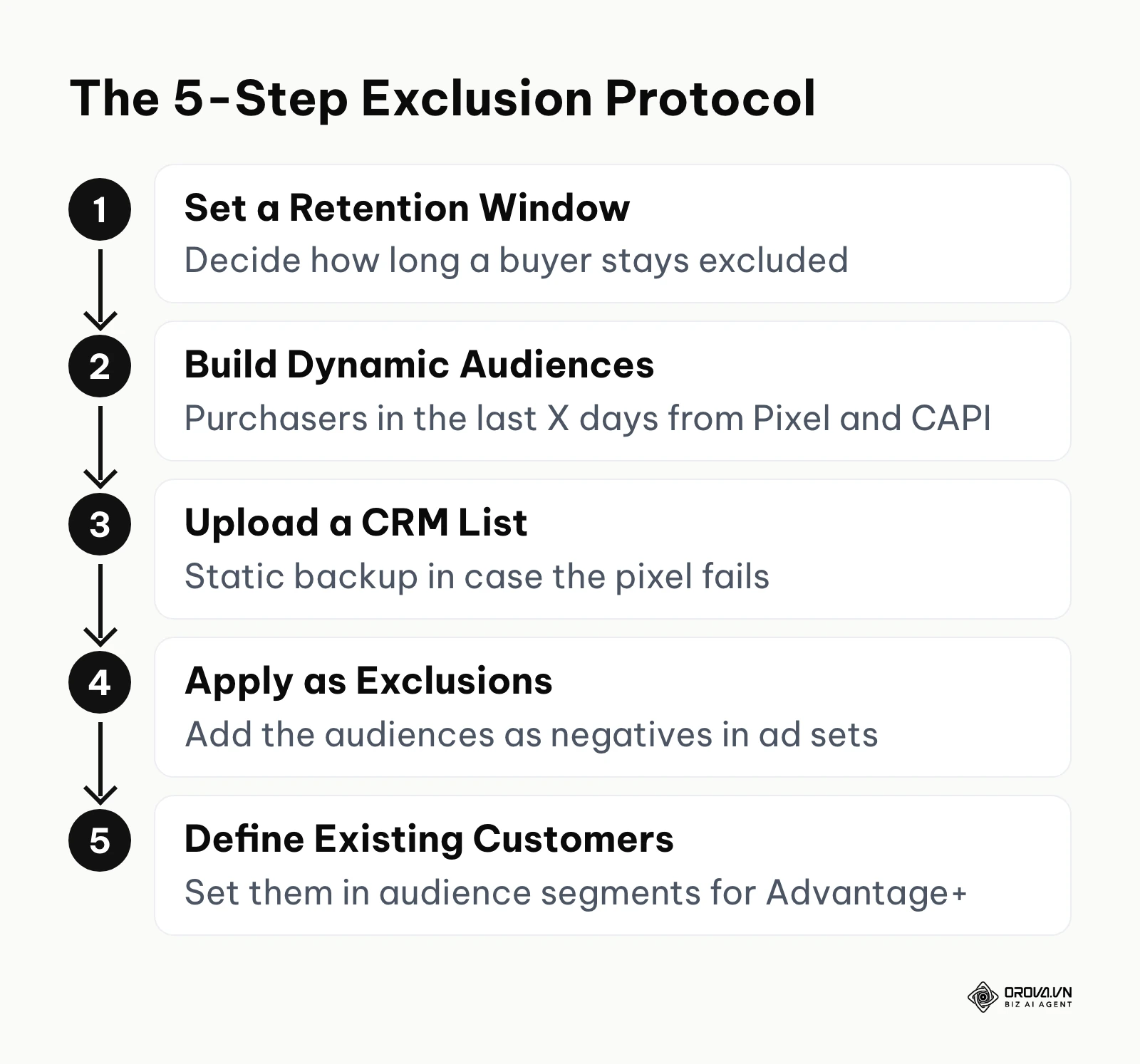
To prevent this, you must build a robust exclusion safety net. First, define your retention window. If your product is a mattress, a customer won't buy another one for ten years; you must exclude them indefinitely. If you sell consumable supplements, you might only exclude them for 30 days before retargeting them.
Next, you must build dynamic custom audiences based on your Pixel and CAPI events, specifically targeting "Purchasers in the last X days." You must also upload a static CSV file from your CRM as a backup in case the pixel fails. If you also advertise on Google, the same cleaned list can drive exclusions there through Google Customer Match. Finally, you must apply these custom audiences as negative exclusions in the Ad Set settings. When using Advantage+ campaigns, you must open your ad account's advertising settings and define your existing customers in the audience segments section using these lists. This tells the AI precisely who it is not allowed to take credit for when optimizing for new customer acquisition.
Step 4: Building an overlap-proof campaign structure
A major technical issue that destroys targeting efficiency is auction overlap, the problem covered in our audience overlap guide. This occurs when you have multiple ad sets in your facebook ads manager that are competing in the same internal auction for the same users. If you have an ad set built on a fitness-related interest and another targeting a "1% Lookalike of Purchasers," there is a massive chance that the same people exist in both pools. Meta will not show your ad to the user twice; instead, it will only enter your most competitive ad set into the auction, effectively killing the delivery of the other one. You are self-sabotaging your scale.
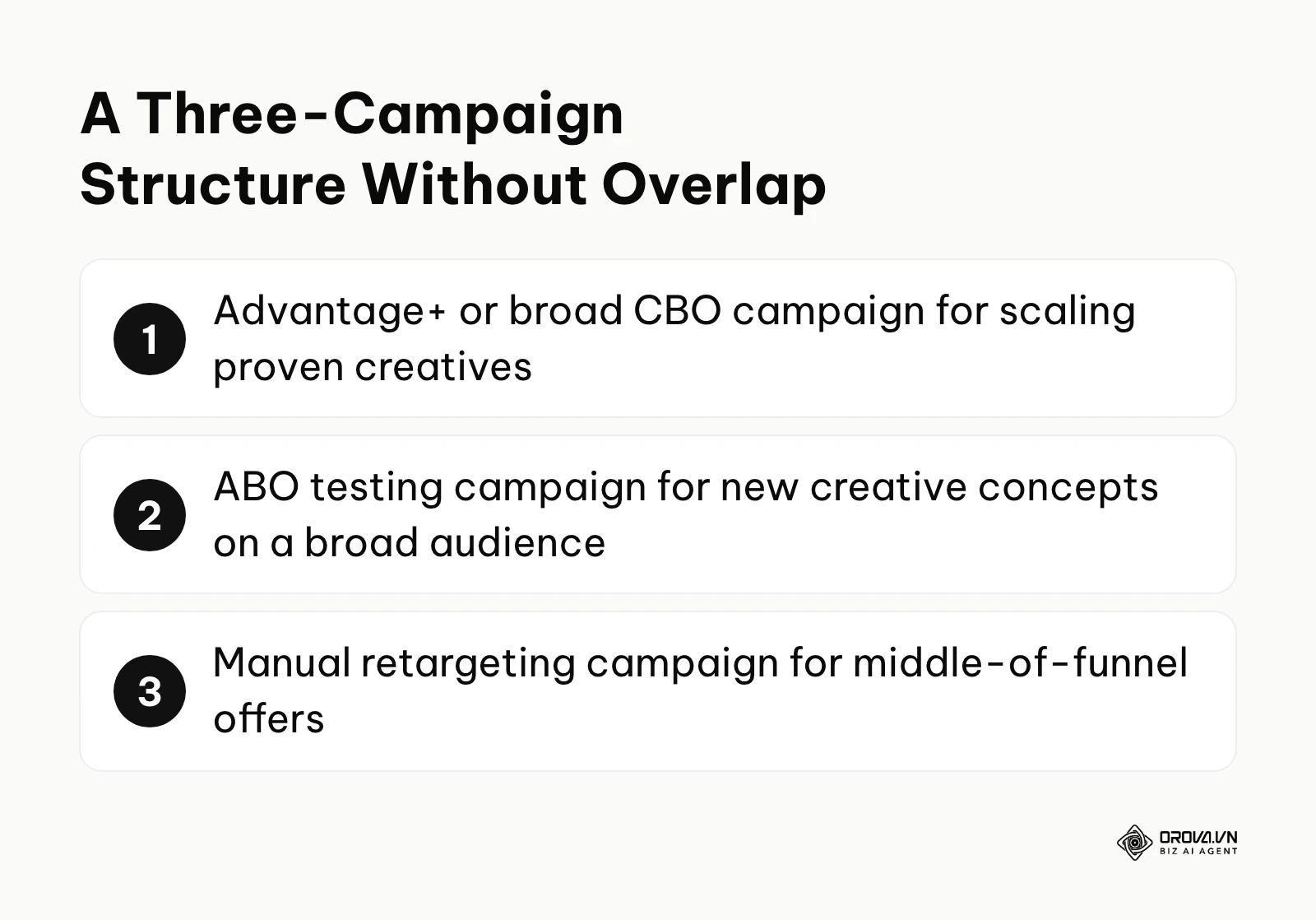
To solve this, you must consolidate your account structure. The goal is to feed as much data into a single entity as possible so it can exit the learning phase quickly; Meta's own guidance on the learning phase recommends combining similar ad sets for this reason.
For most e-commerce businesses, the ideal structure consists of no more than three campaigns. Campaign 1 is your Advantage+ or Broad Campaign Budget Optimization (CBO) intended purely for scaling proven creatives. Campaign 2 is a dynamic testing environment where you use ABO (Ad Set Budget Optimization) to test new creative concepts on a broad audience without disrupting your main scaler. Campaign 3 is a tightly controlled manual retargeting campaign designed to capture middle-of-funnel users with specific promotional offers. By keeping the structure this simple, you eliminate overlap, pool your data, and give the AI the runway it needs to optimize.
Illustrative example: Structuring a local campaign to stop overlap.
- Context: A boutique dental clinic in Chicago was spreading a modest monthly budget across 8 different ad sets. They had separate ad sets for zip codes, specific ages, and interests like "teeth whitening."
- Steps done: 1. The agency audited the account and found heavy auction overlap between the ad sets. 2. They paused all 8 micro-ad sets and consolidated the entire budget into a single CBO campaign. 3. They created one ad set targeting a strict 8-mile radius around the clinic with a broad age range of 25-55, stacking three different creative angles inside it.
- Hurdle and Fix: In the first three days, the CBO pushed almost all the budget to an ad that featured a stock image of a smiling senior citizen, generating lots of likes but zero booked appointments. The fix was pausing that specific underperforming creative within the ad set, forcing the CBO to redistribute the budget to a video tour of the clinic.
- Visible Result: By consolidating the budget and removing the overlap, the single ad set exited the learning phase within a week. The clinic saw a consistent, manageable flow of 15 new patient bookings per week directly attributed to the video ad, with a noticeably lower CPA than the fragmented setup.
Step 5: Troubleshooting Advantage+ delivery limits
One of the most terrifying moments in modern media buying is when you launch an Advantage+ Shopping Campaign, it performs brilliantly for four days, and then suddenly stops spending or sees the CPA triple overnight. This happens because the algorithm has exhausted the "easy" pockets of conversions—usually your warm audience and highly engaged social followers—and is now struggling to expand into true cold prospecting.
When this occurs, look for the controls Meta offers in your account for limiting spend on existing customers, such as an existing-customer budget cap or a new-customer acquisition goal; the exact option and its name have changed across Advantage+ updates, so check what your campaign settings show. Left unchecked, Advantage+ will lean toward warm users. To force it to hunt for new users, limit how much can go to the existing customers defined in your audience segments.
If your campaign is dying, you should analyze the breakdown of spend. If most of the budget is going to existing customers, you have a retargeting campaign disguised as a scaler. Set a low ceiling for existing customers, for example 10%. This artificially restricts the AI, forcing it to deploy the remaining 90% of the budget out into the broad, cold audience. It will be painful for a few days as the CPA rises during this forced exploration phase, but it is the only way to achieve sustainable scale.
Step 6: Executing a facebook ads targeting strategy for small budget
If you are operating with a small daily budget, you face a distinct mathematical disadvantage. Meta's algorithm requires approximately 50 optimization events (conversions) within a 7-day rolling window to fully exit the "Learning Phase" and stabilize delivery. If your daily budget is only a fifth of your typical CPA, a full week of spend buys one or two conversions, far short of the threshold. The AI simply will not get enough data points to map the audience accurately.
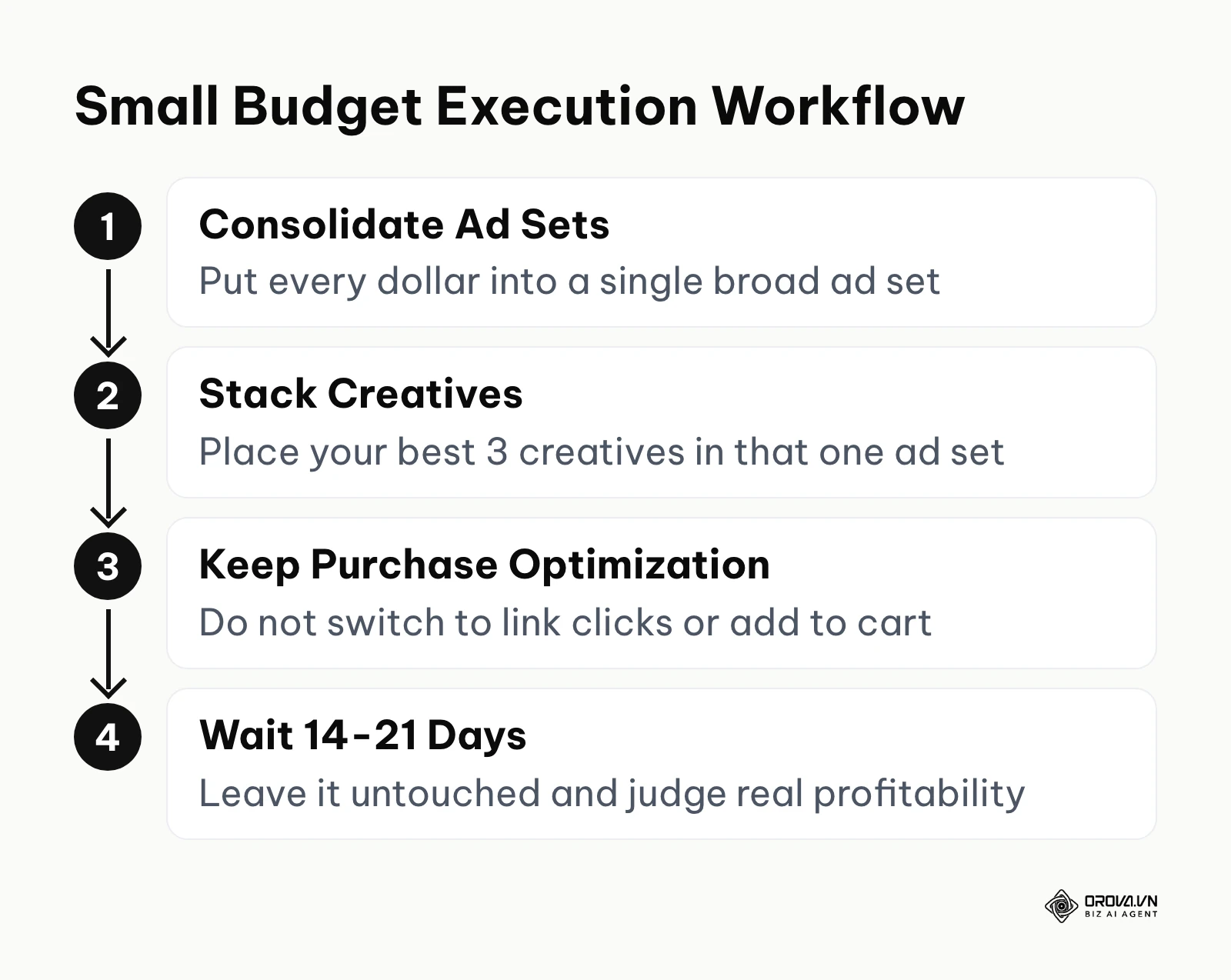
Executing a facebook ads targeting strategy for small budget requires extreme discipline. First, you must utterly refuse to segment your audience. You cannot afford to split an already small daily budget across four ad sets. You must consolidate every dollar into a single, broad ad set. Second, you must rely heavily on user generated content ads because authentic, native-looking creatives act as the strongest possible filter when you lack the budget for extensive algorithmic learning.
Finally, you must accept the reality of operating in "Learning Limited" status. Do not panic and change your optimization event to "Link Clicks" or "Add to Cart" just to get more volume. The algorithm will dutifully find you people who love to click and never buy. Keep the optimization set to Purchase, use one broad audience, stack your best 3 creatives in it, and do not touch it. Allow the campaign to run over a longer horizon (14 to 21 days) to evaluate its actual profitability rather than relying on the platform's stability indicators.
OROVA ADS applies AI Agent to automate and optimize ad performance on Google, Meta and TikTok. Scale your budget safely, monitor 24/7 and expand your business quickly.
Experience the solution at orova.vn/ads
Deep dive: facebook ads advantage plus vs manual targeting
The debate surrounding facebook ads advantage plus vs manual targeting is the most contentious topic in media buying today. Understanding the mechanical differences between the two is crucial for determining which architecture to deploy. Advantage+ (specifically ASC) is essentially a black box. It replaces the traditional campaign, ad set, and ad hierarchy with a streamlined flow. You provide the creatives, the budget, and the destination; the AI uses reinforcement learning to dynamically test thousands of audience permutations, constantly shifting budget between prospecting and retargeting in real-time.
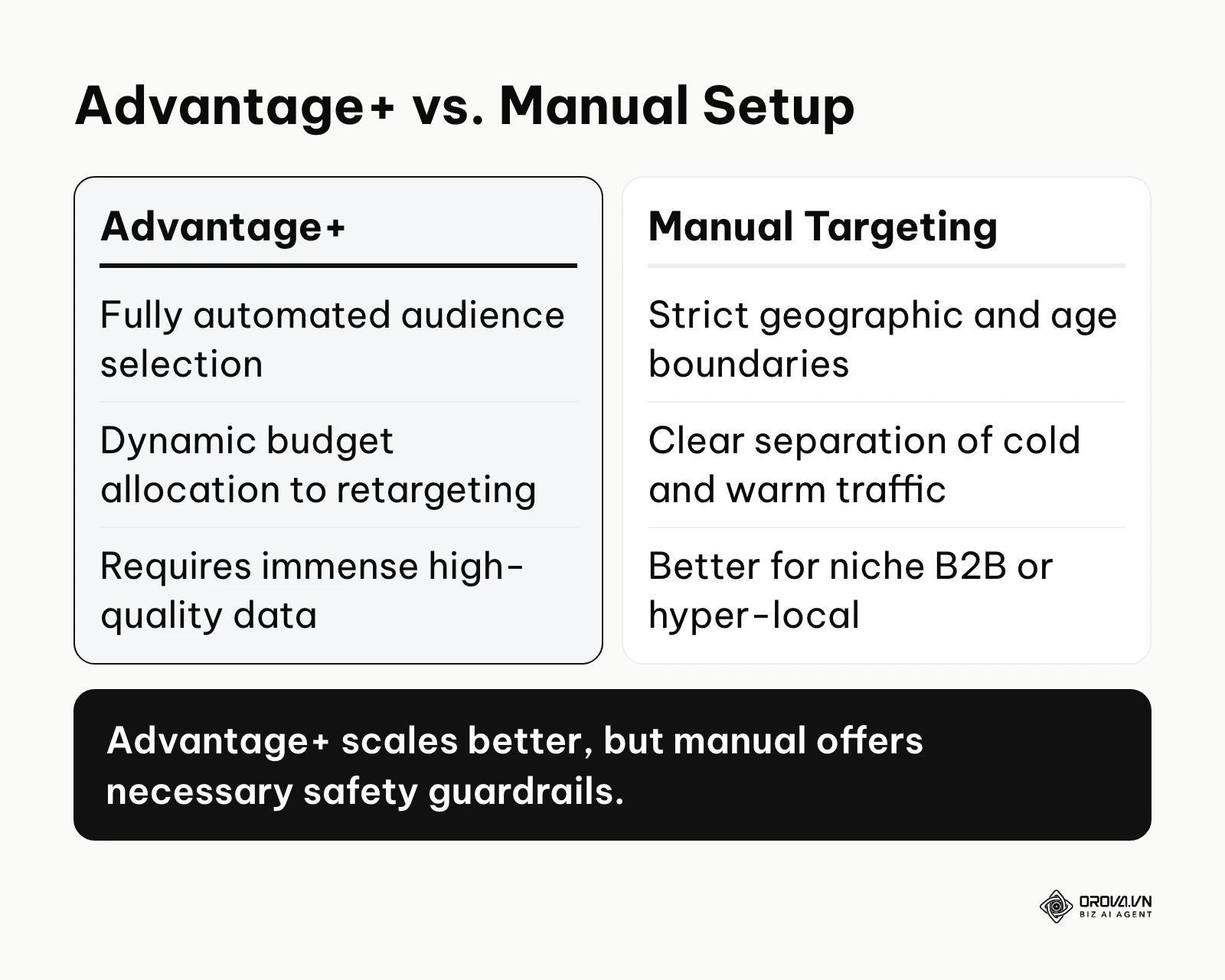
Manual targeting, conversely, retains the traditional structure. You dictate the exact geographic boundaries, the demographic constraints, and the specific Lookalike or interest intersections. The algorithm optimizes within those boundaries, but it cannot override your rules. If you set a budget at the Ad Set level, the system must spend it there, regardless of whether a cheaper conversion exists elsewhere.
| Comparison Factor | Advantage+ (Automated) | Manual Targeting |
|---|---|---|
| Data Requirement | Requires high volume of clean pixel data to function | Can function with limited pixel history |
| Budget Fluidity | Dynamically shifts between cold and warm traffic | Strict separation; budget goes exactly where told |
| Audience Control | Zero control over specific demographics reached | Absolute control over age, gender, and location |
| Scaling Capability | Exceptional; scales vertically with minimal fatigue | Prone to audience saturation and auction overlap |
| Best Used For | D2C E-commerce, large catalogs, massive budgets | B2B Lead Gen, hyper-local businesses, strict compliance |
The tradeoff is profound. Advantage+ offers unparalleled efficiency and scale for accounts with vast data liquidity, but it completely strips the advertiser of analytical transparency. You will not know who bought your product, only that the system achieved the CPA. Manual targeting provides immense analytical clarity and safety guardrails, but it requires constant manual intervention to combat audience decay and fatigue. For most businesses in 2026, a hybrid approach—using Advantage+ for core scaling and manual campaigns for strict testing and local constraints—yields the most stable blended return.
Measuring targeting success beyond platform metrics
Relying exclusively on the Return on Ad Spend (ROAS) metric reported inside the Ads Manager is a dangerous practice that often leads to catastrophic scaling decisions. Meta's in-platform metrics are heavily influenced by attribution modeling, cross-device tracking issues, and the algorithmic tendency to claim credit for organic conversions (especially when retargeting). If you scale a campaign simply because the platform reports a 4.0 ROAS, you might find that your actual bank account is shrinking.
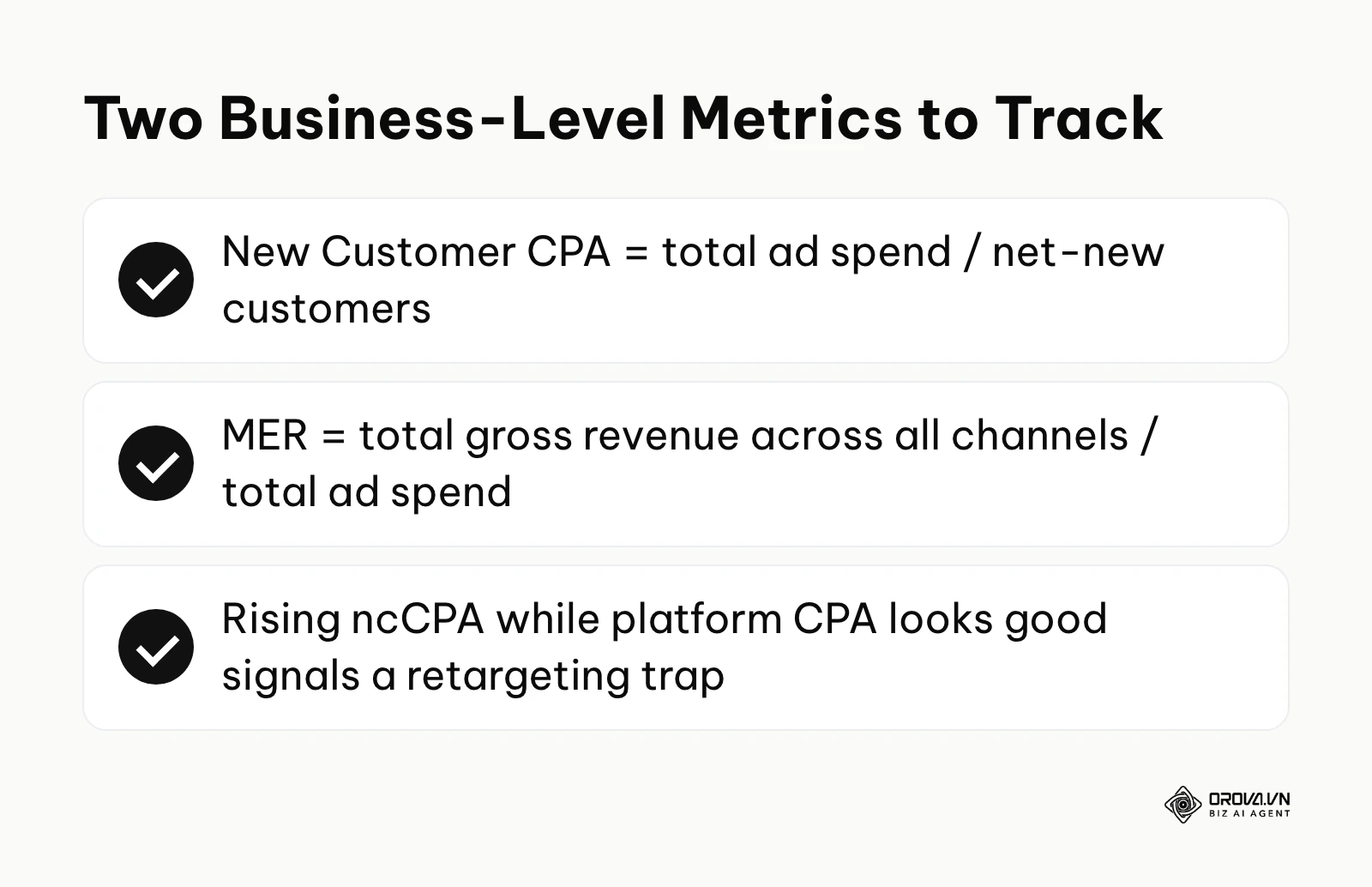
To accurately measure targeting success, you must elevate your analysis to business-level metrics. The most critical metric is New Customer CPA (ncCPA). This is calculated by taking your total ad spend and dividing it only by the number of net-new customers acquired, ignoring repeat purchases. If your targeting is genuinely prospecting and finding new audiences, your ncCPA will remain stable as you scale. If your targeting has devolved into a retargeting trap, your platform CPA might look amazing, but your ncCPA will skyrocket because you aren't acquiring anyone new.
The second crucial metric is the Marketing Efficiency Ratio (MER), also known as blended ROAS. You calculate this by dividing your total gross revenue across all channels by your total ad spend. MER acts as the ultimate truth teller. If you launch a new broad targeting campaign and your in-platform ROAS looks poor, but your overall Shopify revenue jumps and your MER improves, the campaign is successful. It is likely generating massive top-of-funnel awareness that is converting later via organic search or email, proving that the broad targeting is working exactly as intended, even if the facebook pixel tracking doesn't perfectly capture the final click.
Critical targeting mistakes and how to fix them
Even with a perfect strategy, execution errors can derail an entire account. The Meta algorithm is highly sensitive to sudden changes, and small administrative mistakes can reset the learning phase or cause the AI to optimize in the wrong direction entirely. Avoiding these common pitfalls is the fastest way to stabilize erratic performance.
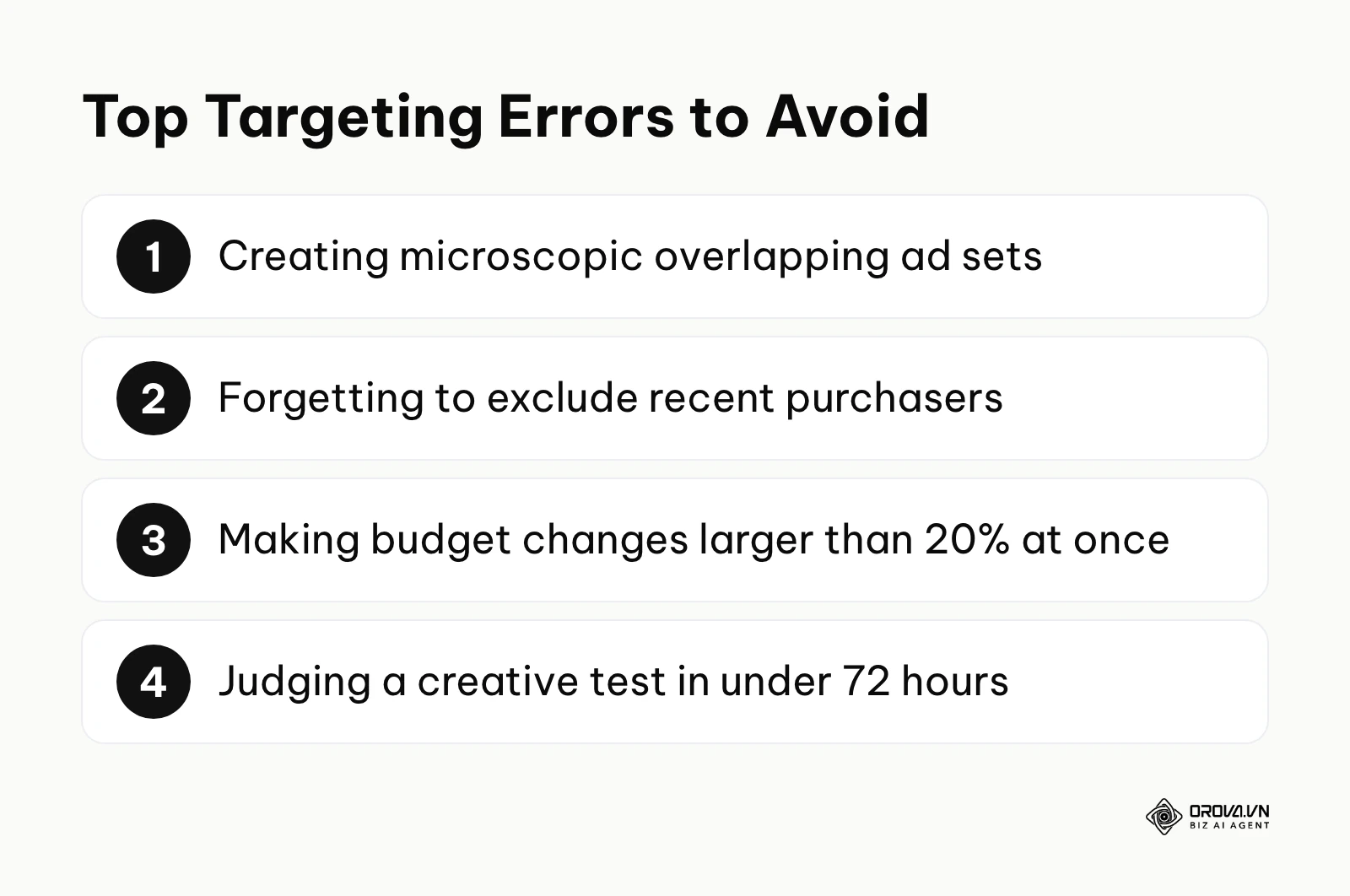
Over-segmentation of Audiences: The most common mistake inherited from outdated playbooks is creating a dozen different ad sets, each targeting a slightly different interest (e.g., "Dogs," "Dog Food," "Pet Grooming"). This causes massive auction overlap and starves the AI of data. The fix is to pause them all and consolidate the budget into a single ad set targeting a broad audience, letting the creative do the segmentation.
Illustrative example: The over-segmentation trap in B2B.
- Context: A B2B software company was running a lead generation campaign with a mid-sized daily budget, split across 10 ad sets, each built on a different detailed targeting option aimed at business decision makers.
- Steps done: 1. The marketing manager noticed that none of the ad sets were exiting the learning phase and the CPA was highly volatile. 2. They paused all 10 ad sets. 3. They launched a single new ad set targeting a 1% Lookalike of their highest LTV customers, combining all the creatives into this one pool.
- Hurdle and Fix: The initial lead quality dropped for the first 48 hours as the algorithm explored the edges of the Lookalike audience. The fix was implementing a stricter lead form with qualifying questions to feed better negative signals back to the algorithm.
- Visible Result: By the end of the week, the consolidated ad set exited the learning phase, lead volume doubled for the same budget, and the sales team reported a stable, predictable flow of qualified prospects in the CRM.
Ignoring the Retargeting Overlap in Broad Campaigns: Launching a broad campaign without excluding your recent purchasers is a critical error. The AI will immediately target people who bought yesterday because they are the most likely to click. The fix is strictly implementing the 5-step exclusion protocol and ensuring your CRM list is synced dynamically to prevent wasted spend on users who don't need to see the ad again.
Making Massive Budget Adjustments: If a campaign is performing well, the temptation is to double the budget overnight. Doing so will violently reset the algorithm's learning phase, causing performance to tank. The fix is to utilize a careful ads budget scaling strategy, increasing successful campaigns by no more than 15-20% every 48 hours, a common rule of thumb among media buyers, to allow the AI to adjust its bidding strategy smoothly.
Judging Creative Tests Prematurely: Meta's algorithm utilizes stochastic exploration in the first few days of a campaign. It will intentionally spend money on weird, unlikely pockets of users to gather data. If you panic and turn off an ad after 24 hours because the CPA is high, you are overriding the machine learning before it has a chance to optimize. The fix is committing to a minimum 72-hour (preferably 7-day) un-edited window for any new targeting test.
Want to scale your budget but afraid of breaking performance? 📉
Integrate OROVA ADS now - an AI Agent that automatically monitors and optimizes Google, Meta, TikTok ads 24/7. Now, expanding and replicating your Performance Ads team is just one click away.
🚀 Try it now at: orova.vn/ads
Future trends in Facebook targeting: Author's perspective
The landscape of media buying is shifting at an unprecedented velocity. The tactics that work today are merely a bridge to a fully automated future. Based on the current trajectory of Meta's machine learning capabilities and global privacy regulations, here is how I believe targeting will evolve over the next few years.
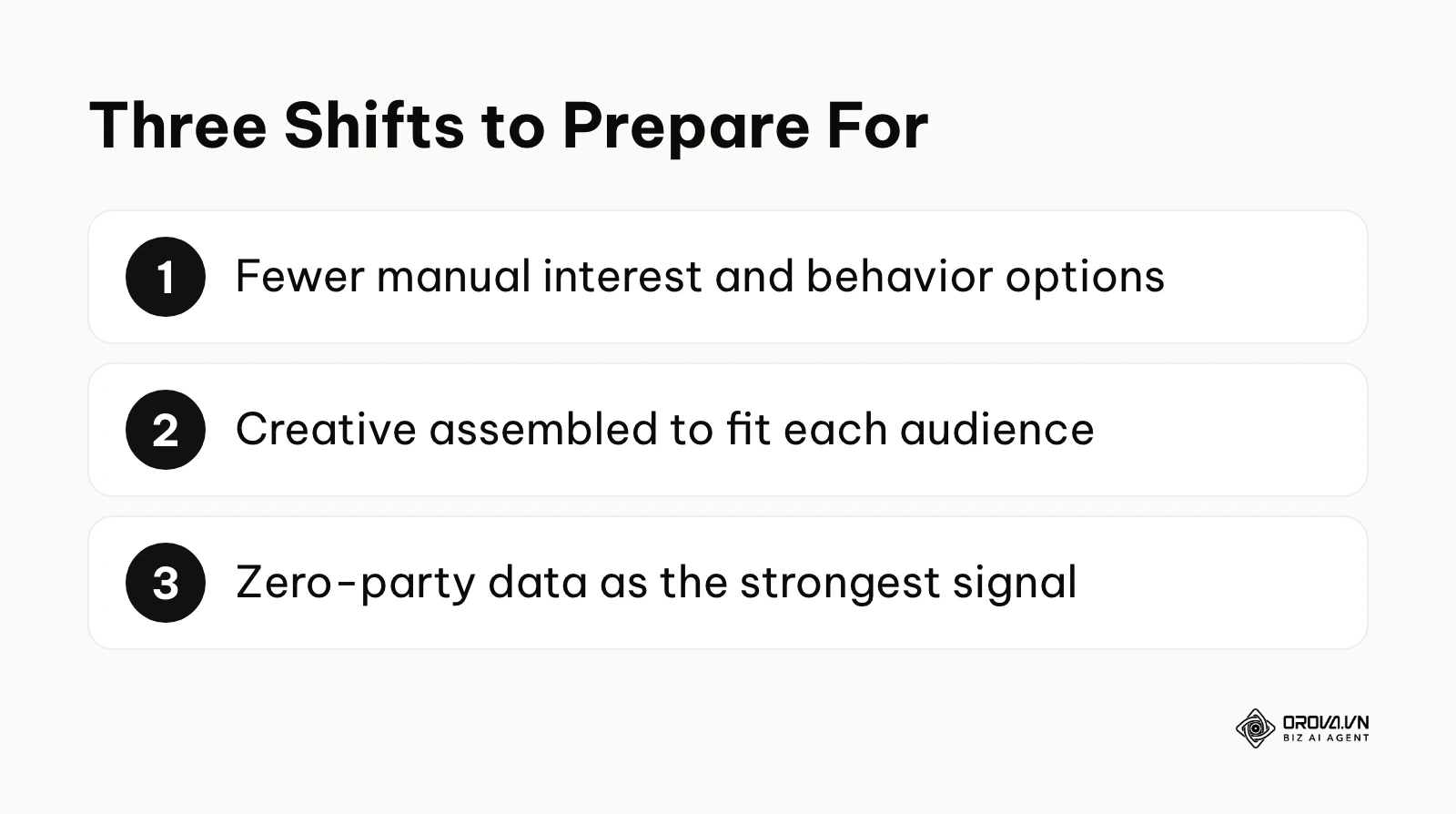
The absolute end of manual interest targeting
Meta has already retired many detailed targeting options, and in Advantage+ audience the interests you add are treated as suggestions. I think the remaining interest and behavior options will keep shrinking, and that the platform may move toward a system where you provide the creative and the business objective while the AI handles most of the audience distribution. Advertisers need to prepare for this by entirely divorcing themselves from the mental crutch of interest groups and mastering creative strategy and offer psychology, as these will be the only variables left to control.
Creative generation merging with audience selection
Currently, we build creatives to act as filters for broad audiences. I suspect the AI will increasingly not just distribute the creative, but dynamically alter it on a per-user basis to match the micro-segment it wants to target. If the algorithm identifies a user who responds well to urgency, it will automatically overlay a countdown timer on your video; if it identifies a user who values aesthetics, it will swap the background music and color grading. To prepare, brands must focus on building massive asset libraries—raw clips, varying hooks, modular copy—rather than highly polished, immutable, final video exports, allowing the AI to assemble the perfect ad for the perfect user in real-time.
Zero-party data becoming the ultimate signal
With third-party tracking degrading further every year, relying on pixel events will become increasingly unreliable for feeding the targeting algorithm. I strongly believe that zero-party data—information the customer explicitly and willingly shares with you—will become the primary currency for AI targeting. Brands that build interactive quizzes, comprehensive post-purchase surveys, and conversational messaging funnels will be able to feed rich, deterministic data directly into Meta's CAPI. Those who rely on algorithmic guesswork without a robust backend CRM strategy will face unscalable acquisition costs.
Frequently asked questions about Facebook targeting
How do I exclude yesterday's buyers when CAPI hasn't synced?
If your server-side Conversions API takes 24 hours to sync, you run the risk of aggressively retargeting people who just bought. To bridge this gap, you must rely on standard Pixel events for immediate, short-term exclusions. Create a custom audience of "Visited Order Confirmation Page in the last 3 days" using URL rules. The browser pixel fires instantly, providing a temporary exclusion net until the robust server data catches up and populates your primary CRM exclusion lists.
Is AI targeting reliable for a strictly local business?
Advantage+ and purely broad targeting can be highly volatile for local businesses if left completely unconstrained. The AI might find cheaper clicks just outside your service area, burning budget on people who won't drive to your store. For local targeting, you should use manual campaigns to enforce a strict geographic radius (e.g., 5 miles). Within that radius, however, you should embrace the broad philosophy: remove all age, gender, and interest restrictions to give the algorithm maximum liquidity within your local footprint.
Does Advantage+ work for B2B lead generation?
Advantage+ was originally built for high-volume e-commerce (hence the original "Shopping Campaigns" name), but Meta has since extended Advantage+ automation to other objectives, including leads. However, for B2B lead generation, it is incredibly risky unless you have strict down-funnel integrations. If you optimize merely for "Lead Form Fills," the AI will find the cheapest, lowest-quality users who click on everything. You must integrate your CRM (like Salesforce) to pass back "Qualified Lead" or "Closed Won" events via API, and force the Advantage+ campaign to optimize for those deep-funnel actions. If you cannot do this, stick to manual Lookalikes.
What is the minimum budget for AI targeting to learn?
The mathematical threshold for the Meta algorithm to exit the learning phase is approximately 50 conversion events within a 7-day window. To calculate your minimum budget, multiply your target CPA by 50, and divide by 7. If your target CPA is 30 in your account currency, you need roughly 1,500 a week, or about 215 a day per ad set, for the AI targeting to function optimally. If you spend drastically less than this, you will remain in "Learning Limited," requiring you to consolidate ad sets heavily to pool your limited data.
Will AI eventually replace media buyers entirely?
No, but it is aggressively replacing the "button pushers." The technical task of facebook ads cost cap configuration and audience slicing is being fully automated. The media buyer of the future is essentially a creative director and a data architect. Their job is to deeply understand consumer psychology, direct the production of highly specific creative assets that feed the AI, and ensure the data pipeline between the company's backend and Meta's servers is flawless. Strategic oversight replaces manual execution.
Where should you start?
Navigating the complexities of modern Meta targeting can be paralyzing, especially when your dashboard is a sea of red metrics. The key is not to tear down your entire account and rebuild it in one day, but to identify the single most critical bottleneck restricting your performance and address it immediately.
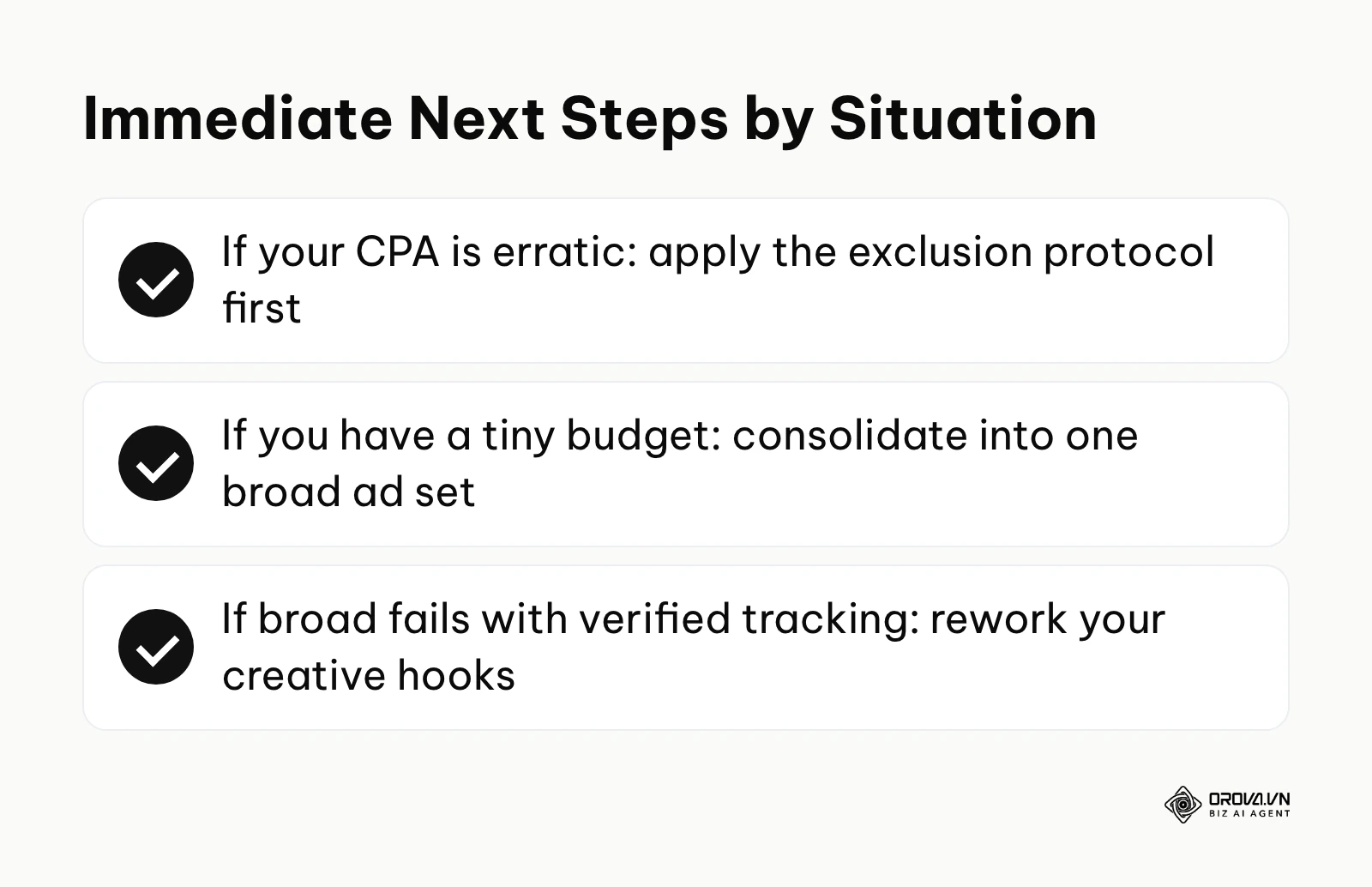
If your CPA is wildly erratic and you suspect you are paying to acquire customers you already own, your first step must be the exclusion protocol. Do not launch any new creatives or adjust budgets. Spend your next working session entirely in the Audiences tab. Export your last 90 days of purchasers from your CRM, upload them as a custom audience, and apply them as a hard exclusion to your primary prospecting campaigns. You will likely see an immediate stabilization in your true acquisition costs.
If your budget is tiny and your campaigns are permanently stuck in "Learning Limited," your first step is ruthless consolidation. Go into your Ads Manager and pause every micro-segmented ad set you have. Create a single, broad ad set with no interest targeting, move your top three best-performing video creatives into it, and let it run untouched for a week. By pooling your limited budget into one entity, you give the algorithm its best chance to find a pocket of profitability.
If your broad campaigns are failing and you have verified your data tracking is accurate, your targeting problem is actually a creative problem. Your first step is to analyze your video hooks. Stop tweaking the ad set settings and start brainstorming text overlays that explicitly call out your ideal buyer. The algorithm is waiting for you to tell it who to find, and it only understands the language of your creative assets.
About the author

Builder of Orova
Nguyễn Đỗ Trọng Ân has 8 years of experience in marketing, including 6 years managing market development across Asia. He builds Orova, a Biz AI Agent that never sleeps: it plans, runs and optimizes work for businesses.
Run your business with AI Agents
Orova is the always-on Biz AI Agent — it plans, runs, and optimizes the work for you.
Save time, unlock productivity.