
What is SEO anchor text? A practical guide to types, context and audits

SEO anchor text is the visible, clickable text of a hyperlink, and search engines read it, together with the sentence around it, as a clue to what the linked page is about. Imagine you are analyzing your website's traffic drop, staring at a backlink report filled with repetitive, exact-match phrases pointing directly to your most important commercial pages. You suspect an algorithmic penalty, and your instincts are likely correct. The rules governing seo anchor text have shifted dramatically over the past few years. The outdated strategy of aggressively stuffing target keywords into hyperlinks to manipulate search rankings is now a direct path to severe algorithmic devaluation. In the current era of semantic search and artificial intelligence, search engines evaluate not just the clickable words themselves, but the entire linguistic context surrounding them. This comprehensive guide will dissect the modern approach to link text optimization, providing you with clear definitions, an illustrative distribution example, practical audit frameworks, and contextual strategies needed to build a resilient, future-proof website architecture.
What is SEO Anchor Text?
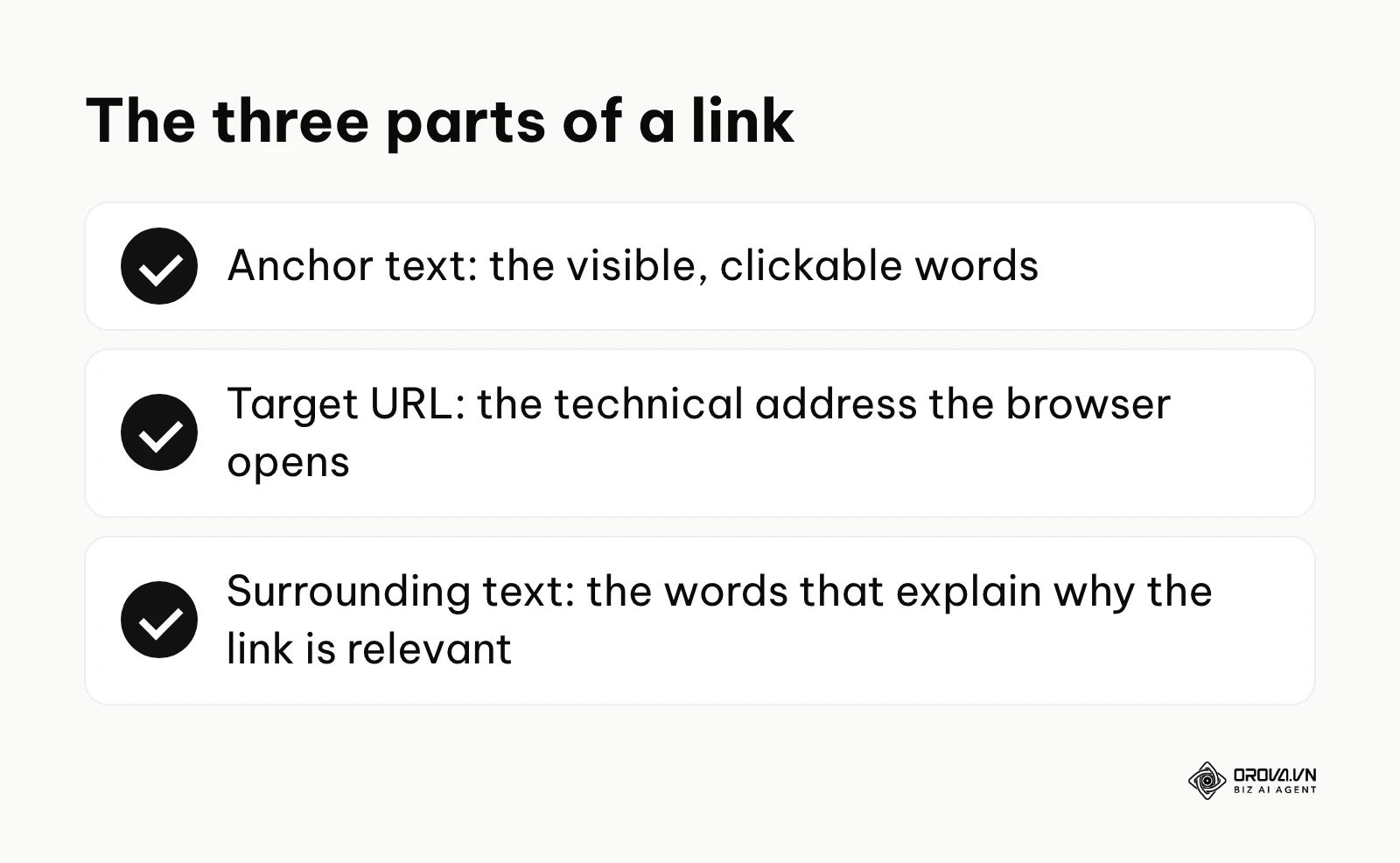
SEO anchor text is the visible, clickable characters within a hyperlink that users interact with to navigate between web pages. It is used to provide strong contextual signals to search engines about the destination page's topic. Unlike the destination URL itself, which is a technical address, this text is specifically designed for human readability.
The concept originated with the creation of the World Wide Web, serving as the fundamental mechanism for connecting discrete documents. While early search algorithms relied entirely on these clickable words to determine page relevance, modern systems use them as just one of many complex contextual signals.
Understanding the difference between the components of a link is crucial for effective optimization. The table below clarifies these distinctions.
| Component | Characteristics and Differences | Real-World Example |
|---|---|---|
| Anchor Text | The visible string of text. It differs from the URL because it uses natural language, and differs from surrounding text because it is interactive. | "Read our complete guide to gardening" |
| Target URL | The invisible, technical web address the browser navigates to when the text is clicked. It is meant for machines, not reading. | https://example.com/gardening-guide |
| Surrounding Text | The non-clickable words immediately before and after the link. It provides the semantic context that explains why the link is relevant. | "If you want to grow tomatoes,..." |
Think of anchor text as a street sign pointing toward a specific building. The sign itself (the text) tells you what to expect when you arrive, while the road it sits on represents the semantic context. If the sign simply says "Best Shoes," but it points to a library, both users and search algorithms will quickly recognize the mismatch and lose trust in the signal.
The Meaning and Strategic Role in Modern Search
To grasp why link text optimization is so heavily scrutinized, you must understand the problem it solves for search engines. The internet is a chaotic, disconnected mesh of billions of documents. Search engines deploy automated crawlers to discover and index this content. When a crawler encounters a hyperlink, it pauses its analysis of the current page, notes the destination URL, and critically, records the words used in the link. These words act as semantic bridges, categorizing the destination page based on how others describe it.
In the broader picture of search optimization, link text sits perfectly at the intersection of on-page content and off-page authority. It is the primary vehicle through which "link equity" (the measure of authority passed from one page to another) is transferred along with topical relevance. If a highly authoritative university website links to your article using the phrase "climate change research," search engines register a massive vote of confidence specifically for that topic.
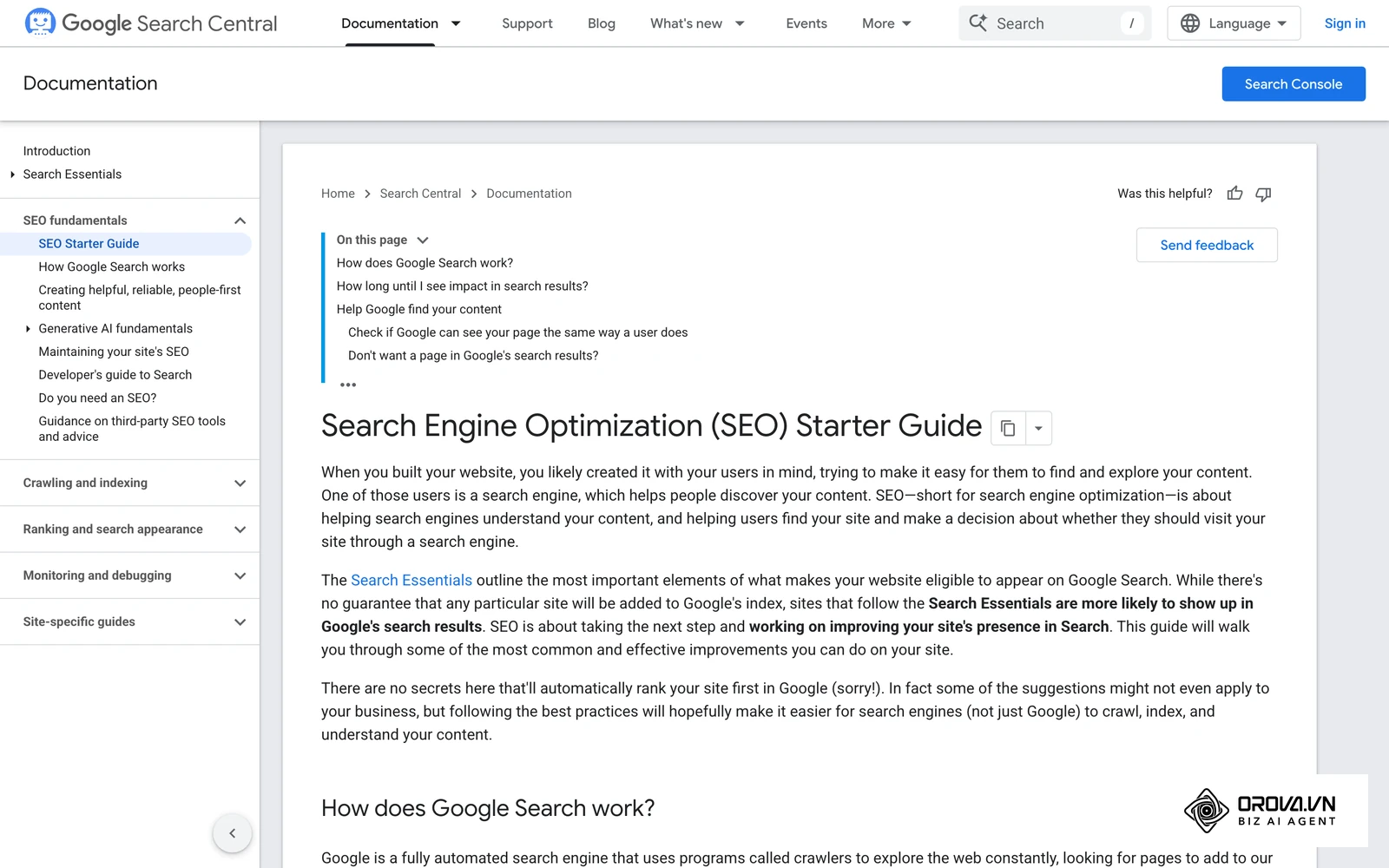
One of the most critical distinctions in modern SEO is understanding the vast difference in rules between internal and external links. For a broader plan that covers both sides, see our guide to internal and external linking strategies.
Internal vs. External Link Strategies
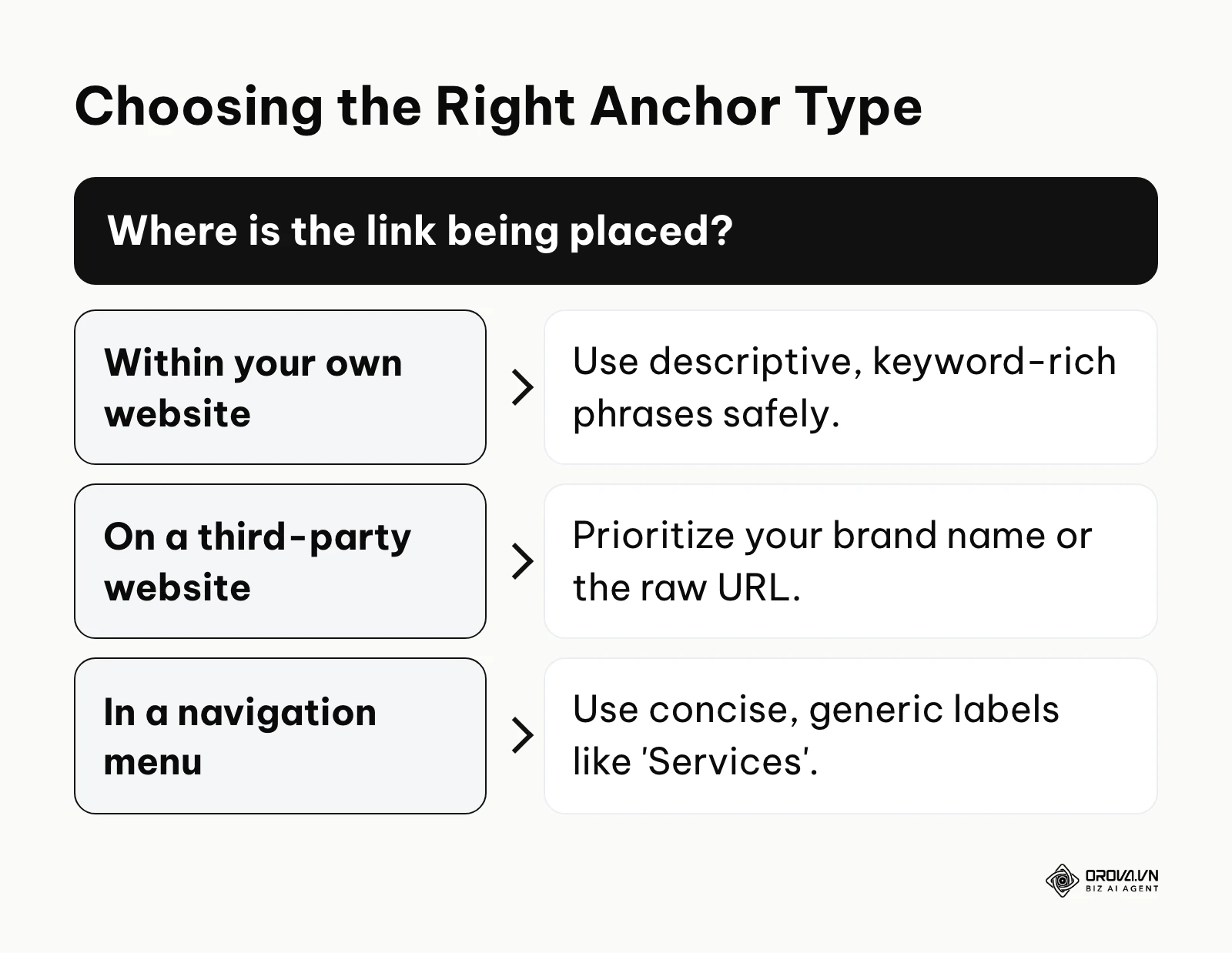
The fundamental difference lies in control. You have complete control over the internal links connecting your own pages. Search engines expect internal links to be highly descriptive and structurally logical. Therefore, using exact-match keywords for internal navigation is generally safe and encouraged, provided it helps the user. For example, linking from a blog post to your product page using the exact phrase "enterprise accounting software" is perfectly acceptable.
Conversely, you theoretically have zero control over how external third-party websites link to you. If a search engine analyzes your backlink profile and sees that 80% of independent websites are linking to you using the exact same commercial phrase, it triggers a massive red flag. Natural web behavior dictates that people link using a chaotic mix of brand names, raw URLs, and conversational phrases. Therefore, external link text must be heavily diluted to appear organic and avoid algorithmic penalties. If you fail to manage this distinction, you risk either confusing search engines about your site structure (poor internal linking) or triggering spam filters (over-optimized external linking). Before hiring any outside help, learn how to evaluate link building services so that new links do not skew your profile toward unnatural patterns.
When You Do Not Need Optimized Link Text
When do you not need highly optimized anchor text? There are specific scenarios where attempting to insert descriptive keywords is actually detrimental. First, when citing academic or official sources, using a naked URL serves as a transparent and trustworthy reference. Second, in primary site navigation menus, users expect concise, universally understood labels like "Contact Us" or "Home" rather than keyword-rich phrases. Finally, when linking from purely decorative images, the visual context supersedes the need for complex alternative text acting as an anchor. Attempting to force keywords into these areas creates a poor user experience and offers zero ranking benefit.
Business Value and Implementer Benefits
Investing time in auditing and optimizing how pages connect yields significant returns across different levels of an organization. It is not merely a technical exercise; it is a fundamental pillar of digital risk management and user experience design.
Value for the Business
For business owners and executives, the primary value lies in risk mitigation and predictable organic growth. A poorly managed link profile, heavily skewed toward exact-match phrases, is a ticking time bomb. Algorithmic updates specifically target these unnatural patterns. By enforcing a data-driven approach to link text, a business protects its primary source of inbound traffic from sudden, catastrophic drops. Furthermore, a clean, structurally sound internal linking strategy ensures that the authority generated by expensive marketing campaigns flows efficiently to the pages that actually generate revenue, maximizing the return on investment for all content efforts.
Benefits for the Implementer
For the SEO specialist, content writer, or webmaster, proper optimization provides a clear blueprint for site architecture. It removes the guesswork from content creation. Instead of wondering how to connect a new blog post to an old service page, the implementer follows a defined framework based on topical relevance. This leads to cleaner code, faster publishing workflows, and a significantly better journey for the end-user, who can navigate the site logically based on descriptive cues.
Illustrative example:
- Context: An SEO manager for a large e-commerce platform featuring over 5,000 product categories was struggling with stagnant organic traffic.
- Steps: The manager initiated a project to revamp the internal linking structure. They moved away from using the generic phrase "buy running shoes" across hundreds of blog posts. Instead, they mapped specific, long-tail variations to relevant sub-categories (e.g., linking "men's trail running shoes" to the trail sub-category, and "lightweight marathon sneakers" to the racing category).
- Hiccup & Fix: Initially, they faced internal resistance from writers who found it difficult to naturally insert these longer phrases. The fix involved creating a dynamic spreadsheet that automatically suggested appropriate link text based on the blog post's primary topic, easing the workflow.
- Visible Result: Within three months, the e-commerce site began displaying expanded site links directly on the Google search results page for broad brand queries, indicating that the search engine had finally understood their complex site hierarchy.
Measuring the Impact
The benefits of proper link optimization are measurable, provided you track the right indicators over the correct time horizon.
| Benefit Category | Primary Metric to Monitor | Expected Time to See Results |
|---|---|---|
| Risk Mitigation | Manual actions resolved in the Search Console Manual Actions report | After Google reviews your reconsideration request (timing varies) |
| Topical Relevance | Increase in impressions for long-tail keywords | 4 to 8 weeks |
| Site Architecture | Increased average pages per session | 2 to 4 weeks |
| Authority Distribution | Higher ranking positions for deep product pages | 3 to 6 months |
Discover Orova.vn – a Biz AI Agent platform with OROVA SEO, a complete solution for every website. The system supports search engine optimization from A to Z with features including keyword research, writing new SEO-ready articles, optimizing existing content, rank tracking, plus competitor analysis and in-depth technical analysis. Sign up today to experience OROVA SEO completely free (offer valid through July 7, 2027).
How Anchor Text Works and How to Optimize It
To truly master link optimization, you must move beyond basic definitions and understand the underlying mechanics of how search engines process HTML, categorize text variations, and interpret human language. This section details the technical anatomy and the strategic frameworks necessary for advanced optimization.
The Anatomy of a Link
According to the HTML Living Standard maintained by WHATWG, the anchor element is fundamentally designed to create hyperlinks, with its text content acting as the primary descriptor for the linked resource. The structure is universally standard: an opening <a> tag carrying an href attribute with the target address, the visible text, and a closing </a> tag.
The <a> tag initiates the command. The href attribute dictates the exact technical destination. The text situated strictly between the opening <a> and closing </a> tags is what the browser renders as clickable, usually denoted by an underline and a distinct color. Search engine crawlers parse this exact string of characters and store it in vast databases, mapping the relationship between the page where the link exists (the source) and the page it points to (the target).
The Core Types of Anchor Text
Not all link text is created equal. Search engines categorize these strings into distinct buckets to assess the naturalness of a website's overall link profile. You must understand and utilize all of them.
| Type | Characteristics and Usage | Appropriate Scenario |
|---|---|---|
| Exact Match | Matches the target keyword exactly (e.g., "auto insurance"). Very powerful but carries the highest risk of penalty if overused externally. | Best used sparingly for highly relevant internal links pointing to core hub pages. |
| Partial Match | Includes the target keyword along with other words (e.g., "affordable auto insurance policies"). Provides context while diluting the exact string. | Excellent for both internal contextual linking and external editorial mentions. |
| Branded | Uses the company or website name (e.g., "Orova"). The safest form of external link, building entity recognition. | Should form the vast majority of your external backlink profile. |
| Naked URL | The raw web address is used as the text (e.g., "https://orova.vn"). Highly natural, often resulting from copy-pasting. | Common in forum discussions, citations, and unlinked brand mentions turning into links. |
| Generic | Non-descriptive calls to action (e.g., "click here", "read more"). Provides zero topical context to search engines. | Necessary for user interface elements but should be avoided in editorial content. |
The Role of Surrounding Text and Semantic Context
This is arguably the most significant shift in SEO over the last decade. Historically, search engines were relatively rudimentary string-matching machines. If the link text said "best laptops," they associated the target page with "best laptops," regardless of what the rest of the page was about. This led to rampant manipulation.
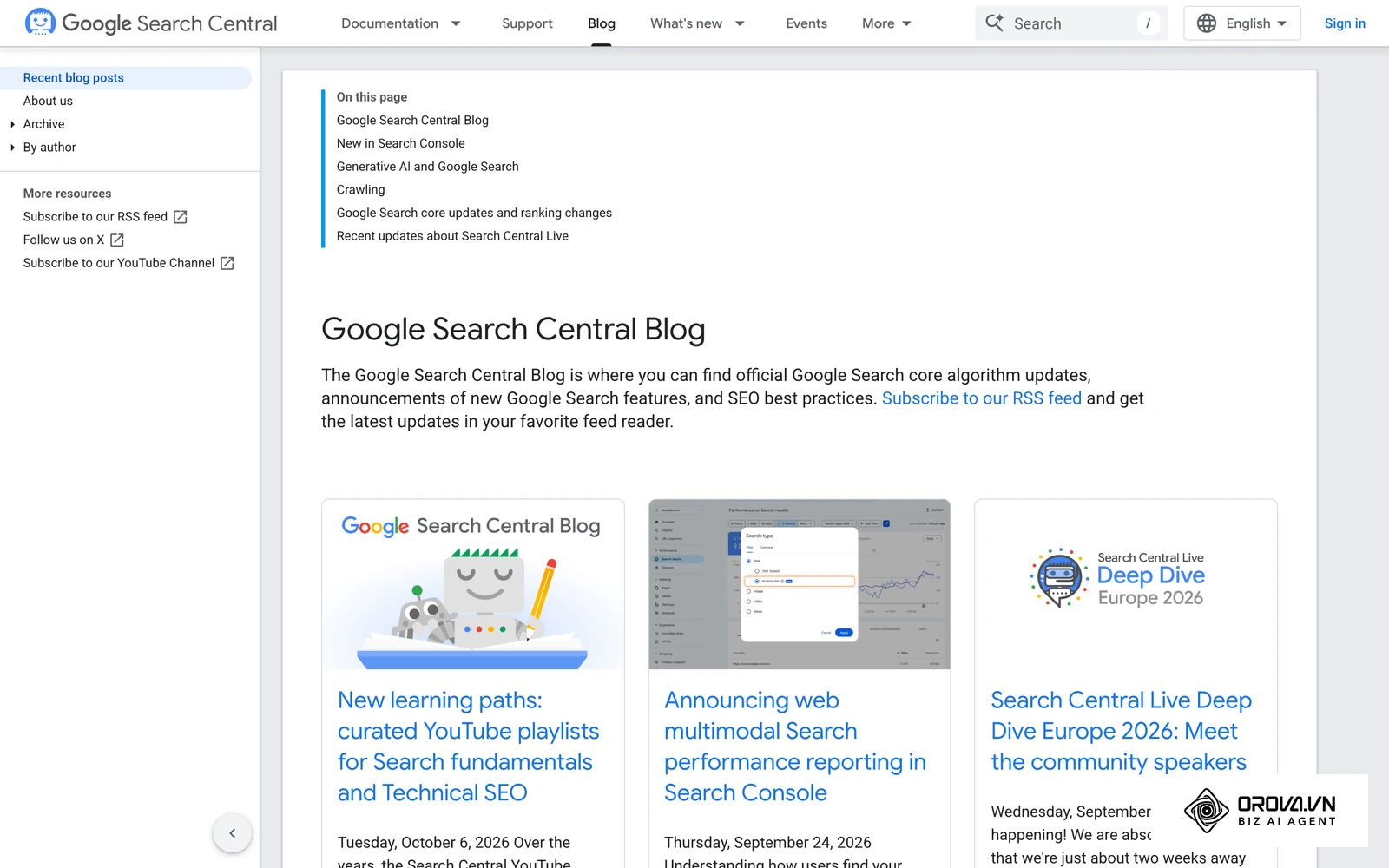
Today, heavily influenced by natural language processing models like BERT, search engines evaluate the semantic context surrounding the link. The algorithms analyze the sentences and paragraphs immediately before and after the HTML anchor tag. They look for related entities, verbs, and subject matter to validate the link.
If a link utilizing the text "financial planning" is placed in a paragraph discussing gardening techniques, the algorithm will detect the semantic mismatch. It will likely devalue that link entirely, assuming it was placed unnaturally or purchased. Therefore, true optimization in the modern era requires writing comprehensive, logically flowing paragraphs where the link serves as a natural continuation of the thought process, not an abrupt interruption. The sentence surrounding the link is now just as important as the clickable words themselves.
Illustrative example:
- Context: A content specialist was managing a high-traffic personal finance blog and attempting to boost the ranking of a new credit card review page.
- Steps: They initially went through older, high-authority posts and arbitrarily inserted exact-match links like "best travel credit card" randomly into existing paragraphs without changing the surrounding sentences.
- Hiccup & Fix: Traffic to the new review page remained flat. An analysis revealed that search engines were likely ignoring the links due to poor context. The specialist went back and rewrote entire 50-word paragraphs around the links, ensuring they explicitly detailed why the recommended card was beneficial in the context of the specific article. They nested the link naturally within a descriptive noun phrase.
- Visible Result: The target page experienced a noticeable lift in organic impressions, and analytics showed that actual human users were clicking the links at a much higher rate because the context made the recommendation trustworthy.
Link Equity Sharing (First Link Priority)
A common, advanced technical question involves multiple links pointing to the same destination from a single source page. How do search engines handle this? SEO practitioners often describe a behavior called "First Link Priority." Google has not officially documented it, so treat it as an observed pattern rather than a rule. Practitioner tests suggest that if an article contains two links pointing to the exact same URL, the search crawler typically only passes equity and register the anchor text of the first link it encounters in the HTML document (reading top to bottom). The second link is effectively ignored for ranking purposes.
This implies that if your primary navigation menu at the top of the page links to your "Services" page using the generic word "Services," and later in the article body you link to the same page using a highly optimized phrase like "enterprise consulting services," the search engine may only register the generic navigation link. Understanding this mechanic is vital for advanced site architecture planning, ensuring your most descriptive links are the primary pathways crawled.
Image ALT Text as an Alternative
When you wrap an image in a hyperlink, there is no physical text for the user to click; they click the image itself. In this scenario, how do search engines extract context? They rely entirely on the image's alt attribute.
The alternative text, designed primarily for screen readers and accessibility, functions as the exact equivalent of text-based anchor text for image links. Therefore, if you use banner ads or promotional graphics to link internally to product pages, leaving the alt tag blank means you are passing zero contextual relevance. Optimizing image alt tags is a non-negotiable aspect of a complete internal linking strategy.
Anchor Text Distribution: An Illustrative Example
The most frequent question asked by webmasters is: "What percentage of my links can be exact match before I get penalized?" Search engines do not publish any threshold, and there is no official or industry-standard percentage. What you can do is compare your external backlink profile against a pattern that looks like natural human linking.
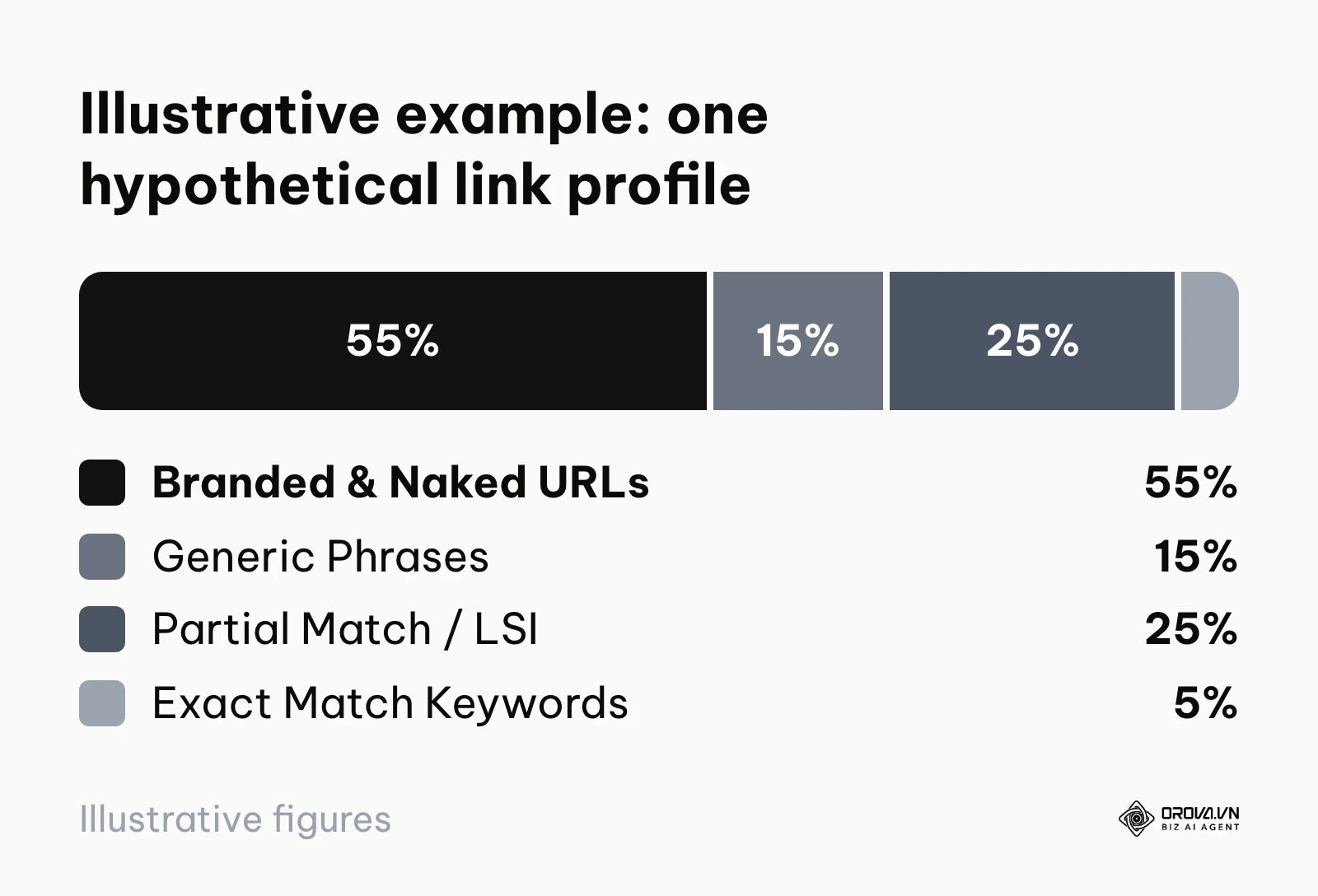
If an algorithm analyzes 1,000 links pointing to your homepage, the distribution must mimic natural human behavior. People do not naturally coordinate to use exact commercial keywords. In a natural profile, branded and naked URLs usually make up most inbound links, while exact match phrases stay low.
Illustrative example (a hypothetical profile, not a benchmark or a target):
- Branded/Naked URLs: 55% (the foundation of trust).
- Generic/Miscellaneous: 15% (natural web noise).
- Partial Match/LSI: 25% (contextual signals).
- Exact Match: 5% (the smallest share).
Use numbers like these only as a reference for spotting outliers. If one commercial phrase dominates your external links far more than your brand name or URL, treat that page as a candidate for review, whatever the exact percentage.
If you want to ensure your foundational technical structure is sound before worrying about link profiles, reviewing a comprehensive SEO checklist is a mandatory prerequisite.
What to Do to Start: The Anchor Text Audit
If you suspect your website is suffering from historical over-optimization, or if you simply want to establish a clean baseline, you must conduct a systematic audit. This is not a theoretical exercise; it requires extracting hard data and making structural changes.
The 5-Step Audit and Dilution Checklist
Follow this process to identify and rectify toxic link patterns.
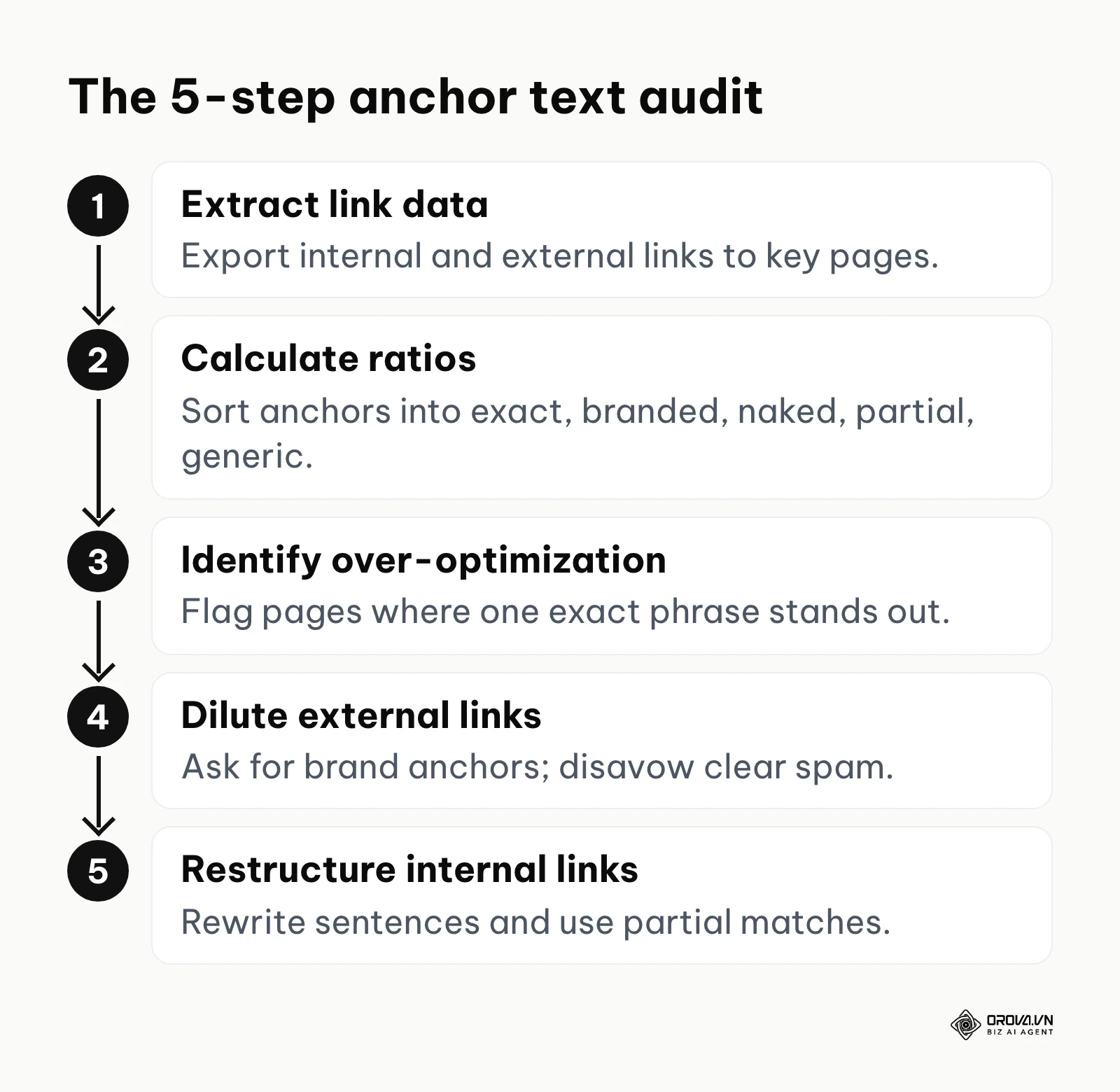
- Extract Link Data: Utilize Google Search Console or a reputable third-party crawler to export a complete list of all internal and external links pointing to your most important pages.
- Calculate Current Ratios: Categorize the exported link text into the buckets mentioned previously (Exact, Branded, Naked, etc.). Calculate the exact percentage for each category.
- Identify Over-Optimization: Flag any target page where one exact-match phrase clearly stands out from the rest of its profile (for example, used far more often than your brand name). These are your high-risk URLs.
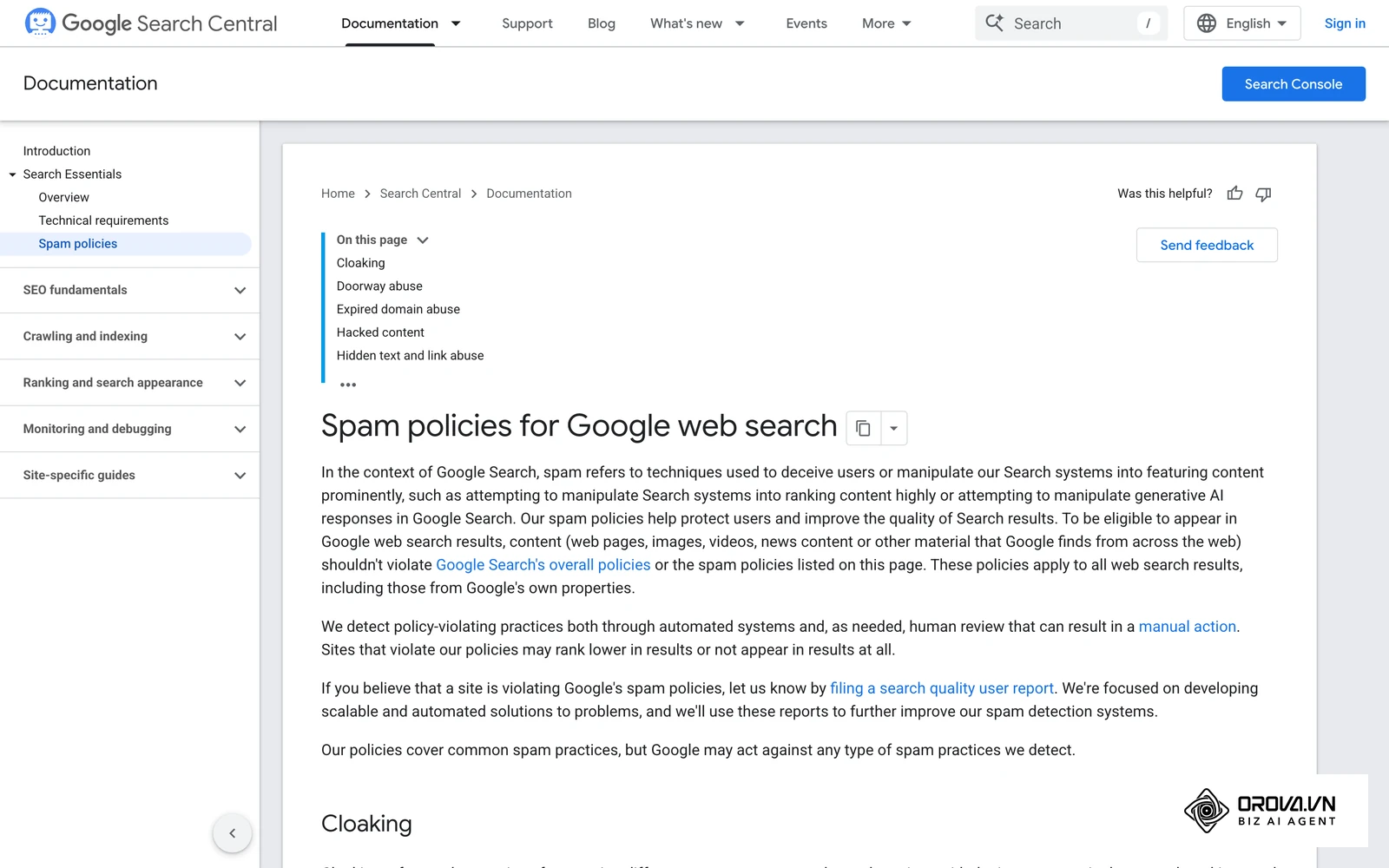
- Dilute External Links: For hazardous external links, attempt to contact webmasters to change the text to your brand name. If unreachable, and the links are highly spammy, compile them into a list and submit them via the Google Disavow tool to sever the connection entirely.
- Restructure Internal Links: For internal links, manually edit the source pages. Rewrite the surrounding sentences and change the exact-match phrases to longer, more descriptive partial matches to naturally lower the concentration.
A thorough Google Search Console SEO audit will provide the raw data needed to execute this process effectively.
Action Plans by Audience
Different roles require different approaches to link management.
For the Small Business Owner
Your focus should be entirely on building a logical internal structure. Do not worry about complex backlink analysis yet.
- Ensure your main navigation menu uses clear, unambiguous terms.
- When writing blog posts, link back to your core service pages using natural, descriptive phrases.
- Check that all functional images (like a clickable logo) have their alt text properly filled out with your brand name.
For the In-House SEO Manager
Your responsibility is holistic site health and risk management.
- Conduct a full crawl to identify "orphan pages" that have zero internal links pointing to them.
- Standardize the terminology used across different departments when linking to core product pages to avoid keyword cannibalization.
- Monitor the external link profile monthly to ensure newly acquired links are naturally diluting the overall ratio.
For the Agency or Freelancer
Your job is often to clean up the mistakes of previous practitioners.
- Immediately run a ratio analysis on a new client's backlink profile before initiating any new campaigns.
- Develop a strict "no exact-match" policy for any external outreach efforts to protect the client's domain.
- Educate the client's internal writing team on the importance of semantic context and surrounding text when publishing new content.
Common Anchor Text Mistakes
Avoiding critical errors is often more impactful than executing advanced strategies perfectly.
| Mistake | Consequence | How to Avoid It |
|---|---|---|
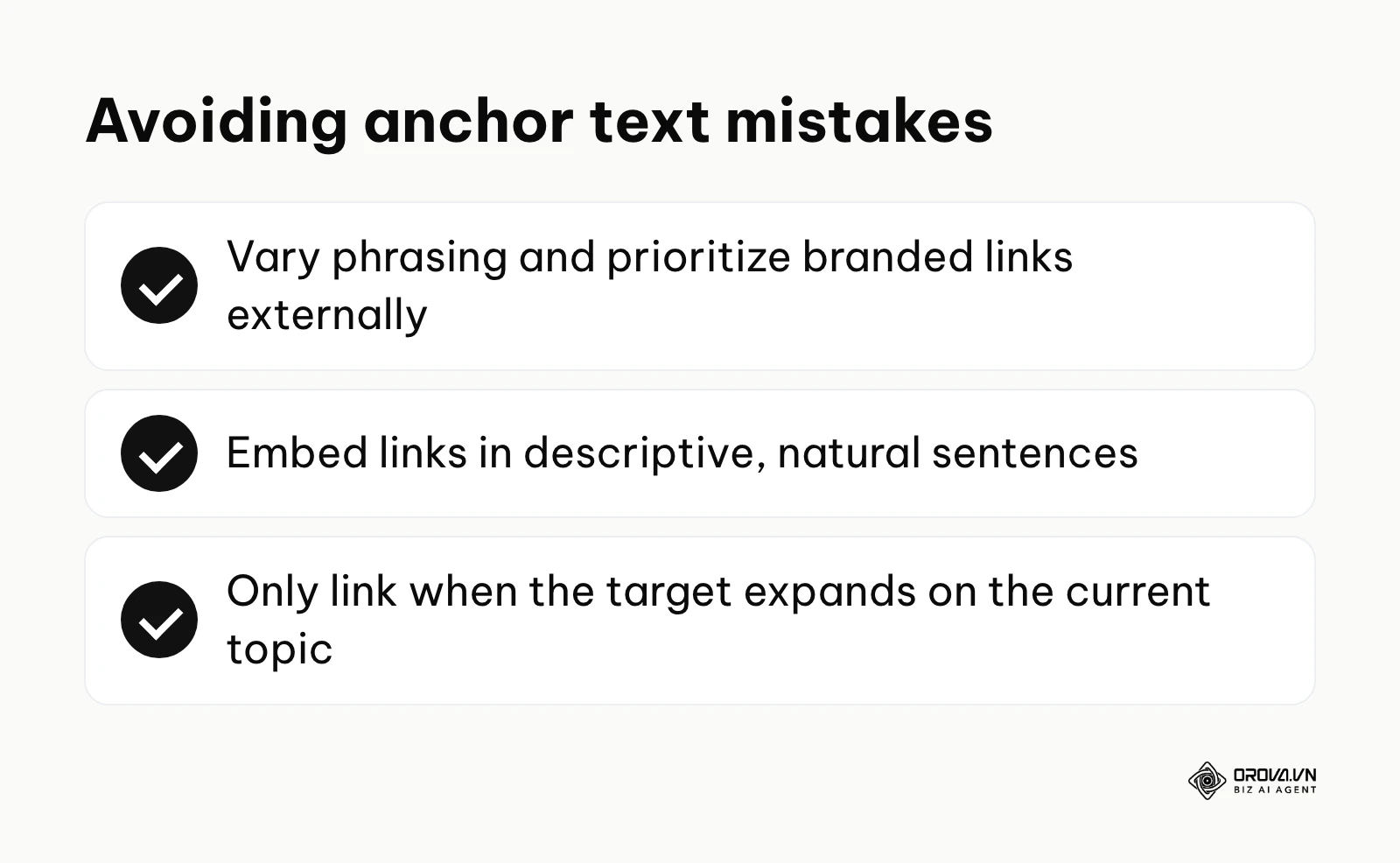
| Keyword Stuffing | Triggers algorithmic spam filters, leading to severe ranking drops. | Vary your phrasing; prioritize branded links externally. |
| Naked Links in Body Copy | Looks unprofessional and wastes an opportunity to provide context. | Always embed URLs within descriptive natural language phrases in editorial content. |
| Irrelevant Linking | Confuses search engines and frustrates users who click expecting one thing and getting another. | Only link when the destination page directly expands upon the concept currently being discussed. |
Understanding how proper linking supports broader concepts like on page SEO is crucial for a unified digital strategy.
With OROVA.VN and the OROVA SEO module, you put an end to the exhausting days of manual work for good. Instead of struggling for hours to write articles and compile reports, the entire process is now optimized and completed in just 5 minutes.
Future Trends of SEO Anchor Text: The Author's Perspective
As we look toward the next evolution of search, driven heavily by generative AI, the fundamental mechanics of how links are evaluated are shifting. Based on current trajectories observed up to 2026, I anticipate several major changes in how we must approach link text optimization.
The Shift from Strings to Entities
I believe that over the coming years, the exact string of characters used in a link will matter significantly less than the entities they represent. AI search engines are becoming extraordinarily adept at understanding concepts rather than just matching keywords. If you link to a page using the phrase "Apple's latest device," the AI understands the entity is an iPhone, even without the explicit keyword. Therefore, I anticipate a future where over-obsessing about getting the exact keyword into the link text will yield diminishing returns, while focusing on the broader semantic relevance of the entire paragraph will become paramount. Content creators must prepare by writing richer, more deeply researched content where the entities are clearly defined by the surrounding context.
The Critical Importance of Internal Navigation in Zero-Click Search
I anticipate that as search engines attempt to answer more queries directly on the results page (zero-click searches), the traffic that does reach your website will be harder to acquire. Consequently, keeping that user engaged and navigating deeper into your site architecture will become critical for survival. Internal anchor text will transition from being primarily an SEO signal to being the most important user experience lever you possess. If your internal links are not compelling, highly relevant, and contextually perfect, users will bounce back to the search engine. You should prepare by auditing your internal links not just for keyword inclusion, but for click-through rate and user intent satisfaction.
Visual Search and the Evolution of Image Anchors
I am leaning towards the conclusion that as visual search capabilities improve, the reliance on manual alt text for image anchors will change. Search engines are increasingly capable of interpreting the contents of an image directly using computer vision. While alt text remains crucial for accessibility, I believe algorithms will soon cross-reference the visual data of the image itself with the destination page it links to. If you use an image of a generic landscape to link to a financial software page, the AI will recognize the disconnect, regardless of what the alt text says. Webmasters must begin ensuring that image assets used as navigational elements are visually synonymous with their target destinations.
To stay ahead of these shifts, familiarizing yourself with a modern website ranking framework adapted for AI is highly recommended.
Frequently Asked Questions About SEO Anchor Text
Navigating the nuances of link optimization naturally raises several common questions, especially as algorithms continuously update.
Is exact match anchor text completely dead?
No, it is not dead, but its application has drastically changed. For internal links, exact match remains a powerful and safe way to signal site structure to search engines. However, for external inbound links, relying heavily on exact match phrases is incredibly dangerous and is the most common trigger for algorithmic penalties. It must be used sparingly, representing a tiny fraction of your overall link profile.
How do search engines calculate equity if there are two links to the same page?
Many SEO practitioners observe a "first link priority" pattern, although Google has not officially documented it. If you link to the same destination URL twice on a single page, the crawler typically only registers the anchor text and passes the link equity through the very first link it encounters in the HTML document's code. Therefore, ensure your most descriptive and important links appear higher up in the page structure.
Do image links have anchor text?
Yes, functionally they do. When an image is wrapped in a hyperlink, search engines rely on the image's alt attribute to serve as the anchor text. If the alt attribute is left blank, the link passes virtually zero contextual relevance, representing a significant missed optimization opportunity.
Will SEO anchor text still be necessary with AI search engines?
Absolutely. While AI search engines are becoming better at reading entire documents and understanding broad semantic contexts, they still rely on the fundamental architecture of the web—which is built on hyperlinks—to discover new information and understand relationships between disparate entities. Links, and the text that describes them, remain the structural pathways that AI agents traverse to build their knowledge graphs. Proper link text provides explicit confirmation of an AI's assumptions about a page's topic. Establishing deep topical authority requires a meticulously linked internal architecture.
Where to Start?
Taking action on your link profile depends entirely on your current operational maturity. Do not attempt a massive overhaul if you haven't established basic tracking.
If you are starting from scratch and have no defined linking strategy, your single first step for an afternoon is to map out your site's hierarchy. If you organize content around pillar pages, those hubs are the natural targets for your most descriptive internal links. Identify your top five most important "money pages" (services or products). Then, review your five most popular blog posts and manually add one highly relevant, contextually rich internal link from each post pointing directly to the appropriate money page.
If you have links scattered haphazardly across your site without logic, your first step is to implement a strict formatting rule for all future content. Mandate that every new piece of content must contain at least two internal links to existing resources, and ensure the text used for those links is descriptive and embedded naturally within a complete sentence, rather than standing alone as a naked call to action.
If you have been actively building links but have not measured the impact, your immediate task is to connect your website to Google Search Console. Spend one hour exporting the "Top linking text" report to establish a baseline view of how the external web currently describes your brand. This raw data is the necessary prerequisite before making any strategic changes or attempting dilution campaigns.
Master your SEO anchor text, and you master the foundational structure of organic growth.
About the author

Builder of Orova
Nguyễn Đỗ Trọng Ân has 8 years of experience in marketing, including 6 years managing market development across Asia. He builds Orova, a Biz AI Agent that never sleeps: it plans, runs and optimizes work for businesses.
Run your business with AI Agents
Orova is the always-on Biz AI Agent — it plans, runs, and optimizes the work for you.
Save time, unlock productivity.