
How to find long tail keywords: a 6-step framework

If you want to know how to find long tail keywords, you have to stop looking at aggregate volume metrics and start looking at specific user problems. Staring at a spreadsheet of ten thousand keywords from a major SEO tool often leads to analysis paralysis. Most beginners filter the list by Keyword Difficulty (KD) under twenty and search volume over one hundred. However, this standard approach leaves you competing with massive, authoritative websites that simply happen to have low KD scores for broad topics. Learning to identify true niche opportunities is no longer about finding long phrases with many words. It is about uncovering highly specific search intents that your major competitors actively ignore. This comprehensive guide will walk you through a complete, step-by-step framework to locate, filter, and cluster these highly specific terms. You will learn how to build content that actually ranks and converts, without relying blindly on expensive software.
How to find long tail keywords: The core concept
A long tail keyword is a highly specific search query that typically has a lower search volume but a significantly higher conversion rate. The term "long tail" refers to the long tail of the search demand curve, not the actual word count of the phrase. A two-word phrase can be a long tail keyword if it addresses a very narrow intent. You should implement this strategy if you are a bootstrapped startup, a new blog, or a niche affiliate site lacking the domain authority to compete for broad terms. You should not rely solely on this strategy if you are an established authority site that requires massive, top-of-funnel traffic immediately to sustain enterprise-level growth.
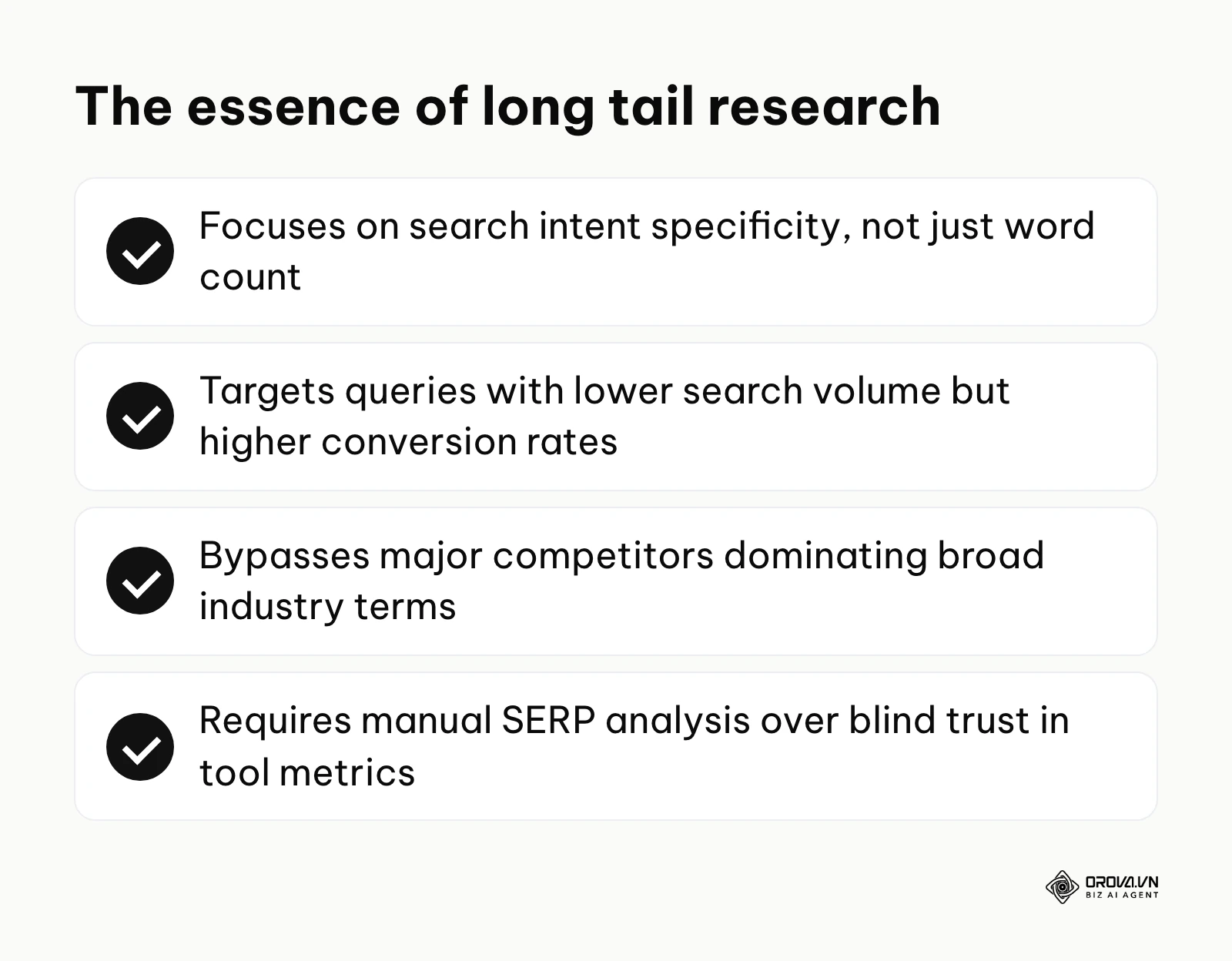
Understanding the difference between head terms and long tail terms is critical. A head term like "shoes" might get hundreds of thousands of searches per month, but the intent is incredibly vague. The searcher might want to buy shoes, look at pictures of shoes, or learn how shoes are made. A long tail term like "best lightweight running shoes for flat feet marathon training" might only get fifty searches per month. However, the intent is crystal clear. The person typing that query has their credit card ready. Individually these queries are small, but together they cover a huge range of real questions that broad pages never answer well. If you are still unsure how to read the intent behind a query, our guide to keyword intent breaks down the main types.
You must also understand that search engines have evolved. Google's public guidance on helpful content repeatedly stresses meeting the needs behind a query rather than repeating the query itself. If you write a generic article, you will not rank for the specific variations. You must tailor your content to answer the exact question being asked. This requires a shift in mindset from chasing traffic to chasing relevance.
What you need before you begin
Before you dive into the research process, you must gather your resources. You cannot effectively find long tail keywords if you do not understand your audience or lack the basic tools to organize your data. Preparation ensures that your research translates into actionable content rather than a messy spreadsheet of useless phrases.
| Item needed | Where to get it | Time needed |
|---|---|---|
| Customer data | Sales calls, support tickets, CRM logs | 2 hours |
| Google Search Console | Connect it to your website for free | 15 minutes |
| Google Sheets | Create a new blank spreadsheet | 2 minutes |
| Keyword Research Template | Build it based on the framework below | 30 minutes |
| A free SEO extension | Chrome Web Store (e.g., SEO Minion) | 5 minutes |
| Dedicated brainstorming time | Schedule a block in your calendar | 1-2 hours |
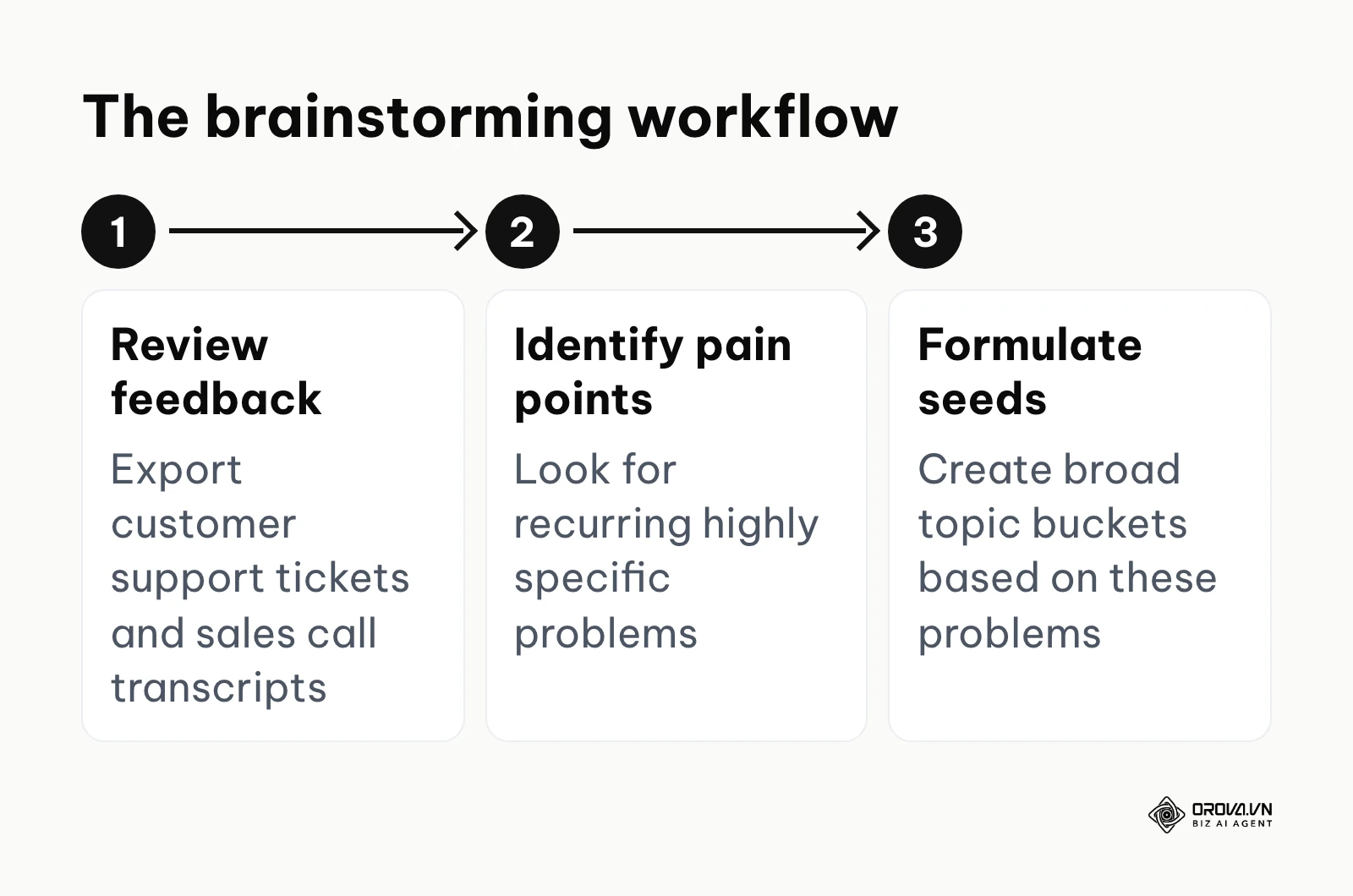
You must start with customer data. If you try to guess what your audience wants, you will fail. Your sales and support teams interact with real customers every day. They know the exact phrases, frustrations, and questions that people use. Export your support tickets. Read through transcripts of sales calls. Look for recurring problems that are highly specific to your industry.
Google Search Console is equally vital. It shows you the exact queries people are already using to find your website. Often, you will discover that you are ranking on page three or four for a long tail keyword you never intentionally targeted. This is a massive opportunity. By identifying these terms and creating dedicated content, you can easily push them to the first page.
Finally, you need a structured way to organize your findings. A blank Google Sheet is sufficient if you follow a strict scoring methodology. Do not skip this preparation phase. The quality of your raw data dictates the success of your entire organic strategy.
The 6-step framework to find and organize long tail keywords
This framework is designed to take you from a blank screen to a prioritized content calendar. You must follow these steps sequentially. Skipping a step will result in wasted effort and poor rankings.
Step 1: Brainstorming seed topics and zero-volume angles
Many marketers start their research by opening a keyword tool and typing a broad term. This is a fundamental mistake. The best way to begin is by talking to your customer-facing teams. You need to establish broad topic buckets based on actual business problems. These are your seed topics.
You must actively look for zero-volume keywords during this phase. These are search queries that major SEO tools report as having zero searches per month. Why does this happen? Keyword tools rely on historical clickstream data. They aggregate data over months. If a new problem emerges in your industry, the search volume will appear as zero because the tools have not caught up yet. However, real people are still searching for it.
To find these emerging topics, you must browse niche forums, specialized industry boards, and communities like Reddit. Look for questions that get asked repeatedly but have poor or outdated answers on Google. When you write content for these zero-volume terms, you face almost zero competition. You establish authority early.
Illustrative example:
- Context: A content manager at a small B2B accounting software company wants high-intent leads without competing against giant financial publishers.
- Actions: She exports recent support tickets about data exports and notices users repeatedly asking how to export to a specific multi-currency Excel format, rather than general export questions. She maps these exact phrases into a list of seed topics.
- Stumbling block and fix: Keyword tools show zero search volume for these phrases. She trusts the customer data instead and publishes a dedicated guide anyway.
- What to watch: Over the following months, Search Console starts showing impressions for variations of that question, and the page begins to attract qualified sign-ups.
You must train yourself to ignore the zero-volume warning if you have concrete proof from your audience that the problem exists. Seed topics are not meant to be final keywords. They are the starting points that you will plug into various discovery methods in the next step.
Step 2: Gathering the raw data manually and with tools
Once you have your seed topics, you need to expand them into hundreds of long tail variations. Do not rely on a single tool. You must combine manual methods with automated software to get a complete picture.
Start with Google Autocomplete. This is the most powerful, free tool available. Google's predictions reflect queries that people actually search for, so they surface real phrasing you would rarely think of yourself. Open an incognito window. Type your seed topic and press the spacebar. Note the suggestions.
Then, use the wildcard trick. Type an underscore or an asterisk before, within, or after your query. For example, type "how to * multi currency invoices". Google will fill in the blank with popular terms. You must also map the alphabet. Type your seed topic followed by the letter "a", then "b", and so on. Record every relevant suggestion.
Next, look at the "People Also Ask" (PAA) boxes on the search results page. Click on a question to expand it, and Google will automatically load more related questions below it. Repeat this a few times to build a long list of highly specific user questions. Our People Also Ask guide shows how to mine these boxes in more depth.
Look at what your rivals already rank for, too: competitor keyword research often reveals long tail gaps they cover poorly. Finally, you can use free or paid keyword tools to generate more ideas (see our comparison of the best keyword research tools). Enter your seed topics into these tools and filter for phrases containing more than three words. Export all this data into a single, massive list. At this stage, do not worry about filtering. Your goal is purely volume. You want to capture every possible variation. You should also evaluate the search volume of these terms, but keep in mind that tools often underestimate true traffic. For a deeper understanding of this discrepancy, read our guide on how to evaluate true keyword value regarding search volume.
Step 3: Filtering the noise with a custom scoring template
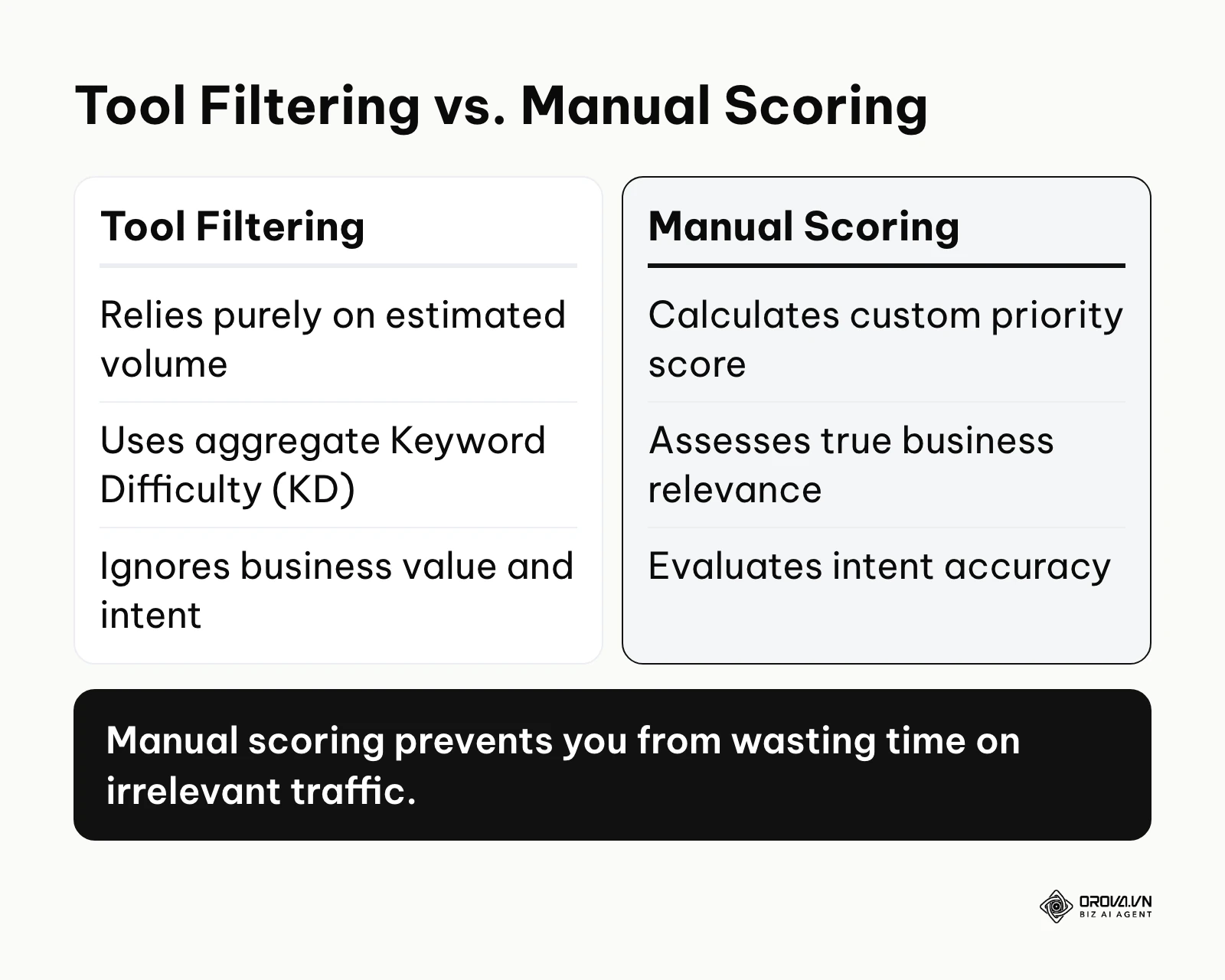
You now have a spreadsheet with thousands of keywords. If you try to write an article for every single one, you will exhaust your resources. You must filter the noise using a custom scoring template in Google Sheets.
Create a spreadsheet with the following columns. Here is the template with one example row you can copy:
| Keyword | Intent | Business Value (1-3) | Tool Volume | KD | Priority Score |
|---|---|---|---|---|---|
| how to export multi currency invoices to excel | Informational | 3 | 0 | 12 | =(C2*20)+(100-E2) → 148 |
| accounting software | Transactional | 2 | 5000 | 78 | =(C3*20)+(100-E3) → 62 |
First, categorize the Intent. Is it Informational (looking for an answer), Navigational (looking for a specific website), or Transactional (ready to buy)? Discard navigational terms that belong to your competitors.
Second, assign a Business Value score from one to three. A score of one means the topic is loosely related to your industry but unlikely to convert. A score of three means the topic directly relates to a problem your product solves.
Third, input the Tool Volume and the KD reported by your tool. Treat the volume as a rough signal only, because tools often underestimate long tail demand and show zero for new or very specific questions.
Finally, calculate your Priority Score. You can use a formula like =(Business Value * 20) + (100 - KD). Multiplying business value by twenty keeps relevance from being drowned out by the difficulty number. This simple formula forces you to prioritize keywords that have high business relevance and relatively lower competition. Sort your spreadsheet by this Priority Score. You have now transformed a chaotic list into an actionable roadmap.
Illustrative example:
- Context: An editor running an affiliate blog about home appliances has a raw list of three thousand keywords from various tools and does not know where to start.
- Actions: He builds the scoring sheet above, tags the intent of the most promising keywords, and assigns a business value score based on likely commission. The priority formula ranks the list.
- Stumbling block and fix: Many high-volume keywords score poorly on business value, tempting him to chase traffic over revenue. He hides every row with a business value of one, regardless of volume.
- What to watch: The result is a shorter, focused content calendar: fewer articles, each aimed at a query that can actually earn commission.
This template approach ensures you remain objective. It prevents you from falling in love with a high-volume keyword that will never actually drive meaningful business results.
Step 4: Manual SERP analysis and the 3-point checklist
Keyword Difficulty (KD) can be misleading, especially for long tail keywords. Most KD metrics lean heavily on the backlink profiles of the top-ranking pages. They do not account for context, content quality, or exact intent match. A keyword might have a KD of forty, making it look impossible, but a manual check might reveal that the top results are completely irrelevant. You must manually analyze the Search Engine Results Page (SERP) for every keyword on your priority list. For context on how to read the number itself, see what a good keyword difficulty score looks like.
Use this three-point checklist to evaluate true difficulty:
- Intent Mismatch: Does the top result actually answer the specific query? Often, for long tail terms, Google is forced to rank a broad article because no specific article exists. If a user searches for "how to fix a leaking copper pipe under the sink" and the top result is a generic "plumbing basics" guide, the intent is mismatched. You can easily outrank them by providing the exact answer.
- Content Depth and Quality: Look at the actual content of the top three results. Is it a thin, five-hundred-word article written five years ago? Is the formatting terrible, lacking headings and images? If the existing content is poor, the domain authority of the site matters less. You can win by creating a comprehensive, well-structured piece.
- User-Generated Content (UGC) Presence: Are there forum threads (like Reddit, Quora, or specialized boards) ranking in the top five? Forum results often appear when there is no strong dedicated article for the query. A Reddit thread at position two is a strong green light that a well-researched post has a real chance to compete.
You must perform this check in an incognito window to disable personalization. You should also use tools to simulate searches from different geographic locations if your business is local. Never trust a tool's difficulty score blindly. Your eyes are the best SEO tool you have.
Step 5: Keyword clustering to prevent cannibalization
Once you have verified the SERP, you must organize your keywords into clusters. A common mistake is writing a separate blog post for every slight variation of a keyword. If you write one post for "how to wash a dog" and another post for "best way to wash a dog", you risk keyword cannibalization. Search engines will not know which page to rank, and they will compete against each other, driving both down in the rankings.
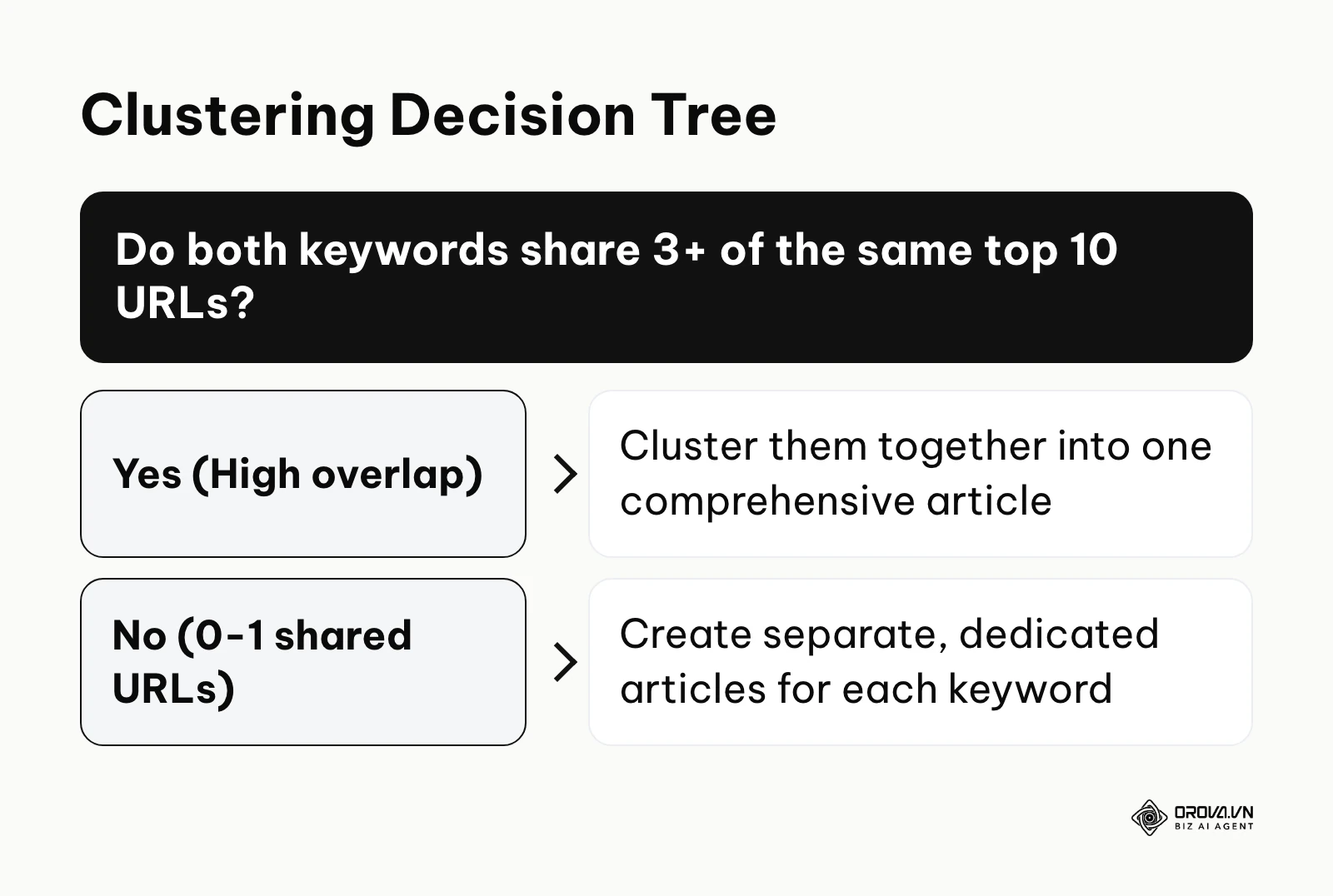
Keyword clustering solves this. A cluster is a group of closely related keywords that share the same search intent. You target an entire cluster with a single, comprehensive pillar page.
How do you know if two keywords belong in the same cluster? You must analyze the SERP overlap. Search for keyword A. Then search for keyword B. Look at the top ten organic results for both. If they share three or more identical URLs, Google considers them to have the same intent. They must be clustered together. If they share zero or one URL, the intent is different, and they require separate pages.
Illustrative example:
- Context: An in-house SEO specialist at a local fitness chain needs more organic trial sign-ups.
- Actions: The site has many thin posts targeting "gym in downtown", "downtown fitness center", and "workout downtown". A SERP overlap check shows these terms share most of the same top results, so the specialist merges them into one complete local guide.
- Stumbling block and fix: The thin pages keep swapping positions and none ranks well. The specialist sets up 301 redirects from the thin pages to the new pillar page so search engines see one clear target.
- What to watch: Rankings for the cluster stop fluctuating, and trial sign-ups from organic search become easier to attribute to a single page.
Clustering forces you to build better content. Instead of writing five mediocre articles, you write one exceptional article that covers the topic from every angle. This approach satisfies users and aligns perfectly with modern search engine algorithms.
Step 6: Prioritizing and planning your content calendar
The final step is turning your clustered data into a structured content calendar. You must be strategic about what you write first. Do not just start at the top of the list.
You must look for quick wins. These are keyword clusters with high business value, low manual SERP difficulty, and a strong presence of UGC in the current results. These are the topics that will drive revenue fastest and build momentum for your site.
You should also plan your internal linking strategy at this stage. When you schedule a new post, identify three existing, relevant posts on your site that can link to it. Internal links pass authority and help search engines understand the structure of your website.
Create a timeline. Assign deadlines. If a topic requires input from a subject matter expert, schedule the interview immediately. A keyword strategy is useless if it remains trapped in a spreadsheet. Execution is the only thing that matters. By following this six-step framework, you ensure that every hour spent writing is an hour invested in highly targeted, profitable organic growth.
Discover Orova.vn – a Biz AI Agent platform with OROVA SEO, a complete solution for every website. The system supports search engine optimization from A to Z with features including keyword research, writing new SEO-ready articles, optimizing existing content, rank tracking, plus competitor analysis and in-depth technical analysis. Sign up today to experience OROVA SEO completely free (offer valid through July 7, 2027).
Deep dive: Trade-offs of different keyword research methods
There is no perfect way to conduct keyword research. Every method involves trade-offs between speed, cost, and accuracy. You must understand these trade-offs to choose the right approach for your specific situation.
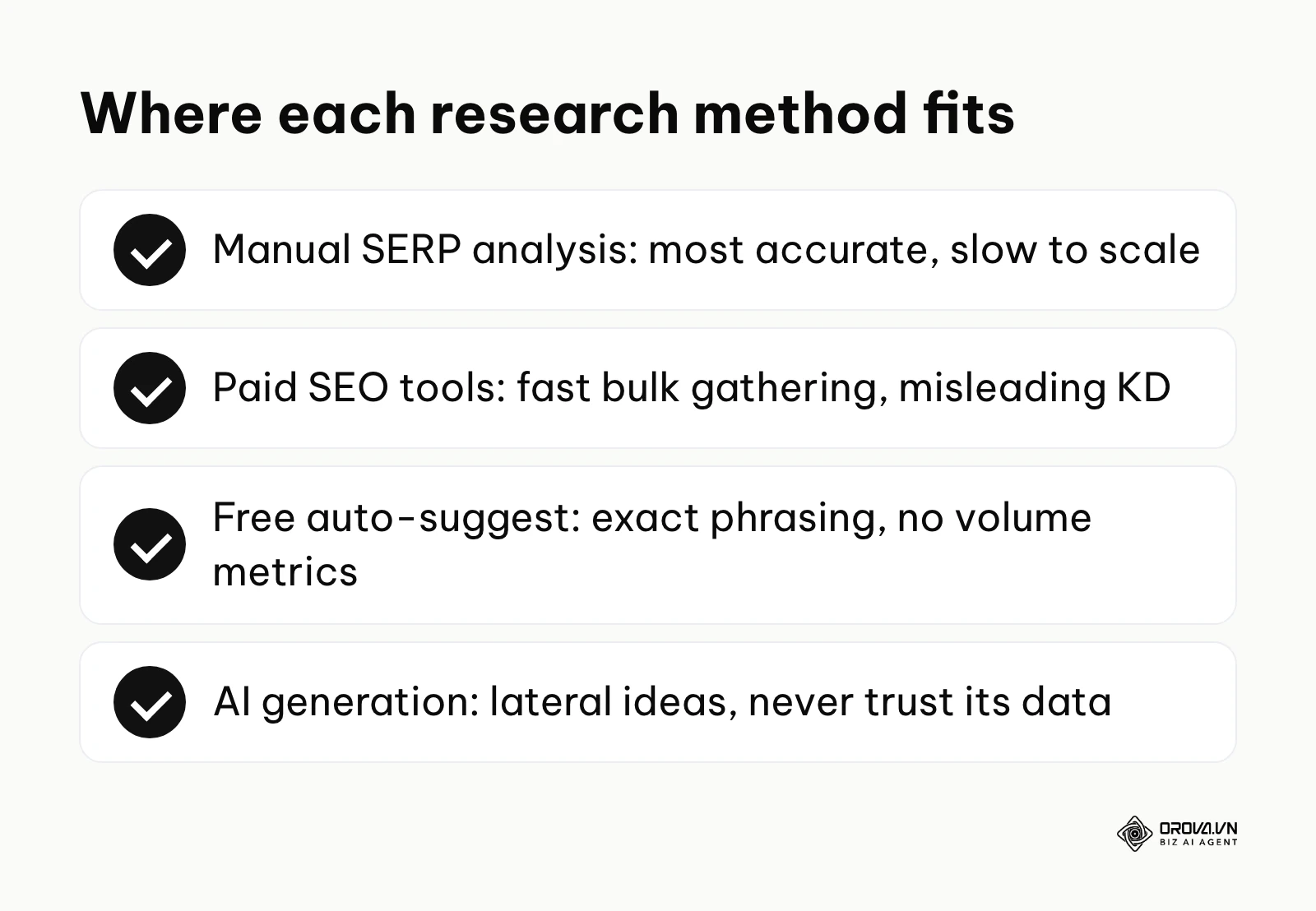
| Research Method | When it fits best | Major Weakness |
|---|---|---|
| Manual SERP Analysis | High-stakes content, zero-volume terms, small niches | Extremely time-consuming; difficult to scale across thousands of terms |
| Paid SEO Tools (Ahrefs, Semrush) | Bulk gathering, competitor gap analysis, large sites | KD metrics are often misleading; tools miss emerging trends entirely |
| Free Auto-suggest (Google, PAA) | Bootstrapped projects, finding exact phrasing | Lacks volume metrics; requires manual organization in spreadsheets |
| AI Generation (ChatGPT, Claude) | Initial brainstorming, generating lateral ideas | Hallucinates data; produces generic clusters disconnected from real search intent |
Manual research is undeniably the most accurate. When you look at the SERP yourself, you understand exactly what Google wants to see. However, it is slow. If you need to plan content for a massive enterprise site, manual research alone will bottleneck your entire operation.
Paid tools offer incredible speed and scale. They allow you to spy on competitors and download thousands of keywords in seconds. The trade-off is accuracy, particularly for long tail terms. Their difficulty metrics are based on links, not content quality, which frequently leads marketers to abandon highly profitable, easy-to-rank keywords. Once a page is published, a Google SEO optimization tool helps you check that the page itself is in good technical shape.
AI generation is excellent for breaking through creative blocks. You can ask an AI to generate fifty angles on a boring topic. But you must never trust an AI to provide search volume or difficulty scores. AI chat models do not see Google's own search data. They predict text; they do not analyze search behavior. You must always validate AI-generated ideas through manual SERP analysis or reputable tools.
Measuring the success of your keyword strategy
Finding the keywords is only the first half of the battle. You must measure the results to understand if your strategy is actually working. Many marketers focus purely on organic traffic. Traffic is a vanity metric if it does not convert. You must track deeper business metrics.
| Metric | Meaning | Warning threshold |
|---|---|---|
| Impressions (GSC) | How often your page appears in search results | Stagnant or dropping after 3 months |
| Click-Through Rate (CTR) | Percentage of people who click your link in the SERP | Clearly below your own average for similar positions |
| Organic Conversions (GA4) | The number of leads or sales generated from organic traffic | High traffic but zero conversions over 30 days |
| Keyword Ranking Position | Where you stand on the SERP for your target cluster | Stuck on page 2 (positions 11-20) for months |
You should start by monitoring impressions in Google Search Console. Impressions usually grow before clicks do. If impressions are rising, it means search engines are testing your content. If impressions are flat after three months, your content is likely failing to meet the search intent or lacks sufficient internal links.
Next, monitor your Click-Through Rate (CTR). If you rank well but have a terrible CTR, your title tag and meta description are failing to entice the user. You must rewrite them. You can learn how to systematically improve these elements by running an seo test.
Ultimately, you must measure conversions. If a long tail keyword brings in one hundred visitors a month and converts at five percent, it is vastly superior to a broad keyword that brings in ten thousand visitors but converts at zero percent. Connect your Google Analytics 4 (GA4) to your CRM to track the full user journey. Understanding how to calculate your seo roi is essential for justifying your content marketing budget.
With OROVA.VN and the OROVA SEO module, you put an end to the exhausting days of manual work for good. Instead of struggling for hours to write articles and compile reports, the entire process is now optimized and completed in just 5 minutes.
Common mistakes when hunting for long tail keywords
Even with a solid framework, it is easy to fall into bad habits. These common mistakes will sabotage your efforts and waste your writing budget.
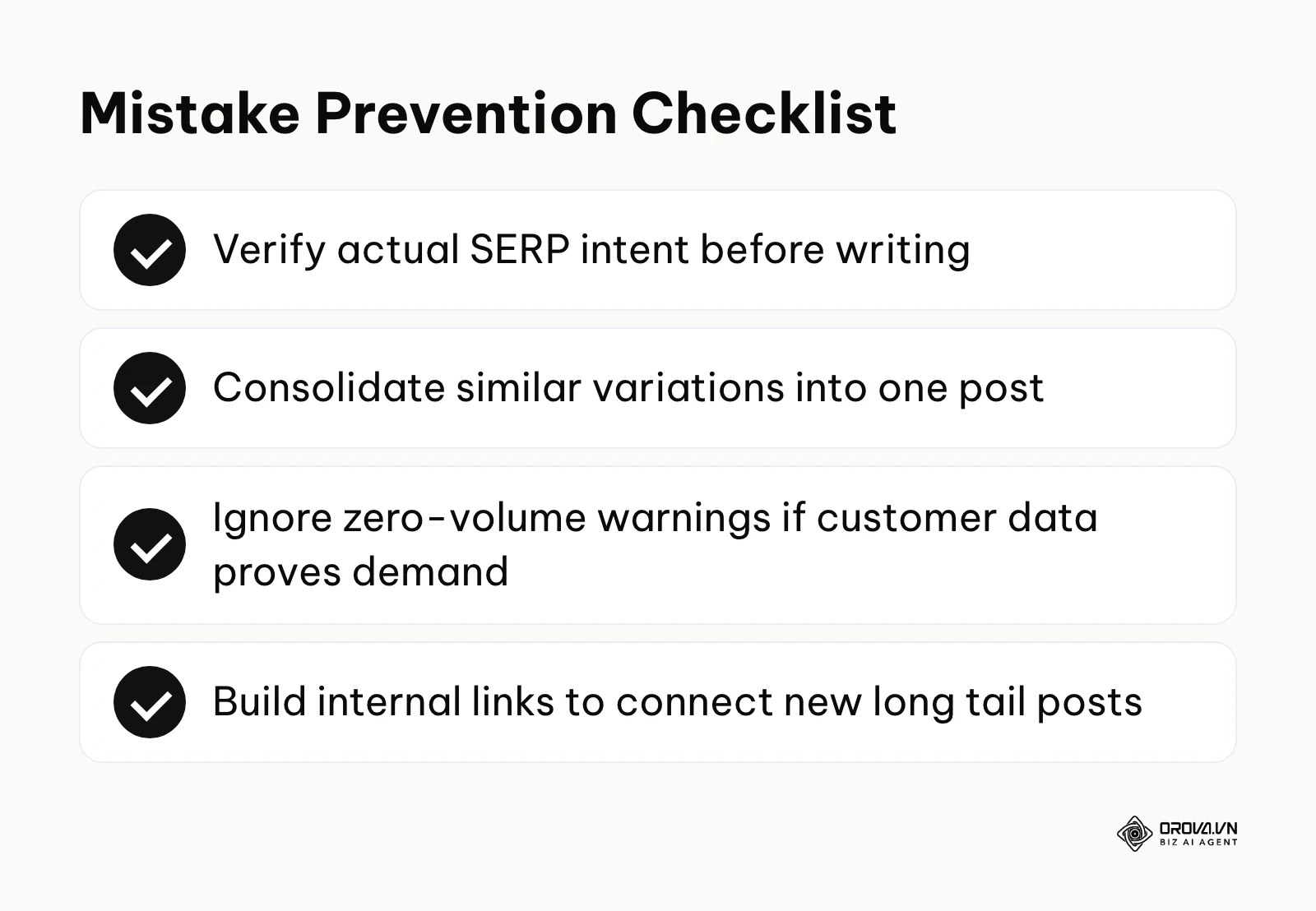
- Blindly trusting tool volume: Consequence: You ignore highly profitable zero-volume keywords and miss out on early market dominance. Fix: Rely on customer feedback and sales data to validate demand, not just SEO software.
- Ignoring specific search intent: Consequence: You write a generic "what is" article for a query where the user clearly wants a step-by-step tutorial, resulting in zero rankings. Fix: Perform manual SERP analysis for every target keyword before outlining the article.
- Creating a new page for every variation: Consequence: You cause massive keyword cannibalization, confusing search engines and diluting your site's authority. Fix: Implement strict keyword clustering based on SERP overlap to consolidate variations into pillar pages.
- Forgetting internal linking: Consequence: Your new long tail posts become orphan pages, receiving no authority from the rest of your website and struggling to index. Fix: Always plan and insert at least three internal links from relevant existing content to your new post upon publication.
- Skipping the SERP analysis: Consequence: You target a low KD keyword only to discover the SERP is dominated by government sites or massive forums that you cannot outrank. Fix: Use the 3-point manual checklist to visually inspect the actual competitors.
- Writing thin content: Consequence: You identify a great long tail keyword but only write a three-hundred-word summary, failing to satisfy the user's deep query. Fix: Ensure your article is the most comprehensive and helpful resource on the entire internet for that specific problem.
Future trends in keyword research: author's perspective
The rise of hyper-specific conversational queries
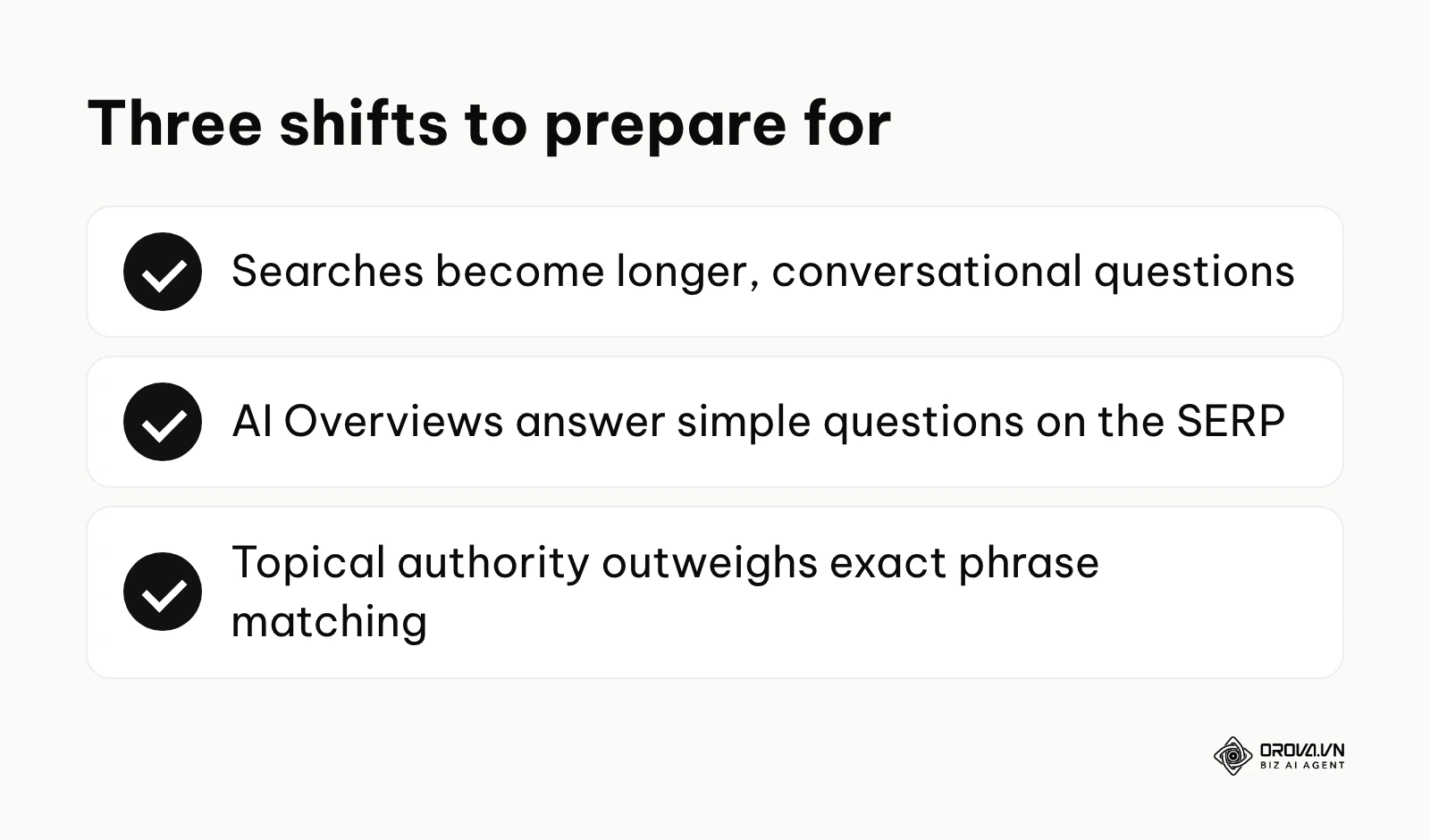
I believe that as of 2026, we are witnessing a fundamental shift in how people search. Users are no longer typing fragmented phrases like "best CRM small business". They are dictating full, conversational sentences into their devices, such as "what is the best CRM for a three-person plumbing business that integrates with Quickbooks". I expect this trend to keep growing. The implication is that traditional keyword tools will become increasingly useless at tracking these hyper-specific, one-off queries. You must prepare for this by focusing entirely on deep customer empathy and natural language processing, ensuring your content answers complex, multi-part questions comprehensively rather than just stuffing targeted phrases. While this is highly likely, a shift in user interface design by major tech companies could alter how conversational inputs are processed.
AI Overviews shifting the goalposts
The integration of AI Overviews directly into the search results is already changing the landscape. I observe that simple informational queries are increasingly being answered directly on the SERP, resulting in zero-click searches. I suspect that targeting basic long tail questions (like "what temperature to bake chicken") will bring less and less organic traffic, even if you rank first. You should prepare from this moment on by pivoting your long tail strategy towards experience-based queries, highly opinionated reviews, and complex strategic guides that AI cannot reliably summarize. If search engines decide to throttle AI answers due to copyright pressure, this prediction may not fully materialize, but I still think the shift towards deep expertise is the safer bet.
Authority outweighing exact match optimization
Currently, you can sometimes rank a brand new site for a very obscure long tail keyword simply by matching the exact phrase perfectly. I think this loophole is slowly closing. Search engines are likely to rely more heavily on topical authority and entity recognition rather than exact string matching. Even for zero-volume, highly specific terms, Google may prefer to rank a site that has proven expertise in the broader topic. You must start building tightly interlinked topic clusters now. You can no longer rely on standalone, disconnected long tail posts. You must build a comprehensive web of knowledge that proves you are a legitimate entity in your industry, not just a keyword hunter.
Frequently asked questions about how to find long tail keywords
What is the difference between a head term and a long tail keyword?
A head term is a broad, popular search query with massive volume and vague intent, such as "marketing software". A long tail keyword is highly specific, has much lower search volume, but indicates a clear and precise user intent, such as "marketing software for real estate agents".
Why do some highly specific keywords show zero search volume in tools?
Keyword research tools rely on historical, aggregated clickstream data which often lags behind real-world trends. If a query is very new, highly niche, or conversational, the tools will report zero volume, even though real users are actively searching for it.
How can AI help in the keyword research process?
AI is excellent for lateral brainstorming and generating related topics you might not have considered. However, AI cannot provide accurate search volume, cannot assess true keyword difficulty, and cannot replace the necessity of manual SERP analysis to verify actual search intent.
When should I create a new page versus updating an old one?
You should create a new page if the long tail keyword has a distinct search intent that is not covered by your existing content. If the new keyword shares the same intent and SERP overlap as a topic you already cover, you should update the old page and cluster the keywords together.
How long does it take to rank for these specific queries?
While highly dependent on your site's authority and content quality, specific, low-competition queries generally rank much faster than broad terms. Watch impressions in Search Console first; they usually appear before clicks once the page is indexed and matches the intent.
Where to start?
If you are a complete beginner with no existing content, start by securing your seed topics. Do not buy expensive software yet. Spend one afternoon interviewing a customer support representative or reading through your company's support inbox. Identify three recurring, highly specific problems. Type those exact problems into Google Autocomplete and document the suggestions in a simple spreadsheet.
If you have a website but struggle to gain traction, start by connecting Google Search Console. In a single session, navigate to the Performance report and sort your queries by impressions. Look for long phrases where you are ranking on page three or four. Choose one of these phrases, analyze the top results manually, and write a vastly superior, dedicated article to capture that existing momentum.
If you already have hundreds of blog posts but stagnant traffic, start by auditing for keyword cannibalization. Spend an hour mapping out your top twenty articles. Identify any posts that target the exact same intent. Choose one cluster, select the strongest post to become the pillar page, consolidate the information from the weaker posts into it, and set up 301 redirects.
By following this framework, you now know exactly how to find long tail keywords.
About the author

Builder of Orova
Nguyễn Đỗ Trọng Ân has 8 years of experience in marketing, including 6 years managing market development across Asia. He builds Orova, a Biz AI Agent that never sleeps: it plans, runs and optimizes work for businesses.
Run your business with AI Agents
Orova is the always-on Biz AI Agent — it plans, runs, and optimizes the work for you.
Save time, unlock productivity.